Italian Remote Conference 24/25 06
Davide Mezzetti
Malta
English version
Remote Team Building
Some experiences
• Team sports
• Martial Arts
• Research communities
• Startups
• Worked for a big company
• Experiential trainer
• A lot of travel
• Live and work
Some experiences
• I worked with Italians, French, Spanish,
Colombian, American, Maltese, Swiss, Indian,
German and Turkish ..
• Nice? Yes
• Tough? Yes
Organization of the slides
• Target
• Forming a team – Ideal case
• Forming a team – Usually
• Forming a team – By remote
• Problems = Solutions
Target
To carry general life experience in order to
manage & maintain a team in a remote
context !
Why?
• Adapt to a growing market
• Increase performance
• Complete projects
• Respect deadlines
• Have fun
Forming a team
• Definition by wikipedia:
A team “is a group of people linked in a common
purpose.”
Having a SHARED GOAL
Gives us direction
Basic of project management
• All team members must have a clear objective
to achieve..
• The goal is made clear on a roadmap.
• The roadmap is divided into milestones.
• Each milestone is achieved by the team.
• Each destination is celebrated as a success!
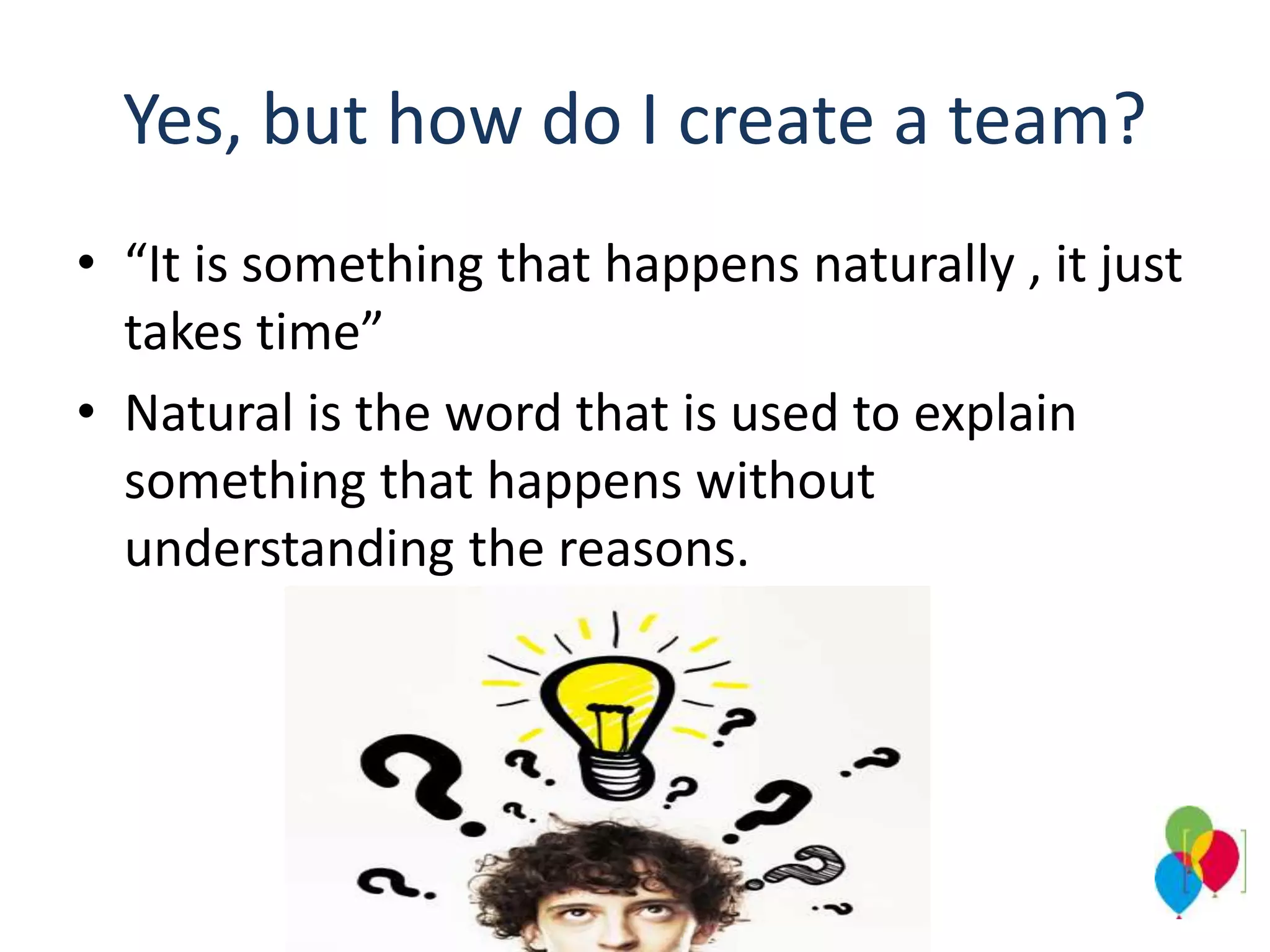
Yes, but how do I create a team?
• “It is something that happens naturally , it just
takes time”
• Natural is the word that is used to explain
something that happens without
understanding the reasons.
How do I create a team?
Dynamics and concepts
• Common goal
• Common and individual motivation
• Management and enforcement of roles
• Shared culture
• Shared values
• Methods
• Leadership
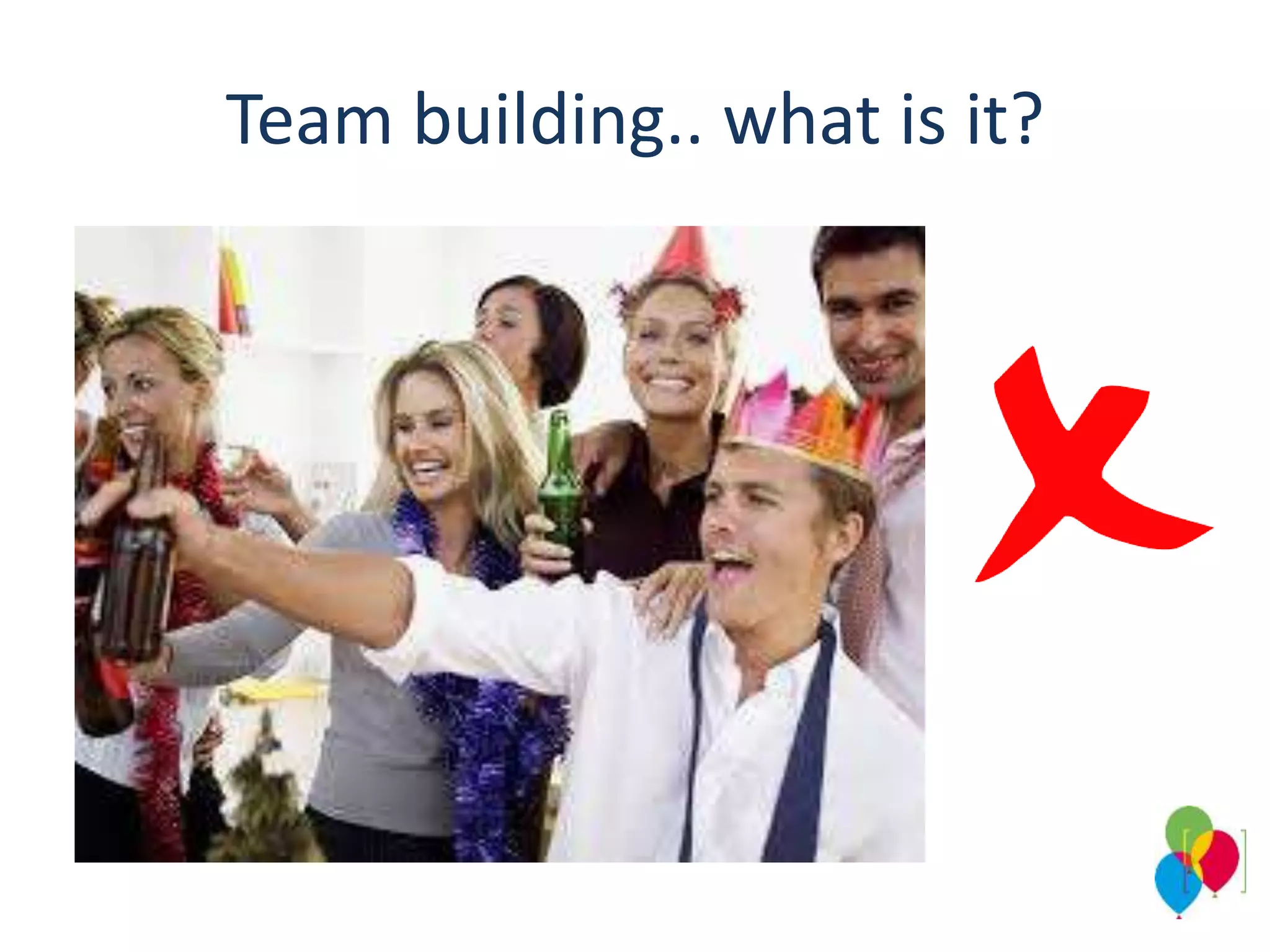
Team building.. what is it?
Team building – really is..
• Bonding activities organised in order to bring
the group together after analysis of the group
dynamics.
• Sharing experience and internalization  It
leads to a real growth and therefore to a
change in performance and harmony.
Team building: the Italian case
• Beer with colleagues
• Cigarette break
• Football matches
• Business dinners
• ...
Team building: the italian case
• The inclusion of human resources is not
managed
• The responsibility is entrusted to the
individual and to his soft- skill
• The creation and optimization team takes time
and resources because there is a practical
methodology to be applied
• Often it creates unmotivated employees
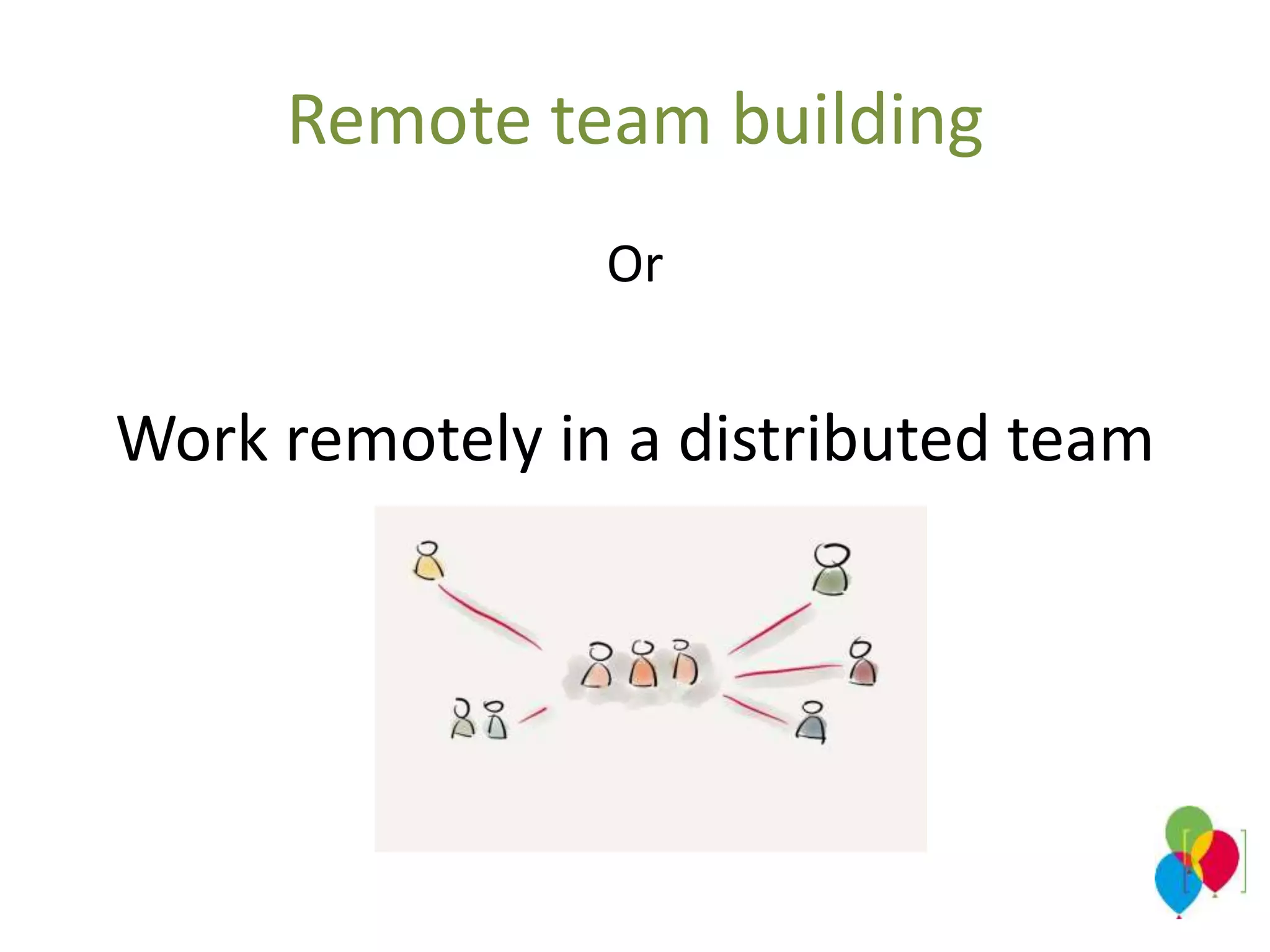
Remote team building
Or
Work remotely in a distributed team
Remote team building
Typical approach: to gain personal experience in
companies .. remotely.
Does it work??
It does not work as efficiently as it does when
not working remotely.
Why?
• We should deal with the different problems to
those we are used to
DIFFERENT
• In reality, the problems are the same and are
much more amplified!
But we never stopped to observe them!
Some examples?
• Cultural Diversity
• Different timing
• Different language
• Hard to find things in common
• No method
• Lack of human contact
• No coffee break and cigarettes
More..
• We do not know. (never seen in person , what about emotional
affinity?)
• We do not trust it (because of the past history: wars, conflicts,
tensions, bad experiences)
• You do not have the usual cultural phenomena in common (words,
food, approach to friendship, approach to life, approach to work,
emotional openness)
• We have different schedules.
• We have different interests (the national sport is different , the
climate is different , the smells are different, ..)
• We have different backgrounds (universities are all different)
• We have different specialization (graphics , database)
• We have different goals (we'll see how this is a key factor )
More..
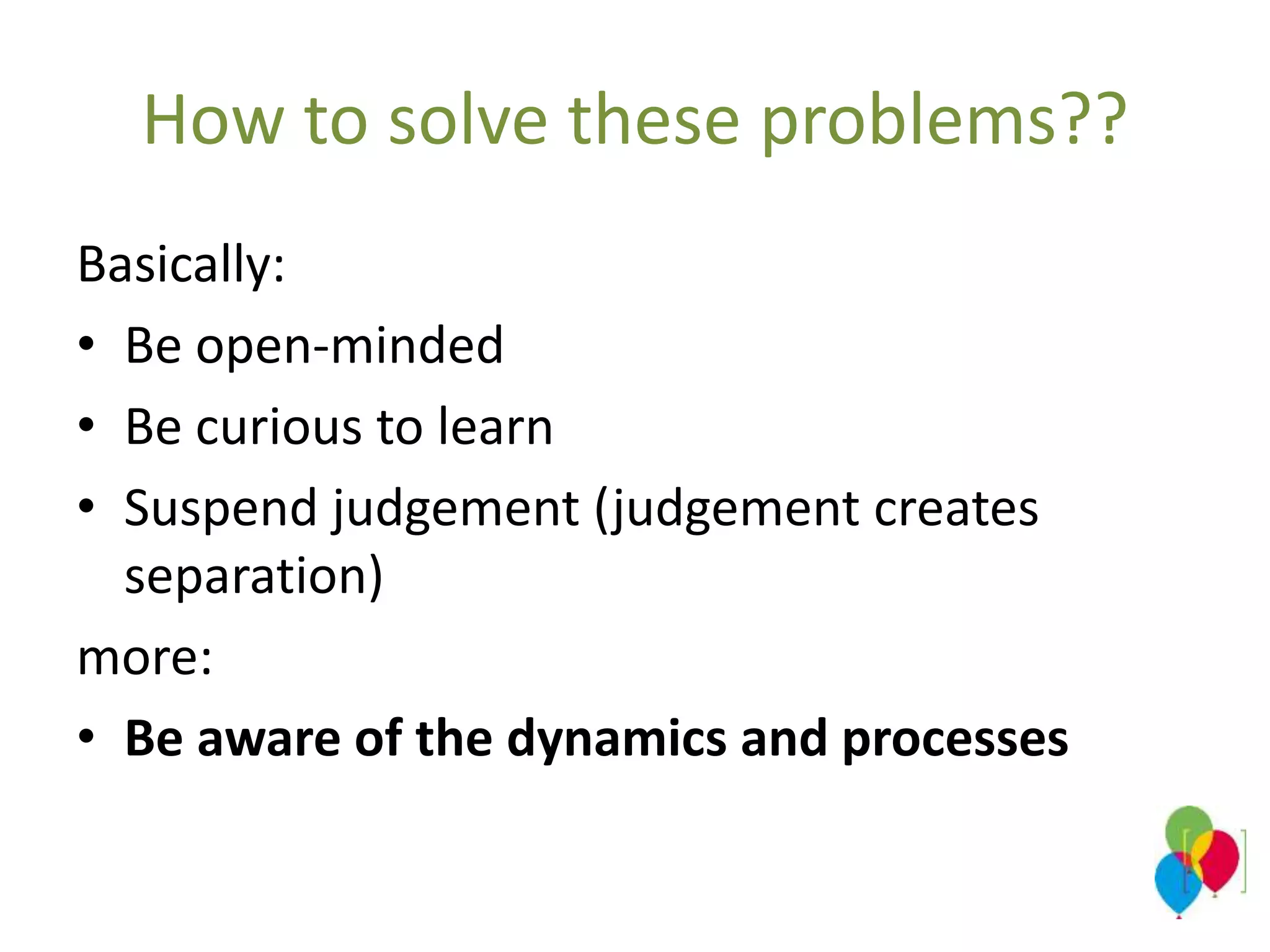
How to solve these problems??
Basically:
• Be open-minded
• Be curious to learn
• Suspend judgement (judgement creates
separation)
more:
• Be aware of the dynamics and processes
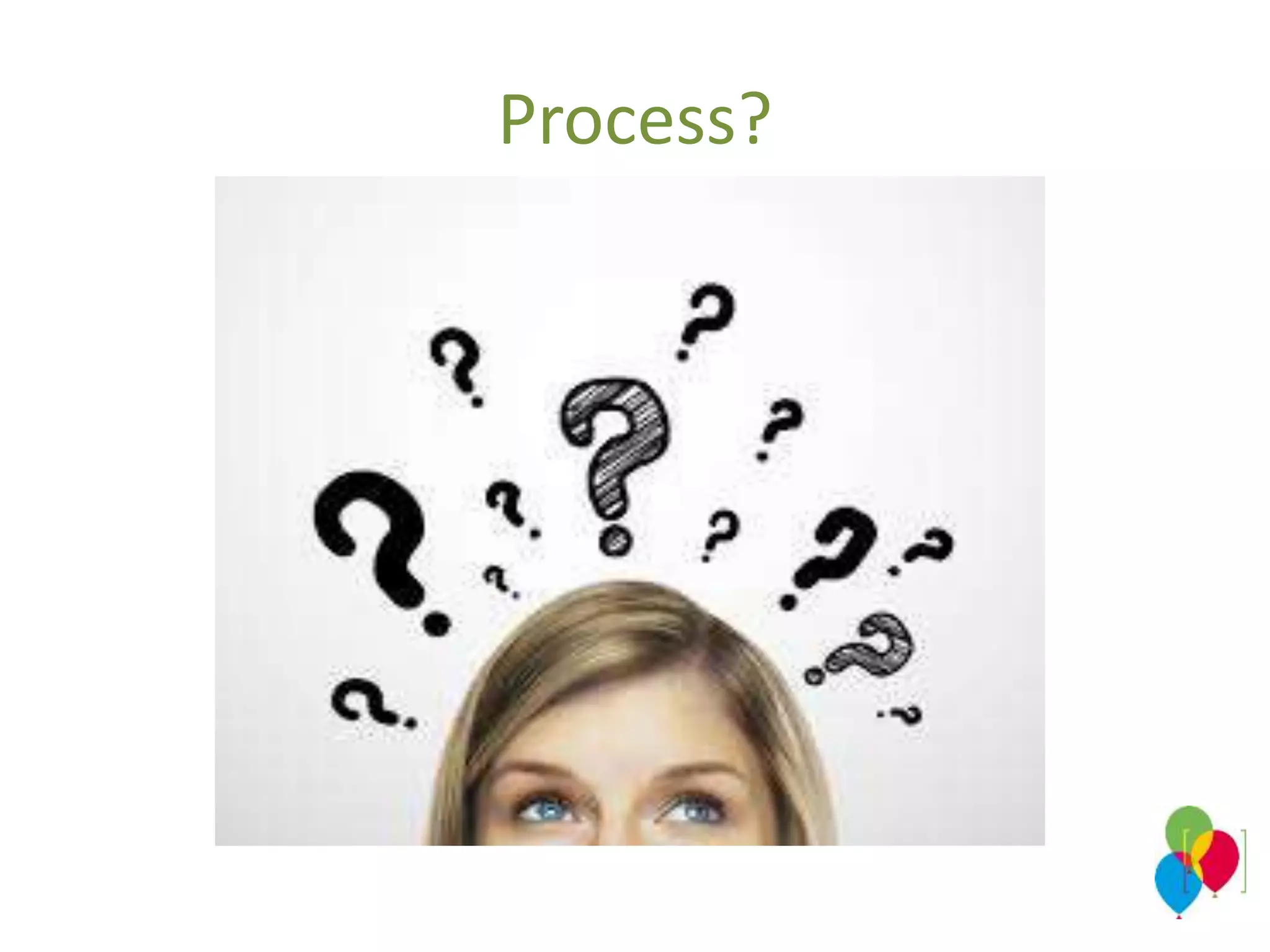
Process?
Process of creation of the team:
fundamentals
• Common goal (roadmap , milestone)
• Role definitions
• Creating a team culture
• Focus on communication
• First integrating the person, then his skill
• Members’ enthusiasm (Do you like your job?)
• Do not take anything for granted .. ask
questions
First the person, then practice!
• Hangouts group led by leader.
• Each participant must participate actively.
• Hangout in pairs.
• Continuous feedback.
• It is necessary to maintain and monitor the
relationship with each team member.
First the person, then practice 2!
• Definition of an alliance based on value
• Definition of team’s value (transparency,
sincerity, trust, ..)
• Individual motivations (personal interest to
use technology, personal interest to cover a
role)
And now…the project
• Requirements, technical choices, difficulty,
etc.
• Shared Vision.
• Individual Vision –defines boundaries–
• Role in the project.
• Skill and experience (levels and compensation)
• Integration technologies: Slack, Trello, git,
Atlassian, jira, dropbox , gmail etc.
Team’s culture
Which means:
• Having shared memories
• Having shared words
• Having a similar vision of the team
Team’s culture
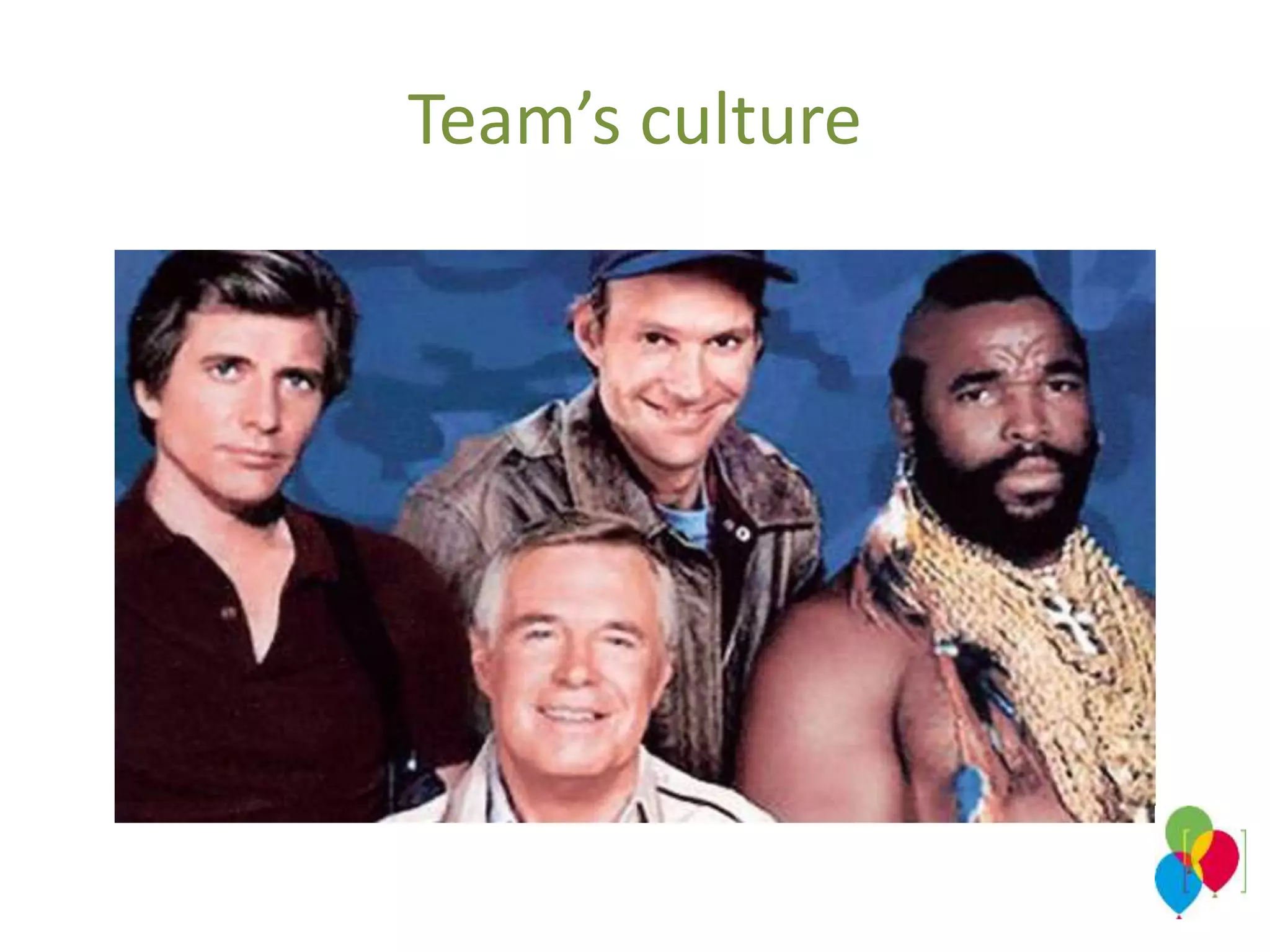
Teams culture: the a-team
• Defined roles: shared and respected
• Shared culture: Vietnam War
• Shared culture: military culture
• Shared mission: have fun and help others
Keyword: sharing
The problem : coordinating a group
• Typically: two-way chat.
• Ideally: everything about the team must be
shared among every one. A defined space
should be created to share and maintain this
information.
Solution : Coordination of a Group
• Keeping a group chat where people exchange
personal information ONLY: daily life, personal
activities, hobbies, music, resources.
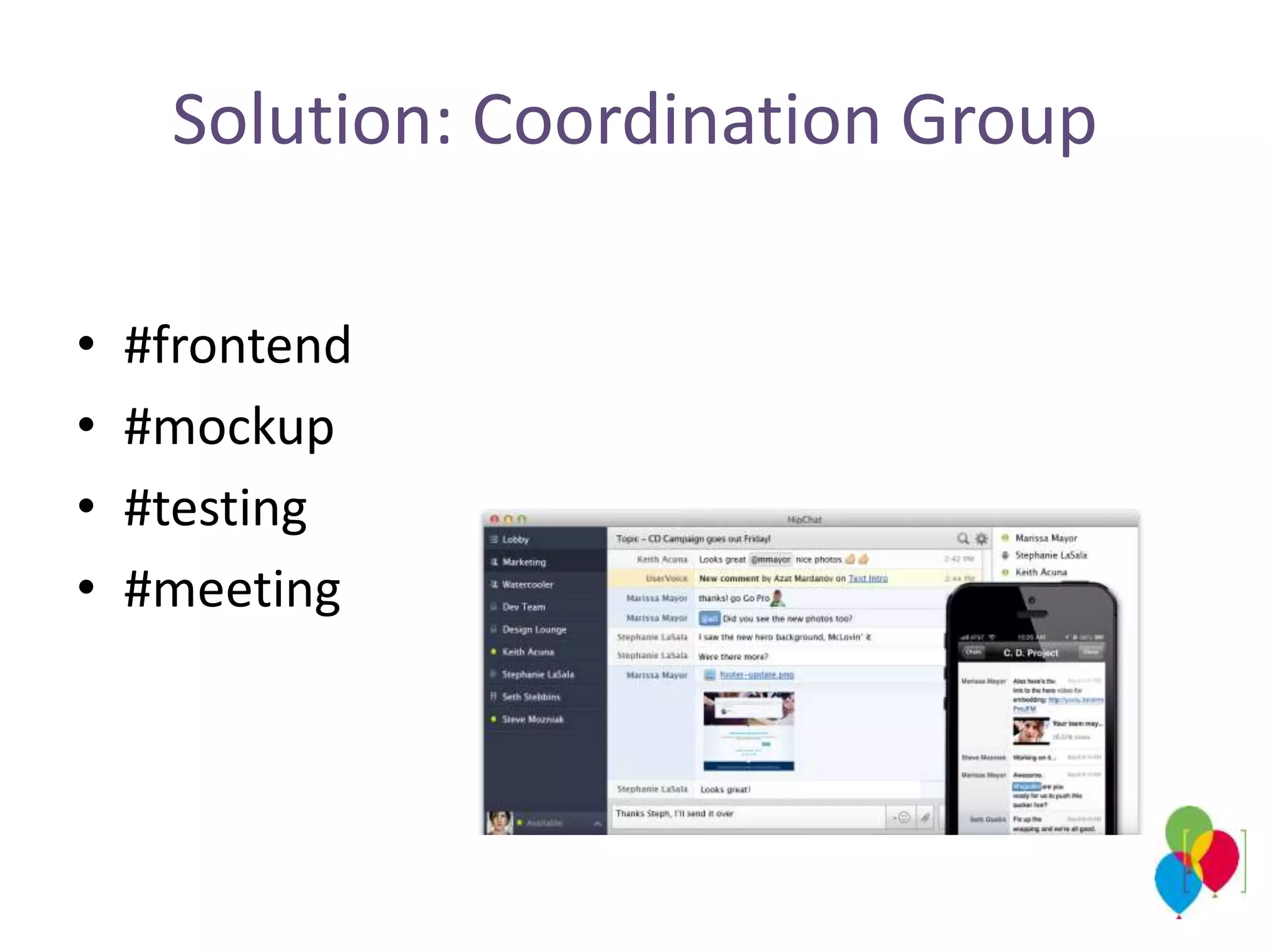
• Keep a chat group technique , possibly with a
hashtag system and log so you can easily
manage the direct recipients of the message
and the history.
• Slack and Trello.
Solution: Coordination Group
• #frontend
• #mockup
• #testing
• #meeting
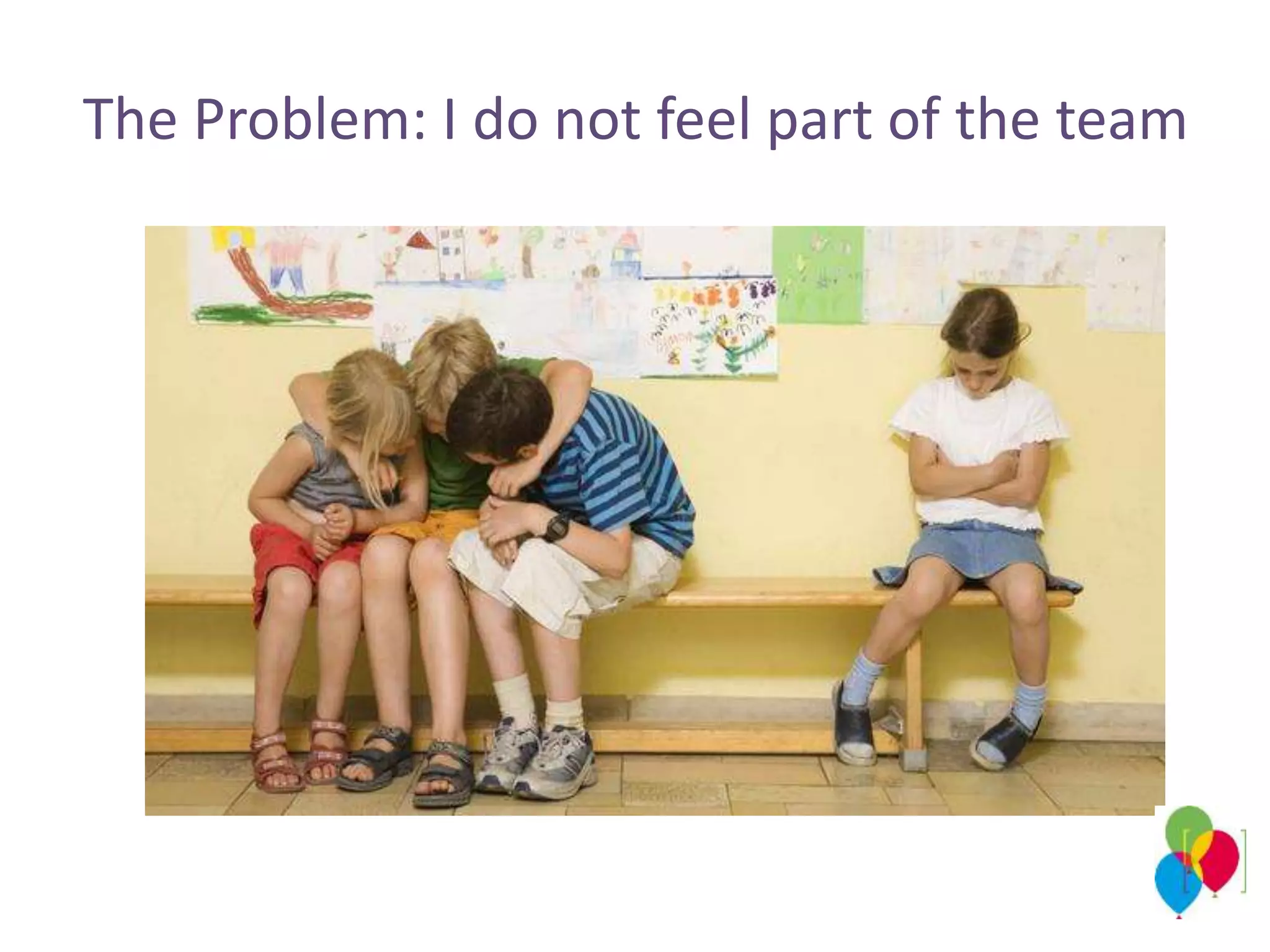
The Problem: I do not feel part of the team
The Problem: I don’t feel part of the
team
Analysis:
• The individual is not participating emotionally to the
live group -> declining productivity
• This happens because:
a) the goal of the team project is not defined clearly or it
is not made ​​explicit
b) An individual’s culture differs from the team culture
If unresolved, this leads to separation/exclusion of
individuals.
The Solution: I do not feel part of the team
• Regular analysis of reports
• Daily and weekly meetings
• Professionalism
• Compliance of the team rhythm
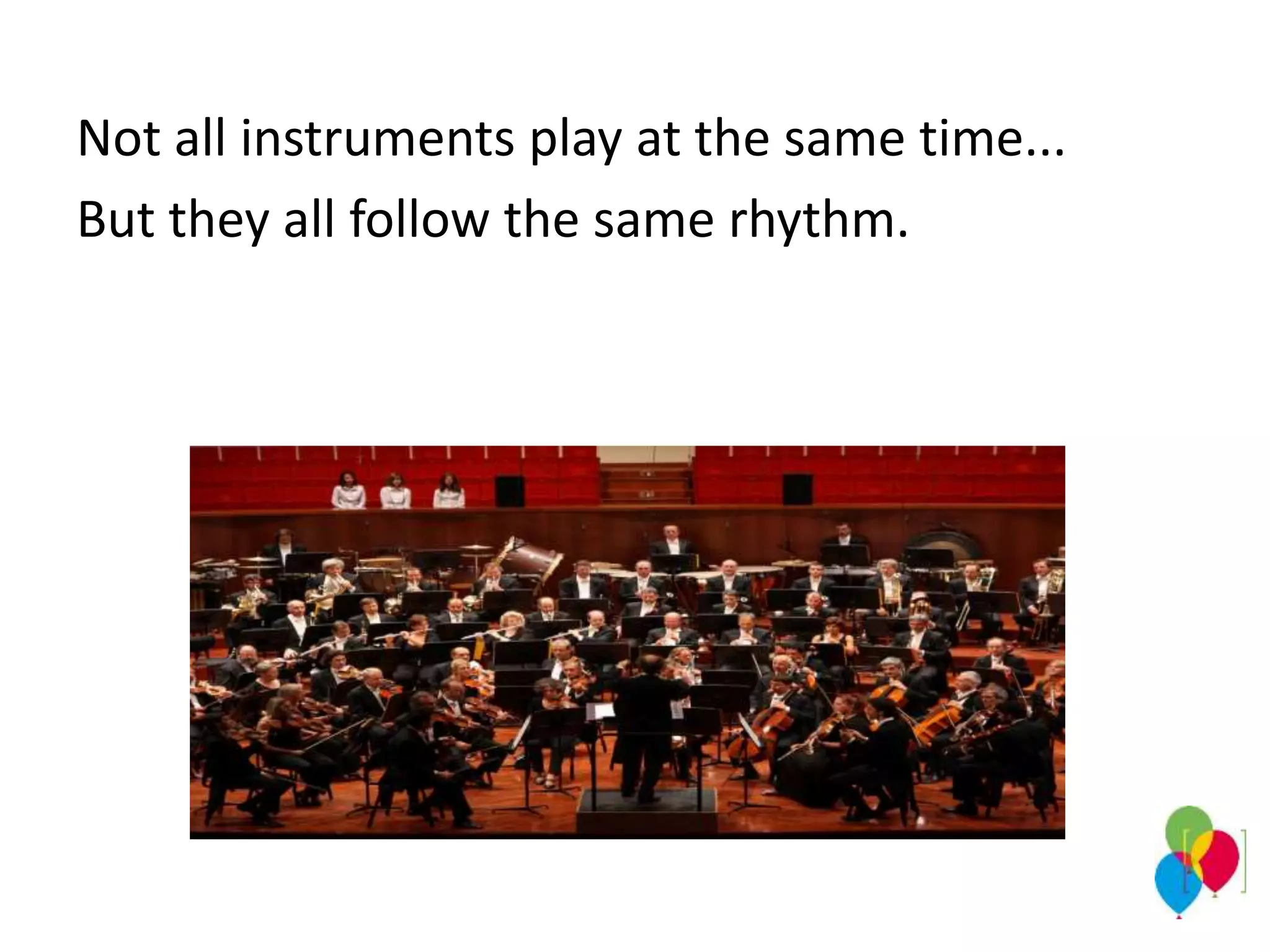
Not all instruments play at the same time...
But they all follow the same rhythm.
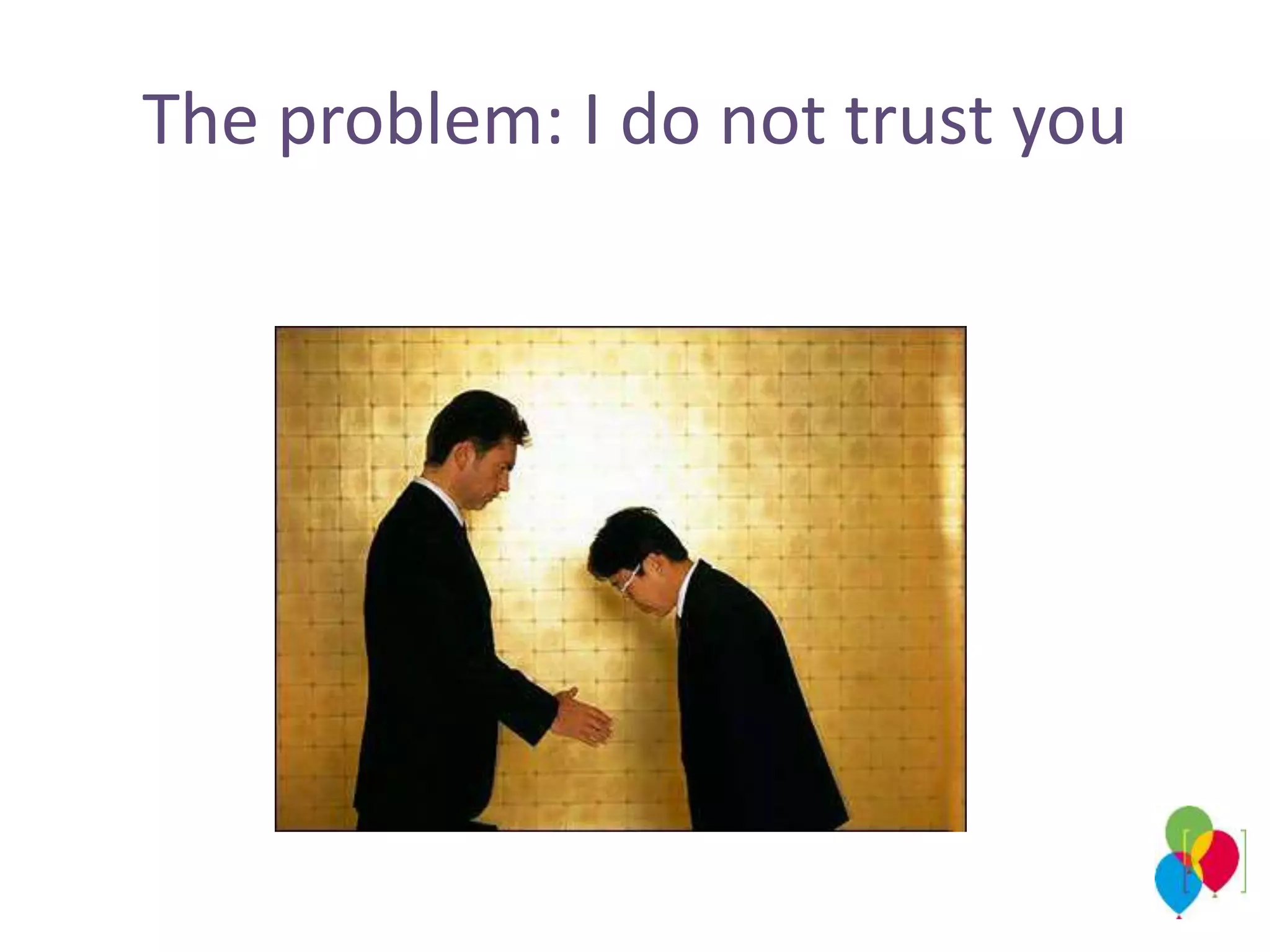
The problem: I do not trust you
The problem: I do not trust
The farther away the individual is culturally
=
The less they tend to trust
Solution
• Small projects
• Neighboring cultures
• Initially should share/accept/test workflow
Workflow?
• It is the passing of the ball between team
members.
• It is the fun part. If you do not like it, team work
is not for you!
Examples:
• Designers prepare psd for the front-end
• Back-end prepares endpoint for front-end
• Commit and merge
The problem: there is always someone
missing at meetings!
Solution:
• The meetings are planned systematically
beforehand .
• We are aware of the extra commitments of all
the team members by keeping a shared
calendar.
• The meetings can not be missed!
The problem: there is always someone
missing at meetings!
The planning itself is a group activity in which
the whole group can participate!
• It keeps the team in line.
• Weekly.
• Start week/end week.
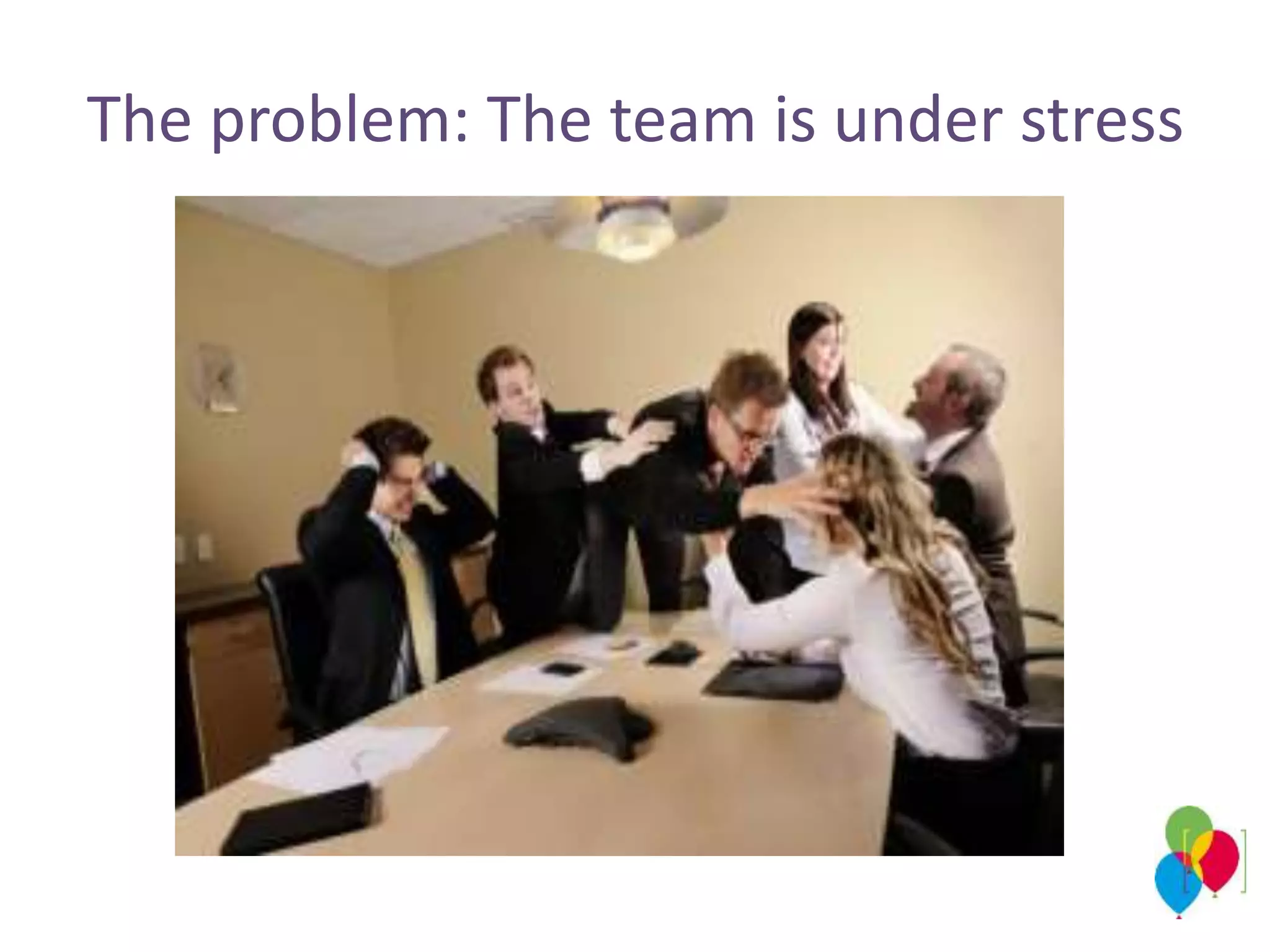
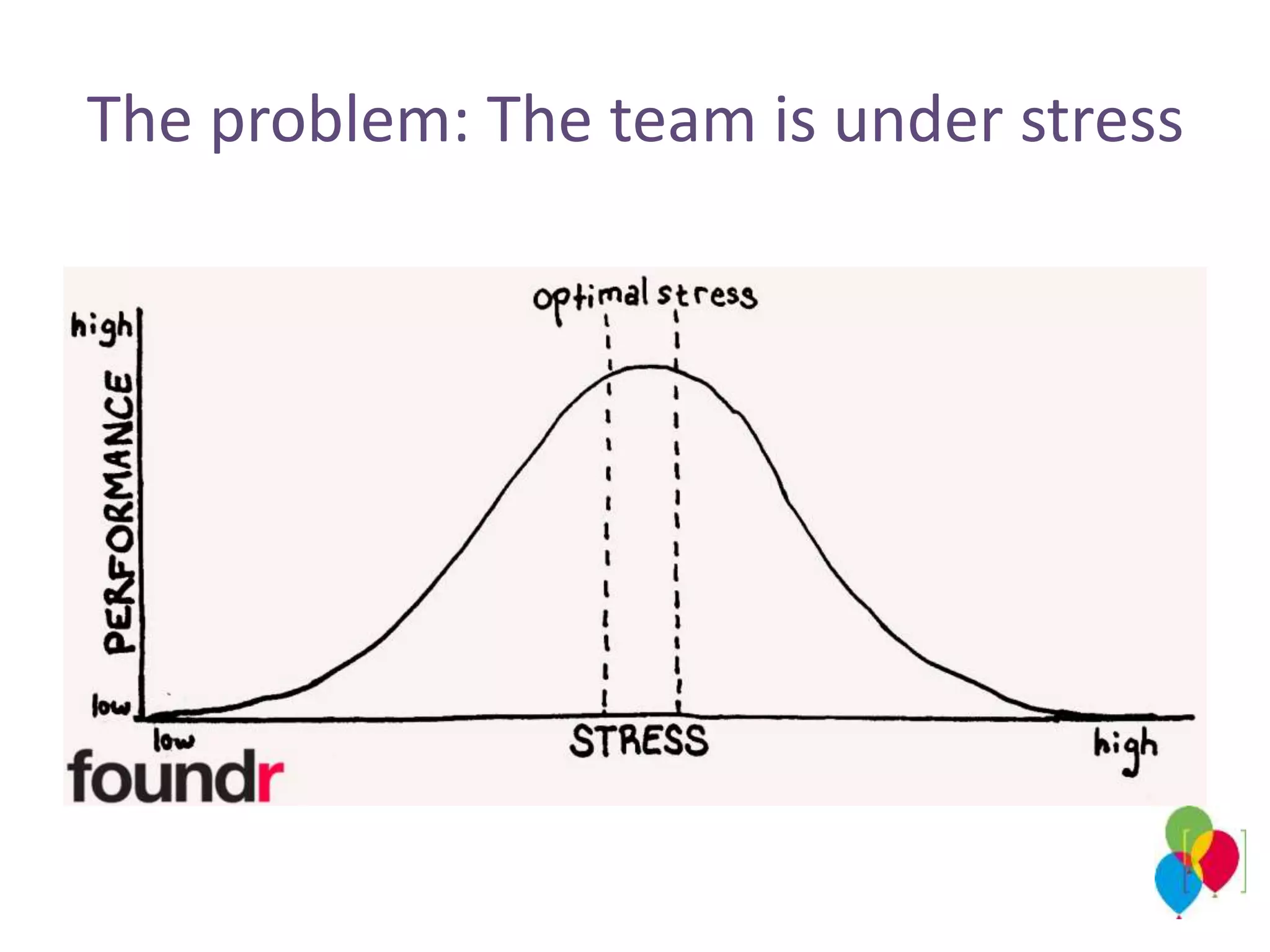
The problem: The team is under stress
The problem: The team under stress
Typical indicators:
• Conflict
• Performance in sharp decline
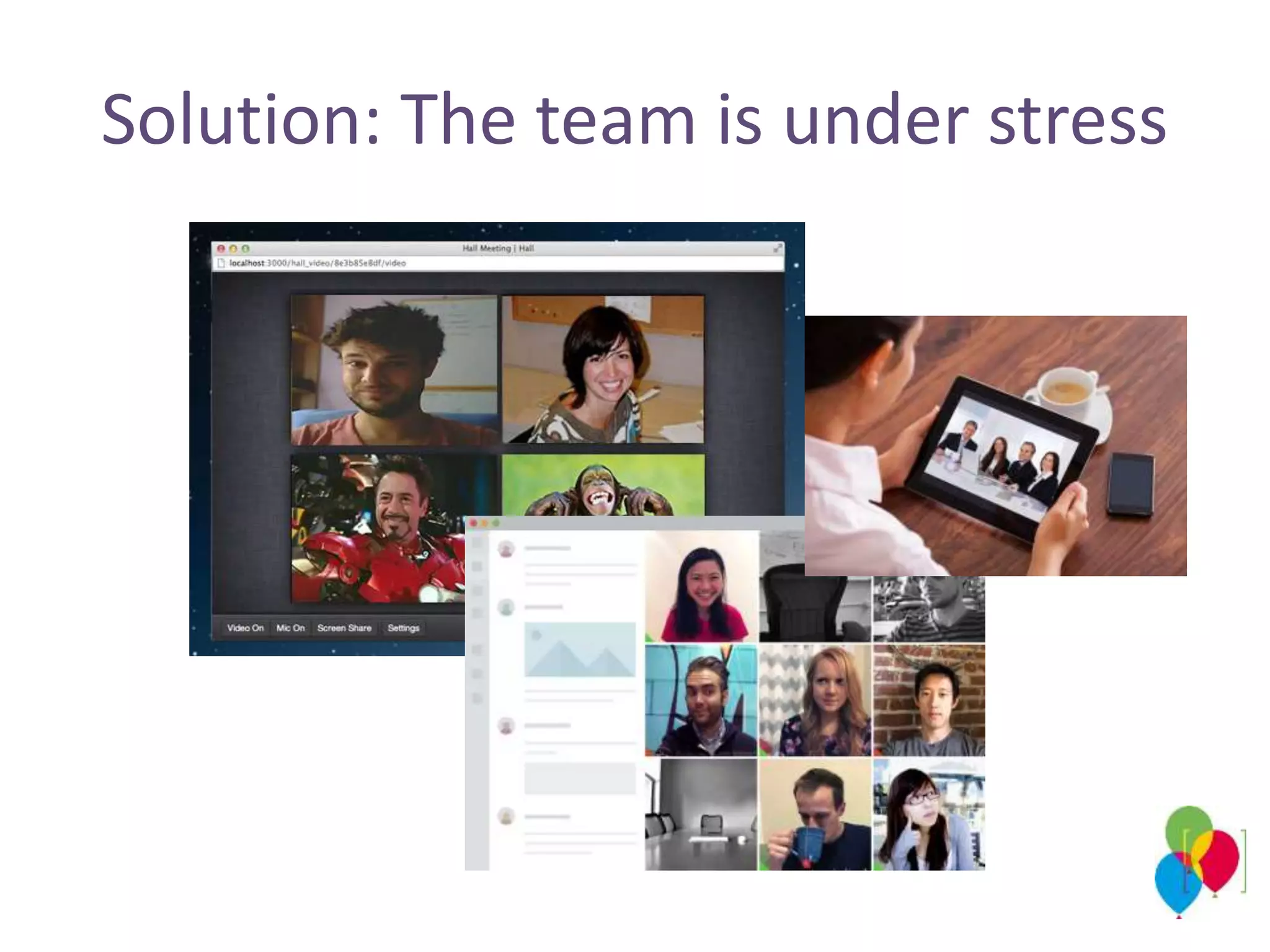
Solution: The team is under stress
• Bring the group together with meetings,
accept clashes as a growth process,
understand the issues of all (by listening).
• We can do this because we have created an
ethical pact, a kind of alliance which defines
the conduct to be followed during the clash.
Solution: The team is under stress
Growth continues: tips
• Team meetings should be held after reaching
every milestone in order to get feedback and
try to figure out what went well and what can
be improved.
• Evaluate themselves constructively.
• Evaluate others constructively.
• Evaluate the model constructively.
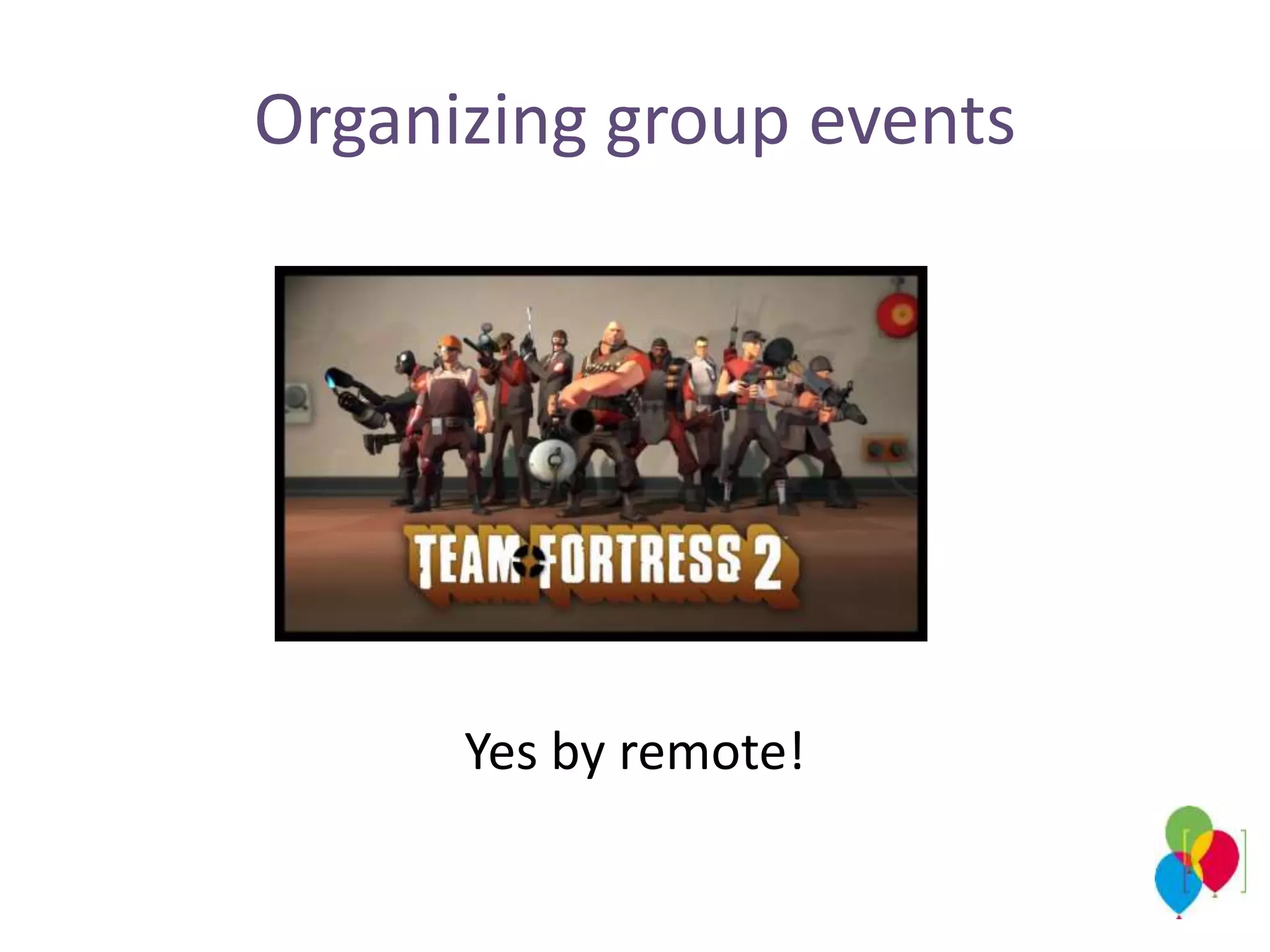
Organizing group events
Yes by remote!
In brief
Focus on:
• The person, first and foremost
• Sharing and communicating
• Task alignment
• Feedback and monitoring
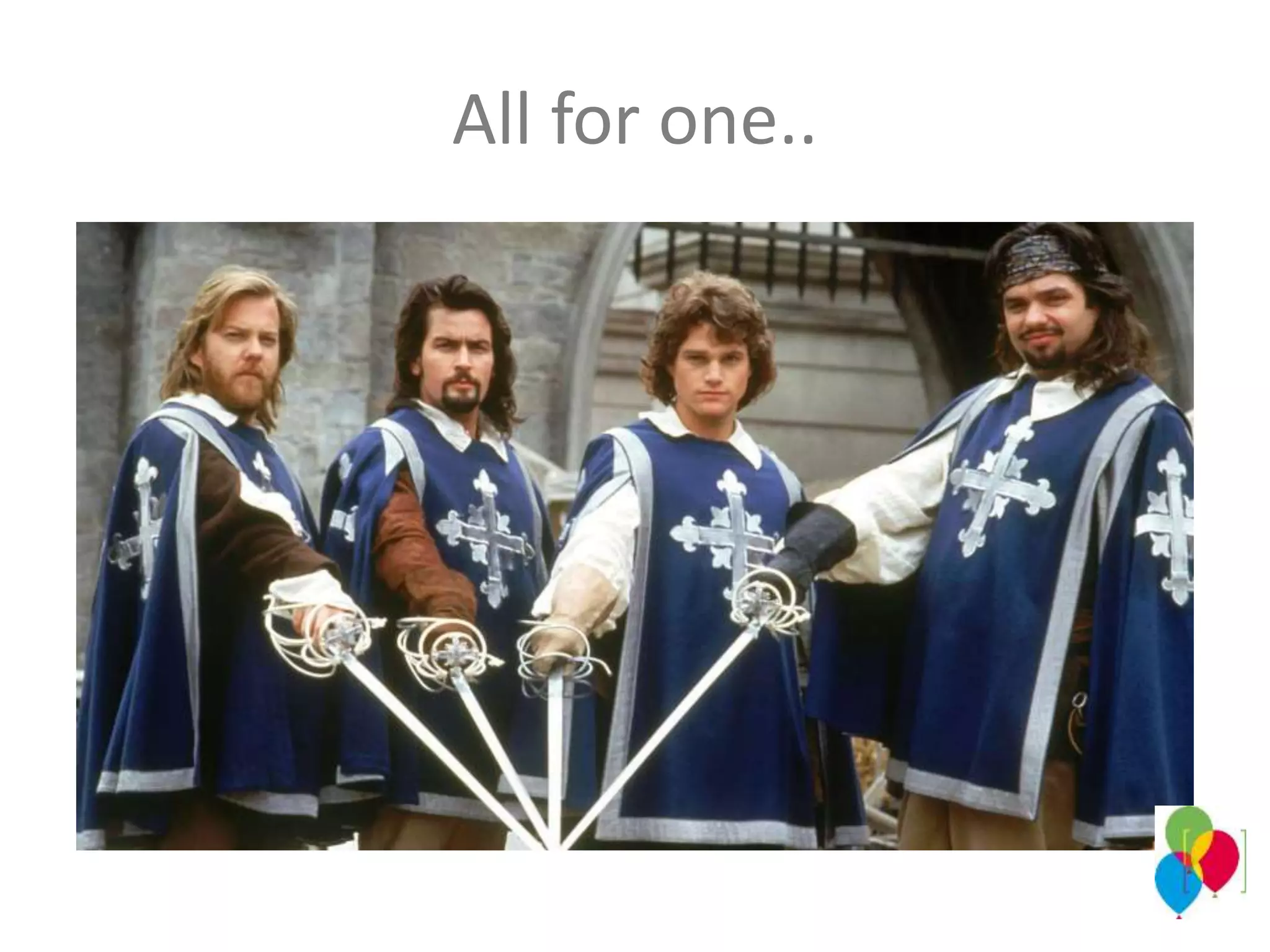
All for one..
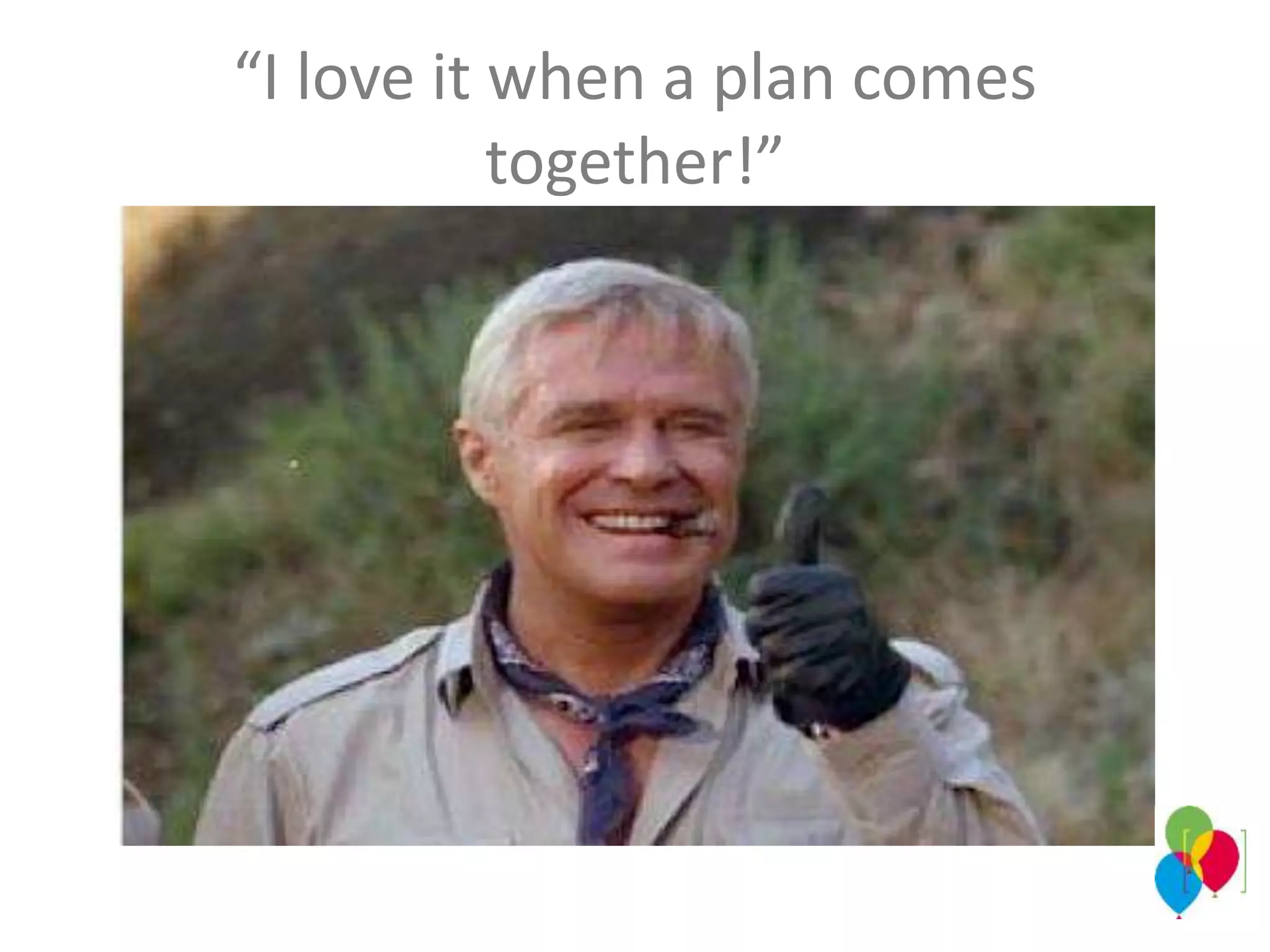
“I love it when a plan comes
together!”
{{Happy coding}}
Personal contacts
Davide.mezzetti@hotmail.it
Skype davide.mezzetti
staff@balloonsteam.com
Thanks bros!!

Remote team building- eng version

  • 1.
    Italian Remote Conference24/25 06 Davide Mezzetti Malta English version Remote Team Building
  • 2.
    Some experiences • Teamsports • Martial Arts • Research communities • Startups • Worked for a big company • Experiential trainer • A lot of travel • Live and work
  • 3.
    Some experiences • Iworked with Italians, French, Spanish, Colombian, American, Maltese, Swiss, Indian, German and Turkish .. • Nice? Yes • Tough? Yes
  • 4.
    Organization of theslides • Target • Forming a team – Ideal case • Forming a team – Usually • Forming a team – By remote • Problems = Solutions
  • 5.
    Target To carry generallife experience in order to manage & maintain a team in a remote context !
  • 6.
    Why? • Adapt toa growing market • Increase performance • Complete projects • Respect deadlines • Have fun
  • 7.
    Forming a team •Definition by wikipedia: A team “is a group of people linked in a common purpose.” Having a SHARED GOAL Gives us direction
  • 8.
    Basic of projectmanagement • All team members must have a clear objective to achieve.. • The goal is made clear on a roadmap. • The roadmap is divided into milestones. • Each milestone is achieved by the team. • Each destination is celebrated as a success!
  • 9.
    Yes, but howdo I create a team? • “It is something that happens naturally , it just takes time” • Natural is the word that is used to explain something that happens without understanding the reasons.
  • 10.
    How do Icreate a team? Dynamics and concepts • Common goal • Common and individual motivation • Management and enforcement of roles • Shared culture • Shared values • Methods • Leadership
  • 11.
  • 12.
    Team building –really is.. • Bonding activities organised in order to bring the group together after analysis of the group dynamics. • Sharing experience and internalization  It leads to a real growth and therefore to a change in performance and harmony.
  • 13.
    Team building: theItalian case • Beer with colleagues • Cigarette break • Football matches • Business dinners • ...
  • 14.
    Team building: theitalian case • The inclusion of human resources is not managed • The responsibility is entrusted to the individual and to his soft- skill • The creation and optimization team takes time and resources because there is a practical methodology to be applied • Often it creates unmotivated employees
  • 15.
    Remote team building Or Workremotely in a distributed team
  • 16.
    Remote team building Typicalapproach: to gain personal experience in companies .. remotely. Does it work?? It does not work as efficiently as it does when not working remotely.
  • 17.
    Why? • We shoulddeal with the different problems to those we are used to DIFFERENT • In reality, the problems are the same and are much more amplified! But we never stopped to observe them!
  • 18.
    Some examples? • CulturalDiversity • Different timing • Different language • Hard to find things in common • No method • Lack of human contact • No coffee break and cigarettes
  • 19.
    More.. • We donot know. (never seen in person , what about emotional affinity?) • We do not trust it (because of the past history: wars, conflicts, tensions, bad experiences) • You do not have the usual cultural phenomena in common (words, food, approach to friendship, approach to life, approach to work, emotional openness) • We have different schedules. • We have different interests (the national sport is different , the climate is different , the smells are different, ..) • We have different backgrounds (universities are all different) • We have different specialization (graphics , database) • We have different goals (we'll see how this is a key factor )
  • 20.
  • 21.
    How to solvethese problems?? Basically: • Be open-minded • Be curious to learn • Suspend judgement (judgement creates separation) more: • Be aware of the dynamics and processes
  • 22.
  • 23.
    Process of creationof the team: fundamentals • Common goal (roadmap , milestone) • Role definitions • Creating a team culture • Focus on communication • First integrating the person, then his skill • Members’ enthusiasm (Do you like your job?) • Do not take anything for granted .. ask questions
  • 24.
    First the person,then practice! • Hangouts group led by leader. • Each participant must participate actively. • Hangout in pairs. • Continuous feedback. • It is necessary to maintain and monitor the relationship with each team member.
  • 25.
    First the person,then practice 2! • Definition of an alliance based on value • Definition of team’s value (transparency, sincerity, trust, ..) • Individual motivations (personal interest to use technology, personal interest to cover a role)
  • 26.
    And now…the project •Requirements, technical choices, difficulty, etc. • Shared Vision. • Individual Vision –defines boundaries– • Role in the project. • Skill and experience (levels and compensation) • Integration technologies: Slack, Trello, git, Atlassian, jira, dropbox , gmail etc.
  • 27.
    Team’s culture Which means: •Having shared memories • Having shared words • Having a similar vision of the team
  • 28.
  • 29.
    Teams culture: thea-team • Defined roles: shared and respected • Shared culture: Vietnam War • Shared culture: military culture • Shared mission: have fun and help others Keyword: sharing
  • 30.
    The problem :coordinating a group • Typically: two-way chat. • Ideally: everything about the team must be shared among every one. A defined space should be created to share and maintain this information.
  • 31.
    Solution : Coordinationof a Group • Keeping a group chat where people exchange personal information ONLY: daily life, personal activities, hobbies, music, resources. • Keep a chat group technique , possibly with a hashtag system and log so you can easily manage the direct recipients of the message and the history. • Slack and Trello.
  • 32.
    Solution: Coordination Group •#frontend • #mockup • #testing • #meeting
  • 33.
    The Problem: Ido not feel part of the team
  • 34.
    The Problem: Idon’t feel part of the team Analysis: • The individual is not participating emotionally to the live group -> declining productivity • This happens because: a) the goal of the team project is not defined clearly or it is not made ​​explicit b) An individual’s culture differs from the team culture If unresolved, this leads to separation/exclusion of individuals.
  • 35.
    The Solution: Ido not feel part of the team • Regular analysis of reports • Daily and weekly meetings • Professionalism • Compliance of the team rhythm
  • 36.
    Not all instrumentsplay at the same time... But they all follow the same rhythm.
  • 37.
    The problem: Ido not trust you
  • 38.
    The problem: Ido not trust The farther away the individual is culturally = The less they tend to trust Solution • Small projects • Neighboring cultures • Initially should share/accept/test workflow
  • 39.
    Workflow? • It isthe passing of the ball between team members. • It is the fun part. If you do not like it, team work is not for you! Examples: • Designers prepare psd for the front-end • Back-end prepares endpoint for front-end • Commit and merge
  • 40.
    The problem: thereis always someone missing at meetings! Solution: • The meetings are planned systematically beforehand . • We are aware of the extra commitments of all the team members by keeping a shared calendar. • The meetings can not be missed!
  • 41.
    The problem: thereis always someone missing at meetings! The planning itself is a group activity in which the whole group can participate! • It keeps the team in line. • Weekly. • Start week/end week.
  • 42.
    The problem: Theteam is under stress
  • 43.
    The problem: Theteam is under stress
  • 44.
    The problem: Theteam is under stress
  • 45.
    The problem: Theteam under stress Typical indicators: • Conflict • Performance in sharp decline
  • 46.
    Solution: The teamis under stress • Bring the group together with meetings, accept clashes as a growth process, understand the issues of all (by listening). • We can do this because we have created an ethical pact, a kind of alliance which defines the conduct to be followed during the clash.
  • 47.
    Solution: The teamis under stress
  • 48.
    Growth continues: tips •Team meetings should be held after reaching every milestone in order to get feedback and try to figure out what went well and what can be improved. • Evaluate themselves constructively. • Evaluate others constructively. • Evaluate the model constructively.
  • 49.
  • 50.
    In brief Focus on: •The person, first and foremost • Sharing and communicating • Task alignment • Feedback and monitoring
  • 51.
  • 52.
    “I love itwhen a plan comes together!”
  • 53.
  • 54.
  • 55.