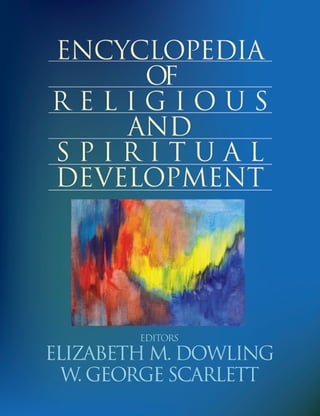
ENCYCLOPEDIA
     OF
RELIGIOUS
    AND
SPIRITUAL
DEVELOPMENT
ENCYCLOPEDIA
     OF
RELIGIOUS
    AND
SPIRITUAL
DEVELOPMENT


           Editors

Elizabeth M. Dowling
     ImagineNations Group

 W. George Scarlett
        Tufts University
Copyright © 2006 by Sage Publications, Inc.

All rights reserved. No part of this book may be reproduced or utilized in any form or by any means,
electronic or mechanical, including photocopying, recording, or by any information storage and retrieval
system, without permission in writing from the publisher.
For information:
          Sage Publications, Inc.
          2455 Teller Road
          Thousand Oaks, California 91320
          E-mail: order@sagepub.com
          Sage Publications Ltd.
          1 Oliver’s Yard
          55 City Road
          London EC1Y 1SP
          United Kingdom
          Sage Publications India Pvt. Ltd.
          B-42, Panchsheel Enclave
          Post Box 4109
          New Delhi 110 017 India


Printed in the United States of America on acid-free paper


Library of Congress Cataloging-in-Publication data

Encyclopedia of religious and spiritual development / editors, Elizabeth M. Dowling, W. George
Scarlett.
     p. cm. — (Sage program on applied developmental science)
“A SAGE reference publication.”
Includes bibliographical references and index.
ISBN 0-7619-2883-9 (hardcover)
   1. Youth—Religious life—Encyclopedias. 2. Faith development—Encyclopedias.
3. Youth psychology—Encyclopedias. I. Dowling, Elizabeth Meredith.
II. Scarlett, W. George. III. Title. IV. Series.
BV4571.3.E53 2005
200′.83′03—dc22                                   2005012704


06   07   08   09      10   9   8   7   6   5   4   3   2   1
Acquiring Editor:           Jim Brace-Thompson
Editorial Assistant:        Karen Ehrmann
Typesetter:                 C&M Digitals (P) Ltd.
Indexer:                    Teri Greenberg
Cover Designer:             Janet Foulger
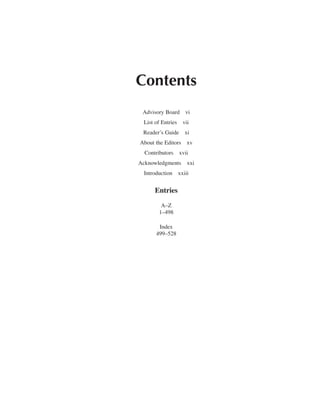
Contents
 Advisory Board       vi
 List of Entries     vii
 Reader’s Guide       xi
About the Editors xv
  Contributors xvii
Acknowledgments        xxi
 Introduction      xxiii


      Entries

        A–Z
       1–498

       Index
      499–528
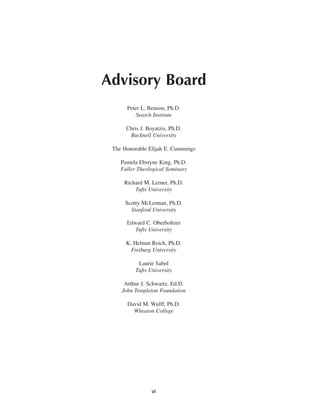
Advisory Board
      Peter L. Benson, Ph.D.
         Search Institute

      Chris J. Boyatzis, Ph.D.
       Bucknell University

 The Honorable Elijah E. Cummings

    Pamela Ebstyne King, Ph.D.
    Fuller Theological Seminary

     Richard M. Lerner, Ph.D.
         Tufts University

      Scotty McLennan, Ph.D.
        Stanford University

      Edward C. Oberholtzer
         Tufts University

      K. Helmut Reich, Ph.D.
        Freiburg University

           Laurie Sabol
          Tufts University

     Arthur J. Schwartz, Ed.D.
    John Templeton Foundation

      David M. Wulff, Ph.D.
        Wheaton College


                 vi
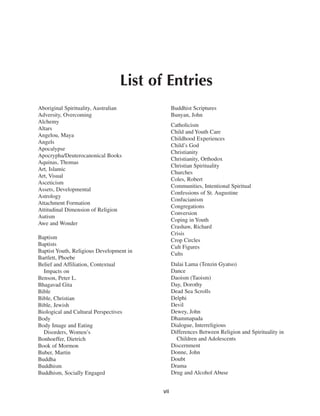
List of Entries
Aboriginal Spirituality, Australian             Buddhist Scriptures
Adversity, Overcoming                           Bunyan, John
Alchemy
                                                Catholicism
Altars
                                                Child and Youth Care
Angelou, Maya
                                                Childhood Experiences
Angels
                                                Child’s God
Apocalypse
                                                Christianity
Apocrypha/Deuterocanonical Books
                                                Christianity, Orthodox
Aquinas, Thomas
                                                Christian Spirituality
Art, Islamic
                                                Churches
Art, Visual
                                                Coles, Robert
Asceticism
                                                Communities, Intentional Spiritual
Assets, Developmental
                                                Confessions of St. Augustine
Astrology
                                                Confucianism
Attachment Formation
                                                Congregations
Attitudinal Dimension of Religion
                                                Conversion
Autism
                                                Coping in Youth
Awe and Wonder
                                                Crashaw, Richard
                                                Crisis
Baptism                                         Crop Circles
Baptists                                        Cult Figures
Baptist Youth, Religious Development in         Cults
Bartlett, Phoebe
Belief and Affiliation, Contextual              Dalai Lama (Tenzin Gyatso)
  Impacts on                                    Dance
Benson, Peter L.                                Daoism (Taoism)
Bhagavad Gita                                   Day, Dorothy
Bible                                           Dead Sea Scrolls
Bible, Christian                                Delphi
Bible, Jewish                                   Devil
Biological and Cultural Perspectives            Dewey, John
Body                                            Dhammapada
Body Image and Eating                           Dialogue, Interreligious
  Disorders, Women’s                            Differences Between Religion and Spirituality in
Bonhoeffer, Dietrich                              Children and Adolescents
Book of Mormon                                  Discernment
Buber, Martin                                   Donne, John
Buddha                                          Doubt
Buddhism                                        Drama
Buddhism, Socially Engaged                      Drug and Alcohol Abuse


                                          vii
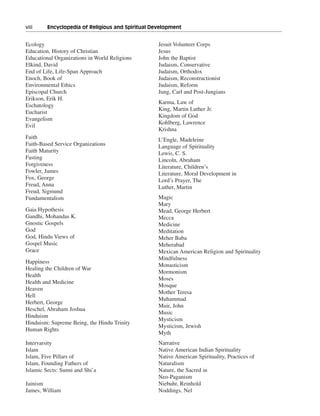
viii———Encyclopedia of Religious and Spiritual Development


Ecology                                          Jesuit Volunteer Corps
Education, History of Christian                  Jesus
Educational Organizations in World Religions     John the Baptist
Elkind, David                                    Judaism, Conservative
End of Life, Life-Span Approach                  Judaism, Orthodox
Enoch, Book of                                   Judaism, Reconstructionist
Environmental Ethics                             Judaism, Reform
Episcopal Church                                 Jung, Carl and Post-Jungians
Erikson, Erik H.
                                                 Karma, Law of
Eschatology
                                                 King, Martin Luther Jr.
Eucharist
                                                 Kingdom of God
Evangelism
                                                 Kohlberg, Lawrence
Evil
                                                 Krishna
Faith                                            L’Engle, Madeleine
Faith-Based Service Organizations                Language of Spirituality
Faith Maturity                                   Lewis, C. S.
Fasting                                          Lincoln, Abraham
Forgiveness                                      Literature, Children’s
Fowler, James                                    Literature, Moral Development in
Fox, George                                      Lord’s Prayer, The
Freud, Anna                                      Luther, Martin
Freud, Sigmund
Fundamentalism                                   Magic
                                                 Mary
Gaia Hypothesis                                  Mead, George Herbert
Gandhi, Mohandas K.                              Mecca
Gnostic Gospels                                  Medicine
God                                              Meditation
God, Hindu Views of                              Meher Baba
Gospel Music                                     Meherabad
Grace                                            Mexican American Religion and Spirituality
                                                 Mindfulness
Happiness
                                                 Monasticism
Healing the Children of War
                                                 Mormonism
Health
                                                 Moses
Health and Medicine
                                                 Mosque
Heaven
                                                 Mother Teresa
Hell
                                                 Muhammad
Herbert, George
                                                 Muir, John
Heschel, Abraham Joshua
                                                 Music
Hinduism
                                                 Mysticism
Hinduism: Supreme Being, the Hindu Trinity
                                                 Mysticism, Jewish
Human Rights
                                                 Myth
Intervarsity                                     Narrative
Islam                                            Native American Indian Spirituality
Islam, Five Pillars of                           Native American Spirituality, Practices of
Islam, Founding Fathers of                       Naturalism
Islamic Sects: Sunni and Shi’a                   Nature, the Sacred in
                                                 Neo-Paganism
Jainism                                          Niebuhr, Reinhold
James, William                                   Noddings, Nel
List of Entries———ix


Object-Relations Theory                            Siqueiros, David Alfaro
Objectivism                                        Sistine Chapel
Original Sin                                       Soul
Orthodox Christian Youth in Western Societies      Speech, Ethical
Oser, Fritz K.                                     Spiritual Development of Children and Youth:
Outcomes, Adolescent                                  Biblical Descriptions
                                                   Spirituality, Contemporary Approaches to Defining
Parental Influence on Adolescent Religiosity       Spirituals, African American
Peer and Friend Influences on Adolescent           St. Bonaventure
  Faith Development                                St. Ignatius of Loyola
Pluralism                                          St. Ignatius, Spiritual Exercises of
Pluralism, Hindu Approach                          Stage-Structural Approach to Religious
Politics and Religion in the American Presidency      Development
Pope, the                                          Stein, Edith
Positive Youth Development                         Stonehenge
Prayer                                             Suicide and Native American Spirituality
Prayer in Psychological Perspectives
Presbyterian                                       Tarot
Prophets of the Hebrew Bible                       Teen Challenge
Psychoanalytic Approaches                          Templeton, Sir John
Psychological Correlates of Religion               Theodicy: God and Evil
Psychological Evil                                 Theologian, Adolescent as
Psychological Type and Religion                    Thich Nhat Hanh
Psychopathology, Personality, and Religion         Torah
Public Education, Spiritual Development in, a      Tower of David
  Charter School Case Study                        Transformation, Religious
Purpose in Life                                    Troeltsch, Ernst
                                                   Tutu, Archbishop Desmond, and the South African
Quaker Education                                     Truth and Reconciliation Commission
Qur’an                                             Tyrants
Relational Consciousness                           UNESCO
Religious Diversity in North America               UNICEF
Religious Theory, Developmental Systems View       United Nations
Retreats
Revelation                                         Vaughan, Henry
Ritual                                             Vodun (Voodoo)
Rosicrucianism                                     Volunteerism
Sacraments                                         Wesley, John
Sacrifice                                          Western Wall
Saints                                             Wicca and Witchcraft
Salvation                                          Wilderness
Save the Children                                  Witches in Popular Culture
Science and Religion                               World Youth Day
Search Institute                                   Worship
Sedona, Arizona
Self-Esteem                                        YMCA
Semiotics                                          Yoga
Service                                            Young Life
Shamanism                                          YouthBuild
Sierra Club
Sin                                                Zoroastrianism
Reader’s Guide

The distinction between that which is religious and                Myth
that which is spiritual is far from clear-cut and far              Narrative
from being an either-or type of distinction. For                   Siqueiros, David Alfaro
example, the Dalai Lama is both a religious figure and             Spirituals, African American
a spiritual exemplar. We have therefore purposely kept             Vaughan, Henry (see also Exemplars)
the concepts of religious and spiritual together in organi-
zing the encyclopedia’s Reader’s Guide. We have also
                                                                   CONCEPTS, RELIGIOUS AND SPIRITUAL
placed each entry into a category that best defines its
relationship to the religious and/or spiritual. However,           Angels
given that some entries are representative of more                 Apocalypse
than one category, we have placed in parentheses the               Attitudinal Dimension
name of the category to which the entry also closely               Awe and Wonder
applies. We hope this Reader’s Guide provides some                 Body
sense of the scope and range of the characteristics and            Child’s God
contexts that are involved in religious and spiritual              Childhood Experiences
development. We also hope that this Reader’s Guide                 Christian Spirituality
helps to frame what might be missing from this ency-               Conversion (see also Practices, Religious
clopedia—as explained in the Introduction—as well                    and Spiritual)
as where the study of religious and spiritual develop-             Devil
ment may turn in the future.                                       Doubt
                                                                   Eschatology
                                                                   Evil
THE ARTS
                                                                   Faith
Angelou, Maya (see also Exemplars)                                 Fundamentalism
Crashaw, Richard (see also Exemplars)                              God
Dance                                                              God, Hindu View of (see also Practices,
Dance Festivals, Latvian                                             Religious and Spiritual)
Donne, John (see also Exemplars)                                   Grace
Drama                                                              Happiness
Film                                                               Heaven
Gospel Music                                                       Hell
Herbert, George (see also Exemplars)                               Hinduism, Supreme Being of, the Hindu Trinity
Islamic Art                                                        Kingdom of God
L’Engle, Madeleine (see also Exemplars)                            Krishna
Lewis, C. S. (see also Exemplars)                                  Mindfulness (see also Practices, Religious
Literature, Children’s                                               and Spiritual)
Literature, Moral Development in                                   Mysticism
Music                                                              Mysticism, Jewish


                                                              xi
xii———Encyclopedia of Religious and Spiritual Development


Neo-Paganism (see also Practices, Religious               Bonhoeffer, Dietrich
  and Spiritual)                                          Bunyan, John
Original Sin                                              Confucius
Pluralism (see also Practices, Religious and Spiritual)   Crashaw, Richard (see also the Arts)
Religious Diversity                                       Dalai Lama (Tenzin Gyatso)
Revelation                                                Day, Dorothy
Sacrifice (see also Practices, Religious and Spiritual)   Donne, John (see also the Arts)
Saints                                                    Fox, George
Salvation                                                 Gandhi, Mohandas K.
Sin                                                       Herbert, George (see also the Arts)
Soul                                                      Heschel, Abraham Joshua
Theodicy: God and Evil                                    Islam, Founding Fathers of
Theologian, Adolescent as                                 John the Baptist
                                                          King Jr., Martin Luther
HEALTH                                                    L’Engle, Madeline (see also the Arts)
                                                          Lewis, C. S. (see also the Arts)
Attachment Formation                                      Lincoln, Abraham
Autism                                                    Luther, Martin
Body Image                                                Mary
Coping in Youth                                           Meher Baba
Faith Maturity (see also Theory)                          Mother Teresa
Healing, Children of War                                  Muir, John
Health                                                    Pope
Health and Medicine (see also Practices,                  Saints
  Religious and Spiritual)                                St. Bonaventure
Orthodox Christian Youth in Western Societies             St. Ignatius of Loyola
Outcomes, Adolescent                                      Stein, Edith
Positive Youth Development (see also Theory)              Thich Nhat Hanh
Psychological Evil                                        Tutu, Archbishop Desmond
Psychological Type and Religion (see also Theory)         Vaughan, Henry (see also the Arts)
Psychopathology, Personality, and Religion                Wesley, John
  (see also Theory)
Purpose in Life
Self-Esteem                                               SCHOLARS
Suicide and Native American Spirituality                  Aquinas, Thomas
                                                          Benson, Peter
                                                          Buber, Martin
LEADING RELIGIOUS
                                                          Coles, Robert
AND SPIRITUAL FIGURES
                                                          Dewey, John
Central Religious Figures                                 Elkind, David
Buddha                                                    Erikson, Erik
Jesus                                                     Fowler, James
Muhammad                                                  Freud, Anna
Moses                                                     Freud, Sigmund
Prophets of the Hebrew Bible                              James, William
                                                          Jung, Carl and Post-Jungians
                                                          Mead, George Herbert
Exemplars and Influential Figures
                                                          Noddings, Nel
Angelou, Maya (see also the Arts)                         Oser, Fritz
Bartlett, Phoebe                                          Troeltsch, Ernst
Reader’s Guide———xiii


NATURE                                        PRACTICES, RELIGIOUS AND SPIRITUAL
Crop Circles                                  Alchemy
Ecology                                       Asceticism
Environmental Ethics                          Astrology
Gaia Hypothesis                               Buddhism, Socially Engaged
Mother Earth                                  Conversion (see also Concepts, Religious
Naturalism                                       and Spiritual)
Nature (see also Places, Religious            Cults (see also Supports/Contexts)
  and Spiritual)                              Dance
Nature, the Sacred in                         Dialogue, Inter-Religious
Wilderness (see also Places,                  Discernment
  Religious and Spiritual)                    Eucharist
                                              Fasting
                                              Forgiveness
ORGANIZATIONS                                 God, Hindu View of (see also Concepts,
Educational Organizations (see also              Religious and Spiritual)
   Supports/Contexts)                         Gospel Music (see also Art)
Faith-based Service Organizations (see also   Health and Medicine (see also Health)
   Supports/Contexts)                         Islam, Five Pillars of
InterVarsity                                  Karma, Law of
Jesuit Volunteer Corps                        Lord’s Prayer
Save the Children                             Magic
Search Institute                              Meditation
Sierra Club                                   Mindfulness (see also Concepts,
Teen Challenge                                   Religious and Spiritual)
UNESCO                                        Native American Spirituality, Practices of
UNICEF                                        Neo-paganism
United Nations                                Objectivism
World Youth Day                               Pluralism (see also Concepts, Religious
YMCA                                             and Spiritual)
Young Life                                    Pluralism, Hindu (see also Concepts,
YouthBuild                                       Religious and Spiritual)
                                              Prayer
                                              Psychological Prayer
                                              Ritual
PLACES, RELIGIOUS AND SPIRITUAL
                                              Sacraments
Altars                                        Sacrifice (see also Concepts,
Churches                                         Religious and Spiritual)
Delphi                                        Service
Mecca                                         Speech, Ethical
Meherabad                                     Spirituals, African American (See also Art)
Mosque                                        St. Ignatius, Spiritual Exercises of
Nature (see also Wilderness)                  Tarot
Retreats                                      Vodun (Voodoo)
Sistine Chapel                                Volunteerism
Stonehenge                                    Wicca and Witchcraft
Tower of David                                Witches, Popular Culture
Western Wall                                  Worship
Wilderness (see also Nature)                  Yoga
xiv———Encyclopedia of Religious and Spiritual Development


SUPPORTS/CONTEXTS                                        Faith Maturity (see also Health)
                                                         Object Relations
Assets, Developmental
                                                         Positive Youth Development (see also Health)
Belief and Affiliation, Contextual Impacts on
                                                         Psychoanalytic Perspective
Child and Youth Care
                                                         Psychological Type (see also Health)
Communities, Intentional Spiritual
                                                         Psychopathology, Personality, and Religion
Cults
                                                           (see also Health)
Education, Christian Religion
                                                         Relational Consciousness
Education, Spiritual Development in
                                                         Religious Theory, Developmental Systems View
Educational organizations (see also
                                                         Religious Transformation
  Organizations)
                                                         Science and Religion
Faith-based Service Organizations
                                                         Semiotics
  (see also Organizations)
                                                         Stage-Structural Approach to Religious
Human Rights
                                                           Development
Parental Influence on Adolescent Religiosity
Peer and Friend Influences on Adolescent
  Faith Development
                                                         TRADITIONS
Politics and Religion in the American Presidency
Quaker Education                                         Aboriginal
Religious Diversity in North America                     Baptists
                                                         Buddhism
                                                         Catholicism
TEXTS
                                                         Christianity
Apocrypha/Deuterocanonical Books                         Christianity, Orthodox
Bhagavad Gita                                            Confucianism
Bible                                                    Daoism
Bible, Christian                                         Episcopal Church
Bible, Jewish                                            Hinduism
Book of Mormon                                           Islam
Confessions of St. Augustine                             Judaism, Conservative
Dead Sea Scrolls                                         Judaism, Orthodox
Dhammapada                                               Judaism, Reconstructionist
Enoch, Book of                                           Judaism, Reform
Gnostic Gospels                                          Mexican American Religion and Spirituality
Qur’an                                                   Mormonism
Torah                                                    Native American Spirituality
                                                         Presbyterian
                                                         Rosicrucianism
THEORY
                                                         Shamanism
Differences between Religion and Spirituality in Youth   Spirituality, Australian
End of Life, Lifespan Approach                           Zoroastrianism
About the Editors

Elizabeth M. Dowling., Ph.D, is the director of                 W. George Scarlett is an assistant professor and
research for The ImagineNations Group. Elizabeth                deputy chair of the Eliot-Pearson Department of Child
works closely with local, national, regional, and inter-        Development at Tufts University. Professor Scarlett
national research partners to design and implement              received a B.A. from Yale University, an M.Div. from
effective and sustainable research practices for                the Episcopal Divinity School, and a Ph.D. (in
ImagineNations and oversees information transfer to             developmental psychology) from Clark University. He
all members of the ImagineNations staff. She gradu-             has published extensively in the areas of religious and
ated from Haverford College in 1991 with a B.A. in              spiritual development, children’s play, and approaches
psychology and received a M.Ed. from Lesley                     to children’s problem behavior. In addition to his writ-
University in 1994 in early childhood education. She            ing, teaching, and administrative work, he has been a
received her doctorate in child development from                long-time consultant for Head Start and the director of
Tufts University. Elizabeth is the author of numerous           a residential camp for emotionally disturbed children.
publications in leading journals and handbooks of
human development.


                                                           xv
Contributors

Abercrombie, Eric N.                          Bornstein, Marc H.
Case Western Reserve University               National Institute of Child Health and
                                                Human Development
Alberts, Amy E.
Tufts University                              Bosacki, Sandra
                                              Brock University
Altman, Penny F.
Sharon, Massachusetts                         Boyatzis, Chris J.
                                              Bucknell University
Allen, Wm. Loyd
McAfee School of Theology                     Brady, Richard
                                              Sidwell Friends School
Al-Solaim, Lamis
Royal Holloway University of London           Bridgers, Lynn
                                              Emory University
Anderson, Pamela M.
Tufts University                              Brotter, Jake Jurkowitz
                                              Tufts University
Antonucci, Toni C.
University of Michigan                        Brown, Edna
                                              University of Michigan
Barrett, Justin L.
Douglas County Young Life                     Cain, Clifford Chalmers
                                              Franklin College
Baughman, Michael J.
Princeton Theological Seminary                Charlesworth, William R.
                                              University of Minnesota
Beit-Hallahmi, Benjamin
University of Haifa                           Chartrand-Burke, Tony
                                              York University
Bell, David
Emory University                              Cheek, Dennis William
                                              John Templeton Foundation
Berndtson, Annie
Tufts University                              Chilton, Bruce
                                              Bard College
Blakeney, Charles David
                                              Chirban, John T.
University of Fribourg
                                              Harvard Medical School
Blakeney, Ronnie Frankel                      Hellenic College
University of Fribourg
                                              Chu, Pamela
Bobek, Deborah L.                             Harvard Graduate School
Tufts University                                of Education


                                       xvii
xviii———Encyclopedia of Religious and Spiritual Development


Clendenen, Avis                                  Gold, Genevie
Saint Xavier University                          Tufts University
Clinton, Boruch                                      ´         .
                                                 Gozdziak, Elzbieta M.
Ottawa Torah Institute                           Georgetown University
Coggan, Sharon L.                                Grainger, Teresa
University of Colorado at Denver                 Canterbury Christ Church University College
Crawford, Cory                                   Gross, Zehavit
Harvard University                               Bar Ilan University
Cutting, Christopher                             Gubbay Helfer, Sharon
Wilfrid Laurier University                       Concordia University

Delgado, Grace Peña                              Halstead, J. Mark
California State University,                     University of Plymouth
  Long Beach                                     Haselhoff, Eltjo H.
Dillon, James                                    Dutch Centre for Crop Circle Research
State University of West Georgia                 Holcomb, Gay L.
Dowling, Elizabeth M.                            Asbury College
ImagineNations Group                             Hooker, Charles
Duffy, Timothy John                              Emory University
College of the Holy Cross                        Jindra, Ines Wenger
Duns, Ryan Gerard                                Spring Arbor University
John Carroll University                          Johnson, Baylor
Fernsler, Christine                              St. Lawrence University
Sidwell Friends School                           Johnson, Mark C.
Fiori, Katherine L.                              YMCA of the USA
University of Michigan                           Johnson, Troy
Flick, Jr., Hugh M.                              California State University
Yale University                                  Johnson-Miller, Beverly C.
                                                 Asbury Theological Seminary
Forman, Jed Daniel
Tufts University                                 Kasimow, Harold
                                                 Grinnell College
Fountain-Harris, Chantal
Tufts University                                 Kendall-Seatter, Sue
                                                 Canterbury Christ Church University College
Francis, Leslie J.
University of Wales, Bangor                      Kibble, David G.
                                                 Huntington School
Galarneau, Charlene A.
Tufts University                                 Kiesling, Chris
                                                 Asbury Theological Seminary
Gearon, Liam
                                                 King, Pamela Ebstyne
University of Surrey Roehampton
                                                 Fuller Theological Seminary
Gilmore, Christopher                             Kirchner, Sandra R.
The Holistic Education Foundation                Miami University
Glickman-Simon, Richard                          Klassen, Chris
Tufts University                                 York University
Contributors———xix


Knaster, Mirka                               Posner, Meredith
Oakland, California                          Tufts University
Lakeou, Lula                                 Raman, Varadaraja V.
Tufts University                             Rochester Institute of Technology
Lawton, Jane E.                              Redditt, Paul L.
Santa Fe, New Mexico                         Georgetown College
Lerner, Richard M.                           Reich, K. Helmut
Tufts University                             University of Fribourg
Leslie, Anne                                 Richert, Rebekah
YouthBuild USA                               Harvard University
Lindemann, Evie                              Roehlkepartain, Eugene C.
Yale University School of Nursing            Search Institute
Lodish, Richard                              Rutman, Lori Ellen
Sidwell Friends School                       Stanford University School of Medicine
Mackenzie, Elizabeth                         Rymarz, Richard
Boston College                               Australian Catholic University Limited
McClellan, Ian                               Scarlett, W. George
Tufts University                             Tufts University
Massey, Karen G.                             Schliesser, Christine Cochlovius
Mercer University                            Tübingen University
Michaels, Cathleen                           Schuldenfrei, Brian
East Bay Conservation Corps Charter School   Sinai Temple, Los Angeles
Molleur, Joseph                              Schwartz, Kelly Dean
Cornell College                              Nazarene University College
Morrissey, Taryn W.                          Schweitzer, Friedrich
Cornell University                           Universität Tübingen
Mueller, Ross A.                             Scott, Daniel G.
Fuller Theological Seminary                  University of Victoria
Najmi, Danyal                                Semetsky, Inna
Tufts University                             Monash University
Neufeld, Dietmar                             Shenton, Andrew
University of British Columbia               Boston University
Nikolajev, Olga                              Sinkin, Amelia
Ottawa, Ontario                              Tufts University
Oberholtzer, Edward C.                       Snarey, John
Tufts University                             Emory University
O’Leary, David M.                            Sniegocki, John
Tufts University                             Xavier University
Osborn, Peter                                Spitzer, Lee B.
Tufts University                             American Baptist Churches of New Jersey
Poe, Gary R.                                 Stavros, George
Palm Beach Atlantic University               The Danielsen Institute
xx———Encyclopedia of Religious and Spiritual Development


Steorts, Mitchael C.                            Watkins, Greg
Tufts University                                Stanford University
Stoneman, Dorothy                               Webster, Jane S.
YouthBuild USA                                  Barton College
Streib, Heinz                                   White, David F.
University of Bielefeld                         Emory University
Thomas, Trudelle                                Wieland-Robbescheuten, Julie
Xavier University                               Wilfrid Laurier University
Thuesen, Peter J.                               Wilson, Melanie
Tufts University                                New England Network for Child, Youth
                                                  & Family Services
Trousdale, Ann M.
Louisiana State University                      Wong, Ping Ho
                                                The Hong Kong Institute of Education
Van Slyke, James A.
Fuller Theological Seminary                     Worthington, Jr., Everett L.
                                                Virginia Commonwealth University
Varnish, Amanda
Brock University                                Wright, Brian L.
                                                Tufts University
Verni, Kevin
Tufts University
Walser, Joseph
Tufts University
Acknowledgments

The editors would like to thank our editorial assistant,          have greatly benefited from the guidance of our editors
Jennifer Davison of the Institute of Applied Research in          at Sage Publications, most especially Jim Brace-
Youth Development (IARYD) at Tufts University. With               Thompson, Sanford Robinson, and Karen Ehrmann.
true patience and a bright sense of humor and spirit,             Finally, we would like to thank our families and friends—
Jennifer kept authors and editors in line and on task. We         and all those who have inspired our own religious and
would also like to thank Richard M. Lerner and the fac-           spiritual development. Your kindness, love, and faith
ulty, students, and staff at IARYD for the support and            contributed to the creation and development of this
time that they willingly gave us during this project. We          encyclopedia.


                                                            xxi
Introduction

In the 18th and 19th centuries, religion and spirituality         Spiritual development and religious development
were supposed to be replaced by science and reason—           are about identity development and how, across the
or so many thought. But that did not happen, and today,       human life span, one sees oneself in relation to that
religion and spirituality play a major role in people’s       which is considered divine or transcendent. While reli-
lives and in determining world affairs. So to be informed     gious development is usually about identifying one-
about today’s world requires being informed about             self with a particular religious tradition, its practices
matters pertaining to religion and spirituality. This is      and beliefs, spiritual development is about becoming
especially the case in a pluralistic global society that is   a whole person, someone who stands for something
growing increasingly “connected.” No longer are dif-          that defines and gives meaning to being human. The two
ferent religious groups found only in far-away places,        may overlap–so that what is spiritual is also religious–
to be experienced only in books or through word of            but they need not. There is religion without spiritual-
mouth. Instead, we now live in communities and nations        ity and spirituality without religion.
where multiple religions and multiple spiritualities are          Due to the work and contributions of scholars
practiced. Furthermore, many of us have access to             and academics, much has been learned about what it
radio, television, newsprint, and the worldwide Web,          means to be human and about the process of human
allowing us, with the turn of a knob or the click of a        development. We have learned that individual devel-
switch, to immerse ourselves in other cultures. We now        opment involves the interplay of multiple contexts,
are brought face-to-face with religious and spiritual         contexts that interact in dynamic ways across the life
diversity.                                                    span. No two people share the same biology or the
    Despite the world becoming a global village, reli-        same combination of contexts and experiences, so every
gion and spirituality still elicit negative stereotypes       person has a unique developmental history. The same
and foster fear, hatred, and even war. And yet, religion      is true for religious and spiritual development. Owing
and spirituality also foster peace and unity. Today,          to the innumerable contexts that influence individual
then, perhaps more than ever, it is especially impor-         development throughout the life span, religious and
tant that we understand one another by understanding          spiritual development must be understood as different
one another’s faith traditions and equally critical that      for each person.
we understand positive, healthy, religious and spiri-             Furthermore, given that the contexts that affect
tual development. We must seek to bridge divides,             religious and spiritual development are innumerable,
counteract negative stereotypes, and explode destruc-         it is impossible to capture the entirety of their expres-
tive myths so as to set the conditions that connect us        sions or influence within one encyclopedia. In deciding,
to all our fellow humans.                                     then, on what entries to collect, we narrowed down a
    This encyclopedia joins a recent trend in research        seemingly endless list of possible entries to present a
and scholarship aimed at better understanding the sim-        sample of contexts and experiences that are central for
ilarities and differences between world religions and         at least some people, in some parts of the world, some
spiritualities, between expressions of the divine and         of the time. We do not assume that all people are
between experiences of the transcendent. It does so,          equally affected by or touched by the same contexts.
however, with a focus on the development of religios-         We do assume that people of different ages, genders,
ity and spirituality.                                         faiths, and ethnicities are more or less affected by the

                                                          xxiii
xxiv———Encyclopedia of Religious and Spiritual Development


contexts discussed in this encyclopedia at different             With a recent heightened level of interest in the
times in their lives. Therefore, we cannot reiterate          study of religious and spiritual development, we imag-
enough that the entries collected in this encyclopedia        ine that in the future we will come to learn more about
are offered as a collection of contexts that potentially      the individual and shared characteristics and contexts
impact individual and group religious and spiritual           that influence the development of spirituality and reli-
development. We were intentional in making the                giosity. As such, a future reference work on this topic
selections we did. Their diversity represents the diver-      may have a very different list of entries than the col-
sity in religious and spiritual development.                  lection we present. We welcome this change and look
    This encyclopedia covers a wide range of topics—          forward to what further research will contribute to the
from ideas, to places, to people. Furthermore, the topics     study and practice of healthy religious and spiritual
come in all sizes—from small topics, such as particular       development.
cultic practices, to large topics, such as major religions.      This encyclopedia does not, then, teach all there is
Some will say that we have included that which should         to know about religious and spiritual development,
be excluded and excluded that which should be                 but it can help point the reader in the right directions,
included—and to a certain extent, they may be right.          so that the reader can become better informed. We
However, once again, our intent was not to achieve a          hope the reader will use this encyclopedia that way—
perfectly balanced and representative sample of entries,      as a pointer, or, to change the metaphor, as a window
because it is difficult to say what such a sample would       into the many fascinating and complex phenomena
look like and, most certainly, each reader will have his      and people that figure centrally in discussions of the
or her own interests and definition of a balanced and         development of religiousness and spirituality. We also
representative sample. Rather, our intent was to provide      hope the reader will use this encyclopedia for per-
a sample of entries to help the reader become better          sonal growth, to help answer those personal questions
informed about the complexity of factors involved in          that, if left unanswered, can stunt or arrest spiritual
religious and spiritual development, so as to become          growth.
better able to function in a pluralistic society and better
able to support personal spiritual growth.                              —Elizabeth M. Dowling and W. George Scarlett
A
                                                                to know and behave in certain ways in relationship to
ABORIGINAL SPIRITUALITY,                                        their own family, the land, and their spiritual relation-
AUSTRALIAN                                                      ship to both.
                                                                   Clans consist of men, women, and children who
    The spirituality of Aboriginal people in Australia          are considered to be descendants of the same ancestor
is traditionally associated with specific tracts of land        or ancestors, but whom at any one time, are scattered
in diverse ways. The ancestral spirits permeate social          throughout a number of different lands. All clan members
life, and individuals within each group develop a gen-          within a language group are related, even if distantly,
uine sense of belonging with the spiritual and physical         and all relationships are recognized and respected.
landscapes. Within individual regions, various social           Unwritten rules govern how people are addressed
groups possess certain traits in addition to their spiri-       by one another and what behaviors are appropriate for
tual beliefs. They have a shared language or dialect and        each relationship and each age group. These social
economic system, and particular songs and ceremonies            relationships and rules are all part of the laws of the
that belong to their specific clan. Descent groups              Dreaming.
occupy particular environments and come to be asso-                At birth, children possess their own spiritual
ciated with specific territories. Children at birth are         presence, and the rest of the group already knows their
taught which descent group they belong to and what              kinship ties. They are given a special name at a cere-
part of the land is theirs to be part of and protect.           mony. From their earliest days, children live within
They are taught songs and told stories about their              their kin structure and are gradually taught how to
ancestors.                                                      behave toward other people. They have special kin-
    There have been perhaps 300 language groups in              ship terms and relationships. For example, it is com-
Aboriginal Australia. Today, many of those languages            mon for the mother’s brother to occupy the most
no longer exist. There are approximately 20 languages           important place in the life of a male child, guiding the
still spoken by more than a few people. As none of the          young boy along the early steps towards initiation and
languages were written, many have been lost forever.            manhood.
Clans or other descent-based groups comprised the                  An extended family usually lives at the same camp
social frameworks within each. Descent groups acted             and moves about the territory as a group. Kinship is a
as guardians of the land inherited from their ancestors.        crucial element in the structuring of social and spiri-
By belonging to a clan, individuals are provided with           tual relationships in Aboriginal societies. Kinship is
a birthright, a passport to a portion of the land, shared       of prime importance throughout Aboriginal Australia,
customs, and the obligation to comply with the rigor-           and is applied to all people inclusively. It is part of the
ous rules of the social structure that accompany clan           spiritual relationship to the land and their ancestors.
membership. All children learn these rules at an early             In traditional societies, everyone with whom an
age. At each stage of development, they are expected            Aboriginal person comes into social contact is likely

                                                            1
2———Aboriginal Spirituality, Australian


to be recognized as some kind of relative. Every             being. Each region would be influenced by several
individual is connected to everyone else by descent,         powerful figures and those Ancestral Beings would
marriage, or some other form of affiliation. To an           then continue to support and resource the communities
outsider, the network of relationships and obligations       living within that area. When their work was done, the
might seem complex. Nobody remains outside the kin-          Ancestral Beings sank into the earth or returned to the
ship system, and all are required to carry out their         sky, ready to be called upon by prescribed ritual.
obligations and responsibilities toward others and the           Australian Aboriginals understand that they act as
land. No one is forgotten. If children are left orphaned     custodians of the land, and are therefore responsible
or adults widowed, they are incorporated into the kin-       for protecting the world of the spirit beings that cre-
ship system. This in turn connects all to a spiritual        ated the land and still live in mountains, waterholes,
life. In its simplest form, the notion of kin is based on    trees, rocks, and sky. The Ancestral Beings are hon-
the idea that a man calls his brother’s children son and     ored and called to protect the land by prescribed
daughter. In turn, they address him as father as they do     rituals of the elders. The places on the earth where
their biological father. A man’s sister’s children are       Ancestral Beings brought forth life are still known as
considered son and daughter.                                 sacred sites.
    Traditionally, spiritual beliefs permeate every              The all-pervasive powers of the Ancestral Beings
aspect of life. The spirit helps the individual              of the Dreaming are present in the land and natural
pass through a series of important life events or rites      species, and reside within individuals. Particular groups,
of passage. The laws are laid down in the Dreaming.          tribes, or clans fulfill their responsibilities, working
The Dreaming is a term used to describe the                  within a highly complex structure that incorporates
spiritual, natural, and moral order of the cosmos.           spiritual belief, sacred law, ceremonies, kinship, and
Each life segment brings with it a set of rights and         places in a particular area with which they have been
obligations.                                                 associated for many thousands of years. It is associ-
    Children spend a lot of their time in the company        ated with their day-to-day survival in provision of
of other youngsters and various adults, especially           food and medicines, ritual songs, objects, and graphic
members of the extended family. They enjoy great             designs.
freedom as long as their actions do not harm anyone              One of the best-known sacred sites in Australia is
and they obey instructions such as staying clear of          Uluru (Ayers Rock), on the land of the Pitjantjatjara
dangerous and sacred places. Proper respect to elders        people, which is of particular significance to the Mala
and family is to be shown at all times. Many of the          (Wallaby) and Kunia (Carpet Snake) clans. There
proper ways of behaving are conveyed to children             are many other sacred sites throughout Australia. In
through stories and songs around the campfire. These         simple terms, sacred sites are like churches. Each site
stories vary from region to region and are passed on         has particular meaning and significance and special
orally. The stories have several levels. The first stories   ceremonies and ways of behaving associated with
were for children and all community members. The             it. Often their location and significance are closely
same story may vary in information for different ages        guarded secrets and cannot be shared with outsiders.
and contain sacred information. Art and drawings are         It is not proper to discuss sacred sites with everyone,
also used to convey spiritual information linking            as some sites are only to be shared by men and some
always to the land.                                          sites are only for women. Men’s and women’s busi-
    Creation stories follow a general pattern, all related   ness are scrupulously segregated, but of equal power
to the land and landscape. Before creation, the land         and importance in traditional societies.
now called Australia was a barren place, devoid of all           Land represents the mainspring of the psyche and
human life. In the Dreamtime, Ancestral Beings came          well-being of the people who inhabit a certain terri-
down from the stars and rose from the earth. They            tory. Communities and individuals are still directly
moved across the land, singing into existence an intri-      responsible for the protection of the land under their
cate network of rivers, deserts, mountains, forest,          guardianship. This responsibility or custodianship
animals, and birds. They stretched to the sun announc-       forms the basis of much of the conflict that continues
ing; “I am Ant!” “I am Snake!” “I am Kangaroo!” “I           to exist between Aborigines and those who operate in
am Emu!” As they called out the names they created           a way that abuses the sacred obligations placed on
sacred songs that brought aspects of the land into           those who inhabit the land. Land can never be sold or
Adversity, Overcoming———3


traded, as it represents a sacred bequest from the            that to the first people of Australia the land was filled
Ancestral Beings and the Dreaming.                            with an intricate web of Dreaming. “We walk together
    Specialized knowledge of any territory, such as           on sacred ground. Black feet, white feet, footprints,
details of ritual and the more intimate details of the        soft upon the land. The Tjukurpa (Pitjantjatjara word
particular relationship of any community to their tra-        for Dreaming) moves beneath our feet. The landscape
ditional lands, is jealously guarded. It is considered        is alive.”—Anon.
sacrilegious to share privileged information with out-                                                    —Jane E. Lawton
siders. From an early age children are taught relation-
ships and knowledge about their role in learning and
passing on rituals and information belonging to their         FURTHER READING
particular family group.
                                                              Horton, D. (1994). The encyclopedia of Aboriginal Australia.
    Aboriginal law is very sacred and complex.                   Canberra, Australia: Australian Institute of Aboriginal and
Ceremonial objects used in rituals to do with the law            Torres Strait Islander Studies.
are revered, and kept in the possession of either the         Jacob, T. (1991). In the beginning: A perspective on traditional
“clever man” or “clever woman.” It is a serious trans-           Aboriginal societies. Perth, Western Australia: Ministry of
gression of the law to look upon them, even by acci-             Education.
dent. Aboriginal elders are “wise men and clever              Caruana, W. (1996). Aboriginal art. New York: Thames and
women” who have the sacred responsibility of acting              Hudson.
                                                              Australian Institute of Aboriginal and Torres Strait Islander
as guardians of the land and the sites created by the
                                                                 Studies. Retrieved February 5, 2005, from www.aiatsis.gov.au
Ancestral Beings. They believe that disturbance of
a sacred site by entering without the appropriate
ceremony represents a violation of that trust that has
been handed down for hundreds of generations, long
before Australia was settled by others. All children are      ADVERSITY, OVERCOMING
taught to show respect to their elders.
    The Ancestral Beings are still relevant today. Day-           Adversity refers to hardship and misfortune.
to-day activities are carried out within the framework        Although what constitutes hardship and misfortune
of that original structure created many thousands of          may vary from one person to another, there are gen-
years ago. They continue to inspire, protect, support,        eral stressors considered by most to be conditions
and govern daily life of traditional Aboriginal people,       defining hardship and misfortune. Stressors come in
and are recognized by all Aborigines, even those who          two types: acute and chronic. Acute stressors are major
have grown up in cities. The Dreaming has deep and            life events such as the loss of a loved one, a divorce,
sacred meanings. It is inaccurate to refer to Dreaming        and a major accident causing bodily harm. Chronic
stories as fables or folklore, as the Dreaming is not         stressors include long-term neglect (by parents, peers,
fictitious to many Aboriginal people.                         others in general), poverty, and permanent physical and
    This traditional and complex culture was in no            mental disabilities. Religion often serves as a means
way prepared to encounter white explorers and settlers        to cope with such adversity.
from alien cultures with a vastly different belief system.        The research on coping distinguishes between
The colonizers believed that Australia was an empty           three types, namely, self-directing, deferring, and
continent, or terra nullius, which is Latin for “a land       collaborative types. The self-directing type refers to
belonging to no-one.” It was established as a concept         when people rely mostly on themselves to cope; the
in European international law in the age of European          deferring type refers to when people take control by
colonization. Nyoongar elder Yongar Mungan tells the          giving control over to God; the collaborative type
story of Aboriginal leader Yellagonga who, when greeted       refers to when people collaborate with God, that is,
by Captain James Stirling in the southwest of Western         see both themselves and God as actively participating
Australia, “He bowed and offered his country and              in the coping process.
resources to the settler.” It was thought the settlers were       The self-directing type of coping is associated with
countrymen who had returned from the spirit world.            a greater sense of personal control and higher self-
    Today, many Aboriginal people in Australia still          esteem. An example of self-directing coping is having
honor their traditions. All people in Australia know          a sense that God will support one’s decisions on how
4———Alchemy


to cope, but the decisions themselves are one’s own.         Pargament. K I. (1990). God help me: Toward a theoretical
The deferring type of coping is associated with lower           framework of coping for the psychology of religion.
self-esteem, less planning and problem solving, and             Research in the Social-Scientfic Study of Religion, 2,
                                                                195–224.
greater intolerance for the differences found in others.
                                                             Smith, C., & Carlson, B. (1997). Stress, coping, and resilience
An example of the deferring type is when individuals            in children and youth. Chicago: University of Chicago
pray for God to do something miraculous. The collab-            Press.
orative type of coping is similar to the self-directing
type in that it too is associated with greater sense of
personal control and greater self esteem. However, with
the collaborative type, there is an active give-and-take     ALCHEMY
between the individual and God. For example, an
individual may pray for support and strength needed              The word alchemy is itself of Arabic origin,
to solve certain problems defining his or her adverse        although its original significance is lost. Forms of
situation.                                                   alchemy have been practiced over many hundreds of
    No matter what type of coping, all follow similar        years by the Greeks, Egyptians, Chinese, Indians, and
steps. First, there is a major life event, followed by an    Arabs, but in Europe it reached the peak of its popu-
appraisal and then some coping activity that focuses         larity with a proliferation of new texts on the subject
either on fixing a problem or on improving some              in the 16th and 17th centuries. It was practiced by figures
emotional-psychological condition. Appraisal plays a         as diverse as John Dee, Francis Bacon, Thomas Vaughan,
central role in the coping process. In making an appraisal   Robert Boyle, and Isaac Newton. The popular image
of their adverse circumstances, individuals can see the      of alchemists was of secret brotherhoods and individual
same circumstances very differently. For example, when       fraudsters (Ben Jonson’s satirical play The Alchemist
told they have a cancerous tumor, individuals can appraise   and Pieter Bruegel the Elder’s drawing of the same
their situation as a challenge to take on or as a hopeless   name illustrate this), but it was not until the growth of
situation that they have to accept. These different          modern science in the 18th century (to which alchemy
appraisals determine what strategies will follow.            had itself made no small contribution) that interest
    Religion can play an integral role in coping with        began to decline.
adversity. Indeed, after tragic events, sometimes                The Swiss psychoanalyst Carl Jung introduced
turning to religion can seem the only way to cope.           a new approach to alchemy in the 20th century. He
Religious coping activities are numerous, and include        noted a close correspondence between the dreams and
cultivating relationships with members of a faith com-       fantasies of his patients and the writings of alchemists,
munity, including the clergy, as well as cultivating a       particularly in terms of recurrent symbols and images
relationship with God. They include cognitive change,        (such as sun and moon, king and queen, toad, dragon,
such as finding a lesson or meaning in adversity;            eagle, and rose). He considered that alchemical litera-
emotional change, such as feeling dependent on God;          ture could be explained in psychological terms, and he
behavioral change, such as leading a more caring life;       viewed the symbols as manifestations of a “collective
and social change, such as investing energy in social        unconscious.” Although Jung’s own life and work were
causes. It is difficult to determine how many people         profoundly influenced by his contact with alchemy,
turn to religion in order to cope with adversity. How-       the impact on psychoanalytical theory has so far been
ever, research has shown that for many people in             limited.
adverse circumstances, religion is indeed relied on for          Alchemy, sometimes known simply as “The Art,”
coping.                                                      is an esoteric mixture of ancient wisdom and quasi-
                                       —Meredith Posner
                                                             scientific experimentation. Essentially it is about trans-
                                                             formation, particularly the purification and perfection
See also Coping in Youth                                     of base, unrefined materials. The transformation may
                                                             be at a physical or spiritual level. At a physical level,
                                                             it is usually expressed in terms of the attempt to trans-
FURTHER READING                                              form base metals into gold, and it involves complex
Pargament, K. I. (1997). The psychology of religion and      procedures in the laboratory. It may also be about trans-
   coping. New York: Guilford Press.                         formation from sickness to health, or from old age to
Altars———5


youth. At the spiritual level, the various alchemical          In a spiritual sense, the prima materia on which
processes in spiritual transformation may be symbolic       the alchemist works is himself, and (at least from a
of the attempt to perfect base human nature; the trans-     Christian perspective) Christ is the perfect Philosopher’s
formation and purification occur as a result of the spir-   Stone. When the alchemist seeks to free the soul (mer-
itual experiences encountered on the journey through        cury) and spirit (sulphur) from the body (salt) and to
life.                                                       reunite them in a purified form, he is seeking to purge
    Many key alchemical terms have meaning on               himself of the impurity of sin, so that he can be made
the physical and spiritual levels simultaneously. For       again in Christ’s image. The alchemical process thus
example, conjunction (sometimes called the alchemi-         helps an understanding of God’s will and purpose
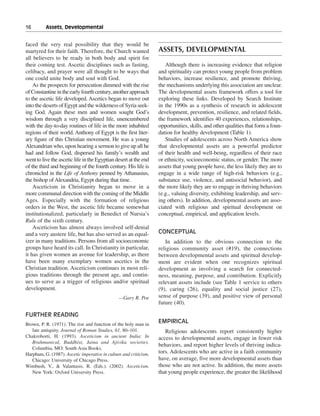
cal marriage) refers in the laboratory to the fusing of     in creation. Many 17th-century Christian writers and
mercury and sulphur, but at a spiritual level (espe-        poets use images drawn from alchemy to convey deep
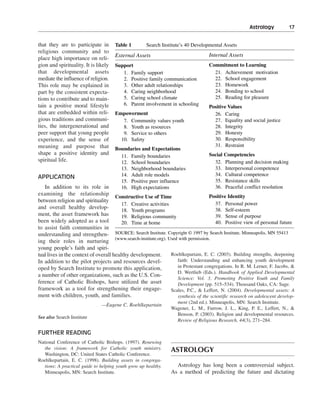
cially in the writing of a Christian alchemist like         spiritual truths. George Herbert, for example, in his
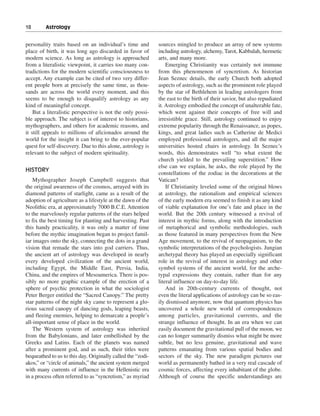
Jakob Boehme) it refers to the soul’s union with God;       poem “The Elixir,” claims to have found in the princi-
it is variously symbolized by the marriage of a king        ple of doing every action as if for God “the famous
and queen, by sexual union, by astrological conjunc-        stone that turneth all to gold.”
tion (e.g., of the sun and the moon) and by the figure                                               —J. Mark Halstead
of the hermaphrodite.
    The goal of the “sacred philosophy” of the alchemists   See also Art, Visual; Herbert, George; Jung, Carl and Post-
was to produce the Philosopher’s Stone, which could            Jungians
then be used as the agent of all kinds of transforma-
tion, including turning base metals into gold, pro-
longing life, and curing the sick. The Stone could          FURTHER READING
take a variety of forms, including powder or liquid,        Burland, C. A. (1967). The arts of the alchemists. London:
and was also known as the Elixir or Tincture. The              Weidenfeld and Nicolson.
alchemical process was thus to turn the prima mate-         Gilchrist, C. (1984). Alchemy: the great work. Wellingborough:
                                                               Aquarian Press.
ria (“ordinary matter”—although of course there was
much debate about what was the best substance to
start with) into the Philosopher’s Stone by separating
it into its components, purging its impurities, and
reconstituting it in perfect proportion in its refined      ALTARS
form. There was no precise formula for achieving this
result. The alchemist had to create a model of the uni-         The Oxford English Dictionary defines altar as a
verse (or of human consciousness) within a sealed,          block, pile, table, stand, or other raised structure, with a
preferably egg-shaped, glass vessel or flask. Through       plain top, on which to place or sacrifice offerings
a complicated succession of gradual heating and             to a deity. The altar can be a place where incense
distillation, the transformation of the prima materia       is burned in worship. Nearly all world religions and
could take place. The transformation required the           faiths have use of an altar. The classical Hebrew sense
“death” of the body or original substance, the ascen-       of the altar is as the meeting place between heaven and
sion of the “soul,” the reuniting of the two in a new       earth. The physical altar becomes the place of meeting
way and the fixing of the volatile elements thus            between the Creator and humanity. It is the place of
generated.                                                  sacrifice and of communion. The altar is always a very
    The sequence of 12 stages of the laboratory process     special place of devotion and deepest respect.
are described by the 15th-century English alchemist,            In many religions, the altar began as the place of
Canon George Ripley, as calcination, solution, separa-      sacrifice. This altar would have been temporary and
tion, conjunction, putrefaction, congelation, cibation,     erected for the moment. Offerings were made to a
sublimation, fermentation, exaltation, multiplication,      deity, including fruits, vegetables, animals, and even
and finally projection (i.e., the use of the Stone for      humans (in some societies and times). Once a faith
transformation). The whole operation is described in        tradition or religion became a bit more permanent,
the symbolic language of birth, marriage, death, res-       the altar was eventually turned into a very permanent
urrection, battles, dragons, birds, and celestial bodies.   structure located inside a sacred building, temple, or
6———Angelou, Maya


church. Only the ritually trained were allowed to             is nourished and fed. The altar should be seen as a
come to the altar. Barriers and railings were set up to       place where all are welcomed, where the poor find
keep out those not fully trained to minister at the altar.    justice, victims of oppression find freedom, and the
    Christianity sees the altar on many levels. The altar     whole of humanity is reunited with its Creator.
is where simple gifts of bread and wine are placed                                               —Rev. David M. O’Leary
for Eucharistic worship. The altar becomes the table
of the Lord. The Last Supper of Jesus sees a meal             See also Christianity; Churches; Eucharist; Judaism; Sacrifice
becoming a time for theology. The altar and/or table
now takes on deeper meaning. Just like in any family,
a special meal with family gathered takes on a deeper
meaning. The table indeed becomes an altar. Great             ANGELOU, MAYA
care is taken to set the table/altar, special vessels are
used on the table/altar, and stories are shared (sacred          I Know Why the Caged Bird Sings (1969) is a pow-
scriptures are proclaimed). Once at the table, people         erful, inspirational childhood autobiography by Maya
tend to stay there. Being allowed at the big persons’         Angelou, the well-known literary, artistic, and spiritual
table is seen as an initiation into adulthood. The meal       figure. The book spans her early childhood through
is more than just a sharing of food. Even though one          adolescence, most of it spent in the South in the 1930s
may take great pride in a beautifully set table/altar, it     and 1940s. The author’s voice is primarily the first-
is the experience of communion with one another that          person vantage point of a child. The opening scene is
is of prime importance. After Jesus’ resurrection from        Easter Sunday in church, with young Maya squirming
the dead, it was at table that he revealed himself to his     in the children’s section; spiritual and religious issues
followers, in the breaking of the bread. Again, it is the     permeate the book. Angelou captures many common
table/altar that becomes a place of action and of con-        paradoxes of living, and explores the role of faith and
vergence between believers and the deity.                     spirituality in reconciling these tensions. Pervasive
    More recently, a split in understanding of the            through the book are influences of race, gender, socio-
altar has developed. The altar has become a place for         economic status, geographical region, and historical
meals, remembrance, and community. The older idea             era. This autobiography contextualizes spiritual devel-
of altar as the place of sacrifice is fading away in some     opment. Every page speaks a human voice, and thus
circles of believers. The altar is now seen as the table      captures the authenticity of the personal and institu-
of the Lord where the community gathers. Some com-            tional in a child’s spirituality.
munities try to hold on to the multiple ideas of altar.          Throughout the book, Angelou illustrates how
Some would see the altar as the place of sacrifice, the       children’s many social contexts—family, church, school,
Lord’s Table, and a place of nourishment and strength         peers, neighborhood, and so on—all influence spiri-
for the community gathered. The altar can be a table          tual development. Spirituality’s life-affirming role in
of joy, a place of communion and peace, and a source          the African-American community is made particu-
of unity and friendship.                                      larly evident in Maya’s childhood during which she
    There is one final aspect of altar that is slowly being   lived in a small, segregated town in Arkansas. The val-
forgotten. The altar has also been a place of memorial        ues, worldviews, and disciplines in the faithful com-
for a person who died for the faith or the deity. The         munities of which she is a part uphold her spiritual
graves of special people had altars erected on them in        journey. However, other communities (such as Maya’s
some religious faiths. The purpose of this altar was to       time in St. Louis with her mother) are lacking in spir-
be a memorial of the martyr’s death. In fact, in most         itual grounding, and Maya’s development suffers. In
Roman Catholic churches, altars have to have a relic          both communities, Maya’s spirituality is crucial in her
(an object of a saint) placed into the altar. Some ancient    resilience against tough odds.
churches are built over the remains of an early believer         A crucial figure in Maya’s life is her maternal
(e.g., the central church of Roman Catholicism, the           grandmother, Momma, who raises Maya and her older
Vatican in Rome, is built on Saint Peter’s remains).          brother in Stamps, Arkansas, after the children’s neg-
    Today, most communities would see the altar as a          ligent parents in California sent them packing. Momma
place of gathering of the believers. It is a place where      shares her theology in verbal assertions, such as God
the mystery of God’s gift unfolds, and the community          “never gives us more than we can bear” (p. 132) and
Angels———7


“God is love. Just worry about whether you’re being a       in a tent with a dirt floor, and she wondered, “Would
good girl then he will love you” (p. 47). Momma’s           God the Father allow His only Son to mix with this
authoritarian behavior, demands for cleanliness and         crowd of cotton pickers and maids, washerwomen and
obedience in the name of God, and her own daily spir-       handymen?” The book is a window into the child’s
itual disciplines provide a powerful model for Maya’s       soulful struggles with the worth of herself and her
observational learning of spirituality. Momma begins        people in God’s eyes. The book continues through
each day with morning prayer and she regularly              adolescent struggles, and a more personal “individuative-
invokes God to cope with stressors. A traumatic inci-       reflective” orientation begins to emerge as she wrestles
dent occurred when unkempt, impudent white girls            with sexuality, vocation, self-esteem, and changing
approached Momma to mock her, a display of disre-           interpersonal relations.
spect that Momma would never tolerate from her own              This wonderful autobiography is a study of
family. Young Maya watched helplessly as her grand-         resilience, of the child’s capacity to not only survive
mother stood her ground, and did not defend herself         but even thrive amid adversity. Maya’s spirituality,
but instead quietly uttered under her breath. Maya, the     shaped by many forces, is the fertile soil in which this
young spiritual apprentice observing her grand-             resilience grows. This is a superb book for a mature
mother’s faith in action, could hear her elder singing,     adolescent group, although sections describing
“Bread of heaven, bread of heaven, feed me til I want       Maya’s sexual abuse as a child and her adolescent
no more.” Maya saw that faith serves as a shield against    sexual explorations will disturb some. Boyatzis and
the slings and arrows of a hard life, and she concluded     Braxton, among other sources, may help educators,
that “whatever the contest had been out front, I knew       parents, or youth ministers use Angelou’s book. Child-
Momma had won” (p. 27). This indelible experience,          hood autobiographies have become popular, and many
witnessing how faith allows one to endure suffering         emphasize spiritual themes, including Kimmel, Scot,
and enables one to salvage spiritual victory from the       and Hampl. Each eloquently depicts the inextricable
jaws of defeat, gave Maya a deep metaphor to grasp          links between childhood and adolescent spirituality,
the essential theme of death and resurrection.              and the family, church, community, and time and place
    While Momma provides spiritual discipline and           in the American landscape. Amidst this fine literature,
strength, Maya’s older brother, Bailey, provides an         Angelou’s book is perhaps the finest case study of
unconditional love that creates in Maya a more bal-         spiritual development.
anced, healthy spirituality. Bailey is Maya’s compan-                                                  —Chris J. Boyatzis
ion and supporter. In a most eloquent passage (p. 19),
Maya writes: “Of all the needs . . . a lonely child has,
the one that must be satisfied, if there is going to be     FURTHER READING
hope and a hope of wholeness, is the unshaking need         Angelou, M. (1969). I know why the caged bird sings.
for an unshakable God. My pretty Black brother was             New York: Bantam.
my Kingdom Come.” While Momma embodies God’s                Boyatzis, C. J. (1992). Let the caged bird sing: Using literature
omnipotence and absoluteness, Bailey incarnates                to teach developmental psychology. Teaching of Psycho-
God’s unconditional, loving acceptance. Others, too,           logy, 19, 221–222.
contribute to Maya’s spirituality, such as Louise, Maya’s   Braxton, J. M. (Ed.). (1999). I know why the caged bird sings:
first childhood friend, and Mrs. Flowers, the aristocrat       A casebook. New York: Oxford University Press.
                                                            Hampl, P. (1992). Virgin time. New York: Ballantine.
of Black Stamps who makes Maya “proud to be
                                                            Kimmel, H. (2001). A girl named Zippy: Growing up small in
Negro” (p. 79).                                                Mooreland, Indiana. New York: Doubleday.
    Angelou’s journey illustrates developmental trends      Scot, B. J. (1995). Prairie reunion. New York: Riverhead.
in faith development (e.g., Fowler). In middle child-
hood, Angelou has a “mythic-literal” faith “absorbed”
from her family; Deuteronomy with its rigid laws
is her favorite book of the Bible. Later in childhood,      ANGELS
Maya experiences growing skepticism and questioning
about her community’s faith norms. As Maya approaches         In English, the word “angel” comes from the Greek
adolescence, a revival meeting (chapter 18) generates       word angelos meaning messenger. In Christian, Islam,
doubt in her, as she is confused by worshipping God         and Jewish beliefs, angels are said to be supernatural
8———Angels


beings above ordinary mankind, or citizens of inner          historians. Not all traditional institutions or academics
space. As messengers from God, their function is to          have agreed on the order and content of these hierar-
praise and to serve God and mankind, helping in many         chies and, indeed, the spelling in English of many
different ways those in harmony with them. Also              angels often varies. However, Dionysius the Areopagite,
known as Prets, Devas, Bhuts, and Devtas, angels are         a disciple of Saint Paul in the sixth century, described
believed to be everywhere, although they have never          three categories or spheres of angels, with three orders
been known to incarnate in human form. They remain           in each. Using this model of nine orders of service,
mostly invisible, and are sexless by nature. Without         angels who serve as heavenly counselors are in the
apparent feelings, through their service they express        first sphere and contain the seraphim, cherubim and
love and compassion for humans in distress. In watch-        thrones, all of which contemplate God’s goodness and
ing over virtually every aspect of human activity, there     reflect his glory. A brief description of the nine orders
are also records of them being on hand in order to help      of angelic beings follows.
the creative progress of activities that are serving a
spiritual purpose. This especially applies to those on         1. Seraphim: Singing the music of the spheres,
earth ready to become more conscious and responsi-                these angels are among the most wise and dedi-
ble for their own spiritual development.                          cated in their love of God. Although remote from
    “Angel” is a generic name for a vast host of invisi-          human experience, they are said to help regulate
ble beings said to populate the seven heavens. Some               the movement of the heavens. The heavenly
people express angels as thoughts of God. There is                hosts might seem to work in graded ranks.
no one correct way of perceiving angels or beings of              However, it is more helpful to see them all work-
light. In so far as they reflect and amplify our own              ing as one so that the seraphim, who seem fur-
condition, they can appear in as many ways and in                 thest removed from us on earth, also work with
many colors. Most are said to be so dazzling that their           the God in each human being. For example,
forms look as if weaved out of fluid light beams.                 Isaiah in his vision saw the six-winged seraphim
Although some of the Higher Beings have been seen                 above the throne of God, and one of them carried
to be as tall as the sky, angels are said to be in the            a burning coal to his mouth to purge his sin.
same line of evolution as earth’s nature spirits of the
                                                               2. Cherubim: Contemplating God’s Laws, cheru-
fairy kingdom. To define elusive angel forms could be said
                                                                  bim are the guardians of light. No matter how
to be as difficult as defining electrons is for the quan-
                                                                  remote they seem, their light, as from the stars,
tum physicist. Better to experience them directly.
                                                                  filters down from the heavens and touches our
    In the first centuries of the Christian era, many
                                                                  lives on earth. Some astrologers claim that there
known as heretics called on angels for help, just as
                                                                  are 72 angels, in groups of 18. These control all
pre-Christian “pagans” had been blamed for calling
                                                                  four elements, each angel governing 5 degrees of
on the many gods of the old religion, paganism. In
                                                                  the Zodiac. Overseeing the element of Fire, 18
Latin religio paganorum means “peasants’ religion.”
                                                                  angels control action, illumination, and transfor-
Thus, for centuries the Church forbade the “ignorant”
                                                                  mation. Eighteen angels control the element of
faithful to give the angels names. From its religious
                                                                  Water, expressed as emotion, love, desire, and
rites it also banned anything that could evoke them,
                                                                  passion. For the element of Air, another 18 angels
preserving only the names of the four main archangels
                                                                  oversee practical intelligence and communica-
familiar to Jews, Christians, and Muslims. Although
                                                                  tion. Helping human prosperity, security, and
their names Michael, Gabriel, Raphael and Uriel are
                                                                  abundance, 18 angels oversee the element of
male, most commentators see all angels as having no
                                                                  Earth. As for birth, the single word cherub, por-
specific human gender. And virtually all the world’s
                                                                  trayed as a winged baby with a chubby, rosy face,
systems of religious belief include celestial beings in
                                                                  is mentioned in the Christian bible, Genesis 3:24.
their cosmologies, their scriptures containing refer-
ences of angelic interventions.                                3. Thrones: Thrones represent the first order in the
    Moving down from the Supreme Creator or God,                  third sphere. Think of these angels as celestial
angels are organized in a celestial hierarchy, by means           solicitors. They implement the laws mentioned
of classifications generally accepted by commentators             above. In dark days, it is good to remember that,
of many faiths including the Cabbalists and angel                 as well as being companion angels with each of
Angels———9


   the planets, the Earth angel, guardian of this                holds a pair of scales suggesting, perhaps, that
   world, can be especially solicitous to those in               balance in all matters is the ultimate wisdom.
   spiritual need.                                           •   Gabriel, the messenger of divine mercy and
                                                                 Revelation is often depicted holding a lily
4. Dominions: These heavenly beings govern the
                                                                 to represent at the Annunciation, purity, and
   activities of all angelic groupings below them.
                                                                 truth. Sometimes seen with an ink well and
   They also integrate the spiritual and material
                                                                 quill, his function is as the heavenly commu-
   worlds. Although they serve the laws and orders
                                                                 nicator of the Word of God. Not only did he
   of God and thereby prescribe action, they rarely
                                                                 visit the Virgin Mary in the form of a man,
   contact individual souls. Nonetheless, their ser-
                                                                 Gabriel also visited Mohammed as he slept,
   vice is very much in tune with the constraints of
                                                                 with the angel’s feet astride the horizon in
   physical reality.
                                                                 order to dictate the Koran.
5. Virtues: From the Divine Source, essential ener-          •   Raphael is the bringer of divine healing, his
   gies come from good deeds. Thus, those who                    right forefinger pointing toward heaven.
   work with these beings can become infused with                Often he is shown as a pilgrim with a gourd.
   great spiritual energies necessary at this time               In front of him leaps a curative fish. By way
   for our present home planet, Earth. Virtues are               of saving a suicide, such a fish has been
   beyond and before powers (see next category).                 known to leap out of water when some unfor-
6. Powers: These beings are the keepers of collec-               tunate—but blessed—soul on a riverbank is
   tive consciousness and cosmic history, as well                thinking of drowning himself. Raphael also
   as bearers of the conscience of all humanity.                 holds a staff or caduceus entwined with a
   The angels of birth and death are therefore                   snake to symbolize healing.
   included here. Like the leaves of a tree draw             •   Uriel, as the radiant regent of the sun, is the
   down the powers of sunlight into the soil, so                 bearer of the fire of God, and is seen with a
   these light beings draw down the energies of the              flame in his open hand. He rules over thunder
   divine plan. Multifaith in service, they work                 and terror so that, like lightning, the knowl-
   with and for all that exists, holistically, without           edge of God can be delivered to the people of
   fear or favor. Their intention is to help the spiri-          the earth. Helping to interpret and decode our
   tual evolution of this planet. Thus, they govern              inner voice, prophecy and wisdom are also
   the operations engaged in by both the Thrones                 his domain. He can appear holding a scroll,
   and the Dominions.                                            or with a book at his feet that he gave to
                                                                 Adam with all the medicinal herbs in it.
7. Principalities: In medieval angelology, these             •   The Recording Angels are often referred to by
   were known as guardian angels, not of human                   those who wish to consider that all deeds on
   individuals, but of large groups such as nations              earth are seen and accountable. Metatron might
   and the welfare of their cities. Even today’s                 be considered the most earthly of archangels.
   multinationals, as in worldwide corporations,                 Taken up to heaven as a wise and virtuous man,
   have such protection as appropriate to their con-             he is now depicted holding a pen or quill while
   sciousness and spiritual development.                         recording human deeds in the Book of Life.
8. Archangels: Many religions tell of spiritual
   beings that have never incarnated. Those most          9. Angels: As indicated above, angels can appear in
   mentioned are the archangels. They oversee                many forms and have many different functions.
   the actions of human leaders. The four main               In India, for example, they are known as pitarah.
   archangels familiar to Jews, Christians, and              Although dealing less with individuals these
   Muslims follow:                                           household deities are perceived to protect families
                                                             against illness, famine, drought, and other disas-
   • Michael, the messenger of divine judgment,              ters. To the Australian aboriginal, the wajima rep-
     usually depicted with a sword to subdue Satan           resents the spirit of an ancestor. For the Pueblo
     (represented sometimes as a dragon), to cut             peoples of the American Southwest, the kachina
     away evil. As the Guardian of Peace, he also            is known as a guiding, beneficent life spirit.
10———Apocalypse


   In Kabbalism, the Tree of Life contains a complete       athletic prowess. A fun-loving and positive approach
system expressing angelology, the nature of human-          to life is thus encouraged, celebrating youthful quali-
ity’s origins and relationship to God, including the        ties that can thrive in all those who stay young at heart
doctrine of reincarnation. In the Jewish Kabbalah           throughout their entire lives.
(or Qabalah), this traditional mystic map represents            All loving beings in this world who help others,
physical creation. Increasingly today, it is also used in   even starving animals in the wild who do not attack
relationship to Tarot cards and to astrology.               good people, can be said to be “angels.” In terms of
   In the study of astrology, 18 angels are said to         human service to the suffering, consider Florence
control the element of Earth. Eighteen more angels          Nightingale. Nursing dying soldiers during the
control Fire (indicating action, illumination, and trans-   Crimean war, she was known as an angel of mercy, a
formation). Eighteen control Water (indicating emo-         title that relates to nursing staff even today. She was
tions, love, desire, and passion). Eighteen control the     certain that not just war wounds eventually kill, but
element of Air (indicating practical intelligence and       that lack of hygiene in living conditions caused fatal
communication). Those interested in the symbolism           diseases. Further, she stated that when the human
of numbers, as in numerology, will notice that reduced      spirit is in a state of dis-ease, it is because the laws of
to their lowest denominators, all the numbers men-          God are not being obeyed.
tioned here boil down to a nine. Since multiples of
nine always reproduce themselves, as in 9 × 2 = 18;               ‘Angel aides’ says William Blake
1 + 8 = 9, this divine number represents eternity.                ‘Gently help Seekers for God’s sake.’
Given that the unnumbered hosts of angels are said to
be beyond human calculation, perhaps one of the best              In light beams they bask
known accounts of angels concerns Jacob and his                   Unseen till we ask.
ladder teeming with these light-filled angelic beings.            Best blessings let each human make.
However, not all angels have stayed heaven bound.
                                                                                                  —Christopher Gilmore
Fallen Angels: The line between a good angel and a
bad angel, or demon, can seem unclear. For example,         FURTHER READING
the angel Samael has been seen as a force for good in
                                                            Ambika, W. (1995). The angel oracle. London: Connections.
one era and as a devil in the next. This could depend       Corten, T. (1992). Discovering angels. Oxfordshire, UK: Caer
on how their supernatural “power” is perceived. Lucifer,       Sidi Publications.
after all, has been called the Angel of Light as well as    Daniel, A., Wyllie, T., & Ramer, A. (1992). Ask your angels.
the Devil. As personified powers mediating between             London: Piatkus.
the divine and the human, fallen angels are those who       Watson, D. (1993). A dictionary of mind and spirit. London:
chose no longer to obey the laws of God. But perhaps           Optima.
not all is lost. William Blake, the poet-philosopher        Harvey, C. L. (2002). An Angel for the new education. Soul
                                                               Educator, 9 (25), 4.
and mystic artist, states that Lucifer will return to
                                                            Twitchell, P. (1977). Letters to Gail (Vol. II). Menlo Park, CA:
God’s throne once “the soul emerges from the illusion          Illuminated Way Press.
of evil...”

Guardian Angels: Children of all ages and through
all civilizations have been aware of their guardian         APOCALYPSE
angels. Intimate as unseen breath, they watch over our
spiritual growth throughout our lives until enlighten-         In popular usage, the word apocalypse refers to
ment is eventually achieved through all the light           a cataclysmic event that results in the devastation or
and heavy lessons to be encountered on earth. Uncon-        utter destruction of humanity. However, the technical
ditionally, they love and cherish, guide and protect us.    use of the term is reserved for a genre (or type) of lit-
Alert always to our needs, they are especially helpful      erature found in the biblically based religious tradi-
in the moments we open ourselves in relaxed accep-          tions (Judaism, Christianity, and Islam). Examples of
tance of their divine presence. The guardian angel of       this literature surface in times of anxiety, when a com-
youth carries bow and arrows and a slingshot to indicate    munity is experiencing great change or persecution.
Apocalypse———11


The authors use evocative imagery and stock literary          use, then, ensured that readers of the time would be
techniques to encourage their readers to remain true          able to “de-code” an apocalypse, and see in it a plea
to the faith as the day will soon come when God will          to remain faithful until the time when God will bring
intervene and restore order. On that day the faithful         an end to the current tribulation.
will be rewarded, and the wicked will be punished.                The influence of apocalyptic literature extended
   Apocalypses receive their name from the Revela-            into the first-century C.E. when several charismatic
tion (apokalypsis in Greek) of John, found in the             preachers called on God to rid Judea (formerly Judah)
Christian New Testament. However, the Revelation of           of its latest rulers: the Romans. One such preacher was
John is not the only apocalypse, nor is it the first.         John the Baptist who, the New Testament gospels tell
Scholars who seek the origins of apocalyptic literature       us, criticized the Judean aristocracy and warned of a
look to the writings of two sixth-century B.C.E. Jewish       “wrath to come” (Matthew 3:7; Luke 3:7). John was
prophets: Ezekiel and Zechariah. Writing at the time          executed, but before his death he was able to groom an
of the Babylonian Exile (587–538 B.C.E.), when the            apparent successor in Jesus of Nazareth who, borrow-
Jerusalem Temple had been destroyed and many of the           ing imagery from Daniel, spoke about “the Son of Man
residents of Judah (southern Israel) had been deported        coming in clouds” (Mark 13:26) at the end of the age.
to Babylon, the authors of these texts describe ecstatic          The apocalypticism of the Jesus movement carried
visions in which they are transported to the throne of        over into letters written by the apostle Paul (ca. 50–65
God and shown that the current tribulations will end          C.E.). In these letters, Paul describes the resurrection
and Israel will be restored to peace and prosperity. The      of Jesus as the “first fruits” of a general end-time res-
Judahites were indeed returned to their homeland.             urrection of the faithful.
   In the second century B.C.E., writers drew upon                Apocalytic literature continued to develop in
the techniques of Ezekiel and Zechariah to describe           Judaism after the beginnings of the Jesus movement.
new visions to provide hope for their readers. The            Texts found among the Dead Sea scrolls, such as the
book of Daniel and the noncanonical 1 Enoch, both             War Rule, provide evidence of first-century Jewish
written in response to attacks on Jewish culture by the       apocalyptic thought.
Syrian king Antiochus IV Epiphanes (ca. 175–164                   As Christianity gradually separated from Judaism,
B.C.E.), are the first true apocalypses. These texts are      Christians encountered persecution and martyrdom
similar in form to Ezekiel and Zechariah but include          for their beliefs and actions. Faced with the possibil-
additional literary techniques that are used in later         ity of losing adherents, Christian writers employed the
apocalyptic texts such as Revelation. These tech-             apocalyptic genre to strengthen the faith of their com-
niques include pseudonymous authorship (the vision-           munity. Revelation, for example, is believed to be a
ary, and thus the narrator of the text is a legendary         response to the persecution of Christians under the
figure of the past); an other-worldly journey (the            emperor Domitian, and the noncanonical Apocalypse
visionary is taken on a journey through the heavens           of Peter, with its gruesome tour of Hell, was written,
and/or to the throne of God); an overview of history          most likely, to prevent Christians from joining the
(from the beginning of time to the period of the vision-      Jewish revolt of 135–137 C.E.
ary, followed by detailed “prophecies” of the recent              Apocalyptic expectations temporarily waned after
past from the visionary’s time to the time of the book’s      the persecution of Christians ceased in the fourth cen-
composition, and then a set of ambiguous prophecies           tury. But Muhammad, the seventh-century founder of
of the real author’s own future); eschatology (descrip-       Islam, drew upon apocalyptic motifs when he warned
tions of the “end time” when God will destroy the             the citizens of the Arabian city of Mecca that their
author’s and his community’s enemies and bring about          behavior would be punished on the forthcoming Day
a new age of peace and prosperity); elaborate imagery         of Judgment. Shi’i Muslim groups make particular
(angels and demons proliferate, and various kings and         use of apocalyptic ideas. Seeing themselves as the
kingdoms are represented symbolically as composite            object of persecution by the Sunni majority, Shi’i
beasts); and a promise of personal salvation (those           Muslims wrote that the rightful leader of the Muslim
among the community who have died will be rewarded            community will return to establish universal justice
for their faith in the afterlife). All of these techniques,   and usher in the Day of Judgment.
though often misunderstood by modern readers, can                 Even though apocalypses focus on events close to
be found in other literature of antiquity. Their general      the time that the text was composed, many contemporary
12———Apocrypha/Deuterocanonical Books


readers continue to see in them indications of the                Maccabees, which outline the successful rebellion of
coming “apocalypse.” Such apocalyptic expectation                 the Jews against their Greek (Seleucid) overlords, the
reached its height during the Cold War. At that time,             establishment of a sovereign Jewish political and reli-
anxieties about worldwide nuclear destruction led                 gious state under the Hasmoneans, and its eventual
Christian preachers and authors (such as Hal Lindsey,             demise under Rome in 63 B.C.E. They also include
The Late Great Planet Earth, 1977) to seek relief in              wisdom books similar to Proverbs (the Wisdom of
apocalyptic texts, and inspired filmmakers to draw upon           Solomon and Sirach), stories such as Tobit, Judith,
and transform apocalyptic motifs to craft biblically              Susanna, Bel and the Dragon, an extra psalm (Psalm
based horror films (such as The Omen series).                     151), and the Prayer of Manasseh. These books reflect
   When anxieties about the Cold War ceased, apoca-               Jewish life and theology from approximately 300
lyptic ideas receded, although today some Christian               B.C.E. to 70 C.E.
denominations—most notably Jehovah’s Witnesses,                                                             —Jane S. Webster
Seventh-Day Adventists, the Church of Jesus Christ
of Latter-Day Saints (Mormons), and the Worldwide                 See also Bible, Jewish; Catholicism; Christianity, Orthodox
Church of God—retain a strongly apocalyptic world-
view, as do the occasional radical apocalyptic (or
“millennial”) groups such as the Branch Davidians                 FURTHER READING
of Waco, Texas. However, these groups have always                 Bandstra, B. L. (2003). Reading the Old Testament: An intro-
been in the minority. The norm has always been to                    duction to the Hebrew Bible. Belmont, CA: Wadsworth.
create or focus on apocalyptic literature as the need             Harris, S. L. (2003). Understanding the Bible. Boston, MA:
arises, in response to times that challenge a commu-                 McGraw-Hill.
nity’s capacity to hope.
                                    —Tony Chartrand-Burke

See also Dead Sea Scrolls; Eschatology; Jesus; Muhammad
                                                                  AQUINAS, THOMAS

                                                                     Thomas Aquinas is a towering figure in the history
FURTHER READING                                                   of the Dominican Order of friars in theology and
Boyer, P. (1994). When time shall be no more: Prophecy belief     philosophy. The exact date of his birth is not known,
   in modern American culture. Cambridge: Harvard Univer-         but most sources state that the year was 1225, and the
   sity Press.                                                    place was the castle of Rocca Secca, midway between
Collins, J. J. (1998). The apocalyptic imagination: An intro-     Rome and Naples. Early in life, he planned to join
   duction to the Jewish matrix of Christianity (Rev. ed.).       the Order of Preachers, the Dominican friars. This did
   Grand Rapids, MI: Eerdmans.
Himmelfarb, M. (1983). Tours of hell: An apocalyptic form in
                                                                  not please his family, who conspired to keep him from
   Jewish and Christian literature. Philadelphia: University of   joining the Dominicans. They even kidnapped him
   Pennsylvania Press.                                            and locked him in a castle tower for over a year.
McGinn, B. (1979). Visions of the end: apocalyptic traditions     Thomas Aquinas was still drawn by the Order’s intel-
   in the Middle Ages. New York: Columbia University Press.       lectual apostolate and the mendicant way of life. In
                                                                  1244, he joined the Order. The rest of his brief life was
                                                                  divided between Paris and Italy, studying, lecturing,
                                                                  and writing. He did this until his death at age 49, in
APOCRYPHA/                                                        1274. His greatest writing was the Summa Theologica,
DEUTEROCANONICAL BOOKS                                            completed in 1266. This massive work fills five vol-
                                                                  umes and addresses Aquinas’s very mature thought
    The 16 extra books found in the Greek translation             on all the Christian mysteries. The format consists of
of the Hebrew Bible are known as the Deuterocanonical             questions, objections, and authoritative replies in each
Books by Catholic and Orthodox traditions and as the              article, providing a very concise summary of his view
Apocrypha (meaning “hidden”) in Protestant traditions.            on the matter under discussion. His Summa Theologica
Originally written in Hebrew, Greek, and Aramaic,                 became the model and standard theological text in
this collection includes the history books of the                 many schools and universities.
Art, Islamic———13


    The Summa Theologica was written as a systematic
exposition of theology. It is divided into three parts, of   ART, ISLAMIC
which the second is further subdivided into two. The
first part deals with the reality of God and creation.           Islamic art does not mean art with a specifically
It also includes a treatment on human nature and the         Islamic subject matter, but rather art produced by
intellectual life. Aquinas strongly maintained the pri-      Muslims. There is nothing in Islam that corresponds
macy of the intellect over the will. The second part         to Christian iconography. Indeed, there is a conscious
deals with the moral life, considering the final end         avoidance of painting with a religious theme, whether
of humankind and the general moral themes of virtues         portraits of the Prophet Muhammad, his companions,
and vices. The final section concerns Jesus the Christ,      or his wives, or incidents from the Qur’an or the life
and the sacraments of the Roman Catholic Church.             of the Prophet. Human figures do not feature at all
    Aquinas was very adept at using Aristotle’s and          in the decoration of religious buildings or in copies of
Plato’s philosophical insights, patristic writings, and      the Qur’an, mainly because there, in particular, they
clear reasoning. His oral teachings and his writings on      might distract worshippers from the true object of
theology, philosophy, and scripture were equal to the        their prayers and spiritual meditations. However, none
work of several people in his day. Sources state that        of this should be taken to imply that Islamic art is
he dictated to four or five secretaries at the same time.    not religious, or that it does not derive its inspiration
Throughout his life he was always very modest and            from the Qur’an. On the contrary, beauty is perceived
unassuming. A man of deep prayer and spiritual               as a divine quality in Islam, and art opens up a pathway
insight, he saw himself as devoting his life to God          to contemplative knowledge whose ultimate object
through theological scholarship. Yet, he also lent his       is divine beauty. A hadith (saying of the Prophet)
intellect to helping the everyday believer. He wrote         reminds Muslims that, “Allah is beautiful and he loves
commentaries for the average person on the basic             beauty.” Artistic creativity (when given expression
prayers, including the Creed, the Our Father, and the        within the boundaries permitted by Islamic law) is
Hail Mary.                                                   considered a God-given skill that should be used to
    He was canonized a saint of the Roman Catholic           celebrate His greatness.
Church in 1323. A later honor was bestowed on him in             However, these are not the only differences
1567, being declared a doctor of the Church, because         between Western and Islamic art. In Islam, a work of
of his writings, and is now known as the “angelic doctor”    art is not judged in terms of its assumed originality,
because of one of his writings on angels.                    for continuity of style and imitation of predecessors
    In his day, his writings were not immediately or         are equally important. Little attention is normally paid
universally accepted. A commission was appointed             to the individual genius of the artist or his personality,
to examine his writings, as his use of Aristotle was         mood, or psychological state. Indeed, these things are
suspect. Aristotelianism was seen as radical and             as far as they could be from the spirit of Islamic art.
unorthodox. The use of non-Christian philosophers            The most important thing about a work of art is not
like Aristotle and Plato brought the attention of            who produced it, but what spiritual values it conveys,
Church authorities. Three years after Aquinas’s death,       or what spiritual vision it embodies.
21 theses of Aquinas were condemned as in error by               Indeed, the whole conception of art in Islam
the bishop of Paris. Yet, through the centuries, the         differs from Western conceptions. Figurative painting
Roman Catholic Church has embraced his writings,             (whether on wood, canvas, or wall), print-making,
theology, and liturgical music as accurately relaying        and sculpture are generally not valued, because they
the true faith. His Summa Theologia was the greatest         tend to imitate nature, whereas Islamic art is more con-
monument of the age. It was one of only three refer-         cerned to represent the meaning and spiritual quality of
ence works laid on the table of the assembly at the          things rather than their physical and material form. For
Council of Trent, the other two books being the Bible        this reason, Islamic art has rarely valued perspective
and the pontifical decrees. In the revised calendar of       or three-dimensional work, and has preferred, rather
feasts in the Roman Catholic Church, the Thomas              than reproduce natural forms, to transmute or transfigure
Aquinas feast day is celebrated on January 28.               them into something more abstract or stylized. There is
                                                             no distinction of worth in Islam between fine art and
                                —Rev. David M. O’Leary       applied art. The three most valued forms of art are
14———Art, Visual


  1. Calligraphy (particularly Arabic words from the          transmitting the stories that express their faith. Art,
     Qur’an                                                   then, has been a central means for expressing all things
                                                              religious.
  2. Architecture
                                                                  However, art carrying religious themes has not
  3. Decorative arts and crafts (particularly wood            always expressed or conveyed what might be called
     and stone carving, pottery, glassware, mosaics,          spiritual meaning, while art without religious themes
     metalwork, carpets, and bookbinding, and the             has often done so. The distinction rests on whether the
     illumination and illustration of books, especially       artist and viewer experience in art what is commonly
     in the Safavid and Ottoman traditions)                   referred to as transcendence—a higher power or
                                                              insight into a deeper meaning of life. An example of art
    Every object from the religious building to the           expressing spiritual feelings without any specific reli-
humble household utensil has to be endowed with some          gious meaning is the images drawn of daily work in a
beauty. Apart from calligraphy, the two most common           field and of everyday life in general—as can be shown
forms of ornamental decoration are the arabesque              in many of the French impressionists’ paintings. For
(ornamental leaf and branch designs) and complex              many, these images take on spiritual meaning.
geometrical patterns. The unending repetition of these            For religious purposes, art has been used for reli-
patterns reflects Allah’s infinite nature and the interre-    gious rituals, for teaching, and for expressing spiritual
latedness of all His creation. The study of Islamic art has   feelings. Art used to enhance the ritual aspects of
often traditionally been considered the best way to           religion can be found almost anywhere. For cen-
understand the spiritual dimension of the Islamic culture     turies, vessels and jewelry have been made for use in
as a whole. This is perhaps because its balance, har-         religious rituals. The Ijebu of Yoruba use ritualistic
mony, and unity convey an inner truth without requiring       containers in the form of animals to exhibit particular
complex rational evaluation or explanation. The incor-        animals’ strengths. More cultures than can be named
poration of Western values into contemporary Islamic          use masks in religious ceremonies that may represent
art has diminished its distinctive identity and has some-     sacred animals, gods, or goddesses. During religious
times been lamented as leading to a loss of spirituality.     ceremonies, some cultures have individuals put on
                                       —J. Mark Halstead      masks representing gods or goddesses to assume their
                                                              spiritual powers.
See also Islam; Qur’an                                            In preliterate societies, art has been an impor-
                                                              tant way to teach. For example, at the height of the
                                                              Renaissance, images were made to teach illiterate
FURTHER READING                                               persons about the characters, events, and stories in the
Burckhardt, T. (1976). Art of Islam: language and meaning.    Bible. Another favorite subject was that of saints, who
   London: World of Islam Festival Publishing Co.             were often depicted on triptychs for use as personal
Nasr, S. H. (1987). Islamic art and spirituality. Ipswich:    altars. This was a time when the only art that was
   Golgonooza Press.                                          commissioned was about religion, and so much of the
                                                              art from this period was religious without expressing
                                                              something spiritual.
                                                                  Art in places of worship is often intended to elicit
ART, VISUAL                                                   feelings of awe and reverence. For example, in the
                                                              Sistine Chapel, the viewer looks up at a huge mural on
   Virtually all cultures have used art for religious         the ceiling that is obviously meant to overwhelm the
purposes. The drawings in Paleolithic caves seem to           viewer with its image of a very powerful God.
have served a spiritual purpose. Some of the animals              Many cultures use art to tell stories central to their
depicted are drawn with exaggerated features that             religion and to commemorate various gods. A walk
make them take on a supernatural power, which sug-            through any museum collection of African or Aztec
gests, for the artists, that the animals had religious        art is apt to show artifacts and images on bowls depict-
meaning. The ancient Egyptians used art to please             ing such stories with religious themes.
their gods and to ensure long life. Since ancient times,          Religious symbols are often carried around in
indigenous cultures and religious traditions everywhere       everyday life as people wear a symbol of their faith
have used artistic objects and images in rituals and in       in their jewelry. These visual representations allow
Asceticism———15


people to hold their religion close to them wherever                philosophers when discussing those who, for the
they go. Art, then, provides concrete, visible, and even            sake of wisdom, spent more time in contemplation, and
portable manifestations of a person’s faith.                        avoided what were considered more worldly pursuits,
    Despite the distinction between religious and                   for the purpose of developing character and virtue.
spiritual art, the intent behind most religious art is both.            While the practice of asceticism is generally
Tibetan sand paintings are among the clearest and most              equated with healthy religious and/or spiritual devel-
consistent examples of art that is both religious and               opment by those who practice and preach it, through-
spiritual. The images, which are made by a mosaic of                out history there are many stories of asceticism gone
tiny bits of colored sand carefully placed over many                awry wherein, for example, with the hopes of achiev-
days, include typical Tibetan iconography. After the                ing a closer relation to that which is considered divine,
sand painting is finished, it is swept up and placed                an individual or group took the practice of asceticism
in the river, a spiritual act symbolizing life’s imperma-           to the extreme, risking good health. As such, the prac-
nence, one of the central messages in Buddhism.                     tice of asceticism and the benefits that come with it
    In the 20th century, the emphasis in art has been               are often debated and disputed.
less on the religious and more on the spiritual. Spiritual              One example of a Greek philosopher who empha-
art becomes personal, and relies more on the viewer’s               sized the ascetic life was Pythagoras, a Greek who
internal experience. When religious icons are removed               sought to instill virtue in his followers through a
from art, spirituality may actually be more accessible and          very disciplined lifestyle. The hope was that as persons
more easily communicated across faiths and cultures.                gave up their illogical pursuit of passions, they gained
Wassily Kandinsky talks about art that is essentially               character and wisdom and no longer sought after more
timeless in its spiritual meaning. For Kandinsky, the suc-          worldly pursuits. Both Stoics and Cynics were also
cessful spiritual artwork is internal and timeless.                 considered ascetic as they emphasized a disciplined
    Religious art and art with spiritual meaning has                lifestyle in which one progressed in virtue and moved
played and still plays an essential role in the faith of both       away from a variety of vices because of a disciplined
communities and individuals. The images and objects                 lifestyle. Ascetic discipline continued to be a theme in
may change, and the balance between religious and                   many Greek philosophical circles well into the second
spiritual may change as well. However, what remains                 and third centuries C.E.
constant is the central importance of art as a means for                Asceticism has long been a part of most major
expressing transcendence and life’s meaning.                        religious traditions as well. Most religions have groups
                                  —Chantal Fountain-Harris
                                                                    who seek spiritual wisdom through some form of self-
                                                                    discipline and self-denial. In Hinduism, Brahmins
                                                                    have long emphasized the ascetic lifestyle Some of
FURTHER READING                                                     their practices were extremely rigorous including the
Barzun, J. (1973). The use and abuse of art. Princeton, NJ:         practices of rolling on the ground for hours at a time,
   Princeton University Press.                                      and standing on tiptoes throughout the day, as well as
Lipsey, R. (1988). An art of our own: The spiritual in twentieth-   remaining exposed to the extremes of weather for long
   century art. Boston: Shambhala.                                  periods with little or no clothing. Judaism has had var-
                                                                    ious groups that practiced forms of asceticism through
                                                                    very austere lifestyles. Most notable were the
                                                                    Nazarites who were noted for their separation from the
ASCETICISM                                                          rest of society, avoidance of wine and any by-products,
                                                                    and never cutting their hair. Buddhism also has an
    Asceticism is a lifestyle of rigorous self-discipline,          ascetic emphasis, but in a more communal setting than
often using some form of self-denial and/or simple                  the Brahmins. For the Buddhists, there is not necessar-
living as the means for spiritual improvement and                   ily the desire to progress toward God or some other
development. The word itself is rooted in the Greek                 spiritual being, but to reach the state of nirvana
word ascesis, emphasizing a disciplined lifestyle. The              through a lifestyle that emphasizes chastity, honesty,
ancient Greeks used it in reference to both athletes                and the avoidance of intoxicating drinks.
and philosophers. Athletes were ascetic in the sense                    In early Christianity, ascetic practices were often
that they were disciplined to train hard every day in               seen as preparation for martyrdom. In the Roman
preparation for competition. The term was used of                   world of the first through the third centuries, Christians
16———Assets, Developmental


faced the very real possibility that they would be
martyred for their faith. Therefore, the Church wanted             ASSETS, DEVELOPMENTAL
all believers to be ready in both body and spirit for
their coming test. Ascetic disciplines such as fasting,               Although there is increasing evidence that religion
celibacy, and prayer were all thought to be ways that              and spirituality can protect young people from problem
one could unite body and soul with God.                            behaviors, increase resilience, and promote thriving,
    As the prospects for persecution dimmed with the rise          the mechanisms underlying this association are unclear.
of Constantine in the early fourth century, another approach       The developmental assets framework offers a tool for
to the ascetic life developed. Ascetics began to move out          exploring these links. Developed by Search Institute
into the deserts of Egypt and the wilderness of Syria seek-        in the 1990s as a synthesis of research in adolescent
ing God. Again these men and women sought God’s                    development, prevention, resilience, and related fields,
wisdom through a very disciplined life, unencumbered               the framework identifies 40 experiences, relationships,
with the day-to-day routines of life in the more inhabited         opportunities, skills, and other qualities that form a foun-
regions of their world. Anthony of Egypt is the first liter-       dation for healthy development (Table 1).
ary figure of this Christian movement. He was a young                 Studies of adolescents across North America show
Alexandrian who, upon hearing a sermon to give up all he           that developmental assets are a powerful predictor
had and follow God, dispersed his family’s wealth and              of their health and well-being, regardless of their race
went to live the ascetic life in the Egyptian desert at the end    or ethnicity, socioeconomic status, or gender. The more
of the third and beginning of the fourth century. His life is      assets that young people have, the less likely they are to
chronicled in the Life of Anthony penned by Athanasius,            engage in a wide range of high-risk behaviors (e.g.,
the bishop of Alexandria, Egypt during that time.                  substance use, violence, and antisocial behavior), and
    Asceticism in Christianity began to move in a                  the more likely they are to engage in thriving behaviors
more communal direction with the coming of the Middle              (e.g., valuing diversity, exhibiting leadership, and serv-
Ages. Especially with the formation of religious                   ing others). In addition, developmental assets are asso-
orders in the West, the ascetic life became somewhat               ciated with religious and spiritual development on
institutionalized, particularly in Benedict of Nursia’s            conceptual, empirical, and application levels.
Rule of the sixth century.
    Asceticism has almost always involved self-denial
and a very austere life, but has also served as an equal-          CONCEPTUAL
izer in many traditions. Persons from all socioeconomic               In addition to the obvious connection to the
groups have heard its call. In Christianity in particular,         religious community asset (#19), the connections
it has given women an avenue for leadership, as there              between developmental assets and spiritual develop-
have been many exemplary women ascetics in the                     ment are evident when one recognizes spiritual
Christian tradition. Asceticism continues in most reli-            development as involving a search for connected-
gious traditions through the present age, and contin-              ness, meaning, purpose, and contribution. Explicitly
ues to serve as a trigger of religious and/or spiritual            relevant assets include (see Table 1 service to others
development.                                                       (9), caring (26), equality and social justice (27),
                                                —Gary R. Poe       sense of purpose (39), and positive view of personal
                                                                   future (40).

FURTHER READING
Brown, P. R. (1971). The rise and function of the holy man in
                                                                   EMPIRICAL
   late antiquity. Journal of Roman Studies, 61, 80–101.              Religious adolescents report consistently higher
Chakroborti, H. (1993). Asceticism in ancient India: In            access to developmental assets, engage in fewer risk
   Brahmanical, Buddhist, Jaina and Ajivika societies.
                                                                   behaviors, and report higher levels of thriving indica-
   Columbia, MO: South Asia Books.
Harpham, G. (1987). Ascetic imperative in culture and criticism.   tors. Adolescents who are active in a faith community
   Chicago: University of Chicago Press.                           have, on average, five more developmental assets than
Wimbush, V., & Valantasis, R. (Eds.). (2002). Asceticism.          those who are not active. In addition, the more assets
   New York: Oxford University Press.                              that young people experience, the greater the likelihood
Astrology———17


that they are to participate in       Table 1        Search Institute’s 40 Developmental Assets
religious community and to
                                      External Assets                               Internal Assets
place high importance on reli-
gion and spirituality. It is likely   Support                                       Commitment to Learning
that developmental assets                1. Family support                            21. Achievement motivation
mediate the influence of religion.       2. Positive family communication             22. School engagement
This role may be explained in            3. Other adult relationships                 23. Homework
part by the consistent expecta-          4. Caring neighborhood                       24. Bonding to school
tions to contribute and to main-         5. Caring school climate                     25. Reading for pleasure
tain a positive moral lifestyle          6. Parent involvement in schooling
                                                                                    Positive Values
that are embedded within reli-        Empowerment                                     26. Caring
gious traditions and communi-            7. Community values youth                    27. Equality and social justice
ties, the intergenerational and          8. Youth as resources                        28. Integrity
peer support that young people           9. Service to others                         29. Honesty
experience, and the sense of            10. Safety                                    30. Responsibility
meaning and purpose that                                                              31. Restraint
                                      Boundaries and Expectations
shape a positive identity and                                                       Social Competencies
                                        11. Family boundaries
spiritual life.                         12. School boundaries                         32. Planning and decision making
                                        13. Neighborhood boundaries                   33. Interpersonal competence
                                        14. Adult role models                         34. Cultural competence
APPLICATION
                                        15. Positive peer influence                   35. Resistance skills
   In addition to its role in           16. High expectations                         36. Peaceful conflict resolution
examining the relationship                                                          Positive Identity
                                      Constructive Use of Time
between religion and spirituality
                                         17. Creative activities                        37. Personal power
and overall healthy develop-                                                            38. Self-esteem
                                         18. Youth programs
ment, the asset framework has            19. Religious community                        39. Sense of purpose
been widely adopted as a tool            20. Time at home                               40. Positive view of personal future
to assist faith communities in
understanding and strengthen- SOURCE: Search Institute. Copyright © 1997 by Search Institute, Minneapolis, MN 55413
ing their roles in nurturing (www.search-institute.org). Used with permission.
young people’s faith and spiri-
tual lives in the context of overall healthy development.        Roehlkepartain, E. C. (2003). Building strengths, deepening
In addition to the pilot projects and resources devel-              faith: Understanding and enhancing youth development
oped by Search Institute to promote this application,               in Protestant congregations. In R. M. Lerner, F. Jacobs, &
                                                                    D. Wertlieb (Eds.). Handbook of Applied Developmental
a number of other organizations, such as the U.S. Con-
                                                                    Science: Vol. 3, Promoting Positive Youth and Family
ference of Catholic Bishops, have utilized the asset                Development (pp. 515–534). Thousand Oaks, CA: Sage.
framework as a tool for strengthening their engage-              Scales, P.C., & Leffert, N. (2004). Developmental assets: A
ment with children, youth, and families.                            synthesis of the scientific research on adolescent develop-
                                                                   ment (2nd ed.). Minneapolis, MN: Search Institute.
                               —Eugene C. Roehlkepartain
                                                                 Wagener, L. M., Furrow, J. L., King, P. E., Leffert, N., &
                                                                   Benson, P. (2003). Religion and developmental resources.
See also Search Institute
                                                                   Review of Religious Research, 44(3), 271–284.

FURTHER READING
National Conference of Catholic Bishops. (1997). Renewing
   the vision: A framework for Catholic youth ministry.          ASTROLOGY
   Washington, DC: United States Catholic Conference.
Roehlkepartain, E. C. (1998). Building assets in congrega-
   tions: A practical guide to helping youth grow up healthy.      Astrology has long been a controversial subject.
   Minneapolis, MN: Search Institute.                            As a method of predicting the future and dictating
18———Astrology


personality traits based on an individual’s time and         sources mingled to produce an array of new systems
place of birth, it was long ago discarded in favor of        including astrology, alchemy, Tarot, Kabbalah, hermetic
modern science. As long as astrology is approached           arts, and many more.
from a literalistic viewpoint, it carries too many con-          Emerging Christianity was certainly not immune
tradictions for the modern scientific consciousness to       from this phenomenon of syncretism. As historian
accept. Any example can be cited of two very differ-         Jean Seznec details, the early Church both adopted
ent people born at precisely the same time, as thou-         aspects of astrology, such as the prominent role played
sands are across the world every moment, and this            by the star of Bethlehem in leading astrologers from
seems to be enough to disqualify astrology as any            the east to the birth of their savior, but also repudiated
kind of meaningful concept.                                  it. Astrology embodied the concept of unalterable fate,
    But a literalistic perspective is not the only possi-    which went against their concepts of free will and
ble approach. The subject is of interest to historians,      irresistible grace. Still, astrology continued to enjoy
mythographers, and others for academic reasons, and          extreme popularity through the Renaissance, as popes,
it still appeals to millions of aficionados around the       kings, and great ladies such as Catherine de Medici
world for the insight it can bring to the ever-popular       employed professional astrologers, and all the major
quest for self-discovery. Due to this alone, astrology is    universities hosted chairs in astrology. In Seznec’s
relevant to the subject of modern spirituality.              words, this demonstrates well “to what extent the
                                                             church yielded to the prevailing superstition.” How
                                                             else can we explain, he asks, the role played by the
HISTORY
                                                             constellations of the zodiac in the decorations at the
    Mythographer Joseph Campbell suggests that               Vatican?
the original awareness of the cosmos, arrayed with its           If Christianity leveled some of the original blows
diamond patterns of starlight, came as a result of the       at astrology, the rationalism and empirical sciences
adoption of agriculture as a lifestyle at the dawn of the    of the early modern era seemed to finish it as any kind
Neolithic era, at approximately 7000 B.C.E. Attention        of viable explanation for one’s fate and place in the
to the marvelously regular patterns of the stars helped      world. But the 20th century witnessed a revival of
to fix the best timing for planting and harvesting. Past     interest in mythic forms, along with the introduction
this handy practicality, it was only a matter of time        of metaphorical and symbolic methodologies, such
before the mythic imagination began to project famil-        as those featured in many perspectives from the New
iar images onto the sky, connecting the dots in a grand      Age movement, to the revival of neopaganism, to the
vision that remade the stars into god carriers. Thus,        symbolic interpretations of the psychologists. Jungian
the ancient art of astrology was developed in nearly         archetypal theory has played an especially significant
every developed civilization of the ancient world,           role in the revival of interest in astrology and other
including Egypt, the Middle East, Persia, India,             symbol systems of the ancient world, for the arche-
China, and the empires of Mesoamerica. There is pos-         typal expressions they contain, rather than for any
sibly no more graphic example of the erection of a           literal influence on day-to-day life.
sphere of psychic protection in what the sociologist             And in 20th-century currents of thought, not
Peter Berger entitled the “Sacred Canopy.” The pretty        even the literal applications of astrology can be so eas-
star patterns of the night sky came to represent a glo-      ily dismissed anymore, now that quantum physics has
rious sacred canopy of dancing gods, leaping beasts,         uncovered a whole new world of correspondences
and fleeing enemies, helping to demarcate a people’s         among particles, gravitational currents, and the
all-important sense of place in the world.                   strange influence of thought. In an era when we can
    The Western system of astrology was inherited            easily document the gravitational pull of the moon, we
from the Babylonians, and later embellished by the           can no longer summarily dismiss what might be more
Greeks and Latins. Each of the planets was named             subtle, but no less genuine, gravitational and wave
after a prominent god, and as such, their titles were        patterns emanating from various spatial bodies and
bequeathed to us to this day. Originally called the “zodi-   sectors of the sky. The new paradigm pictures our
akos,” or “circle of animals,” the ancient system merged     world as permanently bathed in a very real cascade of
with many currents of influence in the Hellenistic era       cosmic forces, affecting every inhabitant of the globe.
in a process often referred to as “syncretism,” as myriad    Although of course the specific understandings are
Astrology———19


quite different, still, this vision might not be so           Signs and Planets,
drastically removed from the sacred canopies of the           Houses and Elements
ancients who imagined the same globe as bathed in a
continual stream of cosmic influences.                            The system’s orienting point is the date of the ver-
   Twentieth-century astrologers, such as Walter              nal equinox, around March 20, when the sun annually
Koch, Dane Rudhyar, Michel Gauquelin, Marc Edmund             enters the constellation Aries, the Ram. This is the
Jones, Evangeline Adams, Lois Rodden, and Noel Tyl            first sign, then, and considered the first “house” or
have passed the ancient art of astrology down to the          sector in the universal system, on which all other
contemporary era. The current practice of astrology is        charts are then superimposed. Each house will be
carried out with extreme mathematical sophistication,         assigned specific aspects of life. In the case of the first
as every minute measurement and aspect of the inter-          house, these include personality itself and physical
active dance of the stars is scrutinized to produce           appearance. Each constellation along the ecliptic is
untold thousands of lines of analysis. The resulting          associated with a specific deity, and through that god’s
system is a hybrid phenomenon, as classical deities           personality elements, a complex of factors is identi-
are merged with images drawn on the sky. But typi-            fied. In this way, the first house, Aries, is ruled by
cally, astrologers do not receive an education in clas-       Mars, god of war; hence the “warlike” qualities of the
sical mythology, nor do most mythographers and                Aries personality such as the enthrallment of battle,
classicists turn their attention to the “superstition” of     debate, argument, and competition, and the powerful
astrology. Hence, astrologers are not always in a posi-       nature of the Aries in general. Aries is considered a
tion to recognize the appropriate deities involved in         fire sign, as each constellation is correlated with one
their art.                                                    of the four elements. Fire signs include Aries, Leo,
                                                              and Sagittarius; earth: Taurus, Virgo, and Capricorn;
                                                              air: Gemini, Libra, and Aquarius; and water: Cancer,
THE SYSTEM
                                                              Scorpio, and Pisces.
   An individual’s “sun sign,” that is, the position of           The second “house” is Taurus, the Bull, ruled by
the sun relative to the earth on one side and the con-        Venus, goddess of love. As an earth sign, Taureans
stellation along the ecliptic behind it, is only the most     will have a strong connection to the earth, and the
basic identifying marker in astrology. To obtain the          qualities of fertility, sexuality, and sensuality. They are
full picture, a zodiacal “chart” is constructed for each      practical and “down to earth,” but they can get bogged
individual, and for specific events, by diagramming           down, as if “stuck in the mud.” The concerns of
the precise positions in the sky of all the constellations    the second house include physical comfort, money,
and planets at a given moment. Special significance is        finances, and support systems. In this sign, the hybrid
attached to certain sectors of the sky for the moment         nature of the astrological system can be seen. The sign
of birth, especially the “ascendant” or “rising sign,”        is ruled by Venus. But when the image of the bull is
the constellation on the eastern horizon, and the “mid-       added, an entirely different deity emerges, the bull-
heaven,” the zenith point directly above. Whatever            god, Dionysus, or Osiris of ancient Egypt. This god’s
sign or planets that happened to be in these sensitive        complex symbolism must be included for thorough
sectors at the moment of birth will be read as having         assessment of this type.
an important influence on that individual’s life and              The third house is the realm of Gemini, the Twins,
character. Also, astrologers are not always aware of          ruled by Mercury. Among many other things, this god
their blind spot. All the planets are “read” for their sig-   is a trickster and a thief, lending many Geminis a fas-
nificance except one—the earth, the planet we are rid-        cination with the shady side of life. The third house
ing on while projecting our fanciful images onto the          is said to rule over the area of communication of all
sky. The sun sign is opposite to the placement of the         types, media, short trips, and so on. The image of the
earth, so each sign’s opposite, the “earth sign,” must        Twins adds the characteristic of a dual nature. The
also be taken into consideration to yield thorough            sign’s air nature links it to the world of intellect and
results in an astrological reading. Similarly, individu-      ideas, and shows the connection to birds, flitting about
als born “on the cusp,” between two signs, need to            from branch to branch, from subject to subject, as
have both those signs’ qualities applied in order to see      Geminis will often feature the famous short attention
the special combination that person represents.               span.
20———Astrology


    The fourth house is Cancer, the Crab, ruled by            death. Scorpio natives are the most intense of all the
the Moon goddess, whose phases lend Cancerians a              signs. They can fly into a rage and are known by their
moody, changeable, unpredictable nature. Nurturing,           scorpion’s sting of cutting words and uncensored truth-
parenting, and issues of home life are the characteris-       telling. Yet they bear the profound wisdom of the crone
tic areas ruled by this house. The crab demonstrates          goddess of the underworld, Hecate. Before Pluto was
the Cancer’s love of hoarding and hiding things,              discovered in 1930, astrology assigned rulership of this
especially feelings. Cancers will typically hate to have      sign to Ares, based on the concept of the war god’s
anyone else invade this inner sanctum of secrets, tram-       forceful personality and ruthless nature.
pling on the soft inner parts inside the crab’s protec-           The Scorpionic heaviness gives way to the soaring
tive shell.                                                   ambitions of Sagittarius, the Centaur, occupying the
    The fifth house is Leo, the Lion, king of the jungle,     ninth house. This sector rules over matters relating to
ruled by the Sun god, Apollo in Greek myth, though            philosophy, religion, law, writing, publishing, and travel
since there is no planet with this title in our solar sys-    to faraway places. The Sagittarius is the great wanderer
tem, he is another unrecognized mythic presence in            and adventurer. Ruled by Jupiter, the native expresses
astrology. As children of Apollo, discus thrower, Leos        the buoyant optimism, jovial nature, and commanding
are typically very athletic, active, ambitious, and dri-      presence of this grandest of the planets. Sagittarius’
ven. This sector rules over children and childhood, as        inquisitive nature and eternal search for truth will lead
if to eternalize the era when we all played in the sun        them to explore many interests, but their pronounced
with a carefree, fun-loving attitude. The famous sunny        impatience and lack of discipline will make starting
personality of the Leo will be the result. As their regal     things very easy, but finishing anything a life-long quest.
connections hint, Leo can believe he or she is, or should         Capricorn, the Goat, resides in the 10th house, the
be, the center of attention.                                  realm associated with career, ambition, society, and
    The sixth house is Virgo, the Virgin, demure and          authority of all kinds. The Capricorn native is serious
shy, yet feeling the need to be of some real service          and dedicated to duty and service toward society. The
to others. The sixth house rules over this concept of         concept of the work ethic could have been designed
service, the actual workplace, and also health, making        with the Capricorn in mind; noses always to the grind-
nursing and healthcare professionals among its classic        stone, they do not always know how to loosen up and
exponents. Virgos’ classic defining characteristic is their   enjoy life. Work and duty keep them insulated and in
busybody nature and attention to tiny details, making         control, protecting them from having to feel. This type
them efficient and organized, but often considered            can be plagued by a sense of unworthiness, as they con-
picky by others.                                              tinually seek approval from others. The sign is tradi-
    The seventh house is occupied by Libra, the               tionally ruled by Saturn, who represents the boundaries
Scales of Justice. This is the domain of relationships        and restrictions, and the very principle of discipline that
of all sorts, friendship, love, and also enemies. Libra       Jupiter seeks to escape. Capricorn’s children are the
is refined, and fascinated by the works of civilization,      functionaries and protectors of the social order.
especially its art forms and the elegance of language.            Again a different deity is hidden when the particulars
The sign’s air nature will lend the native a tendency         of the zodiacal image are added: it is a hybrid goat and
to want to keep it light. Ruled by Venus, goddess of          fish symbol, and named for the cornucopia, the horn
beauty, the Libran will have a highly developed aes-          of plenty. Capricorn natives might be glad to find out
thetic sensibility, sometimes tending toward vanity.          that this complex of mythic references points to a much
But here is another missing presence, as the image of         more fun-loving god than Saturn, namely Pan, the wood-
the scales carries a totally different deity, Athena,         land goat god. Pan rules over the whole pastoral lifestyle,
goddess of justice. The keen Athenian interests in            which included herding, hunting, and fishing; hence the
political affairs and dedication to fairness and justice      fusion of goat and fish. Saturn’s ancient connection to
are often overlooked. Many Librans are lawyers or             agriculture adds yet another dimension of complexity to
judges, as the scales of justice represent their domain.      the sign of Capricorn. It is the great father of the zodiac,
    The constellation of Scorpio, the Scorpion, is next.      working hard to provide nourishment and serving as the
Its eighth house placement correlates it to issues of life,   authority figure for all his children.
death, and rebirth, as this is the season of the death            As we move to the 11th house, Aquarius, we move
of the plant life. As such it is ruled by Pluto, god of       out to the faraway planet Uranus, another more recent
Attachment Formation———21


discovery of the 18th century. Ancient astrology             inner conflict. A chart featuring many trines will mark
assigned its rulership to Saturn, suggesting an aged         a fortunate person who faces little opposition in life.
quality to this sign. Here the traditional aspects of the    Prominent positioning of the planets will lead some to
Saturnine personality are merged with the revolution-        be ruled by the darker or more violent planets, called
ary spirit of Uranus, as the forces of tradition and         “malefics,” including Mars, Saturn, and Uranus,
innovation combine. An air sign, Aquarius, the Water         whereas others can count themselves lucky to be ruled
Bearer, represents the development of the higher mind        by the milder sensibilities of the “benefics,” especially
and the refined products of civilization, in this case,      Venus and Jupiter.
science and technology. The Aquarian spirit is inven-           The details of the work involve charting “transits,”
tive, innovative, futuristic, and infused with the grand     as the current movements of the planets always affect
optimism and promise of science. The 11th house is           or “touch off” aspects related to the placement of the
considered to rule over the vast masses of society,          planets and signs in one’s natal chart. Progressions
one’s country, neighborhood, and circle of friends. The      must also be taken into consideration, as the complex
great humanitarians of history are so often Aquarians,       puzzle construction never ends. Compelling questions
caring for the generalized masses, but sometimes             engage astrologers, such as the issue of “generational
unable to fulfill needs in ordinary life and truly offer     astrology,” as the very slow-moving outer planets visit
love to an individual person.                                one constellation for decades, binding entire genera-
    The 12th house is Pisces, the Fish, two entwined         tions together in values and personality aspects. With
swimmers, one pointing up toward higher conscious-           work enough to challenge many schooled intellects for
ness, the other downward into the vast, unfathom-            centuries to come, it is only to be regretted that such a
able unconscious. The Piscean is plunged into the sea,       fascinating and useful field as astrology should have to
at home in the deep unconscious. In fact, many of            suffer from a social stigma that views it as illegitimate.
Neptune’s children prefer that dreamy environment            Consideration of the symbolic significance alone of the
to the harsh light of day in the physical world. Natives     myriad elements involved, makes it a subject most wor-
will be subject to the mood swings, glassy compla-           thy of serious attention by reflective, educated students.
cency, and sudden, irrational tempests of the sea. The                                              —Sharon L. Coggan
12th house stands for the collective realm, the vast uni-
verse. As such, the Piscean native will be characterized     See also Neo-paganism
by a pronounced need to experience the transcenden-
tal. Neptune’s soft tones and soothing rhythms lead the
native to prefer to live in a fantasy realm, and to never    FURTHER READING
remove their rose-colored glasses. As such their down-       Berger, P. (1967). The sacred canopy: Elements of a sociolog-
fall is their tendency toward dependencies of all types,        ical theory of religion. New York: Doubleday & Co.
such as drug and alcohol addiction.                          Campbell, J. (1974). The mythic image. Princeton, NJ:
                                                                Princeton University Press.
                                                             Jung, C. G. (1962). Man and his symbols. New York: Dell
Aspects, Transits, and More                                     Publications.
                                                             Rudhyar, D. (1936). The astrology of personality. New York:
   Many patterns and correlations between planets and           Doubleday.
signs emerge as their interactive dance is charted. The      Seznec, J. (1953). The survival of the pagan gods: The mytho-
signs sharing an element, earth, air, fire, or water, mea-      logical tradition and its place in Renaissance humanism
sure as “trine” in relation to each other, the most har-        and art. New York: Pantheon Books.
monious of all relationships. Planets and signs that fall    Tyl, N. (1998). Synthesis and counseling in astrology: The
at 90-degree angles to each other are “squares” and are         professional manual. St. Paul, MN: Llewellyn Press.
considered the toughest relationships. “Oppositions”
are 180-degree angles, which are difficult but uncanny
in carrying a combination of opposites. These angle
measurements, or “aspects,” can be applied to relation-      ATTACHMENT FORMATION
ships between people and also within a person’s own
character. If the sign on the ascendant is a square to the      Understanding the impact of the parent–child rela-
position of one’s sun, the result is a person somehow in     tionship awakens our deepest concern, for we intuitively
22———Attachment Formation


perceive that initial bonds with others affect who              In general, the securely attached child’s caretaker
we are for our entire life. Our physical, emotional, and     is warm and sensitively attached, producing a secure
spiritual connections constitute what is called attach-      adult who usually has securely attached children; the
ment. Attachments are enduring emotional bonds whose         avoidantly attached child’s caretaker is emotionally
existence provides the cornerstone for the develop-          unavailable or rejecting, developing into a dismissive
ment of trust and intimacy in human relationships            adult, and usually has avoidantly attached children;
throughout life.                                             the ambivalently attached child’s caretaker is unpre-
    These early bonds can also affect our ability and        dictable or chaotic, growing into a preoccupied adult,
capacity to trust God and have faith. The dynamics in        and usually has ambivalently attached children.
our earliest bonding experiences provide the template           The lack of nurturing experiences early in life gives
upon which we build intimate connections with all            rise to both damaged emotional developments and the
others—God included. Our former relationships estab-         reenactment of dysfunctional homes. Poor attachments
lish the foundation for our current relationships.           lead to a spectrum of behaviors described as “attach-
    The relationship between attachment theory and           ment disorders”—from shyness to antisocial behav-
faith is not definitive; however, one’s ability to develop   iors, which often create a “snowball effect” as poor
trust in God is driven by one’s early attachment expe-       child care often leads to the child becoming a neglect-
riences. The healthy dependency that we feel toward          ful parent for his or her own children. Emotionally
our parents can develop into a more general healthy          paralyzed children often become parents of emotion-
feeling of dependency on God. Just as children per-          ally paralyzed children, as they seek to care for their
ceive their parents as good caretakers who they want to      children in the same way that they were not cared for.
know and love, as adults God is experienced in a per-           Studies show that children who have spent most of
sonal way as this symbol of the good. That transfer of       infancy in an environment lacking human partners or
trust is the result of healthy attachment in early child-    sufficient conditions for sustained human attachment
hood. To understand that process, it is important to first   later demonstrated measurable impairment in three
understand attachment in a child’s first years.              areas: attachment to parental figures, intellectual
    Attachments first occur between the child and his        functioning, and impulse control—particularly con-
or her primary caregiver, whether parent or caretaker,       trol of aggression. Therefore, there is a connection
that is, whomever the child is exposed to most often.        between attachment and both how personalities form
Research in child development demonstrates that              and how early struggles with caretakers resurface in
without successful bonding during the first 2 years          later relationships.
of childhood, the child’s personality can be harmed.            To nurture healthy attachment, children must feel
Children deprived of nurturance, who have not formed         that the world is a positive place and that they have
personal, human bonds during the first 2 years of life,      value and importance in that world. Parents must suc-
show permanent difficulty establishing meaningful            cessfully form a deep connection with the child and
relationships in later childhood and throughout their        convey their presence. They must demonstrate through
adult lives. In other words, the quality of care pro-        their actions (1) their attention to the child’s signifi-
vided in the first 2 years has a significant effect on the   cance and value, (2) their recognition of the child’s
child’s relationships for the duration of his or her life.   needs and wants, and (3) their love and its uncondi-
Of course, this fact does not diminish the importance        tional quality.
of continued care throughout childhood and adoles-              The quality of the parent–child relationship
cence for the full development of a person.                  launches a series of developmental experiences that
    The substantial literature called “attachment            become visible at the various stages of development in
theory” explains how the relationship between a              childhood and adolescence. Boys and girls may have
dependent individual—the attached person—evolves             different developmental experiences, and as a result
between one or more nurturing providers, or the              acquire skills differently through their particular inter-
attached figures. Based on the newborn’s bonding             actions. As children grow, their maturation becomes
experience, three attachment styles have been charac-        focused. Between ages 6 and 12, children generate a
terized that extend into childhood and well beyond:          strong sense of self, develop defense mechanisms
secure attachment, avoidant attachment, and ambiva-          against stress, and explore their growing intellectual
lent attachment.                                             capacities. In the absence of a strong bond, restrictions
Attitudinal Dimension of Religion———23


occur in both play and attentive behavior. The inability       we do not know the processes by which attachments
to express the self gets transferred to social situations      influence health, inevitably the reduced perception that
and often leads to social isolation, antisocial behavior,      resources outweigh pressures appears as an advantage.
or unrealistic expectations of others.                             When parents acknowledge their child’s importance
    During the changes of adolescence, ages 13 to 21,          and abilities, they in turn recognize the child’s “true
identity formation is enhanced by identification with          self,” and those intrinsic gifts that cultivate dignity,
others. The range of emotionality and confusion about          identity, and direction. By introducing children to their
self and others is expressed through the quality of inter-     own innate qualities of the “true self” (spontaneity,
actions with others. Transitions occur dramatically and        reasoning, free will, creativity, spirituality, discern-
often in the multiple spheres of development; the mat-         ment, and love) and guiding them as they deepen their
uration of self shows distinct growth in biological,           critical connections (their evolving relationships with
intellectual, moral, emotional, sexual, social, and spir-      self, others, and God), a child becomes equipped with
itual spheres. The adolescent feels engaged with many          resources necessary for healthy attachment in later life.
but often committed to none. Emotionally deprived                  Promoting early attachment helps transition
teenage girls may act out their fantasies of having a          children positively into mature adults who are capable
baby and become pregnant. They vicariously identify            of engaging in caring and supportive relationships.
with the baby’s need for love and nurturance. Many             Strong attachment also provides solid foundations
often reinvolve their own mothers in caring for their          upon which children can build healthy spiritual rela-
babies, in an effort to receive the care from their own        tionships with God. Nurturing spirituality through
mother that they missed in childhood.                          prayer and participating in a spiritual community are
    Studies indicate that most infants form attachments        useful ways for establishing links as well as transi-
to both parents at about the same time, but that by the        tioning between parental bonds and spiritual bonds,
second year of life, boys, in fact, prefer to interact with    these links of attachment are important for healthy rela-
their fathers. They begin to seek out and imitate the          tionships with self, others, and God.
father’s activities and behaviors as expressing identifi-                                                 —John T. Chirban
cation. Findings show that mothers and fathers gener-
ally represent different types of experiences for infants,
suggestive of the fact that both parents have simulta-         FURTHER READING
neously independent and interrelated influences on             Bowlby, J. (1969). Attachment and loss: Vol. I, Attachment.
infant development.                                               New York: Basic.
    Research about attachment formation has made clear         Cassidy, J., Shaver, P. R. (Eds.). (1999). Handbook of attach-
that relationships with childhood caretakers influence            ment: Theory, research, and clinical applications.
religious behavior and our relationship with God. Those           New York: Guilford.
with secure attachments to God, defining the relation-         Chirban, J. T. (2004). True coming of age: A dynamic process
                                                                  that leads to emotional well-being, spiritual growth, and
ship as comfortable and providing happiness and satis-
                                                                  meaningful relationships. New York: McGraw-Hill.
faction, experience greater life satisfaction, less anxiety,   Rowatt, W. C., & Kirkpatrick, L. A. (2002). Two dimensions
depression, and physical illness than those with anxious          of attachment to God and their relation to affect, religios-
attachments to God that are characterized as experienc-           ity, and personality constructs. Journal for the Scientific
ing God as inconsistent or unresponsive to needs. Those           Study of Religion, 41(4): 637–665.
with anxious attachment to God or avoidant relation-           Winnicott, D.W. (1965). The maturational processes and the
ships tend to display emotion-based religiosity, marked           facilitating environment: Studies in the field of emotional
by relatively sudden religious change, compensating for           development. London: Hogarth.
insecure relationships by becoming more religious or
finding a new relationship with God. Avoidant attach-
ment sufferers find God impersonal, distant, and having
little intent in the person.
                                                               ATTITUDINAL DIMENSION
    In secure attachment, God provides a secure base           OF RELIGION
through a relationship supporting confidence and
strength to face the challenges of daily life, in addition        The scientific study of religious development dur-
to being a counsel, offering care at times of crisis. While    ing childhood and adolescence has helped to sharpen
24———Attitudinal Dimension of Religion


the understanding of religion as a multidimensional           is able to get to the heart of the young person’s
concept. The attitudinal dimension of religion has            religion and spirituality. Affiliation is to some extent
emerged from such research as a particularly power-           socially shaped by family of origin and may say little
ful and important key to understanding the influence          about the young person’s personal choice. Beliefs
of religion and spirituality on the development and           are shaped by different traditions and live in the mind
formation of young people.                                    rather than in the heart. Religious groups may be
    Since the late 1920s, attitudes have been of central      divided by beliefs, but united by attitudes. Practices
concern to several streams within social psychology.          (especially public practices) are shaped by many exter-
Although there is no unanimity among social scien-            nal pressures: One young person may attend church in
tists regarding the way in which attitude should be           response to parental pressure, while another may stay
defined, the main consensus is to regard attitudes as         away from church in response to peer group pressure.
concerned with affect rather than with cognition or           Attitudes (an affective response for or against reli-
behavior. Attitudes are concerned with how people             gion) are personal and special to the individual young
feel about things, rather than with what they believe         person).
about things or with what they actually do in relation            The measurement and assessment of attitudes was
to things.                                                    significantly shaped by two pioneering psychologists
    Furthermore, attitudes are understood to be funda-        around 1930, L. L. Thurstone and R. A. Likert. Subse-
mental, deep-seated, and covert predispositions.              quently, others have refined the science, and psychol-
Attitudes are hidden below the surface. In that sense         ogists of religion have benefited from this general
they cannot be seen with the naked eye but have to be         development in social psychology.
inferred from the stable patterns of behaviors and opin-          In the 1970s, Leslie J. Francis initiated a research
ions that they help to shape.                                 program concerned with the assessment of attitude
    Attitudes are often shaped and formed below the           toward Christianity during childhood and adoles-
level of the young person’s consciousness. Attitudes          cence, employing the Francis Scale of Attitude
are shaped by experience, beliefs, and actions. As            Toward Christianity. This research began in the
covert predispositions, once shaped, attitudes may be         United Kingdom, and has since been extended by
quite difficult to reformulate. Unless consciously and        others in Australia, Canada, France, Germany, Hong
critically examined, attitudes shaped during childhood        Kong, Netherlands, Norway, South Africa, United
and adolescence may persist for much of adult life. It        States, and elsewhere. More recently, similar instru-
is wise, therefore, for those concerned with the reli-        ments have been developed to assess attitudes within
gious and spiritual development of children and ado-          other faith traditions, including the Katz-Francis
lescents to take attitude development seriously.              Scale of Attitude Toward Judaism, the Sahin-Francis
    In understanding the attitudinal dimension of reli-       Scale of Attitude Toward Islam, and the Santosh-
gion, it is helpful to distinguish this dimension from        Francis Scale of Attitude Toward Hinduism. These
three other dimensions generally referred to in dis-          instruments enable studies originally conceived in a
cussion of religious development during childhood             Christian context to be replicated and extended in
and adolescence: affiliation, belief, and practice. The       other faith contexts. Cumulatively, these studies have
dimension of religious affiliation refers to the religious    illustrated the centrality of the attitudinal dimensions
group with which the young person identifies either           of religion in shaping a wide range of aspects of
at the level of faith group (say, Hindu or Sikh) or at the    the personal and social development of children and
level of denomination within a faith group (say, Baptist      adolescents.
or Catholic). The dimension of religious belief refers            This research has examined the factors that can pro-
to what the young person believes, either in terms of         mote or inhibit the development of positive attitudes
content (say, life after death), or in terms of style (say,   toward religion during childhood and adolescence,
conservative or liberal). The dimension of religious          including parental religious practice, socioeconomic
practice refers to what the young person does, either         status, contact with church, type of school attended,
publicly (say, attend church or synagogue) or privately       friendship networks, patterns of television viewing,
(say, perform prayers or read the scriptures).                pop culture, and basic factors like gender, age, and
    In comparison with these other three dimensions           personality. This program of research has also exam-
(affiliation, belief, practice), the attitudinal dimension    ined the factors that can be influenced and shaped by
Autism———25


positive and negative attitudes toward religion, including      defined by a particular religion. It can also involve a
issues like abortion, altruism, beliefs about the world,        feeling of being one with the environment and others,
conservatism, evolutionary theory, gender orientation,          or a guiding sense of meaning or value in life. For
intelligence, mental health, moral values, pro-social           some, it may include a desire to understand and express
values, purpose in life, scientism, self-actualization,         their purpose in life, and understand their place in a
self-esteem, and suicidal ideation.                             greater spectrum. It can include the experience of
   The empirical evidence from this research demon-             love, joy, pain, sorrow, peace, contentment, and wonder
strates that a positive attitude toward religion plays an       about life’s experiences, and to care about and respect
important role in youth/human development. In turn a            all living things.
range of personal and contextual factors play an impor-             Overall, both autism and spirituality are multi-
tant role in shaping an individual’s attitude toward            faceted concepts that remain relatively unexplored
religion.                                                       within the disciplines of social sciences and educa-
   The attitudinal dimension of religion has therefore          tion. Even less understood is the concept of spiritual-
proved to be an important key to understanding the influ-       ity as it relates to autistic children and their caregivers.
ence of religion and spirituality on the development            This lack of definition leads to further questions
and formation of young people. Those who care for               regarding how researchers and educators can address
and hope to better understand the religious develop-            these issues in children. It is important to explore the
ment of young people and/or the healthy development             connections between the two concepts as a better
of young people need to take seriously the attitudinal          understanding of the spiritual experience for autistic
dimension of religion.                                          children may provide insight into the inner worlds of
                                         —Leslie J. Francis
                                                                these children and assist them in developing a sense of
                                                                spirituality.
                                                                    The study of spirituality and autism is particularly
FURTHER READING                                                 difficult due to the nature of the disorder. Autism is a
Kay, W. K., & Francis, L. J. (1996). Drift from the churches:   disability that involves impairment in psychological
  Attitude toward Christianity during childhood and adoles-     connection and affective engagement with others, the
  cence. Cardiff: University of Wales Press.                    skills necessary for spiritual awareness with others.
                                                                Since most spiritual experiences involve relating, how
                                                                can autistic children participate in spiritual activities?
                                                                Furthermore, autistic children have language impair-
AUTISM                                                          ments, making it difficult for them to communicate.
                                                                These communicative deficits present a problem for
   Autism is a developmental disability that is usually         those children attempting to participate in spiritual
diagnosed in early childhood. There is a spectrum of            activities where many of the teachings are explained
autistic disorders ranging from classical autism to the         through written texts, such as the Bible.
higher-functioning pervasive developmental disorder.                Another challenge in experiencing spirituality for
These disorders are characterized by (1) impairments            autistic children is their difficulty with understanding
in the ability and desire to form basic social relation-        and representing abstract concepts. Much religion is
ships, (2) abnormal communication and language                  based on theological principles. Since they are unable
skills, and (3) limited or nonexistent imagination, and         to think in abstract terms, religion may seem imposed
rigid patterns of behavior with a desire for sameness.          by an institution detached from their own reality. This
Although the exact cause of autism remains a puzzle to          experience can be frustrating, as one autistic individ-
researchers, many scholars claim that there is a genetic        ual described religious experience as being like “an
component to the disorder.                                      outsider looking in.” If a concept of spirituality is to
   Similar to the complex phenomenon of autism,                 exist for autistic children, it must respect the culture of
the concept of spirituality also remains a challenge to         those who cannot understand the concepts of univer-
define. The experience of spirituality remains depen-           sality and abstraction easily.
dent on individual experience. That is, spirituality can            Although there are many challenges for autistic
mean different things to different people. Spirituality         children’s experience of spirituality, several forms
can involve belief of a higher power, or a way of life          of therapy aimed at increasing the autistic child’s
26———Awe and Wonder


emotional responsiveness are used today, and may
in turn foster their ability to experience spirituality.          AWE AND WONDER
For example, music therapy has been shown to greatly
improve autistic children’s communication, and may                   There is wide agreement that awe and wonder
help to promote a sense of spirituality. Music is a form          occupy a central place within spirituality, particularly
of expression to most people to varying degrees. It is            the spirituality of young children. The two terms
comparable to verbal language in its variety, subtlety,           capture something important about their curiosity and
and power to affect communication in the emotional                fascination with things, their extraordinary capacity to
realm. It is particularly useful with nonverbal individ-          enter into fantasy and exercise their imagination, their
uals as it does not require the use of language. By               intense awareness of immediate experiences and emo-
aiding in their communicative abilities, it may assist            tions, and their innocent raising of profound questions
autistic children to express themselves and their                 about the meaning of life. Yet the terms themselves
spirituality.                                                     are far from straightforward. It is not immediately
    Therapy with animals such as dogs or dolphins                 clear what sort of responses they describe, whether
has also been used to assist autistic children. Animal            these responses are natural or learned, whether they
therapy has been useful in encouraging pro-social                 are essentially religious concepts, or what educational
behaviors, by decreasing self-absorption, and making              value, if any, they have. It is not even clear whether
autistic children more aware of their social environ-             the two terms are synonymous.
ment. By improving children’s social, communication,                 Of the two terms, perhaps “wonder” is the more
and emotional skills, autistic children may be better             straightforward. It refers to a feeling of surprise and
equipped to experience and express spirituality.                  admiration, evoked by an experience that is in some
    A sense of spirituality can be very enriching to the          way inexplicable or that surpasses expectation. We
life of an autistic child. Based on the developmental             wonder at things that go beyond our finite selves, and
challenges the autistic child faces, it is important that         the emotion thus reminds us that there is more to life
it be considered in terms of the context of the individ-          than those things we can easily understand. We feel
ual’s emotional, cognitive, and spiritual environments.           wonder not only when we are confronted with some-
Spirituality must also be rooted in their personal, cul-          thing exceptional or spectacular (like one of the “seven
tural, and religious experiences. If this can be accom-           wonders of the world”), but also when we experience
plished, then spirituality can play a positive role in the        something of the mystery of life or when we suddenly
lives of autistic children.                                       achieve fresh insights into familiar things (like the
                    —Amanda Varnish and Sandra Bosacki
                                                                  color of a flower or the awareness of love). By
                                                                  reminding us of our own limitations, wonder may lead
                                                                  to humility, reverence, and an appreciation of things
FURTHER READING                                                   that are greater than ourselves. But it can also evoke
                                                                  curiosity and a desire to learn. Wonder may therefore
Isanon, A. (2001). Spirituality and the autism spectrum: Of       be a starting point for both scientific and philosophi-
   falling sparrows. Philadelphia: Jessica Kingsley Publishers.
                                                                  cal investigations, a point made by Aristotle in his
Morris, L. (2001). Autism and spirituality. In J. Erricker,
   C. Ota, and C. Erricker (Eds.), Spiritual education: cul-
                                                                  Metaphysics.
   tural, religious, and social differences: New perspectives        Like wonder, the concept of awe includes feelings
   for the 21st century (pp. 234–247). Portland: Sussex Acad-     of solemn admiration and reverence, whether directed
   emic Press.                                                    towards a superior or divine being or in response to
Redefer, L. A., & Goodman, J. F. (1989). Pet facilitated          something vast or splendid in the natural world. But
   therapy with autistic children. Journal of Autism and          in the case of awe, these feelings may also involve a
   Developmental Disabilities, 19(3): 461–467.                    sense of fear, especially the fear of something vaster
Turry, A., & Marcus, D. (2003). Using the Nordoff-Robbins
                                                                  than oneself that may impinge on one’s life and leave
   approach to music therapy with adults diagnosed with
   autism. In Daniel J. Wiener, & Linda K. Oxford (Eds.),         one helpless. The intimate connection between fear
   Action therapy with families and groups: Using creative        and awe is illustrated by the fact that in many lan-
   arts improvisation in clinical practice (pp. 197–228).         guages, including Hebrew and Greek, the same word
   Washington, DC: American Psychological Association.            is used for both concepts; recent English translations
Awe and Wonder———27


of the Bible (such as the Revised Standard Version)               This emphasis on the importance of wonder,
often use the term “awe” in preference to the                  reverence, and awe as a response to the divine is partic-
Authorized Version’s “fear” to describe the appropri-          ularly seen in the work of the theologian Rudolf Otto
ate human response to God (e.g., 1 Chron. 16:25;               (1869–1937). He claims that all humans can experi-
Matt. 17:6; Heb. 12:28). Awesome fear may also be a            ence a nonrational aspect of religion (the “holy”) as a
response to the ravages of nature, to wanton destruc-          result of their innate capacity to respond to the “numi-
tion, or to death, loss, suffering, separation, and despair,   nous” (or divine mystery).
especially where these are experienced by the inno-               If the emotions of awe and wonder contribute
cent and the helpless.                                         to our understanding of the place of humans in the
    At first glance, therefore, it may seem possible           broader scheme of things, they clearly have educa-
to construct a continuum of feeling in which “awe”             tional value. It is easy to encourage young children to
occupies a central place, with “admiration” and “won-          be aware of jewels in a raindrop or the vastness of the
der” on one side and “fear” and “dread” on the other.          night sky, to use fantasy techniques to become a bird
But closer examination reveals awe as a more com-              soaring in the sky, or to see a flower as if for the first
plex concept, inspiring wonder and fear, admiration            time. The telescope and the microscope both open up
and terror, at the same time. The experience of awe            a range of experiences to which young children will
thus provides spiritual insights into the precarious           naturally respond with awe and wonder. As they grow
nature of human life, human insignificance, and                older, awe may also be inspired by an awareness of
powerlessness, and the fact that our destiny does not          evil and suffering and the capriciousness of fate, and
lie entirely in our own hands. By providing a deeper           the study of tragedy (which according to Aristotle
understanding of the potential and limitations of the          evokes awe and pity) is one example of a way of using
human condition, the emotion of awe contributes to             this awareness to promote spiritual, emotional, and
our spiritual development.                                     moral growth. Perhaps our current overuse of words
    For some people, such feelings may be shadows of           like “wonderful” and “awesome” indicates a hunger
the awe that is felt in the presence of God, the awe that      for a certain kind of human emotion, a craving to
inspired Carl Boberg to write                                  probe deeper into the beauty, pain, and mystery of the
                                                               human condition.
      O Lord my God, when I in awesome wonder                                                        —J. Mark Halstead
      Consider all the works Thy Hand hath made,
      I see the stars, I hear the mighty thunder,
      Thy pow’r throughout the universe displayed;
      Then sings my soul, my Saviour God, to
         Thee:
      How great Thou art, how great Thou art!
                             (Translation by S. K. Hine)
B
                                                               some denominations baptize “in the name of Jesus,”
BAPTISM                                                        and some pastors baptize in the name of the “Creator,
                                                               Sustainer, Redeemer” or other alternative formulas.
    Baptism is a Christian ritual that involves washing        After baptizing a person or group of people, the con-
water over the head or entire body of someone who              gregation will then make a pledge to welcome the
is publicly entering the church. Whether the baptism           baptized into their community and help that person
is done by dunking someone entirely under the water            grow in his or her faith.
(a practice common among Baptists) or sprinkling                   Baptism is an important part of Christian life. It is
water on someone’s forehead (a practice common                 considered a sacrament in all churches that have sacra-
in the Roman Catholic Church), water is important              ments, and is therefore a “means of grace,” or process
because of its presence in the baptism of Jesus and            through which God’s grace is given to a person. In
because of its symbolic qualities.                             some churches, only adults or persons considered old
    The ritual is rooted in the practices of John the          enough to make decisions for themselves (usually this
Baptist who used baptism as a way to help people               means that they must be an adolescent) are eligible for
seek forgiveness from their sins (Matthew 3:1–12,              baptism because it is a life-long commitment to live a
Luke 3:1–14) and in Jesus’ own baptism at the hands            Christ-like life and be a part of the church. In their tra-
of John the Baptist (Matthew 3:13–17, Mark 1:9–11,             dition, baptism is something that should be remem-
Luke 3:15–17). The church continues the practice not           bered and understood before it is done. Adult baptism
only in imitation of Jesus’ life and ministry, but also        is most common in what are generally considered to
in fulfillment of Jesus’ final command in Matthew              be “conservative” or “evangelical” traditions, such
28:18–20 to “[g]o therefore and make disciples of              as Baptists, Church of God, or Pentecostal. In other
all nations, baptizing them in the name of the Father          churches, infants may be baptized as well as adults. In
and of the Son and of the Holy Spirit, teaching them           these traditions, baptism is understood to be a life-long
to observe all that I have commanded you; and lo,              commitment to live a Christ-like life and to be a part of
I am with you always, to the end of the age.”                  the church; however, they feel that this is a promise
    Baptisms are almost exclusively performed by               that a parent can make on behalf of a child. In these
ordained clergy. Although the details of a baptism vary        traditions, which tend to be considered “liberal,”
a lot across denominations, the clergy will somehow            “mainline,” or “sacramental,” a person is given the
put water upon the person’s head (by sprinkling, pour-         chance later in life to go through a process called “con-
ing, etc.) or whole body (by dunking). The vast major-         firmation” in which they confirm the vows made for
ity of clergy will then say, “I baptize you in the name        them at their baptism. Churches that do not baptize
of the Father and of the Son and of the Holy Spirit.”          infants will generally have a “commissioning service”
While baptizing in the name of the Trinity is the most         in which the baby is presented to a congregation who
common and most historically practiced method,                 then promise to raise the child in the faith.

                                                          29
30———Baptists


    Christians draw meaning from the properties in water        HISTORY
as they understand baptism. Water is used to wash—
similarly, baptism is understood as a cleansing of one’s           Baptist beginnings are associated with John
soul from the marks of sin. Water is life-giving—               Smyth (1554–1612), a Separatist Puritan minister in
similarly, baptism is understood to be a life-giving rit-       England. As a Separatist, Smyth was convinced that
ual. Through baptism, people are permanently brought            the Church should be separate from the English
into the community of faith that will help them lead a          Crown. As a Puritan, he believed that the Church of
more fulfilling life. Water is also dangerous, and people       England needed further purification from the remain-
cannot breathe under water. Because of this, in Scripture       ing vestiges of Catholicism. His views were con-
(i.e., Rom. 6) and the church tradition, baptism is seen        trary to the Anglican Church of that time, and rather
as a death with an immediate new life. Baptism, there-          than face persecution, he fled to Holland with his
fore, is an enormous commitment. Through baptism, a             London congregation. While there, he was influenced
person loses her or his own life, and the life then             by Mennonites, who converted him to their view of
belongs to God and the church.                                  believer’s baptism. Believer’s baptism is the belief
                               —Rev. Michael J. Baughman
                                                                that infant baptism is not biblical, and therefore
                                                                should be discontinued. In its place they argued for
See also Christianity; Grace; Sacraments                        what they believed was the biblical model for baptism
                                                                in which a new convert first professed his or her new
                                                                faith and then was baptized. In practice, this meant
FURTHER READING                                                 that usually only adults or teens would be baptized,
Coppenger, M. (2001). First person: What should a Baptist       never infants. This was a radical notion since infant
   make of other baptisms? Retrieved May 15, 2003, from         baptism had been practiced almost exclusively for at
   www.bpnews.net/printerfriendly.asp?ID=10486.                 least a thousand years. Smyth is responsible for artic-
Riggs, J. W. (2002). Baptism in the Reformed tradition.         ulating two core Baptist principles—this idea of
   Louisville, KY: Westminster John Knox Press.
                                                                believer’s baptism, and the idea of religious liberty.
The United Methodist Church. (2000). By water and the spirit:
   A United Methodist understanding of baptism. Retrieved
                                                                He also founded the first Baptist church while in
   May 15, 2003, from www.gbod.org/worship/ articles/water      Holland.
   _spirit/.                                                       Thomas Helwys (1550–1616), another minister
Vatican Archive. “Baptism,” Roman Catholic Catechism.           who fled to Holland with Smyth, helped in the found-
   Retrieved May 15, 2003, from www.vatican.va/archive/ccc      ing of the first Baptist church. When Smyth decided to
   _css/archive/catechism/p2s2c1a1.htm.                         join this Baptist church with the Mennonites, Helwys
Witaker, E. C. (1960). Documents of the Baptismal liturgy.      decided that he did not want to participate and wanted
   London: Athenaeum.
                                                                to remain separate. So, in 1611, Helwys returned to
                                                                England where he founded the first Baptist Church in
                                                                East London. In 1612, his work A Short Declaration
                                                                of the Mystery of Iniquity was published. In this work
BAPTISTS                                                        Helwys articulates the first claim in English for
                                                                absolute religious freedom. He stated that King James
    Baptists are one of the largest Protestant groups           had no authority over the spiritual matter of persons’
in Christianity. Defining Baptists is a difficult task          souls. Because of his views, Helwys was eventually
because one of the hallmarks of Baptists is their diver-        imprisoned where he died in 1616. His associate John
sity. Baptists in the United States alone are divided           Murton continued the work of Helwys, and by 1644
into some 50-plus major groups with a total member-             there were forty-seven Baptist churches in England
ship of well over 20 million people. They are divided           preaching believer’s baptism and religious liberty.
by such concerns as ethnicity, theology, and cultural              Henry Jacob began another strain of Baptist life
issues. Divided as they are, they share a common her-           (1563–1624) in 1616. Jacob was pastor of a Puritan
itage as well as practices and beliefs. The Baptist reli-       church. He did not want to completely separate from
gion represents well the diversity of contexts that are         the Anglican Church, but he did begin to embrace
potentially involved in the origin and development of           believer’s baptism. His theological background, like
a religion.                                                     that of many Puritans, was greatly influenced by the
Baptists———31


theology of John Calvin. Referred to as Reformed            Baptist church in North America, founded in 1639 in
theology, these Puritans embraced such theological          Providence. He continued to debate the issue of reli-
ideas as predestination (all human destinies, in this       gious liberty with John Cotton of the Massachusetts
life and the next, are predetermined by God) and lim-       Bay Colony, most notably in his The Bloudy Tenet of
ited atonement (the atoning work of Christ is limited       Persecution, written in 1644. Williams welcomed all
to only the elect, those predetermined before the           persons to Rhode Island, believing that people should
beginning of time). These views were not acceptable         be free to worship whomever and however they wanted,
to the earlier Baptist churches started by Smyth and        or to choose not to worship at all. Because of his
Helwys, who were more influenced by Arminian theol-         insistence on religious liberty, the first Jewish syna-
ogy (named after Jacob Arminius who argued against          gogue in North America was founded in Providence,
Calvinism and for the place of human free will). This       Rhode Island as well. By 1700, there were approxi-
disagreement over free will or predestination is the        mately 10 churches with around 300 members in
first division among Baptists. While they agreed on such    the New England colonies. New Baptist churches
things as religious liberty, and especially on believer’s   continued to develop in both England and the North
baptism, they disagreed about the idea of free will and     American colonies. As more churches were estab-
how deterministic God was.                                  lished, Baptists began to join together in associations
    Baptists in the Smyth-Helwys tradition came to          of churches. General and Particular Baptists continued
be known as General Baptists, arguing that the atoning      to feud in England, with the resulting establish-
work of Christ was a general atonement available to all     ment of a variety of associations and confessional
people who would accept it. Baptists in the Henry           statements.
Jacob tradition came to be known as Particular Baptists,       The Baptist experience in North America was
arguing that Christ’s atoning work was only for a par-      similar to that in the British Isles during this period.
ticular group, those elected predetermined before the       The first organization of Baptist churches in North
beginning of time. This tension between the General         America came in 1707 with the Philadelphia Baptist
Baptists and the Particular Baptists still exists today.    Association. This association was formed by five
    Early Baptists were more concerned with the             churches in Philadelphia, and eventually produced the
theology of baptism and the spiritual state of the one      Philadelphia Confession of Faith in 1742, based
being baptized than they were with the actual practice.     almost solely on the Second London Confession.
By 1640, Richard Blunt, who was in the Particular           This Association and Confession was very influential
Baptist vein, became convinced that total immersion         in Baptist life in North America for years to come.
of the new convert was the correct biblical symbol of       Baptists in North America also struggled with the
remembering the burial and resurrection of Jesus. By        debate between the more Arminian-minded and the
1641, baptism by immersion was the standard practice        more Calvinistic churches. The Great Awakening in
in several Baptist churches in the London area.             the middle of the 18th century served to polarize the
    A Baptist presence arrived in North America at          issues between these two groups. As in most other
about this time in the person of Roger Williams             groups, such as the Anglicans and the Presbyterians,
(1603–1683). Williams was a Cambridge-educated              there were supporters of the Great Awakening and
Puritan chaplain who came to Boston in 1631. He             those opposed to its efforts. This led to splits in most
began preaching a message of separation of church           of these groups, and the Baptists were no different.
and state in the nonseparating Massachusetts Bay               The more revivalistic Baptists, those favoring the
Colony. By 1635, he was banished from the colony for        Great Awakening, came to be known as the Separate
what were termed “erroneous views,” such as sup-            Baptists. They were more Arminian in their beliefs,
porting the Native Americans’ rights as owners of the       and placed a strong emphasis on evangelism, while
land, that Anglican ministers should not be listened to,    believing that humans could respond to the preaching
and that civil magistrates’ power extended only to “the     of the Gospel. They were the equivalent of the General
outward states of men.”                                     Baptists in England. Those opposing the Awakening
    Williams left Massachusetts in 1636, and sought         and its revivals were known as Regular Baptists.
and received a Royal Charter to found the Rhode             They were more Calvinistic in their beliefs and argued
Island colony in 1644. This colony, founded on the          that no human efforts could lead one to salvation.
ideal of religious freedom, was the home of the first       They were like the Particular Baptists in England who
32———Baptists


argued that humans were incapable of making such           called “The General Missionary Convention of the
decisions because all humanity inherited the sin initi-    Baptist Denomination in the United States of America
ated by Adam and Eve. God had preordained before           for Foreign Mission.” It was also known by its shorter
the beginning of time those chosen for heaven and          name, “The Triennial Convention,” because it would
those left behind. No amount of human efforts, evan-       meet for business every three years.
gelistic or otherwise, could change that eternal decree.       The work of Baptists continued to grow and thrive
Baptist Churches began organizing Associations accord-     both in the United States, and around the world in the
ing to these theological differences.                      19th century. From 1814 to 1844, Baptists increased
   Two of the most influential Associations after          360%, while the U.S. population as a whole only
Philadelphia were formed in the South. William             increased 140%. In 1845, the Triennial Convention
Screven, who had strong connections with the               became the American Baptist Missionary Union.
Calvinistic Baptists of the Philadelphia Association,          All of this came to a halt with a great split in the
started the first Baptist church in the South. He          mid-19th century over the issue of slavery. All denom-
founded a Baptist church in Charleston, South              inations faced splits during this time, but most were
Carolina in the early 1690s. By 1751, a Charleston         reconciled later. Not so with the Baptists. As tensions
Association of Baptist churches was formed. This           rose between North and South, Baptist bodies, both
“Charleston tradition” as it came to be called, was        North and South, took sides. Finally, in 1845, Baptists
the source of Calvinistic thought in Baptist churches      in the South split from those in the North, forming
in the South well into the 20th century. In 1758, the      the Southern Baptist Convention. With this move, the
Sandy Creek Association of Baptist churches was            Baptists’ two largest bodies were formed out of the split
formed in Sandy Creek, North Carolina. This                of the main group, and Baptists were left with the
Association was initiated with the preaching of two        Southern Baptist Convention and the Northern
preachers, Shubal Stearns (1706–1771) and Daniel           Baptists. Unlike the Methodists and Presbyterians
Marshall (1706–1784), both of whom had been influ-         who split over slavery but eventually reunited, these
enced by the Great Awakenings in the New England           two Baptist bodies have never rejoined. To this day,
and middle colonies. Eventually these two traditions       there is still a Southern Baptist Convention, the largest
would set aside their theological differences to           body of Baptists, and the American Baptists, which
organize around the purposes of missions, evangelism,      was once the Northern Baptists. In addition, there are
education, and the formation of the Southern Baptist       still some 50-plus other Baptist groups in the country,
Convention in the mid-19th century.                        as well as national Baptist groups in countries all
   Baptists continued to grow from that point on           around the world.
with a strong emphasis on global missions. There
were always tensions over issues like the Arminian/
                                                           BELIEFS AND PRACTICES
Calvinist debates, but most Baptists decided that
the call to send missionaries was greater than the            Baptists can be identified by their unique beliefs,
debates that separated them. This foreign missionary       organizational structures, and worship practices.
emphasis derived from the work of Luther Rice              Two major beliefs have dominated Baptist thought
(1783–1836) and Adoniram Judson (1788–1850),               through the years. Believer’s baptism and the separa-
who originally went to India in 1812 as missionaries       tion of church and state are two key components to a
of the Congregationalists from the New England area.       Baptist identity. Primarily, Baptists have always been
While in the field they came to accept the idea of         motivated by the concern for all of humanity to
believer’s baptism by immersion and decided to             become baptized believers. Through efforts of evan-
become Baptists. Judson went on to Burma, and Rice         gelism, foreign missionaries, and educational institu-
returned to the United States to seek funding for their    tions, Baptists have sought to find ways to emphasize
efforts from the Baptists. In the process, he toured the   conversion to their understanding of Christianity. This
country seeking financial support for their work, and      understanding is a rejection of infant baptism empha-
under his leadership started the “Baptist Society          sized in most mainline denominations, and an empha-
for the Propagation of the Gospel in India and other       sis on bringing persons to a crisis point where they
Foreign Parts.” This became the root of what became        accept the atoning work of Jesus on their behalf, and
a national organization of Baptist churches in 1814        then publicly profess this through the initiatory act of
Baptists———33


baptism. In Baptist theology, it is not the baptism              Baptist worship follows what is generally referred to
itself that works conversion, but the individual’s pro-      as “low church.” There is no set liturgy, and churches
fession that she or he now accept the atoning work           are free to structure their worship however they see fit.
of Jesus. Baptism is a symbolic and obedient act that        Early in their history, spontaneity was often an ideal in
publicly confirms the interior spiritual condition of        Baptist worship services. Ideally, anyone can preach
the one being baptized.                                      and preside over the serving of what Baptists usually
    Growing out of the Separatist tradition in England,      call the Lord’s Supper. This is in place of Communion
and having faced persecution both in England and the         or the Holy Eucharist in other traditions. Since Baptists
North American colonies, Baptists have always                do not believe that there are any sacraments, their under-
argued for the separation of church and state. This was      standings of the practices in the church are somewhat
not important as a political principle for Baptists, but     different than other traditions. There are two ordinances,
has always been a theological point for Baptists. As         baptism and the Lord’s Supper, but they are both described
Roger Williams argued in colonial Massachusetts and          in more symbolic terms.
based on the New Testament, the state does not have a            There are differences here among Baptists in both
role in the spiritual well-being of its citizens. The best   understanding and practice, but for the most part,
thing that the state can do is to create the environment     Baptists hold to a more symbolic and less sacramental
where all faiths are free to worship and accept new          view of these worship activities. Neither of these prac-
members, without aid or deterrence from the state.           tices is considered essential for the salvation of the
Baptists have often argued that people should be free        individual Christian, and their place in the church is
to worship however they want, or not to worship at all.      often described more as a memorial to past events,
Any faith dependent on the state is not truly depen-         than having any present-day spiritual efficacy.
dent on God, and therefore is not true to the essence            Because of their strong missionary vigor beginning
of Christianity.                                             in the late 18th century, Baptists today can be found
    Baptists claim that the only authority outside of God    around the globe. Baptists continue to be the largest
is the Bible. They are a highly biblical people when it      Protestant group in the United States, and continue to
comes to religious authority. They often claim as their      send missionaries around the world. Yet they continue
mantra, “no creed but the Bible.” By this they seek to       in their various sectarian ways, split still over
refute long-standing traditions and a more hierarchical      issues like the Calvinistic-Arminian debates that have
authority structure such as popes and bishops. They          haunted them through the centuries. Baptists continue
developed confessional statements, but they were             to emphasize believer’s baptism, and many still call
always tempered by a high regard for Scripture.              for the separation of church and state. Divided as
    Baptists are organized around a congregational           they are, though, they still continue in the tradition
form of ecclesiology or church government. This is in        from which they came, and they continue to spread to
reference to their recognition that all members of a         all parts of the globe.
congregation are equal, and no one individual requires                                                      —Gary R. Poe
special authority to serve in a leadership role. The term
that they developed for this is “soul liberty,” or what      See also Baptism; Baptist Youth, Religious Development in;
others call the “priesthood of the believer.” The idea          Presbyterian
here is that each individual Christian is equal in the
eyes of God and requires no priestly intermediary.
Therefore, clergy are usually not dressed in any litur-      FURTHER READING
gical vestments, and many members of a church                Brackney, W. H. (1988). The Baptists. New York: Greenwood
can be involved in the leadership of a church.                  Press.
Additionally, each Baptist church is an independent          Brackeny, W. H. (Ed.). (1983). Baptist life and thought:
and autonomous entity. There is no bishop or board              1600–1980. Valley Forge, PA: Judson Press.
                                                             Freeman, C., McClendon, J. W, Jr., & Velloso da Silva, C. R.
outside of the church body that makes decisions or
                                                                (Eds.). (1999). Baptist roots: A reader in the theology of a
provides leadership. Each church is independent and             Christian people. Valley Forge, PA: Judson Press.
free to call their own pastors, to work with other           Furr, G. A. & Freeman, C. (Eds.). (1994). Ties that bind:
churches or not, and generally to establish their own           Life together in the Baptist vision. Macon, GA: Smyth &
ministry patterns.                                              Helwys.
34———Baptist Youth, Religious Development In


Goodwin, E. C. (Ed.). Baptists in the balance: The tension       encourages the individual child to seek and encounter
   between freedom and responsibility. Valley Forge, PA:         God for himself/herself, to read and learn from the
   Judson Press.                                                 Scriptures, and apply its insights on a personal level, to
Leonard, B. J. (2003). Baptist ways: A history. Valley Forge,
                                                                 join with others in order to journey faithfully, and to
   PA: Judson Press.
Leonard, B. J. (Ed.). (1994). Dictionary of Baptists in          accept God’s call as expressed through Christian service.
   America. Downer’s Grove, IL: Intervarsity Press.
McBeth, H. L. (1987). The Baptist heritage. Nashville, TN:
                                                                 THE INDIVIDUAL’S ENCOUNTER
   Broadman.
McBeth, H. L. (1990). A sourcebook for Baptist heritage.         AND JOURNEY WITH GOD
   Nashville, TN: Broadman.                                         The Baptist adherence to the principles of separa-
Torbet, R. G. (1973). A history of the Baptists. Valley Forge,   tion of church and state, autonomy of the local church,
   PA: Judson Press.
Tull, J. (1972). Shapers of Baptist thought. Valley Forge, PA:
                                                                 and soul freedom create a religious environment that
   Judson Press.                                                 encourages the individual person to take responsibility
White, B. (1996). The English Baptists of the seventeenth        for his/her spiritual development. Coercion from gov-
   century. Didcot, England: Baptist Historical Society.         ernmental (secular), ecclesiastical (denominational), or
                                                                 even familial sources is vehemently opposed by Baptists.
                                                                 In terms of spiritual formation in youth, Baptists there-
                                                                 fore seek to provide maximum freedom for children
                                                                 to grow in their understanding of the Christian life.
BAPTIST YOUTH,                                                   Specifically, this entails a tension between being
RELIGIOUS DEVELOPMENT IN                                         encouraged to commit one’s life to Christ on one hand,
                                                                 and being protected from premature commitments to
    The Baptist family of churches arose out of the              God or the church on the other.
Protestant Reformation and Anabaptist movements of                  The Baptist faith emphasizes the need to confront
the 16th century. The first Baptist churches were founded        one’s sinfulness and to accept forgiveness of those sins
in Holland (1609) and England (1611). In the United              by acknowledging Jesus Christ as one’s Savior and
States, the First Baptist Church in America was estab-           Lord. Baptists do not speak in terms of original sin (an
lished in Providence, Rhode Island by Roger Williams             innate sinfulness passed down through generations),
in 1638–1639. In the first decade of the 21st century,           but instead emphasize that each person inevitably suc-
Baptist denominations have more than 37 million adher-           cumbs to temptation and falls short of God’s standards
ents who live throughout the world.                              of holiness. Once children reach “the age of account-
    Although a noncreedal and individualistic people,            ability” (defined as knowing the difference between
Baptists have nevertheless upheld certain defining               right and wrong, or the beginnings of conscience), they
values, including separation of church and state                 are considered morally responsible for their behavior.
(religious liberty), soul freedom (the right and obligation      This is a psychospiritual awakening or development,
of the individual to express his/her own understanding           and thus not strictly chronological. In practice, most
of the Christian life), the autonomy or self-governance          Baptists would say this transition takes place between
of the local church, a commitment to live according to           the ages of 4 to 6. Prior to reaching the age of account-
the standards of the New Testament, regenerate church            ability, children are considered innocents, and are not
membership (only those who can testify to a personal             held liable, in spiritual terms, for their actions.
saving experience may join the church as a member),                 Baptists therefore believe that infants and very
and believer’s baptism by immersion. These defining              young children who die are granted eternal life in
features have influenced how Baptists have sought to             heaven without the need for expressing a personal faith
promote the spiritual formation and development of               commitment to God (which they are too young to do),
children under their care.                                       or for undergoing church rituals such as infant baptism.
    Translating these concepts to the arena of childhood         In place of infant baptism, Baptists practice a ceremony
spiritual formation, Baptists have developed and prac-           variously called infant/child or parental dedication.
ticed four core principles that facilitate the spiritual         Inspired by the Biblical dedications of Samuel and
development of youth. Baptist spiritual formation                Jesus, infant/child or parental dedication involves the
Baptist Youth, Religious Development In———35


parents presenting their infant or child to God and to the   Scriptures, and seek from it principles for spirituality
church during a worship service. The parents declare         and morality.
that they will raise their child in the Christian faith          Children as well as adults are expected to engage
by personally modeling its values and by encouraging         in ongoing Bible study in order to further their spiri-
their family to be active in the life and witness of the     tual formation and development. Baptists have placed
local congregation. Although the focus is on the child’s     particular stress on the promotion of Sunday Schools,
spiritual future, the onus of responsibility is placed on    youth group programs, Bible clubs, and summer vaca-
the adults. The congregation also commits itself to pro-     tion Bible schools. The goal of this educational empha-
viding for the spiritual nurture of the child. Prayers are   sis is not merely intellectual knowledge, but the gaining
then offered for both parents and child.                     of wisdom and the deepening of spiritual commit-
    As the child grows in spiritual awareness, it is         ment. Baptists read and study the Bible in the pursuit
hoped that he/she will decide to make a personal com-        of personal application of timeless Scriptural truths so
mitment to God through Jesus Christ. The church’s            that ongoing spiritual transformation may take place.
ministries (Sunday School, children’s sermons, and           Recounting the stories of Biblical role models is a
worship services) are mobilized to encourage the             favored teaching methodology in Baptist youth classes
development of a sensitive conscience and a desire to        because it encourages youth to emulate the faithfulness
seek God’s presence in their lives. Grace, mercy, and        of the spiritual giants of the Bible. Although less promi-
forgiveness represent the offer of God’s love and care,      nent in the Baptist tradition, non-Biblical sources can
in response to the message that God expects human-           also be used to educate youth about the spiritual life.
ity, both individually and corporately, to embrace           John Bunyan’s classic allegory of the Christian journey,
justice and righteousness.                                   The Pilgrim’s Progress, is a well-known text (Bunyan
    Baptists are perhaps most famous for their practice      was a Baptist minister who lived between 1628 and
of baptism by immersion as the symbol of embracing           1688).
the Christian journey and identifying with Jesus’
death and resurrection. For Baptists, baptism is a
                                                             JOINING WITH OTHERS
public act of personal faith in which a person declares
                                                             TO JOURNEY FAITHFULLY
the intention to become a disciple of Jesus Christ and
to live out the Christian journey by joining with                Baptism, as a symbol of the individual’s desire to
other believers (by becoming a member of a specific          journey in the Christian way, also serves as the indi-
church). In most Baptist churches, children are              vidual’s official incorporation into the community of
encouraged to take this step when they are able to           believers. In the Baptist tradition, the emphasis on the
articulate their commitment to Christ and understand-        individual’s relationship with God is counterbalanced
ing of the basics of Christian beliefs and practices.        by the recognition that one needs the companionship
In practice, this usually is reserved for those who are      of others to negotiate the challenges of the spiritual
in their early teens, but some congregations will per-       life, and this is why participation in congregational
mit younger children who display a more precocious           life becomes an integral aspect of Baptist spirituality.
grasp of the faith to be baptized as well.                       The Baptist practice of prayer serves as a case
                                                             in point. On the one hand, each Baptist member is
                                                             expected to develop, cultivate, and maintain a personal
BECOMING A STUDENT
                                                             prayer discipline. On the other hand, conversational
OF THE SCRIPTURES
                                                             prayer in the presence of others—the Baptist prayer
   As a Biblicist movement, Baptists have histori-           meeting—is a core feature of classic Baptist church
cally emphasized the authority and centrality of the         life. In contrast to the more contemplative forms of
Scriptures for informing how believers should live out       prayer, Baptist prayer experiences tend to emphasize
the Gospel of Jesus Christ. In 1824, Baptists created        a spontaneous conversational style in which members
the Baptist General Tract Society, which later was           take turns praying for the needs of one another.
renamed the American Baptist Education Society, and          Children are introduced to this form of prayer at an
helped create the American and Foreign Bible Society         early age, and are expected to practice it as soon as they
in 1837. Baptists are avid and dedicated students of the     begin talking.
36———Bartlett, Phoebe


ACCEPTING GOD’S CALL TO SERVE                                   Edwards (1703–1758), early America’s most impor-
                                                                tant Calvinist theologian and pastor of the First
   The Baptist emphasis on personal spiritual devel-
                                                                Congregational Church of Northampton. Bartlett and a
opment also incorporates the dimension of sacrificial
                                                                young woman, Abigail Hutchinson, were Edwards’s
service. To follow Christ as a disciple entails serving
                                                                (1738) principal case studies in A Faithful Narrative
the world even as Jesus served others. In the Baptist
                                                                of the Surprising Work of God, which provided a
tradition, therefore, ministry is not just the fruit of a
                                                                model script for later evangelical Protestant revivalists.
positive spiritual life. It is a vital aspect of it.
                                                                    Four-year-old Phoebe’s story began in the spring of
   This ministry can take many forms. It may involve
                                                                1735, when she took a keen interest in the religious
evangelism, worship leadership, teaching, hospitality,
                                                                talk of her 11-year-old brother, who had recently
and various forms of community involvement and
                                                                experienced the life-changing conversion that New
social action. In Baptist churches, children are expected
                                                                England Puritans demanded as evidence of a person’s
and encouraged to express the notion of the “priest-
                                                                election to salvation. Soon Phoebe was retreating
hood of all believers” by testing their gifts and talents
                                                                five or six times a day to her closet for secret prayer.
in the service of others. Inviting others to church and
                                                                During one of these sessions, her mother over-
to a consideration of the claims of the Baptist faith,
                                                                heard her begging the Lord for forgiveness of her
singing in the choir or playing musical instruments,
                                                                sins. Emerging from the closet in uncontrollable
helping to disciple younger children, and sharing their
                                                                weeping, Phoebe resisted her mother’s efforts to comfort
testimonies at their baptism are just some of the ways
                                                                her until suddenly she stopped crying and exclaimed,
Baptist youth are encouraged to unite faith with deeds.
                                                                “Mother, the kingdom of heaven is come to me!”
Such activities are considered both ends in themselves
                                                                (Goen, 1972: 200). In the months that followed, she
as well as aspects of an ongoing spiritual formation in
                                                                continued to grow in holiness, strictly observing
anticipation of serving the church and the world as
                                                                the Sabbath and counseling other children in spiritual
adults.
                                                                matters. She also showed great love toward her pastor,
                                   —Rev. Dr. Lee B. Spitzer     as Edwards himself reported. His account does not
                                                                describe her adult life, although parish records indi-
See also Baptism; Baptists                                      cate that she was not admitted to full communion until
                                                                shortly before her marriage in 1754, a common prac-
                                                                tice among adults in Puritan New England.
FURTHER READING
                                                                    Edwards’s narrative of Phoebe Bartlet’s conversion
Bunyan, J. (1998). The pilgrim’s progress. Oxford: Oxford       reflects the ambivalence toward children’s religious
  University Press, 1998.                                       experience in late Puritan culture. On the one hand,
Goodwin, E. C. (2002). Down by the riverside: a brief history   Edwards and other orthodox clergy believed that
  of the Baptist faith. Valley Forge, PA: Judson Press.
                                                                children and adults inherited Adam’s sin, and thus
Goodwin, E. C. (1995). The new Hiscox guide for Baptist
  churches. Valley Forge, PA: Judson Press.                     deserved eternal punishment. In sermons preached to
Wardin, Albert W. (Ed.). (1995). Baptists around the world:     special meetings of children, Edwards emphasized
  A comprehensive handbook. Nashville: Broadman and             God’s anger at their sins and warned them of the dan-
  Holman Publishers.                                            ger of dying in childhood before being born again in
                                                                Christ. On the other hand, Edwards saw children as
                                                                capable of genuine saving faith and took their spiritu-
                                                                ality seriously. During the 1734–1735 revivals he
BARTLETT, PHOEBE                                                admitted 20 children under the age of 14 to full com-
                                                                munion, a practice shunned by earlier ministers.
    Phoebe Bartlett (1731–1805) experienced an                      Edwards’s views of children have had a similarly
emotional religious conversion at age 4. She became             mixed influence on later Protestant culture. On the
the most famous exemplar of childhood piety in late             one hand, his writings provided subsequent evangeli-
Puritan New England after the colonial minister                 cals with a weapon against the Enlightenment’s rejec-
Jonathan Edwards described her transformation in a              tion of original sin and other Augustinian doctrines.
popular treatise. Her conversion occurred amid the              On the other hand, his idealization of childhood (and
religious revivals in western Massachusetts led by              female) piety ironically paved the way for Victorian
Belief and Affiliation, Contextual Impacts On———37


Protestantism’s sentimental views of human nature                  in the religious traditions and beliefs of one’s parents
and domestic piety.                                                involves young people growing up in religious com-
                                         —Peter J. Thuesen
                                                                   munities and peer groups—all of which influence a
                                                                   young person’s connection to that tradition. Some
See also Narrative; Christianity                                   young people are brought up in families where reli-
                                                                   gious beliefs are strong and where participation in
                                                                   religious worship and practice is part of family life. In
FURTHER READING                                                    other families, religious beliefs may be weak and
Brekus, C. A. (2001). Children of wrath, children of grace:        attendance at a place of worship will be rare or nonex-
   Jonathan Edwards and the Puritan culture of child rearing.      istent. Some young people may be part of families and
   In M. J. Bunge (Ed.), The child in Christian thought            religious traditions that present a positive image of
   (pp. 300–328). Grand Rapids, MI: Eerdmans.                      God and others may be exposed to a more authoritar-
Goen, C. C. (Ed.). (1972). The works of Jonathan Edwards:
                                                                   ian and punishing image of God. These environmen-
   Vol. 4. The Great Awakening. New Haven, CT:Yale University
   Press.
                                                                   tal or contextual experiences are just a few examples
Lambert, F. (1999). Inventing the “Great Awakening.”               of the many that might impact a young person’s reli-
   Princeton, NJ: Princeton University Press.                      gious affiliation and beliefs.
                                                                       Contexts that impact religious affiliation are
                                                                   broader than one’s immediate familial environment.
                                                                   Some young people are brought up in an environment
                                                                   where everyone around them belongs to a single reli-
BELIEF AND AFFILIATION,                                            gious community. Others are brought up in a society
CONTEXTUAL IMPACTS ON                                              where there are a range of religious communities and
                                                                   beliefs: as a result they will likely meet people from
    In any human life, many factors help to determine              different religious communities who hold different
the multiple contexts that influence one’s religious               beliefs and attitudes to their own. Some young people
affiliation and beliefs. Certainly, one’s religious affili-        grow up in a society or culture where religious belief
ation will impact one’s religious beliefs, as will one’s           is strong. In other societies and cultures belief in reli-
beliefs influence decisions made throughout life about             gion may be weak. Some young people are educated
religious affiliation. To better understand the impact             in schools where one single religion is taught. Some
of context on religious affiliation and beliefs in child-          are educated in schools where a variety of religions
hood and adolescence, it is important to also consider             are taught. Others attend schools where religion is not
how contexts interact with individual developmental                taught at all.
characteristics. A person’s age, gender, ethnicity, nation-            An example of the differences in religious belief
ality, and family background all help to form all inter-           and affiliation that can be found within a country is
act with a young person’s context to define issues of              identified and explained in research that finds that
religious development and identity.                                young people living in Great Britain who are from
    It is also important to consider that adolescence can          families that originally came from the Indian subcon-
be a time of religious doubt, a time when young people             tinent are likely to have a stronger religious affiliation
pull away (often for just a short while) from affiliating          than a Caucasian young person in Great Britain.
themselves with the religious beliefs and tradition of             Hence, it is not surprising that most young Muslim
their family, or indeed any religious tradition and/or             Asians in Great Britain seek out and become involved
beliefs at all. The experiences and interactions that one          in religious practice and traditions (e.g., attending a
has with the contexts which influence religious affilia-           religious school—a mosque school—where they learn
tion and beliefs will have a significant impact on if and          Arabic, the Qur’an, and about Muslim religious tradi-
how doubt affects a young person’s religiosity. A few              tions) more so than their white peers.
of these contexts which can influence religious affilia-               When looking at differences in religious belief
tion and belief are considered below.                              and affiliation across countries, it is helpful to com-
    Young people typically identify/affiliate with the con-        pare the experiences of young people in Great Britain
text of those closest to them (e.g., the religion of their         with their same-aged peers in the United States and, as
parents) and share their religious beliefs. Participating          well, with their peers in Jordan, a predominantly Muslim
38———Benson, Peter L.


country in the Middle East. A survey carried out in          See also Parental Influence on Adolescent Religiousness; Peer
Great Britain in 2000 examined the strength of                  and Friend Influences on Adolescent Faith Development;
young people’s religious beliefs. Twenty-nine per-              Transformation, Religious
cent of young people in state schools said that they
believed that God existed. Forty-four percent said           FURTHER READING
that they did not know whether God existed, while
                                                             Brierley, P. (2000). The tide is running out, London. London:
28% said that they did not believe in God at all.
                                                                Christian Research.
Only 8% of those young people believed that it was           Kibble, D. G., Hamdi, N., and Shuker, A. Abu al. (2001).
good to follow a religion seriously, while 77% said             Young People in Britain and Jordan: a Comparison of East
that it might be good to follow some elements of a              and West. Theology, 104, 335–344.
religion.                                                    Smith, C., Denton, M. L., Faris, R., and Regenerus, M. (2002).
    In the United States, religious belief among the            Mapping American adolescent religious participation.
population is stronger than in Great Britain, and this is       Journal for the Scientific Study of Religion, 41(4),
reflected in a stronger religious belief and church atten-      597–612.
dance among young people. In 1999, 43% of American
teenagers said that they thought that “having a deep
religious faith” was very important to them; only 23%
said that they thought it unimportant. In 1996, a survey     BENSON, PETER L.
showed that around 53% of American young people
attended church at least once a month, while 38%                 Some scholars spend a whole career focusing on
attended at least weekly. There has been, over the past      specific dimensions of religion or spirituality. Others
thirty years, a decline in the numbers of young people       seek to understand other dimensions of human devel-
attending church in the United States, but the decline       opment and rarely acknowledge the spiritual or reli-
has not been as rapid as that seen in Great Britain.         gious dimension. Social psychologist Peter L. Benson
These differences in religiosity in young people in the      has both contributed significantly to the broad field of
two nations might be partly explained by the fact that       applied human development, and to understanding
churches in the United States are often more of a focus      religious and spiritual development. Thus, his work is
for the local community. They run activities for young       an important resource for integrating an understand-
people and have staff members whose role it is to work       ing of spiritual development as a core dimension of
with them. As a result, in 1996 a survey showed that         human development.
56% of young people had been involved in a church-               Benson was born on May 2, 1946, in Duluth,
based youth group.                                           Minnesota, and spent portions of his childhood and
    Jordan, a country in the Middle East, presents us        adolescence in several towns and cities in Kansas and
with a different picture. Here most families are prac-       Illinois. He then attended Augustana College, Rock
ticing Muslims. In a survey carried out in 2000, 94%         Island, Illinois, where he earned a double major in
of young people at two schools in Jordan said that           psychology and religion. He then attended Yale
they believed in God. Only 2% said that God did not          University, where he earned an M.A. in psychology of
exist. More than 70% of the Jordanian students said that     religion (1970), followed by studies at the University
it was good to follow a religion seriously and the vast      of Denver, where he earned another M.A. (1972) and
majority—over three quarters—said that they tried to         a Ph.D. (1973) in experimental social psychology.
follow some of the religious rules and practices of the          After several years in academia, Benson moved
Muslim religion.                                             to Minneapolis-based Search Institute in 1978, and
    There is a potentially endless list of contexts          became its president in 1985. In addition to a range of
that influence an individual’s religious affiliation and     research studies in prevention and youth development,
beliefs across one’s life time. To better understand and     Benson led significant studies on the role of religion
support the healthy development of religious affilia-        in society and in adolescent development. This grow-
tion and belief in childhood and adolescence, it is crit-    ing body of work led to his receipt in 1989 of the
ical that a contextual view of religious development is      William James Award from the American Psychology
taken.                                                       Association for career contributions to the psychology
                                       —David G. Kibble      of religion.
Bhagavad Gita———39


   In 2003, Benson launched a new initiative on                        essential doctrines of mainstream Hinduism. It is in
spiritual development in childhood and adolescence                     the format of a dialogue in which the divine Krishna
with support of the John Templeton Foundation.                         expounds spiritual truths to the hero Arjuna in the con-
Designed to be international, multidisciplinary, and                   text of an impending war. The work appears in the
multifaith in scope, the initiative will seek to contribute            Hindu epic known as Mahabharata.
to an increased recognition of spiritual development as                    Its eighteen chapters are divided into three sec-
an integral component of human development, while                      tions. The first deals with the practice of yoga, stresses
also providing insights and tools that equip practition-               the importance of asceticism for the spiritual aspirant,
ers to nurture the spirit in young people.                             and affirms divine omnipresence. Soul and transmi-
   As this work continues, it will inevitably reflect                  gration are also explained. The second expounds
the themes that have shaped Benson’s work to date:                     Vedanta which is central to Hindu philosophy. Here
respect for multiple ways of learning and knowing,                     Krishna reveals his cosmic aspect (Vishvarupa) of
the relationship between person and society and cul-                   dazzling radiance. Arjuna was dazzled by a direct
ture, a commitment to both the inner journey and                       encounter with the Divine which can be blinding.
social change, a desire to promote the common good,                    In the last section, the purusha-prakriti duality is
and integration of science and practice. Its scope and                 explained. Human consciousness (purusha) is more
breadth, although daunting to some, offers a unique                    basic than the phenomenal world (prakriti). Without
opportunity for Benson’s expansive vision and inte-                    it, the clockwork of a mechanical world would be as
grative scholarship to add important new insights and                  irrelevant as libraries buried in the sea. The physical
understanding for both science and practice.                           universe takes on significance only in the context of
                                   —Eugene C. Roehlkepartain
                                                                       an experiencing observer (purusha).
                                                                           Like other great works of perennial significance,
                                                                       the value of the Gita lies in the insights that may be
FURTHER READING                                                        adapted from age to age to draw contextual nourish-
Benson, P. L., Donahue, M. J., & Erickson, J. A. (1993). The           ment. Scholars and commentators have written volu-
   faith maturity scale: Conceptualization, measurement, and           minously on the interpretations of the Gita, which
   empirical validation. In M. L. Lynn & D. O. Moberg (Eds.),          have also touched people beyond the Hindu tradition.
   Research in the social scientific study of religion (Vol. 5,            The Gita speaks of an unchanging principle spann-
   pp. 1–26). Greenwich, CT: JAI Press.                                ing the ever-changing world of fleeting impressions. As
Benson, P. L., Masters, K. S., & Larson, D. B. (1997).                 spectators of a show we may laugh at the comedy and
   Religious influences on child and adolescent development.
                                                                       shed tears at the tragedy. But we must never forget that
   In N. E. Alessi (Ed.), Handbook of child and adolescent
   psychiatry: Vol. 4. Varieties of development (pp. 206–219).         what we are witnessing is only a show, and that there is
   New York: Wiley.                                                    a real world outside. Likewise, even in the triumphs and
Benson, P. L., Roehlkepartain, E. C., & Rude, S. P. (2003).            tribulations of life, we must bear in mind that beneath all
   Spiritual development in childhood and adolescence:                 transient experiences, there is something more perma-
   Toward a field of inquiry. Applied Developmental Science,           nent, more durable, more intrinsically real.
   7(3), 204–212.                                                          Another teaching of the Gita relates to our attitudes
Benson, P. L., Scales, P. C., Sesma, A. Jr., & Roehlkepartain, E. C.   to work: While engaged in a task, we should not be
   (2005). Adolescent spirituality. In K. A. Moore and
                                                                       preoccupied with the fruits of our actions. We must
   L. Lippman (Eds.), What do children need to flourish?
   Conceptualizing and measuring indicators of positive devel-         undertake only desireless action (nish-kama karma):
   opment. New York: Kluwer Academic/Plenum Publishers.                In any undertaking, our commitment should be total
Benson, P. L., & Williams, D. L. (1982). Religion on Capitol           and selfless. The aim should be completion of the task
   Hill: Myths & realities. San Francisco: Harper & Row.               and not reaping the fruits that might accrue. Exertion
                                                                       in a spirit of total detachment enhances efficiency.
                                                                           Desireless action becomes relevant in public
                                                                       involvements. Temptations of personal gains can only
BHAGAVAD GITA                                                          spell disaster. The Gita suggests that in our commit-
                                                                       ments to community, in our campaigns for a just cause,
  The Bhagavad Gita is the most revered and best-                      in political actions and social services, we must dedi-
known sacred work in the Hindu world. It contains the                  cate ourselves without any thought of self-interest.
40———Bible


    The Gita stresses the importance of different paths     the Hindu tradition have also found meaning and
(margas) that people follow: intellectual, activist, and    message in the Gita.
spiritual-aesthetic. It is more dangerous to try to do         The Gita combines poetry and philosophy, music
another’s mode (paradharma) perfectly than to try           and religious solace. It kindles subtle thoughts, and
to execute, however inadequately, one’s own (svad-          calls for decisive actions. It consoles the bereaved
harma). Svadharma is what one can and must do with          and uplifts the dejected. It thrills the soul and illu-
one’s talents and tendencies. We must realize our           mines the mind. Few other works have accomplished
potential and recognize our limitations. Our work and       so much for over a millennium of human history. The
aspirations must be determined by these, and not by         Bhagavad Gita has been translated, fully or partially,
what others may achieve. Often people wreck their           into more than seventy languages, and commented upon
lives because of envy and ambition.                         by countless scholars.
    The Gita also gives a message of historical opti-                                           —Varadaraja V. Raman
mism to the effect that whenever and wherever injus-
tice and oppression arise, an appropriate leader will
                                                            FURTHER READING
emerge to reinstate justice and righteousness.
    The Gita can stand alone, but it appears in the mid-    Edwin, A. (1885). The song divine. Wheaton, IL: Theosophical
dle of a Hindu epic, suggesting that its truths become         Publishing House.
                                                            Edgerton, F. (1944). The Bhagavad Gita. Cambridge, MA:
particularly relevant in the context of Indian culture.
                                                               Harvard University Press.
    The Gita is presented as a dialogue with the bril-      Prabhupada, A. C. B. S. (1972). Bhagavad-Gita as it is. Los
liant Arjuna in a state of utter confusion. This reflects      Angeles: Bhaktivedanta Book Trust.
the predicament of the keenest intellects in the face of    Radhakrishnan, S. (1948). The Bhagavad Gita. London:
social, moral, and spiritual dilemmas. Scholarship and         George Allen & Unwin.
intelligence cannot tackle questions pertaining to life     Raman, V. V. (1997). Nuggets from the Gita. Bombay: Bharatiya
and God. In moments of deep despair, at the cross-             Vidya Bhavan.
roads of spiritual anguish, we should seek counsel
from the enlightened.
    The Gita expounds the highest philosophies on a         BIBLE
battlefield. This reminds us that the deeper problems
of existence are not to be relegated to hours of leisure        The Bible refers to a collection of 66 to 80 books,
and retirement. Ethical and religious considerations        usually in a single volume, understood to represent the
must be in our minds at every heartbeat of life’s activ-    stories and teachings about the God of the Jewish
ities, in the center of the storm as well as in the quiet   and Christian traditions. The word “bible” comes from
of the countryside.                                         the Greek word meaning “book.” Jews and Christians
    Problems pertaining to war and peace are com-           (Catholics, Orthodox, and Protestant) all use different
plex, as are conflicts of everyday life. Who can assert     collections, but for each, these books authoritatively
categorically what is right and what is wrong, what is      define and inform their tradition and culture. The Bible
punishment and what is forgiving? It is not by con-         is thus also known as “Scripture,” “the word of God,”
ventional rules and common perceptions that we can          “sacred,” and “holy.” Those who follow the words of
arrive at correct decisions. Events in the world, where     the Bible literally, or with attention to exact details,
we may play a major or a minor part, often have far         are known as literalists or fundamentalists; those who
deeper significance than we might imagine; their            follow them in principle, adopting the ethics to their
grander purpose in the scheme of things may not always      own time and place, are known as liberals. Fundamen-
be clear to our imperfect understandings.                   talists and liberals thus invest a different degree of
    The Bhagavad Gita is glorious music. When we            authority in the Bible.
hear it chanted in its traditional rhythm and immerse           Different translations of the ancient manuscripts
ourselves in its serene melody, we experience an inner      are referred to as “versions,” the more familiar ones
peace such as only the loftiest expressions of the human    being the Jewish Publication Society Tanakh, the King
spirit can afford. The piously simple and the profoundly    James Version (KJV), the New Revised Standard Version
sensitive are moved by it. Throughout India’s history,      (NRSV), and the New International Version (NIV).
many thinkers, great and modest, lay and religious,         Some versions, such as the Living Bible, are paraphrases
have been touched by this work. Thinkers outside of         into simplified English.
Bible, Christian———41


   Because it has profoundly affected the develop-               close to Jesus’ disciples, wrote the gospels, this source
ment of Western culture, it is important to be familiar          theory suggests that the authors were not eyewitnesses
with the Bible in order to interpret its cultural prod-          to all of the events they report. The fourth gospel, John,
ucts (film, literature, politics, history, etc.).                is unlike the Synoptic Gospels. It includes some unique
                                           —Jane S. Webster
                                                                 stories (e.g., Samaritan Woman, miracle of changing of
                                                                 the water into wine) and many long speeches by Jesus.
See also Apocrypha/Deuterocanonical Books; Bible,                All four gospels describe Jesus as one who led an
   Christian; Bible, Jewish; Catholicism; Christianity, Funda-   exemplary life, taught his disciples (apostles), and
   mentalist; Judaism                                            performed many miracles. He died willingly “for the
                                                                 sake of the world,” then rose from the dead after three
FURTHER READING                                                  days and was seen by many witnesses. He now reigns
                                                                 in heaven, but will return on the last day of the world to
Achtemeier, P. J. (Series Ed.). (1996). HarperCollins Bible
                                                                 judge people based on their behavior.
  dictionary. San Francisco: HarperSanFrancisco.
Meeks, W. (Series Ed.). (1993). The HarperCollins study              The second volume of Luke, the Acts of the
  bible. San Francisco: HarperCollins.                           Apostles, describes the response of Jesus’ followers to
White, J. B. & Wilson, W. T. (2001). From Adam to                his death and resurrection, especially Peter, John, and
  Armageddon: A survey of the Bible (4th ed.). Belmont, CA:      Paul. The apostles, filled with the power of the Holy
  Wadsworth Thomson Learning.                                    Spirit, do miracles and the news about Jesus spreads
                                                                 from Jerusalem to Rome.
                                                                     The NT contains many letters. Thirteen of them
                                                                 are attributed to Paul. At first, Paul persecuted the
BIBLE, CHRISTIAN                                                 new Christians. On the road to Damascus, Paul met
                                                                 the resurrected Jesus and became a Christian himself.
   The Christian Bible is revered as the most impor-             He spent the rest of his life traveling throughout
tant book of the Christians. It combines the Hebrew              the northeastern Mediterranean area, teaching people
Bible, known to Christians as the Old Testament                  about Jesus and starting churches. These letters repre-
(OT), and the New Testament (NT). Catholic and                   sent some of the correspondence that was preserved
Orthodox Bibles also include the Deuterocanonical                between Paul and the churches and people he met.
Books. Like the OT, the NT was written over time                 Paul’s letters are divided into three groups. The undis-
(from about 50–150 C.E.) by a number of authors. It              puted letters, most probably written by Paul, include 1
contains 27 books (4 gospels; 1 history book, 21 let-            Thessalonians, 1–2 Corinthians, Philippians, Philemon,
ters, and an apocalypse), and continues themes intro-            Galatians, and Romans. The disputed letters include
duced in the OT, such as the intervention of God in              the Deutero-Pauline letters (Ephesians, Colossians,
history, promises (covenants) made to Israel, and the            and 2 Thessalonians) and the Pastoral Epistles (1–2
role of the Jews in the world. Focus centers on the life         Timothy, Titus). Although all claim to be written by
and meaning of Jesus, a man understood to be the                 Paul, changes in vocabulary, style, and the under-
messiah (which means “anointed”) and the son of                  standing of Jesus and appropriate Christian behavior
God.                                                             differ significantly.
   The four gospels recount the life, death, and resur-              Other letters are attributed to James and Jude
rection of Jesus. The first three gospels are very similar       (brothers of Jesus) and Peter. Three letters (1–3 John)
and so are known as the Synoptic Gospels (“seen                  are so similar to the Gospel of John that they are attrib-
together”). Most scholars accept that Mark was likely            uted to the same person, although the author of the
written first (ca. 65–70 C.E.); Luke and Matthew (both           letters is identified as “the elder.” Topics of the NT
after 70 C.E.) use the narrative framework of Mark but           letters include reflections on the purpose and effect of
insert some unique material (called “M” and “L,”                 the life and resurrection of Jesus, especially as he
respectively). They also both insert a large number of           relates to Jewish traditions (the law, circumcision, ethi-
sayings of Jesus and a few additional narratives—                cal behavior, food laws, etc.). They instruct churches
collectively known as the hypothetical source Q (for             (or individuals) on leadership, worship practice, behav-
Quelle, the German for “source”)—although these                  ior codes, identifying false teachers, the return of Jesus,
materials are used differently by Matthew and Luke.              and suffering. Some personal information is also shared.
Although tradition claims that the disciples, or those           Although the book of Hebrews is usually included in
42———Bible, Jewish


the list of letters, and at one time had been attributed to      TORAH
Paul, it does not follow the typical letter form nor is it
                                                                     The first and most important section, called
similar in style and content to the other NT letters.
                                                                 the Torah (“the way” in Hebrew) or the Law, contains
Hebrews describes Jesus as superior to the prophets,
                                                                 five books (Genesis, Exodus, Leviticus, Numbers,
angels, Moses, Joshua, and the priests; he is a superior
                                                                 Deuteronomy), and thus is sometimes called the
sacrifice made once for all time.
                                                                 Pentateuch, meaning “five tools or vessels.” These
    The final book of the NT is the Book of Revelation,
                                                                 five books trace the history of Israel from creation
an apocalypse (“revelation”) given to John (unlikely
                                                                 (Adam and Eve), through the patriarchs (Abraham,
the author of the Gospel and Letters of John) in a mys-
                                                                 Isaac, Jacob [known also as Israel, from whence
tical journey to heaven. John uses symbolic language
                                                                 comes the name of the nation of Israel], and his 12
to describe heaven and the events that occur there
                                                                 sons), through their enslavement in Egypt and their
which, in turn, affect the events experienced on
                                                                 deliverance by Moses 400 years later, and their jour-
earth. He describes a battle between the forces of good
                                                                 neys in the wilderness where they received instruc-
(God, the lamb who was slain [i.e., Jesus], the angels)
                                                                 tions on how to live when they returned to the Promised
and the forces of evil (Satan, the devil, the beast);
                                                                 Land (modern Israel). The narrative ends with the
good ultimately wins. People on earth may experience
                                                                 death of Moses.
persecution and cosmic upheaval, but those who are
                                                                     Although authorship is traditionally ascribed to
faithful will prevail.
                                                                 Moses (c. 1250 B.C.E.), most modern scholars accept
    The undisputed letters of Paul were likely written
                                                                 the validity of the documentary hypothesis, which
first, followed by the gospels, and the other letters
                                                                 claims that the Torah was composed of four inter-
from 70–120 C.E. The various NT documents were
                                                                 twined documents. The narratives combine two
gathered together in their present form by the fourth
                                                                 sources that are identified as the “Yahwist” and the
century. The earliest existing manuscripts date to the
                                                                 “Eloist” sources because of the term used to refer to
early second century.
                                                                 God (Yahweh and Elohim, respectively). These
                                           —Jane S. Webster      sources were likely compiled between 1000 and 700
                                                                 B.C.E. A third source, known as the Priestly source,
See also Apocrypha/Deuterocanonical Books; Bible; Bible,         contributed the interspersed genealogies, and the
   Jewish; Jesus
                                                                 descriptions of religious practices, festivals, and regu-
                                                                 lations. A fourth source, the Deuteronomist, provided
FURTHER READING                                                  most of the Book of Deuteronomy (long speeches by
                                                                 Moses), and likely had a hand in the overall editing of
Harris, S. L. (2002). The New Testament: A student’s introduc-   the collection during the Babylonian exile in the sixth
   tion (4th ed.). New York, NY: McGraw-Hill.
                                                                 century B.C.E.
White, J. B. & Wilson, W. T. (2001). From Adam to
   Armageddon: A survey of the Bible (4th ed.). Belmont, CA:
   Wadsworth Thomson Learning.
                                                                 PROPHETS
                                                                     The Book of the Prophets is divided into two main
                                                                 sections: the Former Prophets and the Latter Prophets.
BIBLE, JEWISH                                                    Though they are mainly narrative in form, the Former
                                                                 Prophets get their name from the stories of prophets
   The Jewish Bible is revered as the most important             contained therein. The first book, Joshua, recounts the
book of the Jews. It contains thirty-nine books and is           military conquest of the Promised Land led by Joshua.
divided into three sections: the Law (also known as              Judges describes the chaos which followed the con-
the Torah or the Pentateuch), the Prophets (Nebi’im)             quest, and the sequence of “judges” (prophets or mili-
and the Writings (Ketubim). The first letters of the             tary leaders) who took leadership. Samson and Gideon
Hebrew titles are combined for the alternate name, the           are the most memorable examples. The double volumes
TanNaKh. Because it was written in Hebrew (some                  of Samuel and Kings trace the transition from the tem-
parts are in Aramaic), it is also known as the Hebrew            porary rule of the judges to the permanent but precari-
Bible, or the Masoretic Text (MT). Christians refer to           ous rule by the monarchy. Samuel, the judge, anoints
the Hebrew Bible as the Old Testament.                           first Saul and then David as king. Solomon, known as
Biological and Cultural Perspectives———43


the wise king, succeeds him. During the reign of             post-exilic period. They give advice on such things as
Rehoboam, a civil uprising leads to a division of the        proper etiquette, appropriate speech, and choosing
kingdom into Israel in the North and Judah in the            a mate, but all advice is undergirded by “fear of the
South. 1 and 2 Kings tell the stories of these kings until   law.” The Song of Solomon is a love poem. Ruth,
the destruction and dispersion of Israel by Assyria in       Esther, and Daniel tell stories of faithful individuals.
the eighth century, and the exile of Judah to Babylon
in the sixth century B.C.E. Prophets, such as Samuel,
                                                             CANONIZATION
Nathan, Elijah, and Elisha, convey messages from God
to the kings, usually challenging their behavior. The           The collection of the books of the Bible came
Former Prophets recount the history of Israel from           together gradually, mainly during the exile, but some
the conquest to the exile. Most scholars agree that the      books were not yet in their final form by the first cen-
Former Prophets were written during the exile in order       tury C.E. The books were written and preserved by
to explain why the people no longer lived in the land        priests, royal officials, prophets, and teachers (sages).
that had been promised to them by God.                       The legendary Letter of Aristeas (which is not
   The Latter Prophets, with only a few short narra-         included in the Bible) describes how the Bible was
tives, mainly represent the words “spoken from God           miraculously translated by 70 scholars into Greek,
to the prophet.” The Major Prophets, so designated           producing the Septuagint (meaning “seventy,” hence
by their length, are Isaiah, Jeremiah, and Ezekiel. The      the Roman numeral designation LXX). In wide use
Minor Prophets, also known as the Book of the Twelve,        by the first century C.E., the Septuagint contained about
include such shorter texts as Joel, Micah, and Hosea.        16 more books or additions than the Hebrew Bible;
The books are ordered roughly by chronology. Dating          these 16 books are known collectively as the Apocrypha
is often distinguished as pre-exilic (eighth century,        or Deuterocanonical Books by Christians. Because the
such as Amos and Micah), exilic (sixth century, such         early Christian church claimed the Greek Septuagint as
as Ezekiel and Jeremiah), and post-exilic (fourth to fifth   their Bible, the Jews decided that only words written
centuries, such as Haggai), and are determined by their      originally in Hebrew (or Aramaic) up to the time of
internal references to historical events, ruling powers,     Ezra were to be included in their Bible. The oldest
and major concerns. Many books have been adjusted            existing manuscripts of the Hebrew Bible were found
by later editors. The prophets explain what God is           among the Dead Sea Scrolls.
doing in the life of Israel and why.                                                                  —Jane S. Webster

WRITINGS                                                     See also Apocrypha/Deuterocanonical Books; Bible; Bible,
                                                                Christian; Dead Sea Scrolls; Judaism; Moses
    The third major section of the Hebrew Bible is
called the Writings. These books are drawn mainly
from the post-exilic and reconstruction period (fourth       FURTHER READING
to fifth centuries). Ezra and Nehemiah recount the sto-      Bandstra, B. L. (2003). Reading the Old Testament: An intro-
ries of Judah’s return from Babylon after the exile and         duction to the Hebrew Bible. Belmont, CA: Wadsworth.
the reconstruction of the temple and the holy city of        Harris, S. L. (2003). Understanding the Bible. Boston, MA:
                                                                McGraw-Hill.
Jerusalem. The people became known as “Jews” at
that time. The longest book in the Bible, the Psalms,
is found in this section and represents the song book
(Psalter). These psalms, numbering 150 in all and
written over 1,000 years, include a diverse collec-          BIOLOGICAL AND
tion of community or individual laments (appeals for         CULTURAL PERSPECTIVES
help), thanksgivings, praise, wisdom (teaching), and
royal psalms. The Book of Proverbs is a collection of           Spirituality is present in every known culture; it
the poetic wise sayings (wisdom literature), suppos-         plays a significant role in the lives of a great many
edly written by King Solomon (10th century B.C.E.),          humans, and despite constituting a gentle part of
but more likely composed from the eighth to the fifth cen-   human nature, has the paradoxical power to transform
turies and collected and edited by the intellectual elite    lives and even world events. The problem with extend-
(government officials and teachers) in the exilic and        ing our inquiry to children is that modern science has
44———Biological and Cultural Perspectives


not advanced very far into explaining how spirituality       However, genes and brains are only part of the story.
actually originates and develops in individuals.             The environments of both invariably have to be con-
Studies of the early lives of great spiritual figures such   sidered—all living organisms need to be nurtured by
as St. Teresa of Avila or a Dalai Lama shed some light       outside sources. Not only is a favorable environment
on how spirituality emerges and develops in the young        essential for survival and growth but for reproduction
child. However, life history accounts of spiritual           as well. The capacities to perform all life functions—
leaders are relatively few in number and usually not         organic, behavioral, and psychological—have to be
systematic and objective enough to allow for valid           transmitted across generations via genes. But this can
generalizations. As for spirituality in other species, we    only be achieved if genes and their products are exposed
know nothing (should we even ask the question?),             to favorable environments. Cultural practices are also
although comparative psychologists do have informa-          transmitted from one generation to another not by
tion on consciousness in animals, consciousness being        genes, of course, but by various forms of learning—
a precondition for spirituality to exist in a living         providing such learning can take place in a supportive
being.                                                       environment offered by family, community, and
    At its minimum, the term “spiritual” implies             society in general.
awareness of an entity that surpasses one’s immediate           The present approach, then, is based on two
senses. It is more than seeing a landscape or hearing        assumptions—first, that all humans have an evolu-
beautiful music. Experiencing this entity can charge         tionary history which, while antedating each individ-
us with feelings of peace and excitement as well as          ual’s own existence, nevertheless exerts some form
motivate us to pursue such an entity further. Obviously,     of causal influence upon the individual. Second, that
religion also entails some degree of spirituality, but       from the moment of conception until death the genes
religion usually requires attention to sacred texts, doc-    and environment interact to have an impact (minute or
trines, public worship, codified rituals, and formal         colossal) on virtually everything the individual does,
methods of education. A spiritual person can, if             feels, thinks, and believes. That is the way it is and
desired, go through life without support from any of         will be for all living things.
these more communal offerings. The term “spiritual-             Tracking the evolutionary origins and cultural
ism” itself usually has a more restricted meaning denot-     development of such a complex, often elusive subjec-
ing a belief in a world of spirits that can be contacted     tive phenomenon as spirituality has to largely rely
through a medium.                                            upon intuition, common knowledge, and a thin smat-
    Traditional approaches to understanding spiritual-       tering of scientific knowledge. Tracking religion,
ity are usually cultural in nature—that is, defined as       however, is different. Scientific knowledge of religion—
those customs, language forms, rules of conduct,             because it is so well-expressed in terms of easily
thoughts, and beliefs that constitute the way of life of     observed behavioral practices and written documents—
a group of like-minded people. Noncultural approaches        has been accumulating for over a century.
to spirituality such as the biological approach are very
rare perhaps because for many biologically oriented
scientists they may appear irrelevant. Body and mind
                                                             GENES
are usually conceived of as having totally different
properties—as scholars have debated for centuries.               We now know for certain that at conception each
But there is no need to ignore examining both within         human (with the exception of identical twins) has a
the same context.                                            unique combination of genes. Part of this combination
                                                             is shared with other species, and a much larger part is
                                                             shared with all other humans. Recent studies of adults
BIOLOGY
                                                             reveal that religiosity, as a stable individual trait, has a
   Adopting the biological approach is based on the          small but not insignificant genetic component to it.
premise that all properties of human nature have a           This finding is of twofold interest—it accounts in part
physical or material dimension to them. Hence spiri-         for the universal presence of spirituality in individuals
tuality, as any other human property, should be viewed       living in different cultures, as well as for the fact that
in terms of genes and their associated brain mecha-          individuals raised in the same culture differ in the
nisms and their possible evolutionary histories.             strength of their biological propensity for spirituality.
Biological and Cultural Perspectives———45


Even when life circumstances are similar, some               the pill is an experimental placebo) can result in the
individuals will respond to spiritual teaching with great    disappearance of the ailment. Body affects mind, and
enthusiasm, others will ignore it, and still others will     mind affects body—the causal arrow works in both
reject it with a passion.                                    directions.


THE BRAIN AND CONSCIOUSNESS                                  EVOLUTION
   The human brain is a biological structure whose               One of the most challenging questions facing scien-
origins are in species-specific genes that have millions     tists today is how the genes that contribute to building
of years of evolutionary history behind them. The            brain proteins, which in turn make thinking possible,
brain’s development in each species’ member, how-            came into existence. Evolutionary psychologists
ever, as already intimated, is influenced by each            hypothesize that behavioral and psychological proper-
member’s everyday interactions with the world. The           ties of organisms serving vital functions are products
fact that the brain is the physical locus of conscious-      of eons of genetic evolution. According to evolutionary
ness means it is also the locus of spirituality; no brain,   theory, genes that produce brains that in turn produce
no spirituality—at least as we commonly use the              consciousness have evolved because consciousness
term spirituality. That the spiritual may take on            serves critical life functions. For example, conscious-
another form, as expressed by the soul, for example, is      ness allows for awareness of resources necessary for
viewed by most scientists as falling outside the realm       survival as well as of the presence of predators or
of scientific inquiry.                                       dangerous situations. Conceivably, then, protohumans
   The fact that spirituality’s locus is the brain implies   having consciousness-producing brains and who took
for some that it can be explained by brain neuro-            appropriate actions have survived long enough to pass
chemistry rather than by nonphysical causes. But such        on the genes for these brains to their offspring. In
an implication is not convincing. While it is true the       evolutionary terms, “consciousness genes” are adap-
brain operates according to physical laws, it does not       tive, and adaptive traits are genetically transmittable
follow that consciousness is a gas-like product of brain     across generations. The same could conceivably be
activity that follows similar laws and can therefore be      true for a trait like spirituality.
observed and analyzed into elements. Even the best of            Evolutionists also have a second evolutionary
current brain technology does not allow us to view sub-      explanation for the origins of spirituality, one resting
jective events. For example, experimental subjects see-      on species comparisons. Comparing humans with
ing a particular brain locus turn orange during a brain      other species (primates in particular) reveals many
scan while they are thinking of a tree will not see a tree   similarities ranging from genes and anatomy to quite
on the monitor. They will see what looks like a neuro-       a few behaviors as well as to some basic psychologi-
logical correlate of a tree. The gap between the orange      cal functions. Charles Darwin’s report on his dog
locus and the actual subjective experience of a tree is      (he called it “a very sensible animal”) is a classic
unbridgeable for now, and probably will be forever.          example. On a slightly breezy day, his dog growled
   While we may know our own thoughts with                   and barked when an open parasol beside him moved.
certainty, we know with less certainty the thoughts of       In interpreting the dog’s reaction, Darwin noted that
others—unless they tell us. Being told by others is,         he “reasoned to himself in a rapid and unconscious
however, not the only clue we rely on to determine           manner, that movement without any apparent causes
whether they are having thoughts. Nonverbal behav-           indicated the presence of some strange living agent,
iors and their accompanying stimulus situations also         and that no stranger had a right to be on his territory.”
help us infer that thinking is taking place in another       Such an explanation may seem a bit stretched, but it is
person—or in animals, as pet lovers like to tell us.         not implausible. Darwin was an excellent observer
   Nevertheless, what we do know for certain about           and very cautious about making unwarranted specula-
such radically different entities as brain and mind is       tions. He also had a big theory to back him up.
that they causally interact. Physical acts such as chew-         As of today, we know nothing about spiritual evo-
ing and swallowing food reduce the conscious experi-         lution in nonhuman species. A baboon staring quietly
ence of hunger pangs. Being informed that a pill one         at a sunset may be engaging in baboon spirituality. Or
takes will eliminate a physical ailment (even though         it may not. Most likely, we will never know. Humans
46———Biological and Cultural Perspectives


staring at a sunset can tell us what they are experiencing,   the first to investigate the true nature of this dynamic
and we can judge from there whether their experience          interaction.
qualifies as spiritual or not.                                    We assume that this interaction begins in the
                                                              first days of life. At present, we cannot say for certain,
                                                              however, when a child first becomes spiritual. Most
CULTURE
                                                              newborns appear conscious of persistent or sudden,
    There have been no controlled studies of what spe-        novel stimulation such as gastrointestinal pain or a
cific cultural factors have a causal effect on spiritual      loud noise. Some months after birth, the repeated
development in children. Of course, in most cultures          speech sounds and behavior made by others appear to
children are taught to pray and think about God or            have a cumulative impact upon the infant’s conscious-
spirits, but the causal connection between what they          ness as indicated by observable signs of awareness
are taught and their spiritual development is far from        and expectation in the infant.
understood. A cursory search of the research literature           During toddlerhood, children begin talking about
on religious beliefs reveals that there are some con-         unseen entities (monsters, ghosts, scary people), enti-
nections between such variables as parental values,           ties that they have probably heard about from adults
social class, intelligence, and educational level on the      and siblings. It is conceivable that these experiences
one hand, and their children’s religiosity and level of       are the developmental forerunners of later beliefs in
moral development on the other. However, all of this          spiritual beings. As for possible general cognitive
research is correlational in nature, which means that         mechanisms responsible for such experiences, child
we cannot ascribe with any certainty causal connec-           psychologists agree that toddler and preschooler assim-
tions between these factors and religiosity.                  ilate what they hear from others to their own thoughts.
    Additionally, there appear to be no systematic sci-       Young children often talk about God and ghosts, say
entific studies of spirituality per se in early childhood.    prayers with gusto, and not infrequently ask questions
Anecdotal accounts of spirituality in children exist, but     about things not seen.
they are not sufficiently rigorous or systematic enough
to give them status above what parents, clergy, teachers,
                                                              LATER CHILDHOOD
and interested lay persons can already tell us.
                                                                  Developmental psychologists have discovered that
                                                              the thought of school-age children rapidly becomes
EARLY DEVELOPMENT
                                                              enriched as a result of both formal instruction and every-
   No matter how seriously we emphasize genes, evo-           day experience. With age, moral and religious beliefs
lution, and basic human brain functioning (all factors        become more cognitively elaborated and abstract. While
that precede in time the creation of the individual),         cognitive growth during the school years is directly
and no matter how we emphasize the powerful roles             affected by outside influences, children also react on the
of culture and environment (factors outside the               basis of personal preferences and experiences—some
individual), a person’s life comes about through the          listen eagerly to religious talk, some not at all; and
dynamic interaction of all these factors. This is a           some distort whatever is said to them. As many adults,
mouthful. But it is true. And it poses one of the             children tend both to absorb what they hear and read by
biggest problems for all sciences. One can make a             way of their preferences and recently acquired idiosyn-
good argument for the case that studying the develop-         cratic filters. Unlike many adults, though, they also tend
ing human is more difficult than studying the forma-          to faithfully mimic the words and behavior of those
tion of the universe. Major elements of the universe          around them. They can often memorize prayers and per-
are in every human, but put together in such a com-           form simple religious rituals seemingly without effort.
plex (one could say miraculous) way, it is possible we        Whether spiritual thoughts and feelings accompany such
will never know completely how humans come to be              behavior is another matter.
what they are. Fortunately, psychologists such as
Piaget and Erikson have contributed valuable ideas
                                                              ADOLESCENCE
and observations on how religious ideas (not neces-
sarily spirituality) develop over time. Their insights as        For certain, spirituality in late adolescence and
well as those of William James and Fowler are among           early adulthood is influenced greatly by education and
Biological and Cultural Perspectives———47


by religious and spiritual models. For many adolescents     in which valuable material goods are placed in the
(at least in most Western cultures), questioning reli-      graves of the deceased. The widespread existence of
gious and moral norms is frequently undertaken in           such customs is remarkable given that our primitive
earnest. Many seek more elaborate reasons about why         ancestors must have surely been aware of the fact that
they should believe or not believe what they have           burial costs entail valuable resources and time, all of
learned when they were younger. Once again reac-            which have to be borne by members of their group.
tions to these answers are contingent not only on ear-      However, perhaps just because the world at the time
lier cultural experiences, but also on the child’s innate   was so demanding and perilous for early humans, imag-
as well as learned interests and prejudices.                ining and hoping for a better life in some other place
    As for factors related to spiritual development         may well have made suffering and death more bearable.
per se, psychologists generally agree that the average         Clearly, wanting to make contact with the
child’s religious and moral development progresses          unseen and exploring the possibility of life after death—
along a series of what appear to be universal stages,       activities that net no known material advantage—has
starting with individual predilections and culminat-        a unique place in a world dominated by material con-
ing in abstract principles that apply to all peoples at     cerns. The universal presence of spirituality attests to
all times. Such stages parallel cognitive growth in         a rather peculiar power inherent in the human mind,
general. However, until wider and deeper sampling           one which materialists can not wholly deny and which
across non-Western societies is conducted, the question     sages, saints, and seers have long known as a given of
of the universality of such a series still remains open.    human nature. With care, this power could be culti-
    It is during adolescence that many youth seek spir-     vated (one would hope) into something of great value
itual guidance to what they feel (and perhaps already       for individuals as well as for communities whose
know in a less sophisticated fashion) to be a trans-        members share the same religious beliefs. While we
cendent entity. Such guidance may be supplied by            have little evidence at present to justify hope for a suc-
teachers of religions practiced in cultures other than      cessful cultivation of spirituality in all humans, we
their own or by charismatic figures that have made an       know for certain that spiritual insights can create inner
emotional impression on them. And this impression           peace (many saints and masters), help moderate social
can be very strong, as we can see from the powerfully       conflict (Gandhi), and, by virtue of the asceticism
motivated, often self-sacrificial, behavior of many         associated with them (St. Francis of Assisi), help pre-
young religious adults politically active today on the      serve the physical world. One could argue that pre-
world’s scene.                                              cisely because spiritual experiences strengthen human
                                                            communities and do not exhaust the world’s resources,
                                                            spiritually guided families will increase in number
CONCLUSIONS
                                                            and their genes will spread throughout increasingly
    In-depth and representative studies covering            more of humanity. If this happens at a widespread
life-span development of spirituality in individuals        enough level, the world could become a more habitable
still have to be done. Surely many clergy, spiritual        place for everyone.
masters, teachers, and parents interested in children’s                                     —William R. Charlesworth
spiritual life possess a wealth of information that
could aid us in better understanding such develop-
ment. But this wealth of information has not yet been       FURTHER READING
systematically documented and collated for scholarly        Higgins, J. J. (1973). Thomas Merton on prayer. New York:
examination.                                                   Doubleday.
    Whatever understanding we now have, there is no         Ridley, M. (2003). Nature via nurture: Genes, experience, and
question that spirituality has most likely been part           what makes us human. New York: Harper Collins.
of the human condition for as long as humans have           Stone, R. (1956). The mystic Bible. Beas, India: Shri R. D.
                                                               Ahluwalia, Radha Swami Satsang.
existed. We can infer this from prehistorical burial
                                                            Swinburne, R. (1997). The evolution of the soul (Rev. ed.).
remains and cave paintings. Despite the demanding              Oxford: Clarendon Press.
physical conditions of Pleistocene life, our distant        Underhill, E. (1919). Mysticism: A study in the nature and
ancestors still managed to be concerned with things            development of man’s spiritual consciousness (8th ed.).
unseen. A good example of this is burial customs               London: Methuen.
48———Body


                                                              “life energy”) can help awaken kundalini (Sanskrit for
BODY                                                          “coiled”) energy at the base of the spine and move it
                                                              up through all seven energy centers or “wheels”
    At the level of physical sensations, the human body       (chakras) that sit in alignment down the middle of
is nonsectarian and morally neutral. The nostrils that        the body. Each one operates on a subtle sensory level
feel air pass in and out are not Jain, Catholic, or Muslim.   related to states of consciousness.
The hands that touch another person’s body cannot tell            Historically, in Christianity there has been great
whether it is Jewish, Shinto, or Baha’i. Vibrations in the    ambivalence toward the body in general and sexuality
throat that give rise to speech and song are not good or      in particular. Negative impressions of the body led
bad. Yet every religious culture envisions and interprets     to painful practices. Ascetics engaged in wearing hair
the body through a specific worldview. That perspective       shirts, flagellating themselves, and performing other
is not monolithic but a complex mixture of beliefs and        mortifications to subdue the body’s passions. The
attitudes that have varied through the centuries.             early church father Origen even castrated himself.
    The body may be the object of fear, distrust,             St. Francis of Assisi called the body “Brother Ass”
loathing, condemnation, hostility, and even harsh pun-        and believed that it should be frequently whipped. St.
ishment. Conversely, it may be the object of gratitude,       Augustine and St. Thomas of Aquinas were excep-
respect, blessing, mindfulness, and tender care.              tions, asserting that the body is not a prison but reveals
Different traditions may appreciate the body as a gift        the goodness of the Creator. This is a prominent teach-
from God, a holy temple, or a vehicle through which to        ing found in the Hebrew Bible.
know absolute reality—they seek liberation in the body.           It is also consistent with prehistoric Goddess-
Others may consider it a prison or tomb of the soul, a        centered, Earth-based traditions as well. While many
snare that impedes spiritual progress, or an enemy to be      texts of patriarchal religions denigrated the female body
conquered—they seek liberation from the body.                 as a decided threat to a man’s spiritual effort, these ear-
    Dualistic thinking has given rise to such divergent       lier traditions considered both the body of a woman and
views. For example, Western philosophical and theolog-        the whole planet sacred. Women, such as the devadasis
ical schools generally have explained the human body          (“female servants of the deity”), were not barred from
as inferior in contradistinction to the superior soul,        sacred rituals because of their bodies, but served in them
spirit, or mind. Some describe body and soul as not only      and enjoyed religious prestige. The devadasis dedicated
separate but also antagonistic. Others explain body and       their lives to song and dance in the temples of India.
soul as both discrete and integral aspects of a whole         They married the deity rather than any mortal man. The
human being. Dualism consequently shows up as a               Hindu worldview understood both erotic and reproduc-
series of polarities between sacred and secular, spirit and   tive sexuality as a reflection of the divine, to be channeled
flesh, asceticism and voluptuousness, male and female.        in the spirit of transcendence. The contemporary
There is spirituality that is vertical, ascending, “up        women’s spirituality movement has resurrected the
there,” puritanical, disembodied, and transcendent, ver-      sacred feminine and its association with the natural world.
sus spirituality that is horizontal, descending, “down            Another contrast to ascetic spirituality is an
here,” sensuous, and based in the everyday world.             approach to the body that calls for moderation and bal-
    Eastern traditions generally see the human being          ance. This is what the Buddha proposed after years of
as consisting not only of a material body but also of         carrying out severe austerities popular among wander-
subtle energy “bodies”—a kind of meta-anatomy and             ing sages in what is now Nepal and India. He realized
physiology. Hindus, for example, distinguish various          that starvation and other deprivations did not lead to
“sheaths” or “envelopes” (koshas)—physical and psy-           enlightenment any more than an excess of sensual
chic layers of graduated refinement that clothe the           pleasures did when he was a prince. The result is a path
spirit. Certain techniques involve addressing the             known as “the Middle Way.” Mindfulness of the body
centers and channels of these “bodies.” Yoga (Sanskrit        is central to the Buddha’s instructions. He taught that it
for “yoke”) is more than a set of postures for physical       is possible to know everything about the world through
benefits; it is a means for seeking spiritual emancipa-       the body and eventually attain spiritual freedom.
tion and communion with the Divine. Special breath                Whatever a tradition’s perception, the body is at
control techniques called pranayama (Sanskrit prana,          the heart of all spiritual teachings, for embodiment is
Body———49


the ground of human experience. Physical existence              Intimate physical activities also can serve spiritual
offers an unparalleled opportunity to participate in         purposes. The Jewish tradition, which sees the body as
spiritual unfolding—what Buddhists call “this pre-           neither intrinsically sacred nor evil, sanctifies every
cious human birth.” All parts of the body, all the           bodily act through blessings—upon seeing a rainbow,
senses, and all the postures are put into the service of     washing, engaging in conjugal sex, defecating, and so
God, the Great Spirit, Allah, the Great Mother,              on. Reciting a blessing is a moment in which to con-
Enlightenment, the Tao, or the Divine Source. There is       sider, acknowledge, and appreciate God’s role in pro-
also the understanding that a person cannot compre-          viding everything—eyes that witness beauty or organs
hend or practice the teachings when certain mental or        that absorb nutrients and eliminate waste. One rabbi
bodily impairments are present.                              said that, when done properly, eating is as much of a
    Some practices for deepening spirituality help build     gateway to unification with God as prayer is.
up and sustain the body in a healthy condition. Without         Thus, all the senses and body parts participate
such strength it is difficult, if not impossible, to pray,   in spiritual practice. Ears listen to sacred music and
meditate, make pilgrimages, sing, chant, or dance.           song, the ringing of church bells, and the cries of
Tibetan Buddhists follow a rigorous routine of doing         muezzins in the minarets of mosques calling the faithful
prostrations—a minimum of 100,000—to activate the            to prayer five times a day. Noses smell the smoke of
body and its inner energy channels, purify any block-        incense. Mouths savor the taste of wine and good food
ages, imprint wholesome patterns, and build up merit.        to fulfill the mitzvah (Hebrew for “commandment”) of
In the process of moving from a standing position to         enjoying and honoring the Sabbath and festivals. Hands
full-length prostration, practitioners incorporate reflec-   cross the body, sprinkle or pour holy water to baptize,
tions, prayers, and visualizations. Prostrations are one                                              -
                                                             anoint with oil, and perform mudra s (Sanskrit for
of four foundational or preliminary practices that           “sign”), ritual gestures that convey spiritual ideas. Feet
prepare them to realize higher insights.                     stamp the ground in traditional Native American cere-
                                                                                        - - -
    The objective of doing prostrations and other            monies and spin Mevlevi Suf is (“whirling” dervishes)
movements impeccably, not mechanically, is for a gen-        around and around their leader in ecstatic dance to seek
uine transformation to occur. All traditions acknowl-        mystical union with the Divine.
edge reciprocity between external postures and                  As the Jewish liturgical poem Nishmat kol hai (“The
gestures and internal states. Moving or maintaining          soul of all living”) teaches, every limb, every fiber of a
body parts in a balanced and harmonious way has an           human being is to be used in praise of the holy. Without
impact on the innermost dimension of being. It is the        the concrete reality of the body, there would be no
reason for being meticulous and precise in such activ-       access to the experience of ultimate peace and happi-
ities as ritual prayer or meditation. For example, each      ness, to the realization of any tradition’s spiritual goals.
stage of Islamic worship—from standing with both
hands a bit in front and to the sides of the head to full                                               —Mirka Knaster
prostration with the forehead on the ground or floor—
enacts an aspect of relationship between Creator and         FURTHER READING
creation.
                                                             Bishop, C. (1996). Sex and spirit. New York: Little, Brown.
    Similarly, inner states are “fleshed out” through        Kasulia, T. P. (Ed.), with Ames, R. T. & Dissanayake, W.
the body. Panim, the Hebrew word for face, is related           (1993). Self as body in Asian theory and practice. Albany:
to penim, for “inside, interior, within.” The Zohar, a          State University of New York Press.
Kabbalistic text, states that what is in a person’s heart    Law, J. M. (Ed.). (1995). Religious reflections on the human
and mind is visible in the face. When Moses came                body. Bloomington: Indiana University Press.
down from Mount Sinai after speaking with God, the           Rayburn, C. A. (1995). The body in religious experience.
skin of his face was luminous (Exodus 34:29). After             In R. W. Hood, Jr. (Ed.), Handbook of religious experience
                                                                (pp. 476–494). Birmingham, AL: Religious Education Press.
Jesus went up on a mountain with Peter, James, and
                                                             Synnott, A. (1992). Tomb, temple, machine and self: The
John, his face was as radiant as the sun (Matthew               social construction of the body.” British Journal of
17:1–2). On the other hand, the Dalai Lama has                  Sociology, 40(1): 79–110.
pointed out that even people who are handsome look           Religion. (1989). [Articles on the body in various spiritual
ugly when their faces turn livid with anger.                    traditions] 19, July.
50———Body Image and Eating Disorders, Women’s


                                                               Research has examined different religious groups.
BODY IMAGE AND EATING                                       In one mixed-age sample of clinic patients, higher
DISORDERS, WOMEN’S                                          proportions of Roman Catholics and Jews and lower
                                                            proportions of Protestants had eating disorders rela-
    There is a long history between religion and eating.    tive to the general population. In one study of ado-
In the sixth century B.C.E., Eastern religions used fast-   lescents in England, disordered eating was more
ing to release the soul from the material world. In later   common in Muslim than Hindu youth. Poor body
centuries, “holy fasting” occurred when many women          image and eating are often due to pathological family
fasted for spiritual self-redemption, purification of       relations. In one study of American college women,
the soul, or to participate in the suffering of Christ      intrinsic religiosity was a buffer against unhealthy
(Bynum, 1987). Even today, contemporary eating              family influence. That is, the more the women inte-
problems are also sometimes framed in religious and         grated their faith into their lives, the less their body
spiritual language and imagery (Lelwica, 1999). There       image was harmed by pathological dynamics in the
is reason to believe that in some cases, religion has a     family. Recent studies have found that for teenage
positive role in one’s body image and eating behavior,      girls with a history of being sexually abused, higher
whereas in other instances it has a negative role.          religiosity was a protective factor against the later
    Studies of diagnosed patients in clinics have           development of eating disorders. Collectively, these
found that women with eating disorders often suffer         studies suggest that religion and spirituality are linked
from overall feelings of spiritual unworthiness and         to improvement or protection from disordered eating.
have negative God images and fear of abandonment               A series of recent studies by Boyatzis and collea-
by God. In one case, a woman invoked religious sym-         gues have studied links between religion, eating, and
bols of light and dark to describe her abnormal eating.     body image in normal samples of nondiagnosed
Eating was impure and defiling to her and thus con-         American females. One study of teenage girls (aver-
sistent with a Satanic meaning of night’s darkness, so      age age 16 years) found that while girls’ overall self-
she ate only at night. In such cases, women used reli-      esteem was the strongest predictor of how girls felt
gious language and symbols to justify disordered eat-       about their weight and appearance, girls’ belief in God
ing and endow it with some grander meaning (Banks,          predicted significant additional variance in the girls’
1996). Two-thirds of a sample of young patients with        body image; thus, the stronger girls believed in God,
eating disorders received Communion less often in           the higher their body image, even above and beyond
order to consume fewer calories. Together, these cases      what their overall self-esteem contributed to their
show that links between religion and eating can be          body image. In a series of studies on college women,
complex. In some cases, women use religion to moti-         those with healthier body image and eating also prayed
vate and perpetuate their disordered eating, whereas in     more often, had a closer and more loving relationship
others women have used their disorder to restrict their     with God, had an intrinsic faith orientation that inte-
involvement in religious practices.                         grated their religion with their life, and were more
    Treatment studies also reveal complex links             likely to view their bodies as holy and sacred. In
between religion and eating behavior. One study             another sample, women higher in quest orientation—
found that inpatient women who improved in spiritual        who value doubt and are open to change in their
well-being during treatment also improved in body           religious beliefs—had lower body image scores. In
image and eating attitudes. Some African-American           college men, religiosity did not predict their body
churches have used successful weight-loss pro-              image or eating disorder scores as well as their exis-
grams based on the structure and spiritual themes           tential well-being did (i.e., their sense of meaning and
of Alcoholics Anonymous, and Orthodox Jewish                purpose in life).
teenagers with eating disorders often involved rab-            Unfortunately, all of this research had correlational
binic authorities in their treatment. Thus, eating dis-     designs, making it impossible to know if religion actu-
orders can be related to religious issues and may           ally affects body image. Fortunately, a new study by
be treated within those social contexts and world-          Boyatzis et al. (2005a) avoided this problem in an
views. Indeed, various religious denominations have         experimental design. College women took a pretest on
employed spiritual dimensions in treating disordered        their body image and then were randomly assigned, in
eating.                                                     a later testing session, to read different kinds of “body
Body Image and Eating Disorders, Women’s———51


affirmations.” The groups had been balanced on                    Banks, C. G. (1996). “There is no fat in heaven”: Religious
the basis of their pretest body image scores and their               asceticism and the meaning of anorexia nervosa. Ethos, 24,
ratings of how important religion was to them. One                   107–135.
                                                                  Bemporad, J. R. (1996). Self-starvation through the ages:
group of women read religious messages about their
                                                                     Reflections on the pre-history of anorexia nervosa. Inter-
bodies (e.g., “God created my body, and I am able to                 national Journal of Eating Disorders, 19, 217–237.
see the divine perfection in my body”); in another                Bemporad, J. R. (1997). Cultural and historical aspects of
condition, women read spiritual statements that did                  eating disorders. Theoretical Medicine, 18, 401–420.
not mention God (e.g., “I wish to see my body only as             Boyatzis, C. J., O’Connell, S., Manning, A. E., Backof, S.,
whole and perfect”). Comparing their scores before                   Bender, L., & Hall, A. F. (2005a). Effects of religious and
and after reading these statements, women who read                   spiritual affirmations on women’s body image. Manuscript
the religious and spiritual affirmations improved sig-               submitted for publication.
                                                                  Boyatzis, C. J., & McConnell, K. M. (2002). Females’
nificantly more than did women in a control group                    religious and spiritual well-being, body esteem, and eating
who did not read body affirmations. In conclusion,                   disorders. Paper presented at the meeting of the American
across this series of studies on normal college women,               Psychological Association, Chicago, August.
there is virtually no evidence that higher religiosity is         Boyatzis, C. J., & McConnell, K. M. (2005b). Quest orienta-
related to feeling worse about one’s body or to have                 tion in young women: Age trends and relations to body
unhealthy eating practices. To the contrary, this series             image and disordered eating. Manuscript submitted for
of studies show that in young women without eating                   publication.
                                                                  Boyatzis, C. J., McConnell, K. M., Baranik, L., Pietrocarlo,
disorders, being religious and spiritual is related to
                                                                     K., Walsh, J., & Zuluaga, A. (2003a). Women’s sanctifica-
more positive body image and healthier eating.                       tion of the body and eating disorders: Viewing the body as
    Together, the work described above confirms that                 a sacred “gift from God.” Paper presented at the Mid-
for many women, religious and spiritual issues are                   Winter Meeting on Religion and Spirituality, Baltimore,
intertwined deeply with their body image and eating.                 MD, March.
For some, religion can be a source of self-loathing; for          Boyatzis, C. J., McConnell, K. M., Baranik, L., Pietrocarlo,
others, religion may be their saving grace. For this lat-            K., Walsh, J., & Zuluaga, A. (2003b). In their own words:
ter group, religion could offer a framework of meaning               Women describe how their religious and spiritual beliefs
                                                                     influence their body image and eating behavior. Paper
that emphasizes deep and permanent qualities as more
                                                                     presented at the Mid-Winter Meeting on Religion and
important than the superficial features of appearance,               Spirituality, Baltimore, MD, March.
weight, and eating habits. Because women with eating              Boyatzis, C. J., & Walsh, J. (2005c). Adolescent girls’ body
disorders commonly have negative thoughts about their                image in relation to self-esteem and religiosity. Manuscript
bodies and fears of losing control around food, religion             submitted for publication.
may provide “a sense of ultimate control through the              Brumberg, J. J. (1988). Fasting girls: A history of anorexia
sacred when life seems out of control” (Pargament, 1997:             nervosa. Cambridge, MA: Harvard University Press.
310). Women who are more religious may be motivated               Bynum, C. W. (1987). Holy feast and holy fast: The religious
                                                                     significance of food to medieval women. Berkeley:
to try to have a healthier body, or they may view their              University of California Press.
bodies and eating in a more self-forgiving or accepting           Chandy, J. M., Blum, R. W., & Resnick, M. D. (1996). Gender-
light, or both. In one study (Boyatzis et al., 2003b), a             specific outcomes for sexually abused adolescents. Child
college woman wrote on a survey, “God doesn’t care                   Abuse and Neglect, 20, 1219–1231.
how big my butt is.” An important conclusion from all             Dancyger, I., Fornari, V., Fisher, M., Schneider, M., Frank, S.,
of this work is that scholars and practitioners could                Wisotsky, W., Sison, C., & Charitou, M. (2002). Cultural
better understand young people’s body image and eat-                 factors in orthodox Jewish adolescents treated in a day
                                                                     program for eating disorders. International Journal of
ing problems by considering their spiritual and reli-
                                                                     Adolescent Medicine and Health, 14, 317–328.
gious beliefs and practices.                                      Davis, N. L., Clance, P. R., & Gailis, A. T. (1999). Treat-
                                         —Chris J. Boyatzis          ment approaches for obese and overweight African
                                                                     American women: A consideration of cultural dimensions.
                                                                     Psychotherapy: Theory, Research, Practice, Training, 36,
FURTHER READING
                                                                     27–35.
Ahmad, S., Waller, G., & Verduyn, C. (1994). Eating attitudes     Forthun, L. F., Pidcock, B. W., & Fischer, J. L. (2003).
  and body satisfaction among Asian and Caucasian adoles-            Religiousness and disordered eating: Does religiousness
  cents. Journal of Adolescence, 17, 461–470.                        modify family risk? Eating Behaviors, 4, 7–26.
52———Bonhoeffer, Dietrich


Graham, M.A., Spencer, W., & Andersen, A. E. (1991). Altered      has left an imprint on the spiritual and religious lives of
   religious practice in patients with eating disorders. Inter-   many who read his works and study his theological per-
   national Journal of Eating Disorders, 10, 239–243.             spective, and his own life serves as a model of religious
Joughin, N., Crisp, A. H., Halek, C., & Humphrey, H. (1992).
                                                                  and spiritual development across the human life span.
   Religious belief and anorexia nervosa. International
   Journal of Eating Disorders, 12, 397–406.
Kumanyika, S. K., & Charleston, J. B. (1992). Lose Weight and     BIOGRAPHICAL INFORMATION
   Win: A church-based weight loss program for blood pres-
   sure control among Black women. Patient Education and              A person’s work cannot be separated from his or
   Counseling, 19, 19–32.                                         her life, without, however, reducing one to the other.
Lelwica, M. M. (1999). Starving for salvation: The spiritual      This is especially true with Dietrich Bonhoeffer. He
   dimensions of eating problems among American girls and         was born into an upper-middle class family in 1906,
   women. New York: Oxford University.
Manning, A. E., & Boyatzis, C. J. (2005). College men’s body
                                                                  a few years before the outbreak of World War I. His
   image in relation to their religiosity and existential well-   father was a well-respected professor of psychiatry
   being. Manuscript in preparation.                              at the University of Berlin in Germany, where
Miles, M. R. (1995). Religion and food: The case of eating dis-   Bonhoeffer would eventually teach as well. Much
   orders. Journal of the American Academy of Religion, 63,       to the surprise of his family—who had little religious
   549–564.                                                       background—Bonhoeffer chose to study theology.
Morgan, J. F., Marsden, P., & Lacey, J. H. (2000). “Spiritual     After completing his first dissertation titled Sanctorum
   starvation?”: A case series concerning Christianity and eat-
                                                                  Communio—hailed by Karl Barth as a “theological
   ing disorders. International Journal of Eating Disorders,
   28, 476–480.
                                                                  miracle”—at the age of 21, Bonhoeffer lived for a year
Pargament, K. I. (1997). The psychology of religion and           in Barcelona, Spain, serving as an assistant pastor to a
   coping. New York: Guilford.                                    German congregation.
Richards, P. S., Hardman, R. K., Frost, H. A., Berrett, M. E.,        Before starting his career as a professor of theology
   Clark-Sly, J. B., & Anderson, D. K. (1997). Spiritual issues   at Berlin University, Bonhoeffer spent a year at Union
   and interventions in the treatment of patients with eating     Theological Seminary in New York for postdoctoral
   disorders. Eating Disorders: The Journal of Treatment and      studies. This year was marked by two friendships that
   Prevention, 5, 261–279.
                                                                  proved to be very influential for Bonhoeffer’s theo-
Smith, F. T., Hardman, R. K., Richards, P. S., & Fischer, L.
   (2003). Intrinsic religiousness and spiritual well-being as    logical and spiritual development. One of the friend-
   predictors of treatment outcome among women with eating        ships was with the French pacifist, Jean Lasserre, who
   disorders. Eating Disorders: The Journal of Treatment and      impressed Bonhoeffer by taking the Sermon on the
   Prevention, 11, 15–26.                                         Mount literally. The other, an African American by the
Sykes, D. K., Leuser, B., Melia, M., & Gross, M. (1988).          name of Frank Fisher, opened Bonhoeffer’s eyes to
   A demographic analysis of 252 patients with anorexia           the pervading racism against African Americans and
   nervosa and bulimia. International Journal for Psycho-         their struggle against such injustices. Marked by these
   somatics, 35, 5–9.
                                                                  friendships, Bonhoeffer returned to Germany and
                                                                  became increasingly aware of and opposed to the rise
                                                                  of Nazism and its radical discrimination against Jews.
BONHOEFFER, DIETRICH                                              Bonhoeffer refused cooperation with the Nazi regime,
                                                                  and was thus forced into underground work, agreeing
   Dietrich Bonhoeffer (1906–1945) is best known                  to serve as the head of an illegal seminary for the
as a martyr, theologian, and political conspirator. The           “Confessing Church.”
diversity represented by these attributes is reflective               Understanding that war was becoming not only a
of Bonhoeffer’s brief life, cut short at the age of 39            likely possibility but a desired goal of the Nazi regime,
by Nazi gallows. Despite the brevity of his life,                 Bonhoeffer became actively engaged in international
Bonhoeffer left behind a rich written legacy,                     ecumenical efforts for peace, and was scorned at home
comprised of 16 volumes of theological and spiritual              by Nazi supporters and labeled as “anti-German.” As
thoughts and insights, letters, papers, sermons, and              his awareness grew about the manifold atrocities com-
poems. Two of his best-known works rank as spiri-                 mitted by the Nazis—primarily against the Jews, but
tual classics: Discipleship (also known as Cost of                also against other dissenting groups and individuals in
Discipleship) and Life Together. Bonhoeffer’s legacy              politics, religion, and society at large—Bonhoeffer
Bonhoeffer, Dietrich———53


decided to participate in a political conspiracy to          than Bonhoeffer’s previous two books. Bonhoeffer
assassinate Hitler. His group was discovered, how-           was never able to finish Ethics. The various manu-
ever, and after spending two years in a Nazi jail,           scripts comprising this work—only parts of which had
Bonhoeffer was executed in 1945, only days before            been reworked by Bonhoeffer—were published
the arrival of the Allied troops.                            posthumously and show clear signs of their unfinished
                                                             nature. Despite the difficulties present in this work,
                                                             the reader willing to engage it will find rich rewards,
BONHOEFFER’S THEOLOGICAL
                                                             for invigorating and thought-provoking new insights
AND SPIRITUAL LEGACY
                                                             emerge from its pages. Bonhoeffer engages here in
   Bonhoeffer has influenced and inspired genera-            nothing less than a radical deconstruction of the com-
tions of theologians and laypeople around the world          mon ethical endeavor that starts with the questions of
with his theological and spiritual insights, as well as      what is good and how to be good.
his life. A variety of thinkers, even those in opposition,       Instead, Bonhoeffer proposes within the pages of
have used Bonhoeffer to support their work. These dif-       the manuscripts that the starting point ought to be the
ferences in understanding and using Bonhoeffer are           inquiry into who is good. For Bonhoeffer, the answer
primarily due to the unfinished nature of Bonhoeffer’s       is clear: Christ alone proves an adequate beginning for
final and most controversial writings: Ethics and            all ethical thought. Christ as the good also becomes
Letters and Papers From Prison.                              synonymous with reality itself, for after the Fall,
   Bonhoeffer’s earlier works, however, are quite            humans have only a distorted view of reality. Based
different in nature. His two dissertations in particular,    on these premises, Bonhoeffer moves on to explicate
Sanctorum Communio and Act and Being, are highly             his understanding of the responsible life, structured
academic, rather abstract treatises of various topics in     by the following two factors: obligation (to God and
theology and little known beyond theological circles.        other humans) and freedom. Bonhoeffer examines
Geared toward a wider audience is Bonhoeffer’s little        obligation from the perspectives of Stellvertretung
booklet about Christian community, Life Together,            (vicarious representative action or deputyship) and
which summarizes his experiences with the illegal sem-       accordance with reality. Freedom takes concrete
inary of the Confessing Church. Life Together explores       shape in the accountability for one’s life and action,
various facets of Christian community and spirituality.      and the venture of the concrete decision. The latter
In this booklet, Bonhoeffer also seeks to reintroduce        includes for Bonhoeffer also the necessity to accept
spiritual disciplines often neglected in Protestant Chris-   guilt for the sake of another person.
tianity, such as confession and meditation.                      Even more heatedly debated among Bonhoeffer’s
   Around the same time, Bonhoeffer wrote his sec-           readers than his Ethics is his final work, Letters and
ond “spiritual classic”: Discipleship. Famous for its        Papers From Prison. Smuggled out of prison and pub-
radical critique of “cheap grace,” that is, grace and        lished only after his death, this exchange of letters,
forgiveness without repentance and discipleship,             papers, and poems with his close friend Eberhard
Discipleship argues for “costly grace” instead. Here,        Bethge comprises revolutionary new ideas for theol-
Bonhoeffer draws from the Sermon on the Mount                ogy and spirituality. Here we read about “a religion-
to give concrete and practical advice on what it means       less Christianity” in “a world come of age” that needs
to be a disciple of Christ. Followers of Christ need to      a different, namely a “nonreligious interpretation” of
renounce themselves and be transformed into the image        biblical and theological concepts. Bonhoeffer holds
of the incarnate, crucified, and resurrected Christ.         that due to the advances in science and the experi-
Published in 1937, with the Nazis in full power, Disci-      ences in two world wars, people can no longer be
pleship offers the attentive reader a practical message      “religious” in the traditional sense of the word.
about the implications of the Sermon on the Mount for        Religion, for Bonhoeffer, thus comes to stand for
everyday Christian life.                                     the imprisonment of Christianity, and we as readers
   Given the context of Bonhoeffer’s participation in        become witnesses of Bonhoeffer’s struggle of how to
political conspiracy, his book Ethics appears quite dif-     speak concretely and without using religious language
ferent in language and content. Designed as an acade-        about Christ and the Church in a manner relevant
mic work, its terminology as well as train of thought        to his contemporaries. He finds a starting point in
presupposes more theological training in its readers         “prayer and righteous action.” The Church itself
54———Book of Mormon


comes to be understood as the true one only “when it                 of their belief that this book is additional Scripture
exists for others.”                                                  existing alongside the Bible. It forms the foundation
                                                                     of Latter-Day Saint doctrine, and constitutes for
                                                                     Mormons, along with the Old and New Testaments,
BONHOEFFER IN A NUTSHELL
                                                                     another witness to the divinity of Jesus Christ.
    Being faced with the almost overwhelming variety
and wealth of Bonhoeffer’s theological and spiritual
legacy, one can justifiably ask whether a common                     ORIGINS OF THE BOOK OF MORMON
thread connects his works and his legacy. This unify-                    In 1823 the young Joseph Smith, founder and first
ing element is found in Bonhoeffer’s consistent                      prophet of the Mormon faith, reported visitations by
Christocentrism. Bonhoeffer’s unwavering focus on                    heavenly beings, who told him of the whereabouts of
Christ as the center of his theology and spirituality is             metal plates buried in upstate New York. Etched onto
perceptible throughout both his works and his own                    these gold plates were the writings of prophets who
life journey, stations of which included being a pastor              lived on the American continents more than a thousand
and a professor of theology, as well as being a double               years before. Smith was instructed by the heavenly
agent conspiring against the Nazi regime, resulting in               beings to unearth the plates and translate them into
his execution. His work and his life will undoubtedly                English. Once he obtained the plates, Smith dictated the
continue to influence and trigger religious and spiri-               translation to one of a number of scribes. According to
tual development for years to come.                                  those who witnessed the process, when resuming trans-
                           —Christine Cochlovius Schliesser          lation after a hiatus of any length, he resumed where he
                                                                     left off from the previous session without repetitions or
                                                                     gaps. After the translation was finished, the angelic
FURTHER READING
                                                                     messenger took back the plates, although not until they
Bonhoeffer, D. (1937, 2001). Discipleship. G. B. Kelly, &            had been shown to 11 men and 1 woman. Their witness
   J. D. Godsey (Eds.). B. Green, & R. Krauss (Trans.).              can be read in the opening pages of modern editions of
   Minneapolis: Fortress Press.                                      the Book of Mormon as “The Testimony of the Three
Bonhoeffer, D. (1949, 2005). Ethics. C. J. Green (Ed.). R. Krauss,
                                                                     Witnesses” and “The Testimony of the Eight Witnesses.”
   Ch. C. West, and D. W. Stott (Trans.). Minneapolis: Fortress
   Press.                                                                In 1830, Grandin published the first edition of the
Bonhoeffer, D. (1939, 1995). Life together. In G. B. Kelly           Book of Mormon in Palmyra, New York. Since then,
   (Ed.). D. W. Bloesch (Trans.). Minneapolis: Fortress Press.       the book has been issued in numerous editions and
Bonhoeffer, D. (1951, 1997). Letters and papers from prison.         has been translated from English into more than 100
   E. Bethge (Ed.). R. Fuller, F. Clark, et al. (Trans.).            languages.
   New York: Simon & Schuster.
Bethge, E. (1967, 2000). Dietrich Bonhoeffer: A biography. In
   V. J. Barnett (Ed., Rev.). Minneapolis: Fortress Press.
Kelly, G. B., & Nelson, F. B. (2003). The cost of moral              CONTENT OF THE BOOK OF MORMON
   leadership—The spirituality of Dietrich Bonhoeffer. Grand            The primary narrative of the Book of Mormon
   Rapids/Cambridge: Eerdmans.
                                                                     opens in Jerusalem ca. 600 B.C.E. A prophet named
                                                                     Lehi (not mentioned in the Old Testament), was
                                                                     instructed by God to warn the people of Jerusalem of
BOOK OF MORMON                                                       the imminent Babylonian catastrophe, just as the Old
                                                                     Testament prophet Jeremiah was doing. In order to
    The Book of Mormon is a compilation of Scripture                 escape the destruction of Jerusalem and the enslave-
considered sacred, along with the Bible, by members of               ment of its inhabitants, Lehi was commanded by God
the Church of Jesus Christ of Latter-Day Saints (LDS).               to leave the city and take his family into the desert.
It contains the writings of ancient prophets who docu-               After traveling through the desert for many years, they
mented their revelations from God concerning the spir-               made their way to the coast of the Arabian Sea. Lehi’s
itual well-being of their people. Members of the LDS                 family built a boat and sailed for a land of promise,
faith have inherited the nickname “Mormons” because                  the then-unknown Americas.
Book of Mormon———55


    Lehi died not long after their arrival in the promised     THE BOOK OF MORMON TODAY
land, and his children split into two groups, named
after two of his sons, Nephi and Laman. The “Nephites”             While certain aspects of the emergence of the
remained for the most part obedient to the command-            Book of Mormon undoubtedly seem fantastic, such
ments of God, and successions of prophets were                 as angelic visitations, buried plates of gold, and so
chosen from among them to provide the people with              on, there are other factors found in the book, like the
continued revelations from God. The “Lamanites,” on            complex literary features characteristic of Hebrew
the other hand, were characteristically wicked and             writing, largely unknown in Joseph Smith’s day, that
violent. The Nephites later met up with another group          support its authenticity. Although the Church of
that had fled Israel at the same time as Lehi, called          Jesus Christ of Latter-Day Saints funds ongoing
the Mulekites after their leader Mulek, a son of King          research into the historicity of the account through
Zedekiah of Jerusalem. The Nephites were also made             linguistic, historical, archaeological, and other
aware of the records of another people, the Jaredites,         analyses, it is not the academic witness that is para-
who had fled Mesopotamia at the time of the Tower of           mount to members of the LDS Church. A promise
Babel and arrived, also by ship, in roughly the same           written by the last prophet, Moroni, in the final pages
geographical area as the Nephites. The Jaredite record         of the book summarizes the place of the book in
indicated that the entire nation was eventually destroyed      Mormon spirituality.
by infighting resulting from their wickedness. The last            Speaking of the Book of Mormon, Moroni
prophet of the Book of Mormon, Moroni, included a              says, “And when ye shall receive these things, I
condensed version of the Jaredite account on the plates        would exhort you that ye would ask God, the Eternal
obtained by Joseph Smith.                                      Father, in the name of Christ, if these things are not
    The Book of Mormon is an abridgement of the                true; and if ye shall ask with a sincere heart, with real
records kept on metal plates by the prophets of the            intent, having faith in Christ, he will manifest the
Nephites, who wrote until roughly C.E. 420. Mormon,            truth of it unto you by the power of the Holy Ghost.
the second-to-last prophet, edited this abridgement and        And by the power of the Holy Ghost ye may know the
summarized the history and teachings contained on the          truth of all things” (Moroni 10:4–5). Readers of the
records available to him. This abridgement included the        Book of Mormon are encouraged by its authors, and
history from the plates kept by Nephi, son of Lehi, and        by members of the Mormon Church, to make its
his descendants, and spanned nearly 1,000 years. The cli-      authenticity and truthfulness a matter of spiritual
max of the narrative is the appearance and ministry of         reflection and meditation because of the central role
Jesus Christ, following his crucifixion and resurrection in    that the Book of Mormon plays in LDS doctrine and
Jerusalem, to the Nephites in the Americas. In the Bible,      practice.
Jesus says, “And other sheep I have, which are not of this         In the introduction to the Book of Mormon, Joseph
fold: them also I must bring, and they shall hear my           Smith is quoted saying that it is the “keystone” of the
voice; and there shall be one fold, and one shepherd”          Mormon religion. If one were to believe in the authen-
(John 10:16 KJV). Jesus Christ’s ministry to the Nephites      ticity of the Book of Mormon, he or she would also
is thus seen as a fulfillment of that biblical prophecy, the   believe that its translator, Joseph Smith, was chosen as
Nephites being among the other “sheep” that were not in        a prophet of God. Conversely, if one were to regard
Jerusalem during the time of Christ’s ministry there.          the Book of Mormon as inauthentic, he or she would
    The centuries immediately following Jesus Christ’s         necessarily disregard Joseph Smith as a true prophet
appearance in the Americas were dominated by peace             of God and also the claims of the LDS church as the
between the Nephites and Lamanites. However, this              true church of Jesus Christ. The debate about these
peace would not last, and ultimately the entire Nephite        controversial doctrines of the LDS Church (i.e.,
nation would be annihilated by the Lamanites in a              modern-day prophets and Christian Scripture not
great battle that occurred ca. C.E. 400. The last Nephite      found in the Bible), hinges on the authenticity of the
prophet to write on the plates, Moroni, buried the             Book of Mormon.
record to protect them from being destroyed by the                 The powerful influence of the Book of Mormon
Lamanites, and the records remained hidden until they          on the worship of members of the LDS church can be
were uncovered by Joseph Smith.                                seen in the way that the church proselytizes and how
56———Buber, Martin


church services are conducted. Young LDS men and
women, usually between the ages of 19 and 26, are             BUBER, MARTIN
encouraged by the church to serve full-time missions
throughout the world. The message of these mission-              Martin Mordechai Buber (1878–1965) was born
aries regards primarily the teachings of the Book of          in Vienna and spent most of his childhood with his
Mormon and how it compares to the Bible as another            grandparents, who raised Buber after his parents’
witness of the divinity of Jesus Christ. Little children      divorce. He later lived with his father and stepmother,
who attend Sunday services at LDS meetinghouses               but his separation from his mother had a profound
hear stories from the Book of Mormon and are taught           impact on his life. In 1896, he studied philosophy at
about the history of the Nephite and Lamanite people          the University of Vienna, and two years later studied
together with biblical stories and events. Mormon             at the University of Leipzig where he encountered
adolescents worldwide attend daily Church-sponsored           the Zionist movement and edited Die Welt, a popular
classes called “seminary,” in which they study the            Zionist publication. He also studied at Berlin and
Book of Mormon, the Bible, and other doctrines of the         Zurich, and was a professor of religion at the
LDS Church.                                                   University of Frankfurt from 1924 until 1933. He
    The Book of Mormon holds a unique place in                worked with Franz Rosenzweig on translating the Old
contemporary discussion of religiosity and spiritual-         Testament into German, and was appointed to the chair
ity. For believers of the book’s authenticity, the Book       of social philosophy at Hebrew University where he
of Mormon serves as a foundation of faith in Jesus            taught until he retired in 1951. His work has influenced
Christ as the son of God and the savior of the world,         the spiritual and religious education and development
and in the Church of Jesus Christ of Latter-Day               of many who have studied his life and work.
Saints as the “Lord’s kingdom once again estab-                  In his early work, he was interested in Hasidic folk
lished on the earth” (Introduction to the Book of             tales, and some of his early work, including Daniel:
Mormon). For critics, it serves only as evidence of           Dialogues in Realization, reflected an interest in
the imagination of Joseph Smith, that he was the lit-         mysticism. In the beginning, his involvement with
eral author of the book (as opposed to its translator)        the Zionist movement was more of an affirmation of
and that all other doctrines of the LDS Church not            Jewish culture, rather than Judaism, although his most
found in the Bible are incorrect. Regardless of one’s         important work I and Thou has been an important
opinion of its authenticity, it must be recognized that       influence in religious studies. Buber’s philosophical
the Book of Mormon has affected and continues to              interests included Immanuel Kant’s Prolegomena and
affect the spiritual and religious development of mil-        Friedrich Nietzsche’s Thus Spoke Zarathustra. Kant’s
lions of people throughout the world, and stands as           distinction between perceiving an object (phenomena)
the centerpiece of one of the fastest-growing reli-           and things-in-themselves (noumena) are problems
gions today.                                                  mirrored in I and Thou. Buber was also interested in
                       —Peter Osborn and Cory Crawford
                                                              the broader humanities including the psychological
                                                              work of Wilhelm Wundt, Carl Stumpf, and the
See also Mormonism                                            hermeneutic theory of Wilhelm Dilthey.


FURTHER READING                                               I AND THOU
Benson, E. T. (1988). A witness and a warning: A modern-day       Buber’s most well-known and engaging work, I and
   prophet testifies of the Book of Mormon. Salt Lake City,   Thou, was originally published in 1923, but was not
   UT: Desert Book Company.                                   translated into English until 1937. Buber identified two
Givens, T. (2002). By the hand of Mormon: The American        ways in which humans relate to the world, each other,
   scripture that launched a New World religion. Oxford:
                                                              and the divine: “I–It” and “I–Thou.” Both are necessary
   Oxford University Press.
Hardy, G. (Ed.). (2003). The Book of Mormon: A reader’s       to human existence, but direct humanity to different
   edition. Urbana: University of Illinois Press.             ends. “I” never exists independently of relationships,
Ludlow, D. H. (Ed.). (1992). Encyclopedia of Mormonism.       and “It” and “Thou” reflect different aspects of human-
   New York: Macmillan.                                       ity, nature, and God. His work had a large influence on
Buber, Martin———57


Jewish philosophy, and both Jewish and Christian the-        the difference between the mechanistic and objective
ological studies, especially in his later writings such as   world of science and the aesthetic, artistic, and reli-
Good and Evil and The Eclipse of God. I and Thou             gious world of Thou. Buber did not intend to remove
emphasized a dialogical view of humanity’s relation-         the I–It relation, but argued that modern society has
ship to God, and provided a metaphor that has influ-         emphasized it too much at the expense of the creative
enced theologians and philosophers since its inception.      impulse of the artist and the religious experience of
    I–It indicates the relationship of a person to an        the aesthetic. The I–It relation is not emotionally
object. The object is described in a language that cat-      involved in what it describes, and it is not open to the
egorizes it, impersonalizes it, and isolates it. The I–It    change that it may encounter when confronted with
relationship can be compared to a subject–object rela-       Thou. It is content to define and remain distant, unin-
tionship where the subject is not relationally affected      terested in the world around it.
by the object; it is simply a relation of analysis and          Thou may be another person, nature, or the eternal
description. The primary limitation of the I–It relation     Thou, God. In speaking of relating to nature, a tree
is the one-way directionality of the relationship. The I     may be classified and understood as an object or
is not moved or changed by its object; the relationship      it may be experienced as Thou. The I–Thou relation
is already defined before there is any chance of recip-      focuses on how the experience of the tree affects and
rocal interaction. There is no sense of mutuality in         changes a person, rather than the tree simply becom-
the relationship; the “I” is denied any impact from the      ing an object that is identified. Buber did not advocate
other. Although Buber showed the problematic                 for any type of dualism, but understood nature and
aspects of this relationship, he also realized that both     God as part of the kingdom of God.
I–It and I–Thou were necessary aspects of humanity.
Yet, Buber, felt that the I–It relationship had achieved        There is not one realm of the spirit and another
a type of dominance that overshadowed the impor-                of nature; there is only the growing kingdom
tance of I–Thou:                                                of God. God is not spirit, but what we call spirit
                                                                and what we call nature hail equally from the
   In our age the I–It relation, gigantically swollen,          God who is beyond and equally unconditioned
   has usurped, practically uncontested, the mas-               by both, and whose kingdom reaches its full-
   tery and the rule. The I of this relation, an I that         ness in the complete unity of spirit and nature.
   possesses all, makes all, succeeds with all, this            (1966: 28)
   I that is unable to say Thou . . . can naturally
   acknowledge neither God nor any genuine                      The importance of the I–Thou relation for spiritual
   absolute which manifests itself to men as of              development highlights the importance of relational
   non-human origin. It steps in between and shuts           engagement with the divine. This should not be seen
   off from us the light of heaven.                          as a mystical union that shuns nature, but rather an
                                                             active engagement with God and his creation. Relating
   In contrast to I–It, I–Thou describes a relationship      to God through the I–It relation transforms God into
that is reciprocal, mutual, and experiential. It is in the   an object that is simply defined and abstracted but
meeting between I and Thou that a person experiences         never experienced. When God is the eternal Thou, the
her or his whole being and the being of the other. This      person is able to open his or her self to being impacted
is not an individual process, but a process of relation,     by the divine, and the person is able to impact God.
the dialogue between one and another. In this rela-          The relationship is mutual and reciprocal, focusing on
tionship, one does not define or contain the other, but      how people allow their life and their person to be per-
rather is affected by the other. No concepts or analy-       suaded and moved in connection to the divine. This is
ses are needed; the relation is simply experienced as        not a relationship that occurs through having correct
each influences the other.                                   concepts or beliefs, but through openness and humility
   This relation can be understood as partially mysti-       that allow two subjects to mutually interact with one
cal, yet Buber wanted this relation to be about the pre-     another.
sent, not a mystical union separate from the physical
world. The contrast between I–It and I–Thou reflects                                            —James A. Van Slyke
58———Buddha


FURTHER READING                                               his wife, and his infant son, and setting out into the
                                                              forest to pursue the life of a wandering monk.
Buber, M. (1913, 1964). Daniel: Dialogues on realization.
  M. Friedman (Trans.). New York: Holt.                           Siddhartha studied with many of the holy men who
Buber, M. (1937, 2000). I and thou. R. G. Smith (Trans.).     wandered through the forests with their disciples seek-
  New York: Scribner.                                         ing ways to come to terms with the unhappiness and
Buber, M. (1952, 1977). Eclipse of God. Westport, CT:         dissatisfaction that people faced in their day-to-day
  Greenwood Press.                                            lives. Despite his ability to master the various meditation
Buber, M. (1966). The way of response: Martin Buber;          techniques taught by the many schools of wandering
  selections from his writings. In N. N. Glatzer (Ed.).
                                                              monks, Siddhartha was unable to find answers to the
  New York: Schocken Books.
Buber, M. (1953). Good and evil: Two interpretations. R. G.
                                                              question of why there was suffering. Following the
  Smith (Trans.). New York: Scribners.                        ascetic practices prescribed by the various teachers left
                                                              Siddhartha emaciated and weakened.
                                                                  One day, a passing child from a nearby village
                                                              offered him a bowl of rice cooked in milk. Siddhartha,
BUDDHA                                                        in violation of what he had been taught, that the source
                                                              of suffering lay in the body and that the path out of suf-
     Buddha was born in Kapilavastu,                          fering required turning away from the body, under-
     Became Enlightened in Magadha,                           stood that his own body was the vehicle through which
     Taught in Varanasi,                                      he would reach enlightenment and that ignoring the
     Entered Nirvana in Kushinagara.                          needs of the body hindered his attainment of the Way.
     Now we set out Buddha’s bowls;                               Having revived himself with food, Siddhartha
     May we, with all living beings,                          resolved to sit under a great bodhi tree until either he
     realize the emptiness of the three wheels:               attained enlightenment or died. For six days he sat, and
     giver, receiver, and gift.                               on the morning of the seventh, with the rising of the
                                                              morning star, he came to the realization that all things
   This verse, which is chanted before formal meals           are interconnected, that there is no distinction between
during Zen Buddhist retreats, sets out in abbreviated         self and other. He had reached enlightenment.
form the life and career of the man who has come                  Siddhartha arose and sought out his former compan-
to be known as the Buddha. The known facts of the             ions. While passing through the forest, Siddhartha met a
Buddha’s life do not fill much more space than that           man who stopped him and asked, “Are you a god?”
eight-line verse, and there is a certain irony in pre-        Siddhartha smiled and said “No.” “Are you a spirit?”
senting a biography of the Buddha. Buddhism, as a set         asked the man. Again, Siddhartha smiled and said
of religious practices, places little emphasis on the         “No.” “ What are you then?” asked the man again. “I am
individual, and so is not inclined to concern itself with     awake,” replied Siddhartha. This is the story which led
the life of its founder.                                      to Siddhartha’s more commonly known name. In
   We do know that he was born in northern India              Sanskrit, the word “Buddha” means the Awakened One.
around the year 600 B.C.E., the son of the ruler of the           In returning to his old companions, the Buddha
Shakya clan. His name was Siddhartha Gautama. We              began a teaching career that would continue until his
are told that prior to his birth his father received a        death at the age of 80. His followers traveled with him
prophecy that his son would be either a great religious       from village to village, begging for their food and
leader or a mighty ruler. To ensure that his son would        teaching villagers the path out of a world of suffering.
make what the father thought was the proper decision,         During the rainy seasons, the Buddha and his disciples
he raised Siddhartha within the walls of the court,           gathered in parks in shelters—given to them by wealthy
showering him with luxuries but not allowing him to           followers. These became the early monasteries that
venture outside. Siddhartha succeeded in slipping out         formed the basis of the expansion of Buddhism.
of the palace and was confronted with a vision of a               From its beginning, Buddhism has been a tech-
sick man, an old man, a corpse, and a wandering holy          nique or way to eliminate suffering. It takes no posi-
man. The realization that life involved suffering             tion on the existence or nonexistence of gods or an
weighed heavily on Siddhartha’s mind, leading him to          afterlife. The Buddha is supposed to have said to a
abandon his previous life, leaving behind the palace,         philosopher who insisted on answers to metaphysical
Buddhism———59


questions that insisting on answers to such questions        their lives into lives lived spiritually. Buddhism, like
is like a wounded man on the battlefield refusing treat-     every other religious tradition, calls men and women
ment for his wounds until he is told the name of his         to become faith-full. The main question, then, is not
assailant, his family background, what he had for            whether Buddhism is a religion, but what characteris-
breakfast, and the name of his pet dog.                      tics define its particular pattern of faith.
    The Buddha described his method using what he                The central characteristics are surprisingly simple,
called the Four Noble Truths—that life is dissatisfaction,   although living out one’s life as a Buddhist is hardly
that dissatisfaction has a cause, that the cause has a       simple. Buddhists take their cue from the life of the
cure, and that the cure is to follow the Eightfold Path.     Buddha, who described himself as the one who “woke
The Eightfold Path is simply having the right views          up,” who became enlightened. What did he wake up
and the right intention; engaging in right speech, right     to, and what, in turn, are all of us encouraged to wake
action, right livelihood, and right effort; and pursuing     up to? The answer has to do first with understanding
right mindfulness and right concentration. This path         life as being askew, as full of suffering, as putting all
offered a way out of suffering that did not rely on meta-    of us in turmoil by there being constant change.
physics or a god. It is not that the Buddha denied the       Nothing is permanent—no matter how hard we try to
existence of a god, but rather that he considered God’s      create permanence.
existence to be beside the point.                                From this seemingly pessimistic view of life as it
    From its origin in northeastern India, Buddhism          really is, there is one conclusion to derive, namely,
extended to the southeast into what is now Burma,            that we should not put our hopes in striving to live our
Cambodia, Thailand, and Vietnam. It moved south              lives the way we normally do, that is, in terms of our
from India into Sri Lanka, and it followed the Silk Road     own selfish goals and desires. Doing so will only per-
through what is now Pakistan and Afghanistan and then        petuate the suffering.
Central Asia, on into China. From China, it spread to            At this point in the discussion, Buddhism changes
Korea and Japan. Sometime later, it moved north from         from being pessimistic to being optimistic, to giving
India into Tibet. Today, it is practiced worldwide.          hope to all those who would follow. There is hope,
                                —Edward C. Oberholtzer
                                                             says Buddhism, because there is Truth or Dharma.
                                                             Amid all the impermanence and all the suffering,
See also Buddhism                                            Dharma remains constant, and if we tap into Dharma,
                                                             discover, and, most important, live according to Dharma,
                                                             we will escape the sorry aspects of this world, escape
FURTHER READING                                              the confines of our own little egos, and discover true
Conze, E. (1993). A short history of Buddhism. Oxford:       happiness. Buddhists believe this not simply as a
   Oneworld.                                                 promise made but as a promise delivered, an experi-
Goldstein, J. (2001). Seeking the path of wisdom. San        ment that has already been carried out and found to be
   Francisco: Shambhala Press.                               true, as seen in the life of the Buddha.
Lopez, D. (2001). The story of Buddhism. San Fancisco:           But what, we may ask, does it mean to live a life
   HarperCollins.
                                                             according to the Truth, according to Dharma? Is this
                                                             just another legalistic religion, one that calls us not to
                                                             live lives passionately but to live lives anxiously and
                                                             in fear of breaking this or that rule? The answer is,
BUDDHISM                                                     “Not at all.”
                                                                 The cosmic truth pointed to in the concept of
    To the Westerner raised in a theocentric religious       Dharma is indeed about morality but not of a legalis-
faith, Buddhism is striking for its not speaking of a        tic kind. Dharma is about the moral dimension of
personal god. Because it does not, many Westerners           reality—the moral law that is written into the very
have mistakenly called Buddhism an atheistic philos-         fabric of existence and, as such, predates the Buddha
ophy rather than a religion. Doing so misses the essen-      and Buddhism. That moral dimension dictates that we
tially religious nature of Buddhism, the fact that           focus our energies not on being righteous but on being
it exists not for men and women to think about the           compassionate, and on freeing ourselves from our
nature of life, but for men and women to transform           petty goals and desires in order to unite with not only
60———Buddhism, Socially Engaged


our fellow humans but with all of life. There is, then,       who later did the same are called Bodhisattvas. They
an essentially mystical core to Buddhism, one not             are the Buddhist saints whose role it is to save others.
unlike the mystical core of Christianity, as many have            Nirvana may be the most dramatic and strange
observed. To live a Buddhist way of life is, then, to         of all Buddhist concepts, at least to Western non-
live a compassionate life, one that is committed to           Buddhists. As such, it has attracted a great deal of
overcoming self-centeredness in order to dissolve the         curiosity among Westerners, often to the point of
boundaries of the self that separate us from the world,       making Buddhists uncomfortable. Buddhists are
and that are, in the final analysis, illusory. We are, say    uncomfortable with this Western curiosity because it
the Buddhists, separate selves in the sense that we           often misses the main focus of Buddhism, which is on
have bodies and individual thoughts and feelings. But         “right living” and Dharma. Buddhists know that
this is not the main point. The main point is that            Nirvana is not for us all, whereas working hard to live
we are connected or, to be more precise, intercon-            life “rightly” is for us all.
nected—so much so that what we take to be our defi-               And so, in the final analysis, Buddhism, as one of
nite and individual selves are, in fact, reflections of       the great faith traditions, is a call to do what it takes to
interconnectedness.                                           live life “rightly” and according to what is true. To do
   Nowhere is this Buddhist concept of intercon-              so requires tremendous self-discipline. Buddhism is
nectedness better illustrated than in the concept of          not about signing on to this or that belief. It is about
reincarnation. Reincarnation does not refer to the            rising early to meditate and get ready to live out the
transmigration of souls or to the magical reappearance,       day in the right frame of mind. It is about reflecting
following death, of the self in a different body or           constantly on one’s thoughts and feelings and speech—
physical form. It refers to the fact that each of us has      so as to learn how to live more compassionately. It is,
been influenced causally by those who have come               then, one of the great self-improvement programs
before, even as we will influence causally those who          known to humankind.
follow us. We are, say the Buddhists, like candles                But to call Buddhism a self-improvement program
standing in a row. When only the first candle is lit, it      is not quite right. Buddhism is not simply a program.
can light the second and then extinguish. The second          It is, rather, a spiritual pathway. Buddhists are realists
can light the third and then extinguish, and so on down       intent upon self-improvement, on becoming more com-
the line. The last candle lit is, then, a reincarnation       passionate and open to others. However, their realism
of the first, even though the first and last appear to be     and efforts at self-improvement are rooted in faith,
totally separate. Just as the candles are connected (inter-   faith that the nature of the universe is indeed essen-
connected), so too are we all connected, whether we           tially moral, and faith that in being compassionate, we
speak of those living or those who are dead.                  tap into what is transcendent.
   Right living, that is, living according to the cosmic                                             —W. George Scarlett
truth called Dharma, brings happiness. But what is
meant here by happiness? To some extent it means the          See also Buddha; Buddhist Scripture
same here as it does to those following other faith tra-
ditions. Buddhists are no different from Hindus,
                                                              FURTHER READING
Muslims, Jews, and Christians in claiming that there is
peace and deep satisfaction in transcending the self          Smith, H. (1961). The world’s religions. San Francisco:
and in leading a truly compassionate life that connects         Harper.
                                                              Smith, W. C. (1998a). Patterns of faith around the world.
us positively to our fellow humans and to life in gen-
                                                                Boston, MA: Oneworld Publications.
eral. However, in the Buddhist case, there is a unique        Smith, W. C. (1998b). Faith and belief: The difference between
endpoint and emphasis. If petty, selfish desires are the        them. Oxford, United Kingdom: Oneworld Publications.
problem, and if freeing oneself from the illusion of
being a separate self is the solution, then the goal or
endpoint is complete selflessness, complete dissolu-
tion of the self’s boundaries. This is what Buddhists         BUDDHISM, SOCIALLY ENGAGED
refer to as Nirvana. Nirvana is as close as Buddhists
get to speaking of a godhead. The Buddha achieved                Socially engaged Buddhists are Buddhists who
Nirvana and returned to help others do the same. Those        are concerned with exploring the significance of the
Buddhism, Socially Engaged———61


Buddhist tradition in response to contemporary prob-        in thousands of villages in Sri Lanka. The movement
lems such as violence, poverty, discrimination, and         is centered on the activity of voluntary work camps in
ecological crisis. These persons and movements              which persons join together to share their labor for the
represent an important development within Buddhism          benefit of their village (digging a well, planting gar-
and are contributing to new forms of Buddhist               dens, digging a latrine, etc.). During the work camp,
practice.                                                   the participants also take part in sessions in which
    The term “engaged Buddhism” was first coined            Buddhist-inspired teachings are shared through song
by the Vietnamese Buddhist monk Thich Nhat Hanh             and drama and basic Buddhist practices such as lov-
in the 1960s in the context of war in Vietnam. Not          ingkindness meditation are taught. The goal of the
content simply to practice Buddhism in the monastery        movement is a dual one of both personal awakening
while remaining detached from the turmoil that his          and social uplift.
country was experiencing, he stressed instead the need          Other examples of engaged Buddhist action in Asia
to shine Buddhist insight upon the problems of war          include the ongoing struggle against human rights
and injustice and to find ways to act to relieve suffer-    abuses in Tibet and the struggle for democracy in
ing. During the war, Thich Nhat Hanh founded the            Burma, led by Nobel Peace Prize winner Aung San
“Order of Interbeing,” a religious order made up of         Suu Kyi. In the United States, the activities of socially
monks, nuns, and laypersons committed to engaging           engaged Buddhists have taken a variety of forms.
in Buddhist principles. He also founded the School of       These have included involvement in the peace and
Youth for Social Service. The purpose of the School         environmental movements, efforts to aid the home-
was to train young people in Buddhist spiritual dis-        less, human rights advocacy, prison ministry, concern
ciplines and in the skills needed to engage in projects     for welfare of animals, and the establishment of hos-
of education, health care, community organizing, and        pices for the dying.
grassroots economic development.                                Proponents of socially engaged Buddhism con-
    As the war intensified, much of the attention of        tend that concern for social justice follows naturally
Thich Nhat Hanh and his followers shifted to relief         from the fundamental principles of Buddhism. Among
work, caring for war orphans, and rebuilding villages       these fundamental principles are the five ethical pre-
destroyed by the war. Thich Nhat Hanh was eventu-           cepts to which all Buddhists are expected to adhere.
ally forced into exile. He lives today at Plum Village,     Engaged Buddhists stress that these precepts have
a Buddhist community that he founded in rural France.       profound social implications. In discussing the first
Along with colleagues such as Sister Chan Khong,            precept of not killing, for example, Thich Nhat Hanh
Thich Nhat Hanh continues to work on behalf of non-         highlights the need not only to make a personal com-
violence, reconciliation, and healing through a world-      mitment not to kill (including not to kill animals for
wide ministry of teaching and retreats.                     food whenever alternatives are available), but also the
    Another significant proponent of socially engaged       need to confront the social manifestations of killing
Buddhism is Sulak Sivaraksa of Thailand/Siam. He is         in the forms of militarism and structural injustice.
cofounder of the International Network of Engaged           When more than 30,000 children die each day due to
Buddhists (INEB), an organization of Buddhists from         hunger-related causes in a world of food abundance,
around the world who are committed to working for           then challenging the structures of the global economy
peace, social justice, and ecological sustainability both   that perpetuate this injustice becomes a necessary
in the global community and in their local settings.        consequence of faithfulness to this precept. Similarly,
Sivaraksa has been active in the quest for political and    Thich Nhat Hanh interprets the second precept of not
economic democracy in Thailand. His book Seeds of           stealing as not only forbidding personal theft and
Peace: A Buddhist Vision for Renewing Society pro-          encouraging the virtue of generosity, but as also
vides an excellent introduction to the central princi-      requiring a commitment to “prevent others from prof-
ples of engaged Buddhism.                                   iting from human suffering or the suffering of other
    One of the most well-known grassroots social            species on Earth” (Nhat Hanh, 1993: 20). Thus, the
movements based on engaged Buddhist principles              second precept requires an active commitment to social
is the Sarvodaya Shramadana movement of Sri Lanka.          and even interspecies justice.
Founded in 1958 by A. T. Ariyaratne, Sarvodaya                  With regard to the third precept forbidding the
Shramadana is a village-based movement that is active       misuse of sexuality, Sulak Sivaraksa argues that this
62———Buddhist Scripture


precept should include not only a personal commit-             next by word of mouth until around the first century
ment to sexual responsibility, but also a critique of male     C.E. when they started to be written down. While the
dominance/patriarchy in the very structures of society.        scriptures have been translated into modern languages
The fourth precept concerning truthfulness Sivaraksa           to provide access to a broader segment of society,
claims should lead not only to a personal commitment not       the original languages include Pali, Sanskrit, Chinese,
to lie, but also to a critique of forms of advertising that    and Japanese, among others. The scriptures have a
stimulate false needs, as well as propaganda, bias in the      significant influence on the religious and spiritual
news media, and other forms of false communication.            development of Buddhists throughout the world, and
   Lastly, with regard to the fifth precept against the        are also known to have a dramatic influence on the
use of intoxicants, Sivaraksa suggests that in addition        spiritual development of those who do not consider
to making a personal commitment to not use these prod-         themselves Buddhist but are moved by, and even
ucts, attention must be given to overcoming the under-         change their lives, according to the teachings of the
lying factors that often contribute to substance abuse.        Buddha found in the canon of Buddhist scripture.
Some of these factors that he highlights include eco-          There are various canons of Buddhist scriptures, and
nomic inequality, unemployment, employment that                each school of Buddhism identifies with a distinctive
lacks social value, and the destruction of communal            canon—although schools of Buddhism tend to have
bonds and spiritual traditions that he sees as resulting       some scriptures in common with other schools. There
from a single-minded pursuit of economic growth.               are a vast number of Buddhist scriptures that deserve to
   Practitioners of socially engaged Buddhism tend to          be the focus of such an encyclopedic entry, but only a
be very critical of the existing economic and political        few will be touched upon here.
structures of the world. They highlight the need for              The three leading types of schools of Buddhism are
alternatives based on spiritual values, the meeting of         Nikaya, Mahayana, and Vajrayana, each having their
basic needs, more equitable distribution of wealth,            own scriptures. Nikaya uses only Theravada scrip-
popular participation in decision making, the use of           tures. Mahayana uses Theravada scriptures plus many
appropriate technology, nonviolence, respect for the           additional sutras. Vajrayana uses Mahayana scriptures
rights of women and minorities, and ecological                 plus many tantric texts. The various schools and their
sustainability.                                                specific scriptures teach of Buddhist practices and
                                          —John Sniegocki
                                                               their aims, such as to be free of suffering (dukkha), to
                                                               be awake to the realization of anatta (egolessness),
See also Buddhism; Thich Nhat Hanh                             and to achieve enlightenment and Nirvana. While
                                                               some schools and their scriptures focus on cleansing
                                                               the self of moral defilements of the “worldly self,”
FURTHER READING                                                other schools and their scriptures appeal to Bodhisattvas
Nhat Hanh, T. (1993). For a future to be possible. Berkeley,   for a favorable rebirth, and/or encourage good and
   CA: Parallax Press.                                         pure actions and know the value of abstaining from bad
Sivaraksa, S. (1992). Seeds of peace: A Buddhist vision for    and impure actions.
   renewing society. Berkeley, CA: Parallax Press.
Queen, C. (Ed.). (2000). Engaged Buddhism in the West.
   Boston: Wisdom Publications.                                THE THERAVADA SCHOOL OF
Queen, C., & King, S. (Eds.). (1996). Engaged Buddhism:        NIKAYA BUDDHISM AND ITS SCRIPTURES
   Buddhist liberation movements in Asia. Albany: State
   University of New York Press.                                   The Theravada school, whose name means
                                                               “Doctrine of the Elders,” is the only surviving school
                                                               of Nikaya Buddhism, and is practiced natively in Sri
                                                               Lanka, Burma, Laos, Thailand, Cambodia, and por-
BUDDHIST SCRIPTURE                                             tions of Vietnam and Malaysia. The doctrine and prac-
                                                               tice of the Theravada school is completely based on
   After the Buddha died and entered into Nirvana,             the Pali Canon, which is considered to be the scripture
his followers formed a consensus about the Buddha’s            closest to the authentic teachings of the Buddha. The
teachings. These teachings were memorized by his               Pali Canon was written on palm leaves in Pali, the
followers and then passed from one generation to the           liturgical language of Theravada Buddhism.
Buddhist Scripture———63


   The Pali Canon consists of three categories of              The Heart Sutra, which is believed to have been
writings: the Vinaya Pitaka, the Sutta Pitaka, and the      written around the first century B.C.E., is only a page in
Abhidhamma Pitaka. These writings form the founda-          length but is considered to be extremely influential, par-
tion of the doctrine of Theravada Buddhism. The Vinaya      ticularly in its teaching of sunyata or emptiness, refer-
Pitaka, or the Book of Discipline, outlines the rules of    ring here to an absence of the sense of self or essence of
conduct for monks and nuns, rules that were offered by      emptiness within all conditioned phenomena.
the Buddha throughout his lifetime. The stories behind         The Diamond Sutra represents a dialogue between
the rules are also supplied in the scriptures, providing    the Buddha and the disciple Subhuti during which
believers with an understanding of how the Buddha           the Buddha teaches that both the self and the world
resolved to bring harmony to a very diverse community       around us are ultimately illusory.
of spiritual leaders. The Sutta Pitaka is a collection in
five subdivisions that provide the Buddha’s discourses
and include all of the central teachings of Theravada       THE VAJRAYANA
Buddhism. The collection includes the essential teach-      SCHOOL AND ITS SCRIPTURES
ings of the Buddha, details of his enlightenment, how to       Native Vajrayana is practiced today mainly in
live morally, and how to meditate. The Abhidhamma           Tibet, Nepal, Bhutan, Mongolia, Kalmykia, and areas
Pitaka, or Higher Teachings, reframes the doctrines pre-    of India, China, and Japan. The Vajrayana school of
sented in the Sutta Pitaka to bring a framework of under-   Buddhism is framed on Theravada and Mahayana
standing to analyses of the nature of mental and physical   teachings, but also include the Buddhist tantras, which
existence.                                                  provide spiritual techniques aimed at refining
                                                            Buddhist practice and supporting one’s path toward
THE MAHAYANA SCHOOL                                         enlightenment.
AND ITS SCRIPTURES
   The Mahayana school of Buddhism focuses on               INFLUENCE ON SPIRITUAL DEVELOPMENT
universal compassion and the ideal of selflessness
as exhibited by the Bodhisattva. Native Mahayana                There is a vast array of Buddhist scriptures
Buddhism is practiced today in China, Japan, Korea,         (beyond what is described herein) that represent a
and most of Vietnam. In addition to the Nikaya scrip-       wide diversity of teachings. As with any major reli-
tures, which are the sole scriptures of Theravada           gion or philosophy that is captured and sustained by
Buddhism, Mahayana schools also recognize sutras            the words within its leading texts, Buddhist scriptures
(written in Sanskrit) that are concerned with the           provide adherents and those interested in learning
purpose of achieving Buddhahood. Buddhahood is              more about the life and practice of the Buddha with
achieved by following the path of the Bodhisattva over      the sustenance and guidance to promote religious and
eons of time. However, given the large amount of time       spiritual development. As the scriptures are shared with
that this enlightenment is explained to take, many          followers around the world, the beauty of the Buddha’s
schools of Mahayana Buddhism allow for the concept          life and his teachings will continue to have a positive
of working toward enlightenment in a Pure Land or an        impact on the lives of Buddhists and those who are
environment that is highly conducive to the enlighten-      touched by the beauty of his teachings.
ment process.                                                                                 —Elizabeth M. Dowling
   In addition to the Nikaya scriptures, the Mahayana
scriptures consist of sutras, such as the Lotus Sutra,      See also Buddha; Buddhism; Religious texts
the Heart Sutra, and the Diamond Sutra. The Lotus
Sutra, originally written in Sanskrit between 100           FURTHER READING
B.C.E. and 200 C.E., is considered one of the most
                                                            Hagen, S. (2003). Buddhism is not what you think: Finding
influential Mahayana scriptures, and has as a key mes-
                                                              freedom beyond beliefs. New York: HarperCollins.
sage the idea of upaya or skill-in-means. In the sutra,     Nhat Hanh, T. (1998). The heart of Buddha’s teachings.
upaya is witnessed as the Buddha adapts his teach-            Berkeley, CA: Thich Nhat Hanh.
ings to a specific audience of saints, monks, nuns, and     Wikipedia. (2005). Buddhist scripture. Retrieved March 24,
Bodhisattvas.                                                 2005 from www.en.wikipedia.org/wiki/Buddhist.
64———Bunyan, John


                                                             even outside the prison, and to support his family by
BUNYAN, JOHN                                                 making shoelaces. After 1672, he was less troubled by
                                                             the religious authorities, and apart from one further
    John Bunyan is one of the most popular religious         brief imprisonment in 1677 he continued preaching as
writers in English. His most famous work, The                far away as London until his death in 1688.
Pilgrim’s Progress, has been more widely read, and              The Pilgrim’s Progress was begun in prison, but not
translated into more languages, than any other 17th-         published until 1678. It is an allegory describing the
century text apart from the Authorized Version of the        adventures of the hero Christian on his journey from
Bible. As a Puritan classic, The Pilgrim’s Progress          the City of Destruction to the Celestial City. The sym-
combines two aspects of spirituality that are rarely         bolic names of characters (such as Faithful, the giant
found together. The first is practical spirituality—the      Despair, Mr. Worldly Wiseman and Little-faith) and
application of biblical doctrines and principles to          places (the Slough of Despond, Vanity Fair, Doubting-
the practical details of everyday social and domestic        Castle) point to the author’s intention of identifying
life. The book is written from a perspective of total        Christian vices and virtues, satirizing human vanity and
Christian commitment and abounds with references             hypocrisy, and drawing attention to the difficulties that
and allusions to the Bible, and yet at the same time it is   beset anyone trying to live a truly Christian life. The
based on close observation and an intimate knowledge         purpose of the story is thus a spiritual and moral one,
of ordinary people, their foibles, predicaments, and         but its simple, homely style has made the story accessi-
mundane lives. The second kind of spirituality is artis-     ble to children, who (as with the stories of C. S. Lewis)
tic, and involves the original, creative use of attributes   may appreciate the adventures without fully under-
and capacities like the imagination. Bunyan’s achieve-       standing the spiritual symbolism until later. The second
ment is to fuse these two dimensions of spirituality by      part of the story, published in 1684, tells how Christian’s
representing Puritan virtues and values through allegory     wife Christiana makes the same pilgrimage.
rather than through anecdote or direct description.             Altogether, Bunyan wrote some 60 works. Apart
    What is most remarkable is that this fusing of           from The Pilgrim’s Progress, the most famous is
dimensions was achieved by a writer of humble origins        his autobiographical Grace Abounding to the Chief of
with little formal education who spent many years of         Sinners (1666), which describes the long spiritual
his adult life in prison. Bunyan was born near Bedford       struggles he underwent in his 20s, leading to his
in England in 1628, the son of a tinker. He followed         career as a preacher. His influence on the development
his father’s trade intermittently, although he also spent    of English literature is significant, and can be detected
3 youthful years in the parliamentary army. A conver-        particularly in Defoe and the early English novel.
sion experience in his mid-20s led him to lay preach-        But his influence on the spiritual life of the country is
ing at a Free Church in Bedford, and he also began           arguably his most lasting achievement.
writing theological and evangelical texts. The restora-                                               —J. Mark Halstead
tion of Charles II to the English throne in 1660,
however, curtailed the freedom of nonconformist
preachers, and he was arrested for holding a “conven-        FURTHER READING
ticle” (an illegal religious meeting). His absolute
                                                             Bacon, E. W. (1983). John Bunyan: Pilgrim and dreamer.
refusal to submit to the discipline of the Church of
                                                                Grand Rapids, MI: Baker Book House.
England meant that his prison sentence was drawn out         Bunyan, J. (1984). The pilgrim’s progress. (Ed. N. H. Keeble).
from the original 3 months to a total of 12 years. The          Oxford: Oxford University Press.
prison regime was fairly relaxed, however, and he was        Bunyan, J. (2002). Grace abounding to the chief of sinners.
free to read and write, to preach inside and sometimes          New Kensington, PA: Whitaker House.
C
                                                                    Thankfully, a more optimistic outlook eventually
CATHOLICISM                                                         prevailed, which allowed Catholicism to underwrite
                                                                    sculpture, painting, stained glass windows, music,
    All Catholics are Christian, but not all Christians are         drama, plays, and scientific inquiry.
Catholics. So the confusion begins. Christians accept                   Catholicism is about holiness and wholeness. All
that Jesus of Nazareth is the Christ or Messiah of history,         people are to be holy every day, not just on Sunday at
and is divine and rose from the dead; all Catholics                 worship. Holiness recognizes that one needs a savior,
believe this. Catholicism has been the decisive spiritual           and one cannot live in isolation. A community, the
force in the history of Western civilization. Catholicism           church, is needed. People are called to holiness as a
is not an island; rather, it is a continent, an entire world        group in holiness and wholeness, living up to their
extending across 2,000 years and embracing more than                fullest potential. All people, every day. There is a fun-
800 million people in every country on Earth. Catholi-              damental dignity to all persons because they are all
cism is a way of being human, a way of being religious,             created in God’s image and likeness. Catholicism
and finally, a way of being Christian.                              attempts to hold on to the “and”: faith and reason,
    Catholicism touches every aspect of life and                    grace and nature, spirit and soul. Yes, one is “saved,”
excludes none. But how does Catholicism differ from                 but one is not yet with God in heaven. There is a life-
Christianity? First, Catholicism is about Catholic,                 time of trying to put one’s faith into action.
which means universal. Catholicism is not about a                       There is a strong commitment in Catholicism
national church, but rather a worldwide one. It is truly            to social transformation. One’s relationship with God
an international and multicultural institution. One of              is in direct proportion to one’s caring for those on the
the first great councils of Church leaders met in                   fringes of society. The early Church cared for widows,
Nicea in 325 and came up with the Nicean Creed. This                orphans, and the sick and dying. Throughout the
prayer is prayed in every Catholic Church throughout                history of the Church, leaders and common folk were
the world. In it there are four “marks” of the Church:              always speaking up for those who were forgotten or
One, Holy, Catholic, and Apostolic. Prayers, worship,               neglected. In the United States, there was strong sup-
and ritual reflect the local church in language, music,             port for the early labor unions and workers’ rights. A
and sacred art.                                                     Roman Catholic priest, John Augustan Ryan, came up
    Catholicism today has a very optimistic view of                 with the economic principles for a “just wage,” which
creation and the human person. Creation and the                     later became the reality of the minimum wage.
human person are seen as fundamentally good. This                       Catholicism has a profound sense of history, good
has not always been the case. There have been points                and bad. Yes, there have been many sad and tragic
in history when the human person and the world were                 times in the history of the Church. These should never
seen as being evil or corrupt. Only the spiritual was to            be overlooked or whitewashed. But at these times men
be encouraged, not the body, worldliness, or sensuality.            and women called by and inspired by God called the

                                                               65
66———Child and Youth Care


leadership and the entire Church back to foundational         FURTHER READING
concepts.
                                                              De Lubac, H. (1958). Catholicism: A study of the corporate
    Catholicism today has a profound respect for                 destiny of mankind. New York: Sheed & Ward.
human knowledge. One needs to remember that after             Dulles, A. (1985). The catholicity of the Church. Oxford:
philosophy, theology is the oldest intellectual disci-           Clarendon Press.
pline. Theology is faith seeking understanding. There         McBrien, R. P. (1994). Catholicism. New York: Harper.
is a need to accept and study sacred texts and sacred
tradition. There is a need to allow for the insights of
reason and experience to show who and what the human          CHILD AND YOUTH CARE
person is. Science is not the enemy. Blind faith is not
part of Catholicism.                                              Child and youth care (CYC) is a professional
    There are 26 different branches of Catholicism,           field focused on the care and nurture of children and
known as “rites.” In the West, most are familiar with         youth, which currently includes concern for spiritual
Roman Catholicism. But there are also the Armenian,           development in its approach to children and youth.
Byzantine, Coptic, Ethiopian, Chaldean, Syrian, and           The field, which is international in scope with strong
Maronite rite Catholics, as well as the very large Eastern-   European roots (where it is sometimes called psycho-
rite Catholics who separated from Rome in 1054. Some          education) combines concern for the both the educa-
Catholics accept the leadership of the Holy Father or         tional and developmental needs of children. CYC
the Pope in Rome; others would just see him as another        work, which may be located in schools, hospitals,
bishop, or perhaps the first among equals.                    jails, youth centers and clubs, churches, care agencies,
    Catholicism completely permeates the roots of             residential settings, and so on, focuses on the healthy
European culture, art, and literature, from the begin-        development and best interests of children and youth.
nings of modern science in the 13th century to the            CYC draws on a number of operational principles:
foundations of nursing and mass education in the
19th century. Catholics have contributed to the arts,           1. The growth and development of children and
sciences, and humanities. In certain cases, they have              youth is central to understanding them in the con-
brought with them a greater depth and vision precisely             text of their life space or environment. Children
because of their faith. In the music of Palestrina, Elgar,         and youth are always embedded in contexts that
or Messiaen, the poetry of Dante, the paintings of                 include their familial, social, cultural, and political
Giotto, Fra Angelico or Michelangelo, the plays of                 circumstances and history which shape their lives.
Shakespeare, the novels of Evelyn Waugh or Flannery
                                                                2. Children and youth need to be viewed from
O’Connor (the list could be extended indefinitely), one
                                                                   a perspective of social competence rather than
can clearly trace a Catholic spirit. One can see this also
                                                                   from a pathology-based orientation. They have
in other fields, in the contributions of E. F. Schumacher
                                                                   skills, insight, and understanding based on a
to environmental economics, of Mary Douglas and
                                                                   range of positive and negative experiences.
Rene Girard to anthropology, and of Alasdair
                                                                   They are always making choices and negotiat-
MacIntyre and Charles Taylor to contemporary philos-
                                                                   ing for the best outcomes for themselves, and
ophy. The Catholic spirit exists not just in Europe, but
                                                                   need responsive care in the midst of their daily
on every continent. In fact, every country has its own
                                                                   lives, and especially in the face of conflict,
expression of the faith, from the martyrs of Nagasaki to
                                                                   distress, and difficulty.
the apparitions of Our Lady of Guadalupe.
    In the end, Catholicism is characterized by three           3. In order to meet children and youth in the
main ideas: sacramentality, mediation, and commu-                  midst of their lives, child and youth care work-
nion. The special configuration of these ideas within              ers develop therapeutic relationships with them
Catholicism makes it unique. Catholicism is a tradition            and their families, engaging in direct day-to-day
that sees God in all things (sacramentality), using the            work with children and youth in their environ-
human, the material, and the finite (mediation) to bring           ments. Children live their days in family, per-
about the unity of the human family (communion).                   sonal, public and institutional settings and CYC
                                                                   professionals go into those environments to sup-
                                 —Rev. David M. O’Leary            port and accompany children.
Child and Youth Care———67


    In the United Nations Convention on the Rights         include references to spirituality or spiritual develop-
of the Child (UNCRC) (1989), spiritual development         ment, and confusion persists that tends to equate
is acknowledged as an area of childhood development        religion and spirituality.
worthy of protection. Articles 17, 27, and 32 call for         Research in the field is beginning to show that
both standards of living that would allow, and legis-      children and youth, from early in their lives, have a
lation that would protect, children and youth from         wide range of intuitive and beyond-the-self experi-
economic exploitation that would prevent them from         ences that can have significant impact on them. Because
experiencing healthy physical, mental, spiritual,          children are, for the most part, living in environments
moral, and social development. Note that religion is       where those experiences are ignored, belittled, or
protected under separate articles that include other       denied, they have not been given the opportunity to
elements of education, cultural heritage, and practice     express, interpret, and integrate those experiences into
(see Articles 14, 29, and 30).                             their developmental processes.
    As well, competency standards established in               Questions are being raised about the impact of
North America for CYC professionals reflect these          significant childhood life experiences that are not given
assumptions and list spiritual development as one of       space in a child’s life. There is concern that suppression
seven areas of development that CYC workers are            of these experiences may either sever children from con-
expected to be aware of as foundational knowledge          fidence in their own perceptions and experience, or cut
for their practice.                                        them off from a wider range of emotional experience
    It is clear that children and youth can and do         rendering them less sensitive to others and perhaps to
have spiritual experiences, beginning in their younger     their own needs. The concern is that this may be making
years, often without the explicit awareness or support     them vulnerable to a range of higher-risk behaviors
of adults, and that those experiences can and do affect    harmful to either themselves or others. If healthy devel-
their ways of perceiving the world and being in it.        opment requires attention to spiritual processes and
Because children live in families and cultures, they       experience, it is the responsibility of CYC professionals
may also have particular religious traditions that         to broaden their understanding of the lives of children
shape them and their ways. They may have spiritual         and youth to include spiritual development, and to
experiences and develop spiritually with or without        create safe nurturing environments where children can
a religious context. Some children’s spiritual experi-     explore and express their spiritual selves.
ences may be private and internal, and not dependent                                                   —Daniel G. Scott
on religious content, knowledge, or context. Other
children may have a close relationship between their
spiritual experience and their religious understanding     FURTHER READING
of that experience.                                        Anglin, J. (1999). The uniqueness of child and youth care:
    This distinction is important for CYC workers who         A personal perspective. Child and Youth Care Forum,
are employed in a wide range of settings where they           28(2), 143–150.
must work with children and their families in cultur-      Association for Child and Youth Care Practice. Retrieved from
ally appropriate and sensitive ways that respect family       www.acycp.org/index.htm.
                                                           ChildSpirit Institute. Retrieved from www.childspirit.net.
traditions, including religious beliefs, while being
                                                           The Children and WorldViews Project. Retrieved from www
concerned for the healthy spiritual development of            .cwvp.com/.
children and youth. Professional ethics require that a     Fewster, G. (1990). Growing together: The personal relation-
particular religious or doctrinal position must not be        ship in child and youth care. In J. P. Anglin, C. J. Denholm,
presumed or imposed on the child, youth, or family,           R. V. Ferguson, & A. R. Pence (Eds.), Perspectives in
and that at the same time the CYC worker responds to          professional child and youth care (pp. 25–39). New York:
the family respecting their existing religious or nonre-      Hawthorne Press.
ligious position.                                          The International Child and Youth Care Network. Retrieved
                                                              from www.cyc-net.org/.
    Attention to spiritual development in CYC is
                                                           Maier, H.W. (1991). Developmental foundations of child
currently hindered by the lack of readily available           and youth care work. In J. Beker & Z. Eisikovits (Eds.),
materials and research to support a knowledge base            Knowledge utilization in residential child and youth care
for practice and in the training of CYC professionals.        practice (pp. 25–48). Washington, DC: Child Welfare
Only the most recent life-span development texts              League of America, Inc.
68———Childhood Experiences


Mattingly, M.S.C., & VanderVen, K. (2001). Proposed compe-      ADULTS MODELING
   tencies for professional child and youth care work person-   SPIRITUALITY FOR YOUTH
   nel (March). International Child and Youth Care Network.
   Retrieved from www.cyc-net.org/pdf/competencies.pdf.             The interaction between youth and adults is a key
United Nations. 1989. Convention on the rights of the child.    component to spiritual development. In ancient
   Geneva: United Nations.                                      Confucian philosophy, the subordination of youth to
                                                                their elders exemplified this connection. Similarly, in
                                                                contemporary practice of spiritual formation children
                                                                and youth begins with the adults in their lives taking
CHILDHOOD EXPERIENCES                                           responsibility for living what they teach. Accordingly,
                                                                adult leaders are expected to practice the religion’s
                                                                spiritual disciplines and model faithfulness to the pre-
    In reaction to the challenges posed by a 21st-              cepts and values of their religious community.
century postmodern cultural context, religious com-                 For example, in the Youth Ministry and Spirituality
munities are grappling with how to provide effective            Project coordinated by the San Francisco Seminary,
spiritual education for youth. The goal of these activ-         adult leaders of local church youth ministries form a
ities is to provide a firm foundation of childhood spir-        small supportive community dedicated to cultivating a
itual experience so that youth may subsequently take            contemplative life. Each member is asked to practice
their place as committed adult members of the reli-             disciplines of lectio divina (a form of spiritual reading
gious community.                                                of Scripture) or silent contemplative prayer for at least
    Some methods employed are traditional in nature,            10 minutes a day, enter into a spiritual direction rela-
while others evidence a willingness to experiment.              tionship in order to promote accountability, and engage
These include cultivating knowledge and awareness               in a monthly reflection exercise with other leaders to
of foundational sacred texts, modeling the faith for            discover how God is moving in and through their min-
youth to observe it in action, encouraging youth to             istry with youth. The leaders’ lives communicate spiri-
practice spiritual disciplines, including youth in reli-        tuality by example instead of by mere assertion.
gious ceremonies and services, and involving youth in               This spirituality based model of youth education is
mission and other cross-cultural experiences.                   notable for two features—a lack of dependence on a
                                                                single paid professional youth pastor and the inten-
                                                                tional inclusion of youth into the faith community’s
CULTIVATION OF AWARENESS                                        journey. Layperson teams that are accountable to pas-
OF FOUNDATIONAL SACRED TEXTS                                    toral staff often serve as their spiritual directors. The
                                                                interaction between these lay leaders and children
    Foundational sacred texts serve to ground youth
                                                                symbolizes the acceptance, caring and love of youth
in the spiritual beliefs, traditions, and ethical norms of
                                                                by the larger adult faith community. Wisdom and
the religious community. In Judaism, the tradition of
                                                                nurture are meant to flow through intergenerational
passing on knowledge of God’s law is as ancient as
                                                                interaction. Instead of segregating youth, this model
the religion itself (see Deuteronomy 6). Since the 19th
                                                                encourages youth to interact with other generations as
century, Protestant Christianity has emphasized the
                                                                equal partners.
importance of youthful study of the Bible through
the now ubiquitous Sunday school program. Islam
stresses the need for children to learn both the Qu’ran
                                                                ENCOURAGING YOUTH TO
and Hadith. Beginning in 1988, the Gita Society
                                                                PRACTICE SPIRITUAL DISCIPLINES
embarked on an ambitious campaign to produce age-
appropriate children’s materials on the teachings of               Youth are yearning for direct spiritual encounters
Hinduism’s foundational text, the Bhagavad Gita.                of the divine presence and authentic practices which
    Often, the teaching of a language accompanies the           will facilitate such experience. As a result, they are
study of the sacred text. Examples of this practice             very open to learning about and experimenting with
include the study of Hebrew by Jewish children,                 classical spiritual disciplines. In Taiwan, for example,
Sanskrit by Hindu children, and Arabic by Muslim                Chinese Buddhists are emulating Christian Protestants
students.                                                       by sponsoring youth religious camps. Children gain
Childhood Experiences———69


experience in Buddhist meditation, chanting, and           Muslims living in West Africa practice naming
singing, and also receive instruction in the Four          ceremonies for children upon their birth (see Carmody
Noble Truths. In the United States, the Hindu com-         & Carmody). The Jewish practices of circumcision
munity has initiated a youth meeting program called        for male infants and the bar/bat mitzvah for teenagers
Bal Gokulam, which features prayer recitation, read-       are well-known rites of passage. In Eastern Orthodoxy,
ings from Hindu texts, and opportunities for socializa-    Roman Catholicism, and some Protestant denomina-
tion with other Hindu youth.                               tions, infant baptism and confirmation are analogous
    Regarding Christian Bible study in both Roman          to Jewish practices. In Protestant denominations that
Catholic and Protestant settings, lectio divina is being   reserve baptism for those consciously embracing
applied in youth group settings. Through repeated          their faith, child/parent dedication ceremonies are
readings of a Biblical text, youth are encouraged to       now commonplace.
listen to their own hearts and the voice of the Spirit         Many children and youth prefer to be active partici-
speaking through the passage. When practiced in a          pants in the intergenerational religious ceremonies and
group setting, sharing takes place in an atmosphere of     worship experiences that their faith community offers.
quiet attentiveness. The goal is to cultivate a spirit     To be sure, there has always been a place for youth
of contemplative reflection and awareness in each          participation in the past (e.g., children’s messages), but
person, as opposed to teaching a preconceived lesson       the current generation of youth desire to be leaders as
to the group.                                              well as congregants. They want to impact others and
    Journal writing is another classical form of spiri-    not just receive instruction. Inclusion and partnership
tual reflection that has gained a measure of acceptance    with adults rather than passivity characterize their under-
among youth. Whether in a blog (an online journal          standing of their place in worship services.
that others are invited to read and even respond to by         With the rise of contemporary praise worship in
posting reactions) or a more traditional paper journal,    Protestant churches, youth can help direct worship ser-
contemporary youth seem comfortable with examin-           vice experiences by being part of the praise and wor-
ing their daily experience as an act of spiritual explo-   ship team (which leads the singing) or the instrumental
ration. This also corresponds with the postmodern          praise band. Variations on this theme include youth
emphasis on sharing one’s narrative as an act of self-     bell choirs and puppet ministries. Youth are involved in
expression and truth sharing.                              such innovative areas as liturgical dance and religious
    Not all contemporary Biblical exercises for youth      drama. In some settings, the traditional acolyte team is
hearken back to classical sources for their inspiration.   being retooled to include more youth in worship lead-
Versions of the New Testament that are packaged in         ership roles (candle lighting, public Scripture reading,
youth-oriented, magazine-style format are popular          leading of responsive readings, and prayers). The rising
among older youth and teenagers. These modern-             use of multimedia presentations is also an acknowledg-
language Bibles focus on questions that are culturally     ment that youthful expressions of devotion are inform-
relevant (such as how to get along with one’s parents,     ing the worship experiences of all generations.
dating Godly partners, and beauty secrets). If lectio          Challenges also have emerged in this regard. Many
divina seeks to foster the soul’s desire to discern        children and youth who are visiting and attending youth
God’s subtle presence, trendy texts for teens respond      groups come from home environments where religious
to the youthful need to respond to the loud and insis-     teaching, training, and practice have been nonexistent
tent voice of contemporary culture.                        or from families challenged by divorce and relational
                                                           disruptions. Such youth often need to be oriented to
                                                           the expectations and norms of the youth group setting
PARTICIPATING IN RELIGIOUS
                                                           in regards to acceptable behavior, dress, and use of lan-
CEREMONIES AND SERVICES
                                                           guage. It cannot be assumed that they will have even a
   Religious rites and ceremonies for children are         cursory knowledge of the faith community’s beliefs,
characteristic of most religions. Hindu rituals are        religious ritual, or behavioral expectations. Meeting
related to the conception, birth, naming, first feeding    their psychological, social, and religious needs, while
of the newborn child, and later on in childhood, his       simultaneously serving the different needs of youth
or her religious initiation (for boys born into the        raised in the religious tradition, is often difficult. There
Brahmin caste, for example, at age 8), while Yoruba        is no consensus on how to address this challenge. Some
70———Child’s God


youth groups create parallel tracks that tailor lessons     interaction (such as ongoing sister church relationships)
according to the level of assimilation or spiritual matu-   become possible.
rity youth manifest, and provide social activities that                                                 —Lee B. Spitzer
include all youth. Other youth groups encourage core
youth to be positive role models and mentors for new
and less assimilated members.                               FURTHER READING
                                                            Brooker, W. (1990). Storyweaving: You and your faith journey.
EMBRACING MISSION AND                                          Judson Church Membership Resources for Growing
                                                               Disciples Series. Valley Forge, PA: Judson Press.
CROSS-CULTURAL EXPERIENCES
                                                            Carmody, D. L., & Carmody, J. T. (1993). Ways to the center:
    Children in the 21st century live in a multicultural       an introduction to world religions (4th ed.) Belmont, CA:
world. Diversity for them is not a theoretical idea, but       Wadsworth.
                                                            The Gita Society. Retrieved from www.gita-society.com.
a commonplace aspect of daily existence, whether
                                                            Huesser, D. B., & Huesser, P. (1985). Children as partners in
in their neighborhood, school, or house of worship. In         the church. Valley Forge, PA: Judson Press.
order to foster understanding and peaceful coexis-          Revolve: The complete New Testament. (2003). Nashville, TN:
tence, many youth groups add a comparative religion            Thomas Nelson.
component to their youth group experience. This may         San Francisco Theological Seminary, Youth Ministry and
entail using a curriculum that examines other religions        Spirituality Project. Retrieved from www.sfts.edu/nc/
and compares their beliefs and practices to one’s own,         resources/index.cfm/fuseaction/ ymsp/fuse/welcome/.
or visiting other houses of worship.
    The familiar youth group trip is also being trans-
formed by the desire to experience other cultures. Many
youth groups are forsaking such time-worn activities as     CHILD’S GOD
ski trip retreats for more adventurous undertakings,
such as short-term trips to other countries. Although          Against the backdrop of a long tradition of research
educational in nature, there is almost always some ser-     emphasizing the anthropomorphic quality of children’s
vice component built into the cross-cultural encounter.     concepts of God, recent research on children’s repre-
A youth group from the heartland of the United States       sentations of God have demonstrated how readily
may visit a Mexican church and teach in a vacation          children may entertain strikingly nonhuman proper-
Bible school. A youth choral or bell choir might orga-      ties for God. In contrast to the popular view that
nize a tour and visit several locations over a 2-week       children’s concept of God begins as understanding
period. Or, teenagers might travel to the Caribbean         God as a human who might live in the sky, even 3- to
to help build a church school wing. Increasingly, cross-    6-year-olds seem to enjoy the requisite conceptual
cultural travel is becoming a two-way street. Countries     equipment to understand God as superknowing, super-
that traditionally have hosted visitors are now sending     perceiving, the cosmic creator, and perhaps, immortal.
youth delegations to other countries.                       Indeed, naturally occurring biases in how children con-
    The benefits from these cross-cultural experiences      ceptualize any intentional agent may encourage them to
are many. For the youth themselves, exposure to other       understand God in superhuman terms. In other words,
cultures enlarges their worldview, increases their          children’s agent concepts appear flexible enough and
appreciation of their own culture, and gives them an        eager to accommodate superhuman properties.
opportunity to express and apply their faith. Congre-          As soon as children begin to demonstrate under-
gations that sponsor the youth mission events also          standing of a particular dimension of human minds,
benefit from this exchange. Their adult members are         they likewise discriminate to which minds that dimen-
given an opportunity to express support for their youth     sion applies, and readily apply superhuman properties
(financially as well as through prayer), and are often      to God. Thus, as children are learning that humans are
surprised by how the youth group’s postmission trip         fallible, they are resistant to including these features
presentation affects their own religious presupposi-        in their concept of God. This suggests that reasoning
tions and perceptions. The host congregations benefit       accurately (theologically speaking) about some of
as well. Resources for needed projects are received,        God’s characteristics may come easier than reasoning
supportive relationships and positive friendships are       accurately about the fallible form these characteristics
established, and follow-up opportunities for continuing     take in humans.
Child’s God———71


GOD AS SUPERKNOWING                                          preschool-aged children are rather disinclined to credit
                                                             people with the creation of natural things, and also
   Developmental research in the theory of mind area
                                                             that they are up to seven times as likely to attribute
over the past two decades converges on the conclusion
                                                             origins of natural objects to God instead of people.
that young children have an early bias to overesti-
                                                             Other studies support the notion that children may
mate the knowledge and belief-accuracy of others.
                                                             have strong dispositions to understand the world as
This bias to assume superknowledge of others renders
                                                             created, but not created by humans.
young children (e.g., 3- to 4-year-olds) able to reason
                                                                Evans asked American 5- to 10-year-old children to
more accurately about God than about their parents,
                                                             rate their agreement with various origin accounts. She
because unlike their parents, God is indeed super-
                                                             found that regardless of whether parents taught evolu-
knowing. A series of experiments conducted by
                                                             tion-based origins to their children, children vastly
Barrett and Richert with 3- to 7-year-olds both in the
                                                             favored creationist accounts of origins for animals over
United States and Mexico among the Yukatec Maya,
                                                             evolutionist, artificialist, or emergentist accounts (that
has demonstrated that even when children begin to
                                                             animals just appeared). Similarly, Kelemen found that
understand the fallible nature of beliefs and limita-
                                                             young children have strong inclinations to understand
tions on knowledge, they may continue to reason about
                                                             both living and nonliving things as purposeful. They
God as superknowing. That is, they need not anthro-
                                                             see living and nonliving things as possessing attributes
pomorphize. Some evidence suggests that even 3-year-
                                                             purposefully designed to help them or serve them-
olds begin to discriminate God’s mind as more
                                                             selves or other things. Kelemen has even raised the
knowledgeable than other minds.
                                                             possibility that children naturally develop as “intuitive
                                                             theists,” and religious instruction merely fills in the
GOD AS SUPERPERCEIVING                                       forms that already exist in children’s minds.

    Similar to their tendency to overestimate others’
knowledge, 3-year-olds often have difficulty under-          GOD AS IMMORTAL
standing that just because they perceive something a             Other research by Giminez, Guerrero, and Harris
certain way, not anyone or everyone else perceives           has tested when children understand that God is
it the same way. Consequently, they might mistakenly         immortal, but that people are not. Three- to five-year-
assume that the book page that appears right-side up         old children were interviewed about whether their
to them also appears right-side up to their mothers, for     friends and God (1) existed when there were dinosaurs
whom it is actually upside down. By age 5, children’s        in the world, (2) were a little baby at one time, (3) will
ability to appreciate another’s visual perspective approx-   get older and older, and (4) will die someday.
imates that of adults. Two sets of studies by Richert that   Although the results may underestimate children’s
investigated children’s understanding of seeing, hear-       understanding of God’s immortality because of nativ-
ing, and smelling, support these findings. While the         ity stories (God was once a baby), findings from this
youngest children reported that a human would be             research are comparable to those of the research on
able to see, smell, and hear things that were actually       children’s theory of mind. The youngest children
imperceptible, and the oldest children said that the         showed a tendency to underestimate human mortality,
human would not, a large majority of all children            and by the age of any robust appreciation of human
answered that God would perceive all. Even young             mortality, they already understood God as immortal.
children embraced decidedly different properties for         Immortality was, perhaps, easier for young children to
God as compared with humans.                                 understand than mortality.

GOD AS CREATOR                                               CONCLUSION
   Other lines of research have questioned the preva-           Research on the divine attributes reviewed above
lence of what Piaget termed “childhood artificialism,”       suggests that young children seem to (1) have devel-
or the notion that the natural world was created             opmentally endowed cognitive predispositions to
by humans, and suggests that very young children             entertain these properties for intentional beings, and
can also understand God as distinct from humans in           (2) have to pare back these properties as applied to
creative capability. Petrovich has shown that British        humans. Human conceptual structures thereby help
72———Christianity


to explain why children are so willing to accept, and             a third of the world’s population is Christian. However,
even seem to assume, that God is superknowing,                    if measured by its track record for whether members/
superperceiving, has creative power, and is immortal.             believers have been faithful to their tradition and have
Hence, the development of God concepts, at least                  treated others well, the Christian tradition has suffered
along these dimensions, may be characterized as                   serious problems. Christianity is no different from other
simply adhering to assumptions that come naturally.               faith traditions in having a history defined by both good
It is human attributes such as limited knowledge and              and evil. However, because Christians have held great
perception and mortality that must be learned. These              political and military power, the extremes seem to have
predispositions help to explain the ease with which               been exaggerated. All too often, power has corrupted,
children seem to accept the possibility that God exists           either in the form of religious imperialism or in some
and is quite different from any other intentional being           other form, such as using religion to dominate others.
that they have encountered.                                       As one critic put it, the Church (meaning the worldwide
                    —Rebekah Richert and Justin L. Barrett
                                                                  community of Christians) has always been an argument
                                                                  against becoming a Christian.
See also God                                                          So, why has Christianity had such tremendous
                                                                  appeal and success? The answer points to one of the
                                                                  many ironies in the Christian tradition. This most dom-
FURTHER READING                                                   inant and powerful religion has as its central focus the
Barrett, J. L., & Richert, R. A. (2003). Anthropomorphism         life of a poor carpenter who preached in direct opposi-
   or preparedness? Exploring children’s concept of God.          tion to acquiring worldly rather than spiritual power. To
   Review of Religious Research, 44, 300–312.                     understand Christianity, then, is to understand the life
Elkind, D. (1970). The origins of religion in the child. Review   of Jesus and the experience of those who have felt they
   of Religious Research, 12, 35–42.
                                                                  have known and been transformed by Jesus.
Evans, E. M. (2001). Cognitive and contextual factors in the
   emergence of diverse belief systems: Creation versus evo-
                                                                      Historians have made much of the fact that by
   lution. Cognitive Psychology, 42, 217–266.                     modern standards, what we know for sure about Jesus
Flavell, J. H. (1999). Cognitive development: Children’s          is not much. In fact, a century ago, some questioned
   knowledge about the mind. Annual Review of Psychology,         whether Jesus ever existed. However, today, that view
   50, 21–45.                                                     has been replaced with one stating we can be sure
Giminez, M., Guerrero, S., & Harris, P. L. (in press).            enough about a few essentials, and that these essen-
   Understanding the impossible: Intimations of immortality       tials are sufficient to tell the story.
   and omniscience in early childhood.
                                                                      The story is about a Jew in a politically oppressed
Goldman, R. G. (1964). Religious thinking from childhood to
   adolescence. London: Routledge and Kegan Paul.                 backwater who was virtually unknown until, around
Kelemen, D. (2004). Are children “intuitive theists”?:            the age of 30, he carried out a brief public ministry
   Reasoning about purpose and design in nature. Psychological    that ended in his being executed. He left no written
   Science, 15(5), 295–301.                                       record and no visible organization. His followers were
Petrovich, O. (1999). Preschool children’s understanding of       common people without influence, political or other-
   the dichotomy between the natural and the artificial.          wise. By this account, the life of Jesus was hardly a
   Psychological Reports, 84, 3–27.                               life to found a great religious tradition on.
Piaget, J. (1929). The child’s conception of the world.
                                                                      However, what is missing in this account is Jesus,
   New York: Harcourt Brace.
Wellman, H., Cross, D., & Watson, J. (2001). Meta-analysis of     the man himself and his profound impact on all who
   theory of mind development: The truth about false-belief.      came in contact with him. Jesus was a charismatic
   Child Development, 72, 655–684.                                figure, meaning that he was more than just attractive.
                                                                  He seemed to have a special power. It was natural for
                                                                  the people of that time to think in terms of two worlds,
                                                                  the tangible world present to our senses and the invis-
CHRISTIANITY                                                      ible, spirit world. Jesus was charismatic inasmuch
                                                                  as he seemed filled with the power that comes from
   Measured by the numbers of people who call                     being connected to the spirit world.
themselves Christians, Christianity is by far the most                Throughout history, there have been many charis-
successful religious tradition. By some accounts, almost          matic religious leaders who now are largely forgotten.
Christianity———73


Jesus was different. First, he was radically good, and          to promote, serve, and save ourselves. Most of us,
in ways that made others want to be good as well. His           then, have feelings that collectively add up to our feel-
concern was always with individuals, all individuals.           ing we are less than we should be, or, to use the
He not only preached an egalitarian ethic of universal          Christian’s metaphor, that we are less than what we
love, he lived it. Tax collectors, prostitutes, the rich,       were intended to be, namely, images of God.
and the poor were all treated with the same loving                  This widespread, if not universal, experience of
concern, with perhaps only one exception. For those             being less than we should be is also the experience of
who took pride in their own righteousness and who               being cut off or separated from God—an experience
preached a kind of righteousness that excluded com-             that leads us to the second truth revealed in the Jesus
passion and love, Jesus expressed contempt. His lov-            story. Try as we might to connect to God, we are
ing nature was not, therefore, indiscriminate.                  doomed to failure if we assume that we can take con-
    Jesus’ impact on others had, then, much to do with          trol. The essence of Christianity is, in a way, a terrify-
his ethics and his character. However, ethics and char-         ing essence, or at least one that creates anxiety when
acter do not by themselves explain Jesus. History has           one fully realizes what is required.
shown us many good men and women who stood for                      What is required of the Christian is nothing less than
truth, but none have come close to having the impact            giving oneself and one’s control to God or, as the
that Jesus has had. There is, then, more to the story of        Quakers put it, “Let go and let God.” This is terrifying,
Jesus than his having charisma and character.                   in part, because giving up control to another can in and
    What makes the story of Jesus exceptional is the            of itself be terrifying. But for those realizing the true
way that it has been experienced as a profound recon-           nature of the Christian call, it is terrifying mainly
ciliation between God and humankind. To understand              because the call is to a way of life so radically different
Christianity is, then, to understand what Jesus was             from ordinary life as to seem, at times, otherworldly.
saying about God. It is also to understand how others               Here we come to perhaps the most important
experienced Jesus as offering not just a way to God,            concept in Jesus’ teaching, namely, the concept of the
but also the way.                                               “Kingdom of God.” Jesus’ “Good News” for others
    God is a symbol, a symbol with many meanings.               was that the Kingdom of God is not some far away
Within the Christian faith tradition itself, there are          place or some afterlife residence. Jesus preached that
many meanings. However, for Jesus, one meaning was              the Kingdom of God is “among you,” even if we cannot
all-important. For Jesus, God is not some impersonal            see or measure it.
force or power that set the universe in motion and then             In essence, Jesus was saying that the spirit and
stepped back to simply watch. For Jesus, God is intensely       tangible worlds are connecting again, and that it is
personal, as evidenced in his referring to God as               possible for each individual to be transformed or saved
“Father.” Furthermore, for Jesus, God is compassionate          by reconnecting to that which He called the Kingdom
and loving—so much so that it would not be a distor-            of God. This spirit world is not a world of primitive
tion to say that, for Jesus, God is love. Finally, for Jesus,   magic, although to the outsider, Christianity has
the love of God is powerful. It is a love that can bring        always seemed to have magic at its core. This spirit
about the seemingly impossible, including the saving            world is where (the word where functions here simply
of lost souls.                                                  as a metaphor) God’s will is done, where God and
    To understand Christianity, then, requires under-           human unite, and where the community of humankind
standing what Jesus meant by salvation. Christianity            is itself united as members of a single spiritual body.
has been so successful not because it has been aligned              Salvation, then, is not from this or that individual
with political power, but because its followers have            sin, for sin is not to be thought of in the plural only or
found in Jesus’ life and words something profoundly             mainly (i.e., as a collection of sins). Sin is the one,
true about the human condition.                                 great, original sin defined in the Adam and Eve myth,
    The first truth is that, hard as we may try, we             the sin of eternal separation between God and
cannot save ourselves. Most of us backslide and fall            humankind. To Christians, Jesus has returned to us
short of living as we should. Most of us are anxious            that state of being known before Adam and Eve’s fall,
and doubting when we feel we should be calm and                 that state of being in total communion with God,
sure. Most of us never quite free ourselves of the              which gives power and contentment so great that we
tyranny of selfish desires, and of the one, great desire        no longer fear anything, death included.
74———Christianity, Orthodox


    This brief summary suggests, then, that Christianity        the Trinity made perfect sense. To the early Christians,
is, at its core, a radical faith, one calling for a renunci-    their own experience was best defined as having a per-
ation of the old, this-world way of living, in order to         sonal connection to Jesus, God, and a spirit felt in the
live life as if in a spiritual world. Furthermore, it is rad-   fellowship of their Christian community.
ical in its emphasis on giving up control, on letting go            The doctrine of the Trinity brings us back to per-
and giving up the pretense that we can save ourselves.          haps the core message of the Christian faith tradition,
    The story of Christianity’s essence might end here          or to what is known as its gospel or “Good News.”
were it not for the fact that in so ending, we still would      That good news, according to Christians, is that God’s
have no satisfying explanation of how the tradition             true, loving nature was revealed in the life and death
spread so quickly to eventually take over the Western           of Jesus; that Jesus is God, which makes his example
world. We need, then, to say a few words about the              binding on us all; and that Jesus is fully human, which
development of Christianity following Jesus’ crucifixion.       makes his example relevant to all. In addition, the good
    The key figure in the early years was Saul of Tarsus,       news is that God and Jesus live as a Holy Spirit, which
better known as St. Paul. St. Paul, a Jew and Roman cit-        makes the Christian community into a community of
izen, lived after Jesus’ death. At one time he actively         diverse parts of the same “mystical body of Christ.”
participated in persecuting Christians, but, after a dra-           This, then, is a summary of the core meaning of
matic conversion experience, he became by far the most          what it means to be a Christian and what defines the
influential figure in establishing Christianity as a reli-      Christian faith tradition. As any reader may infer, the
gion not just for Jews but for all. He did so by constantly     cosmic picture painted by Christians is breathtaking—
traveling to energize and support the budding urban             inspiring for many and appalling for others. Its breath-
Christian communities dotting the Mediterranean world,          taking nature suggests clearly that to become a
but also by shaping Christian thought through his letters.      Christian or to call oneself a Christian is no small mat-
    That thought had as its essence two main ideas.             ter. It is, rather, a life-transforming matter, a radical
The first was the idea that Jesus lives not in the sense        reworking of life as ordinarily lived. It remains to be
of still walking about, preaching and healing, but in the       explained, then, why so many Christians, the vast
sense that he lives within those who have taken him             majority it seems, are so ordinary.
into themselves, as Paul felt that he had taken Jesus               A simple solution to this mystery has been, histori-
into himself. The message of Paul was, then, a mes-             cally, to reserve the name “Christian” for only a few,
sage not about theology but about personal experi-              that is, for those whose lives do indeed reflect the
ence, including his own and those of others as well.            radical spiritual message found in the life of Jesus.
The other main idea was about love. While, as pointed           However, making the judgment as to who is and who
out above, Jesus’ own preaching and actions make                is not a Christian has, historically, been divisive, to say
clear that the mystery of God is bound up with the              the least, so much so that some would rather adhere to
mystery of love, Paul led the community of Christians           the Biblical prescription to “judge not” and leave the
in a direction that, centuries later, culminated in the         answer to the question of who is a Christian up to God.
formulation of the Nicene and Apostles’ creeds that,                                                 —W. George Scarlett
for many, define what Christians believe. We end this
short summary, then, with reference to the doctrine             See also Kingdom of God
of the Trinity, which states that the divine is best
(although inadequately) defined as having three                 FURTHER READING
parts that are paradoxically one. Those parts are “The          Latourette, K. (1953). A history of Christianity. New York:
Father” (God), “Son” (Jesus), and “Holy Spirit.” In                Harper & Row.
the doctrine of the Trinity, the early Christian Church         Smith, H. (1991). The world’s religions. San Francisco:
found a way to combat emerging heresies. However,                  HarperSanFancisco.
the doctrine did much more. It provided a way to suc-
cinctly define the Christian experience.
    To the outsider, the doctrine of the Trinity appears
nonsensical, a product of illogical if not primitive            CHRISTIANITY, ORTHODOX
magical thinking. However, to those who had experi-
enced the transforming power of “letting go and let-               The Orthodox Christian faith emerges from the
ting God” and of living the life of faith, the doctrine of      Incarnation and earthly ministry of Jesus Christ, the
Christianity, Orthodox———75


immortal Son and Word of God, who became human                 Scriptural narratives and images as signposts for the
in order to save humanity from the destruction of sin          human soul in search of its home, God’s Kingdom,
and death. It is historically based in the ministry of         and heart.
the apostles of Jesus Christ, who after Pentecost, were
charged with bringing the saving message of Jesus to
                                                               WHO (WHOSE) AM I?
the world. Through the witness of Holy Scripture
and the living tradition of the Church, the Orthodox              Orthodox Christianity insists that human beings
Christian faith has remained a dynamic vessel of this          are the creation of a loving God, created in the very
saving message for two millennia.                              image and likeness of God Himself. In the simplest
    Eastern Orthodox Christianity is oriented toward           terms, this means that human beings have been
accomplishing a singular goal. It is a faith that brings the   endowed with the power of living flesh and spirit,
whole human being, body, mind, and soul, into commu-           heart, and mind. The very purpose of our existence is
nion with the Creator, the Giver of Life, the Source of        to experience God’s love by relating to Him and to
all things, God the Trinity, Father, Son, and Holy Spirit.     other human beings through our unique gifts and per-
This communion, or relationship with God, is first and         sonhood. We then are called to offer these imperfect
foremost a relationship of love, unconditional, unrelent-      gifts back to God (the Sacrament of Holy Eucharist)
ing, and freely offered from Creator to created.               and direct them to a broken world in need of creativ-
    In practical, everyday ways, the Orthodox Christian        ity and healing. Made in the image of the Creator and
Church provides a rhythmic cycle of daily, weekly, and         Life-giver, human beings are called to lovingly create
seasonal sacramental worship that is geared toward             and relate.
reaching all human senses, both physical and spiritual.
Worship life reaches out to the human sense of hearing
                                                               THE TRINITY
through rich theological and narrative-oriented prayers,
chanted in the sweetly haunting Byzantine style. It               The theological belief that God exists as a Trinity of
reaches out to the eyes through the use of vivid icono-        Persons, Father, Son, and Holy Spirit, is hardly a piece
graphic images of the Lord Jesus, His mother (the              of abstract dogmatism or metaphysical theorizing for
Theotokos or God-bearer), His disciples, and many of           Orthodox Christians. God’s existence as a Trinity of
the saints and prophets who are part of Judeo-Christian        Persons speaks directly to the relational nature of all
history. Worship reaches out to the human sense of             things, with the Creator of all things existing in con-
smell via the use of various kinds of incense, rising up       stant and perfect relational union with Himself and
like prayers in the midst of the congregation. Worship         with His creation, all bound together by love. As crea-
reaches out to the sense of taste through the Sacrament        tures made in the image and likeness of God, the
of the Eucharist, the feast of love, in which sweet wine       Trinity, human beings are most human when embed-
and bread are transformed into the body and blood of           ded within a matrix of loving relationships, involving
the Lord. And finally, worship reaches out to the sense        mutual self-sacrifice and the joy of shared life. Human
of touch, through the use of prayer ropes and the kiss of      beings are most themselves, and most God-like, when
peace offered to one another during the Divine Liturgy.        they are in communion with one another.
    The human being, in order to experience God’s
love, is created in a way which guides one toward
                                                               THE NOUS
answering two fundamental questions: Who (Whose)
am I? and How do I deal with suffering?                           The Eastern Orthodox Church sees the human
    The 2,000-year-old wisdom of the Eastern                   being’s ability to connect with the loving God as tak-
Orthodox Church directs human persons toward a                 ing place through the nous. The nous, which is the
number of different relationships, experiences, and            Greek word for mind, is considered to be the part of
images that are intended to bring to life very personal        the human that perceives plainly God’s presence in all
answers to these powerful questions. In the tradition          things, times, and circumstances. The nous is the eye
of the Eastern Orthodox Church, there is no cookie-            of the soul, the organ that sees the Life-giver, sees the
cutter approach to issues of identity, relationship,           majesty of its Creator, and leaps for joy because of it.
and healing. At the same time, ancient and practical           Unfortunately, we live in a world where there is much
wisdom offered by the Church highlights the necessity          competition for the nous’s attention. There are powerful
for loving relationships, sacramental worship, and             and seductive images that call the nous away from its
76———Christianity, Orthodox


home in the human heart, darkening it and distracting        WE WORSHIP YOUR PASSION, O CHRIST
it as it attaches to temporary material gods.
                                                                 Embedded within the Holy Thursday evening
    Repentance—in Greek, metanoia (meta = change;
                                                             service during Holy Week is the paradoxical hymn,
nous = mind)—is the way in which the human being
                                                             “We worship Your Passion, O Christ.” At the heart of
personally confronts the ways in which the nous has
                                                             this hymn is the acknowledgment that God is will-
been darkened and distracted away from God. This is
                                                             ingly taking on, in a fully human way, the greatest
accomplished through both personal effort akin to ath-
                                                             of all human tragedy and suffering, the reality of
letic training (askesis = struggle) and collaboration
                                                             betrayal, violence, and brutal death, as well as the
with a spiritual elder or confessor (the Sacrament of
                                                             transient experience of hopelessness and separation
Holy Confession). Prayer, fasting from meat and dairy
                                                             from God. In doing this, God “tricks” death and the devil
products at certain times of the week and year, and
                                                             into opening the gates of Hades to receive the cruci-
alms giving are concrete ways in which the Orthodox
                                                             fied Lord Jesus. It is then that God’s ultimate action
Christian moves toward repentance. Seasonal rhythms
                                                             and message of hope reveals itself, with the Lord
attach this process to both the Church’s cycle of feasts
                                                             Jesus Christ going on a rampage of love and freedom,
and fasts, as well as to the meteorological and sea-
                                                             releasing all who were captive to death and the devil
sonal changes of the earth.
                                                             and returning them to loving communion with God.
                                                                 Just as the above hymn ends with the call, “Show
                                                             us also Your glorious Resurrection,” the Good News
THE POWERS OF THE SOUL
                                                             (Evangelion = Gospel = Good News) of this reality in
    The human being also has been endowed with what          the immediacy of everyday life is the following: There
St. Gregory of Sinai called the powers of the soul.          is no human experience, no version of suffering,
These are the life energies that give human beings the       no bodily or spiritual condition that is outside God’s
fire of life, or the passion to create. When harnessed       loving, healing reach. This reality is embodied liturgi-
and tutored, they are a source of power, life, and light.    cally in the Sacrament of Holy Baptism, which is the
When distracted and misdirected, they can be destruc-        death and resurrection of the human person into a new
tive forces of darkness, selfishness, and exploitation.      life as a Christian.
The first power is called thymos, the Greek word for
anger. It can be the source of human courage, motiva-
tion, and self-assertion, but it can also be the source of   LORD JESUS CHRIST, HAVE MERCY ON ME
rage and violence. The second power is called
                                                                 The Jesus Prayer, “Lord Jesus Christ, have mercy
epithymia, the Greek word for desire. It can be the
                                                             on me,” has a special place as a way of experiencing
source of creativity, devotion, and loving attraction,
                                                             and understanding the healing effects of living within
but it can also be the source of lust, destructive impul-
                                                             a relationship with God. This is so because the Jesus
sivity, and betrayal. These powers of the soul work
                                                             Prayer focuses upon the reality that human beings
together with human intellect, reasoning, and imagi-
                                                             are created as beings of depth, with a heart, soul, and
nation to fulfill the human destiny of reflecting God’s
                                                             spirit, or an inner life that goes beyond what one
love back into the world in unique and personal ways.
                                                             observes on the surface.
Darkened and misdirected, however, they can be used
                                                                 In order to understand the deep, healing meaning
in more selfish and deceptive ways.
                                                             of this prayer, it is important to appreciate what con-
                                                             stitutes the call for mercy. Often, a request or prayer
                                                             for mercy conjures up images of small, sinful, cower-
HOW DO I DEAL WITH SUFFERING?
                                                             ing Christians begging a powerful and distant God
   Two useful approaches to this second question,            to forestall punishment and destruction. This image
from an Orthodox Christian perspective, come from            significantly misses the mark of the true meaning of
the Passion and Resurrection of Christ and from the          mercy from an Orthodox Christian perspective.
simple but powerful Jesus prayer. These two icons are            The Greek word for mercy is eleison, which comes
laden with meaning which direct human beings to              from the root word, elaion, meaning olive or olive oil.
their source of life, hope, and healing in the midst of      This is no accident. The uses for olive oil in biblical
brokenness, confusion, and distraction.                      times give an excellent perspective into the deeper
Christian Spirituality———77


meaning of the prayer, or the connection between              FURTHER READING
mercy and the healing that comes in the midst of suf-
                                                              Hopko, T. (1983). The Lenten spring. Crestwood, NY: Saint
fering. For example, olive oil was used for medicinal            Vladimir’s Seminary Press.
purposes in ancient times. In the parable of the Good         Schmemann, A. (1988). The Eucharist. Crestwood, NY: Saint
Samaritan, when the stranger was left beaten and                 Vladimir’s Seminary Press.
dying by the side of the road, the Good Samaritan             Vlachos, H. (1994). Orthodox psychotherapy: The science of
cleaned his wounds with wine and olive oil. A second             the fathers. Levadia, Greece: Birth of the Theotokos
use of olive oil was as a source of sustenance and               Monastery.
                                                              Ware, K. (1986). The Orthodox way. Crestwood, NY: Saint
nourishment. It was then, as it is now, a healthy food.
                                                                 Vladimir’s Seminary Press.
A third use of olive oil was to provide fuel to generate
light. Finally, olive oil was used as to anoint honored
guests, as well as to anoint royalty as part of their
enthronement. The healing and anointing are brought           CHRISTIAN SPIRITUALITY
to life liturgically through the Sacraments of Holy
Unction and Holy Chrismation.                                     Christian spirituality describes a quality of life
   Far from being a call for release from punishment,         or a collection of practices that, according to Christian
the Jesus Prayer is a call for healing. When a human          theology, fosters responsiveness to the Holy Spirit, the
being cries out to his or her Creator for mercy, it is        third person of the Christian Godhead. Christians
comparable to saying                                          believe that spirituality or spiritual practices, which
                                                              range from prayer to seeking justice, not only cultivate
   Lord, I am suffering and injured. Bathe my                 their love for God, but they also foster love for neigh-
   wounds with Your love so that I can be a vessel            bor and true selfhood—the optimum state of individual
   of that love. Feed me with Your love so that I             flourishing. While Christian spirituality, due to the
   can become a source of sustenance to others.               early influence of Greek philosophy, has sometimes
   Shine Your light of mercy on me and my path so             been identified with escaping or denying this life and
   that I don’t lose my way into the passions of              body for a heavenly realm, in its fullest expression it is
   greed, selfishness, exploitation, and destructive-         concerned with enhancing and completing embodied
   ness. Anoint me as Your son or daughter, so that           human life. Irenaeus, the second-century bishop of
   I can remember who I am.                                   Lyons, proclaimed, “The glory of God is humanity
                                                              fully alive,” which identifies human flourishing with
CONCLUSION                                                    God’s glory. Christians expect that connecting their
                                                              lives to the Spirit’s activity of embodying God’s love
   The Eastern Orthodox Church is a vessel designed to        in the world will culminate in the Kingdom of God,
direct its faithful members to experiences of healing         in which all creatures embody the purposes of God and
connection with the Creator of all things, God                their deepest yearnings. Christian understandings of
the Father, Son, and Holy Spirit. Through a combination       spirituality have as sources the stories of God’s work in
of loving relationships, sacramental worship and              the world, as contained in the Bible and elaborated
practice, and personal, disciplined prayer and spiritual      by theologians, but also the concrete practical experi-
exercise, the human person is guided toward the trans-        ments of Christians throughout history. A more
formation of his or her God-given talents and power, in       complete grasp of Christian spirituality requires an
order to create and relate. This increased life of creativ-   articulation of its Trinitarian theological context and its
ity and loving relationality then brings the human            particular practices.
person more and more into a life that resonates with the
purpose of life, from an Orthodox Christian perspective.
                                                              THE TRINITARIAN THEOLOGICAL
That purpose is to join oneself in heart, mind, soul, word,
                                                              CONTEXT OF CHRISTIAN SPIRITUALITY
and deed with the loving and healing presence of God.
                                         —George Stavros
                                                                 According to Christian theology, spirituality is first
                                                              a quality or practice of the inner life of God before it
See also Christianity; Orthodox Christian Youth in Western    is a human quality or practice. The Biblical theologi-
   Societies                                                  cal assertion that “God is love” describes the inner life
78———Christian Spirituality


of the Triune God, characterized by lively, interdepen-       the Christian Church provides a sacramental glimpse
dent, and mutually enhancing relationships among              into the nature of God’s own communion of unity and
the Three-in-one, and approximated in Christian spir-         diversity. Christian theologians insist that not only
itual practices that engage practitioners in a similar        does the Church point backward to the inner life of the
dance of self-giving love with God and neighbor. This         Trinity, but forward as a glimpse of the Kingdom of
Trinitarian communion of mutual love is the primary           God in which all creatures will be gathered in unity
condition for the flourishing of individual and corpo-        and love.
rate life, for diversity and unity within the inner life of      Christian spirituality involves practices that engage
God. Yet according to Christian Trinitarian theology,         us in partnership with the Spirit, and awakening and
since God’s nature is love, God’s life cannot be con-         empowering us for love of God, each other, and cre-
tained within these internal Trinitarian relationships,       ation. A theological term for this partnership is “peri-
but in order to be sustained as love must be extended.        choresis” or “to dance with,” which suggests the
In creating the world, God extends this love. Indeed,         synergy of a dance in which partners are mutually trans-
God created a world in God’s own image, in which love         formed. Christian spiritual practices that foster this
or mutually enhancing interrelationship—ranging from          partnership fall into two general overlapping categories:
environmental ecosystems to human development—                way-of-life practices and contemplative practices.
is a condition necessary for its flourishing.
    The failure of humans to live in such lively, mutu-
                                                              WAY-OF-LIFE PRACTICES
ally enhancing, and loving relationships with each
other, God, and all creation describes our brokenness             Christians understand living in partnership with the
or sin. Failing to live in loving mutuality means that        Spirit as organizing their lives according to the vision
humans cannot live into the fullness or glory for which       of human life and relationships that Jesus illuminated.
we were created, nor can we support the general good          Christian spirituality involves deliberate attention to such
of humankind and creation so that they too may be             mundane matters as how we eat, relate in community,
lifted into the glory for which they were created.            make choices, create art, and seek justice, and how we
    In addition to extending God’s love through creation,     treat strangers—in light of the story and vision of Jesus.
God also extended love in the advent of Jesus Christ,         Such practices often prompt ways of knowing and doing
whose reconciling ways of living and dying open us to         at variance from the dominant culture. For example, con-
the love that is internal to God and required by creation     temporary culture includes a hurried style of life that
for its flourishing. After Jesus’ ascension into heaven,      encourages us to drive through fast food establishments,
Christians believe that the role of the Holy Spirit is to     greet the cashier as a functionary, and devour our food in
further God’s love by awakening humans to God’s love,         isolation while we drive to our next appointment. Yet for
empowering them into the fullness for which they were         Jesus, eating meals was an opportunity to offer gratitude
created and extending love to all creation.                   to the Creator, to acknowledge those who grew and pre-
    The culmination of God’s Kingdom as envisioned            pared the food, and to invite friends and enemies to share
in Christian theology involves restoring all creation to      food with him. For Jesus, taking food was a reconciling
the glory for which it was intended, including lively,        act that encouraged love, mutuality, and unity.
mutually enhancing, loving interaction with all. In               All Christian practices have similar reconciling
this eschatological vision, diversity does not involve        dimensions that counter habits of objectifying and
isolation or fragmentation, but includes mutuality and        using others for selfish purposes. Spiritual practices in
complementarity among people, God, and all crea-              the Christian tradition do not simply foster individual
tures. In this vision, unity does not involve obliterat-      love of God, but also involve those that promote the
ing or ignoring differences, but a harmony in which all       reconciliation, completion, and glory of all creation.
are empowered in their uniqueness in and through              While some limit their discussion of spirituality to
their relationships with God and neighbor. This unity         practices of prayer, the practices that connect us in
that the Spirit is knitting together, toward which all        partnership with the Spirit include a range of lifestyle
Christian spiritual practices are inclined, mirrors the       practices, such as corporate worship, justice seeking,
inner life of God.                                            hospitality to strangers, Sabbath keeping, creative
    It is significant that Christian spirituality cannot      expression, theological reflection, feasting, fasting,
rightly be understood as an individual endeavor, but          discernment, and care of the earth. These lifestyle
Christian Spirituality———79


practices are among those that the Christian Church         belongs to God, and is therefore capable of whispering
has historically embraced as able to keep us close to       to us of God’s truth. In the book of Proverbs, wisdom
God’s enlivening Spirit, enhance our love of God and        is not an abstract or otherworldly truth, but involves
neighbor, and draw forth the fullest expression of our      very practical maxims about priorities, relationships,
individual and corporate humanity.                          and daily conduct, which are learned only through
                                                            experience. This view of spirituality recognizes that
                                                            anything that unveils the truth hidden in the world,
CONTEMPLATIVE PRACTICES
                                                            including our active participation in the world, opens
    Of particular importance for Christians who seek        us to perceive the Spirit and invites us into partnership.
to connect their lives to the Spirit’s movement in the      It is therefore a mistake to make hard distinctions
world are practices of prayer and contemplation,            between contemplative spiritual practices and lifestyle
in which responsiveness to God, others, and self is         practices in general or Christian activism in particular.
strengthened. Practices of contemplation range from
silent or centering prayer—the use of repeated phrases
                                                            ASCETIC PRACTICES AND RESISTING SIN
intended to draw the practitioner into their inner
depths where God speaks, to lectio divina or “holy read-       We should not imagine that Christian spirituality
ing” of scripture intended not primarily for rational       involves a simple matter of drawing out the best of our
understanding, but to allow God to speak through the        humanity, that is, love of God and neighbor, and true
texts. Contemplative practice denotes a practice of         selfhood. Christians have long acknowledged forces
focused attention or “deep gazing”—whether focused          that inhibit the love and glory for which we are cre-
on God, self, or the stranger—and includes the core         ated. Humanity does not stand unequivocally ready to
assumption that the highest act of love is not in doing,    cooperate with the Spirit. Our hearts are often beset
but in truly seeing the other. Seeing others “as they       with ambiguity—by fear, hatred, mistrust, and ambi-
are” opens us to profound respect and compassion,           tion that throw us back on our individual projects and
through which we are transformed, but which also cre-       inhibit love of God and neighbor. Further, these fears
ates conditions for their transformation.                   and ambitions do not simply live in our hearts, but we
    Those who cultivate habits of contemplation in          create entire cultures that foster these fears and ambi-
prayer also extend these habits to perceive the good-       tions. As these fears become culturally validated, they
ness, holiness, or woundedness of each creature. Such       impact our lives with double force—from inside and
compassion motivates many contemplatives to con-            outside. In order to resist the power of fear and to
front injustices of the world, and to celebrate and         cooperate with God’s project of love, Christian spiri-
support life wherever it flourishes. While these            tual practices engage Christians in shaping a world
themes—the importance of silence, encounter with            that supports life and love, but also encouraging close
the Holy, and appreciative and critical perception—of       attention to one’s inner life, and to how fears and
contemplative Christian spirituality run as a thread        ambitions overwhelm individuals and fragment our
through history, their expressions have taken many          communities. Christian tradition has characterized as
forms ranging from Ignatian spirituality to Quaker          sin the failure to resist these fears and ambitions, and
clearness committees to Methodist holiness meetings         has emphasized the importance of resisting these
to Latin American base communities.                         inner and outer forces. A particular form of Christian
    In addition to the comparatively passive practice       spirituality concerned with resisting sin and its con-
of prayer, the contemplative practice of “deep gazing”      texts is asceticism. Ascetic Christians have for cen-
also creates a contemplative orientation to human           turies fasted from food, abstained from sex, lived in
action. In other words, the way of contemplation is not     cloisters, and eschewed the temptations of sensation-
exhausted in prayer, but is enhanced when we mind-          alism, thus seeking to limit the possibility of seduc-
fully engage and explore the concrete world to learn        tion to these lesser goods and focus their lives on
its secrets. Exploring the Spirit’s life incarnate in the   greater goods—love of God and neighbor. While con-
world is often a matter of trial, error, and keen obser-    temporary Christians, particularly feminist Christians,
vation. The biblical wisdom tradition, of which the         have correctly challenged the body-denying aspects
Proverbs are characteristic, exemplifies this way of        of ascetic practices, nevertheless ascetic traditions
spirituality by urging confidence that this world           remind us of the importance of dehabituating from
80———Christian Spirituality


patterns that distort our humanity and rehabituating          toward technical mastery may blind us to the Spirit’s
around practices that foster love of God, neighbor, and       work in our midst. Often, this priority of mastery for
true selfhood.                                                the sake of production filters into the entire range of
                                                              our values and institutions. Our inordinate priority of
                                                              production often becomes too easily identified with
SPIRITUAL GIFTS
                                                              a normative adulthood, since adults are most often
    Another aspect of Christian spirituality involves         productive as wage earners, and we interpret develop-
the notion that the Spirit bestows special skills and         mental theories through these priorities and empha-
capacities to Christians in order to further God’s pro-       size older life stages as more advanced.
ject of love in the world. This understanding is                 In viewing adulthood as normative or more
greatly influenced by the teachings of St. Paul (Rom.         important, we thereby undervalue the signature gifts
12:6–8; Eph. 4:11; I Cor. 12:8–10, 28–30; 13:1–3;             of youth whose idealism, energy, or beauty is exhib-
14:6, 26) who elaborates various, apparently incom-           ited in important ways that are largely in recession
plete, lists of gifts or charismas of the Spirit—including    among adults. Such a view ignores the possibility of
prophecy, leading, teaching, governing, evangelizing,         God working in and through youth. The Pauline idea
miracles, healing, tongues, alms giving, helping, serv-       of spiritual gift or charisma brings the potential gifts
ing, doing works of mercy, and administering mater-           of youth into focus in a way that values children and
ial goods.                                                    adolescents not as imperfect versions of adults, but
    While in some Christian traditions the bestowal of        as bearing important gifts to be energized for the
spiritual gifts is thought to be interventions into nature    Kingdom of God. They are not merely to be exploited
while imparting some skill to which there has been no         by marketers, ignored or diminished by theorists,
natural development, in other traditions spiritual gifts      demonized by police, nor patronized by adults. Youth,
are seen to build on or complete some natural signa-          by virtue of their social location as youth, have unique
ture skill or capacity. In this latter view, all of nature,   perspectives and gifts that Christians are called to help
including human life, is seen to display a glimpse of         mobilize for God’s Kingdom.
God, however distorted, and to build on our natural              The signature gifts that young people offer their
capacities involves clarifying and completing these           communities vary greatly, but typically include a keen
signature skills and mobilizing them on behalf of the         sense for justice, beauty, physical prowess, intellec-
Spirit’s project of love and reconciliation.                  tual curiosity, camaraderie, idealism, and hope. While
    Some have extended this understanding of spiritual        contemporary structures that contain young people
gift to include the influence of social location—insist-      sometimes marginalize youth and obscure their gifts,
ing, for example, that those in particular social posi-       historically the spirited gifts of young people have
tions, whether women, the poor, or ethnic minorities,         served their communities and the public good.
provide unique wisdom and skills that can be mobi-
lized by the Spirit. They suggest that the perceptions
                                                              GIFTS OF YOUTH
of those closest to social power and privilege can be
                                                              ENERGIZED BY THE SPIRIT
distorted. Indeed, they conclude, all perspectives can
only be partial and incomplete. Therefore, we require            Throughout history young people have accepted
a range of alternate perspectives to complete our own.        roles in shaping a better world—including participa-
The perspectives and skills of those from various             tion in every major justice movement, labor move-
social locations may thus constitute gifts through            ment, civil rights movement, and environmental
which the Spirit works for our individual and corpo-          movement in modern history—as well as the various
rate reconciliation and completion. This insight is           contemporary antiwar, antisweatshop, and antiglobal-
echoed in Paul’s articulation of the Body of Christ,          ization movements. Before the middle of the 19th
requiring all parts—whether hands, feet, or head—in           century, many young people engaged in serious work,
relation to each other and the whole.                         held significant social roles, and contributed to social
    This understanding of spiritual gifts can be focused      equilibrium. Prior to the 20th century, young people
in particular ways when reflecting on the social loca-        were anything but passive commodity consumers or
tion of children and adolescents. A risk intrinsic to         recipients of education, roles to which they are now
Western production-oriented society is that our push          largely relegated. For example, David Farragut, the
Churches———81


U.S. Navy’s first admiral, had his first commission as      FURTHER READING
a midshipman at age 10, and his first command of a
                                                            Bass, D. (Ed.). (1998). Practicing our faith: A way of life for a
vessel at age 12. Thomas Edison ran his own printing           searching people. San Francisco: Jossey-Bass.
business at age 12. The men who won the American            Bass, D., & Richter, D. C. (2002). Way to live: Christian prac-
Revolution were barely out of high school—                     tices for teens. Nashville, TN: Upper Room Books.
Alexander Hamilton was 20, Aaron Burr, 21, and              DeMello, A. (1995). The way to love: The last meditations of
Lafayette, 19. What amounted to a college class rose           Anthony De Mello. New York: Doubleday.
up and struck down the British Empire. In France,           Merton, T. (1974). New seeds of contemplation. New York:
                                                               New Directions Publishing.
Delacroix’s painting of the French Revolution, Lady
                                                            Miles, M. (1990). Practicing Christianity: Critical perspec-
Liberty Leads the People, depicts Lady Liberty lead-           tives for an embodied spirituality. New York: Crossroad/
ing the people into freedom—herself led along by               Herder & Herder.
young people. French young people were among                Moltmann, J. (2003). The spirit of life: A universal affirmation
those who in 1789 fomented revolution in Paris cafes           (J. Kohl, Trans.). Minneapolis, MN: Fortress Press.
and died in numbers on the barricades, with cries           Palmer, P. (1999). Let your life speak: Listening for the voice
of “liberty, fraternity, and equality,” and marched            of vocation. San Francisco: Jossey-Bass.
alongside their elders in the early industrial era
demanding lower bread prices and higher wages. The
power of these young people to change the world
included a keen social awareness and ability to com-        CHURCHES
prehend and construct some of the most sophisticated
political documents in history. Because the social              The word “church” comes from the Greek word
roles embraced by youth engaged their signature             ekklesia for “belonging to the Lord,” and with an
gifts—of seeking justice, social renewal, beauty, and       understanding of holy people, especially people who
creativity—medieval myths also identified youth with        are gathered for worship. Ekklesia in Greek had an
spring, Easter, and the spirited rebirth of life.           original meaning of assembly of citizens who
   In more recent times, young poets, musicians, and        enjoyed full civil rights. Thus, the word “church” can
activists of the 1960s, like their premodern counter-       mean the Lord’s holy congregation. The idea of
parts, broke open social codes that validated racism,       church is the abiding presence of God’s definitive and
sexism, militarism, and classism. Youthful revolution-      fully articulated Word, who is Jesus, to the world.
aries and poets throughout history have held a sense of     Since the Word was with God and in God, Jesus
passion, curiosity, adventure, and creativity. And when     founded the church through his very reality. For
the Spirit energizes these signature gifts of youth, they   many, the church is the central context of religious
advance God’s Kingdom of justice and joy. Christian         and spiritual influence.
spirituality at its best is not a device for alienating         In the Christian sacred scriptures, the New
young people from themselves, but a resource for            Testament, it is Jesus of Nazareth, the Christ or
awakening the unique vocation and gifts of youth as         Messiah of history, who calls his followers into com-
youth. As Catholic mystic Thomas Merton insists,            munity. This is not a small secret church just for an
“[W]e give glory to God by living into God’s purpose        elect few, but for all, especially sinners and those on the
for creation.” As observed by developmental theorist        fringes of society. Jesus called people to belong to the
Erik Erikson, adolescence has its own virtue, and its       Kingdom of God, and left behind the celebration of a
own natural energy and telos apart from its trajectory      memorial meal, the breaking of the bread. Many
toward adulthood. And when young people are                 Christians see in the Gospel of Matthew (16:18), the
empowered through spiritual practices to fully employ       foundation of the church with Peter as the first leader of
these gifts and to organize them around the Spirit’s        this new community. It is Peter who is given the power
purpose of love, God is glorified and human life is         to “bind and loose” and the keys of power to this new
vitalized.                                                  church.
                                                                The Pauline writings or letters in the New
                                         —David F. White    Testament show the meaning of church as a local
                                                            community and a theological entity and not an orga-
See also Christiani]ty; Kingdom of God                      nization. Paul had many difficulties spreading the
82———Coles, Robert


early message of Jesus to the gentiles or non-Jewish        focus on church as a political society, the church as a
people. But despite all these problems, Paul still stayed   sacrament, the church as a pilgrim people, and the
connected to the original community at Jerusalem.           church as servant.
For the early believers, there were house churches             For Christians around the world, the church is a
where people gathered for the breaking of the bread.        primary context of influence on religious and spiritual
When Paul uses the term “church,” he really means           development. Individuals, families, and communities
the universal church that is realized and represented in    come together to worship within the walls of the
small local communities.                                    church. It is within the church that blessed sacraments
    Most Christians would agree that Jesus did found        are witnessed and experienced. It is within the church
a church, or that he laid the foundations for one. He       that the Word of God is read, shared, and experienced.
gathered followers around himself, that is, apostles        While each individual person who enters the church
and disciples, for the purpose of preaching and pro-        will have his or her own unique experience, each time
claiming the Kingdom of God. It is clear that Jesus         he or she enters, the church is considered by all
intended to pass on some type of leadership and             Christians to be a place of worship, wherein one’s reli-
power to Peter and others after his life, death, and res-   gious identity and development are enveloped and
urrection. Finally, at the Last Supper Jesus intended       promoted. While each image or model of church takes
for his followers to continue on and “do this in remem-     on a specific direction or a major way of living out
brance of me.”                                              of the message, all Christian communities still strug-
    The early community of believers struggled with         gle to be faithful to strive to be One, Holy, Catholic,
many issues for many centuries. One needs to remem-         and Apostolic.
ber that the early church was outlawed and under-                                                —Rev. David O’Leary
ground until around the year 300. The Council of
Nicea in 325 put down on paper many theological
beliefs concerning God, Jesus, the Holy Spirit, and         FURTHER READING
the idea of church. Nicea proclaimed that there are
                                                            Brown, R. (1985). The churches the Apostles left behind: The
four marks of the church: One, Holy, Catholic, and
                                                               New Testament cradles of Catholic Christianity. New York:
Apostolic. Each of these marks has profound theolog-           Paulist Press.
ical and historical meaning. Thus, the church becomes       Harrington, D. (1980). God’s people in Christ: New Testament
both a sign and instrument of the mission of Jesus, to         perspectives on the Church and Judaism. Philadelphia, PA:
establish the Kingdom of God. There is a strong mis-           Fortress Press.
sionary element to bring the message to all nations.        Schnackenburg, R. (1961). The Church in the New Testament.
    This mission of the church is to proclaim the word         London: SCM Press.
in evangelizing, while fostering the celebration of the
sacraments and to be of service to those on the fringe
of society. The mission of the church is to all and for
all. The early believers had a difficult time under-        COLES, ROBERT
standing and living the full reality of what it meant
to be a church. The subapostolic church (circa 65) and          Robert Coles is a child psychiatrist, a professor of
the postapostolic church (circa 95–100) were commu-         psychiatry, and the Agee Professor of Social Ethics
nities in transition. First, there was the purpose of       at the Graduate School of Education at Duke University.
missionary activity; eventually there was a need for        He has been a visiting professor in the History
pastoral ministry. There was the early tension of going     Department at Duke University, is a founding member
from Jewish leadership and culture to Gentile leader-       of the Center for Documentary Studies at Duke
ship and culture.                                           University, and is a coeditor of Double Take Magazine,
    Down through the centuries the notion of church is      published at the Center. He was also an advisor to
best understood by images. The church is the people         President John F. Kennedy. A Pulitzer Prize–winning
of God, the Body of Christ, the temple of the               author, Coles has written sixty books and well over a
Holy Spirit. Other centuries saw the church as a ship       thousand articles, reviews, and essays. He received the
with Jesus at the center. Contemporary understandings       Medal of Freedom from President William Clinton, the
Coles, Robert———83


highest honor awarded to a civilian in the United States,   reader to question the contexts that allowed/supported
as well as being recognized as one of the nation’s top      Ruby to be able to take the stance she did with such
creative geniuses by the MacArthur Foundation. With         moral integrity and assurance.
his most recent book, A Call to Service, Coles makes a         Coles has been known to challenge the field of
case and an indirect plea for heightened levels of vol-     psychoanalysis and the theories of development that
untary and community service. His work serves to edu-       describe development as occurring in ages and stages.
cate its readers about child and adolescent spiritual and   The stories that he provides, such as the story of Ruby
religious development and, as well, by calling for ser-     Bridges, make clear that young children can pose
vice to others, promotes heightened levels of spiritual     questions about moral and religious significance that,
and religious development in the lives of his readers.      while based in a different “moral notice” than that of
    Coles is recognized and applauded for his work          adults, signify an awareness and understanding of
with underprivileged children around the world and          issues of right and wrong and moral ideals that do not
his insights into the way children develop, what            always fit into neat expectations of ages and stages.
children need to live happy and healthy lives, and how         Coles is very much a contextualist in his perspec-
children understand the world around them. The spir-        tive, as the stories he chooses to share make clear that
itual and moral lives of children have been his primary     the multiple life contexts and historical time in which
interests. Those interested in studying and better          a child lives all have an impact on the moral and reli-
understanding the moral and spiritual lives of children     gious sensitivity and understanding of that child.
often start with readings by Coles, most notably The        As such, young children tend to develop their “moral
Moral Life of Children, The Moral Intelligence of           compass” based on the different behaviors and rea-
Children, and The Spiritual Lives of Children. The          soning of other children (i.e., peers), parents, religious
stories he tells of young children and their experiences    leaders, and teachers that they meet throughout their
with the divine and that which they consider to be          young lives. Although preferring to distance himself
transcendent, as well as the stories of character devel-    from stage theory, Coles does recognize that as
opment and moral questioning, offer the reader and          children age and become more abstract in their rea-
student a comprehensive view of the varieties of            soning and more internalized in cultural practices,
moral, religious, and spiritual experiences in child-       their cultural literacy elevates and their moral literacy
hood. As a result of long-term observations of              declines.
children, Coles offers stories of children’s lives—as          In The Spiritual Life of Children, Coles shares
told by the children. He makes very little commentary       results of his interviews, held over months and years,
or analysis of the stories told. He assumes the stories     with children of different religious and spiritual tradi-
and the voices of children speak for themselves for the     tions, including Hopi children in the Southwestern
reader to decipher and enter into.                          United States; Catholic, Protestant, and Jewish
    Coles offers in his books narrative dialogues shared    children in the Boston area of the United States;
between him and the children he interviews. The sto-        Christian children in Tennessee in the United States;
ries are intended to offer his readers a glimpse into the   and Pakistani children in London. Coles asks them
sensitivity that he finds in the lives of even very young   simple questions, such as what God means to them.
children to moral issues, issues of character, and reli-    Coles hopes that the answers that the children respond
gious understanding. The story of Ruby Bridges, one         with will provide the reader insight into the religiosity
of Coles’s most well-known subjects, is a worthy            of children. The meaning behind the stories, without
example. Coles tells her story—the story of a 6-year-       any analysis or judgment from Coles himself, is,
old African-American girl who was involved in the           again, left to the reader to consider. It is clear, how-
school desegregation movement in the Southern               ever, that in the stories he chooses to share and the
United States and who, despite facing abuse, hatred,        questions he asks in the interviews that Coles hopes to
and violence, found herself praying for the very mob        educate his readers and the broader adult society
of hateful adults and children who threatened her. In       about the wisdom of young people and their under-
sharing this story, Coles not only educates the reader to   standing of and relationship with that which they con-
the experiences of moral behavior, moral intelligence,      sider to be divine. To assume young children cannot
and religiosity of young children, but challenges the       be religious or spiritual because they are too young,
84———Communities, Intentional Spiritual


and therefore not within the appropriate cognitive                Coles, R. (1990). The spiritual life of children. Boston:
or emotional stage, is to fail to listen to the stories              Houghton Mifflin Company.
children tell.                                                    Ronda, B. (1989). Intellect and spirit: The life and work of
                                                                     Robert Coles. New York: Continuum.
    Coles’s work with children and interest in their
                                                                  Woodruff, J., & Carew, S. (Eds.). (1992). Conversations with
moral and spiritual lives can also be found in other                 Robert Coles. Jackson: University Press of Mississippi.
works, such as the narratives he shares in The Political
Lives of Children. He believes that children learn
about politics much in the same way that they learn
about morality—from their parents, friends, and
teachers—and that the political lives of children
                                                                  COMMUNITIES, INTENTIONAL
merge with their moral lives. The stories shared in               SPIRITUAL
The Political Life of Children repeatedly display the
dynamic between the moral and political conscious-                   There are thousands of intentional spiritual com-
ness of children, as children share their views on the            munities located around the world. Some are associ-
relationship between issues related to freedom and                ated with a particular religious tradition, while others
those related to constraint.                                      are ecumenical or interfaith in nature. These commu-
    In A Call to Service, Coles equates voluntary com-            nities vary in size from a handful of people to several
munity service to a natural moral impulse that is part            thousand. People are attracted to intentional commu-
instinct and part the influence of religious tradition.           nities for a variety of reasons. Most common is the
As with moral literacy, Coles finds that one’s natural            belief that the sharing of one’s daily life with others
instinct to give to others is increasingly silenced as the        who have similar beliefs and values will contribute
child becomes more highly immersed in a culture                   to a deepening of spiritual practice and faithfulness. In
through education and peer influence.                             this entry, a selection of these communities, repre-
    Robert Coles inspires his readers to pay attention to         senting a variety of religious traditions, will be briefly
the voices of children and to what they have to say about         discussed.
religion, spirituality, and moral issues. He asks his read-          Among the most widespread intentional spiritual
ers to listen to children, for within their stories lie their     communities in the United States are the communities
understandings of and relationships with that which they          of the Catholic Worker movement. This movement
consider to be divine, transcendent, and right or wrong.          was founded by Dorothy Day and Peter Maurin in
While Coles defers from providing his own theory of               New York in 1933 in the context of the Great
spiritual/religious or moral development, his perspective         Depression. Catholic Workers are committed to nonvi-
can be found when his books and stories shared are read           olence, voluntary poverty, caring for persons in need,
with care. Coles challenges his readers to identify within        and working for social change. Most Catholic Worker
each story told by a child the particular contexts—both           communities are located in urban areas, providing hos-
individual and contextual—that influenced the child’s             pitality to the homeless and food to the hungry through
religious, spiritual, and/or moral development. By                soup kitchens. Rural communities also exist, which
attending to the impact of the historical time on the             care for the land, grow food for the urban houses, and
child’s development, Coles also brings attention to the           serve as places of hospitality and spiritual retreat.
role of time, in interaction with contextual influences,          More than 150 Catholic Worker houses and farms now
on a child’s religious and spiritual development.                 exist in the United States and in several other countries.
                                     —Elizabeth M. Dowling
                                                                  While rooted in the traditions of Catholicism, the
                                                                  movement is not officially affiliated with the Catholic
                                                                  Church. Persons of all religious traditions are welcome
FURTHER READING                                                   to be part of Catholic Worker communities.
                                                                     Another widespread movement of spiritual com-
Coles, R. (1993). The call of service: A witness to idealism.
                                                                  munities is the L’Arche communities, initiated by
   Boston: Houghton Mifflin Company.
Coles, R. (1986a). The moral life of children. Boston: Atlantic   Jean Vanier and Catholic priest Thomas Philippe in
   Monthly Press.                                                 France in 1964. These communities are made up of
Coles, R. (1986b). The political life of children. Boston:        persons with mental disabilities and others who
   Atlantic Monthly Press.                                        choose to share life with disabled persons. L’Arche
Communities, Intentional Spiritual———85


communities stress the unique value of each person         in the world. While these practices are rooted in the
in the eyes of God, especially those who have so often     Buddhist tradition, persons of all faiths are welcome
been marginalized by society. Great emphasis is            to participate in the retreats.
placed on worship, service, forgiveness, and celebra-          Another spiritual community in France that attracts
tion as the bases of communal life. Today there are        large numbers of visitors, especially young people,
over 120 L’Arche communities in more than thirty           is the community of Taizé. Taizé is an ecumenical
countries, including numerous communities in the           Christian monastic community that began in 1940. It
United States.                                             is currently made up of about one hundred brothers
    A different movement with a similar name is the        from more than twenty countries and from a variety of
Communauté de l’Arche (Community of the Ark)               Christian traditions, including the Roman Catholic,
founded in France by Lanza del Vasto in 1948. Del          Anglican, Lutheran, and Reformed Christian tradi-
Vasto was a Christian who went to India to live with       tions. Primary themes of the community include
and learn from Mohandas Gandhi. Gandhi gave him            peace and reconciliation. For more than 30 years the
the name Shantidas, “Servant of Peace,” and sent him       community has welcomed tens of thousands of young
back to France to spread the message of nonviolence        people each summer to take part in worship, Bible
there. The Community of the Ark is a family-centered       study, discussion, and celebration. The young people
movement that is committed to learning how to prac-        live in large tents according to language, and join in
tice nonviolence in every aspect of life. Deep spiritual   worship and other activities together throughout the
practice is seen as the foundation of nonviolence, and     day. The music of Taizé, consisting of simple melodic
time is set apart each day for communal meditation         chants, is internationally known, and is used in worship
and prayer. The largest Ark communities are located        in many churches around the world.
in a mountainous rural area in southern France, where          One of the most popular nondenominational
they seek to be relatively self-sufficient through farm-   international spiritual communities is the Findhorn
ing, with several smaller rural and urban communities      Community in Scotland. Findhorn is devoted to the
in France and in other Western European countries.         cultivation of ecological responsibility and to the
There is also a broader movement of Friends and            recognition of the presence of divinity within all
Allies of the Ark. Members of the Ark movement             beings. Findhorn espouses no particular creed or doc-
often take part in public nonviolent actions. The Ark is   trine, but rather professes respect for all the world’s
an interfaith community that is open to persons of all     major religious traditions and welcomes all spiritual
religious traditions who are committed to nonviolence      seekers to take part in its activities. Thousands of
and to the deep practice of their own faith, and who       people from around the world come to the community
are respectful of the faith of others.                     each year to take part in week-long courses focusing
    One of the most well-known Buddhist comm-              on themes of spirituality and ecological sustainability.
unities in the world is Plum Village, a community in           These are but a few samples of intentional spiritual
southern France that was founded by the Vietnamese         communities that exist around the world. These
Buddhist monk Thich Nhat Hanh in 1982. Thich Nhat          examples represent well the many different contexts
Hanh, one of the most popular and respected Buddhist       in which spirituality and religiosity develop and
teachers in the world today, has lived in exile from       thrive, as well as the many different ways people
Vietnam since the time of the Vietnam War. Plum            come together to share and experience the spiritual
Village is made up of Buddhist monks and nuns,             and the divine.
Vietnamese refugees and their families, and members                                                   —John Sniegocki
of the Order of Interbeing, an international religious
order founded by Thich Nhat Hanh. Numerous visi-           See also Thich Nhat Hanh
tors participate in the life of the community every
year, including many persons from North America
who come to take part in mindfulness retreats. These       FURTHER READING
retreats focus on teaching people how to be fully pre-     Day, D. (1997). Loaves and fishes: The inspiring story of the
sent to the present moment, and in so doing to come           Catholic Worker movement. Maryknoll, NY: Orbis Books.
to be more fully in touch with the wonders and joys of     Del Vasto, L. (1974). Make straight the way of the Lord.
life and to be better able to work to relieve suffering       New York: Knopf.
86———Confessions of St. Augustine


Fellowship for Intentional Community. (2000). Communities         THE CONFESSIONS AND
   directory. Rutledge, MO: Author.                               THE LIFE OF AUGUSTINE
Janzen, D. (1996). Fire, salt, and peace: Intentional Christian
   communities alive in North America. Evanston, IL: Shalom          The restless heart at the center of this work belongs
   Mission Communities.                                           to Augustine of Hippo, the religious genius who stood
Spink, K. (1986). A universal heart: The life and vision of       astride the great divide between two ages, the Early
   Brother Roger of Taizé. San Francisco: Harper & Row.           Church and the Middle Ages. Behind him were four
Vanier, J. (1989). Community and growth. New York: Paulist
                                                                  centuries of formative Christian history, when ortho-
   Press.
                                                                  dox Christian doctrines such as the Trinity and the true
                                                                  nature of Christ were hammered out, when the books
                                                                  of the Bible were settled upon, and when the essential
CONFESSIONS                                                       means of public and private worship were given foun-
OF ST. AUGUSTINE                                                  dation. Before him were centuries of chaos and disso-
                                                                  lution in the West, which would in large measure find
    The Confessions of St. Augustine, written by                  preservation of orthodox Christianity’s essentials
Christianity’s single most influential leader since the           dependent on work already done.
Apostle Paul, is the foremost classic of Christian spir-             In his own life, Augustine faced most of the
ituality after the Bible. Written by Augustine of Hippo           theological issues of his era and bequeathed to the
(354–430) around 400, the Confessions is a spiritual              Christians who followed him an unparalleled sum-
autobiography, the first and only such work of its kind           mary of the Christian faith as developed in the glory
in the first 1,500 years of Christian history. It is unsur-       years of Roman Christian civilization. Augustine’s
passed in Christian literature as a psychological and             perspective is a prototype of Western theology, and
theological depiction of divine grace converting the              his fingerprints are found on its most characteristic
perverted human heart to its original, blessed state.             and distinctive Christian motifs. One collection of
The most frequently quoted sentence from the                      Augustine’s works consists of sixteen volumes of
Confessions is a prayer to God that expresses the pri-            about 1,200, double-columned pages each. None has
mary premise of this work: “You arouse him [human-                had more influence on Christian spiritual life than
ity] to take joy in praising you, for you have made us            the Confessions, which also happens to provide great
for yourself, and our heart is restless until it rests in         detail about the inner and outer life of its author.
you” (Book 1, chapter 1, verse 1). As is the case
with other significant religious literary pieces, the
Confessions serves as both a tool and trigger of                  The Confessions Years
spiritual and/or religious reflection and learning, and               Augustine was born in Thagaste, North Africa,
thereby has an impact on spiritual and/or religious               to a Christian mother and a pagan father. As a child,
development. The Confessions also offers a glimpse                Augustine pilfered from his parents and cheated at
into and a model of a religious developmental journey.            games with his friends. As a teenager, he and some
    The Confessions consists of 13 sections called                friends stole some pears and threw them away.
“books.” The first nine cover Augustine’s life during                 Interpreted by some as a sign of Augustine’s overac-
the years 354 to 388, from his birth through his con-             tive conscience, such memories are better understood
version to Christianity to the death of his mother,               as keys to his ability to see, even in seemingly trivial
Monica. Book 10 deals with memory, Book 11 con-                   wrongs, something of humanity’s attraction to evil. In
siders the nature of time, and Books 12 and 13 com-               response to the suggestion that his preteen mischief was
prise a commentary on the biblical book of Genesis.               unimportant, he wrote: “Is this childhood innocence?
Some scholars say that the first nine and last four               It is not. . . . For these are the practices that pass from
books do not share a common theme, but the purpose                tutors and teachers, and from nuts and balls and birds,
of the last four books is probably best understood as             to governors and kings, and to money and estates and
the great thinker undergirding his personal recollec-             slaves.” He saw in the theft of the pears, committed for
tions with their philosophical and theological context.           no reason except the love of doing wrong, a clear sign
God is at work through memory and in time revealing               that he loved neither his crimes nor their results, but
the mystery of divine purposes initiated in creation.             rather the evil that motivated the crimes.
Confessions of St. Augustine———87


    Even in the midst of these early, self-destructive      depths during a much anticipated interview with the
days, Augustine reflected, God was at work. Naming          Manichaean expert Faustus.
the blessings of his own natural giftedness, family,            In an ambitious career move, Augustine, his
friendship, and life itself, Augustine wrote: “Even         woman friend, and Adeodatus moved to Rome, sneak-
then I existed, had life and feeling, had care for my       ing away at night after lying to his weeping mother to
own well-being, which is a trace of your [God’s] own        prevent her from going with him. Years later, Monica
most mysterious unity from which I took my being”           forced Adeodatus’s mother to return to Africa so
(1.20.31). These themes permeate the Confessions:           that Augustine might be eligible for a more suitable
humanity’s irresistible leaning toward destructive          marriage, although said marriage never occurred.
ways and God’s grace constantly at work to save and         Augustine wrote that her parting “drew blood” from
set right creation, including the man, Augustine.           his wounded heart.
    Sexual conflict is another central spiritual issue in       In Rome, Augustine learned the harsh truth that
the Confessions. Augustine’s mother, Monica, was a          students do not always pay their tuition. Broke and
strictly moralistic Christian who considered his ado-       disillusioned, he took a public position as a rhetori-
lescent sexual passions a “present disease and a future     cian in Milan, where he began to attend the sermons
danger” (2.3.8), while his proud pagan father joyfully      of the famous bishop of the city, Ambrose. From
recounted discovering signs of his 16-year-old son’s        Ambrose, he learned that spiritual truth does not
maturing sexuality at the public baths. Both parents        depend on the kind of rational certainty that proves
were more interested in their son’s academic accom-         “seven and three make ten” (6.4.6). Augustine also
plishments than in helping deal with his promiscuity.       discovered in neo-Platonic philosophy some answers
Throughout his life, or at least until his conversion,      to the intellectual questions that troubled him, and
Augustine struggled to integrate love and sexual long-      found some honest friends with whom to discuss life
ing in a healthy way. At age 30, he still prayed the        and scripture.
prayer of his youth: “Give me chastity . . . , but not          After coming to an intellectual acceptance of
yet!” (8.7.17).                                             Christian faith but still unable to live by his beliefs,
    At age 16, Augustine left his small hometown to         Augustine heard from his friend Ponticianus the story
study rhetoric (part of language arts aimed at making       of Antony, the Egyptian monk and founder of desert
effective arguments) in the city of Carthage. There he      monasticism. This proof that the life he believed in
excelled as a student. He also joined the Manichaean        could actually be lived, and lived by persons far less
sect, a dualistic religion that taught reason as the        educated than himself, ended Augustine’s self-denial
supreme guide to life, and the body’s desires as a nat-     about his failed spiritual state. He wrote that he felt as
ural part of the evil created in nature, which must be      if Antony’s story “took me from behind my own back,
transcended rather than integrated with the spiritual       where I had placed myself because I did not wish to
good.                                                       look upon myself” (8.7.16).
    After completing his Carthage studies, Augustine            In a state of great inner turmoil, as he sat weep-
returned to teach school in Thagaste for a year. There,     ing and praying in a garden, he heard a child’s voice
grief at the sudden death of his dearest friend undid       repeatedly say, “Take up and read.” Randomly open-
his fragile sense of self, making him become “a great       ing Paul’s letter to the Romans, Augustine read, “put
riddle” to himself (4.4.9). He found no relief for his      you on the Lord Jesus Christ, and make not provision
“pierced and bloodied soul” (4.6.11). When he tried to      for the flesh. . . .” In that instant, he reports, he expe-
rest in the religion and reason of his Carthage days, it    rienced a sudden conversion of life, after which he
“hurtled back upon [him] through the void” (4.7.12).        remained a steadfast Christian (8.12.29).
Augustine tried the geographical solution, fleeing              The young seeker had found in Milan an intellec-
from the place of his unhappiness back to Carthage,         tually gifted preacher, conceptual help in philosophy
but found that the source of his spiritual anguish was      education, biblical understanding with a circle of
not in his circumstances, but in himself.                   friends, and evidence of his beliefs actualized in the
    For 7 years, Augustine remained in Carthage, living     lives of committed Christians. These means led to an
with an unnamed woman who bore him a son, Adeo-             experience of the grace of God in his own life that
datus. During these years, he lost confidence in the        never departed. He was baptized on Easter, 387, along
Manichees, having discovered their shallow intellectual     with his friend Alypius, and his son Adeodatus.
88———Confucianism


   Augustine determined to return to Africa to live         through learning, action over doctrine, and harmony.
out his life as a secluded scholar. Both the widowed        Confucianism’s influence lives on not only in China,
Monica and Augustine’s son died on his way home.            but also in other East Asian societies.
The autobiographical part of the Confessions ends               Confucius lived in a period of social and political
with the burial of Monica.                                  turmoil, when vassal states of the weakened Zhou
                                                            approximately 1110–221 B.C.E.) government vied with
                                                            each other for supremacy, providing fertile ground for
AUGUSTINE’S LATER YEARS
                                                            innovative ideas on social order and effective government.
   Augustine’s biographer, Possidus, informs us that        Confucianism was one of the so-called “Hundred
on a visit to the North African town of Hippo in 391,       Schools” that arose in this period. Confucius believed
the church and its aged bishop persuaded a reluctant        that social order depends on people’s ethical qualities,
Augustine to become a priest among them. In a short         especially the ruler’s. He set himself the task of restor-
time, he became their bishop, founded a priestly com-       ing the declining tradition of the ancient sage-kings,
munity according to a monastic lifestyle, and lived out     and his genius lay in reinvigorating traditional concepts
his career there. No doubt his spiritual autobiography,     through creative exegesis, a practice often emulated by
which helped explain how God was working for good           subsequent generations of Chinese reformers. For
throughout all his life, even when he did not realize it,   example, Confucius used the term junzi, which origi-
helped quell rumors about his checkered past.               nally meant “nobleman,” to refer to a virtuous person,
   As Augustine lay dying in 430, the churches of           thereby redefining nobleness as a virtuous achievement
his homeland lay in smoking ruins. The siege engines        rather than a hereditary ascription. His own ambition
of the Vandal barbarians, who had conquered Rome            was to convince the rulers to put his ideas into practice.
decades before, loomed outside the walls of Hippo. The      After repeated frustrations, he settled down in his six-
spiritual lessons of the Confessions remained               ties to concentrate on educational activities. He is con-
untouched, however: “Through prayerful reflection, the      sidered to be the first teacher in Chinese history to have
outer life, even when in disarray, may become a means       broken the nobility’s monopoly on education.
to knowing the more expansive inner world of the self,          Posthumous official recognition came when
and God is better known through clearer knowledge of        the Han (206 B.C.E–220 C.E.) government of the uni-
the true Self, the untarnished image of the divine.”        fied empire declared Confucianism the state ideology.
   Augustine’s life continues to serve as a model of        Numerous honors had been conferred on Confucius
religious development to this day.                          by emperors through the ages, including the title
                                       —Wm. Loyd Allen
                                                            “Paragon and Master of the Ten Thousand Generations.”
                                                            Temples were dedicated to him, where rituals in his
                                                            memory were performed. Traditionally, in every
FURTHER READING                                             schoolroom there was an altar to Confucius, in front
Ryan, J. K. (1960). The confessions of St. Augustine.       of which students would bow. The “Four Books,” the
  New York: Image Books.                                    core of the Confucian canon, became the syllabus for
                                                            civil service examinations in the Yuan Dynasty
                                                            (1260–1370 C.E.). Confucianism’s status as state ide-
                                                            ology ended only in the early 20th century with the
CONFUCIANISM                                                overthrow of the imperial Qing government.
                                                                The Four Books are the Analects, a collection of
   Confucianism is a Chinese religio-ethical tradition      conversations and anecdotes involving Confucius and
founded by Confucius (551–479 B.C.E). It is the lead-       his disciples; the Book of Mencius, a record of the
ing component of the “Three Teachings,” which also          conversations of Mencius (371–289 B.C.E.), a disciple
include Daoism and Buddhism, for their pervasive            of Confucius’s grandson, and whose contribution to
influence on the Chinese people’s thought and behavior.     Confucianism’s foundation is considered second only
As the mainstream tradition, it both reflects and rein-     to that of Confucius himself; the Great Learning and
forces the characteristic Chinese approach to life,         the Doctrine of the Mean, two chapters singled out
emphasizing the relational aspects of human existence,      from the Book of Rites and grouped together with the
this-worldliness, respect for tradition, self-cultivation   other two works by the Song Dynasty neo-Confucian
Confucianism———89


Zhu Xi (1130–1200) so that, with Zhu’s own annota-           through modeling is an effective method. Hence
tions and commentaries, the four provide a systematic        Confucianism’s emphasis on the role of the sage as an
introduction to Confucian learning. Zhu’s effort is part     exemplar of virtue and the consequent high esteem in
of neo-Confucianism, the movement from the Song              which teachers are held. What is important is not what
Dynasty (960–1279) to the Qing Dynasty (1644–1911)           the sages said, but their exemplary actions that others
that systematized and elaborated Confucian teachings         can emulate and internalize as part of themselves.
and practices under the influences of Daoism and             Tradition is to be valued for being the repository of
Buddhism.                                                    practices constitutive of humanity.
    The cardinal virtue highlighted in the Analects             Confucius warned that without human-hearted-
is ren, often translated as “human-heartedness.”             ness, propriety is worse than nothing. For the practice
Etymologically, the character ren consists of two com-       of proper conduct to be an effective means of self-
ponents that mean “two” and “person,” reflecting the         cultivation, mindfulness arising from sincerity and
mutuality of human existence and the requirements that       reverence, two other Confucian virtues, is essential.
this imposes on one’s dealings with others. Confucius        The same attitude applies to all actions. Thus, learning
advised helping others as one would like them to help        as a spiritual path involves dwelling in what is being
one, and against doing to others what one does not wish      learned until it becomes part of one’s being and a
for oneself, versions of the Golden Rule. Mainstream         guiding source of one’s action. It is in this sense that
Confucians, following Mencius, believe in the innate         Confucius held that learning is for the sake of oneself,
goodness of people. However, for the seed of human-          not for others’ sake. Confucius’s description of his
heartedness to flourish, nurture through proper conduct      own lifelong spiritual development exemplifies this
and reflection is required; hence, the importance of         nicely. At 15, he devoted himself to learning. At 30,
self-cultivation through learning. Internal human-           he was able to take his stand. At 40, he no longer
heartedness needs to be given appropriate external           harbored any doubts. At 50, he grasped the will of
expression in the form of proper conduct, which in turn      Heaven. At 60, his ear was attuned to truth. At 70, he
provides the necessary scaffolding for the growth of         could freely follow his heart’s desires without trans-
human-heartedness, with each feeding on the other.           gressing what was right.
Neither human-heartedness nor proper conduct alone              The ultimate goal of learning is to become one
suffices. This is an example of the Confucian way of         with Dao (the Way) and its embodiment. This allows
dialectical thinking, which is aimed at a balanced per-      one to realize one’s authentic nature, which means
spective encompassing the two interpenetrating and           that self-transcendence is at the same time a return to
mutually causative polarities of yin (the negative) and      the source. However, from another perspective, it is
yang (the positive), in this case the internal substance     also an outward movement in the sense that one’s spir-
and the external form. This dynamic and holistic way         itual progression enables, and indeed requires, one to
of thinking is most clearly expressed in the Book of         extend the harmony and order in oneself to one’s com-
Changes, another Confucian classic.                          munity, both by providing an exemplar and by active
    The practice of proper conduct that nurtures             service. The Great Learning expresses this ideal of
human-heartedness includes fulfilling the require-           “inward sageness and outward kingliness” by describ-
ments of one’s diverse social roles. Filial relationships    ing the progression from establishing a sincere will,
provide the archetype for all other kinds of social rela-    through properly aligning the heart-mind, cultivating
tionships, because human-heartedness finds its first         the self, regulating the family, and governing the state,
expression in the home. Rather than beginning with a         to finally bringing peace to the world, with each
set of abstract ethical principles, Confucians work          step serving as the enabling condition for the next.
with what is initially available—the child, with an          This exemplifies on another level the holistic integra-
innate incipient moral sense, in the family—and grad-        tion of the inner and the outer.
ually extend the child’s moral world and moral com-             Although Confucius mentioned the will of Heaven,
petence. More generally, living a genuinely human            in practical matters he mostly held an agnostic attitude
life is an art, involving the exercise of the virtues        toward the supernatural domain. Confucianism’s
of human-heartedness, righteousness, propriety, wis-         humanistic character is evident in its focus on human
dom, trustworthiness, sincerity, reverence, loyalty, and     effort rather than supernatural intervention or guid-
filial piety. As in all kinds of artful practice, learning   ance for achieving self-transformation. In fact,
90———Congregations


humans are thought to be interrelated to Heaven and              (Baha’i), or other group that represents a small, rela-
Earth in a sort of spiritual resonance, because every-           tively autonomous membership unit with a religious
thing is made of the same primordial stuff—qi, a sort of         organization. Congregations may be formally orga-
matter-energy of dual spiritual and material nature—so           nized and institutionalized; or on the other hand, they
that the ethical quality of human actions would have             may be loosely organized gatherings. While some
widespread ramifications, not only for human society,            number their participants in the thousands, most are
but also for nature. According to Mencius, through               quite small.
self-cultivation a person’s qi is nurtured and strength-            At its core, a congregation involves a body of
ened, until it pervades all between Heaven and Earth.            people who adhere to a coherent belief system, set of
   This, and some of Mencius’s other views, for                  values, and shared norms. It involves a regular, inten-
example, that all things are complete within ourselves,          tional assembly, and worship and the sacred. It has a
are now interpreted as expressions of mystical experi-           particular place, and some form of ordained or lay
ences. Similar mystical utterances are frequently found          leadership. In most religious traditions, people of
in subsequent Confucian writings, especially after the           faith regularly gather in congregations for worship,
introduction of the spiritual practice of “quiet-sitting”        prayers, rituals, festivals, and rites of passage, spiri-
in the Song Dynasty under the influence of Buddhist              tual nurture, transmitting doctrine and sacred texts,
meditation. Self-reflective journal keeping was another          social support, fulfillment of obligation or disciplines,
neo-Confucian practice, developed in response to the             and charity or social action. For many people, congre-
importance given to self-reflection in the Analects.             gations are also carriers of their culture’s basic wis-
These are not to be mistaken as hermitic practices. To           dom, traditions, and practices.
Confucians, immortality is sought through bequeath-                 Although temples, mosques, churches, and other
ing to posterity one’s exemplary character, wisdom, or           institutions in some cultures and traditions have
benevolent deeds.                                                historically been dedicated exclusively or primarily to
                                            —Ping Ho Wong
                                                                 religious rituals, prayer, and worship, these institu-
                                                                 tions tend to become multifaceted centers of commu-
                                                                 nity life when located in more religiously pluralistic,
FURTHER READING                                                  Westernized societies (and especially urban environ-
Confucius. (1997). The Analects of Confucius (S. Leys, Trans.    ments) or when the religious community faces oppres-
   and notes). New York: W. W. Norton.                           sion or persecution based on race, class, culture, or
Ching, J. (1986). What is Confucian spirituality? In I. Eber     belief.
   (Ed.), Confucianism: The dynamics of tradition (pp. 63–80).      Congregations have been recognized to play an
   New York: Macmillan.                                          important role in society. They have been referred
Tucker, M. E., & Berthrong, J. (Eds.). (1998). Confucianism      to as “mediating institutions,” as institutions within
   and ecology: The interrelation of heaven, earth, and
                                                                 culture that nurture a sense of character, morality, and
   humans. Cambridge, MA: Harvard University Center for
   the Study of World Religions.                                 civic engagement in young people. Congregations
Yao, X. (2000). An introduction to Confucianism. New York:       potentially impact their members through creating
   Cambridge University Press.                                   unique ideological, social, and spiritual environments.
                                                                 Religious institutions intentionally offer beliefs,
                                                                 moral codes, and values from which a young person
                                                                 can build a personal belief system. In addition, they
CONGREGATIONS                                                    provide an intergenerational body of believers to
                                                                 embody and exemplify these beliefs and values. In
   Congregations are understood to be intentional                addition, congregations provide spiritual environ-
bodies of people, who gather in a specific place con-            ments where young people can transcend their every-
sistently with the commitment of spiritual and/or reli-          day concerns and experience connectedness with the
gious worship and practices. Congregations can refer             divine and human others.
to a church (also megachuch or home church), parish,                Religious congregations serve as what Garbarino
cathedral (Christian), synagogue (Jewish), masjid/               refers to as spiritual anchors, or “institutions of the
mosque (Muslim), temple (Buddhist, Hindu, Jewish),               soul that connect children and teenagers to the deeper
ward (Latter Day Saint), gurdwara (Sikh), assembly               meanings of life and provide solid answers to the
Conversion———91


existential questions: Who am I? What is the meaning        provide beliefs and moral standards, but the members
of life?” Youth need contexts in which to grapple with      embody and enact them in community.
the spiritual issues of understanding their purpose in
life, what they believe, and their place in the world.                                              —Pamela Ebstyne King
Congregations may provide a distinct context in which
a young person can explore these issues that are critical
to commitment to identity.                                  FURTHER READING
    Sociologist Christian Smith suggests that religion      Benson, P. L. (1990). The troubled journey. Minneapolis, MN:
or congregational involvement my influence young                Search Institute.
people in a variety of ways. He proposes three              Benson, P. L., Leffert, N., Scales, P. C., & Blyth, D. A. (1998).
categories of influence. First, religion may influence          Beyond the “village” rhetoric: Creating healthy communi-
young people through providing moral order. Religion            ties for children and adolescents. Applied Developmental
                                                                Science, 2(3), 138–159.
provides moral directives, spiritual experiences, and
                                                            Berger, B., & Berger, P. (1983). The war over the family:
role models that teach morals and may foster a com-             Capturing the middle ground. Garden City, NY: Anchor
mitment to them. Second, congregations provide the              Press.
opportunity for learned competencies through reli-          Billingsley, A. (1999). Mighty like a river: The Black church
gious practices, rituals, and service and leadership            and social reform. New York: Oxford University Press.
opportunities. Youth may gain community and leader-         Garbarino, J. (1995). Raising children in a socially toxic envi-
ship skills, coping skills, and cultural capital. Third,        ronment. San Francisco: Jossey-Bass.
                                                            King, P. E. (2003). Religion and identity: The role of ideolog-
Smith suggests that through congregations, youth
                                                                ical, social, and spiritual contexts. Applied Developmental
have access to unique social and organizational ties.           Sciences, 7(3), 196–203.
    Research suggests that religious youth have             King, P. E., & Furrow, J. L. (2004). Religion as a resource
access to unique social resources that are associated           for positive youth development: religion, social capital,
with positive developmental outcomes. For instance,             and moral outcomes. Developmental Psychology, 40(5),
Benson et al. showed that religious youth report hav-           703–713.
ing more developmental assets, including a network          Orr, J. B., Miller, D. E., Roof, W. C., & Melton, J. G. (1995).
of supportive relationships and positive values.                Politics of the spirit: Religion and multiethnicity in Los
                                                                Angeles. Los Angeles: Universtiy of Southern California.
According to Wagener et al., participation in religious
                                                            Roehlkepartain, G. (2006). Congregations: Unexamined cru-
life seems to result in greater exposure to develop-            cibles for spiritual development. In E. C. Roehlkepartain, P. E.
mental assets, which in turn results in the reduction of        King, L. M. Wagener, & P. Benson (Eds.), The Handbook of
risk-taking behaviors.                                          Spiritual Development in Childhood and Adolescence.
    Another study demonstrated a congregation’s                 Newbury Park, CA: Sage Publications.
potential impact in young people’s lives by examining       Smith, C. (2003). Theorizing religious effects among
the influence of religious social context on adolescent         American adolescents. Journal for the Scientific Study of
moral development. King and Furrow used social cap-             Religion, 42(1), 17–30.
                                                            Stark, R., & Finke, R. (2000). Acts of faith: Explaining the
ital theory as a conceptual model for understanding             human side of religion. Berkeley: University of California
how positive developmental outcomes are mediated                Press.
through congregations and other social settings.            Wagener, L. M., Furrow, J. L., King, P. E., Leffert, N., &
Social capital refers to the actual and potential               Benson, P. (2003). Religion and developmental resources.
resources that a person has access to through his or            Review of Religious Research, 44(3), 271–284.
her network of affiliations and relationships. Through      Wind, J. P., & Lewis, J. W. (Eds.). (1994). American congre-
a study of urban youth, they found that religious youth         gations (Vol. 1). Chicago: University of Chicago Press.
reported more social capital or higher levels of trust-
ing, mutual and interactive relationships. In turn, the
presence of social capital was related to reporting
higher levels of moral outcomes. Social structures,         CONVERSION
such as congregations or faith-based organizations,
can facilitate social interaction, provide a trusting          The term “conversion” can be defined in a variety
relational atmosphere, and promote a collective set of      of secular and religious ways. What is common to
shared values and beliefs. Congregations not only           all definitions of the term is the notion of change.
92———Conversion


Conversion can refer to anything that is changed from       new self-perceptions, empowerment, and sense of
one use or function to another. In economic terms, it       redirection in life. In this regard, the ideas connected
can refer to the exchange of one type of currency for       to the term conversion highlight a radical “turning
another. It identifies a process in mathematics, and is     around” of the whole person and a “return” to a more
also a word used to define the extra point or points        authentic self, which, in spiritual or religious terms,
scored after a touchdown during the game of football.       means a homecoming in God or the divine life. The
Conversion also refers to the change that takes place       story in the Christian Testament of the prodigal son
when one adopts a new religion, faith expression, or        found in the Gospel of Luke (15:11–32) is a good
belief system. This type of conversion is referred to as    example of the process of conversion.
religious conversion.                                          The very nature of religious or spiritual conversion
    The notion of conversion in terms of religion           is rooted in a conviction that God, the Divine-Other
or religious cult may carry with it negative overtones      or Spiritual Presence, is an essential component in the
when used in relation to a religious recruitment that       conversion experience. The initiator of the “convert-
manipulates people, especially the vulnerable, or           ing” experience is beyond the self, but requires the
“brainwashes” them as part of a conversion process.         person to respond to the initiation for change. For
More positively, the word conversion is also used           example, grace in the Christian tradition is the ever-
when referring to the sudden or dramatic or, most           present gift of the ever-available offer of divine life,
often, the gradual and developmental change of mind,        which is core to the experience of conversion.
heart, and behavior that is the substance of spiritual         One cannot be forced into a conversion if con-
conversion. It is a deeply subjective change in the cen-    version is about a radical reorienting of one’s mind
ter of one’s values that leads to a change in loyalties,    and heart, attitudes, and behaviors. Authentic spiritual
life patterns, and the refocus of one’s energies. It is     conversion is without external coercion and relies on
quite possible to live a full life span with a spiritual    the exercise of human freedom, desire, and will to
sense of life and/or involvement in a religious             respond to the graced invitation to change. Thus, some
tradition without necessarily personally claiming an        willingness within the person exists when the experi-
experience of conversion. The issue of conversion in        ence of conversion appears, whether the experience is
religious or spiritual terms can be a controversial topic   sudden and in the high drama of a mystical vision, an
precisely because the dynamics of conversion can            extraordinary encounter, or human catastrophe.
be disruptive to people’s lives. Change invariably dis-        While there are many stories that point to a
rupts the status quo.                                       lightning-bolt conversion suddenly redirecting some-
    The meaning of the term conversion from its             one’s life, such as the first-century Saul being
Hebrew or Greek roots means to turn, turn again, and        knocked off his horse, struck blind, repenting his per-
return. From the scriptural and spiritual point of view,    secution of the followers of Jesus, and then becoming
conversion refers to the change—metanoia—that               the Apostle Paul, a follower of the very ones he had
takes place in a person’s thoughts, feelings, attitudes,    previously persecuted, most conversions are far more
and actions in connection to their personal spiritual       gradual in nature (Act of the Apostles 9). These more
self-awareness, relationship with the Divine, and           dramatic experiences of conversion, however, suggest
sense of responsibility to others, even creation itself.    a process and happen within a certain context and
For example, conversion points to the turning away          length of time, even if the conversion appears to be a
from injustice toward justice, from inhumanity toward       single unexpected event. With most conversions, there
compassion, from contemporary forms of being in             is an unfolding life story that is the milieu for some-
bondage toward false idols—such as money or                 thing new to break in and offer an alternative way of
power—to being embraced by a spiritual presence             thinking, feeling, and acting.
and/or spiritual community. Therefore, conversion              While religious or spiritual conversion is possible
involves the whole person in a radical reorientation        in the life of a child, most children do not possess
to life, which includes a change in thinking, affect,       the developmental maturity to adequately negotiate
attitudes, and, importantly, the actual way one chooses     and integrate an experience of conversion. It is impor-
to live one’s life as a member of the world community.      tant to note, however, that children possess an innate
    The disruption and disorientation that is often         desire for attachment to love, and are quite susceptible
involved in conversion typically results in positive        to the spiritual dimension of life. The psychosocial
Conversion———93


developmental theories of Erik Erikson, the moral/           their love and loyalty in a faith community. Thus, the
faith developmental theories of Lawrence Kohlberg            Jewish ritual of bar mitzvah or bat mitzvah and the
and James Fowler, and the work of child psychiatrist         sacrament of Confirmation in some Christian commu-
Robert Coles suggest that each phase of human devel-         nities are examples of rites of passage for teenagers to
opment holds the potential, and even necessity, for          exteriorize the interior reality of an adolescent’s new
critical change and growth, which can be viewed as           season of maturing spiritual consciousness and transi-
connected to the processes of spiritual growth.              tion into a new role within a community.
    The premise of Coles’s extensive observations and            Most often conversion is a long process of psy-
conversations with children from around the world is         chosocial human development and spiritual change
that children possess a vibrant inner life, are capable      that has been active in the unconscious long before
of contemplative prayer, experience the transcendent         it breaks into consciousness. The “transforming
in nature, feel wonder, and engage in making sense of        moment” of conversion is actually embedded in the
their life as a sacred journey. Fowler supports Coles        ongoing processes of growth and change that mark
and relies on Erikson’s developmental stage theory in        human maturation. One’s actual life is the situational
positing the experience of faith as the way each indi-       context in which transformation occurs. Just as there
vidual, from infancy to old age, finds coherence in and      is that one moment when a baby takes a first step or a
gives meaning to the multiple forces and relations that      perplexing problem finds a solution, so too, in spiri-
shape human life.                                            tual terms, there are decisive moments in life when a
    Fowler has developed a six-stage theory of               person becomes strikingly and unmistakably aware
faith development, which includes granting to young          that she or he is being faced with a life-defining deci-
children, as early as 3 years of age, the intuitive capac-   sion. In theological terms, such a moment is called a
ity to engage the power of story, play, and build imag-      kairos, a Greek word for sacred time or the inbreaking
ination. Adult nurturing of these capacities in children     of the holy unexpectedly into an ordinary moment in
creates the seed bed for the more conscious and              time. Kairos is about a fertile rich moment that holds
reflective experiences of growth in the inner realm          the seeds of transformation.
that we call the spiritual life. Intuition is a powerful         The “crisis” that often precedes conversion is, as
factor in sensing the kind of inner conflict or crisis       already noted, most often more gradual than traumatic
that is pressing the person toward a new stage of growth.    and sudden. The following list identifies some of the
As children gain more sophisticated reasoning abili-         common characteristics associated with an impending
ties, they also gain access to their own life narrative      spiritual crisis-conversion:
and begin to experience their lives as a pilgrimage of
meaning, one with purpose and destiny.                          • Restlessness
    The adolescent years—often portrayed as a phase             • Boredom or depression
of solidifying identity, separation from parental con-          • Lack of satisfaction with the current state of
trol, searching for intimacy, and struggling with con-            affairs in one’s life
formity—are extremely ripe years for discovering the            • Awareness that something is missing from life
power of one’s spiritual center or transcendent self. In        • Vague and elusive agitation and struggle to
this phase of life, it is quite possible for an adolescent        name the source of a problem
to experience conversion in several ways. Adolescents           • Desire for something new arising from ques-
may have gradually grown to a place of greater clarity            tions about the meaning of life
with respect to their own commitment to a way of life,
and find themselves ready and able to freely claim a            Some of the outcomes of living through a kairos
chosen moral path. It is also possible for adolescents       include becoming
to experience a sharply defined event that opens them
to new depths not previously understood or valued.              • More organized in one’s sense of priorities
This defining experience, which reorganizes their pri-          • More aware of the importance of the intangibles
orities and life direction, can be called conversion              in life, such as spirituality
in the adolescent experience. Lastly, as adolescents            • Possessing a clearer sense of direction in life
realize the meaning of personal freedom and respon-             • More grateful, humble, open, generous, and
sibility, they may discover a newfound ability to invest          compassionate
94———Coping in Youth


   • Able to express and receive love more freely                 and meaning in the face of such dire situations.
     and genuinely                                                Enabling people to come to terms with loss, faith
   • Renewed in energy and enthusiasm for the gift                offers a connection to something beyond self, as it
     of life                                                      allows one to make sense of otherwise incomprehen-
   • Oriented beyond self to service of one’s neigh-              sible events. Such spiritual connections can be shared
     bor and the world                                            with children in order to calm and comfort them, and
                                                                  to aid them in their recovery from trauma.
    In short, the sense of “new being” associated with                Everyone responds differently to crises, regard-
spiritual conversion includes an inner serenity that              less of whether the circumstances are deeply personal
arises from anxiety, feelings of joy breaking through             matters or universal situations. Some people are very
from depression, the emergence of hope beyond                     vocal, vociferously expressing their state of emotional
pessimism, the gesture of forgiveness instead of reta-            overdrive. Others internalize their emotional struggle,
liation, and the discovery of courage in place of para-           limiting their responses to the inquiries of concerned
lyzing fear—all of which are manifestations of the                friends and relatives as they attempt to sort things out
triumph of the dynamism of the human spirit. This                 on their own. Nonetheless, everyone is affected by
kind of mature growth comes with change and change                such events. In moments of crisis, adults can some-
brings challenge as well as the hope found in new                 times be too preoccupied with asserting control of a
beginnings. Spiritual conversion is a psychodynamic               chaotic situation and maintaining composure. Such
process, or a breakthrough, whereby human beings                  efforts, which can often drain every last bit of energy
experience greater depths of consciousness about the              and focus, sometimes lead to greater uncertainty. Still,
meaning and direction of life.                                    there is no question that when children are confronted
                                            —Avis Clendenen
                                                                  with crisis, they turn to figures of authority for guid-
                                                                  ance; therefore, it is not entirely clear how adults
See also Grace; Retreats                                          should appropriately respond to children during crises.
                                                                      Engaging children in discussions concerning
                                                                  matters of faith and God—or simply the sense that
FURTHER READING                                                   there is something larger at work in the world—can
Coles, R. (1990). The spiritual life of children. Boston:         support children experiencing traumatic stress factors.
   Houghton Mifflin.                                              It may also provide them with skills for coping with
Conn, J. (1989). Spirituality and personal maturity. Lanham,      difficult matters in the future.
   MD: University Press of America.                                   A child, like an adult, may express different
Fowler, J. (1981). Stages of faith: The psychology of human       emotions as a reaction to trauma: anxiety, depression,
   developmentand the quest for meaning. New York: Harper
   & Row.
                                                                  obsession, confusion, numbness, unfocused rage,
Loder, J. E. (1981). The transforming moment: Understanding       denial, or difficulty finding meaning. Any or all of
   convictional experiences. San Francisco: Harper & Row.         these reactions are possible. For example, it is not
Loder, J. E. (1998). The logic of the spirit: human development   unusual for a 3- to 6-year-old to personalize crises,
   in theological perspective. San Francisco: Jossey-Bass.        feeling as though his unrelated actions actually caused
Rambo, L. (1995). Understanding religious conversion. New         the catastrophe. In order to help the child work
   Haven, CT: Yale University Press.                              through such feelings, adults must convey that they
                                                                  can understand the child’s response without judgment.
                                                                  Adults need to listen and provide an opportunity for
                                                                  the child to express his view.
COPING IN YOUTH                                                       Often a child coping with trauma will question
                                                                  the role of God and/or religion. Adults should try and
   Crisis situations are usually unexpected and                   speak openly about the questions children have about
virtually unpredictable, and therefore often linked               God and religion, so that children understand that
with confusion. Their causes may be unpreventable—                their concerns can be talked about and addressed.
such as news of a family member’s passing or height-                  While young children often parrot what they’ve
ened violence in the world—but religion, faith, and               heard, they also generate a range of complex feelings
spirituality provide a framework for finding direction            of their own—sometimes expressing themselves in a
Coping in Youth———95


manner that an adult may not understand or wish to          feelings, and behaviors that may seem impossible
condone. For example, a child may become “uncoop-           to manage. Pastoral counseling is often useful when
erative” or “aggressive” during a crisis, and can often     young people are faced with crises, particularly when
direct that anger toward God and/or religion. During        they face a crisis of identity with their own religion
crises, it is important to take a step back to appreciate   and God.
and attend to feelings underlying children’s behaviors.         In the face of tragedy, many of us ask, “Can this
Aggression focused on God may veil fear or anger            tragedy also happen to me?” The foundations of our
about God’s perceived lapsed role in ensuring the           daily lives are shaken. Children need to feel secure;
child a sense of safety and constancy. In that case,        adults need to recognize how their own anxiety can
emotional engagement is often more helpful than             challenge the child’s sense of safety. In times of crisis,
control, punishment, or suppression.                        the notion of human fragility is dramatically ampli-
   Listening to children’s ideas and helping them rec-      fied. Managing the struggle between opposing forces
ognize their feelings is much more useful than declar-      such as safety and vulnerability is one of life’s basic
ing what is “right” or “wrong.” When adults talk about      challenges. Faith mediates the coexistence of such
their own faith or tell stories about people who exhib-     opposing forces, allowing a person peace of mind in
ited faith and admirable qualities during crises—           the face of frightening events. Developing a connec-
qualities such as patience, hope, courage, and              tion with a spiritual reality provides the framework
strength—they help guide the process of self-               through which the meaning of such events can be
examination. Such reflections may support the young         understood and to which a response can be developed.
person in developing a healthy relationship with God.           For example, family prayer may literally bring
   When facing crises, some young people will               home the resources of our spiritual connection as the
encounter intense reactions, which serve as a means         family joins together in one mind, connected in their
for coping. For example, both denial and shock may          beliefs despite the crisis. Catastrophic events give
be reactions to a crisis. In denial, there is no acknowl-   rise to the opportunity to discuss both the ability and
edgment that something very stressful has occurred          inability to control life, and to understand how spiri-
and/or the intensity of the event is not fully experi-      tuality and a relationship with God can provide com-
enced. Shock is a sudden and often intense distur-          fort in the face of life’s challenges.
bance that leads to a feeling of being stunned and              Tragedy is often abrupt and sudden. At such times
dazed. While such reactions are usually temporary and       it is common to ask: What is life about? Who am I?
may include feeling unpredictable, anxious, and ner-        Why am I here? These authentic moments provide the
vous, preoccupation with the crisis—recurrent memo-         opportunity to find meaningful answers to existential-
ries of the crisis, interference of these memories with     ist questions. Authentic moments help one bring con-
everyday routine, and interruption in relationships—        trol to life, to make changes, and discover the purpose
decreases gradually and subsides fairly soon after          of existence. Very often one’s relationship with and
the crisis.                                                 understanding of that which is divine and/or spiritual
   To facilitate recovery from crises, time to heal is      influences one’s perspective about and reflections on
needed, as are experiences with empathetic care. It is      the crises experienced.
important that young people secure around them those            On a more scientific note, research suggests that a
familiar with a particular crisis and/or the emotions       negative event may be reframed as an opportunity for
experienced with crises (such as specialized support        spiritual growth and may increase religious meaning.
groups) and to establish positive, healthy routines.        While religion may have positive or negative effects,
Often faith-based groups and/or faith-based institu-        depending on how it factors into a crisis, positive inter-
tions can provide young people in crisis with a sense       pretations bring both hope and a sense of control—a
of security, belonging, and centeredness.                   strengthening of purpose. In this way, spirituality offers
   When such measures do not bring adequate adjust-         a positive mechanism for coping with crisis.
ment, professional support should be considered. It is          Although crises often shatter one’s sense of order
not unusual for those who experience crises to engage       and continuity, religion and spirituality provide clari-
in counseling by specialists who understand such            fication about direction, meaning, and purpose—
difficulties. These professionals are trained to provide    stabilizing one’s perceived place in the world. Faith
constructive recommendations addressing thoughts,           and spirituality reveal how suffering and evil can be
96———Crashaw, Richard


transformed through the Spirit—inviting one into                   example, the awe with which he expresses Christ’s
personal transformation. Crises often lead to mourning             sacrifice is inspired not so much by its doctrinal sig-
of losses, but they can also serve as a reminder to be             nificance as the way to salvation, but by the rapture
thankful for the many blessings received. In this way,             and wonder he feels at the worth and beauty of Jesus’
crises invite self-examination. Through difficult trials,          blood (see the short poem “Upon the Body of our
clarity about purpose in life often arises.                        Blessed Lord, Naked and Bloody”). His poetry has
    In the final analysis, responding to traumatic events          much in common with the Italian poet Marino and
confirms, yet again, the intangible resources on which             with the Continental tradition of the religious mystics,
people rely—the essential values of religion, faith,               and like them he expresses spiritual transcendence
and trust in God. This faith gives direction to life—not           through intensely physical imagery.
only in the sense of a life struggling to survive but also             Crashaw was born in London in 1612, the only son
a life demonstrating value and purpose.                            of a learned Puritan divine with strong anti-Catholic
                                           —John T. Chirban
                                                                   views. After his father’s death, he studied at Pembroke
                                                                   College, Cambridge, later being elected to a fellow-
See also Faith; Crisis                                             ship at Peterhouse College in 1635. Both colleges
                                                                   were known for their High Church sympathies. In
                                                                   spite of his highly ascetic personal life, this was a time
FURTHER READING                                                    of great content for Crashaw, who divided his time
Chirban, J. T. (2004). True coming of age: A dynamic process       among his academic work, preaching at Little St.
   that leads to emotional well-being, spiritual growth, and       Mary’s Church, pastimes of poetry, music, and draw-
   meaningful relationships. New York: McGraw-Hill.                ing, and his visits to the Anglican community at Little
Moghaddam, F. M., & Marsells, A. J. (Eds.). (2004).                Gidding that had been established by George
   Understanding terrorism: Psychological roots, conse-
                                                                   Herbert’s friend Nicholas Ferrar. However, his happi-
   quences, and interventions. Washington, DC: American
   Psychological Association.
                                                                   ness was short-lived, and before Cromwell’s parlia-
Park, C. L., & Cohen, L. H. (1993). Religious and nonreligious     mentary forces smashed the statues in Peterhouse
   coping with the death of a friend. Cognitive Therapy and        College and Little St. Mary’s Church in 1643, he fled
   Research, 17: 561–577.                                          to Leyden and then Paris. By this time, he had con-
Schuster, M. A., Stein, B. D., Jaycox, L. H., Collins, R. L.,      verted to Catholicism, although he named his 1646
   Marshall, G. N., Elliott, M. N., Zhou, A. J., Kanouse, D. E.,   collection of poetry Steps to the Temple in honor
   Morrison, J. L., & Berry, S. H. (2001). A national survey       of the Anglican George Herbert. He continued on to
   of stress reactions after the September 11, 2001, terrorist
                                                                   Rome where he remained virtually destitute for a year
   attacks. New England Journal of Medicine, 345(20):
   505–520.                                                        before being given a minor post. In 1649, he was
Weaver, A. J., Flannelly, L. T., Garbarino, J., Figley, C. R., &   eventually appointed subcanon in the Cathedral of
   Flannelly, K. J. (2003). A systematic review of research on     Our Lady of Loreto, but died the same year.
   religion and spirituality in the Journal of Traumatic Stress:       Crashaw has been described as the chief exponent
   1990–1999. Mental Health, Religion & Culture, 6(3):             in English of the Baroque style. Underlying this style
   215–228.                                                        is the belief that the senses, emotions, and imagination
                                                                   can all combine in God’s worship, and that an elabo-
                                                                   rate, decorative, overflowing style, and passionate,
                                                                   exotic imagery can best stimulate this response. In
CRASHAW, RICHARD                                                   this view, religious art should appeal to the physical
                                                                   senses, while including symbolism that carries deeper
   Richard Crashaw was a 17th-century English devo-                spiritual meaning.
tional poet, but very different from his contemporaries                Crashaw’s most important poems include medita-
John Donne and George Herbert in the way that he                   tions on incidents in the life of Jesus and many show
describes his spiritual experiences. He does not chal-             his fascination with saintly women (“The Weeper,”
lenge his readers with intellectual ideas like Donne, or           “On the Glorious Assumption of our Blessed Lady,”
nurture them in more homely piety like Herbert, but                “Sancta Maria Dolorosa,” “A Hymn to the Name
rather seeks to stir their emotional responses through             and Honour of the Admirable St. Teresa” and “The
the rich sensuousness of his descriptions. For                     Flaming Heart”). Among his poetic techniques are a
Crisis———97


paradoxical fusion of binary opposites such as the                   middle of a life crisis do not try to avoid or escape
sensuous and the spiritual, the secular and the divine,              from the challenges presented by the crisis, but inten-
tears and ecstasy; a frequent appeal to the senses, par-             tionally respond to, and address, the salient issues.
ticularly those of touch, taste and sound; the use of                The latter, more gradual type of growth develops
extravagant metaphors without any hint of irony, as                  through regular and sustained practice of traditional
when he compares Magdalene’s eyes to “two walking                    spiritual disciplines (i.e., prayer, meditation, fasting,
baths, . . . portable and compendious oceans,” and her               and the study of sacred scripture). Both ways typically
tears to the cream above the Milky Way; and the use                  complement one another and work together in tandem
of erotic imagery to convey spiritual longing and spir-              to eventually produce spiritual maturity.
itual experience. This last characteristic is seen in                    Although crises can lead to deeper levels of spiritual
the sexual suggestiveness at the end of the “Letter to the           maturity, crises are not pleasant to experience. Rather,
Countess of Denbigh” and the description of St.                      they are fundamentally unsettling. Indeed, the Chinese
Teresa pierced by the dart of the Angel of Love. The                 word for crisis refers to both danger and opportunity.
startlingly sensuous terms in which Crashaw depicts                  Crisis denotes struggling and wrestling with fundamen-
the spiritual world recall the sculpture of Gianlorenzo              tal life issues. Because of this, many people try to avoid
Bernini, and the earlier writing on divine love of such              dealing with crises and only truly wrestle with hard
women mystics as Julian of Norwich.                                  questions when pressed by serious and unavoidable life
                                            —J. Mark Halstead
                                                                     circumstances. For example, people sometimes reorient
                                                                     their lives in terms of what is of lasting value after
See also John Donne; George Herbert                                  experiencing life-threatening illnesses such as cancer.
                                                                     Many who have reported near-death experiences
                                                                     often do the same. Such times of crisis offer unprece-
FURTHER READING                                                      dented opportunities for profound growth in a variety
Martin, L. C. (Ed.). (1957). The poems, English, Latin and           of dimensions, including spiritual, emotional, cogni-
  Greek, of Richard Crashaw. Oxford: Clarendon Press.                tive, moral, and psychosocial identity development.
Roberts, J. R. (Ed.). (1990). New perspectives on the life and art   Paradoxically, the times of greatest struggle can also be
  of Richard Crashaw. Columbia: University of Missouri Press.        the times of greatest growth.
                                                                         A classic example of crisis stimulating spiritual
                                                                     growth is found in Saint John of the Cross’s classic
                                                                     work, The Dark Night of the Soul. In this work, the
CRISIS                                                               16th-century Spanish mystic describes crises as times
                                                                     of spiritual desolation. Such “dark nights” of desola-
   Crises refer to experiences that challenge people to              tion are essential for the more profound levels of spir-
examine their values and beliefs. They prompt people                 itual insight and maturity.
to ask, “What matters? What do I believe, and why?”                      One need not experience the crisis personally.
If crises are deliberately embraced and engaged, they                Often, crises occur through watching a friend or loved
can be opportunities for tremendous spiritual growth.                one go through a time of struggle. Similarly, reading
Although the term “crisis” can refer to emotionally                  classic works of literature can be powerful stimulants
traumatic events, it usually does not. Used in this                  of growth. Readers have the opportunity of stepping
general sense, a crisis can include anything that chal-              into the shoes of persons from another time, place,
lenges people to examine what they believe and why.                  or culture, and indirectly encountering the wide vari-
Examples of crisis can range from something as simple                ety of dilemmas that people or literary characters have
as dialoguing with someone who holds a differing                     confronted.
viewpoint on an important issue such as the death                        The experience of crisis alone is not sufficient to
penalty, to something as serious as divorce of one’s                 stimulate growth. The crisis must be embraced and gen-
parents, physical or emotional abuse, or critical illness.           uinely engaged. To do so requires virtues such as hon-
   Spiritual growth develops in two ways: in dramatic                esty, courage, and integrity. In order for development to
spurts of rapid growth and in longer periods of slow,                occur, one must not only have been exposed to a crisis,
steady growth. The former, more dramatic type of                     but have actively wrestled with issues and ideas that are
growth, can result when persons who are in the                       relevant to them, and ways of thinking that are different
98———Crisis


from their own. If spiritual growth is to occur, one              Whether or not a person embraces and engages a
cannot merely turn to religious belief for temporary          life crisis (accommodates competing data by recon-
relief (sometimes referred to as “foxhole” religion), but     structing an existing schema) depends on a number of
must deliberately and critically examine beliefs and          factors. For example, environments that are perceived
values. In other words, in order to experience profound       of as physically and emotionally safe (i.e., honest and
spiritual growth, one cannot compartmentalize one’s           genuine expressions of doubt and struggle are sup-
spirituality from ordinary daily life. Instead, one must      ported and encouraged as one wrestles with hard
reorient and integrate spirituality, beliefs, values,         questions) foster this kind of growth. Opportunities
behaviors, and lifestyle into a unified whole. In rare        for role taking (i.e., walking in another person’s shoes
individuals, this can occur in a distinct moment of time.     via service learning, volunteer work, or reading great
But for the majority of people, it is a lifelong journey.     works of literature) stimulate growth and develop-
    This fact was the basis for the psychosocial theory       ment. Having responsibility for others and for solving
of identity development proposed by Erik Erikson, a           relevant moral dilemmas are powerful stimulants to
famous psychologist. Erikson identified eight stages          growth and development. Culturally diverse environ-
of life. At each stage, a life crisis forces persons to       ments provide opportunities to interact with persons
wrestle with issues that are relevant or important to         holding differing viewpoints and values. And they
them. During such times of crisis, people may try on          provide challenges to one’s own thinking. The avail-
various roles and explore competing beliefs and ide-          ability of role models and the attitudes of one’s peers
ologies. In this way one answers the question, “Who           and friends influence whether one will have the
am I?” One’s spiritual beliefs form a central part of         courage to honestly engage a crisis.
their personal identity.                                          Crises are, by their very nature, difficult to experi-
    Crises also stimulate developmental growth by             ence. But the resulting benefits can be profound.
shaping the formation of cognitive schemas. Cognitive         Persons who work through a crisis emerge with an
schemas are like mental scaffolding or mental templates       “owned” identity, rather than with a sense of self that
that influence how information is perceived, processed,       has been “borrowed” from family and friends. They
interpreted, evaluated, organized, stored, and retrieved.     have a greater understanding of who they are, what
Religious beliefs (a specific type of schema) actively fil-   they value, what they believe, and why they believe it.
ter which data are stored, which are discarded, and how       And they gain a greater appreciation for, and comfort
they are subsequently understood and interpreted. For         with, the complexities and paradoxes of modern life.
example, a common childhood cognitive schema is that          If and how one develops spiritually as the result of a
bad things happen to bad people, not to good people.          crisis depends on the nature of the particular crisis, the
Thus, if something bad happens to a person, that person       individual (e.g., his or her history, temperament, and
deserved it because he or she was not a good person.          so on), and the context and conditions in which the
    But what happens if something tragic happens to a         crisis occurred and in which the individual responds
person that they know is good and kind (“when bad             to and recovers from the crisis.
things happen to good people”)? In such a case, incom-
ing data do not agree with an existing belief (schema)                                                  —Gay L. Holcomb
and the potential for a crisis is in the making. The result
is cognitive dissonance—the tension that we experi-           See also Coping in Youth; Erikson, Erik
ence when competing beliefs do not agree with one
another. The person experiencing cognitive dissonance
has two choices: either work the incoming data into           FURTHER READING
existing beliefs or attempt to reconstruct the belief in      Dalton, J. C. (1985). Critical factors in the value development
order to accept the new data. Psychologists refer to             process. In J. C. Dalton (Ed.), Promoting values develop-
these processes as assimilation (working the data into           ment in college students (NASPA Monograph Series, Vol. 4,
                                                                 pp. 47–61). Washington, DC: National Association of
existing beliefs) and accommodation (reconstructing
                                                                 Student Personnel Administrators.
the belief in order to make sense of the new data). The       Droege, T. A. (1983). Faith passages and patterns.
more dramatic rates of spiritual development occur               Philadelphia, PA: Fortress Press.
when accommodation occurs and existing beliefs                Hall, C. M. (1986). Crisis as opportunity for spiritual growth.
are reconstructed.                                               Journal of Religion and Health, 25(1), 8–17.
Crop Circles———99


                                                                    Today, the crop circle phenomenon has evolved
CROP CIRCLES                                                     to a phenomenon that nobody can deny. Over 10,000
                                                                 formations have been reported worldwide (from all
    Crop circles are large, geometric imprints in crop           over Europe to China, and from the United States and
fields and other land areas in which the crops are flat-         Canada to Australia), and the pictograms have grown
tened against the soil. The appearance of these myste-           into very large, extremely complicated, and usually
rious imprints was first reported in the mainstream              very beautiful pieces of landscape art.
media in the early 1980s when they were found in                    As to the source of the crop circle phenomenon,
agricultural fields in the south of England. Today, crop         opinions seem to vary. Many are convinced that they
circles are reported in many countries all over the              are all human-made, with the aid of simple tools to
world at a rate of at least a hundred every year (and            flatten the crop. And indeed, several self-acclaimed
usually more). Their dimensions may vary from sev-               landscape artists have produced beautiful designs
eral square meters to larger than the size of a football         of flattened crops in farm fields, often secretly in the
field, whereas their geometrical complexity and intri-           darkness of the night, but also as a well-paid job (e.g.,
cacy are often breathtaking.                                     for television commercials). Simple explanations pro-
    When the public interest in the crop circle phe-             vided in certain television shows and documentaries
nomenon began to grow in the 1980s, some consid-                 have convinced many that there is nothing mysterious
ered them the work of an extraterrestrial intelligence.          about the appearance of circles and other patterns in
At that time, the formations consisted of smooth,                farm fields or other land areas.
round circles with a well-defined border in which the               In contrast, many others are not willing to accept
flattened crop was neatly spiraled around the center of          that all crop formations are made this way. They
the circle. As the crop circles sometimes appeared in            report repeated findings in some crop circles that can-
a very short time, without any sign of human involve-            not be explained as the result of simple mechanical
ment, and particularly without the presence of any               flattening, such as remarkable cellular and chemical
apparent tracks leading to or from the circles, these            changes in the flattened crop or chemical changes in
imprints were interpreted by many as tracks of “flying           the soil. In fact, several peer-reviewed scientific arti-
saucers” that had landed in the fields.                          cles have appeared that discuss these findings, and
    In 1990, crop circles revealed a dramatic change. For        suggest the presence of high levels of electromagnetic
example, instead of a circle, as usually found (sometimes        energy during the creation of crop circles. In addition,
with a thin ring around it), a much more complicated             many people report remarkable experiences in and
design appeared near the village of Alton Barnes,                around the crop circles, such as intense feelings of
England. It consisted of several circles, connected by           well-being (or the opposite), failure of electronic
straight pathways and including elements similar to char-        equipment, visions, and flying balls of bright light. At
acters of the Roman alphabet. Rectangular bars of various        the least these balls of light seem to be a very real phe-
lengths were found adjacent to it. It became clear that all      nomenon, as they have not only been seen by many
those who had attributed the crop circle phenomenon to           eyewitnesses, but have also been filmed on several
the result of a meteorological effect (e.g., created by a sort   occasions with video cameras. All in all, the crop cir-
of whirlwind) had now been proven wrong. Many similar            cle community is clearly divided in two: those who
designs, of increasing complexity, would appear in fields        believe the phenomenon has a very trivial explanation
around the world in subsequent years, and the simple             and those who believe there is more to it.
expression crop circles started to be replaced by more              The crop circle “believers,” as they are often called,
advanced terms such as crop formations, agroglyphs, or           usually interpret the crop circle phenomenon as a sign
pictograms. It was demonstrated by pioneers such as              that planet Earth is going through a major transforma-
Gerald S. Hawkins, former chair of the Astronomy                 tion. The specific interpretations of this concept vary.
Department at Boston University, that the design of the          For example, the Hopi Indians of North America see
patterns was not only intriguing, but also highly intelli-       the circles as an expression of Mother Earth suffering
gent. Advanced mathematical theorems were found in the           from the bad use that humankind makes of her. Some
positions and proportions of the individual elements of          Christians interpret the flying balls of light and the
the pictograms (e.g., the proportions of the areas of indi-      crop circles as the signs in heaven and signs on earth,
vidual circles in one and the same pattern).                     as predicted in the Bible to appear before the
100———Cult Figures


Apocalypse. Some see the signs as spiritual symbols        friends, regardless of age, appearance, political
that induce subconscious changes in the mind of            preferences, gender, or skin color. Perfect strangers
people (in order to help them prepare for a dimen-         spend the entire day (or longer) inside the formations,
sional shift that the Earth will be going through soon),   and eat, talk, sing, and dance together. Regardless of
whereas others assume that an extraterrestrial intelli-    their meaning and their origin, this fact is certainly an
gence is trying to communicate with us, or is putting      important aspect of the crop circle phenomenon that
humans through a psychological exercise in order to        deserves our attention and appreciation, and should
prepare for their imminent arrival.                        serve as a lesson for all of us.
    No matter which of these interpretations is correct,                                           —Eltjo H. Haselhoff
an interesting fact that nobody can deny is that even
after at least 100 years of these phenomena (crop cir-
cles were reported in the early 20th century, and per-     FURTHER READING
haps even in 1678), discussions about their origin are     Haselhoff, E. H. (2002). The deepening complexity of crop
still ongoing. Another fact is that crop circles often        circles: Scientific research & urban legends. Berkeley, CA:
seem to have very strong effects on the human mind,           Frog.
and many people claim that their lives have changed        Levengood, W. C. (1994). Anatomical anomalies in crop for-
dramatically (mostly for the good) ever since they            mation plants. Physiologia Plantarum, 92: 356–363.
started to get interested in the phenomenon. One ratio-    Levengood, W. C., & Talbott, N. P. (1999). Dispersion of
                                                              energies in worldwide crop formations. Physiologia
nal psychological explanation is that when people
                                                              Plantarum, 105: 615–624.
are confronted with a phenomenon that cannot be
explained in simple terms and that seems to be a
manifestation of a power that is beyond anything on
Earth—and indeed, this is how many people feel
when they are standing in a crop circle—it puts their      CULT FIGURES
lives in a different perspective, and makes everyday
common worries all of a sudden seem small.                     Ancient apocalyptic beliefs have continued to exert
    However, as mentioned earlier, some attribute this     influence in modern times. This is evident in the con-
behavior as an effect of the symbols themselves, which     tinual evolution of new cults that center their indoctri-
act on the subconscious mind, whereas others simply        nation on apocalyptic literature. At the core of their
believe that crop circles with their alleged mysterious    conviction is the end of this worldly existence, which
characteristics make people think about other things       is at hand. In most cults, members firmly believe that
than they usually think about, which opens up their        they are living in a world that is brimming with evil
minds and induces brand-new ideas that they never had      and chaos, and that the only escape is death. Cult
before. In any case, the spiritual or psychological        leaders often prey on adolescents who are in the midst
effects that crop circles have on people are usually       of deep identity development. Cults often provide
very strong, and this is probably why many consider        young people with a sense of community and accep-
and treat crop circles as temporary temples that give      tance that they are unable to find in other places.
them a place to meditate, relax, pray, or think.               Throughout history, religious movements such as
    A personal visit to a crop formation is likely         cults and sects have been an impetus to social change
required before one can develop a well-considered          and spiritual expression. Cults gained attention in the
opinion about all of this. If you ever decide to do so     late 1960s with the appearance of the Moonies, Solar
(today there are even organized tours in the summer        Temple, Heaven’s Gate, Wicca, Branch Davidians,
season, particularly in the south of England but also      and others that called attention to a new form of
elsewhere), you will probably also experience that         spirituality that was infiltrating society. These and
crop circles can have good effects on human mental-        other cult religions brought about alternative forms
ity. It is surprising how in a world with still so much    of Christian expression grounded in new beliefs and
aggression, hatred, envy, and other negative emotions,     modernized interpretations of the Bible and other doc-
a crop circle always seems to be a place of peace,         trines modeled to complement current societal issues.
love, loyalty, mutual respect, and friendship. People          New religious movements embody cultural inte-
meet one another in a crop circle and behave like old      gration and the transformation and globalization that
Cult Figures———101


have remodeled the essence of society. Religious cults      subsequent conviction that the Apocalypse was indeed
focus on the individual’s needs and present a new path      approaching. Jones became increasingly convinced and
to salvation led by a charismatic leader. The leaders       paranoid that Armageddon was imminent, and more to
impose new standards of service expected of the fol-        the point, that his hometown of Indianapolis was the
lowers, and an element of sacrifice that ranges from        point of origin. To further distance himself from immi-
breaking ties with friends and family outside the cult,     nent danger, he moved his Temple base and congrega-
to self-sacrifice and even suicide.                         tion to San Francisco, where Jones felt that he would
   The leader’s focus is typically directed toward          be safe.
apocalyptic beliefs, which demonstrate a rise of vio-          Jones became increasingly obsessed with nuclear
lence in the name of religion based on the belief that      holocaust, and convinced himself and his followers
the followers are living in the last days. The followers    that the world had become riddled with evil and cor-
live with serious expectations of an apocalypse,            ruption. These fears that Jones used to instill in his
instilled by a level of enthusiasm that often blinds a      followers paved the way for Jones to dream of his own
person’s judgment, and fosters often extreme behav-         utopian community rich with peace, love, and a right-
iors resulting in death at the leader’s command.            eous way of living. Jones made this idyllic fantasy
   The relevance of the apocalyptic lore is directly        into a distorted reality.
linked to a prophet or a second messiah figure that            Rankled by his paranoia, Jones gathered patrons of
the charismatic leader takes on, presenting himself         the People’s Temple movement and fled to Guyana,
as someone who can lead the cult to salvation. The          South America, to institute his version of utopia.
rhetoric that such leaders use is full of apocalyptic       However, once the followers were in “Jonestown” as it
imagery; often the Book of Revelations is read and          became to be known, Jones inevitably grew manipula-
preached to followers whose obedience and com-              tive and controlling, while his paranoia worsened. New
mitment to the cause are repeatedly reinforced. The         enemies threatened Jones and his followers, who drove
leaders are passionate in their beliefs and cause, and      Jones to later commit one of the most heinous acts of
personify the role of mother or father figure; follow-      the 1970s. These new enemies that Jones would have
ers become the obedient children turning to the leader      to contend with were any and all U.S. government
for direction and strength.                                 agencies and outside family members who threatened
   The 1960s, an era of revolution and freedom within       to weaken the fabric of the community.
much of the world, saw the advent of a religious orga-         Jones secured a remote location deep in the Guyana
nization that came to be known as the People’s Temple,      jungle to build his newfound community, where he
led by the Reverend Jim Jones. Jones generated a mass       felt safe from the repugnant and pervasive evils of the
following as a result of his orations on the topic of a     civilized world. Jones, a master manipulator, sought to
“new truth” and the utopian dream. This megaloma-           establish complete dependence and infantilism among
niac leader was the focal point of the source of their      cult members as a technique of brainwashing. This goal
salvation. Born on May 13, 1931, to a family of white       was accomplished through the community’s complete
supremacists, members of the Ku Klux Klan, Jones            isolation.
developed a fascination for church work at an early            In his last orders as leader of the People’s Temple,
age. In 1963, he established the People’s Temple Full       Jones set up endurance trials for upcoming events.
Gospel Church in Indianapolis, an interracial congre-       These trials were termed “white nights”: sirens were
gation fostering a notion of a socialist utopian society.   set to sound off in the middle of the night, and follow-
   During Jones’s rise to religious notoriety, his          ers were told that the jungle was swarming with the
mental stability was questionable; he reportedly suf-       evils of outsiders and mercenaries. Once everyone in
fered from frequent mysterious fainting episodes, and       the community had gathered, they were given glasses
communicated with and heeded advice from extrater-          of red liquid and told that it contained poison which
restrials. Jones also practiced faith healing by claiming   would cause death in 45 minutes. These tests would
to heal with touch and prayer. One of the most intrigu-     occur randomly at Jones’s will and without warning.
ing attributes that comprised Jones’s character profile        This ritualistic practice for the end of Jones’s worldly
was his visions of nuclear holocaust. These premoni-        kingdom became a reality on the eve of November 18,
tory images served to fuel his paranoid behavior,           1978. For reasons unknown to outsiders, Jones ordered
and eventually became the foundation of the cult’s          that all 911 congregation members to commit their
102———Cult Figures


revolutionary deaths on that date. He laced a large         following his law, as told by Koresh. Koresh became
quantity of fruit punch with generous doses of cyanide      increasingly manipulative, and began to instill fear of
and Valium. Jones ordered all 276 children at               an end time ushered in by the cult. Koresh moved his
Jonestown to drink the punch, followed by the adults.       congregation to a complex in Waco that they named
In the end, after members had carried out his orders,       Mt. Carmel. Here he fostered a new enemy, the U.S.
Jones shot himself in the head and Jonestown fell silent.   government, deemed to be the locus of evil in the
    The phenomenon of Jim Jones and the People’s            world. His paranoia of the government fueled his teach-
Temple can be viewed as a cultural marking point.           ings to take a different direction, one that involved
The cult itself represents an anomaly, and therefore a      preparation for death. All members acquired firearms
crack in the backbone of mid-20th-century Canadian          and learned how to use them. Children who survived
and American culture. Jonestown and other such cults        Waco recounted how at the age of 3, they knew the cal-
arose from a cultural climate in which members were         iber of guns, and demonstrated for psychologists how
products of their culture, and at the same time pro-        they were to die, by taking a pistol in their mouth.
ducers of a reactant culture. These cults search for a         The children within the cult were never exposed to
new reality, a new meaning, and a new purpose to            the outside world, were taught that the outside was
escape from the corruption that was and is still evident    evil and that they were the “good guys” who had to
in the modern world. Charismatic religious leaders          fight the evil outsiders. The children were also forced
such as Jim Jones provide this reality and reassurance      into obedience by use of the “Helper,” a wooden pad-
to their followers, and they look to the Apocalypse for     dle used to beat them, as adults were told by Koresh
their new reality in this world and the next.               that God wanted them to do so.
    Another spectacular mass violence event took place         Koresh also used sex as an instrument of control.
17 years later. This time the charismatic leader was        Some of his twenty wives were spouses of his disci-
David Koresh, a self-proclaimed Second Messiah.             ples. He ordered celibacy for the men, as only he could
    Koresh was born in 1959 to a single mother in           procreate with their wives, as ordered by God. This
Houston, Texas; he never met his father. Koresh             measure of control furthered his status as undisputed
described his childhood as being very lonely, as he         leader, and tested the obedience of his followers.
was often teased by other children, and suffered from          Koresh fueled the desire for his utopian commu-
dyslexia. At age 12, Koresh became fascinated by            nity with the idea that history would evolve into an
the Bible and memorized long passages. At age 20,           ideal human community, which is grounded in the
he joined the Seventh Day Adventists; he was later          Apocalypse from the Book of Revelation (20–22), The
excommunicated due to being a “bad influence” on the        Assurance of the Second Coming (Rev 16:15/Acts
youth in the congregation.                                  1:11), The Resurrection of the Dead (Rev 20:12/Dan
    In 1981, Koresh was welcomed into the Branch            12:2), Last Judgment (Rev 20:12/Matt 25:31–33), and
Davidians in Waco, Texas. Almost immediately, he            the Antichrist figure (1 John 2:18, 4:3–2/Rev13: 1–18).
attempted to assert himself in the cult as a leader. A      These Biblical passages were instrumental in Koresh’s
power struggle between Koresh and George Roden              teachings to his disciples. His knowledge of the Bible
for the role of leader ended in 1987, when Roden            and gift of rhetoric inspired his followers to support his
was killed during a shootout between the two men’s          cause and his beliefs that they were living in the time
followers. Koresh was put on trial for Roden’s death;       of the Apocalypse.
Koresh claimed that Roden was shot by mistake, as he           The FBI became wary of the Branch Davidians,
(Koresh) was aiming at a tree.                              mainly owing to reports of weapons caches and sys-
    In his role as the Second Messiah, Koresh was per-      tematic child abuse, including Koresh’s marriage to a
ceived as the deliverer of God’s message, and revealer      10-year-old. There was a 51-day siege, during which lists
of the “truth.” He often led 12-hour Bible studies          of demands were exchanged. On Wednesday, April 19,
preaching this newfound truth to his disciples. The         1993, Koresh’s waiting period ended. Members were
Book of Revelations was at the core of his teachings, in    calm but enthusiastic while awaiting their final act,
which he emphasized the Seven Seals, and that he was        their exodus to death. FBI agents raided the compound;
the chosen ruler of the House of David to open the seal.    gunshots were fired by both Koresh’s disciples and the
    Death would allow Koresh’s followers to reach           FBI, and cult members set the compound on fire, a fire
salvation and live in God’s Kingdom, for they would be      that raged almost instantly.
Cults———103


   Television viewers around the globe watched                charismatic leader who promotes deceptive-coercive
in horror as the compound burned. A total of eighty           recruitment practices to ensnare individuals to join a
members died, including twenty children. Autopsy              totalitarian community organized to solicit funds and
reports disclosed that many had died from asphyxia-           secure favors that benefit neither the group’s members
tion from the intense fires that consumed the com-            nor society.
pound. Women and children who hid under wet                      However, not all cults fit this negative description,
blankets were killed by falling debris. Other members         and a good many do demonstrable good. Some cult
were shot to death in acts of suicide or apparent mercy       experts prefer the terms “new religious movement”
killings. The pattern of death in Waco was one of hys-        and “alternative religions” as ways to label these
teria, and not typical of the mass suicide as seen at         groups without negative bias. Among experts, then,
Jonestown. In the end, Koresh died by shooting him-           there are roughly two groups generally referred to as
self in the head, following through with the lesson that      “cult critics” and “cult sympathizers.” Regardless of
he had once taught his disciples.                             the type of expert, the most frequently posed research
   The spectacular mass violence seen in Jonestown,           questions have been:
Guyana and the Branch Davidian disaster in Waco,
Texas are very rare. Violence, although on a smaller             • Why do cults emerge?
scale, has been associated with various cults in recent          • Who joins cults?
decades, including the Manson family, Synanon, Hare              • Why do some cults become violent or lead to
Krishna, London Group, Heaven’s Gate, and Order of                 violent endings?
the Solar Temple. These religious organizations made
their quest for a new spirituality, religious expression,         To some extent, cults emerge as reactions to social
and apocalyptic theory the focal points around which          movements and societal change. For example, many
they shaped their belief systems and notions of the           of the cults that emerged in the 1970s were reactions
future.                                                       to the social upheavals of the 1960s, particularly to the
   The leaders of these cults shaped a new worldview of       widespread rejection of white, middle-class values of
the cataclysmic end of the world based on themes of           the 1950s that included narrow conceptions of the role
destruction and salvation in religious texts such as the      of women and a value system that was insensitive to
books of Isaiah, Ezekiel, Daniel, and Revelations as a        diversity. Even before the civil rights movement and
foundational tool to justify their predictions of future      anti-Vietnam demonstrations, American youth in par-
events and their own actions. Apocalyptic literature is a     ticular began to challenge conventions. The cults of
profoundly powerful collection of images, visions, and        the 1970s were, then, extensions of these efforts to
dialogues that has the ability to leave one in fear of both   challenge convention.
modern times and the coming end times. The inspira-               As for who joins cults, no single stereotype applies.
tional battle of the forces of good and evil, and the         Members of cults have at one time or another been
rewarding of the righteous have led many to develop and       described as young and idealistic and easily manipu-
follow a spiritual quest and their own path to salvation.     lated by authority figures. However, there is no dis-
                           —Julie Wieland-Robbescheuten
                                                              tinct type of individual likely to join a cult or new
                                                              religious movement—at least not according to the
                                                              available research.
See also Cults
                                                                  There are, however, conditions that support or
                                                              encourage people to join cults. These conditions
                                                              include mild depression; being in a transitional stage,
CULTS                                                         and being dissatisfied with traditional, mainstream
                                                              religious institutions. For example, young people
   The term cult can apply to any small group dedi-           entering college may feel unusually lonely and lost; so
cated to a common set of spiritually oriented beliefs or      that joining a cult may help them feel connected and
philosophies, but because of tragedies associated with        oriented. As another example, the members of Jim
cults, the term has taken on a decidedly negative             Jones’s cult, the “People’s Temple,” were mostly poor
meaning. For many, the term refers to a particular kind       African Americans who had suffered from racism and
of group, one with a self-appointed, dogmatic, and            poverty. They found in the socialist and egalitarian
104———Cults


philosophy of the People’s Temple support that they            • Does abuse occur, such as sexual abuse and
could not find elsewhere. In short, cults serve important        corporal punishment of children that qualifies as
functions for members that have more to do with                  child abuse?
specific circumstances than with character traits.
   The question of why some cults turn violent or lead         Asking these questions helps to identify “bad” cults,
to violent endings is central. The two most-discussed       but it also helps to distinguish bad cults from those that
examples are the People’s Temple and the Branch             may be doing good. In many cases, the answers to all
Davidians. In each of these cases, the majority of          of these questions may be “no.” For example, certain
members died in a tragic ending. Many fault the             cult groups of young people have been described as
leaders, Jim Jones and David Koresh, respectively.          “off-road religion” and age-appropriate insofar as they
However, many also fault the poor judgment of out-          provide ways for young people to try out new identities
siders (e.g., government officials) who exerted what        to see what “fits.” Other cult groups provide needed
some say was unnecessary pressure and force that pre-       emotional support, as in the case of certain Wicca
cipitated the violence. In each of these cases, it was      groups that attract women who have suffered from
not the beliefs of the organizations that precipitated      disappointments and discrimination.
government intervention and led to their demise, but           In sum, there are bad and good cults, and the
the suspected abuse of members.                             differences between the two are becoming increas-
   Regardless of who is to blame for their tragic end-      ingly clear. Furthermore, while there is no single type
ings, these two cults have served as the main examples      of person who tends to join a cult, there are common
of “bad cults.” The control that both Koresh and Jones      conditions encouraging people to join. Finally, we
had over their organizations did not allow for negative     should remember that virtually all of the world’s great
feedback or criticism, whether from inside or outside       faith traditions began as cults, so that we need to be
of the group. This lack of internal criticism created a     especially thoughtful and avoid stereotyping when
dangerous level of conformity, which ultimately led to      speaking about cults.
the tragic endings.                                                                                        —Kevin Verni
   Cults such as the People’s Temple and Branch
Davidians have forced others to develop questions to
evaluate whether a particular cult is “bad.” The main       FURTHER READING
questions are the following:                                Barrett, D. V. (2001). The new believers: A survey of sects,
                                                               cults and alternative religions. London: Orion.
   • Does an individual charismatic leader control          Dawson, L. L. (1998). Comprehending cults: The sociology
     the group?                                                of new religious movements. Toronto: Oxford University
   • Are the members isolated from the outside world?          Press.
                                                            Robbins, T., & Zablocki, B. (2001). Misunderstanding cults:
   • Are the members restricted from criticizing their
                                                               Searching forobjectivity in a controversial field. Toronto:
     leader or questioning the beliefs of the group?           University of Toronto Press.
   • Are extreme commitments demanded or exces-             Thaler, M. S., & Lalich, J. (1995). Cults in our midst. San
     sive requests made for monetary contributions?            Francisco: Jossey-Bass.
   • Does manipulation, deception, or “brainwashing”
     occur?
D
                                                                     The young boy was taken on a 3-month journey to
DALAI LAMA (TENZIN GYATSO)                                        Lhasa, the capital of Tibet. In 1940 the 14th Dalai Lama
                                                                  was installed on the Lion Throne at the Potala Palace, a
   The title Dalai Lama refers to an individual who               1,000-chamber winter home of the Dalai Lama, located
serves as the spiritual and political leader of Tibetan           on a mountainside overlooking the city of Lhasa. A
people. In English, Dalai Lama roughly translates to              regent governed the country while the 5-year-old Dalai
“Ocean of Wisdom.” Throughout history, each Dalai                 Lama completed his rigorous religious education.
Lama has been recognized as the reincarnation of                     In 1950, 84,000 troops of the newly created People’s
those before him. This belief is deeply rooted in the             Republic of China launched a major invasion of Tibet.
Tibetan Buddhist faith that an individual’s spirit                The small Tibetan army was unable to handle such an
remains, even after the physical body dies. The 13th              invasion. As a result, the Dalai Lama was forced to fin-
Dalai Lama of Tibet died in 1933. At that time, the               ish his studies and assume full political rule of Tibet.
Tibetan people began the search to identify his rein-             The teenaged ruler struggled with his responsibilities,
carnation, their future leader. In 1937, Lhamo                    but he firmly grounded all his decisions and actions in
Thondup, later named Tenzin Gyatso, was identified                Buddhist philosophy. Finally, on March 31, 1959, the
as the 14th Dalai Lama of Tibet.                                  Dalai Lama recognized he was no longer safe and that
   Lhamo Thondup (translated to “Wish-Fulfilling                  he could better serve the Tibetan people from outside
Goddess”) was born on July 6, 1935, to a poor family              Tibet. He fled the country and more than 80,000 Tibetans
in the town of Taktser, situated in the Amdo region of            followed him into exile in India.
northeastern Tibet. Just 2 years later, in 1937, the high            More than 1.2 million Tibetans (one fifth the pop-
lama Kyestang Rinpoche (a Tibetan Buddhist spiritual              ulation) have died as a result of China’s occupation of
master) had a vision at Lhamo Lhatso, an oracle lake              Tibet. Tens of thousands have been arrested and tor-
in southern Tibet, which directed a group of Tibetan              tured for their political views. Over 6,000 monasteries
monks to the home of Lhamo Thondup.                               have been destroyed, ancient texts burned, and
   The monks arrived in full disguise, yet when                   Buddhist followers prevented from becoming monks
Lhamo Dundrup saw one dressed as a servant, he                    and nuns. Despite this abuse against his people,
immediately called him “Sera Lama.” In fact, the man              country, and religion, the Dalai Lama refuses to feel
was a lama (teacher) from the Sera monastery in                   hatred toward China or its leaders. Continuing to adhere
Tibet. Later, when the young boy was presented with               to a code of Buddhist morals, he recognizes that all
various objects, he selected those that belonged to the           people have endured suffering at some point in time.
13th Dalai Lama, stating, “It’s mine.” The series of              He maintains the Chinese, including their leaders,
difficult tests that followed confirmed that Lhamo                should be treated with compassion.
Thondup was the reincarnation of the 13th Dalai                      Now residing in Dharamsala, India, His Holiness
Lama.                                                             the 14th Dalai Lama is one of the most recognized,

                                                            105
106———Dance


well-traveled, and beloved leaders. In 1989 he was                continue to explore the spiritual undertones of dance.
awarded the Nobel Peace Prize for numerous nonvio-                In the United States, sacred dance takes a variety of
lent teachings and peaceful efforts on behalf of Tibet.           forms, including ballet, jazz, and ethnic folk dances.
This honor led to tremendous international notoriety,             A recent survey indicates churches in more than 23
and the Dalai Lama is now widely considered to be                 denominations embrace dance as a form of worship,
one of the greatest living spiritual exemplars.                   including Methodist, Lutheran, Catholic, Unitarian,
   The Dalai Lama has actively dedicated his life in              Mennonite, Russian Orthodox, as well as some Jewish
exile to preserving all aspects of Tibetan culture. For           synagogues. The Sacred Dance Guild, an interfaith
example, he has established more than 50 agricultural             organization committed to dance as a catalyst for spir-
settlements for exiled Tibetans and founded hundreds              itual growth, sponsors events and workshops offering
of Tibetan schools and monasteries in India, Nepal,               various dance forms from a unique blend of religious,
and throughout the world. He has written more than                ethnic, and cultural backgrounds.
three-dozen books, several of which are international                 To all appearances, American dance forms share
best-sellers. Perhaps most notable are his continuous             little in common with their ancient ancestors.
efforts to peacefully campaign for Tibetan indepen-               However, beneath the surface, there are many similar-
dence and human rights in Tibet.                                  ities. Dance as a spiritual practice has roots in the
   His Holiness the 14th Dalai Lama is the first                  Paleolithic era. Ancient paintings and sculptures from
Dalai Lama to live and control a government in exile.             the areas now known as Greece, Spain, India, Egypt,
Questions remain over the identification of his rein-             and a variety of other countries depict women danc-
carnation, as China continues to occupy Tibet. The                ing. Many scholars interpret these women as dancing
Chinese government may either forbid future recogni-              priestesses.
tion of Dalai Lamas or control their selection. The                   The religious use of dance likely began as sympa-
14th Dalai Lama has stated that the Tibetan people                thetic mimicry of birth. Priestesses and midwives
will ultimately decide what the future will hold. He              gathered around the birthing woman, miming her
explains that although recognition of Dalai Lamas                 movements in an effort to support her and lend their
may eventually cease, Tibetan Buddhist culture will               energy to a successful birth. From these beginnings,
remain as long as the Tibetan people exist.                       early peoples set these movements to rhythms for use
                                        —Lori Ellen Rutman
                                                                  as a form of sympathetic magic for a variety of reli-
                                                                  gious purposes.
See also Buddhism                                                     In Ancient Egypt, for example, everyone danced,
                                                                  whether slave or king. While there were many non-
                                                                  religious festival dances, the most prevalent dances
FURTHER READING                                                   were for religious purposes. The Ancient Egyptians
His Holiness the Dalai Lama of Tibet. (1997). My land and my      danced in celebration of the gods, such as Hathor and
   people: The original autobiography of His Holiness the         Bastet, they offered harvest and fertility dances, and
   Dalai Lama of Tibet. New York: Warner Books.                   they danced at funerals to usher the spirit of the dead
Hunt, S. A. (2002). The future of peace: On the front lines       to the afterlife.
   with the world’s great peacemakers. San Francisco, CA:
                                                                      Cultures all over the world continue to use dance
   HarperSanFrancisco.
Willis, C. (Ed.). (2002). A lifetime of wisdom: Essential writ-
                                                                  as a spiritual tool. In Morocco, dancers perform the
   ings by and about the Dalai Lama. New York: Marlowe &          Guedra as a ritual of blessing. The zar is another rit-
   Company.                                                       ual dance used for emotional healing on behalf of
                                                                  someone who has been possessed. Hadra, which is
                                                                  part of a ceremony performed by the Sufi brotherhood
                                                                  called the Aissawa, is another exorcism ritual. Finally,
DANCE                                                             the Mevlevi and Jerahi sects of Islam use whirling as
                                                                  a spiritual tool. Religious and spiritual dance rituals
   Dance, in all of its myriad forms, has long held               such as these are often used as intentional tools to
spiritual significance in the world’s cultures. From              promote healthy development. Many dance styles and
Sufi whirling dervishes to modern Christian liturgical            practices have a particular appeal to young people and
dance, religious communities the world over have and              should be considered in attempts to better understand
Dance———107


how religious and spiritual practices can impact             union with the natural way their bodies move. It
healthy development in childhood and adolescence.            connects them with the primal force of feminine
                                                             consciousness by connecting them to an ancient lin-
                                                             eage of women who have done the same movements
BELLY DANCE: CONNECTING THE
                                                             in dance, in birth, and in celebration of life and wom-
SPIRITUAL DANCE WITH HEALTHY
                                                             anhood. This can be very healing in a physical, men-
DEVELOPMENT
                                                             tal, emotional, psychological, and spiritual way.
   Belly dance, an Americanized synthesis of several             The work of transpersonal psychotherapists
different Middle Eastern dance forms, is growing in          Gay and Kathlyn Hendricks has shown that many
popularity as a spiritual practice. Once an under-           emotional problems can be lessened by paying close
ground phenomenon, belly dance has moved into the            attention to one’s body and by treating one’s emotions
American mainstream due to its health benefits and           and sensations with the utmost respect. The spiritual
use in popular music videos. These same videos have          and creative dimension of belly dance provides an
increased interest in learning the dance among adoles-       opening through which girls can begin to explore the
cent girls. Like their adult counterparts, girls are find-   light and dark places of their own psyches, on their
ing that belly dance provides a moving spiritual outlet.     own terms, leading to a restoration of self.
   Although many believe belly dance to be Egyptian              Dancing also stimulates the unconscious, heightens
in origin, other theories suggest that traveling dancers     life, and leads to a feeling of wholeness. It contains a
brought the style to Egypt. Modern belly dance has           spiritual dimension that is associated with the experi-
many movements in common with the traditional                ence of ecstatic dance. Ecstatic dance involves a para-
dances of the Ghawazi of Egypt and the Ouled Nail of         doxical melding with one’s body while achieving a
Algeria. Both groups have mysterious origins, but his-       shift of focus and consciousness to the spiritual realm.
torical artifacts suggest that neither group originated      This occurs when the dance becomes a spiritual disci-
in the country with which they are now associated.           pline, a tool that teaches girls how to live inside, inter-
American belly dancers derive movements from these           act with, and grow through their bodies. For belly
and many other forms of Middle Eastern dance.                dancers, the body is not an obstacle to enlightenment
Though there are dozens of varied folk forms, belly          or realization of spiritual truth. Rather, it is the key.
dance isolates those movements that highlight the            Union with her body allows a girl to know herself, her
abdomen as the center of human creation or strength.         essence, and her connection to all life in a way that
   Belly dance came to America through the efforts           mainstream American culture denies.
of Sol Bloom at the 1893 World’s Fair in Chicago. He             Belly dance as a spiritual practice is available
brought together Middle Eastern folk dancers from sev-       within a wide variety of religious frameworks. For
eral different countries, including Algeria and Tunisia,     example, it has found an easy home within the modern-
as “cultural expositions” for the fair. Unfortunately, the   day pagan movement. Many pagans are also part of
commercial burlesque stage soon picked up the move-          the belly dance community and bring their dance
ments of the dances, where they were twisted and vul-        talents into their spiritual practices. In addition, some
garized. American strippers and prostitutes adopted the      have studied the Middle Eastern rituals and incorpo-
costumes and movements of the dance for their own use.       rated modified versions into their own spiritual paths.
This adaptation gave belly dance the stigma it still bears       The dance can also play a role within the context of
today. However, rather than dehumanized sexuality, this      mainstream American religion. Some progressive
dance should be considered an erotic celebration of life     Lutheran, Episcopalian, and Unitarian congregations
and the body. Those who shy away from the idea of the        have welcomed belly dance as liturgical dance during
spirituality within belly dancing fail to appreciate the     their services. Even some of the more conservative
possibility of spiritual eroticism and refuse to acknowl-    Christian denominations have accepted belly dance as
edge that eroticism and the celebration of the female        part of special events, such as talent shows and cele-
body can be valid paths to spiritual growth.                 bratory dances during certain services. Consequently,
   Unlike other forms of modern dance, belly dance           even girls within mainstream religious institutions can
is wholly feminine and natural; it does not require          experience the benefits of the dance.
extreme or unnatural contortions as do some common               Dance has long been used as an expression of
forms of dance. Belly dance brings girls back into           cultural values, including the religious and spiritual
108———Daoism (Taoism)


rituals within different cultures. In addition to its               Philosophical Daoism, emphasizing the fecundity
historical functions for political advantage, celebration,       of emptiness and the mutual definition and transfor-
and healing, dance is often (intentionally or uninten-           mation of contrary qualities and states, provides the
tionally) a trigger of religious and/or spiritual devel-         archetypical intellectual framework for diverse
opment. Dance can also serve as a tool for promoting             Chinese disciplines, such as aesthetics, medicine, and
healthy emotional, physical, and mental development              martial arts. Religious Daoism, which re-interpreted
in young people. For example, with today’s excessive             and developed the concepts of philosophical Daoism,
emphasis on the shape of girl’s and women’s bodies,              addresses people’s concerns with mortality and the
belly dance can provide a physical, emotional, and               supernatural, the former through alchemy and its
spiritual release from the pressures young people face.          extension in the form of “inner alchemy” involving
Belly dance celebrates the natural shapes and move-              cultivation of the body and the latter through various
ments of a woman’s body, a celebration that may go               practices intended to influence spiritual beings. Both
far toward combating the contemporary “thin-is-in”               streams of Daoism, together with Confucianism, have
cultural message bombarding young girls. Rather than             shaped the basic outlook of the Chinese people for
starving themselves for an unnatural slender figure,             over 2,000 years, with their influences extending to
belly dance allows girls to rejoice in the natural curves        China’s East Asian neighbors.
of their bodies. This connection with the body pro-                 The common version of Daodejing opens by stat-
vides a spiritual liberation that goes bone deep.                ing bluntly that the communicable Dao is not the
                                       —Sandra R. Kirchner
                                                                 Absolute Dao, immediately putting the author’s own
                                                                 effort into question and setting an ironic tone that per-
                                                                 meates the entire work. A skepticism about language’s
FURTHER READING                                                  fidelity also pervades Zhuangzi, named after Zhuangzi
Al-Rawi, R. (2003). Grandmother’s secrets: The ancient ritu-     (ca. 369–ca. 286 B.C.E.), considered to be almost
   als and healing power of belly dance. New York: Interlink     Laozi’s equal as Daoism’s twin founders. True to this
   Books.                                                        skepticism, the language of Daodejing is poetic and
Carlton, D. (1994). Looking for Little Egypt. Bloomington, IN:   paradoxical, while Zhuangzi employs parables to
   IDD Books.                                                    make its points. The results are two masterpieces, one
Gioseffi, D. (1980). Earth dancing: Mother nature’s oldest       of poetry, the other of prose, constituting two sources
   rite. Harrisburg, PA: Stackpole Books.
                                                                 of the Chinese literary tradition.
Richards, T. (2000). The belly dance book: Rediscovering the
   oldest dance. Concord, CA: Backbeat Press.                       The terse, enigmatic language of Daodejing makes
Stewart, I. J. (2000). Sacred woman, sacred dance: Awakening     it pregnant with interpretative possibilities, opening
   spirituality through movement and ritual. Rochester, VT:      up immense imaginative space in the reader’s mind,
   Inner Traditions.                                             just as the primordial, empty Dao is the all-embracive
                                                                 mother of the whole creation. Considering also that
                                                                 the origins of this work on the elusive Dao are shrouded
                                                                 in mystery, Daodejing exemplifies what it preaches in
DAOISM (TAOISM)                                                  more than one way.
                                                                    The fact is that Daoism espouses very general
    Daoism is a generic term covering various Chinese            principles discernible and applicable across diverse
philosophical and religious traditions that trace their          domains, even in modern physics, as Capra tries to
origins back to the possibly apocryphal figure Laozi             show in The Tao of Physics. Because Laozi, thought
from the sixth century BCE, after whom a small col-              to be Confucius’s contemporary, lived in a politically
lection of mystico-poetic aphorisms is named, also               volatile era with widespread suffering, Daodejing has
called Daodejing (Scripture [jing] of the Way [Dao]              been read both as political advice for the ruler and
and Its Virtue [de]). As its name implies, Daoism’s car-         survival strategies for the ruled. For example, active
dinal concept is Dao, the primordial, creative source            inaction can be interpreted as laissez-faire government,
that gives rise to and nourishes all things and to which         Machiavellian machination, or self-preservation through
all things return. Human flourishing requires living             withdrawal. Daoist political principles were actually
with the grain of Dao in material and mental simplic-            part of the short-lived state-sanctioned Huang-Lao ide-
ity, in a state of tranquil freedom and active inaction.         ology in the early Han Dynasty (206 B.C.E.–220 C.E.)
Daoism (Taoism)———109


before Confucianism’s ascendance. Even after Daoism’s      and Daoism providing them with inner solace and
official displacement by Confucianism, Daoist strate-      spiritual pursuits, especially in the face of frustration.
gies, such as retreating before an advance, continued      Daoism and Confucianism have been likened to the
to inform many political intrigues behind the Confu-       yin (feminine aspect) and yang (masculine aspect)
cian façade.                                               of Chinese culture, and Daodejing itself abounds in
   Elements of Daoist thought, with their aversion         feminine imageries like “the gate of the mysterious
to bureaucratic imposition, and elevation of the lowly     female,” described as the root of heaven and earth.
and the weak, were soon adopted by peasant groups             To simplify—the two streams are in fact not
rebelling against the Han government. They fashioned       clear-cut—philosophical and religious Daoism hold
their religio-political regimes by combining these         different views of mortality, entailing divergent paths
Daoist elements with egalitarianism, millenarian           toward salvation. Philosophical Daoism takes a cosmic
prophecies of an age of great peace, popular healing       perspective, seeing all creation as equal, and life and death
practices, and revelations from the deified Laozi now      as an example of complementary natural processes
honored as the founder of their movements with titles      with no difference in value, a view most clearly expressed
like Lord Lao. This greatly advanced the development       in Zhuangzi. Salvation is to be achieved through indif-
of religious Daoism, which was also stimulated by the      ference to death, enabling one to release the desperate
arrival and spread of Buddhism in China around this        hold on life, thus freeing one of all worries that inhibit
time. The rebels eventually reconciled with successors     one from plunging into life wholeheartedly. Self-
of the Han government. Through official recognition        actualization, the full development of the virtues or
and conferment of attendant privileges, religious          powers of the Dao in one’s nature, is possible only if
Daoist sects were institutionalized, although rebels in    one forgets oneself—one of the Daoist paradoxes.
subsequent ages continued to legitimate themselves         One then can devote one’s whole being to the task at
with variations of Daoist religious beliefs.               hand and achieve oneness with Dao as instantiated in
   With the establishment of Confucianism as state         and guiding one’s pursuit, even if the pursuit is as
ideology and the domestication of rebellious Daoist        mundane as that of a cook cutting up cows.
movements, Daoism moved inward and developed its              Zhuangzi describes this marvelous state in numer-
spiritual aspects. On the philosophical wing, this gave    ous parables, emphasizing the importance of mindful-
rise to Neo-Daoism, which elaborated the metaphysi-        ness for the progressive mastery of one’s undertaking,
cal nature of Dao and influenced various Chinese           whereby one gradually leaves the senses behind until
fine arts, such as calligraphy, painting, and poetry, by   one works wonders directly through one’s spirit. For
putting forth the ideal of spontaneous creativity,         Zhuangzi’s Perfect Man, death is overcome through
among other things, and emphasizing the meditative         freedom and transcendence, made possible by non-
potential of artistic practices.                           attachment to life. Human beings are decentered by
   On the religious wing, esoteric practices pursuing      philosophical Daoism’s cosmocentric stand. Dao,
personal well-being and immortality were developed.        which nourishes all things and effects their return to it
Soon mainstream Daoism became established as a             without prejudice, provides the model for the enlight-
spiritual path toward personal salvation. Since then       ened one’s actions.
Daoism and Confucianism have been two comple-                 On the other hand, religious Daoism retreats
mentary, intertwining strands in the fabric of Chinese     to a more anthropocentric stand, in the sense that it
culture. Both traditions emphasize the complementary       prizes human life and seeks literal immortality
of contraries and the necessity of their harmonious        through various life-prolonging practices. The prepa-
integration, represented visually by the diagram of the    ration of alchemical elixirs contributed to the devel-
Great Ultimate, showing a circle with two inter-           opment of science in ancient China, including the
penetrating halves morphing into each other, an icon       invention of gunpowder. Subsequently, the belief in
adopted by both traditions and now most frequently         the homology between the cosmos and the human
seen on the attire of religious Daoists.                   body led to the internalization of alchemy. Inner
   Daoism and Confucianism themselves constitute           alchemy, sometimes taking the form of sexual prac-
just such a couple of contraries, with Confucianism        tices, is in effect the meditative practices involving
guiding people’s social behavior, exhorting intellectu-    visualizing the microcosm of one’s body as providing
als, for example, to pursue a career in public service,    variously the vessel, the fire, and the raw material for
110———Day, Dorothy


alchemical reactions, with one directing, concentrat-
ing, and transforming one’s qi (airy matter–energy),               DAY, DOROTHY
jing (vital essence), and shen (spirit) in the formation
of inner elixir. These self-cultivation practices involve              The life of Dorothy Day serves as a model of reli-
simultaneously body and spirit and are believed to                 gious and spiritual development across the human life
benefit both—which the Chinese do not distinguish                  span. Her life as a journalist, pacifist, and reformer
sharply—ultimately enabling one to become immor-                   makes her a role model to many—her involvement in
tal, just like many members of the Daoist pantheon                 social issues stretched from the women’s suffrage
who through self-cultivation had moved from the                    movement to the Vietnam War. She is best known as a
state of mortal beings to that of immortal spiritual               cofounder of the Catholic Worker Movement. Born on
beings.                                                            November 8, 1897 in Brooklyn, New York, she was
    These practices draw their theoretical inspiration             the third of John and Grace Satterlee Day’s five
from traditional principles such as the complementar-              children. The family moved often due to John Day’s
ity of yin and yang, the five interacting elements of              work as a journalist and experienced spells of both
earth, wood, metal, fire, and water in relationships               poverty and moderate affluence. As a teenager, Day
of begetting and overcoming, and especially Laozi’s                often found herself wandering the poorer neighbor-
idea that “returning” characterizes Dao’s movement.                hoods of Chicago and New York, discovering her com-
Thus one’s vital resources are to be conserved and                 passion for the plight of the poor and beauty in the
nurtured, through forgetting and unlearning, until                 midst of urban desolation. An avid reader, Day fueled
fully restored to their original undisturbed, boun-                her growing social conscience with books such as
teous, and pristine state as in the child. Striving and            Upton Sinclair’s novel The Jungle. Along with social
sensuous indulgences dissipate one’s vital resources               concerns, organized religion intrigued Day. She was
and are to be avoided. Instead active inaction is                  fascinated by the piety and spiritual discipline she wit-
recommended.                                                       nessed in neighbors and roommates. While she dis-
    Daoism esteems nature above artifice. It recom-                agreed with Church doctrines supporting charity over
mends frequent contacts with nature so that one may                justice, she felt drawn to the Catholic Church because
experience Dao. Chinese landscape paintings are a                  of its connection to immigrants and the poor.
particularly well-developed genre. Technology is mis-                  In 1914 Day began attending the University of
trusted, not only because it complicates life but, much            Illinois in Urbana, supporting herself with scholarships,
more significantly, also because ingenuity promotes                domestic labor, and freelance writing. Her social out-
craftiness. Human nature being what it is, technology              look continued in a radical direction, and she dropped
cannot but corrupt. Dao is a cosmic intelligence that              out of college after only 2 years. Soon after, she moved
one can tune into, but through the intuitive spiritual             to New York and found a job covering labor strikes and
intelligence cultivated with one’s body rather than                demonstrations as a reporter for The Call, a socialist
through cerebral intelligence, which tends instead to              paper. After several months, she moved on to writing for
alienate one from Dao, one’s source.                               The Masses, a socialist journal that was shut down for
                                             —Ping Ho Wong
                                                                   sedition within a few months of her arrival.
                                                                       As a young woman, Day lived what she called
                                                                   a bohemian-like existence: moving from city to city,
FURTHER READING                                                    writing for different papers, living among the poor, and
Girardot, N. J., Miller, J., & Liu, X. (Ed.). (2001). Daoism and   associating with young radicals. Day participated in, as
   ecology: Ways within a cosmic landscape. Cambridge,             well as wrote about, demonstrations and rallies regard-
   MA: Harvard University Center for the Study of World            ing social conditions. In 1917 she went to prison for
   Religions.                                                      protesting in front of the White House about the exclu-
Kohn, L. (Ed.). (1993). The Taoist experience: an anthology.       sion of women from voting and holding public office.
   Albany, NY: State University of New York Press.
                                                                   While in prison, she participated in a hunger strike to
Oldstone-Moore, J. (2003). Taoism: Origins, beliefs, practices,
   holy texts, sacred places. New York, NY: Oxford                 bring attention to the inhumane treatment of prisoners.
   University Press.                                               Day and her suffragette companions were eventually
Wong, E. (1997). The Shambhala guide to Taoism. Boston:            freed by order of President Woodrow Wilson. She was
   Shambhala.                                                      jailed several more times in her life for acts of civil
Dead Sea Scrolls———111


disobedience, including refusing to take part in civil    her lifetime, Day spoke and acted on every major social
defense drills in the 1950s and participating in a        issue, including the Spanish Civil War in 1926, the Civil
banned picket line when she was 75 years old.             Rights movement of the 1950s and 1960s, the Catholic
   Day’s first novel, The Eleventh Virgin, published in   Church’s Second Vatican Council, the Vietnam War,
1924, included autobiographical information about a       and the United Farm Workers’ strikes in California. In
love affair she had had that resulted in pregnancy and    addition to her public expressions of faith and justice,
an abortion. In 1924, with the money she obtained by      Day nurtured a deep prayer life, spending hours pon-
selling the movie rights to the novel, Day bought a       dering scripture and the lives of saints.
beach house on Staten Island where she sought emo-           By the end of her life, Day was embraced by her
tional healing. She lived there for several years with    adopted church, but her name continues to spark
her common-law husband, Forster Batterham, until          debate in both Catholic and secular circles alike. She
the birth of their daughter, Tamar Therese, in 1927.      continued to write for The Catholic Worker and live in
Batterham shared Day’s radical social views but           a house of hospitality until her death in 1980 at the age
opposed marriage and religion. As Day blossomed as        of 83. In 2000 Day was recommended for canonization
a mother and seriously pursued her attraction to          as a saint, a process that typically takes several years.
Catholicism, her relationship with Forster suffered.                                          —Elizabeth Mackenzie
After Day and their daughter were baptized in 1928,
Batterham left the family permanently. So began
Day’s concerted effort to reconcile her radical social    FURTHER READING
views with her Catholic faith.                            Coles, R. (1987). Dorothy Day: A radical devotion. Reading,
   Day and her daughter eventually moved to                  MA: Addison-Wesley.
New York City, and it was there, in 1932, that she met    Day, D. (1952). The long loneliness: The autobiography of
Peter Maurin. A French peasant and former Christian          Dorothy Day. New York: Harper Collins.
Brother who found his way to the United States,           Forest, J. H. (1986). Love is the measure: A biography of
Maurin encouraged Day to use her journalistic skills         Dorothy Day. Maryknoll, NY: Orbis.
to publicize Catholic social teaching and promote
social transformation through peaceful means. In
1933 the first edition of The Catholic Worker was cir-
culated in New York City for a penny a copy. Within       DEAD SEA SCROLLS
a year, the eight-page newspaper grew from 2,500 to
10,000 copies a month. Day was the principal writer          Texts often provide the foundation and history of
and editor, with Maurin frequently submitting short       a religious tradition and are often a primary way in
poems on faith and justice called Easy Essays.            which devotees learn about and/or are trained in a reli-
   The paper criticized industrialism and the accepted    gious tradition. The Dead Sea Scrolls represent one of
social order, and encouraged readers to take action       many different religious texts that serve such a pur-
based on the works of mercy outlined in Jesus’ Sermon     pose. The term Dead Sea Scrolls refers to the collec-
on the Mount. With the Depression in full swing and       tion of papyri and leather scrolls dated from the
vast numbers of people in dire poverty, Day soon          mid-third century B.C.E. to 68 C.E. that were found in
opened her apartment to practice what The Catholic        11 caves to the west of the Dead Sea, close to the ruins
Worker preached. Thus was born the first house of         of Qumran, which date to the same period. Among the
hospitality. Under Day’s direction, it welcomed all and   scrolls are the oldest existing manuscripts of the
sought only to serve, not to evangelize. Eventually       Hebrew Bible; all books of the Bible are represented,
more apartments and then houses were acquired; by         except Esther, and there are several copies of some
1936 there were over 30 Catholic Worker houses            books, such as the Psalms and Torah. Different ver-
across the country. In 2003, there were 185 worldwide.    sions of the Hebrew text and the inclusion of addi-
   The Catholic Worker Movement that Day inspired         tional books, such as Jubilees and Enoch, suggest that
is known for its strong commitments to living in          the Bible had not yet reached its final form.
solidarity with the poor, acting on behalf of justice        In addition to the biblical books, there are a
and practicing pacifism. These positions have drawn       number of sectarian documents that provide insight
both criticism and praise throughout the years. During    into the community that safeguarded them. Some tell
112———Delphi


their history, some give rules for membership in the
community, some use the biblical prophets or psalms            DELPHI
to explain current historical events, and some are
psalmlike thanksgivings. One scroll describes a cos-               The world of ancient Greece was rich in spiritual-
mic battle between the sons of light, led by a figure          ism, faith, mythology, and the ever-present gods and
called the Teacher of Righteousness, and the sons of           goddesses. The Greeks believed that the gods gov-
darkness. Their concerns focus on the correct priestly         erned every aspect of their lives. The gods and god-
line, calendar, and purity laws, suggesting that the           desses were immortal ancients of Greece and ruled on
group defined itself against the Jewish hierarchy situ-        Mount Olympus. In the ancient world, it was believed
ated in Jerusalem. The manuscripts are written in Greek,       that fate, destiny, or the gods determined a man’s life.
Hebrew, or Aramaic.                                            As people believed that their future could be revealed,
    These texts provide valuable information about             oracles of every kind—personal and political—
Judaism in the Second Temple Period (from the third            became a function of Greek society. The most famous
century B.C.E. to the first century C.E.). Most scholars       being the Delphic Oracles, a site of pilgrimage for
believe that the texts were produced by a group iden-          Greek and non-Greek alike in search of prophecies
tified by Jewish and Roman historians as the Essenes,          about the future.
a community-based group that was apparently wiped                  In Greek mythology, the gods and their offspring
out by the Romans during the Jewish revolt in 66–70            created the world and make up the colorful Greek
C.E. They performed ritual cleansing (rock pools               Pantheon, blessing humans with artistry, love, and
were found in the ruins, and the manuscripts refer to          other gifts. The gods, who were blessed with immor-
ritual washing) and shared a ritual common meal, not           tality, superhuman strength, and wisdom, were wor-
unlike the Christian Baptism and the Lord’s Supper.            shipped and adored by the Greeks. In times of trouble,
They anticipated the presence of the messiah (or mes-          and on specific days, offerings were made to the gods
siahs) and the final judgment. There is no evidence yet        at their respected temples, which were spread through-
found that suggests the Essenes were related to early          out the Greek Empire. Priests and priestesses were in
Christians, but some suggest that John the Baptist may         charge of proper ritual conduct, prayers, and libations
have been associated with them. The scrolls testify to         offered to each assigned deity.
the diversity of Jewish traditions during that time.               Zeus was considered king of the gods, good luck,
    The first scrolls were discovered in clay jars by a        and the avenger of murder. Along with Hera, his wife;
Bedouin shepherd in 1947; since then many caves in             Diana, the goddess of the hunt; Aphrodite, the god-
the area have been excavated, and fragments have               dess of Love; Dionysus, the god of wine; and others,
been found in 11 of them. Of these, Cave 4 produced            Zeus filled the Greek Pantheon and governed human-
the most fragments. Amid a great deal of controversy           ity. In addition to being the parents and guardians of
over publication rights, an international team of schol-       the Grecians, the Olympian deities were credited with
ars have worked hard to preserve, piece together,              the mythological tales that would assist children and
translate, identify, and publish their findings. Most          adults in times of need or that would explain myster-
have been initially published with commentary by               ies and set examples for correct moral conduct. The
Oxford University Press in Discoveries of the Judean           gods’ main purpose was to be there to help humans in
Desert. Many of the scrolls are displayed in the Shrine        their lives and share with them a mystical and spiritual
of the Book at the Israel Museum, Jerusalem.                   relationship.
                                          —Jane S. Webster
                                                                   The magnitude of the importance of gods in the
                                                               lives of Greeks is demonstrated by the number of
See also Baptism; Bible; John the Baptist; Judaism             sacred precincts that the Greeks erected in dedication
                                                               to the gods. Temples were where mortals could speak
                                                               with the gods and appeal to them for help.
FURTHER READING                                                    One of the most famous precincts or sites is the
Martínez, F. G. (1996). The Dead Sea Scrolls translated: The   Delphi. At the Temple of Delphi, the god Apollo
   Qumran texts in English (2nd ed.). Leiden, NL: Brill.       helped humankind by giving them the gift of foresight.
VanderKam, J. C. (1994). The Dead Sea Scrolls today. Grand     This would be explained to the Greek pilgrims that
   Rapids, MI: Eerdmans.                                       made the journey to Delphi by Apollo’s priestesses
Devil———113


through oracles—the telling of the future events.          one of the great Panhellenic sanctuaries at Delphi
Delphi is where the god Apollo’s son, Asclepias,           began where the athletes sought the oracles to foresee
blessed with the gift to heal, would perform his mira-     their outcome at the Games. The revival of these cults
cles and heal the sick by divine intervention.             brought literature, art, sculpture, and more sacred
    When the Olympian god Apollo came to the pre-          buildings within the Greek Empire. The Greek reli-
Greek site of Delphi, a sacred female snake guarded        gion was expanding and became fuller and more elab-
it. Apollo, though magnificent and powerful, was           orate. Delphi and the oracles and devotion to Apollo
never able to fully recover from the assault that the      began to increase during this period.
Pythoness launched on him. From that moment on, in            The stories of Greek mythology are a part of most
order to preserve the person of the Pythoness, the         Western educational experiences. The stories of the
servants in the Temple of Apollo were women. The           gods serve as cultural, historical, and anthropological
fabled throne of prophecy within the sanctuary of          lessons that reveal to their audiences the beliefs and
Delphi has been called the “navel of the earth.” From      practices of spiritualities past.
this seat, vapors were emitted causing enigmatic                                      —Julie Wieland-Robbescheuten
words that were recorded and interpreted as sayings
of Apollo. While in trance, the priestess was believed
to become the vehicle for the voice of Apollo, uttering
prophecies capable of changing the history of the
Greek people.                                              DEVIL
    Aegeus and Jason from the myth of Jason and the
Argonauts sought out the Delphic Oracle and had               The devil has been given numerous names that are
their lives changed. Jason inquired of the Oracle          synonymous for identifying the devil; Satan, Prince of
whether he should take on the task of retrieving the       Darkness, Lucifer, Mephistopheles, and the fallen
Golden Fleece to avenge the death of his father Aeson      angel. Regardless of which label one decides to use to
and take the throne from his uncle, Pelias. The Oracles    identify the evil one, the devil, is without a doubt labeled
also warned Pelias that a man only wearing one san-        as the cause of all evil, destruction, and suffering in
dal would turn him off the throne of Iolcus—this man       the cosmos. The concept of the devil only exists in
would be Jason. The Oracles encouraged Jason to do         select religious traditions, namely the predominant
this task. Brutus, the founder of the Roman Republic       monotheistic religious systems. Every religion has
traveled to Delphi to inquire of the Oracles about         demons and evil antagonistic gods that persuade
how he might take power away from Tarquinias and           humans to commit evil deeds. But within the great
become the ruler of Rome. Oedipus consulted the            religious world there exists only four religions
Delphic Oracle to inquire about who his real father        (Zoroastrianism, Judaism, Christianity, Islam) that
was and was told that he was destined to kill his real     believe in one evil figure, the devil, as the cause of evil
father and marry his mother. The Delphic Oracle was        and suffering in the world. Belief in the devil and his
consulted as to why Thebes was plagued, revealing          home, the underworld or hell, can have differing
that Jocasta and her husband Oedipus were really           influences on individual religious and/or spiritual
mother and son.                                            development—from extreme to minimal to nonexistent.
    As the Delphic Oracle was meant to reveal the          Whatever the impact, throughout human history, the
future for humans as a gift to humans, angry gods and      devil has played and will continue to play an impor-
goddesses used the Oracle as a means to give false         tant role in the development of religiousness and spir-
prophecies out of spite for the individual that had        ituality throughout the world.
sparked their anger. The Greek gods had a reputation          Zoroastrianism, the world’s first monotheistic reli-
for not only loving their human children but for also      gion, was centered on the belief in a balanced world:
intervening and toying with them in sometimes rather       light and darkness, good and evil. The all-powerful
cruel and manipulative ways.                               god of light and righteousness was Ahura Mazda, who
    During the age of colonization in ancient Greece,      was in constant battle with his demonic antagonistic
in the eighth century B.C.E., there was a rebirth within   match, Angra Mayu. This battle between the forces
Greek society. Specifically in the year 776 B.C.E., when   of good and evil laid the foundation for the additional
the first Olympic games occurred, the flowering of         monotheistic traditions focusing on this concept. Ancient
114———Devil


Hebrew, Christianity, and Islam are rich with narratives   land soaked in burning fire, the color of blood. This
of Job, Jesus, and other biblical figures that wrestle     red fire led to the direct association that the devil him-
with the devil and his incitements to do the opposite      self was also red. As in direct contrast to God, the
of what God wants.                                         devil too has servants, demonic forces that work his
    Because the devil is described as chaos, he is des-    will and tempt humans from righteous choices, attempt-
ignated, along with his many names, by a variety of        ing to steer them away from God.
symbols that represent evil and chaos. In the Hebrew          During the apocalyptic period from 200 B.C.E. to
text there is the serpent from Eden and the monster        100 C.E., there were numerous books that were cre-
Leviathan. The crescent moon came to be interpreted        ated, called the pseudepigrapha, a collection of false
as the horns of the devil, which are on ancient sym-       writing, telling of visions and revelations of the end of
bols of power, fertility, and luck. Therefore, the horns   the world—connected with the problem of evil. In the
of the devil represent his princely power wrought with     apocalyptic period, the Jewish people were deeply
negativity.                                                concerned with evil, why it occurred, and why God
    The character of the devil was created through the     allowed it to happen. One such text from the apoca-
meshing of pagan deities that came to be classified as     lyptic period was called the book of Enoch, in which
demons by Christians linking Greco-Roman deities to        the author writes in the words of Enoch (a great man
attributes of the devil. The one mythological deity that   from the book of Genesis who was lifted to heaven by
has had the most influence in the creation of the image    God), who had a vision of Sheol (the underworld) and
of the devil is the god Pan. Pan was associated with       sees certain angels who lusted after the daughters of
wilderness and hostility and was feared by the             men and had left heaven in a fallen state. These fallen
ancients. Pan was believed to be hairy and was similar     angels were now called Watchers for their interest in
in appearance to that of a goat with horns and cloven      women defiled them before God and was done in
hooves. Christians took the myth of the god Pan and        direct defiance of God.
mixed his characteristics with another Greek deity,           These fallen angels, Belial, Mastema, Azazel,
Hades, the god of the underworld, ruler of death. The      Sammael, Satanail, and Semyaza, had one leader,
final deity that was combined into creating the devil      Satan, who orchestrated their fall from heaven. Satan
image was Charun, the Etruscan god of death. He was        and his band of Watchers were punished by God for
represented in Etruscan art with a huge beaked nose,       their evil actions and outright defiance and were ban-
shaggy beard and hair, pointed ears, wings, and smirking   ished for all eternity from heaven. This story explains
image. These three images were well-known in the           the reasoning for the definite barriers between God
ancient world and through fusing their physical and        and Satan, with God being righteous and the devil
personality traits, the image of the devil emerged and     being evil.
is depicted in medieval and modern art as a goat or           The next evolution in building the devil’s character
beastlike creature, a concoction of meshing three feared   is witnessed in the New Testament’s Synoptic Gospels
ancient deities into one figure, the devil.                and the book of Revelations. In the New Testament
    There is a definite tension that exists within the     there are numerous narratives of Jesus casting out
world, the constant struggle that humans endure hav-       people possessed with demons. In Matthew 4:1–11,
ing to choose between good and evil. This sets the         Jesus is tempted in the desert by the devil himself; this
dynamic for the dualism, the power of God the right-       depiction elevated the devil to a definite symbol of an
eous Lord against the source and concept of evil, the      evil tempter, and Jesus makes references to the devil
Lord of Darkness, the devil. The reality and problem       and the coming age where the devil will tempt humans
of evil is constant in the world and is present within     into taking his path (Mark 13: 1–31).
every world view.                                             In the New Testament the devil becomes a central
    The good and righteous God resides in heaven with      figure in the book of Revelations, which foretells the
his band of angels, seraphim and his servants, whose       devil and his army of demonic servants battling with
main objective is to protect humans, and through them      Jesus and his army of righteousness in a cosmic end-
God delivers His messages and works. In contrast, the      time battle between good and evil.
devil presides in the underworld, beneath the earth, in       The devil, with his demonic and evil characteristics
a dark and dreary land. From the place of the devil’s      that were so graciously awarded to him through the
kingdom, emerges the myth of hell with its image of a      centuries by humans out of fear and as a way to explain
Dewey, John———115


evil in their world, has maintained an element of fear       world displays continuity, that is, a harmonious
through his powers even in the modern Western world.         unifying order. The unification of the self, however,
The devil was created from Pan and other figures             can never be achieved just in terms of itself. Human
that were well-known to the ancients. Through this           doings and sufferings constitute a ceaseless experien-
process of taking what they know and putting a face to       tial flux, in which the self transcends itself by means
evil, the devil continues to be re-invented in modern        of a continuous integration of shifting experiences with
times as new faces of evil emerge.                           the totality of the universe. Such integration represents
   The image of the devil remains today a symbol of          a learning process described by Dewey as a readjust-
evil and is used to explain the divine balance of good       ment in every form of human consciousness: spirit
and evil. The devil will continue to be the figure           itself informs. This is what Dewey has called learning
through which moral decisions are reconciled, ensur-         from experience: the ability to make multiple connec-
ing that the world seeks a path toward righteousness,        tions between what we do to things and what we can
steering clear of this symbol of evil from ancient           enjoy—or suffer—from things in return. Whatever
times to end times.                                          people do cannot be reduced to an individual act but
                          —Julie Wieland-Robbescheuten
                                                             represents an experiment with the world outside—a
                                                             transaction. To discover such a mutual connection
See also Evil                                                means to learn.
                                                                 For Dewey, the idea of God represented the active
                                                             relation between the ideal and the actual. The human
FURTHER READING                                              desire to unite the two belongs to what may be con-
Cohn, N. (1993). Cosmos, chaos and the world to come. New    sidered a spiritual act. Dewey distinguished between
   Haven: Yale University Press.                             religion and the religious; the latter was not to be
Collins, J. J. (1998). The apocalyptic imagination. Grand    identified with the supernatural. He held another con-
   Rapids, MI: William B. Eerdmans.                          ception of that aspect of experience, one that was a
Russell, J. B. (1988). The prince of darkness. Ithaca, NY:
                                                             qualitative category designated by an adjective, the
   Cornell University Press.
                                                             religious, as opposed to religion. For Dewey, there is
                                                             no such thing as a singular religion, but a multitude of
                                                             different religions; therefore, religion is posited as a
                                                             collective and not a universal term. People can make
DEWEY, JOHN                                                  choices among many religions. Some values and func-
                                                             tions in experience may also be selected. The emanci-
   John Dewey was a philosopher and an educational           pation of certain beliefs and practices from their
innovator. He was also a poet who loved nature,              institutional organization and developing attitudes
children, and his fellow citizens. He was concerned          that may be taken toward some ideal constitute, for
with changing the course of moral ideas so as to over-       Dewey, the religious quality of experience. As such,
come the dualisms between mind and world, soul and           this quality signifies something that may belong to a
body, nature and God. For Dewey, nature represented          variety of aesthetic, scientific, moral, or political
the whole complex of human desires, hopes, memo-             experiences or experiences such as companionship
ries, and knowledge, in their interactions with the          and friendship. The religious reorientation brings for-
world. Dewey noticed that to call somebody spiritual         ward the sense of security and stability by virtue of
never meant to invoke some mysterious and unnatural          creating a better and more enduring adjustment to the
entity outside of the real world. For Dewey a spiritual      real-life circumstances. New values are created so as
person possessed qualities of rich, coordinated, and         to help in carrying one through the frequent moments
sensitive participation in the many situations of life.      of desperation or depression while not submitting to
Dewey’s philosophy and teachings offer much to the           fatalistic resignation.
student of spiritual and religious development.                  For Dewey, an experiential situation calls up some-
   According to Dewey, only spiritual people have            thing not present directly to sense perception. Dewey
souls, and soul and spirit are not to be considered as       emphasized the role of imagination in the process of
belonging to a mythic realm; just the opposite: they         unifying the self with objective conditions, stressing
are embedded in real human experiences. The natural          that unity, as the idea of a whole, is to be understood
116———Dhammapada


as an imaginative, and not a literal, idea. Imagination        talks were delivered to all levels of society—to kings
expands the world only narrowly apprehended in                 and queens as well as to merchants, laborers, mothers,
knowledge or realized in reflective thinking. Imagina-         and even criminals. Although the collection is based
tion exceeds faith, the latter being based on the truth        on the Buddha’s teaching, people of other spiritual
of the propositions solely by virtue of their supernat-        traditions will find its advice universal, for its apho-
ural author.                                                   risms are conducive to living a harmonious life.
    Because faith always has practical and moral                   Various scholars suggest different translations
import, Dewey stressed the difficulty embedded                 of the title. Dhamma (in the ancient Pali language) or
specifically in the moral component. The truly reli-           Dharma (in Sanskrit) is “the Truth,” “the Law,” or
gious attitude is not limited to what is actually out          “the Norm”—what the Buddha discovered and pro-
there; it is inspired by belief in what is possible, even      claimed about the nature of existence. Pada is “sec-
if only ideal in character. The realm of the possible is       tions,” “parts,” or “way.” Thus, Dhammapada can be
much broader than an intellectual assurance or rational        rendered as “The Way of Truth” or “Words of the
belief can encompass. A human is never to be taken in          Truth.” Its verses serve two basic purposes: to imbue
isolation from the rest of the physical world—what             readers or listeners with a particular view of life, its
Dewey called the essentially unreligious attitude. We          difficulties, and their solution and to impart certain
are parts of a larger whole, and we have the capacity          spiritual and ethical values.
to intelligently and purposefully create conditions for            As a primer of foundational Buddhism, the
a continuous inquiry into the mysteries of the natural         Dhammapada emphasizes the centrality of the mind
world. The faith in intelligent inquiry—by means of            in creating sorrow and happiness, the ephemeral nature
natural interactions between people and their environ-         of worldly or material pleasures, the role of personal
ment—becomes religious in quality.                             responsibility, and the law of cause and effect (karma).
    Dewey’s written works provide the reader and               It points to the Buddhist path as one that a wise person
student with much to consider, particularly those who          follows and a fool ignores. For example, the wise do
question and seek to understand a religious attitude as        not associate with low persons and bad friends, but
compared with dogma and to understand how ethics               with the best people and admirable friends.
and our moral conduct play a very important role in                The Buddha was radical in redefining nobility not
common faith.                                                  as birth into the highest caste but as specific qualities
                                           —Inna Semetsky
                                                               of character and behavior (such as truthfulness, gen-
                                                               erosity, and patience), all earned through spiritual
                                                               purification and self-mastery. Such noble develop-
FURTHER READING                                                ment is not the result of repression, stringent asceti-
Dewey, J. (1916). Democracy and education. New York:           cism, coercion by religious authorities, dependence on
  Macmillan.                                                   external forces or powers, or rites and rituals in wor-
Dewey, J. (1934). A common faith. New Haven: Yale              ship of a deity. Instead, the Buddha highlighted con-
  University Press.                                            scious restraint from unwholesome mental, physical,
Dewey, J. (1934). Art as experience. New York: Minton Balch.   and verbal action and conscious cultivation of a clear,
                                                               steady, balanced mind and a heart filled with compas-
                                                               sion and loving kindness. Through our own efforts,
                                                               we can achieve peace of mind and inner freedom
DHAMMAPADA                                                     regardless of outer circumstances.
                                                                   The verses of the Dhammapada suggest how to
   Dating to the fifth century B.C.E., the Dhammapada          attain such peace. For example, Chapter 10 calls for
is one of the most influential canonical texts in the          nonviolence. It asks us to stand in someone else’s shoes
Buddhist world. It is such a beloved classic that new          before acting. Knowing that everyone treasures life and
translations of it appear regularly and novices, espe-         trembles when threatened with a beating or death,
cially in Burma and Sri Lanka, recite the 26 chapters          would we kill or get others to kill for us? Similarly, if
of verse from memory. The 423 stanzas are a distilla-          we speak harshly to anyone or cause conflict with our
tion of hundreds of discourses that are attributed to the      words, that verbal abuse will come back to haunt us in
Buddha and appear in other scriptural works. These             the pain of retaliation. The Buddha’s message is that
Dialogue, Interreligious———117


respect and sensitivity to others lead to harmony within     FURTHER READING
and without. Even when someone verbally abused him,
                                                             Buddharakkhita, A. (1985). The Dhammapada: Buddha’s Path
he always responded courteously and wisely.                     to Wisdom(Trans.). Kandy, Sri Lanka: Buddhist Publication
    The Buddha dispensed advice for how to attain that          Society. Retrieved July 24, 2005 from www.accesstoinsight
harmony. For instance, we easily notice and comment             .org/canon/sutta/khuddaka/dhp/abo
on the failings of others, yet remain oblivious to our       Carter, J.R., & Palihawadana, M. (2000). The Dhammapada
own (verse 252). It would be better not to find fault           (Trans.). New York: Oxford University Press.
                                                              -
                                                             Narada Thera. (1954). The Dhammapada (Trans., 3rd Rev. ed.).
with others and see what we do instead (verse 50). He
                                                                London: John Murray.
also says that it is wiser to go alone and do no harm
than to keep the company of fools who do ill (verses
207 and 330). Chapter 8 suggests that it is preferable
to say one beneficial word or verse that upon hearing
it brings peace than to utter thousands of useless words     DIALOGUE, INTERRELIGIOUS
or verses. It is also better to act on our words and not
merely say things that sound good (verses 51 and 52).           It is far easier to determine cross-pollination in
    The Buddha promoted self-control for personal            the realm of nature than in the world of religion.
benefit and for the welfare of others. He stressed rein-     Scientists spend endless hours watching the process in
ing in anger and craving because otherwise there is no       the field and analyzing the evidence in laboratories.
end to either unwholesome force. Unchecked anger             But how can theologians and other scholars ever be
can lead to intense hatred that results in violence. In      fully confident that the spiritual thinking of one group
Chapter 17 the Buddha exhorts the reader to abandon,         of people influenced the religious development of
conquer, and guard against anger to keep away suffer-        another? This is particularly problematic if the inter-
ing and misery. Frequently quoted, verse 5 contends          preters of history are blinded by their own religious
that we will never banish hatred with hatred; only with      persuasions and documentation is not only minimal
goodwill and patience will we overcome hostility.            but, in some cases, unreliable.
    As in the case of anger, unchecked craving can              Nevertheless, in one way or another and often
lead to addiction that makes destruction possible.           unconsciously, all religions have drawn on beliefs and
Chapter 24 describes a person whose craving is like a        practices of other traditions they have encountered.
creeping vine that smothers the very support that            Sometimes the blending is the result of marriage
holds it up. His sorrows spring up like wild grass after     between a woman of one spiritual community and a
it rains. He runs around like a rabbit caught in a trap.     man of another. At other times it is the consequence of
He is like a spider that falls into its own web.             traders of different persuasions coming into contact,
    The Buddha used such simple similes so that              even settling down outside their own society. In addi-
everyone, of whatever educational level, could under-        tion, converts to one tradition carry with them ideas,
stand. As an itinerant teacher for 45 years, he              beliefs, and stories from their own heritage. Close
addressed all ages, from children to the elderly.            proximity of diverse neighbors can also lead to shar-
Although it is an introduction to the Buddhist perspec-      ing practices. For example, although Jews do not have
tive, the Dhammapada is not an abstract intellectual         a history of asceticism, in medieval Germany there
treatise but a practical guide to living well, to behaving   were pious Jews who incorporated severe austerities
ethically. The Buddha uttered these sayings to inspire       after having observed them among Christians. And
those who heard him speak. Twenty-five hundred years         some Jews living in the medieval Islamic societies of
later, millions of people are still reflecting on them and   the Iberian Peninsula and North Africa studied with
putting them into practice. Anyone can read them, but        Sufi masters. The reverse is true as well: the develop-
those who are unfamiliar with Buddhism would do              ment of both Christianity and Islam reflects borrow-
well to select a translation with explanatory notes writ-    ings from Judaism.
ten by someone who does not interpret the Buddha’s              Whenever history has brought different peoples
teaching through the lens of another religion.               to live together, religions have modified each other,
                                                             sometimes to their mutual benefit and sometimes
                                         —Mirka Knaster
                                                             not. In Latin America, Roman Catholicism was grafted
See also Buddha, Buddhism                                    onto indigenous spiritual systems. In China, where
118———Dialogue, Interreligious


Buddhism commingled with Taoism and Confucianism,            Charles T. Strauss, who was both the first Jew and first
it took on a different form than in Sri Lanka (Ceylon)       westerner to publicly embrace the Buddha’s teaching
or Myanmar (Burma).                                          on American soil. At the World’s Parliament of
    Some of what happened many centuries ago is              Religions of 1893 in Chicago, he performed the cere-
traceable, but much of it has disappeared in the mists       mony of taking refuge in the Buddha in front of an
of time. However, today, when it is clear that no reli-      overflow crowd and remained devoted until his death.
gion is an island, as Rabbi Abraham Joshua Heschel               Like the trade routes that opened relations between
(1907–1972) pointed out, there is the opportunity to         the Near East and Far East in ancient times, modern
experience a great range of religious life. We can con-      transportation and media have opened relations
sciously witness how interfaith exchanges take place         between Western Jews and Asian Buddhists. Austrian-
and document them. One such active contemporary              born Israeli philosopher Martin Buber (1878–1965)
exchange is between Buddhism and Judaism.                                                        -
                                                             received visits from Japanese roshi (Zen master)
    Since the final decades of the 20th century, an          Nyogen Senzaki (1876–1958) in Jerusalem and from
unprecedented and disproportionate number of Jews            Buddhist scholars D. T. Suzuki (1870–1966) and Masao
have been drawn to practice in the different schools of      Abe in New York. Israeli Prime Minister David Ben
                      -         - -             -
Buddhism—Theravada, Mahaya na, and Vajrayana. This           Gurion (1886–1973) discussed ties between Jews and
phenomenon poses a curious question: Is it an anomaly,       Buddhists with Burmese Prime Minister U Nu (1907–
or has a Jewish-Buddhist dialogue occurred before?           1995) on TV in 1959.
    While it is difficult to determine what actually tran-       During the “Zen boom” of the 1950s, beat poet
spired in the distant past, several writers suggest that     Allen Ginsberg (1926–1997) proclaimed himself a
Buddhists and Jews have known each other for at least        “Buddhist Jew.” Interest in Buddhism grew in the
2 millennia and possibly much longer. Others are con-        1960s after some westerners who had practiced in
vinced that there was no early exchange or direct            Japanese temples in the 1950s returned and wrote
impact. Those who subscribe to linkages between the          about it. Foremost among them was Philip Kapleau
two groups in the ancient world point out that along         (1912–2004), who became the first westerner ordained
with merchants, there were also ambassadors, emis-                -
                                                             as roshi. By the 1970s an estimated 50% of Zen people
saries, and missionaries who traveled the trade routes       in San Francisco and 33% in Los Angeles were Jews,
connecting India with regions to the west. For example,      though the total Jewish population in the United States
in the third century B.C.E., King Ashoka’s deputy            is estimated around 2%.
to Alexandria may have influenced the author of                  Through various levels of participation, Jews have
Ecclesiastes. One scholar notes that Jews were a trad-       been instrumental in the development of Western
ing connection between Christian Europe and Hindu-           Buddhism. For example, they have helped establish
Buddhist India and Jewish settlements appeared in            some of the leading Buddhist teaching institutions in
India in the first century. And the “silk road” between      North America. After studying with Buddhist masters
the Chinese and Roman empires passed through the             in India and Thailand, Joseph Goldstein, Jack
Negev Desert of Israel.                                      Kornfield, Sharon Salzberg, and Jacqueline Schwartz
    There are references to India in early Jewish his-                               -
                                                             founded the Theravada-based Insight Meditation
torical writings as well as in the Talmud, which             Society in Barre, Massachusetts, in 1975. Others have
includes some Sanskrit words. By the early medieval          trained with Tibetan teachers and become Buddhist
era, Jewish merchants made a whole body of                   scholars, professors of Buddhist Studies, translators,
                              -
Buddhist literature (the Ja taka tales) available to the     and publishers. One of them, Sam Bercholz, started
Western world. Interestingly, one story in particular        Shambhala Books, the first major publishing house to
parallels the judgment tale of King Solomon in Kings         release Tibetan Buddhist works in the United States and
3:16–28. Thereafter, little to nothing is heard about a      later publish books about every school of Buddhism.
connection between Jews and Buddhists for many                   Still other Jews became popular dharma teachers
centuries.                                                   themselves. Lama Surya Das, born Jeffrey Miller, is
    In America, there was no public conversation about       the first American Tibetan lama. Rôshi Bernard
Buddhism until the mid- to late 1800s, and those who         Tetsugen Glassman is the first American-born lineage
engaged in it were generally New England men of                                - -
                                                             holder in the So to Zen sect of Japan. Ayya Khema
British and Protestant heritage. However, it was a           (1923–1997), born Ilse Kussel in Berlin, was the first
Swiss-born Jewish businessman from New York City,                                                           -
                                                             Western woman to be ordained as a Therava da nun.
Differences Between Religion and Spirituality in Children and Adolescents———119


She founded a monastery (“Nun’s Island”) in Sri             make research contributions that do not grow solely
Lanka, and a Buddhist center in Germany, from which         out of intellectual knowledge but also are informed by
she had originally fled Nazi terrorism.                     intimate experience, creating a marriage between the-
    Academic or theological dialogue is another part of     oretical and existential understanding. The present
the Jewish–Buddhist encounter. However, while               Jewish–Buddhist dialogue in the West may well be a
Christians have interacted with Buddhists through mis-      modern-day version of the ferment that existed at the
sionary activity as well as interfaith dialogue and have    turn of the Common Era, when the Middle East was a
produced volumes of literature on the subject, there are    crossroads where Eastern and Western ideas met.
far fewer Jewish–Buddhist dialogues or comparative             This history of Jewish–Buddhist dialogue and inter-
research efforts on record. Unquestionably the most         action illustrates what happens when people of differ-
prominent of such dialogues resulted when the Dalai         ent religions interact with each other on more than a
Lama invited a small delegation of diverse Jewish           superficial level. It can have a profound effect on the
leaders to Dharamsala, India, in October 1990. Faced        development of personal practice as well as on the
with the urgent need to preserve Tibetan culture, he        development of world peace. Instead of merely seeing
sought to learn the “secret technique” that has enabled     each other as an outsider, even considering the other as
the Jews to keep their own tradition alive during 2,000     wrong or misguided, individuals come to understand,
years of persecution and exile. It will be interesting      on an experiential level, what the other one knows and
to track whether their suggestions, based on Jewish         does and are transformed by that knowledge. In such
practices, will inform the development of Tibetan           interfaith encounters lies the potential for followers of
Buddhism in modern times.                                   many kinds of spiritualities to live together in greater
    The area of Jewish–Buddhist encounter that has          harmony and mutual respect.
drawn the most attention and perhaps produced the most                                                 —Mirka Knaster
writing is personal experience. Dozens of magazine and
newspaper articles, essays in anthologies, memoirs,         See also Judaism, Buddhism
other nonfiction, and even a novel recount variations on
simultaneously being Jewish and engaging in Buddhist
practice. These works reflect a different level of inter-   FURTHER READING
faith discourse. Instead of taking place between distinct   Boorstein, S. (1997). That’s funny, you don’t look Buddhist:
representatives of the two traditions, the exchange is         On being a faithful Jew and a passionate Buddhist.
within practitioners themselves: Their very lives are the      New York: HarperSanFrancisco.
authentic dialogue. The various publications trace indi-    Kamenetz, R. (1994). The Jew in the lotus: A poet’s rediscov-
                                                               ery of Jewish identity in Buddhist India. New York: Harper
vidual spiritual journeys. In some cases, Jews who took
                                                               SanFrancisco.
up Buddhist practice return fully to Judaism, even          Kasimow, H., Keenan, J. P., & Keenan, L. K. (2003). Beside
becoming rabbis. In other instances, they negotiate the        still waters: Jews, Christians, and the way of the Buddha.
paradox of integrating the two different religions.            Boston: Wisdom Publications.
    As Jews participate in shaping Buddhism in the          Lew, A., & Jaffe, S. (1999). One God clapping: The spiritual
West, Buddhist practice is also reshaping Judaism.             path of a Zen rabbi. New York: Kodansha International.
Engaging in Buddhist meditation has enabled some            Linzer, J. (1996). Torah and Dharma: Jewish seekers in
Jews to delve into the texts of their birth religion and       Eastern religions. Northvale, N.J.: Jason Aronson.
discern ancient practices they could not previously
recognize for lack of experiential understanding. In
turn, this has helped open the door to Jewish mysti-        DIFFERENCES BETWEEN
cism. Additionally, The Spirituality Institute trains
rabbis, cantors, educators, and social activists in the     RELIGION AND SPIRITUALITY
nonsectarian practice of mindfulness meditation that        IN CHILDREN AND ADOLESCENTS
the Buddha first taught more than 2,500 years ago.
    This phenomenon of “mixing and matching”                   Spirituality and religion are, at least in part, over-
Judaism and Buddhism is yielding academic fruit.            lapping concepts. They are highly complex and hard
There is increased interest in examining where the          to define, and their exact relationship is difficult to
two converge and diverge. As Jewish practitioners of        describe. Today, they are used in a whole number of
Buddhism explore the tradition from within, they can        different academic disciplines (theology, religious and
120———Differences Between Religion and Spirituality in Children and Adolescents


cultural studies, psychology, sociology, historical          and aberrations. It is only in modern times that the
studies, etc.), in many different contexts, and in refer-    concept religion is applied, as a universal term, to all
ence to different traditions or religions in different       religions interchangeably and independently of differ-
parts of the world. Yet their meaning and much of            ent traditions, truth claims, and convictions, and reli-
the scientific discussions about them in the past has        gious practices.
been strongly influenced by European and Western                 In the contemporary literature, it is often stressed
Christianity and, in part, Judaism and Islam that            that there are no clear or consensual definitions of the
accounts for some of the difficulties that currently are     two concepts. Most of the numerous definitions found
of central concern for many researchers in this              in the literature are based on a certain normative
increasingly international, multireligious, and open         understanding or on the wish to see a certain under-
field of study. In addition to the broad long-term his-      standing prevail, not only in theory but also within the
torical context that has shaped these concepts, there        life of religious traditions or communities. The uni-
are contemporary social and cultural developments            versal application of the concepts presupposes that
that have created a new interest in spirituality, which,     their meaning is mostly independent of certain content
more and more, is seen as clearly different from reli-       but rather refers to general or universal functions or
gion, in relationship to children and adolescents but        structures, like finding, expressing, or creating ulti-
also with adults.                                            mate meaning, world coherence, cosmic order, foun-
    The etymology of the concepts is telling but does        dations of ethical life, etc. According to this point of
not lead to consensual understandings or to clear def-       view, it is the specific function for the individual or
initions that can be relied upon in the present. Both        for a group or community or society that defines the
terms go back to Latin roots. While the adjective spir-      meaning of religion and spirituality. In contrast to this,
itual may be traced back, as a translation, to the Greek     the older literature also includes content-related fea-
(New Testament) pneumatikos, or pneumatic—relating           tures within the universal use of the concepts, for
to the pneuma or spirit (which again is rooted in the        example, worship of a goddess or higher being. These
Hebrew bible’s notion of ruach or spirit), the noun          kinds of content-related universals are now often crit-
spirituality does not occur before the fifth century and     icized as illegitimate generalizations from Judaism,
becomes a common concept not before the 12th cen-            Christianity, and Islam to nontheistic or polytheistic
tury. It is first used in a Christian context (baptism and   religions. Comparative study of religion and spiritual-
Christian life after baptism), later in a more general       ity is legitimate, but one must always be mindful of
sense to describe that which is different from body or       the origin of the concepts applied as well as of their
matter and which is not subject to temporal limitations.     being influenced and loaded by particular traditions
The medieval connotations of the concept remain              and cultural settings. So-called indigenous religions
Christian in a broad sense, later, after the Reformation,    or spiritual traditions, for example, in Africa or Asia
more Roman Catholic than Protestant because of the           cannot be adequately captured by making them fit into
special emphasis on spiritual discipline in Catholicism,     Western categories.
for example, with the Jesuits. Today, the concept is             It is because of such self-critical insights and
used in all Christian denominations and also within          considerations concerning the limitations of one’s
Judaism, Islam, Buddhism, Hinduism, as well as in            concepts or terminology that some researchers have
other traditions and religions in order to describe the      also called into question the concept of religion itself.
spiritual aspects of these religions or traditions or to     The connotations of this concept—unity, shared con-
refer to special groups or orientations within these         victions and creeds, institutional membership struc-
religions or traditions.                                     tures, etc.—may indeed be more in line with Western
    The origins and meaning of the term religion are         religions and especially with Christianity than with
doubtful, with Cicero connecting it to relegere, or to       other kinds of religions in different parts of the world.
read over again, and other authors like Augustine to         Hinduism is a telling example. For westerners coming
religare, or referring to binding obligation. Under the      to India, it clearly was and is a religion that can be
influence of early Christianity, the general concept of      considered a parallel and competitor to Western reli-
religion soon became identified with the Christian           gions. For the people living on the Indian subconti-
faith and was then used in opposition to what, from a        nent themselves, Hinduism may have never been a
Christian perspective, was seen as heathen idolatry          unified religious system at all. Moreover, the concept
Differences Between Religion and Spirituality in Children and Adolescents———121


of religion is closely related to (Western) political          children. What exactly does the difference between
history, and the connotations mentioned above must             spirituality and religion mean in relation to children and
be understood against the background of political              adolescents?
interests, among others, in political unity and national           Considering the present cultural and religious situa-
adherence. The conclusion from these etymological              tion in many countries of the Western world, the differ-
and definitional considerations must be that there             ence between religion and spirituality clearly reflects
should be no naive and uncritical use of the concepts          the tensions between institutionalized forms of religion
of spirituality and religion.                                  such as the churches, on the one hand, and the individ-
   The general observations concerning the two                 ual or personal interest or belief in transcendence, on
concepts must be kept in mind when we now turn to              the other. Many adolescents are especially critical of all
questions of their more specific use in reference to           institutions, including religious institutions. The tradi-
children and youth. When applied to today’s children           tional churches, for example, that are often referred to
and youth, the understanding of spirituality is often          as mainline churches, strike them as dated institutions
supposed to be very broad and open. It is taken to be          and as the embodiment of authoritarian doctrines that
a purely formal concept that is not connected to any           they do not find very convincing. Social and theologi-
particular religious tradition or institution. Instead it      cal analysts have pointed out that such views are not
refers to characteristics like interest in the divine, tran-   only expressive of personal dissatisfaction with reli-
scendence, ultimate meaning, etc., which can be filled         gious institutions but are also indicative of the broader
in very different ways. In this sense, the reference to        cultural and social tendencies of religious pluralization
the spirituality of children and youth is in line with         and individualization that are characteristic of modern
contemporary research that is trying to include a              and postmodern societies. According to this view, mod-
broad range of different spiritualities that, at least         ern individuals are not willing to accept traditional
originally, were not connected to this term—like               membership roles or the creedal and convictional or
Native American spirituality, indigenous spirituality,         ethical obligations that come with such roles. Instead
ecological spirituality, women’s spirituality, new age         they insist on their own personal needs, experiences,
spirituality, etc. In the English language, the relation-      insights, etc. “Everyone is a special case” is the telling
ship between spirituality and religion is commonly             title of a study on religion in Switzerland published in
defined by the different references to institutionalized       the 1990s.
religion that are characteristic of the two concepts.              The interest in personal or individual experience
Religion then refers to institutionalized religion, to         has also led to the uncovering of what has been called
religious communities and hierarchies, most often              the spiritual life of children. It is quite difficult to
with a fixed creedal and moral system in the sense of          come into immediate contact with the spiritual expe-
dogma. In contrast to this, spirituality means the indi-       riences of young children simply because children
vidual and personal interest in transcendence, the ulti-       are often lacking the expressive means and especially
mate, etc., often including the attempt of opening             the language to describe such experiences. Yet the
oneself up to spiritual experiences through the use of         narratives on childhood produced by adolescents or
certain rites, practices, techniques, etc. Spirituality        adults often allow—at least for some—a retrospective
can also be or become communal but rarely in the               understanding of children’s spirituality. Systematic
sense of structured institutions.                              collection and analysis of such narratives as well as
   It is this understanding of the difference between          refined interview techniques that permit respective
spirituality and religion that has made the concept of         dialogues with young children consistently support
spirituality attractive for contemporary researchers.          the understanding that children do have religious or
According to recent interview studies, more and more           spiritual experiences and that such experiences are
adolescents (and adults) in the Western world feel that        not just due to the influence of a specific type of nur-
they are not religious but that they are spiritual—that        ture to which they were exposed in their families.
they can indeed have a deep interest in spirituality and       Rather, the ways in which children experience their
in the spiritual dimensions of life without being reli-        social and natural environment seem to imply some-
gious. For obvious reasons, especially younger children        thing like a transcendent overtone or dimension
are not included in such interview studies, but there          that accounts for the religious or spiritual interest of
also is a new and strong interest in the spirituality of       children.
122———Discernment


    What is most telling in relation to the difference          especially concerning children and youth who may not
between religion and spirituality in childhood is the           yet be aware of the ambivalences to be encountered in
observation that many narratives entail a conflict at           this field full of fascinations.
the point when children, after a certain age, come in                                                 —Friedrich Schweitzer
touch with institutionalized forms of religious instruc-
tion or worship. Even after several decades, people
recall the deep disappointment that they suffered when          FURTHER READING
their own religious or spiritual needs and experiences          Ahn, G. (1997). Religion. In G. Müller Theologische
were not addressed by religious institutions or by reli-           Realenzyklopädie, 28, Berlin and New York.
gious education in school and when the religion pre-            Best, R. (1996). Education, spirituality and the whole child.
sented to them there remained foreign, distant, cold,              London and New York: Cassell.
and meaningless for them. This kind of experience               Coles, R. (1990). The spiritual life of children. Boston:
seems to create a permanent split between personal                 Houghton Mifflin.
                                                                Fuller, R. C. (2001). Spiritual, but not religious:
spirituality and official or institutional religion.
                                                                   Understanding unchurched America. Oxford and
    Researchers aptly describe the contemporary situa-             New York: Oxford University Press.
tion in Western countries as a “spiritual marketplace.”         Luckmann, T. (1967). The invisible religion: The problem of
Through popular culture and the media, children                    religion in modern society. New York and London:
and adolescents are exposed to the influences of this              Macmillan.
marketplace from early on. Even television advertise-           Robinson, E. (1983). The original vision: A study of the reli-
ment has come to include elements of spirituality, for             gious experience of childhood. New York: Seabury Press.
example, by attaching the promise of deep personal              Roof, W. C. (1999). Spiritual marketplace: Baby boomers and
                                                                   the remaking of American religion. Princeton and Oxford:
fulfillment to products like cars or perfumes. Offers of
                                                                   Princeton University Press.
psychological help and self-improvement are another             Schweitzer, F. (2004). The post modern life cycle: Challenges
case in point. The spiritual marketplace has many                  for church and theology. St. Louis: Chalice Press.
things to offer, new possibilities for personal develop-        Waaijman, K. (2002). Spirituality: Forms, foundations, methods.
ment but also dangerous forms of addictive and                     Leuven: Peeters.
exploitative practices. The varieties of spiritual offer-
ings in the marketplace worry many people—not only
the representatives of the traditional religions who
observe the flourishing of nontraditional types of per-         DISCERNMENT
sonal or spiritual life but also psychologists and social
analysts who are concerned about the potential abuse                Discernment is the ability to judge wisely and
of people’s credulity. Not everything that toots itself         objectively. Discernment is an important and common
spiritual has to do with spiritual interests—often it is        trait of religious and spiritual tradition and education
a purely commercial and mundane matter. And not                 and, as such, is a key characteristic in discussions of
everything leads to personal growth and to the fulfill-         religious and spiritual development. The concept of
ment of deeper needs but only fits the needs and inter-         religious and spiritual discernment is most famously
ests of commercial enterprises.                                 described and modeled by St. Ignatius in his Spiritual
    Distinguishing between religion and spirituality in         Exercises (1548/1997) in which he describes a unique
childhood and adolescence is helpful to the degree that         method of prayer and meditation in which one care-
this distinction allows for a new openness and appreci-         fully attends to or “discerns” one’s feelings for the
ation in respect to young people’s needs and longings,          movement of the Holy Spirit. Ignatius taught princi-
their creativity and independence that are not always           ples of discernment to others by founding schools and
addressed by the religious institutions in an adequate          directing silent, 30-day retreats. By the time of his
manner. The distinction becomes shallow, however, when          death in 1556, Ignatius and his companions had
it leads to the uncritical acceptance of whatever appears       founded 35 schools and had conducted hundreds of
spiritual while everything religious is considered dated        retreats. Today there are more than 20,000 members of
and meaningless. Both, theories of religion and of spir-        the Society of Jesus, the religious order Ignatius founded,
ituality, must include a critical potential and critical        over 200 “Jesuit” schools worldwide, and 56 retreat
attitude toward both, the abuse of religion and spirituality,   centers in 24 U.S. states and 17 foreign countries.
Discernment———123


    Ignatius believed and shared with others that God           of discernment the infant will later internalize
establishes relationship in the human heart, the inte-          and employ as a child.
rior dimension of the person. In the heart, the person
discovers God’s purpose or vocation for his or her life.     2. Transitional Phase (1½–6 years). During this
Each person is seen to have both a general and a spe-           phase, the child begins to internalize and employ
cific vocation. At a general level, humans are called           the reflected tools of discernment provided by
to “praise, reverence, and serve” God, but specifically         parents and educational surrogates. The child
how they are to do this is seen to vary from person to          teeters back and forth between being able to dis-
person. Ignatius discovered that when the call of God           cern alone and needing the support of parents
presents itself to the heart, it stirs the emotions. Thus,      and teachers. This phenomenon is analogous
the way to know the will of God for one’s own life is           to the “private speech” observed by Vygotsky
to discern with the intellect the various stirrings of the      (1986–1934) in which the child labors to make
heart. The will then puts what the intellect has dis-           external linguistic tools his or her own. The child
cerned into action in the world.                                is also improving his or her ability to isolate and
    The overall goal of Ignatian spiritual development          identify his or her emotions and to appreciate
is to be able to “find God in all things.” In order for         the connection between these effects and the will
this to occur, Ignatius believed that the whole                 of God. This period of development is also one
person—body, intellect, and soul—must be educated.              of great mental and physical activity. As such, it
In particular, the body and the intellect must be freed         is an opportune time for the cultivation and prac-
from “inordinate attachments” that prevent them from            tice of habits, for example, moral virtues, daily
being open to discerning the promptings of the Holy             recitation of prayers, scripture readings, that will
Spirit. Such attachments include physical passions              dispose the child to be open to the workings of
and appetites, as well as psychological needs for               the Holy Spirit.
esteem, power, and wealth. Ignatius guided others on         3. The Age of Reason (6–13 years). While the pre-
the development of discernment. His teachings frame             vious phase was one of action, during this
contemporary applied efforts to develop discernment             phase, the child is beginning to deal with the
in children and youth.                                          world primarily with his or her intellect. With
    The ability to discern depends upon the com-                the growing liberation of the intellect from the
mitment of parents, teachers, and the discerning indi-          passions, logical error, and dependence on
vidual. It is therefore impossible to articulate a series       authority figures, comes an increased sense of
of invariant stages applicable to all individuals.              self and presence to the heart. With these psy-
However, given a familial and scholastic environment            chological achievements, the child is now in a
explicitly devoted to cultivating spiritual discernment         position to perfect the skills of discernment so
in the young, it is possible to formulate a five-phase          as to make decisions informed by spiritual guid-
sequence of change based upon psychological capac-              ance. This ability to discern enables the child to
ities that emerge at particular periods in the life span.       understand his or her general vocation to praise,
Ages, of course, are only approximations.                       reverence, and serve God, as well as how to con-
                                                                cretely apply general moral norms to the deci-
  1. Custodial Phase (0–1½ years). By most                      sions of everyday life.
     accounts, the human intellect is only crudely
     developed in infancy. Since the ability to discern      4. Spiritual Commitment (13–17 years). If the
     depends upon a differentiated intellect, the               previous phase is the period of the intellect, this
     infant’s parents are primarily responsible for the         phase is the period of the will. It is one thing for
     task of discernment during the first years of life.        the child to understand his or her general voca-
     Parents’ main task is to discern the infant’s emo-         tion, it is quite another for him or her to make
     tions and then reflect this information back to            a commitment to live it out. Most religious con-
     the infant in the form of gestures, facial expres-         gregations regard the young adolescent as a
     sions, sounds, and words, e.g., “You’re frustrated         “spiritual adult” in the sense that he or she is
     because you can’t reach that toy.” These reflec-           regarded as capable of making mature decisions
     tions are crucial because they are external tools          with respect to participating in the faith. Once
124———Donne, John


      the adolescent has made a commitment to                   in religious and/or spiritual practices, the community
      live a life guided by the Spirit, the task of             of religious and/or spiritual adherents in which one is
      parents and teachers is to help him or her iden-          immersed, etc., all have an impact on the development
      tify and overcome internal and external obsta-            of individual discernment. St. Ignatius has left us with a
      cles that threaten to prevent the realization of his      framework from which to model healthy discernment.
      or her vocation.                                          It is of little surprise that his teachings remain key guide-
                                                                posts to those interested in and invested in the develop-
  5. Lifestyle and Occupational Discernment (17–21
                                                                ment and practice of discernment.
     years). Assuming a commitment has been made
     to the general vocation, during this phase, the                                                          —James Dillon
     young adult discerns his or her particular voca-
     tion. The particular vocation has two compo-               See also St. Ignatius of Loyola
     nents: “lifestyle” and “occupational” vocation.
     With respect to lifestyle, some people are seen            FURTHER READING
     to be called to the “priestly” state of religious
                                                                Ignatius. (1997). The spiritual exercises of Saint Ignatius
     life, others to the married state, and still others
                                                                   (P. Wolff, Trans.). Liguori, MO: Liguori Publications.
     to the lay celibate state. With respect to occupa-            (Original work published 1548)
     tion, each person is believed to be called to per-         van Kaam, A. (1975). In search of spiritual identity. Denville,
     form a particular type of work in the world. In               NJ: Dimension Books.
     familial and educational settings, the young               Vygotsky. L. S. (1986). Thought and language (A. Kozulin,
     adult is given guidance and skills on how to                  Trans.). Cambridge, MA: MIT Press. (Original work pub-
     make these crucial decisions about occupation                 lished 1934)
     and state of life. The thrust of these efforts is not
     “what do I want to do with my life?,” but “what
     is God calling me to do with my life?”                     DONNE, JOHN
  6. Incarnational Phase (21–35 years). Assuming
     the identification of lifestyle and occupational               John Donne’s position as one of the greatest of
     vocation has taken place, during this phase, the           English poets is unquestioned, but there is a much
     young adult commits him or herself to living out           greater ambivalence about his religious and spiritual
     or “incarnating” these vocations in the world.             commitments. Some have seen his religious writing
     This may involve beginning a career, taking reli-          as deeply devotional and meditative, while others
     gious vows, or getting married. As most formal             have found him to be ‘not remarkable for any spiritual
     education ends during this time, it is important           gifts and graces’ and have dismissed his writing as
     that the young adult begin to incorporate regular          “feigned devotion.” Donne’s life serves as a model of
     periods of prayer, reflection, and conscience              religious growth and how religiosity can impact and
     examination into his or her daily life to ensure           trigger devotions and passions in the rest of one’s life.
     ongoing access to the spiritual guidance neces-            His poems have also been known to touch the spiritual
     sary for the full and proper realization of                and religious lives of many a reader.
     lifestyle and occupational commitments. Such                   Donne was born into a Catholic family in 1572 and
     “spiritual hygiene” may also involve devotional            was very familiar with contemporary prejudice
     reading, retreats, and/or professional spiritual           against that faith. He went to Oxford at an early age
     direction.                                                 but was unable to graduate because he was a Catholic.
                                                                In due course he broke away from the faith and
    The development of discernment within an individ-           became an Anglican. He was ordained in 1615 and
ual depends upon the back-and-forth movement                    served as Dean of St. Paul’s in London from 1621 until
between parents, culture, and religious tradition on one        his death in 1631. Controversy remains as to whether
hand and the innate strivings of the individual on the          he was simply a fair-weather convert to Anglicanism
other. Certainly context has an important influence on          and whether he was really as tolerant of religious
the development of discernment. As such, experience in          diversity in later life as some of his published sermons
religious and/or spiritual traditions, level of participation   suggest. The controversy is compounded by the
Doubt———125


apparent gulf between the “worldliness” of his early          Extasie”). Similarly, it is through the reunion of the
life and the devotion to religion of his later years. As a    parted lovers at the end of “A Valediction: Forbidding
young man, he trained in the law, served on military          Mourning” that we gain an understanding of the even-
expeditions, traveled widely in Europe, became a              tual reunion of body and soul on the day of resurrec-
Member of Parliament, and was described by a con-             tion. The physical world in all its diversity is for Donne
temporary, Sir Richard Baker, as “a great visitor of          a mirror that reflects an image of spiritual reality.
ladies, a great frequenter of plays, a great writer of con-                                           —J. Mark Halstead
ceited verses.” However, he ruined a promising career
in 1601 by an injudicious marriage to his employer’s
niece, and it is sometimes suggested that he took Holy        FURTHER READING
Orders only as a last resort after years of poverty and       Donne, J. (1985). The complete English poems (C. A. Patrides,
failure to win advancement at court. As Dean of St. Paul’s       Ed.). London: Everyman.
he achieved some of the fame that had eluded him              Donne, J. (1953–1962). The sermons, Vols. 1–10 (E. M.
earlier, and his sermons drew large crowds.                      Simpson & G. R. Potter, Eds.). Berkeley: University of
    Apart from some miscellaneous writings, Donne’s              California Press.
poetry is usually categorized as either love poetry or        Gardner, H. (Ed.). (1952). John Donne: The divine poems.
                                                                 Oxford: Clarendon.
religious poetry, and the assumption behind the cate-
                                                              Oliver, P. M. (1997). Donne’s religious writings: A discourse
gorization is that the love poetry belongs to his youth          in feigned devotion. London: Longman.
and the religious poetry to his more mature years. But
this is an oversimplification, as the dating of the poems
bears out. Both love and religious poems combine the
same intellectual insight, emotional intensity, and spir-     DOUBT
itual significance, though they tend also to be arrogant
and self-absorbed. Donne is profoundly (though not                For many people—young and old alike—doubt is
exclusively) interested in the spiritual dimensions of        a frequent companion in our spiritual journeys.
human love, as his poems “Aire and Angels” and “The           Adolescents often wonder if there is a God, if they can
Relic” indicate, as well as in divine love. One thing         trust religious traditions and institutions, and if there
that binds the love poetry and the religious poetry into      is anything of transcendent value beyond the here and
a unified body of work is the fact that erotic sexuality      now. Is doubt the opposite of faith, or does doubt help
is often symbolic of religious experience, and vice           faith grow? Surely in many cases, doubt can lead to
versa. In “Holy Sonnet XIV”‘ he famously calls on             genuine spiritual growth by challenging the individual
God to ravish him, but in his erotic “Elegy XIX” he           and leading to new breakthroughs and deeper insights;
compares the “full nakedness” of his mistress once she        in other cases, some individuals may expand their
has stripped off her last remaining garment to a soul         doubt to a wholesale rejection of faith. Doubt is part
free at last from the encumbrance of the body.                of the adolescent’s personal experience, but it does
    The movement from human to divine or from                 not occur in a vacuum—adults can influence whether
physical to spiritual lies at the heart of “Holy Sonnet       doubt derails faith or helps it grow. Different
XVII,” in which the poet shows how his love for his           approaches can help illuminate adolescents’ doubt and
wife Ann led him to seek God and how God’s love has           suggest ways to respond to it.
filled the vacuum left by her death. However, the link
between the physical and spiritual worlds goes deeper
                                                              BIBLICAL APPROACHES
than this. Donne’s sermons demonstrate a profound
interest in the theology of incarnation, and it is clear         Scripture tells us that faith is “the assurance of
that for him it is through the body that the divine is        things hoped for, the conviction of things not seen”
revealed to us. Just as God is revealed in the person of      (Heb. 11:1). The Wisdom tradition, especially
Christ and just as the truth of the resurrection was          Ecclesiastes and Job, offers a philosophical vantage
brought home to doubting Thomas when he was able              on doubt, showing it to be a common and even natural
to touch the wounded hands and side of the risen Lord,        aspect of living a faithful life. The New Testament
so our understanding of the mysteries of spiritual love       also addresses doubt in many instances. One of the
is extended through physical, human love (cf. “The            more famous ones is the “Doubting Thomas” incident
126———Doubt


(John 20:29). Here, Thomas inserts his finger into the       others (parents, congregations, peers). Thus, doubt
wound of Jesus, who responds, “Have you believed             helps youth outgrow their earlier “absorbed” faith.
because you have seen me? Blessed are those who              This “demythologizing” or stripping away of prior
have not seen me and yet believe.” Another crucial           beliefs can cause anxiety, but the result is that the teen
incident occurs when the man with a demon-possessed          feels a personal ownership of the faith. In some cases,
child asks if Jesus is able to help him (Mark 9:20–24).      this new faith may indeed be the teen’s “old” faith (of
Jesus replies that “all things are possible to him who       family or congregation); the key difference is that the
believes,” and the father’s famous retort is “I believe;     teenager now takes personal responsibility for believ-
help my unbelief!” This father feels the paradox and         ing and being committed to it.
struggle inherent in faith, a predicament some youth
find themselves in—wanting to believe, but reluctant
                                                             EMPIRICAL APPROACHES
to do so. As these excerpts illustrate, many organized
religions recognize the impact of doubt and want to              Several Canadian psychologists—Bruce Hunsberger,
uphold individuals in their struggles with it.               Michael Pratt, Mark Pancer, and others—have studied
                                                             adolescent doubt. In one study of high school seniors,
                                                             teens higher in religious doubt had parents low in
THEORETICAL APPROACHES
                                                             warmth. Youth of such parents may feel alone and
    Theologian Paul Tillich’s (1957) classic, Dynamics       unsupported in their spiritual journey and thus be
of Faith, analyzes different kinds of doubt. The doubt       more inclined to doubt. In another study by
integral to faith, Tillich claims, is existential doubt,     Hunsberger and colleagues, teens and college students
the capacity to accept the uncertainty that comes with       who had trouble forming a stable and committed iden-
faith in the divine. Tillich insists that doubt is not the   tity were higher in doubt, whereas those with a fore-
negation of faith but is always present in faith and that    closed or premature identity had lower doubt. In the
this faith has a distinct “in spite of,” an uncertainty      former groups, doubt seems linked to uncertainty over
that goes hand-in-hand with faith. Tillich’s view may        who they are; in the latter group, taking on an identity
also help the teenager (and adult) realize that courage      without sufficient exploration or questioning of
is needed to face doubt. Every spiritual journey has its     beliefs seems to suppress doubting.
high seasons and low seasons, and faith is marked not            In another study, college students’ doubt and fun-
by certainty but by trust.                                   damentalism were related in interesting ways:
    Psychologist Gordon Allport suggests adolescent          Doubters who were low in fundamentalism ques-
doubt may be due to skepticism—not about the deeper          tioned the foundations of their religion, whereas
meaning and lasting commitments of faith but many            doubters high in fundamentalism focused on the fail-
of the concrete behavioral expressions of faith, such        ure of others to live up to religious ideals. Overall,
as worship styles, rituals such as communion or              those higher in doubt scored lower in fundamentalism
prayers, and so on. Adults could take on the important       and right-wing authoritarianism.
task of helping teenagers understand this crucial dis-           In one study, the more complex and sophisticated
tinction between the ultimate object of faith and its        students were in their thinking, the more young people
worldly, concrete forms.                                     also experienced doubt. Taking all this evidence
    Another classic, Stages of Faith by James Fowler         together, adolescent doubt seems related to teenagers’
(1981), asserts that the opposite of faith is not doubt      identity maturity and complexity of thinking.
but nihilism—profound despair and inability to envi-         However, some of these works were done on small
sion any transcendent relationships. Fowler describes        samples of Canadian youth, so it is unclear whether
how doubt emerges. In late childhood, youth notice           these findings apply to youth in other cultures.
discrepancies between major accounts of truth (e.g.,
science and religion) and wonder about which is
                                                             ADULTS’ RESPONSE TO DOUBT
“right.” Children also detect hypocrisy in the gap
between what adults preach and practice. Later in               Will adults respond to adolescent doubts as
adolescence, youth develop an “individuative-reflec-         inappropriate and heretical challenges or as genuine
tive” faith that is marked by questioning whether their      concerns that deserve genuine attention and response?
beliefs are actually their own or mere holdovers from        Adults who live and work with youth may influence
Drama———127


where teenagers’ doubt leads and whether it feels like       CONCLUSIONS
liberation or damnation. Adult responses to adolescent
                                                                Let us return to some biblical exemplars of doubt.
doubt may depend on adults’ own feelings about
                                                             Rather than thinking of “doubting” Thomas as an odd-
doubt in one’s spiritual journey. If adults see doubts
                                                             ball or obstinate skeptic, think of him as a poster-child
as the “termites” of faith or think mature spirituality is
                                                             for adolescent doubt. Teenagers are trying to figure
about “having all the answers,” they may respond to
                                                             out what to believe, and they, like Thomas, often want
adolescents’ doubt by ignoring or denying it or dis-
                                                             proof for the claims of their faith traditions. As Epis-
suading the youth out of it. If adults think doubt is
                                                             copal priest Fleming Rutledge (2000) noted in Help
healthy for spiritual growth and is the “ants in the
                                                             My Unbelief, it matters that Thomas’ doubts were
pants” of faith that keeps us on our spiritual toes, they
                                                             changed by seeing the wounds of Jesus. The experience
may welcome teens’ doubts and discuss with them
                                                             of suffering and pain may accompany doubt and give
how to reconcile doubt with faith, questions with trust,
                                                             rise to a deeper faith. Adults who work with youth
uncertainty with commitment.
                                                             may gain something if they look upon adolescents as
    An adult’s responses to youthful doubt may also
                                                             contemporary doubting Thomases who are struggling
reflect the adult’s own faith traditions. There is surely
                                                             amidst uncertainty and the “conviction of things not
wide diversity across denominations in their accep-
                                                             seen.” Adults may help youth even more if they keep
tance of doubt. Even within a single denomination,
                                                             in mind the father of the demon-possessed child, saved
there are many positions. In mainline Protestant tradi-
                                                             by Jesus, whose lament captures the paradox and ten-
tions, doubt is a normal essence of spiritual growth.
                                                             sions of adolescent faith: “I believe; help my unbelief!”
Conservative or evangelical Christian traditions may
                                                             May all adults hear and answer the adolescent cry
view doubt as undermining young people’s faith in the
                                                             therein: “Help my unbelief!”
literal, inerrant word of God. In Judaism, the practice
of Talmudic interrogation and disputation suggests an                                                  —Chris J. Boyatzis
abiding respect for questioning as an integral compo-
nent of mature faith, although the degree of accep-
tance of doubt may vary between and within different         FURTHER READING
Jewish faith traditions.                                     Allport, G. W. (1950). The individual and his religion.
    Youth often think adults are uncomfortable with             New York: Macmillan.
youths’ doubts. In interviews with college students of       Fowler, J. W. (1981). Stages of faith: The psychology of human
many faiths, Hill found that virtually all said they had        development and the quest for meaning. New York: Harper
                                                                & Row.
doubts about faith but they were told, directly or indi-
                                                             Hill, R. H. (1999). When in doubt: The faith journeys of young
rectly, that their doubts were not welcome at their             adults. Curriculum Publishing.
place of worship. Allport asserted that parents and          Hunsberger, B., Pratt, M., & Pancer, S. M. (2002). A longitu-
organized religions might do more to help doubting              dinal study of religious doubts in high school and beyond:
youth. Adults who work with youth must reconcile                Relationships, stability, and searching for answers. Journal
their own tensions about doubt to help youth with their         for the Scientific Study of Religion, 41, 255–256.
struggles. Adults must also discern whether the teens’       Rutledge, F. (2000). Help my unbelief. Grand Rapids, MI:
doubt is more or less healthy. When doubt moves a               Eerdmans.
youth toward despair and a bleak feeling of “it just
doesn’t matter,” adults could be compelled to organize
a supportive response by family and community.
    Adults must also gauge their response to the teen’s      DRAMA
personality. Doubting teens with a more analytic,
intellectualized faith might respond best to philosoph-          Drama can play a powerful role in facilitating spir-
ical or theological argument; those with a more emo-         itual development both in educational and community
tional or intuitive faith may respond best to adults’        contexts. It has the potential to operate as an imagina-
warmth and acceptance. Perhaps all youth would ben-          tive scaffold for spiritual development since the core
efit from hearing personal stories of adults close to        constructs of drama involve both engagement and
them, many of whom have gone through their own dry           reflection, two essential features in cultivating spiritu-
seasons of doubt.                                            ality. In improvisational process drama, children search
128———Drama


for meaning and purpose, examine issues, and learn            framework, then the young learners will not be made
more about the real world from their improvised               to feel personally vulnerable or exposed, even though
engagement in an imaginary one. The opportunity for           they will be emotionally and psychologically involved.
“innerstanding” and inhabiting the lives of others            The drama and the reflective discussions provide a
enables young people to experience safe emotional             safety net and enable the learners to empathize whilst
engagement and take part in creative explorations of          being given the space in which to reflect and quest for
secular and faith tales. The creation of community, the       understanding within a communally shared context.
opportunity to engage in open exploration and reflec-         Reflective engagement such as this can help young
tion through being as well as doing, the development          people handle ambiguity and uncertainty, explore dif-
of self-knowledge, and the chance to experience feel-         ferent ways of seeing, and keep an open mind, all of
ings of wonder and transcendence are all aspects of           which are responsibilities of spiritual education.
spirituality that can be fostered through drama. Drama,           In the midst of the imagined community created,
like spirituality, acknowledges that teaching and             young people can discover their true nature, since the
learning are not merely cognitive but are essentially         conflicts and tensions evident in drama are often
emotional, aesthetic, and ethical.                            experienced as real and begin to blur the distinction
    The transformation of time and space is an essential      between being and becoming. In responding to the
part of drama and is often achieved through the cre-          difficult situations in the unfolding drama, self-
ation of a community. Space and time are also central         knowledge can be developed through relationships as
to spirituality. In drama a sense of the place and the        decisions and moral choices are made. Spiritual devel-
people in the faith or secular tale is built, both fiction-   opment happens not only in the positive and warm
ally and for real. For example, maps of a village may         relationships but through exploring relationships of
be drawn, people at work improvised, and different            pain and suffering as well, and in drama such difficult
settings and related scenarios created. Through partic-       relationships are often to the fore. The dual process of
ipation in the lives of others and through empathetic         finding oneself and losing oneself within the greater
engagement in imaginary worlds, a sense of commu-             whole occur in drama, as children construct their own
nity can be experienced, although a balance needs to          and others’ narratives in order to explore their place
be struck between personal concerns and communal              in the world. The ascendancy of the collective is a sig-
issues. Taking on a role is an act of authentic personal      nificant feature of such drama, enabling both collabo-
engagement, yet in drama more is demanded since par-          rative meanings to be wrought and individual insights
ticipants operate together, responding to one another as      to be accessed. Such drama can also encourage self-
members of the communal narrative.                            acceptance and increase trust in educational contexts.
    Reflective connections too are central, to enable             Opportunities for feelings of transcendence exist in
the learners to perceive links between the life of this       drama, particularly when ritual and symbols are used
community and their own lives. In the context of              and when time is spent in silent contemplation, evoking
drama, time is taken to step out of the fictional frame,      a sense of timelessness or placelessness and creating an
and imaginative connections are prompted in the form          intense aesthetic experience. The children’s exposure to
of text-to-life and life-to-text moves. In this way, the      awe, wonder, and fear through the engagement of their
learners coauthor the text from the inside, making            imaginations is central to this, for drama provides the
sense and constructing meaning together. In addition,         chance to grapple with ultimate questions and deep
through inventing possible scenarios and discovering          dilemmas. Spirituality too addresses some fundamental
the unknown, young people will be reasoning, moral-           human questions about the presence of a god, death,
izing, and imagining—some of the implicit strategies          afterlife, grief, and loss for example. In opening up
vital for a maturing spirituality. If young people write      their awareness of such issues and responding to life
during drama, this often demonstrates their reflective        experiences that are difficult to comprehend, drama
tenor and emotionally positioned stance, fueling the          enables young people to sense the mysterious, the pos-
processes of identification, connection, and transfor-        sible, and the spiritual and helps them tangibly contem-
mation. They can also discuss parallel situations in the      plate the essence of the human spirit. The ritual context
world and make freeze frames, for example, depicting          can give increased access to spiritual insight.
similar situations both past and present in the world. If         The moral dilemmas, spiritual concerns, and
they are given the opportunity to explore these issues        ambiguous social issues that permeate faith tales
further, from within the relative safety of a distancing      make such stories very appropriate resources for
Drug and Alcohol Abuse———129


exploratory classroom drama. Symbols, stories,                     individual spiritual practices have lower rates of
parables, poems, and allegories can be brought to life             alcohol and drug use than do young people who have
and examined through the words, the movements, and                 little or no connection to religion or spiritually based
the gestures of improvisational drama. In such drama,              groups. In fact, religion and spritiutality appear to be
combined learning about religious narrative and spiri-             among the most powerful immunizations against sub-
tual awareness may be developed in a fluid and holis-              stance abuse. The reasons why remain unclear.
tic manner. Such opportunities can empower children                    Social scientists find that the social support pro-
to become spiritually richer by releasing their human              vided and values modeled by churches, synagogues,
potential and recognizing their capacity to learn in an            temples, and mosques create positive “moral commu-
integrated manner. Through its emphasis on group                   nities” where internalized values, future orientation, a
cooperation and relationships, the significance of the             connection to ultimate meaning and positive self-
feeling quality and the importance of the collective,              concept, all can provide support and motivation to say
drama can make an important contribution to spiritual              no to drugs and alcohol.
development. By involving children in the action and                   Developmental psychologists bring a slightly dif-
moving constantly between engagement and reflection,               ferent perspective when explaining how spirituality
children stand both within and outside themselves in               and religion immunize young people against sub-
dramatic contexts. This oscillation between affective              stance abuse. From the point of view of developmen-
engagement and emotional or cognitive distancing is                tal psychology, at each stage in life we are challenged
the hallmark of drama and enables the learners to                  with new tasks specific to that stage. For example,
pause, to connect, and to consider the text they have              infants are challenged to use their attachments to care-
created. This reflective space can deepen their sensi-             givers to make themselves secure enough to explore
tivity to moral and spiritual issues. Within the creative          their physical surroundings. Two-year-olds are chal-
and reflective endeavors of drama, meaning and                     lenged to become independent enough to occasionally
purpose are explored, and the chance to develop self-              want to “do it all by myself.” Here we describe the
knowledge and increase insight abound. The symbi-                  normal developmental tasks of adolescence that place
otic relationship between spirituality and drama, show             adolescents at risk for substance use and abuse. We then
how drama, as the art form of social encounters, can               describe how these very same tasks can be addressed
unlock a range of processes and strategies that enrich             more positively when adolescents have involved them-
children’s spiritual development.                                  selves in faith traditions and taken on spiritual issues.
                —Teresa Grainger and Sue Kendall-Seatter
                                                                   Spirituality and religion can, therefore, provide the
                                                                   same developmental opportunities that substance use
                                                                   may seem to offer.
FURTHER READING
Grainger, T., & Kendall-Seatter, S. (2003). Drama and spiritu-
                                                                   THREE DEVELOPMENTAL
   ality: some reflective connections. International Journal of
   Children’s Spirituality, 8(1), 25–32.
                                                                   QUESTIONS: WHO AM I? WHERE DO
Hay, D. (with Nye, R.). (1998). The spirit of the child. London:   I BELONG? WHAT AM I DOING HERE?
   Fount.                                                             Establishing autonomy from one’s family, finding a
Heathcote, D. (1995). Quoted in O’Neill, C. Drama worlds: A
                                                                   place where one belongs, and addressing questions of
   framework for process drama. Portsmouth, NH: Heinemann.
Winston, J. (1999). Drama, narrative, and moral education:         ultimate meaning are three central developmental
   Exploring traditional tales in the primary years. London:       tasks in adolescence. Furthermore, autonomy, belong-
   Falmer.                                                         ing and meaning-making create vulnerability for sub-
Winston J. (2002). Drama, spirituality and the curriculum.         stance use.
   International Journal of Children’s Spirituality, 7(3),
   241–255.
                                                                   AUTONOMY: A DECLARATION
                                                                   OF INDEPENDENCE
DRUG AND ALCOHOL ABUSE                                                Seemingly overnight, competent, communicative,
                                                                   self-confident children can turn into hip-hopping,
   Research suggests that youth who participate in                 moody, sloppy, secretive adolescents with purple hair,
religious institutions, family religious rituals, and              strange friends, and ever-present headphones. Who
130———Drug and Alcohol Abuse


are these bigger-than-me young persons? Where did          can move quickly from experimental use to risky use
they come from? How can we protect and guide them          or even dependence. Here are some generally accepted
when they are hardly ever around, and when present,        warning signs: marked changes in habits including
don’t listen?                                              declines in school participation and grades, changes in
    Eric Erikson described the adolescent task of iden-    sleeping and eating patterns, and changes in friend-
tity formation as one in which young adolescents           ships. These indicators are the same for the beginning
begin to emotionally separate from their families of       of substance abuse as they are for depression, though
origin and establish a personal identity for them-         substance abuse and depression are often related. This
selves. The period of identity formation is a long         is a reminder that while youth are trying on their new
period of “trying on” identities, styles, personalities,   wings, they are also experiencing the loss of an old
behaviors, and activities, a period when parents may       family nest. As much as they want to make indepen-
experience their children as sullen and uncooperative.     dent decisions about smoking and drinking, they still
Young people, in turn, may experience their parents as     want their lunch made for them and, in general, their
being old-fashioned, intrusive, and controlling.           daily needs met. They want autonomy, then, but with-
Children who formerly accompanied their families to        out the responsibilities that accompany adult life.
religious services now may refuse to do so and instead
may be found sleeping late on weekends, scheduling
                                                           BELONGING
alternate activities, and arguing endlessly about the
hypocrisy of religious attendance in the absence of            Autonomy from family heightens the need to
sincere belief. Family obligations such as attending       belong to some group outside the family. Finding a
religious services and eating supper at seven now may      place “to hang out” with a group, a group where an
take a backseat to freely chosen peer and individual       adolescent feels he or she belongs, is critical for
activities. What’s wrong with doing homework from          developing an independent identity. It is critical also
2 to 4 a.m., lighting candles and incense in the bath-     for developing new ways of social participation, coop-
room, shaving one’s head, and smoking marijuana and        eration, collaboration, and taking responsibility. Infor-
drinking at parties?                                       mal peer groups, as well as activity groups such as sports
    Experimental alcohol and drug use, then, can be a      teams, choirs, rock bands, rap groups, drama groups, and
way of establishing an adolescent’s identity and the       scouts, are typical forms of groups in which adolescents
right to choose. “I have a right to pierce my belly but-   can find a new home. Finding a place where one belongs
ton, to eat nothing but mustard greens and French          can mean a church/synagogue/mosque/temple youth
fries, and to drink alcohol and smoke marijuana, so        group or it can mean a smoking, drinking, drug-using
long, of course, as nobody gets hurt and I get my          peer group.
schoolwork done.”                                              Critical to a sense of belonging is feeling wanted
    In Fritz Oser’s model of religious development,        and known for who you are. Equally critical is finding
adolescents leave behind a conception of G-d as one        a place where adolescents can be their true selves—
who answers prayers, who rewards and punishes, and         pimples, sagging pants, crazy thoughts, shaved head,
who negotiates with individuals in ways that allow         bad grades (or good grades), dreams, doubts, hopes—
individuals to get a better deal. For many adolescents,    that is, where adolescents can know that they will be
G-d has G-d’s own domain and they have their own,          accepted and included even when they are known. Too
separate domain where they are solely responsible for      often, traditional religious institutions create an
the actions. Furthermore, adolescents often start to       atmosphere where adolescents who are trying on
question G-d, or, at least, their old childish concep-     alternative identities or who cannot seem to get their
tions of G-d. Adolescents question what is true and        acts together feel put down, (mis)judged, and unknown
how they know what is true. The natural developmen-        so that they come to feel unwelcome. Too often, drug-
tal questioning of old truths, that include truths about   using hang-outs provide the only places where adoles-
rules and norms for appropriate behavior, creates both     cents do feel welcome.
a risk for substance abuse and an opportunity to build         A sense of belonging also means being able to con-
a deeper religious or spiritual core.                      tribute and participate by making the group happen in
    Although substance use, in moderation, is develop-     some way, by being a necessary part of the team, and
mentally normal in adolescence, drug and alcohol use       by making the team one’s own. If adolescents can
Drug and Alcohol Abuse———131


provide the drinks, roll the joints, play the music, or     meaning for dysfunctional behavior such as alcohol
provide the pot to smoke, then they are making a con-       and drug abuse, we can better distinguish develop-
tribution to the group, however dysfunctional this con-     mentally normal from developmentally abnormal
tribution may be.                                           drug and alcohol use. Furthermore, we can better
    However, so too can adolescents find homes and          address underlying religious and spiritual questions
sense of their contribution when they join faith-based,     that, left unaddressed, may contribute to drug and
or spiritually based groups—especially when the             alcohol abuse.
leaders of these groups make themselves available,              Religion and spirituality offer immunity against
when they are emotionally open, and when they listen.       problem drug and alcohol use because they offer a
Such religious and spiritually based groups are             context and pathway to declare independence, to
numerous and effective, especially in low-income and        search for belonging and to find personal or ultimate
ethnic minority communities.                                meaning. But how can we help our children, our
                                                            brothers and sisters, and our friends to choose a pos-
                                                            itive path over negative alternatives? How can reli-
THE MEANING OF LIFE
                                                            gion help young people navigate the transition to
   For many young people, adolescence is a quest for        adulthood?
meaning. The quest can be expressed in questions                One answer lies in creating contexts for conversa-
such as “How fast can I drive without going off the         tion. Effective religious/spiritual programs (and
road? How drunk can I get and still drive home? How         families) share several features across denominations:
many hours can I study without sleeping? and How            They welcome young people. They make it possible,
thin can I get?” However, the quest can also be             even “cool,” for young people to raise and discuss
expressed while lying beneath a tree and looking up at      questions of religion and spirituality. They provide
the heavens, in questions such as “Is there anything up     adults and peers who listen to and honor young
there? Is all this random? Where did we come from?          people’s questions. And they make it safe to not have
Where am I going? Is anybody up there in charge?            the answers.
What do you see when you look at the sky? Is it the             But what about those young persons who got
same thing that I see? How do you know what’s true?         hooked, who became addicted? Being addicted means
How do you know what’s right?” And, “What’s the             being stuck: stuck in a bad habit, stuck in a way of life
purpose of life, anyway?”                                   that is a downward spiral. Being addicted means some-
   Spiritual awakening, religious calling, and spiritual/   times feeling like two people. It means thinking you
religious commitment are perhaps more common in             want to stop using, that you are a good caring person,
late adolescence than at any other time of life. Young      but going out and using again and again, cutting school,
people can become plagued by questions about the            hanging out with friends you know are up to no good
infinite, and often they find answers by following both     Being addicted, being hooked, means knowing better
traditional and nontraditional paths. “Twice-born           but not being able to stop yourself. When sober, you
souls” are likely to make radical changes in their life     feel bad, sad, guilty. You want to get high again, to
course. Likewise, young people with a religious or          feel better. It works for a little while, until you sober
spiritual calling are likely to make life commitments       up again.
before the age of twenty. Some young people, on the             In faith based recovery programs (including
same spiritual quest, may seek answers through drug         AA, NA, Ala-teen, and residential programs) people
experiences, finding truth in visions induced by drugs.     are encouraged by a fellowship of which they are a
This quest for meaning, then, can be expressed in           member to have faith that a Higher Power will restore
quite different spiritual and nonspiritual ways.            them to sanity. Spiritual (faith-based) recovery pro-
                                                            grams often provoke both spiritual awakenings and a
                                                            depression that is a natural part of abandoning old,
CONCLUSION: CREATING
                                                            dysfunctional ways.
CONTEXTS FOR CONVERSATION
                                                                                         —Ronnie Frankel Blakeney and
   It is important to see adolescent drug and alcohol                                         Charles David Blakeney
use in relation to developmental tasks for several
reasons. When we understand the adolescent’s own            See also Erikson, Erik; Oser, Fritz
E
                                                                donkeys, storks, cattle, wild goats, lions, and the crea-
ECOLOGY                                                         tures of the sea. Since they are important to God, they
                                                                should also be important to humans (Psalm 104). Job
    Planet Earth faces environmental issues of                  gasps in amazement at the hippopotamus and the
unprecedented severity: Acid rain is falling down, and          crocodile, which are of no conceivable utility to him,
garbage dumps are filling up. The ozone layer is thin-          thus indicating that God did not create nature solely
ning, and pollution is thickening. The rain forest is           for human use (Job 40:15–24; 41:7–34).
shrinking, and the human population is expanding.                  Further, humans are to give themselves and nature
Oil spills are oozing everywhere, and toxic waste is            “rest,” symbolized by the weekly occurrence of the
headed anywhere that will accept it.                            Sabbath day and in every seventh year, the sabbatical
    Does religion have anything to do with these                year, when the fields are to lie fallow (Leviticus
environmental issues? For some, the answer is no:               25:1–5). The land is a gift to be appreciated and pro-
Religion has nothing to do with ecology, for religion           tected, since everything on earth ultimately belongs to
is concerned about heaven as a destination and not              God (Psalm 24:1).
concerned about the destiny of the earth. Religion                 In the Christian Bible, it is proclaimed that God
focuses on the spiritual, not on the physical.                  loves the world so much that God became incarnate in
    However, for others there has developed an aware-           order to save a world that needed healing and restora-
ness that religion not only has something to do with            tion (John 3:16). God considers the lilies as more
ecology but also that it must be involved: First, there         valuable than even the splendor of King Solomon
is the religious mandate that human beings are to act           (Matthew 6:28–29). The Apostle Paul views the whole
as responsible stewards of the world that God has cre-          of creation and nature groaning as a woman giving
ated. In the Hebrew Scriptures, it is proclaimed that           birth, but they will take part in redemption and fulfill-
God made everything that is and that all of this is             ment (Romans 8:19–23; cf. Isaiah 65:17f). Humans
intrinsically good (Gen. 1:10, 12, 18, 25, 31). Being           are to participate in this as their responsibility and
created in God’s image (Gen. 1:26–27), human beings             special function, and not to do so is to be like the ten-
are to care for and serve the creation (Gen. 2:15):             ants in the vineyard who are punished for being irre-
Therefore, Noah is bidden to save the birds and beasts          sponsible and wicked (Matthew 21:33–46).
and reptiles no less than humans (Gen. 6:19–20). The               Religion has something to do with ecology because
covenant is subsequently made not only with Noah                this is a requirement for persons who take religion
and his descendants, but also with all the creatures in         seriously. Stewardship is a responsibility for religious
nature (Gen. 9:10). Jonah is sent to Nineveh because            people.
of God’s concern for the cattle as well as for the                 Second, the ecological problems which beset planet
human beings there (Jonah 4:11). The Psalms declare             earth are at their root, spiritual issues. Especially in
God’s concern for the welfare of animals such as wild           Western culture, growth is valued as the means for

                                                          133
134———Education, History of Christian


establishing more markets for more products which            FURTHER READING
will yield greater economic prosperity. However,
                                                             Cain, C. C. (1998, March). Stewardship. American Baptist
growth without limits is not sustainable from a natural         Quarterly, 17(1).
resources’ point-of-view. If trees are cut down faster       Granberg-Michaelson, W. (1988). Ecology and life: Accepting
than they can be replaced in order to facilitate growth,        our environmental responsibility. Waco, TX: Word Books.
then this action cannot be maintained forever. If            Hall, D. J. (1990). The steward: A biblical symbol come of age.
pollutants are emitted into the atmosphere in a greater         Grand Rapids: Eerdmans.
quantity and for a longer period of time than they can       Hessel, D. T. (1985). For creation’s sake. Philadelphia: Geneva
                                                                Press.
be naturally broken down, then the air humans breathe
                                                             Parham, R. (1991). Loving neighbors across time: A Christian
is unhealthy, acid rain falls down, and holes in the            guide to protecting the earth. Birmingham, AL: New Hope
ozone layer of the stratosphere develop.                        Press.
    Western culture also advocates consumption as a per-     Rockefeller, S. C., & Elder, J. C. (1992). Spirit and nature:
sonal lifestyle that promises happiness and meaning.            Why the environment is a religious issue. Boston: Beacon
The message which society sends is that the more persons        Press.
have, the happier they will be, and that “enough” is
always a little more than anyone has ever had. The drain
which results on natural resources and the waste that is
generated as a byproduct of this usage mean that nature      EDUCATION, HISTORY
is running out of resources and filling up with garbage.     OF CHRISTIAN
    Short-term benefits are also valued in Western cul-
ture over long-term repercussions. Gasoline is kept at an
                                                             THE EARLY CHURCH
artificially, low price compared to the world market, and
this encourages people to use it unreservedly in the short      Christian education began with Jesus himself who
run, even though most scientists calculate that we           was educated in the religious life of Judaism. His
have but 80 years of oil reserves left worldwide. Conser-    teaching ministry is described in the New Testament
vation of this resource and research and development of      Gospels where he is lauded as the master, and teacher
alternative energy sources are forgotten factors, even       of the New Torah, also known as the Sermon on the
though these must be considered in the long run.             Mount. Jesus welcomed and taught many types of
    A final example, but perhaps most important of all,      people, including the rich, the poor, the outcast, women,
is that nature is regarded as a supply of resources to be    and children. Through parables, questions, and object
exploited, rather than as a web of life of which the         lessons, he challenged traditional wisdom, inspired
human species is a part. Nature is therefore seen as a       radical change, and recruited followers.
commodity to be possessed rather than as a commu-               Christianity spread by the 12 disciples closest to
nity with which to relate.                                   Jesus as well as larger groups of disciples who were
    Environmentalists and ecologists insist that growth      commanded by Jesus to teach others. Teaching and
must be tempered by restraint; that consumption must         learning were crucial dimensions in the development
give way to simpler living; that long-term conse-            of Christian communities as recorded in the New
quences must have priority over short-term benefits;         Testament book of Acts. Early church teachers and
that nature must be viewed as a “subject” with which         traveling prophets who instructed members of the
humans must relate positively rather than an “object”        Christian communities were gradually replaced during
to be used and degraded.                                     the first century by apostles, presbyters, and deacons.
    This situation therefore involves a values dilemma          As Christianity spread, the need for teachers to
and is a spiritual issue. Religion has its set of positive   instruct about the Christian faith increased. This led to
values, deep traditions, and scriptural wisdom to bring      the beginning of the catechumenal schools in the first
to bear on this values dilemma. As a result, religion (as    century. The purpose of the catechumenal schools was
well as science and technology) is crucial for respond-      to prepare new adult converts for baptism. These can-
ing to, and resolving, current ecological problems.          didates for baptism spent 2 to 3 years listening to
                                                             sermons and instruction in Bible doctrine and the
                                  —Clifford Chalmers Cain
                                                             Christian disciplines of prayer, fasting, confession,
See also Environmental Ethics; Nature, the Sacred in         exorcism, and Christian lifestyle. Following baptism,
Education, History of Christian———135


ongoing instruction in Christian living occurred                Religious movements such as the Brethren of the
through the bishop’s sermons during weekly celebra-          Common Life promoted pious religion of the heart
tions of the Eucharist. The catechumenate served as          and made religious instruction a high priority. Educating
the major avenue for Christian education until the end       schoolboys of the common people contributed to the
of the fourth century.                                       gradual transition from medieval ecclesiasticism
                                                             (church leadership) to scholasticism (school or educa-
                                                             tional leadership).
THE MIDDLE AGES
                                                                Church leaders brought about the scholastic move-
    By the middle of the fifth century, the catechume-       ment by efforts to synthesize Christian theology and
nate was no longer needed due to the emerging prac-          secular philosophy. The scholastic movement appealed
tice of infant baptism. The rise in infant baptism,          to the intellectual interests of the time and influenced
due in part to the fourth century legalization of            the development of medieval universities. Scholastic
Christianity, and the decline of the catechumenate           philosopher Peter Abelard (1079–1142) encouraged
brought about the need for godparents who, along             students to think for themselves through a process of
with parents, were responsible for teaching the faith.       questioning and doubt, and held that faith must be
Since most adults and priests were poorly educated,          based on reason. Another leading scholastic thinker,
church teaching centered on moral instruction, the           Thomas Aquinas (1225–1274) developed the basic
Lord’s Prayer, the Ten Commandments, and the                 doctrinal framework of the Catholic Church through a
Apostle’s Creed.                                             masterful work, Summa Theologica. For Aquinas,
    Other formative forces of Christian culture included     faith was superior to reason.
popular practices of piety such as holy days, proces-
sions, wayside shrines, pilgrimages, and adoration
                                                             THE RENAISSANCE AND REFORMATION
of saints. The Christian faith was also communicated
through stained glass windows and other medieval                A revival of learning, known as the Renaissance,
visual art, referred to as “the Bible for the poor.”         developed during the 14th century and took on a reli-
    During the Middle Ages, schools of asceticism (the       gious dimension as it spread throughout northern
practice of self-denial or even self-punishment) and         Europe. There was a renewed interest in the biblical
Christian life known as monasteries emerged to pre-          languages of Greek and Hebrew, and the works of the
serve and develop instruction in the Christian faith.        early church fathers were published in a new form, the
Guided by moral and religious purposes, monks, priests,      printed book. Biblical piety rather than scholastic the-
children of nobility, and sometimes children of the poor     ology became the mode for promoting the growth of
were instructed in reading, writing, arithmetic, singing,    the Christian faith. In some areas of Northern Europe,
and the elements of Christian doctrine. Monastic train-      this revival of learning focused on reforming the
ing in the East was moral and ascetic, while monastic        church and Christian theology.
instruction in the West had a more intellectual focus           The educational efforts of Renaissance humanism
emphasizing the necessity of reading and devotion to         (focus on human study) resulted in the establishment
scripture. There were often two departments in monas-        of secondary and preparatory schools. The curriculum
tic schools, one for interns, those intending to be monks,   combined secular and religious learning as well as the
and one for externs, those intending to return to secular    classical and medieval. Renaissance learning focused
life after completing their education.                       on the betterment of society and included traditional
    Charlemagne, emperor of the Roman Empire in the          subjects of reading, speaking, writing, poetry, history,
early years of the ninth century, ignited an educational     and moral philosophy. By the 15th century, the values
renaissance through his efforts to improve the educa-        of the Italian Renaissance on Scripture wedded with
tion of clergy and by insisting that every monastery         mystical philosophy had spread throughout Europe.
and cathedral establish a school. Cathedral schools             Desiderius Erasmus (1466–1536), the most influ-
were intended for all people in the community and            ential Christian humanist in England, promoted a
served as places of worship and social gatherings for        simpler and non-dogmatic version of the Christian
young people. Instruction included Christian religion,       faith, distinct from the abstract and theoretical nature
grammar, rhetoric, dialectic, music, arithmetic, geom-       of scholasticism. Erasmus promoted Christian piety
etry, and astronomy.                                         based on knowledge of Scripture and the church
136———Education, History of Christian


fathers. He promoted learning through creative games        influence of many major leaders and movements. The
and physical activity, and held that teachers should        ideas of John Amos Comenius (1592–1670), a Moravian
build knowledge and character in their students             church bishop, demonstrated a break from the educa-
through love and understanding.                             tional practices of the Middle Ages making a significant
    Renaissance humanism brought about cultural and         impact on European education of children. Comenius
political changes in Germany that enabled the               devised new methods of teaching Latin through pic-
Protestant Reformation. Martin Luther (1483–1546),          tures, and he believed that children should be taught
a Roman Catholic priest and professor of theology at        according to their natural psychological development.
the University of Wittenberg, Germany, mobilized the        Comenius also believed that people come to know truth
Reformation when he publicly revolted against certain       through religious faith rather than secular studies.
church teachings and practices. Luther argued that             In contrast to Comenius, Enlightenment (1680–
the Bible was the supreme authority in matters of           1790) thinkers believed that human reason was the
Christian life and that everyone had the right and          supreme authority for life rather than faith or church
responsibility to access scripture. He also believed        tradition. Enlightenment thought challenged traditional
that every Christian could act as a priest for himself or   Christian theology, yet along with Comenius, it paved
herself and approach God directly.                          the way for the emergence of liberal and progressive
    A central concern of the 16th century Reformation       approaches to education in the 19th century. Many of
was the reform of education, including early cate-          the Enlightenment ideas rejected by Christians were
chism training to graduate studies. Luther fought for       eventually incorporated into Christian education. For
the establishment of schools throughout Germany for         example, the revolt against children as small adults
all children, and he had a significant role in develop-     led by Enlightenment writer Jean Jacques Rousseau
ing a national system of education in Europe. Luther        (1712–1778) was embraced by progressive Christian
communicated the ideals of his reform movement by           educators of the 20th century.
developing educational systems for young children.             Catholic educators of the 19th century held to
The publication of Luther’s Large Catechism for pas-        humanist tradition of liberal arts education, but con-
tors and teachers and a Small Catechism for children        demned Enlightenment ideas as modern heresy. The
marked his major contribution to Christian education.       papacy upheld the scholastic tradition of Thomas
Through the catechisms, Luther sought to promote            Aquinas, and rejected modern biblical scholarship.
systematic education in Christian teachings.                The ideals of Catholic education, such as the value of
    In response to the Protestant Reformation, the          theological knowledge in liberal arts education, were
Roman Catholic Church leaders met at the Council            articulated by John Cardinal Newman’s 1852 work,
of Trent (three separate sessions between 1545–1563),       The Idea of a University. In 1929, Pope Pius XI circu-
giving serious attention to the education of the clergy     lated a major letter on education that argued for the
and strengthening Catholic education by establishing        rights of the Catholic Church to maintain traditional
schools. The Jesuits, a Roman Catholic order founded        Catholic education and attacked the modern progres-
by Ignatius of Loyola, established many schools. The        sive education in Europe and the United States.
Jesuit system of education was thorough and effective,         Christian revivalism of the 18th and 19th centuries
giving meticulous attention to educational principles,      set the stage for new forms of Protestant Christian
preparation of teachers, and a broad scope of learning.     leadership and educational vision. John Wesley
The Jesuit Plan of Studies, printed in 1599, guided         (1703–1791), founder of Methodism, provided educa-
Jesuit education without change for more than 200           tional instruction in the Christian faith through an elab-
years. The curriculum included creative and competi-        orate system of small groups referred to as classes,
tive learning strategies and encouraged positive            bands, and societies. Those who responded to Wesley’s
teacher–student relationships.                              preaching were organized into these groups in order to
                                                            strengthen their Christian living. Concern for the spir-
                                                            itual nurture of children led Wesley to author teaching
THE BIRTH OF MODERN
                                                            manuals and establish Methodist schools.
CHRISTIAN EDUCATION
                                                               Robert Raikes, a publisher and social activist, gave
  Modern Christian education, rooted in the                 birth to one of the most significant and far-reaching
Renaissance and the Reformation, evolved from the           movements in the history of Protestant education. Due
Educational Organizations in World Religions———137


to the impact of 17th century industrialization, masses    Protestant groups. George A. Coe, Sophia Fahs, and
of poor children were subjected to harsh labor prac-       H. Shelton Smith represented the liberal stream.
tices 6 days a week with no hope for education. In         Neo-orthodox educators included Iris Cully, Hulda
1780, Raikes hired teachers to provide moral, spiri-       Niebhur, James Smart, D. Campbell Wyckoff, and
tual, and literary education for poor children ages 6      Lewis Sherrill. Lois LeBar, Henrietta Mears, and
to 14. Sunday school–related societies formed to sup-      Larry Richards were a few of many evangelical edu-
port the movement, and the positive changes in the         cators. In spite of the theological distinctions, ongoing
children led to phenomenal growth with over a million      dialogue between and within each theological stream
participants by 1831.                                      has led to a growing pluralism of approaches to
    Although America borrowed the model of the             Protestant Christian education.
Sunday charity schools from Britain, by the 1820s              Distinctions between traditionalists and reformers
there were significant differences between them.           continue into the 21st century for both Catholics
While the Sunday Schools in Britain continued to           and Protestants. Yet, leading educators among the
focus on the needs of the poor, the Sunday schools in      Catholics, such as James Michael Lee, Gabrial
America included the rich as well as the poor. With        Moran, Mary Boys, and Thomas Groome, and among
the opening of public schools, the American Sunday         the Protestants, such as John Westerhoff, James
School began to focus on religious instruction             Fowler, and Mary Elizabeth Moore, have enabled inter-
alone. Societies, such as the American Bible Society       faith dialogue and vision appropriate to a postmodern
(1816), and the American Sunday School Union               ecumenical world.
(1825) mobilized massive Bible distribution by                                           —Beverly C. Johnson-Miller
Sunday School missionaries throughout America.
Sunday Schools promoted memorization of Scripture,
catechism, and hymns for the sake of self-discipline       FURTHER READING
and self-respect, as well as religious and moral           Elias, J. L. (2002). A history of Christian education:
instruction.                                                  Protestant, Catholic, and Orthodox perspectives. Malabar,
    In the 1960s a group of religious leaders from            FL: Krieger.
                                                           Reed, J. E., & Prevost, R. (1993). A history of Christian
Illinois rallied for a unified Sunday School vision
                                                              education. Nashville, TN: Broadman & Holman.
through an international convention system and corre-
sponding uniform lessons. With the aid of 19th
century revivals led by D. L. Moody and others, the
renewed interdenominational Sunday school move-            EDUCATIONAL ORGANIZATIONS
ment spread rapidly with millions of participants in       IN WORLD RELIGIONS
the United States and abroad by 1890. The convention
system de-emphasized theological themes for the sake          The major religions of the world have evolved a
of interdenominational harmony and promoted insti-         wide array of formal and informal educational organi-
tutional networks for teacher training. Sunday School      zations to perform a variety of functions. They pro-
leaders focused on moral reform and a staged process       vide (1) information and points of entry for interested
of religious growth through the implementation of a        publics and possible new converts to the religion
regularized curriculum system.                             in question, (2) direct instruction via print, audio, and
    The growing theological diversity at the turn of the   visual media for children, youth, and adults, and (3)
century led to denominational control of the Sunday        diverse resources which adults and local organiza-
School by 1930. While Evangelical Christians expanded      tional units can employ in formal and informal learn-
their educational efforts through mission projects,        ing settings with their constituents. All major world
vacation Bible schools, Bible institutes, and Christian    religions have extensive and growing educational
colleges, those in the liberal theological stream formed   resources available online on the World Wide Web,
the Religious Education Association influencing the        some representing official positions and most repre-
development of religious education programs in col-        senting the viewpoints of distinct subgroups within
leges, public schools, and churches.                       particular religions.
    The leading educators and theories that emerged           The Society for the Scientific Study of Religion
throughout the 20th century supported three major          (SSSR), Religious Research Association (RRA),
138———Educational Organizations in World Religions


American Academy of Religion (AAR), and the                seminaries (e.g., Association of Theological Schools
Association of Professors and Researchers in               of the United States and Canada), television networks
Religious Education (APRRE) are umbrella interna-          and programs (e.g., Trinity Broadcast Network,
tional organizations for persons who study the educa-      Christian Broadcast Network), and the extremely
tional dimensions of world religions and who share         large and active world of Christian publishing compa-
their findings in peer-reviewed publications and           nies (e.g., Zondervan, Baker Book House, Group
annual conferences. Members of these organizations         Publishing, Wm. B. Eerdmans, Thomas B. Nelson,
produce the bulk of the research that informs the          Intervarsity Press, Hendrickson Publications, Our
work of a much vaster set of educational organiza-         Sunday Visitor, Maryknoll, American Bible Society,
tions who create and distribute materials and provide      and Gospel Light).
services for intermediary organizations such as                There are still other sources of religious education.
denominational groups, mosques, synagogues, tem-           Major mechanisms for the transmission of Christian
ples, and churches and for practitioners and adherents,    beliefs and understandings to the next generation in
both young and old.                                        the United States have been church rituals of con-
   Christianity has spawned more educational organi-       firmation and baptism, Sunday School or Sabbath
zations than any other major world religion, likely due    school, parachurch and church-based youth groups,
to both its fractious doctrinal developments over time     summer camps, Christian concerts, church services or
and its overwhelming presence within technologi-           masses, Bible studies, prayer meetings, and confer-
cally advanced and economically robust countries.          ences and retreats for youth or adults.
The World Council of Churches, an umbrella interna-            Judaism, although much smaller in terms of the
tional organization for Christian denominations and        number of adherents, also has extensive networks at the
groups, has the long-standing World Council of             global level and within particular countries where Jews
Christian Education. There has also been a recent          are numerous. Global organizations include the World
surge of interest in adult theological education with an   Union of Jewish Students, World Union of Jewish
attendant Association of Centres of Adult Theological      Studies, B’nai B’rith Youth Organization, European
Education based in the United Kingdom.                     Association for Jewish Studies, and the European
   Many countries with a large Christian presence          Union of Jewish Students. Sample Jewish educational
have a plethora of national Christian education orga-      organizations within the United States include those
nizations. In the United States, for example, one can      targeted to seminaries (Association of Advanced
find organizations for private and parochial Christian     Rabbinical and Talmudic Schools), youth (North
schools (e.g., Association of Christian Schools            American Federation of Temple Youth, Young Judaea,
International, National Catholic Education Association,    United Synagogue Youth, Hillel, Bnei Akiva, Betar
Accelerated Christian Education), church-affiliated        Likud, and the National Conference of Synagogue
universities and colleges (e.g., Association of Jesuit     Youth), and the general public (e.g., the Jewish
Colleges and Universities, Association of Catholic         Publication Society). Sabbath schools or congrega-
Colleges and Universities, Council of Christian Colleges   tional religious schools have been a principle means for
and Universities, American Association of Bible            formal education in Judaism outside of the family unit
Colleges, Transnational Association of Christian           since the mid-19th century in the United States, and
Colleges and Schools Accrediting Commission),              organizations such as the Jewish Educators Assembly
Sunday schools and church-based education (e.g.,           exist to share ideas among educators within this
National Sunday School Association, Professional           arena. They are increasingly common in Europe and
Association of Christian Educators, Commission on          elsewhere.
General Education of the National Council of                   The role of educational organizations becomes some-
Churches), informal Christian youth and children’s         what less clear when considering Islam, Buddhism,
groups that engage in education (e.g., Youth for Christ    Hinduism, and Shinto. This is likely due to the partic-
International, Catholic Youth Foundation, Campus           ular ways in which education historically was seen as
Crusade for Christ, Intervarsity Christian Fellowship      related to the religious quest. The strongholds for these
USA, Life Teen, Awana Clubs International, Pioneer         religions (e.g., the Arab world, Indian subcontinent,
Clubs, Navigators, Youth Ministry Network, Baptist         and Asia) generally have maintained practices linked
Young People’s Union, Child Evangelism Fellowship),        more fully and explicitly to the historic bases of these
Educational Organizations in World Religions———139


religions. Most religious leaders have been reticent to      through training, (5) recognizing cause and effect,
make accommodations to modernity or to allow tradi-          (6) becoming self-aware (mindful), and (7) thinking
tional religious practices to evolve.                        wisely. While there have been Young Men’s Buddhist
    Traditional Islamic education in the Middle East         Associations in many countries starting with the first
begins in the masjid (school) where instruction con-         in Yangon, Myanmar (Burma), in 1906, there are few
sists chiefly of memorizing the Qur’an and learning          organizations that would be viewed as “educational
to read and write Arabic. Further study occurs at            organizations” within Buddhism, except those that
schools of higher study known as madrasahs, early            produce publications targeted principally to non-
Arabic precursors to the European universities of the        Buddhists. This appears to be due to the fact that
Middle Ages. In some countries, the madrasahs are            sikkha (education) within Buddhism is largely a result
restricted to males only. Today, the curriculum still        of self-discipline, training, and personal enlighten-
generally focuses on grammar, logic, rhetoric, law,          ment that does not lend itself to communal forms
early mathematics, Arabic literature and history, and        of learning. Some notable exceptions exist where
Qur’anic studies and prayer. Occasionally medicine           instruction for children and youth is explicitly con-
and agronomy are also taught, usually along tradi-           ducted, such as the Clear Vision Trust in the United
tional lines.                                                Kingdom, the Nyima Dzong community in Alpes-de-
    There is a growing feeling on the part of some           Haute-Provence, France, and the increasing numbers
leaders within the Muslim world (e.g., the Inter-            of Dhamma schools linked to Vihara (Buddhist
national Institute of Islamic Thought & Civilization in      “churches”) in the United States. These schools
Kuala Lumpur, Malaysia), and especially in the West,         provide weekly sessions of 1 to 2 hours for children
that there should be more of a focus on the Qur’anic         where Jataka stories (Buddhist parables and fables)
concept of tarbiyyah (cultivating), which seeks to link      are employed to teach about character. Buddhism as
modern concerns with the Qur’an and interpret its            a formal part of the Religious Education curriculum
teachings in concert with issues and information facing      has been required by law in Austria since 1983, and
youth and families today. Many mosques in the West           the Religious Education national curriculum within
that have adopted this philosophy have established           England prescribes the study of Buddhism as part of
Islamic schools consisting of four basic types: full-        the Key Stage 2 Curriculum.
time, part-time, weekend, and home. A wide array of             Hinduism also seems to lack significant educational
colorful, well-designed materials have been produced         organizations other than those engaged in reaching
to support instruction including magazines, books,           non-Hindus, although there are ways in which
CDs, electronic games, and computer software that            persons may study Hinduism, for example, obtaining a
address such topics as Muslim history, Muslim science        General Certificate of Secondary Education (GCSE)
and scientists, Arabic and Urdu lessons, stories,            or Advanced/Secondary (A/S) level of educational
biographies, instruction on hajj, the Qur’an, and prayer,    qualification in Hinduism as part of Religious Studies
as well as contemporary concerns such as sex educa-          within the formal English educational system. In recent
tion. This effort in the United States has received major    years, Hindus in the United States and Great Britain
support from the International Institute of Islamic          have also generated Web sites and printed and media
Thought, the Islamic Society of North America (ISNA),        materials for children to learn about Hindu dharma
the Islamic Circle of North America, and the Islamic         and its origination in the land of Bharat (India), their
Schools League of America. ISNA sponsors large annual        motherland.
conferences and printed proceedings. Two large Muslim           Shinto derives its name from a Chinese word for
youth organizations in the United States are the Young       “ways of the gods.” The Japanese people believe in
Muslims Brothers and Young Muslims Sisters who               kami, deities and noble people from history, including
hold regional and national meetings.                         the ancestors of the Japanese people and Japanese rul-
    Buddha advised (Samyuttanikaya V:29–31) that             ing dynasties, and venerate them. There are four basic
youth should acquire the seven auroras of a good life        kinds of Shinto: state, shrine, sectarian, and folk.
to become truly noble. They are (1) finding wisdom           These kinds of Shinto are interrelated in the lives
through the personal example of a friend, (2) develop-       of most Japanese who honor kami who protect and
ing discipline to one’s life, (3) aspiring to learning and   advance the state of Japan, kami who are influential
productive action, (4) realizing one’s full potential        persons in Japanese history, and kami who are their
140———Elkind, David


family ancestors. Most homes have an altar (kami-dana,           Developmental psychologist David Elkind has
lit., “shelf of gods”) and the family regularly worships         explained this by showing that three key develop-
there. This familial setting is where education about            ments in children’s thinking allow for key develop-
Shinto is first passed on and reinforced for children.           ments in their thinking about religion. Those three
The All Japan Shinto Youth Council exists for young              have to do with the ability to understand that objects
Shinto priests, and there are general educational or             and people do not cease to exist when they are out of
social organizations in Japan including the All Japan            sight (object permanence), the ability to not only rep-
Nursery School Association, the All Japan Ujiko                  resent or symbolize but understand what it means to
Youth Council, and the All Japan Shinto Youth                    symbolize, and the ability to give reasons and judg-
Conference.                                                      ments using logic (i.e., conservation).
                                    —Dennis William Cheek
                                                                    The first ability develops gradually during infancy.
                                                                 Around 3 or 4 years old it makes possible an appreci-
See also Buddhism; Christianity; Hinduism; Islam; Judaism        ation for certain religious ideas, such as there are spir-
                                                                 itual beings (e.g., God) that exist despite their not
                                                                 being visible and there is life after death. The second
FURTHER READING                                                  ability develops gradually during early childhood and
Anthony, M. J. (Ed.). (2001). Evangelical dictionary of          makes possible school-age (around 6 or 7) children’s
   Christian education. Grand Rapids, MI: Baker Book             appreciation for the many images and stories that
   House.                                                        define and make up their own religious tradition. The
Berkey, J. (2004). Education. In R. C. Martin (Ed.),             third ability develops gradually during late childhood
   Encyclopedia of Islam and the Muslim world (Vol. 1, pp.
                                                                 and makes possible, around 11 or 12, an appreciation
   202–206). New York: Macmillan.
Bukkyo Dendo Kyokai. (1991). The teaching of Buddha.
                                                                 for different points of view about religion and reli-
   Tokyo: Kosaido Printing Company.                              gious issues. Developments associated with thinking,
Buson, M. (2003). Our Sunday Visitor’s 2003 Catholic             then, make possible the milestones in religious under-
   almanac. Huntingdon, IN: Our Sunday’s Visitor Publishing      standing and religious development.
   Division.                                                        Elkind also employs the familiar concrete-to-
Dalai Lama. (2001). Dialogue on universal responsibility &       abstract and global-to-specific dimensions to explain
   education. New Delhi, India: Paljor Publications.             how particular religious concepts develop throughout
Deegalle, M. (2004). Education. In R. E. Buswell, Jr. (Ed.),
                                                                 childhood. The concepts of prayer and religious
   Encyclopedia of Buddhism (Vol. 1, pp. 247–248).
   New York: Macmillan.                                          denomination provide prime examples. For young
Fox, S., Scheffler, I., & Marom, D. (Eds.). (2003). Visions of   school-age children, the meaning of prayer is often con-
   Jewish education. New York: Cambridge University Press.       cretely tied to speech while being simultaneously
Francis, L. J., Kay, W. K., & Campbell, W. S. (Eds.). (1996).    over-generalized to apply to animals as well as to
   Research in religious education. Macon, GA: Smyth &           humans. Only gradually, then, do children come to think
   Helwys.                                                       of prayer abstractly and specifically as conversation
Glassé, C. (2001). The new encyclopedia of Islam. Lanham,        by humans with God, its content usually including
   MD: AltaMira Press.
                                                                 requests, confessions, or expressions of thanks.
ISNA Community Development Department. (2003).
   Resource manual and program, April 18–20, 2003, The           Similarly, the meaning of religious denominations
   Westin O’Hare, Chicago, IL. Plainville, IN: Islamic Society   begins with references to concrete characteristics such
   of North America.                                             as whether someone goes to a church or a synagogue.
Nimer, M. (2003). The North American Muslim resource             Religious holidays are not always clearly distin-
   guide: Muslim community life in the United States and         guished from secular holidays, e.g., Valentine’s
   Canada. New York: Routledge.                                  Day. Only much later do children understand that
                                                                 differences between religious denominations have
                                                                 to do with abstract differences in beliefs and patterns
                                                                 of faith.
ELKIND, DAVID                                                       In sum, David Elkind’s research and similar
                                                                 research in what is sometimes called the cognitive-
   To some extent, religious development rests on                developmental tradition shows clearly that religious
cognitive development or the development of thinking.            development rests on cognitive development and that
End of Life, Life-span Approach———141


one important aspect of religious development has to              individual faces death. Negative psychological
do with the development of new meanings.                          outcomes are often linked to the ways in which people
                                       —Taryn W. Morrissey
                                                                  view their relationship to God. Patients coping with
                                                                  a terminal illness, for instance, might become angry
                                                                  with God and worsen their psychological health.
FURTHER READING                                                   Furthermore, certain religious doctrines may engen-
Elkind, D. (1967). The children’s conception of prayer.           der particular negative emotional states (such as guilt,
   Journal for the Scientific Study of Religion, 6(1), 101–109.   shame, or anxiety) and negative attitudes and beliefs
Elkind, D. (1978). Religious development. In D. Elkind (Ed.),     that may, in turn, impact negatively on physical and
   The child’s reality: Three developmental themes (pp. 1–45).    mental health. Religious or spiritual beliefs may cre-
   Hillsdale, NJ: Erlbaum.                                        ate religious or spiritual turmoil in dying patients who
Elkind, D. (1997). The origins of religion in the child. In       perceive their illness as a punishment or abandonment
   B. Spilka & D. N. McIntosh (Eds.), The psychology of reli-
                                                                  by God and find themselves worrying and concerned
   gion (p. 97–104). Boulder, CO: Westview.
Piaget, J. (1969). Judgment and reasoning in the child. Malden,   about their eternal outcomes. Again, it is important to
   MA: Blackwell.                                                 note that the positive and negative effects of religion
                                                                  and spirituality on psychological health may vary
                                                                  across the life span and may also vary by ecological
                                                                  factors, ranging from the self to the broader cultural
                                                                  context.
END OF LIFE,                                                          Older adults, among whom death is an expected
LIFE-SPAN APPROACH                                                and often planned-for occurrence, may have long
                                                                  grappled with the dual issues of spirituality and mor-
    The end of life is often a confusing and fearful time         tality. Thus, for such individuals, spirituality at the
for the dying person and their loved ones. Spirituality           end of life is likely to provide comfort and acceptance.
and/or religion often come to the forefront during                Children and adolescents faced with death, however,
the dying process. Religious and spiritual beliefs, for           must address these issues prematurely. Due to many
instance, play an important role as a coping resource             youth-oriented societies (such as in the United States)
in the face of a life-threatening or terminal illness.            and the atypicality of childhood deaths, as well as
Beliefs are often related to how a patient interprets             adults’ attempts to “protect” children from issues of
the meaning and prognosis of a particular diagnosis.              death, many children confronted with their own mor-
Strong religious or spiritual faith may cause negative            tality and/or the death of others may possess unrealis-
life events, such as the diagnosis of a terminal illness,         tic and distorted views of the process.
to be seen as opportunities for spiritual growth. By                  The stress response of a child resulting from the
turning to a source larger than oneself, religious and            news of a fatal illness is a transaction between the
spiritual beliefs can help reduce the discomfort and              child (their age and/or cognitive and emotional devel-
the anxiety caused by illness and the threat of death.            opmental level) and the situation (family factors, type
    Patients who are more religious or spiritual are more         of illness, etc.). Very young children have some under-
likely to accept their illness and find some positive             standing of death. For example, many 4-year-olds
meaning in its diagnosis. Contrary to the popular under-          think that dead things can become alive again sponta-
standing that religious and/or spiritual beliefs provide          neously, for instance, by praying. Between the ages of
only a passive means of coping, such beliefs may actu-            5 and 7, children transition from the Piagetian preop-
ally empower an individual to take action (such as                erational stage of thinking to the more advanced stage
fighting against an illness). Furthermore, in situations          of concrete operational thinking; they begin to process
in which death is imminent, giving up some control                abstract concepts but they need concrete examples to
may in fact be a healthy form of coping. However, these           understand these concepts. Thus, their understanding
are rarely isolated late life events but rather a continua-       of death also changes as they begin to understand
tion of a coping style that develops and is utilized              the irreversibity, the nonfunctionality, and the univer-
across the life span, from childhood through old age.             sality of death. The family’s religious beliefs may be
    It should also be noted that strong religious or              a particularly salient situational factor that affects a
spiritual beliefs may not always be beneficial as an              child’s cognitive understanding and emotional response
142———Enoch, Book Of


to death. In order to make sense of what has happened        families. In these settings, it is important to recognize
to them, even children who are not from a religious          and foster spirituality as well as to understand the
home may use God as an all-purpose explanatory               importance of religious convictions and practices. Not
construct.                                                   only do different religions offer different views of
   Issues of faith arise in even very young children.        death, but conceptions of death and dying change
Slightly older e.g., (school-age) children may elaborate     across the life span and vary on a range of cognitive
the concept of death with many religious and cultural        and ecological factors, from the individual and family
meanings. Especially for those children who come             to society and culture.
from religious homes, these beliefs may offer comfort.                                                —Toni C. Antonucci,
Although some children might lose faith in God as they                                              Katherine L. Fiori, and
face death (either their own or the death of a loved one),                                                    Edna Brown
most children from religious homes perceive God as a
savior throughout their struggle with death. The effi-
cacy of religious beliefs as a coping method in children     FURTHER READING
can be seen in their interest and beliefs in life after      Bronfenbrenner, U. (1980). Ecology of childhood. School
death. It is interesting that although heaven is often          Psychology Review, 9, 294–297.
mentioned among dying children, hell rarely is. On           deVeber, L. L. (1995). The influence of spirituality on dying
the other hand, while many school-age children may              children’s perceptions of death. In J. D. Morgan, (Series
believe in and/or understand the concept of life after          Ed.), D. W. Adams, & E. J. Deveau (Vol. Eds.), Beyond
                                                                the innocence of childhood: Vol. 2. Helping children and
death, for some this idea may not be comforting if they
                                                                adolescents cope with life-threatening illness and dying
fear facing this afterlife alone. Children experience less      (pp. 295–316). New York: Baywood.
anxiety when allowed to openly acknowledge and dis-          Holland, J., Passik, S., Kash, K., Russak, S., Groner, M.,
cuss their fears and spiritual concerns.                        Sison, A., et al. (1999). The roles of religious and spiritual
   Facing death in adolescence may present                      beliefs in coping with malignant melanoma. Psycho-
even more challenges. Due to the development of                 Oncology, 8, 14–26.
hypothetico-deductive reasoning in many adolescents,         Koenig, H. (2002). A commentary: The role of religion and
                                                                spirituality at the end of life. The Gerontologist, 42,
philosophical issues of life, death, and reality become
                                                                24–25.
more salient even among healthy adolescents. The             Pargament, K., & Hahn, J. (1986). God and the just world:
acquisition of religious belief systems is an important         Causal and coping attributions to God in health situations.
component of the development of identity, which is a            Journal for the Scientific Study of Religion, 25, 193–207.
key task in adolescence. Adolescents facing mortal-          Piaget, J. (1971). The stages of the intellectual development of
ity often experience intensified spiritual and religious        the child. Bulletin of the Menninger Clinic, 26, 120–128.
concerns. The contemplation of a prognosis may force         Sourkes, B. M. (1995). Armfuls of time: The psychological
the adolescent to consider some aspects of religion,            experience of the child with a life-threatening illness.
                                                                Pittsburgh: University of Pittsburgh Press.
even if these aspects were rejected upon previous con-
                                                             Speece, M. W., & Brent, S. B. (1984). Children’s understand-
sideration. Like younger children, adolescents begin            ing of death: A review of three components of a death con-
to consider life after death. Through spirituality and          cept. Child Development, 55, 1671–1686.
religion, adolescents also attempt to find answers to        Wenger, J. L. (2001). Children’s theories of God: Explanations
questions and meaning in suffering. Not only must               for difficult-to-explain phenomena. Journal of Genetic
these adolescents come to terms with death, but they            Psychology: Special Issue, 162, 41–55.
must also make sense of dying young or before their
time. Just as in childhood, if such cognitive searching
and discussion is discouraged, emotional isolation
may deepen.                                                  ENOCH, BOOK OF
   In conclusion, many children and adolescents
(as well as older adults) want and seek out formal reli-        The Book of Enoch was a major stimulus for the
gious and spiritual discussions as they near death or        modern study of apocalyptic literature and how it
confront the death of loved ones. Especially in pallia-      describes the emergence of Satan, the fallen angels,
tive care settings, spiritual care is vital to a holistic    the Nephilim, and the end of time. The stories of
approach to caring for dying individuals and their           Enoch provide moralistic teachings for the reader,
Enoch, Book Of———143


demonstrating the religious piety that biblical figures     pseudepigraphy, which presents ideas by putting
possessed and serving as models for how the religious       oneself in the position of well-respected biblical pri-
followers of the Bible should act. The apocalyptic          mordial figures. By using Enoch’s name, the writers
genre within the Book of Enoch reveals divination           anticipated well that the text would be read and
in the decoding of mysterious signs that foretell the       respected.
events that lead up to the end time and what the end of        I Enoch reflects the stresses and strains in ancient
time will be like for humanity.                             Palestine, the Antiochan persecutions, and the domi-
    I Enoch, the story of the Watchers, is an apocalyp-     nation of foreign peoples. The narrative is richly inter-
tic work that focuses on the divinely appointed order       spersed with prophecies of the end of time—the final
and the evil forces at work that threaten it. The figure    cataclysm. The Watchers provides a paradigm for the
of Enoch himself is a mysterious figure of the Old          origin of evil and sin. The tendency to explain the
Testament. Enoch appears in the book of Genesis             human situation in mythic terms is characteristic of
(5:21–24) as the seventh patriarch in a genealogy           apocalyptic literature.
from Abraham to Noah. Enoch was the father of                  The visions of Enoch are of astronomical, cosmic,
Methuselah and a man of great piety. Enoch was said         and divine nature, in his journeys to heaven and hell,
to have walked with God, and as a reward for his piety      to the realms of good and evil. Enoch is a mediator
at the age of 365, God raised Enoch up to heaven.           between God and the Watchers and speaks openly
Some scholars have even suggested that this is the          with God and the fallen angels, which further elevates
basis for the calendar with 365 days. God raised            the popularity of Enoch for having contact with God.
Enoch up to heaven giving Enoch divine knowledge               The text tells of a band of angels led by Lucifer
and recognition, for he knows God. In Islam, Enoch is       who visited earth and consorted with women. The
regarded as one of their many prophets.                     angels were involved in sexual relations with the
    The work of Enoch is not included in the Bible or       women and taught them knowledge that was forbid-
the Apocrypha, yet Enoch and his work are widely            den, such as crafting weapons. The offspring from
known both before and after the time of Jesus and           the angels and the women were the Nephilim (Gen.
have enjoyed much prestige. Eleven manuscripts of           6:1–8), giantlike creatures that ravaged the earth and
Enoch’s works were produced for the elusive Qumran          that are mentioned briefly in the Bible. The birth of
community located in the Israeli desert, and it stretched   the Nephilim gives explanation to the Flood to wipe
into even greater circles and farther lands including       out all things that were evil on the earth.
Ethiopia. The original text of I Enoch was written in          God punished Lucifer and the band of angels for
Aramaic, the common language of the time, and later         disobeying his orders and sentenced them to meet
was translated into Greek.                                  their doom and to live in Sheol (hell). These angels
    I Enoch was an apocalyptic text, and apocryphal         introduced chaos into the ordered world, and they
writers of the time were well aquainted with Enoch’s        were banned from heaven and cast to remain in per-
literature. References to the text can be seen in the       petual torment in a place that Enoch saw with colos-
New Testament and the Apocrypha. The cosmic jour-           sal pillars of fire, a fiery abyss.
ney of Enoch, the clear separation between good and            The Watchers is a prototype for all of humanity that
evil, and the punishments and rewards that await            those who fall from God’s grace will be punished,
humans become inlaid in further apocalyptic literature      just as God punished his angels. The good will be
based on I Enoch. I Enoch carried the same authority        rewarded in paradise, in heaven, with God. The ten-
of the canonical Bible under major Christian Fathers        sion of good and evil, the evolution of how Satan
such as Clement of Alexandria and Tertullian until the      came to be, is one of the most influential aspects of I
third century C.E. In the fourth century, Jerome and        Enoch, and this notion of the fallen angel has been the
Augustine demoted the authority of the text and its         means to explain how Satan and evil came to be.
authority fell in the Western Church, while in the             I Enoch still survives in its legend of Satan, the
Eastern Church, I Enoch continued to be handled with        fallen angels, evil, and the end of time to come. The
great respect until the ninth century C.E.                  figure of Enoch has found a place within the Islamic faith
    The content of Enoch is not composed by Enoch           as one of their prophets, for Enoch was so beloved by
himself, but by a collaboration of authors imple-           Allah (God) and the legends that spawned from the
menting a writing phenomenon of the time called             Watchers are still echoed in Christian churches on
144———Environmental Ethics


Sunday mornings. Enoch, a silent figure in the Old              created them male and female. And God blessed
Testament and model religious devotee to Yahweh,                them, and God said to them, “Be fruitful and
serves as a spiritual model for others to follow.               multiply and fill the earth and subdue it and
                          —Julie Wieland-Robbescheuten
                                                                dominate the fish of the sea and the birds of the
                                                                skies and every animal that creeps on the earth.”
                                                                And God said, “Here, I have placed all the veg-
                                                                etation that produces seed that is on the face of
                                                                all the earth for you and every tree, which has in
ENVIRONMENTAL ETHICS                                            it the fruit of a tree producing seed. It will be for
                                                                you, and for all the wild animals of the earth and
    All the world’s religions, faith traditions, and spir-      for all the birds of the skies and for all the creep-
itualities pay respect to the concept of environmental          ing things on the earth, everything in which
ethics. While it is a commonly held belief that envi-           there is a living being: every plant of vegetation,
ronmental ethics is a relatively new field, coming to           for food.” And it was so.
life in the 1970s, the idea is present in Jewish and
Christian sacred scriptures.                                     The prophets of the Jewish sacred texts teach about
    However, the early 1970s started the first celebra-      faith and justice. The quality of one’s personal faith
tion of Earth Day and the acknowledgement of envi-           is dependent upon the quality of justice. Where one
ronmental ethics as a separate field of study within         stands with one’s Creator is dependent upon where
philosophy and ethics. The field emerged almost simul-       one stands with those on the fringes of society, i.e.,
taneously in three countries; Australia, the United          the poor, the widows, the aliens, those with illnesses.
States, and Norway. In the first two of these countries,     The dignity of the human person is always to be
direction and inspiration came largely from the earlier      upheld, since the human person is created in God’s
20th century literature of the environment. The              image and likeness. Environmental ethics now links
Scottish emigrant John Muir (founder of the Sierra           the concept of the dignity of the person to the dignity
Club and the “father of American conservation”) and          of creation. Some ethicists claim that one protects
subsequently the forester Aldo Leopold had advocated         human dignity by rights and duties, and rights are a
an appreciation and conservation of things natural,          moral claim to a good that is essential to human dig-
wild, and free. There is now a linking of environmen-        nity. Therefore, the environment is also essential to
tal ethics with the animal rights movement.                  human dignity. To continue this line of thought, since
    Caring for and being attuned to the environment, as      the human person is sacred and social, one needs to be
promoted and practiced in environmental ethics, have         in community. There are many levels of community:
long been key aspects of the religious and spiritual         family, civil society, region, or nation, but the most
developmental trajectories of individuals and commu-         basic community is the community of the earth. This
nities. Environmental ethics is taught in a variety of       connection allows the linking of stewardship with the
contexts—religious programs, schools, one-on-one inter-      purpose of humanity.
actions, and in personal revelations often gained through        Modern-day religious scholars and theologians
experiences in nature.                                       would highlight the concept of stewardship as a criti-
    The book of Genesis in the Jewish sacred texts,          cal aspect of environmental ethics and as an important
which all Christians also accept, is the starting point      way to live a life faithful to God’s word. Each person
for ethical environmental treatment. Chapter I verses        is meant to be a cocreator with God in art, culture,
26–30 states,                                                science and in regards to the earth. Humans are
                                                             entrusted with the earth. All the earth’s goods are for
   And God said, “let us make a human, in our                all, all the time. The idea of stewardship now states
   image, according to our likeness, and let them            that creation and nonhuman things are not the prop-
   dominate the fish of the sea and the birds of the         erty of any one person, but each person is to care for
   skies and the domestic animals and all the earth          and protect what was loaned to the human family by
   and all the creeping things that creep on the             the Creator. Stewardship means one needs to give an
   earth.” And God created the human in His                  accounting to the Creator of how one used the goods
   image. He created it in the image of God; He              and materials of the earth.
The Episcopal Church———145


    Stewardship of the environment is also taught in               160 countries on five continents. The churches are
schools and religious programs throughout the world.               linked by their common ground in scripture, tradition,
Young people are given the opportunity—through                     and reason. Moreover, the Anglican Communion is
community service projects, classroom responsibilities,            connected by a recognition of the Eucharist as the cen-
etc.—to become engaged in caring for the environment.              tral act of worship and the acceptance of the Apostles’
Whereas some experiences are intentionally linked to a             Creed and the Nicene Creed as the statements of faith.
religious lesson, other intentional and nonintentional             The Eucharist and baptism are recognized as the cen-
experiences, without being linked to a religious lesson,           tral acts of worship and the Anglican Communion
nurture and promote healthy spiritual development by               accepts the standards of worship set forth in the revised
engaging young people in activities that require them to           Book of Common Prayer, although separate congrega-
transcend themselves. Stewardship of the environment               tions are permitted leeway in the observance of ritual.
also takes place on a daily basis around the world in                  The Church of England separated itself from the
one-on-one interactions between parents and children,              Roman Catholic Church mostly for political reasons.
teachers and students, peers, siblings, etc. Often indi-           Consequently, it still has much in common in terms of
viduals, just by immersing themselves in nature, are               doctrine with Roman Catholicism (in addition to com-
moved to become stewards. When stewards of the envi-               monalities with Eastern Orthodoxy). The Church was
ronment are thought about in this way, surely it is clear          formally organized in the late 18th century when the
that environmental ethics has always been a part of reli-          American colonies proclaimed independence from Great
gious and spiritual development.                                   Britain. Ties between the Church of the colonies and
    Environmental ethics is an ever-expanding field                the Church of England were severed after the American
of study. If one takes the stewardship model to heart,             Revolution. As a result, the Episcopal Church became a
then one will treat the environment with respect and               separate entity, dedicated to American ideals such as the
dignity at all times, thereby leaving the world a better           separation of church and state but committed to preserv-
place for the next generation.                                     ing its Anglican heritage. Today, there are between 2 and
                                    —Rev. David M. O’Leary
                                                                   3 million baptized members throughout the world.
                                                                       The basic unit of organization in the Episcopal
See also Ecology; Nature, the Sacred in                            Church is the diocese, a group of at least six parishes
                                                                   under the leadership of one bishop. Today, the Church
FURTHER READING                                                    comprises 100 domestic dioceses and 13 international
Guha, R. (1999). Radical American environmentalism revis-          dioceses. Within the United States, Massachusetts is
   ited. In N. Witoszek & A. Brennan (Eds.), Philosophical         the largest diocese with over 91,000 members, while Eau
   dialogues: Arne Næss and the progress of ecophilosophy          Claire, Wisconsin is the smallest, with just over 2,500
   (pp. 473–479). New York: Rowman and Littlefield.                members. All of these dioceses are under the jurisdic-
International Association of Environmental Philosophy.             tion of a presiding bishop of the Episcopal Church.
   Retrieved February 1, 2005, from www.environmentalphi-              The presiding bishop serves as the chief pastor of
   losophy.org/
                                                                   the church, president of the House of Bishops, presi-
The International Society for Environmental Ethics. www.cep
   .unt.edu/ISEE.html                                              dent of the Domestic and Foreign Missionary Society,
Nash, R. F. (1990). American environmentalism: Readings in         and president and chair of the Executive Council. The
   conservation history. New York: McGraw Hill.                    presiding bishop is elected by the House of Bishops
Varner, G. (1998). In nature’s interest? Interests animal rights   and confirmed by the House of Deputies to fulfill such
   and environmental ethics. Oxford: Oxford University Press.      responsibilities as initiating and developing policy
W. Maurice Young Centre for Applied Ethics. Retrieved              and strategy of the church, serving as the chief conse-
   February 1, 2005, from www.ethics.ubc.ca/
                                                                   crator at ordinations of bishops, and representing the
                                                                   Episcopal Church to the world.
                                                                       In addition to the presiding bishop, the Episcopal
THE EPISCOPAL CHURCH                                               Church recognizes three orders of ordained ministers:
                                                                   bishops, priests, and deacons. Bishops preside over a
    The Episcopal Church is the American branch of                 diocese and priests are usually the primary ministers
the Anglican Communion. The Anglican Communion                     in local congregations, often assisted by deacons.
is composed of 38 self-governing churches, located in              Bishops ordain priests; priests are empowered to
146———Erikson, Erik H.


celebrate the Eucharist, pronounce absolution, and
perform other sacraments. Deacons are ordained min-               ERIKSON, ERIK H.
isters charged with reading the gospel at the Eucharist
and preparing the altar. Until the latter part of the                The most prominent 20th century American
20th century, males were the only individuals eligible            psychologist of child and adolescent development,
for ordination into the priesthood of the Episcopal               Erik H. Erikson (1902–1994), saw religion as impor-
Church. However, in 1974 the American Episcopal                   tant for supporting optimal human development. He is
Church granted women ordination into the priesthood,              best known for establishing an eight-stage theory of
and in 1988 the diocese of Massachusetts elected the              the human life cycle and for instigating an upsurge in
first woman bishop. However, the decision to ordain               child and adolescent research in the latter half of that
women remains optional in each diocese. Today three               century. Part scientist and part artist, he originally trained
dioceses in the United States continue to refuse to               in Freudian psychoanalytic theory but remodeled this
ordain or recognize the priesthood of women (Fort                 heritage to fit his own observations. He accomplished
Worth, TX; Quincy, IL; and San Joaquin, CA).                      this by incorporating a more holistic perspective that
    The Church believes that the Bible is “The Word of            integrated both psychobiological and sociocultural
God” and that all that is required for salvation is               factors in human development. In addition, unlike the
contained within it. However, they also believe that              predominantly critical approach to religion expressed
lessons in life can be learned outside of scripture and           by those who followed the psychoanalytic tradition,
that scripture has to be interpreted according to tradi-          Erikson saw the positive value of religion in an indi-
tion and reason. The standards of doctrine within                 vidual’s life. Erikson placed the concept of identity as
the Episcopal Church are the Apostles’ and Nicene                 the keystone of his model of human development,
Creeds, the Thirty-Nine Articles of 1801, and the Book            which spanned the entire life cycle. This emphasis par-
of Common Prayer. Although these serve as the stan-               alleled his personal, lifelong concern with identity.
dard doctrines, the Episcopal Church has adopted an
understanding of latitudinarianism and is there-
                                                                  AGE PERIODS OF ERIKSON’S LIFE
fore accommodating of alternative stances. As such,
Episcopalians within the same church may be pulled                   Erik was born on June 15, 1902, in Frankfurt,
more toward the practice of Calvinism, Catholicism,               Germany, to Karla Abrahamsen, a Jewish native of
or Methodism. Regardless of particular stance, the                Denmark. Erik’s original last name, Salomonsen, came
Book of Common Prayer is held as a common frame-                  from his mother’s first husband who had separated from
work that governs the worship of all Anglicans, with a            her 4 years before Erik’s birth. Erik’s biological father
varied commitment to the Thirty-Nine Articles.                    was a non-Jewish Dane who had left Karla before Erik
    At the essence of Anglican spirituality are three             was born. Karla reared young Erik as a single parent for
things: scripture, tradition, and reason. The faith of            the first 3 years of his life. She then married Theodor
the Episcopal Church is grounded in a spirituality of             Homburger, a prominent children’s physician and
grace. As such, those who worship in the Episcopal                president of the local synagogue, who adopted Erik and
Church believe in a faith that is based upon the scrip-           changed his surname to Homburger. Theodor posed as
tures and thus interpret the scriptures in the light of           Erik’s biological father, and Erik only discovered the
the Church’s tradition and reason.                                truth as an adolescent. Further complicating his sense of
                                      —Pamela M. Anderson
                                                                  identity confusion, Erik Homburger’s appearance (tall,
                                                                  blue-eyed, and blond) was unusual within his Jewish
                                                                  community. As an adult, Erik moved to the United
FURTHER READING                                                   States and eventually changed his name again, this time
                                                                  to Erik H. Erikson, that is, Erik’s son.
Holmes, D. L. (1993). A brief history of the Episcopal Church.
   Valley Forge, PA: Trinity Press International.
Prichard, R. W. (1991). A history of the Episcopal Church.        MORATORIUM YEARS AND
   Harrisburg, PA: Morehouse.                                     MONTESSORI INFLUENCES
Webber, C. L. (1999). Welcome to the Episcopal Church: An
   introduction to its history, faith, and worship. Harrisburg,      After graduating from the German equivalent of
   PA: Morehouse.                                                 high school, Erikson entered a state art school in
Erikson, Erik H.———147


1921. Following a few years of formal art training, he    research on children and identity. In 1936, Erikson
lived a bohemian lifestyle as he wandered through         accepted a research position at Yale University where
Europe sketching, making woodcuts, painting, and vis-     he began to work out his developmental stage theory,
iting museums. After half a dozen years, he returned      studying different forms of play carried out by children
home, confused and exhausted.                             of different ages; he also traveled to South Dakota to
    In 1927, Erikson was interviewed for a job by Anna    study the Sioux Indians, in whom he saw the dramatic
Freud, Sigmund Freud’s daughter. Erikson began to         impact of cultural forces on child development.
teach art to children at the Hietzing School—an insti-
tution linked with Sigmund Freud and the Vienna
                                                          The Berkeley Childhood-
Psychoanalytic Society. At the same time he also earned
                                                          and-Society Years
a teaching degree from the local Montessori teacher-
training school. Some of Erikson’s initial insights in       In 1939, Erikson accepted a research position at
child psychology came from these experiences as he        the Institute of Child Welfare at the University of
taught children of different ages, observed their play,   California–Berkeley. He later began teaching graduate
and began to analyze their behavior.                      seminars at Berkeley and opened a private practice
                                                          in the San Francisco area. During this time his ideas
                                                          regarding sociocultural factors in ego development
PSYCHOANALYTIC AND
                                                          were starting to crystallize. He developed the concept
PSYCHOSOCIAL TRAINING YEARS
                                                          of ego identity, a consistent sense of one’s own self in
   The experience of being psychoanalyzed by Anna         relation to one’s culture. He also formulated the idea
Freud, coupled with the encouragement of many             of identity crisis, a disruption or turning point in a
peers, led Erikson to decide to become a child analyst.   person’s ego development, which is most common dur-
He studied with Vienna’s senior psychoanalysts, includ-   ing adolescence but can occur at any time. In 1949, he
ing the aging Sigmund Freud, and graduated from the       became a full professor in psychology at Berkeley. The
Vienna Psychoanalytic Institute in 1933. Though           book that would be his magnum opus soon followed.
Erikson’s later theories were often at odds with psy-        The publication of Childhood and Society in 1950
choanalytic theory, he felt indebted to the field and     established Erikson’s scholarly reputation. The work
was always respectful of Sigmund Freud.                   consisted of a collection of earlier essays that Erikson
   An often overlooked ingredient in Erikson’s intel-     retooled to appeal to a broader audience beyond
lectual development was his relationship with Joan        specialists in psychoanalysis. Chapter seven, on the
M. Serson, who was teaching dance at the Hietzing         Eight Stages of Man, was a groundbreaking model of
School when they met and who became his wife in           the life span that spanned from infancy through elder
1930. Joan was a trained sociologist and scholar,         adulthood. This model, which will be described in
and her influence on Erik was significant, as she sup-    more detail later, garnered him so much attention that
ported the development of his ideas and edited his        he became a popular academic celebrity in America.
writings. In effect, their relationship also wedded
their two fields of psychology and sociology, therein
                                                          The Austen Riggs Clinician Years
giving birth to psychosocial theory. Furthermore, as a
Protestant, Joan disagreed with Freud’s largely nega-         At first, fame did not bring Erikson academic secu-
tive thoughts on religion. Her support of religiosity     rity. The rise of McCarthyism and anxiety about com-
was significant for Erik, who came to describe himself    munism in the nation’s universities troubled his sense
as most comfortable standing on the “shadowy bor-         of academic freedom. He refused to sign an oath
derline” between his German Jewish and Danish             at Berkeley and eventually resigned from his hard-
Protestant heritages.                                     earned tenured position. In 1951, he accepted a posi-
   As the Nazi regime began to threaten Vienna, Erik,     tion as an analyst at the Austen Riggs Center, a mental
Joan, and their two children moved to the United          health facility in Stockbridge, Massachusetts. The
States in 1933. Erikson was accepted by the Boston        position provided valued time for writing, and he
Psychoanalytic Society and became the first child ana-    stayed there for a decade. During these years Erikson
lyst in Boston. He also became a research assistant at    also became more vocal about the positive role of reli-
the Harvard Psychological Clinic and conducted            gious experience and began to take into account the
148———Erikson, Erik H.


role of religious traditions as a transmitter of values     psychoanalytic method of confronting the inner
and psychological well-being across the life span.          enemy. Additionally, Erikson’s work with identity
   Erikson was particularly inspired by one of his clin-    crises and the life cycle perfectly addressed the con-
ical patients, that of a seminary graduate who had been     flicts of the 1960s, when American youth rebelled
preparing for missionary work before having a psy-          against traditional institutions, embraced pluralism,
chotic episode. Erikson found a good bit of similarity      and demanded their own meaningful identities.
between this clinical case and the identity crisis          Erikson later received a Pulitzer Prize for Gandhi’s
suffered by the father of the Protestant Reformation,       Truth (1969).
Martin Luther, when he was a young man. He began                Erikson became professor emeritus at Harvard
preparing a new book that would integrate some of his       University in 1970. During his retirement from teach-
clinical cases with a psychohistorical account of Martin    ing, he was able to flesh out his concepts of generativ-
Luther, centering on the central concept of identity dif-   ity and integrity with further detail. Having found
fusion or breakdown. Instead of portraying religion         Gandhi’s life to exemplify generativity, Erikson exam-
as an inherently pathological vice, Erikson saw in          ined the life of Thomas Jefferson with a continued
Luther’s life a homo religious (Latin for “religious        focus on the moral ethic of care in Dimensions of a New
man”), who’s personal developmental crisis was able to      Identity (1974). In the 1980s, turning his attention to
address larger sociological crises, such as religious and   the last stage of the life cycle, integrity versus despair,
political freedom. Furthermore, Erikson’s analysis          Erik and Joan worked together on Vital Involvement in
offered a compatible link between Luther’s theological      Old Age (1986). Erikson generally emphasized the
revolution and Freud’s psychoanalytic revolution and        connected cycle of generations in his last works as
between religion and psychology in general. With the        he described linkages between the eighth stage and the
publication of Young Man Luther (1958), Erikson’s           first stage. Finally, Erikson considered the reality of
acclaim expanded beyond the field of psychology.            death and how the sense of “I” was renegotiated at the
                                                            end of life. Though the search for identity is most
                                                            tangible during the adolescent age period, Erikson’s
The Harvard Professor Years
                                                            life confirmed that the task of identity should never be
   Erikson accepted an appointment as Professor of          seen as a completed project. Erik H. Erikson died in
Human Development at Harvard University in 1960.            Harwich, Massachusetts, in 1994 at the age of 91.
He became very popular with students and a valued
conversation partner with his peers, including Paul
                                                            ERIKSON’S CONTRIBUTIONS
Tillich, a fellow German-born immigrant and Harvard
                                                            TO THE PSYCHOLOGY OF RELIGION
theologian. In his first book from those years, Insight
and Responsibility (1964), Erikson built upon his               Erikson understood the importance of organized
eight stages by adding specifically achieved “virtues”      religious traditions and doctrines, but he never cen-
to each of the stages: hope, will, purpose, competence,     tered his work on them. Rather, in his studies of
fidelity, love, care, and wisdom. Each virtue repre-        Luther, Gandhi, and Jesus, Erikson carefully exam-
sented an ego strength that would animate a person’s        ined religious experience as it related to identity for-
morality and ethics. His model of human develop-            mation, ethical choices, and the life cycle. In a sense,
ment was thus prized for attending to psychological         he was more interested in what many now call per-
strengths instead of only pathology and disease.            sonal spiritual development, which he saw occurring
   For several years, he worked on a psychohistory of       at the complex intersection of individual life histories
Gandhi, which was concerned with the ethics of social       and the life histories of religious institutions. His intu-
identity and the negative ethical concept of pseudo-        itive approach, so helpful in psychoanalysis, proved
speciation (the tendency of human groups to isolate         to further his vigorous reflections on God, the
themselves from others, to regard themselves as the         “Ultimate Other,” in relationship to one’s vital inner
chosen people, and other groups as less worthy of           core. Erikson saw different religions as social centers
respect). Emphasizing the life cycle’s persistent           of meaning that aided people through the life cycle
movement toward an adult ethic of generative care, he       and helped them find identity and healing.
likened Gandhi’s concept of Satyagraha or “persever-            Many of Erikson’s concepts lend themselves to
ance in truth” and nonviolent confrontation with Freud’s    the interpretation of religious experience, that is, to
Erikson, Erik H.———149


theological interpretation. Erikson’s psychosocial                 will become a fundamental quality of the person
theory embraces what many theologians value in seeing              in later stages of the life cycle. Parents who
the individual in relationship to a larger social com-             relate to their infants and children in a consis-
munity. Added to this, Erikson’s focus on generative               tent and trustworthy manner promote their off-
care and the connectedness of generations is fruitful to           spring’s sense of faith in life itself. Such trust
religious constructions of personal and congregational             also undergirds religious faith.
values. Erikson noted, furthermore, that the primary
                                                                2. Autonomy Versus Doubt (early childhood).
“developmental virtues,” which arise across the eight
                                                                   Beginning around the second year of life, the
stages of life (e.g., hope, fidelity, and care), are not dis-
                                                                   child becomes preoccupied with autonomy ver-
similar to the primary “creedal values” of Christianity
                                                                   sus shame and doubt. This tension is engen-
(e.g., hope, faith, and love).
                                                                   dered by the toddler’s growing motor control
                                                                   and ability to differentiate between self and others.
Spiritual Development                                              Achieving a favorable balance of autonomy
Grounded in Life-Cycle Stages                                      over shame at this stage enables the child to
                                                                   develop the strength that Erikson calls will, as in
    Overall, Erikson’s greatest contribution to the study
                                                                   will power or courage. As children listen to sto-
of religious development in childhood and adolescence
                                                                   ries of heroes of the faith, for instance, they are
is his life-cycle theory and its eight stages. His frame-
                                                                   encouraged to become more willful and confi-
work provides a foundation with which to better
                                                                   dent in their own early sense of God.
understand how it is that children and youth develop in
their religious attitudes and behavior. With five of the        3. Initiative Versus Guilt (play age). In Stage 3 of
eight stages occurring before young adulthood,                     Erikson’s scheme, initiative versus guilt, new
Erikson skillfully delineated the psychosocial crises              levels of physical and intellectual maturity allow
that each child and adolescent faces. Each of these                children to broaden their social world beyond
stages has a biological base in an individual’s physical           the family and to increase their curiosity and abil-
maturing and cognitive development, as well as a                   ity to explore this new world. If the preschool
sociological base in the society’s role expecta-                   child completes this stage with a sense of initia-
tions. Erikson used the term epigenesis to describe the            tive that outweighs his or her sense of guilt, pur-
organic quality of this developmental model. Borrowed              posefulness will be an enduring strength. This
from embryology, the word describes the way in which               sense of purpose enables children to become
fetal organs normally develop in a careful sequential              religious actors as they embody their family’s
priority with each other. Each stage of organic devel-             religious story.
opment is necessary for a good healthy life. Likewise,
                                                                4. Industry Versus Inferiority (school age).
each of Erikson’s psychosocial stages is built upon the
                                                                   Around the age of 6, children generally join up
other, as a resolution to a particular psychosocial cri-
                                                                   with society and receive some systematic edu-
sis, and is, in turn, favorably balanced. Erikson’s stages
                                                                   cation. With a favorable balance of industry
are described below, with particular attention to the
                                                                   over inferiority, the child achieves the strength
first five, which occur during childhood and adoles-
                                                                   of competence—the enduring belief that one
cence, and to their correlated spirituality.
                                                                   can begin a project and also complete it at an
                                                                   acceptable level of quality. Children explore
  1. Trust Versus Mistrust (infancy). Erikson relates
                                                                   their mastery of their community’s religion dur-
     psychosocial development during the first year
                                                                   ing this time. They ask who is God, what does
     of life to the infant’s task of developing a favor-
                                                                   God do, and how does God do it. They delve
     able balance of basic trust versus mistrust. The
                                                                   into the stories of their tradition’s sacred texts
     infant’s apparent question, “Can I trust again?”
                                                                   and the techniques of reading them with an
     builds on the infant’s biological preoccupation
                                                                   uncritical acceptance of their religious tradi-
     with, “Will I be fed again?” Consistent, trust-
                                                                   tion’s teachings.
     worthy parental care enables infants to attain a
     favorable balance of trust over mistrust, which,           5. Identity Versus Confusion (adolescent age). As
     in turn, helps ensure that the strength of hope               adolescents develop the cognitive ability to think
150———Erikson, Erik H.


     of infinite hypothetical possibilities, society             IDENTITY, VALUES, AND RELIGION
     requires that they learn to fill specific adult roles.
                                                                     The concept of identity was central to Erikson’s
     These two changes are synchronized in an ado-
                                                                 work. He coined the term, identity crisis, which
     lescent’s psychosocial task of achieving a sense
                                                                 became a prominent concept in adolescent studies.
     of identity and working out what he or she should
                                                                 This crisis involves a renegotiating of one’s values, as
     do with their lives. Achieving a favorable balance
                                                                 they are oriented around other individuals and society
     of identity over identity confusion, according to
                                                                 at large. Erikson’s notion of identity is always framed
     Erikson, leads to the strength of fidelity—a sense
                                                                 by social values and norms. Each person’s ethnicity,
     of commitment to a self-chosen value system and
                                                                 gender, physical characteristics, and social class all
     the capacity to maintain loyalties freely made in
                                                                 affect a young person’s sense of identity.
     spite of the unavoidable contradictions of value
                                                                     As each person renegotiates his or her values in
     systems. Identity formation often socially takes
                                                                 relation to society, personal religious affiliations and
     the form of a search for a political, religious, or
                                                                 spiritual development are deeply affected. Erikson’s
     moral ideology that provides a durable set of val-
                                                                 essay on Jesus’ teachings and his major work on
     ues on which an inner coherence can be based.
                                                                 Martin Luther both showed the way in which religious
     Conversion experiences often characterize reli-
                                                                 beliefs and actions are developed through the identity
     gious development during this stage. Such expe-
                                                                 development of the individual. According to Erikson,
     riences answer the question, “Who am I in
                                                                 Jesus’ sayings in Galilee were spoken as he struggled
     relation to God?” and shift religious ideas to the
                                                                 through establishing his own sense of “I.” He renego-
     center of the person’s identity.
                                                                 tiated the values of his given religion by reframing
                                                                 God as “Abba”—not a revengeful distant judge, but a
   Each of the childhood and adolescent developmen-
                                                                 gentle caring parent. With his strength of autonomy,
tal stages and resulting virtues are reworked during
                                                                 Jesus reframed the notion of care to include all of
the subsequent three stages of adulthood:
                                                                 humanity. Luther, suffering from a severe crisis of
                                                                 meaning and identity in the youthful years, used his
  6. Intimacy Versus Isolation (young adulthood). For
                                                                 autonomy and initiative to speak out against a reli-
     example, as young adults move to Stage 6, bal-
                                                                 gious tradition with which he could not identify. He
     ancing intimacy versus isolation gives rise to the
                                                                 trusted his faith in God and his own moral voice to
     virtue of love. Those who lack a clear sense of
                                                                 break with the conventional values. In renegotia-
     their identity will find it difficult to realize an inti-
                                                                 ting his values and working out his identity, Luther
     mate relationship because they fear losing “who
                                                                 enabled a society to speak out during its own crisis of
     they are” as they fuse long-term relationships.
                                                                 meaning and identity. Just as Jesus’ views on his iden-
  7. Generativity Versus Stagnation (middle adult-               tity spurred his society to a new religious identity, so
     hood). Adults at Stage 7, generativity, avoid exces-        were Luther’s views the impetus for his generation’s
     sive personal stagnation by creating and caring             reformation.
     for the next generation. By parenting, mentoring,
     volunteering, and creating, they achieve the
     strength of care. Generative teachers of religious          SUMMARY
     traditions support development through a genuine
                                                                     Erikson’s life-cycle approach to personality devel-
     sense of concern and care. Generative adults take
                                                                 opment, particularly his charting of psychosocial and
     on the responsibility of the life cycle by bringing
                                                                 ethical development, is evidence of his own generativ-
     children through the first five stages of their lives.
                                                                 ity. Erikson’s writings also developed, over the years,
  8. Integrity Versus Despair (older adulthood). At              an insightful understanding of the importance of reli-
     Stage 8, which characterizes old age, the person’s          gion for supporting development during each period
     attainment of a greater ratio of integrity over             of the life cycle. Further, the model has strong appeal
     isolation gives rise to the final strength of wis-          to the virtue orientation of religious traditions.
     dom. A religious community’s mature oldest                  Erikson also showed how the life cycle of an individ-
     adults often serve as wise elders, contributing to          ual and the life history of a society are held together
     the stability of a congregation.                            by generative adults and religious communities,
Eschatology———151


which provide the necessary developmental conditions             their faith, or working actively to reform their society.
for the next generation.                                         In most cases, however, God is taken to be the princi-
                              —John Snarey and David Bell
                                                                 pal actor and the one who will transform this imper-
                                                                 fect world into something better.
See also Freud, Anna; Freud, Sigmund                                Though it is common to think that the eschaton
                                                                 always refers to a cataclysmic destruction of the
                                                                 world, eschatology takes several forms, most of which
FURTHER READING                                                  do not imagine the end this way. Scholars have subdi-
                                                                 vided eschatology into several subcategories.
Aden, L. (1976). Faith and the developmental cycle. Pastoral
                                                                    Developmentally, the earliest of these is prophetic
   Psychology, 24(3), 215-230.
Erikson, E. H. (1950). Childhood and society. New York:          eschatology. The pre-exilic Hebrew prophets writing
   Norton.                                                       in the eighth to seventh century B.C.E.—particularly,
Erikson, E. H. (1958). Young man Luther. New York: Norton.       Amos, Isaiah, and Zephaniah—criticized the Jews of
Erikson, E. H. (1964). Insight and responsibility. New York:     Israel and Judah for failing to live up to their covenant
   Norton.                                                       with Yahweh (God). The people of Israel began cele-
Erikson, E. H. (1968). Identity: Youth and crisis. New York:     brating a new holiday: the Day of the Lord, a New
   Norton.
                                                                 Year’s festal day anticipating the great Day of Yahweh
Erikson, E. H. (1981). The Galilean sayings and the sense of
   “I.” Yale Review, 70(3), 321–362.
                                                                 when the promises of the covenant would be fulfilled
Erikson, E. H., & Erikson, J. M. (1981). On generativity and     and Israel would be crowned with glory. But the
   identity. Harvard Educational Review, 51(2), 249-269.         prophets said such celebration was hypocritical, for
Erikson, E. H., & Erikson, J. M. (1997). The life cycle com-     the people were not following the moral and ethical
   pleted: Extended version. New York: Norton.                   demands of the covenant. So, the Day of Yahweh
Friedman, L. (1999). Identity’s architect: A biography of Erik   would be, in reality, a day of judgment, when the ene-
   H. Erikson. New York: Scribner.                               mies of Israel and Judah would triumph and only the
Snarey, J. (1993). How fathers care for the next generation:
                                                                 truly righteous would be saved from destruction. Soon
   A four-decade study of generativity. Cambridge, MA:
   Harvard University Press.                                     after, these enemies did triumph, dispersing the north-
Wright, E. (1982). Erikson: Identity and religion. New York:     ern tribes of Israel (in 721 B.C.E.) and sending the
   Seabury.                                                      southern tribes of Judah into exile in Babylon
Zock, H. (1990). A psychology of ultimate concern: Erik H.       (587–538 B.C.E.).
   Erikson’s contribution to the psychology of religion.            The situation of the Jews in Babylon led to a new
   Amsterdam: Rodopi.                                            form of eschatology, namely, restoration eschatology.
                                                                 Prophets in the time of the exile—particularly
                                                                 Ezekiel and Second Isaiah—wished to offer their
                                                                 people hope for a renewed Israel. They wrote of an
ESCHATOLOGY                                                      end to Yahweh’s punishment, an end to Israel’s
                                                                 oppression by its enemies, and the beginning of a
    The world religions that are based on the Bible—             return to glory. Just as Yahweh once brought destruc-
Judaism, Christianity, and Islam—hold that the world             tion in the form of invading armies, now he would
had a definite beginning. Genesis describes that begin-          bring salvation by gathering the dispersed Israelites
ning as God bringing order out of chaos. Over time,              like a shepherd rescuing lost sheep (as in Ezekiel) or
when the world seemed to be reverting back to chaos,             by restoring the exiles to their land through raising up
thinkers from these religions have speculated about              a righteous foreign ruler (for example, Cyrus, the
the end (in Greek, eschaton) of God’s creation.                  Persian king who allowed the Judahite exiles to
Eschatology is, then, a term coined by scholars to               return to their homeland and who Second Isaiah
refer to speculating about the end of time. Central to           called the Messiah).
all forms of eschatology is dissatisfaction with life in            Eschatology took another form in Hellenistic times
the present world. Eschatology calls for change and              when the conquests of Alexander the Great (356–323
an end to the problems faced by the community. This              B.C.E.) left many Judeans feeling anxious about their
change requires action from believers—whether by                 place in the cosmos. Yahweh now seemed more remote,
altering their own behavior, remaining steadfast in              apparently caring little about his people on earth.
152———Eschatology


When a Syrian prince attempted to force Hellenistic         too subversive. Orthodox texts, particularly the
(Greek) culture on Jerusalem, apocalyptic eschatol-         Gospels of Luke and John, instead represent realized
ogy was born—i.e., the belief that Yahweh’s interven-       eschatology—the end of the evil powers’ rule of the
tion in world events would take the form of a cosmic        earth has begun with Jesus’ ministry. This idea is
battle of good versus evil leading to the creation of       expressed in a more spiritual way by Jesus in the
a heaven on earth where the righteous would be              Gospel of John: “Whoever believes in the Son has eter-
rewarded for their steadfast faith. Apocalyptic escha-      nal life” (3:36)—eternal life here and now, not later.
tology can be observed in the canonical book of                 Gnostic Christians embraced ascetical eschatology,
Daniel and in a variety of noncanonical Jewish litera-      believing that if they refused to have children, creation
ture, including the Enoch texts, Jubilees, and the Dead     would, in effect, roll back. For Gnostics, the end was
Sea Scrolls.                                                the beginning. Other Christians, such as the author of
    The chaos that came with Alexander’s conquests          the book of Revelation, remained apocalyptic in their
led also to criticism of earthly forms of government.       outlook.
Jewish thinkers of the time wrote of an idealized               Revelation’s graphic description of the cataclysmic
“kingdom of God” that was free of the corruption and        battle between good and evil was unsettling to many
injustices of earthly kingdoms (Daniel 7:14; Psalm of       early Christians, and though the text was accepted as
Solomon 17:3; Testament of Moses 10:1; and 4Q246            scripture, Christian leaders discouraged literal read-
and 4Q521 from the Dead Sea Scrolls). One day, they         ings of the text. They said some day Jesus would
hoped, the kingdom of God would be realized upon            return to usher in a new age, but not in the way
earth.                                                      described in the book of Revelation and not anytime
    The concept of the kingdom of God was used to           soon.
great effect in the first century by John the Baptist and       In Islam, several forms of eschatology include the
Jesus of Nazareth. Using the language of his apoca-         concept of the Day of Judgment. Muhammad, the
lyptic predecessors, John proclaimed, “Repent, for the      founder of Islam, believed himself to be the last of a
kingdom of God has come near” (Matt. 3:2 or Luke            long line of prophets that stretched back through
3:3) and warned of a “wrath to come” (Matt. 3:7 or          Christianity and into ancient Jewish history. Like the
Luke 3:7). Jesus also spoke of a kingdom of God, but        Hebrew prophets of old, Muhammad criticized his
scholars are divided over whether Jesus was truly           people for failing to follow established moral princi-
an apocalyptic prophet. John D. Crossan, a prominent        ples, which in this case meant the principles of
historical Jesus scholar, characterizes the teaching of     muruwwah (manliness). He warned listeners of an
Jesus as eschatological but not apocalyptic. Defining       impending doom, an apocalyptic day of destruction,
eschatology more broadly as world negation, Crossan         when the deeds of every person would be weighed.
identifies several forms that eschatology may take:         On that day, the good would enter paradise, and the
apocalyptic eschatology (which sees the world as            wicked would be condemned to hell. Islamic escha-
overtaken by evil and in need of rescue by God),            tology is, therefore, prophetic, and for the most part, it
ascetical eschatology (withdrawal from the world            is apocalyptic though without being motivated by the
through denial of luxuries such as rich food, sex,          threat of persecution.
ostentatious clothing, property, and an occupation),            The one major exception has been Shi’i Islam. As
and ethical eschatology (actively but nonviolently          a result of discrimination from the majority Sunni,
protesting against a system judged to be evil, unjust,      apocalyptic eschatology is more pronounced in Shi’i
or violent). While many scholars see continuity             Islam. Shi’i Islam has evolved a doctrine that the true
between the eschatological views of John the Baptist        leader of Islam will one day come out of hiding, vin-
and Jesus, Crossan believes that John’s eschatology         dicate his followers, and establish just rule on earth.
was apocalyptic and Jesus’ was ethical.                         In sum, biblically inspired eschatology has served
    Whatever Jesus’ particular views of the end time,       as an important expression of dissatisfaction with the
the Christian movement that emerged after his death         present and hope for the future. By our understanding
embraced a variety of eschatologies. Seeking to ingra-      the various forms that eschatology takes, we better
tiate itself with the Roman authorities who persecuted      understand world views and spiritual motives that
it, orthodox Christianity, distanced itself from apoca-     serve as powerful forces of change. The subject of
lyptic eschatology as it made Christianity appear to be     eschatology is, then, a subject to be taken seriously as
Eucharist———153


it provides one key to understanding human behavior,              small, individual cup of wine. While some congrega-
historical change, and the spiritual lives of many.               tions kneel at an altar, others walk to the front of the
                                    —Tony Chartrand-Burke
                                                                  church, receive the Eucharist, and return to their seats.
                                                                  In other churches, members pass the bread and wine
See also Apocalypse; Jesus; Muhammad                              to one another and help themselves. With the excep-
                                                                  tion of a few denominations, how people take the
                                                                  bread and wine is more often than not a matter of con-
FURTHER READING                                                   gregational preference.
Cohn, N. (1993). Cosmos, chaos and the world to come. New            What determines how often a community practices
    Haven: Yale University Press.                                 the Eucharist is sometimes, but not always based
Collins, J. J. (1998). The apocalyptic imagination: An intro-     on theology. Roman Catholics typically celebrate the
    duction to the Jewish matrix of Christianity (Rev. ed.)       Eucharist every week out of deference to their theo-
    Grand Rapids, MI: Eerdmans.
                                                                  logical tradition that places tremendous importance on
Crossan, John D. (1998). The birth of Christianity:
    Discovering what happened in the years immediately after
                                                                  The Lord’s Supper. Some Christian communities take
    the execution of Jesus. San Francisco: Harper Collins.        communion four times a year or less. In their tradi-
Elliott, Mark A. (2000). The survivors of Israel: A reconsider-   tion, it is purely a symbolic meal that does not need to
    ation of the theology of pre-Christian Judaism. Grand         be celebrated very often. Most United Methodist and
    Rapids, MI: Eerdmans.                                         Presbyterian churches celebrate the Eucharist about
                                                                  once a month, despite the fact that their respective
                                                                  founders, John Wesley and John Calvin, believed that
                                                                  more frequent celebration was important.
EUCHARIST
                                                                  WHAT DOES IT MEAN?
   The Eucharist is a sacrament or rite of the Christian
church in which a congregation will use bread and                     Christians partake of the Eucharist because,
wine to re-enact the last meal of Jesus before his cru-           according to the gospels of Mark, Luke, and Matthew
cifixion. It is also known as Communion, Holy                     and to Paul’s letter to the Corinthian church, Jesus
Communion or The Lord’s Supper.                                   commands them to do so in remembrance of him. On
                                                                  the night of the Passover feast, Jesus revealed that he
                                                                  knew one of his disciples was going to betray him. He
WHAT IS THE EUCHARIST?
                                                                  then offered bread and wine from the table, saying
    Christians usually celebrate the Eucharist—a Greek            “this is my body” and “this is my blood.” He told the
word that literally means “to give thanks”—in the con-            disciples that they were his blood and body as signs of
text of a worship service. During the worship service, an         a new covenant for the forgiveness of sins. He then
ordained pastor or priest leads the congregation in a             commanded them to “do this in remembrance of me.”
liturgy that usually includes a chance to confess sins.               Since that event, the Christian church has spent
Most congregations also “pass the peace of Christ” by             nearly 2000 years debating the meaning of the word
shaking hands, hugging, or kissing to show that there             is. While some of the greatest divisions on the subject
is no bad will between members of the congregation.               arose during the Reformation, there has always been
The liturgy retells some of the story of God and God’s            debate within and between different Christian
people. While these liturgies may vary across Christian           churches. Some theologians, including most Baptists,
traditions, almost all include what are referred to as the        believe that Jesus’ use of the word is was purely
Words of Institution, which are taken from 1 Corinthians          symbolic—that obviously the bread could not have
11:23–26, Matthew 26:26–28, Mark 14:22–24, and                    been Jesus’ body because his body was still in tact as
Luke 22:19–20. More prayers are offered, and people               he stood in front of the disciples. Others, such as
come up to receive the bread and wine.                            Roman Catholic theologians, argue that Jesus was
    How congregations receive the bread and wine                  capable of any supernatural miracle: if Jesus said that
varies a lot by congregation. Some receive a piece of             bread “is” his body, then it is his body. This miracle
bread to eat and then drink out of one big chalice                can be repeated by ordained priests who use the words
or cup of wine. In other traditions, people receive a             that it is believed Jesus used.
154———Eucharist


    Just as different Christians have different beliefs       promised land. This was seen as a great act of God’s
about Jesus’ use of the word is, different traditions         power, mercy, and love. Likewise, Christians see the
have diverse opinions as to what “happens” in the             death and resurrection that came after the Eucharistic
Eucharist. Some take a more mystical approach that            meal to be an awesome act of God’s love, power, and
holds a more supernatural understanding of the sacra-         mercy. Therefore the Eucharist is not just a solemn
ment. It is an especially powerful ritual for members         memory of the sacrifice Jesus made. It is also a cele-
of more sacramentally focused denominations such              bration of the great things that God did despite the pain
as the Eastern Orthodox, Roman Catholic, Anglican,            of Jesus’ crucifixion. Wine is simultaneously bitter and
Lutheran, and to some extent, Methodist, Presbyterian,        sweet. Some see this as a reflection of the Christian
and Reformed traditions. Although each denomina-              lifestyle that brings both joy and hardship. Eucharist
tion has its own perspective on what actually happens         comes from the Greek verb, eucaristw or “eucharisto,”
in the Eucharist, all of these traditions believe that        which means to celebrate. Ultimately, Christians remem-
Jesus is especially present in the meal.                      ber that the bread and wine become or symbolize
    Roman Catholics believe that the essence of the           the body and blood of Jesus—a powerful reminder
bread and wine actually turn into the body and blood          of the belief that their God loved them so much that
of Jesus (this is called the doctrine of transubstantia-      God was willing to suffer for them (cf. Phil. 2).
tion). Lutherans believe that Jesus is mystically inte-           That the Eucharist is a meal is also significant for
grated into the bread and wine but do not believe that        Christian understanding. By sharing in a meal, com-
the physical components themselves change (this               munities become more like a family. Sharing in
is called the doctrine of consubstantiation). Other           the same food symbolically represents the idea that
Protestant traditions hold that Jesus is mystically con-      Christians are all nourished from the same source and
nected to the bread and wine through the Holy Spirit          that they do so in community—not in isolation.
(another aspect or part of God) but that Jesus’ body          Eucharist in the early church may have actually looked
has ascended into heaven and cannot, therefore, be            less like a worship service and more like a potluck
present in a church service. Regardless of these dif-         supper in which members of the community brought
ferences, all of these traditions maintain that whoever       food to share. Although there was certainly some
takes part in the Eucharistic ritual and believes in          liturgy in these gatherings, Paul makes it clear that the
Jesus receives God’s grace and experiences greater            meal is intended to bring the community closer
intimacy with the Christian community.                        together and help people to settle their differences
    Other traditions, such as most Baptist churches, take     (cf. 1 Cor. 11–12). In fact, Christians are encouraged
a much more symbolic approach to the Eucharist (this          to do so before coming to the communion table. When
approach is called memorialism). In this perspective,         a member of a Mennonite Christian community has an
generally attributed to Zwingli, followers do not believe     issue with another member, the two may be denied
that anything supernatural occurs in the Eucharist.           communion until they are able to resolve whatever it
Rather it is a way of remembering Jesus that has been         is that comes between them.
given to the church before he died. Because it is not as          Regardless of different interpretations of exactly
central to Christian living as it might be in a more sacra-   what happens in the Eucharist, it is universally agreed
mental tradition, Christians in these denominations tend      that it represents and reminds the Christian commu-
not to celebrate Communion as often—celebrating four          nity of one of the most important nights in Christian
times a year or less. This is not to say that the Eucharist   history—the night in which Jesus, whom Christians
does have special meaning to Christians with this per-        believe to be God on earth, willingly decided to sacri-
spective. The bread and wine are still special because        fice his life for the good of God’s creation.
they are associated with Jesus—just as an old toy might                                     —Rev. Michael J. Baughman
be considered special to someone because it was given
to them by a family member or loved one.                      See also Grace, Sacraments
    The Eucharist is a meal of contrasts that simultane-
ously observes joy and sorrow, death and life. That the
first Eucharist took place at a Passover meal is signifi-     FURTHER READING
cant. The Passover feast celebrates the night before the      McGrath, A. E. (2001). Christian theology (3rd ed.). Malden,
Israelites left slavery and began their journey into the        MA: Blackwell.
Evil———155


Schmemmann, A. (2000). For the life of the world. Crestwood,       of everyday decisions. Homosexuality, divorce,
   NY: St. Vladimir’s Seminary Press.                              interracial marriage, and financial responsibility are
Stamm, M. W. (2001). Sacraments & discipleship. Nashville:         all frequent subjects in evangelist programs—as is
   Discipleship Resources.
                                                                   finances. With regard to finances, viewers are often
Stookey, L. H. (1993). Eucharist. Nashville, TN: Abingdon Press.
                                                                   solicited to pay money to outreach programs or in some
                                                                   cases even to the preachers themselves. Several cases of
                                                                   fraud have surfaced regarding evangelist tithing.
                                                                       While there are negative stereotypes associated
EVANGELISM                                                         with evangelism in the United States, much can be
                                                                   said about its positive contributions to society. Bob
   Most commonly associated with missionary work,                  Jones Sr., one of the most popular evangelists, built
evangelism is derived from a Greek term meaning                    Bob Jones University, which has been thriving for
“good news.” The mission of evangelicals is to spread              more than 80 years. Beginning in Florida in 1927 and
the good news of Jesus Christ and his ministry.                    moving to South Carolina in 1946, the university is
Evangelism can be examined in four different stages:               known as the “citadel of biblical Christianity.” Jones’s
the time of Christ, missionary operations, the modern              vision was to establish a center for Christians from
era, and the late 20th century to the present.                     around the world that would be known for its acade-
Evangelism has a global objective in increasing faith              mic excellence and what he referred to as “refined
in Jesus Christ. In the New Testament, Christ tells his            standards of behavior.” Learning centers such as Bob
disciples to “go make disciples of all nations.” After             Jones University advocate that Christ should be the
the death of Christ, some interpreted this passage lit-            center of all thought and conduct of students.
erally, and evangelism soon became a Christian mis-                    Evangelism is a broader term than fundamentalism,
sion enterprise.                                                   although often the two have been used interchange-
   Evangelism dates, then, all the way back to the first           ably. However, it is possible to be a community or
century C.E. Evangelism spread the word of Christ                  individual with a strong belief in the value of evange-
throughout the Roman Empire, Persia, and parts of                  lizing, and yet not be identified with the central
India. Once Christianity became the dominant reli-                 characteristics of fundamentalism. On the other hand,
gion in Europe, missionaries were sent overseas in                 all Christian fundamentalists believe in and value
order to evangelize. Much of this missionary work                  evangelizing.
was carried out in Africa and the Middle East.                         Today in America, evangelical churches are grow-
   Since the late 1800s, evangelism in America has                 ing at a faster pace than other more “mainline”
been more commonly associated with animated preach-                churches, especially in the South and Midwest. In doing
ers and, more recently, with conservative politics.                so, they have become a major force in American politics
Preachers such as Dwight L. Moody, Billy Sunday,                   and in shaping American culture.
Aimee Semple McPherson, and Billy Graham are
                                                                                                               —Lula Lakeou
examples.
   The year 1954 marked the first television outreach
by an evangelical preacher. Televangelism, as it came
to be known, led to the creation of an “electronic
church” that allowed worshippers and curious view-                 EVIL
ers to receive sermons while sitting in their living
rooms. Popular televangelists include Oral Roberts,                   It is difficult to produce a single definition of
Pat Robertson (founder of the Christian Broadcasting               evil—as if a string of words linked together could
Network), and Jim and Tammy Faye Bakker.                           make the reality of evil comprehensible. In the
Dedicated to the conversion of nonevangelists, tele-               Christian tradition, it is noted as the seventh petition in
vangelists Jerry Falwell and Jimmy Swaggart used                   the “Lord’s Prayer,” when the gospel author places
their airtime to warn viewers of the evils of American             in the mouth of Jesus these words, “but deliver us
society.                                                           from evil. . . .” In a very real sense, we have to see it
   Several issues covered in television outreach stem              and then say, “This is it. This is evil.” This is it; this
from American society and the perilous consequences                is evil: institutionalized slavery, apartheid, the
156———Evil


Holocaust, genocide, “9/11”: these provide a few             suffering? Why would God permit evil, pain, destruc-
signposts that point to the reality of evil. Poet Maya       tion, and death when God is the epitome of absolute
Angelou once referred to the Holocaust—the mass              goodness, manifestation of grace, creator of life, and
murder of 6 million Jews during the Second World             omnipotent eternal One? The attempt to reconcile the
War—as the time when millions of ourselves killed            existence of God and the reality of evil is called theod-
millions of ourselves. This is evil. Evil is in opposition   icy, from two Greek words meaning God (theos) and
to life.                                                     righteousness (dike). Theodicy is the religious response
    Evil can be referred to as a plight of and blight        to the problem of pain and suffering; an intelligible
upon humankind to which there appears to be no solu-         effort to bring together the unlimited goodness of an
tion. The world is riddled with an abundance of shap-        all-powerful God with the terrorizing reality of evil.
ing traditions, political systems and social structures      The word was coined in the 18th century and has
that have given birth to racial, sexual, social, and eco-    engaged theologians who explore the nature of the
nomic forms of prejudice and exploitation. Such is the       Divine in juxtaposition with the inconceivable horrors
stuff of which evil is made. For example, evil is made       of death and destruction and the seemingly endless
manifest through human inventions of thought and             human propensity to cause harm and inflict suffering
practice, which give prerogative to be arbitrarily cruel     generation after generation.
and punitive, for example, to those who are deter-               Generally, the notion of evil is categorized in a
mined as intrinsically inferior. Many of the world           twofold way: moral evil and natural evil. Moral evil
systems or social orders are structured on a model           refers to the exercise of human freedom and free will
of domination or subordination, meaning reality is           to deliberately inflict pain, cause harm, and destroy
skewed to established power relations where those            wholeness. For example, moral evil is the outcome of
who “naturally” are meant to dominate do so over             taking incredible human genius and using it to create
those who are, supposedly by nature, meant to be             weapons of mass destruction and then using those
dominated.                                                   weapons upon human beings and the environment.
    Institutionalized slavery is an example. The master      Natural evil, on the other hand, refers to unpredictable
or slave system is organized on the premise that there       phenomena beyond human control, such as earth-
are those who “need” to be dominated by those                quakes, tornados, floods, hurricanes, and all forms of
empowered to dominate. It then becomes the privilege         “natural disasters,” that result in catastrophes of epic
of those who perceive themselves masters to grant            proportions. There is argument that it is inappropriate
themselves permission to brutalize those whom they           to name such natural phenomena evil, as if the rain
claim are theirs to control. Civilization in the 20th        could stop itself from becoming a torrential flood or
century through law and practice has confronted this         the winds control the direction of a hurricane to pre-
system as evil. One race of people is not by nature          vent a trail of destruction. The results of nature can be
superior to another.                                         brutal, but uncontrollable nature is not evil. For some,
    Through history and across religious history             the category of evil belongs exclusively to humankind’s
humans have struggled to come to terms with the root         capacity to voluntarily perpetrate forms of inhumanity.
cause of that which twists, knots, and gnarls human              An ancient Western philosophy called dualism
nature to such an extent as to produce suffering on a        viewed reality as divided into hostile opposites, good
massive scale. The realization of the capacity for per-      and evil, due to an aberration of the good—original
versity in the exercise of free will is a common feature     sin—that became the source of the entry of evil into
of virtually all the major religious traditions—Eastern      created reality. Evil, then, is a by-product of the
and Western. How can evil be so predominant when             absence of the good. Evil is a contaminant of good
most who live upon the face of the earth profess to          and is always divisive. It is antilife. The reality of evil
adhere to the standard of the golden rule: “Do unto          is not willed by God but arises from the exercise of
others as you would have them do unto you” (Matt.            human freedom by those who will to do evil. God
7:12)? This guiding principle for right action exists in     “permits” but does not intend evil. This is the mainline
all major religions in some form.                            construction of monotheistic theodicy. Other views,
    The question of theodicy is fundamentally a philo-       some part of Eastern philosophy and religion, include
sophical and religious one: What kind of a God               the notion that evil exists to serve a higher purpose.
permits evil, especially innocent and undeserved             The realities of pain and suffering, intended or
Evil———157


unintended, are necessary means for human and spir-         norms that govern social relations and shared human
itual development. Without suffering and pain there is      responsibilities, what believers name stewardship. Such
no growth in personhood to the deeper realms of             individuals exhibit unwillingness to undergo self-
human potential and altruistic love.                        examination that might penetrate self-deception. These
    Popular culture uses slogans to motivate competition    failings in human consciousness and conscience estab-
such as “no pain, no gain” or “no guts, no glory” in        lish a pattern of attitude and action whose cumulative,
referring to the victory of endurance, such as in Olympic   progressive, and disastrous effects we can call evil.
contests. Such slogans are used to motivate a “winning”     (These descriptions of deteriorations can be applied to
attitude and unwittingly suggest a deeper, spiritual        institutions or social systems as well as individuals.)
meaning. A Christian theology of the cross carries the          The contemporary theology explored in the book
vision that suffering can be meaningful and a source of     The Other Side of Sin: Woundedness from the Per-
spiritual growth. This notion is popularized by the         spective of the Sinned-Against (2001) question the
phrase: “no cross, no crown.” Behind these pop culture      accepted necessity that it is not possible for humans not
and religious slogans is the conviction that human          to sin and thus perpetuate evil. Innocent suffering raises
beings possess great capacity for enduring enormous         the question of the ultimate morality of the world and the
challenges and hardships without the need to capitulate     goodness of God. What kind of a world do we sustain
to the easiest solution or compromise of integrity.         when the innocent suffer for the sins of others? Must it
Confronting the forces of evil pulls human beings out of    remain a permanent truth that each generation must be
the lures of excessive self-absorption, apathy, domina-     wounded all over again by the evil it inherits? In the
tion, and violence and toward love of neighbor, selfless-   end, each generation asks and answers the question,
ness, strength of character, and care of the earth.         Who is God, in the midst of unrelenting evil? Ultimately,
    Those who succumb to the lures of egoism and self-      evil falls into the category of mystery, which comes
destruction or whose character fails to develop in          from the Greek word mysterion, meaning something
moral strength, empathy, and integrity are those whose      seemingly unsolvable but something about which there
early life experiences may have caused a separation         is always more to know.
from the development of a true self. Psychopathology                                                    —Avis Clendenen
riddles such a malformed psyche and sets the stage
for the evolution of a destructive personality weak in      See also Original Sin; Psychological Evil Sin
emotional connectedness and mutuality with others.
Such pathology left unaddressed leaves human person-
ality in the grip of unregulated grandiosity, rage, hate,   FURTHER READING
and narcissism. Through faulty exercise of human            Evil. (1999). [Special issue.] Parabola, 24(4).
freedom, individuals gradually distort their innate         Jung, C. G. (1958). Answer to Job. Princeton, NJ: Princeton
direction toward the good and, in the process, actually        University Press.
become less free.                                           Kelly, J. (2003). Responding to evil. Collegeville, MN:
                                                               Liturgical Press.
    Empathy and mutuality in relationship evaporate
                                                            Moore, Robert L. (2003). Facing the dragon: Confronting per-
from the repertoire of human exchange and social rela-         sonal and spiritual grandiosity. Wilmette, IL: Chiron.
tions. A sense of accountability to others and one’s cit-   Park, A. S., & Nelson, S. (Eds.). (2001). The other side of sin:
izenship in the world cease to matter to those caught in       Woundedness from the perspective of the sinned-against.
this compulsion. Persons exempt themselves from the            New York: State University of New York Press.
F
                                                                         The second tradition defines faith more in terms of
FAITH                                                                trust, commitment, and an individual’s response to a
                                                                     faith tradition. In this tradition, faith becomes an ori-
    Faith is one of the key concepts used to define                  entation toward life. In this tradition too, faith becomes
and explain religious and spiritual development. For                 a quality of persons rather than a single attribute or
many, it is the key concept. Given its importance,                   set of beliefs. In this tradition then, though belief is
then, faith might be expected to have a clear and                    assumed to be one expression of faith, faith itself is far
agreed upon meaning. However, it does not. There                     larger than belief.
are, in fact, many meanings, but each can be classified                  In the second tradition, the meaning of faith as trust
under one of two major traditions.                                   and commitment often leads to faith being discussed
    The first tradition defines faith in terms of belief or          as a particular kind of response within a relationship.
assent to supernatural, often “revealed” truth. This                 So, from the point of view of this second tradition,
tradition was strong in the first centuries of Christianity,         someone might say he believes in an evil person or
but today it can be found in discussions both within and             power (e.g., Hitler, the devil) but has no faith in that
outside the Christian tradition and within and outside               person or power. In this tradition then, belief is neutral
religious groups. For example, a major topic among                   whereas faith is never neutral. In this tradition, most
cognitive anthropologists and cognitive developmental                of the time faith is a virtue.
psychologists today is the topic of how children acquire                 These two traditions and meanings of faith have
beliefs in the supernatural. Contrary to previous gener-             important implications for defining and explaining reli-
ations of researchers, today’s researchers are emphasiz-             gious and spiritual development. In adopting the first,
ing similarities in the religious beliefs of children and            intellectualistic meaning of faith as belief, religious and
adults and demonstrating the complex mental operations               spiritual development become tied to whatever is con-
involved in children’s acquisition of religious beliefs.             sidered to be revealed truth and the core beliefs of a par-
However, even a cursory analysis of this new literature              ticular religious group. In adopting the second, holistic
suggests that in their focus on children’s acquisition of            meaning of faith as trust, commitment, and orientation
religious beliefs, social scientists today are assuming              toward life, religious and spiritual development become
that for all intents and purposes, belief and faith are the          tied to how individuals and communities attempt to live
same. Likewise, in ordinary discourse about religion, it is          their lives as expressions of what they take to be tran-
common to find discussants equating faith and belief—                scendent and sacred. In the first tradition then, faith
as when individuals pose the question, “What religion                (belief) development is a precursor to the development
are you?” and follow immediately with questions about                of the whole person. In the second tradition, faith devel-
what members of a particular religious group or faith                opment is the development of the whole person—or at
are supposed to believe in.                                          least the core development that matters most.


                                                               159
160———Faith-Based Service Organizations


   In the last several decades, a number of scholars          programs that aim to help people and that involve reli-
have argued that the first, intellectualistic tradition has   gion in one way or another. For some faith-based service
led to a trivializing of religious and spiritual develop-     organizations, religion serves simply as motivation for
ment. They argue that treating faith as belief provides       their mission. For others, religion forms an integral
a way for nonbelievers to dominate intellectually             part of the content of their program. In most faith-
the study and explanation of religious individuals and        based service organizations, the staff and volunteers
communities. This same group also argues that the             usually adhere to a specific faith or religious tradition,
intellectualistic tradition continues a largely Western       while participants may or may not share that faith or
and biblical bias since in many non-Western faith tra-        tradition.
ditions belief plays a relatively minor role in the reli-         The term faith based is inclusive and can refer
gious lives of individuals and communities. Finally,          to congregations and organizations of various reli-
those currently arguing for the second meaning of             gions and faith traditions. Additionally, it enables ser-
faith underscore its power for explaining not only            vice organizations to designate religion or spirituality
individuals responding to religious faith traditions but      as an important part of their program, while commu-
individuals responding to secular “faith” traditions as       nicating that proselytizing or evangelizing are not nec-
well. For this group, one can have an entirely secular        essarily major goals.
faith and live life trying to express some ideal or sec-          By providing spiritual, religious, social, and/or
ular tradition such as the American democratic ideal          practical support, faith-based service organizations can
or the scientific tradition. Indeed, more than a few          be important resources for youth, adults, and families.
have pointed out that science today has become a major,       Furthermore, support can come in many forms, including
perhaps the major, faith tradition.                           tutoring, mentoring, programs for addiction recovery,
   Finally with respect to the usefulness of defining         providing legal assistance, and, in addition, religious
faith as trust, commitment, and orientation to what           education or programs specifically designed to nurture
is considered to be transcendent or sacred, faith can         spiritual development. The focus of these organizations
be usefully employed to define and explain narrow-            is usually on underprivileged populations.
minded, mean-spirited, even pathological faith. There             The methods used by faith-based service organiza-
are, after all, many examples of false prophets or indi-      tions are varied. For example, Victory Outreach in Los
viduals who come to see themselves as saviors of the          Angeles is an extremely effective recovery program that
world, individuals whose distorted faith leads them to        helps men and women recover from addiction through
commit evil acts motivated by their faith.                    faith conversion and spiritual growth. In contrast,
   In sum, there are two main ways of defining faith          Industrial Areas Foundation (IAF) organizes communi-
and its development, one in terms of belief, the other        ties in a way that politically empowers underrepresented
in terms of trust, commitment, and orientation toward         members of society, and in the South Bronx, the Urban
what is taken to be transcendent and sacred. The first        Youth Alliance, a 30-year-old faith-based organization,
way continues to be the most common way of defin-             provides after-school programs that include mentoring,
ing faith, but there are good reasons for adopting the        counseling, recreation, and church and educational pro-
second way—reasons having to do with its capturing            gramming for neighborhood gang youth.
what is central and most significant about religious              Although religious congregations have been at the
and spiritual development.                                    heart of American public life since its inception, the
                                     —W. George Scarlett
                                                              terms faith-based service organization and faith-based
                                                              initiative have gained increased prominence only in
                                                              the past decade. For centuries service has always been
                                                              central to the mission of religious institutions. They
FAITH-BASED SERVICE                                           have fed and clothed the poor, offered guidance and
ORGANIZATIONS                                                 counseling, and educated individuals. Today, their abil-
                                                              ity to effectively meet the complex issues facing youth
    The term faith-based service organizations refers         and families has become identified as an important
to organizations or programs that have a religious orien-     community asset within our society.
tation and offer various forms of services to individuals         This is especially true in urban areas. Government
or families. They can be church, synagogue, temple,           officials, policy makers, foundations, and community
or some other religious group or community-based              organizations have begun to recognize that faith-based
Faith Maturity———161


organizations are uniquely positioned within their            recruit volunteers, attract participants, and implement
neighborhoods to distribute social services to those in       programs. Furthermore, the fact that they are faith
need. Congregations are often a natural resource for          based serves to attract and engage certain participants
reaching their community. They are often highly trusted       as well as provide motivation and support for staff,
and regarded. They have a donor base, a committed             volunteers, and the youth and adults who are served.
core of volunteers, and their clergy have an intimate             Faith-based organizations generally are faced with
knowledge of the needs and habits of their neighbors.         many legitimate needs including needs for food,
    Donald Miller and his colleagues at the Center            clothing, and shelter. However, those that become
for Religion and Civic Culture at the University              effective service organizations usually are those that
of Southern California were among the first to docu-          have a specific focus as to the services they provide.
ment the important role faith-based organizations can         Having a specific focus sometimes provides a rallying
play in addressing societal needs. They documented            point for congregations of different faiths. Although
the central work done by faith-based organizations            Muslims and Jews may not share the same doctrinal
in rebuilding neighborhoods in south central Los              beliefs, and though in some parts of the world they
Angeles after the Rodney King Riots in April 1992.            may be enemies, when there is a faith-based service
After neighborhoods were devastated during the riots,         organization with a specific, needed focus, Muslims
faith-based organizations were among the first to             and Jews work together for the welfare of the
provide resources for community redevelopment—by              children, adolescents, and adults in the neighborhood.
offering medical services, loans to start small busi-             Faith-based programs intend to impact and trans-
nesses, and after-school programs for children.               form the lives of their participants and their commu-
    To highlight the value of faith-based service orga-       nity. Sometimes the transformation intended is of a
nizations, President George W. Bush established a             religious nature, and sometimes it is not. Although
White House Task Force on Community and Faith-                personal transformation through religious faith is
Based Organizations early on in his administration.           often the ultimate goal, faith-based organizations rec-
The work of the task force led to the establishment           ognize that there are many changes in the lives of their
of the U.S. Department of Health and Human                    participants that are worth pursuing that are not
Services Center for Faith and Community-Based                 necessarily religious in the narrow meaning of the
Initiatives.                                                  term. In sum, regardless of their mission and size, faith-
    Significant controversy has surrounded the govern-        based service organizations are community-serving min-
ment’s advocacy for legislation to provide federal fund-      istries that leverage faith or religion to be effective in
ing for organizations with religious affiliations because     the lives of individuals and in their communities.
some fear this kind of government support goes against                                                —Pamela Ebstyne King
the American democratic system of keeping church
and state separate. Despite fears, in 2002 the U.S. Depart-
                                                              FURTHER READING
ment of Health and Human Services established a Center
on Faith and Community-Based Initiatives whose purpose        Berndt, J., & Miller, D. (2000). Politics of the spirit: Portraits.
is to fund local organizations that achieve valid public         Los Angeles: Center for Religion and Civic Culture, Univer-
purposes such as decreasing violence, strengthening              sity of Southern California.
                                                              Orr, J. B., Miller, D. E., Roof, W. C., & Melton, J. G. (1995).
families, and improving neighborhoods.
                                                                 Politics of the spirit: Religion and multi-ethnicity in Los
    Faith-based service organizations or initiatives             Angeles. Los Angeles: University of Southern California.
can take on many shapes and sizes. They can refer to          Trulear, H. D. (2000). Faith-based institutions and high-risk
single congregations that offer particular services in           youth: First report to the field. Philadelphia: Public Private
its community, or they can refer to broad coalitions of          Ventures.
congregations and government agencies—such as law
enforcement agencies that offer alternative programs
for juvenile offenders.
    Faith-based service organizations appear to have          FAITH MATURITY
much to offer for a variety of reasons. Their roots
in the community provide opportunities to build                 Numerous and diverse attempts have been made to
strategic partnerships within the community, leverage         measure religious and spiritual beliefs, practices, com-
resources, build financial and community support,             mitments, and attitudes. Each measure has a unique
162———Faith Maturity


purpose, perspective, and operating assumptions and             4. Seeks spiritual growth through study, reflection,
each contributes unique understanding to this rich and             prayer, and discussion with others.
complex domain of life.
                                                                5. Seeks to be part of a community of believers
    The Faith Maturity Scale (FMS), developed by
                                                                   in which people give witness to their faith and
Peter L. Benson and colleagues at Search Institute is a
                                                                   support and nourish one another.
psychometrically robust construct that has been used
in multiple studies of both adults and adolescents.             6. Holds life-affirming values, including commit-
Though primarily used with Catholic, Evangelical,                  ment to racial and gender equality, affirmation
and Protestant Christians in the United States and                 of cultural and religious diversity, and a per-
Canada, it has subsequently been utilized in and                   sonal sense of responsibility for the welfare of
adapted for other religious traditions and cultures.               others.
In addition to its scientific validity with adolescents,        7. Advocates social and global change to bring
college students, and adults across denominations and              about greater social justice.
cultures, its grounding in the perspectives of congre-
gational leaders and members also gives it particular           8. Serves humanity, consistently and passionately,
value for reflection and planning.                                 through acts of love and justice.
    Rather than measuring faith itself, FMS focuses on
what Benson, Donahue, and Erickson describe as “the               The original FMS included 38 items that examined
degree to which a person embodies the priorities, com-        these eight dimensions as well as vertical and hori-
mitments, and perspectives characteristic of vibrant and      zontal faith. Subsequent analyses and studies have
life-transforming faith, as these have been understood in     developed shorter scales (between 11 and 13 items)
mainline Protestant traditions.” Thus, in this model, faith   that highly correlate with the original 38-item scale.
is a way of living, not just knowledge of or adherence to     Some of these alternate measures do not include the
doctrine, dogma, or tradition. This distinction sets this     Christian-specific items, making them appropriate
scale apart from most scales of personal religiosity,         measures across monotheistic religious traditions.
which emphasize orthodox beliefs and ritualistic prac-        Various studies using these condensed measures have
tices, or the process of spiritual or faith development,      found faith maturity to be related to emotional matu-
not the substance of faith as manifested in daily life.       rity, personal meaning, and prosocial behavior (even
    At the core of the FMS is an understanding of faith       after controlling for the effects of personality), secure
as having “vertical” and “horizontal” dimensions, with        attachment styles, and a nurturing family environment.
faith maturity being the integration of the two (inte-        These findings suggest that the FMS offers unique
grated faith). The vertical dimension emphasizes the          insight into human functioning, not just a repackaging
self and its relationship to God or the divine, or the        or “religifying” of existing constructs.
inward journey. The horizontal dimension emphasizes               The original study of U.S. mainline Protestant con-
obligation and action on the human plane through acts         gregations found that 64% of youth (grades 6 through
of service and justice, or the outward journey.               12) had an undeveloped faith (low in both the hori-
    In addition, the FMS identifies eight core dimen-         zontal and vertical dimensions), with only 11% of
sions of faith that underscore the multidimensionality        youth having an integrated faith (high on both dimen-
of faith. A person of mature faith has the following          sions). In addition, faith maturity tends to decline
attributes (as developed for the original Protestant          (cross-sectionally) during adolescence. Subsequent stud-
Christian sample):                                            ies with Evangelical Christian youth (Seventh-Day
                                                              Adventist and Lutheran Church–Missouri Synod) in
  1. Trusts God’s saving grace and believes firmly in         the United States found somewhat higher levels of
     the humanity and divinity of Jesus.                      integrated faith (22% and 25%, respectively). Among
                                                              mainline Protestant adults in the United States, levels
  2. Experiences a sense of personal well-being,
                                                              of integrated faith were found to increase from 16%
     security, and peace.
                                                              among young adults (ages 20–29) to as high as 57%
  3. Integrates faith and life, seeing work, family,          for older adults (age 70+).
     social relationships, and political choices as part          Just as important as mapping faith maturity among
     of one’s religious life.                                 youth and adults, the FMS has been used widely as
Fasting———163


an outcome measure for understanding congregational                Roehlkepartain, E. C. (1993). The teaching church: Moving
effectiveness (instead of focusing only on financial                  Christian education to center stage. Nashville, TN:
strength or numerical growth as signs of health) and                  Abingdon Press.
                                                                   Tisdale, T. C. (1999). Faith Maturity Scale. In P. C. Hill, &
other contributing factors. Various studies point to the
                                                                      R. W. Hood, Jr. (Eds.), Measures of religiosity (pp. 171–174).
importance of family religious practices in nurturing                 Birmingham, AL: Religious Education Press.
faith maturity in both youth and adults. In addition,
a wide range of congregational variables are associ-
ated with growth in faith maturity, including a caring
climate, a climate that encourages thinking, and
programming that engages both youth and adults in
                                                                   FASTING
effective educational practices. Thus, several religi-
ous bodies and organizations from a wide range of                     Fasting is refraining from bodily nourishment.
Christian traditions have utilized the framework as a              Fasts vary according to degree, duration, and purpose.
tool for designing their strategies for education and              A complete fast is one in which all food and liquids
nurture with children and adolescents, guiding cur-                are refused. More often, fasting is refraining from
riculum and program development as well as being                   food, or limiting its amount, while continuing to drink
utilized in seminary education of clergy and religious             water. A kind of selective fasting, sometimes called
educators.                                                         abstinence in technical religious terminology, is
   In addition, the scale offers a tool for meaningful             abstaining from only certain types of food or drink,
dialogue among young people and adults about multi-                such as meat or alcohol. Avoiding things other than
ple dimensions of their spiritual journey that move                food or drink is also sometimes called fasting, as in
beyond discussions of belief or dogma. In doing so, it             “fasting from television,” but this usage goes beyond
helps young people internalize spiritual and religi-               the typical definition of fasting.
ous practices that both engage them in cultivating                    The duration of a fast may extend from a single
their relationship with God (the “vertical” dimension)             eating event to a few days to a lifetime. Fasts may be
while actively engaging in acts of compassion and jus-             seasonal, such as Jewish Yom Kippur, Christian Lent’s
tice in the world (the “horizontal” dimension). Thus,              40-day fast, or Muslim Ramadan’s lunar month, or
by articulating a multidimensional understanding of                fasts may be tailored to more individual needs.
faith and the spiritual life that resonates with scripture            Fasting is an almost universal spiritual impulse usu-
as well as human experience, the FMS has become a                  ally tied to public or private religious observances. Of
valuable tool for enriching the religious and spiritual            the ascetic spiritual practices, fasting is the most com-
lives of children, adolescents, and adults.                        mon and universal. Religions from all over the world,
                                                                   including Hinduism, Jainism, Buddhism, Native
                                —Eugene C. Roehlkepartain          American religion, Judaism, Christianity, and Islam,
                                                                   practice fasting as an ascetic discipline of self-denial.
FURTHER READING
Benson, P. L., Donahue, M. J., & Erickson, J. A. (1993). The       FASTING AS A SPIRITUAL PRACTICE
   Faith Maturity Scale: Conceptualization, measurement,
                                                                      Most fasting worldwide has been and is practiced
   and empirical validation. Research in the Social Scientific
   Study of Religion, 5, 1–26.                                     for spiritual reasons, but not all fasting is motivated
Benson, P. L., & Eklin, C. H. (1990). Effective Christian edu-     by spiritual concerns. Dieters fast to lose weight or to
   cation: A national study of Protestant congregations: A sum-    purge the body of impurities. Persons go on hunger strikes
   mary on faith, loyalty, and congregational life. Minneapolis,   to obtain political goals. Certain illnesses are associated
   MN: Search Institute.                                           with fasting, such as anorexia nervosa. As religious
Erickson, J. A. (1992). Adolescent religious development and       observance has declined in parts of the modern world,
   commitment: A structural equation model of the role of
                                                                   fasting for nonreligious goals has increased. Of course,
   family, peer group, and educational influences. Journal for
   the Scientific Study of Religion, 31(2), 131–152.
                                                                   fasts may include a combination of motives.
Piedmont, R. L., & Nelson, R. (2001). A psychometric evalua-
   tion of the short form of the Faith Maturity Scale. Research    For Purification. Perhaps the most ancient purpose for
   in the Social Scientific Study of Religion, 12, 165–183.        fasting is purification through loosening the grip of
164———Fasting


physical matter on the spirit. Many religions, old and      Preparation for Divine Encounter. Fasting that purifies,
new, hold a dualistic view of reality. Spirit is good;      protects, and justifies easily comes to be understood as
matter is bad. Fasting within this context is a means to    a practice that prepares individuals or communities for
free the spirit from the body and the food and drink        contact with the divine. Fasting to prepare for worship
upon which it depends for nourishment.                      is an example of self-denial creating space for
   In its most extreme form, the dualist purification       encounter with the divine. The Jewish faith called for
motive may allow religiously sanctioned fatal fasting.      fasting on the Day of Atonement. Most Christian tradi-
In Hinduism, the rare and conditional practice of           tions encourage fasting before taking the Eucharist.
fasting to death is called Prayopavesa, salekhana is        Native Americans, such as the Lakotas, employ fasting
its counterpart in Jainism, and heretical Christian         in preparation for the Vision Quest, a search for a life
Albigenses of the Middle Ages practiced a life-ending       and purpose through contact with the divine Source.
fast called the endura.                                     The Islam’s Qur’an gives as the main reason for fasting
   The Abrahamic faiths—Judaism, Christianity, and          “so that you may attain taqwa or God-consciousness.”
Islam—are not dualistic in nature. In these faiths, fast-
ing is a means of being purified from evil or wrong-        To Know the Self. Self-denial leads to self-knowledge.
doing, but not by separation from the body, a part of       Fasting brings self-discovery as it stirs the inner pas-
God’s good creation to be purified as well.                 sions. Irritability, impatience, anger, and anxiety as
                                                            well as mental clarity, calmness, and empathy often
For Protection and Self-Control. Another ancient rea-       arise during fasting. The fast becomes a solvent
son for fasting is protection from evil. Mourning and       revealing underlying emotions and motives. Mahatma
fasting are closely related in many religious traditions.   Gandhi said, “What the eyes are for the outer world,
The origins of this connection lie in purification that     fasts are for the inner.”
comes from fasting, protecting from the evil spirits           Voluntary separation from nourishment reminds
associated with death.                                      those fasting of the conditional nature of their everyday
   This protection motif in fasting applies as well         existence. The spiritual counterpart of this realization is
to assistance against internal destructive passions. The    recognition of dependence upon divine resources.
fourth century Christian monk John the Dwarf com-              This goes far toward explaining the intimate
pared the effects of fasting upon inner passions to a       connection between fasting and prayer, so central to
king cutting off food and water to his enemies through      Judaism and Christianity, as well as some other faiths.
a siege. Such internal victories increase one’s power       Fasting leads to experience of dependence upon the
and self-control.                                           Other for the most basic of needs; prayer issues natu-
                                                            rally from this intimate awareness of divine necessity.
For Penance. The practice of self-denial as punish-
ment is penance. Fasting is used as penance to              To Do Justice. Voluntary fasting, which awakens
reestablish right relationships lost through disobedi-      one to knowledge of the self’s dependence upon the
ence. For example, the 11th chapter of the Hindu            Other, often leads naturally to recognizing the needs
Laws of Mandu, a text from about 500 B.C.E., names          of others. This fasting-induced empathy brings an
various kinds of penance, including fasting, for cer-       ethical dimension to fasting in world religions that
tain violations of law. The penance for stealing wood,      emphasize justice in the divine character. Jews,
clothes, or molasses is a 3-day fast.                       Christians, and Muslims encourage their followers to
   Christianity tied punishment for wrongdoing to           allow hunger pains arising during fasting to prompt
repentance for sin, a necessity for justification under     them to remember the poor whose hunger is involun-
God. Third-century Christians practiced fasting as          tary. Preaching on fasting, Augustine of Hippo wrote,
part of public penance. Forgiveness for sins against        “Let the voluntary want of the person who has plenty
God and humanity is offered freely through grace, but       become the needed plenty of the person in want.”
the forgiven offered restitution through penance, often
expressed as fasting. Though Protestant Christianity        In Obedience and Imitation. The lives of certain
abandoned formal penance, the connection between            exemplary figures, often called saints, reveal the ben-
fasting and repentance has remained strong in most          efits of fasting. Their disciples often fast in obedience
Christian traditions.                                       to and imitation of such revered figures. Muhammad’s
Forgiveness———165


example is codified in the dawn-to-dusk month-              ill effects but reduces the future importance of the
long fast of Ramadan, one of the Five Pillars (or           event in governing one’s behavior. It releases one
duties) of Islam. Jesus, who never commanded fast-          from emotion by giving up one’s expectations for
ing but seemed to assume it (Matt. 6:16–18), fasted         the redress of injustice. People might reduce injustice
for 40 days in the desert, and the Christian church         through narrative approaches by excusing or justify-
institutionalized a 40-day fast in Lent, citing his         ing transgressions against themselves. Essentially,
example.                                                    they tell a different story about the transgression.
                                                                Finally, people might deal with injustice by for-
                                                            giving. Emotional forgiveness is the emotional replace-
GENERAL CONSIDERATIONS
                                                            ment of negative unforgiving emotions (like bitterness,
    As a spiritual practice, fasting is typically a means   resentment, and anger) by positive other-oriented emo-
of readying the self to encounter and serve the divine.     tions such as empathy, sympathy, compassion, or love.
Though fasting may be motivated by desire to                When people forgive, their negative emotions subside.
increase personal power and perception, most world          They are less motivated to get revenge or avoid the
religions shun any ascetic practice that turns in upon      transgressor, and if forgiving is complete, they might
itself rather than reaching out toward the divine and       feel love, compassion, sympathy, or empathy for the
service to others.                                          transgressor. Some people grant decisional forgive-
    Finally, fasting is a spiritual practice with clear     ness. They decide not to seek revenge or to avoid the
physical consequences that must be given their due.         transgressor even though they might not have emo-
Consideration of health conditions, such as diabetes,       tionally forgiven him or her. Decisional forgiveness is
before fasting is important. Absolute fasts from both       a sincere statement about controlling one’s future
food and water are best limited to a few days at most,      behavior. Forgiveness may be initiated by reasoning,
and lengthy fasts should be accompanied by a physi-         simply experiencing positive other-oriented emotions
cian’s advice. Many resources with common sense             toward the transgressor, acting kindly toward the
advice about the practical aspects of fasting are avail-    transgressor, or having the transgressor act contritely
able and should be referred to by those who partici-        or in a way that provokes empathy, sympathy, compas-
pate in this spiritual practice.                            sion, or love.
                                       —Wm. Loyd Allen
                                                                A child can be induced to grant decisional forgive-
                                                            ness at very early ages. Parents can model and instruct
                                                            children to foreswear avoidance and revenge through
                                                            decisional forgiveness. By controlling his or her
FORGIVENESS                                                 negative behavior the child might even experience
                                                            changed negative emotions and motivations, thus come
   Transgressions violate people’s psychological or         to emotionally forgive. But the child also might not
physical boundaries. People can deal with transgres-        experience emotional forgiveness in tandem with
sions by seeking to reestablish justice or redress the      decisional forgiveness.
injustice. They may do this by enacting revenge (i.e.,          Robert Enright and his colleagues have conducted
vigilante justice) or by appealing to some formal sys-      substantial research on the development of reasoning
tem to reestablish societal justice—such as judicial,       about forgiveness. They identified six stages of devel-
criminal, political, or social justice. They may seek       opment of how people reason about forgiveness.
personal justice in the form of receiving an apology or     Enright’s stages, which emphasize mercy, parallel
restitution, or they might turn judgment over to a          Lawrence Kohlberg’s six stages of reasoning about
divine power to bring justice about.                        justice. The timetables of development of reasoning
   People might also respond to transgressions by try-      about justice and mercy are also parallel.
ing to control their emotions. They might forebear the          In Enright’s model, very young children think that
transgression. Forebearing is withstanding and per-         forgiveness will help them avoid punishment (Stage 1)
haps suppressing anger and hatred while controlling         or get rewards (Stage 2). As children progress into mid-
negative emotions. People might also simply accept          dle childhood and early adolescence, they learn to grant
the transgressions and the injustice and move on with       forgiveness and perhaps experience emotional forgive-
their life. Acceptance acknowledges injustice and its       ness after reasoning that considers social disapproval
166———Forgiveness


and approval for their responses to transgressions.            First, temperament is important. Babies often
Only in adolescence and beyond are children thought         develop easy, difficult, slow-to-warm-up, or mixed
to be capable of reasoning abstractly about forgive-        temperaments by 3 months. If emotional forgiveness
ness. In some ways, the consideration of how children       is seen more as an emotional replacement than as a
develop the capacity to reason about forgiveness is less    cognitive decision, we might note that babies with
important than whether children actually experience         easy temperaments can legitimately be considered to
forgiveness after a transgression. One’s capacity to for-   be emotionally forgiving. The mother delays a diaper
give (for instance) at Stage 5 does not imply that one      change: No problem. All is quickly forgiven by easy
will ever actually forgive. We all know brilliant adults    babies. In difficult babies the crankiness persists and
who are spiteful, bitter, unforgiving, and vindictive.      may generalize. Obviously, there is no cognitive under-
   Substantial research has shown that emotional unfor-     standing of forgiveness, but emotional unforgiveness
giveness has negative effects on people’s mental health,    has been replaced with positive emotions toward the
physical health, and relationships and perhaps on their     mother. Reasoning thusly, even infants emotionally
spiritual lives. Therefore, if people are to benefit from   forgive (in a primitive way), and some infants are
forgiving a transgressor, one important question is not     more temperamentally geared for it than are other
When can children learn to grant decisional forgiveness?    infants.
(Answer: Very young, if parents emphasize and enforce          Second, childhood attachment to parental love
granting decisional forgiveness.) Nor is it When are        objects should be expected to influence the degree to
children capable of mature reasoning about forgiveness?     which children experience emotional forgiveness.
(Answer: Sophistication of reasoning changes with age.)     Children who develop insecure attachment styles,
Rather the important questions are                          which do not facilitate close relationships, are not
                                                            expected to be heavily invested in experiencing for-
   • When do children actually experience emo-              giveness. Those with secure attachment styles are likely
     tional forgiveness?                                    to value relationships more as they age. They thus try
   • How can parents and teachers facilitate their          to preserve and restore them by emotionally (and deci-
     emotional experience?                                  sionally) forgiving.
   • What factors determine how quickly the experi-            Third, from the early months of a child’s life,
     ence of emotional forgiveness develops?                emotion regulation occurs. Even babies at the youngest
   • What factors affect whether children actually          ages learn to emotionally down regulate negative emo-
     forgive emotionally when they are transgressed         tions by self-soothing, calming, and distracting them-
     against?                                               selves from their frustrations. As children age, their
                                                            repertoire of emotion-regulation strategies becomes
   Clearly, the capacity to reason in such a way that a     more varied and sophisticated. The repertoire of
child concludes that one should forgive can be impor-       emotion-regulation strategies that children develop
tant to whether he or she emotionally forgives. To rea-     differs across children. Those children who develop,
son that one should forgive for reasons more socially       even in their preschool years, an early sense of empa-
motivated than motivated by rewards and punishments         thy, sympathy, compassion, and unselfish love for
will also affect how children and adolescents think         others are expected to be able to experience emotional
about and try to experience forgiving. So, develop-         forgiveness more quickly than are children who
ment of reasoning capacities is not unimportant to          develop such capacities later or become impaired in
actually forgiving.                                         those capacities.
   However, by understanding forgiveness as an emo-            Fourth, coaching from their parents can help
tional replacement of negative with positive emotions       children broaden and deepen their emotion-regulation
leads us to understand the development of forgiveness       strategies. Through emotion coaching, parents con-
as being more complex than mere obedience or as             vey their meta-emotional philosophy to children.
being primarily a function of cognitive development.        They directly and indirectly tell and show children
Other developmental considerations that are in line         what emotions are acceptable to experience and to
with the child’s emotional development are important        express. They train children in how to deal with
to understanding whether children actually forgive          emotion-provoking experiences—notably (for our
and at which ages.                                          purposes) transgressions.
Fowler, James———167


    Fifth, people encounter stress throughout their        to and teach their children. Spirituality, the personal
lives. Stressors make demands for change. Children         intensity with which parents adhere to their belief sys-
appraise the stressors and respond to their appraisals     tem involving the sacred, will affect the ways and fre-
with stress reactions; or they respond to physical         quency that children are exposed to demonstrations
stressors, sometimes without appraisal. They try to        of forgiveness—decisional and emotional—as well as
cope with both situations and their own reactions. Some    the importance they give it. Forgiveness has been
stress reactions are unpleasant and prompt children to     shown to be related to religion in a variety of studies.
employ problem-focused or emotion-focused coping           Forgiveness has not yet been thoroughly investigated
strategies. Problem-focused coping strategies seek to      in terms of its relationship to spirituality.
solve the problem and deal directly with the stressor.        Altogether then, we can see that children probably
Emotion-focused coping strategies seek to manage           learn to grant forgiveness largely depending on the
negative emotions. The development of a repertoire of      parents’ belief system, their practice of encouraging
emotion-focused coping strategies will facilitate or       and rewarding the child’s expression of decisional for-
hamper forgiving depending on what types of coping         giveness after being transgressed against, and their
strategies the child practices.                            modeling of decisional forgiveness. However, the
    For example, a child who sees God as a hostile         development of the experiencing of emotional for-
authority figure might be less likely to respond with      giveness (in contrast to granting decisional forgive-
forgiveness to someone who had offended him or her         ness) is substantially less due to external demands
(especially to a parent, caregiver, or other authority     from parents. Instead, it is highly related to the climate
figure) than would a child who perceives God to            within the parent-child relationship, which affects the
be nurturing and collaborative. Psychologist Kenneth       child’s temperament, emotion-regulation capability,
Pargament (McCullough, Pargament, & Thoresen,              parental meta-emotional philosophy, cognitive devel-
2000) has identified numerous religious and spiritual      opment of the ability to reason about justice and for-
coping strategies. These religious and spiritual coping    giveness, repertoire of ways of coping with stress, and
strategies—such as praying, meditating, and making         religious and spiritual environment.
positive attributions to God—can affect the capacity of                                   —Everett L. Worthington, Jr.
the child to forgive. Prayer as a coping strategy might
be more available to older children than to younger        See also Attachment
children, which demonstrates development as well.
    Sixth, the religious and spiritual environment in
the home will likely also affect the child’s development   FURTHER READING
of the experience of emotional forgiveness. Forgiveness    Enright, R. D., & Fitzgibbons, R. (2000). Helping clients for-
(decisional or emotional), in response to a transgres-        give. Washington, D.C.: APA Books.
sion, is valued by every major religion. It is generally   McCullough, M. E., Pargament, K. I., & Thoresen, C. E. (Eds.).
                                                              (2000). Forgiveness: Theory, research, and practice.
considered to be the centerpiece of the Christian
                                                              New York: Guilford.
religion. Some religions firmly advocate decisional        Worthington, E. L., Jr. (2003). Forgiving and reconciling:
forgiveness and emphasize controlling one’s negative          Bridges to wholeness and hope. Downer’s Grove, IL:
behavior. Research scientists have found this to be most      InterVarsity Press.
characteristic of Judaism and Islam. Other religions
(notably Christianity) advocate emotional forgiveness
in addition to decisional forgiveness. Buddhism pro-
motes compassion and detachment from vengefulness,         FOWLER, JAMES
thus promoting emotional forgiveness (though most
forms of Buddhism do not use the word forgiveness).            James Fowler is well-known in the United States
    Religion and spirituality have been found to be cor-   and beyond for his faith development theory. His
related with forgiveness in adults. Membership in a        groundbreaking book of 1981, Stages of Faith, with
religious denomination, which involves a belief sys-       its 35 printings and several translations has inspired
tem that values forgiveness more or less strongly, will    theory and research in religious studies worldwide.
determine some underlying cognitive, emotional, and        More than 80 dissertations focusing on Fowler’s
behavioral structures of parents, which they transmit      theory and research, half of them using his research
168———Fowler, James


instrument or a variation thereof, are an indication of       religion and human development and of psychoana-
the growing attraction of faith-development theory.           lyst Ana-Maria Rizzuto’s developmental account of
Two characteristics in particular make Fowler’s theory        representations of God, especially in Fowler’s 1996
interesting: its open and inclusive concept of faith as       book. However, most influential for Fowler’s theory
meaning making—which, while akin to the concept of            and research has been the theory and research of
spirituality, has the potential of qualifying spirituality—   Lawrence Kohlberg, the well-known developmental
and its detailed analysis of changes of faith occurring       psychologist at Harvard University who, influenced
during childhood, adolescence, and adulthood.                 by the work of Jean Piaget, constructed a cognitive-
                                                              structural theory of moral development. It is safe to
                                                              conclude that Fowler owes his groundbreaking inspi-
BIOGRAPHICAL INFORMATION
                                                              ration to envision a developmental schema of faith to
   Fowler’s background is theology. He earned his             his cooperation with Kohlberg. Fowler’s concept of
Ph.D. in 1971 at Harvard University in Religion and           faith has, then, received its most characteristic imprint
Society with a dissertation on the work of the theolo-        from the Piaget/Kohlberg tradition: Faith as meaning
gian H. Richard Niebuhr. After teaching at Harvard            making is understood as a special type of knowing,
Divinity School (1969–1975), postdoctoral research            namely constitutive knowing. Comparing Kohlberg’s
at Harvard’s Center for Moral Development, and teach-         theory of moral development and Fowler’s theory of
ing at Boston College (1975–1976), Fowler joined the          faith development, one encounters striking parallels.
faculty of Candler School of Theology at Emory                The two theorists debated about whether moral develop-
University in 1977. He was named a Candler Profes-            ment precedes faith development, or vice versa.
sor in 1987, and he established and directed the Center
for Research on Faith and Moral Development and
                                                              FAITH DEVELOPMENT
has served as Director of Emory’s Center for Ethics
and Public Policy since 1994. His winning the Oscar              Faith, according to Fowler, undergoes several sig-
Pfister Award from the American Psychiatric Associa-          nificant reconstructions during one’s life and may pro-
tion (1994) and the William James Award from the              ceed progressively through six distinct stages. Since
American Psychological Association (1994) indicates           Fowler has given these stages illustrative names, it is
Fowler’s recognition in the field of psychology. The          informative to attend to this terminology: Faith devel-
honoris causa doctor of divinity awarded from the             ops from an intuitive-projective style (Stage 1) in
University of Edinburgh in 1999 indicates again Fowler’s      infancy and early childhood to the mythic-literal style
worldwide recognition in theology.                            (Stage 2), which we should not expect before the age
                                                              of 6 or 7; the plasticity of a vivid and open imagina-
                                                              tion turns into a preoccupation with order, narrative
FAITH IN INTERDISCIPLINARY PERSPECTIVE
                                                              realism, and literal truth. Synthetic-conventional faith
   Both theology and psychology come together in              (Stage 3) can be expected to emerge after age 11 for a
Fowler’s thinking. This is obvious from the basic def-        majority of individuals. Here, the conventions of one’s
initions in faith development theory. In terms of the-        religious community and the distinction between we
ology, the perspectives of Paul Tillich and H. Richard        and they dominate, and the image of God is structured
Niebuhr have influenced Fowler’s concept of faith.            in terms of personal relations. Not before early adult-
Tillich and Niebuhr teach us to ask for faith by asking       hood—and not all individuals are expected to reach
questions like the following: What is the ultimate            this stage—the individuative-reflective faith (Stage 4)
value and power? To whom am I finally loyal? What             may develop. In this stage, individuals construct an
am I ultimately concerned about? What gives my life           explicit system of knowledge about their religion and
meaning? The work of William Cantwell Smith, a                defend it even in opposition to their own groups and
great theorist of religion from a cross-cultural per-         traditions.
spective, has also been important for Fowler in obtain-          According to Fowler’s perspective, Stages 1 through 3
ing further clarification of this open concept of faith       are in the foreground of spiritual development during
and its demarcation from belief and religion.                 childhood and adolescence. The stage transition from
   In terms of psychology, we see a strong impact             mythic-literal faith to synthetic-conventional faith is
from Erik H. Erikson’s psychoanalytic view on                 an especially major issue for children in primary and
Fox, George———169


middle school age. The struggle with the emerging             grounding of faith development theory. This can be
individuative-reflective style of faith has its primary       understood as a response to theological critics of faith
time in middle and late adolescence.                          development theory who diagnosed a lack of theolog-
                                                              ical foundation in Fowler’s 1981 book. Fowler’s texts
                                                              between 1984 and 1996 addressed themes such as
FAITH DEVELOPMENT BEYOND
                                                              vocation, the environment of the church, issues of reli-
THE INDIVIDUATIVE-REFLECTIVE STYLE
                                                              gious and public education, questions of pastoral care
    It is Fowler’s central assumption that development        in relation to faith development, and themes such
must not come to an end with Stage 4. In conjunctive          as shame and guilt. In many of these contributions,
faith (Stage 5), structures of dialogue, a thinking style     however, we see the architect of faith development
of complementarity, and the appreciation of the other         theory engage in correlations with psychological
and potentially strange religions have overcome and           perspectives, among them Robert Keagan’s theory
left behind the rigors of defending the autonomy and          of the Evolving Self and Ana-Maria Rizzuto’s psycho-
reflective absolutism of Stage 4. Finally, the examples       analytic view.
of Martin Luther King, Mother Theresa, and Mahatma               The inclusiveness of the concept of faith and of the
Gandhi illustrate the humility and total personal invest-     theory of faith development point to a characteristic
ment of sacrificing one’s life for others and for the sake    trait of Fowler’s thinking which has attracted many
of humanity, which is characteristic of universalizing        colleagues in theology, religious studies, and psychology
faith (Stage 6). Despite the fact that relatively few indi-   of religion and inspired them to welcome and advance
viduals develop a conjunctive style of faith—and uni-         theory and research in faith development.
versalizing faith in particular is extremely rare—these                                                       —Heinz Streib
final stages are of crucial importance for Fowler’s
theory as they indicate the direction and the aim of
faith development. In the profile of these final stages,      FURTHER READING
faith development theory aims toward an answer to
                                                              Fowler, J. W. (1981). Stages of faith. The psychology of human
the predicament of modern religious culture in our               development and the quest for meaning. San Francisco:
Western societies between exclusive truth claims and             Harper&Row.
careless relativism—an answer which, according to             Fowler, J. W. (1996). Faithful change. The personal and public
Fowler, corresponds to the theological vision expressed          challenges of postmodern life. Nashville, TN: Abingdon Press.
by the metaphor of the Kingdom of God.                        Streib, H. (2003). Faith development research at twenty years.
                                                                 In R. R. Osmer & F. Schweitzer (Eds.), Faith development
                                                                 and public life. St. Louis, MO: Chalice Press.
FAITH DEVELOPMENT RESEARCH
   Fowler is not only a theological and psychological
theorist but also an empirical researcher. The empiri-
cal foundation of his major book, published in1981,           FOX, GEORGE
consists of the considerable body of 359 faith devel-
opment interviews. Research in faith development                 George Fox was the founder of the Religious
consists of an open-ended interview guided by a list of       Society of Friends, commonly known as the Quakers
key questions about present and past relationships,           because they were said to quake before the Lord.
about present values and commitments, and about               Always a seeker of wisdom, Fox finally discovered
religion. The answers are audio-recorded, transcribed,        that true wisdom from God was to be found within
and then interpreted sentence by sentence to deter-           rather than outside of oneself. His story is one of a
mine the stage of faith in each answer and finally in         seeker pursuing divine wisdom, only to discover wis-
the entire interview.                                         dom was to be found within, in his own “Inner Light.”
                                                              Fox came from humble means, was imprisoned many
                                                              times, but in the end left an important legacy in the
THEOLOGICAL GROUNDING
                                                              history of Christianity.
   The majority of Fowler’s publications after Stages            Fox was born in 1624 in Leicestershire, England
of Faith focus on a theological reinterpretation and          into very simple circumstances. His father was a
170———Fox, George


weaver, and he himself eventually took up shoemaking.       the Lord, and so yes, he was a Quaker in the sense that
The church of his day left him unsatisfied and seeking      he quaked because of God’s holiness. From this point
more. He was a serious young man in his teens and           forward The Society of Friends referred to themselves
was put off by any form of hypocrisy and/or deceit.         as Quakers as well as Friends.
In his Journal he tells of one episode at the age of            Fox was eventually released and settled at Swarth-
19 where he was at a party. The drunken behavior of         more Hall, home of Judge Thomas and Margaret Fell.
these “nominal” Christians so disgusted him that he         Here Fox had a base to operate from, and spent time
knew he needed to find something more. In 1643 he           writing and traveling from there. In 1652 the Friends
left home and traveled around England looking for           had their first community, or Meeting House as it was
enlightenment.                                              called, in Preston Patrick in northern England. By
    In 1646 Fox discovered what he called the “Inner        1654, Quakers had spread to London, Bristol, and
Light of the Living Christ” already within him. In          Norwich. By this time Swarthmore Hall had become
moments of stillness and contemplation that Inner           the official headquarters for the preachers of the Religious
Light would reveal itself to him, and to any others         Society of Friends. Fox continued to operate out of
who sought after it. He believed that this inner enlight-   Swarthmore and after the death of Thomas Fell, Fox
enment was a form of revelation, like the scriptures.       married his widow, Margaret, in 1669.
Therefore he believed that God’s revelation was not             Quakers continued to face opposition both in
limited to the Bible but continued to come from the         England and in North America. By 1661 more than
Holy Spirit to each believer. He argued that the            3,000 Friends had been imprisoned, including Fox,
Church of England did not have any special authority        who spent 8 months at the Launceston prison in 1656.
to mediate God’s voice. Its ordained clergy had no          In the end he spent eight different terms in various pris-
special revelation from God and therefore were not          ons during his lifetime. Quakers were always defiant,
necessary for knowing God. He was very critical of          and unlike many of the other dissenting traditions of
the professional ministry of his day and argued any-        17th century England, they refused to meet in secret.
one can minister if God has illuminated his or her              Fox instilled a strong missionary spirit in the new
Inner Light. Likewise, he began to criticize the litur-     movement. The movement sent missionaries to places
gical worship of the Church. He argued that if one was      like Jerusalem, The West Indies, Germany, Austria,
right with God on the inside and could hear that inner      and Holland. Fox himself traveled to Ireland in 1669,
voice, then there was no need for such things as the        the West Indies and North America in 1671 and 1672,
Eucharist and baptism.                                      and to Holland in both 1677 and 1684. The Quaker
    Fox began to travel around preaching this message       influence became particularly strong in North America
in 1647, trying to persuade others that truth is found      when William Penn, a Quaker, founded Pennsylvania
in the inner voice of God that speaks to each and every     in 1681 as an experiment in religious liberty and
soul. Fox continued to discount the need for the clergy     pacifism.
of his day and argued against what he called artificial         Fox died on January 13, 1691. While his influence
titles and the swearing of oaths. Two very important        might have seemed small at the time in terms of the
points that distanced Fox from the other noncon-            number of adherents to Quakerism, his ideas have
formists of his day were his rejection of slavery and       lived on. The world became more familiar with Fox
the declaration that war of any sort is unlawful for any    when his Journal was published posthumously in
Christian. These ideas did not sit well with the English    1694. Through the influence of his writings and his
authorities and the Church of England, and by 1649 he       followers, slavery never had the same pervasive exis-
found himself thrown into prison in Nottingham.             tence in England as it did in North America. His paci-
    It was in a courtroom that the name Quaker came         fistic message has always been a part of the Quakers
into usage for the Friends. Fox and his followers had       and is still a distinguishing characteristic to this day.
thought of themselves as the Society of Friends based       Other than Baptists, no other group to grow out of the
on Jesus’ words found in John 15:15 where Jesus said        unsettled times of 17th century England remain as
to his followers, “I have called you friends.” While in     organized, and much of this is due to the work of
court, a judge asked Fox if he was a part of the group      George Fox.
known as Quakers. To this Fox was reported to have              The ministries’ of the Society of Friends today
replied that all must tremble and quake at the Word of      continue the work begun by Fox. Numbers are hard
Freud, Anna———171


to determine with the fluidity of the beliefs and prac-            psychoanalysis in 1922, and finally started practicing
tices of the Society of Friends, but there are approxi-            as a psychoanalyst in 1923. Being psychoanalyzed by
mately 300,000 Friends worldwide. Of those, 17,000                 one’s own father would not be done today, but in those
are in Fox’s home country of England, while about                  early days of psychoanalysis it was possible, while
93,000 are in the United States. These followers of                causing quite a few murmurs of disbelief. Becoming
Fox are divided into three main groups today, the                  a psychoanalyst while having no formal education
Friends General Conference, The Friends United                     beyond high school would be unbelievable today, but
Meeting, and the Evangelical Friends International.                it is to the credit of the public school system in Vienna
These groups are involved in a variety of ministries               in the early 20th century that Anna Freud was clearly
around the world with Meeting Houses on every                      a well-educated woman, displaying vast knowledge in
continent. They seek to provide spiritual growth                   various fields. Her own intellect, talent, and creativity
through a variety of educational and retreat centers.              are beyond dispute.
They are especially devoted to social concerns. The                    Sigmund Freud was diagnosed with cancer of the
Society of Friends seeks to alleviate poverty around               jaw in 1923, and during his 16 years of illness Anna
the globe; they are also actively involved with orphan-            tended her father, and took over many of his functions
ages. There is also a strong egalitarian emphasis by               as he became less able to take care of things. She
the Friends that stretches all the way back to Fox.                became General Secretary of the International Psycho-
Because of this the Society of Friends is involved in              analytical Association and director of the Vienna
efforts to stop racism of all types. They are also                 Psychoanalytical Training Institute. The Freud family
involved in gender equality and supporting the                     fled Austria for England in the summer of 1938, fol-
rights of homosexuals. One of their key values has                 lowing the Nazi takeover of Austria. Anna lived for the
always been as peace activists and the Friends con-                rest of her life in London, where she became more
tinue to lead all of Christianity in pacifistic efforts.           and more involved in the psychological treatment of
While the Society of Friends is a small minority in                children. She was more of a practitioner than a theorist,
Christianity in terms of the number of members,                    and most of her contributions to the study of personal-
they continue to be an influential force with a world-             ity come out of her work with young children.
wide impact.                                                           Anna Freud followed her father in regarding
                                                —Gary R. Poe
                                                                   humans’ long dependency in infancy and childhood
                                                                   as the setting that creates both the normal personality
See also Quaker Education                                          and pathology. The dependent child is exposed to
                                                                   the fear of object loss, love loss, and punishment. This
                                                                   creates the conscience and the capacity for compli-
FURTHER READING                                                    ance, but also neurosis. This long period of depen-
Fox, G. (1999). The Journal. New York: Penguin.                    dency, which characterizes humans, is responsible
Jones, R. (2003). George Fox: Seeker and friend. New York:         for the capacity for love and attachment to others. It
   Kessinger.                                                      makes the child human and social, and it also creates
Ingle, H. L. (1996). First among friends: George Fox and the
                                                                   the capacity for religious and magical practices and
   creation of Quakerism. New York: Oxford University Press.
Steere, D. V. (Ed.). (1984). Quaker spirituality: Selected writ-   beliefs. What the child experiences, together with depen-
   ings. Classics of Western spirituality. New York: Paulist       dence and helplessness, is love and care from adults,
   Press.                                                          which can lead to the creation of religious ideas (e.g.,
                                                                   heaven, salvation).
                                                                       Anna Freud was among the pioneers of what has
                                                                   become known as psychoanalytic ego psychology.
FREUD, ANNA                                                        According to classical psychoanalytic theory, the
                                                                   structure known as ego is the executive center of the
   Anna Freud (1895–1982) was the youngest of                      personality. It keeps in touch with reality and has
Sigmund Freud’s six children and the only one among                to balance and control internal drives and reality
them who made her father’s ideas into her own life                 constraints.
work and mission. In 1918, Anna entered psycho-                        The ego-psychology theoretical orientation empha-
analysis with her father, published her first paper on             sizes not only sexual and aggressive drives but also
172———Freud, Sigmund


adaptation and defense, i.e., personal adaptation to the     be a symptom of such an adolescent crisis and its
environment and the defense of the ego from internal         resolution. At the height of the crisis, the adolescent is
anxiety and external dangers. Successful adaptation to       in danger of withdrawing from those around him and
reality is achieved through both unconscious defense         becoming totally narcissistic. He escapes this danger
mechanisms and realistic actions. Defense mecha-             by convulsive efforts to make contact once more with
nisms act by distorting the nature of a real threat or       external objects through passionate identifications.
by avoiding it, thus reducing anxiety. Some ways                Psychoanalytic ego psychology has suggested that
of using defenses are successful, while others are           there is a natural limit to rational reality testing and
maladaptive.                                                 that the constant tension of keeping in touch with real-
    Important defense mechanisms are identifica-             ity may be relieved by opportunities for regression in
tion, i.e., the unconscious fantasy of internalizing the     the service of the ego, e.g., controlled, limited regres-
desired qualities of another; displacement, i.e., the        sion from reality that is found in art and religion. This
redirection of drives toward more accessible goals;          relatively new concept intends to remind us that not
and reaction formation, i.e., the redirection of socially    every regression is pathological, and this kind of lim-
undesirable drives toward socially beneficial goals.         ited regression may reflect flexibility and creativity.
    Turning against the self is a very special form of       Regression in the service of the ego may play an
displacement, where the person becomes their own             important role in religious behavior.
substitute target. It is normally used in reference to                                      —Benjamin Beit-Hallahmi
hatred, anger, and aggression rather than more positive
impulses, and it is the Freudian explanation for many        See also Freud, Sigmund; Object Relations Theory;
of our feelings of inferiority, guilt, and depression.          Psychoanalytic Approaches
    Defensive projection, which Anna Freud also
called displacement outward, is almost the complete
opposite of turning against the self. It involves the ten-   FURTHER READING
dency to see your own unacceptable desires in other          Freud, A. (1966). The ego and the mechanisms of defense.
people. In other words, the desires are still there, but        New York : International Universities Press.
they are not one’s own desires anymore.
    According to the ego psychology approach, most
human behavior is made up of reactions to anxiety
and attempts to cope with them to the best of the ego’s      FREUD, SIGMUND
ability. Various rituals and magical practices are ways
of providing the ego with relief from stressful situa-           Sigmund Freud (1856–1939) was a neurologist
tions. The ego has to find ways and devices to control       who developed an approach to human behavior known
anxiety, and religion can be such a way.                     as psychoanalysis. Freud was a man of enormous
    Defense mechanisms that play a major role in the         learning and huge capacities and talents. His writings,
development of religious activities include sublima-         which fill up about 30 volumes, cover all aspects of
tion, i.e., the channeling of aggressive and sexual          human experience, culture, and history.
drives to socially approved activities. Unlike repres-           The creation of psychoanalysis offered at once a
sion, which produces only neurotic symptoms whose            theory of the human psyche, a therapy for the relief of
meaning is unknown even to the sufferer, sublimation         its ills, and a method for the interpretation of culture
is a conflict-free resolution of repression, which leads     and society. Despite repeated criticisms and qualifica-
to positively valued cultural works. The mechanism of        tions of Freud’s work, its influence remained power-
undoing involves magical gestures or rituals that are        ful well after his death and in fields far removed from
meant to cancel out unpleasant thoughts or feelings          psychology as it is narrowly defined.
after they have already occurred. It clearly has a major         Sigmund Freud was trained as a physician and was
role in many traditional rituals.                            drawn to neurology and psychiatry, but he was always
    According to Anna Freud, adolescent preoccu-             more interested in theory than in practice. After start-
pation with religious ideas is a way of coping with          ing his work with neurotic patients, he came to believe
instincts. Sometimes, it is a reflection of adolescent       that many mental disorders are the product of uncon-
rebellion and its resolution. Religious conversion may       scious conflicts. Freud suggested that humans are
Freud, Sigmund———173


born with sexual and aggressive instincts, but starting       primitive urges for gratification in the infant, urges
early on in life, they must repress such desires, driving     dominated by the desire for pleasure. Ruled by no
them away from conscious awareness. Some repressed            laws of logic, indifferent to the demands of expedi-
desires do not disappear but unconsciously haunt our          ency, unconstrained by the resistance of external
behavior and thoughts. Dreams, slips of the tongue,           reality, the id is ruled by what Freud called the
and neuroses are, Freud argued, distorted reflections         primary process directly expressing somatically gen-
of repressed desires that originate in childhood. Psycho-     erated instincts. Through the inevitable experience of
analytic practice aimed to uncover such hidden mental         frustration the infant learns to adapt itself to the reality.
processes. Thus, dreams are the disguised expression of           The secondary process that results leads to the
wish fulfillments. Like neurotic symptoms, they are the       growth of the ego, which follows what Freud called
effects of compromises in the psyche between desires          the reality principle in contradistinction to the plea-
and prohibitions in conflict with their realization. Slips    sure principle dominating the id. Here the need to
of the tongue and similar everyday errors, Freud              delay gratification in the service of self-preservation is
claimed, had symptomatic and thus interpretable impor-        slowly learned in an effort to thwart the anxiety pro-
tance. But unlike dreams, they need not betray a              duced by unfulfilled desires. What Freud termed
repressed infantile wish, yet they can arise from more        defense mechanisms are developed by the ego to deal
immediate hostile, jealous, or egoistic causes.               with such conflicts. Repression is the most fundamen-
    Another kind of everyday behavior Freud analyzed          tal, but Freud also posited an entire repertoire of others,
was humor. Seemingly innocent phenomena like puns             including reaction formation, isolation, undoing,
are as open to interpretation as more obviously ten-          denial, displacement, and rationalization.
dentious, obscene, or hostile jokes. The powerful and             The last structure to appear within the personality
joyful response often produced by successful humor,           is the superego, developed from the internalization of
Freud contended, owes its power to the release of uncon-      society’s moral commands through identification
scious impulses, aggressive as well as sexual.                with parental dictates. The superego gains its punish-
    Freud did not invent the idea of the conscious ver-       ing force by borrowing certain aggressive elements in
sus unconscious mind, but he certainly was responsi-          the id, which are turned inward against the ego and
ble for making it popular. The conscious mind is what         produce feelings of guilt. These three structures are
you are aware of at any particular moment, your pre-          involved in the constant internal struggle, where innate
sent perceptions, memories, thoughts, fantasies, and          instincts are always at war with society and reality. The
feelings. Working closely with the conscious mind is          best that can be hoped for is a temporary truce.
what Freud called the preconscious, what we might                 Freud devoted much attention to the development
today call available memory: anything that can easily         of sexuality in the individual. He described how this
be made conscious, the memories you are not at the            development is prone to troubling maladjustments
moment thinking about but can readily bring to mind.          if its various early stages are unsuccessfully negotiated.
No one has a problem with these two layers of con-            Confusion about sexual aims or objects can occur at
sciousness. Freud suggested that these are the smallest.      any particular moment, caused either by an actual
    The largest part by far is the unconscious. It includes   trauma or the blockage of a powerful urge. If this fixa-
all the things that are not easily available to awareness,    tion is allowed to express itself directly at a later age,
including many things that have their origins there,          the result is what was then generally called a perver-
such as our drives or instincts, and things that are put      sion. If, however, some part of the psyche prohibits
there because we cannot bear to look at them, such as         such overt expression, then, Freud contended, the
the memories and emotions associated with trauma.             repressed and censored impulse produce neurotic symp-
    According to Freud, the source of our motivations         toms. Neurotics repeat the desired act in repressed form,
is unconscious, whether they be simple desires for            without conscious memory of its origin or the ability to
food or sex, neurotic compulsions, or the motives of an       confront and work it through in the present.
artist or scientist. And yet, we are often driven to deny         Focusing on the prevalence of human guilt and the
or resist becoming conscious of these motives, and            impossibility of achieving unalloyed happiness, Freud
they are often available to us only in disguised form.        contended that no social solution of the discontents of
    Our personality contains three structures: id, ego,       mankind is possible. The best to be hoped for is a life
and superego. The id is defined in terms of the most          in which the repressive burdens of society are in rough
174———Fundamentalism


balance with the realization of instinctual gratification
and the sublimated love for mankind. But reconcilia-             FUNDAMENTALISM
tion of nature and culture is impossible, for the price
of any civilization is the guilt produced by the neces-              Fundamentalism originally referred to an
sary thwarting of man’s instinctual drives.                      American Protestant Christian movement occurring
    Freud’s writings are among the most ambitious                at the turn of the 20th century. Since then the term
attempts in history to present a comprehensive inter-            has been adopted by scholars to refer to a worldwide
pretation of religion. The topics Freud dealt with               movement that includes various faith traditions. The
include, first of all, a developmental theory of religion,       usefulness of the term lies in its ability to capture the
for humanity as a whole and for each individual. Freud           form and functions of a great many religious groups
also attempted to explain the functions and conse-               and to define the essence of their agendas. As used by
quences of religion, for both society and the individual.        scholars, the term is meant to describe, not evaluate.
    Freud’s theoretical explanation for the origin and               At the heart of fundamentalist movements is their
existence of religion is based on certain presumed               revolt against modernism and their call to return to the
universal psychological experiences and processes:               fundamentals of their faith traditions, fundamentals
the universal experience of helplessness, the tendency           defined either in sacred texts such as the Bible and the
for compensation through fantasy, and the experience             Qur’an or in the practices of a faith tradition’s founder
of early relations with protective figures. Every indi-          or original community. Fundamentalism refers, then,
vidual is psychologically prepared by these univer-              to protests against developments associated with mod-
sal experiences to accept religious ideas that are               ernism, protests that are often energetic, sometimes
obviously culturally transmitted. The question about             aggressive, and occasionally violent.
the world of spirits is, Does this world exist “out                  Fundamentalists feel that certain developments
there” and if it does not where is it? The psychologi-           associated with modernism undermine religious iden-
cal answer given by psychoanalysis, is that it exists            tity and their own religious worldview. They believe
within, in our own mental apparatus and our own                  these developments undermine the ability to lead a
mental abilities to fantasize and project. The world             morally pure life and, in some cases, a life that prepares
of spirits, the supernatural world unseen and some-              for the afterlife. Their concern is not with developments
how felt in religious experience, is a projection of the         in technology and science per se but only with those
internal world. Psychoanalytic theory explains both              developments that challenge their religious worldview
the origin of supernaturalist ideas and their specific           or have moral implications—as when Darwinian evolu-
contents.                                                        tionary theory challenged the creationist theory derived
    Freud’s theory does not suggest that the individual          from a literal reading of Genesis.
creates his religion on his own, out of nothing, but that            In North America, the term fundamentalism
childhood experiences within the family prepare the              has often been used interchangeably with the term
individual for the cultural system of religion. Belief in        evangelism—though more so at the beginning of the
omnipotent gods is a psychic reproduction of the uni-            fundamentalist movement than in recent times.
versal state of helplessness in infancy. Like an ideal-          Evangelism refers to the winning or saving of souls.
ized father, God is the projection of childish wishes            To evangelize, then, means to lead others to becoming
for an omnipotent protector. If children can outgrow             saved. North American fundamentalists are, then,
their dependence, he concluded with cautious opti-               all about being saved and saving others—saved by
mism, then humanity may also hope to leave behind                believing in Jesus as the Lord and saved by accepting
its prevalent and immature fantasies.                            the Bible as the literal and inerrant word of God.
                                 —Benjamin Beit-Hallahmi
                                                                     To be saved, it is not enough to attend church or to
                                                                 try hard to lead a good life. Being saved, say the fun-
See also Freud, Anna; Object Relations Theory; Psychoana-        damentalists and evangelicals, entails no less than a
   lytic Approaches                                              total commitment to Christ and a total belief in the
                                                                 Bible. To be a North American Protestant funda-
                                                                 mentalist is, then, to embrace a biblical perspective
FURTHER READING                                                  that is clear, free from contradiction, and rejecting
Gay, P. (1995). Freud: A life for our time. London: Macmillan.   of alternative, nonfundamentalist worldviews. Being
Fundamentalism———175


ecumenical is not, then, a part of the fundamentalist        that today’s secular, pluralistic society will be
agenda. Therefore, North American Protestant funda-          replaced by a monoreligious society.
mentalism, like other forms of fundamentalism                    One particularly controversial aspect of the focus
around the world, runs counter to the dominant world-        on evangelism has been the recruiting efforts by a
view in most societies today, a worldview that values        few fundamentalist groups on college campuses and
pluralism and accepts there being multiple perspec-          in other places where youth gather. These groups have
tives on what is true and valuable.                          come under attack for their singling out vulnerable
    Nor is it a fundamentalist agenda to promote a sep-      youth, for their sometimes using deception to recruit,
aration of religion and state, a separation that has been    and for their encouraging new members to separate
central in North American and European democratic            themselves from the larger community. However, the
traditions. This is even more evident in Arab regions        fundamentalist movement is far broader than these
of the world where Islamic fundamentalism works to           youth-based groups, and so it is not clear whether any
unite societies under Islamic law and under Islamic          generalizations can be made with regard to funda-
religious leadership.                                        mentalism and youth development.
    Worldwide fundamentalism has, then, been both                Fundamentalism has and will continue to appeal
separatist in spirit and integrationist in political life.   to large segments of societies—especially in troubled
That is, while fundamentalists speak of the need to          times and in times of rapid transition. Its greatest appeal
separate one’s self from the unsaved and from this           is in its offering clarity where there is doubt, order and
sinful or corrupt world; they also speak of the need for     continuity where there is disorder and discontinuity,
human kind to become a single, religious community.          and hope for being good and being saved where there is
    Fundamentalism is not, then, simply about return-        despair about being sinful and being lost.
ing to a distant past or living in the present according         On the other hand, fundamentalism will likely
to truths and prescriptions revealed in the distant past.    continue to be rejected by the majority and for several
It is also about working and waiting for an imagined         reasons. First, its appeal to return to previous ways
future. In North American Christian fundamentalism,          runs counter to the majority’s desire to develop new
the imagined future is the second coming of Christ or        ways that reflect new conditions in modern life.
Parousia, a time when sinners (nonbelievers) will be         Second, its appeal to adopt an uncompromising per-
judged and the Kingdom of God will be established.           spective, one that does not value alternative faith tra-
    This theme of there being a cataclysmic future           ditions and alternative worldviews, runs counter to the
event or time when sinners will be judged and the            majority’s desire to value cultural and religious diver-
righteous and true believers will prevail is not just a      sity so as to live harmoniously in a pluralistic society.
theme in North American Protestant Christian funda-          Third, its appeal to believe in the literal and inerrant
mentalism. It is also a theme in non-Christian, non-         truth of sacred texts runs counter to the philosophical
Western fundamentalist movements. The important              and scientific ways of thinking that pervade modern
point here is, then, not about the Parousia but about        academic and political institutions.
the general theme in all fundamentalist movements                                                 —W. George Scarlett
G
                                                                  rivers and streams as its veins, the mountains as
GAIA HYPOTHESIS                                                   its bones, and living organisms as its senses. But the
                                                                  hypothesis does not imply that the earth actually is a
    The Gaia hypothesis affirms that the earth is not             goddess, or indeed any kind of sentient being with
just a place where life is found but that is itself a             awareness, foresight, or intention. It is perhaps more
living organism (“Gaia”). It may be compared to the               helpful to view the earth as alive in the way a tree is
human body where billions of cells interact to make a             alive—with much dead tissue, yet using sunlight, water,
single living being. The life forms on earth in all their         and minerals to grow and change over time.
diversity work together as a coherent, self-regulating                The Gaia hypothesis has been criticized by scientists
living system. They interact with chemical, physical,             such as Richard Dawkins who argue that as Gaia can-
biological, and geological forces and adapt and co-               not reproduce herself, she cannot be said to be alive in
evolve over time to maintain a balanced environment               any meaningful way. However, while the hypothesis
and to produce the optimal conditions for the growth              has by no means been substantiated (and indeed it is
and prosperity not of themselves but of the larger                difficult to know how it could be), it has generated
whole. Gaia may therefore be defined as a single                  much scientific research. Lovelock has said himself
yet complex living system involving the biosphere,                that the hypothesis may just be a different way of view-
atmosphere, oceans, and terrestrial crust. These inter-           ing the facts we know about the earth. Some people
act to keep in balance the surface temperature of the             find it easier to understand as a metaphor rather than a
earth and the oxygen levels of the atmosphere, just               literal scientific statement, reflecting the interdepen-
as our bodies regulate their own temperature and the              dence of life and affecting the way we view the earth.
oxygen levels in their arteries.                                  As a metaphor, Gaia can be said to encourage coopera-
    The hypothesis was formulated by the British sci-             tion rather than competition and the avoidance of dam-
entist James Lovelock, while he was working for the               age through deforestation or carbon dioxide emission.
U.S. NASA space program in the 1960s on experi-                       For Lovelock, Gaia is a religious as well as a
ments to detect the possibility of life on Mars. He real-         scientific concept, though often the response to the
ized that the atmosphere of a planet with life was                hypothesis goes beyond his own view of humanity as
fundamentally different from that of a dead planet like           peripheral, though dangerous, to the life systems of
Venus or Mars. The name Gaia (the ancient Greek                   the planet. For many people, the Gaia hypothesis
earth-mother goddess) was suggested to Lovelock by                encourages a spiritual dimension in their relationship
the novelist William Golding because of her dual role             with the earth, and affirms the sacredness of what they
as a caring supporter and a ruthless annihilator. The             have been conditioned to treat merely as resources
name Gaia perhaps encourages a false tendency to                  to be exploited. Though it is claimed that the Gaia
view the earth anthropomorphically, with the equator-             hypothesis does not conflict with any of the major
ial rain forests functioning as the planet’s lungs, the           world religions, it strikes a chord particularly with the

                                                            177
178———Gandhi, Mohandas K.


beliefs of alternative communities and new forms of                against social injustice is to stand for God. Unlike
spiritual thinking in its emphasis on people’s inner               many spiritual leaders before him, Gandhi did not
sense of connection with something larger than them-               believe truth was revealed to him directly. Rather, he
selves. For some, too, it provides the motivation to               believed that truth comes through careful study, effort
live on a sustainable basis with other species and the             and experiment. Gandhi’s resistance movements were,
earth’s finite resources.                                          then, spiritual as well as scientific. Most important,
                                          —J. Mark Halstead
                                                                   they were nonviolent and designed so as to appeal both
                                                                   to the reasonableness of opponents and to their moral
                                                                   conscience. The latter was appealed to not just with
FURTHER READING                                                    arguments but with passive resistance by Gandhi and
Bunyard, P. (Ed.). (1996). Gaia in action: Science of the living   his followers, resistance that often resulted in their
   earth. Edinburgh: Floris Books.                                 being beaten, jailed, even killed. The power of this
Lovelock, J. (1979). Gaia: A new look at planet Earth. Oxford:     method lay, then, in its showing the opponent (in this
   Oxford University Press.                                        case, the British rulers of India), the unreasonableness
Lovelock, J. (1988). The ages of Gaia. Oxford: Oxford              and injustice of their position. No issue having to do
   University Press.                                               with justice was too small or too large for Gandhi; for
                                                                   all such issues have to do with finding and serving
                                                                   God. So, Gandhi’s Satyagrahas came in all sizes. They
                                                                   ranged from small labor strikes to nonviolent demon-
GANDHI, MOHANDAS K.                                                strations to secure better sanitary conditions for entire
                                                                   cities. His most famous movement may well have been
   Mohandas K. Gandhi is better known as Mahatma                   his 1930 march to the sea ending in his securing a
(meaning, the “Great Soul”) Gandhi. This title was                 pinch of salt from the sea in protest against a British
given to him not just for his leading the early 20th               law that gave the British a monopoly on the production
century movement to free India from British rule.                  of salt. The protest led, eventually, to brutal reactions
It was given to him also for the way he led and for his            on the part of the authorities which, in turn, elicited
saintly character.                                                 sympathy for Gandhi’s cause, not only among Indians
   Gandhi began his career as a somewhat shy and                   but also among the British. This was the effect that
undistinguished lawyer who no one could suspect                    Satyagraha was designed to have. Satyagraha was, then,
would develop into a world leader. In 1891, after leav-            a powerful political tool even as it expressed the spir-
ing India to work in South Africa, Gandhi’s life                   ituality of its creator, Gandhi.
changed dramatically after he was thrown off a train                   Gandhi’s spirituality was also seen in his simplic-
for refusing to give up his first-class ticket because a           ity and self-denial. He dressed as a peasant and ate
white man had refused to share the same compartment                only meager vegetarian meals. He answered not to
space with him. For the next 23 years Gandhi led social            political pressures, not to his own desires, but to what
movements in South Africa to protest unfair laws and               he felt was true and just, namely, to God.
to win better living conditions for Indians working in                 Gandhi’s first priority was to find God and to live up
South Africa. Furthermore, from about 1905 on,                     to God’s standards. For Gandhi, God is elusive, and the
Gandhi committed himself to leading a spiritual life,              search for God can be never ending. However, God’s
one stressing simplicity, self-denial, and compassion              elusiveness and the need to search indefinitely did not
for others. From 1905 on, then, Gandhi became both a               deter Gandhi, because he believed that searching for
political and a spiritual leader.                                  God is the only way to reach one’s full potential.
   In 1914, after returning to his native India, Gandhi                Gandhi’s image of a just and caring God led him
became the spokesperson for Indians yearning to free               to adopt a similar image of humans which, in turn,
themselves from British rule. He developed a new                   helped him care for everyone, regardless of their race,
method for nonviolent resistance, the method or prac-              religion, or nationality. For Gandhi, all have value
tice of satyagraha.                                                because all are made by God. To harm another is, then,
   Satyagraha combines the concepts of firm and truth              to go against God.
to mean, literally, “standing firm for truth.” For Gandhi,             However, Gandhi took his positive approach to
God is the truth element in Satyagraha, and to stand               others and to injustice a step further. He advocated
Gnostic Gospels———179


returning good for evil. He tried to love everyone              Egypt. The texts, written on papyrus and bound in
regardless of how others treated him and regardless of          leather, consisted of 13 separate books, known as
whether others were good or bad.                                codices. Scientific analysis of the writings indicated
   Gandhi believed, as did his mother, that animals             that they had originated around 350–400 C.E., but schol-
too are beloved creatures of God and as such, are to be         ars concluded that they were copies of even earlier texts
valued and respected. For most of his adult life he             written in the first and second centuries after Christ.
remained a strict vegetarian. Once even, he denied              The texts were virtually all that remained of a body
meat products for his sick son—against the advice of            of early Christian writings from a religious movement
the family doctor.                                              known as Gnosticism. The texts and the movement of
   Throughout his life Gandhi encountered and stud-             Gnosticism serve as good examples of the power of
ied many faith traditions. He believed that God would           the written word and its influence in impacting reli-
always be with him, and so he was not worried about             gious ideas, practices, and understandings.
what faith he would eventually adopt as his own.                    Gnosticism was one of many religious philosophies
Instead, he searched always for the best way to wor-            rooted in the newly formed Christian tradition that
ship God. Gandhi probably spent more time studying              competed for respectability during the tumultuous early
Christianity than any other religion except Hinduism.           years of the Christian Church. When it emerged as a
He liked many of the messages and ideals expressed              serious rival to orthodox Christianity, it was attacked as
in Christianity, especially Jesus’ message about turn-          heretical, its texts were destroyed, and its teachers and
ing the other cheek in response to insult. But he rejected      adherents were denounced and even murdered.
the message that only Christians go to heaven. For                  In Greek, gnostic means knowing. Gnostic
Gandhi, God judges all people equally.                          Christians took the name because they claimed to
   Gandhi’s Hinduism was rooted in the value he found           know God in a unique, intimate, and much deeper way
in Bracharya, the set of vows taken by certain Hindu            than ordinary Christians. Gnostic churches had little
holy men, vows that have to do with simplicity and              formal structure, and the only qualification for mem-
self-denial. Later in his life, Gandhi stopped sexual           bership was an assertion of direct, personal experience
relations, limited his meals to two a day, and wore the         of the divine. In many Gnostic groups, men and women
simple clothes of the lowest caste. Gandhi believed that        were equally eligible for leadership positions.
by denying himself, he was opening himself up to God.               By contrast, the emerging orthodox Christian
   Gandhi was clearly a spiritual exemplar who spent            church organized itself around professional, all-male
the majority of his life crusading in the name of God.          clergy who gained their authority through traceable,
Both Gandhi and Satyagraha have become models of                if increasingly distant, links to the apostles who had
leadership, models rooted in spirituality.                      known Jesus. The Orthodox Church was hierarchical,
                                           —Ian McClellan
                                                                and its members relied on the clergy for interpreta-
                                                                tions of scripture. Unlike the Gnostic groups, which
                                                                held a multiplicity of sometimes conflicting beliefs,
FURTHER READING                                                 the Orthodox Church developed an authoritative writ-
Gandhi, M. (1948). Gandhi’s autobiography. Washington:          ten canon that established church doctrine and pro-
   Public Affairs Press.                                        vided historical support for the church’s claim of sole
Gandhi, M. (1951). Satyagraha (nonviolent resistance).          religious authority.
   Ahmadabad: Navajivan Publishing House.                           The codices discovered at Nag Hammadi contained
Desai, N. (1980). Handbook for satyagrahas: A manual for        52 separate texts, many of them written in obscure and
   volunteers of total revolution. Philadelphia: Movement for   mystical language. Some of them claim to be “secret”
   a New Society.                                               writings based on first-hand knowledge not available
                                                                to other Christians. Many of the writings offered alter-
                                                                native versions of stories familiar in the Bible, and
                                                                some criticized foundational Christian beliefs such as
GNOSTIC GOSPELS                                                 the virgin birth and the literal resurrection of Christ.
                                                                    Some Gnostics described the Creator as female or
   The Gnostic Gospels were discovered by peasants              as a dyad consisting of feminine and masculine elements.
in 1945 near the town of Nag Hammadi in upper                   This juxtaposition of opposing parts is found throughout
180———God


Gnostic thought and reflects the classic Gnostic view
that the physical world was inherently evil while the           GOD
spiritual one was inherently good. This dualistic
philosophy was most forcefully articulated by the                   To write about God is, of course, to write about
second century poet Valentinus, the most influential of         what others have felt, thought, and said about God. In
the Gnostic teachers.                                           the end, God is a symbol pointing to that which cannot
   Perhaps the best known of the Gnostic texts is the           be contained in words. God is transcendence, power,
Gospel of Thomas, purported to be a collection of Jesus’        and mystery that, from the beginning, humans have felt
sayings. This book, thought to be as old as or even older       but never been able to define simply and for all time.
than the four gospels that appear in the New Testament,             However, the history of how humans have strug-
presents Jesus as a spiritual teacher who, instead of           gled to define God has far more meaning than might
preaching God’s superiority over humans, preached               be suggested when focusing only on the impossibility
humans’ capacity for equality with God. “He who will            of defining God. This history has revealed that the
drink from my mouth will become as I am,” reads one             struggle to define God has been nothing less than the
quote attributed to Jesus. “I myself shall become he, and       struggle to define who we are as humans, both as indi-
the things that are hidden will be revealed to him.”            viduals and as communities. In tracing the history
   The notion that ordinary people were somehow                 of how God has been defined we are, then, tracing
themselves divine—or at least, with the enlightenment           no less than our evolving identities.
offered by Jesus, could become so—outraged ortho-                   There is in this history so much variation as to, at
dox Christian leaders, who countered with frequent,             first, make the task of recounting the history impossi-
angry polemics charging the Gnostics with blas-                 bly complex. However, if we step back from the details,
phemy. Scholars believe that the Orthodox Church                we start to see patterns that allow for basic distinc-
was so consumed by its struggle against the Gnostics            tions, which, in turn, allow for an organization that
that its very structure and doctrines were affected             helps to understand the nature of the struggle to define
by it. They point, for example, to New Testament texts          God. There are, it seems, three major distinctions to
such as Saint Paul’s supposed letters to Timothy,               consider: that between gods and God, that between
which were actually written by orthodox leaders in              a personal and utterly transcendent God, and that
Paul’s name to discredit Gnostic ideas.                         between a transcendent and immanent God. We shall
   Other well-known Gnostic texts include the Gospel            consider each of these distinctions in turn.
of Philip, the Book of James, the Secret Book of John,              The idea of there being one God may well have
and the Gospel of Truth. All the texts discovered in            been common from the beginning, but the more preva-
Egypt have been translated from Coptic, and the entire          lent idea seems to have been that there are many gods.
collection of writings, known collectively as the Nag           Indeed, even in early biblical times, many Jews under-
Hammadi Library, is now widely available. Though the            stood their Yahweh to coexist with lesser gods.
Gnostic movement was effectively dead by the fifth                  The gods have usually been tied to functions
century, the discovery of the ancient texts has rekindled       and localities. In being tied to functions, humans must
contemporary interest in Gnosticism and prompted new            have felt more connected to the different powers that
debates about the origins of Christianity.                      they depended upon: the god of the sky where rain
                                          —Melanie Wilson
                                                                comes from, the god of the earth out of which crops
                                                                grow, and so forth. Gods with specific functions, then,
See also Dead Sea Scrolls                                       provide a more manageable way to carry on trans-
                                                                actions designed to influence—for example, sacrifices
                                                                and petitionary prayers—than does one, single tran-
FURTHER READING                                                 scendent but distant and mysterious God.
                                                                    The fact that gods were often tied to regions
Meyer, M. (1986). The secret teachings of Jesus: Four Gnostic
                                                                or specific localities also served a useful purpose.
   Gospels. New York: Vintage.
Pagels, E. (1979). The Gnostic Gospels. New York: Random        Having one’s own, local gods provides added security
   House.                                                       and can ensure a tolerance for others’ faith that is
Robinson, J. (1990). The Nag Hammadi library. New York:         often undermined when there is faith in one, overar-
   HarperCollins.                                               ching, and jealous God. For example, the plurality of
God———181


gods during the heyday of the Roman Empire is said         were threatening to fracture and dissolve the
to have been a mechanism by which Romans could             community. The result was the doctrine of the Trinity,
hold together diverse groups under one political roof.     the doctrine that states that God is paradoxically “The
A plurality of gods could, then, ensure a modicum of       Father,” “The Son,” and “The Holy Spirit” so that God
religious tolerance.                                       is three in one. This creed was never intended as a
    However, the plurality of gods left humans divided,    logical formula. Instead, it was intended as a symbol
not only divided in terms of there being communities       to capture the essence of the Christian experience. It
and groups divided from one another, but also divided      also provides a clear example of how humans work to
in terms of individuals having no single focus to pro-     solve this dilemma between preserving the power and
vide a sense of personal integrity, identity, and pur-     transcendence of God, on one hand, and the need for
pose. The struggle to define and have faith in one God     personal connection, on the other. The Father points to
Religious and spiritual development

Religious and spiritual development

  • 2.
    ENCYCLOPEDIA OF RELIGIOUS AND SPIRITUAL DEVELOPMENT
  • 3.
    ENCYCLOPEDIA OF RELIGIOUS AND SPIRITUAL DEVELOPMENT Editors Elizabeth M. Dowling ImagineNations Group W. George Scarlett Tufts University
  • 4.
    Copyright © 2006by Sage Publications, Inc. All rights reserved. No part of this book may be reproduced or utilized in any form or by any means, electronic or mechanical, including photocopying, recording, or by any information storage and retrieval system, without permission in writing from the publisher. For information: Sage Publications, Inc. 2455 Teller Road Thousand Oaks, California 91320 E-mail: order@sagepub.com Sage Publications Ltd. 1 Oliver’s Yard 55 City Road London EC1Y 1SP United Kingdom Sage Publications India Pvt. Ltd. B-42, Panchsheel Enclave Post Box 4109 New Delhi 110 017 India Printed in the United States of America on acid-free paper Library of Congress Cataloging-in-Publication data Encyclopedia of religious and spiritual development / editors, Elizabeth M. Dowling, W. George Scarlett. p. cm. — (Sage program on applied developmental science) “A SAGE reference publication.” Includes bibliographical references and index. ISBN 0-7619-2883-9 (hardcover) 1. Youth—Religious life—Encyclopedias. 2. Faith development—Encyclopedias. 3. Youth psychology—Encyclopedias. I. Dowling, Elizabeth Meredith. II. Scarlett, W. George. III. Title. IV. Series. BV4571.3.E53 2005 200′.83′03—dc22 2005012704 06 07 08 09 10 9 8 7 6 5 4 3 2 1 Acquiring Editor: Jim Brace-Thompson Editorial Assistant: Karen Ehrmann Typesetter: C&M Digitals (P) Ltd. Indexer: Teri Greenberg Cover Designer: Janet Foulger
  • 5.
    Contents Advisory Board vi List of Entries vii Reader’s Guide xi About the Editors xv Contributors xvii Acknowledgments xxi Introduction xxiii Entries A–Z 1–498 Index 499–528
  • 6.
    Advisory Board Peter L. Benson, Ph.D. Search Institute Chris J. Boyatzis, Ph.D. Bucknell University The Honorable Elijah E. Cummings Pamela Ebstyne King, Ph.D. Fuller Theological Seminary Richard M. Lerner, Ph.D. Tufts University Scotty McLennan, Ph.D. Stanford University Edward C. Oberholtzer Tufts University K. Helmut Reich, Ph.D. Freiburg University Laurie Sabol Tufts University Arthur J. Schwartz, Ed.D. John Templeton Foundation David M. Wulff, Ph.D. Wheaton College vi
  • 7.
    List of Entries AboriginalSpirituality, Australian Buddhist Scriptures Adversity, Overcoming Bunyan, John Alchemy Catholicism Altars Child and Youth Care Angelou, Maya Childhood Experiences Angels Child’s God Apocalypse Christianity Apocrypha/Deuterocanonical Books Christianity, Orthodox Aquinas, Thomas Christian Spirituality Art, Islamic Churches Art, Visual Coles, Robert Asceticism Communities, Intentional Spiritual Assets, Developmental Confessions of St. Augustine Astrology Confucianism Attachment Formation Congregations Attitudinal Dimension of Religion Conversion Autism Coping in Youth Awe and Wonder Crashaw, Richard Crisis Baptism Crop Circles Baptists Cult Figures Baptist Youth, Religious Development in Cults Bartlett, Phoebe Belief and Affiliation, Contextual Dalai Lama (Tenzin Gyatso) Impacts on Dance Benson, Peter L. Daoism (Taoism) Bhagavad Gita Day, Dorothy Bible Dead Sea Scrolls Bible, Christian Delphi Bible, Jewish Devil Biological and Cultural Perspectives Dewey, John Body Dhammapada Body Image and Eating Dialogue, Interreligious Disorders, Women’s Differences Between Religion and Spirituality in Bonhoeffer, Dietrich Children and Adolescents Book of Mormon Discernment Buber, Martin Donne, John Buddha Doubt Buddhism Drama Buddhism, Socially Engaged Drug and Alcohol Abuse vii
  • 8.
    viii———Encyclopedia of Religiousand Spiritual Development Ecology Jesuit Volunteer Corps Education, History of Christian Jesus Educational Organizations in World Religions John the Baptist Elkind, David Judaism, Conservative End of Life, Life-Span Approach Judaism, Orthodox Enoch, Book of Judaism, Reconstructionist Environmental Ethics Judaism, Reform Episcopal Church Jung, Carl and Post-Jungians Erikson, Erik H. Karma, Law of Eschatology King, Martin Luther Jr. Eucharist Kingdom of God Evangelism Kohlberg, Lawrence Evil Krishna Faith L’Engle, Madeleine Faith-Based Service Organizations Language of Spirituality Faith Maturity Lewis, C. S. Fasting Lincoln, Abraham Forgiveness Literature, Children’s Fowler, James Literature, Moral Development in Fox, George Lord’s Prayer, The Freud, Anna Luther, Martin Freud, Sigmund Fundamentalism Magic Mary Gaia Hypothesis Mead, George Herbert Gandhi, Mohandas K. Mecca Gnostic Gospels Medicine God Meditation God, Hindu Views of Meher Baba Gospel Music Meherabad Grace Mexican American Religion and Spirituality Mindfulness Happiness Monasticism Healing the Children of War Mormonism Health Moses Health and Medicine Mosque Heaven Mother Teresa Hell Muhammad Herbert, George Muir, John Heschel, Abraham Joshua Music Hinduism Mysticism Hinduism: Supreme Being, the Hindu Trinity Mysticism, Jewish Human Rights Myth Intervarsity Narrative Islam Native American Indian Spirituality Islam, Five Pillars of Native American Spirituality, Practices of Islam, Founding Fathers of Naturalism Islamic Sects: Sunni and Shi’a Nature, the Sacred in Neo-Paganism Jainism Niebuhr, Reinhold James, William Noddings, Nel
  • 9.
    List of Entries———ix Object-RelationsTheory Siqueiros, David Alfaro Objectivism Sistine Chapel Original Sin Soul Orthodox Christian Youth in Western Societies Speech, Ethical Oser, Fritz K. Spiritual Development of Children and Youth: Outcomes, Adolescent Biblical Descriptions Spirituality, Contemporary Approaches to Defining Parental Influence on Adolescent Religiosity Spirituals, African American Peer and Friend Influences on Adolescent St. Bonaventure Faith Development St. Ignatius of Loyola Pluralism St. Ignatius, Spiritual Exercises of Pluralism, Hindu Approach Stage-Structural Approach to Religious Politics and Religion in the American Presidency Development Pope, the Stein, Edith Positive Youth Development Stonehenge Prayer Suicide and Native American Spirituality Prayer in Psychological Perspectives Presbyterian Tarot Prophets of the Hebrew Bible Teen Challenge Psychoanalytic Approaches Templeton, Sir John Psychological Correlates of Religion Theodicy: God and Evil Psychological Evil Theologian, Adolescent as Psychological Type and Religion Thich Nhat Hanh Psychopathology, Personality, and Religion Torah Public Education, Spiritual Development in, a Tower of David Charter School Case Study Transformation, Religious Purpose in Life Troeltsch, Ernst Tutu, Archbishop Desmond, and the South African Quaker Education Truth and Reconciliation Commission Qur’an Tyrants Relational Consciousness UNESCO Religious Diversity in North America UNICEF Religious Theory, Developmental Systems View United Nations Retreats Revelation Vaughan, Henry Ritual Vodun (Voodoo) Rosicrucianism Volunteerism Sacraments Wesley, John Sacrifice Western Wall Saints Wicca and Witchcraft Salvation Wilderness Save the Children Witches in Popular Culture Science and Religion World Youth Day Search Institute Worship Sedona, Arizona Self-Esteem YMCA Semiotics Yoga Service Young Life Shamanism YouthBuild Sierra Club Sin Zoroastrianism
  • 10.
    Reader’s Guide The distinctionbetween that which is religious and Myth that which is spiritual is far from clear-cut and far Narrative from being an either-or type of distinction. For Siqueiros, David Alfaro example, the Dalai Lama is both a religious figure and Spirituals, African American a spiritual exemplar. We have therefore purposely kept Vaughan, Henry (see also Exemplars) the concepts of religious and spiritual together in organi- zing the encyclopedia’s Reader’s Guide. We have also CONCEPTS, RELIGIOUS AND SPIRITUAL placed each entry into a category that best defines its relationship to the religious and/or spiritual. However, Angels given that some entries are representative of more Apocalypse than one category, we have placed in parentheses the Attitudinal Dimension name of the category to which the entry also closely Awe and Wonder applies. We hope this Reader’s Guide provides some Body sense of the scope and range of the characteristics and Child’s God contexts that are involved in religious and spiritual Childhood Experiences development. We also hope that this Reader’s Guide Christian Spirituality helps to frame what might be missing from this ency- Conversion (see also Practices, Religious clopedia—as explained in the Introduction—as well and Spiritual) as where the study of religious and spiritual develop- Devil ment may turn in the future. Doubt Eschatology Evil THE ARTS Faith Angelou, Maya (see also Exemplars) Fundamentalism Crashaw, Richard (see also Exemplars) God Dance God, Hindu View of (see also Practices, Dance Festivals, Latvian Religious and Spiritual) Donne, John (see also Exemplars) Grace Drama Happiness Film Heaven Gospel Music Hell Herbert, George (see also Exemplars) Hinduism, Supreme Being of, the Hindu Trinity Islamic Art Kingdom of God L’Engle, Madeleine (see also Exemplars) Krishna Lewis, C. S. (see also Exemplars) Mindfulness (see also Practices, Religious Literature, Children’s and Spiritual) Literature, Moral Development in Mysticism Music Mysticism, Jewish xi
  • 11.
    xii———Encyclopedia of Religiousand Spiritual Development Neo-Paganism (see also Practices, Religious Bonhoeffer, Dietrich and Spiritual) Bunyan, John Original Sin Confucius Pluralism (see also Practices, Religious and Spiritual) Crashaw, Richard (see also the Arts) Religious Diversity Dalai Lama (Tenzin Gyatso) Revelation Day, Dorothy Sacrifice (see also Practices, Religious and Spiritual) Donne, John (see also the Arts) Saints Fox, George Salvation Gandhi, Mohandas K. Sin Herbert, George (see also the Arts) Soul Heschel, Abraham Joshua Theodicy: God and Evil Islam, Founding Fathers of Theologian, Adolescent as John the Baptist King Jr., Martin Luther HEALTH L’Engle, Madeline (see also the Arts) Lewis, C. S. (see also the Arts) Attachment Formation Lincoln, Abraham Autism Luther, Martin Body Image Mary Coping in Youth Meher Baba Faith Maturity (see also Theory) Mother Teresa Healing, Children of War Muir, John Health Pope Health and Medicine (see also Practices, Saints Religious and Spiritual) St. Bonaventure Orthodox Christian Youth in Western Societies St. Ignatius of Loyola Outcomes, Adolescent Stein, Edith Positive Youth Development (see also Theory) Thich Nhat Hanh Psychological Evil Tutu, Archbishop Desmond Psychological Type and Religion (see also Theory) Vaughan, Henry (see also the Arts) Psychopathology, Personality, and Religion Wesley, John (see also Theory) Purpose in Life Self-Esteem SCHOLARS Suicide and Native American Spirituality Aquinas, Thomas Benson, Peter Buber, Martin LEADING RELIGIOUS Coles, Robert AND SPIRITUAL FIGURES Dewey, John Central Religious Figures Elkind, David Buddha Erikson, Erik Jesus Fowler, James Muhammad Freud, Anna Moses Freud, Sigmund Prophets of the Hebrew Bible James, William Jung, Carl and Post-Jungians Mead, George Herbert Exemplars and Influential Figures Noddings, Nel Angelou, Maya (see also the Arts) Oser, Fritz Bartlett, Phoebe Troeltsch, Ernst
  • 12.
    Reader’s Guide———xiii NATURE PRACTICES, RELIGIOUS AND SPIRITUAL Crop Circles Alchemy Ecology Asceticism Environmental Ethics Astrology Gaia Hypothesis Buddhism, Socially Engaged Mother Earth Conversion (see also Concepts, Religious Naturalism and Spiritual) Nature (see also Places, Religious Cults (see also Supports/Contexts) and Spiritual) Dance Nature, the Sacred in Dialogue, Inter-Religious Wilderness (see also Places, Discernment Religious and Spiritual) Eucharist Fasting Forgiveness ORGANIZATIONS God, Hindu View of (see also Concepts, Educational Organizations (see also Religious and Spiritual) Supports/Contexts) Gospel Music (see also Art) Faith-based Service Organizations (see also Health and Medicine (see also Health) Supports/Contexts) Islam, Five Pillars of InterVarsity Karma, Law of Jesuit Volunteer Corps Lord’s Prayer Save the Children Magic Search Institute Meditation Sierra Club Mindfulness (see also Concepts, Teen Challenge Religious and Spiritual) UNESCO Native American Spirituality, Practices of UNICEF Neo-paganism United Nations Objectivism World Youth Day Pluralism (see also Concepts, Religious YMCA and Spiritual) Young Life Pluralism, Hindu (see also Concepts, YouthBuild Religious and Spiritual) Prayer Psychological Prayer Ritual PLACES, RELIGIOUS AND SPIRITUAL Sacraments Altars Sacrifice (see also Concepts, Churches Religious and Spiritual) Delphi Service Mecca Speech, Ethical Meherabad Spirituals, African American (See also Art) Mosque St. Ignatius, Spiritual Exercises of Nature (see also Wilderness) Tarot Retreats Vodun (Voodoo) Sistine Chapel Volunteerism Stonehenge Wicca and Witchcraft Tower of David Witches, Popular Culture Western Wall Worship Wilderness (see also Nature) Yoga
  • 13.
    xiv———Encyclopedia of Religiousand Spiritual Development SUPPORTS/CONTEXTS Faith Maturity (see also Health) Object Relations Assets, Developmental Positive Youth Development (see also Health) Belief and Affiliation, Contextual Impacts on Psychoanalytic Perspective Child and Youth Care Psychological Type (see also Health) Communities, Intentional Spiritual Psychopathology, Personality, and Religion Cults (see also Health) Education, Christian Religion Relational Consciousness Education, Spiritual Development in Religious Theory, Developmental Systems View Educational organizations (see also Religious Transformation Organizations) Science and Religion Faith-based Service Organizations Semiotics (see also Organizations) Stage-Structural Approach to Religious Human Rights Development Parental Influence on Adolescent Religiosity Peer and Friend Influences on Adolescent Faith Development TRADITIONS Politics and Religion in the American Presidency Quaker Education Aboriginal Religious Diversity in North America Baptists Buddhism Catholicism TEXTS Christianity Apocrypha/Deuterocanonical Books Christianity, Orthodox Bhagavad Gita Confucianism Bible Daoism Bible, Christian Episcopal Church Bible, Jewish Hinduism Book of Mormon Islam Confessions of St. Augustine Judaism, Conservative Dead Sea Scrolls Judaism, Orthodox Dhammapada Judaism, Reconstructionist Enoch, Book of Judaism, Reform Gnostic Gospels Mexican American Religion and Spirituality Qur’an Mormonism Torah Native American Spirituality Presbyterian Rosicrucianism THEORY Shamanism Differences between Religion and Spirituality in Youth Spirituality, Australian End of Life, Lifespan Approach Zoroastrianism
  • 14.
    About the Editors ElizabethM. Dowling., Ph.D, is the director of W. George Scarlett is an assistant professor and research for The ImagineNations Group. Elizabeth deputy chair of the Eliot-Pearson Department of Child works closely with local, national, regional, and inter- Development at Tufts University. Professor Scarlett national research partners to design and implement received a B.A. from Yale University, an M.Div. from effective and sustainable research practices for the Episcopal Divinity School, and a Ph.D. (in ImagineNations and oversees information transfer to developmental psychology) from Clark University. He all members of the ImagineNations staff. She gradu- has published extensively in the areas of religious and ated from Haverford College in 1991 with a B.A. in spiritual development, children’s play, and approaches psychology and received a M.Ed. from Lesley to children’s problem behavior. In addition to his writ- University in 1994 in early childhood education. She ing, teaching, and administrative work, he has been a received her doctorate in child development from long-time consultant for Head Start and the director of Tufts University. Elizabeth is the author of numerous a residential camp for emotionally disturbed children. publications in leading journals and handbooks of human development. xv
  • 15.
    Contributors Abercrombie, Eric N. Bornstein, Marc H. Case Western Reserve University National Institute of Child Health and Human Development Alberts, Amy E. Tufts University Bosacki, Sandra Brock University Altman, Penny F. Sharon, Massachusetts Boyatzis, Chris J. Bucknell University Allen, Wm. Loyd McAfee School of Theology Brady, Richard Sidwell Friends School Al-Solaim, Lamis Royal Holloway University of London Bridgers, Lynn Emory University Anderson, Pamela M. Tufts University Brotter, Jake Jurkowitz Tufts University Antonucci, Toni C. University of Michigan Brown, Edna University of Michigan Barrett, Justin L. Douglas County Young Life Cain, Clifford Chalmers Franklin College Baughman, Michael J. Princeton Theological Seminary Charlesworth, William R. University of Minnesota Beit-Hallahmi, Benjamin University of Haifa Chartrand-Burke, Tony York University Bell, David Emory University Cheek, Dennis William John Templeton Foundation Berndtson, Annie Tufts University Chilton, Bruce Bard College Blakeney, Charles David Chirban, John T. University of Fribourg Harvard Medical School Blakeney, Ronnie Frankel Hellenic College University of Fribourg Chu, Pamela Bobek, Deborah L. Harvard Graduate School Tufts University of Education xvii
  • 16.
    xviii———Encyclopedia of Religiousand Spiritual Development Clendenen, Avis Gold, Genevie Saint Xavier University Tufts University Clinton, Boruch ´ . Gozdziak, Elzbieta M. Ottawa Torah Institute Georgetown University Coggan, Sharon L. Grainger, Teresa University of Colorado at Denver Canterbury Christ Church University College Crawford, Cory Gross, Zehavit Harvard University Bar Ilan University Cutting, Christopher Gubbay Helfer, Sharon Wilfrid Laurier University Concordia University Delgado, Grace Peña Halstead, J. Mark California State University, University of Plymouth Long Beach Haselhoff, Eltjo H. Dillon, James Dutch Centre for Crop Circle Research State University of West Georgia Holcomb, Gay L. Dowling, Elizabeth M. Asbury College ImagineNations Group Hooker, Charles Duffy, Timothy John Emory University College of the Holy Cross Jindra, Ines Wenger Duns, Ryan Gerard Spring Arbor University John Carroll University Johnson, Baylor Fernsler, Christine St. Lawrence University Sidwell Friends School Johnson, Mark C. Fiori, Katherine L. YMCA of the USA University of Michigan Johnson, Troy Flick, Jr., Hugh M. California State University Yale University Johnson-Miller, Beverly C. Asbury Theological Seminary Forman, Jed Daniel Tufts University Kasimow, Harold Grinnell College Fountain-Harris, Chantal Tufts University Kendall-Seatter, Sue Canterbury Christ Church University College Francis, Leslie J. University of Wales, Bangor Kibble, David G. Huntington School Galarneau, Charlene A. Tufts University Kiesling, Chris Asbury Theological Seminary Gearon, Liam King, Pamela Ebstyne University of Surrey Roehampton Fuller Theological Seminary Gilmore, Christopher Kirchner, Sandra R. The Holistic Education Foundation Miami University Glickman-Simon, Richard Klassen, Chris Tufts University York University
  • 17.
    Contributors———xix Knaster, Mirka Posner, Meredith Oakland, California Tufts University Lakeou, Lula Raman, Varadaraja V. Tufts University Rochester Institute of Technology Lawton, Jane E. Redditt, Paul L. Santa Fe, New Mexico Georgetown College Lerner, Richard M. Reich, K. Helmut Tufts University University of Fribourg Leslie, Anne Richert, Rebekah YouthBuild USA Harvard University Lindemann, Evie Roehlkepartain, Eugene C. Yale University School of Nursing Search Institute Lodish, Richard Rutman, Lori Ellen Sidwell Friends School Stanford University School of Medicine Mackenzie, Elizabeth Rymarz, Richard Boston College Australian Catholic University Limited McClellan, Ian Scarlett, W. George Tufts University Tufts University Massey, Karen G. Schliesser, Christine Cochlovius Mercer University Tübingen University Michaels, Cathleen Schuldenfrei, Brian East Bay Conservation Corps Charter School Sinai Temple, Los Angeles Molleur, Joseph Schwartz, Kelly Dean Cornell College Nazarene University College Morrissey, Taryn W. Schweitzer, Friedrich Cornell University Universität Tübingen Mueller, Ross A. Scott, Daniel G. Fuller Theological Seminary University of Victoria Najmi, Danyal Semetsky, Inna Tufts University Monash University Neufeld, Dietmar Shenton, Andrew University of British Columbia Boston University Nikolajev, Olga Sinkin, Amelia Ottawa, Ontario Tufts University Oberholtzer, Edward C. Snarey, John Tufts University Emory University O’Leary, David M. Sniegocki, John Tufts University Xavier University Osborn, Peter Spitzer, Lee B. Tufts University American Baptist Churches of New Jersey Poe, Gary R. Stavros, George Palm Beach Atlantic University The Danielsen Institute
  • 18.
    xx———Encyclopedia of Religiousand Spiritual Development Steorts, Mitchael C. Watkins, Greg Tufts University Stanford University Stoneman, Dorothy Webster, Jane S. YouthBuild USA Barton College Streib, Heinz White, David F. University of Bielefeld Emory University Thomas, Trudelle Wieland-Robbescheuten, Julie Xavier University Wilfrid Laurier University Thuesen, Peter J. Wilson, Melanie Tufts University New England Network for Child, Youth & Family Services Trousdale, Ann M. Louisiana State University Wong, Ping Ho The Hong Kong Institute of Education Van Slyke, James A. Fuller Theological Seminary Worthington, Jr., Everett L. Virginia Commonwealth University Varnish, Amanda Brock University Wright, Brian L. Tufts University Verni, Kevin Tufts University Walser, Joseph Tufts University
  • 19.
    Acknowledgments The editors wouldlike to thank our editorial assistant, have greatly benefited from the guidance of our editors Jennifer Davison of the Institute of Applied Research in at Sage Publications, most especially Jim Brace- Youth Development (IARYD) at Tufts University. With Thompson, Sanford Robinson, and Karen Ehrmann. true patience and a bright sense of humor and spirit, Finally, we would like to thank our families and friends— Jennifer kept authors and editors in line and on task. We and all those who have inspired our own religious and would also like to thank Richard M. Lerner and the fac- spiritual development. Your kindness, love, and faith ulty, students, and staff at IARYD for the support and contributed to the creation and development of this time that they willingly gave us during this project. We encyclopedia. xxi
  • 20.
    Introduction In the 18thand 19th centuries, religion and spirituality Spiritual development and religious development were supposed to be replaced by science and reason— are about identity development and how, across the or so many thought. But that did not happen, and today, human life span, one sees oneself in relation to that religion and spirituality play a major role in people’s which is considered divine or transcendent. While reli- lives and in determining world affairs. So to be informed gious development is usually about identifying one- about today’s world requires being informed about self with a particular religious tradition, its practices matters pertaining to religion and spirituality. This is and beliefs, spiritual development is about becoming especially the case in a pluralistic global society that is a whole person, someone who stands for something growing increasingly “connected.” No longer are dif- that defines and gives meaning to being human. The two ferent religious groups found only in far-away places, may overlap–so that what is spiritual is also religious– to be experienced only in books or through word of but they need not. There is religion without spiritual- mouth. Instead, we now live in communities and nations ity and spirituality without religion. where multiple religions and multiple spiritualities are Due to the work and contributions of scholars practiced. Furthermore, many of us have access to and academics, much has been learned about what it radio, television, newsprint, and the worldwide Web, means to be human and about the process of human allowing us, with the turn of a knob or the click of a development. We have learned that individual devel- switch, to immerse ourselves in other cultures. We now opment involves the interplay of multiple contexts, are brought face-to-face with religious and spiritual contexts that interact in dynamic ways across the life diversity. span. No two people share the same biology or the Despite the world becoming a global village, reli- same combination of contexts and experiences, so every gion and spirituality still elicit negative stereotypes person has a unique developmental history. The same and foster fear, hatred, and even war. And yet, religion is true for religious and spiritual development. Owing and spirituality also foster peace and unity. Today, to the innumerable contexts that influence individual then, perhaps more than ever, it is especially impor- development throughout the life span, religious and tant that we understand one another by understanding spiritual development must be understood as different one another’s faith traditions and equally critical that for each person. we understand positive, healthy, religious and spiri- Furthermore, given that the contexts that affect tual development. We must seek to bridge divides, religious and spiritual development are innumerable, counteract negative stereotypes, and explode destruc- it is impossible to capture the entirety of their expres- tive myths so as to set the conditions that connect us sions or influence within one encyclopedia. In deciding, to all our fellow humans. then, on what entries to collect, we narrowed down a This encyclopedia joins a recent trend in research seemingly endless list of possible entries to present a and scholarship aimed at better understanding the sim- sample of contexts and experiences that are central for ilarities and differences between world religions and at least some people, in some parts of the world, some spiritualities, between expressions of the divine and of the time. We do not assume that all people are between experiences of the transcendent. It does so, equally affected by or touched by the same contexts. however, with a focus on the development of religios- We do assume that people of different ages, genders, ity and spirituality. faiths, and ethnicities are more or less affected by the xxiii
  • 21.
    xxiv———Encyclopedia of Religiousand Spiritual Development contexts discussed in this encyclopedia at different With a recent heightened level of interest in the times in their lives. Therefore, we cannot reiterate study of religious and spiritual development, we imag- enough that the entries collected in this encyclopedia ine that in the future we will come to learn more about are offered as a collection of contexts that potentially the individual and shared characteristics and contexts impact individual and group religious and spiritual that influence the development of spirituality and reli- development. We were intentional in making the giosity. As such, a future reference work on this topic selections we did. Their diversity represents the diver- may have a very different list of entries than the col- sity in religious and spiritual development. lection we present. We welcome this change and look This encyclopedia covers a wide range of topics— forward to what further research will contribute to the from ideas, to places, to people. Furthermore, the topics study and practice of healthy religious and spiritual come in all sizes—from small topics, such as particular development. cultic practices, to large topics, such as major religions. This encyclopedia does not, then, teach all there is Some will say that we have included that which should to know about religious and spiritual development, be excluded and excluded that which should be but it can help point the reader in the right directions, included—and to a certain extent, they may be right. so that the reader can become better informed. We However, once again, our intent was not to achieve a hope the reader will use this encyclopedia that way— perfectly balanced and representative sample of entries, as a pointer, or, to change the metaphor, as a window because it is difficult to say what such a sample would into the many fascinating and complex phenomena look like and, most certainly, each reader will have his and people that figure centrally in discussions of the or her own interests and definition of a balanced and development of religiousness and spirituality. We also representative sample. Rather, our intent was to provide hope the reader will use this encyclopedia for per- a sample of entries to help the reader become better sonal growth, to help answer those personal questions informed about the complexity of factors involved in that, if left unanswered, can stunt or arrest spiritual religious and spiritual development, so as to become growth. better able to function in a pluralistic society and better able to support personal spiritual growth. —Elizabeth M. Dowling and W. George Scarlett
  • 22.
    A to know and behave in certain ways in relationship to ABORIGINAL SPIRITUALITY, their own family, the land, and their spiritual relation- AUSTRALIAN ship to both. Clans consist of men, women, and children who The spirituality of Aboriginal people in Australia are considered to be descendants of the same ancestor is traditionally associated with specific tracts of land or ancestors, but whom at any one time, are scattered in diverse ways. The ancestral spirits permeate social throughout a number of different lands. All clan members life, and individuals within each group develop a gen- within a language group are related, even if distantly, uine sense of belonging with the spiritual and physical and all relationships are recognized and respected. landscapes. Within individual regions, various social Unwritten rules govern how people are addressed groups possess certain traits in addition to their spiri- by one another and what behaviors are appropriate for tual beliefs. They have a shared language or dialect and each relationship and each age group. These social economic system, and particular songs and ceremonies relationships and rules are all part of the laws of the that belong to their specific clan. Descent groups Dreaming. occupy particular environments and come to be asso- At birth, children possess their own spiritual ciated with specific territories. Children at birth are presence, and the rest of the group already knows their taught which descent group they belong to and what kinship ties. They are given a special name at a cere- part of the land is theirs to be part of and protect. mony. From their earliest days, children live within They are taught songs and told stories about their their kin structure and are gradually taught how to ancestors. behave toward other people. They have special kin- There have been perhaps 300 language groups in ship terms and relationships. For example, it is com- Aboriginal Australia. Today, many of those languages mon for the mother’s brother to occupy the most no longer exist. There are approximately 20 languages important place in the life of a male child, guiding the still spoken by more than a few people. As none of the young boy along the early steps towards initiation and languages were written, many have been lost forever. manhood. Clans or other descent-based groups comprised the An extended family usually lives at the same camp social frameworks within each. Descent groups acted and moves about the territory as a group. Kinship is a as guardians of the land inherited from their ancestors. crucial element in the structuring of social and spiri- By belonging to a clan, individuals are provided with tual relationships in Aboriginal societies. Kinship is a birthright, a passport to a portion of the land, shared of prime importance throughout Aboriginal Australia, customs, and the obligation to comply with the rigor- and is applied to all people inclusively. It is part of the ous rules of the social structure that accompany clan spiritual relationship to the land and their ancestors. membership. All children learn these rules at an early In traditional societies, everyone with whom an age. At each stage of development, they are expected Aboriginal person comes into social contact is likely 1
  • 23.
    2———Aboriginal Spirituality, Australian tobe recognized as some kind of relative. Every being. Each region would be influenced by several individual is connected to everyone else by descent, powerful figures and those Ancestral Beings would marriage, or some other form of affiliation. To an then continue to support and resource the communities outsider, the network of relationships and obligations living within that area. When their work was done, the might seem complex. Nobody remains outside the kin- Ancestral Beings sank into the earth or returned to the ship system, and all are required to carry out their sky, ready to be called upon by prescribed ritual. obligations and responsibilities toward others and the Australian Aboriginals understand that they act as land. No one is forgotten. If children are left orphaned custodians of the land, and are therefore responsible or adults widowed, they are incorporated into the kin- for protecting the world of the spirit beings that cre- ship system. This in turn connects all to a spiritual ated the land and still live in mountains, waterholes, life. In its simplest form, the notion of kin is based on trees, rocks, and sky. The Ancestral Beings are hon- the idea that a man calls his brother’s children son and ored and called to protect the land by prescribed daughter. In turn, they address him as father as they do rituals of the elders. The places on the earth where their biological father. A man’s sister’s children are Ancestral Beings brought forth life are still known as considered son and daughter. sacred sites. Traditionally, spiritual beliefs permeate every The all-pervasive powers of the Ancestral Beings aspect of life. The spirit helps the individual of the Dreaming are present in the land and natural pass through a series of important life events or rites species, and reside within individuals. Particular groups, of passage. The laws are laid down in the Dreaming. tribes, or clans fulfill their responsibilities, working The Dreaming is a term used to describe the within a highly complex structure that incorporates spiritual, natural, and moral order of the cosmos. spiritual belief, sacred law, ceremonies, kinship, and Each life segment brings with it a set of rights and places in a particular area with which they have been obligations. associated for many thousands of years. It is associ- Children spend a lot of their time in the company ated with their day-to-day survival in provision of of other youngsters and various adults, especially food and medicines, ritual songs, objects, and graphic members of the extended family. They enjoy great designs. freedom as long as their actions do not harm anyone One of the best-known sacred sites in Australia is and they obey instructions such as staying clear of Uluru (Ayers Rock), on the land of the Pitjantjatjara dangerous and sacred places. Proper respect to elders people, which is of particular significance to the Mala and family is to be shown at all times. Many of the (Wallaby) and Kunia (Carpet Snake) clans. There proper ways of behaving are conveyed to children are many other sacred sites throughout Australia. In through stories and songs around the campfire. These simple terms, sacred sites are like churches. Each site stories vary from region to region and are passed on has particular meaning and significance and special orally. The stories have several levels. The first stories ceremonies and ways of behaving associated with were for children and all community members. The it. Often their location and significance are closely same story may vary in information for different ages guarded secrets and cannot be shared with outsiders. and contain sacred information. Art and drawings are It is not proper to discuss sacred sites with everyone, also used to convey spiritual information linking as some sites are only to be shared by men and some always to the land. sites are only for women. Men’s and women’s busi- Creation stories follow a general pattern, all related ness are scrupulously segregated, but of equal power to the land and landscape. Before creation, the land and importance in traditional societies. now called Australia was a barren place, devoid of all Land represents the mainspring of the psyche and human life. In the Dreamtime, Ancestral Beings came well-being of the people who inhabit a certain terri- down from the stars and rose from the earth. They tory. Communities and individuals are still directly moved across the land, singing into existence an intri- responsible for the protection of the land under their cate network of rivers, deserts, mountains, forest, guardianship. This responsibility or custodianship animals, and birds. They stretched to the sun announc- forms the basis of much of the conflict that continues ing; “I am Ant!” “I am Snake!” “I am Kangaroo!” “I to exist between Aborigines and those who operate in am Emu!” As they called out the names they created a way that abuses the sacred obligations placed on sacred songs that brought aspects of the land into those who inhabit the land. Land can never be sold or
  • 24.
    Adversity, Overcoming———3 traded, asit represents a sacred bequest from the that to the first people of Australia the land was filled Ancestral Beings and the Dreaming. with an intricate web of Dreaming. “We walk together Specialized knowledge of any territory, such as on sacred ground. Black feet, white feet, footprints, details of ritual and the more intimate details of the soft upon the land. The Tjukurpa (Pitjantjatjara word particular relationship of any community to their tra- for Dreaming) moves beneath our feet. The landscape ditional lands, is jealously guarded. It is considered is alive.”—Anon. sacrilegious to share privileged information with out- —Jane E. Lawton siders. From an early age children are taught relation- ships and knowledge about their role in learning and passing on rituals and information belonging to their FURTHER READING particular family group. Horton, D. (1994). The encyclopedia of Aboriginal Australia. Aboriginal law is very sacred and complex. Canberra, Australia: Australian Institute of Aboriginal and Ceremonial objects used in rituals to do with the law Torres Strait Islander Studies. are revered, and kept in the possession of either the Jacob, T. (1991). In the beginning: A perspective on traditional “clever man” or “clever woman.” It is a serious trans- Aboriginal societies. Perth, Western Australia: Ministry of gression of the law to look upon them, even by acci- Education. dent. Aboriginal elders are “wise men and clever Caruana, W. (1996). Aboriginal art. New York: Thames and women” who have the sacred responsibility of acting Hudson. Australian Institute of Aboriginal and Torres Strait Islander as guardians of the land and the sites created by the Studies. Retrieved February 5, 2005, from www.aiatsis.gov.au Ancestral Beings. They believe that disturbance of a sacred site by entering without the appropriate ceremony represents a violation of that trust that has been handed down for hundreds of generations, long before Australia was settled by others. All children are ADVERSITY, OVERCOMING taught to show respect to their elders. The Ancestral Beings are still relevant today. Day- Adversity refers to hardship and misfortune. to-day activities are carried out within the framework Although what constitutes hardship and misfortune of that original structure created many thousands of may vary from one person to another, there are gen- years ago. They continue to inspire, protect, support, eral stressors considered by most to be conditions and govern daily life of traditional Aboriginal people, defining hardship and misfortune. Stressors come in and are recognized by all Aborigines, even those who two types: acute and chronic. Acute stressors are major have grown up in cities. The Dreaming has deep and life events such as the loss of a loved one, a divorce, sacred meanings. It is inaccurate to refer to Dreaming and a major accident causing bodily harm. Chronic stories as fables or folklore, as the Dreaming is not stressors include long-term neglect (by parents, peers, fictitious to many Aboriginal people. others in general), poverty, and permanent physical and This traditional and complex culture was in no mental disabilities. Religion often serves as a means way prepared to encounter white explorers and settlers to cope with such adversity. from alien cultures with a vastly different belief system. The research on coping distinguishes between The colonizers believed that Australia was an empty three types, namely, self-directing, deferring, and continent, or terra nullius, which is Latin for “a land collaborative types. The self-directing type refers to belonging to no-one.” It was established as a concept when people rely mostly on themselves to cope; the in European international law in the age of European deferring type refers to when people take control by colonization. Nyoongar elder Yongar Mungan tells the giving control over to God; the collaborative type story of Aboriginal leader Yellagonga who, when greeted refers to when people collaborate with God, that is, by Captain James Stirling in the southwest of Western see both themselves and God as actively participating Australia, “He bowed and offered his country and in the coping process. resources to the settler.” It was thought the settlers were The self-directing type of coping is associated with countrymen who had returned from the spirit world. a greater sense of personal control and higher self- Today, many Aboriginal people in Australia still esteem. An example of self-directing coping is having honor their traditions. All people in Australia know a sense that God will support one’s decisions on how
  • 25.
    4———Alchemy to cope, butthe decisions themselves are one’s own. Pargament. K I. (1990). God help me: Toward a theoretical The deferring type of coping is associated with lower framework of coping for the psychology of religion. self-esteem, less planning and problem solving, and Research in the Social-Scientfic Study of Religion, 2, 195–224. greater intolerance for the differences found in others. Smith, C., & Carlson, B. (1997). Stress, coping, and resilience An example of the deferring type is when individuals in children and youth. Chicago: University of Chicago pray for God to do something miraculous. The collab- Press. orative type of coping is similar to the self-directing type in that it too is associated with greater sense of personal control and greater self esteem. However, with the collaborative type, there is an active give-and-take ALCHEMY between the individual and God. For example, an individual may pray for support and strength needed The word alchemy is itself of Arabic origin, to solve certain problems defining his or her adverse although its original significance is lost. Forms of situation. alchemy have been practiced over many hundreds of No matter what type of coping, all follow similar years by the Greeks, Egyptians, Chinese, Indians, and steps. First, there is a major life event, followed by an Arabs, but in Europe it reached the peak of its popu- appraisal and then some coping activity that focuses larity with a proliferation of new texts on the subject either on fixing a problem or on improving some in the 16th and 17th centuries. It was practiced by figures emotional-psychological condition. Appraisal plays a as diverse as John Dee, Francis Bacon, Thomas Vaughan, central role in the coping process. In making an appraisal Robert Boyle, and Isaac Newton. The popular image of their adverse circumstances, individuals can see the of alchemists was of secret brotherhoods and individual same circumstances very differently. For example, when fraudsters (Ben Jonson’s satirical play The Alchemist told they have a cancerous tumor, individuals can appraise and Pieter Bruegel the Elder’s drawing of the same their situation as a challenge to take on or as a hopeless name illustrate this), but it was not until the growth of situation that they have to accept. These different modern science in the 18th century (to which alchemy appraisals determine what strategies will follow. had itself made no small contribution) that interest Religion can play an integral role in coping with began to decline. adversity. Indeed, after tragic events, sometimes The Swiss psychoanalyst Carl Jung introduced turning to religion can seem the only way to cope. a new approach to alchemy in the 20th century. He Religious coping activities are numerous, and include noted a close correspondence between the dreams and cultivating relationships with members of a faith com- fantasies of his patients and the writings of alchemists, munity, including the clergy, as well as cultivating a particularly in terms of recurrent symbols and images relationship with God. They include cognitive change, (such as sun and moon, king and queen, toad, dragon, such as finding a lesson or meaning in adversity; eagle, and rose). He considered that alchemical litera- emotional change, such as feeling dependent on God; ture could be explained in psychological terms, and he behavioral change, such as leading a more caring life; viewed the symbols as manifestations of a “collective and social change, such as investing energy in social unconscious.” Although Jung’s own life and work were causes. It is difficult to determine how many people profoundly influenced by his contact with alchemy, turn to religion in order to cope with adversity. How- the impact on psychoanalytical theory has so far been ever, research has shown that for many people in limited. adverse circumstances, religion is indeed relied on for Alchemy, sometimes known simply as “The Art,” coping. is an esoteric mixture of ancient wisdom and quasi- —Meredith Posner scientific experimentation. Essentially it is about trans- formation, particularly the purification and perfection See also Coping in Youth of base, unrefined materials. The transformation may be at a physical or spiritual level. At a physical level, it is usually expressed in terms of the attempt to trans- FURTHER READING form base metals into gold, and it involves complex Pargament, K. I. (1997). The psychology of religion and procedures in the laboratory. It may also be about trans- coping. New York: Guilford Press. formation from sickness to health, or from old age to
  • 26.
    Altars———5 youth. At thespiritual level, the various alchemical In a spiritual sense, the prima materia on which processes in spiritual transformation may be symbolic the alchemist works is himself, and (at least from a of the attempt to perfect base human nature; the trans- Christian perspective) Christ is the perfect Philosopher’s formation and purification occur as a result of the spir- Stone. When the alchemist seeks to free the soul (mer- itual experiences encountered on the journey through cury) and spirit (sulphur) from the body (salt) and to life. reunite them in a purified form, he is seeking to purge Many key alchemical terms have meaning on himself of the impurity of sin, so that he can be made the physical and spiritual levels simultaneously. For again in Christ’s image. The alchemical process thus example, conjunction (sometimes called the alchemi- helps an understanding of God’s will and purpose cal marriage) refers in the laboratory to the fusing of in creation. Many 17th-century Christian writers and mercury and sulphur, but at a spiritual level (espe- poets use images drawn from alchemy to convey deep cially in the writing of a Christian alchemist like spiritual truths. George Herbert, for example, in his Jakob Boehme) it refers to the soul’s union with God; poem “The Elixir,” claims to have found in the princi- it is variously symbolized by the marriage of a king ple of doing every action as if for God “the famous and queen, by sexual union, by astrological conjunc- stone that turneth all to gold.” tion (e.g., of the sun and the moon) and by the figure —J. Mark Halstead of the hermaphrodite. The goal of the “sacred philosophy” of the alchemists See also Art, Visual; Herbert, George; Jung, Carl and Post- was to produce the Philosopher’s Stone, which could Jungians then be used as the agent of all kinds of transforma- tion, including turning base metals into gold, pro- longing life, and curing the sick. The Stone could FURTHER READING take a variety of forms, including powder or liquid, Burland, C. A. (1967). The arts of the alchemists. London: and was also known as the Elixir or Tincture. The Weidenfeld and Nicolson. alchemical process was thus to turn the prima mate- Gilchrist, C. (1984). Alchemy: the great work. Wellingborough: Aquarian Press. ria (“ordinary matter”—although of course there was much debate about what was the best substance to start with) into the Philosopher’s Stone by separating it into its components, purging its impurities, and reconstituting it in perfect proportion in its refined ALTARS form. There was no precise formula for achieving this result. The alchemist had to create a model of the uni- The Oxford English Dictionary defines altar as a verse (or of human consciousness) within a sealed, block, pile, table, stand, or other raised structure, with a preferably egg-shaped, glass vessel or flask. Through plain top, on which to place or sacrifice offerings a complicated succession of gradual heating and to a deity. The altar can be a place where incense distillation, the transformation of the prima materia is burned in worship. Nearly all world religions and could take place. The transformation required the faiths have use of an altar. The classical Hebrew sense “death” of the body or original substance, the ascen- of the altar is as the meeting place between heaven and sion of the “soul,” the reuniting of the two in a new earth. The physical altar becomes the place of meeting way and the fixing of the volatile elements thus between the Creator and humanity. It is the place of generated. sacrifice and of communion. The altar is always a very The sequence of 12 stages of the laboratory process special place of devotion and deepest respect. are described by the 15th-century English alchemist, In many religions, the altar began as the place of Canon George Ripley, as calcination, solution, separa- sacrifice. This altar would have been temporary and tion, conjunction, putrefaction, congelation, cibation, erected for the moment. Offerings were made to a sublimation, fermentation, exaltation, multiplication, deity, including fruits, vegetables, animals, and even and finally projection (i.e., the use of the Stone for humans (in some societies and times). Once a faith transformation). The whole operation is described in tradition or religion became a bit more permanent, the symbolic language of birth, marriage, death, res- the altar was eventually turned into a very permanent urrection, battles, dragons, birds, and celestial bodies. structure located inside a sacred building, temple, or
  • 27.
    6———Angelou, Maya church. Onlythe ritually trained were allowed to is nourished and fed. The altar should be seen as a come to the altar. Barriers and railings were set up to place where all are welcomed, where the poor find keep out those not fully trained to minister at the altar. justice, victims of oppression find freedom, and the Christianity sees the altar on many levels. The altar whole of humanity is reunited with its Creator. is where simple gifts of bread and wine are placed —Rev. David M. O’Leary for Eucharistic worship. The altar becomes the table of the Lord. The Last Supper of Jesus sees a meal See also Christianity; Churches; Eucharist; Judaism; Sacrifice becoming a time for theology. The altar and/or table now takes on deeper meaning. Just like in any family, a special meal with family gathered takes on a deeper meaning. The table indeed becomes an altar. Great ANGELOU, MAYA care is taken to set the table/altar, special vessels are used on the table/altar, and stories are shared (sacred I Know Why the Caged Bird Sings (1969) is a pow- scriptures are proclaimed). Once at the table, people erful, inspirational childhood autobiography by Maya tend to stay there. Being allowed at the big persons’ Angelou, the well-known literary, artistic, and spiritual table is seen as an initiation into adulthood. The meal figure. The book spans her early childhood through is more than just a sharing of food. Even though one adolescence, most of it spent in the South in the 1930s may take great pride in a beautifully set table/altar, it and 1940s. The author’s voice is primarily the first- is the experience of communion with one another that person vantage point of a child. The opening scene is is of prime importance. After Jesus’ resurrection from Easter Sunday in church, with young Maya squirming the dead, it was at table that he revealed himself to his in the children’s section; spiritual and religious issues followers, in the breaking of the bread. Again, it is the permeate the book. Angelou captures many common table/altar that becomes a place of action and of con- paradoxes of living, and explores the role of faith and vergence between believers and the deity. spirituality in reconciling these tensions. Pervasive More recently, a split in understanding of the through the book are influences of race, gender, socio- altar has developed. The altar has become a place for economic status, geographical region, and historical meals, remembrance, and community. The older idea era. This autobiography contextualizes spiritual devel- of altar as the place of sacrifice is fading away in some opment. Every page speaks a human voice, and thus circles of believers. The altar is now seen as the table captures the authenticity of the personal and institu- of the Lord where the community gathers. Some com- tional in a child’s spirituality. munities try to hold on to the multiple ideas of altar. Throughout the book, Angelou illustrates how Some would see the altar as the place of sacrifice, the children’s many social contexts—family, church, school, Lord’s Table, and a place of nourishment and strength peers, neighborhood, and so on—all influence spiri- for the community gathered. The altar can be a table tual development. Spirituality’s life-affirming role in of joy, a place of communion and peace, and a source the African-American community is made particu- of unity and friendship. larly evident in Maya’s childhood during which she There is one final aspect of altar that is slowly being lived in a small, segregated town in Arkansas. The val- forgotten. The altar has also been a place of memorial ues, worldviews, and disciplines in the faithful com- for a person who died for the faith or the deity. The munities of which she is a part uphold her spiritual graves of special people had altars erected on them in journey. However, other communities (such as Maya’s some religious faiths. The purpose of this altar was to time in St. Louis with her mother) are lacking in spir- be a memorial of the martyr’s death. In fact, in most itual grounding, and Maya’s development suffers. In Roman Catholic churches, altars have to have a relic both communities, Maya’s spirituality is crucial in her (an object of a saint) placed into the altar. Some ancient resilience against tough odds. churches are built over the remains of an early believer A crucial figure in Maya’s life is her maternal (e.g., the central church of Roman Catholicism, the grandmother, Momma, who raises Maya and her older Vatican in Rome, is built on Saint Peter’s remains). brother in Stamps, Arkansas, after the children’s neg- Today, most communities would see the altar as a ligent parents in California sent them packing. Momma place of gathering of the believers. It is a place where shares her theology in verbal assertions, such as God the mystery of God’s gift unfolds, and the community “never gives us more than we can bear” (p. 132) and
  • 28.
    Angels———7 “God is love.Just worry about whether you’re being a in a tent with a dirt floor, and she wondered, “Would good girl then he will love you” (p. 47). Momma’s God the Father allow His only Son to mix with this authoritarian behavior, demands for cleanliness and crowd of cotton pickers and maids, washerwomen and obedience in the name of God, and her own daily spir- handymen?” The book is a window into the child’s itual disciplines provide a powerful model for Maya’s soulful struggles with the worth of herself and her observational learning of spirituality. Momma begins people in God’s eyes. The book continues through each day with morning prayer and she regularly adolescent struggles, and a more personal “individuative- invokes God to cope with stressors. A traumatic inci- reflective” orientation begins to emerge as she wrestles dent occurred when unkempt, impudent white girls with sexuality, vocation, self-esteem, and changing approached Momma to mock her, a display of disre- interpersonal relations. spect that Momma would never tolerate from her own This wonderful autobiography is a study of family. Young Maya watched helplessly as her grand- resilience, of the child’s capacity to not only survive mother stood her ground, and did not defend herself but even thrive amid adversity. Maya’s spirituality, but instead quietly uttered under her breath. Maya, the shaped by many forces, is the fertile soil in which this young spiritual apprentice observing her grand- resilience grows. This is a superb book for a mature mother’s faith in action, could hear her elder singing, adolescent group, although sections describing “Bread of heaven, bread of heaven, feed me til I want Maya’s sexual abuse as a child and her adolescent no more.” Maya saw that faith serves as a shield against sexual explorations will disturb some. Boyatzis and the slings and arrows of a hard life, and she concluded Braxton, among other sources, may help educators, that “whatever the contest had been out front, I knew parents, or youth ministers use Angelou’s book. Child- Momma had won” (p. 27). This indelible experience, hood autobiographies have become popular, and many witnessing how faith allows one to endure suffering emphasize spiritual themes, including Kimmel, Scot, and enables one to salvage spiritual victory from the and Hampl. Each eloquently depicts the inextricable jaws of defeat, gave Maya a deep metaphor to grasp links between childhood and adolescent spirituality, the essential theme of death and resurrection. and the family, church, community, and time and place While Momma provides spiritual discipline and in the American landscape. Amidst this fine literature, strength, Maya’s older brother, Bailey, provides an Angelou’s book is perhaps the finest case study of unconditional love that creates in Maya a more bal- spiritual development. anced, healthy spirituality. Bailey is Maya’s compan- —Chris J. Boyatzis ion and supporter. In a most eloquent passage (p. 19), Maya writes: “Of all the needs . . . a lonely child has, the one that must be satisfied, if there is going to be FURTHER READING hope and a hope of wholeness, is the unshaking need Angelou, M. (1969). I know why the caged bird sings. for an unshakable God. My pretty Black brother was New York: Bantam. my Kingdom Come.” While Momma embodies God’s Boyatzis, C. J. (1992). Let the caged bird sing: Using literature omnipotence and absoluteness, Bailey incarnates to teach developmental psychology. Teaching of Psycho- God’s unconditional, loving acceptance. Others, too, logy, 19, 221–222. contribute to Maya’s spirituality, such as Louise, Maya’s Braxton, J. M. (Ed.). (1999). I know why the caged bird sings: first childhood friend, and Mrs. Flowers, the aristocrat A casebook. New York: Oxford University Press. Hampl, P. (1992). Virgin time. New York: Ballantine. of Black Stamps who makes Maya “proud to be Kimmel, H. (2001). A girl named Zippy: Growing up small in Negro” (p. 79). Mooreland, Indiana. New York: Doubleday. Angelou’s journey illustrates developmental trends Scot, B. J. (1995). Prairie reunion. New York: Riverhead. in faith development (e.g., Fowler). In middle child- hood, Angelou has a “mythic-literal” faith “absorbed” from her family; Deuteronomy with its rigid laws is her favorite book of the Bible. Later in childhood, ANGELS Maya experiences growing skepticism and questioning about her community’s faith norms. As Maya approaches In English, the word “angel” comes from the Greek adolescence, a revival meeting (chapter 18) generates word angelos meaning messenger. In Christian, Islam, doubt in her, as she is confused by worshipping God and Jewish beliefs, angels are said to be supernatural
  • 29.
    8———Angels beings above ordinarymankind, or citizens of inner historians. Not all traditional institutions or academics space. As messengers from God, their function is to have agreed on the order and content of these hierar- praise and to serve God and mankind, helping in many chies and, indeed, the spelling in English of many different ways those in harmony with them. Also angels often varies. However, Dionysius the Areopagite, known as Prets, Devas, Bhuts, and Devtas, angels are a disciple of Saint Paul in the sixth century, described believed to be everywhere, although they have never three categories or spheres of angels, with three orders been known to incarnate in human form. They remain in each. Using this model of nine orders of service, mostly invisible, and are sexless by nature. Without angels who serve as heavenly counselors are in the apparent feelings, through their service they express first sphere and contain the seraphim, cherubim and love and compassion for humans in distress. In watch- thrones, all of which contemplate God’s goodness and ing over virtually every aspect of human activity, there reflect his glory. A brief description of the nine orders are also records of them being on hand in order to help of angelic beings follows. the creative progress of activities that are serving a spiritual purpose. This especially applies to those on 1. Seraphim: Singing the music of the spheres, earth ready to become more conscious and responsi- these angels are among the most wise and dedi- ble for their own spiritual development. cated in their love of God. Although remote from “Angel” is a generic name for a vast host of invisi- human experience, they are said to help regulate ble beings said to populate the seven heavens. Some the movement of the heavens. The heavenly people express angels as thoughts of God. There is hosts might seem to work in graded ranks. no one correct way of perceiving angels or beings of However, it is more helpful to see them all work- light. In so far as they reflect and amplify our own ing as one so that the seraphim, who seem fur- condition, they can appear in as many ways and in thest removed from us on earth, also work with many colors. Most are said to be so dazzling that their the God in each human being. For example, forms look as if weaved out of fluid light beams. Isaiah in his vision saw the six-winged seraphim Although some of the Higher Beings have been seen above the throne of God, and one of them carried to be as tall as the sky, angels are said to be in the a burning coal to his mouth to purge his sin. same line of evolution as earth’s nature spirits of the 2. Cherubim: Contemplating God’s Laws, cheru- fairy kingdom. To define elusive angel forms could be said bim are the guardians of light. No matter how to be as difficult as defining electrons is for the quan- remote they seem, their light, as from the stars, tum physicist. Better to experience them directly. filters down from the heavens and touches our In the first centuries of the Christian era, many lives on earth. Some astrologers claim that there known as heretics called on angels for help, just as are 72 angels, in groups of 18. These control all pre-Christian “pagans” had been blamed for calling four elements, each angel governing 5 degrees of on the many gods of the old religion, paganism. In the Zodiac. Overseeing the element of Fire, 18 Latin religio paganorum means “peasants’ religion.” angels control action, illumination, and transfor- Thus, for centuries the Church forbade the “ignorant” mation. Eighteen angels control the element of faithful to give the angels names. From its religious Water, expressed as emotion, love, desire, and rites it also banned anything that could evoke them, passion. For the element of Air, another 18 angels preserving only the names of the four main archangels oversee practical intelligence and communica- familiar to Jews, Christians, and Muslims. Although tion. Helping human prosperity, security, and their names Michael, Gabriel, Raphael and Uriel are abundance, 18 angels oversee the element of male, most commentators see all angels as having no Earth. As for birth, the single word cherub, por- specific human gender. And virtually all the world’s trayed as a winged baby with a chubby, rosy face, systems of religious belief include celestial beings in is mentioned in the Christian bible, Genesis 3:24. their cosmologies, their scriptures containing refer- ences of angelic interventions. 3. Thrones: Thrones represent the first order in the Moving down from the Supreme Creator or God, third sphere. Think of these angels as celestial angels are organized in a celestial hierarchy, by means solicitors. They implement the laws mentioned of classifications generally accepted by commentators above. In dark days, it is good to remember that, of many faiths including the Cabbalists and angel as well as being companion angels with each of
  • 30.
    Angels———9 the planets, the Earth angel, guardian of this holds a pair of scales suggesting, perhaps, that world, can be especially solicitous to those in balance in all matters is the ultimate wisdom. spiritual need. • Gabriel, the messenger of divine mercy and Revelation is often depicted holding a lily 4. Dominions: These heavenly beings govern the to represent at the Annunciation, purity, and activities of all angelic groupings below them. truth. Sometimes seen with an ink well and They also integrate the spiritual and material quill, his function is as the heavenly commu- worlds. Although they serve the laws and orders nicator of the Word of God. Not only did he of God and thereby prescribe action, they rarely visit the Virgin Mary in the form of a man, contact individual souls. Nonetheless, their ser- Gabriel also visited Mohammed as he slept, vice is very much in tune with the constraints of with the angel’s feet astride the horizon in physical reality. order to dictate the Koran. 5. Virtues: From the Divine Source, essential ener- • Raphael is the bringer of divine healing, his gies come from good deeds. Thus, those who right forefinger pointing toward heaven. work with these beings can become infused with Often he is shown as a pilgrim with a gourd. great spiritual energies necessary at this time In front of him leaps a curative fish. By way for our present home planet, Earth. Virtues are of saving a suicide, such a fish has been beyond and before powers (see next category). known to leap out of water when some unfor- 6. Powers: These beings are the keepers of collec- tunate—but blessed—soul on a riverbank is tive consciousness and cosmic history, as well thinking of drowning himself. Raphael also as bearers of the conscience of all humanity. holds a staff or caduceus entwined with a The angels of birth and death are therefore snake to symbolize healing. included here. Like the leaves of a tree draw • Uriel, as the radiant regent of the sun, is the down the powers of sunlight into the soil, so bearer of the fire of God, and is seen with a these light beings draw down the energies of the flame in his open hand. He rules over thunder divine plan. Multifaith in service, they work and terror so that, like lightning, the knowl- with and for all that exists, holistically, without edge of God can be delivered to the people of fear or favor. Their intention is to help the spiri- the earth. Helping to interpret and decode our tual evolution of this planet. Thus, they govern inner voice, prophecy and wisdom are also the operations engaged in by both the Thrones his domain. He can appear holding a scroll, and the Dominions. or with a book at his feet that he gave to Adam with all the medicinal herbs in it. 7. Principalities: In medieval angelology, these • The Recording Angels are often referred to by were known as guardian angels, not of human those who wish to consider that all deeds on individuals, but of large groups such as nations earth are seen and accountable. Metatron might and the welfare of their cities. Even today’s be considered the most earthly of archangels. multinationals, as in worldwide corporations, Taken up to heaven as a wise and virtuous man, have such protection as appropriate to their con- he is now depicted holding a pen or quill while sciousness and spiritual development. recording human deeds in the Book of Life. 8. Archangels: Many religions tell of spiritual beings that have never incarnated. Those most 9. Angels: As indicated above, angels can appear in mentioned are the archangels. They oversee many forms and have many different functions. the actions of human leaders. The four main In India, for example, they are known as pitarah. archangels familiar to Jews, Christians, and Although dealing less with individuals these Muslims follow: household deities are perceived to protect families against illness, famine, drought, and other disas- • Michael, the messenger of divine judgment, ters. To the Australian aboriginal, the wajima rep- usually depicted with a sword to subdue Satan resents the spirit of an ancestor. For the Pueblo (represented sometimes as a dragon), to cut peoples of the American Southwest, the kachina away evil. As the Guardian of Peace, he also is known as a guiding, beneficent life spirit.
  • 31.
    10———Apocalypse In Kabbalism, the Tree of Life contains a complete athletic prowess. A fun-loving and positive approach system expressing angelology, the nature of human- to life is thus encouraged, celebrating youthful quali- ity’s origins and relationship to God, including the ties that can thrive in all those who stay young at heart doctrine of reincarnation. In the Jewish Kabbalah throughout their entire lives. (or Qabalah), this traditional mystic map represents All loving beings in this world who help others, physical creation. Increasingly today, it is also used in even starving animals in the wild who do not attack relationship to Tarot cards and to astrology. good people, can be said to be “angels.” In terms of In the study of astrology, 18 angels are said to human service to the suffering, consider Florence control the element of Earth. Eighteen more angels Nightingale. Nursing dying soldiers during the control Fire (indicating action, illumination, and trans- Crimean war, she was known as an angel of mercy, a formation). Eighteen control Water (indicating emo- title that relates to nursing staff even today. She was tions, love, desire, and passion). Eighteen control the certain that not just war wounds eventually kill, but element of Air (indicating practical intelligence and that lack of hygiene in living conditions caused fatal communication). Those interested in the symbolism diseases. Further, she stated that when the human of numbers, as in numerology, will notice that reduced spirit is in a state of dis-ease, it is because the laws of to their lowest denominators, all the numbers men- God are not being obeyed. tioned here boil down to a nine. Since multiples of nine always reproduce themselves, as in 9 × 2 = 18; ‘Angel aides’ says William Blake 1 + 8 = 9, this divine number represents eternity. ‘Gently help Seekers for God’s sake.’ Given that the unnumbered hosts of angels are said to be beyond human calculation, perhaps one of the best In light beams they bask known accounts of angels concerns Jacob and his Unseen till we ask. ladder teeming with these light-filled angelic beings. Best blessings let each human make. However, not all angels have stayed heaven bound. —Christopher Gilmore Fallen Angels: The line between a good angel and a bad angel, or demon, can seem unclear. For example, FURTHER READING the angel Samael has been seen as a force for good in Ambika, W. (1995). The angel oracle. London: Connections. one era and as a devil in the next. This could depend Corten, T. (1992). Discovering angels. Oxfordshire, UK: Caer on how their supernatural “power” is perceived. Lucifer, Sidi Publications. after all, has been called the Angel of Light as well as Daniel, A., Wyllie, T., & Ramer, A. (1992). Ask your angels. the Devil. As personified powers mediating between London: Piatkus. the divine and the human, fallen angels are those who Watson, D. (1993). A dictionary of mind and spirit. London: chose no longer to obey the laws of God. But perhaps Optima. not all is lost. William Blake, the poet-philosopher Harvey, C. L. (2002). An Angel for the new education. Soul Educator, 9 (25), 4. and mystic artist, states that Lucifer will return to Twitchell, P. (1977). Letters to Gail (Vol. II). Menlo Park, CA: God’s throne once “the soul emerges from the illusion Illuminated Way Press. of evil...” Guardian Angels: Children of all ages and through all civilizations have been aware of their guardian APOCALYPSE angels. Intimate as unseen breath, they watch over our spiritual growth throughout our lives until enlighten- In popular usage, the word apocalypse refers to ment is eventually achieved through all the light a cataclysmic event that results in the devastation or and heavy lessons to be encountered on earth. Uncon- utter destruction of humanity. However, the technical ditionally, they love and cherish, guide and protect us. use of the term is reserved for a genre (or type) of lit- Alert always to our needs, they are especially helpful erature found in the biblically based religious tradi- in the moments we open ourselves in relaxed accep- tions (Judaism, Christianity, and Islam). Examples of tance of their divine presence. The guardian angel of this literature surface in times of anxiety, when a com- youth carries bow and arrows and a slingshot to indicate munity is experiencing great change or persecution.
  • 32.
    Apocalypse———11 The authors useevocative imagery and stock literary use, then, ensured that readers of the time would be techniques to encourage their readers to remain true able to “de-code” an apocalypse, and see in it a plea to the faith as the day will soon come when God will to remain faithful until the time when God will bring intervene and restore order. On that day the faithful an end to the current tribulation. will be rewarded, and the wicked will be punished. The influence of apocalyptic literature extended Apocalypses receive their name from the Revela- into the first-century C.E. when several charismatic tion (apokalypsis in Greek) of John, found in the preachers called on God to rid Judea (formerly Judah) Christian New Testament. However, the Revelation of of its latest rulers: the Romans. One such preacher was John is not the only apocalypse, nor is it the first. John the Baptist who, the New Testament gospels tell Scholars who seek the origins of apocalyptic literature us, criticized the Judean aristocracy and warned of a look to the writings of two sixth-century B.C.E. Jewish “wrath to come” (Matthew 3:7; Luke 3:7). John was prophets: Ezekiel and Zechariah. Writing at the time executed, but before his death he was able to groom an of the Babylonian Exile (587–538 B.C.E.), when the apparent successor in Jesus of Nazareth who, borrow- Jerusalem Temple had been destroyed and many of the ing imagery from Daniel, spoke about “the Son of Man residents of Judah (southern Israel) had been deported coming in clouds” (Mark 13:26) at the end of the age. to Babylon, the authors of these texts describe ecstatic The apocalypticism of the Jesus movement carried visions in which they are transported to the throne of over into letters written by the apostle Paul (ca. 50–65 God and shown that the current tribulations will end C.E.). In these letters, Paul describes the resurrection and Israel will be restored to peace and prosperity. The of Jesus as the “first fruits” of a general end-time res- Judahites were indeed returned to their homeland. urrection of the faithful. In the second century B.C.E., writers drew upon Apocalytic literature continued to develop in the techniques of Ezekiel and Zechariah to describe Judaism after the beginnings of the Jesus movement. new visions to provide hope for their readers. The Texts found among the Dead Sea scrolls, such as the book of Daniel and the noncanonical 1 Enoch, both War Rule, provide evidence of first-century Jewish written in response to attacks on Jewish culture by the apocalyptic thought. Syrian king Antiochus IV Epiphanes (ca. 175–164 As Christianity gradually separated from Judaism, B.C.E.), are the first true apocalypses. These texts are Christians encountered persecution and martyrdom similar in form to Ezekiel and Zechariah but include for their beliefs and actions. Faced with the possibil- additional literary techniques that are used in later ity of losing adherents, Christian writers employed the apocalyptic texts such as Revelation. These tech- apocalyptic genre to strengthen the faith of their com- niques include pseudonymous authorship (the vision- munity. Revelation, for example, is believed to be a ary, and thus the narrator of the text is a legendary response to the persecution of Christians under the figure of the past); an other-worldly journey (the emperor Domitian, and the noncanonical Apocalypse visionary is taken on a journey through the heavens of Peter, with its gruesome tour of Hell, was written, and/or to the throne of God); an overview of history most likely, to prevent Christians from joining the (from the beginning of time to the period of the vision- Jewish revolt of 135–137 C.E. ary, followed by detailed “prophecies” of the recent Apocalyptic expectations temporarily waned after past from the visionary’s time to the time of the book’s the persecution of Christians ceased in the fourth cen- composition, and then a set of ambiguous prophecies tury. But Muhammad, the seventh-century founder of of the real author’s own future); eschatology (descrip- Islam, drew upon apocalyptic motifs when he warned tions of the “end time” when God will destroy the the citizens of the Arabian city of Mecca that their author’s and his community’s enemies and bring about behavior would be punished on the forthcoming Day a new age of peace and prosperity); elaborate imagery of Judgment. Shi’i Muslim groups make particular (angels and demons proliferate, and various kings and use of apocalyptic ideas. Seeing themselves as the kingdoms are represented symbolically as composite object of persecution by the Sunni majority, Shi’i beasts); and a promise of personal salvation (those Muslims wrote that the rightful leader of the Muslim among the community who have died will be rewarded community will return to establish universal justice for their faith in the afterlife). All of these techniques, and usher in the Day of Judgment. though often misunderstood by modern readers, can Even though apocalypses focus on events close to be found in other literature of antiquity. Their general the time that the text was composed, many contemporary
  • 33.
    12———Apocrypha/Deuterocanonical Books readers continueto see in them indications of the Maccabees, which outline the successful rebellion of coming “apocalypse.” Such apocalyptic expectation the Jews against their Greek (Seleucid) overlords, the reached its height during the Cold War. At that time, establishment of a sovereign Jewish political and reli- anxieties about worldwide nuclear destruction led gious state under the Hasmoneans, and its eventual Christian preachers and authors (such as Hal Lindsey, demise under Rome in 63 B.C.E. They also include The Late Great Planet Earth, 1977) to seek relief in wisdom books similar to Proverbs (the Wisdom of apocalyptic texts, and inspired filmmakers to draw upon Solomon and Sirach), stories such as Tobit, Judith, and transform apocalyptic motifs to craft biblically Susanna, Bel and the Dragon, an extra psalm (Psalm based horror films (such as The Omen series). 151), and the Prayer of Manasseh. These books reflect When anxieties about the Cold War ceased, apoca- Jewish life and theology from approximately 300 lyptic ideas receded, although today some Christian B.C.E. to 70 C.E. denominations—most notably Jehovah’s Witnesses, —Jane S. Webster Seventh-Day Adventists, the Church of Jesus Christ of Latter-Day Saints (Mormons), and the Worldwide See also Bible, Jewish; Catholicism; Christianity, Orthodox Church of God—retain a strongly apocalyptic world- view, as do the occasional radical apocalyptic (or “millennial”) groups such as the Branch Davidians FURTHER READING of Waco, Texas. However, these groups have always Bandstra, B. L. (2003). Reading the Old Testament: An intro- been in the minority. The norm has always been to duction to the Hebrew Bible. Belmont, CA: Wadsworth. create or focus on apocalyptic literature as the need Harris, S. L. (2003). Understanding the Bible. Boston, MA: arises, in response to times that challenge a commu- McGraw-Hill. nity’s capacity to hope. —Tony Chartrand-Burke See also Dead Sea Scrolls; Eschatology; Jesus; Muhammad AQUINAS, THOMAS Thomas Aquinas is a towering figure in the history FURTHER READING of the Dominican Order of friars in theology and Boyer, P. (1994). When time shall be no more: Prophecy belief philosophy. The exact date of his birth is not known, in modern American culture. Cambridge: Harvard Univer- but most sources state that the year was 1225, and the sity Press. place was the castle of Rocca Secca, midway between Collins, J. J. (1998). The apocalyptic imagination: An intro- Rome and Naples. Early in life, he planned to join duction to the Jewish matrix of Christianity (Rev. ed.). the Order of Preachers, the Dominican friars. This did Grand Rapids, MI: Eerdmans. Himmelfarb, M. (1983). Tours of hell: An apocalyptic form in not please his family, who conspired to keep him from Jewish and Christian literature. Philadelphia: University of joining the Dominicans. They even kidnapped him Pennsylvania Press. and locked him in a castle tower for over a year. McGinn, B. (1979). Visions of the end: apocalyptic traditions Thomas Aquinas was still drawn by the Order’s intel- in the Middle Ages. New York: Columbia University Press. lectual apostolate and the mendicant way of life. In 1244, he joined the Order. The rest of his brief life was divided between Paris and Italy, studying, lecturing, and writing. He did this until his death at age 49, in APOCRYPHA/ 1274. His greatest writing was the Summa Theologica, DEUTEROCANONICAL BOOKS completed in 1266. This massive work fills five vol- umes and addresses Aquinas’s very mature thought The 16 extra books found in the Greek translation on all the Christian mysteries. The format consists of of the Hebrew Bible are known as the Deuterocanonical questions, objections, and authoritative replies in each Books by Catholic and Orthodox traditions and as the article, providing a very concise summary of his view Apocrypha (meaning “hidden”) in Protestant traditions. on the matter under discussion. His Summa Theologica Originally written in Hebrew, Greek, and Aramaic, became the model and standard theological text in this collection includes the history books of the many schools and universities.
  • 34.
    Art, Islamic———13 The Summa Theologica was written as a systematic exposition of theology. It is divided into three parts, of ART, ISLAMIC which the second is further subdivided into two. The first part deals with the reality of God and creation. Islamic art does not mean art with a specifically It also includes a treatment on human nature and the Islamic subject matter, but rather art produced by intellectual life. Aquinas strongly maintained the pri- Muslims. There is nothing in Islam that corresponds macy of the intellect over the will. The second part to Christian iconography. Indeed, there is a conscious deals with the moral life, considering the final end avoidance of painting with a religious theme, whether of humankind and the general moral themes of virtues portraits of the Prophet Muhammad, his companions, and vices. The final section concerns Jesus the Christ, or his wives, or incidents from the Qur’an or the life and the sacraments of the Roman Catholic Church. of the Prophet. Human figures do not feature at all Aquinas was very adept at using Aristotle’s and in the decoration of religious buildings or in copies of Plato’s philosophical insights, patristic writings, and the Qur’an, mainly because there, in particular, they clear reasoning. His oral teachings and his writings on might distract worshippers from the true object of theology, philosophy, and scripture were equal to the their prayers and spiritual meditations. However, none work of several people in his day. Sources state that of this should be taken to imply that Islamic art is he dictated to four or five secretaries at the same time. not religious, or that it does not derive its inspiration Throughout his life he was always very modest and from the Qur’an. On the contrary, beauty is perceived unassuming. A man of deep prayer and spiritual as a divine quality in Islam, and art opens up a pathway insight, he saw himself as devoting his life to God to contemplative knowledge whose ultimate object through theological scholarship. Yet, he also lent his is divine beauty. A hadith (saying of the Prophet) intellect to helping the everyday believer. He wrote reminds Muslims that, “Allah is beautiful and he loves commentaries for the average person on the basic beauty.” Artistic creativity (when given expression prayers, including the Creed, the Our Father, and the within the boundaries permitted by Islamic law) is Hail Mary. considered a God-given skill that should be used to He was canonized a saint of the Roman Catholic celebrate His greatness. Church in 1323. A later honor was bestowed on him in However, these are not the only differences 1567, being declared a doctor of the Church, because between Western and Islamic art. In Islam, a work of of his writings, and is now known as the “angelic doctor” art is not judged in terms of its assumed originality, because of one of his writings on angels. for continuity of style and imitation of predecessors In his day, his writings were not immediately or are equally important. Little attention is normally paid universally accepted. A commission was appointed to the individual genius of the artist or his personality, to examine his writings, as his use of Aristotle was mood, or psychological state. Indeed, these things are suspect. Aristotelianism was seen as radical and as far as they could be from the spirit of Islamic art. unorthodox. The use of non-Christian philosophers The most important thing about a work of art is not like Aristotle and Plato brought the attention of who produced it, but what spiritual values it conveys, Church authorities. Three years after Aquinas’s death, or what spiritual vision it embodies. 21 theses of Aquinas were condemned as in error by Indeed, the whole conception of art in Islam the bishop of Paris. Yet, through the centuries, the differs from Western conceptions. Figurative painting Roman Catholic Church has embraced his writings, (whether on wood, canvas, or wall), print-making, theology, and liturgical music as accurately relaying and sculpture are generally not valued, because they the true faith. His Summa Theologia was the greatest tend to imitate nature, whereas Islamic art is more con- monument of the age. It was one of only three refer- cerned to represent the meaning and spiritual quality of ence works laid on the table of the assembly at the things rather than their physical and material form. For Council of Trent, the other two books being the Bible this reason, Islamic art has rarely valued perspective and the pontifical decrees. In the revised calendar of or three-dimensional work, and has preferred, rather feasts in the Roman Catholic Church, the Thomas than reproduce natural forms, to transmute or transfigure Aquinas feast day is celebrated on January 28. them into something more abstract or stylized. There is no distinction of worth in Islam between fine art and —Rev. David M. O’Leary applied art. The three most valued forms of art are
  • 35.
    14———Art, Visual 1. Calligraphy (particularly Arabic words from the transmitting the stories that express their faith. Art, Qur’an then, has been a central means for expressing all things religious. 2. Architecture However, art carrying religious themes has not 3. Decorative arts and crafts (particularly wood always expressed or conveyed what might be called and stone carving, pottery, glassware, mosaics, spiritual meaning, while art without religious themes metalwork, carpets, and bookbinding, and the has often done so. The distinction rests on whether the illumination and illustration of books, especially artist and viewer experience in art what is commonly in the Safavid and Ottoman traditions) referred to as transcendence—a higher power or insight into a deeper meaning of life. An example of art Every object from the religious building to the expressing spiritual feelings without any specific reli- humble household utensil has to be endowed with some gious meaning is the images drawn of daily work in a beauty. Apart from calligraphy, the two most common field and of everyday life in general—as can be shown forms of ornamental decoration are the arabesque in many of the French impressionists’ paintings. For (ornamental leaf and branch designs) and complex many, these images take on spiritual meaning. geometrical patterns. The unending repetition of these For religious purposes, art has been used for reli- patterns reflects Allah’s infinite nature and the interre- gious rituals, for teaching, and for expressing spiritual latedness of all His creation. The study of Islamic art has feelings. Art used to enhance the ritual aspects of often traditionally been considered the best way to religion can be found almost anywhere. For cen- understand the spiritual dimension of the Islamic culture turies, vessels and jewelry have been made for use in as a whole. This is perhaps because its balance, har- religious rituals. The Ijebu of Yoruba use ritualistic mony, and unity convey an inner truth without requiring containers in the form of animals to exhibit particular complex rational evaluation or explanation. The incor- animals’ strengths. More cultures than can be named poration of Western values into contemporary Islamic use masks in religious ceremonies that may represent art has diminished its distinctive identity and has some- sacred animals, gods, or goddesses. During religious times been lamented as leading to a loss of spirituality. ceremonies, some cultures have individuals put on —J. Mark Halstead masks representing gods or goddesses to assume their spiritual powers. See also Islam; Qur’an In preliterate societies, art has been an impor- tant way to teach. For example, at the height of the Renaissance, images were made to teach illiterate FURTHER READING persons about the characters, events, and stories in the Burckhardt, T. (1976). Art of Islam: language and meaning. Bible. Another favorite subject was that of saints, who London: World of Islam Festival Publishing Co. were often depicted on triptychs for use as personal Nasr, S. H. (1987). Islamic art and spirituality. Ipswich: altars. This was a time when the only art that was Golgonooza Press. commissioned was about religion, and so much of the art from this period was religious without expressing something spiritual. Art in places of worship is often intended to elicit ART, VISUAL feelings of awe and reverence. For example, in the Sistine Chapel, the viewer looks up at a huge mural on Virtually all cultures have used art for religious the ceiling that is obviously meant to overwhelm the purposes. The drawings in Paleolithic caves seem to viewer with its image of a very powerful God. have served a spiritual purpose. Some of the animals Many cultures use art to tell stories central to their depicted are drawn with exaggerated features that religion and to commemorate various gods. A walk make them take on a supernatural power, which sug- through any museum collection of African or Aztec gests, for the artists, that the animals had religious art is apt to show artifacts and images on bowls depict- meaning. The ancient Egyptians used art to please ing such stories with religious themes. their gods and to ensure long life. Since ancient times, Religious symbols are often carried around in indigenous cultures and religious traditions everywhere everyday life as people wear a symbol of their faith have used artistic objects and images in rituals and in in their jewelry. These visual representations allow
  • 36.
    Asceticism———15 people to holdtheir religion close to them wherever philosophers when discussing those who, for the they go. Art, then, provides concrete, visible, and even sake of wisdom, spent more time in contemplation, and portable manifestations of a person’s faith. avoided what were considered more worldly pursuits, Despite the distinction between religious and for the purpose of developing character and virtue. spiritual art, the intent behind most religious art is both. While the practice of asceticism is generally Tibetan sand paintings are among the clearest and most equated with healthy religious and/or spiritual devel- consistent examples of art that is both religious and opment by those who practice and preach it, through- spiritual. The images, which are made by a mosaic of out history there are many stories of asceticism gone tiny bits of colored sand carefully placed over many awry wherein, for example, with the hopes of achiev- days, include typical Tibetan iconography. After the ing a closer relation to that which is considered divine, sand painting is finished, it is swept up and placed an individual or group took the practice of asceticism in the river, a spiritual act symbolizing life’s imperma- to the extreme, risking good health. As such, the prac- nence, one of the central messages in Buddhism. tice of asceticism and the benefits that come with it In the 20th century, the emphasis in art has been are often debated and disputed. less on the religious and more on the spiritual. Spiritual One example of a Greek philosopher who empha- art becomes personal, and relies more on the viewer’s sized the ascetic life was Pythagoras, a Greek who internal experience. When religious icons are removed sought to instill virtue in his followers through a from art, spirituality may actually be more accessible and very disciplined lifestyle. The hope was that as persons more easily communicated across faiths and cultures. gave up their illogical pursuit of passions, they gained Wassily Kandinsky talks about art that is essentially character and wisdom and no longer sought after more timeless in its spiritual meaning. For Kandinsky, the suc- worldly pursuits. Both Stoics and Cynics were also cessful spiritual artwork is internal and timeless. considered ascetic as they emphasized a disciplined Religious art and art with spiritual meaning has lifestyle in which one progressed in virtue and moved played and still plays an essential role in the faith of both away from a variety of vices because of a disciplined communities and individuals. The images and objects lifestyle. Ascetic discipline continued to be a theme in may change, and the balance between religious and many Greek philosophical circles well into the second spiritual may change as well. However, what remains and third centuries C.E. constant is the central importance of art as a means for Asceticism has long been a part of most major expressing transcendence and life’s meaning. religious traditions as well. Most religions have groups —Chantal Fountain-Harris who seek spiritual wisdom through some form of self- discipline and self-denial. In Hinduism, Brahmins have long emphasized the ascetic lifestyle Some of FURTHER READING their practices were extremely rigorous including the Barzun, J. (1973). The use and abuse of art. Princeton, NJ: practices of rolling on the ground for hours at a time, Princeton University Press. and standing on tiptoes throughout the day, as well as Lipsey, R. (1988). An art of our own: The spiritual in twentieth- remaining exposed to the extremes of weather for long century art. Boston: Shambhala. periods with little or no clothing. Judaism has had var- ious groups that practiced forms of asceticism through very austere lifestyles. Most notable were the Nazarites who were noted for their separation from the ASCETICISM rest of society, avoidance of wine and any by-products, and never cutting their hair. Buddhism also has an Asceticism is a lifestyle of rigorous self-discipline, ascetic emphasis, but in a more communal setting than often using some form of self-denial and/or simple the Brahmins. For the Buddhists, there is not necessar- living as the means for spiritual improvement and ily the desire to progress toward God or some other development. The word itself is rooted in the Greek spiritual being, but to reach the state of nirvana word ascesis, emphasizing a disciplined lifestyle. The through a lifestyle that emphasizes chastity, honesty, ancient Greeks used it in reference to both athletes and the avoidance of intoxicating drinks. and philosophers. Athletes were ascetic in the sense In early Christianity, ascetic practices were often that they were disciplined to train hard every day in seen as preparation for martyrdom. In the Roman preparation for competition. The term was used of world of the first through the third centuries, Christians
  • 37.
    16———Assets, Developmental faced thevery real possibility that they would be martyred for their faith. Therefore, the Church wanted ASSETS, DEVELOPMENTAL all believers to be ready in both body and spirit for their coming test. Ascetic disciplines such as fasting, Although there is increasing evidence that religion celibacy, and prayer were all thought to be ways that and spirituality can protect young people from problem one could unite body and soul with God. behaviors, increase resilience, and promote thriving, As the prospects for persecution dimmed with the rise the mechanisms underlying this association are unclear. of Constantine in the early fourth century, another approach The developmental assets framework offers a tool for to the ascetic life developed. Ascetics began to move out exploring these links. Developed by Search Institute into the deserts of Egypt and the wilderness of Syria seek- in the 1990s as a synthesis of research in adolescent ing God. Again these men and women sought God’s development, prevention, resilience, and related fields, wisdom through a very disciplined life, unencumbered the framework identifies 40 experiences, relationships, with the day-to-day routines of life in the more inhabited opportunities, skills, and other qualities that form a foun- regions of their world. Anthony of Egypt is the first liter- dation for healthy development (Table 1). ary figure of this Christian movement. He was a young Studies of adolescents across North America show Alexandrian who, upon hearing a sermon to give up all he that developmental assets are a powerful predictor had and follow God, dispersed his family’s wealth and of their health and well-being, regardless of their race went to live the ascetic life in the Egyptian desert at the end or ethnicity, socioeconomic status, or gender. The more of the third and beginning of the fourth century. His life is assets that young people have, the less likely they are to chronicled in the Life of Anthony penned by Athanasius, engage in a wide range of high-risk behaviors (e.g., the bishop of Alexandria, Egypt during that time. substance use, violence, and antisocial behavior), and Asceticism in Christianity began to move in a the more likely they are to engage in thriving behaviors more communal direction with the coming of the Middle (e.g., valuing diversity, exhibiting leadership, and serv- Ages. Especially with the formation of religious ing others). In addition, developmental assets are asso- orders in the West, the ascetic life became somewhat ciated with religious and spiritual development on institutionalized, particularly in Benedict of Nursia’s conceptual, empirical, and application levels. Rule of the sixth century. Asceticism has almost always involved self-denial and a very austere life, but has also served as an equal- CONCEPTUAL izer in many traditions. Persons from all socioeconomic In addition to the obvious connection to the groups have heard its call. In Christianity in particular, religious community asset (#19), the connections it has given women an avenue for leadership, as there between developmental assets and spiritual develop- have been many exemplary women ascetics in the ment are evident when one recognizes spiritual Christian tradition. Asceticism continues in most reli- development as involving a search for connected- gious traditions through the present age, and contin- ness, meaning, purpose, and contribution. Explicitly ues to serve as a trigger of religious and/or spiritual relevant assets include (see Table 1 service to others development. (9), caring (26), equality and social justice (27), —Gary R. Poe sense of purpose (39), and positive view of personal future (40). FURTHER READING Brown, P. R. (1971). The rise and function of the holy man in EMPIRICAL late antiquity. Journal of Roman Studies, 61, 80–101. Religious adolescents report consistently higher Chakroborti, H. (1993). Asceticism in ancient India: In access to developmental assets, engage in fewer risk Brahmanical, Buddhist, Jaina and Ajivika societies. behaviors, and report higher levels of thriving indica- Columbia, MO: South Asia Books. Harpham, G. (1987). Ascetic imperative in culture and criticism. tors. Adolescents who are active in a faith community Chicago: University of Chicago Press. have, on average, five more developmental assets than Wimbush, V., & Valantasis, R. (Eds.). (2002). Asceticism. those who are not active. In addition, the more assets New York: Oxford University Press. that young people experience, the greater the likelihood
  • 38.
    Astrology———17 that they areto participate in Table 1 Search Institute’s 40 Developmental Assets religious community and to External Assets Internal Assets place high importance on reli- gion and spirituality. It is likely Support Commitment to Learning that developmental assets 1. Family support 21. Achievement motivation mediate the influence of religion. 2. Positive family communication 22. School engagement This role may be explained in 3. Other adult relationships 23. Homework part by the consistent expecta- 4. Caring neighborhood 24. Bonding to school tions to contribute and to main- 5. Caring school climate 25. Reading for pleasure tain a positive moral lifestyle 6. Parent involvement in schooling Positive Values that are embedded within reli- Empowerment 26. Caring gious traditions and communi- 7. Community values youth 27. Equality and social justice ties, the intergenerational and 8. Youth as resources 28. Integrity peer support that young people 9. Service to others 29. Honesty experience, and the sense of 10. Safety 30. Responsibility meaning and purpose that 31. Restraint Boundaries and Expectations shape a positive identity and Social Competencies 11. Family boundaries spiritual life. 12. School boundaries 32. Planning and decision making 13. Neighborhood boundaries 33. Interpersonal competence 14. Adult role models 34. Cultural competence APPLICATION 15. Positive peer influence 35. Resistance skills In addition to its role in 16. High expectations 36. Peaceful conflict resolution examining the relationship Positive Identity Constructive Use of Time between religion and spirituality 17. Creative activities 37. Personal power and overall healthy develop- 38. Self-esteem 18. Youth programs ment, the asset framework has 19. Religious community 39. Sense of purpose been widely adopted as a tool 20. Time at home 40. Positive view of personal future to assist faith communities in understanding and strengthen- SOURCE: Search Institute. Copyright © 1997 by Search Institute, Minneapolis, MN 55413 ing their roles in nurturing (www.search-institute.org). Used with permission. young people’s faith and spiri- tual lives in the context of overall healthy development. Roehlkepartain, E. C. (2003). Building strengths, deepening In addition to the pilot projects and resources devel- faith: Understanding and enhancing youth development oped by Search Institute to promote this application, in Protestant congregations. In R. M. Lerner, F. Jacobs, & D. Wertlieb (Eds.). Handbook of Applied Developmental a number of other organizations, such as the U.S. Con- Science: Vol. 3, Promoting Positive Youth and Family ference of Catholic Bishops, have utilized the asset Development (pp. 515–534). Thousand Oaks, CA: Sage. framework as a tool for strengthening their engage- Scales, P.C., & Leffert, N. (2004). Developmental assets: A ment with children, youth, and families. synthesis of the scientific research on adolescent develop- ment (2nd ed.). Minneapolis, MN: Search Institute. —Eugene C. Roehlkepartain Wagener, L. M., Furrow, J. L., King, P. E., Leffert, N., & Benson, P. (2003). Religion and developmental resources. See also Search Institute Review of Religious Research, 44(3), 271–284. FURTHER READING National Conference of Catholic Bishops. (1997). Renewing the vision: A framework for Catholic youth ministry. ASTROLOGY Washington, DC: United States Catholic Conference. Roehlkepartain, E. C. (1998). Building assets in congrega- tions: A practical guide to helping youth grow up healthy. Astrology has long been a controversial subject. Minneapolis, MN: Search Institute. As a method of predicting the future and dictating
  • 39.
    18———Astrology personality traits basedon an individual’s time and sources mingled to produce an array of new systems place of birth, it was long ago discarded in favor of including astrology, alchemy, Tarot, Kabbalah, hermetic modern science. As long as astrology is approached arts, and many more. from a literalistic viewpoint, it carries too many con- Emerging Christianity was certainly not immune tradictions for the modern scientific consciousness to from this phenomenon of syncretism. As historian accept. Any example can be cited of two very differ- Jean Seznec details, the early Church both adopted ent people born at precisely the same time, as thou- aspects of astrology, such as the prominent role played sands are across the world every moment, and this by the star of Bethlehem in leading astrologers from seems to be enough to disqualify astrology as any the east to the birth of their savior, but also repudiated kind of meaningful concept. it. Astrology embodied the concept of unalterable fate, But a literalistic perspective is not the only possi- which went against their concepts of free will and ble approach. The subject is of interest to historians, irresistible grace. Still, astrology continued to enjoy mythographers, and others for academic reasons, and extreme popularity through the Renaissance, as popes, it still appeals to millions of aficionados around the kings, and great ladies such as Catherine de Medici world for the insight it can bring to the ever-popular employed professional astrologers, and all the major quest for self-discovery. Due to this alone, astrology is universities hosted chairs in astrology. In Seznec’s relevant to the subject of modern spirituality. words, this demonstrates well “to what extent the church yielded to the prevailing superstition.” How else can we explain, he asks, the role played by the HISTORY constellations of the zodiac in the decorations at the Mythographer Joseph Campbell suggests that Vatican? the original awareness of the cosmos, arrayed with its If Christianity leveled some of the original blows diamond patterns of starlight, came as a result of the at astrology, the rationalism and empirical sciences adoption of agriculture as a lifestyle at the dawn of the of the early modern era seemed to finish it as any kind Neolithic era, at approximately 7000 B.C.E. Attention of viable explanation for one’s fate and place in the to the marvelously regular patterns of the stars helped world. But the 20th century witnessed a revival of to fix the best timing for planting and harvesting. Past interest in mythic forms, along with the introduction this handy practicality, it was only a matter of time of metaphorical and symbolic methodologies, such before the mythic imagination began to project famil- as those featured in many perspectives from the New iar images onto the sky, connecting the dots in a grand Age movement, to the revival of neopaganism, to the vision that remade the stars into god carriers. Thus, symbolic interpretations of the psychologists. Jungian the ancient art of astrology was developed in nearly archetypal theory has played an especially significant every developed civilization of the ancient world, role in the revival of interest in astrology and other including Egypt, the Middle East, Persia, India, symbol systems of the ancient world, for the arche- China, and the empires of Mesoamerica. There is pos- typal expressions they contain, rather than for any sibly no more graphic example of the erection of a literal influence on day-to-day life. sphere of psychic protection in what the sociologist And in 20th-century currents of thought, not Peter Berger entitled the “Sacred Canopy.” The pretty even the literal applications of astrology can be so eas- star patterns of the night sky came to represent a glo- ily dismissed anymore, now that quantum physics has rious sacred canopy of dancing gods, leaping beasts, uncovered a whole new world of correspondences and fleeing enemies, helping to demarcate a people’s among particles, gravitational currents, and the all-important sense of place in the world. strange influence of thought. In an era when we can The Western system of astrology was inherited easily document the gravitational pull of the moon, we from the Babylonians, and later embellished by the can no longer summarily dismiss what might be more Greeks and Latins. Each of the planets was named subtle, but no less genuine, gravitational and wave after a prominent god, and as such, their titles were patterns emanating from various spatial bodies and bequeathed to us to this day. Originally called the “zodi- sectors of the sky. The new paradigm pictures our akos,” or “circle of animals,” the ancient system merged world as permanently bathed in a very real cascade of with many currents of influence in the Hellenistic era cosmic forces, affecting every inhabitant of the globe. in a process often referred to as “syncretism,” as myriad Although of course the specific understandings are
  • 40.
    Astrology———19 quite different, still,this vision might not be so Signs and Planets, drastically removed from the sacred canopies of the Houses and Elements ancients who imagined the same globe as bathed in a continual stream of cosmic influences. The system’s orienting point is the date of the ver- Twentieth-century astrologers, such as Walter nal equinox, around March 20, when the sun annually Koch, Dane Rudhyar, Michel Gauquelin, Marc Edmund enters the constellation Aries, the Ram. This is the Jones, Evangeline Adams, Lois Rodden, and Noel Tyl first sign, then, and considered the first “house” or have passed the ancient art of astrology down to the sector in the universal system, on which all other contemporary era. The current practice of astrology is charts are then superimposed. Each house will be carried out with extreme mathematical sophistication, assigned specific aspects of life. In the case of the first as every minute measurement and aspect of the inter- house, these include personality itself and physical active dance of the stars is scrutinized to produce appearance. Each constellation along the ecliptic is untold thousands of lines of analysis. The resulting associated with a specific deity, and through that god’s system is a hybrid phenomenon, as classical deities personality elements, a complex of factors is identi- are merged with images drawn on the sky. But typi- fied. In this way, the first house, Aries, is ruled by cally, astrologers do not receive an education in clas- Mars, god of war; hence the “warlike” qualities of the sical mythology, nor do most mythographers and Aries personality such as the enthrallment of battle, classicists turn their attention to the “superstition” of debate, argument, and competition, and the powerful astrology. Hence, astrologers are not always in a posi- nature of the Aries in general. Aries is considered a tion to recognize the appropriate deities involved in fire sign, as each constellation is correlated with one their art. of the four elements. Fire signs include Aries, Leo, and Sagittarius; earth: Taurus, Virgo, and Capricorn; air: Gemini, Libra, and Aquarius; and water: Cancer, THE SYSTEM Scorpio, and Pisces. An individual’s “sun sign,” that is, the position of The second “house” is Taurus, the Bull, ruled by the sun relative to the earth on one side and the con- Venus, goddess of love. As an earth sign, Taureans stellation along the ecliptic behind it, is only the most will have a strong connection to the earth, and the basic identifying marker in astrology. To obtain the qualities of fertility, sexuality, and sensuality. They are full picture, a zodiacal “chart” is constructed for each practical and “down to earth,” but they can get bogged individual, and for specific events, by diagramming down, as if “stuck in the mud.” The concerns of the precise positions in the sky of all the constellations the second house include physical comfort, money, and planets at a given moment. Special significance is finances, and support systems. In this sign, the hybrid attached to certain sectors of the sky for the moment nature of the astrological system can be seen. The sign of birth, especially the “ascendant” or “rising sign,” is ruled by Venus. But when the image of the bull is the constellation on the eastern horizon, and the “mid- added, an entirely different deity emerges, the bull- heaven,” the zenith point directly above. Whatever god, Dionysus, or Osiris of ancient Egypt. This god’s sign or planets that happened to be in these sensitive complex symbolism must be included for thorough sectors at the moment of birth will be read as having assessment of this type. an important influence on that individual’s life and The third house is the realm of Gemini, the Twins, character. Also, astrologers are not always aware of ruled by Mercury. Among many other things, this god their blind spot. All the planets are “read” for their sig- is a trickster and a thief, lending many Geminis a fas- nificance except one—the earth, the planet we are rid- cination with the shady side of life. The third house ing on while projecting our fanciful images onto the is said to rule over the area of communication of all sky. The sun sign is opposite to the placement of the types, media, short trips, and so on. The image of the earth, so each sign’s opposite, the “earth sign,” must Twins adds the characteristic of a dual nature. The also be taken into consideration to yield thorough sign’s air nature links it to the world of intellect and results in an astrological reading. Similarly, individu- ideas, and shows the connection to birds, flitting about als born “on the cusp,” between two signs, need to from branch to branch, from subject to subject, as have both those signs’ qualities applied in order to see Geminis will often feature the famous short attention the special combination that person represents. span.
  • 41.
    20———Astrology The fourth house is Cancer, the Crab, ruled by death. Scorpio natives are the most intense of all the the Moon goddess, whose phases lend Cancerians a signs. They can fly into a rage and are known by their moody, changeable, unpredictable nature. Nurturing, scorpion’s sting of cutting words and uncensored truth- parenting, and issues of home life are the characteris- telling. Yet they bear the profound wisdom of the crone tic areas ruled by this house. The crab demonstrates goddess of the underworld, Hecate. Before Pluto was the Cancer’s love of hoarding and hiding things, discovered in 1930, astrology assigned rulership of this especially feelings. Cancers will typically hate to have sign to Ares, based on the concept of the war god’s anyone else invade this inner sanctum of secrets, tram- forceful personality and ruthless nature. pling on the soft inner parts inside the crab’s protec- The Scorpionic heaviness gives way to the soaring tive shell. ambitions of Sagittarius, the Centaur, occupying the The fifth house is Leo, the Lion, king of the jungle, ninth house. This sector rules over matters relating to ruled by the Sun god, Apollo in Greek myth, though philosophy, religion, law, writing, publishing, and travel since there is no planet with this title in our solar sys- to faraway places. The Sagittarius is the great wanderer tem, he is another unrecognized mythic presence in and adventurer. Ruled by Jupiter, the native expresses astrology. As children of Apollo, discus thrower, Leos the buoyant optimism, jovial nature, and commanding are typically very athletic, active, ambitious, and dri- presence of this grandest of the planets. Sagittarius’ ven. This sector rules over children and childhood, as inquisitive nature and eternal search for truth will lead if to eternalize the era when we all played in the sun them to explore many interests, but their pronounced with a carefree, fun-loving attitude. The famous sunny impatience and lack of discipline will make starting personality of the Leo will be the result. As their regal things very easy, but finishing anything a life-long quest. connections hint, Leo can believe he or she is, or should Capricorn, the Goat, resides in the 10th house, the be, the center of attention. realm associated with career, ambition, society, and The sixth house is Virgo, the Virgin, demure and authority of all kinds. The Capricorn native is serious shy, yet feeling the need to be of some real service and dedicated to duty and service toward society. The to others. The sixth house rules over this concept of concept of the work ethic could have been designed service, the actual workplace, and also health, making with the Capricorn in mind; noses always to the grind- nursing and healthcare professionals among its classic stone, they do not always know how to loosen up and exponents. Virgos’ classic defining characteristic is their enjoy life. Work and duty keep them insulated and in busybody nature and attention to tiny details, making control, protecting them from having to feel. This type them efficient and organized, but often considered can be plagued by a sense of unworthiness, as they con- picky by others. tinually seek approval from others. The sign is tradi- The seventh house is occupied by Libra, the tionally ruled by Saturn, who represents the boundaries Scales of Justice. This is the domain of relationships and restrictions, and the very principle of discipline that of all sorts, friendship, love, and also enemies. Libra Jupiter seeks to escape. Capricorn’s children are the is refined, and fascinated by the works of civilization, functionaries and protectors of the social order. especially its art forms and the elegance of language. Again a different deity is hidden when the particulars The sign’s air nature will lend the native a tendency of the zodiacal image are added: it is a hybrid goat and to want to keep it light. Ruled by Venus, goddess of fish symbol, and named for the cornucopia, the horn beauty, the Libran will have a highly developed aes- of plenty. Capricorn natives might be glad to find out thetic sensibility, sometimes tending toward vanity. that this complex of mythic references points to a much But here is another missing presence, as the image of more fun-loving god than Saturn, namely Pan, the wood- the scales carries a totally different deity, Athena, land goat god. Pan rules over the whole pastoral lifestyle, goddess of justice. The keen Athenian interests in which included herding, hunting, and fishing; hence the political affairs and dedication to fairness and justice fusion of goat and fish. Saturn’s ancient connection to are often overlooked. Many Librans are lawyers or agriculture adds yet another dimension of complexity to judges, as the scales of justice represent their domain. the sign of Capricorn. It is the great father of the zodiac, The constellation of Scorpio, the Scorpion, is next. working hard to provide nourishment and serving as the Its eighth house placement correlates it to issues of life, authority figure for all his children. death, and rebirth, as this is the season of the death As we move to the 11th house, Aquarius, we move of the plant life. As such it is ruled by Pluto, god of out to the faraway planet Uranus, another more recent
  • 42.
    Attachment Formation———21 discovery ofthe 18th century. Ancient astrology inner conflict. A chart featuring many trines will mark assigned its rulership to Saturn, suggesting an aged a fortunate person who faces little opposition in life. quality to this sign. Here the traditional aspects of the Prominent positioning of the planets will lead some to Saturnine personality are merged with the revolution- be ruled by the darker or more violent planets, called ary spirit of Uranus, as the forces of tradition and “malefics,” including Mars, Saturn, and Uranus, innovation combine. An air sign, Aquarius, the Water whereas others can count themselves lucky to be ruled Bearer, represents the development of the higher mind by the milder sensibilities of the “benefics,” especially and the refined products of civilization, in this case, Venus and Jupiter. science and technology. The Aquarian spirit is inven- The details of the work involve charting “transits,” tive, innovative, futuristic, and infused with the grand as the current movements of the planets always affect optimism and promise of science. The 11th house is or “touch off” aspects related to the placement of the considered to rule over the vast masses of society, planets and signs in one’s natal chart. Progressions one’s country, neighborhood, and circle of friends. The must also be taken into consideration, as the complex great humanitarians of history are so often Aquarians, puzzle construction never ends. Compelling questions caring for the generalized masses, but sometimes engage astrologers, such as the issue of “generational unable to fulfill needs in ordinary life and truly offer astrology,” as the very slow-moving outer planets visit love to an individual person. one constellation for decades, binding entire genera- The 12th house is Pisces, the Fish, two entwined tions together in values and personality aspects. With swimmers, one pointing up toward higher conscious- work enough to challenge many schooled intellects for ness, the other downward into the vast, unfathom- centuries to come, it is only to be regretted that such a able unconscious. The Piscean is plunged into the sea, fascinating and useful field as astrology should have to at home in the deep unconscious. In fact, many of suffer from a social stigma that views it as illegitimate. Neptune’s children prefer that dreamy environment Consideration of the symbolic significance alone of the to the harsh light of day in the physical world. Natives myriad elements involved, makes it a subject most wor- will be subject to the mood swings, glassy compla- thy of serious attention by reflective, educated students. cency, and sudden, irrational tempests of the sea. The —Sharon L. Coggan 12th house stands for the collective realm, the vast uni- verse. As such, the Piscean native will be characterized See also Neo-paganism by a pronounced need to experience the transcenden- tal. Neptune’s soft tones and soothing rhythms lead the native to prefer to live in a fantasy realm, and to never FURTHER READING remove their rose-colored glasses. As such their down- Berger, P. (1967). The sacred canopy: Elements of a sociolog- fall is their tendency toward dependencies of all types, ical theory of religion. New York: Doubleday & Co. such as drug and alcohol addiction. Campbell, J. (1974). The mythic image. Princeton, NJ: Princeton University Press. Jung, C. G. (1962). Man and his symbols. New York: Dell Aspects, Transits, and More Publications. Rudhyar, D. (1936). The astrology of personality. New York: Many patterns and correlations between planets and Doubleday. signs emerge as their interactive dance is charted. The Seznec, J. (1953). The survival of the pagan gods: The mytho- signs sharing an element, earth, air, fire, or water, mea- logical tradition and its place in Renaissance humanism sure as “trine” in relation to each other, the most har- and art. New York: Pantheon Books. monious of all relationships. Planets and signs that fall Tyl, N. (1998). Synthesis and counseling in astrology: The at 90-degree angles to each other are “squares” and are professional manual. St. Paul, MN: Llewellyn Press. considered the toughest relationships. “Oppositions” are 180-degree angles, which are difficult but uncanny in carrying a combination of opposites. These angle measurements, or “aspects,” can be applied to relation- ATTACHMENT FORMATION ships between people and also within a person’s own character. If the sign on the ascendant is a square to the Understanding the impact of the parent–child rela- position of one’s sun, the result is a person somehow in tionship awakens our deepest concern, for we intuitively
  • 43.
    22———Attachment Formation perceive thatinitial bonds with others affect who In general, the securely attached child’s caretaker we are for our entire life. Our physical, emotional, and is warm and sensitively attached, producing a secure spiritual connections constitute what is called attach- adult who usually has securely attached children; the ment. Attachments are enduring emotional bonds whose avoidantly attached child’s caretaker is emotionally existence provides the cornerstone for the develop- unavailable or rejecting, developing into a dismissive ment of trust and intimacy in human relationships adult, and usually has avoidantly attached children; throughout life. the ambivalently attached child’s caretaker is unpre- These early bonds can also affect our ability and dictable or chaotic, growing into a preoccupied adult, capacity to trust God and have faith. The dynamics in and usually has ambivalently attached children. our earliest bonding experiences provide the template The lack of nurturing experiences early in life gives upon which we build intimate connections with all rise to both damaged emotional developments and the others—God included. Our former relationships estab- reenactment of dysfunctional homes. Poor attachments lish the foundation for our current relationships. lead to a spectrum of behaviors described as “attach- The relationship between attachment theory and ment disorders”—from shyness to antisocial behav- faith is not definitive; however, one’s ability to develop iors, which often create a “snowball effect” as poor trust in God is driven by one’s early attachment expe- child care often leads to the child becoming a neglect- riences. The healthy dependency that we feel toward ful parent for his or her own children. Emotionally our parents can develop into a more general healthy paralyzed children often become parents of emotion- feeling of dependency on God. Just as children per- ally paralyzed children, as they seek to care for their ceive their parents as good caretakers who they want to children in the same way that they were not cared for. know and love, as adults God is experienced in a per- Studies show that children who have spent most of sonal way as this symbol of the good. That transfer of infancy in an environment lacking human partners or trust is the result of healthy attachment in early child- sufficient conditions for sustained human attachment hood. To understand that process, it is important to first later demonstrated measurable impairment in three understand attachment in a child’s first years. areas: attachment to parental figures, intellectual Attachments first occur between the child and his functioning, and impulse control—particularly con- or her primary caregiver, whether parent or caretaker, trol of aggression. Therefore, there is a connection that is, whomever the child is exposed to most often. between attachment and both how personalities form Research in child development demonstrates that and how early struggles with caretakers resurface in without successful bonding during the first 2 years later relationships. of childhood, the child’s personality can be harmed. To nurture healthy attachment, children must feel Children deprived of nurturance, who have not formed that the world is a positive place and that they have personal, human bonds during the first 2 years of life, value and importance in that world. Parents must suc- show permanent difficulty establishing meaningful cessfully form a deep connection with the child and relationships in later childhood and throughout their convey their presence. They must demonstrate through adult lives. In other words, the quality of care pro- their actions (1) their attention to the child’s signifi- vided in the first 2 years has a significant effect on the cance and value, (2) their recognition of the child’s child’s relationships for the duration of his or her life. needs and wants, and (3) their love and its uncondi- Of course, this fact does not diminish the importance tional quality. of continued care throughout childhood and adoles- The quality of the parent–child relationship cence for the full development of a person. launches a series of developmental experiences that The substantial literature called “attachment become visible at the various stages of development in theory” explains how the relationship between a childhood and adolescence. Boys and girls may have dependent individual—the attached person—evolves different developmental experiences, and as a result between one or more nurturing providers, or the acquire skills differently through their particular inter- attached figures. Based on the newborn’s bonding actions. As children grow, their maturation becomes experience, three attachment styles have been charac- focused. Between ages 6 and 12, children generate a terized that extend into childhood and well beyond: strong sense of self, develop defense mechanisms secure attachment, avoidant attachment, and ambiva- against stress, and explore their growing intellectual lent attachment. capacities. In the absence of a strong bond, restrictions
  • 44.
    Attitudinal Dimension ofReligion———23 occur in both play and attentive behavior. The inability we do not know the processes by which attachments to express the self gets transferred to social situations influence health, inevitably the reduced perception that and often leads to social isolation, antisocial behavior, resources outweigh pressures appears as an advantage. or unrealistic expectations of others. When parents acknowledge their child’s importance During the changes of adolescence, ages 13 to 21, and abilities, they in turn recognize the child’s “true identity formation is enhanced by identification with self,” and those intrinsic gifts that cultivate dignity, others. The range of emotionality and confusion about identity, and direction. By introducing children to their self and others is expressed through the quality of inter- own innate qualities of the “true self” (spontaneity, actions with others. Transitions occur dramatically and reasoning, free will, creativity, spirituality, discern- often in the multiple spheres of development; the mat- ment, and love) and guiding them as they deepen their uration of self shows distinct growth in biological, critical connections (their evolving relationships with intellectual, moral, emotional, sexual, social, and spir- self, others, and God), a child becomes equipped with itual spheres. The adolescent feels engaged with many resources necessary for healthy attachment in later life. but often committed to none. Emotionally deprived Promoting early attachment helps transition teenage girls may act out their fantasies of having a children positively into mature adults who are capable baby and become pregnant. They vicariously identify of engaging in caring and supportive relationships. with the baby’s need for love and nurturance. Many Strong attachment also provides solid foundations often reinvolve their own mothers in caring for their upon which children can build healthy spiritual rela- babies, in an effort to receive the care from their own tionships with God. Nurturing spirituality through mother that they missed in childhood. prayer and participating in a spiritual community are Studies indicate that most infants form attachments useful ways for establishing links as well as transi- to both parents at about the same time, but that by the tioning between parental bonds and spiritual bonds, second year of life, boys, in fact, prefer to interact with these links of attachment are important for healthy rela- their fathers. They begin to seek out and imitate the tionships with self, others, and God. father’s activities and behaviors as expressing identifi- —John T. Chirban cation. Findings show that mothers and fathers gener- ally represent different types of experiences for infants, suggestive of the fact that both parents have simulta- FURTHER READING neously independent and interrelated influences on Bowlby, J. (1969). Attachment and loss: Vol. I, Attachment. infant development. New York: Basic. Research about attachment formation has made clear Cassidy, J., Shaver, P. R. (Eds.). (1999). Handbook of attach- that relationships with childhood caretakers influence ment: Theory, research, and clinical applications. religious behavior and our relationship with God. Those New York: Guilford. with secure attachments to God, defining the relation- Chirban, J. T. (2004). True coming of age: A dynamic process that leads to emotional well-being, spiritual growth, and ship as comfortable and providing happiness and satis- meaningful relationships. New York: McGraw-Hill. faction, experience greater life satisfaction, less anxiety, Rowatt, W. C., & Kirkpatrick, L. A. (2002). Two dimensions depression, and physical illness than those with anxious of attachment to God and their relation to affect, religios- attachments to God that are characterized as experienc- ity, and personality constructs. Journal for the Scientific ing God as inconsistent or unresponsive to needs. Those Study of Religion, 41(4): 637–665. with anxious attachment to God or avoidant relation- Winnicott, D.W. (1965). The maturational processes and the ships tend to display emotion-based religiosity, marked facilitating environment: Studies in the field of emotional by relatively sudden religious change, compensating for development. London: Hogarth. insecure relationships by becoming more religious or finding a new relationship with God. Avoidant attach- ment sufferers find God impersonal, distant, and having little intent in the person. ATTITUDINAL DIMENSION In secure attachment, God provides a secure base OF RELIGION through a relationship supporting confidence and strength to face the challenges of daily life, in addition The scientific study of religious development dur- to being a counsel, offering care at times of crisis. While ing childhood and adolescence has helped to sharpen
  • 45.
    24———Attitudinal Dimension ofReligion the understanding of religion as a multidimensional is able to get to the heart of the young person’s concept. The attitudinal dimension of religion has religion and spirituality. Affiliation is to some extent emerged from such research as a particularly power- socially shaped by family of origin and may say little ful and important key to understanding the influence about the young person’s personal choice. Beliefs of religion and spirituality on the development and are shaped by different traditions and live in the mind formation of young people. rather than in the heart. Religious groups may be Since the late 1920s, attitudes have been of central divided by beliefs, but united by attitudes. Practices concern to several streams within social psychology. (especially public practices) are shaped by many exter- Although there is no unanimity among social scien- nal pressures: One young person may attend church in tists regarding the way in which attitude should be response to parental pressure, while another may stay defined, the main consensus is to regard attitudes as away from church in response to peer group pressure. concerned with affect rather than with cognition or Attitudes (an affective response for or against reli- behavior. Attitudes are concerned with how people gion) are personal and special to the individual young feel about things, rather than with what they believe person). about things or with what they actually do in relation The measurement and assessment of attitudes was to things. significantly shaped by two pioneering psychologists Furthermore, attitudes are understood to be funda- around 1930, L. L. Thurstone and R. A. Likert. Subse- mental, deep-seated, and covert predispositions. quently, others have refined the science, and psychol- Attitudes are hidden below the surface. In that sense ogists of religion have benefited from this general they cannot be seen with the naked eye but have to be development in social psychology. inferred from the stable patterns of behaviors and opin- In the 1970s, Leslie J. Francis initiated a research ions that they help to shape. program concerned with the assessment of attitude Attitudes are often shaped and formed below the toward Christianity during childhood and adoles- level of the young person’s consciousness. Attitudes cence, employing the Francis Scale of Attitude are shaped by experience, beliefs, and actions. As Toward Christianity. This research began in the covert predispositions, once shaped, attitudes may be United Kingdom, and has since been extended by quite difficult to reformulate. Unless consciously and others in Australia, Canada, France, Germany, Hong critically examined, attitudes shaped during childhood Kong, Netherlands, Norway, South Africa, United and adolescence may persist for much of adult life. It States, and elsewhere. More recently, similar instru- is wise, therefore, for those concerned with the reli- ments have been developed to assess attitudes within gious and spiritual development of children and ado- other faith traditions, including the Katz-Francis lescents to take attitude development seriously. Scale of Attitude Toward Judaism, the Sahin-Francis In understanding the attitudinal dimension of reli- Scale of Attitude Toward Islam, and the Santosh- gion, it is helpful to distinguish this dimension from Francis Scale of Attitude Toward Hinduism. These three other dimensions generally referred to in dis- instruments enable studies originally conceived in a cussion of religious development during childhood Christian context to be replicated and extended in and adolescence: affiliation, belief, and practice. The other faith contexts. Cumulatively, these studies have dimension of religious affiliation refers to the religious illustrated the centrality of the attitudinal dimensions group with which the young person identifies either of religion in shaping a wide range of aspects of at the level of faith group (say, Hindu or Sikh) or at the the personal and social development of children and level of denomination within a faith group (say, Baptist adolescents. or Catholic). The dimension of religious belief refers This research has examined the factors that can pro- to what the young person believes, either in terms of mote or inhibit the development of positive attitudes content (say, life after death), or in terms of style (say, toward religion during childhood and adolescence, conservative or liberal). The dimension of religious including parental religious practice, socioeconomic practice refers to what the young person does, either status, contact with church, type of school attended, publicly (say, attend church or synagogue) or privately friendship networks, patterns of television viewing, (say, perform prayers or read the scriptures). pop culture, and basic factors like gender, age, and In comparison with these other three dimensions personality. This program of research has also exam- (affiliation, belief, practice), the attitudinal dimension ined the factors that can be influenced and shaped by
  • 46.
    Autism———25 positive and negativeattitudes toward religion, including defined by a particular religion. It can also involve a issues like abortion, altruism, beliefs about the world, feeling of being one with the environment and others, conservatism, evolutionary theory, gender orientation, or a guiding sense of meaning or value in life. For intelligence, mental health, moral values, pro-social some, it may include a desire to understand and express values, purpose in life, scientism, self-actualization, their purpose in life, and understand their place in a self-esteem, and suicidal ideation. greater spectrum. It can include the experience of The empirical evidence from this research demon- love, joy, pain, sorrow, peace, contentment, and wonder strates that a positive attitude toward religion plays an about life’s experiences, and to care about and respect important role in youth/human development. In turn a all living things. range of personal and contextual factors play an impor- Overall, both autism and spirituality are multi- tant role in shaping an individual’s attitude toward faceted concepts that remain relatively unexplored religion. within the disciplines of social sciences and educa- The attitudinal dimension of religion has therefore tion. Even less understood is the concept of spiritual- proved to be an important key to understanding the influ- ity as it relates to autistic children and their caregivers. ence of religion and spirituality on the development This lack of definition leads to further questions and formation of young people. Those who care for regarding how researchers and educators can address and hope to better understand the religious develop- these issues in children. It is important to explore the ment of young people and/or the healthy development connections between the two concepts as a better of young people need to take seriously the attitudinal understanding of the spiritual experience for autistic dimension of religion. children may provide insight into the inner worlds of —Leslie J. Francis these children and assist them in developing a sense of spirituality. The study of spirituality and autism is particularly FURTHER READING difficult due to the nature of the disorder. Autism is a Kay, W. K., & Francis, L. J. (1996). Drift from the churches: disability that involves impairment in psychological Attitude toward Christianity during childhood and adoles- connection and affective engagement with others, the cence. Cardiff: University of Wales Press. skills necessary for spiritual awareness with others. Since most spiritual experiences involve relating, how can autistic children participate in spiritual activities? Furthermore, autistic children have language impair- AUTISM ments, making it difficult for them to communicate. These communicative deficits present a problem for Autism is a developmental disability that is usually those children attempting to participate in spiritual diagnosed in early childhood. There is a spectrum of activities where many of the teachings are explained autistic disorders ranging from classical autism to the through written texts, such as the Bible. higher-functioning pervasive developmental disorder. Another challenge in experiencing spirituality for These disorders are characterized by (1) impairments autistic children is their difficulty with understanding in the ability and desire to form basic social relation- and representing abstract concepts. Much religion is ships, (2) abnormal communication and language based on theological principles. Since they are unable skills, and (3) limited or nonexistent imagination, and to think in abstract terms, religion may seem imposed rigid patterns of behavior with a desire for sameness. by an institution detached from their own reality. This Although the exact cause of autism remains a puzzle to experience can be frustrating, as one autistic individ- researchers, many scholars claim that there is a genetic ual described religious experience as being like “an component to the disorder. outsider looking in.” If a concept of spirituality is to Similar to the complex phenomenon of autism, exist for autistic children, it must respect the culture of the concept of spirituality also remains a challenge to those who cannot understand the concepts of univer- define. The experience of spirituality remains depen- sality and abstraction easily. dent on individual experience. That is, spirituality can Although there are many challenges for autistic mean different things to different people. Spirituality children’s experience of spirituality, several forms can involve belief of a higher power, or a way of life of therapy aimed at increasing the autistic child’s
  • 47.
    26———Awe and Wonder emotionalresponsiveness are used today, and may in turn foster their ability to experience spirituality. AWE AND WONDER For example, music therapy has been shown to greatly improve autistic children’s communication, and may There is wide agreement that awe and wonder help to promote a sense of spirituality. Music is a form occupy a central place within spirituality, particularly of expression to most people to varying degrees. It is the spirituality of young children. The two terms comparable to verbal language in its variety, subtlety, capture something important about their curiosity and and power to affect communication in the emotional fascination with things, their extraordinary capacity to realm. It is particularly useful with nonverbal individ- enter into fantasy and exercise their imagination, their uals as it does not require the use of language. By intense awareness of immediate experiences and emo- aiding in their communicative abilities, it may assist tions, and their innocent raising of profound questions autistic children to express themselves and their about the meaning of life. Yet the terms themselves spirituality. are far from straightforward. It is not immediately Therapy with animals such as dogs or dolphins clear what sort of responses they describe, whether has also been used to assist autistic children. Animal these responses are natural or learned, whether they therapy has been useful in encouraging pro-social are essentially religious concepts, or what educational behaviors, by decreasing self-absorption, and making value, if any, they have. It is not even clear whether autistic children more aware of their social environ- the two terms are synonymous. ment. By improving children’s social, communication, Of the two terms, perhaps “wonder” is the more and emotional skills, autistic children may be better straightforward. It refers to a feeling of surprise and equipped to experience and express spirituality. admiration, evoked by an experience that is in some A sense of spirituality can be very enriching to the way inexplicable or that surpasses expectation. We life of an autistic child. Based on the developmental wonder at things that go beyond our finite selves, and challenges the autistic child faces, it is important that the emotion thus reminds us that there is more to life it be considered in terms of the context of the individ- than those things we can easily understand. We feel ual’s emotional, cognitive, and spiritual environments. wonder not only when we are confronted with some- Spirituality must also be rooted in their personal, cul- thing exceptional or spectacular (like one of the “seven tural, and religious experiences. If this can be accom- wonders of the world”), but also when we experience plished, then spirituality can play a positive role in the something of the mystery of life or when we suddenly lives of autistic children. achieve fresh insights into familiar things (like the —Amanda Varnish and Sandra Bosacki color of a flower or the awareness of love). By reminding us of our own limitations, wonder may lead to humility, reverence, and an appreciation of things FURTHER READING that are greater than ourselves. But it can also evoke curiosity and a desire to learn. Wonder may therefore Isanon, A. (2001). Spirituality and the autism spectrum: Of be a starting point for both scientific and philosophi- falling sparrows. Philadelphia: Jessica Kingsley Publishers. cal investigations, a point made by Aristotle in his Morris, L. (2001). Autism and spirituality. In J. Erricker, C. Ota, and C. Erricker (Eds.), Spiritual education: cul- Metaphysics. tural, religious, and social differences: New perspectives Like wonder, the concept of awe includes feelings for the 21st century (pp. 234–247). Portland: Sussex Acad- of solemn admiration and reverence, whether directed emic Press. towards a superior or divine being or in response to Redefer, L. A., & Goodman, J. F. (1989). Pet facilitated something vast or splendid in the natural world. But therapy with autistic children. Journal of Autism and in the case of awe, these feelings may also involve a Developmental Disabilities, 19(3): 461–467. sense of fear, especially the fear of something vaster Turry, A., & Marcus, D. (2003). Using the Nordoff-Robbins than oneself that may impinge on one’s life and leave approach to music therapy with adults diagnosed with autism. In Daniel J. Wiener, & Linda K. Oxford (Eds.), one helpless. The intimate connection between fear Action therapy with families and groups: Using creative and awe is illustrated by the fact that in many lan- arts improvisation in clinical practice (pp. 197–228). guages, including Hebrew and Greek, the same word Washington, DC: American Psychological Association. is used for both concepts; recent English translations
  • 48.
    Awe and Wonder———27 ofthe Bible (such as the Revised Standard Version) This emphasis on the importance of wonder, often use the term “awe” in preference to the reverence, and awe as a response to the divine is partic- Authorized Version’s “fear” to describe the appropri- ularly seen in the work of the theologian Rudolf Otto ate human response to God (e.g., 1 Chron. 16:25; (1869–1937). He claims that all humans can experi- Matt. 17:6; Heb. 12:28). Awesome fear may also be a ence a nonrational aspect of religion (the “holy”) as a response to the ravages of nature, to wanton destruc- result of their innate capacity to respond to the “numi- tion, or to death, loss, suffering, separation, and despair, nous” (or divine mystery). especially where these are experienced by the inno- If the emotions of awe and wonder contribute cent and the helpless. to our understanding of the place of humans in the At first glance, therefore, it may seem possible broader scheme of things, they clearly have educa- to construct a continuum of feeling in which “awe” tional value. It is easy to encourage young children to occupies a central place, with “admiration” and “won- be aware of jewels in a raindrop or the vastness of the der” on one side and “fear” and “dread” on the other. night sky, to use fantasy techniques to become a bird But closer examination reveals awe as a more com- soaring in the sky, or to see a flower as if for the first plex concept, inspiring wonder and fear, admiration time. The telescope and the microscope both open up and terror, at the same time. The experience of awe a range of experiences to which young children will thus provides spiritual insights into the precarious naturally respond with awe and wonder. As they grow nature of human life, human insignificance, and older, awe may also be inspired by an awareness of powerlessness, and the fact that our destiny does not evil and suffering and the capriciousness of fate, and lie entirely in our own hands. By providing a deeper the study of tragedy (which according to Aristotle understanding of the potential and limitations of the evokes awe and pity) is one example of a way of using human condition, the emotion of awe contributes to this awareness to promote spiritual, emotional, and our spiritual development. moral growth. Perhaps our current overuse of words For some people, such feelings may be shadows of like “wonderful” and “awesome” indicates a hunger the awe that is felt in the presence of God, the awe that for a certain kind of human emotion, a craving to inspired Carl Boberg to write probe deeper into the beauty, pain, and mystery of the human condition. O Lord my God, when I in awesome wonder —J. Mark Halstead Consider all the works Thy Hand hath made, I see the stars, I hear the mighty thunder, Thy pow’r throughout the universe displayed; Then sings my soul, my Saviour God, to Thee: How great Thou art, how great Thou art! (Translation by S. K. Hine)
  • 50.
    B some denominations baptize “in the name of Jesus,” BAPTISM and some pastors baptize in the name of the “Creator, Sustainer, Redeemer” or other alternative formulas. Baptism is a Christian ritual that involves washing After baptizing a person or group of people, the con- water over the head or entire body of someone who gregation will then make a pledge to welcome the is publicly entering the church. Whether the baptism baptized into their community and help that person is done by dunking someone entirely under the water grow in his or her faith. (a practice common among Baptists) or sprinkling Baptism is an important part of Christian life. It is water on someone’s forehead (a practice common considered a sacrament in all churches that have sacra- in the Roman Catholic Church), water is important ments, and is therefore a “means of grace,” or process because of its presence in the baptism of Jesus and through which God’s grace is given to a person. In because of its symbolic qualities. some churches, only adults or persons considered old The ritual is rooted in the practices of John the enough to make decisions for themselves (usually this Baptist who used baptism as a way to help people means that they must be an adolescent) are eligible for seek forgiveness from their sins (Matthew 3:1–12, baptism because it is a life-long commitment to live a Luke 3:1–14) and in Jesus’ own baptism at the hands Christ-like life and be a part of the church. In their tra- of John the Baptist (Matthew 3:13–17, Mark 1:9–11, dition, baptism is something that should be remem- Luke 3:15–17). The church continues the practice not bered and understood before it is done. Adult baptism only in imitation of Jesus’ life and ministry, but also is most common in what are generally considered to in fulfillment of Jesus’ final command in Matthew be “conservative” or “evangelical” traditions, such 28:18–20 to “[g]o therefore and make disciples of as Baptists, Church of God, or Pentecostal. In other all nations, baptizing them in the name of the Father churches, infants may be baptized as well as adults. In and of the Son and of the Holy Spirit, teaching them these traditions, baptism is understood to be a life-long to observe all that I have commanded you; and lo, commitment to live a Christ-like life and to be a part of I am with you always, to the end of the age.” the church; however, they feel that this is a promise Baptisms are almost exclusively performed by that a parent can make on behalf of a child. In these ordained clergy. Although the details of a baptism vary traditions, which tend to be considered “liberal,” a lot across denominations, the clergy will somehow “mainline,” or “sacramental,” a person is given the put water upon the person’s head (by sprinkling, pour- chance later in life to go through a process called “con- ing, etc.) or whole body (by dunking). The vast major- firmation” in which they confirm the vows made for ity of clergy will then say, “I baptize you in the name them at their baptism. Churches that do not baptize of the Father and of the Son and of the Holy Spirit.” infants will generally have a “commissioning service” While baptizing in the name of the Trinity is the most in which the baby is presented to a congregation who common and most historically practiced method, then promise to raise the child in the faith. 29
  • 51.
    30———Baptists Christians draw meaning from the properties in water HISTORY as they understand baptism. Water is used to wash— similarly, baptism is understood as a cleansing of one’s Baptist beginnings are associated with John soul from the marks of sin. Water is life-giving— Smyth (1554–1612), a Separatist Puritan minister in similarly, baptism is understood to be a life-giving rit- England. As a Separatist, Smyth was convinced that ual. Through baptism, people are permanently brought the Church should be separate from the English into the community of faith that will help them lead a Crown. As a Puritan, he believed that the Church of more fulfilling life. Water is also dangerous, and people England needed further purification from the remain- cannot breathe under water. Because of this, in Scripture ing vestiges of Catholicism. His views were con- (i.e., Rom. 6) and the church tradition, baptism is seen trary to the Anglican Church of that time, and rather as a death with an immediate new life. Baptism, there- than face persecution, he fled to Holland with his fore, is an enormous commitment. Through baptism, a London congregation. While there, he was influenced person loses her or his own life, and the life then by Mennonites, who converted him to their view of belongs to God and the church. believer’s baptism. Believer’s baptism is the belief —Rev. Michael J. Baughman that infant baptism is not biblical, and therefore should be discontinued. In its place they argued for See also Christianity; Grace; Sacraments what they believed was the biblical model for baptism in which a new convert first professed his or her new faith and then was baptized. In practice, this meant FURTHER READING that usually only adults or teens would be baptized, Coppenger, M. (2001). First person: What should a Baptist never infants. This was a radical notion since infant make of other baptisms? Retrieved May 15, 2003, from baptism had been practiced almost exclusively for at www.bpnews.net/printerfriendly.asp?ID=10486. least a thousand years. Smyth is responsible for artic- Riggs, J. W. (2002). Baptism in the Reformed tradition. ulating two core Baptist principles—this idea of Louisville, KY: Westminster John Knox Press. believer’s baptism, and the idea of religious liberty. The United Methodist Church. (2000). By water and the spirit: A United Methodist understanding of baptism. Retrieved He also founded the first Baptist church while in May 15, 2003, from www.gbod.org/worship/ articles/water Holland. _spirit/. Thomas Helwys (1550–1616), another minister Vatican Archive. “Baptism,” Roman Catholic Catechism. who fled to Holland with Smyth, helped in the found- Retrieved May 15, 2003, from www.vatican.va/archive/ccc ing of the first Baptist church. When Smyth decided to _css/archive/catechism/p2s2c1a1.htm. join this Baptist church with the Mennonites, Helwys Witaker, E. C. (1960). Documents of the Baptismal liturgy. decided that he did not want to participate and wanted London: Athenaeum. to remain separate. So, in 1611, Helwys returned to England where he founded the first Baptist Church in East London. In 1612, his work A Short Declaration of the Mystery of Iniquity was published. In this work BAPTISTS Helwys articulates the first claim in English for absolute religious freedom. He stated that King James Baptists are one of the largest Protestant groups had no authority over the spiritual matter of persons’ in Christianity. Defining Baptists is a difficult task souls. Because of his views, Helwys was eventually because one of the hallmarks of Baptists is their diver- imprisoned where he died in 1616. His associate John sity. Baptists in the United States alone are divided Murton continued the work of Helwys, and by 1644 into some 50-plus major groups with a total member- there were forty-seven Baptist churches in England ship of well over 20 million people. They are divided preaching believer’s baptism and religious liberty. by such concerns as ethnicity, theology, and cultural Henry Jacob began another strain of Baptist life issues. Divided as they are, they share a common her- (1563–1624) in 1616. Jacob was pastor of a Puritan itage as well as practices and beliefs. The Baptist reli- church. He did not want to completely separate from gion represents well the diversity of contexts that are the Anglican Church, but he did begin to embrace potentially involved in the origin and development of believer’s baptism. His theological background, like a religion. that of many Puritans, was greatly influenced by the
  • 52.
    Baptists———31 theology of JohnCalvin. Referred to as Reformed Baptist church in North America, founded in 1639 in theology, these Puritans embraced such theological Providence. He continued to debate the issue of reli- ideas as predestination (all human destinies, in this gious liberty with John Cotton of the Massachusetts life and the next, are predetermined by God) and lim- Bay Colony, most notably in his The Bloudy Tenet of ited atonement (the atoning work of Christ is limited Persecution, written in 1644. Williams welcomed all to only the elect, those predetermined before the persons to Rhode Island, believing that people should beginning of time). These views were not acceptable be free to worship whomever and however they wanted, to the earlier Baptist churches started by Smyth and or to choose not to worship at all. Because of his Helwys, who were more influenced by Arminian theol- insistence on religious liberty, the first Jewish syna- ogy (named after Jacob Arminius who argued against gogue in North America was founded in Providence, Calvinism and for the place of human free will). This Rhode Island as well. By 1700, there were approxi- disagreement over free will or predestination is the mately 10 churches with around 300 members in first division among Baptists. While they agreed on such the New England colonies. New Baptist churches things as religious liberty, and especially on believer’s continued to develop in both England and the North baptism, they disagreed about the idea of free will and American colonies. As more churches were estab- how deterministic God was. lished, Baptists began to join together in associations Baptists in the Smyth-Helwys tradition came to of churches. General and Particular Baptists continued be known as General Baptists, arguing that the atoning to feud in England, with the resulting establish- work of Christ was a general atonement available to all ment of a variety of associations and confessional people who would accept it. Baptists in the Henry statements. Jacob tradition came to be known as Particular Baptists, The Baptist experience in North America was arguing that Christ’s atoning work was only for a par- similar to that in the British Isles during this period. ticular group, those elected predetermined before the The first organization of Baptist churches in North beginning of time. This tension between the General America came in 1707 with the Philadelphia Baptist Baptists and the Particular Baptists still exists today. Association. This association was formed by five Early Baptists were more concerned with the churches in Philadelphia, and eventually produced the theology of baptism and the spiritual state of the one Philadelphia Confession of Faith in 1742, based being baptized than they were with the actual practice. almost solely on the Second London Confession. By 1640, Richard Blunt, who was in the Particular This Association and Confession was very influential Baptist vein, became convinced that total immersion in Baptist life in North America for years to come. of the new convert was the correct biblical symbol of Baptists in North America also struggled with the remembering the burial and resurrection of Jesus. By debate between the more Arminian-minded and the 1641, baptism by immersion was the standard practice more Calvinistic churches. The Great Awakening in in several Baptist churches in the London area. the middle of the 18th century served to polarize the A Baptist presence arrived in North America at issues between these two groups. As in most other about this time in the person of Roger Williams groups, such as the Anglicans and the Presbyterians, (1603–1683). Williams was a Cambridge-educated there were supporters of the Great Awakening and Puritan chaplain who came to Boston in 1631. He those opposed to its efforts. This led to splits in most began preaching a message of separation of church of these groups, and the Baptists were no different. and state in the nonseparating Massachusetts Bay The more revivalistic Baptists, those favoring the Colony. By 1635, he was banished from the colony for Great Awakening, came to be known as the Separate what were termed “erroneous views,” such as sup- Baptists. They were more Arminian in their beliefs, porting the Native Americans’ rights as owners of the and placed a strong emphasis on evangelism, while land, that Anglican ministers should not be listened to, believing that humans could respond to the preaching and that civil magistrates’ power extended only to “the of the Gospel. They were the equivalent of the General outward states of men.” Baptists in England. Those opposing the Awakening Williams left Massachusetts in 1636, and sought and its revivals were known as Regular Baptists. and received a Royal Charter to found the Rhode They were more Calvinistic in their beliefs and argued Island colony in 1644. This colony, founded on the that no human efforts could lead one to salvation. ideal of religious freedom, was the home of the first They were like the Particular Baptists in England who
  • 53.
    32———Baptists argued that humanswere incapable of making such called “The General Missionary Convention of the decisions because all humanity inherited the sin initi- Baptist Denomination in the United States of America ated by Adam and Eve. God had preordained before for Foreign Mission.” It was also known by its shorter the beginning of time those chosen for heaven and name, “The Triennial Convention,” because it would those left behind. No amount of human efforts, evan- meet for business every three years. gelistic or otherwise, could change that eternal decree. The work of Baptists continued to grow and thrive Baptist Churches began organizing Associations accord- both in the United States, and around the world in the ing to these theological differences. 19th century. From 1814 to 1844, Baptists increased Two of the most influential Associations after 360%, while the U.S. population as a whole only Philadelphia were formed in the South. William increased 140%. In 1845, the Triennial Convention Screven, who had strong connections with the became the American Baptist Missionary Union. Calvinistic Baptists of the Philadelphia Association, All of this came to a halt with a great split in the started the first Baptist church in the South. He mid-19th century over the issue of slavery. All denom- founded a Baptist church in Charleston, South inations faced splits during this time, but most were Carolina in the early 1690s. By 1751, a Charleston reconciled later. Not so with the Baptists. As tensions Association of Baptist churches was formed. This rose between North and South, Baptist bodies, both “Charleston tradition” as it came to be called, was North and South, took sides. Finally, in 1845, Baptists the source of Calvinistic thought in Baptist churches in the South split from those in the North, forming in the South well into the 20th century. In 1758, the the Southern Baptist Convention. With this move, the Sandy Creek Association of Baptist churches was Baptists’ two largest bodies were formed out of the split formed in Sandy Creek, North Carolina. This of the main group, and Baptists were left with the Association was initiated with the preaching of two Southern Baptist Convention and the Northern preachers, Shubal Stearns (1706–1771) and Daniel Baptists. Unlike the Methodists and Presbyterians Marshall (1706–1784), both of whom had been influ- who split over slavery but eventually reunited, these enced by the Great Awakenings in the New England two Baptist bodies have never rejoined. To this day, and middle colonies. Eventually these two traditions there is still a Southern Baptist Convention, the largest would set aside their theological differences to body of Baptists, and the American Baptists, which organize around the purposes of missions, evangelism, was once the Northern Baptists. In addition, there are education, and the formation of the Southern Baptist still some 50-plus other Baptist groups in the country, Convention in the mid-19th century. as well as national Baptist groups in countries all Baptists continued to grow from that point on around the world. with a strong emphasis on global missions. There were always tensions over issues like the Arminian/ BELIEFS AND PRACTICES Calvinist debates, but most Baptists decided that the call to send missionaries was greater than the Baptists can be identified by their unique beliefs, debates that separated them. This foreign missionary organizational structures, and worship practices. emphasis derived from the work of Luther Rice Two major beliefs have dominated Baptist thought (1783–1836) and Adoniram Judson (1788–1850), through the years. Believer’s baptism and the separa- who originally went to India in 1812 as missionaries tion of church and state are two key components to a of the Congregationalists from the New England area. Baptist identity. Primarily, Baptists have always been While in the field they came to accept the idea of motivated by the concern for all of humanity to believer’s baptism by immersion and decided to become baptized believers. Through efforts of evan- become Baptists. Judson went on to Burma, and Rice gelism, foreign missionaries, and educational institu- returned to the United States to seek funding for their tions, Baptists have sought to find ways to emphasize efforts from the Baptists. In the process, he toured the conversion to their understanding of Christianity. This country seeking financial support for their work, and understanding is a rejection of infant baptism empha- under his leadership started the “Baptist Society sized in most mainline denominations, and an empha- for the Propagation of the Gospel in India and other sis on bringing persons to a crisis point where they Foreign Parts.” This became the root of what became accept the atoning work of Jesus on their behalf, and a national organization of Baptist churches in 1814 then publicly profess this through the initiatory act of
  • 54.
    Baptists———33 baptism. In Baptisttheology, it is not the baptism Baptist worship follows what is generally referred to itself that works conversion, but the individual’s pro- as “low church.” There is no set liturgy, and churches fession that she or he now accept the atoning work are free to structure their worship however they see fit. of Jesus. Baptism is a symbolic and obedient act that Early in their history, spontaneity was often an ideal in publicly confirms the interior spiritual condition of Baptist worship services. Ideally, anyone can preach the one being baptized. and preside over the serving of what Baptists usually Growing out of the Separatist tradition in England, call the Lord’s Supper. This is in place of Communion and having faced persecution both in England and the or the Holy Eucharist in other traditions. Since Baptists North American colonies, Baptists have always do not believe that there are any sacraments, their under- argued for the separation of church and state. This was standings of the practices in the church are somewhat not important as a political principle for Baptists, but different than other traditions. There are two ordinances, has always been a theological point for Baptists. As baptism and the Lord’s Supper, but they are both described Roger Williams argued in colonial Massachusetts and in more symbolic terms. based on the New Testament, the state does not have a There are differences here among Baptists in both role in the spiritual well-being of its citizens. The best understanding and practice, but for the most part, thing that the state can do is to create the environment Baptists hold to a more symbolic and less sacramental where all faiths are free to worship and accept new view of these worship activities. Neither of these prac- members, without aid or deterrence from the state. tices is considered essential for the salvation of the Baptists have often argued that people should be free individual Christian, and their place in the church is to worship however they want, or not to worship at all. often described more as a memorial to past events, Any faith dependent on the state is not truly depen- than having any present-day spiritual efficacy. dent on God, and therefore is not true to the essence Because of their strong missionary vigor beginning of Christianity. in the late 18th century, Baptists today can be found Baptists claim that the only authority outside of God around the globe. Baptists continue to be the largest is the Bible. They are a highly biblical people when it Protestant group in the United States, and continue to comes to religious authority. They often claim as their send missionaries around the world. Yet they continue mantra, “no creed but the Bible.” By this they seek to in their various sectarian ways, split still over refute long-standing traditions and a more hierarchical issues like the Calvinistic-Arminian debates that have authority structure such as popes and bishops. They haunted them through the centuries. Baptists continue developed confessional statements, but they were to emphasize believer’s baptism, and many still call always tempered by a high regard for Scripture. for the separation of church and state. Divided as Baptists are organized around a congregational they are, though, they still continue in the tradition form of ecclesiology or church government. This is in from which they came, and they continue to spread to reference to their recognition that all members of a all parts of the globe. congregation are equal, and no one individual requires —Gary R. Poe special authority to serve in a leadership role. The term that they developed for this is “soul liberty,” or what See also Baptism; Baptist Youth, Religious Development in; others call the “priesthood of the believer.” The idea Presbyterian here is that each individual Christian is equal in the eyes of God and requires no priestly intermediary. Therefore, clergy are usually not dressed in any litur- FURTHER READING gical vestments, and many members of a church Brackney, W. H. (1988). The Baptists. New York: Greenwood can be involved in the leadership of a church. Press. Additionally, each Baptist church is an independent Brackeny, W. H. (Ed.). (1983). Baptist life and thought: and autonomous entity. There is no bishop or board 1600–1980. Valley Forge, PA: Judson Press. Freeman, C., McClendon, J. W, Jr., & Velloso da Silva, C. R. outside of the church body that makes decisions or (Eds.). (1999). Baptist roots: A reader in the theology of a provides leadership. Each church is independent and Christian people. Valley Forge, PA: Judson Press. free to call their own pastors, to work with other Furr, G. A. & Freeman, C. (Eds.). (1994). Ties that bind: churches or not, and generally to establish their own Life together in the Baptist vision. Macon, GA: Smyth & ministry patterns. Helwys.
  • 55.
    34———Baptist Youth, ReligiousDevelopment In Goodwin, E. C. (Ed.). Baptists in the balance: The tension encourages the individual child to seek and encounter between freedom and responsibility. Valley Forge, PA: God for himself/herself, to read and learn from the Judson Press. Scriptures, and apply its insights on a personal level, to Leonard, B. J. (2003). Baptist ways: A history. Valley Forge, join with others in order to journey faithfully, and to PA: Judson Press. Leonard, B. J. (Ed.). (1994). Dictionary of Baptists in accept God’s call as expressed through Christian service. America. Downer’s Grove, IL: Intervarsity Press. McBeth, H. L. (1987). The Baptist heritage. Nashville, TN: THE INDIVIDUAL’S ENCOUNTER Broadman. McBeth, H. L. (1990). A sourcebook for Baptist heritage. AND JOURNEY WITH GOD Nashville, TN: Broadman. The Baptist adherence to the principles of separa- Torbet, R. G. (1973). A history of the Baptists. Valley Forge, tion of church and state, autonomy of the local church, PA: Judson Press. Tull, J. (1972). Shapers of Baptist thought. Valley Forge, PA: and soul freedom create a religious environment that Judson Press. encourages the individual person to take responsibility White, B. (1996). The English Baptists of the seventeenth for his/her spiritual development. Coercion from gov- century. Didcot, England: Baptist Historical Society. ernmental (secular), ecclesiastical (denominational), or even familial sources is vehemently opposed by Baptists. In terms of spiritual formation in youth, Baptists there- fore seek to provide maximum freedom for children to grow in their understanding of the Christian life. BAPTIST YOUTH, Specifically, this entails a tension between being RELIGIOUS DEVELOPMENT IN encouraged to commit one’s life to Christ on one hand, and being protected from premature commitments to The Baptist family of churches arose out of the God or the church on the other. Protestant Reformation and Anabaptist movements of The Baptist faith emphasizes the need to confront the 16th century. The first Baptist churches were founded one’s sinfulness and to accept forgiveness of those sins in Holland (1609) and England (1611). In the United by acknowledging Jesus Christ as one’s Savior and States, the First Baptist Church in America was estab- Lord. Baptists do not speak in terms of original sin (an lished in Providence, Rhode Island by Roger Williams innate sinfulness passed down through generations), in 1638–1639. In the first decade of the 21st century, but instead emphasize that each person inevitably suc- Baptist denominations have more than 37 million adher- cumbs to temptation and falls short of God’s standards ents who live throughout the world. of holiness. Once children reach “the age of account- Although a noncreedal and individualistic people, ability” (defined as knowing the difference between Baptists have nevertheless upheld certain defining right and wrong, or the beginnings of conscience), they values, including separation of church and state are considered morally responsible for their behavior. (religious liberty), soul freedom (the right and obligation This is a psychospiritual awakening or development, of the individual to express his/her own understanding and thus not strictly chronological. In practice, most of the Christian life), the autonomy or self-governance Baptists would say this transition takes place between of the local church, a commitment to live according to the ages of 4 to 6. Prior to reaching the age of account- the standards of the New Testament, regenerate church ability, children are considered innocents, and are not membership (only those who can testify to a personal held liable, in spiritual terms, for their actions. saving experience may join the church as a member), Baptists therefore believe that infants and very and believer’s baptism by immersion. These defining young children who die are granted eternal life in features have influenced how Baptists have sought to heaven without the need for expressing a personal faith promote the spiritual formation and development of commitment to God (which they are too young to do), children under their care. or for undergoing church rituals such as infant baptism. Translating these concepts to the arena of childhood In place of infant baptism, Baptists practice a ceremony spiritual formation, Baptists have developed and prac- variously called infant/child or parental dedication. ticed four core principles that facilitate the spiritual Inspired by the Biblical dedications of Samuel and development of youth. Baptist spiritual formation Jesus, infant/child or parental dedication involves the
  • 56.
    Baptist Youth, ReligiousDevelopment In———35 parents presenting their infant or child to God and to the Scriptures, and seek from it principles for spirituality church during a worship service. The parents declare and morality. that they will raise their child in the Christian faith Children as well as adults are expected to engage by personally modeling its values and by encouraging in ongoing Bible study in order to further their spiri- their family to be active in the life and witness of the tual formation and development. Baptists have placed local congregation. Although the focus is on the child’s particular stress on the promotion of Sunday Schools, spiritual future, the onus of responsibility is placed on youth group programs, Bible clubs, and summer vaca- the adults. The congregation also commits itself to pro- tion Bible schools. The goal of this educational empha- viding for the spiritual nurture of the child. Prayers are sis is not merely intellectual knowledge, but the gaining then offered for both parents and child. of wisdom and the deepening of spiritual commit- As the child grows in spiritual awareness, it is ment. Baptists read and study the Bible in the pursuit hoped that he/she will decide to make a personal com- of personal application of timeless Scriptural truths so mitment to God through Jesus Christ. The church’s that ongoing spiritual transformation may take place. ministries (Sunday School, children’s sermons, and Recounting the stories of Biblical role models is a worship services) are mobilized to encourage the favored teaching methodology in Baptist youth classes development of a sensitive conscience and a desire to because it encourages youth to emulate the faithfulness seek God’s presence in their lives. Grace, mercy, and of the spiritual giants of the Bible. Although less promi- forgiveness represent the offer of God’s love and care, nent in the Baptist tradition, non-Biblical sources can in response to the message that God expects human- also be used to educate youth about the spiritual life. ity, both individually and corporately, to embrace John Bunyan’s classic allegory of the Christian journey, justice and righteousness. The Pilgrim’s Progress, is a well-known text (Bunyan Baptists are perhaps most famous for their practice was a Baptist minister who lived between 1628 and of baptism by immersion as the symbol of embracing 1688). the Christian journey and identifying with Jesus’ death and resurrection. For Baptists, baptism is a JOINING WITH OTHERS public act of personal faith in which a person declares TO JOURNEY FAITHFULLY the intention to become a disciple of Jesus Christ and to live out the Christian journey by joining with Baptism, as a symbol of the individual’s desire to other believers (by becoming a member of a specific journey in the Christian way, also serves as the indi- church). In most Baptist churches, children are vidual’s official incorporation into the community of encouraged to take this step when they are able to believers. In the Baptist tradition, the emphasis on the articulate their commitment to Christ and understand- individual’s relationship with God is counterbalanced ing of the basics of Christian beliefs and practices. by the recognition that one needs the companionship In practice, this usually is reserved for those who are of others to negotiate the challenges of the spiritual in their early teens, but some congregations will per- life, and this is why participation in congregational mit younger children who display a more precocious life becomes an integral aspect of Baptist spirituality. grasp of the faith to be baptized as well. The Baptist practice of prayer serves as a case in point. On the one hand, each Baptist member is expected to develop, cultivate, and maintain a personal BECOMING A STUDENT prayer discipline. On the other hand, conversational OF THE SCRIPTURES prayer in the presence of others—the Baptist prayer As a Biblicist movement, Baptists have histori- meeting—is a core feature of classic Baptist church cally emphasized the authority and centrality of the life. In contrast to the more contemplative forms of Scriptures for informing how believers should live out prayer, Baptist prayer experiences tend to emphasize the Gospel of Jesus Christ. In 1824, Baptists created a spontaneous conversational style in which members the Baptist General Tract Society, which later was take turns praying for the needs of one another. renamed the American Baptist Education Society, and Children are introduced to this form of prayer at an helped create the American and Foreign Bible Society early age, and are expected to practice it as soon as they in 1837. Baptists are avid and dedicated students of the begin talking.
  • 57.
    36———Bartlett, Phoebe ACCEPTING GOD’SCALL TO SERVE Edwards (1703–1758), early America’s most impor- tant Calvinist theologian and pastor of the First The Baptist emphasis on personal spiritual devel- Congregational Church of Northampton. Bartlett and a opment also incorporates the dimension of sacrificial young woman, Abigail Hutchinson, were Edwards’s service. To follow Christ as a disciple entails serving (1738) principal case studies in A Faithful Narrative the world even as Jesus served others. In the Baptist of the Surprising Work of God, which provided a tradition, therefore, ministry is not just the fruit of a model script for later evangelical Protestant revivalists. positive spiritual life. It is a vital aspect of it. Four-year-old Phoebe’s story began in the spring of This ministry can take many forms. It may involve 1735, when she took a keen interest in the religious evangelism, worship leadership, teaching, hospitality, talk of her 11-year-old brother, who had recently and various forms of community involvement and experienced the life-changing conversion that New social action. In Baptist churches, children are expected England Puritans demanded as evidence of a person’s and encouraged to express the notion of the “priest- election to salvation. Soon Phoebe was retreating hood of all believers” by testing their gifts and talents five or six times a day to her closet for secret prayer. in the service of others. Inviting others to church and During one of these sessions, her mother over- to a consideration of the claims of the Baptist faith, heard her begging the Lord for forgiveness of her singing in the choir or playing musical instruments, sins. Emerging from the closet in uncontrollable helping to disciple younger children, and sharing their weeping, Phoebe resisted her mother’s efforts to comfort testimonies at their baptism are just some of the ways her until suddenly she stopped crying and exclaimed, Baptist youth are encouraged to unite faith with deeds. “Mother, the kingdom of heaven is come to me!” Such activities are considered both ends in themselves (Goen, 1972: 200). In the months that followed, she as well as aspects of an ongoing spiritual formation in continued to grow in holiness, strictly observing anticipation of serving the church and the world as the Sabbath and counseling other children in spiritual adults. matters. She also showed great love toward her pastor, —Rev. Dr. Lee B. Spitzer as Edwards himself reported. His account does not describe her adult life, although parish records indi- See also Baptism; Baptists cate that she was not admitted to full communion until shortly before her marriage in 1754, a common prac- tice among adults in Puritan New England. FURTHER READING Edwards’s narrative of Phoebe Bartlet’s conversion Bunyan, J. (1998). The pilgrim’s progress. Oxford: Oxford reflects the ambivalence toward children’s religious University Press, 1998. experience in late Puritan culture. On the one hand, Goodwin, E. C. (2002). Down by the riverside: a brief history Edwards and other orthodox clergy believed that of the Baptist faith. Valley Forge, PA: Judson Press. children and adults inherited Adam’s sin, and thus Goodwin, E. C. (1995). The new Hiscox guide for Baptist churches. Valley Forge, PA: Judson Press. deserved eternal punishment. In sermons preached to Wardin, Albert W. (Ed.). (1995). Baptists around the world: special meetings of children, Edwards emphasized A comprehensive handbook. Nashville: Broadman and God’s anger at their sins and warned them of the dan- Holman Publishers. ger of dying in childhood before being born again in Christ. On the other hand, Edwards saw children as capable of genuine saving faith and took their spiritu- ality seriously. During the 1734–1735 revivals he BARTLETT, PHOEBE admitted 20 children under the age of 14 to full com- munion, a practice shunned by earlier ministers. Phoebe Bartlett (1731–1805) experienced an Edwards’s views of children have had a similarly emotional religious conversion at age 4. She became mixed influence on later Protestant culture. On the the most famous exemplar of childhood piety in late one hand, his writings provided subsequent evangeli- Puritan New England after the colonial minister cals with a weapon against the Enlightenment’s rejec- Jonathan Edwards described her transformation in a tion of original sin and other Augustinian doctrines. popular treatise. Her conversion occurred amid the On the other hand, his idealization of childhood (and religious revivals in western Massachusetts led by female) piety ironically paved the way for Victorian
  • 58.
    Belief and Affiliation,Contextual Impacts On———37 Protestantism’s sentimental views of human nature in the religious traditions and beliefs of one’s parents and domestic piety. involves young people growing up in religious com- —Peter J. Thuesen munities and peer groups—all of which influence a young person’s connection to that tradition. Some See also Narrative; Christianity young people are brought up in families where reli- gious beliefs are strong and where participation in religious worship and practice is part of family life. In FURTHER READING other families, religious beliefs may be weak and Brekus, C. A. (2001). Children of wrath, children of grace: attendance at a place of worship will be rare or nonex- Jonathan Edwards and the Puritan culture of child rearing. istent. Some young people may be part of families and In M. J. Bunge (Ed.), The child in Christian thought religious traditions that present a positive image of (pp. 300–328). Grand Rapids, MI: Eerdmans. God and others may be exposed to a more authoritar- Goen, C. C. (Ed.). (1972). The works of Jonathan Edwards: ian and punishing image of God. These environmen- Vol. 4. The Great Awakening. New Haven, CT:Yale University Press. tal or contextual experiences are just a few examples Lambert, F. (1999). Inventing the “Great Awakening.” of the many that might impact a young person’s reli- Princeton, NJ: Princeton University Press. gious affiliation and beliefs. Contexts that impact religious affiliation are broader than one’s immediate familial environment. Some young people are brought up in an environment where everyone around them belongs to a single reli- BELIEF AND AFFILIATION, gious community. Others are brought up in a society CONTEXTUAL IMPACTS ON where there are a range of religious communities and beliefs: as a result they will likely meet people from In any human life, many factors help to determine different religious communities who hold different the multiple contexts that influence one’s religious beliefs and attitudes to their own. Some young people affiliation and beliefs. Certainly, one’s religious affili- grow up in a society or culture where religious belief ation will impact one’s religious beliefs, as will one’s is strong. In other societies and cultures belief in reli- beliefs influence decisions made throughout life about gion may be weak. Some young people are educated religious affiliation. To better understand the impact in schools where one single religion is taught. Some of context on religious affiliation and beliefs in child- are educated in schools where a variety of religions hood and adolescence, it is important to also consider are taught. Others attend schools where religion is not how contexts interact with individual developmental taught at all. characteristics. A person’s age, gender, ethnicity, nation- An example of the differences in religious belief ality, and family background all help to form all inter- and affiliation that can be found within a country is act with a young person’s context to define issues of identified and explained in research that finds that religious development and identity. young people living in Great Britain who are from It is also important to consider that adolescence can families that originally came from the Indian subcon- be a time of religious doubt, a time when young people tinent are likely to have a stronger religious affiliation pull away (often for just a short while) from affiliating than a Caucasian young person in Great Britain. themselves with the religious beliefs and tradition of Hence, it is not surprising that most young Muslim their family, or indeed any religious tradition and/or Asians in Great Britain seek out and become involved beliefs at all. The experiences and interactions that one in religious practice and traditions (e.g., attending a has with the contexts which influence religious affilia- religious school—a mosque school—where they learn tion and beliefs will have a significant impact on if and Arabic, the Qur’an, and about Muslim religious tradi- how doubt affects a young person’s religiosity. A few tions) more so than their white peers. of these contexts which can influence religious affilia- When looking at differences in religious belief tion and belief are considered below. and affiliation across countries, it is helpful to com- Young people typically identify/affiliate with the con- pare the experiences of young people in Great Britain text of those closest to them (e.g., the religion of their with their same-aged peers in the United States and, as parents) and share their religious beliefs. Participating well, with their peers in Jordan, a predominantly Muslim
  • 59.
    38———Benson, Peter L. countryin the Middle East. A survey carried out in See also Parental Influence on Adolescent Religiousness; Peer Great Britain in 2000 examined the strength of and Friend Influences on Adolescent Faith Development; young people’s religious beliefs. Twenty-nine per- Transformation, Religious cent of young people in state schools said that they believed that God existed. Forty-four percent said FURTHER READING that they did not know whether God existed, while Brierley, P. (2000). The tide is running out, London. London: 28% said that they did not believe in God at all. Christian Research. Only 8% of those young people believed that it was Kibble, D. G., Hamdi, N., and Shuker, A. Abu al. (2001). good to follow a religion seriously, while 77% said Young People in Britain and Jordan: a Comparison of East that it might be good to follow some elements of a and West. Theology, 104, 335–344. religion. Smith, C., Denton, M. L., Faris, R., and Regenerus, M. (2002). In the United States, religious belief among the Mapping American adolescent religious participation. population is stronger than in Great Britain, and this is Journal for the Scientific Study of Religion, 41(4), reflected in a stronger religious belief and church atten- 597–612. dance among young people. In 1999, 43% of American teenagers said that they thought that “having a deep religious faith” was very important to them; only 23% said that they thought it unimportant. In 1996, a survey BENSON, PETER L. showed that around 53% of American young people attended church at least once a month, while 38% Some scholars spend a whole career focusing on attended at least weekly. There has been, over the past specific dimensions of religion or spirituality. Others thirty years, a decline in the numbers of young people seek to understand other dimensions of human devel- attending church in the United States, but the decline opment and rarely acknowledge the spiritual or reli- has not been as rapid as that seen in Great Britain. gious dimension. Social psychologist Peter L. Benson These differences in religiosity in young people in the has both contributed significantly to the broad field of two nations might be partly explained by the fact that applied human development, and to understanding churches in the United States are often more of a focus religious and spiritual development. Thus, his work is for the local community. They run activities for young an important resource for integrating an understand- people and have staff members whose role it is to work ing of spiritual development as a core dimension of with them. As a result, in 1996 a survey showed that human development. 56% of young people had been involved in a church- Benson was born on May 2, 1946, in Duluth, based youth group. Minnesota, and spent portions of his childhood and Jordan, a country in the Middle East, presents us adolescence in several towns and cities in Kansas and with a different picture. Here most families are prac- Illinois. He then attended Augustana College, Rock ticing Muslims. In a survey carried out in 2000, 94% Island, Illinois, where he earned a double major in of young people at two schools in Jordan said that psychology and religion. He then attended Yale they believed in God. Only 2% said that God did not University, where he earned an M.A. in psychology of exist. More than 70% of the Jordanian students said that religion (1970), followed by studies at the University it was good to follow a religion seriously and the vast of Denver, where he earned another M.A. (1972) and majority—over three quarters—said that they tried to a Ph.D. (1973) in experimental social psychology. follow some of the religious rules and practices of the After several years in academia, Benson moved Muslim religion. to Minneapolis-based Search Institute in 1978, and There is a potentially endless list of contexts became its president in 1985. In addition to a range of that influence an individual’s religious affiliation and research studies in prevention and youth development, beliefs across one’s life time. To better understand and Benson led significant studies on the role of religion support the healthy development of religious affilia- in society and in adolescent development. This grow- tion and belief in childhood and adolescence, it is crit- ing body of work led to his receipt in 1989 of the ical that a contextual view of religious development is William James Award from the American Psychology taken. Association for career contributions to the psychology —David G. Kibble of religion.
  • 60.
    Bhagavad Gita———39 In 2003, Benson launched a new initiative on essential doctrines of mainstream Hinduism. It is in spiritual development in childhood and adolescence the format of a dialogue in which the divine Krishna with support of the John Templeton Foundation. expounds spiritual truths to the hero Arjuna in the con- Designed to be international, multidisciplinary, and text of an impending war. The work appears in the multifaith in scope, the initiative will seek to contribute Hindu epic known as Mahabharata. to an increased recognition of spiritual development as Its eighteen chapters are divided into three sec- an integral component of human development, while tions. The first deals with the practice of yoga, stresses also providing insights and tools that equip practition- the importance of asceticism for the spiritual aspirant, ers to nurture the spirit in young people. and affirms divine omnipresence. Soul and transmi- As this work continues, it will inevitably reflect gration are also explained. The second expounds the themes that have shaped Benson’s work to date: Vedanta which is central to Hindu philosophy. Here respect for multiple ways of learning and knowing, Krishna reveals his cosmic aspect (Vishvarupa) of the relationship between person and society and cul- dazzling radiance. Arjuna was dazzled by a direct ture, a commitment to both the inner journey and encounter with the Divine which can be blinding. social change, a desire to promote the common good, In the last section, the purusha-prakriti duality is and integration of science and practice. Its scope and explained. Human consciousness (purusha) is more breadth, although daunting to some, offers a unique basic than the phenomenal world (prakriti). Without opportunity for Benson’s expansive vision and inte- it, the clockwork of a mechanical world would be as grative scholarship to add important new insights and irrelevant as libraries buried in the sea. The physical understanding for both science and practice. universe takes on significance only in the context of —Eugene C. Roehlkepartain an experiencing observer (purusha). Like other great works of perennial significance, the value of the Gita lies in the insights that may be FURTHER READING adapted from age to age to draw contextual nourish- Benson, P. L., Donahue, M. J., & Erickson, J. A. (1993). The ment. Scholars and commentators have written volu- faith maturity scale: Conceptualization, measurement, and minously on the interpretations of the Gita, which empirical validation. In M. L. Lynn & D. O. Moberg (Eds.), have also touched people beyond the Hindu tradition. Research in the social scientific study of religion (Vol. 5, The Gita speaks of an unchanging principle spann- pp. 1–26). Greenwich, CT: JAI Press. ing the ever-changing world of fleeting impressions. As Benson, P. L., Masters, K. S., & Larson, D. B. (1997). spectators of a show we may laugh at the comedy and Religious influences on child and adolescent development. shed tears at the tragedy. But we must never forget that In N. E. Alessi (Ed.), Handbook of child and adolescent psychiatry: Vol. 4. Varieties of development (pp. 206–219). what we are witnessing is only a show, and that there is New York: Wiley. a real world outside. Likewise, even in the triumphs and Benson, P. L., Roehlkepartain, E. C., & Rude, S. P. (2003). tribulations of life, we must bear in mind that beneath all Spiritual development in childhood and adolescence: transient experiences, there is something more perma- Toward a field of inquiry. Applied Developmental Science, nent, more durable, more intrinsically real. 7(3), 204–212. Another teaching of the Gita relates to our attitudes Benson, P. L., Scales, P. C., Sesma, A. Jr., & Roehlkepartain, E. C. to work: While engaged in a task, we should not be (2005). Adolescent spirituality. In K. A. Moore and preoccupied with the fruits of our actions. We must L. Lippman (Eds.), What do children need to flourish? Conceptualizing and measuring indicators of positive devel- undertake only desireless action (nish-kama karma): opment. New York: Kluwer Academic/Plenum Publishers. In any undertaking, our commitment should be total Benson, P. L., & Williams, D. L. (1982). Religion on Capitol and selfless. The aim should be completion of the task Hill: Myths & realities. San Francisco: Harper & Row. and not reaping the fruits that might accrue. Exertion in a spirit of total detachment enhances efficiency. Desireless action becomes relevant in public involvements. Temptations of personal gains can only BHAGAVAD GITA spell disaster. The Gita suggests that in our commit- ments to community, in our campaigns for a just cause, The Bhagavad Gita is the most revered and best- in political actions and social services, we must dedi- known sacred work in the Hindu world. It contains the cate ourselves without any thought of self-interest.
  • 61.
    40———Bible The Gita stresses the importance of different paths the Hindu tradition have also found meaning and (margas) that people follow: intellectual, activist, and message in the Gita. spiritual-aesthetic. It is more dangerous to try to do The Gita combines poetry and philosophy, music another’s mode (paradharma) perfectly than to try and religious solace. It kindles subtle thoughts, and to execute, however inadequately, one’s own (svad- calls for decisive actions. It consoles the bereaved harma). Svadharma is what one can and must do with and uplifts the dejected. It thrills the soul and illu- one’s talents and tendencies. We must realize our mines the mind. Few other works have accomplished potential and recognize our limitations. Our work and so much for over a millennium of human history. The aspirations must be determined by these, and not by Bhagavad Gita has been translated, fully or partially, what others may achieve. Often people wreck their into more than seventy languages, and commented upon lives because of envy and ambition. by countless scholars. The Gita also gives a message of historical opti- —Varadaraja V. Raman mism to the effect that whenever and wherever injus- tice and oppression arise, an appropriate leader will FURTHER READING emerge to reinstate justice and righteousness. The Gita can stand alone, but it appears in the mid- Edwin, A. (1885). The song divine. Wheaton, IL: Theosophical dle of a Hindu epic, suggesting that its truths become Publishing House. Edgerton, F. (1944). The Bhagavad Gita. Cambridge, MA: particularly relevant in the context of Indian culture. Harvard University Press. The Gita is presented as a dialogue with the bril- Prabhupada, A. C. B. S. (1972). Bhagavad-Gita as it is. Los liant Arjuna in a state of utter confusion. This reflects Angeles: Bhaktivedanta Book Trust. the predicament of the keenest intellects in the face of Radhakrishnan, S. (1948). The Bhagavad Gita. London: social, moral, and spiritual dilemmas. Scholarship and George Allen & Unwin. intelligence cannot tackle questions pertaining to life Raman, V. V. (1997). Nuggets from the Gita. Bombay: Bharatiya and God. In moments of deep despair, at the cross- Vidya Bhavan. roads of spiritual anguish, we should seek counsel from the enlightened. The Gita expounds the highest philosophies on a BIBLE battlefield. This reminds us that the deeper problems of existence are not to be relegated to hours of leisure The Bible refers to a collection of 66 to 80 books, and retirement. Ethical and religious considerations usually in a single volume, understood to represent the must be in our minds at every heartbeat of life’s activ- stories and teachings about the God of the Jewish ities, in the center of the storm as well as in the quiet and Christian traditions. The word “bible” comes from of the countryside. the Greek word meaning “book.” Jews and Christians Problems pertaining to war and peace are com- (Catholics, Orthodox, and Protestant) all use different plex, as are conflicts of everyday life. Who can assert collections, but for each, these books authoritatively categorically what is right and what is wrong, what is define and inform their tradition and culture. The Bible punishment and what is forgiving? It is not by con- is thus also known as “Scripture,” “the word of God,” ventional rules and common perceptions that we can “sacred,” and “holy.” Those who follow the words of arrive at correct decisions. Events in the world, where the Bible literally, or with attention to exact details, we may play a major or a minor part, often have far are known as literalists or fundamentalists; those who deeper significance than we might imagine; their follow them in principle, adopting the ethics to their grander purpose in the scheme of things may not always own time and place, are known as liberals. Fundamen- be clear to our imperfect understandings. talists and liberals thus invest a different degree of The Bhagavad Gita is glorious music. When we authority in the Bible. hear it chanted in its traditional rhythm and immerse Different translations of the ancient manuscripts ourselves in its serene melody, we experience an inner are referred to as “versions,” the more familiar ones peace such as only the loftiest expressions of the human being the Jewish Publication Society Tanakh, the King spirit can afford. The piously simple and the profoundly James Version (KJV), the New Revised Standard Version sensitive are moved by it. Throughout India’s history, (NRSV), and the New International Version (NIV). many thinkers, great and modest, lay and religious, Some versions, such as the Living Bible, are paraphrases have been touched by this work. Thinkers outside of into simplified English.
  • 62.
    Bible, Christian———41 Because it has profoundly affected the develop- close to Jesus’ disciples, wrote the gospels, this source ment of Western culture, it is important to be familiar theory suggests that the authors were not eyewitnesses with the Bible in order to interpret its cultural prod- to all of the events they report. The fourth gospel, John, ucts (film, literature, politics, history, etc.). is unlike the Synoptic Gospels. It includes some unique —Jane S. Webster stories (e.g., Samaritan Woman, miracle of changing of the water into wine) and many long speeches by Jesus. See also Apocrypha/Deuterocanonical Books; Bible, All four gospels describe Jesus as one who led an Christian; Bible, Jewish; Catholicism; Christianity, Funda- exemplary life, taught his disciples (apostles), and mentalist; Judaism performed many miracles. He died willingly “for the sake of the world,” then rose from the dead after three FURTHER READING days and was seen by many witnesses. He now reigns in heaven, but will return on the last day of the world to Achtemeier, P. J. (Series Ed.). (1996). HarperCollins Bible judge people based on their behavior. dictionary. San Francisco: HarperSanFrancisco. Meeks, W. (Series Ed.). (1993). The HarperCollins study The second volume of Luke, the Acts of the bible. San Francisco: HarperCollins. Apostles, describes the response of Jesus’ followers to White, J. B. & Wilson, W. T. (2001). From Adam to his death and resurrection, especially Peter, John, and Armageddon: A survey of the Bible (4th ed.). Belmont, CA: Paul. The apostles, filled with the power of the Holy Wadsworth Thomson Learning. Spirit, do miracles and the news about Jesus spreads from Jerusalem to Rome. The NT contains many letters. Thirteen of them are attributed to Paul. At first, Paul persecuted the BIBLE, CHRISTIAN new Christians. On the road to Damascus, Paul met the resurrected Jesus and became a Christian himself. The Christian Bible is revered as the most impor- He spent the rest of his life traveling throughout tant book of the Christians. It combines the Hebrew the northeastern Mediterranean area, teaching people Bible, known to Christians as the Old Testament about Jesus and starting churches. These letters repre- (OT), and the New Testament (NT). Catholic and sent some of the correspondence that was preserved Orthodox Bibles also include the Deuterocanonical between Paul and the churches and people he met. Books. Like the OT, the NT was written over time Paul’s letters are divided into three groups. The undis- (from about 50–150 C.E.) by a number of authors. It puted letters, most probably written by Paul, include 1 contains 27 books (4 gospels; 1 history book, 21 let- Thessalonians, 1–2 Corinthians, Philippians, Philemon, ters, and an apocalypse), and continues themes intro- Galatians, and Romans. The disputed letters include duced in the OT, such as the intervention of God in the Deutero-Pauline letters (Ephesians, Colossians, history, promises (covenants) made to Israel, and the and 2 Thessalonians) and the Pastoral Epistles (1–2 role of the Jews in the world. Focus centers on the life Timothy, Titus). Although all claim to be written by and meaning of Jesus, a man understood to be the Paul, changes in vocabulary, style, and the under- messiah (which means “anointed”) and the son of standing of Jesus and appropriate Christian behavior God. differ significantly. The four gospels recount the life, death, and resur- Other letters are attributed to James and Jude rection of Jesus. The first three gospels are very similar (brothers of Jesus) and Peter. Three letters (1–3 John) and so are known as the Synoptic Gospels (“seen are so similar to the Gospel of John that they are attrib- together”). Most scholars accept that Mark was likely uted to the same person, although the author of the written first (ca. 65–70 C.E.); Luke and Matthew (both letters is identified as “the elder.” Topics of the NT after 70 C.E.) use the narrative framework of Mark but letters include reflections on the purpose and effect of insert some unique material (called “M” and “L,” the life and resurrection of Jesus, especially as he respectively). They also both insert a large number of relates to Jewish traditions (the law, circumcision, ethi- sayings of Jesus and a few additional narratives— cal behavior, food laws, etc.). They instruct churches collectively known as the hypothetical source Q (for (or individuals) on leadership, worship practice, behav- Quelle, the German for “source”)—although these ior codes, identifying false teachers, the return of Jesus, materials are used differently by Matthew and Luke. and suffering. Some personal information is also shared. Although tradition claims that the disciples, or those Although the book of Hebrews is usually included in
  • 63.
    42———Bible, Jewish the listof letters, and at one time had been attributed to TORAH Paul, it does not follow the typical letter form nor is it The first and most important section, called similar in style and content to the other NT letters. the Torah (“the way” in Hebrew) or the Law, contains Hebrews describes Jesus as superior to the prophets, five books (Genesis, Exodus, Leviticus, Numbers, angels, Moses, Joshua, and the priests; he is a superior Deuteronomy), and thus is sometimes called the sacrifice made once for all time. Pentateuch, meaning “five tools or vessels.” These The final book of the NT is the Book of Revelation, five books trace the history of Israel from creation an apocalypse (“revelation”) given to John (unlikely (Adam and Eve), through the patriarchs (Abraham, the author of the Gospel and Letters of John) in a mys- Isaac, Jacob [known also as Israel, from whence tical journey to heaven. John uses symbolic language comes the name of the nation of Israel], and his 12 to describe heaven and the events that occur there sons), through their enslavement in Egypt and their which, in turn, affect the events experienced on deliverance by Moses 400 years later, and their jour- earth. He describes a battle between the forces of good neys in the wilderness where they received instruc- (God, the lamb who was slain [i.e., Jesus], the angels) tions on how to live when they returned to the Promised and the forces of evil (Satan, the devil, the beast); Land (modern Israel). The narrative ends with the good ultimately wins. People on earth may experience death of Moses. persecution and cosmic upheaval, but those who are Although authorship is traditionally ascribed to faithful will prevail. Moses (c. 1250 B.C.E.), most modern scholars accept The undisputed letters of Paul were likely written the validity of the documentary hypothesis, which first, followed by the gospels, and the other letters claims that the Torah was composed of four inter- from 70–120 C.E. The various NT documents were twined documents. The narratives combine two gathered together in their present form by the fourth sources that are identified as the “Yahwist” and the century. The earliest existing manuscripts date to the “Eloist” sources because of the term used to refer to early second century. God (Yahweh and Elohim, respectively). These —Jane S. Webster sources were likely compiled between 1000 and 700 B.C.E. A third source, known as the Priestly source, See also Apocrypha/Deuterocanonical Books; Bible; Bible, contributed the interspersed genealogies, and the Jewish; Jesus descriptions of religious practices, festivals, and regu- lations. A fourth source, the Deuteronomist, provided FURTHER READING most of the Book of Deuteronomy (long speeches by Moses), and likely had a hand in the overall editing of Harris, S. L. (2002). The New Testament: A student’s introduc- the collection during the Babylonian exile in the sixth tion (4th ed.). New York, NY: McGraw-Hill. century B.C.E. White, J. B. & Wilson, W. T. (2001). From Adam to Armageddon: A survey of the Bible (4th ed.). Belmont, CA: Wadsworth Thomson Learning. PROPHETS The Book of the Prophets is divided into two main sections: the Former Prophets and the Latter Prophets. BIBLE, JEWISH Though they are mainly narrative in form, the Former Prophets get their name from the stories of prophets The Jewish Bible is revered as the most important contained therein. The first book, Joshua, recounts the book of the Jews. It contains thirty-nine books and is military conquest of the Promised Land led by Joshua. divided into three sections: the Law (also known as Judges describes the chaos which followed the con- the Torah or the Pentateuch), the Prophets (Nebi’im) quest, and the sequence of “judges” (prophets or mili- and the Writings (Ketubim). The first letters of the tary leaders) who took leadership. Samson and Gideon Hebrew titles are combined for the alternate name, the are the most memorable examples. The double volumes TanNaKh. Because it was written in Hebrew (some of Samuel and Kings trace the transition from the tem- parts are in Aramaic), it is also known as the Hebrew porary rule of the judges to the permanent but precari- Bible, or the Masoretic Text (MT). Christians refer to ous rule by the monarchy. Samuel, the judge, anoints the Hebrew Bible as the Old Testament. first Saul and then David as king. Solomon, known as
  • 64.
    Biological and CulturalPerspectives———43 the wise king, succeeds him. During the reign of post-exilic period. They give advice on such things as Rehoboam, a civil uprising leads to a division of the proper etiquette, appropriate speech, and choosing kingdom into Israel in the North and Judah in the a mate, but all advice is undergirded by “fear of the South. 1 and 2 Kings tell the stories of these kings until law.” The Song of Solomon is a love poem. Ruth, the destruction and dispersion of Israel by Assyria in Esther, and Daniel tell stories of faithful individuals. the eighth century, and the exile of Judah to Babylon in the sixth century B.C.E. Prophets, such as Samuel, CANONIZATION Nathan, Elijah, and Elisha, convey messages from God to the kings, usually challenging their behavior. The The collection of the books of the Bible came Former Prophets recount the history of Israel from together gradually, mainly during the exile, but some the conquest to the exile. Most scholars agree that the books were not yet in their final form by the first cen- Former Prophets were written during the exile in order tury C.E. The books were written and preserved by to explain why the people no longer lived in the land priests, royal officials, prophets, and teachers (sages). that had been promised to them by God. The legendary Letter of Aristeas (which is not The Latter Prophets, with only a few short narra- included in the Bible) describes how the Bible was tives, mainly represent the words “spoken from God miraculously translated by 70 scholars into Greek, to the prophet.” The Major Prophets, so designated producing the Septuagint (meaning “seventy,” hence by their length, are Isaiah, Jeremiah, and Ezekiel. The the Roman numeral designation LXX). In wide use Minor Prophets, also known as the Book of the Twelve, by the first century C.E., the Septuagint contained about include such shorter texts as Joel, Micah, and Hosea. 16 more books or additions than the Hebrew Bible; The books are ordered roughly by chronology. Dating these 16 books are known collectively as the Apocrypha is often distinguished as pre-exilic (eighth century, or Deuterocanonical Books by Christians. Because the such as Amos and Micah), exilic (sixth century, such early Christian church claimed the Greek Septuagint as as Ezekiel and Jeremiah), and post-exilic (fourth to fifth their Bible, the Jews decided that only words written centuries, such as Haggai), and are determined by their originally in Hebrew (or Aramaic) up to the time of internal references to historical events, ruling powers, Ezra were to be included in their Bible. The oldest and major concerns. Many books have been adjusted existing manuscripts of the Hebrew Bible were found by later editors. The prophets explain what God is among the Dead Sea Scrolls. doing in the life of Israel and why. —Jane S. Webster WRITINGS See also Apocrypha/Deuterocanonical Books; Bible; Bible, Christian; Dead Sea Scrolls; Judaism; Moses The third major section of the Hebrew Bible is called the Writings. These books are drawn mainly from the post-exilic and reconstruction period (fourth FURTHER READING to fifth centuries). Ezra and Nehemiah recount the sto- Bandstra, B. L. (2003). Reading the Old Testament: An intro- ries of Judah’s return from Babylon after the exile and duction to the Hebrew Bible. Belmont, CA: Wadsworth. the reconstruction of the temple and the holy city of Harris, S. L. (2003). Understanding the Bible. Boston, MA: McGraw-Hill. Jerusalem. The people became known as “Jews” at that time. The longest book in the Bible, the Psalms, is found in this section and represents the song book (Psalter). These psalms, numbering 150 in all and written over 1,000 years, include a diverse collec- BIOLOGICAL AND tion of community or individual laments (appeals for CULTURAL PERSPECTIVES help), thanksgivings, praise, wisdom (teaching), and royal psalms. The Book of Proverbs is a collection of Spirituality is present in every known culture; it the poetic wise sayings (wisdom literature), suppos- plays a significant role in the lives of a great many edly written by King Solomon (10th century B.C.E.), humans, and despite constituting a gentle part of but more likely composed from the eighth to the fifth cen- human nature, has the paradoxical power to transform turies and collected and edited by the intellectual elite lives and even world events. The problem with extend- (government officials and teachers) in the exilic and ing our inquiry to children is that modern science has
  • 65.
    44———Biological and CulturalPerspectives not advanced very far into explaining how spirituality However, genes and brains are only part of the story. actually originates and develops in individuals. The environments of both invariably have to be con- Studies of the early lives of great spiritual figures such sidered—all living organisms need to be nurtured by as St. Teresa of Avila or a Dalai Lama shed some light outside sources. Not only is a favorable environment on how spirituality emerges and develops in the young essential for survival and growth but for reproduction child. However, life history accounts of spiritual as well. The capacities to perform all life functions— leaders are relatively few in number and usually not organic, behavioral, and psychological—have to be systematic and objective enough to allow for valid transmitted across generations via genes. But this can generalizations. As for spirituality in other species, we only be achieved if genes and their products are exposed know nothing (should we even ask the question?), to favorable environments. Cultural practices are also although comparative psychologists do have informa- transmitted from one generation to another not by tion on consciousness in animals, consciousness being genes, of course, but by various forms of learning— a precondition for spirituality to exist in a living providing such learning can take place in a supportive being. environment offered by family, community, and At its minimum, the term “spiritual” implies society in general. awareness of an entity that surpasses one’s immediate The present approach, then, is based on two senses. It is more than seeing a landscape or hearing assumptions—first, that all humans have an evolu- beautiful music. Experiencing this entity can charge tionary history which, while antedating each individ- us with feelings of peace and excitement as well as ual’s own existence, nevertheless exerts some form motivate us to pursue such an entity further. Obviously, of causal influence upon the individual. Second, that religion also entails some degree of spirituality, but from the moment of conception until death the genes religion usually requires attention to sacred texts, doc- and environment interact to have an impact (minute or trines, public worship, codified rituals, and formal colossal) on virtually everything the individual does, methods of education. A spiritual person can, if feels, thinks, and believes. That is the way it is and desired, go through life without support from any of will be for all living things. these more communal offerings. The term “spiritual- Tracking the evolutionary origins and cultural ism” itself usually has a more restricted meaning denot- development of such a complex, often elusive subjec- ing a belief in a world of spirits that can be contacted tive phenomenon as spirituality has to largely rely through a medium. upon intuition, common knowledge, and a thin smat- Traditional approaches to understanding spiritual- tering of scientific knowledge. Tracking religion, ity are usually cultural in nature—that is, defined as however, is different. Scientific knowledge of religion— those customs, language forms, rules of conduct, because it is so well-expressed in terms of easily thoughts, and beliefs that constitute the way of life of observed behavioral practices and written documents— a group of like-minded people. Noncultural approaches has been accumulating for over a century. to spirituality such as the biological approach are very rare perhaps because for many biologically oriented scientists they may appear irrelevant. Body and mind GENES are usually conceived of as having totally different properties—as scholars have debated for centuries. We now know for certain that at conception each But there is no need to ignore examining both within human (with the exception of identical twins) has a the same context. unique combination of genes. Part of this combination is shared with other species, and a much larger part is shared with all other humans. Recent studies of adults BIOLOGY reveal that religiosity, as a stable individual trait, has a Adopting the biological approach is based on the small but not insignificant genetic component to it. premise that all properties of human nature have a This finding is of twofold interest—it accounts in part physical or material dimension to them. Hence spiri- for the universal presence of spirituality in individuals tuality, as any other human property, should be viewed living in different cultures, as well as for the fact that in terms of genes and their associated brain mecha- individuals raised in the same culture differ in the nisms and their possible evolutionary histories. strength of their biological propensity for spirituality.
  • 66.
    Biological and CulturalPerspectives———45 Even when life circumstances are similar, some the pill is an experimental placebo) can result in the individuals will respond to spiritual teaching with great disappearance of the ailment. Body affects mind, and enthusiasm, others will ignore it, and still others will mind affects body—the causal arrow works in both reject it with a passion. directions. THE BRAIN AND CONSCIOUSNESS EVOLUTION The human brain is a biological structure whose One of the most challenging questions facing scien- origins are in species-specific genes that have millions tists today is how the genes that contribute to building of years of evolutionary history behind them. The brain proteins, which in turn make thinking possible, brain’s development in each species’ member, how- came into existence. Evolutionary psychologists ever, as already intimated, is influenced by each hypothesize that behavioral and psychological proper- member’s everyday interactions with the world. The ties of organisms serving vital functions are products fact that the brain is the physical locus of conscious- of eons of genetic evolution. According to evolutionary ness means it is also the locus of spirituality; no brain, theory, genes that produce brains that in turn produce no spirituality—at least as we commonly use the consciousness have evolved because consciousness term spirituality. That the spiritual may take on serves critical life functions. For example, conscious- another form, as expressed by the soul, for example, is ness allows for awareness of resources necessary for viewed by most scientists as falling outside the realm survival as well as of the presence of predators or of scientific inquiry. dangerous situations. Conceivably, then, protohumans The fact that spirituality’s locus is the brain implies having consciousness-producing brains and who took for some that it can be explained by brain neuro- appropriate actions have survived long enough to pass chemistry rather than by nonphysical causes. But such on the genes for these brains to their offspring. In an implication is not convincing. While it is true the evolutionary terms, “consciousness genes” are adap- brain operates according to physical laws, it does not tive, and adaptive traits are genetically transmittable follow that consciousness is a gas-like product of brain across generations. The same could conceivably be activity that follows similar laws and can therefore be true for a trait like spirituality. observed and analyzed into elements. Even the best of Evolutionists also have a second evolutionary current brain technology does not allow us to view sub- explanation for the origins of spirituality, one resting jective events. For example, experimental subjects see- on species comparisons. Comparing humans with ing a particular brain locus turn orange during a brain other species (primates in particular) reveals many scan while they are thinking of a tree will not see a tree similarities ranging from genes and anatomy to quite on the monitor. They will see what looks like a neuro- a few behaviors as well as to some basic psychologi- logical correlate of a tree. The gap between the orange cal functions. Charles Darwin’s report on his dog locus and the actual subjective experience of a tree is (he called it “a very sensible animal”) is a classic unbridgeable for now, and probably will be forever. example. On a slightly breezy day, his dog growled While we may know our own thoughts with and barked when an open parasol beside him moved. certainty, we know with less certainty the thoughts of In interpreting the dog’s reaction, Darwin noted that others—unless they tell us. Being told by others is, he “reasoned to himself in a rapid and unconscious however, not the only clue we rely on to determine manner, that movement without any apparent causes whether they are having thoughts. Nonverbal behav- indicated the presence of some strange living agent, iors and their accompanying stimulus situations also and that no stranger had a right to be on his territory.” help us infer that thinking is taking place in another Such an explanation may seem a bit stretched, but it is person—or in animals, as pet lovers like to tell us. not implausible. Darwin was an excellent observer Nevertheless, what we do know for certain about and very cautious about making unwarranted specula- such radically different entities as brain and mind is tions. He also had a big theory to back him up. that they causally interact. Physical acts such as chew- As of today, we know nothing about spiritual evo- ing and swallowing food reduce the conscious experi- lution in nonhuman species. A baboon staring quietly ence of hunger pangs. Being informed that a pill one at a sunset may be engaging in baboon spirituality. Or takes will eliminate a physical ailment (even though it may not. Most likely, we will never know. Humans
  • 67.
    46———Biological and CulturalPerspectives staring at a sunset can tell us what they are experiencing, the first to investigate the true nature of this dynamic and we can judge from there whether their experience interaction. qualifies as spiritual or not. We assume that this interaction begins in the first days of life. At present, we cannot say for certain, however, when a child first becomes spiritual. Most CULTURE newborns appear conscious of persistent or sudden, There have been no controlled studies of what spe- novel stimulation such as gastrointestinal pain or a cific cultural factors have a causal effect on spiritual loud noise. Some months after birth, the repeated development in children. Of course, in most cultures speech sounds and behavior made by others appear to children are taught to pray and think about God or have a cumulative impact upon the infant’s conscious- spirits, but the causal connection between what they ness as indicated by observable signs of awareness are taught and their spiritual development is far from and expectation in the infant. understood. A cursory search of the research literature During toddlerhood, children begin talking about on religious beliefs reveals that there are some con- unseen entities (monsters, ghosts, scary people), enti- nections between such variables as parental values, ties that they have probably heard about from adults social class, intelligence, and educational level on the and siblings. It is conceivable that these experiences one hand, and their children’s religiosity and level of are the developmental forerunners of later beliefs in moral development on the other. However, all of this spiritual beings. As for possible general cognitive research is correlational in nature, which means that mechanisms responsible for such experiences, child we cannot ascribe with any certainty causal connec- psychologists agree that toddler and preschooler assim- tions between these factors and religiosity. ilate what they hear from others to their own thoughts. Additionally, there appear to be no systematic sci- Young children often talk about God and ghosts, say entific studies of spirituality per se in early childhood. prayers with gusto, and not infrequently ask questions Anecdotal accounts of spirituality in children exist, but about things not seen. they are not sufficiently rigorous or systematic enough to give them status above what parents, clergy, teachers, LATER CHILDHOOD and interested lay persons can already tell us. Developmental psychologists have discovered that the thought of school-age children rapidly becomes EARLY DEVELOPMENT enriched as a result of both formal instruction and every- No matter how seriously we emphasize genes, evo- day experience. With age, moral and religious beliefs lution, and basic human brain functioning (all factors become more cognitively elaborated and abstract. While that precede in time the creation of the individual), cognitive growth during the school years is directly and no matter how we emphasize the powerful roles affected by outside influences, children also react on the of culture and environment (factors outside the basis of personal preferences and experiences—some individual), a person’s life comes about through the listen eagerly to religious talk, some not at all; and dynamic interaction of all these factors. This is a some distort whatever is said to them. As many adults, mouthful. But it is true. And it poses one of the children tend both to absorb what they hear and read by biggest problems for all sciences. One can make a way of their preferences and recently acquired idiosyn- good argument for the case that studying the develop- cratic filters. Unlike many adults, though, they also tend ing human is more difficult than studying the forma- to faithfully mimic the words and behavior of those tion of the universe. Major elements of the universe around them. They can often memorize prayers and per- are in every human, but put together in such a com- form simple religious rituals seemingly without effort. plex (one could say miraculous) way, it is possible we Whether spiritual thoughts and feelings accompany such will never know completely how humans come to be behavior is another matter. what they are. Fortunately, psychologists such as Piaget and Erikson have contributed valuable ideas ADOLESCENCE and observations on how religious ideas (not neces- sarily spirituality) develop over time. Their insights as For certain, spirituality in late adolescence and well as those of William James and Fowler are among early adulthood is influenced greatly by education and
  • 68.
    Biological and CulturalPerspectives———47 by religious and spiritual models. For many adolescents in which valuable material goods are placed in the (at least in most Western cultures), questioning reli- graves of the deceased. The widespread existence of gious and moral norms is frequently undertaken in such customs is remarkable given that our primitive earnest. Many seek more elaborate reasons about why ancestors must have surely been aware of the fact that they should believe or not believe what they have burial costs entail valuable resources and time, all of learned when they were younger. Once again reac- which have to be borne by members of their group. tions to these answers are contingent not only on ear- However, perhaps just because the world at the time lier cultural experiences, but also on the child’s innate was so demanding and perilous for early humans, imag- as well as learned interests and prejudices. ining and hoping for a better life in some other place As for factors related to spiritual development may well have made suffering and death more bearable. per se, psychologists generally agree that the average Clearly, wanting to make contact with the child’s religious and moral development progresses unseen and exploring the possibility of life after death— along a series of what appear to be universal stages, activities that net no known material advantage—has starting with individual predilections and culminat- a unique place in a world dominated by material con- ing in abstract principles that apply to all peoples at cerns. The universal presence of spirituality attests to all times. Such stages parallel cognitive growth in a rather peculiar power inherent in the human mind, general. However, until wider and deeper sampling one which materialists can not wholly deny and which across non-Western societies is conducted, the question sages, saints, and seers have long known as a given of of the universality of such a series still remains open. human nature. With care, this power could be culti- It is during adolescence that many youth seek spir- vated (one would hope) into something of great value itual guidance to what they feel (and perhaps already for individuals as well as for communities whose know in a less sophisticated fashion) to be a trans- members share the same religious beliefs. While we cendent entity. Such guidance may be supplied by have little evidence at present to justify hope for a suc- teachers of religions practiced in cultures other than cessful cultivation of spirituality in all humans, we their own or by charismatic figures that have made an know for certain that spiritual insights can create inner emotional impression on them. And this impression peace (many saints and masters), help moderate social can be very strong, as we can see from the powerfully conflict (Gandhi), and, by virtue of the asceticism motivated, often self-sacrificial, behavior of many associated with them (St. Francis of Assisi), help pre- young religious adults politically active today on the serve the physical world. One could argue that pre- world’s scene. cisely because spiritual experiences strengthen human communities and do not exhaust the world’s resources, spiritually guided families will increase in number CONCLUSIONS and their genes will spread throughout increasingly In-depth and representative studies covering more of humanity. If this happens at a widespread life-span development of spirituality in individuals enough level, the world could become a more habitable still have to be done. Surely many clergy, spiritual place for everyone. masters, teachers, and parents interested in children’s —William R. Charlesworth spiritual life possess a wealth of information that could aid us in better understanding such develop- ment. But this wealth of information has not yet been FURTHER READING systematically documented and collated for scholarly Higgins, J. J. (1973). Thomas Merton on prayer. New York: examination. Doubleday. Whatever understanding we now have, there is no Ridley, M. (2003). Nature via nurture: Genes, experience, and question that spirituality has most likely been part what makes us human. New York: Harper Collins. of the human condition for as long as humans have Stone, R. (1956). The mystic Bible. Beas, India: Shri R. D. Ahluwalia, Radha Swami Satsang. existed. We can infer this from prehistorical burial Swinburne, R. (1997). The evolution of the soul (Rev. ed.). remains and cave paintings. Despite the demanding Oxford: Clarendon Press. physical conditions of Pleistocene life, our distant Underhill, E. (1919). Mysticism: A study in the nature and ancestors still managed to be concerned with things development of man’s spiritual consciousness (8th ed.). unseen. A good example of this is burial customs London: Methuen.
  • 69.
    48———Body “life energy”) can help awaken kundalini (Sanskrit for BODY “coiled”) energy at the base of the spine and move it up through all seven energy centers or “wheels” At the level of physical sensations, the human body (chakras) that sit in alignment down the middle of is nonsectarian and morally neutral. The nostrils that the body. Each one operates on a subtle sensory level feel air pass in and out are not Jain, Catholic, or Muslim. related to states of consciousness. The hands that touch another person’s body cannot tell Historically, in Christianity there has been great whether it is Jewish, Shinto, or Baha’i. Vibrations in the ambivalence toward the body in general and sexuality throat that give rise to speech and song are not good or in particular. Negative impressions of the body led bad. Yet every religious culture envisions and interprets to painful practices. Ascetics engaged in wearing hair the body through a specific worldview. That perspective shirts, flagellating themselves, and performing other is not monolithic but a complex mixture of beliefs and mortifications to subdue the body’s passions. The attitudes that have varied through the centuries. early church father Origen even castrated himself. The body may be the object of fear, distrust, St. Francis of Assisi called the body “Brother Ass” loathing, condemnation, hostility, and even harsh pun- and believed that it should be frequently whipped. St. ishment. Conversely, it may be the object of gratitude, Augustine and St. Thomas of Aquinas were excep- respect, blessing, mindfulness, and tender care. tions, asserting that the body is not a prison but reveals Different traditions may appreciate the body as a gift the goodness of the Creator. This is a prominent teach- from God, a holy temple, or a vehicle through which to ing found in the Hebrew Bible. know absolute reality—they seek liberation in the body. It is also consistent with prehistoric Goddess- Others may consider it a prison or tomb of the soul, a centered, Earth-based traditions as well. While many snare that impedes spiritual progress, or an enemy to be texts of patriarchal religions denigrated the female body conquered—they seek liberation from the body. as a decided threat to a man’s spiritual effort, these ear- Dualistic thinking has given rise to such divergent lier traditions considered both the body of a woman and views. For example, Western philosophical and theolog- the whole planet sacred. Women, such as the devadasis ical schools generally have explained the human body (“female servants of the deity”), were not barred from as inferior in contradistinction to the superior soul, sacred rituals because of their bodies, but served in them spirit, or mind. Some describe body and soul as not only and enjoyed religious prestige. The devadasis dedicated separate but also antagonistic. Others explain body and their lives to song and dance in the temples of India. soul as both discrete and integral aspects of a whole They married the deity rather than any mortal man. The human being. Dualism consequently shows up as a Hindu worldview understood both erotic and reproduc- series of polarities between sacred and secular, spirit and tive sexuality as a reflection of the divine, to be channeled flesh, asceticism and voluptuousness, male and female. in the spirit of transcendence. The contemporary There is spirituality that is vertical, ascending, “up women’s spirituality movement has resurrected the there,” puritanical, disembodied, and transcendent, ver- sacred feminine and its association with the natural world. sus spirituality that is horizontal, descending, “down Another contrast to ascetic spirituality is an here,” sensuous, and based in the everyday world. approach to the body that calls for moderation and bal- Eastern traditions generally see the human being ance. This is what the Buddha proposed after years of as consisting not only of a material body but also of carrying out severe austerities popular among wander- subtle energy “bodies”—a kind of meta-anatomy and ing sages in what is now Nepal and India. He realized physiology. Hindus, for example, distinguish various that starvation and other deprivations did not lead to “sheaths” or “envelopes” (koshas)—physical and psy- enlightenment any more than an excess of sensual chic layers of graduated refinement that clothe the pleasures did when he was a prince. The result is a path spirit. Certain techniques involve addressing the known as “the Middle Way.” Mindfulness of the body centers and channels of these “bodies.” Yoga (Sanskrit is central to the Buddha’s instructions. He taught that it for “yoke”) is more than a set of postures for physical is possible to know everything about the world through benefits; it is a means for seeking spiritual emancipa- the body and eventually attain spiritual freedom. tion and communion with the Divine. Special breath Whatever a tradition’s perception, the body is at control techniques called pranayama (Sanskrit prana, the heart of all spiritual teachings, for embodiment is
  • 70.
    Body———49 the ground ofhuman experience. Physical existence Intimate physical activities also can serve spiritual offers an unparalleled opportunity to participate in purposes. The Jewish tradition, which sees the body as spiritual unfolding—what Buddhists call “this pre- neither intrinsically sacred nor evil, sanctifies every cious human birth.” All parts of the body, all the bodily act through blessings—upon seeing a rainbow, senses, and all the postures are put into the service of washing, engaging in conjugal sex, defecating, and so God, the Great Spirit, Allah, the Great Mother, on. Reciting a blessing is a moment in which to con- Enlightenment, the Tao, or the Divine Source. There is sider, acknowledge, and appreciate God’s role in pro- also the understanding that a person cannot compre- viding everything—eyes that witness beauty or organs hend or practice the teachings when certain mental or that absorb nutrients and eliminate waste. One rabbi bodily impairments are present. said that, when done properly, eating is as much of a Some practices for deepening spirituality help build gateway to unification with God as prayer is. up and sustain the body in a healthy condition. Without Thus, all the senses and body parts participate such strength it is difficult, if not impossible, to pray, in spiritual practice. Ears listen to sacred music and meditate, make pilgrimages, sing, chant, or dance. song, the ringing of church bells, and the cries of Tibetan Buddhists follow a rigorous routine of doing muezzins in the minarets of mosques calling the faithful prostrations—a minimum of 100,000—to activate the to prayer five times a day. Noses smell the smoke of body and its inner energy channels, purify any block- incense. Mouths savor the taste of wine and good food ages, imprint wholesome patterns, and build up merit. to fulfill the mitzvah (Hebrew for “commandment”) of In the process of moving from a standing position to enjoying and honoring the Sabbath and festivals. Hands full-length prostration, practitioners incorporate reflec- cross the body, sprinkle or pour holy water to baptize, tions, prayers, and visualizations. Prostrations are one - anoint with oil, and perform mudra s (Sanskrit for of four foundational or preliminary practices that “sign”), ritual gestures that convey spiritual ideas. Feet prepare them to realize higher insights. stamp the ground in traditional Native American cere- - - - The objective of doing prostrations and other monies and spin Mevlevi Suf is (“whirling” dervishes) movements impeccably, not mechanically, is for a gen- around and around their leader in ecstatic dance to seek uine transformation to occur. All traditions acknowl- mystical union with the Divine. edge reciprocity between external postures and As the Jewish liturgical poem Nishmat kol hai (“The gestures and internal states. Moving or maintaining soul of all living”) teaches, every limb, every fiber of a body parts in a balanced and harmonious way has an human being is to be used in praise of the holy. Without impact on the innermost dimension of being. It is the the concrete reality of the body, there would be no reason for being meticulous and precise in such activ- access to the experience of ultimate peace and happi- ities as ritual prayer or meditation. For example, each ness, to the realization of any tradition’s spiritual goals. stage of Islamic worship—from standing with both hands a bit in front and to the sides of the head to full —Mirka Knaster prostration with the forehead on the ground or floor— enacts an aspect of relationship between Creator and FURTHER READING creation. Bishop, C. (1996). Sex and spirit. New York: Little, Brown. Similarly, inner states are “fleshed out” through Kasulia, T. P. (Ed.), with Ames, R. T. & Dissanayake, W. the body. Panim, the Hebrew word for face, is related (1993). Self as body in Asian theory and practice. Albany: to penim, for “inside, interior, within.” The Zohar, a State University of New York Press. Kabbalistic text, states that what is in a person’s heart Law, J. M. (Ed.). (1995). Religious reflections on the human and mind is visible in the face. When Moses came body. Bloomington: Indiana University Press. down from Mount Sinai after speaking with God, the Rayburn, C. A. (1995). The body in religious experience. skin of his face was luminous (Exodus 34:29). After In R. W. Hood, Jr. (Ed.), Handbook of religious experience (pp. 476–494). Birmingham, AL: Religious Education Press. Jesus went up on a mountain with Peter, James, and Synnott, A. (1992). Tomb, temple, machine and self: The John, his face was as radiant as the sun (Matthew social construction of the body.” British Journal of 17:1–2). On the other hand, the Dalai Lama has Sociology, 40(1): 79–110. pointed out that even people who are handsome look Religion. (1989). [Articles on the body in various spiritual ugly when their faces turn livid with anger. traditions] 19, July.
  • 71.
    50———Body Image andEating Disorders, Women’s Research has examined different religious groups. BODY IMAGE AND EATING In one mixed-age sample of clinic patients, higher DISORDERS, WOMEN’S proportions of Roman Catholics and Jews and lower proportions of Protestants had eating disorders rela- There is a long history between religion and eating. tive to the general population. In one study of ado- In the sixth century B.C.E., Eastern religions used fast- lescents in England, disordered eating was more ing to release the soul from the material world. In later common in Muslim than Hindu youth. Poor body centuries, “holy fasting” occurred when many women image and eating are often due to pathological family fasted for spiritual self-redemption, purification of relations. In one study of American college women, the soul, or to participate in the suffering of Christ intrinsic religiosity was a buffer against unhealthy (Bynum, 1987). Even today, contemporary eating family influence. That is, the more the women inte- problems are also sometimes framed in religious and grated their faith into their lives, the less their body spiritual language and imagery (Lelwica, 1999). There image was harmed by pathological dynamics in the is reason to believe that in some cases, religion has a family. Recent studies have found that for teenage positive role in one’s body image and eating behavior, girls with a history of being sexually abused, higher whereas in other instances it has a negative role. religiosity was a protective factor against the later Studies of diagnosed patients in clinics have development of eating disorders. Collectively, these found that women with eating disorders often suffer studies suggest that religion and spirituality are linked from overall feelings of spiritual unworthiness and to improvement or protection from disordered eating. have negative God images and fear of abandonment A series of recent studies by Boyatzis and collea- by God. In one case, a woman invoked religious sym- gues have studied links between religion, eating, and bols of light and dark to describe her abnormal eating. body image in normal samples of nondiagnosed Eating was impure and defiling to her and thus con- American females. One study of teenage girls (aver- sistent with a Satanic meaning of night’s darkness, so age age 16 years) found that while girls’ overall self- she ate only at night. In such cases, women used reli- esteem was the strongest predictor of how girls felt gious language and symbols to justify disordered eat- about their weight and appearance, girls’ belief in God ing and endow it with some grander meaning (Banks, predicted significant additional variance in the girls’ 1996). Two-thirds of a sample of young patients with body image; thus, the stronger girls believed in God, eating disorders received Communion less often in the higher their body image, even above and beyond order to consume fewer calories. Together, these cases what their overall self-esteem contributed to their show that links between religion and eating can be body image. In a series of studies on college women, complex. In some cases, women use religion to moti- those with healthier body image and eating also prayed vate and perpetuate their disordered eating, whereas in more often, had a closer and more loving relationship others women have used their disorder to restrict their with God, had an intrinsic faith orientation that inte- involvement in religious practices. grated their religion with their life, and were more Treatment studies also reveal complex links likely to view their bodies as holy and sacred. In between religion and eating behavior. One study another sample, women higher in quest orientation— found that inpatient women who improved in spiritual who value doubt and are open to change in their well-being during treatment also improved in body religious beliefs—had lower body image scores. In image and eating attitudes. Some African-American college men, religiosity did not predict their body churches have used successful weight-loss pro- image or eating disorder scores as well as their exis- grams based on the structure and spiritual themes tential well-being did (i.e., their sense of meaning and of Alcoholics Anonymous, and Orthodox Jewish purpose in life). teenagers with eating disorders often involved rab- Unfortunately, all of this research had correlational binic authorities in their treatment. Thus, eating dis- designs, making it impossible to know if religion actu- orders can be related to religious issues and may ally affects body image. Fortunately, a new study by be treated within those social contexts and world- Boyatzis et al. (2005a) avoided this problem in an views. Indeed, various religious denominations have experimental design. College women took a pretest on employed spiritual dimensions in treating disordered their body image and then were randomly assigned, in eating. a later testing session, to read different kinds of “body
  • 72.
    Body Image andEating Disorders, Women’s———51 affirmations.” The groups had been balanced on Banks, C. G. (1996). “There is no fat in heaven”: Religious the basis of their pretest body image scores and their asceticism and the meaning of anorexia nervosa. Ethos, 24, ratings of how important religion was to them. One 107–135. Bemporad, J. R. (1996). Self-starvation through the ages: group of women read religious messages about their Reflections on the pre-history of anorexia nervosa. Inter- bodies (e.g., “God created my body, and I am able to national Journal of Eating Disorders, 19, 217–237. see the divine perfection in my body”); in another Bemporad, J. R. (1997). Cultural and historical aspects of condition, women read spiritual statements that did eating disorders. Theoretical Medicine, 18, 401–420. not mention God (e.g., “I wish to see my body only as Boyatzis, C. J., O’Connell, S., Manning, A. E., Backof, S., whole and perfect”). Comparing their scores before Bender, L., & Hall, A. F. (2005a). Effects of religious and and after reading these statements, women who read spiritual affirmations on women’s body image. Manuscript the religious and spiritual affirmations improved sig- submitted for publication. Boyatzis, C. J., & McConnell, K. M. (2002). Females’ nificantly more than did women in a control group religious and spiritual well-being, body esteem, and eating who did not read body affirmations. In conclusion, disorders. Paper presented at the meeting of the American across this series of studies on normal college women, Psychological Association, Chicago, August. there is virtually no evidence that higher religiosity is Boyatzis, C. J., & McConnell, K. M. (2005b). Quest orienta- related to feeling worse about one’s body or to have tion in young women: Age trends and relations to body unhealthy eating practices. To the contrary, this series image and disordered eating. Manuscript submitted for of studies show that in young women without eating publication. Boyatzis, C. J., McConnell, K. M., Baranik, L., Pietrocarlo, disorders, being religious and spiritual is related to K., Walsh, J., & Zuluaga, A. (2003a). Women’s sanctifica- more positive body image and healthier eating. tion of the body and eating disorders: Viewing the body as Together, the work described above confirms that a sacred “gift from God.” Paper presented at the Mid- for many women, religious and spiritual issues are Winter Meeting on Religion and Spirituality, Baltimore, intertwined deeply with their body image and eating. MD, March. For some, religion can be a source of self-loathing; for Boyatzis, C. J., McConnell, K. M., Baranik, L., Pietrocarlo, others, religion may be their saving grace. For this lat- K., Walsh, J., & Zuluaga, A. (2003b). In their own words: ter group, religion could offer a framework of meaning Women describe how their religious and spiritual beliefs influence their body image and eating behavior. Paper that emphasizes deep and permanent qualities as more presented at the Mid-Winter Meeting on Religion and important than the superficial features of appearance, Spirituality, Baltimore, MD, March. weight, and eating habits. Because women with eating Boyatzis, C. J., & Walsh, J. (2005c). Adolescent girls’ body disorders commonly have negative thoughts about their image in relation to self-esteem and religiosity. Manuscript bodies and fears of losing control around food, religion submitted for publication. may provide “a sense of ultimate control through the Brumberg, J. J. (1988). Fasting girls: A history of anorexia sacred when life seems out of control” (Pargament, 1997: nervosa. Cambridge, MA: Harvard University Press. 310). Women who are more religious may be motivated Bynum, C. W. (1987). Holy feast and holy fast: The religious significance of food to medieval women. Berkeley: to try to have a healthier body, or they may view their University of California Press. bodies and eating in a more self-forgiving or accepting Chandy, J. M., Blum, R. W., & Resnick, M. D. (1996). Gender- light, or both. In one study (Boyatzis et al., 2003b), a specific outcomes for sexually abused adolescents. Child college woman wrote on a survey, “God doesn’t care Abuse and Neglect, 20, 1219–1231. how big my butt is.” An important conclusion from all Dancyger, I., Fornari, V., Fisher, M., Schneider, M., Frank, S., of this work is that scholars and practitioners could Wisotsky, W., Sison, C., & Charitou, M. (2002). Cultural better understand young people’s body image and eat- factors in orthodox Jewish adolescents treated in a day program for eating disorders. International Journal of ing problems by considering their spiritual and reli- Adolescent Medicine and Health, 14, 317–328. gious beliefs and practices. Davis, N. L., Clance, P. R., & Gailis, A. T. (1999). Treat- —Chris J. Boyatzis ment approaches for obese and overweight African American women: A consideration of cultural dimensions. Psychotherapy: Theory, Research, Practice, Training, 36, FURTHER READING 27–35. Ahmad, S., Waller, G., & Verduyn, C. (1994). Eating attitudes Forthun, L. F., Pidcock, B. W., & Fischer, J. L. (2003). and body satisfaction among Asian and Caucasian adoles- Religiousness and disordered eating: Does religiousness cents. Journal of Adolescence, 17, 461–470. modify family risk? Eating Behaviors, 4, 7–26.
  • 73.
    52———Bonhoeffer, Dietrich Graham, M.A.,Spencer, W., & Andersen, A. E. (1991). Altered has left an imprint on the spiritual and religious lives of religious practice in patients with eating disorders. Inter- many who read his works and study his theological per- national Journal of Eating Disorders, 10, 239–243. spective, and his own life serves as a model of religious Joughin, N., Crisp, A. H., Halek, C., & Humphrey, H. (1992). and spiritual development across the human life span. Religious belief and anorexia nervosa. International Journal of Eating Disorders, 12, 397–406. Kumanyika, S. K., & Charleston, J. B. (1992). Lose Weight and BIOGRAPHICAL INFORMATION Win: A church-based weight loss program for blood pres- sure control among Black women. Patient Education and A person’s work cannot be separated from his or Counseling, 19, 19–32. her life, without, however, reducing one to the other. Lelwica, M. M. (1999). Starving for salvation: The spiritual This is especially true with Dietrich Bonhoeffer. He dimensions of eating problems among American girls and was born into an upper-middle class family in 1906, women. New York: Oxford University. Manning, A. E., & Boyatzis, C. J. (2005). College men’s body a few years before the outbreak of World War I. His image in relation to their religiosity and existential well- father was a well-respected professor of psychiatry being. Manuscript in preparation. at the University of Berlin in Germany, where Miles, M. R. (1995). Religion and food: The case of eating dis- Bonhoeffer would eventually teach as well. Much orders. Journal of the American Academy of Religion, 63, to the surprise of his family—who had little religious 549–564. background—Bonhoeffer chose to study theology. Morgan, J. F., Marsden, P., & Lacey, J. H. (2000). “Spiritual After completing his first dissertation titled Sanctorum starvation?”: A case series concerning Christianity and eat- Communio—hailed by Karl Barth as a “theological ing disorders. International Journal of Eating Disorders, 28, 476–480. miracle”—at the age of 21, Bonhoeffer lived for a year Pargament, K. I. (1997). The psychology of religion and in Barcelona, Spain, serving as an assistant pastor to a coping. New York: Guilford. German congregation. Richards, P. S., Hardman, R. K., Frost, H. A., Berrett, M. E., Before starting his career as a professor of theology Clark-Sly, J. B., & Anderson, D. K. (1997). Spiritual issues at Berlin University, Bonhoeffer spent a year at Union and interventions in the treatment of patients with eating Theological Seminary in New York for postdoctoral disorders. Eating Disorders: The Journal of Treatment and studies. This year was marked by two friendships that Prevention, 5, 261–279. proved to be very influential for Bonhoeffer’s theo- Smith, F. T., Hardman, R. K., Richards, P. S., & Fischer, L. (2003). Intrinsic religiousness and spiritual well-being as logical and spiritual development. One of the friend- predictors of treatment outcome among women with eating ships was with the French pacifist, Jean Lasserre, who disorders. Eating Disorders: The Journal of Treatment and impressed Bonhoeffer by taking the Sermon on the Prevention, 11, 15–26. Mount literally. The other, an African American by the Sykes, D. K., Leuser, B., Melia, M., & Gross, M. (1988). name of Frank Fisher, opened Bonhoeffer’s eyes to A demographic analysis of 252 patients with anorexia the pervading racism against African Americans and nervosa and bulimia. International Journal for Psycho- their struggle against such injustices. Marked by these somatics, 35, 5–9. friendships, Bonhoeffer returned to Germany and became increasingly aware of and opposed to the rise of Nazism and its radical discrimination against Jews. BONHOEFFER, DIETRICH Bonhoeffer refused cooperation with the Nazi regime, and was thus forced into underground work, agreeing Dietrich Bonhoeffer (1906–1945) is best known to serve as the head of an illegal seminary for the as a martyr, theologian, and political conspirator. The “Confessing Church.” diversity represented by these attributes is reflective Understanding that war was becoming not only a of Bonhoeffer’s brief life, cut short at the age of 39 likely possibility but a desired goal of the Nazi regime, by Nazi gallows. Despite the brevity of his life, Bonhoeffer became actively engaged in international Bonhoeffer left behind a rich written legacy, ecumenical efforts for peace, and was scorned at home comprised of 16 volumes of theological and spiritual by Nazi supporters and labeled as “anti-German.” As thoughts and insights, letters, papers, sermons, and his awareness grew about the manifold atrocities com- poems. Two of his best-known works rank as spiri- mitted by the Nazis—primarily against the Jews, but tual classics: Discipleship (also known as Cost of also against other dissenting groups and individuals in Discipleship) and Life Together. Bonhoeffer’s legacy politics, religion, and society at large—Bonhoeffer
  • 74.
    Bonhoeffer, Dietrich———53 decided toparticipate in a political conspiracy to than Bonhoeffer’s previous two books. Bonhoeffer assassinate Hitler. His group was discovered, how- was never able to finish Ethics. The various manu- ever, and after spending two years in a Nazi jail, scripts comprising this work—only parts of which had Bonhoeffer was executed in 1945, only days before been reworked by Bonhoeffer—were published the arrival of the Allied troops. posthumously and show clear signs of their unfinished nature. Despite the difficulties present in this work, the reader willing to engage it will find rich rewards, BONHOEFFER’S THEOLOGICAL for invigorating and thought-provoking new insights AND SPIRITUAL LEGACY emerge from its pages. Bonhoeffer engages here in Bonhoeffer has influenced and inspired genera- nothing less than a radical deconstruction of the com- tions of theologians and laypeople around the world mon ethical endeavor that starts with the questions of with his theological and spiritual insights, as well as what is good and how to be good. his life. A variety of thinkers, even those in opposition, Instead, Bonhoeffer proposes within the pages of have used Bonhoeffer to support their work. These dif- the manuscripts that the starting point ought to be the ferences in understanding and using Bonhoeffer are inquiry into who is good. For Bonhoeffer, the answer primarily due to the unfinished nature of Bonhoeffer’s is clear: Christ alone proves an adequate beginning for final and most controversial writings: Ethics and all ethical thought. Christ as the good also becomes Letters and Papers From Prison. synonymous with reality itself, for after the Fall, Bonhoeffer’s earlier works, however, are quite humans have only a distorted view of reality. Based different in nature. His two dissertations in particular, on these premises, Bonhoeffer moves on to explicate Sanctorum Communio and Act and Being, are highly his understanding of the responsible life, structured academic, rather abstract treatises of various topics in by the following two factors: obligation (to God and theology and little known beyond theological circles. other humans) and freedom. Bonhoeffer examines Geared toward a wider audience is Bonhoeffer’s little obligation from the perspectives of Stellvertretung booklet about Christian community, Life Together, (vicarious representative action or deputyship) and which summarizes his experiences with the illegal sem- accordance with reality. Freedom takes concrete inary of the Confessing Church. Life Together explores shape in the accountability for one’s life and action, various facets of Christian community and spirituality. and the venture of the concrete decision. The latter In this booklet, Bonhoeffer also seeks to reintroduce includes for Bonhoeffer also the necessity to accept spiritual disciplines often neglected in Protestant Chris- guilt for the sake of another person. tianity, such as confession and meditation. Even more heatedly debated among Bonhoeffer’s Around the same time, Bonhoeffer wrote his sec- readers than his Ethics is his final work, Letters and ond “spiritual classic”: Discipleship. Famous for its Papers From Prison. Smuggled out of prison and pub- radical critique of “cheap grace,” that is, grace and lished only after his death, this exchange of letters, forgiveness without repentance and discipleship, papers, and poems with his close friend Eberhard Discipleship argues for “costly grace” instead. Here, Bethge comprises revolutionary new ideas for theol- Bonhoeffer draws from the Sermon on the Mount ogy and spirituality. Here we read about “a religion- to give concrete and practical advice on what it means less Christianity” in “a world come of age” that needs to be a disciple of Christ. Followers of Christ need to a different, namely a “nonreligious interpretation” of renounce themselves and be transformed into the image biblical and theological concepts. Bonhoeffer holds of the incarnate, crucified, and resurrected Christ. that due to the advances in science and the experi- Published in 1937, with the Nazis in full power, Disci- ences in two world wars, people can no longer be pleship offers the attentive reader a practical message “religious” in the traditional sense of the word. about the implications of the Sermon on the Mount for Religion, for Bonhoeffer, thus comes to stand for everyday Christian life. the imprisonment of Christianity, and we as readers Given the context of Bonhoeffer’s participation in become witnesses of Bonhoeffer’s struggle of how to political conspiracy, his book Ethics appears quite dif- speak concretely and without using religious language ferent in language and content. Designed as an acade- about Christ and the Church in a manner relevant mic work, its terminology as well as train of thought to his contemporaries. He finds a starting point in presupposes more theological training in its readers “prayer and righteous action.” The Church itself
  • 75.
    54———Book of Mormon comesto be understood as the true one only “when it of their belief that this book is additional Scripture exists for others.” existing alongside the Bible. It forms the foundation of Latter-Day Saint doctrine, and constitutes for Mormons, along with the Old and New Testaments, BONHOEFFER IN A NUTSHELL another witness to the divinity of Jesus Christ. Being faced with the almost overwhelming variety and wealth of Bonhoeffer’s theological and spiritual legacy, one can justifiably ask whether a common ORIGINS OF THE BOOK OF MORMON thread connects his works and his legacy. This unify- In 1823 the young Joseph Smith, founder and first ing element is found in Bonhoeffer’s consistent prophet of the Mormon faith, reported visitations by Christocentrism. Bonhoeffer’s unwavering focus on heavenly beings, who told him of the whereabouts of Christ as the center of his theology and spirituality is metal plates buried in upstate New York. Etched onto perceptible throughout both his works and his own these gold plates were the writings of prophets who life journey, stations of which included being a pastor lived on the American continents more than a thousand and a professor of theology, as well as being a double years before. Smith was instructed by the heavenly agent conspiring against the Nazi regime, resulting in beings to unearth the plates and translate them into his execution. His work and his life will undoubtedly English. Once he obtained the plates, Smith dictated the continue to influence and trigger religious and spiri- translation to one of a number of scribes. According to tual development for years to come. those who witnessed the process, when resuming trans- —Christine Cochlovius Schliesser lation after a hiatus of any length, he resumed where he left off from the previous session without repetitions or gaps. After the translation was finished, the angelic FURTHER READING messenger took back the plates, although not until they Bonhoeffer, D. (1937, 2001). Discipleship. G. B. Kelly, & had been shown to 11 men and 1 woman. Their witness J. D. Godsey (Eds.). B. Green, & R. Krauss (Trans.). can be read in the opening pages of modern editions of Minneapolis: Fortress Press. the Book of Mormon as “The Testimony of the Three Bonhoeffer, D. (1949, 2005). Ethics. C. J. Green (Ed.). R. Krauss, Witnesses” and “The Testimony of the Eight Witnesses.” Ch. C. West, and D. W. Stott (Trans.). Minneapolis: Fortress Press. In 1830, Grandin published the first edition of the Bonhoeffer, D. (1939, 1995). Life together. In G. B. Kelly Book of Mormon in Palmyra, New York. Since then, (Ed.). D. W. Bloesch (Trans.). Minneapolis: Fortress Press. the book has been issued in numerous editions and Bonhoeffer, D. (1951, 1997). Letters and papers from prison. has been translated from English into more than 100 E. Bethge (Ed.). R. Fuller, F. Clark, et al. (Trans.). languages. New York: Simon & Schuster. Bethge, E. (1967, 2000). Dietrich Bonhoeffer: A biography. In V. J. Barnett (Ed., Rev.). Minneapolis: Fortress Press. Kelly, G. B., & Nelson, F. B. (2003). The cost of moral CONTENT OF THE BOOK OF MORMON leadership—The spirituality of Dietrich Bonhoeffer. Grand The primary narrative of the Book of Mormon Rapids/Cambridge: Eerdmans. opens in Jerusalem ca. 600 B.C.E. A prophet named Lehi (not mentioned in the Old Testament), was instructed by God to warn the people of Jerusalem of BOOK OF MORMON the imminent Babylonian catastrophe, just as the Old Testament prophet Jeremiah was doing. In order to The Book of Mormon is a compilation of Scripture escape the destruction of Jerusalem and the enslave- considered sacred, along with the Bible, by members of ment of its inhabitants, Lehi was commanded by God the Church of Jesus Christ of Latter-Day Saints (LDS). to leave the city and take his family into the desert. It contains the writings of ancient prophets who docu- After traveling through the desert for many years, they mented their revelations from God concerning the spir- made their way to the coast of the Arabian Sea. Lehi’s itual well-being of their people. Members of the LDS family built a boat and sailed for a land of promise, faith have inherited the nickname “Mormons” because the then-unknown Americas.
  • 76.
    Book of Mormon———55 Lehi died not long after their arrival in the promised THE BOOK OF MORMON TODAY land, and his children split into two groups, named after two of his sons, Nephi and Laman. The “Nephites” While certain aspects of the emergence of the remained for the most part obedient to the command- Book of Mormon undoubtedly seem fantastic, such ments of God, and successions of prophets were as angelic visitations, buried plates of gold, and so chosen from among them to provide the people with on, there are other factors found in the book, like the continued revelations from God. The “Lamanites,” on complex literary features characteristic of Hebrew the other hand, were characteristically wicked and writing, largely unknown in Joseph Smith’s day, that violent. The Nephites later met up with another group support its authenticity. Although the Church of that had fled Israel at the same time as Lehi, called Jesus Christ of Latter-Day Saints funds ongoing the Mulekites after their leader Mulek, a son of King research into the historicity of the account through Zedekiah of Jerusalem. The Nephites were also made linguistic, historical, archaeological, and other aware of the records of another people, the Jaredites, analyses, it is not the academic witness that is para- who had fled Mesopotamia at the time of the Tower of mount to members of the LDS Church. A promise Babel and arrived, also by ship, in roughly the same written by the last prophet, Moroni, in the final pages geographical area as the Nephites. The Jaredite record of the book summarizes the place of the book in indicated that the entire nation was eventually destroyed Mormon spirituality. by infighting resulting from their wickedness. The last Speaking of the Book of Mormon, Moroni prophet of the Book of Mormon, Moroni, included a says, “And when ye shall receive these things, I condensed version of the Jaredite account on the plates would exhort you that ye would ask God, the Eternal obtained by Joseph Smith. Father, in the name of Christ, if these things are not The Book of Mormon is an abridgement of the true; and if ye shall ask with a sincere heart, with real records kept on metal plates by the prophets of the intent, having faith in Christ, he will manifest the Nephites, who wrote until roughly C.E. 420. Mormon, truth of it unto you by the power of the Holy Ghost. the second-to-last prophet, edited this abridgement and And by the power of the Holy Ghost ye may know the summarized the history and teachings contained on the truth of all things” (Moroni 10:4–5). Readers of the records available to him. This abridgement included the Book of Mormon are encouraged by its authors, and history from the plates kept by Nephi, son of Lehi, and by members of the Mormon Church, to make its his descendants, and spanned nearly 1,000 years. The cli- authenticity and truthfulness a matter of spiritual max of the narrative is the appearance and ministry of reflection and meditation because of the central role Jesus Christ, following his crucifixion and resurrection in that the Book of Mormon plays in LDS doctrine and Jerusalem, to the Nephites in the Americas. In the Bible, practice. Jesus says, “And other sheep I have, which are not of this In the introduction to the Book of Mormon, Joseph fold: them also I must bring, and they shall hear my Smith is quoted saying that it is the “keystone” of the voice; and there shall be one fold, and one shepherd” Mormon religion. If one were to believe in the authen- (John 10:16 KJV). Jesus Christ’s ministry to the Nephites ticity of the Book of Mormon, he or she would also is thus seen as a fulfillment of that biblical prophecy, the believe that its translator, Joseph Smith, was chosen as Nephites being among the other “sheep” that were not in a prophet of God. Conversely, if one were to regard Jerusalem during the time of Christ’s ministry there. the Book of Mormon as inauthentic, he or she would The centuries immediately following Jesus Christ’s necessarily disregard Joseph Smith as a true prophet appearance in the Americas were dominated by peace of God and also the claims of the LDS church as the between the Nephites and Lamanites. However, this true church of Jesus Christ. The debate about these peace would not last, and ultimately the entire Nephite controversial doctrines of the LDS Church (i.e., nation would be annihilated by the Lamanites in a modern-day prophets and Christian Scripture not great battle that occurred ca. C.E. 400. The last Nephite found in the Bible), hinges on the authenticity of the prophet to write on the plates, Moroni, buried the Book of Mormon. record to protect them from being destroyed by the The powerful influence of the Book of Mormon Lamanites, and the records remained hidden until they on the worship of members of the LDS church can be were uncovered by Joseph Smith. seen in the way that the church proselytizes and how
  • 77.
    56———Buber, Martin church servicesare conducted. Young LDS men and women, usually between the ages of 19 and 26, are BUBER, MARTIN encouraged by the church to serve full-time missions throughout the world. The message of these mission- Martin Mordechai Buber (1878–1965) was born aries regards primarily the teachings of the Book of in Vienna and spent most of his childhood with his Mormon and how it compares to the Bible as another grandparents, who raised Buber after his parents’ witness of the divinity of Jesus Christ. Little children divorce. He later lived with his father and stepmother, who attend Sunday services at LDS meetinghouses but his separation from his mother had a profound hear stories from the Book of Mormon and are taught impact on his life. In 1896, he studied philosophy at about the history of the Nephite and Lamanite people the University of Vienna, and two years later studied together with biblical stories and events. Mormon at the University of Leipzig where he encountered adolescents worldwide attend daily Church-sponsored the Zionist movement and edited Die Welt, a popular classes called “seminary,” in which they study the Zionist publication. He also studied at Berlin and Book of Mormon, the Bible, and other doctrines of the Zurich, and was a professor of religion at the LDS Church. University of Frankfurt from 1924 until 1933. He The Book of Mormon holds a unique place in worked with Franz Rosenzweig on translating the Old contemporary discussion of religiosity and spiritual- Testament into German, and was appointed to the chair ity. For believers of the book’s authenticity, the Book of social philosophy at Hebrew University where he of Mormon serves as a foundation of faith in Jesus taught until he retired in 1951. His work has influenced Christ as the son of God and the savior of the world, the spiritual and religious education and development and in the Church of Jesus Christ of Latter-Day of many who have studied his life and work. Saints as the “Lord’s kingdom once again estab- In his early work, he was interested in Hasidic folk lished on the earth” (Introduction to the Book of tales, and some of his early work, including Daniel: Mormon). For critics, it serves only as evidence of Dialogues in Realization, reflected an interest in the imagination of Joseph Smith, that he was the lit- mysticism. In the beginning, his involvement with eral author of the book (as opposed to its translator) the Zionist movement was more of an affirmation of and that all other doctrines of the LDS Church not Jewish culture, rather than Judaism, although his most found in the Bible are incorrect. Regardless of one’s important work I and Thou has been an important opinion of its authenticity, it must be recognized that influence in religious studies. Buber’s philosophical the Book of Mormon has affected and continues to interests included Immanuel Kant’s Prolegomena and affect the spiritual and religious development of mil- Friedrich Nietzsche’s Thus Spoke Zarathustra. Kant’s lions of people throughout the world, and stands as distinction between perceiving an object (phenomena) the centerpiece of one of the fastest-growing reli- and things-in-themselves (noumena) are problems gions today. mirrored in I and Thou. Buber was also interested in —Peter Osborn and Cory Crawford the broader humanities including the psychological work of Wilhelm Wundt, Carl Stumpf, and the See also Mormonism hermeneutic theory of Wilhelm Dilthey. FURTHER READING I AND THOU Benson, E. T. (1988). A witness and a warning: A modern-day Buber’s most well-known and engaging work, I and prophet testifies of the Book of Mormon. Salt Lake City, Thou, was originally published in 1923, but was not UT: Desert Book Company. translated into English until 1937. Buber identified two Givens, T. (2002). By the hand of Mormon: The American ways in which humans relate to the world, each other, scripture that launched a New World religion. Oxford: and the divine: “I–It” and “I–Thou.” Both are necessary Oxford University Press. Hardy, G. (Ed.). (2003). The Book of Mormon: A reader’s to human existence, but direct humanity to different edition. Urbana: University of Illinois Press. ends. “I” never exists independently of relationships, Ludlow, D. H. (Ed.). (1992). Encyclopedia of Mormonism. and “It” and “Thou” reflect different aspects of human- New York: Macmillan. ity, nature, and God. His work had a large influence on
  • 78.
    Buber, Martin———57 Jewish philosophy,and both Jewish and Christian the- the difference between the mechanistic and objective ological studies, especially in his later writings such as world of science and the aesthetic, artistic, and reli- Good and Evil and The Eclipse of God. I and Thou gious world of Thou. Buber did not intend to remove emphasized a dialogical view of humanity’s relation- the I–It relation, but argued that modern society has ship to God, and provided a metaphor that has influ- emphasized it too much at the expense of the creative enced theologians and philosophers since its inception. impulse of the artist and the religious experience of I–It indicates the relationship of a person to an the aesthetic. The I–It relation is not emotionally object. The object is described in a language that cat- involved in what it describes, and it is not open to the egorizes it, impersonalizes it, and isolates it. The I–It change that it may encounter when confronted with relationship can be compared to a subject–object rela- Thou. It is content to define and remain distant, unin- tionship where the subject is not relationally affected terested in the world around it. by the object; it is simply a relation of analysis and Thou may be another person, nature, or the eternal description. The primary limitation of the I–It relation Thou, God. In speaking of relating to nature, a tree is the one-way directionality of the relationship. The I may be classified and understood as an object or is not moved or changed by its object; the relationship it may be experienced as Thou. The I–Thou relation is already defined before there is any chance of recip- focuses on how the experience of the tree affects and rocal interaction. There is no sense of mutuality in changes a person, rather than the tree simply becom- the relationship; the “I” is denied any impact from the ing an object that is identified. Buber did not advocate other. Although Buber showed the problematic for any type of dualism, but understood nature and aspects of this relationship, he also realized that both God as part of the kingdom of God. I–It and I–Thou were necessary aspects of humanity. Yet, Buber, felt that the I–It relationship had achieved There is not one realm of the spirit and another a type of dominance that overshadowed the impor- of nature; there is only the growing kingdom tance of I–Thou: of God. God is not spirit, but what we call spirit and what we call nature hail equally from the In our age the I–It relation, gigantically swollen, God who is beyond and equally unconditioned has usurped, practically uncontested, the mas- by both, and whose kingdom reaches its full- tery and the rule. The I of this relation, an I that ness in the complete unity of spirit and nature. possesses all, makes all, succeeds with all, this (1966: 28) I that is unable to say Thou . . . can naturally acknowledge neither God nor any genuine The importance of the I–Thou relation for spiritual absolute which manifests itself to men as of development highlights the importance of relational non-human origin. It steps in between and shuts engagement with the divine. This should not be seen off from us the light of heaven. as a mystical union that shuns nature, but rather an active engagement with God and his creation. Relating In contrast to I–It, I–Thou describes a relationship to God through the I–It relation transforms God into that is reciprocal, mutual, and experiential. It is in the an object that is simply defined and abstracted but meeting between I and Thou that a person experiences never experienced. When God is the eternal Thou, the her or his whole being and the being of the other. This person is able to open his or her self to being impacted is not an individual process, but a process of relation, by the divine, and the person is able to impact God. the dialogue between one and another. In this rela- The relationship is mutual and reciprocal, focusing on tionship, one does not define or contain the other, but how people allow their life and their person to be per- rather is affected by the other. No concepts or analy- suaded and moved in connection to the divine. This is ses are needed; the relation is simply experienced as not a relationship that occurs through having correct each influences the other. concepts or beliefs, but through openness and humility This relation can be understood as partially mysti- that allow two subjects to mutually interact with one cal, yet Buber wanted this relation to be about the pre- another. sent, not a mystical union separate from the physical world. The contrast between I–It and I–Thou reflects —James A. Van Slyke
  • 79.
    58———Buddha FURTHER READING his wife, and his infant son, and setting out into the forest to pursue the life of a wandering monk. Buber, M. (1913, 1964). Daniel: Dialogues on realization. M. Friedman (Trans.). New York: Holt. Siddhartha studied with many of the holy men who Buber, M. (1937, 2000). I and thou. R. G. Smith (Trans.). wandered through the forests with their disciples seek- New York: Scribner. ing ways to come to terms with the unhappiness and Buber, M. (1952, 1977). Eclipse of God. Westport, CT: dissatisfaction that people faced in their day-to-day Greenwood Press. lives. Despite his ability to master the various meditation Buber, M. (1966). The way of response: Martin Buber; techniques taught by the many schools of wandering selections from his writings. In N. N. Glatzer (Ed.). monks, Siddhartha was unable to find answers to the New York: Schocken Books. Buber, M. (1953). Good and evil: Two interpretations. R. G. question of why there was suffering. Following the Smith (Trans.). New York: Scribners. ascetic practices prescribed by the various teachers left Siddhartha emaciated and weakened. One day, a passing child from a nearby village offered him a bowl of rice cooked in milk. Siddhartha, BUDDHA in violation of what he had been taught, that the source of suffering lay in the body and that the path out of suf- Buddha was born in Kapilavastu, fering required turning away from the body, under- Became Enlightened in Magadha, stood that his own body was the vehicle through which Taught in Varanasi, he would reach enlightenment and that ignoring the Entered Nirvana in Kushinagara. needs of the body hindered his attainment of the Way. Now we set out Buddha’s bowls; Having revived himself with food, Siddhartha May we, with all living beings, resolved to sit under a great bodhi tree until either he realize the emptiness of the three wheels: attained enlightenment or died. For six days he sat, and giver, receiver, and gift. on the morning of the seventh, with the rising of the morning star, he came to the realization that all things This verse, which is chanted before formal meals are interconnected, that there is no distinction between during Zen Buddhist retreats, sets out in abbreviated self and other. He had reached enlightenment. form the life and career of the man who has come Siddhartha arose and sought out his former compan- to be known as the Buddha. The known facts of the ions. While passing through the forest, Siddhartha met a Buddha’s life do not fill much more space than that man who stopped him and asked, “Are you a god?” eight-line verse, and there is a certain irony in pre- Siddhartha smiled and said “No.” “Are you a spirit?” senting a biography of the Buddha. Buddhism, as a set asked the man. Again, Siddhartha smiled and said of religious practices, places little emphasis on the “No.” “ What are you then?” asked the man again. “I am individual, and so is not inclined to concern itself with awake,” replied Siddhartha. This is the story which led the life of its founder. to Siddhartha’s more commonly known name. In We do know that he was born in northern India Sanskrit, the word “Buddha” means the Awakened One. around the year 600 B.C.E., the son of the ruler of the In returning to his old companions, the Buddha Shakya clan. His name was Siddhartha Gautama. We began a teaching career that would continue until his are told that prior to his birth his father received a death at the age of 80. His followers traveled with him prophecy that his son would be either a great religious from village to village, begging for their food and leader or a mighty ruler. To ensure that his son would teaching villagers the path out of a world of suffering. make what the father thought was the proper decision, During the rainy seasons, the Buddha and his disciples he raised Siddhartha within the walls of the court, gathered in parks in shelters—given to them by wealthy showering him with luxuries but not allowing him to followers. These became the early monasteries that venture outside. Siddhartha succeeded in slipping out formed the basis of the expansion of Buddhism. of the palace and was confronted with a vision of a From its beginning, Buddhism has been a tech- sick man, an old man, a corpse, and a wandering holy nique or way to eliminate suffering. It takes no posi- man. The realization that life involved suffering tion on the existence or nonexistence of gods or an weighed heavily on Siddhartha’s mind, leading him to afterlife. The Buddha is supposed to have said to a abandon his previous life, leaving behind the palace, philosopher who insisted on answers to metaphysical
  • 80.
    Buddhism———59 questions that insistingon answers to such questions their lives into lives lived spiritually. Buddhism, like is like a wounded man on the battlefield refusing treat- every other religious tradition, calls men and women ment for his wounds until he is told the name of his to become faith-full. The main question, then, is not assailant, his family background, what he had for whether Buddhism is a religion, but what characteris- breakfast, and the name of his pet dog. tics define its particular pattern of faith. The Buddha described his method using what he The central characteristics are surprisingly simple, called the Four Noble Truths—that life is dissatisfaction, although living out one’s life as a Buddhist is hardly that dissatisfaction has a cause, that the cause has a simple. Buddhists take their cue from the life of the cure, and that the cure is to follow the Eightfold Path. Buddha, who described himself as the one who “woke The Eightfold Path is simply having the right views up,” who became enlightened. What did he wake up and the right intention; engaging in right speech, right to, and what, in turn, are all of us encouraged to wake action, right livelihood, and right effort; and pursuing up to? The answer has to do first with understanding right mindfulness and right concentration. This path life as being askew, as full of suffering, as putting all offered a way out of suffering that did not rely on meta- of us in turmoil by there being constant change. physics or a god. It is not that the Buddha denied the Nothing is permanent—no matter how hard we try to existence of a god, but rather that he considered God’s create permanence. existence to be beside the point. From this seemingly pessimistic view of life as it From its origin in northeastern India, Buddhism really is, there is one conclusion to derive, namely, extended to the southeast into what is now Burma, that we should not put our hopes in striving to live our Cambodia, Thailand, and Vietnam. It moved south lives the way we normally do, that is, in terms of our from India into Sri Lanka, and it followed the Silk Road own selfish goals and desires. Doing so will only per- through what is now Pakistan and Afghanistan and then petuate the suffering. Central Asia, on into China. From China, it spread to At this point in the discussion, Buddhism changes Korea and Japan. Sometime later, it moved north from from being pessimistic to being optimistic, to giving India into Tibet. Today, it is practiced worldwide. hope to all those who would follow. There is hope, —Edward C. Oberholtzer says Buddhism, because there is Truth or Dharma. Amid all the impermanence and all the suffering, See also Buddhism Dharma remains constant, and if we tap into Dharma, discover, and, most important, live according to Dharma, we will escape the sorry aspects of this world, escape FURTHER READING the confines of our own little egos, and discover true Conze, E. (1993). A short history of Buddhism. Oxford: happiness. Buddhists believe this not simply as a Oneworld. promise made but as a promise delivered, an experi- Goldstein, J. (2001). Seeking the path of wisdom. San ment that has already been carried out and found to be Francisco: Shambhala Press. true, as seen in the life of the Buddha. Lopez, D. (2001). The story of Buddhism. San Fancisco: But what, we may ask, does it mean to live a life HarperCollins. according to the Truth, according to Dharma? Is this just another legalistic religion, one that calls us not to live lives passionately but to live lives anxiously and in fear of breaking this or that rule? The answer is, BUDDHISM “Not at all.” The cosmic truth pointed to in the concept of To the Westerner raised in a theocentric religious Dharma is indeed about morality but not of a legalis- faith, Buddhism is striking for its not speaking of a tic kind. Dharma is about the moral dimension of personal god. Because it does not, many Westerners reality—the moral law that is written into the very have mistakenly called Buddhism an atheistic philos- fabric of existence and, as such, predates the Buddha ophy rather than a religion. Doing so misses the essen- and Buddhism. That moral dimension dictates that we tially religious nature of Buddhism, the fact that focus our energies not on being righteous but on being it exists not for men and women to think about the compassionate, and on freeing ourselves from our nature of life, but for men and women to transform petty goals and desires in order to unite with not only
  • 81.
    60———Buddhism, Socially Engaged ourfellow humans but with all of life. There is, then, who later did the same are called Bodhisattvas. They an essentially mystical core to Buddhism, one not are the Buddhist saints whose role it is to save others. unlike the mystical core of Christianity, as many have Nirvana may be the most dramatic and strange observed. To live a Buddhist way of life is, then, to of all Buddhist concepts, at least to Western non- live a compassionate life, one that is committed to Buddhists. As such, it has attracted a great deal of overcoming self-centeredness in order to dissolve the curiosity among Westerners, often to the point of boundaries of the self that separate us from the world, making Buddhists uncomfortable. Buddhists are and that are, in the final analysis, illusory. We are, say uncomfortable with this Western curiosity because it the Buddhists, separate selves in the sense that we often misses the main focus of Buddhism, which is on have bodies and individual thoughts and feelings. But “right living” and Dharma. Buddhists know that this is not the main point. The main point is that Nirvana is not for us all, whereas working hard to live we are connected or, to be more precise, intercon- life “rightly” is for us all. nected—so much so that what we take to be our defi- And so, in the final analysis, Buddhism, as one of nite and individual selves are, in fact, reflections of the great faith traditions, is a call to do what it takes to interconnectedness. live life “rightly” and according to what is true. To do Nowhere is this Buddhist concept of intercon- so requires tremendous self-discipline. Buddhism is nectedness better illustrated than in the concept of not about signing on to this or that belief. It is about reincarnation. Reincarnation does not refer to the rising early to meditate and get ready to live out the transmigration of souls or to the magical reappearance, day in the right frame of mind. It is about reflecting following death, of the self in a different body or constantly on one’s thoughts and feelings and speech— physical form. It refers to the fact that each of us has so as to learn how to live more compassionately. It is, been influenced causally by those who have come then, one of the great self-improvement programs before, even as we will influence causally those who known to humankind. follow us. We are, say the Buddhists, like candles But to call Buddhism a self-improvement program standing in a row. When only the first candle is lit, it is not quite right. Buddhism is not simply a program. can light the second and then extinguish. The second It is, rather, a spiritual pathway. Buddhists are realists can light the third and then extinguish, and so on down intent upon self-improvement, on becoming more com- the line. The last candle lit is, then, a reincarnation passionate and open to others. However, their realism of the first, even though the first and last appear to be and efforts at self-improvement are rooted in faith, totally separate. Just as the candles are connected (inter- faith that the nature of the universe is indeed essen- connected), so too are we all connected, whether we tially moral, and faith that in being compassionate, we speak of those living or those who are dead. tap into what is transcendent. Right living, that is, living according to the cosmic —W. George Scarlett truth called Dharma, brings happiness. But what is meant here by happiness? To some extent it means the See also Buddha; Buddhist Scripture same here as it does to those following other faith tra- ditions. Buddhists are no different from Hindus, FURTHER READING Muslims, Jews, and Christians in claiming that there is peace and deep satisfaction in transcending the self Smith, H. (1961). The world’s religions. San Francisco: and in leading a truly compassionate life that connects Harper. Smith, W. C. (1998a). Patterns of faith around the world. us positively to our fellow humans and to life in gen- Boston, MA: Oneworld Publications. eral. However, in the Buddhist case, there is a unique Smith, W. C. (1998b). Faith and belief: The difference between endpoint and emphasis. If petty, selfish desires are the them. Oxford, United Kingdom: Oneworld Publications. problem, and if freeing oneself from the illusion of being a separate self is the solution, then the goal or endpoint is complete selflessness, complete dissolu- tion of the self’s boundaries. This is what Buddhists BUDDHISM, SOCIALLY ENGAGED refer to as Nirvana. Nirvana is as close as Buddhists get to speaking of a godhead. The Buddha achieved Socially engaged Buddhists are Buddhists who Nirvana and returned to help others do the same. Those are concerned with exploring the significance of the
  • 82.
    Buddhism, Socially Engaged———61 Buddhisttradition in response to contemporary prob- in thousands of villages in Sri Lanka. The movement lems such as violence, poverty, discrimination, and is centered on the activity of voluntary work camps in ecological crisis. These persons and movements which persons join together to share their labor for the represent an important development within Buddhism benefit of their village (digging a well, planting gar- and are contributing to new forms of Buddhist dens, digging a latrine, etc.). During the work camp, practice. the participants also take part in sessions in which The term “engaged Buddhism” was first coined Buddhist-inspired teachings are shared through song by the Vietnamese Buddhist monk Thich Nhat Hanh and drama and basic Buddhist practices such as lov- in the 1960s in the context of war in Vietnam. Not ingkindness meditation are taught. The goal of the content simply to practice Buddhism in the monastery movement is a dual one of both personal awakening while remaining detached from the turmoil that his and social uplift. country was experiencing, he stressed instead the need Other examples of engaged Buddhist action in Asia to shine Buddhist insight upon the problems of war include the ongoing struggle against human rights and injustice and to find ways to act to relieve suffer- abuses in Tibet and the struggle for democracy in ing. During the war, Thich Nhat Hanh founded the Burma, led by Nobel Peace Prize winner Aung San “Order of Interbeing,” a religious order made up of Suu Kyi. In the United States, the activities of socially monks, nuns, and laypersons committed to engaging engaged Buddhists have taken a variety of forms. in Buddhist principles. He also founded the School of These have included involvement in the peace and Youth for Social Service. The purpose of the School environmental movements, efforts to aid the home- was to train young people in Buddhist spiritual dis- less, human rights advocacy, prison ministry, concern ciplines and in the skills needed to engage in projects for welfare of animals, and the establishment of hos- of education, health care, community organizing, and pices for the dying. grassroots economic development. Proponents of socially engaged Buddhism con- As the war intensified, much of the attention of tend that concern for social justice follows naturally Thich Nhat Hanh and his followers shifted to relief from the fundamental principles of Buddhism. Among work, caring for war orphans, and rebuilding villages these fundamental principles are the five ethical pre- destroyed by the war. Thich Nhat Hanh was eventu- cepts to which all Buddhists are expected to adhere. ally forced into exile. He lives today at Plum Village, Engaged Buddhists stress that these precepts have a Buddhist community that he founded in rural France. profound social implications. In discussing the first Along with colleagues such as Sister Chan Khong, precept of not killing, for example, Thich Nhat Hanh Thich Nhat Hanh continues to work on behalf of non- highlights the need not only to make a personal com- violence, reconciliation, and healing through a world- mitment not to kill (including not to kill animals for wide ministry of teaching and retreats. food whenever alternatives are available), but also the Another significant proponent of socially engaged need to confront the social manifestations of killing Buddhism is Sulak Sivaraksa of Thailand/Siam. He is in the forms of militarism and structural injustice. cofounder of the International Network of Engaged When more than 30,000 children die each day due to Buddhists (INEB), an organization of Buddhists from hunger-related causes in a world of food abundance, around the world who are committed to working for then challenging the structures of the global economy peace, social justice, and ecological sustainability both that perpetuate this injustice becomes a necessary in the global community and in their local settings. consequence of faithfulness to this precept. Similarly, Sivaraksa has been active in the quest for political and Thich Nhat Hanh interprets the second precept of not economic democracy in Thailand. His book Seeds of stealing as not only forbidding personal theft and Peace: A Buddhist Vision for Renewing Society pro- encouraging the virtue of generosity, but as also vides an excellent introduction to the central princi- requiring a commitment to “prevent others from prof- ples of engaged Buddhism. iting from human suffering or the suffering of other One of the most well-known grassroots social species on Earth” (Nhat Hanh, 1993: 20). Thus, the movements based on engaged Buddhist principles second precept requires an active commitment to social is the Sarvodaya Shramadana movement of Sri Lanka. and even interspecies justice. Founded in 1958 by A. T. Ariyaratne, Sarvodaya With regard to the third precept forbidding the Shramadana is a village-based movement that is active misuse of sexuality, Sulak Sivaraksa argues that this
  • 83.
    62———Buddhist Scripture precept shouldinclude not only a personal commit- next by word of mouth until around the first century ment to sexual responsibility, but also a critique of male C.E. when they started to be written down. While the dominance/patriarchy in the very structures of society. scriptures have been translated into modern languages The fourth precept concerning truthfulness Sivaraksa to provide access to a broader segment of society, claims should lead not only to a personal commitment not the original languages include Pali, Sanskrit, Chinese, to lie, but also to a critique of forms of advertising that and Japanese, among others. The scriptures have a stimulate false needs, as well as propaganda, bias in the significant influence on the religious and spiritual news media, and other forms of false communication. development of Buddhists throughout the world, and Lastly, with regard to the fifth precept against the are also known to have a dramatic influence on the use of intoxicants, Sivaraksa suggests that in addition spiritual development of those who do not consider to making a personal commitment to not use these prod- themselves Buddhist but are moved by, and even ucts, attention must be given to overcoming the under- change their lives, according to the teachings of the lying factors that often contribute to substance abuse. Buddha found in the canon of Buddhist scripture. Some of these factors that he highlights include eco- There are various canons of Buddhist scriptures, and nomic inequality, unemployment, employment that each school of Buddhism identifies with a distinctive lacks social value, and the destruction of communal canon—although schools of Buddhism tend to have bonds and spiritual traditions that he sees as resulting some scriptures in common with other schools. There from a single-minded pursuit of economic growth. are a vast number of Buddhist scriptures that deserve to Practitioners of socially engaged Buddhism tend to be the focus of such an encyclopedic entry, but only a be very critical of the existing economic and political few will be touched upon here. structures of the world. They highlight the need for The three leading types of schools of Buddhism are alternatives based on spiritual values, the meeting of Nikaya, Mahayana, and Vajrayana, each having their basic needs, more equitable distribution of wealth, own scriptures. Nikaya uses only Theravada scrip- popular participation in decision making, the use of tures. Mahayana uses Theravada scriptures plus many appropriate technology, nonviolence, respect for the additional sutras. Vajrayana uses Mahayana scriptures rights of women and minorities, and ecological plus many tantric texts. The various schools and their sustainability. specific scriptures teach of Buddhist practices and —John Sniegocki their aims, such as to be free of suffering (dukkha), to be awake to the realization of anatta (egolessness), See also Buddhism; Thich Nhat Hanh and to achieve enlightenment and Nirvana. While some schools and their scriptures focus on cleansing the self of moral defilements of the “worldly self,” FURTHER READING other schools and their scriptures appeal to Bodhisattvas Nhat Hanh, T. (1993). For a future to be possible. Berkeley, for a favorable rebirth, and/or encourage good and CA: Parallax Press. pure actions and know the value of abstaining from bad Sivaraksa, S. (1992). Seeds of peace: A Buddhist vision for and impure actions. renewing society. Berkeley, CA: Parallax Press. Queen, C. (Ed.). (2000). Engaged Buddhism in the West. Boston: Wisdom Publications. THE THERAVADA SCHOOL OF Queen, C., & King, S. (Eds.). (1996). Engaged Buddhism: NIKAYA BUDDHISM AND ITS SCRIPTURES Buddhist liberation movements in Asia. Albany: State University of New York Press. The Theravada school, whose name means “Doctrine of the Elders,” is the only surviving school of Nikaya Buddhism, and is practiced natively in Sri Lanka, Burma, Laos, Thailand, Cambodia, and por- BUDDHIST SCRIPTURE tions of Vietnam and Malaysia. The doctrine and prac- tice of the Theravada school is completely based on After the Buddha died and entered into Nirvana, the Pali Canon, which is considered to be the scripture his followers formed a consensus about the Buddha’s closest to the authentic teachings of the Buddha. The teachings. These teachings were memorized by his Pali Canon was written on palm leaves in Pali, the followers and then passed from one generation to the liturgical language of Theravada Buddhism.
  • 84.
    Buddhist Scripture———63 The Pali Canon consists of three categories of The Heart Sutra, which is believed to have been writings: the Vinaya Pitaka, the Sutta Pitaka, and the written around the first century B.C.E., is only a page in Abhidhamma Pitaka. These writings form the founda- length but is considered to be extremely influential, par- tion of the doctrine of Theravada Buddhism. The Vinaya ticularly in its teaching of sunyata or emptiness, refer- Pitaka, or the Book of Discipline, outlines the rules of ring here to an absence of the sense of self or essence of conduct for monks and nuns, rules that were offered by emptiness within all conditioned phenomena. the Buddha throughout his lifetime. The stories behind The Diamond Sutra represents a dialogue between the rules are also supplied in the scriptures, providing the Buddha and the disciple Subhuti during which believers with an understanding of how the Buddha the Buddha teaches that both the self and the world resolved to bring harmony to a very diverse community around us are ultimately illusory. of spiritual leaders. The Sutta Pitaka is a collection in five subdivisions that provide the Buddha’s discourses and include all of the central teachings of Theravada THE VAJRAYANA Buddhism. The collection includes the essential teach- SCHOOL AND ITS SCRIPTURES ings of the Buddha, details of his enlightenment, how to Native Vajrayana is practiced today mainly in live morally, and how to meditate. The Abhidhamma Tibet, Nepal, Bhutan, Mongolia, Kalmykia, and areas Pitaka, or Higher Teachings, reframes the doctrines pre- of India, China, and Japan. The Vajrayana school of sented in the Sutta Pitaka to bring a framework of under- Buddhism is framed on Theravada and Mahayana standing to analyses of the nature of mental and physical teachings, but also include the Buddhist tantras, which existence. provide spiritual techniques aimed at refining Buddhist practice and supporting one’s path toward THE MAHAYANA SCHOOL enlightenment. AND ITS SCRIPTURES The Mahayana school of Buddhism focuses on INFLUENCE ON SPIRITUAL DEVELOPMENT universal compassion and the ideal of selflessness as exhibited by the Bodhisattva. Native Mahayana There is a vast array of Buddhist scriptures Buddhism is practiced today in China, Japan, Korea, (beyond what is described herein) that represent a and most of Vietnam. In addition to the Nikaya scrip- wide diversity of teachings. As with any major reli- tures, which are the sole scriptures of Theravada gion or philosophy that is captured and sustained by Buddhism, Mahayana schools also recognize sutras the words within its leading texts, Buddhist scriptures (written in Sanskrit) that are concerned with the provide adherents and those interested in learning purpose of achieving Buddhahood. Buddhahood is more about the life and practice of the Buddha with achieved by following the path of the Bodhisattva over the sustenance and guidance to promote religious and eons of time. However, given the large amount of time spiritual development. As the scriptures are shared with that this enlightenment is explained to take, many followers around the world, the beauty of the Buddha’s schools of Mahayana Buddhism allow for the concept life and his teachings will continue to have a positive of working toward enlightenment in a Pure Land or an impact on the lives of Buddhists and those who are environment that is highly conducive to the enlighten- touched by the beauty of his teachings. ment process. —Elizabeth M. Dowling In addition to the Nikaya scriptures, the Mahayana scriptures consist of sutras, such as the Lotus Sutra, See also Buddha; Buddhism; Religious texts the Heart Sutra, and the Diamond Sutra. The Lotus Sutra, originally written in Sanskrit between 100 FURTHER READING B.C.E. and 200 C.E., is considered one of the most Hagen, S. (2003). Buddhism is not what you think: Finding influential Mahayana scriptures, and has as a key mes- freedom beyond beliefs. New York: HarperCollins. sage the idea of upaya or skill-in-means. In the sutra, Nhat Hanh, T. (1998). The heart of Buddha’s teachings. upaya is witnessed as the Buddha adapts his teach- Berkeley, CA: Thich Nhat Hanh. ings to a specific audience of saints, monks, nuns, and Wikipedia. (2005). Buddhist scripture. Retrieved March 24, Bodhisattvas. 2005 from www.en.wikipedia.org/wiki/Buddhist.
  • 85.
    64———Bunyan, John even outside the prison, and to support his family by BUNYAN, JOHN making shoelaces. After 1672, he was less troubled by the religious authorities, and apart from one further John Bunyan is one of the most popular religious brief imprisonment in 1677 he continued preaching as writers in English. His most famous work, The far away as London until his death in 1688. Pilgrim’s Progress, has been more widely read, and The Pilgrim’s Progress was begun in prison, but not translated into more languages, than any other 17th- published until 1678. It is an allegory describing the century text apart from the Authorized Version of the adventures of the hero Christian on his journey from Bible. As a Puritan classic, The Pilgrim’s Progress the City of Destruction to the Celestial City. The sym- combines two aspects of spirituality that are rarely bolic names of characters (such as Faithful, the giant found together. The first is practical spirituality—the Despair, Mr. Worldly Wiseman and Little-faith) and application of biblical doctrines and principles to places (the Slough of Despond, Vanity Fair, Doubting- the practical details of everyday social and domestic Castle) point to the author’s intention of identifying life. The book is written from a perspective of total Christian vices and virtues, satirizing human vanity and Christian commitment and abounds with references hypocrisy, and drawing attention to the difficulties that and allusions to the Bible, and yet at the same time it is beset anyone trying to live a truly Christian life. The based on close observation and an intimate knowledge purpose of the story is thus a spiritual and moral one, of ordinary people, their foibles, predicaments, and but its simple, homely style has made the story accessi- mundane lives. The second kind of spirituality is artis- ble to children, who (as with the stories of C. S. Lewis) tic, and involves the original, creative use of attributes may appreciate the adventures without fully under- and capacities like the imagination. Bunyan’s achieve- standing the spiritual symbolism until later. The second ment is to fuse these two dimensions of spirituality by part of the story, published in 1684, tells how Christian’s representing Puritan virtues and values through allegory wife Christiana makes the same pilgrimage. rather than through anecdote or direct description. Altogether, Bunyan wrote some 60 works. Apart What is most remarkable is that this fusing of from The Pilgrim’s Progress, the most famous is dimensions was achieved by a writer of humble origins his autobiographical Grace Abounding to the Chief of with little formal education who spent many years of Sinners (1666), which describes the long spiritual his adult life in prison. Bunyan was born near Bedford struggles he underwent in his 20s, leading to his in England in 1628, the son of a tinker. He followed career as a preacher. His influence on the development his father’s trade intermittently, although he also spent of English literature is significant, and can be detected 3 youthful years in the parliamentary army. A conver- particularly in Defoe and the early English novel. sion experience in his mid-20s led him to lay preach- But his influence on the spiritual life of the country is ing at a Free Church in Bedford, and he also began arguably his most lasting achievement. writing theological and evangelical texts. The restora- —J. Mark Halstead tion of Charles II to the English throne in 1660, however, curtailed the freedom of nonconformist preachers, and he was arrested for holding a “conven- FURTHER READING ticle” (an illegal religious meeting). His absolute Bacon, E. W. (1983). John Bunyan: Pilgrim and dreamer. refusal to submit to the discipline of the Church of Grand Rapids, MI: Baker Book House. England meant that his prison sentence was drawn out Bunyan, J. (1984). The pilgrim’s progress. (Ed. N. H. Keeble). from the original 3 months to a total of 12 years. The Oxford: Oxford University Press. prison regime was fairly relaxed, however, and he was Bunyan, J. (2002). Grace abounding to the chief of sinners. free to read and write, to preach inside and sometimes New Kensington, PA: Whitaker House.
  • 86.
    C Thankfully, a more optimistic outlook eventually CATHOLICISM prevailed, which allowed Catholicism to underwrite sculpture, painting, stained glass windows, music, All Catholics are Christian, but not all Christians are drama, plays, and scientific inquiry. Catholics. So the confusion begins. Christians accept Catholicism is about holiness and wholeness. All that Jesus of Nazareth is the Christ or Messiah of history, people are to be holy every day, not just on Sunday at and is divine and rose from the dead; all Catholics worship. Holiness recognizes that one needs a savior, believe this. Catholicism has been the decisive spiritual and one cannot live in isolation. A community, the force in the history of Western civilization. Catholicism church, is needed. People are called to holiness as a is not an island; rather, it is a continent, an entire world group in holiness and wholeness, living up to their extending across 2,000 years and embracing more than fullest potential. All people, every day. There is a fun- 800 million people in every country on Earth. Catholi- damental dignity to all persons because they are all cism is a way of being human, a way of being religious, created in God’s image and likeness. Catholicism and finally, a way of being Christian. attempts to hold on to the “and”: faith and reason, Catholicism touches every aspect of life and grace and nature, spirit and soul. Yes, one is “saved,” excludes none. But how does Catholicism differ from but one is not yet with God in heaven. There is a life- Christianity? First, Catholicism is about Catholic, time of trying to put one’s faith into action. which means universal. Catholicism is not about a There is a strong commitment in Catholicism national church, but rather a worldwide one. It is truly to social transformation. One’s relationship with God an international and multicultural institution. One of is in direct proportion to one’s caring for those on the the first great councils of Church leaders met in fringes of society. The early Church cared for widows, Nicea in 325 and came up with the Nicean Creed. This orphans, and the sick and dying. Throughout the prayer is prayed in every Catholic Church throughout history of the Church, leaders and common folk were the world. In it there are four “marks” of the Church: always speaking up for those who were forgotten or One, Holy, Catholic, and Apostolic. Prayers, worship, neglected. In the United States, there was strong sup- and ritual reflect the local church in language, music, port for the early labor unions and workers’ rights. A and sacred art. Roman Catholic priest, John Augustan Ryan, came up Catholicism today has a very optimistic view of with the economic principles for a “just wage,” which creation and the human person. Creation and the later became the reality of the minimum wage. human person are seen as fundamentally good. This Catholicism has a profound sense of history, good has not always been the case. There have been points and bad. Yes, there have been many sad and tragic in history when the human person and the world were times in the history of the Church. These should never seen as being evil or corrupt. Only the spiritual was to be overlooked or whitewashed. But at these times men be encouraged, not the body, worldliness, or sensuality. and women called by and inspired by God called the 65
  • 87.
    66———Child and YouthCare leadership and the entire Church back to foundational FURTHER READING concepts. De Lubac, H. (1958). Catholicism: A study of the corporate Catholicism today has a profound respect for destiny of mankind. New York: Sheed & Ward. human knowledge. One needs to remember that after Dulles, A. (1985). The catholicity of the Church. Oxford: philosophy, theology is the oldest intellectual disci- Clarendon Press. pline. Theology is faith seeking understanding. There McBrien, R. P. (1994). Catholicism. New York: Harper. is a need to accept and study sacred texts and sacred tradition. There is a need to allow for the insights of reason and experience to show who and what the human CHILD AND YOUTH CARE person is. Science is not the enemy. Blind faith is not part of Catholicism. Child and youth care (CYC) is a professional There are 26 different branches of Catholicism, field focused on the care and nurture of children and known as “rites.” In the West, most are familiar with youth, which currently includes concern for spiritual Roman Catholicism. But there are also the Armenian, development in its approach to children and youth. Byzantine, Coptic, Ethiopian, Chaldean, Syrian, and The field, which is international in scope with strong Maronite rite Catholics, as well as the very large Eastern- European roots (where it is sometimes called psycho- rite Catholics who separated from Rome in 1054. Some education) combines concern for the both the educa- Catholics accept the leadership of the Holy Father or tional and developmental needs of children. CYC the Pope in Rome; others would just see him as another work, which may be located in schools, hospitals, bishop, or perhaps the first among equals. jails, youth centers and clubs, churches, care agencies, Catholicism completely permeates the roots of residential settings, and so on, focuses on the healthy European culture, art, and literature, from the begin- development and best interests of children and youth. nings of modern science in the 13th century to the CYC draws on a number of operational principles: foundations of nursing and mass education in the 19th century. Catholics have contributed to the arts, 1. The growth and development of children and sciences, and humanities. In certain cases, they have youth is central to understanding them in the con- brought with them a greater depth and vision precisely text of their life space or environment. Children because of their faith. In the music of Palestrina, Elgar, and youth are always embedded in contexts that or Messiaen, the poetry of Dante, the paintings of include their familial, social, cultural, and political Giotto, Fra Angelico or Michelangelo, the plays of circumstances and history which shape their lives. Shakespeare, the novels of Evelyn Waugh or Flannery 2. Children and youth need to be viewed from O’Connor (the list could be extended indefinitely), one a perspective of social competence rather than can clearly trace a Catholic spirit. One can see this also from a pathology-based orientation. They have in other fields, in the contributions of E. F. Schumacher skills, insight, and understanding based on a to environmental economics, of Mary Douglas and range of positive and negative experiences. Rene Girard to anthropology, and of Alasdair They are always making choices and negotiat- MacIntyre and Charles Taylor to contemporary philos- ing for the best outcomes for themselves, and ophy. The Catholic spirit exists not just in Europe, but need responsive care in the midst of their daily on every continent. In fact, every country has its own lives, and especially in the face of conflict, expression of the faith, from the martyrs of Nagasaki to distress, and difficulty. the apparitions of Our Lady of Guadalupe. In the end, Catholicism is characterized by three 3. In order to meet children and youth in the main ideas: sacramentality, mediation, and commu- midst of their lives, child and youth care work- nion. The special configuration of these ideas within ers develop therapeutic relationships with them Catholicism makes it unique. Catholicism is a tradition and their families, engaging in direct day-to-day that sees God in all things (sacramentality), using the work with children and youth in their environ- human, the material, and the finite (mediation) to bring ments. Children live their days in family, per- about the unity of the human family (communion). sonal, public and institutional settings and CYC professionals go into those environments to sup- —Rev. David M. O’Leary port and accompany children.
  • 88.
    Child and YouthCare———67 In the United Nations Convention on the Rights include references to spirituality or spiritual develop- of the Child (UNCRC) (1989), spiritual development ment, and confusion persists that tends to equate is acknowledged as an area of childhood development religion and spirituality. worthy of protection. Articles 17, 27, and 32 call for Research in the field is beginning to show that both standards of living that would allow, and legis- children and youth, from early in their lives, have a lation that would protect, children and youth from wide range of intuitive and beyond-the-self experi- economic exploitation that would prevent them from ences that can have significant impact on them. Because experiencing healthy physical, mental, spiritual, children are, for the most part, living in environments moral, and social development. Note that religion is where those experiences are ignored, belittled, or protected under separate articles that include other denied, they have not been given the opportunity to elements of education, cultural heritage, and practice express, interpret, and integrate those experiences into (see Articles 14, 29, and 30). their developmental processes. As well, competency standards established in Questions are being raised about the impact of North America for CYC professionals reflect these significant childhood life experiences that are not given assumptions and list spiritual development as one of space in a child’s life. There is concern that suppression seven areas of development that CYC workers are of these experiences may either sever children from con- expected to be aware of as foundational knowledge fidence in their own perceptions and experience, or cut for their practice. them off from a wider range of emotional experience It is clear that children and youth can and do rendering them less sensitive to others and perhaps to have spiritual experiences, beginning in their younger their own needs. The concern is that this may be making years, often without the explicit awareness or support them vulnerable to a range of higher-risk behaviors of adults, and that those experiences can and do affect harmful to either themselves or others. If healthy devel- their ways of perceiving the world and being in it. opment requires attention to spiritual processes and Because children live in families and cultures, they experience, it is the responsibility of CYC professionals may also have particular religious traditions that to broaden their understanding of the lives of children shape them and their ways. They may have spiritual and youth to include spiritual development, and to experiences and develop spiritually with or without create safe nurturing environments where children can a religious context. Some children’s spiritual experi- explore and express their spiritual selves. ences may be private and internal, and not dependent —Daniel G. Scott on religious content, knowledge, or context. Other children may have a close relationship between their spiritual experience and their religious understanding FURTHER READING of that experience. Anglin, J. (1999). The uniqueness of child and youth care: This distinction is important for CYC workers who A personal perspective. Child and Youth Care Forum, are employed in a wide range of settings where they 28(2), 143–150. must work with children and their families in cultur- Association for Child and Youth Care Practice. Retrieved from ally appropriate and sensitive ways that respect family www.acycp.org/index.htm. ChildSpirit Institute. Retrieved from www.childspirit.net. traditions, including religious beliefs, while being The Children and WorldViews Project. Retrieved from www concerned for the healthy spiritual development of .cwvp.com/. children and youth. Professional ethics require that a Fewster, G. (1990). Growing together: The personal relation- particular religious or doctrinal position must not be ship in child and youth care. In J. P. Anglin, C. J. Denholm, presumed or imposed on the child, youth, or family, R. V. Ferguson, & A. R. Pence (Eds.), Perspectives in and that at the same time the CYC worker responds to professional child and youth care (pp. 25–39). New York: the family respecting their existing religious or nonre- Hawthorne Press. ligious position. The International Child and Youth Care Network. Retrieved from www.cyc-net.org/. Attention to spiritual development in CYC is Maier, H.W. (1991). Developmental foundations of child currently hindered by the lack of readily available and youth care work. In J. Beker & Z. Eisikovits (Eds.), materials and research to support a knowledge base Knowledge utilization in residential child and youth care for practice and in the training of CYC professionals. practice (pp. 25–48). Washington, DC: Child Welfare Only the most recent life-span development texts League of America, Inc.
  • 89.
    68———Childhood Experiences Mattingly, M.S.C.,& VanderVen, K. (2001). Proposed compe- ADULTS MODELING tencies for professional child and youth care work person- SPIRITUALITY FOR YOUTH nel (March). International Child and Youth Care Network. Retrieved from www.cyc-net.org/pdf/competencies.pdf. The interaction between youth and adults is a key United Nations. 1989. Convention on the rights of the child. component to spiritual development. In ancient Geneva: United Nations. Confucian philosophy, the subordination of youth to their elders exemplified this connection. Similarly, in contemporary practice of spiritual formation children and youth begins with the adults in their lives taking CHILDHOOD EXPERIENCES responsibility for living what they teach. Accordingly, adult leaders are expected to practice the religion’s spiritual disciplines and model faithfulness to the pre- In reaction to the challenges posed by a 21st- cepts and values of their religious community. century postmodern cultural context, religious com- For example, in the Youth Ministry and Spirituality munities are grappling with how to provide effective Project coordinated by the San Francisco Seminary, spiritual education for youth. The goal of these activ- adult leaders of local church youth ministries form a ities is to provide a firm foundation of childhood spir- small supportive community dedicated to cultivating a itual experience so that youth may subsequently take contemplative life. Each member is asked to practice their place as committed adult members of the reli- disciplines of lectio divina (a form of spiritual reading gious community. of Scripture) or silent contemplative prayer for at least Some methods employed are traditional in nature, 10 minutes a day, enter into a spiritual direction rela- while others evidence a willingness to experiment. tionship in order to promote accountability, and engage These include cultivating knowledge and awareness in a monthly reflection exercise with other leaders to of foundational sacred texts, modeling the faith for discover how God is moving in and through their min- youth to observe it in action, encouraging youth to istry with youth. The leaders’ lives communicate spiri- practice spiritual disciplines, including youth in reli- tuality by example instead of by mere assertion. gious ceremonies and services, and involving youth in This spirituality based model of youth education is mission and other cross-cultural experiences. notable for two features—a lack of dependence on a single paid professional youth pastor and the inten- tional inclusion of youth into the faith community’s CULTIVATION OF AWARENESS journey. Layperson teams that are accountable to pas- OF FOUNDATIONAL SACRED TEXTS toral staff often serve as their spiritual directors. The interaction between these lay leaders and children Foundational sacred texts serve to ground youth symbolizes the acceptance, caring and love of youth in the spiritual beliefs, traditions, and ethical norms of by the larger adult faith community. Wisdom and the religious community. In Judaism, the tradition of nurture are meant to flow through intergenerational passing on knowledge of God’s law is as ancient as interaction. Instead of segregating youth, this model the religion itself (see Deuteronomy 6). Since the 19th encourages youth to interact with other generations as century, Protestant Christianity has emphasized the equal partners. importance of youthful study of the Bible through the now ubiquitous Sunday school program. Islam stresses the need for children to learn both the Qu’ran ENCOURAGING YOUTH TO and Hadith. Beginning in 1988, the Gita Society PRACTICE SPIRITUAL DISCIPLINES embarked on an ambitious campaign to produce age- appropriate children’s materials on the teachings of Youth are yearning for direct spiritual encounters Hinduism’s foundational text, the Bhagavad Gita. of the divine presence and authentic practices which Often, the teaching of a language accompanies the will facilitate such experience. As a result, they are study of the sacred text. Examples of this practice very open to learning about and experimenting with include the study of Hebrew by Jewish children, classical spiritual disciplines. In Taiwan, for example, Sanskrit by Hindu children, and Arabic by Muslim Chinese Buddhists are emulating Christian Protestants students. by sponsoring youth religious camps. Children gain
  • 90.
    Childhood Experiences———69 experience inBuddhist meditation, chanting, and Muslims living in West Africa practice naming singing, and also receive instruction in the Four ceremonies for children upon their birth (see Carmody Noble Truths. In the United States, the Hindu com- & Carmody). The Jewish practices of circumcision munity has initiated a youth meeting program called for male infants and the bar/bat mitzvah for teenagers Bal Gokulam, which features prayer recitation, read- are well-known rites of passage. In Eastern Orthodoxy, ings from Hindu texts, and opportunities for socializa- Roman Catholicism, and some Protestant denomina- tion with other Hindu youth. tions, infant baptism and confirmation are analogous Regarding Christian Bible study in both Roman to Jewish practices. In Protestant denominations that Catholic and Protestant settings, lectio divina is being reserve baptism for those consciously embracing applied in youth group settings. Through repeated their faith, child/parent dedication ceremonies are readings of a Biblical text, youth are encouraged to now commonplace. listen to their own hearts and the voice of the Spirit Many children and youth prefer to be active partici- speaking through the passage. When practiced in a pants in the intergenerational religious ceremonies and group setting, sharing takes place in an atmosphere of worship experiences that their faith community offers. quiet attentiveness. The goal is to cultivate a spirit To be sure, there has always been a place for youth of contemplative reflection and awareness in each participation in the past (e.g., children’s messages), but person, as opposed to teaching a preconceived lesson the current generation of youth desire to be leaders as to the group. well as congregants. They want to impact others and Journal writing is another classical form of spiri- not just receive instruction. Inclusion and partnership tual reflection that has gained a measure of acceptance with adults rather than passivity characterize their under- among youth. Whether in a blog (an online journal standing of their place in worship services. that others are invited to read and even respond to by With the rise of contemporary praise worship in posting reactions) or a more traditional paper journal, Protestant churches, youth can help direct worship ser- contemporary youth seem comfortable with examin- vice experiences by being part of the praise and wor- ing their daily experience as an act of spiritual explo- ship team (which leads the singing) or the instrumental ration. This also corresponds with the postmodern praise band. Variations on this theme include youth emphasis on sharing one’s narrative as an act of self- bell choirs and puppet ministries. Youth are involved in expression and truth sharing. such innovative areas as liturgical dance and religious Not all contemporary Biblical exercises for youth drama. In some settings, the traditional acolyte team is hearken back to classical sources for their inspiration. being retooled to include more youth in worship lead- Versions of the New Testament that are packaged in ership roles (candle lighting, public Scripture reading, youth-oriented, magazine-style format are popular leading of responsive readings, and prayers). The rising among older youth and teenagers. These modern- use of multimedia presentations is also an acknowledg- language Bibles focus on questions that are culturally ment that youthful expressions of devotion are inform- relevant (such as how to get along with one’s parents, ing the worship experiences of all generations. dating Godly partners, and beauty secrets). If lectio Challenges also have emerged in this regard. Many divina seeks to foster the soul’s desire to discern children and youth who are visiting and attending youth God’s subtle presence, trendy texts for teens respond groups come from home environments where religious to the youthful need to respond to the loud and insis- teaching, training, and practice have been nonexistent tent voice of contemporary culture. or from families challenged by divorce and relational disruptions. Such youth often need to be oriented to the expectations and norms of the youth group setting PARTICIPATING IN RELIGIOUS in regards to acceptable behavior, dress, and use of lan- CEREMONIES AND SERVICES guage. It cannot be assumed that they will have even a Religious rites and ceremonies for children are cursory knowledge of the faith community’s beliefs, characteristic of most religions. Hindu rituals are religious ritual, or behavioral expectations. Meeting related to the conception, birth, naming, first feeding their psychological, social, and religious needs, while of the newborn child, and later on in childhood, his simultaneously serving the different needs of youth or her religious initiation (for boys born into the raised in the religious tradition, is often difficult. There Brahmin caste, for example, at age 8), while Yoruba is no consensus on how to address this challenge. Some
  • 91.
    70———Child’s God youth groupscreate parallel tracks that tailor lessons interaction (such as ongoing sister church relationships) according to the level of assimilation or spiritual matu- become possible. rity youth manifest, and provide social activities that —Lee B. Spitzer include all youth. Other youth groups encourage core youth to be positive role models and mentors for new and less assimilated members. FURTHER READING Brooker, W. (1990). Storyweaving: You and your faith journey. EMBRACING MISSION AND Judson Church Membership Resources for Growing Disciples Series. Valley Forge, PA: Judson Press. CROSS-CULTURAL EXPERIENCES Carmody, D. L., & Carmody, J. T. (1993). Ways to the center: Children in the 21st century live in a multicultural an introduction to world religions (4th ed.) Belmont, CA: world. Diversity for them is not a theoretical idea, but Wadsworth. The Gita Society. Retrieved from www.gita-society.com. a commonplace aspect of daily existence, whether Huesser, D. B., & Huesser, P. (1985). Children as partners in in their neighborhood, school, or house of worship. In the church. Valley Forge, PA: Judson Press. order to foster understanding and peaceful coexis- Revolve: The complete New Testament. (2003). Nashville, TN: tence, many youth groups add a comparative religion Thomas Nelson. component to their youth group experience. This may San Francisco Theological Seminary, Youth Ministry and entail using a curriculum that examines other religions Spirituality Project. Retrieved from www.sfts.edu/nc/ and compares their beliefs and practices to one’s own, resources/index.cfm/fuseaction/ ymsp/fuse/welcome/. or visiting other houses of worship. The familiar youth group trip is also being trans- formed by the desire to experience other cultures. Many youth groups are forsaking such time-worn activities as CHILD’S GOD ski trip retreats for more adventurous undertakings, such as short-term trips to other countries. Although Against the backdrop of a long tradition of research educational in nature, there is almost always some ser- emphasizing the anthropomorphic quality of children’s vice component built into the cross-cultural encounter. concepts of God, recent research on children’s repre- A youth group from the heartland of the United States sentations of God have demonstrated how readily may visit a Mexican church and teach in a vacation children may entertain strikingly nonhuman proper- Bible school. A youth choral or bell choir might orga- ties for God. In contrast to the popular view that nize a tour and visit several locations over a 2-week children’s concept of God begins as understanding period. Or, teenagers might travel to the Caribbean God as a human who might live in the sky, even 3- to to help build a church school wing. Increasingly, cross- 6-year-olds seem to enjoy the requisite conceptual cultural travel is becoming a two-way street. Countries equipment to understand God as superknowing, super- that traditionally have hosted visitors are now sending perceiving, the cosmic creator, and perhaps, immortal. youth delegations to other countries. Indeed, naturally occurring biases in how children con- The benefits from these cross-cultural experiences ceptualize any intentional agent may encourage them to are many. For the youth themselves, exposure to other understand God in superhuman terms. In other words, cultures enlarges their worldview, increases their children’s agent concepts appear flexible enough and appreciation of their own culture, and gives them an eager to accommodate superhuman properties. opportunity to express and apply their faith. Congre- As soon as children begin to demonstrate under- gations that sponsor the youth mission events also standing of a particular dimension of human minds, benefit from this exchange. Their adult members are they likewise discriminate to which minds that dimen- given an opportunity to express support for their youth sion applies, and readily apply superhuman properties (financially as well as through prayer), and are often to God. Thus, as children are learning that humans are surprised by how the youth group’s postmission trip fallible, they are resistant to including these features presentation affects their own religious presupposi- in their concept of God. This suggests that reasoning tions and perceptions. The host congregations benefit accurately (theologically speaking) about some of as well. Resources for needed projects are received, God’s characteristics may come easier than reasoning supportive relationships and positive friendships are accurately about the fallible form these characteristics established, and follow-up opportunities for continuing take in humans.
  • 92.
    Child’s God———71 GOD ASSUPERKNOWING preschool-aged children are rather disinclined to credit people with the creation of natural things, and also Developmental research in the theory of mind area that they are up to seven times as likely to attribute over the past two decades converges on the conclusion origins of natural objects to God instead of people. that young children have an early bias to overesti- Other studies support the notion that children may mate the knowledge and belief-accuracy of others. have strong dispositions to understand the world as This bias to assume superknowledge of others renders created, but not created by humans. young children (e.g., 3- to 4-year-olds) able to reason Evans asked American 5- to 10-year-old children to more accurately about God than about their parents, rate their agreement with various origin accounts. She because unlike their parents, God is indeed super- found that regardless of whether parents taught evolu- knowing. A series of experiments conducted by tion-based origins to their children, children vastly Barrett and Richert with 3- to 7-year-olds both in the favored creationist accounts of origins for animals over United States and Mexico among the Yukatec Maya, evolutionist, artificialist, or emergentist accounts (that has demonstrated that even when children begin to animals just appeared). Similarly, Kelemen found that understand the fallible nature of beliefs and limita- young children have strong inclinations to understand tions on knowledge, they may continue to reason about both living and nonliving things as purposeful. They God as superknowing. That is, they need not anthro- see living and nonliving things as possessing attributes pomorphize. Some evidence suggests that even 3-year- purposefully designed to help them or serve them- olds begin to discriminate God’s mind as more selves or other things. Kelemen has even raised the knowledgeable than other minds. possibility that children naturally develop as “intuitive theists,” and religious instruction merely fills in the GOD AS SUPERPERCEIVING forms that already exist in children’s minds. Similar to their tendency to overestimate others’ knowledge, 3-year-olds often have difficulty under- GOD AS IMMORTAL standing that just because they perceive something a Other research by Giminez, Guerrero, and Harris certain way, not anyone or everyone else perceives has tested when children understand that God is it the same way. Consequently, they might mistakenly immortal, but that people are not. Three- to five-year- assume that the book page that appears right-side up old children were interviewed about whether their to them also appears right-side up to their mothers, for friends and God (1) existed when there were dinosaurs whom it is actually upside down. By age 5, children’s in the world, (2) were a little baby at one time, (3) will ability to appreciate another’s visual perspective approx- get older and older, and (4) will die someday. imates that of adults. Two sets of studies by Richert that Although the results may underestimate children’s investigated children’s understanding of seeing, hear- understanding of God’s immortality because of nativ- ing, and smelling, support these findings. While the ity stories (God was once a baby), findings from this youngest children reported that a human would be research are comparable to those of the research on able to see, smell, and hear things that were actually children’s theory of mind. The youngest children imperceptible, and the oldest children said that the showed a tendency to underestimate human mortality, human would not, a large majority of all children and by the age of any robust appreciation of human answered that God would perceive all. Even young mortality, they already understood God as immortal. children embraced decidedly different properties for Immortality was, perhaps, easier for young children to God as compared with humans. understand than mortality. GOD AS CREATOR CONCLUSION Other lines of research have questioned the preva- Research on the divine attributes reviewed above lence of what Piaget termed “childhood artificialism,” suggests that young children seem to (1) have devel- or the notion that the natural world was created opmentally endowed cognitive predispositions to by humans, and suggests that very young children entertain these properties for intentional beings, and can also understand God as distinct from humans in (2) have to pare back these properties as applied to creative capability. Petrovich has shown that British humans. Human conceptual structures thereby help
  • 93.
    72———Christianity to explain whychildren are so willing to accept, and a third of the world’s population is Christian. However, even seem to assume, that God is superknowing, if measured by its track record for whether members/ superperceiving, has creative power, and is immortal. believers have been faithful to their tradition and have Hence, the development of God concepts, at least treated others well, the Christian tradition has suffered along these dimensions, may be characterized as serious problems. Christianity is no different from other simply adhering to assumptions that come naturally. faith traditions in having a history defined by both good It is human attributes such as limited knowledge and and evil. However, because Christians have held great perception and mortality that must be learned. These political and military power, the extremes seem to have predispositions help to explain the ease with which been exaggerated. All too often, power has corrupted, children seem to accept the possibility that God exists either in the form of religious imperialism or in some and is quite different from any other intentional being other form, such as using religion to dominate others. that they have encountered. As one critic put it, the Church (meaning the worldwide —Rebekah Richert and Justin L. Barrett community of Christians) has always been an argument against becoming a Christian. See also God So, why has Christianity had such tremendous appeal and success? The answer points to one of the many ironies in the Christian tradition. This most dom- FURTHER READING inant and powerful religion has as its central focus the Barrett, J. L., & Richert, R. A. (2003). Anthropomorphism life of a poor carpenter who preached in direct opposi- or preparedness? Exploring children’s concept of God. tion to acquiring worldly rather than spiritual power. To Review of Religious Research, 44, 300–312. understand Christianity, then, is to understand the life Elkind, D. (1970). The origins of religion in the child. Review of Jesus and the experience of those who have felt they of Religious Research, 12, 35–42. have known and been transformed by Jesus. Evans, E. M. (2001). Cognitive and contextual factors in the emergence of diverse belief systems: Creation versus evo- Historians have made much of the fact that by lution. Cognitive Psychology, 42, 217–266. modern standards, what we know for sure about Jesus Flavell, J. H. (1999). Cognitive development: Children’s is not much. In fact, a century ago, some questioned knowledge about the mind. Annual Review of Psychology, whether Jesus ever existed. However, today, that view 50, 21–45. has been replaced with one stating we can be sure Giminez, M., Guerrero, S., & Harris, P. L. (in press). enough about a few essentials, and that these essen- Understanding the impossible: Intimations of immortality tials are sufficient to tell the story. and omniscience in early childhood. The story is about a Jew in a politically oppressed Goldman, R. G. (1964). Religious thinking from childhood to adolescence. London: Routledge and Kegan Paul. backwater who was virtually unknown until, around Kelemen, D. (2004). Are children “intuitive theists”?: the age of 30, he carried out a brief public ministry Reasoning about purpose and design in nature. Psychological that ended in his being executed. He left no written Science, 15(5), 295–301. record and no visible organization. His followers were Petrovich, O. (1999). Preschool children’s understanding of common people without influence, political or other- the dichotomy between the natural and the artificial. wise. By this account, the life of Jesus was hardly a Psychological Reports, 84, 3–27. life to found a great religious tradition on. Piaget, J. (1929). The child’s conception of the world. However, what is missing in this account is Jesus, New York: Harcourt Brace. Wellman, H., Cross, D., & Watson, J. (2001). Meta-analysis of the man himself and his profound impact on all who theory of mind development: The truth about false-belief. came in contact with him. Jesus was a charismatic Child Development, 72, 655–684. figure, meaning that he was more than just attractive. He seemed to have a special power. It was natural for the people of that time to think in terms of two worlds, the tangible world present to our senses and the invis- CHRISTIANITY ible, spirit world. Jesus was charismatic inasmuch as he seemed filled with the power that comes from Measured by the numbers of people who call being connected to the spirit world. themselves Christians, Christianity is by far the most Throughout history, there have been many charis- successful religious tradition. By some accounts, almost matic religious leaders who now are largely forgotten.
  • 94.
    Christianity———73 Jesus was different.First, he was radically good, and to promote, serve, and save ourselves. Most of us, in ways that made others want to be good as well. His then, have feelings that collectively add up to our feel- concern was always with individuals, all individuals. ing we are less than we should be, or, to use the He not only preached an egalitarian ethic of universal Christian’s metaphor, that we are less than what we love, he lived it. Tax collectors, prostitutes, the rich, were intended to be, namely, images of God. and the poor were all treated with the same loving This widespread, if not universal, experience of concern, with perhaps only one exception. For those being less than we should be is also the experience of who took pride in their own righteousness and who being cut off or separated from God—an experience preached a kind of righteousness that excluded com- that leads us to the second truth revealed in the Jesus passion and love, Jesus expressed contempt. His lov- story. Try as we might to connect to God, we are ing nature was not, therefore, indiscriminate. doomed to failure if we assume that we can take con- Jesus’ impact on others had, then, much to do with trol. The essence of Christianity is, in a way, a terrify- his ethics and his character. However, ethics and char- ing essence, or at least one that creates anxiety when acter do not by themselves explain Jesus. History has one fully realizes what is required. shown us many good men and women who stood for What is required of the Christian is nothing less than truth, but none have come close to having the impact giving oneself and one’s control to God or, as the that Jesus has had. There is, then, more to the story of Quakers put it, “Let go and let God.” This is terrifying, Jesus than his having charisma and character. in part, because giving up control to another can in and What makes the story of Jesus exceptional is the of itself be terrifying. But for those realizing the true way that it has been experienced as a profound recon- nature of the Christian call, it is terrifying mainly ciliation between God and humankind. To understand because the call is to a way of life so radically different Christianity is, then, to understand what Jesus was from ordinary life as to seem, at times, otherworldly. saying about God. It is also to understand how others Here we come to perhaps the most important experienced Jesus as offering not just a way to God, concept in Jesus’ teaching, namely, the concept of the but also the way. “Kingdom of God.” Jesus’ “Good News” for others God is a symbol, a symbol with many meanings. was that the Kingdom of God is not some far away Within the Christian faith tradition itself, there are place or some afterlife residence. Jesus preached that many meanings. However, for Jesus, one meaning was the Kingdom of God is “among you,” even if we cannot all-important. For Jesus, God is not some impersonal see or measure it. force or power that set the universe in motion and then In essence, Jesus was saying that the spirit and stepped back to simply watch. For Jesus, God is intensely tangible worlds are connecting again, and that it is personal, as evidenced in his referring to God as possible for each individual to be transformed or saved “Father.” Furthermore, for Jesus, God is compassionate by reconnecting to that which He called the Kingdom and loving—so much so that it would not be a distor- of God. This spirit world is not a world of primitive tion to say that, for Jesus, God is love. Finally, for Jesus, magic, although to the outsider, Christianity has the love of God is powerful. It is a love that can bring always seemed to have magic at its core. This spirit about the seemingly impossible, including the saving world is where (the word where functions here simply of lost souls. as a metaphor) God’s will is done, where God and To understand Christianity, then, requires under- human unite, and where the community of humankind standing what Jesus meant by salvation. Christianity is itself united as members of a single spiritual body. has been so successful not because it has been aligned Salvation, then, is not from this or that individual with political power, but because its followers have sin, for sin is not to be thought of in the plural only or found in Jesus’ life and words something profoundly mainly (i.e., as a collection of sins). Sin is the one, true about the human condition. great, original sin defined in the Adam and Eve myth, The first truth is that, hard as we may try, we the sin of eternal separation between God and cannot save ourselves. Most of us backslide and fall humankind. To Christians, Jesus has returned to us short of living as we should. Most of us are anxious that state of being known before Adam and Eve’s fall, and doubting when we feel we should be calm and that state of being in total communion with God, sure. Most of us never quite free ourselves of the which gives power and contentment so great that we tyranny of selfish desires, and of the one, great desire no longer fear anything, death included.
  • 95.
    74———Christianity, Orthodox This brief summary suggests, then, that Christianity the Trinity made perfect sense. To the early Christians, is, at its core, a radical faith, one calling for a renunci- their own experience was best defined as having a per- ation of the old, this-world way of living, in order to sonal connection to Jesus, God, and a spirit felt in the live life as if in a spiritual world. Furthermore, it is rad- fellowship of their Christian community. ical in its emphasis on giving up control, on letting go The doctrine of the Trinity brings us back to per- and giving up the pretense that we can save ourselves. haps the core message of the Christian faith tradition, The story of Christianity’s essence might end here or to what is known as its gospel or “Good News.” were it not for the fact that in so ending, we still would That good news, according to Christians, is that God’s have no satisfying explanation of how the tradition true, loving nature was revealed in the life and death spread so quickly to eventually take over the Western of Jesus; that Jesus is God, which makes his example world. We need, then, to say a few words about the binding on us all; and that Jesus is fully human, which development of Christianity following Jesus’ crucifixion. makes his example relevant to all. In addition, the good The key figure in the early years was Saul of Tarsus, news is that God and Jesus live as a Holy Spirit, which better known as St. Paul. St. Paul, a Jew and Roman cit- makes the Christian community into a community of izen, lived after Jesus’ death. At one time he actively diverse parts of the same “mystical body of Christ.” participated in persecuting Christians, but, after a dra- This, then, is a summary of the core meaning of matic conversion experience, he became by far the most what it means to be a Christian and what defines the influential figure in establishing Christianity as a reli- Christian faith tradition. As any reader may infer, the gion not just for Jews but for all. He did so by constantly cosmic picture painted by Christians is breathtaking— traveling to energize and support the budding urban inspiring for many and appalling for others. Its breath- Christian communities dotting the Mediterranean world, taking nature suggests clearly that to become a but also by shaping Christian thought through his letters. Christian or to call oneself a Christian is no small mat- That thought had as its essence two main ideas. ter. It is, rather, a life-transforming matter, a radical The first was the idea that Jesus lives not in the sense reworking of life as ordinarily lived. It remains to be of still walking about, preaching and healing, but in the explained, then, why so many Christians, the vast sense that he lives within those who have taken him majority it seems, are so ordinary. into themselves, as Paul felt that he had taken Jesus A simple solution to this mystery has been, histori- into himself. The message of Paul was, then, a mes- cally, to reserve the name “Christian” for only a few, sage not about theology but about personal experi- that is, for those whose lives do indeed reflect the ence, including his own and those of others as well. radical spiritual message found in the life of Jesus. The other main idea was about love. While, as pointed However, making the judgment as to who is and who out above, Jesus’ own preaching and actions make is not a Christian has, historically, been divisive, to say clear that the mystery of God is bound up with the the least, so much so that some would rather adhere to mystery of love, Paul led the community of Christians the Biblical prescription to “judge not” and leave the in a direction that, centuries later, culminated in the answer to the question of who is a Christian up to God. formulation of the Nicene and Apostles’ creeds that, —W. George Scarlett for many, define what Christians believe. We end this short summary, then, with reference to the doctrine See also Kingdom of God of the Trinity, which states that the divine is best (although inadequately) defined as having three FURTHER READING parts that are paradoxically one. Those parts are “The Latourette, K. (1953). A history of Christianity. New York: Father” (God), “Son” (Jesus), and “Holy Spirit.” In Harper & Row. the doctrine of the Trinity, the early Christian Church Smith, H. (1991). The world’s religions. San Francisco: found a way to combat emerging heresies. However, HarperSanFancisco. the doctrine did much more. It provided a way to suc- cinctly define the Christian experience. To the outsider, the doctrine of the Trinity appears nonsensical, a product of illogical if not primitive CHRISTIANITY, ORTHODOX magical thinking. However, to those who had experi- enced the transforming power of “letting go and let- The Orthodox Christian faith emerges from the ting God” and of living the life of faith, the doctrine of Incarnation and earthly ministry of Jesus Christ, the
  • 96.
    Christianity, Orthodox———75 immortal Sonand Word of God, who became human Scriptural narratives and images as signposts for the in order to save humanity from the destruction of sin human soul in search of its home, God’s Kingdom, and death. It is historically based in the ministry of and heart. the apostles of Jesus Christ, who after Pentecost, were charged with bringing the saving message of Jesus to WHO (WHOSE) AM I? the world. Through the witness of Holy Scripture and the living tradition of the Church, the Orthodox Orthodox Christianity insists that human beings Christian faith has remained a dynamic vessel of this are the creation of a loving God, created in the very saving message for two millennia. image and likeness of God Himself. In the simplest Eastern Orthodox Christianity is oriented toward terms, this means that human beings have been accomplishing a singular goal. It is a faith that brings the endowed with the power of living flesh and spirit, whole human being, body, mind, and soul, into commu- heart, and mind. The very purpose of our existence is nion with the Creator, the Giver of Life, the Source of to experience God’s love by relating to Him and to all things, God the Trinity, Father, Son, and Holy Spirit. other human beings through our unique gifts and per- This communion, or relationship with God, is first and sonhood. We then are called to offer these imperfect foremost a relationship of love, unconditional, unrelent- gifts back to God (the Sacrament of Holy Eucharist) ing, and freely offered from Creator to created. and direct them to a broken world in need of creativ- In practical, everyday ways, the Orthodox Christian ity and healing. Made in the image of the Creator and Church provides a rhythmic cycle of daily, weekly, and Life-giver, human beings are called to lovingly create seasonal sacramental worship that is geared toward and relate. reaching all human senses, both physical and spiritual. Worship life reaches out to the human sense of hearing THE TRINITY through rich theological and narrative-oriented prayers, chanted in the sweetly haunting Byzantine style. It The theological belief that God exists as a Trinity of reaches out to the eyes through the use of vivid icono- Persons, Father, Son, and Holy Spirit, is hardly a piece graphic images of the Lord Jesus, His mother (the of abstract dogmatism or metaphysical theorizing for Theotokos or God-bearer), His disciples, and many of Orthodox Christians. God’s existence as a Trinity of the saints and prophets who are part of Judeo-Christian Persons speaks directly to the relational nature of all history. Worship reaches out to the human sense of things, with the Creator of all things existing in con- smell via the use of various kinds of incense, rising up stant and perfect relational union with Himself and like prayers in the midst of the congregation. Worship with His creation, all bound together by love. As crea- reaches out to the sense of taste through the Sacrament tures made in the image and likeness of God, the of the Eucharist, the feast of love, in which sweet wine Trinity, human beings are most human when embed- and bread are transformed into the body and blood of ded within a matrix of loving relationships, involving the Lord. And finally, worship reaches out to the sense mutual self-sacrifice and the joy of shared life. Human of touch, through the use of prayer ropes and the kiss of beings are most themselves, and most God-like, when peace offered to one another during the Divine Liturgy. they are in communion with one another. The human being, in order to experience God’s love, is created in a way which guides one toward THE NOUS answering two fundamental questions: Who (Whose) am I? and How do I deal with suffering? The Eastern Orthodox Church sees the human The 2,000-year-old wisdom of the Eastern being’s ability to connect with the loving God as tak- Orthodox Church directs human persons toward a ing place through the nous. The nous, which is the number of different relationships, experiences, and Greek word for mind, is considered to be the part of images that are intended to bring to life very personal the human that perceives plainly God’s presence in all answers to these powerful questions. In the tradition things, times, and circumstances. The nous is the eye of the Eastern Orthodox Church, there is no cookie- of the soul, the organ that sees the Life-giver, sees the cutter approach to issues of identity, relationship, majesty of its Creator, and leaps for joy because of it. and healing. At the same time, ancient and practical Unfortunately, we live in a world where there is much wisdom offered by the Church highlights the necessity competition for the nous’s attention. There are powerful for loving relationships, sacramental worship, and and seductive images that call the nous away from its
  • 97.
    76———Christianity, Orthodox home inthe human heart, darkening it and distracting WE WORSHIP YOUR PASSION, O CHRIST it as it attaches to temporary material gods. Embedded within the Holy Thursday evening Repentance—in Greek, metanoia (meta = change; service during Holy Week is the paradoxical hymn, nous = mind)—is the way in which the human being “We worship Your Passion, O Christ.” At the heart of personally confronts the ways in which the nous has this hymn is the acknowledgment that God is will- been darkened and distracted away from God. This is ingly taking on, in a fully human way, the greatest accomplished through both personal effort akin to ath- of all human tragedy and suffering, the reality of letic training (askesis = struggle) and collaboration betrayal, violence, and brutal death, as well as the with a spiritual elder or confessor (the Sacrament of transient experience of hopelessness and separation Holy Confession). Prayer, fasting from meat and dairy from God. In doing this, God “tricks” death and the devil products at certain times of the week and year, and into opening the gates of Hades to receive the cruci- alms giving are concrete ways in which the Orthodox fied Lord Jesus. It is then that God’s ultimate action Christian moves toward repentance. Seasonal rhythms and message of hope reveals itself, with the Lord attach this process to both the Church’s cycle of feasts Jesus Christ going on a rampage of love and freedom, and fasts, as well as to the meteorological and sea- releasing all who were captive to death and the devil sonal changes of the earth. and returning them to loving communion with God. Just as the above hymn ends with the call, “Show us also Your glorious Resurrection,” the Good News THE POWERS OF THE SOUL (Evangelion = Gospel = Good News) of this reality in The human being also has been endowed with what the immediacy of everyday life is the following: There St. Gregory of Sinai called the powers of the soul. is no human experience, no version of suffering, These are the life energies that give human beings the no bodily or spiritual condition that is outside God’s fire of life, or the passion to create. When harnessed loving, healing reach. This reality is embodied liturgi- and tutored, they are a source of power, life, and light. cally in the Sacrament of Holy Baptism, which is the When distracted and misdirected, they can be destruc- death and resurrection of the human person into a new tive forces of darkness, selfishness, and exploitation. life as a Christian. The first power is called thymos, the Greek word for anger. It can be the source of human courage, motiva- tion, and self-assertion, but it can also be the source of LORD JESUS CHRIST, HAVE MERCY ON ME rage and violence. The second power is called The Jesus Prayer, “Lord Jesus Christ, have mercy epithymia, the Greek word for desire. It can be the on me,” has a special place as a way of experiencing source of creativity, devotion, and loving attraction, and understanding the healing effects of living within but it can also be the source of lust, destructive impul- a relationship with God. This is so because the Jesus sivity, and betrayal. These powers of the soul work Prayer focuses upon the reality that human beings together with human intellect, reasoning, and imagi- are created as beings of depth, with a heart, soul, and nation to fulfill the human destiny of reflecting God’s spirit, or an inner life that goes beyond what one love back into the world in unique and personal ways. observes on the surface. Darkened and misdirected, however, they can be used In order to understand the deep, healing meaning in more selfish and deceptive ways. of this prayer, it is important to appreciate what con- stitutes the call for mercy. Often, a request or prayer for mercy conjures up images of small, sinful, cower- HOW DO I DEAL WITH SUFFERING? ing Christians begging a powerful and distant God Two useful approaches to this second question, to forestall punishment and destruction. This image from an Orthodox Christian perspective, come from significantly misses the mark of the true meaning of the Passion and Resurrection of Christ and from the mercy from an Orthodox Christian perspective. simple but powerful Jesus prayer. These two icons are The Greek word for mercy is eleison, which comes laden with meaning which direct human beings to from the root word, elaion, meaning olive or olive oil. their source of life, hope, and healing in the midst of This is no accident. The uses for olive oil in biblical brokenness, confusion, and distraction. times give an excellent perspective into the deeper
  • 98.
    Christian Spirituality———77 meaning ofthe prayer, or the connection between FURTHER READING mercy and the healing that comes in the midst of suf- Hopko, T. (1983). The Lenten spring. Crestwood, NY: Saint fering. For example, olive oil was used for medicinal Vladimir’s Seminary Press. purposes in ancient times. In the parable of the Good Schmemann, A. (1988). The Eucharist. Crestwood, NY: Saint Samaritan, when the stranger was left beaten and Vladimir’s Seminary Press. dying by the side of the road, the Good Samaritan Vlachos, H. (1994). Orthodox psychotherapy: The science of cleaned his wounds with wine and olive oil. A second the fathers. Levadia, Greece: Birth of the Theotokos use of olive oil was as a source of sustenance and Monastery. Ware, K. (1986). The Orthodox way. Crestwood, NY: Saint nourishment. It was then, as it is now, a healthy food. Vladimir’s Seminary Press. A third use of olive oil was to provide fuel to generate light. Finally, olive oil was used as to anoint honored guests, as well as to anoint royalty as part of their enthronement. The healing and anointing are brought CHRISTIAN SPIRITUALITY to life liturgically through the Sacraments of Holy Unction and Holy Chrismation. Christian spirituality describes a quality of life Far from being a call for release from punishment, or a collection of practices that, according to Christian the Jesus Prayer is a call for healing. When a human theology, fosters responsiveness to the Holy Spirit, the being cries out to his or her Creator for mercy, it is third person of the Christian Godhead. Christians comparable to saying believe that spirituality or spiritual practices, which range from prayer to seeking justice, not only cultivate Lord, I am suffering and injured. Bathe my their love for God, but they also foster love for neigh- wounds with Your love so that I can be a vessel bor and true selfhood—the optimum state of individual of that love. Feed me with Your love so that I flourishing. While Christian spirituality, due to the can become a source of sustenance to others. early influence of Greek philosophy, has sometimes Shine Your light of mercy on me and my path so been identified with escaping or denying this life and that I don’t lose my way into the passions of body for a heavenly realm, in its fullest expression it is greed, selfishness, exploitation, and destructive- concerned with enhancing and completing embodied ness. Anoint me as Your son or daughter, so that human life. Irenaeus, the second-century bishop of I can remember who I am. Lyons, proclaimed, “The glory of God is humanity fully alive,” which identifies human flourishing with CONCLUSION God’s glory. Christians expect that connecting their lives to the Spirit’s activity of embodying God’s love The Eastern Orthodox Church is a vessel designed to in the world will culminate in the Kingdom of God, direct its faithful members to experiences of healing in which all creatures embody the purposes of God and connection with the Creator of all things, God their deepest yearnings. Christian understandings of the Father, Son, and Holy Spirit. Through a combination spirituality have as sources the stories of God’s work in of loving relationships, sacramental worship and the world, as contained in the Bible and elaborated practice, and personal, disciplined prayer and spiritual by theologians, but also the concrete practical experi- exercise, the human person is guided toward the trans- ments of Christians throughout history. A more formation of his or her God-given talents and power, in complete grasp of Christian spirituality requires an order to create and relate. This increased life of creativ- articulation of its Trinitarian theological context and its ity and loving relationality then brings the human particular practices. person more and more into a life that resonates with the purpose of life, from an Orthodox Christian perspective. THE TRINITARIAN THEOLOGICAL That purpose is to join oneself in heart, mind, soul, word, CONTEXT OF CHRISTIAN SPIRITUALITY and deed with the loving and healing presence of God. —George Stavros According to Christian theology, spirituality is first a quality or practice of the inner life of God before it See also Christianity; Orthodox Christian Youth in Western is a human quality or practice. The Biblical theologi- Societies cal assertion that “God is love” describes the inner life
  • 99.
    78———Christian Spirituality of theTriune God, characterized by lively, interdepen- the Christian Church provides a sacramental glimpse dent, and mutually enhancing relationships among into the nature of God’s own communion of unity and the Three-in-one, and approximated in Christian spir- diversity. Christian theologians insist that not only itual practices that engage practitioners in a similar does the Church point backward to the inner life of the dance of self-giving love with God and neighbor. This Trinity, but forward as a glimpse of the Kingdom of Trinitarian communion of mutual love is the primary God in which all creatures will be gathered in unity condition for the flourishing of individual and corpo- and love. rate life, for diversity and unity within the inner life of Christian spirituality involves practices that engage God. Yet according to Christian Trinitarian theology, us in partnership with the Spirit, and awakening and since God’s nature is love, God’s life cannot be con- empowering us for love of God, each other, and cre- tained within these internal Trinitarian relationships, ation. A theological term for this partnership is “peri- but in order to be sustained as love must be extended. choresis” or “to dance with,” which suggests the In creating the world, God extends this love. Indeed, synergy of a dance in which partners are mutually trans- God created a world in God’s own image, in which love formed. Christian spiritual practices that foster this or mutually enhancing interrelationship—ranging from partnership fall into two general overlapping categories: environmental ecosystems to human development— way-of-life practices and contemplative practices. is a condition necessary for its flourishing. The failure of humans to live in such lively, mutu- WAY-OF-LIFE PRACTICES ally enhancing, and loving relationships with each other, God, and all creation describes our brokenness Christians understand living in partnership with the or sin. Failing to live in loving mutuality means that Spirit as organizing their lives according to the vision humans cannot live into the fullness or glory for which of human life and relationships that Jesus illuminated. we were created, nor can we support the general good Christian spirituality involves deliberate attention to such of humankind and creation so that they too may be mundane matters as how we eat, relate in community, lifted into the glory for which they were created. make choices, create art, and seek justice, and how we In addition to extending God’s love through creation, treat strangers—in light of the story and vision of Jesus. God also extended love in the advent of Jesus Christ, Such practices often prompt ways of knowing and doing whose reconciling ways of living and dying open us to at variance from the dominant culture. For example, con- the love that is internal to God and required by creation temporary culture includes a hurried style of life that for its flourishing. After Jesus’ ascension into heaven, encourages us to drive through fast food establishments, Christians believe that the role of the Holy Spirit is to greet the cashier as a functionary, and devour our food in further God’s love by awakening humans to God’s love, isolation while we drive to our next appointment. Yet for empowering them into the fullness for which they were Jesus, eating meals was an opportunity to offer gratitude created and extending love to all creation. to the Creator, to acknowledge those who grew and pre- The culmination of God’s Kingdom as envisioned pared the food, and to invite friends and enemies to share in Christian theology involves restoring all creation to food with him. For Jesus, taking food was a reconciling the glory for which it was intended, including lively, act that encouraged love, mutuality, and unity. mutually enhancing, loving interaction with all. In All Christian practices have similar reconciling this eschatological vision, diversity does not involve dimensions that counter habits of objectifying and isolation or fragmentation, but includes mutuality and using others for selfish purposes. Spiritual practices in complementarity among people, God, and all crea- the Christian tradition do not simply foster individual tures. In this vision, unity does not involve obliterat- love of God, but also involve those that promote the ing or ignoring differences, but a harmony in which all reconciliation, completion, and glory of all creation. are empowered in their uniqueness in and through While some limit their discussion of spirituality to their relationships with God and neighbor. This unity practices of prayer, the practices that connect us in that the Spirit is knitting together, toward which all partnership with the Spirit include a range of lifestyle Christian spiritual practices are inclined, mirrors the practices, such as corporate worship, justice seeking, inner life of God. hospitality to strangers, Sabbath keeping, creative It is significant that Christian spirituality cannot expression, theological reflection, feasting, fasting, rightly be understood as an individual endeavor, but discernment, and care of the earth. These lifestyle
  • 100.
    Christian Spirituality———79 practices areamong those that the Christian Church belongs to God, and is therefore capable of whispering has historically embraced as able to keep us close to to us of God’s truth. In the book of Proverbs, wisdom God’s enlivening Spirit, enhance our love of God and is not an abstract or otherworldly truth, but involves neighbor, and draw forth the fullest expression of our very practical maxims about priorities, relationships, individual and corporate humanity. and daily conduct, which are learned only through experience. This view of spirituality recognizes that anything that unveils the truth hidden in the world, CONTEMPLATIVE PRACTICES including our active participation in the world, opens Of particular importance for Christians who seek us to perceive the Spirit and invites us into partnership. to connect their lives to the Spirit’s movement in the It is therefore a mistake to make hard distinctions world are practices of prayer and contemplation, between contemplative spiritual practices and lifestyle in which responsiveness to God, others, and self is practices in general or Christian activism in particular. strengthened. Practices of contemplation range from silent or centering prayer—the use of repeated phrases ASCETIC PRACTICES AND RESISTING SIN intended to draw the practitioner into their inner depths where God speaks, to lectio divina or “holy read- We should not imagine that Christian spirituality ing” of scripture intended not primarily for rational involves a simple matter of drawing out the best of our understanding, but to allow God to speak through the humanity, that is, love of God and neighbor, and true texts. Contemplative practice denotes a practice of selfhood. Christians have long acknowledged forces focused attention or “deep gazing”—whether focused that inhibit the love and glory for which we are cre- on God, self, or the stranger—and includes the core ated. Humanity does not stand unequivocally ready to assumption that the highest act of love is not in doing, cooperate with the Spirit. Our hearts are often beset but in truly seeing the other. Seeing others “as they with ambiguity—by fear, hatred, mistrust, and ambi- are” opens us to profound respect and compassion, tion that throw us back on our individual projects and through which we are transformed, but which also cre- inhibit love of God and neighbor. Further, these fears ates conditions for their transformation. and ambitions do not simply live in our hearts, but we Those who cultivate habits of contemplation in create entire cultures that foster these fears and ambi- prayer also extend these habits to perceive the good- tions. As these fears become culturally validated, they ness, holiness, or woundedness of each creature. Such impact our lives with double force—from inside and compassion motivates many contemplatives to con- outside. In order to resist the power of fear and to front injustices of the world, and to celebrate and cooperate with God’s project of love, Christian spiri- support life wherever it flourishes. While these tual practices engage Christians in shaping a world themes—the importance of silence, encounter with that supports life and love, but also encouraging close the Holy, and appreciative and critical perception—of attention to one’s inner life, and to how fears and contemplative Christian spirituality run as a thread ambitions overwhelm individuals and fragment our through history, their expressions have taken many communities. Christian tradition has characterized as forms ranging from Ignatian spirituality to Quaker sin the failure to resist these fears and ambitions, and clearness committees to Methodist holiness meetings has emphasized the importance of resisting these to Latin American base communities. inner and outer forces. A particular form of Christian In addition to the comparatively passive practice spirituality concerned with resisting sin and its con- of prayer, the contemplative practice of “deep gazing” texts is asceticism. Ascetic Christians have for cen- also creates a contemplative orientation to human turies fasted from food, abstained from sex, lived in action. In other words, the way of contemplation is not cloisters, and eschewed the temptations of sensation- exhausted in prayer, but is enhanced when we mind- alism, thus seeking to limit the possibility of seduc- fully engage and explore the concrete world to learn tion to these lesser goods and focus their lives on its secrets. Exploring the Spirit’s life incarnate in the greater goods—love of God and neighbor. While con- world is often a matter of trial, error, and keen obser- temporary Christians, particularly feminist Christians, vation. The biblical wisdom tradition, of which the have correctly challenged the body-denying aspects Proverbs are characteristic, exemplifies this way of of ascetic practices, nevertheless ascetic traditions spirituality by urging confidence that this world remind us of the importance of dehabituating from
  • 101.
    80———Christian Spirituality patterns thatdistort our humanity and rehabituating toward technical mastery may blind us to the Spirit’s around practices that foster love of God, neighbor, and work in our midst. Often, this priority of mastery for true selfhood. the sake of production filters into the entire range of our values and institutions. Our inordinate priority of production often becomes too easily identified with SPIRITUAL GIFTS a normative adulthood, since adults are most often Another aspect of Christian spirituality involves productive as wage earners, and we interpret develop- the notion that the Spirit bestows special skills and mental theories through these priorities and empha- capacities to Christians in order to further God’s pro- size older life stages as more advanced. ject of love in the world. This understanding is In viewing adulthood as normative or more greatly influenced by the teachings of St. Paul (Rom. important, we thereby undervalue the signature gifts 12:6–8; Eph. 4:11; I Cor. 12:8–10, 28–30; 13:1–3; of youth whose idealism, energy, or beauty is exhib- 14:6, 26) who elaborates various, apparently incom- ited in important ways that are largely in recession plete, lists of gifts or charismas of the Spirit—including among adults. Such a view ignores the possibility of prophecy, leading, teaching, governing, evangelizing, God working in and through youth. The Pauline idea miracles, healing, tongues, alms giving, helping, serv- of spiritual gift or charisma brings the potential gifts ing, doing works of mercy, and administering mater- of youth into focus in a way that values children and ial goods. adolescents not as imperfect versions of adults, but While in some Christian traditions the bestowal of as bearing important gifts to be energized for the spiritual gifts is thought to be interventions into nature Kingdom of God. They are not merely to be exploited while imparting some skill to which there has been no by marketers, ignored or diminished by theorists, natural development, in other traditions spiritual gifts demonized by police, nor patronized by adults. Youth, are seen to build on or complete some natural signa- by virtue of their social location as youth, have unique ture skill or capacity. In this latter view, all of nature, perspectives and gifts that Christians are called to help including human life, is seen to display a glimpse of mobilize for God’s Kingdom. God, however distorted, and to build on our natural The signature gifts that young people offer their capacities involves clarifying and completing these communities vary greatly, but typically include a keen signature skills and mobilizing them on behalf of the sense for justice, beauty, physical prowess, intellec- Spirit’s project of love and reconciliation. tual curiosity, camaraderie, idealism, and hope. While Some have extended this understanding of spiritual contemporary structures that contain young people gift to include the influence of social location—insist- sometimes marginalize youth and obscure their gifts, ing, for example, that those in particular social posi- historically the spirited gifts of young people have tions, whether women, the poor, or ethnic minorities, served their communities and the public good. provide unique wisdom and skills that can be mobi- lized by the Spirit. They suggest that the perceptions GIFTS OF YOUTH of those closest to social power and privilege can be ENERGIZED BY THE SPIRIT distorted. Indeed, they conclude, all perspectives can only be partial and incomplete. Therefore, we require Throughout history young people have accepted a range of alternate perspectives to complete our own. roles in shaping a better world—including participa- The perspectives and skills of those from various tion in every major justice movement, labor move- social locations may thus constitute gifts through ment, civil rights movement, and environmental which the Spirit works for our individual and corpo- movement in modern history—as well as the various rate reconciliation and completion. This insight is contemporary antiwar, antisweatshop, and antiglobal- echoed in Paul’s articulation of the Body of Christ, ization movements. Before the middle of the 19th requiring all parts—whether hands, feet, or head—in century, many young people engaged in serious work, relation to each other and the whole. held significant social roles, and contributed to social This understanding of spiritual gifts can be focused equilibrium. Prior to the 20th century, young people in particular ways when reflecting on the social loca- were anything but passive commodity consumers or tion of children and adolescents. A risk intrinsic to recipients of education, roles to which they are now Western production-oriented society is that our push largely relegated. For example, David Farragut, the
  • 102.
    Churches———81 U.S. Navy’s firstadmiral, had his first commission as FURTHER READING a midshipman at age 10, and his first command of a Bass, D. (Ed.). (1998). Practicing our faith: A way of life for a vessel at age 12. Thomas Edison ran his own printing searching people. San Francisco: Jossey-Bass. business at age 12. The men who won the American Bass, D., & Richter, D. C. (2002). Way to live: Christian prac- Revolution were barely out of high school— tices for teens. Nashville, TN: Upper Room Books. Alexander Hamilton was 20, Aaron Burr, 21, and DeMello, A. (1995). The way to love: The last meditations of Lafayette, 19. What amounted to a college class rose Anthony De Mello. New York: Doubleday. up and struck down the British Empire. In France, Merton, T. (1974). New seeds of contemplation. New York: New Directions Publishing. Delacroix’s painting of the French Revolution, Lady Miles, M. (1990). Practicing Christianity: Critical perspec- Liberty Leads the People, depicts Lady Liberty lead- tives for an embodied spirituality. New York: Crossroad/ ing the people into freedom—herself led along by Herder & Herder. young people. French young people were among Moltmann, J. (2003). The spirit of life: A universal affirmation those who in 1789 fomented revolution in Paris cafes (J. Kohl, Trans.). Minneapolis, MN: Fortress Press. and died in numbers on the barricades, with cries Palmer, P. (1999). Let your life speak: Listening for the voice of “liberty, fraternity, and equality,” and marched of vocation. San Francisco: Jossey-Bass. alongside their elders in the early industrial era demanding lower bread prices and higher wages. The power of these young people to change the world included a keen social awareness and ability to com- CHURCHES prehend and construct some of the most sophisticated political documents in history. Because the social The word “church” comes from the Greek word roles embraced by youth engaged their signature ekklesia for “belonging to the Lord,” and with an gifts—of seeking justice, social renewal, beauty, and understanding of holy people, especially people who creativity—medieval myths also identified youth with are gathered for worship. Ekklesia in Greek had an spring, Easter, and the spirited rebirth of life. original meaning of assembly of citizens who In more recent times, young poets, musicians, and enjoyed full civil rights. Thus, the word “church” can activists of the 1960s, like their premodern counter- mean the Lord’s holy congregation. The idea of parts, broke open social codes that validated racism, church is the abiding presence of God’s definitive and sexism, militarism, and classism. Youthful revolution- fully articulated Word, who is Jesus, to the world. aries and poets throughout history have held a sense of Since the Word was with God and in God, Jesus passion, curiosity, adventure, and creativity. And when founded the church through his very reality. For the Spirit energizes these signature gifts of youth, they many, the church is the central context of religious advance God’s Kingdom of justice and joy. Christian and spiritual influence. spirituality at its best is not a device for alienating In the Christian sacred scriptures, the New young people from themselves, but a resource for Testament, it is Jesus of Nazareth, the Christ or awakening the unique vocation and gifts of youth as Messiah of history, who calls his followers into com- youth. As Catholic mystic Thomas Merton insists, munity. This is not a small secret church just for an “[W]e give glory to God by living into God’s purpose elect few, but for all, especially sinners and those on the for creation.” As observed by developmental theorist fringes of society. Jesus called people to belong to the Erik Erikson, adolescence has its own virtue, and its Kingdom of God, and left behind the celebration of a own natural energy and telos apart from its trajectory memorial meal, the breaking of the bread. Many toward adulthood. And when young people are Christians see in the Gospel of Matthew (16:18), the empowered through spiritual practices to fully employ foundation of the church with Peter as the first leader of these gifts and to organize them around the Spirit’s this new community. It is Peter who is given the power purpose of love, God is glorified and human life is to “bind and loose” and the keys of power to this new vitalized. church. The Pauline writings or letters in the New —David F. White Testament show the meaning of church as a local community and a theological entity and not an orga- See also Christiani]ty; Kingdom of God nization. Paul had many difficulties spreading the
  • 103.
    82———Coles, Robert early messageof Jesus to the gentiles or non-Jewish focus on church as a political society, the church as a people. But despite all these problems, Paul still stayed sacrament, the church as a pilgrim people, and the connected to the original community at Jerusalem. church as servant. For the early believers, there were house churches For Christians around the world, the church is a where people gathered for the breaking of the bread. primary context of influence on religious and spiritual When Paul uses the term “church,” he really means development. Individuals, families, and communities the universal church that is realized and represented in come together to worship within the walls of the small local communities. church. It is within the church that blessed sacraments Most Christians would agree that Jesus did found are witnessed and experienced. It is within the church a church, or that he laid the foundations for one. He that the Word of God is read, shared, and experienced. gathered followers around himself, that is, apostles While each individual person who enters the church and disciples, for the purpose of preaching and pro- will have his or her own unique experience, each time claiming the Kingdom of God. It is clear that Jesus he or she enters, the church is considered by all intended to pass on some type of leadership and Christians to be a place of worship, wherein one’s reli- power to Peter and others after his life, death, and res- gious identity and development are enveloped and urrection. Finally, at the Last Supper Jesus intended promoted. While each image or model of church takes for his followers to continue on and “do this in remem- on a specific direction or a major way of living out brance of me.” of the message, all Christian communities still strug- The early community of believers struggled with gle to be faithful to strive to be One, Holy, Catholic, many issues for many centuries. One needs to remem- and Apostolic. ber that the early church was outlawed and under- —Rev. David O’Leary ground until around the year 300. The Council of Nicea in 325 put down on paper many theological beliefs concerning God, Jesus, the Holy Spirit, and FURTHER READING the idea of church. Nicea proclaimed that there are Brown, R. (1985). The churches the Apostles left behind: The four marks of the church: One, Holy, Catholic, and New Testament cradles of Catholic Christianity. New York: Apostolic. Each of these marks has profound theolog- Paulist Press. ical and historical meaning. Thus, the church becomes Harrington, D. (1980). God’s people in Christ: New Testament both a sign and instrument of the mission of Jesus, to perspectives on the Church and Judaism. Philadelphia, PA: establish the Kingdom of God. There is a strong mis- Fortress Press. sionary element to bring the message to all nations. Schnackenburg, R. (1961). The Church in the New Testament. This mission of the church is to proclaim the word London: SCM Press. in evangelizing, while fostering the celebration of the sacraments and to be of service to those on the fringe of society. The mission of the church is to all and for all. The early believers had a difficult time under- COLES, ROBERT standing and living the full reality of what it meant to be a church. The subapostolic church (circa 65) and Robert Coles is a child psychiatrist, a professor of the postapostolic church (circa 95–100) were commu- psychiatry, and the Agee Professor of Social Ethics nities in transition. First, there was the purpose of at the Graduate School of Education at Duke University. missionary activity; eventually there was a need for He has been a visiting professor in the History pastoral ministry. There was the early tension of going Department at Duke University, is a founding member from Jewish leadership and culture to Gentile leader- of the Center for Documentary Studies at Duke ship and culture. University, and is a coeditor of Double Take Magazine, Down through the centuries the notion of church is published at the Center. He was also an advisor to best understood by images. The church is the people President John F. Kennedy. A Pulitzer Prize–winning of God, the Body of Christ, the temple of the author, Coles has written sixty books and well over a Holy Spirit. Other centuries saw the church as a ship thousand articles, reviews, and essays. He received the with Jesus at the center. Contemporary understandings Medal of Freedom from President William Clinton, the
  • 104.
    Coles, Robert———83 highest honorawarded to a civilian in the United States, reader to question the contexts that allowed/supported as well as being recognized as one of the nation’s top Ruby to be able to take the stance she did with such creative geniuses by the MacArthur Foundation. With moral integrity and assurance. his most recent book, A Call to Service, Coles makes a Coles has been known to challenge the field of case and an indirect plea for heightened levels of vol- psychoanalysis and the theories of development that untary and community service. His work serves to edu- describe development as occurring in ages and stages. cate its readers about child and adolescent spiritual and The stories that he provides, such as the story of Ruby religious development and, as well, by calling for ser- Bridges, make clear that young children can pose vice to others, promotes heightened levels of spiritual questions about moral and religious significance that, and religious development in the lives of his readers. while based in a different “moral notice” than that of Coles is recognized and applauded for his work adults, signify an awareness and understanding of with underprivileged children around the world and issues of right and wrong and moral ideals that do not his insights into the way children develop, what always fit into neat expectations of ages and stages. children need to live happy and healthy lives, and how Coles is very much a contextualist in his perspec- children understand the world around them. The spir- tive, as the stories he chooses to share make clear that itual and moral lives of children have been his primary the multiple life contexts and historical time in which interests. Those interested in studying and better a child lives all have an impact on the moral and reli- understanding the moral and spiritual lives of children gious sensitivity and understanding of that child. often start with readings by Coles, most notably The As such, young children tend to develop their “moral Moral Life of Children, The Moral Intelligence of compass” based on the different behaviors and rea- Children, and The Spiritual Lives of Children. The soning of other children (i.e., peers), parents, religious stories he tells of young children and their experiences leaders, and teachers that they meet throughout their with the divine and that which they consider to be young lives. Although preferring to distance himself transcendent, as well as the stories of character devel- from stage theory, Coles does recognize that as opment and moral questioning, offer the reader and children age and become more abstract in their rea- student a comprehensive view of the varieties of soning and more internalized in cultural practices, moral, religious, and spiritual experiences in child- their cultural literacy elevates and their moral literacy hood. As a result of long-term observations of declines. children, Coles offers stories of children’s lives—as In The Spiritual Life of Children, Coles shares told by the children. He makes very little commentary results of his interviews, held over months and years, or analysis of the stories told. He assumes the stories with children of different religious and spiritual tradi- and the voices of children speak for themselves for the tions, including Hopi children in the Southwestern reader to decipher and enter into. United States; Catholic, Protestant, and Jewish Coles offers in his books narrative dialogues shared children in the Boston area of the United States; between him and the children he interviews. The sto- Christian children in Tennessee in the United States; ries are intended to offer his readers a glimpse into the and Pakistani children in London. Coles asks them sensitivity that he finds in the lives of even very young simple questions, such as what God means to them. children to moral issues, issues of character, and reli- Coles hopes that the answers that the children respond gious understanding. The story of Ruby Bridges, one with will provide the reader insight into the religiosity of Coles’s most well-known subjects, is a worthy of children. The meaning behind the stories, without example. Coles tells her story—the story of a 6-year- any analysis or judgment from Coles himself, is, old African-American girl who was involved in the again, left to the reader to consider. It is clear, how- school desegregation movement in the Southern ever, that in the stories he chooses to share and the United States and who, despite facing abuse, hatred, questions he asks in the interviews that Coles hopes to and violence, found herself praying for the very mob educate his readers and the broader adult society of hateful adults and children who threatened her. In about the wisdom of young people and their under- sharing this story, Coles not only educates the reader to standing of and relationship with that which they con- the experiences of moral behavior, moral intelligence, sider to be divine. To assume young children cannot and religiosity of young children, but challenges the be religious or spiritual because they are too young,
  • 105.
    84———Communities, Intentional Spiritual andtherefore not within the appropriate cognitive Coles, R. (1990). The spiritual life of children. Boston: or emotional stage, is to fail to listen to the stories Houghton Mifflin Company. children tell. Ronda, B. (1989). Intellect and spirit: The life and work of Robert Coles. New York: Continuum. Coles’s work with children and interest in their Woodruff, J., & Carew, S. (Eds.). (1992). Conversations with moral and spiritual lives can also be found in other Robert Coles. Jackson: University Press of Mississippi. works, such as the narratives he shares in The Political Lives of Children. He believes that children learn about politics much in the same way that they learn about morality—from their parents, friends, and teachers—and that the political lives of children COMMUNITIES, INTENTIONAL merge with their moral lives. The stories shared in SPIRITUAL The Political Life of Children repeatedly display the dynamic between the moral and political conscious- There are thousands of intentional spiritual com- ness of children, as children share their views on the munities located around the world. Some are associ- relationship between issues related to freedom and ated with a particular religious tradition, while others those related to constraint. are ecumenical or interfaith in nature. These commu- In A Call to Service, Coles equates voluntary com- nities vary in size from a handful of people to several munity service to a natural moral impulse that is part thousand. People are attracted to intentional commu- instinct and part the influence of religious tradition. nities for a variety of reasons. Most common is the As with moral literacy, Coles finds that one’s natural belief that the sharing of one’s daily life with others instinct to give to others is increasingly silenced as the who have similar beliefs and values will contribute child becomes more highly immersed in a culture to a deepening of spiritual practice and faithfulness. In through education and peer influence. this entry, a selection of these communities, repre- Robert Coles inspires his readers to pay attention to senting a variety of religious traditions, will be briefly the voices of children and to what they have to say about discussed. religion, spirituality, and moral issues. He asks his read- Among the most widespread intentional spiritual ers to listen to children, for within their stories lie their communities in the United States are the communities understandings of and relationships with that which they of the Catholic Worker movement. This movement consider to be divine, transcendent, and right or wrong. was founded by Dorothy Day and Peter Maurin in While Coles defers from providing his own theory of New York in 1933 in the context of the Great spiritual/religious or moral development, his perspective Depression. Catholic Workers are committed to nonvi- can be found when his books and stories shared are read olence, voluntary poverty, caring for persons in need, with care. Coles challenges his readers to identify within and working for social change. Most Catholic Worker each story told by a child the particular contexts—both communities are located in urban areas, providing hos- individual and contextual—that influenced the child’s pitality to the homeless and food to the hungry through religious, spiritual, and/or moral development. By soup kitchens. Rural communities also exist, which attending to the impact of the historical time on the care for the land, grow food for the urban houses, and child’s development, Coles also brings attention to the serve as places of hospitality and spiritual retreat. role of time, in interaction with contextual influences, More than 150 Catholic Worker houses and farms now on a child’s religious and spiritual development. exist in the United States and in several other countries. —Elizabeth M. Dowling While rooted in the traditions of Catholicism, the movement is not officially affiliated with the Catholic Church. Persons of all religious traditions are welcome FURTHER READING to be part of Catholic Worker communities. Another widespread movement of spiritual com- Coles, R. (1993). The call of service: A witness to idealism. munities is the L’Arche communities, initiated by Boston: Houghton Mifflin Company. Coles, R. (1986a). The moral life of children. Boston: Atlantic Jean Vanier and Catholic priest Thomas Philippe in Monthly Press. France in 1964. These communities are made up of Coles, R. (1986b). The political life of children. Boston: persons with mental disabilities and others who Atlantic Monthly Press. choose to share life with disabled persons. L’Arche
  • 106.
    Communities, Intentional Spiritual———85 communitiesstress the unique value of each person in the world. While these practices are rooted in the in the eyes of God, especially those who have so often Buddhist tradition, persons of all faiths are welcome been marginalized by society. Great emphasis is to participate in the retreats. placed on worship, service, forgiveness, and celebra- Another spiritual community in France that attracts tion as the bases of communal life. Today there are large numbers of visitors, especially young people, over 120 L’Arche communities in more than thirty is the community of Taizé. Taizé is an ecumenical countries, including numerous communities in the Christian monastic community that began in 1940. It United States. is currently made up of about one hundred brothers A different movement with a similar name is the from more than twenty countries and from a variety of Communauté de l’Arche (Community of the Ark) Christian traditions, including the Roman Catholic, founded in France by Lanza del Vasto in 1948. Del Anglican, Lutheran, and Reformed Christian tradi- Vasto was a Christian who went to India to live with tions. Primary themes of the community include and learn from Mohandas Gandhi. Gandhi gave him peace and reconciliation. For more than 30 years the the name Shantidas, “Servant of Peace,” and sent him community has welcomed tens of thousands of young back to France to spread the message of nonviolence people each summer to take part in worship, Bible there. The Community of the Ark is a family-centered study, discussion, and celebration. The young people movement that is committed to learning how to prac- live in large tents according to language, and join in tice nonviolence in every aspect of life. Deep spiritual worship and other activities together throughout the practice is seen as the foundation of nonviolence, and day. The music of Taizé, consisting of simple melodic time is set apart each day for communal meditation chants, is internationally known, and is used in worship and prayer. The largest Ark communities are located in many churches around the world. in a mountainous rural area in southern France, where One of the most popular nondenominational they seek to be relatively self-sufficient through farm- international spiritual communities is the Findhorn ing, with several smaller rural and urban communities Community in Scotland. Findhorn is devoted to the in France and in other Western European countries. cultivation of ecological responsibility and to the There is also a broader movement of Friends and recognition of the presence of divinity within all Allies of the Ark. Members of the Ark movement beings. Findhorn espouses no particular creed or doc- often take part in public nonviolent actions. The Ark is trine, but rather professes respect for all the world’s an interfaith community that is open to persons of all major religious traditions and welcomes all spiritual religious traditions who are committed to nonviolence seekers to take part in its activities. Thousands of and to the deep practice of their own faith, and who people from around the world come to the community are respectful of the faith of others. each year to take part in week-long courses focusing One of the most well-known Buddhist comm- on themes of spirituality and ecological sustainability. unities in the world is Plum Village, a community in These are but a few samples of intentional spiritual southern France that was founded by the Vietnamese communities that exist around the world. These Buddhist monk Thich Nhat Hanh in 1982. Thich Nhat examples represent well the many different contexts Hanh, one of the most popular and respected Buddhist in which spirituality and religiosity develop and teachers in the world today, has lived in exile from thrive, as well as the many different ways people Vietnam since the time of the Vietnam War. Plum come together to share and experience the spiritual Village is made up of Buddhist monks and nuns, and the divine. Vietnamese refugees and their families, and members —John Sniegocki of the Order of Interbeing, an international religious order founded by Thich Nhat Hanh. Numerous visi- See also Thich Nhat Hanh tors participate in the life of the community every year, including many persons from North America who come to take part in mindfulness retreats. These FURTHER READING retreats focus on teaching people how to be fully pre- Day, D. (1997). Loaves and fishes: The inspiring story of the sent to the present moment, and in so doing to come Catholic Worker movement. Maryknoll, NY: Orbis Books. to be more fully in touch with the wonders and joys of Del Vasto, L. (1974). Make straight the way of the Lord. life and to be better able to work to relieve suffering New York: Knopf.
  • 107.
    86———Confessions of St.Augustine Fellowship for Intentional Community. (2000). Communities THE CONFESSIONS AND directory. Rutledge, MO: Author. THE LIFE OF AUGUSTINE Janzen, D. (1996). Fire, salt, and peace: Intentional Christian communities alive in North America. Evanston, IL: Shalom The restless heart at the center of this work belongs Mission Communities. to Augustine of Hippo, the religious genius who stood Spink, K. (1986). A universal heart: The life and vision of astride the great divide between two ages, the Early Brother Roger of Taizé. San Francisco: Harper & Row. Church and the Middle Ages. Behind him were four Vanier, J. (1989). Community and growth. New York: Paulist centuries of formative Christian history, when ortho- Press. dox Christian doctrines such as the Trinity and the true nature of Christ were hammered out, when the books of the Bible were settled upon, and when the essential CONFESSIONS means of public and private worship were given foun- OF ST. AUGUSTINE dation. Before him were centuries of chaos and disso- lution in the West, which would in large measure find The Confessions of St. Augustine, written by preservation of orthodox Christianity’s essentials Christianity’s single most influential leader since the dependent on work already done. Apostle Paul, is the foremost classic of Christian spir- In his own life, Augustine faced most of the ituality after the Bible. Written by Augustine of Hippo theological issues of his era and bequeathed to the (354–430) around 400, the Confessions is a spiritual Christians who followed him an unparalleled sum- autobiography, the first and only such work of its kind mary of the Christian faith as developed in the glory in the first 1,500 years of Christian history. It is unsur- years of Roman Christian civilization. Augustine’s passed in Christian literature as a psychological and perspective is a prototype of Western theology, and theological depiction of divine grace converting the his fingerprints are found on its most characteristic perverted human heart to its original, blessed state. and distinctive Christian motifs. One collection of The most frequently quoted sentence from the Augustine’s works consists of sixteen volumes of Confessions is a prayer to God that expresses the pri- about 1,200, double-columned pages each. None has mary premise of this work: “You arouse him [human- had more influence on Christian spiritual life than ity] to take joy in praising you, for you have made us the Confessions, which also happens to provide great for yourself, and our heart is restless until it rests in detail about the inner and outer life of its author. you” (Book 1, chapter 1, verse 1). As is the case with other significant religious literary pieces, the Confessions serves as both a tool and trigger of The Confessions Years spiritual and/or religious reflection and learning, and Augustine was born in Thagaste, North Africa, thereby has an impact on spiritual and/or religious to a Christian mother and a pagan father. As a child, development. The Confessions also offers a glimpse Augustine pilfered from his parents and cheated at into and a model of a religious developmental journey. games with his friends. As a teenager, he and some The Confessions consists of 13 sections called friends stole some pears and threw them away. “books.” The first nine cover Augustine’s life during Interpreted by some as a sign of Augustine’s overac- the years 354 to 388, from his birth through his con- tive conscience, such memories are better understood version to Christianity to the death of his mother, as keys to his ability to see, even in seemingly trivial Monica. Book 10 deals with memory, Book 11 con- wrongs, something of humanity’s attraction to evil. In siders the nature of time, and Books 12 and 13 com- response to the suggestion that his preteen mischief was prise a commentary on the biblical book of Genesis. unimportant, he wrote: “Is this childhood innocence? Some scholars say that the first nine and last four It is not. . . . For these are the practices that pass from books do not share a common theme, but the purpose tutors and teachers, and from nuts and balls and birds, of the last four books is probably best understood as to governors and kings, and to money and estates and the great thinker undergirding his personal recollec- slaves.” He saw in the theft of the pears, committed for tions with their philosophical and theological context. no reason except the love of doing wrong, a clear sign God is at work through memory and in time revealing that he loved neither his crimes nor their results, but the mystery of divine purposes initiated in creation. rather the evil that motivated the crimes.
  • 108.
    Confessions of St.Augustine———87 Even in the midst of these early, self-destructive depths during a much anticipated interview with the days, Augustine reflected, God was at work. Naming Manichaean expert Faustus. the blessings of his own natural giftedness, family, In an ambitious career move, Augustine, his friendship, and life itself, Augustine wrote: “Even woman friend, and Adeodatus moved to Rome, sneak- then I existed, had life and feeling, had care for my ing away at night after lying to his weeping mother to own well-being, which is a trace of your [God’s] own prevent her from going with him. Years later, Monica most mysterious unity from which I took my being” forced Adeodatus’s mother to return to Africa so (1.20.31). These themes permeate the Confessions: that Augustine might be eligible for a more suitable humanity’s irresistible leaning toward destructive marriage, although said marriage never occurred. ways and God’s grace constantly at work to save and Augustine wrote that her parting “drew blood” from set right creation, including the man, Augustine. his wounded heart. Sexual conflict is another central spiritual issue in In Rome, Augustine learned the harsh truth that the Confessions. Augustine’s mother, Monica, was a students do not always pay their tuition. Broke and strictly moralistic Christian who considered his ado- disillusioned, he took a public position as a rhetori- lescent sexual passions a “present disease and a future cian in Milan, where he began to attend the sermons danger” (2.3.8), while his proud pagan father joyfully of the famous bishop of the city, Ambrose. From recounted discovering signs of his 16-year-old son’s Ambrose, he learned that spiritual truth does not maturing sexuality at the public baths. Both parents depend on the kind of rational certainty that proves were more interested in their son’s academic accom- “seven and three make ten” (6.4.6). Augustine also plishments than in helping deal with his promiscuity. discovered in neo-Platonic philosophy some answers Throughout his life, or at least until his conversion, to the intellectual questions that troubled him, and Augustine struggled to integrate love and sexual long- found some honest friends with whom to discuss life ing in a healthy way. At age 30, he still prayed the and scripture. prayer of his youth: “Give me chastity . . . , but not After coming to an intellectual acceptance of yet!” (8.7.17). Christian faith but still unable to live by his beliefs, At age 16, Augustine left his small hometown to Augustine heard from his friend Ponticianus the story study rhetoric (part of language arts aimed at making of Antony, the Egyptian monk and founder of desert effective arguments) in the city of Carthage. There he monasticism. This proof that the life he believed in excelled as a student. He also joined the Manichaean could actually be lived, and lived by persons far less sect, a dualistic religion that taught reason as the educated than himself, ended Augustine’s self-denial supreme guide to life, and the body’s desires as a nat- about his failed spiritual state. He wrote that he felt as ural part of the evil created in nature, which must be if Antony’s story “took me from behind my own back, transcended rather than integrated with the spiritual where I had placed myself because I did not wish to good. look upon myself” (8.7.16). After completing his Carthage studies, Augustine In a state of great inner turmoil, as he sat weep- returned to teach school in Thagaste for a year. There, ing and praying in a garden, he heard a child’s voice grief at the sudden death of his dearest friend undid repeatedly say, “Take up and read.” Randomly open- his fragile sense of self, making him become “a great ing Paul’s letter to the Romans, Augustine read, “put riddle” to himself (4.4.9). He found no relief for his you on the Lord Jesus Christ, and make not provision “pierced and bloodied soul” (4.6.11). When he tried to for the flesh. . . .” In that instant, he reports, he expe- rest in the religion and reason of his Carthage days, it rienced a sudden conversion of life, after which he “hurtled back upon [him] through the void” (4.7.12). remained a steadfast Christian (8.12.29). Augustine tried the geographical solution, fleeing The young seeker had found in Milan an intellec- from the place of his unhappiness back to Carthage, tually gifted preacher, conceptual help in philosophy but found that the source of his spiritual anguish was education, biblical understanding with a circle of not in his circumstances, but in himself. friends, and evidence of his beliefs actualized in the For 7 years, Augustine remained in Carthage, living lives of committed Christians. These means led to an with an unnamed woman who bore him a son, Adeo- experience of the grace of God in his own life that datus. During these years, he lost confidence in the never departed. He was baptized on Easter, 387, along Manichees, having discovered their shallow intellectual with his friend Alypius, and his son Adeodatus.
  • 109.
    88———Confucianism Augustine determined to return to Africa to live through learning, action over doctrine, and harmony. out his life as a secluded scholar. Both the widowed Confucianism’s influence lives on not only in China, Monica and Augustine’s son died on his way home. but also in other East Asian societies. The autobiographical part of the Confessions ends Confucius lived in a period of social and political with the burial of Monica. turmoil, when vassal states of the weakened Zhou approximately 1110–221 B.C.E.) government vied with each other for supremacy, providing fertile ground for AUGUSTINE’S LATER YEARS innovative ideas on social order and effective government. Augustine’s biographer, Possidus, informs us that Confucianism was one of the so-called “Hundred on a visit to the North African town of Hippo in 391, Schools” that arose in this period. Confucius believed the church and its aged bishop persuaded a reluctant that social order depends on people’s ethical qualities, Augustine to become a priest among them. In a short especially the ruler’s. He set himself the task of restor- time, he became their bishop, founded a priestly com- ing the declining tradition of the ancient sage-kings, munity according to a monastic lifestyle, and lived out and his genius lay in reinvigorating traditional concepts his career there. No doubt his spiritual autobiography, through creative exegesis, a practice often emulated by which helped explain how God was working for good subsequent generations of Chinese reformers. For throughout all his life, even when he did not realize it, example, Confucius used the term junzi, which origi- helped quell rumors about his checkered past. nally meant “nobleman,” to refer to a virtuous person, As Augustine lay dying in 430, the churches of thereby redefining nobleness as a virtuous achievement his homeland lay in smoking ruins. The siege engines rather than a hereditary ascription. His own ambition of the Vandal barbarians, who had conquered Rome was to convince the rulers to put his ideas into practice. decades before, loomed outside the walls of Hippo. The After repeated frustrations, he settled down in his six- spiritual lessons of the Confessions remained ties to concentrate on educational activities. He is con- untouched, however: “Through prayerful reflection, the sidered to be the first teacher in Chinese history to have outer life, even when in disarray, may become a means broken the nobility’s monopoly on education. to knowing the more expansive inner world of the self, Posthumous official recognition came when and God is better known through clearer knowledge of the Han (206 B.C.E–220 C.E.) government of the uni- the true Self, the untarnished image of the divine.” fied empire declared Confucianism the state ideology. Augustine’s life continues to serve as a model of Numerous honors had been conferred on Confucius religious development to this day. by emperors through the ages, including the title —Wm. Loyd Allen “Paragon and Master of the Ten Thousand Generations.” Temples were dedicated to him, where rituals in his memory were performed. Traditionally, in every FURTHER READING schoolroom there was an altar to Confucius, in front Ryan, J. K. (1960). The confessions of St. Augustine. of which students would bow. The “Four Books,” the New York: Image Books. core of the Confucian canon, became the syllabus for civil service examinations in the Yuan Dynasty (1260–1370 C.E.). Confucianism’s status as state ide- ology ended only in the early 20th century with the CONFUCIANISM overthrow of the imperial Qing government. The Four Books are the Analects, a collection of Confucianism is a Chinese religio-ethical tradition conversations and anecdotes involving Confucius and founded by Confucius (551–479 B.C.E). It is the lead- his disciples; the Book of Mencius, a record of the ing component of the “Three Teachings,” which also conversations of Mencius (371–289 B.C.E.), a disciple include Daoism and Buddhism, for their pervasive of Confucius’s grandson, and whose contribution to influence on the Chinese people’s thought and behavior. Confucianism’s foundation is considered second only As the mainstream tradition, it both reflects and rein- to that of Confucius himself; the Great Learning and forces the characteristic Chinese approach to life, the Doctrine of the Mean, two chapters singled out emphasizing the relational aspects of human existence, from the Book of Rites and grouped together with the this-worldliness, respect for tradition, self-cultivation other two works by the Song Dynasty neo-Confucian
  • 110.
    Confucianism———89 Zhu Xi (1130–1200)so that, with Zhu’s own annota- through modeling is an effective method. Hence tions and commentaries, the four provide a systematic Confucianism’s emphasis on the role of the sage as an introduction to Confucian learning. Zhu’s effort is part exemplar of virtue and the consequent high esteem in of neo-Confucianism, the movement from the Song which teachers are held. What is important is not what Dynasty (960–1279) to the Qing Dynasty (1644–1911) the sages said, but their exemplary actions that others that systematized and elaborated Confucian teachings can emulate and internalize as part of themselves. and practices under the influences of Daoism and Tradition is to be valued for being the repository of Buddhism. practices constitutive of humanity. The cardinal virtue highlighted in the Analects Confucius warned that without human-hearted- is ren, often translated as “human-heartedness.” ness, propriety is worse than nothing. For the practice Etymologically, the character ren consists of two com- of proper conduct to be an effective means of self- ponents that mean “two” and “person,” reflecting the cultivation, mindfulness arising from sincerity and mutuality of human existence and the requirements that reverence, two other Confucian virtues, is essential. this imposes on one’s dealings with others. Confucius The same attitude applies to all actions. Thus, learning advised helping others as one would like them to help as a spiritual path involves dwelling in what is being one, and against doing to others what one does not wish learned until it becomes part of one’s being and a for oneself, versions of the Golden Rule. Mainstream guiding source of one’s action. It is in this sense that Confucians, following Mencius, believe in the innate Confucius held that learning is for the sake of oneself, goodness of people. However, for the seed of human- not for others’ sake. Confucius’s description of his heartedness to flourish, nurture through proper conduct own lifelong spiritual development exemplifies this and reflection is required; hence, the importance of nicely. At 15, he devoted himself to learning. At 30, self-cultivation through learning. Internal human- he was able to take his stand. At 40, he no longer heartedness needs to be given appropriate external harbored any doubts. At 50, he grasped the will of expression in the form of proper conduct, which in turn Heaven. At 60, his ear was attuned to truth. At 70, he provides the necessary scaffolding for the growth of could freely follow his heart’s desires without trans- human-heartedness, with each feeding on the other. gressing what was right. Neither human-heartedness nor proper conduct alone The ultimate goal of learning is to become one suffices. This is an example of the Confucian way of with Dao (the Way) and its embodiment. This allows dialectical thinking, which is aimed at a balanced per- one to realize one’s authentic nature, which means spective encompassing the two interpenetrating and that self-transcendence is at the same time a return to mutually causative polarities of yin (the negative) and the source. However, from another perspective, it is yang (the positive), in this case the internal substance also an outward movement in the sense that one’s spir- and the external form. This dynamic and holistic way itual progression enables, and indeed requires, one to of thinking is most clearly expressed in the Book of extend the harmony and order in oneself to one’s com- Changes, another Confucian classic. munity, both by providing an exemplar and by active The practice of proper conduct that nurtures service. The Great Learning expresses this ideal of human-heartedness includes fulfilling the require- “inward sageness and outward kingliness” by describ- ments of one’s diverse social roles. Filial relationships ing the progression from establishing a sincere will, provide the archetype for all other kinds of social rela- through properly aligning the heart-mind, cultivating tionships, because human-heartedness finds its first the self, regulating the family, and governing the state, expression in the home. Rather than beginning with a to finally bringing peace to the world, with each set of abstract ethical principles, Confucians work step serving as the enabling condition for the next. with what is initially available—the child, with an This exemplifies on another level the holistic integra- innate incipient moral sense, in the family—and grad- tion of the inner and the outer. ually extend the child’s moral world and moral com- Although Confucius mentioned the will of Heaven, petence. More generally, living a genuinely human in practical matters he mostly held an agnostic attitude life is an art, involving the exercise of the virtues toward the supernatural domain. Confucianism’s of human-heartedness, righteousness, propriety, wis- humanistic character is evident in its focus on human dom, trustworthiness, sincerity, reverence, loyalty, and effort rather than supernatural intervention or guid- filial piety. As in all kinds of artful practice, learning ance for achieving self-transformation. In fact,
  • 111.
    90———Congregations humans are thoughtto be interrelated to Heaven and (Baha’i), or other group that represents a small, rela- Earth in a sort of spiritual resonance, because every- tively autonomous membership unit with a religious thing is made of the same primordial stuff—qi, a sort of organization. Congregations may be formally orga- matter-energy of dual spiritual and material nature—so nized and institutionalized; or on the other hand, they that the ethical quality of human actions would have may be loosely organized gatherings. While some widespread ramifications, not only for human society, number their participants in the thousands, most are but also for nature. According to Mencius, through quite small. self-cultivation a person’s qi is nurtured and strength- At its core, a congregation involves a body of ened, until it pervades all between Heaven and Earth. people who adhere to a coherent belief system, set of This, and some of Mencius’s other views, for values, and shared norms. It involves a regular, inten- example, that all things are complete within ourselves, tional assembly, and worship and the sacred. It has a are now interpreted as expressions of mystical experi- particular place, and some form of ordained or lay ences. Similar mystical utterances are frequently found leadership. In most religious traditions, people of in subsequent Confucian writings, especially after the faith regularly gather in congregations for worship, introduction of the spiritual practice of “quiet-sitting” prayers, rituals, festivals, and rites of passage, spiri- in the Song Dynasty under the influence of Buddhist tual nurture, transmitting doctrine and sacred texts, meditation. Self-reflective journal keeping was another social support, fulfillment of obligation or disciplines, neo-Confucian practice, developed in response to the and charity or social action. For many people, congre- importance given to self-reflection in the Analects. gations are also carriers of their culture’s basic wis- These are not to be mistaken as hermitic practices. To dom, traditions, and practices. Confucians, immortality is sought through bequeath- Although temples, mosques, churches, and other ing to posterity one’s exemplary character, wisdom, or institutions in some cultures and traditions have benevolent deeds. historically been dedicated exclusively or primarily to —Ping Ho Wong religious rituals, prayer, and worship, these institu- tions tend to become multifaceted centers of commu- nity life when located in more religiously pluralistic, FURTHER READING Westernized societies (and especially urban environ- Confucius. (1997). The Analects of Confucius (S. Leys, Trans. ments) or when the religious community faces oppres- and notes). New York: W. W. Norton. sion or persecution based on race, class, culture, or Ching, J. (1986). What is Confucian spirituality? In I. Eber belief. (Ed.), Confucianism: The dynamics of tradition (pp. 63–80). Congregations have been recognized to play an New York: Macmillan. important role in society. They have been referred Tucker, M. E., & Berthrong, J. (Eds.). (1998). Confucianism to as “mediating institutions,” as institutions within and ecology: The interrelation of heaven, earth, and culture that nurture a sense of character, morality, and humans. Cambridge, MA: Harvard University Center for the Study of World Religions. civic engagement in young people. Congregations Yao, X. (2000). An introduction to Confucianism. New York: potentially impact their members through creating Cambridge University Press. unique ideological, social, and spiritual environments. Religious institutions intentionally offer beliefs, moral codes, and values from which a young person can build a personal belief system. In addition, they CONGREGATIONS provide an intergenerational body of believers to embody and exemplify these beliefs and values. In Congregations are understood to be intentional addition, congregations provide spiritual environ- bodies of people, who gather in a specific place con- ments where young people can transcend their every- sistently with the commitment of spiritual and/or reli- day concerns and experience connectedness with the gious worship and practices. Congregations can refer divine and human others. to a church (also megachuch or home church), parish, Religious congregations serve as what Garbarino cathedral (Christian), synagogue (Jewish), masjid/ refers to as spiritual anchors, or “institutions of the mosque (Muslim), temple (Buddhist, Hindu, Jewish), soul that connect children and teenagers to the deeper ward (Latter Day Saint), gurdwara (Sikh), assembly meanings of life and provide solid answers to the
  • 112.
    Conversion———91 existential questions: Whoam I? What is the meaning provide beliefs and moral standards, but the members of life?” Youth need contexts in which to grapple with embody and enact them in community. the spiritual issues of understanding their purpose in life, what they believe, and their place in the world. —Pamela Ebstyne King Congregations may provide a distinct context in which a young person can explore these issues that are critical to commitment to identity. FURTHER READING Sociologist Christian Smith suggests that religion Benson, P. L. (1990). The troubled journey. Minneapolis, MN: or congregational involvement my influence young Search Institute. people in a variety of ways. He proposes three Benson, P. L., Leffert, N., Scales, P. C., & Blyth, D. A. (1998). categories of influence. First, religion may influence Beyond the “village” rhetoric: Creating healthy communi- young people through providing moral order. Religion ties for children and adolescents. Applied Developmental Science, 2(3), 138–159. provides moral directives, spiritual experiences, and Berger, B., & Berger, P. (1983). The war over the family: role models that teach morals and may foster a com- Capturing the middle ground. Garden City, NY: Anchor mitment to them. Second, congregations provide the Press. opportunity for learned competencies through reli- Billingsley, A. (1999). Mighty like a river: The Black church gious practices, rituals, and service and leadership and social reform. New York: Oxford University Press. opportunities. Youth may gain community and leader- Garbarino, J. (1995). Raising children in a socially toxic envi- ship skills, coping skills, and cultural capital. Third, ronment. San Francisco: Jossey-Bass. King, P. E. (2003). Religion and identity: The role of ideolog- Smith suggests that through congregations, youth ical, social, and spiritual contexts. Applied Developmental have access to unique social and organizational ties. Sciences, 7(3), 196–203. Research suggests that religious youth have King, P. E., & Furrow, J. L. (2004). Religion as a resource access to unique social resources that are associated for positive youth development: religion, social capital, with positive developmental outcomes. For instance, and moral outcomes. Developmental Psychology, 40(5), Benson et al. showed that religious youth report hav- 703–713. ing more developmental assets, including a network Orr, J. B., Miller, D. E., Roof, W. C., & Melton, J. G. (1995). of supportive relationships and positive values. Politics of the spirit: Religion and multiethnicity in Los Angeles. Los Angeles: Universtiy of Southern California. According to Wagener et al., participation in religious Roehlkepartain, G. (2006). Congregations: Unexamined cru- life seems to result in greater exposure to develop- cibles for spiritual development. In E. C. Roehlkepartain, P. E. mental assets, which in turn results in the reduction of King, L. M. Wagener, & P. Benson (Eds.), The Handbook of risk-taking behaviors. Spiritual Development in Childhood and Adolescence. Another study demonstrated a congregation’s Newbury Park, CA: Sage Publications. potential impact in young people’s lives by examining Smith, C. (2003). Theorizing religious effects among the influence of religious social context on adolescent American adolescents. Journal for the Scientific Study of moral development. King and Furrow used social cap- Religion, 42(1), 17–30. Stark, R., & Finke, R. (2000). Acts of faith: Explaining the ital theory as a conceptual model for understanding human side of religion. Berkeley: University of California how positive developmental outcomes are mediated Press. through congregations and other social settings. Wagener, L. M., Furrow, J. L., King, P. E., Leffert, N., & Social capital refers to the actual and potential Benson, P. (2003). Religion and developmental resources. resources that a person has access to through his or Review of Religious Research, 44(3), 271–284. her network of affiliations and relationships. Through Wind, J. P., & Lewis, J. W. (Eds.). (1994). American congre- a study of urban youth, they found that religious youth gations (Vol. 1). Chicago: University of Chicago Press. reported more social capital or higher levels of trust- ing, mutual and interactive relationships. In turn, the presence of social capital was related to reporting higher levels of moral outcomes. Social structures, CONVERSION such as congregations or faith-based organizations, can facilitate social interaction, provide a trusting The term “conversion” can be defined in a variety relational atmosphere, and promote a collective set of of secular and religious ways. What is common to shared values and beliefs. Congregations not only all definitions of the term is the notion of change.
  • 113.
    92———Conversion Conversion can referto anything that is changed from new self-perceptions, empowerment, and sense of one use or function to another. In economic terms, it redirection in life. In this regard, the ideas connected can refer to the exchange of one type of currency for to the term conversion highlight a radical “turning another. It identifies a process in mathematics, and is around” of the whole person and a “return” to a more also a word used to define the extra point or points authentic self, which, in spiritual or religious terms, scored after a touchdown during the game of football. means a homecoming in God or the divine life. The Conversion also refers to the change that takes place story in the Christian Testament of the prodigal son when one adopts a new religion, faith expression, or found in the Gospel of Luke (15:11–32) is a good belief system. This type of conversion is referred to as example of the process of conversion. religious conversion. The very nature of religious or spiritual conversion The notion of conversion in terms of religion is rooted in a conviction that God, the Divine-Other or religious cult may carry with it negative overtones or Spiritual Presence, is an essential component in the when used in relation to a religious recruitment that conversion experience. The initiator of the “convert- manipulates people, especially the vulnerable, or ing” experience is beyond the self, but requires the “brainwashes” them as part of a conversion process. person to respond to the initiation for change. For More positively, the word conversion is also used example, grace in the Christian tradition is the ever- when referring to the sudden or dramatic or, most present gift of the ever-available offer of divine life, often, the gradual and developmental change of mind, which is core to the experience of conversion. heart, and behavior that is the substance of spiritual One cannot be forced into a conversion if con- conversion. It is a deeply subjective change in the cen- version is about a radical reorienting of one’s mind ter of one’s values that leads to a change in loyalties, and heart, attitudes, and behaviors. Authentic spiritual life patterns, and the refocus of one’s energies. It is conversion is without external coercion and relies on quite possible to live a full life span with a spiritual the exercise of human freedom, desire, and will to sense of life and/or involvement in a religious respond to the graced invitation to change. Thus, some tradition without necessarily personally claiming an willingness within the person exists when the experi- experience of conversion. The issue of conversion in ence of conversion appears, whether the experience is religious or spiritual terms can be a controversial topic sudden and in the high drama of a mystical vision, an precisely because the dynamics of conversion can extraordinary encounter, or human catastrophe. be disruptive to people’s lives. Change invariably dis- While there are many stories that point to a rupts the status quo. lightning-bolt conversion suddenly redirecting some- The meaning of the term conversion from its one’s life, such as the first-century Saul being Hebrew or Greek roots means to turn, turn again, and knocked off his horse, struck blind, repenting his per- return. From the scriptural and spiritual point of view, secution of the followers of Jesus, and then becoming conversion refers to the change—metanoia—that the Apostle Paul, a follower of the very ones he had takes place in a person’s thoughts, feelings, attitudes, previously persecuted, most conversions are far more and actions in connection to their personal spiritual gradual in nature (Act of the Apostles 9). These more self-awareness, relationship with the Divine, and dramatic experiences of conversion, however, suggest sense of responsibility to others, even creation itself. a process and happen within a certain context and For example, conversion points to the turning away length of time, even if the conversion appears to be a from injustice toward justice, from inhumanity toward single unexpected event. With most conversions, there compassion, from contemporary forms of being in is an unfolding life story that is the milieu for some- bondage toward false idols—such as money or thing new to break in and offer an alternative way of power—to being embraced by a spiritual presence thinking, feeling, and acting. and/or spiritual community. Therefore, conversion While religious or spiritual conversion is possible involves the whole person in a radical reorientation in the life of a child, most children do not possess to life, which includes a change in thinking, affect, the developmental maturity to adequately negotiate attitudes, and, importantly, the actual way one chooses and integrate an experience of conversion. It is impor- to live one’s life as a member of the world community. tant to note, however, that children possess an innate The disruption and disorientation that is often desire for attachment to love, and are quite susceptible involved in conversion typically results in positive to the spiritual dimension of life. The psychosocial
  • 114.
    Conversion———93 developmental theories ofErik Erikson, the moral/ their love and loyalty in a faith community. Thus, the faith developmental theories of Lawrence Kohlberg Jewish ritual of bar mitzvah or bat mitzvah and the and James Fowler, and the work of child psychiatrist sacrament of Confirmation in some Christian commu- Robert Coles suggest that each phase of human devel- nities are examples of rites of passage for teenagers to opment holds the potential, and even necessity, for exteriorize the interior reality of an adolescent’s new critical change and growth, which can be viewed as season of maturing spiritual consciousness and transi- connected to the processes of spiritual growth. tion into a new role within a community. The premise of Coles’s extensive observations and Most often conversion is a long process of psy- conversations with children from around the world is chosocial human development and spiritual change that children possess a vibrant inner life, are capable that has been active in the unconscious long before of contemplative prayer, experience the transcendent it breaks into consciousness. The “transforming in nature, feel wonder, and engage in making sense of moment” of conversion is actually embedded in the their life as a sacred journey. Fowler supports Coles ongoing processes of growth and change that mark and relies on Erikson’s developmental stage theory in human maturation. One’s actual life is the situational positing the experience of faith as the way each indi- context in which transformation occurs. Just as there vidual, from infancy to old age, finds coherence in and is that one moment when a baby takes a first step or a gives meaning to the multiple forces and relations that perplexing problem finds a solution, so too, in spiri- shape human life. tual terms, there are decisive moments in life when a Fowler has developed a six-stage theory of person becomes strikingly and unmistakably aware faith development, which includes granting to young that she or he is being faced with a life-defining deci- children, as early as 3 years of age, the intuitive capac- sion. In theological terms, such a moment is called a ity to engage the power of story, play, and build imag- kairos, a Greek word for sacred time or the inbreaking ination. Adult nurturing of these capacities in children of the holy unexpectedly into an ordinary moment in creates the seed bed for the more conscious and time. Kairos is about a fertile rich moment that holds reflective experiences of growth in the inner realm the seeds of transformation. that we call the spiritual life. Intuition is a powerful The “crisis” that often precedes conversion is, as factor in sensing the kind of inner conflict or crisis already noted, most often more gradual than traumatic that is pressing the person toward a new stage of growth. and sudden. The following list identifies some of the As children gain more sophisticated reasoning abili- common characteristics associated with an impending ties, they also gain access to their own life narrative spiritual crisis-conversion: and begin to experience their lives as a pilgrimage of meaning, one with purpose and destiny. • Restlessness The adolescent years—often portrayed as a phase • Boredom or depression of solidifying identity, separation from parental con- • Lack of satisfaction with the current state of trol, searching for intimacy, and struggling with con- affairs in one’s life formity—are extremely ripe years for discovering the • Awareness that something is missing from life power of one’s spiritual center or transcendent self. In • Vague and elusive agitation and struggle to this phase of life, it is quite possible for an adolescent name the source of a problem to experience conversion in several ways. Adolescents • Desire for something new arising from ques- may have gradually grown to a place of greater clarity tions about the meaning of life with respect to their own commitment to a way of life, and find themselves ready and able to freely claim a Some of the outcomes of living through a kairos chosen moral path. It is also possible for adolescents include becoming to experience a sharply defined event that opens them to new depths not previously understood or valued. • More organized in one’s sense of priorities This defining experience, which reorganizes their pri- • More aware of the importance of the intangibles orities and life direction, can be called conversion in life, such as spirituality in the adolescent experience. Lastly, as adolescents • Possessing a clearer sense of direction in life realize the meaning of personal freedom and respon- • More grateful, humble, open, generous, and sibility, they may discover a newfound ability to invest compassionate
  • 115.
    94———Coping in Youth • Able to express and receive love more freely and meaning in the face of such dire situations. and genuinely Enabling people to come to terms with loss, faith • Renewed in energy and enthusiasm for the gift offers a connection to something beyond self, as it of life allows one to make sense of otherwise incomprehen- • Oriented beyond self to service of one’s neigh- sible events. Such spiritual connections can be shared bor and the world with children in order to calm and comfort them, and to aid them in their recovery from trauma. In short, the sense of “new being” associated with Everyone responds differently to crises, regard- spiritual conversion includes an inner serenity that less of whether the circumstances are deeply personal arises from anxiety, feelings of joy breaking through matters or universal situations. Some people are very from depression, the emergence of hope beyond vocal, vociferously expressing their state of emotional pessimism, the gesture of forgiveness instead of reta- overdrive. Others internalize their emotional struggle, liation, and the discovery of courage in place of para- limiting their responses to the inquiries of concerned lyzing fear—all of which are manifestations of the friends and relatives as they attempt to sort things out triumph of the dynamism of the human spirit. This on their own. Nonetheless, everyone is affected by kind of mature growth comes with change and change such events. In moments of crisis, adults can some- brings challenge as well as the hope found in new times be too preoccupied with asserting control of a beginnings. Spiritual conversion is a psychodynamic chaotic situation and maintaining composure. Such process, or a breakthrough, whereby human beings efforts, which can often drain every last bit of energy experience greater depths of consciousness about the and focus, sometimes lead to greater uncertainty. Still, meaning and direction of life. there is no question that when children are confronted —Avis Clendenen with crisis, they turn to figures of authority for guid- ance; therefore, it is not entirely clear how adults See also Grace; Retreats should appropriately respond to children during crises. Engaging children in discussions concerning matters of faith and God—or simply the sense that FURTHER READING there is something larger at work in the world—can Coles, R. (1990). The spiritual life of children. Boston: support children experiencing traumatic stress factors. Houghton Mifflin. It may also provide them with skills for coping with Conn, J. (1989). Spirituality and personal maturity. Lanham, difficult matters in the future. MD: University Press of America. A child, like an adult, may express different Fowler, J. (1981). Stages of faith: The psychology of human emotions as a reaction to trauma: anxiety, depression, developmentand the quest for meaning. New York: Harper & Row. obsession, confusion, numbness, unfocused rage, Loder, J. E. (1981). The transforming moment: Understanding denial, or difficulty finding meaning. Any or all of convictional experiences. San Francisco: Harper & Row. these reactions are possible. For example, it is not Loder, J. E. (1998). The logic of the spirit: human development unusual for a 3- to 6-year-old to personalize crises, in theological perspective. San Francisco: Jossey-Bass. feeling as though his unrelated actions actually caused Rambo, L. (1995). Understanding religious conversion. New the catastrophe. In order to help the child work Haven, CT: Yale University Press. through such feelings, adults must convey that they can understand the child’s response without judgment. Adults need to listen and provide an opportunity for the child to express his view. COPING IN YOUTH Often a child coping with trauma will question the role of God and/or religion. Adults should try and Crisis situations are usually unexpected and speak openly about the questions children have about virtually unpredictable, and therefore often linked God and religion, so that children understand that with confusion. Their causes may be unpreventable— their concerns can be talked about and addressed. such as news of a family member’s passing or height- While young children often parrot what they’ve ened violence in the world—but religion, faith, and heard, they also generate a range of complex feelings spirituality provide a framework for finding direction of their own—sometimes expressing themselves in a
  • 116.
    Coping in Youth———95 mannerthat an adult may not understand or wish to feelings, and behaviors that may seem impossible condone. For example, a child may become “uncoop- to manage. Pastoral counseling is often useful when erative” or “aggressive” during a crisis, and can often young people are faced with crises, particularly when direct that anger toward God and/or religion. During they face a crisis of identity with their own religion crises, it is important to take a step back to appreciate and God. and attend to feelings underlying children’s behaviors. In the face of tragedy, many of us ask, “Can this Aggression focused on God may veil fear or anger tragedy also happen to me?” The foundations of our about God’s perceived lapsed role in ensuring the daily lives are shaken. Children need to feel secure; child a sense of safety and constancy. In that case, adults need to recognize how their own anxiety can emotional engagement is often more helpful than challenge the child’s sense of safety. In times of crisis, control, punishment, or suppression. the notion of human fragility is dramatically ampli- Listening to children’s ideas and helping them rec- fied. Managing the struggle between opposing forces ognize their feelings is much more useful than declar- such as safety and vulnerability is one of life’s basic ing what is “right” or “wrong.” When adults talk about challenges. Faith mediates the coexistence of such their own faith or tell stories about people who exhib- opposing forces, allowing a person peace of mind in ited faith and admirable qualities during crises— the face of frightening events. Developing a connec- qualities such as patience, hope, courage, and tion with a spiritual reality provides the framework strength—they help guide the process of self- through which the meaning of such events can be examination. Such reflections may support the young understood and to which a response can be developed. person in developing a healthy relationship with God. For example, family prayer may literally bring When facing crises, some young people will home the resources of our spiritual connection as the encounter intense reactions, which serve as a means family joins together in one mind, connected in their for coping. For example, both denial and shock may beliefs despite the crisis. Catastrophic events give be reactions to a crisis. In denial, there is no acknowl- rise to the opportunity to discuss both the ability and edgment that something very stressful has occurred inability to control life, and to understand how spiri- and/or the intensity of the event is not fully experi- tuality and a relationship with God can provide com- enced. Shock is a sudden and often intense distur- fort in the face of life’s challenges. bance that leads to a feeling of being stunned and Tragedy is often abrupt and sudden. At such times dazed. While such reactions are usually temporary and it is common to ask: What is life about? Who am I? may include feeling unpredictable, anxious, and ner- Why am I here? These authentic moments provide the vous, preoccupation with the crisis—recurrent memo- opportunity to find meaningful answers to existential- ries of the crisis, interference of these memories with ist questions. Authentic moments help one bring con- everyday routine, and interruption in relationships— trol to life, to make changes, and discover the purpose decreases gradually and subsides fairly soon after of existence. Very often one’s relationship with and the crisis. understanding of that which is divine and/or spiritual To facilitate recovery from crises, time to heal is influences one’s perspective about and reflections on needed, as are experiences with empathetic care. It is the crises experienced. important that young people secure around them those On a more scientific note, research suggests that a familiar with a particular crisis and/or the emotions negative event may be reframed as an opportunity for experienced with crises (such as specialized support spiritual growth and may increase religious meaning. groups) and to establish positive, healthy routines. While religion may have positive or negative effects, Often faith-based groups and/or faith-based institu- depending on how it factors into a crisis, positive inter- tions can provide young people in crisis with a sense pretations bring both hope and a sense of control—a of security, belonging, and centeredness. strengthening of purpose. In this way, spirituality offers When such measures do not bring adequate adjust- a positive mechanism for coping with crisis. ment, professional support should be considered. It is Although crises often shatter one’s sense of order not unusual for those who experience crises to engage and continuity, religion and spirituality provide clari- in counseling by specialists who understand such fication about direction, meaning, and purpose— difficulties. These professionals are trained to provide stabilizing one’s perceived place in the world. Faith constructive recommendations addressing thoughts, and spirituality reveal how suffering and evil can be
  • 117.
    96———Crashaw, Richard transformed throughthe Spirit—inviting one into example, the awe with which he expresses Christ’s personal transformation. Crises often lead to mourning sacrifice is inspired not so much by its doctrinal sig- of losses, but they can also serve as a reminder to be nificance as the way to salvation, but by the rapture thankful for the many blessings received. In this way, and wonder he feels at the worth and beauty of Jesus’ crises invite self-examination. Through difficult trials, blood (see the short poem “Upon the Body of our clarity about purpose in life often arises. Blessed Lord, Naked and Bloody”). His poetry has In the final analysis, responding to traumatic events much in common with the Italian poet Marino and confirms, yet again, the intangible resources on which with the Continental tradition of the religious mystics, people rely—the essential values of religion, faith, and like them he expresses spiritual transcendence and trust in God. This faith gives direction to life—not through intensely physical imagery. only in the sense of a life struggling to survive but also Crashaw was born in London in 1612, the only son a life demonstrating value and purpose. of a learned Puritan divine with strong anti-Catholic —John T. Chirban views. After his father’s death, he studied at Pembroke College, Cambridge, later being elected to a fellow- See also Faith; Crisis ship at Peterhouse College in 1635. Both colleges were known for their High Church sympathies. In spite of his highly ascetic personal life, this was a time FURTHER READING of great content for Crashaw, who divided his time Chirban, J. T. (2004). True coming of age: A dynamic process among his academic work, preaching at Little St. that leads to emotional well-being, spiritual growth, and Mary’s Church, pastimes of poetry, music, and draw- meaningful relationships. New York: McGraw-Hill. ing, and his visits to the Anglican community at Little Moghaddam, F. M., & Marsells, A. J. (Eds.). (2004). Gidding that had been established by George Understanding terrorism: Psychological roots, conse- Herbert’s friend Nicholas Ferrar. However, his happi- quences, and interventions. Washington, DC: American Psychological Association. ness was short-lived, and before Cromwell’s parlia- Park, C. L., & Cohen, L. H. (1993). Religious and nonreligious mentary forces smashed the statues in Peterhouse coping with the death of a friend. Cognitive Therapy and College and Little St. Mary’s Church in 1643, he fled Research, 17: 561–577. to Leyden and then Paris. By this time, he had con- Schuster, M. A., Stein, B. D., Jaycox, L. H., Collins, R. L., verted to Catholicism, although he named his 1646 Marshall, G. N., Elliott, M. N., Zhou, A. J., Kanouse, D. E., collection of poetry Steps to the Temple in honor Morrison, J. L., & Berry, S. H. (2001). A national survey of the Anglican George Herbert. He continued on to of stress reactions after the September 11, 2001, terrorist Rome where he remained virtually destitute for a year attacks. New England Journal of Medicine, 345(20): 505–520. before being given a minor post. In 1649, he was Weaver, A. J., Flannelly, L. T., Garbarino, J., Figley, C. R., & eventually appointed subcanon in the Cathedral of Flannelly, K. J. (2003). A systematic review of research on Our Lady of Loreto, but died the same year. religion and spirituality in the Journal of Traumatic Stress: Crashaw has been described as the chief exponent 1990–1999. Mental Health, Religion & Culture, 6(3): in English of the Baroque style. Underlying this style 215–228. is the belief that the senses, emotions, and imagination can all combine in God’s worship, and that an elabo- rate, decorative, overflowing style, and passionate, exotic imagery can best stimulate this response. In CRASHAW, RICHARD this view, religious art should appeal to the physical senses, while including symbolism that carries deeper Richard Crashaw was a 17th-century English devo- spiritual meaning. tional poet, but very different from his contemporaries Crashaw’s most important poems include medita- John Donne and George Herbert in the way that he tions on incidents in the life of Jesus and many show describes his spiritual experiences. He does not chal- his fascination with saintly women (“The Weeper,” lenge his readers with intellectual ideas like Donne, or “On the Glorious Assumption of our Blessed Lady,” nurture them in more homely piety like Herbert, but “Sancta Maria Dolorosa,” “A Hymn to the Name rather seeks to stir their emotional responses through and Honour of the Admirable St. Teresa” and “The the rich sensuousness of his descriptions. For Flaming Heart”). Among his poetic techniques are a
  • 118.
    Crisis———97 paradoxical fusion ofbinary opposites such as the middle of a life crisis do not try to avoid or escape sensuous and the spiritual, the secular and the divine, from the challenges presented by the crisis, but inten- tears and ecstasy; a frequent appeal to the senses, par- tionally respond to, and address, the salient issues. ticularly those of touch, taste and sound; the use of The latter, more gradual type of growth develops extravagant metaphors without any hint of irony, as through regular and sustained practice of traditional when he compares Magdalene’s eyes to “two walking spiritual disciplines (i.e., prayer, meditation, fasting, baths, . . . portable and compendious oceans,” and her and the study of sacred scripture). Both ways typically tears to the cream above the Milky Way; and the use complement one another and work together in tandem of erotic imagery to convey spiritual longing and spir- to eventually produce spiritual maturity. itual experience. This last characteristic is seen in Although crises can lead to deeper levels of spiritual the sexual suggestiveness at the end of the “Letter to the maturity, crises are not pleasant to experience. Rather, Countess of Denbigh” and the description of St. they are fundamentally unsettling. Indeed, the Chinese Teresa pierced by the dart of the Angel of Love. The word for crisis refers to both danger and opportunity. startlingly sensuous terms in which Crashaw depicts Crisis denotes struggling and wrestling with fundamen- the spiritual world recall the sculpture of Gianlorenzo tal life issues. Because of this, many people try to avoid Bernini, and the earlier writing on divine love of such dealing with crises and only truly wrestle with hard women mystics as Julian of Norwich. questions when pressed by serious and unavoidable life —J. Mark Halstead circumstances. For example, people sometimes reorient their lives in terms of what is of lasting value after See also John Donne; George Herbert experiencing life-threatening illnesses such as cancer. Many who have reported near-death experiences often do the same. Such times of crisis offer unprece- FURTHER READING dented opportunities for profound growth in a variety Martin, L. C. (Ed.). (1957). The poems, English, Latin and of dimensions, including spiritual, emotional, cogni- Greek, of Richard Crashaw. Oxford: Clarendon Press. tive, moral, and psychosocial identity development. Roberts, J. R. (Ed.). (1990). New perspectives on the life and art Paradoxically, the times of greatest struggle can also be of Richard Crashaw. Columbia: University of Missouri Press. the times of greatest growth. A classic example of crisis stimulating spiritual growth is found in Saint John of the Cross’s classic work, The Dark Night of the Soul. In this work, the CRISIS 16th-century Spanish mystic describes crises as times of spiritual desolation. Such “dark nights” of desola- Crises refer to experiences that challenge people to tion are essential for the more profound levels of spir- examine their values and beliefs. They prompt people itual insight and maturity. to ask, “What matters? What do I believe, and why?” One need not experience the crisis personally. If crises are deliberately embraced and engaged, they Often, crises occur through watching a friend or loved can be opportunities for tremendous spiritual growth. one go through a time of struggle. Similarly, reading Although the term “crisis” can refer to emotionally classic works of literature can be powerful stimulants traumatic events, it usually does not. Used in this of growth. Readers have the opportunity of stepping general sense, a crisis can include anything that chal- into the shoes of persons from another time, place, lenges people to examine what they believe and why. or culture, and indirectly encountering the wide vari- Examples of crisis can range from something as simple ety of dilemmas that people or literary characters have as dialoguing with someone who holds a differing confronted. viewpoint on an important issue such as the death The experience of crisis alone is not sufficient to penalty, to something as serious as divorce of one’s stimulate growth. The crisis must be embraced and gen- parents, physical or emotional abuse, or critical illness. uinely engaged. To do so requires virtues such as hon- Spiritual growth develops in two ways: in dramatic esty, courage, and integrity. In order for development to spurts of rapid growth and in longer periods of slow, occur, one must not only have been exposed to a crisis, steady growth. The former, more dramatic type of but have actively wrestled with issues and ideas that are growth, can result when persons who are in the relevant to them, and ways of thinking that are different
  • 119.
    98———Crisis from their own.If spiritual growth is to occur, one Whether or not a person embraces and engages a cannot merely turn to religious belief for temporary life crisis (accommodates competing data by recon- relief (sometimes referred to as “foxhole” religion), but structing an existing schema) depends on a number of must deliberately and critically examine beliefs and factors. For example, environments that are perceived values. In other words, in order to experience profound of as physically and emotionally safe (i.e., honest and spiritual growth, one cannot compartmentalize one’s genuine expressions of doubt and struggle are sup- spirituality from ordinary daily life. Instead, one must ported and encouraged as one wrestles with hard reorient and integrate spirituality, beliefs, values, questions) foster this kind of growth. Opportunities behaviors, and lifestyle into a unified whole. In rare for role taking (i.e., walking in another person’s shoes individuals, this can occur in a distinct moment of time. via service learning, volunteer work, or reading great But for the majority of people, it is a lifelong journey. works of literature) stimulate growth and develop- This fact was the basis for the psychosocial theory ment. Having responsibility for others and for solving of identity development proposed by Erik Erikson, a relevant moral dilemmas are powerful stimulants to famous psychologist. Erikson identified eight stages growth and development. Culturally diverse environ- of life. At each stage, a life crisis forces persons to ments provide opportunities to interact with persons wrestle with issues that are relevant or important to holding differing viewpoints and values. And they them. During such times of crisis, people may try on provide challenges to one’s own thinking. The avail- various roles and explore competing beliefs and ide- ability of role models and the attitudes of one’s peers ologies. In this way one answers the question, “Who and friends influence whether one will have the am I?” One’s spiritual beliefs form a central part of courage to honestly engage a crisis. their personal identity. Crises are, by their very nature, difficult to experi- Crises also stimulate developmental growth by ence. But the resulting benefits can be profound. shaping the formation of cognitive schemas. Cognitive Persons who work through a crisis emerge with an schemas are like mental scaffolding or mental templates “owned” identity, rather than with a sense of self that that influence how information is perceived, processed, has been “borrowed” from family and friends. They interpreted, evaluated, organized, stored, and retrieved. have a greater understanding of who they are, what Religious beliefs (a specific type of schema) actively fil- they value, what they believe, and why they believe it. ter which data are stored, which are discarded, and how And they gain a greater appreciation for, and comfort they are subsequently understood and interpreted. For with, the complexities and paradoxes of modern life. example, a common childhood cognitive schema is that If and how one develops spiritually as the result of a bad things happen to bad people, not to good people. crisis depends on the nature of the particular crisis, the Thus, if something bad happens to a person, that person individual (e.g., his or her history, temperament, and deserved it because he or she was not a good person. so on), and the context and conditions in which the But what happens if something tragic happens to a crisis occurred and in which the individual responds person that they know is good and kind (“when bad to and recovers from the crisis. things happen to good people”)? In such a case, incom- ing data do not agree with an existing belief (schema) —Gay L. Holcomb and the potential for a crisis is in the making. The result is cognitive dissonance—the tension that we experi- See also Coping in Youth; Erikson, Erik ence when competing beliefs do not agree with one another. The person experiencing cognitive dissonance has two choices: either work the incoming data into FURTHER READING existing beliefs or attempt to reconstruct the belief in Dalton, J. C. (1985). Critical factors in the value development order to accept the new data. Psychologists refer to process. In J. C. Dalton (Ed.), Promoting values develop- these processes as assimilation (working the data into ment in college students (NASPA Monograph Series, Vol. 4, pp. 47–61). Washington, DC: National Association of existing beliefs) and accommodation (reconstructing Student Personnel Administrators. the belief in order to make sense of the new data). The Droege, T. A. (1983). Faith passages and patterns. more dramatic rates of spiritual development occur Philadelphia, PA: Fortress Press. when accommodation occurs and existing beliefs Hall, C. M. (1986). Crisis as opportunity for spiritual growth. are reconstructed. Journal of Religion and Health, 25(1), 8–17.
  • 120.
    Crop Circles———99 Today, the crop circle phenomenon has evolved CROP CIRCLES to a phenomenon that nobody can deny. Over 10,000 formations have been reported worldwide (from all Crop circles are large, geometric imprints in crop over Europe to China, and from the United States and fields and other land areas in which the crops are flat- Canada to Australia), and the pictograms have grown tened against the soil. The appearance of these myste- into very large, extremely complicated, and usually rious imprints was first reported in the mainstream very beautiful pieces of landscape art. media in the early 1980s when they were found in As to the source of the crop circle phenomenon, agricultural fields in the south of England. Today, crop opinions seem to vary. Many are convinced that they circles are reported in many countries all over the are all human-made, with the aid of simple tools to world at a rate of at least a hundred every year (and flatten the crop. And indeed, several self-acclaimed usually more). Their dimensions may vary from sev- landscape artists have produced beautiful designs eral square meters to larger than the size of a football of flattened crops in farm fields, often secretly in the field, whereas their geometrical complexity and intri- darkness of the night, but also as a well-paid job (e.g., cacy are often breathtaking. for television commercials). Simple explanations pro- When the public interest in the crop circle phe- vided in certain television shows and documentaries nomenon began to grow in the 1980s, some consid- have convinced many that there is nothing mysterious ered them the work of an extraterrestrial intelligence. about the appearance of circles and other patterns in At that time, the formations consisted of smooth, farm fields or other land areas. round circles with a well-defined border in which the In contrast, many others are not willing to accept flattened crop was neatly spiraled around the center of that all crop formations are made this way. They the circle. As the crop circles sometimes appeared in report repeated findings in some crop circles that can- a very short time, without any sign of human involve- not be explained as the result of simple mechanical ment, and particularly without the presence of any flattening, such as remarkable cellular and chemical apparent tracks leading to or from the circles, these changes in the flattened crop or chemical changes in imprints were interpreted by many as tracks of “flying the soil. In fact, several peer-reviewed scientific arti- saucers” that had landed in the fields. cles have appeared that discuss these findings, and In 1990, crop circles revealed a dramatic change. For suggest the presence of high levels of electromagnetic example, instead of a circle, as usually found (sometimes energy during the creation of crop circles. In addition, with a thin ring around it), a much more complicated many people report remarkable experiences in and design appeared near the village of Alton Barnes, around the crop circles, such as intense feelings of England. It consisted of several circles, connected by well-being (or the opposite), failure of electronic straight pathways and including elements similar to char- equipment, visions, and flying balls of bright light. At acters of the Roman alphabet. Rectangular bars of various the least these balls of light seem to be a very real phe- lengths were found adjacent to it. It became clear that all nomenon, as they have not only been seen by many those who had attributed the crop circle phenomenon to eyewitnesses, but have also been filmed on several the result of a meteorological effect (e.g., created by a sort occasions with video cameras. All in all, the crop cir- of whirlwind) had now been proven wrong. Many similar cle community is clearly divided in two: those who designs, of increasing complexity, would appear in fields believe the phenomenon has a very trivial explanation around the world in subsequent years, and the simple and those who believe there is more to it. expression crop circles started to be replaced by more The crop circle “believers,” as they are often called, advanced terms such as crop formations, agroglyphs, or usually interpret the crop circle phenomenon as a sign pictograms. It was demonstrated by pioneers such as that planet Earth is going through a major transforma- Gerald S. Hawkins, former chair of the Astronomy tion. The specific interpretations of this concept vary. Department at Boston University, that the design of the For example, the Hopi Indians of North America see patterns was not only intriguing, but also highly intelli- the circles as an expression of Mother Earth suffering gent. Advanced mathematical theorems were found in the from the bad use that humankind makes of her. Some positions and proportions of the individual elements of Christians interpret the flying balls of light and the the pictograms (e.g., the proportions of the areas of indi- crop circles as the signs in heaven and signs on earth, vidual circles in one and the same pattern). as predicted in the Bible to appear before the
  • 121.
    100———Cult Figures Apocalypse. Somesee the signs as spiritual symbols friends, regardless of age, appearance, political that induce subconscious changes in the mind of preferences, gender, or skin color. Perfect strangers people (in order to help them prepare for a dimen- spend the entire day (or longer) inside the formations, sional shift that the Earth will be going through soon), and eat, talk, sing, and dance together. Regardless of whereas others assume that an extraterrestrial intelli- their meaning and their origin, this fact is certainly an gence is trying to communicate with us, or is putting important aspect of the crop circle phenomenon that humans through a psychological exercise in order to deserves our attention and appreciation, and should prepare for their imminent arrival. serve as a lesson for all of us. No matter which of these interpretations is correct, —Eltjo H. Haselhoff an interesting fact that nobody can deny is that even after at least 100 years of these phenomena (crop cir- cles were reported in the early 20th century, and per- FURTHER READING haps even in 1678), discussions about their origin are Haselhoff, E. H. (2002). The deepening complexity of crop still ongoing. Another fact is that crop circles often circles: Scientific research & urban legends. Berkeley, CA: seem to have very strong effects on the human mind, Frog. and many people claim that their lives have changed Levengood, W. C. (1994). Anatomical anomalies in crop for- dramatically (mostly for the good) ever since they mation plants. Physiologia Plantarum, 92: 356–363. started to get interested in the phenomenon. One ratio- Levengood, W. C., & Talbott, N. P. (1999). Dispersion of energies in worldwide crop formations. Physiologia nal psychological explanation is that when people Plantarum, 105: 615–624. are confronted with a phenomenon that cannot be explained in simple terms and that seems to be a manifestation of a power that is beyond anything on Earth—and indeed, this is how many people feel when they are standing in a crop circle—it puts their CULT FIGURES lives in a different perspective, and makes everyday common worries all of a sudden seem small. Ancient apocalyptic beliefs have continued to exert However, as mentioned earlier, some attribute this influence in modern times. This is evident in the con- behavior as an effect of the symbols themselves, which tinual evolution of new cults that center their indoctri- act on the subconscious mind, whereas others simply nation on apocalyptic literature. At the core of their believe that crop circles with their alleged mysterious conviction is the end of this worldly existence, which characteristics make people think about other things is at hand. In most cults, members firmly believe that than they usually think about, which opens up their they are living in a world that is brimming with evil minds and induces brand-new ideas that they never had and chaos, and that the only escape is death. Cult before. In any case, the spiritual or psychological leaders often prey on adolescents who are in the midst effects that crop circles have on people are usually of deep identity development. Cults often provide very strong, and this is probably why many consider young people with a sense of community and accep- and treat crop circles as temporary temples that give tance that they are unable to find in other places. them a place to meditate, relax, pray, or think. Throughout history, religious movements such as A personal visit to a crop formation is likely cults and sects have been an impetus to social change required before one can develop a well-considered and spiritual expression. Cults gained attention in the opinion about all of this. If you ever decide to do so late 1960s with the appearance of the Moonies, Solar (today there are even organized tours in the summer Temple, Heaven’s Gate, Wicca, Branch Davidians, season, particularly in the south of England but also and others that called attention to a new form of elsewhere), you will probably also experience that spirituality that was infiltrating society. These and crop circles can have good effects on human mental- other cult religions brought about alternative forms ity. It is surprising how in a world with still so much of Christian expression grounded in new beliefs and aggression, hatred, envy, and other negative emotions, modernized interpretations of the Bible and other doc- a crop circle always seems to be a place of peace, trines modeled to complement current societal issues. love, loyalty, mutual respect, and friendship. People New religious movements embody cultural inte- meet one another in a crop circle and behave like old gration and the transformation and globalization that
  • 122.
    Cult Figures———101 have remodeledthe essence of society. Religious cults subsequent conviction that the Apocalypse was indeed focus on the individual’s needs and present a new path approaching. Jones became increasingly convinced and to salvation led by a charismatic leader. The leaders paranoid that Armageddon was imminent, and more to impose new standards of service expected of the fol- the point, that his hometown of Indianapolis was the lowers, and an element of sacrifice that ranges from point of origin. To further distance himself from immi- breaking ties with friends and family outside the cult, nent danger, he moved his Temple base and congrega- to self-sacrifice and even suicide. tion to San Francisco, where Jones felt that he would The leader’s focus is typically directed toward be safe. apocalyptic beliefs, which demonstrate a rise of vio- Jones became increasingly obsessed with nuclear lence in the name of religion based on the belief that holocaust, and convinced himself and his followers the followers are living in the last days. The followers that the world had become riddled with evil and cor- live with serious expectations of an apocalypse, ruption. These fears that Jones used to instill in his instilled by a level of enthusiasm that often blinds a followers paved the way for Jones to dream of his own person’s judgment, and fosters often extreme behav- utopian community rich with peace, love, and a right- iors resulting in death at the leader’s command. eous way of living. Jones made this idyllic fantasy The relevance of the apocalyptic lore is directly into a distorted reality. linked to a prophet or a second messiah figure that Rankled by his paranoia, Jones gathered patrons of the charismatic leader takes on, presenting himself the People’s Temple movement and fled to Guyana, as someone who can lead the cult to salvation. The South America, to institute his version of utopia. rhetoric that such leaders use is full of apocalyptic However, once the followers were in “Jonestown” as it imagery; often the Book of Revelations is read and became to be known, Jones inevitably grew manipula- preached to followers whose obedience and com- tive and controlling, while his paranoia worsened. New mitment to the cause are repeatedly reinforced. The enemies threatened Jones and his followers, who drove leaders are passionate in their beliefs and cause, and Jones to later commit one of the most heinous acts of personify the role of mother or father figure; follow- the 1970s. These new enemies that Jones would have ers become the obedient children turning to the leader to contend with were any and all U.S. government for direction and strength. agencies and outside family members who threatened The 1960s, an era of revolution and freedom within to weaken the fabric of the community. much of the world, saw the advent of a religious orga- Jones secured a remote location deep in the Guyana nization that came to be known as the People’s Temple, jungle to build his newfound community, where he led by the Reverend Jim Jones. Jones generated a mass felt safe from the repugnant and pervasive evils of the following as a result of his orations on the topic of a civilized world. Jones, a master manipulator, sought to “new truth” and the utopian dream. This megaloma- establish complete dependence and infantilism among niac leader was the focal point of the source of their cult members as a technique of brainwashing. This goal salvation. Born on May 13, 1931, to a family of white was accomplished through the community’s complete supremacists, members of the Ku Klux Klan, Jones isolation. developed a fascination for church work at an early In his last orders as leader of the People’s Temple, age. In 1963, he established the People’s Temple Full Jones set up endurance trials for upcoming events. Gospel Church in Indianapolis, an interracial congre- These trials were termed “white nights”: sirens were gation fostering a notion of a socialist utopian society. set to sound off in the middle of the night, and follow- During Jones’s rise to religious notoriety, his ers were told that the jungle was swarming with the mental stability was questionable; he reportedly suf- evils of outsiders and mercenaries. Once everyone in fered from frequent mysterious fainting episodes, and the community had gathered, they were given glasses communicated with and heeded advice from extrater- of red liquid and told that it contained poison which restrials. Jones also practiced faith healing by claiming would cause death in 45 minutes. These tests would to heal with touch and prayer. One of the most intrigu- occur randomly at Jones’s will and without warning. ing attributes that comprised Jones’s character profile This ritualistic practice for the end of Jones’s worldly was his visions of nuclear holocaust. These premoni- kingdom became a reality on the eve of November 18, tory images served to fuel his paranoid behavior, 1978. For reasons unknown to outsiders, Jones ordered and eventually became the foundation of the cult’s that all 911 congregation members to commit their
  • 123.
    102———Cult Figures revolutionary deathson that date. He laced a large following his law, as told by Koresh. Koresh became quantity of fruit punch with generous doses of cyanide increasingly manipulative, and began to instill fear of and Valium. Jones ordered all 276 children at an end time ushered in by the cult. Koresh moved his Jonestown to drink the punch, followed by the adults. congregation to a complex in Waco that they named In the end, after members had carried out his orders, Mt. Carmel. Here he fostered a new enemy, the U.S. Jones shot himself in the head and Jonestown fell silent. government, deemed to be the locus of evil in the The phenomenon of Jim Jones and the People’s world. His paranoia of the government fueled his teach- Temple can be viewed as a cultural marking point. ings to take a different direction, one that involved The cult itself represents an anomaly, and therefore a preparation for death. All members acquired firearms crack in the backbone of mid-20th-century Canadian and learned how to use them. Children who survived and American culture. Jonestown and other such cults Waco recounted how at the age of 3, they knew the cal- arose from a cultural climate in which members were iber of guns, and demonstrated for psychologists how products of their culture, and at the same time pro- they were to die, by taking a pistol in their mouth. ducers of a reactant culture. These cults search for a The children within the cult were never exposed to new reality, a new meaning, and a new purpose to the outside world, were taught that the outside was escape from the corruption that was and is still evident evil and that they were the “good guys” who had to in the modern world. Charismatic religious leaders fight the evil outsiders. The children were also forced such as Jim Jones provide this reality and reassurance into obedience by use of the “Helper,” a wooden pad- to their followers, and they look to the Apocalypse for dle used to beat them, as adults were told by Koresh their new reality in this world and the next. that God wanted them to do so. Another spectacular mass violence event took place Koresh also used sex as an instrument of control. 17 years later. This time the charismatic leader was Some of his twenty wives were spouses of his disci- David Koresh, a self-proclaimed Second Messiah. ples. He ordered celibacy for the men, as only he could Koresh was born in 1959 to a single mother in procreate with their wives, as ordered by God. This Houston, Texas; he never met his father. Koresh measure of control furthered his status as undisputed described his childhood as being very lonely, as he leader, and tested the obedience of his followers. was often teased by other children, and suffered from Koresh fueled the desire for his utopian commu- dyslexia. At age 12, Koresh became fascinated by nity with the idea that history would evolve into an the Bible and memorized long passages. At age 20, ideal human community, which is grounded in the he joined the Seventh Day Adventists; he was later Apocalypse from the Book of Revelation (20–22), The excommunicated due to being a “bad influence” on the Assurance of the Second Coming (Rev 16:15/Acts youth in the congregation. 1:11), The Resurrection of the Dead (Rev 20:12/Dan In 1981, Koresh was welcomed into the Branch 12:2), Last Judgment (Rev 20:12/Matt 25:31–33), and Davidians in Waco, Texas. Almost immediately, he the Antichrist figure (1 John 2:18, 4:3–2/Rev13: 1–18). attempted to assert himself in the cult as a leader. A These Biblical passages were instrumental in Koresh’s power struggle between Koresh and George Roden teachings to his disciples. His knowledge of the Bible for the role of leader ended in 1987, when Roden and gift of rhetoric inspired his followers to support his was killed during a shootout between the two men’s cause and his beliefs that they were living in the time followers. Koresh was put on trial for Roden’s death; of the Apocalypse. Koresh claimed that Roden was shot by mistake, as he The FBI became wary of the Branch Davidians, (Koresh) was aiming at a tree. mainly owing to reports of weapons caches and sys- In his role as the Second Messiah, Koresh was per- tematic child abuse, including Koresh’s marriage to a ceived as the deliverer of God’s message, and revealer 10-year-old. There was a 51-day siege, during which lists of the “truth.” He often led 12-hour Bible studies of demands were exchanged. On Wednesday, April 19, preaching this newfound truth to his disciples. The 1993, Koresh’s waiting period ended. Members were Book of Revelations was at the core of his teachings, in calm but enthusiastic while awaiting their final act, which he emphasized the Seven Seals, and that he was their exodus to death. FBI agents raided the compound; the chosen ruler of the House of David to open the seal. gunshots were fired by both Koresh’s disciples and the Death would allow Koresh’s followers to reach FBI, and cult members set the compound on fire, a fire salvation and live in God’s Kingdom, for they would be that raged almost instantly.
  • 124.
    Cults———103 Television viewers around the globe watched charismatic leader who promotes deceptive-coercive in horror as the compound burned. A total of eighty recruitment practices to ensnare individuals to join a members died, including twenty children. Autopsy totalitarian community organized to solicit funds and reports disclosed that many had died from asphyxia- secure favors that benefit neither the group’s members tion from the intense fires that consumed the com- nor society. pound. Women and children who hid under wet However, not all cults fit this negative description, blankets were killed by falling debris. Other members and a good many do demonstrable good. Some cult were shot to death in acts of suicide or apparent mercy experts prefer the terms “new religious movement” killings. The pattern of death in Waco was one of hys- and “alternative religions” as ways to label these teria, and not typical of the mass suicide as seen at groups without negative bias. Among experts, then, Jonestown. In the end, Koresh died by shooting him- there are roughly two groups generally referred to as self in the head, following through with the lesson that “cult critics” and “cult sympathizers.” Regardless of he had once taught his disciples. the type of expert, the most frequently posed research The spectacular mass violence seen in Jonestown, questions have been: Guyana and the Branch Davidian disaster in Waco, Texas are very rare. Violence, although on a smaller • Why do cults emerge? scale, has been associated with various cults in recent • Who joins cults? decades, including the Manson family, Synanon, Hare • Why do some cults become violent or lead to Krishna, London Group, Heaven’s Gate, and Order of violent endings? the Solar Temple. These religious organizations made their quest for a new spirituality, religious expression, To some extent, cults emerge as reactions to social and apocalyptic theory the focal points around which movements and societal change. For example, many they shaped their belief systems and notions of the of the cults that emerged in the 1970s were reactions future. to the social upheavals of the 1960s, particularly to the The leaders of these cults shaped a new worldview of widespread rejection of white, middle-class values of the cataclysmic end of the world based on themes of the 1950s that included narrow conceptions of the role destruction and salvation in religious texts such as the of women and a value system that was insensitive to books of Isaiah, Ezekiel, Daniel, and Revelations as a diversity. Even before the civil rights movement and foundational tool to justify their predictions of future anti-Vietnam demonstrations, American youth in par- events and their own actions. Apocalyptic literature is a ticular began to challenge conventions. The cults of profoundly powerful collection of images, visions, and the 1970s were, then, extensions of these efforts to dialogues that has the ability to leave one in fear of both challenge convention. modern times and the coming end times. The inspira- As for who joins cults, no single stereotype applies. tional battle of the forces of good and evil, and the Members of cults have at one time or another been rewarding of the righteous have led many to develop and described as young and idealistic and easily manipu- follow a spiritual quest and their own path to salvation. lated by authority figures. However, there is no dis- —Julie Wieland-Robbescheuten tinct type of individual likely to join a cult or new religious movement—at least not according to the available research. See also Cults There are, however, conditions that support or encourage people to join cults. These conditions include mild depression; being in a transitional stage, CULTS and being dissatisfied with traditional, mainstream religious institutions. For example, young people The term cult can apply to any small group dedi- entering college may feel unusually lonely and lost; so cated to a common set of spiritually oriented beliefs or that joining a cult may help them feel connected and philosophies, but because of tragedies associated with oriented. As another example, the members of Jim cults, the term has taken on a decidedly negative Jones’s cult, the “People’s Temple,” were mostly poor meaning. For many, the term refers to a particular kind African Americans who had suffered from racism and of group, one with a self-appointed, dogmatic, and poverty. They found in the socialist and egalitarian
  • 125.
    104———Cults philosophy of thePeople’s Temple support that they • Does abuse occur, such as sexual abuse and could not find elsewhere. In short, cults serve important corporal punishment of children that qualifies as functions for members that have more to do with child abuse? specific circumstances than with character traits. The question of why some cults turn violent or lead Asking these questions helps to identify “bad” cults, to violent endings is central. The two most-discussed but it also helps to distinguish bad cults from those that examples are the People’s Temple and the Branch may be doing good. In many cases, the answers to all Davidians. In each of these cases, the majority of of these questions may be “no.” For example, certain members died in a tragic ending. Many fault the cult groups of young people have been described as leaders, Jim Jones and David Koresh, respectively. “off-road religion” and age-appropriate insofar as they However, many also fault the poor judgment of out- provide ways for young people to try out new identities siders (e.g., government officials) who exerted what to see what “fits.” Other cult groups provide needed some say was unnecessary pressure and force that pre- emotional support, as in the case of certain Wicca cipitated the violence. In each of these cases, it was groups that attract women who have suffered from not the beliefs of the organizations that precipitated disappointments and discrimination. government intervention and led to their demise, but In sum, there are bad and good cults, and the the suspected abuse of members. differences between the two are becoming increas- Regardless of who is to blame for their tragic end- ingly clear. Furthermore, while there is no single type ings, these two cults have served as the main examples of person who tends to join a cult, there are common of “bad cults.” The control that both Koresh and Jones conditions encouraging people to join. Finally, we had over their organizations did not allow for negative should remember that virtually all of the world’s great feedback or criticism, whether from inside or outside faith traditions began as cults, so that we need to be of the group. This lack of internal criticism created a especially thoughtful and avoid stereotyping when dangerous level of conformity, which ultimately led to speaking about cults. the tragic endings. —Kevin Verni Cults such as the People’s Temple and Branch Davidians have forced others to develop questions to evaluate whether a particular cult is “bad.” The main FURTHER READING questions are the following: Barrett, D. V. (2001). The new believers: A survey of sects, cults and alternative religions. London: Orion. • Does an individual charismatic leader control Dawson, L. L. (1998). Comprehending cults: The sociology the group? of new religious movements. Toronto: Oxford University • Are the members isolated from the outside world? Press. Robbins, T., & Zablocki, B. (2001). Misunderstanding cults: • Are the members restricted from criticizing their Searching forobjectivity in a controversial field. Toronto: leader or questioning the beliefs of the group? University of Toronto Press. • Are extreme commitments demanded or exces- Thaler, M. S., & Lalich, J. (1995). Cults in our midst. San sive requests made for monetary contributions? Francisco: Jossey-Bass. • Does manipulation, deception, or “brainwashing” occur?
  • 126.
    D The young boy was taken on a 3-month journey to DALAI LAMA (TENZIN GYATSO) Lhasa, the capital of Tibet. In 1940 the 14th Dalai Lama was installed on the Lion Throne at the Potala Palace, a The title Dalai Lama refers to an individual who 1,000-chamber winter home of the Dalai Lama, located serves as the spiritual and political leader of Tibetan on a mountainside overlooking the city of Lhasa. A people. In English, Dalai Lama roughly translates to regent governed the country while the 5-year-old Dalai “Ocean of Wisdom.” Throughout history, each Dalai Lama completed his rigorous religious education. Lama has been recognized as the reincarnation of In 1950, 84,000 troops of the newly created People’s those before him. This belief is deeply rooted in the Republic of China launched a major invasion of Tibet. Tibetan Buddhist faith that an individual’s spirit The small Tibetan army was unable to handle such an remains, even after the physical body dies. The 13th invasion. As a result, the Dalai Lama was forced to fin- Dalai Lama of Tibet died in 1933. At that time, the ish his studies and assume full political rule of Tibet. Tibetan people began the search to identify his rein- The teenaged ruler struggled with his responsibilities, carnation, their future leader. In 1937, Lhamo but he firmly grounded all his decisions and actions in Thondup, later named Tenzin Gyatso, was identified Buddhist philosophy. Finally, on March 31, 1959, the as the 14th Dalai Lama of Tibet. Dalai Lama recognized he was no longer safe and that Lhamo Thondup (translated to “Wish-Fulfilling he could better serve the Tibetan people from outside Goddess”) was born on July 6, 1935, to a poor family Tibet. He fled the country and more than 80,000 Tibetans in the town of Taktser, situated in the Amdo region of followed him into exile in India. northeastern Tibet. Just 2 years later, in 1937, the high More than 1.2 million Tibetans (one fifth the pop- lama Kyestang Rinpoche (a Tibetan Buddhist spiritual ulation) have died as a result of China’s occupation of master) had a vision at Lhamo Lhatso, an oracle lake Tibet. Tens of thousands have been arrested and tor- in southern Tibet, which directed a group of Tibetan tured for their political views. Over 6,000 monasteries monks to the home of Lhamo Thondup. have been destroyed, ancient texts burned, and The monks arrived in full disguise, yet when Buddhist followers prevented from becoming monks Lhamo Dundrup saw one dressed as a servant, he and nuns. Despite this abuse against his people, immediately called him “Sera Lama.” In fact, the man country, and religion, the Dalai Lama refuses to feel was a lama (teacher) from the Sera monastery in hatred toward China or its leaders. Continuing to adhere Tibet. Later, when the young boy was presented with to a code of Buddhist morals, he recognizes that all various objects, he selected those that belonged to the people have endured suffering at some point in time. 13th Dalai Lama, stating, “It’s mine.” The series of He maintains the Chinese, including their leaders, difficult tests that followed confirmed that Lhamo should be treated with compassion. Thondup was the reincarnation of the 13th Dalai Now residing in Dharamsala, India, His Holiness Lama. the 14th Dalai Lama is one of the most recognized, 105
  • 127.
    106———Dance well-traveled, and belovedleaders. In 1989 he was continue to explore the spiritual undertones of dance. awarded the Nobel Peace Prize for numerous nonvio- In the United States, sacred dance takes a variety of lent teachings and peaceful efforts on behalf of Tibet. forms, including ballet, jazz, and ethnic folk dances. This honor led to tremendous international notoriety, A recent survey indicates churches in more than 23 and the Dalai Lama is now widely considered to be denominations embrace dance as a form of worship, one of the greatest living spiritual exemplars. including Methodist, Lutheran, Catholic, Unitarian, The Dalai Lama has actively dedicated his life in Mennonite, Russian Orthodox, as well as some Jewish exile to preserving all aspects of Tibetan culture. For synagogues. The Sacred Dance Guild, an interfaith example, he has established more than 50 agricultural organization committed to dance as a catalyst for spir- settlements for exiled Tibetans and founded hundreds itual growth, sponsors events and workshops offering of Tibetan schools and monasteries in India, Nepal, various dance forms from a unique blend of religious, and throughout the world. He has written more than ethnic, and cultural backgrounds. three-dozen books, several of which are international To all appearances, American dance forms share best-sellers. Perhaps most notable are his continuous little in common with their ancient ancestors. efforts to peacefully campaign for Tibetan indepen- However, beneath the surface, there are many similar- dence and human rights in Tibet. ities. Dance as a spiritual practice has roots in the His Holiness the 14th Dalai Lama is the first Paleolithic era. Ancient paintings and sculptures from Dalai Lama to live and control a government in exile. the areas now known as Greece, Spain, India, Egypt, Questions remain over the identification of his rein- and a variety of other countries depict women danc- carnation, as China continues to occupy Tibet. The ing. Many scholars interpret these women as dancing Chinese government may either forbid future recogni- priestesses. tion of Dalai Lamas or control their selection. The The religious use of dance likely began as sympa- 14th Dalai Lama has stated that the Tibetan people thetic mimicry of birth. Priestesses and midwives will ultimately decide what the future will hold. He gathered around the birthing woman, miming her explains that although recognition of Dalai Lamas movements in an effort to support her and lend their may eventually cease, Tibetan Buddhist culture will energy to a successful birth. From these beginnings, remain as long as the Tibetan people exist. early peoples set these movements to rhythms for use —Lori Ellen Rutman as a form of sympathetic magic for a variety of reli- gious purposes. See also Buddhism In Ancient Egypt, for example, everyone danced, whether slave or king. While there were many non- religious festival dances, the most prevalent dances FURTHER READING were for religious purposes. The Ancient Egyptians His Holiness the Dalai Lama of Tibet. (1997). My land and my danced in celebration of the gods, such as Hathor and people: The original autobiography of His Holiness the Bastet, they offered harvest and fertility dances, and Dalai Lama of Tibet. New York: Warner Books. they danced at funerals to usher the spirit of the dead Hunt, S. A. (2002). The future of peace: On the front lines to the afterlife. with the world’s great peacemakers. San Francisco, CA: Cultures all over the world continue to use dance HarperSanFrancisco. Willis, C. (Ed.). (2002). A lifetime of wisdom: Essential writ- as a spiritual tool. In Morocco, dancers perform the ings by and about the Dalai Lama. New York: Marlowe & Guedra as a ritual of blessing. The zar is another rit- Company. ual dance used for emotional healing on behalf of someone who has been possessed. Hadra, which is part of a ceremony performed by the Sufi brotherhood called the Aissawa, is another exorcism ritual. Finally, DANCE the Mevlevi and Jerahi sects of Islam use whirling as a spiritual tool. Religious and spiritual dance rituals Dance, in all of its myriad forms, has long held such as these are often used as intentional tools to spiritual significance in the world’s cultures. From promote healthy development. Many dance styles and Sufi whirling dervishes to modern Christian liturgical practices have a particular appeal to young people and dance, religious communities the world over have and should be considered in attempts to better understand
  • 128.
    Dance———107 how religious andspiritual practices can impact union with the natural way their bodies move. It healthy development in childhood and adolescence. connects them with the primal force of feminine consciousness by connecting them to an ancient lin- eage of women who have done the same movements BELLY DANCE: CONNECTING THE in dance, in birth, and in celebration of life and wom- SPIRITUAL DANCE WITH HEALTHY anhood. This can be very healing in a physical, men- DEVELOPMENT tal, emotional, psychological, and spiritual way. Belly dance, an Americanized synthesis of several The work of transpersonal psychotherapists different Middle Eastern dance forms, is growing in Gay and Kathlyn Hendricks has shown that many popularity as a spiritual practice. Once an under- emotional problems can be lessened by paying close ground phenomenon, belly dance has moved into the attention to one’s body and by treating one’s emotions American mainstream due to its health benefits and and sensations with the utmost respect. The spiritual use in popular music videos. These same videos have and creative dimension of belly dance provides an increased interest in learning the dance among adoles- opening through which girls can begin to explore the cent girls. Like their adult counterparts, girls are find- light and dark places of their own psyches, on their ing that belly dance provides a moving spiritual outlet. own terms, leading to a restoration of self. Although many believe belly dance to be Egyptian Dancing also stimulates the unconscious, heightens in origin, other theories suggest that traveling dancers life, and leads to a feeling of wholeness. It contains a brought the style to Egypt. Modern belly dance has spiritual dimension that is associated with the experi- many movements in common with the traditional ence of ecstatic dance. Ecstatic dance involves a para- dances of the Ghawazi of Egypt and the Ouled Nail of doxical melding with one’s body while achieving a Algeria. Both groups have mysterious origins, but his- shift of focus and consciousness to the spiritual realm. torical artifacts suggest that neither group originated This occurs when the dance becomes a spiritual disci- in the country with which they are now associated. pline, a tool that teaches girls how to live inside, inter- American belly dancers derive movements from these act with, and grow through their bodies. For belly and many other forms of Middle Eastern dance. dancers, the body is not an obstacle to enlightenment Though there are dozens of varied folk forms, belly or realization of spiritual truth. Rather, it is the key. dance isolates those movements that highlight the Union with her body allows a girl to know herself, her abdomen as the center of human creation or strength. essence, and her connection to all life in a way that Belly dance came to America through the efforts mainstream American culture denies. of Sol Bloom at the 1893 World’s Fair in Chicago. He Belly dance as a spiritual practice is available brought together Middle Eastern folk dancers from sev- within a wide variety of religious frameworks. For eral different countries, including Algeria and Tunisia, example, it has found an easy home within the modern- as “cultural expositions” for the fair. Unfortunately, the day pagan movement. Many pagans are also part of commercial burlesque stage soon picked up the move- the belly dance community and bring their dance ments of the dances, where they were twisted and vul- talents into their spiritual practices. In addition, some garized. American strippers and prostitutes adopted the have studied the Middle Eastern rituals and incorpo- costumes and movements of the dance for their own use. rated modified versions into their own spiritual paths. This adaptation gave belly dance the stigma it still bears The dance can also play a role within the context of today. However, rather than dehumanized sexuality, this mainstream American religion. Some progressive dance should be considered an erotic celebration of life Lutheran, Episcopalian, and Unitarian congregations and the body. Those who shy away from the idea of the have welcomed belly dance as liturgical dance during spirituality within belly dancing fail to appreciate the their services. Even some of the more conservative possibility of spiritual eroticism and refuse to acknowl- Christian denominations have accepted belly dance as edge that eroticism and the celebration of the female part of special events, such as talent shows and cele- body can be valid paths to spiritual growth. bratory dances during certain services. Consequently, Unlike other forms of modern dance, belly dance even girls within mainstream religious institutions can is wholly feminine and natural; it does not require experience the benefits of the dance. extreme or unnatural contortions as do some common Dance has long been used as an expression of forms of dance. Belly dance brings girls back into cultural values, including the religious and spiritual
  • 129.
    108———Daoism (Taoism) rituals withindifferent cultures. In addition to its Philosophical Daoism, emphasizing the fecundity historical functions for political advantage, celebration, of emptiness and the mutual definition and transfor- and healing, dance is often (intentionally or uninten- mation of contrary qualities and states, provides the tionally) a trigger of religious and/or spiritual devel- archetypical intellectual framework for diverse opment. Dance can also serve as a tool for promoting Chinese disciplines, such as aesthetics, medicine, and healthy emotional, physical, and mental development martial arts. Religious Daoism, which re-interpreted in young people. For example, with today’s excessive and developed the concepts of philosophical Daoism, emphasis on the shape of girl’s and women’s bodies, addresses people’s concerns with mortality and the belly dance can provide a physical, emotional, and supernatural, the former through alchemy and its spiritual release from the pressures young people face. extension in the form of “inner alchemy” involving Belly dance celebrates the natural shapes and move- cultivation of the body and the latter through various ments of a woman’s body, a celebration that may go practices intended to influence spiritual beings. Both far toward combating the contemporary “thin-is-in” streams of Daoism, together with Confucianism, have cultural message bombarding young girls. Rather than shaped the basic outlook of the Chinese people for starving themselves for an unnatural slender figure, over 2,000 years, with their influences extending to belly dance allows girls to rejoice in the natural curves China’s East Asian neighbors. of their bodies. This connection with the body pro- The common version of Daodejing opens by stat- vides a spiritual liberation that goes bone deep. ing bluntly that the communicable Dao is not the —Sandra R. Kirchner Absolute Dao, immediately putting the author’s own effort into question and setting an ironic tone that per- meates the entire work. A skepticism about language’s FURTHER READING fidelity also pervades Zhuangzi, named after Zhuangzi Al-Rawi, R. (2003). Grandmother’s secrets: The ancient ritu- (ca. 369–ca. 286 B.C.E.), considered to be almost als and healing power of belly dance. New York: Interlink Laozi’s equal as Daoism’s twin founders. True to this Books. skepticism, the language of Daodejing is poetic and Carlton, D. (1994). Looking for Little Egypt. Bloomington, IN: paradoxical, while Zhuangzi employs parables to IDD Books. make its points. The results are two masterpieces, one Gioseffi, D. (1980). Earth dancing: Mother nature’s oldest of poetry, the other of prose, constituting two sources rite. Harrisburg, PA: Stackpole Books. of the Chinese literary tradition. Richards, T. (2000). The belly dance book: Rediscovering the oldest dance. Concord, CA: Backbeat Press. The terse, enigmatic language of Daodejing makes Stewart, I. J. (2000). Sacred woman, sacred dance: Awakening it pregnant with interpretative possibilities, opening spirituality through movement and ritual. Rochester, VT: up immense imaginative space in the reader’s mind, Inner Traditions. just as the primordial, empty Dao is the all-embracive mother of the whole creation. Considering also that the origins of this work on the elusive Dao are shrouded in mystery, Daodejing exemplifies what it preaches in DAOISM (TAOISM) more than one way. The fact is that Daoism espouses very general Daoism is a generic term covering various Chinese principles discernible and applicable across diverse philosophical and religious traditions that trace their domains, even in modern physics, as Capra tries to origins back to the possibly apocryphal figure Laozi show in The Tao of Physics. Because Laozi, thought from the sixth century BCE, after whom a small col- to be Confucius’s contemporary, lived in a politically lection of mystico-poetic aphorisms is named, also volatile era with widespread suffering, Daodejing has called Daodejing (Scripture [jing] of the Way [Dao] been read both as political advice for the ruler and and Its Virtue [de]). As its name implies, Daoism’s car- survival strategies for the ruled. For example, active dinal concept is Dao, the primordial, creative source inaction can be interpreted as laissez-faire government, that gives rise to and nourishes all things and to which Machiavellian machination, or self-preservation through all things return. Human flourishing requires living withdrawal. Daoist political principles were actually with the grain of Dao in material and mental simplic- part of the short-lived state-sanctioned Huang-Lao ide- ity, in a state of tranquil freedom and active inaction. ology in the early Han Dynasty (206 B.C.E.–220 C.E.)
  • 130.
    Daoism (Taoism)———109 before Confucianism’sascendance. Even after Daoism’s and Daoism providing them with inner solace and official displacement by Confucianism, Daoist strate- spiritual pursuits, especially in the face of frustration. gies, such as retreating before an advance, continued Daoism and Confucianism have been likened to the to inform many political intrigues behind the Confu- yin (feminine aspect) and yang (masculine aspect) cian façade. of Chinese culture, and Daodejing itself abounds in Elements of Daoist thought, with their aversion feminine imageries like “the gate of the mysterious to bureaucratic imposition, and elevation of the lowly female,” described as the root of heaven and earth. and the weak, were soon adopted by peasant groups To simplify—the two streams are in fact not rebelling against the Han government. They fashioned clear-cut—philosophical and religious Daoism hold their religio-political regimes by combining these different views of mortality, entailing divergent paths Daoist elements with egalitarianism, millenarian toward salvation. Philosophical Daoism takes a cosmic prophecies of an age of great peace, popular healing perspective, seeing all creation as equal, and life and death practices, and revelations from the deified Laozi now as an example of complementary natural processes honored as the founder of their movements with titles with no difference in value, a view most clearly expressed like Lord Lao. This greatly advanced the development in Zhuangzi. Salvation is to be achieved through indif- of religious Daoism, which was also stimulated by the ference to death, enabling one to release the desperate arrival and spread of Buddhism in China around this hold on life, thus freeing one of all worries that inhibit time. The rebels eventually reconciled with successors one from plunging into life wholeheartedly. Self- of the Han government. Through official recognition actualization, the full development of the virtues or and conferment of attendant privileges, religious powers of the Dao in one’s nature, is possible only if Daoist sects were institutionalized, although rebels in one forgets oneself—one of the Daoist paradoxes. subsequent ages continued to legitimate themselves One then can devote one’s whole being to the task at with variations of Daoist religious beliefs. hand and achieve oneness with Dao as instantiated in With the establishment of Confucianism as state and guiding one’s pursuit, even if the pursuit is as ideology and the domestication of rebellious Daoist mundane as that of a cook cutting up cows. movements, Daoism moved inward and developed its Zhuangzi describes this marvelous state in numer- spiritual aspects. On the philosophical wing, this gave ous parables, emphasizing the importance of mindful- rise to Neo-Daoism, which elaborated the metaphysi- ness for the progressive mastery of one’s undertaking, cal nature of Dao and influenced various Chinese whereby one gradually leaves the senses behind until fine arts, such as calligraphy, painting, and poetry, by one works wonders directly through one’s spirit. For putting forth the ideal of spontaneous creativity, Zhuangzi’s Perfect Man, death is overcome through among other things, and emphasizing the meditative freedom and transcendence, made possible by non- potential of artistic practices. attachment to life. Human beings are decentered by On the religious wing, esoteric practices pursuing philosophical Daoism’s cosmocentric stand. Dao, personal well-being and immortality were developed. which nourishes all things and effects their return to it Soon mainstream Daoism became established as a without prejudice, provides the model for the enlight- spiritual path toward personal salvation. Since then ened one’s actions. Daoism and Confucianism have been two comple- On the other hand, religious Daoism retreats mentary, intertwining strands in the fabric of Chinese to a more anthropocentric stand, in the sense that it culture. Both traditions emphasize the complementary prizes human life and seeks literal immortality of contraries and the necessity of their harmonious through various life-prolonging practices. The prepa- integration, represented visually by the diagram of the ration of alchemical elixirs contributed to the devel- Great Ultimate, showing a circle with two inter- opment of science in ancient China, including the penetrating halves morphing into each other, an icon invention of gunpowder. Subsequently, the belief in adopted by both traditions and now most frequently the homology between the cosmos and the human seen on the attire of religious Daoists. body led to the internalization of alchemy. Inner Daoism and Confucianism themselves constitute alchemy, sometimes taking the form of sexual prac- just such a couple of contraries, with Confucianism tices, is in effect the meditative practices involving guiding people’s social behavior, exhorting intellectu- visualizing the microcosm of one’s body as providing als, for example, to pursue a career in public service, variously the vessel, the fire, and the raw material for
  • 131.
    110———Day, Dorothy alchemical reactions,with one directing, concentrat- ing, and transforming one’s qi (airy matter–energy), DAY, DOROTHY jing (vital essence), and shen (spirit) in the formation of inner elixir. These self-cultivation practices involve The life of Dorothy Day serves as a model of reli- simultaneously body and spirit and are believed to gious and spiritual development across the human life benefit both—which the Chinese do not distinguish span. Her life as a journalist, pacifist, and reformer sharply—ultimately enabling one to become immor- makes her a role model to many—her involvement in tal, just like many members of the Daoist pantheon social issues stretched from the women’s suffrage who through self-cultivation had moved from the movement to the Vietnam War. She is best known as a state of mortal beings to that of immortal spiritual cofounder of the Catholic Worker Movement. Born on beings. November 8, 1897 in Brooklyn, New York, she was These practices draw their theoretical inspiration the third of John and Grace Satterlee Day’s five from traditional principles such as the complementar- children. The family moved often due to John Day’s ity of yin and yang, the five interacting elements of work as a journalist and experienced spells of both earth, wood, metal, fire, and water in relationships poverty and moderate affluence. As a teenager, Day of begetting and overcoming, and especially Laozi’s often found herself wandering the poorer neighbor- idea that “returning” characterizes Dao’s movement. hoods of Chicago and New York, discovering her com- Thus one’s vital resources are to be conserved and passion for the plight of the poor and beauty in the nurtured, through forgetting and unlearning, until midst of urban desolation. An avid reader, Day fueled fully restored to their original undisturbed, boun- her growing social conscience with books such as teous, and pristine state as in the child. Striving and Upton Sinclair’s novel The Jungle. Along with social sensuous indulgences dissipate one’s vital resources concerns, organized religion intrigued Day. She was and are to be avoided. Instead active inaction is fascinated by the piety and spiritual discipline she wit- recommended. nessed in neighbors and roommates. While she dis- Daoism esteems nature above artifice. It recom- agreed with Church doctrines supporting charity over mends frequent contacts with nature so that one may justice, she felt drawn to the Catholic Church because experience Dao. Chinese landscape paintings are a of its connection to immigrants and the poor. particularly well-developed genre. Technology is mis- In 1914 Day began attending the University of trusted, not only because it complicates life but, much Illinois in Urbana, supporting herself with scholarships, more significantly, also because ingenuity promotes domestic labor, and freelance writing. Her social out- craftiness. Human nature being what it is, technology look continued in a radical direction, and she dropped cannot but corrupt. Dao is a cosmic intelligence that out of college after only 2 years. Soon after, she moved one can tune into, but through the intuitive spiritual to New York and found a job covering labor strikes and intelligence cultivated with one’s body rather than demonstrations as a reporter for The Call, a socialist through cerebral intelligence, which tends instead to paper. After several months, she moved on to writing for alienate one from Dao, one’s source. The Masses, a socialist journal that was shut down for —Ping Ho Wong sedition within a few months of her arrival. As a young woman, Day lived what she called a bohemian-like existence: moving from city to city, FURTHER READING writing for different papers, living among the poor, and Girardot, N. J., Miller, J., & Liu, X. (Ed.). (2001). Daoism and associating with young radicals. Day participated in, as ecology: Ways within a cosmic landscape. Cambridge, well as wrote about, demonstrations and rallies regard- MA: Harvard University Center for the Study of World ing social conditions. In 1917 she went to prison for Religions. protesting in front of the White House about the exclu- Kohn, L. (Ed.). (1993). The Taoist experience: an anthology. sion of women from voting and holding public office. Albany, NY: State University of New York Press. While in prison, she participated in a hunger strike to Oldstone-Moore, J. (2003). Taoism: Origins, beliefs, practices, holy texts, sacred places. New York, NY: Oxford bring attention to the inhumane treatment of prisoners. University Press. Day and her suffragette companions were eventually Wong, E. (1997). The Shambhala guide to Taoism. Boston: freed by order of President Woodrow Wilson. She was Shambhala. jailed several more times in her life for acts of civil
  • 132.
    Dead Sea Scrolls———111 disobedience,including refusing to take part in civil her lifetime, Day spoke and acted on every major social defense drills in the 1950s and participating in a issue, including the Spanish Civil War in 1926, the Civil banned picket line when she was 75 years old. Rights movement of the 1950s and 1960s, the Catholic Day’s first novel, The Eleventh Virgin, published in Church’s Second Vatican Council, the Vietnam War, 1924, included autobiographical information about a and the United Farm Workers’ strikes in California. In love affair she had had that resulted in pregnancy and addition to her public expressions of faith and justice, an abortion. In 1924, with the money she obtained by Day nurtured a deep prayer life, spending hours pon- selling the movie rights to the novel, Day bought a dering scripture and the lives of saints. beach house on Staten Island where she sought emo- By the end of her life, Day was embraced by her tional healing. She lived there for several years with adopted church, but her name continues to spark her common-law husband, Forster Batterham, until debate in both Catholic and secular circles alike. She the birth of their daughter, Tamar Therese, in 1927. continued to write for The Catholic Worker and live in Batterham shared Day’s radical social views but a house of hospitality until her death in 1980 at the age opposed marriage and religion. As Day blossomed as of 83. In 2000 Day was recommended for canonization a mother and seriously pursued her attraction to as a saint, a process that typically takes several years. Catholicism, her relationship with Forster suffered. —Elizabeth Mackenzie After Day and their daughter were baptized in 1928, Batterham left the family permanently. So began Day’s concerted effort to reconcile her radical social FURTHER READING views with her Catholic faith. Coles, R. (1987). Dorothy Day: A radical devotion. Reading, Day and her daughter eventually moved to MA: Addison-Wesley. New York City, and it was there, in 1932, that she met Day, D. (1952). The long loneliness: The autobiography of Peter Maurin. A French peasant and former Christian Dorothy Day. New York: Harper Collins. Brother who found his way to the United States, Forest, J. H. (1986). Love is the measure: A biography of Maurin encouraged Day to use her journalistic skills Dorothy Day. Maryknoll, NY: Orbis. to publicize Catholic social teaching and promote social transformation through peaceful means. In 1933 the first edition of The Catholic Worker was cir- culated in New York City for a penny a copy. Within DEAD SEA SCROLLS a year, the eight-page newspaper grew from 2,500 to 10,000 copies a month. Day was the principal writer Texts often provide the foundation and history of and editor, with Maurin frequently submitting short a religious tradition and are often a primary way in poems on faith and justice called Easy Essays. which devotees learn about and/or are trained in a reli- The paper criticized industrialism and the accepted gious tradition. The Dead Sea Scrolls represent one of social order, and encouraged readers to take action many different religious texts that serve such a pur- based on the works of mercy outlined in Jesus’ Sermon pose. The term Dead Sea Scrolls refers to the collec- on the Mount. With the Depression in full swing and tion of papyri and leather scrolls dated from the vast numbers of people in dire poverty, Day soon mid-third century B.C.E. to 68 C.E. that were found in opened her apartment to practice what The Catholic 11 caves to the west of the Dead Sea, close to the ruins Worker preached. Thus was born the first house of of Qumran, which date to the same period. Among the hospitality. Under Day’s direction, it welcomed all and scrolls are the oldest existing manuscripts of the sought only to serve, not to evangelize. Eventually Hebrew Bible; all books of the Bible are represented, more apartments and then houses were acquired; by except Esther, and there are several copies of some 1936 there were over 30 Catholic Worker houses books, such as the Psalms and Torah. Different ver- across the country. In 2003, there were 185 worldwide. sions of the Hebrew text and the inclusion of addi- The Catholic Worker Movement that Day inspired tional books, such as Jubilees and Enoch, suggest that is known for its strong commitments to living in the Bible had not yet reached its final form. solidarity with the poor, acting on behalf of justice In addition to the biblical books, there are a and practicing pacifism. These positions have drawn number of sectarian documents that provide insight both criticism and praise throughout the years. During into the community that safeguarded them. Some tell
  • 133.
    112———Delphi their history, somegive rules for membership in the community, some use the biblical prophets or psalms DELPHI to explain current historical events, and some are psalmlike thanksgivings. One scroll describes a cos- The world of ancient Greece was rich in spiritual- mic battle between the sons of light, led by a figure ism, faith, mythology, and the ever-present gods and called the Teacher of Righteousness, and the sons of goddesses. The Greeks believed that the gods gov- darkness. Their concerns focus on the correct priestly erned every aspect of their lives. The gods and god- line, calendar, and purity laws, suggesting that the desses were immortal ancients of Greece and ruled on group defined itself against the Jewish hierarchy situ- Mount Olympus. In the ancient world, it was believed ated in Jerusalem. The manuscripts are written in Greek, that fate, destiny, or the gods determined a man’s life. Hebrew, or Aramaic. As people believed that their future could be revealed, These texts provide valuable information about oracles of every kind—personal and political— Judaism in the Second Temple Period (from the third became a function of Greek society. The most famous century B.C.E. to the first century C.E.). Most scholars being the Delphic Oracles, a site of pilgrimage for believe that the texts were produced by a group iden- Greek and non-Greek alike in search of prophecies tified by Jewish and Roman historians as the Essenes, about the future. a community-based group that was apparently wiped In Greek mythology, the gods and their offspring out by the Romans during the Jewish revolt in 66–70 created the world and make up the colorful Greek C.E. They performed ritual cleansing (rock pools Pantheon, blessing humans with artistry, love, and were found in the ruins, and the manuscripts refer to other gifts. The gods, who were blessed with immor- ritual washing) and shared a ritual common meal, not tality, superhuman strength, and wisdom, were wor- unlike the Christian Baptism and the Lord’s Supper. shipped and adored by the Greeks. In times of trouble, They anticipated the presence of the messiah (or mes- and on specific days, offerings were made to the gods siahs) and the final judgment. There is no evidence yet at their respected temples, which were spread through- found that suggests the Essenes were related to early out the Greek Empire. Priests and priestesses were in Christians, but some suggest that John the Baptist may charge of proper ritual conduct, prayers, and libations have been associated with them. The scrolls testify to offered to each assigned deity. the diversity of Jewish traditions during that time. Zeus was considered king of the gods, good luck, The first scrolls were discovered in clay jars by a and the avenger of murder. Along with Hera, his wife; Bedouin shepherd in 1947; since then many caves in Diana, the goddess of the hunt; Aphrodite, the god- the area have been excavated, and fragments have dess of Love; Dionysus, the god of wine; and others, been found in 11 of them. Of these, Cave 4 produced Zeus filled the Greek Pantheon and governed human- the most fragments. Amid a great deal of controversy ity. In addition to being the parents and guardians of over publication rights, an international team of schol- the Grecians, the Olympian deities were credited with ars have worked hard to preserve, piece together, the mythological tales that would assist children and translate, identify, and publish their findings. Most adults in times of need or that would explain myster- have been initially published with commentary by ies and set examples for correct moral conduct. The Oxford University Press in Discoveries of the Judean gods’ main purpose was to be there to help humans in Desert. Many of the scrolls are displayed in the Shrine their lives and share with them a mystical and spiritual of the Book at the Israel Museum, Jerusalem. relationship. —Jane S. Webster The magnitude of the importance of gods in the lives of Greeks is demonstrated by the number of See also Baptism; Bible; John the Baptist; Judaism sacred precincts that the Greeks erected in dedication to the gods. Temples were where mortals could speak with the gods and appeal to them for help. FURTHER READING One of the most famous precincts or sites is the Martínez, F. G. (1996). The Dead Sea Scrolls translated: The Delphi. At the Temple of Delphi, the god Apollo Qumran texts in English (2nd ed.). Leiden, NL: Brill. helped humankind by giving them the gift of foresight. VanderKam, J. C. (1994). The Dead Sea Scrolls today. Grand This would be explained to the Greek pilgrims that Rapids, MI: Eerdmans. made the journey to Delphi by Apollo’s priestesses
  • 134.
    Devil———113 through oracles—the tellingof the future events. one of the great Panhellenic sanctuaries at Delphi Delphi is where the god Apollo’s son, Asclepias, began where the athletes sought the oracles to foresee blessed with the gift to heal, would perform his mira- their outcome at the Games. The revival of these cults cles and heal the sick by divine intervention. brought literature, art, sculpture, and more sacred When the Olympian god Apollo came to the pre- buildings within the Greek Empire. The Greek reli- Greek site of Delphi, a sacred female snake guarded gion was expanding and became fuller and more elab- it. Apollo, though magnificent and powerful, was orate. Delphi and the oracles and devotion to Apollo never able to fully recover from the assault that the began to increase during this period. Pythoness launched on him. From that moment on, in The stories of Greek mythology are a part of most order to preserve the person of the Pythoness, the Western educational experiences. The stories of the servants in the Temple of Apollo were women. The gods serve as cultural, historical, and anthropological fabled throne of prophecy within the sanctuary of lessons that reveal to their audiences the beliefs and Delphi has been called the “navel of the earth.” From practices of spiritualities past. this seat, vapors were emitted causing enigmatic —Julie Wieland-Robbescheuten words that were recorded and interpreted as sayings of Apollo. While in trance, the priestess was believed to become the vehicle for the voice of Apollo, uttering prophecies capable of changing the history of the Greek people. DEVIL Aegeus and Jason from the myth of Jason and the Argonauts sought out the Delphic Oracle and had The devil has been given numerous names that are their lives changed. Jason inquired of the Oracle synonymous for identifying the devil; Satan, Prince of whether he should take on the task of retrieving the Darkness, Lucifer, Mephistopheles, and the fallen Golden Fleece to avenge the death of his father Aeson angel. Regardless of which label one decides to use to and take the throne from his uncle, Pelias. The Oracles identify the evil one, the devil, is without a doubt labeled also warned Pelias that a man only wearing one san- as the cause of all evil, destruction, and suffering in dal would turn him off the throne of Iolcus—this man the cosmos. The concept of the devil only exists in would be Jason. The Oracles encouraged Jason to do select religious traditions, namely the predominant this task. Brutus, the founder of the Roman Republic monotheistic religious systems. Every religion has traveled to Delphi to inquire of the Oracles about demons and evil antagonistic gods that persuade how he might take power away from Tarquinias and humans to commit evil deeds. But within the great become the ruler of Rome. Oedipus consulted the religious world there exists only four religions Delphic Oracle to inquire about who his real father (Zoroastrianism, Judaism, Christianity, Islam) that was and was told that he was destined to kill his real believe in one evil figure, the devil, as the cause of evil father and marry his mother. The Delphic Oracle was and suffering in the world. Belief in the devil and his consulted as to why Thebes was plagued, revealing home, the underworld or hell, can have differing that Jocasta and her husband Oedipus were really influences on individual religious and/or spiritual mother and son. development—from extreme to minimal to nonexistent. As the Delphic Oracle was meant to reveal the Whatever the impact, throughout human history, the future for humans as a gift to humans, angry gods and devil has played and will continue to play an impor- goddesses used the Oracle as a means to give false tant role in the development of religiousness and spir- prophecies out of spite for the individual that had ituality throughout the world. sparked their anger. The Greek gods had a reputation Zoroastrianism, the world’s first monotheistic reli- for not only loving their human children but for also gion, was centered on the belief in a balanced world: intervening and toying with them in sometimes rather light and darkness, good and evil. The all-powerful cruel and manipulative ways. god of light and righteousness was Ahura Mazda, who During the age of colonization in ancient Greece, was in constant battle with his demonic antagonistic in the eighth century B.C.E., there was a rebirth within match, Angra Mayu. This battle between the forces Greek society. Specifically in the year 776 B.C.E., when of good and evil laid the foundation for the additional the first Olympic games occurred, the flowering of monotheistic traditions focusing on this concept. Ancient
  • 135.
    114———Devil Hebrew, Christianity, andIslam are rich with narratives land soaked in burning fire, the color of blood. This of Job, Jesus, and other biblical figures that wrestle red fire led to the direct association that the devil him- with the devil and his incitements to do the opposite self was also red. As in direct contrast to God, the of what God wants. devil too has servants, demonic forces that work his Because the devil is described as chaos, he is des- will and tempt humans from righteous choices, attempt- ignated, along with his many names, by a variety of ing to steer them away from God. symbols that represent evil and chaos. In the Hebrew During the apocalyptic period from 200 B.C.E. to text there is the serpent from Eden and the monster 100 C.E., there were numerous books that were cre- Leviathan. The crescent moon came to be interpreted ated, called the pseudepigrapha, a collection of false as the horns of the devil, which are on ancient sym- writing, telling of visions and revelations of the end of bols of power, fertility, and luck. Therefore, the horns the world—connected with the problem of evil. In the of the devil represent his princely power wrought with apocalyptic period, the Jewish people were deeply negativity. concerned with evil, why it occurred, and why God The character of the devil was created through the allowed it to happen. One such text from the apoca- meshing of pagan deities that came to be classified as lyptic period was called the book of Enoch, in which demons by Christians linking Greco-Roman deities to the author writes in the words of Enoch (a great man attributes of the devil. The one mythological deity that from the book of Genesis who was lifted to heaven by has had the most influence in the creation of the image God), who had a vision of Sheol (the underworld) and of the devil is the god Pan. Pan was associated with sees certain angels who lusted after the daughters of wilderness and hostility and was feared by the men and had left heaven in a fallen state. These fallen ancients. Pan was believed to be hairy and was similar angels were now called Watchers for their interest in in appearance to that of a goat with horns and cloven women defiled them before God and was done in hooves. Christians took the myth of the god Pan and direct defiance of God. mixed his characteristics with another Greek deity, These fallen angels, Belial, Mastema, Azazel, Hades, the god of the underworld, ruler of death. The Sammael, Satanail, and Semyaza, had one leader, final deity that was combined into creating the devil Satan, who orchestrated their fall from heaven. Satan image was Charun, the Etruscan god of death. He was and his band of Watchers were punished by God for represented in Etruscan art with a huge beaked nose, their evil actions and outright defiance and were ban- shaggy beard and hair, pointed ears, wings, and smirking ished for all eternity from heaven. This story explains image. These three images were well-known in the the reasoning for the definite barriers between God ancient world and through fusing their physical and and Satan, with God being righteous and the devil personality traits, the image of the devil emerged and being evil. is depicted in medieval and modern art as a goat or The next evolution in building the devil’s character beastlike creature, a concoction of meshing three feared is witnessed in the New Testament’s Synoptic Gospels ancient deities into one figure, the devil. and the book of Revelations. In the New Testament There is a definite tension that exists within the there are numerous narratives of Jesus casting out world, the constant struggle that humans endure hav- people possessed with demons. In Matthew 4:1–11, ing to choose between good and evil. This sets the Jesus is tempted in the desert by the devil himself; this dynamic for the dualism, the power of God the right- depiction elevated the devil to a definite symbol of an eous Lord against the source and concept of evil, the evil tempter, and Jesus makes references to the devil Lord of Darkness, the devil. The reality and problem and the coming age where the devil will tempt humans of evil is constant in the world and is present within into taking his path (Mark 13: 1–31). every world view. In the New Testament the devil becomes a central The good and righteous God resides in heaven with figure in the book of Revelations, which foretells the his band of angels, seraphim and his servants, whose devil and his army of demonic servants battling with main objective is to protect humans, and through them Jesus and his army of righteousness in a cosmic end- God delivers His messages and works. In contrast, the time battle between good and evil. devil presides in the underworld, beneath the earth, in The devil, with his demonic and evil characteristics a dark and dreary land. From the place of the devil’s that were so graciously awarded to him through the kingdom, emerges the myth of hell with its image of a centuries by humans out of fear and as a way to explain
  • 136.
    Dewey, John———115 evil intheir world, has maintained an element of fear world displays continuity, that is, a harmonious through his powers even in the modern Western world. unifying order. The unification of the self, however, The devil was created from Pan and other figures can never be achieved just in terms of itself. Human that were well-known to the ancients. Through this doings and sufferings constitute a ceaseless experien- process of taking what they know and putting a face to tial flux, in which the self transcends itself by means evil, the devil continues to be re-invented in modern of a continuous integration of shifting experiences with times as new faces of evil emerge. the totality of the universe. Such integration represents The image of the devil remains today a symbol of a learning process described by Dewey as a readjust- evil and is used to explain the divine balance of good ment in every form of human consciousness: spirit and evil. The devil will continue to be the figure itself informs. This is what Dewey has called learning through which moral decisions are reconciled, ensur- from experience: the ability to make multiple connec- ing that the world seeks a path toward righteousness, tions between what we do to things and what we can steering clear of this symbol of evil from ancient enjoy—or suffer—from things in return. Whatever times to end times. people do cannot be reduced to an individual act but —Julie Wieland-Robbescheuten represents an experiment with the world outside—a transaction. To discover such a mutual connection See also Evil means to learn. For Dewey, the idea of God represented the active relation between the ideal and the actual. The human FURTHER READING desire to unite the two belongs to what may be con- Cohn, N. (1993). Cosmos, chaos and the world to come. New sidered a spiritual act. Dewey distinguished between Haven: Yale University Press. religion and the religious; the latter was not to be Collins, J. J. (1998). The apocalyptic imagination. Grand identified with the supernatural. He held another con- Rapids, MI: William B. Eerdmans. ception of that aspect of experience, one that was a Russell, J. B. (1988). The prince of darkness. Ithaca, NY: qualitative category designated by an adjective, the Cornell University Press. religious, as opposed to religion. For Dewey, there is no such thing as a singular religion, but a multitude of different religions; therefore, religion is posited as a collective and not a universal term. People can make DEWEY, JOHN choices among many religions. Some values and func- tions in experience may also be selected. The emanci- John Dewey was a philosopher and an educational pation of certain beliefs and practices from their innovator. He was also a poet who loved nature, institutional organization and developing attitudes children, and his fellow citizens. He was concerned that may be taken toward some ideal constitute, for with changing the course of moral ideas so as to over- Dewey, the religious quality of experience. As such, come the dualisms between mind and world, soul and this quality signifies something that may belong to a body, nature and God. For Dewey, nature represented variety of aesthetic, scientific, moral, or political the whole complex of human desires, hopes, memo- experiences or experiences such as companionship ries, and knowledge, in their interactions with the and friendship. The religious reorientation brings for- world. Dewey noticed that to call somebody spiritual ward the sense of security and stability by virtue of never meant to invoke some mysterious and unnatural creating a better and more enduring adjustment to the entity outside of the real world. For Dewey a spiritual real-life circumstances. New values are created so as person possessed qualities of rich, coordinated, and to help in carrying one through the frequent moments sensitive participation in the many situations of life. of desperation or depression while not submitting to Dewey’s philosophy and teachings offer much to the fatalistic resignation. student of spiritual and religious development. For Dewey, an experiential situation calls up some- According to Dewey, only spiritual people have thing not present directly to sense perception. Dewey souls, and soul and spirit are not to be considered as emphasized the role of imagination in the process of belonging to a mythic realm; just the opposite: they unifying the self with objective conditions, stressing are embedded in real human experiences. The natural that unity, as the idea of a whole, is to be understood
  • 137.
    116———Dhammapada as an imaginative,and not a literal, idea. Imagination talks were delivered to all levels of society—to kings expands the world only narrowly apprehended in and queens as well as to merchants, laborers, mothers, knowledge or realized in reflective thinking. Imagina- and even criminals. Although the collection is based tion exceeds faith, the latter being based on the truth on the Buddha’s teaching, people of other spiritual of the propositions solely by virtue of their supernat- traditions will find its advice universal, for its apho- ural author. risms are conducive to living a harmonious life. Because faith always has practical and moral Various scholars suggest different translations import, Dewey stressed the difficulty embedded of the title. Dhamma (in the ancient Pali language) or specifically in the moral component. The truly reli- Dharma (in Sanskrit) is “the Truth,” “the Law,” or gious attitude is not limited to what is actually out “the Norm”—what the Buddha discovered and pro- there; it is inspired by belief in what is possible, even claimed about the nature of existence. Pada is “sec- if only ideal in character. The realm of the possible is tions,” “parts,” or “way.” Thus, Dhammapada can be much broader than an intellectual assurance or rational rendered as “The Way of Truth” or “Words of the belief can encompass. A human is never to be taken in Truth.” Its verses serve two basic purposes: to imbue isolation from the rest of the physical world—what readers or listeners with a particular view of life, its Dewey called the essentially unreligious attitude. We difficulties, and their solution and to impart certain are parts of a larger whole, and we have the capacity spiritual and ethical values. to intelligently and purposefully create conditions for As a primer of foundational Buddhism, the a continuous inquiry into the mysteries of the natural Dhammapada emphasizes the centrality of the mind world. The faith in intelligent inquiry—by means of in creating sorrow and happiness, the ephemeral nature natural interactions between people and their environ- of worldly or material pleasures, the role of personal ment—becomes religious in quality. responsibility, and the law of cause and effect (karma). Dewey’s written works provide the reader and It points to the Buddhist path as one that a wise person student with much to consider, particularly those who follows and a fool ignores. For example, the wise do question and seek to understand a religious attitude as not associate with low persons and bad friends, but compared with dogma and to understand how ethics with the best people and admirable friends. and our moral conduct play a very important role in The Buddha was radical in redefining nobility not common faith. as birth into the highest caste but as specific qualities —Inna Semetsky of character and behavior (such as truthfulness, gen- erosity, and patience), all earned through spiritual purification and self-mastery. Such noble develop- FURTHER READING ment is not the result of repression, stringent asceti- Dewey, J. (1916). Democracy and education. New York: cism, coercion by religious authorities, dependence on Macmillan. external forces or powers, or rites and rituals in wor- Dewey, J. (1934). A common faith. New Haven: Yale ship of a deity. Instead, the Buddha highlighted con- University Press. scious restraint from unwholesome mental, physical, Dewey, J. (1934). Art as experience. New York: Minton Balch. and verbal action and conscious cultivation of a clear, steady, balanced mind and a heart filled with compas- sion and loving kindness. Through our own efforts, we can achieve peace of mind and inner freedom DHAMMAPADA regardless of outer circumstances. The verses of the Dhammapada suggest how to Dating to the fifth century B.C.E., the Dhammapada attain such peace. For example, Chapter 10 calls for is one of the most influential canonical texts in the nonviolence. It asks us to stand in someone else’s shoes Buddhist world. It is such a beloved classic that new before acting. Knowing that everyone treasures life and translations of it appear regularly and novices, espe- trembles when threatened with a beating or death, cially in Burma and Sri Lanka, recite the 26 chapters would we kill or get others to kill for us? Similarly, if of verse from memory. The 423 stanzas are a distilla- we speak harshly to anyone or cause conflict with our tion of hundreds of discourses that are attributed to the words, that verbal abuse will come back to haunt us in Buddha and appear in other scriptural works. These the pain of retaliation. The Buddha’s message is that
  • 138.
    Dialogue, Interreligious———117 respect andsensitivity to others lead to harmony within FURTHER READING and without. Even when someone verbally abused him, Buddharakkhita, A. (1985). The Dhammapada: Buddha’s Path he always responded courteously and wisely. to Wisdom(Trans.). Kandy, Sri Lanka: Buddhist Publication The Buddha dispensed advice for how to attain that Society. Retrieved July 24, 2005 from www.accesstoinsight harmony. For instance, we easily notice and comment .org/canon/sutta/khuddaka/dhp/abo on the failings of others, yet remain oblivious to our Carter, J.R., & Palihawadana, M. (2000). The Dhammapada own (verse 252). It would be better not to find fault (Trans.). New York: Oxford University Press. - Narada Thera. (1954). The Dhammapada (Trans., 3rd Rev. ed.). with others and see what we do instead (verse 50). He London: John Murray. also says that it is wiser to go alone and do no harm than to keep the company of fools who do ill (verses 207 and 330). Chapter 8 suggests that it is preferable to say one beneficial word or verse that upon hearing it brings peace than to utter thousands of useless words DIALOGUE, INTERRELIGIOUS or verses. It is also better to act on our words and not merely say things that sound good (verses 51 and 52). It is far easier to determine cross-pollination in The Buddha promoted self-control for personal the realm of nature than in the world of religion. benefit and for the welfare of others. He stressed rein- Scientists spend endless hours watching the process in ing in anger and craving because otherwise there is no the field and analyzing the evidence in laboratories. end to either unwholesome force. Unchecked anger But how can theologians and other scholars ever be can lead to intense hatred that results in violence. In fully confident that the spiritual thinking of one group Chapter 17 the Buddha exhorts the reader to abandon, of people influenced the religious development of conquer, and guard against anger to keep away suffer- another? This is particularly problematic if the inter- ing and misery. Frequently quoted, verse 5 contends preters of history are blinded by their own religious that we will never banish hatred with hatred; only with persuasions and documentation is not only minimal goodwill and patience will we overcome hostility. but, in some cases, unreliable. As in the case of anger, unchecked craving can Nevertheless, in one way or another and often lead to addiction that makes destruction possible. unconsciously, all religions have drawn on beliefs and Chapter 24 describes a person whose craving is like a practices of other traditions they have encountered. creeping vine that smothers the very support that Sometimes the blending is the result of marriage holds it up. His sorrows spring up like wild grass after between a woman of one spiritual community and a it rains. He runs around like a rabbit caught in a trap. man of another. At other times it is the consequence of He is like a spider that falls into its own web. traders of different persuasions coming into contact, The Buddha used such simple similes so that even settling down outside their own society. In addi- everyone, of whatever educational level, could under- tion, converts to one tradition carry with them ideas, stand. As an itinerant teacher for 45 years, he beliefs, and stories from their own heritage. Close addressed all ages, from children to the elderly. proximity of diverse neighbors can also lead to shar- Although it is an introduction to the Buddhist perspec- ing practices. For example, although Jews do not have tive, the Dhammapada is not an abstract intellectual a history of asceticism, in medieval Germany there treatise but a practical guide to living well, to behaving were pious Jews who incorporated severe austerities ethically. The Buddha uttered these sayings to inspire after having observed them among Christians. And those who heard him speak. Twenty-five hundred years some Jews living in the medieval Islamic societies of later, millions of people are still reflecting on them and the Iberian Peninsula and North Africa studied with putting them into practice. Anyone can read them, but Sufi masters. The reverse is true as well: the develop- those who are unfamiliar with Buddhism would do ment of both Christianity and Islam reflects borrow- well to select a translation with explanatory notes writ- ings from Judaism. ten by someone who does not interpret the Buddha’s Whenever history has brought different peoples teaching through the lens of another religion. to live together, religions have modified each other, sometimes to their mutual benefit and sometimes —Mirka Knaster not. In Latin America, Roman Catholicism was grafted See also Buddha, Buddhism onto indigenous spiritual systems. In China, where
  • 139.
    118———Dialogue, Interreligious Buddhism commingledwith Taoism and Confucianism, Charles T. Strauss, who was both the first Jew and first it took on a different form than in Sri Lanka (Ceylon) westerner to publicly embrace the Buddha’s teaching or Myanmar (Burma). on American soil. At the World’s Parliament of Some of what happened many centuries ago is Religions of 1893 in Chicago, he performed the cere- traceable, but much of it has disappeared in the mists mony of taking refuge in the Buddha in front of an of time. However, today, when it is clear that no reli- overflow crowd and remained devoted until his death. gion is an island, as Rabbi Abraham Joshua Heschel Like the trade routes that opened relations between (1907–1972) pointed out, there is the opportunity to the Near East and Far East in ancient times, modern experience a great range of religious life. We can con- transportation and media have opened relations sciously witness how interfaith exchanges take place between Western Jews and Asian Buddhists. Austrian- and document them. One such active contemporary born Israeli philosopher Martin Buber (1878–1965) exchange is between Buddhism and Judaism. - received visits from Japanese roshi (Zen master) Since the final decades of the 20th century, an Nyogen Senzaki (1876–1958) in Jerusalem and from unprecedented and disproportionate number of Jews Buddhist scholars D. T. Suzuki (1870–1966) and Masao have been drawn to practice in the different schools of Abe in New York. Israeli Prime Minister David Ben - - - - Buddhism—Theravada, Mahaya na, and Vajrayana. This Gurion (1886–1973) discussed ties between Jews and phenomenon poses a curious question: Is it an anomaly, Buddhists with Burmese Prime Minister U Nu (1907– or has a Jewish-Buddhist dialogue occurred before? 1995) on TV in 1959. While it is difficult to determine what actually tran- During the “Zen boom” of the 1950s, beat poet spired in the distant past, several writers suggest that Allen Ginsberg (1926–1997) proclaimed himself a Buddhists and Jews have known each other for at least “Buddhist Jew.” Interest in Buddhism grew in the 2 millennia and possibly much longer. Others are con- 1960s after some westerners who had practiced in vinced that there was no early exchange or direct Japanese temples in the 1950s returned and wrote impact. Those who subscribe to linkages between the about it. Foremost among them was Philip Kapleau two groups in the ancient world point out that along (1912–2004), who became the first westerner ordained with merchants, there were also ambassadors, emis- - as roshi. By the 1970s an estimated 50% of Zen people saries, and missionaries who traveled the trade routes in San Francisco and 33% in Los Angeles were Jews, connecting India with regions to the west. For example, though the total Jewish population in the United States in the third century B.C.E., King Ashoka’s deputy is estimated around 2%. to Alexandria may have influenced the author of Through various levels of participation, Jews have Ecclesiastes. One scholar notes that Jews were a trad- been instrumental in the development of Western ing connection between Christian Europe and Hindu- Buddhism. For example, they have helped establish Buddhist India and Jewish settlements appeared in some of the leading Buddhist teaching institutions in India in the first century. And the “silk road” between North America. After studying with Buddhist masters the Chinese and Roman empires passed through the in India and Thailand, Joseph Goldstein, Jack Negev Desert of Israel. Kornfield, Sharon Salzberg, and Jacqueline Schwartz There are references to India in early Jewish his- - founded the Theravada-based Insight Meditation torical writings as well as in the Talmud, which Society in Barre, Massachusetts, in 1975. Others have includes some Sanskrit words. By the early medieval trained with Tibetan teachers and become Buddhist era, Jewish merchants made a whole body of scholars, professors of Buddhist Studies, translators, - Buddhist literature (the Ja taka tales) available to the and publishers. One of them, Sam Bercholz, started Western world. Interestingly, one story in particular Shambhala Books, the first major publishing house to parallels the judgment tale of King Solomon in Kings release Tibetan Buddhist works in the United States and 3:16–28. Thereafter, little to nothing is heard about a later publish books about every school of Buddhism. connection between Jews and Buddhists for many Still other Jews became popular dharma teachers centuries. themselves. Lama Surya Das, born Jeffrey Miller, is In America, there was no public conversation about the first American Tibetan lama. Rôshi Bernard Buddhism until the mid- to late 1800s, and those who Tetsugen Glassman is the first American-born lineage engaged in it were generally New England men of - - holder in the So to Zen sect of Japan. Ayya Khema British and Protestant heritage. However, it was a (1923–1997), born Ilse Kussel in Berlin, was the first Swiss-born Jewish businessman from New York City, - Western woman to be ordained as a Therava da nun.
  • 140.
    Differences Between Religionand Spirituality in Children and Adolescents———119 She founded a monastery (“Nun’s Island”) in Sri make research contributions that do not grow solely Lanka, and a Buddhist center in Germany, from which out of intellectual knowledge but also are informed by she had originally fled Nazi terrorism. intimate experience, creating a marriage between the- Academic or theological dialogue is another part of oretical and existential understanding. The present the Jewish–Buddhist encounter. However, while Jewish–Buddhist dialogue in the West may well be a Christians have interacted with Buddhists through mis- modern-day version of the ferment that existed at the sionary activity as well as interfaith dialogue and have turn of the Common Era, when the Middle East was a produced volumes of literature on the subject, there are crossroads where Eastern and Western ideas met. far fewer Jewish–Buddhist dialogues or comparative This history of Jewish–Buddhist dialogue and inter- research efforts on record. Unquestionably the most action illustrates what happens when people of differ- prominent of such dialogues resulted when the Dalai ent religions interact with each other on more than a Lama invited a small delegation of diverse Jewish superficial level. It can have a profound effect on the leaders to Dharamsala, India, in October 1990. Faced development of personal practice as well as on the with the urgent need to preserve Tibetan culture, he development of world peace. Instead of merely seeing sought to learn the “secret technique” that has enabled each other as an outsider, even considering the other as the Jews to keep their own tradition alive during 2,000 wrong or misguided, individuals come to understand, years of persecution and exile. It will be interesting on an experiential level, what the other one knows and to track whether their suggestions, based on Jewish does and are transformed by that knowledge. In such practices, will inform the development of Tibetan interfaith encounters lies the potential for followers of Buddhism in modern times. many kinds of spiritualities to live together in greater The area of Jewish–Buddhist encounter that has harmony and mutual respect. drawn the most attention and perhaps produced the most —Mirka Knaster writing is personal experience. Dozens of magazine and newspaper articles, essays in anthologies, memoirs, See also Judaism, Buddhism other nonfiction, and even a novel recount variations on simultaneously being Jewish and engaging in Buddhist practice. These works reflect a different level of inter- FURTHER READING faith discourse. Instead of taking place between distinct Boorstein, S. (1997). That’s funny, you don’t look Buddhist: representatives of the two traditions, the exchange is On being a faithful Jew and a passionate Buddhist. within practitioners themselves: Their very lives are the New York: HarperSanFrancisco. authentic dialogue. The various publications trace indi- Kamenetz, R. (1994). The Jew in the lotus: A poet’s rediscov- ery of Jewish identity in Buddhist India. New York: Harper vidual spiritual journeys. In some cases, Jews who took SanFrancisco. up Buddhist practice return fully to Judaism, even Kasimow, H., Keenan, J. P., & Keenan, L. K. (2003). Beside becoming rabbis. In other instances, they negotiate the still waters: Jews, Christians, and the way of the Buddha. paradox of integrating the two different religions. Boston: Wisdom Publications. As Jews participate in shaping Buddhism in the Lew, A., & Jaffe, S. (1999). One God clapping: The spiritual West, Buddhist practice is also reshaping Judaism. path of a Zen rabbi. New York: Kodansha International. Engaging in Buddhist meditation has enabled some Linzer, J. (1996). Torah and Dharma: Jewish seekers in Jews to delve into the texts of their birth religion and Eastern religions. Northvale, N.J.: Jason Aronson. discern ancient practices they could not previously recognize for lack of experiential understanding. In turn, this has helped open the door to Jewish mysti- DIFFERENCES BETWEEN cism. Additionally, The Spirituality Institute trains rabbis, cantors, educators, and social activists in the RELIGION AND SPIRITUALITY nonsectarian practice of mindfulness meditation that IN CHILDREN AND ADOLESCENTS the Buddha first taught more than 2,500 years ago. This phenomenon of “mixing and matching” Spirituality and religion are, at least in part, over- Judaism and Buddhism is yielding academic fruit. lapping concepts. They are highly complex and hard There is increased interest in examining where the to define, and their exact relationship is difficult to two converge and diverge. As Jewish practitioners of describe. Today, they are used in a whole number of Buddhism explore the tradition from within, they can different academic disciplines (theology, religious and
  • 141.
    120———Differences Between Religionand Spirituality in Children and Adolescents cultural studies, psychology, sociology, historical and aberrations. It is only in modern times that the studies, etc.), in many different contexts, and in refer- concept religion is applied, as a universal term, to all ence to different traditions or religions in different religions interchangeably and independently of differ- parts of the world. Yet their meaning and much of ent traditions, truth claims, and convictions, and reli- the scientific discussions about them in the past has gious practices. been strongly influenced by European and Western In the contemporary literature, it is often stressed Christianity and, in part, Judaism and Islam that that there are no clear or consensual definitions of the accounts for some of the difficulties that currently are two concepts. Most of the numerous definitions found of central concern for many researchers in this in the literature are based on a certain normative increasingly international, multireligious, and open understanding or on the wish to see a certain under- field of study. In addition to the broad long-term his- standing prevail, not only in theory but also within the torical context that has shaped these concepts, there life of religious traditions or communities. The uni- are contemporary social and cultural developments versal application of the concepts presupposes that that have created a new interest in spirituality, which, their meaning is mostly independent of certain content more and more, is seen as clearly different from reli- but rather refers to general or universal functions or gion, in relationship to children and adolescents but structures, like finding, expressing, or creating ulti- also with adults. mate meaning, world coherence, cosmic order, foun- The etymology of the concepts is telling but does dations of ethical life, etc. According to this point of not lead to consensual understandings or to clear def- view, it is the specific function for the individual or initions that can be relied upon in the present. Both for a group or community or society that defines the terms go back to Latin roots. While the adjective spir- meaning of religion and spirituality. In contrast to this, itual may be traced back, as a translation, to the Greek the older literature also includes content-related fea- (New Testament) pneumatikos, or pneumatic—relating tures within the universal use of the concepts, for to the pneuma or spirit (which again is rooted in the example, worship of a goddess or higher being. These Hebrew bible’s notion of ruach or spirit), the noun kinds of content-related universals are now often crit- spirituality does not occur before the fifth century and icized as illegitimate generalizations from Judaism, becomes a common concept not before the 12th cen- Christianity, and Islam to nontheistic or polytheistic tury. It is first used in a Christian context (baptism and religions. Comparative study of religion and spiritual- Christian life after baptism), later in a more general ity is legitimate, but one must always be mindful of sense to describe that which is different from body or the origin of the concepts applied as well as of their matter and which is not subject to temporal limitations. being influenced and loaded by particular traditions The medieval connotations of the concept remain and cultural settings. So-called indigenous religions Christian in a broad sense, later, after the Reformation, or spiritual traditions, for example, in Africa or Asia more Roman Catholic than Protestant because of the cannot be adequately captured by making them fit into special emphasis on spiritual discipline in Catholicism, Western categories. for example, with the Jesuits. Today, the concept is It is because of such self-critical insights and used in all Christian denominations and also within considerations concerning the limitations of one’s Judaism, Islam, Buddhism, Hinduism, as well as in concepts or terminology that some researchers have other traditions and religions in order to describe the also called into question the concept of religion itself. spiritual aspects of these religions or traditions or to The connotations of this concept—unity, shared con- refer to special groups or orientations within these victions and creeds, institutional membership struc- religions or traditions. tures, etc.—may indeed be more in line with Western The origins and meaning of the term religion are religions and especially with Christianity than with doubtful, with Cicero connecting it to relegere, or to other kinds of religions in different parts of the world. read over again, and other authors like Augustine to Hinduism is a telling example. For westerners coming religare, or referring to binding obligation. Under the to India, it clearly was and is a religion that can be influence of early Christianity, the general concept of considered a parallel and competitor to Western reli- religion soon became identified with the Christian gions. For the people living on the Indian subconti- faith and was then used in opposition to what, from a nent themselves, Hinduism may have never been a Christian perspective, was seen as heathen idolatry unified religious system at all. Moreover, the concept
  • 142.
    Differences Between Religionand Spirituality in Children and Adolescents———121 of religion is closely related to (Western) political children. What exactly does the difference between history, and the connotations mentioned above must spirituality and religion mean in relation to children and be understood against the background of political adolescents? interests, among others, in political unity and national Considering the present cultural and religious situa- adherence. The conclusion from these etymological tion in many countries of the Western world, the differ- and definitional considerations must be that there ence between religion and spirituality clearly reflects should be no naive and uncritical use of the concepts the tensions between institutionalized forms of religion of spirituality and religion. such as the churches, on the one hand, and the individ- The general observations concerning the two ual or personal interest or belief in transcendence, on concepts must be kept in mind when we now turn to the other. Many adolescents are especially critical of all questions of their more specific use in reference to institutions, including religious institutions. The tradi- children and youth. When applied to today’s children tional churches, for example, that are often referred to and youth, the understanding of spirituality is often as mainline churches, strike them as dated institutions supposed to be very broad and open. It is taken to be and as the embodiment of authoritarian doctrines that a purely formal concept that is not connected to any they do not find very convincing. Social and theologi- particular religious tradition or institution. Instead it cal analysts have pointed out that such views are not refers to characteristics like interest in the divine, tran- only expressive of personal dissatisfaction with reli- scendence, ultimate meaning, etc., which can be filled gious institutions but are also indicative of the broader in very different ways. In this sense, the reference to cultural and social tendencies of religious pluralization the spirituality of children and youth is in line with and individualization that are characteristic of modern contemporary research that is trying to include a and postmodern societies. According to this view, mod- broad range of different spiritualities that, at least ern individuals are not willing to accept traditional originally, were not connected to this term—like membership roles or the creedal and convictional or Native American spirituality, indigenous spirituality, ethical obligations that come with such roles. Instead ecological spirituality, women’s spirituality, new age they insist on their own personal needs, experiences, spirituality, etc. In the English language, the relation- insights, etc. “Everyone is a special case” is the telling ship between spirituality and religion is commonly title of a study on religion in Switzerland published in defined by the different references to institutionalized the 1990s. religion that are characteristic of the two concepts. The interest in personal or individual experience Religion then refers to institutionalized religion, to has also led to the uncovering of what has been called religious communities and hierarchies, most often the spiritual life of children. It is quite difficult to with a fixed creedal and moral system in the sense of come into immediate contact with the spiritual expe- dogma. In contrast to this, spirituality means the indi- riences of young children simply because children vidual and personal interest in transcendence, the ulti- are often lacking the expressive means and especially mate, etc., often including the attempt of opening the language to describe such experiences. Yet the oneself up to spiritual experiences through the use of narratives on childhood produced by adolescents or certain rites, practices, techniques, etc. Spirituality adults often allow—at least for some—a retrospective can also be or become communal but rarely in the understanding of children’s spirituality. Systematic sense of structured institutions. collection and analysis of such narratives as well as It is this understanding of the difference between refined interview techniques that permit respective spirituality and religion that has made the concept of dialogues with young children consistently support spirituality attractive for contemporary researchers. the understanding that children do have religious or According to recent interview studies, more and more spiritual experiences and that such experiences are adolescents (and adults) in the Western world feel that not just due to the influence of a specific type of nur- they are not religious but that they are spiritual—that ture to which they were exposed in their families. they can indeed have a deep interest in spirituality and Rather, the ways in which children experience their in the spiritual dimensions of life without being reli- social and natural environment seem to imply some- gious. For obvious reasons, especially younger children thing like a transcendent overtone or dimension are not included in such interview studies, but there that accounts for the religious or spiritual interest of also is a new and strong interest in the spirituality of children.
  • 143.
    122———Discernment What is most telling in relation to the difference especially concerning children and youth who may not between religion and spirituality in childhood is the yet be aware of the ambivalences to be encountered in observation that many narratives entail a conflict at this field full of fascinations. the point when children, after a certain age, come in —Friedrich Schweitzer touch with institutionalized forms of religious instruc- tion or worship. Even after several decades, people recall the deep disappointment that they suffered when FURTHER READING their own religious or spiritual needs and experiences Ahn, G. (1997). Religion. In G. Müller Theologische were not addressed by religious institutions or by reli- Realenzyklopädie, 28, Berlin and New York. gious education in school and when the religion pre- Best, R. (1996). Education, spirituality and the whole child. sented to them there remained foreign, distant, cold, London and New York: Cassell. and meaningless for them. This kind of experience Coles, R. (1990). The spiritual life of children. Boston: seems to create a permanent split between personal Houghton Mifflin. Fuller, R. C. (2001). Spiritual, but not religious: spirituality and official or institutional religion. Understanding unchurched America. Oxford and Researchers aptly describe the contemporary situa- New York: Oxford University Press. tion in Western countries as a “spiritual marketplace.” Luckmann, T. (1967). The invisible religion: The problem of Through popular culture and the media, children religion in modern society. New York and London: and adolescents are exposed to the influences of this Macmillan. marketplace from early on. Even television advertise- Robinson, E. (1983). The original vision: A study of the reli- ment has come to include elements of spirituality, for gious experience of childhood. New York: Seabury Press. example, by attaching the promise of deep personal Roof, W. C. (1999). Spiritual marketplace: Baby boomers and the remaking of American religion. Princeton and Oxford: fulfillment to products like cars or perfumes. Offers of Princeton University Press. psychological help and self-improvement are another Schweitzer, F. (2004). The post modern life cycle: Challenges case in point. The spiritual marketplace has many for church and theology. St. Louis: Chalice Press. things to offer, new possibilities for personal develop- Waaijman, K. (2002). Spirituality: Forms, foundations, methods. ment but also dangerous forms of addictive and Leuven: Peeters. exploitative practices. The varieties of spiritual offer- ings in the marketplace worry many people—not only the representatives of the traditional religions who observe the flourishing of nontraditional types of per- DISCERNMENT sonal or spiritual life but also psychologists and social analysts who are concerned about the potential abuse Discernment is the ability to judge wisely and of people’s credulity. Not everything that toots itself objectively. Discernment is an important and common spiritual has to do with spiritual interests—often it is trait of religious and spiritual tradition and education a purely commercial and mundane matter. And not and, as such, is a key characteristic in discussions of everything leads to personal growth and to the fulfill- religious and spiritual development. The concept of ment of deeper needs but only fits the needs and inter- religious and spiritual discernment is most famously ests of commercial enterprises. described and modeled by St. Ignatius in his Spiritual Distinguishing between religion and spirituality in Exercises (1548/1997) in which he describes a unique childhood and adolescence is helpful to the degree that method of prayer and meditation in which one care- this distinction allows for a new openness and appreci- fully attends to or “discerns” one’s feelings for the ation in respect to young people’s needs and longings, movement of the Holy Spirit. Ignatius taught princi- their creativity and independence that are not always ples of discernment to others by founding schools and addressed by the religious institutions in an adequate directing silent, 30-day retreats. By the time of his manner. The distinction becomes shallow, however, when death in 1556, Ignatius and his companions had it leads to the uncritical acceptance of whatever appears founded 35 schools and had conducted hundreds of spiritual while everything religious is considered dated retreats. Today there are more than 20,000 members of and meaningless. Both, theories of religion and of spir- the Society of Jesus, the religious order Ignatius founded, ituality, must include a critical potential and critical over 200 “Jesuit” schools worldwide, and 56 retreat attitude toward both, the abuse of religion and spirituality, centers in 24 U.S. states and 17 foreign countries.
  • 144.
    Discernment———123 Ignatius believed and shared with others that God of discernment the infant will later internalize establishes relationship in the human heart, the inte- and employ as a child. rior dimension of the person. In the heart, the person discovers God’s purpose or vocation for his or her life. 2. Transitional Phase (1½–6 years). During this Each person is seen to have both a general and a spe- phase, the child begins to internalize and employ cific vocation. At a general level, humans are called the reflected tools of discernment provided by to “praise, reverence, and serve” God, but specifically parents and educational surrogates. The child how they are to do this is seen to vary from person to teeters back and forth between being able to dis- person. Ignatius discovered that when the call of God cern alone and needing the support of parents presents itself to the heart, it stirs the emotions. Thus, and teachers. This phenomenon is analogous the way to know the will of God for one’s own life is to the “private speech” observed by Vygotsky to discern with the intellect the various stirrings of the (1986–1934) in which the child labors to make heart. The will then puts what the intellect has dis- external linguistic tools his or her own. The child cerned into action in the world. is also improving his or her ability to isolate and The overall goal of Ignatian spiritual development identify his or her emotions and to appreciate is to be able to “find God in all things.” In order for the connection between these effects and the will this to occur, Ignatius believed that the whole of God. This period of development is also one person—body, intellect, and soul—must be educated. of great mental and physical activity. As such, it In particular, the body and the intellect must be freed is an opportune time for the cultivation and prac- from “inordinate attachments” that prevent them from tice of habits, for example, moral virtues, daily being open to discerning the promptings of the Holy recitation of prayers, scripture readings, that will Spirit. Such attachments include physical passions dispose the child to be open to the workings of and appetites, as well as psychological needs for the Holy Spirit. esteem, power, and wealth. Ignatius guided others on 3. The Age of Reason (6–13 years). While the pre- the development of discernment. His teachings frame vious phase was one of action, during this contemporary applied efforts to develop discernment phase, the child is beginning to deal with the in children and youth. world primarily with his or her intellect. With The ability to discern depends upon the com- the growing liberation of the intellect from the mitment of parents, teachers, and the discerning indi- passions, logical error, and dependence on vidual. It is therefore impossible to articulate a series authority figures, comes an increased sense of of invariant stages applicable to all individuals. self and presence to the heart. With these psy- However, given a familial and scholastic environment chological achievements, the child is now in a explicitly devoted to cultivating spiritual discernment position to perfect the skills of discernment so in the young, it is possible to formulate a five-phase as to make decisions informed by spiritual guid- sequence of change based upon psychological capac- ance. This ability to discern enables the child to ities that emerge at particular periods in the life span. understand his or her general vocation to praise, Ages, of course, are only approximations. reverence, and serve God, as well as how to con- cretely apply general moral norms to the deci- 1. Custodial Phase (0–1½ years). By most sions of everyday life. accounts, the human intellect is only crudely developed in infancy. Since the ability to discern 4. Spiritual Commitment (13–17 years). If the depends upon a differentiated intellect, the previous phase is the period of the intellect, this infant’s parents are primarily responsible for the phase is the period of the will. It is one thing for task of discernment during the first years of life. the child to understand his or her general voca- Parents’ main task is to discern the infant’s emo- tion, it is quite another for him or her to make tions and then reflect this information back to a commitment to live it out. Most religious con- the infant in the form of gestures, facial expres- gregations regard the young adolescent as a sions, sounds, and words, e.g., “You’re frustrated “spiritual adult” in the sense that he or she is because you can’t reach that toy.” These reflec- regarded as capable of making mature decisions tions are crucial because they are external tools with respect to participating in the faith. Once
  • 145.
    124———Donne, John the adolescent has made a commitment to in religious and/or spiritual practices, the community live a life guided by the Spirit, the task of of religious and/or spiritual adherents in which one is parents and teachers is to help him or her iden- immersed, etc., all have an impact on the development tify and overcome internal and external obsta- of individual discernment. St. Ignatius has left us with a cles that threaten to prevent the realization of his framework from which to model healthy discernment. or her vocation. It is of little surprise that his teachings remain key guide- posts to those interested in and invested in the develop- 5. Lifestyle and Occupational Discernment (17–21 ment and practice of discernment. years). Assuming a commitment has been made to the general vocation, during this phase, the —James Dillon young adult discerns his or her particular voca- tion. The particular vocation has two compo- See also St. Ignatius of Loyola nents: “lifestyle” and “occupational” vocation. With respect to lifestyle, some people are seen FURTHER READING to be called to the “priestly” state of religious Ignatius. (1997). The spiritual exercises of Saint Ignatius life, others to the married state, and still others (P. Wolff, Trans.). Liguori, MO: Liguori Publications. to the lay celibate state. With respect to occupa- (Original work published 1548) tion, each person is believed to be called to per- van Kaam, A. (1975). In search of spiritual identity. Denville, form a particular type of work in the world. In NJ: Dimension Books. familial and educational settings, the young Vygotsky. L. S. (1986). Thought and language (A. Kozulin, adult is given guidance and skills on how to Trans.). Cambridge, MA: MIT Press. (Original work pub- make these crucial decisions about occupation lished 1934) and state of life. The thrust of these efforts is not “what do I want to do with my life?,” but “what is God calling me to do with my life?” DONNE, JOHN 6. Incarnational Phase (21–35 years). Assuming the identification of lifestyle and occupational John Donne’s position as one of the greatest of vocation has taken place, during this phase, the English poets is unquestioned, but there is a much young adult commits him or herself to living out greater ambivalence about his religious and spiritual or “incarnating” these vocations in the world. commitments. Some have seen his religious writing This may involve beginning a career, taking reli- as deeply devotional and meditative, while others gious vows, or getting married. As most formal have found him to be ‘not remarkable for any spiritual education ends during this time, it is important gifts and graces’ and have dismissed his writing as that the young adult begin to incorporate regular “feigned devotion.” Donne’s life serves as a model of periods of prayer, reflection, and conscience religious growth and how religiosity can impact and examination into his or her daily life to ensure trigger devotions and passions in the rest of one’s life. ongoing access to the spiritual guidance neces- His poems have also been known to touch the spiritual sary for the full and proper realization of and religious lives of many a reader. lifestyle and occupational commitments. Such Donne was born into a Catholic family in 1572 and “spiritual hygiene” may also involve devotional was very familiar with contemporary prejudice reading, retreats, and/or professional spiritual against that faith. He went to Oxford at an early age direction. but was unable to graduate because he was a Catholic. In due course he broke away from the faith and The development of discernment within an individ- became an Anglican. He was ordained in 1615 and ual depends upon the back-and-forth movement served as Dean of St. Paul’s in London from 1621 until between parents, culture, and religious tradition on one his death in 1631. Controversy remains as to whether hand and the innate strivings of the individual on the he was simply a fair-weather convert to Anglicanism other. Certainly context has an important influence on and whether he was really as tolerant of religious the development of discernment. As such, experience in diversity in later life as some of his published sermons religious and/or spiritual traditions, level of participation suggest. The controversy is compounded by the
  • 146.
    Doubt———125 apparent gulf betweenthe “worldliness” of his early Extasie”). Similarly, it is through the reunion of the life and the devotion to religion of his later years. As a parted lovers at the end of “A Valediction: Forbidding young man, he trained in the law, served on military Mourning” that we gain an understanding of the even- expeditions, traveled widely in Europe, became a tual reunion of body and soul on the day of resurrec- Member of Parliament, and was described by a con- tion. The physical world in all its diversity is for Donne temporary, Sir Richard Baker, as “a great visitor of a mirror that reflects an image of spiritual reality. ladies, a great frequenter of plays, a great writer of con- —J. Mark Halstead ceited verses.” However, he ruined a promising career in 1601 by an injudicious marriage to his employer’s niece, and it is sometimes suggested that he took Holy FURTHER READING Orders only as a last resort after years of poverty and Donne, J. (1985). The complete English poems (C. A. Patrides, failure to win advancement at court. As Dean of St. Paul’s Ed.). London: Everyman. he achieved some of the fame that had eluded him Donne, J. (1953–1962). The sermons, Vols. 1–10 (E. M. earlier, and his sermons drew large crowds. Simpson & G. R. Potter, Eds.). Berkeley: University of Apart from some miscellaneous writings, Donne’s California Press. poetry is usually categorized as either love poetry or Gardner, H. (Ed.). (1952). John Donne: The divine poems. Oxford: Clarendon. religious poetry, and the assumption behind the cate- Oliver, P. M. (1997). Donne’s religious writings: A discourse gorization is that the love poetry belongs to his youth in feigned devotion. London: Longman. and the religious poetry to his more mature years. But this is an oversimplification, as the dating of the poems bears out. Both love and religious poems combine the same intellectual insight, emotional intensity, and spir- DOUBT itual significance, though they tend also to be arrogant and self-absorbed. Donne is profoundly (though not For many people—young and old alike—doubt is exclusively) interested in the spiritual dimensions of a frequent companion in our spiritual journeys. human love, as his poems “Aire and Angels” and “The Adolescents often wonder if there is a God, if they can Relic” indicate, as well as in divine love. One thing trust religious traditions and institutions, and if there that binds the love poetry and the religious poetry into is anything of transcendent value beyond the here and a unified body of work is the fact that erotic sexuality now. Is doubt the opposite of faith, or does doubt help is often symbolic of religious experience, and vice faith grow? Surely in many cases, doubt can lead to versa. In “Holy Sonnet XIV”‘ he famously calls on genuine spiritual growth by challenging the individual God to ravish him, but in his erotic “Elegy XIX” he and leading to new breakthroughs and deeper insights; compares the “full nakedness” of his mistress once she in other cases, some individuals may expand their has stripped off her last remaining garment to a soul doubt to a wholesale rejection of faith. Doubt is part free at last from the encumbrance of the body. of the adolescent’s personal experience, but it does The movement from human to divine or from not occur in a vacuum—adults can influence whether physical to spiritual lies at the heart of “Holy Sonnet doubt derails faith or helps it grow. Different XVII,” in which the poet shows how his love for his approaches can help illuminate adolescents’ doubt and wife Ann led him to seek God and how God’s love has suggest ways to respond to it. filled the vacuum left by her death. However, the link between the physical and spiritual worlds goes deeper BIBLICAL APPROACHES than this. Donne’s sermons demonstrate a profound interest in the theology of incarnation, and it is clear Scripture tells us that faith is “the assurance of that for him it is through the body that the divine is things hoped for, the conviction of things not seen” revealed to us. Just as God is revealed in the person of (Heb. 11:1). The Wisdom tradition, especially Christ and just as the truth of the resurrection was Ecclesiastes and Job, offers a philosophical vantage brought home to doubting Thomas when he was able on doubt, showing it to be a common and even natural to touch the wounded hands and side of the risen Lord, aspect of living a faithful life. The New Testament so our understanding of the mysteries of spiritual love also addresses doubt in many instances. One of the is extended through physical, human love (cf. “The more famous ones is the “Doubting Thomas” incident
  • 147.
    126———Doubt (John 20:29). Here,Thomas inserts his finger into the others (parents, congregations, peers). Thus, doubt wound of Jesus, who responds, “Have you believed helps youth outgrow their earlier “absorbed” faith. because you have seen me? Blessed are those who This “demythologizing” or stripping away of prior have not seen me and yet believe.” Another crucial beliefs can cause anxiety, but the result is that the teen incident occurs when the man with a demon-possessed feels a personal ownership of the faith. In some cases, child asks if Jesus is able to help him (Mark 9:20–24). this new faith may indeed be the teen’s “old” faith (of Jesus replies that “all things are possible to him who family or congregation); the key difference is that the believes,” and the father’s famous retort is “I believe; teenager now takes personal responsibility for believ- help my unbelief!” This father feels the paradox and ing and being committed to it. struggle inherent in faith, a predicament some youth find themselves in—wanting to believe, but reluctant EMPIRICAL APPROACHES to do so. As these excerpts illustrate, many organized religions recognize the impact of doubt and want to Several Canadian psychologists—Bruce Hunsberger, uphold individuals in their struggles with it. Michael Pratt, Mark Pancer, and others—have studied adolescent doubt. In one study of high school seniors, teens higher in religious doubt had parents low in THEORETICAL APPROACHES warmth. Youth of such parents may feel alone and Theologian Paul Tillich’s (1957) classic, Dynamics unsupported in their spiritual journey and thus be of Faith, analyzes different kinds of doubt. The doubt more inclined to doubt. In another study by integral to faith, Tillich claims, is existential doubt, Hunsberger and colleagues, teens and college students the capacity to accept the uncertainty that comes with who had trouble forming a stable and committed iden- faith in the divine. Tillich insists that doubt is not the tity were higher in doubt, whereas those with a fore- negation of faith but is always present in faith and that closed or premature identity had lower doubt. In the this faith has a distinct “in spite of,” an uncertainty former groups, doubt seems linked to uncertainty over that goes hand-in-hand with faith. Tillich’s view may who they are; in the latter group, taking on an identity also help the teenager (and adult) realize that courage without sufficient exploration or questioning of is needed to face doubt. Every spiritual journey has its beliefs seems to suppress doubting. high seasons and low seasons, and faith is marked not In another study, college students’ doubt and fun- by certainty but by trust. damentalism were related in interesting ways: Psychologist Gordon Allport suggests adolescent Doubters who were low in fundamentalism ques- doubt may be due to skepticism—not about the deeper tioned the foundations of their religion, whereas meaning and lasting commitments of faith but many doubters high in fundamentalism focused on the fail- of the concrete behavioral expressions of faith, such ure of others to live up to religious ideals. Overall, as worship styles, rituals such as communion or those higher in doubt scored lower in fundamentalism prayers, and so on. Adults could take on the important and right-wing authoritarianism. task of helping teenagers understand this crucial dis- In one study, the more complex and sophisticated tinction between the ultimate object of faith and its students were in their thinking, the more young people worldly, concrete forms. also experienced doubt. Taking all this evidence Another classic, Stages of Faith by James Fowler together, adolescent doubt seems related to teenagers’ (1981), asserts that the opposite of faith is not doubt identity maturity and complexity of thinking. but nihilism—profound despair and inability to envi- However, some of these works were done on small sion any transcendent relationships. Fowler describes samples of Canadian youth, so it is unclear whether how doubt emerges. In late childhood, youth notice these findings apply to youth in other cultures. discrepancies between major accounts of truth (e.g., science and religion) and wonder about which is ADULTS’ RESPONSE TO DOUBT “right.” Children also detect hypocrisy in the gap between what adults preach and practice. Later in Will adults respond to adolescent doubts as adolescence, youth develop an “individuative-reflec- inappropriate and heretical challenges or as genuine tive” faith that is marked by questioning whether their concerns that deserve genuine attention and response? beliefs are actually their own or mere holdovers from Adults who live and work with youth may influence
  • 148.
    Drama———127 where teenagers’ doubtleads and whether it feels like CONCLUSIONS liberation or damnation. Adult responses to adolescent Let us return to some biblical exemplars of doubt. doubt may depend on adults’ own feelings about Rather than thinking of “doubting” Thomas as an odd- doubt in one’s spiritual journey. If adults see doubts ball or obstinate skeptic, think of him as a poster-child as the “termites” of faith or think mature spirituality is for adolescent doubt. Teenagers are trying to figure about “having all the answers,” they may respond to out what to believe, and they, like Thomas, often want adolescents’ doubt by ignoring or denying it or dis- proof for the claims of their faith traditions. As Epis- suading the youth out of it. If adults think doubt is copal priest Fleming Rutledge (2000) noted in Help healthy for spiritual growth and is the “ants in the My Unbelief, it matters that Thomas’ doubts were pants” of faith that keeps us on our spiritual toes, they changed by seeing the wounds of Jesus. The experience may welcome teens’ doubts and discuss with them of suffering and pain may accompany doubt and give how to reconcile doubt with faith, questions with trust, rise to a deeper faith. Adults who work with youth uncertainty with commitment. may gain something if they look upon adolescents as An adult’s responses to youthful doubt may also contemporary doubting Thomases who are struggling reflect the adult’s own faith traditions. There is surely amidst uncertainty and the “conviction of things not wide diversity across denominations in their accep- seen.” Adults may help youth even more if they keep tance of doubt. Even within a single denomination, in mind the father of the demon-possessed child, saved there are many positions. In mainline Protestant tradi- by Jesus, whose lament captures the paradox and ten- tions, doubt is a normal essence of spiritual growth. sions of adolescent faith: “I believe; help my unbelief!” Conservative or evangelical Christian traditions may May all adults hear and answer the adolescent cry view doubt as undermining young people’s faith in the therein: “Help my unbelief!” literal, inerrant word of God. In Judaism, the practice of Talmudic interrogation and disputation suggests an —Chris J. Boyatzis abiding respect for questioning as an integral compo- nent of mature faith, although the degree of accep- tance of doubt may vary between and within different FURTHER READING Jewish faith traditions. Allport, G. W. (1950). The individual and his religion. Youth often think adults are uncomfortable with New York: Macmillan. youths’ doubts. In interviews with college students of Fowler, J. W. (1981). Stages of faith: The psychology of human many faiths, Hill found that virtually all said they had development and the quest for meaning. New York: Harper & Row. doubts about faith but they were told, directly or indi- Hill, R. H. (1999). When in doubt: The faith journeys of young rectly, that their doubts were not welcome at their adults. Curriculum Publishing. place of worship. Allport asserted that parents and Hunsberger, B., Pratt, M., & Pancer, S. M. (2002). A longitu- organized religions might do more to help doubting dinal study of religious doubts in high school and beyond: youth. Adults who work with youth must reconcile Relationships, stability, and searching for answers. Journal their own tensions about doubt to help youth with their for the Scientific Study of Religion, 41, 255–256. struggles. Adults must also discern whether the teens’ Rutledge, F. (2000). Help my unbelief. Grand Rapids, MI: doubt is more or less healthy. When doubt moves a Eerdmans. youth toward despair and a bleak feeling of “it just doesn’t matter,” adults could be compelled to organize a supportive response by family and community. Adults must also gauge their response to the teen’s DRAMA personality. Doubting teens with a more analytic, intellectualized faith might respond best to philosoph- Drama can play a powerful role in facilitating spir- ical or theological argument; those with a more emo- itual development both in educational and community tional or intuitive faith may respond best to adults’ contexts. It has the potential to operate as an imagina- warmth and acceptance. Perhaps all youth would ben- tive scaffold for spiritual development since the core efit from hearing personal stories of adults close to constructs of drama involve both engagement and them, many of whom have gone through their own dry reflection, two essential features in cultivating spiritu- seasons of doubt. ality. In improvisational process drama, children search
  • 149.
    128———Drama for meaning andpurpose, examine issues, and learn framework, then the young learners will not be made more about the real world from their improvised to feel personally vulnerable or exposed, even though engagement in an imaginary one. The opportunity for they will be emotionally and psychologically involved. “innerstanding” and inhabiting the lives of others The drama and the reflective discussions provide a enables young people to experience safe emotional safety net and enable the learners to empathize whilst engagement and take part in creative explorations of being given the space in which to reflect and quest for secular and faith tales. The creation of community, the understanding within a communally shared context. opportunity to engage in open exploration and reflec- Reflective engagement such as this can help young tion through being as well as doing, the development people handle ambiguity and uncertainty, explore dif- of self-knowledge, and the chance to experience feel- ferent ways of seeing, and keep an open mind, all of ings of wonder and transcendence are all aspects of which are responsibilities of spiritual education. spirituality that can be fostered through drama. Drama, In the midst of the imagined community created, like spirituality, acknowledges that teaching and young people can discover their true nature, since the learning are not merely cognitive but are essentially conflicts and tensions evident in drama are often emotional, aesthetic, and ethical. experienced as real and begin to blur the distinction The transformation of time and space is an essential between being and becoming. In responding to the part of drama and is often achieved through the cre- difficult situations in the unfolding drama, self- ation of a community. Space and time are also central knowledge can be developed through relationships as to spirituality. In drama a sense of the place and the decisions and moral choices are made. Spiritual devel- people in the faith or secular tale is built, both fiction- opment happens not only in the positive and warm ally and for real. For example, maps of a village may relationships but through exploring relationships of be drawn, people at work improvised, and different pain and suffering as well, and in drama such difficult settings and related scenarios created. Through partic- relationships are often to the fore. The dual process of ipation in the lives of others and through empathetic finding oneself and losing oneself within the greater engagement in imaginary worlds, a sense of commu- whole occur in drama, as children construct their own nity can be experienced, although a balance needs to and others’ narratives in order to explore their place be struck between personal concerns and communal in the world. The ascendancy of the collective is a sig- issues. Taking on a role is an act of authentic personal nificant feature of such drama, enabling both collabo- engagement, yet in drama more is demanded since par- rative meanings to be wrought and individual insights ticipants operate together, responding to one another as to be accessed. Such drama can also encourage self- members of the communal narrative. acceptance and increase trust in educational contexts. Reflective connections too are central, to enable Opportunities for feelings of transcendence exist in the learners to perceive links between the life of this drama, particularly when ritual and symbols are used community and their own lives. In the context of and when time is spent in silent contemplation, evoking drama, time is taken to step out of the fictional frame, a sense of timelessness or placelessness and creating an and imaginative connections are prompted in the form intense aesthetic experience. The children’s exposure to of text-to-life and life-to-text moves. In this way, the awe, wonder, and fear through the engagement of their learners coauthor the text from the inside, making imaginations is central to this, for drama provides the sense and constructing meaning together. In addition, chance to grapple with ultimate questions and deep through inventing possible scenarios and discovering dilemmas. Spirituality too addresses some fundamental the unknown, young people will be reasoning, moral- human questions about the presence of a god, death, izing, and imagining—some of the implicit strategies afterlife, grief, and loss for example. In opening up vital for a maturing spirituality. If young people write their awareness of such issues and responding to life during drama, this often demonstrates their reflective experiences that are difficult to comprehend, drama tenor and emotionally positioned stance, fueling the enables young people to sense the mysterious, the pos- processes of identification, connection, and transfor- sible, and the spiritual and helps them tangibly contem- mation. They can also discuss parallel situations in the plate the essence of the human spirit. The ritual context world and make freeze frames, for example, depicting can give increased access to spiritual insight. similar situations both past and present in the world. If The moral dilemmas, spiritual concerns, and they are given the opportunity to explore these issues ambiguous social issues that permeate faith tales further, from within the relative safety of a distancing make such stories very appropriate resources for
  • 150.
    Drug and AlcoholAbuse———129 exploratory classroom drama. Symbols, stories, individual spiritual practices have lower rates of parables, poems, and allegories can be brought to life alcohol and drug use than do young people who have and examined through the words, the movements, and little or no connection to religion or spiritually based the gestures of improvisational drama. In such drama, groups. In fact, religion and spritiutality appear to be combined learning about religious narrative and spiri- among the most powerful immunizations against sub- tual awareness may be developed in a fluid and holis- stance abuse. The reasons why remain unclear. tic manner. Such opportunities can empower children Social scientists find that the social support pro- to become spiritually richer by releasing their human vided and values modeled by churches, synagogues, potential and recognizing their capacity to learn in an temples, and mosques create positive “moral commu- integrated manner. Through its emphasis on group nities” where internalized values, future orientation, a cooperation and relationships, the significance of the connection to ultimate meaning and positive self- feeling quality and the importance of the collective, concept, all can provide support and motivation to say drama can make an important contribution to spiritual no to drugs and alcohol. development. By involving children in the action and Developmental psychologists bring a slightly dif- moving constantly between engagement and reflection, ferent perspective when explaining how spirituality children stand both within and outside themselves in and religion immunize young people against sub- dramatic contexts. This oscillation between affective stance abuse. From the point of view of developmen- engagement and emotional or cognitive distancing is tal psychology, at each stage in life we are challenged the hallmark of drama and enables the learners to with new tasks specific to that stage. For example, pause, to connect, and to consider the text they have infants are challenged to use their attachments to care- created. This reflective space can deepen their sensi- givers to make themselves secure enough to explore tivity to moral and spiritual issues. Within the creative their physical surroundings. Two-year-olds are chal- and reflective endeavors of drama, meaning and lenged to become independent enough to occasionally purpose are explored, and the chance to develop self- want to “do it all by myself.” Here we describe the knowledge and increase insight abound. The symbi- normal developmental tasks of adolescence that place otic relationship between spirituality and drama, show adolescents at risk for substance use and abuse. We then how drama, as the art form of social encounters, can describe how these very same tasks can be addressed unlock a range of processes and strategies that enrich more positively when adolescents have involved them- children’s spiritual development. selves in faith traditions and taken on spiritual issues. —Teresa Grainger and Sue Kendall-Seatter Spirituality and religion can, therefore, provide the same developmental opportunities that substance use may seem to offer. FURTHER READING Grainger, T., & Kendall-Seatter, S. (2003). Drama and spiritu- THREE DEVELOPMENTAL ality: some reflective connections. International Journal of Children’s Spirituality, 8(1), 25–32. QUESTIONS: WHO AM I? WHERE DO Hay, D. (with Nye, R.). (1998). The spirit of the child. London: I BELONG? WHAT AM I DOING HERE? Fount. Establishing autonomy from one’s family, finding a Heathcote, D. (1995). Quoted in O’Neill, C. Drama worlds: A place where one belongs, and addressing questions of framework for process drama. Portsmouth, NH: Heinemann. Winston, J. (1999). Drama, narrative, and moral education: ultimate meaning are three central developmental Exploring traditional tales in the primary years. London: tasks in adolescence. Furthermore, autonomy, belong- Falmer. ing and meaning-making create vulnerability for sub- Winston J. (2002). Drama, spirituality and the curriculum. stance use. International Journal of Children’s Spirituality, 7(3), 241–255. AUTONOMY: A DECLARATION OF INDEPENDENCE DRUG AND ALCOHOL ABUSE Seemingly overnight, competent, communicative, self-confident children can turn into hip-hopping, Research suggests that youth who participate in moody, sloppy, secretive adolescents with purple hair, religious institutions, family religious rituals, and strange friends, and ever-present headphones. Who
  • 151.
    130———Drug and AlcoholAbuse are these bigger-than-me young persons? Where did can move quickly from experimental use to risky use they come from? How can we protect and guide them or even dependence. Here are some generally accepted when they are hardly ever around, and when present, warning signs: marked changes in habits including don’t listen? declines in school participation and grades, changes in Eric Erikson described the adolescent task of iden- sleeping and eating patterns, and changes in friend- tity formation as one in which young adolescents ships. These indicators are the same for the beginning begin to emotionally separate from their families of of substance abuse as they are for depression, though origin and establish a personal identity for them- substance abuse and depression are often related. This selves. The period of identity formation is a long is a reminder that while youth are trying on their new period of “trying on” identities, styles, personalities, wings, they are also experiencing the loss of an old behaviors, and activities, a period when parents may family nest. As much as they want to make indepen- experience their children as sullen and uncooperative. dent decisions about smoking and drinking, they still Young people, in turn, may experience their parents as want their lunch made for them and, in general, their being old-fashioned, intrusive, and controlling. daily needs met. They want autonomy, then, but with- Children who formerly accompanied their families to out the responsibilities that accompany adult life. religious services now may refuse to do so and instead may be found sleeping late on weekends, scheduling BELONGING alternate activities, and arguing endlessly about the hypocrisy of religious attendance in the absence of Autonomy from family heightens the need to sincere belief. Family obligations such as attending belong to some group outside the family. Finding a religious services and eating supper at seven now may place “to hang out” with a group, a group where an take a backseat to freely chosen peer and individual adolescent feels he or she belongs, is critical for activities. What’s wrong with doing homework from developing an independent identity. It is critical also 2 to 4 a.m., lighting candles and incense in the bath- for developing new ways of social participation, coop- room, shaving one’s head, and smoking marijuana and eration, collaboration, and taking responsibility. Infor- drinking at parties? mal peer groups, as well as activity groups such as sports Experimental alcohol and drug use, then, can be a teams, choirs, rock bands, rap groups, drama groups, and way of establishing an adolescent’s identity and the scouts, are typical forms of groups in which adolescents right to choose. “I have a right to pierce my belly but- can find a new home. Finding a place where one belongs ton, to eat nothing but mustard greens and French can mean a church/synagogue/mosque/temple youth fries, and to drink alcohol and smoke marijuana, so group or it can mean a smoking, drinking, drug-using long, of course, as nobody gets hurt and I get my peer group. schoolwork done.” Critical to a sense of belonging is feeling wanted In Fritz Oser’s model of religious development, and known for who you are. Equally critical is finding adolescents leave behind a conception of G-d as one a place where adolescents can be their true selves— who answers prayers, who rewards and punishes, and pimples, sagging pants, crazy thoughts, shaved head, who negotiates with individuals in ways that allow bad grades (or good grades), dreams, doubts, hopes— individuals to get a better deal. For many adolescents, that is, where adolescents can know that they will be G-d has G-d’s own domain and they have their own, accepted and included even when they are known. Too separate domain where they are solely responsible for often, traditional religious institutions create an the actions. Furthermore, adolescents often start to atmosphere where adolescents who are trying on question G-d, or, at least, their old childish concep- alternative identities or who cannot seem to get their tions of G-d. Adolescents question what is true and acts together feel put down, (mis)judged, and unknown how they know what is true. The natural developmen- so that they come to feel unwelcome. Too often, drug- tal questioning of old truths, that include truths about using hang-outs provide the only places where adoles- rules and norms for appropriate behavior, creates both cents do feel welcome. a risk for substance abuse and an opportunity to build A sense of belonging also means being able to con- a deeper religious or spiritual core. tribute and participate by making the group happen in Although substance use, in moderation, is develop- some way, by being a necessary part of the team, and mentally normal in adolescence, drug and alcohol use by making the team one’s own. If adolescents can
  • 152.
    Drug and AlcoholAbuse———131 provide the drinks, roll the joints, play the music, or meaning for dysfunctional behavior such as alcohol provide the pot to smoke, then they are making a con- and drug abuse, we can better distinguish develop- tribution to the group, however dysfunctional this con- mentally normal from developmentally abnormal tribution may be. drug and alcohol use. Furthermore, we can better However, so too can adolescents find homes and address underlying religious and spiritual questions sense of their contribution when they join faith-based, that, left unaddressed, may contribute to drug and or spiritually based groups—especially when the alcohol abuse. leaders of these groups make themselves available, Religion and spirituality offer immunity against when they are emotionally open, and when they listen. problem drug and alcohol use because they offer a Such religious and spiritually based groups are context and pathway to declare independence, to numerous and effective, especially in low-income and search for belonging and to find personal or ultimate ethnic minority communities. meaning. But how can we help our children, our brothers and sisters, and our friends to choose a pos- itive path over negative alternatives? How can reli- THE MEANING OF LIFE gion help young people navigate the transition to For many young people, adolescence is a quest for adulthood? meaning. The quest can be expressed in questions One answer lies in creating contexts for conversa- such as “How fast can I drive without going off the tion. Effective religious/spiritual programs (and road? How drunk can I get and still drive home? How families) share several features across denominations: many hours can I study without sleeping? and How They welcome young people. They make it possible, thin can I get?” However, the quest can also be even “cool,” for young people to raise and discuss expressed while lying beneath a tree and looking up at questions of religion and spirituality. They provide the heavens, in questions such as “Is there anything up adults and peers who listen to and honor young there? Is all this random? Where did we come from? people’s questions. And they make it safe to not have Where am I going? Is anybody up there in charge? the answers. What do you see when you look at the sky? Is it the But what about those young persons who got same thing that I see? How do you know what’s true? hooked, who became addicted? Being addicted means How do you know what’s right?” And, “What’s the being stuck: stuck in a bad habit, stuck in a way of life purpose of life, anyway?” that is a downward spiral. Being addicted means some- Spiritual awakening, religious calling, and spiritual/ times feeling like two people. It means thinking you religious commitment are perhaps more common in want to stop using, that you are a good caring person, late adolescence than at any other time of life. Young but going out and using again and again, cutting school, people can become plagued by questions about the hanging out with friends you know are up to no good infinite, and often they find answers by following both Being addicted, being hooked, means knowing better traditional and nontraditional paths. “Twice-born but not being able to stop yourself. When sober, you souls” are likely to make radical changes in their life feel bad, sad, guilty. You want to get high again, to course. Likewise, young people with a religious or feel better. It works for a little while, until you sober spiritual calling are likely to make life commitments up again. before the age of twenty. Some young people, on the In faith based recovery programs (including same spiritual quest, may seek answers through drug AA, NA, Ala-teen, and residential programs) people experiences, finding truth in visions induced by drugs. are encouraged by a fellowship of which they are a This quest for meaning, then, can be expressed in member to have faith that a Higher Power will restore quite different spiritual and nonspiritual ways. them to sanity. Spiritual (faith-based) recovery pro- grams often provoke both spiritual awakenings and a depression that is a natural part of abandoning old, CONCLUSION: CREATING dysfunctional ways. CONTEXTS FOR CONVERSATION —Ronnie Frankel Blakeney and It is important to see adolescent drug and alcohol Charles David Blakeney use in relation to developmental tasks for several reasons. When we understand the adolescent’s own See also Erikson, Erik; Oser, Fritz
  • 154.
    E donkeys, storks, cattle, wild goats, lions, and the crea- ECOLOGY tures of the sea. Since they are important to God, they should also be important to humans (Psalm 104). Job Planet Earth faces environmental issues of gasps in amazement at the hippopotamus and the unprecedented severity: Acid rain is falling down, and crocodile, which are of no conceivable utility to him, garbage dumps are filling up. The ozone layer is thin- thus indicating that God did not create nature solely ning, and pollution is thickening. The rain forest is for human use (Job 40:15–24; 41:7–34). shrinking, and the human population is expanding. Further, humans are to give themselves and nature Oil spills are oozing everywhere, and toxic waste is “rest,” symbolized by the weekly occurrence of the headed anywhere that will accept it. Sabbath day and in every seventh year, the sabbatical Does religion have anything to do with these year, when the fields are to lie fallow (Leviticus environmental issues? For some, the answer is no: 25:1–5). The land is a gift to be appreciated and pro- Religion has nothing to do with ecology, for religion tected, since everything on earth ultimately belongs to is concerned about heaven as a destination and not God (Psalm 24:1). concerned about the destiny of the earth. Religion In the Christian Bible, it is proclaimed that God focuses on the spiritual, not on the physical. loves the world so much that God became incarnate in However, for others there has developed an aware- order to save a world that needed healing and restora- ness that religion not only has something to do with tion (John 3:16). God considers the lilies as more ecology but also that it must be involved: First, there valuable than even the splendor of King Solomon is the religious mandate that human beings are to act (Matthew 6:28–29). The Apostle Paul views the whole as responsible stewards of the world that God has cre- of creation and nature groaning as a woman giving ated. In the Hebrew Scriptures, it is proclaimed that birth, but they will take part in redemption and fulfill- God made everything that is and that all of this is ment (Romans 8:19–23; cf. Isaiah 65:17f). Humans intrinsically good (Gen. 1:10, 12, 18, 25, 31). Being are to participate in this as their responsibility and created in God’s image (Gen. 1:26–27), human beings special function, and not to do so is to be like the ten- are to care for and serve the creation (Gen. 2:15): ants in the vineyard who are punished for being irre- Therefore, Noah is bidden to save the birds and beasts sponsible and wicked (Matthew 21:33–46). and reptiles no less than humans (Gen. 6:19–20). The Religion has something to do with ecology because covenant is subsequently made not only with Noah this is a requirement for persons who take religion and his descendants, but also with all the creatures in seriously. Stewardship is a responsibility for religious nature (Gen. 9:10). Jonah is sent to Nineveh because people. of God’s concern for the cattle as well as for the Second, the ecological problems which beset planet human beings there (Jonah 4:11). The Psalms declare earth are at their root, spiritual issues. Especially in God’s concern for the welfare of animals such as wild Western culture, growth is valued as the means for 133
  • 155.
    134———Education, History ofChristian establishing more markets for more products which FURTHER READING will yield greater economic prosperity. However, Cain, C. C. (1998, March). Stewardship. American Baptist growth without limits is not sustainable from a natural Quarterly, 17(1). resources’ point-of-view. If trees are cut down faster Granberg-Michaelson, W. (1988). Ecology and life: Accepting than they can be replaced in order to facilitate growth, our environmental responsibility. Waco, TX: Word Books. then this action cannot be maintained forever. If Hall, D. J. (1990). The steward: A biblical symbol come of age. pollutants are emitted into the atmosphere in a greater Grand Rapids: Eerdmans. quantity and for a longer period of time than they can Hessel, D. T. (1985). For creation’s sake. Philadelphia: Geneva Press. be naturally broken down, then the air humans breathe Parham, R. (1991). Loving neighbors across time: A Christian is unhealthy, acid rain falls down, and holes in the guide to protecting the earth. Birmingham, AL: New Hope ozone layer of the stratosphere develop. Press. Western culture also advocates consumption as a per- Rockefeller, S. C., & Elder, J. C. (1992). Spirit and nature: sonal lifestyle that promises happiness and meaning. Why the environment is a religious issue. Boston: Beacon The message which society sends is that the more persons Press. have, the happier they will be, and that “enough” is always a little more than anyone has ever had. The drain which results on natural resources and the waste that is generated as a byproduct of this usage mean that nature EDUCATION, HISTORY is running out of resources and filling up with garbage. OF CHRISTIAN Short-term benefits are also valued in Western cul- ture over long-term repercussions. Gasoline is kept at an THE EARLY CHURCH artificially, low price compared to the world market, and this encourages people to use it unreservedly in the short Christian education began with Jesus himself who run, even though most scientists calculate that we was educated in the religious life of Judaism. His have but 80 years of oil reserves left worldwide. Conser- teaching ministry is described in the New Testament vation of this resource and research and development of Gospels where he is lauded as the master, and teacher alternative energy sources are forgotten factors, even of the New Torah, also known as the Sermon on the though these must be considered in the long run. Mount. Jesus welcomed and taught many types of A final example, but perhaps most important of all, people, including the rich, the poor, the outcast, women, is that nature is regarded as a supply of resources to be and children. Through parables, questions, and object exploited, rather than as a web of life of which the lessons, he challenged traditional wisdom, inspired human species is a part. Nature is therefore seen as a radical change, and recruited followers. commodity to be possessed rather than as a commu- Christianity spread by the 12 disciples closest to nity with which to relate. Jesus as well as larger groups of disciples who were Environmentalists and ecologists insist that growth commanded by Jesus to teach others. Teaching and must be tempered by restraint; that consumption must learning were crucial dimensions in the development give way to simpler living; that long-term conse- of Christian communities as recorded in the New quences must have priority over short-term benefits; Testament book of Acts. Early church teachers and that nature must be viewed as a “subject” with which traveling prophets who instructed members of the humans must relate positively rather than an “object” Christian communities were gradually replaced during to be used and degraded. the first century by apostles, presbyters, and deacons. This situation therefore involves a values dilemma As Christianity spread, the need for teachers to and is a spiritual issue. Religion has its set of positive instruct about the Christian faith increased. This led to values, deep traditions, and scriptural wisdom to bring the beginning of the catechumenal schools in the first to bear on this values dilemma. As a result, religion (as century. The purpose of the catechumenal schools was well as science and technology) is crucial for respond- to prepare new adult converts for baptism. These can- ing to, and resolving, current ecological problems. didates for baptism spent 2 to 3 years listening to sermons and instruction in Bible doctrine and the —Clifford Chalmers Cain Christian disciplines of prayer, fasting, confession, See also Environmental Ethics; Nature, the Sacred in exorcism, and Christian lifestyle. Following baptism,
  • 156.
    Education, History ofChristian———135 ongoing instruction in Christian living occurred Religious movements such as the Brethren of the through the bishop’s sermons during weekly celebra- Common Life promoted pious religion of the heart tions of the Eucharist. The catechumenate served as and made religious instruction a high priority. Educating the major avenue for Christian education until the end schoolboys of the common people contributed to the of the fourth century. gradual transition from medieval ecclesiasticism (church leadership) to scholasticism (school or educa- tional leadership). THE MIDDLE AGES Church leaders brought about the scholastic move- By the middle of the fifth century, the catechume- ment by efforts to synthesize Christian theology and nate was no longer needed due to the emerging prac- secular philosophy. The scholastic movement appealed tice of infant baptism. The rise in infant baptism, to the intellectual interests of the time and influenced due in part to the fourth century legalization of the development of medieval universities. Scholastic Christianity, and the decline of the catechumenate philosopher Peter Abelard (1079–1142) encouraged brought about the need for godparents who, along students to think for themselves through a process of with parents, were responsible for teaching the faith. questioning and doubt, and held that faith must be Since most adults and priests were poorly educated, based on reason. Another leading scholastic thinker, church teaching centered on moral instruction, the Thomas Aquinas (1225–1274) developed the basic Lord’s Prayer, the Ten Commandments, and the doctrinal framework of the Catholic Church through a Apostle’s Creed. masterful work, Summa Theologica. For Aquinas, Other formative forces of Christian culture included faith was superior to reason. popular practices of piety such as holy days, proces- sions, wayside shrines, pilgrimages, and adoration THE RENAISSANCE AND REFORMATION of saints. The Christian faith was also communicated through stained glass windows and other medieval A revival of learning, known as the Renaissance, visual art, referred to as “the Bible for the poor.” developed during the 14th century and took on a reli- During the Middle Ages, schools of asceticism (the gious dimension as it spread throughout northern practice of self-denial or even self-punishment) and Europe. There was a renewed interest in the biblical Christian life known as monasteries emerged to pre- languages of Greek and Hebrew, and the works of the serve and develop instruction in the Christian faith. early church fathers were published in a new form, the Guided by moral and religious purposes, monks, priests, printed book. Biblical piety rather than scholastic the- children of nobility, and sometimes children of the poor ology became the mode for promoting the growth of were instructed in reading, writing, arithmetic, singing, the Christian faith. In some areas of Northern Europe, and the elements of Christian doctrine. Monastic train- this revival of learning focused on reforming the ing in the East was moral and ascetic, while monastic church and Christian theology. instruction in the West had a more intellectual focus The educational efforts of Renaissance humanism emphasizing the necessity of reading and devotion to (focus on human study) resulted in the establishment scripture. There were often two departments in monas- of secondary and preparatory schools. The curriculum tic schools, one for interns, those intending to be monks, combined secular and religious learning as well as the and one for externs, those intending to return to secular classical and medieval. Renaissance learning focused life after completing their education. on the betterment of society and included traditional Charlemagne, emperor of the Roman Empire in the subjects of reading, speaking, writing, poetry, history, early years of the ninth century, ignited an educational and moral philosophy. By the 15th century, the values renaissance through his efforts to improve the educa- of the Italian Renaissance on Scripture wedded with tion of clergy and by insisting that every monastery mystical philosophy had spread throughout Europe. and cathedral establish a school. Cathedral schools Desiderius Erasmus (1466–1536), the most influ- were intended for all people in the community and ential Christian humanist in England, promoted a served as places of worship and social gatherings for simpler and non-dogmatic version of the Christian young people. Instruction included Christian religion, faith, distinct from the abstract and theoretical nature grammar, rhetoric, dialectic, music, arithmetic, geom- of scholasticism. Erasmus promoted Christian piety etry, and astronomy. based on knowledge of Scripture and the church
  • 157.
    136———Education, History ofChristian fathers. He promoted learning through creative games influence of many major leaders and movements. The and physical activity, and held that teachers should ideas of John Amos Comenius (1592–1670), a Moravian build knowledge and character in their students church bishop, demonstrated a break from the educa- through love and understanding. tional practices of the Middle Ages making a significant Renaissance humanism brought about cultural and impact on European education of children. Comenius political changes in Germany that enabled the devised new methods of teaching Latin through pic- Protestant Reformation. Martin Luther (1483–1546), tures, and he believed that children should be taught a Roman Catholic priest and professor of theology at according to their natural psychological development. the University of Wittenberg, Germany, mobilized the Comenius also believed that people come to know truth Reformation when he publicly revolted against certain through religious faith rather than secular studies. church teachings and practices. Luther argued that In contrast to Comenius, Enlightenment (1680– the Bible was the supreme authority in matters of 1790) thinkers believed that human reason was the Christian life and that everyone had the right and supreme authority for life rather than faith or church responsibility to access scripture. He also believed tradition. Enlightenment thought challenged traditional that every Christian could act as a priest for himself or Christian theology, yet along with Comenius, it paved herself and approach God directly. the way for the emergence of liberal and progressive A central concern of the 16th century Reformation approaches to education in the 19th century. Many of was the reform of education, including early cate- the Enlightenment ideas rejected by Christians were chism training to graduate studies. Luther fought for eventually incorporated into Christian education. For the establishment of schools throughout Germany for example, the revolt against children as small adults all children, and he had a significant role in develop- led by Enlightenment writer Jean Jacques Rousseau ing a national system of education in Europe. Luther (1712–1778) was embraced by progressive Christian communicated the ideals of his reform movement by educators of the 20th century. developing educational systems for young children. Catholic educators of the 19th century held to The publication of Luther’s Large Catechism for pas- humanist tradition of liberal arts education, but con- tors and teachers and a Small Catechism for children demned Enlightenment ideas as modern heresy. The marked his major contribution to Christian education. papacy upheld the scholastic tradition of Thomas Through the catechisms, Luther sought to promote Aquinas, and rejected modern biblical scholarship. systematic education in Christian teachings. The ideals of Catholic education, such as the value of In response to the Protestant Reformation, the theological knowledge in liberal arts education, were Roman Catholic Church leaders met at the Council articulated by John Cardinal Newman’s 1852 work, of Trent (three separate sessions between 1545–1563), The Idea of a University. In 1929, Pope Pius XI circu- giving serious attention to the education of the clergy lated a major letter on education that argued for the and strengthening Catholic education by establishing rights of the Catholic Church to maintain traditional schools. The Jesuits, a Roman Catholic order founded Catholic education and attacked the modern progres- by Ignatius of Loyola, established many schools. The sive education in Europe and the United States. Jesuit system of education was thorough and effective, Christian revivalism of the 18th and 19th centuries giving meticulous attention to educational principles, set the stage for new forms of Protestant Christian preparation of teachers, and a broad scope of learning. leadership and educational vision. John Wesley The Jesuit Plan of Studies, printed in 1599, guided (1703–1791), founder of Methodism, provided educa- Jesuit education without change for more than 200 tional instruction in the Christian faith through an elab- years. The curriculum included creative and competi- orate system of small groups referred to as classes, tive learning strategies and encouraged positive bands, and societies. Those who responded to Wesley’s teacher–student relationships. preaching were organized into these groups in order to strengthen their Christian living. Concern for the spir- itual nurture of children led Wesley to author teaching THE BIRTH OF MODERN manuals and establish Methodist schools. CHRISTIAN EDUCATION Robert Raikes, a publisher and social activist, gave Modern Christian education, rooted in the birth to one of the most significant and far-reaching Renaissance and the Reformation, evolved from the movements in the history of Protestant education. Due
  • 158.
    Educational Organizations inWorld Religions———137 to the impact of 17th century industrialization, masses Protestant groups. George A. Coe, Sophia Fahs, and of poor children were subjected to harsh labor prac- H. Shelton Smith represented the liberal stream. tices 6 days a week with no hope for education. In Neo-orthodox educators included Iris Cully, Hulda 1780, Raikes hired teachers to provide moral, spiri- Niebhur, James Smart, D. Campbell Wyckoff, and tual, and literary education for poor children ages 6 Lewis Sherrill. Lois LeBar, Henrietta Mears, and to 14. Sunday school–related societies formed to sup- Larry Richards were a few of many evangelical edu- port the movement, and the positive changes in the cators. In spite of the theological distinctions, ongoing children led to phenomenal growth with over a million dialogue between and within each theological stream participants by 1831. has led to a growing pluralism of approaches to Although America borrowed the model of the Protestant Christian education. Sunday charity schools from Britain, by the 1820s Distinctions between traditionalists and reformers there were significant differences between them. continue into the 21st century for both Catholics While the Sunday Schools in Britain continued to and Protestants. Yet, leading educators among the focus on the needs of the poor, the Sunday schools in Catholics, such as James Michael Lee, Gabrial America included the rich as well as the poor. With Moran, Mary Boys, and Thomas Groome, and among the opening of public schools, the American Sunday the Protestants, such as John Westerhoff, James School began to focus on religious instruction Fowler, and Mary Elizabeth Moore, have enabled inter- alone. Societies, such as the American Bible Society faith dialogue and vision appropriate to a postmodern (1816), and the American Sunday School Union ecumenical world. (1825) mobilized massive Bible distribution by —Beverly C. Johnson-Miller Sunday School missionaries throughout America. Sunday Schools promoted memorization of Scripture, catechism, and hymns for the sake of self-discipline FURTHER READING and self-respect, as well as religious and moral Elias, J. L. (2002). A history of Christian education: instruction. Protestant, Catholic, and Orthodox perspectives. Malabar, In the 1960s a group of religious leaders from FL: Krieger. Reed, J. E., & Prevost, R. (1993). A history of Christian Illinois rallied for a unified Sunday School vision education. Nashville, TN: Broadman & Holman. through an international convention system and corre- sponding uniform lessons. With the aid of 19th century revivals led by D. L. Moody and others, the renewed interdenominational Sunday school move- EDUCATIONAL ORGANIZATIONS ment spread rapidly with millions of participants in IN WORLD RELIGIONS the United States and abroad by 1890. The convention system de-emphasized theological themes for the sake The major religions of the world have evolved a of interdenominational harmony and promoted insti- wide array of formal and informal educational organi- tutional networks for teacher training. Sunday School zations to perform a variety of functions. They pro- leaders focused on moral reform and a staged process vide (1) information and points of entry for interested of religious growth through the implementation of a publics and possible new converts to the religion regularized curriculum system. in question, (2) direct instruction via print, audio, and The growing theological diversity at the turn of the visual media for children, youth, and adults, and (3) century led to denominational control of the Sunday diverse resources which adults and local organiza- School by 1930. While Evangelical Christians expanded tional units can employ in formal and informal learn- their educational efforts through mission projects, ing settings with their constituents. All major world vacation Bible schools, Bible institutes, and Christian religions have extensive and growing educational colleges, those in the liberal theological stream formed resources available online on the World Wide Web, the Religious Education Association influencing the some representing official positions and most repre- development of religious education programs in col- senting the viewpoints of distinct subgroups within leges, public schools, and churches. particular religions. The leading educators and theories that emerged The Society for the Scientific Study of Religion throughout the 20th century supported three major (SSSR), Religious Research Association (RRA),
  • 159.
    138———Educational Organizations inWorld Religions American Academy of Religion (AAR), and the seminaries (e.g., Association of Theological Schools Association of Professors and Researchers in of the United States and Canada), television networks Religious Education (APRRE) are umbrella interna- and programs (e.g., Trinity Broadcast Network, tional organizations for persons who study the educa- Christian Broadcast Network), and the extremely tional dimensions of world religions and who share large and active world of Christian publishing compa- their findings in peer-reviewed publications and nies (e.g., Zondervan, Baker Book House, Group annual conferences. Members of these organizations Publishing, Wm. B. Eerdmans, Thomas B. Nelson, produce the bulk of the research that informs the Intervarsity Press, Hendrickson Publications, Our work of a much vaster set of educational organiza- Sunday Visitor, Maryknoll, American Bible Society, tions who create and distribute materials and provide and Gospel Light). services for intermediary organizations such as There are still other sources of religious education. denominational groups, mosques, synagogues, tem- Major mechanisms for the transmission of Christian ples, and churches and for practitioners and adherents, beliefs and understandings to the next generation in both young and old. the United States have been church rituals of con- Christianity has spawned more educational organi- firmation and baptism, Sunday School or Sabbath zations than any other major world religion, likely due school, parachurch and church-based youth groups, to both its fractious doctrinal developments over time summer camps, Christian concerts, church services or and its overwhelming presence within technologi- masses, Bible studies, prayer meetings, and confer- cally advanced and economically robust countries. ences and retreats for youth or adults. The World Council of Churches, an umbrella interna- Judaism, although much smaller in terms of the tional organization for Christian denominations and number of adherents, also has extensive networks at the groups, has the long-standing World Council of global level and within particular countries where Jews Christian Education. There has also been a recent are numerous. Global organizations include the World surge of interest in adult theological education with an Union of Jewish Students, World Union of Jewish attendant Association of Centres of Adult Theological Studies, B’nai B’rith Youth Organization, European Education based in the United Kingdom. Association for Jewish Studies, and the European Many countries with a large Christian presence Union of Jewish Students. Sample Jewish educational have a plethora of national Christian education orga- organizations within the United States include those nizations. In the United States, for example, one can targeted to seminaries (Association of Advanced find organizations for private and parochial Christian Rabbinical and Talmudic Schools), youth (North schools (e.g., Association of Christian Schools American Federation of Temple Youth, Young Judaea, International, National Catholic Education Association, United Synagogue Youth, Hillel, Bnei Akiva, Betar Accelerated Christian Education), church-affiliated Likud, and the National Conference of Synagogue universities and colleges (e.g., Association of Jesuit Youth), and the general public (e.g., the Jewish Colleges and Universities, Association of Catholic Publication Society). Sabbath schools or congrega- Colleges and Universities, Council of Christian Colleges tional religious schools have been a principle means for and Universities, American Association of Bible formal education in Judaism outside of the family unit Colleges, Transnational Association of Christian since the mid-19th century in the United States, and Colleges and Schools Accrediting Commission), organizations such as the Jewish Educators Assembly Sunday schools and church-based education (e.g., exist to share ideas among educators within this National Sunday School Association, Professional arena. They are increasingly common in Europe and Association of Christian Educators, Commission on elsewhere. General Education of the National Council of The role of educational organizations becomes some- Churches), informal Christian youth and children’s what less clear when considering Islam, Buddhism, groups that engage in education (e.g., Youth for Christ Hinduism, and Shinto. This is likely due to the partic- International, Catholic Youth Foundation, Campus ular ways in which education historically was seen as Crusade for Christ, Intervarsity Christian Fellowship related to the religious quest. The strongholds for these USA, Life Teen, Awana Clubs International, Pioneer religions (e.g., the Arab world, Indian subcontinent, Clubs, Navigators, Youth Ministry Network, Baptist and Asia) generally have maintained practices linked Young People’s Union, Child Evangelism Fellowship), more fully and explicitly to the historic bases of these
  • 160.
    Educational Organizations inWorld Religions———139 religions. Most religious leaders have been reticent to through training, (5) recognizing cause and effect, make accommodations to modernity or to allow tradi- (6) becoming self-aware (mindful), and (7) thinking tional religious practices to evolve. wisely. While there have been Young Men’s Buddhist Traditional Islamic education in the Middle East Associations in many countries starting with the first begins in the masjid (school) where instruction con- in Yangon, Myanmar (Burma), in 1906, there are few sists chiefly of memorizing the Qur’an and learning organizations that would be viewed as “educational to read and write Arabic. Further study occurs at organizations” within Buddhism, except those that schools of higher study known as madrasahs, early produce publications targeted principally to non- Arabic precursors to the European universities of the Buddhists. This appears to be due to the fact that Middle Ages. In some countries, the madrasahs are sikkha (education) within Buddhism is largely a result restricted to males only. Today, the curriculum still of self-discipline, training, and personal enlighten- generally focuses on grammar, logic, rhetoric, law, ment that does not lend itself to communal forms early mathematics, Arabic literature and history, and of learning. Some notable exceptions exist where Qur’anic studies and prayer. Occasionally medicine instruction for children and youth is explicitly con- and agronomy are also taught, usually along tradi- ducted, such as the Clear Vision Trust in the United tional lines. Kingdom, the Nyima Dzong community in Alpes-de- There is a growing feeling on the part of some Haute-Provence, France, and the increasing numbers leaders within the Muslim world (e.g., the Inter- of Dhamma schools linked to Vihara (Buddhist national Institute of Islamic Thought & Civilization in “churches”) in the United States. These schools Kuala Lumpur, Malaysia), and especially in the West, provide weekly sessions of 1 to 2 hours for children that there should be more of a focus on the Qur’anic where Jataka stories (Buddhist parables and fables) concept of tarbiyyah (cultivating), which seeks to link are employed to teach about character. Buddhism as modern concerns with the Qur’an and interpret its a formal part of the Religious Education curriculum teachings in concert with issues and information facing has been required by law in Austria since 1983, and youth and families today. Many mosques in the West the Religious Education national curriculum within that have adopted this philosophy have established England prescribes the study of Buddhism as part of Islamic schools consisting of four basic types: full- the Key Stage 2 Curriculum. time, part-time, weekend, and home. A wide array of Hinduism also seems to lack significant educational colorful, well-designed materials have been produced organizations other than those engaged in reaching to support instruction including magazines, books, non-Hindus, although there are ways in which CDs, electronic games, and computer software that persons may study Hinduism, for example, obtaining a address such topics as Muslim history, Muslim science General Certificate of Secondary Education (GCSE) and scientists, Arabic and Urdu lessons, stories, or Advanced/Secondary (A/S) level of educational biographies, instruction on hajj, the Qur’an, and prayer, qualification in Hinduism as part of Religious Studies as well as contemporary concerns such as sex educa- within the formal English educational system. In recent tion. This effort in the United States has received major years, Hindus in the United States and Great Britain support from the International Institute of Islamic have also generated Web sites and printed and media Thought, the Islamic Society of North America (ISNA), materials for children to learn about Hindu dharma the Islamic Circle of North America, and the Islamic and its origination in the land of Bharat (India), their Schools League of America. ISNA sponsors large annual motherland. conferences and printed proceedings. Two large Muslim Shinto derives its name from a Chinese word for youth organizations in the United States are the Young “ways of the gods.” The Japanese people believe in Muslims Brothers and Young Muslims Sisters who kami, deities and noble people from history, including hold regional and national meetings. the ancestors of the Japanese people and Japanese rul- Buddha advised (Samyuttanikaya V:29–31) that ing dynasties, and venerate them. There are four basic youth should acquire the seven auroras of a good life kinds of Shinto: state, shrine, sectarian, and folk. to become truly noble. They are (1) finding wisdom These kinds of Shinto are interrelated in the lives through the personal example of a friend, (2) develop- of most Japanese who honor kami who protect and ing discipline to one’s life, (3) aspiring to learning and advance the state of Japan, kami who are influential productive action, (4) realizing one’s full potential persons in Japanese history, and kami who are their
  • 161.
    140———Elkind, David family ancestors.Most homes have an altar (kami-dana, Developmental psychologist David Elkind has lit., “shelf of gods”) and the family regularly worships explained this by showing that three key develop- there. This familial setting is where education about ments in children’s thinking allow for key develop- Shinto is first passed on and reinforced for children. ments in their thinking about religion. Those three The All Japan Shinto Youth Council exists for young have to do with the ability to understand that objects Shinto priests, and there are general educational or and people do not cease to exist when they are out of social organizations in Japan including the All Japan sight (object permanence), the ability to not only rep- Nursery School Association, the All Japan Ujiko resent or symbolize but understand what it means to Youth Council, and the All Japan Shinto Youth symbolize, and the ability to give reasons and judg- Conference. ments using logic (i.e., conservation). —Dennis William Cheek The first ability develops gradually during infancy. Around 3 or 4 years old it makes possible an appreci- See also Buddhism; Christianity; Hinduism; Islam; Judaism ation for certain religious ideas, such as there are spir- itual beings (e.g., God) that exist despite their not being visible and there is life after death. The second FURTHER READING ability develops gradually during early childhood and Anthony, M. J. (Ed.). (2001). Evangelical dictionary of makes possible school-age (around 6 or 7) children’s Christian education. Grand Rapids, MI: Baker Book appreciation for the many images and stories that House. define and make up their own religious tradition. The Berkey, J. (2004). Education. In R. C. Martin (Ed.), third ability develops gradually during late childhood Encyclopedia of Islam and the Muslim world (Vol. 1, pp. and makes possible, around 11 or 12, an appreciation 202–206). New York: Macmillan. Bukkyo Dendo Kyokai. (1991). The teaching of Buddha. for different points of view about religion and reli- Tokyo: Kosaido Printing Company. gious issues. Developments associated with thinking, Buson, M. (2003). Our Sunday Visitor’s 2003 Catholic then, make possible the milestones in religious under- almanac. Huntingdon, IN: Our Sunday’s Visitor Publishing standing and religious development. Division. Elkind also employs the familiar concrete-to- Dalai Lama. (2001). Dialogue on universal responsibility & abstract and global-to-specific dimensions to explain education. New Delhi, India: Paljor Publications. how particular religious concepts develop throughout Deegalle, M. (2004). Education. In R. E. Buswell, Jr. (Ed.), childhood. The concepts of prayer and religious Encyclopedia of Buddhism (Vol. 1, pp. 247–248). New York: Macmillan. denomination provide prime examples. For young Fox, S., Scheffler, I., & Marom, D. (Eds.). (2003). Visions of school-age children, the meaning of prayer is often con- Jewish education. New York: Cambridge University Press. cretely tied to speech while being simultaneously Francis, L. J., Kay, W. K., & Campbell, W. S. (Eds.). (1996). over-generalized to apply to animals as well as to Research in religious education. Macon, GA: Smyth & humans. Only gradually, then, do children come to think Helwys. of prayer abstractly and specifically as conversation Glassé, C. (2001). The new encyclopedia of Islam. Lanham, by humans with God, its content usually including MD: AltaMira Press. requests, confessions, or expressions of thanks. ISNA Community Development Department. (2003). Resource manual and program, April 18–20, 2003, The Similarly, the meaning of religious denominations Westin O’Hare, Chicago, IL. Plainville, IN: Islamic Society begins with references to concrete characteristics such of North America. as whether someone goes to a church or a synagogue. Nimer, M. (2003). The North American Muslim resource Religious holidays are not always clearly distin- guide: Muslim community life in the United States and guished from secular holidays, e.g., Valentine’s Canada. New York: Routledge. Day. Only much later do children understand that differences between religious denominations have to do with abstract differences in beliefs and patterns of faith. ELKIND, DAVID In sum, David Elkind’s research and similar research in what is sometimes called the cognitive- To some extent, religious development rests on developmental tradition shows clearly that religious cognitive development or the development of thinking. development rests on cognitive development and that
  • 162.
    End of Life,Life-span Approach———141 one important aspect of religious development has to individual faces death. Negative psychological do with the development of new meanings. outcomes are often linked to the ways in which people —Taryn W. Morrissey view their relationship to God. Patients coping with a terminal illness, for instance, might become angry with God and worsen their psychological health. FURTHER READING Furthermore, certain religious doctrines may engen- Elkind, D. (1967). The children’s conception of prayer. der particular negative emotional states (such as guilt, Journal for the Scientific Study of Religion, 6(1), 101–109. shame, or anxiety) and negative attitudes and beliefs Elkind, D. (1978). Religious development. In D. Elkind (Ed.), that may, in turn, impact negatively on physical and The child’s reality: Three developmental themes (pp. 1–45). mental health. Religious or spiritual beliefs may cre- Hillsdale, NJ: Erlbaum. ate religious or spiritual turmoil in dying patients who Elkind, D. (1997). The origins of religion in the child. In perceive their illness as a punishment or abandonment B. Spilka & D. N. McIntosh (Eds.), The psychology of reli- by God and find themselves worrying and concerned gion (p. 97–104). Boulder, CO: Westview. Piaget, J. (1969). Judgment and reasoning in the child. Malden, about their eternal outcomes. Again, it is important to MA: Blackwell. note that the positive and negative effects of religion and spirituality on psychological health may vary across the life span and may also vary by ecological factors, ranging from the self to the broader cultural context. END OF LIFE, Older adults, among whom death is an expected LIFE-SPAN APPROACH and often planned-for occurrence, may have long grappled with the dual issues of spirituality and mor- The end of life is often a confusing and fearful time tality. Thus, for such individuals, spirituality at the for the dying person and their loved ones. Spirituality end of life is likely to provide comfort and acceptance. and/or religion often come to the forefront during Children and adolescents faced with death, however, the dying process. Religious and spiritual beliefs, for must address these issues prematurely. Due to many instance, play an important role as a coping resource youth-oriented societies (such as in the United States) in the face of a life-threatening or terminal illness. and the atypicality of childhood deaths, as well as Beliefs are often related to how a patient interprets adults’ attempts to “protect” children from issues of the meaning and prognosis of a particular diagnosis. death, many children confronted with their own mor- Strong religious or spiritual faith may cause negative tality and/or the death of others may possess unrealis- life events, such as the diagnosis of a terminal illness, tic and distorted views of the process. to be seen as opportunities for spiritual growth. By The stress response of a child resulting from the turning to a source larger than oneself, religious and news of a fatal illness is a transaction between the spiritual beliefs can help reduce the discomfort and child (their age and/or cognitive and emotional devel- the anxiety caused by illness and the threat of death. opmental level) and the situation (family factors, type Patients who are more religious or spiritual are more of illness, etc.). Very young children have some under- likely to accept their illness and find some positive standing of death. For example, many 4-year-olds meaning in its diagnosis. Contrary to the popular under- think that dead things can become alive again sponta- standing that religious and/or spiritual beliefs provide neously, for instance, by praying. Between the ages of only a passive means of coping, such beliefs may actu- 5 and 7, children transition from the Piagetian preop- ally empower an individual to take action (such as erational stage of thinking to the more advanced stage fighting against an illness). Furthermore, in situations of concrete operational thinking; they begin to process in which death is imminent, giving up some control abstract concepts but they need concrete examples to may in fact be a healthy form of coping. However, these understand these concepts. Thus, their understanding are rarely isolated late life events but rather a continua- of death also changes as they begin to understand tion of a coping style that develops and is utilized the irreversibity, the nonfunctionality, and the univer- across the life span, from childhood through old age. sality of death. The family’s religious beliefs may be It should also be noted that strong religious or a particularly salient situational factor that affects a spiritual beliefs may not always be beneficial as an child’s cognitive understanding and emotional response
  • 163.
    142———Enoch, Book Of todeath. In order to make sense of what has happened families. In these settings, it is important to recognize to them, even children who are not from a religious and foster spirituality as well as to understand the home may use God as an all-purpose explanatory importance of religious convictions and practices. Not construct. only do different religions offer different views of Issues of faith arise in even very young children. death, but conceptions of death and dying change Slightly older e.g., (school-age) children may elaborate across the life span and vary on a range of cognitive the concept of death with many religious and cultural and ecological factors, from the individual and family meanings. Especially for those children who come to society and culture. from religious homes, these beliefs may offer comfort. —Toni C. Antonucci, Although some children might lose faith in God as they Katherine L. Fiori, and face death (either their own or the death of a loved one), Edna Brown most children from religious homes perceive God as a savior throughout their struggle with death. The effi- cacy of religious beliefs as a coping method in children FURTHER READING can be seen in their interest and beliefs in life after Bronfenbrenner, U. (1980). Ecology of childhood. School death. It is interesting that although heaven is often Psychology Review, 9, 294–297. mentioned among dying children, hell rarely is. On deVeber, L. L. (1995). The influence of spirituality on dying the other hand, while many school-age children may children’s perceptions of death. In J. D. Morgan, (Series believe in and/or understand the concept of life after Ed.), D. W. Adams, & E. J. Deveau (Vol. Eds.), Beyond the innocence of childhood: Vol. 2. Helping children and death, for some this idea may not be comforting if they adolescents cope with life-threatening illness and dying fear facing this afterlife alone. Children experience less (pp. 295–316). New York: Baywood. anxiety when allowed to openly acknowledge and dis- Holland, J., Passik, S., Kash, K., Russak, S., Groner, M., cuss their fears and spiritual concerns. Sison, A., et al. (1999). The roles of religious and spiritual Facing death in adolescence may present beliefs in coping with malignant melanoma. Psycho- even more challenges. Due to the development of Oncology, 8, 14–26. hypothetico-deductive reasoning in many adolescents, Koenig, H. (2002). A commentary: The role of religion and spirituality at the end of life. The Gerontologist, 42, philosophical issues of life, death, and reality become 24–25. more salient even among healthy adolescents. The Pargament, K., & Hahn, J. (1986). God and the just world: acquisition of religious belief systems is an important Causal and coping attributions to God in health situations. component of the development of identity, which is a Journal for the Scientific Study of Religion, 25, 193–207. key task in adolescence. Adolescents facing mortal- Piaget, J. (1971). The stages of the intellectual development of ity often experience intensified spiritual and religious the child. Bulletin of the Menninger Clinic, 26, 120–128. concerns. The contemplation of a prognosis may force Sourkes, B. M. (1995). Armfuls of time: The psychological the adolescent to consider some aspects of religion, experience of the child with a life-threatening illness. Pittsburgh: University of Pittsburgh Press. even if these aspects were rejected upon previous con- Speece, M. W., & Brent, S. B. (1984). Children’s understand- sideration. Like younger children, adolescents begin ing of death: A review of three components of a death con- to consider life after death. Through spirituality and cept. Child Development, 55, 1671–1686. religion, adolescents also attempt to find answers to Wenger, J. L. (2001). Children’s theories of God: Explanations questions and meaning in suffering. Not only must for difficult-to-explain phenomena. Journal of Genetic these adolescents come to terms with death, but they Psychology: Special Issue, 162, 41–55. must also make sense of dying young or before their time. Just as in childhood, if such cognitive searching and discussion is discouraged, emotional isolation may deepen. ENOCH, BOOK OF In conclusion, many children and adolescents (as well as older adults) want and seek out formal reli- The Book of Enoch was a major stimulus for the gious and spiritual discussions as they near death or modern study of apocalyptic literature and how it confront the death of loved ones. Especially in pallia- describes the emergence of Satan, the fallen angels, tive care settings, spiritual care is vital to a holistic the Nephilim, and the end of time. The stories of approach to caring for dying individuals and their Enoch provide moralistic teachings for the reader,
  • 164.
    Enoch, Book Of———143 demonstratingthe religious piety that biblical figures pseudepigraphy, which presents ideas by putting possessed and serving as models for how the religious oneself in the position of well-respected biblical pri- followers of the Bible should act. The apocalyptic mordial figures. By using Enoch’s name, the writers genre within the Book of Enoch reveals divination anticipated well that the text would be read and in the decoding of mysterious signs that foretell the respected. events that lead up to the end time and what the end of I Enoch reflects the stresses and strains in ancient time will be like for humanity. Palestine, the Antiochan persecutions, and the domi- I Enoch, the story of the Watchers, is an apocalyp- nation of foreign peoples. The narrative is richly inter- tic work that focuses on the divinely appointed order spersed with prophecies of the end of time—the final and the evil forces at work that threaten it. The figure cataclysm. The Watchers provides a paradigm for the of Enoch himself is a mysterious figure of the Old origin of evil and sin. The tendency to explain the Testament. Enoch appears in the book of Genesis human situation in mythic terms is characteristic of (5:21–24) as the seventh patriarch in a genealogy apocalyptic literature. from Abraham to Noah. Enoch was the father of The visions of Enoch are of astronomical, cosmic, Methuselah and a man of great piety. Enoch was said and divine nature, in his journeys to heaven and hell, to have walked with God, and as a reward for his piety to the realms of good and evil. Enoch is a mediator at the age of 365, God raised Enoch up to heaven. between God and the Watchers and speaks openly Some scholars have even suggested that this is the with God and the fallen angels, which further elevates basis for the calendar with 365 days. God raised the popularity of Enoch for having contact with God. Enoch up to heaven giving Enoch divine knowledge The text tells of a band of angels led by Lucifer and recognition, for he knows God. In Islam, Enoch is who visited earth and consorted with women. The regarded as one of their many prophets. angels were involved in sexual relations with the The work of Enoch is not included in the Bible or women and taught them knowledge that was forbid- the Apocrypha, yet Enoch and his work are widely den, such as crafting weapons. The offspring from known both before and after the time of Jesus and the angels and the women were the Nephilim (Gen. have enjoyed much prestige. Eleven manuscripts of 6:1–8), giantlike creatures that ravaged the earth and Enoch’s works were produced for the elusive Qumran that are mentioned briefly in the Bible. The birth of community located in the Israeli desert, and it stretched the Nephilim gives explanation to the Flood to wipe into even greater circles and farther lands including out all things that were evil on the earth. Ethiopia. The original text of I Enoch was written in God punished Lucifer and the band of angels for Aramaic, the common language of the time, and later disobeying his orders and sentenced them to meet was translated into Greek. their doom and to live in Sheol (hell). These angels I Enoch was an apocalyptic text, and apocryphal introduced chaos into the ordered world, and they writers of the time were well aquainted with Enoch’s were banned from heaven and cast to remain in per- literature. References to the text can be seen in the petual torment in a place that Enoch saw with colos- New Testament and the Apocrypha. The cosmic jour- sal pillars of fire, a fiery abyss. ney of Enoch, the clear separation between good and The Watchers is a prototype for all of humanity that evil, and the punishments and rewards that await those who fall from God’s grace will be punished, humans become inlaid in further apocalyptic literature just as God punished his angels. The good will be based on I Enoch. I Enoch carried the same authority rewarded in paradise, in heaven, with God. The ten- of the canonical Bible under major Christian Fathers sion of good and evil, the evolution of how Satan such as Clement of Alexandria and Tertullian until the came to be, is one of the most influential aspects of I third century C.E. In the fourth century, Jerome and Enoch, and this notion of the fallen angel has been the Augustine demoted the authority of the text and its means to explain how Satan and evil came to be. authority fell in the Western Church, while in the I Enoch still survives in its legend of Satan, the Eastern Church, I Enoch continued to be handled with fallen angels, evil, and the end of time to come. The great respect until the ninth century C.E. figure of Enoch has found a place within the Islamic faith The content of Enoch is not composed by Enoch as one of their prophets, for Enoch was so beloved by himself, but by a collaboration of authors imple- Allah (God) and the legends that spawned from the menting a writing phenomenon of the time called Watchers are still echoed in Christian churches on
  • 165.
    144———Environmental Ethics Sunday mornings.Enoch, a silent figure in the Old created them male and female. And God blessed Testament and model religious devotee to Yahweh, them, and God said to them, “Be fruitful and serves as a spiritual model for others to follow. multiply and fill the earth and subdue it and —Julie Wieland-Robbescheuten dominate the fish of the sea and the birds of the skies and every animal that creeps on the earth.” And God said, “Here, I have placed all the veg- etation that produces seed that is on the face of all the earth for you and every tree, which has in ENVIRONMENTAL ETHICS it the fruit of a tree producing seed. It will be for you, and for all the wild animals of the earth and All the world’s religions, faith traditions, and spir- for all the birds of the skies and for all the creep- itualities pay respect to the concept of environmental ing things on the earth, everything in which ethics. While it is a commonly held belief that envi- there is a living being: every plant of vegetation, ronmental ethics is a relatively new field, coming to for food.” And it was so. life in the 1970s, the idea is present in Jewish and Christian sacred scriptures. The prophets of the Jewish sacred texts teach about However, the early 1970s started the first celebra- faith and justice. The quality of one’s personal faith tion of Earth Day and the acknowledgement of envi- is dependent upon the quality of justice. Where one ronmental ethics as a separate field of study within stands with one’s Creator is dependent upon where philosophy and ethics. The field emerged almost simul- one stands with those on the fringes of society, i.e., taneously in three countries; Australia, the United the poor, the widows, the aliens, those with illnesses. States, and Norway. In the first two of these countries, The dignity of the human person is always to be direction and inspiration came largely from the earlier upheld, since the human person is created in God’s 20th century literature of the environment. The image and likeness. Environmental ethics now links Scottish emigrant John Muir (founder of the Sierra the concept of the dignity of the person to the dignity Club and the “father of American conservation”) and of creation. Some ethicists claim that one protects subsequently the forester Aldo Leopold had advocated human dignity by rights and duties, and rights are a an appreciation and conservation of things natural, moral claim to a good that is essential to human dig- wild, and free. There is now a linking of environmen- nity. Therefore, the environment is also essential to tal ethics with the animal rights movement. human dignity. To continue this line of thought, since Caring for and being attuned to the environment, as the human person is sacred and social, one needs to be promoted and practiced in environmental ethics, have in community. There are many levels of community: long been key aspects of the religious and spiritual family, civil society, region, or nation, but the most developmental trajectories of individuals and commu- basic community is the community of the earth. This nities. Environmental ethics is taught in a variety of connection allows the linking of stewardship with the contexts—religious programs, schools, one-on-one inter- purpose of humanity. actions, and in personal revelations often gained through Modern-day religious scholars and theologians experiences in nature. would highlight the concept of stewardship as a criti- The book of Genesis in the Jewish sacred texts, cal aspect of environmental ethics and as an important which all Christians also accept, is the starting point way to live a life faithful to God’s word. Each person for ethical environmental treatment. Chapter I verses is meant to be a cocreator with God in art, culture, 26–30 states, science and in regards to the earth. Humans are entrusted with the earth. All the earth’s goods are for And God said, “let us make a human, in our all, all the time. The idea of stewardship now states image, according to our likeness, and let them that creation and nonhuman things are not the prop- dominate the fish of the sea and the birds of the erty of any one person, but each person is to care for skies and the domestic animals and all the earth and protect what was loaned to the human family by and all the creeping things that creep on the the Creator. Stewardship means one needs to give an earth.” And God created the human in His accounting to the Creator of how one used the goods image. He created it in the image of God; He and materials of the earth.
  • 166.
    The Episcopal Church———145 Stewardship of the environment is also taught in 160 countries on five continents. The churches are schools and religious programs throughout the world. linked by their common ground in scripture, tradition, Young people are given the opportunity—through and reason. Moreover, the Anglican Communion is community service projects, classroom responsibilities, connected by a recognition of the Eucharist as the cen- etc.—to become engaged in caring for the environment. tral act of worship and the acceptance of the Apostles’ Whereas some experiences are intentionally linked to a Creed and the Nicene Creed as the statements of faith. religious lesson, other intentional and nonintentional The Eucharist and baptism are recognized as the cen- experiences, without being linked to a religious lesson, tral acts of worship and the Anglican Communion nurture and promote healthy spiritual development by accepts the standards of worship set forth in the revised engaging young people in activities that require them to Book of Common Prayer, although separate congrega- transcend themselves. Stewardship of the environment tions are permitted leeway in the observance of ritual. also takes place on a daily basis around the world in The Church of England separated itself from the one-on-one interactions between parents and children, Roman Catholic Church mostly for political reasons. teachers and students, peers, siblings, etc. Often indi- Consequently, it still has much in common in terms of viduals, just by immersing themselves in nature, are doctrine with Roman Catholicism (in addition to com- moved to become stewards. When stewards of the envi- monalities with Eastern Orthodoxy). The Church was ronment are thought about in this way, surely it is clear formally organized in the late 18th century when the that environmental ethics has always been a part of reli- American colonies proclaimed independence from Great gious and spiritual development. Britain. Ties between the Church of the colonies and Environmental ethics is an ever-expanding field the Church of England were severed after the American of study. If one takes the stewardship model to heart, Revolution. As a result, the Episcopal Church became a then one will treat the environment with respect and separate entity, dedicated to American ideals such as the dignity at all times, thereby leaving the world a better separation of church and state but committed to preserv- place for the next generation. ing its Anglican heritage. Today, there are between 2 and —Rev. David M. O’Leary 3 million baptized members throughout the world. The basic unit of organization in the Episcopal See also Ecology; Nature, the Sacred in Church is the diocese, a group of at least six parishes under the leadership of one bishop. Today, the Church FURTHER READING comprises 100 domestic dioceses and 13 international Guha, R. (1999). Radical American environmentalism revis- dioceses. Within the United States, Massachusetts is ited. In N. Witoszek & A. Brennan (Eds.), Philosophical the largest diocese with over 91,000 members, while Eau dialogues: Arne Næss and the progress of ecophilosophy Claire, Wisconsin is the smallest, with just over 2,500 (pp. 473–479). New York: Rowman and Littlefield. members. All of these dioceses are under the jurisdic- International Association of Environmental Philosophy. tion of a presiding bishop of the Episcopal Church. Retrieved February 1, 2005, from www.environmentalphi- The presiding bishop serves as the chief pastor of losophy.org/ the church, president of the House of Bishops, presi- The International Society for Environmental Ethics. www.cep .unt.edu/ISEE.html dent of the Domestic and Foreign Missionary Society, Nash, R. F. (1990). American environmentalism: Readings in and president and chair of the Executive Council. The conservation history. New York: McGraw Hill. presiding bishop is elected by the House of Bishops Varner, G. (1998). In nature’s interest? Interests animal rights and confirmed by the House of Deputies to fulfill such and environmental ethics. Oxford: Oxford University Press. responsibilities as initiating and developing policy W. Maurice Young Centre for Applied Ethics. Retrieved and strategy of the church, serving as the chief conse- February 1, 2005, from www.ethics.ubc.ca/ crator at ordinations of bishops, and representing the Episcopal Church to the world. In addition to the presiding bishop, the Episcopal THE EPISCOPAL CHURCH Church recognizes three orders of ordained ministers: bishops, priests, and deacons. Bishops preside over a The Episcopal Church is the American branch of diocese and priests are usually the primary ministers the Anglican Communion. The Anglican Communion in local congregations, often assisted by deacons. is composed of 38 self-governing churches, located in Bishops ordain priests; priests are empowered to
  • 167.
    146———Erikson, Erik H. celebratethe Eucharist, pronounce absolution, and perform other sacraments. Deacons are ordained min- ERIKSON, ERIK H. isters charged with reading the gospel at the Eucharist and preparing the altar. Until the latter part of the The most prominent 20th century American 20th century, males were the only individuals eligible psychologist of child and adolescent development, for ordination into the priesthood of the Episcopal Erik H. Erikson (1902–1994), saw religion as impor- Church. However, in 1974 the American Episcopal tant for supporting optimal human development. He is Church granted women ordination into the priesthood, best known for establishing an eight-stage theory of and in 1988 the diocese of Massachusetts elected the the human life cycle and for instigating an upsurge in first woman bishop. However, the decision to ordain child and adolescent research in the latter half of that women remains optional in each diocese. Today three century. Part scientist and part artist, he originally trained dioceses in the United States continue to refuse to in Freudian psychoanalytic theory but remodeled this ordain or recognize the priesthood of women (Fort heritage to fit his own observations. He accomplished Worth, TX; Quincy, IL; and San Joaquin, CA). this by incorporating a more holistic perspective that The Church believes that the Bible is “The Word of integrated both psychobiological and sociocultural God” and that all that is required for salvation is factors in human development. In addition, unlike the contained within it. However, they also believe that predominantly critical approach to religion expressed lessons in life can be learned outside of scripture and by those who followed the psychoanalytic tradition, that scripture has to be interpreted according to tradi- Erikson saw the positive value of religion in an indi- tion and reason. The standards of doctrine within vidual’s life. Erikson placed the concept of identity as the Episcopal Church are the Apostles’ and Nicene the keystone of his model of human development, Creeds, the Thirty-Nine Articles of 1801, and the Book which spanned the entire life cycle. This emphasis par- of Common Prayer. Although these serve as the stan- alleled his personal, lifelong concern with identity. dard doctrines, the Episcopal Church has adopted an understanding of latitudinarianism and is there- AGE PERIODS OF ERIKSON’S LIFE fore accommodating of alternative stances. As such, Episcopalians within the same church may be pulled Erik was born on June 15, 1902, in Frankfurt, more toward the practice of Calvinism, Catholicism, Germany, to Karla Abrahamsen, a Jewish native of or Methodism. Regardless of particular stance, the Denmark. Erik’s original last name, Salomonsen, came Book of Common Prayer is held as a common frame- from his mother’s first husband who had separated from work that governs the worship of all Anglicans, with a her 4 years before Erik’s birth. Erik’s biological father varied commitment to the Thirty-Nine Articles. was a non-Jewish Dane who had left Karla before Erik At the essence of Anglican spirituality are three was born. Karla reared young Erik as a single parent for things: scripture, tradition, and reason. The faith of the first 3 years of his life. She then married Theodor the Episcopal Church is grounded in a spirituality of Homburger, a prominent children’s physician and grace. As such, those who worship in the Episcopal president of the local synagogue, who adopted Erik and Church believe in a faith that is based upon the scrip- changed his surname to Homburger. Theodor posed as tures and thus interpret the scriptures in the light of Erik’s biological father, and Erik only discovered the the Church’s tradition and reason. truth as an adolescent. Further complicating his sense of —Pamela M. Anderson identity confusion, Erik Homburger’s appearance (tall, blue-eyed, and blond) was unusual within his Jewish community. As an adult, Erik moved to the United FURTHER READING States and eventually changed his name again, this time to Erik H. Erikson, that is, Erik’s son. Holmes, D. L. (1993). A brief history of the Episcopal Church. Valley Forge, PA: Trinity Press International. Prichard, R. W. (1991). A history of the Episcopal Church. MORATORIUM YEARS AND Harrisburg, PA: Morehouse. MONTESSORI INFLUENCES Webber, C. L. (1999). Welcome to the Episcopal Church: An introduction to its history, faith, and worship. Harrisburg, After graduating from the German equivalent of PA: Morehouse. high school, Erikson entered a state art school in
  • 168.
    Erikson, Erik H.———147 1921.Following a few years of formal art training, he research on children and identity. In 1936, Erikson lived a bohemian lifestyle as he wandered through accepted a research position at Yale University where Europe sketching, making woodcuts, painting, and vis- he began to work out his developmental stage theory, iting museums. After half a dozen years, he returned studying different forms of play carried out by children home, confused and exhausted. of different ages; he also traveled to South Dakota to In 1927, Erikson was interviewed for a job by Anna study the Sioux Indians, in whom he saw the dramatic Freud, Sigmund Freud’s daughter. Erikson began to impact of cultural forces on child development. teach art to children at the Hietzing School—an insti- tution linked with Sigmund Freud and the Vienna The Berkeley Childhood- Psychoanalytic Society. At the same time he also earned and-Society Years a teaching degree from the local Montessori teacher- training school. Some of Erikson’s initial insights in In 1939, Erikson accepted a research position at child psychology came from these experiences as he the Institute of Child Welfare at the University of taught children of different ages, observed their play, California–Berkeley. He later began teaching graduate and began to analyze their behavior. seminars at Berkeley and opened a private practice in the San Francisco area. During this time his ideas regarding sociocultural factors in ego development PSYCHOANALYTIC AND were starting to crystallize. He developed the concept PSYCHOSOCIAL TRAINING YEARS of ego identity, a consistent sense of one’s own self in The experience of being psychoanalyzed by Anna relation to one’s culture. He also formulated the idea Freud, coupled with the encouragement of many of identity crisis, a disruption or turning point in a peers, led Erikson to decide to become a child analyst. person’s ego development, which is most common dur- He studied with Vienna’s senior psychoanalysts, includ- ing adolescence but can occur at any time. In 1949, he ing the aging Sigmund Freud, and graduated from the became a full professor in psychology at Berkeley. The Vienna Psychoanalytic Institute in 1933. Though book that would be his magnum opus soon followed. Erikson’s later theories were often at odds with psy- The publication of Childhood and Society in 1950 choanalytic theory, he felt indebted to the field and established Erikson’s scholarly reputation. The work was always respectful of Sigmund Freud. consisted of a collection of earlier essays that Erikson An often overlooked ingredient in Erikson’s intel- retooled to appeal to a broader audience beyond lectual development was his relationship with Joan specialists in psychoanalysis. Chapter seven, on the M. Serson, who was teaching dance at the Hietzing Eight Stages of Man, was a groundbreaking model of School when they met and who became his wife in the life span that spanned from infancy through elder 1930. Joan was a trained sociologist and scholar, adulthood. This model, which will be described in and her influence on Erik was significant, as she sup- more detail later, garnered him so much attention that ported the development of his ideas and edited his he became a popular academic celebrity in America. writings. In effect, their relationship also wedded their two fields of psychology and sociology, therein The Austen Riggs Clinician Years giving birth to psychosocial theory. Furthermore, as a Protestant, Joan disagreed with Freud’s largely nega- At first, fame did not bring Erikson academic secu- tive thoughts on religion. Her support of religiosity rity. The rise of McCarthyism and anxiety about com- was significant for Erik, who came to describe himself munism in the nation’s universities troubled his sense as most comfortable standing on the “shadowy bor- of academic freedom. He refused to sign an oath derline” between his German Jewish and Danish at Berkeley and eventually resigned from his hard- Protestant heritages. earned tenured position. In 1951, he accepted a posi- As the Nazi regime began to threaten Vienna, Erik, tion as an analyst at the Austen Riggs Center, a mental Joan, and their two children moved to the United health facility in Stockbridge, Massachusetts. The States in 1933. Erikson was accepted by the Boston position provided valued time for writing, and he Psychoanalytic Society and became the first child ana- stayed there for a decade. During these years Erikson lyst in Boston. He also became a research assistant at also became more vocal about the positive role of reli- the Harvard Psychological Clinic and conducted gious experience and began to take into account the
  • 169.
    148———Erikson, Erik H. roleof religious traditions as a transmitter of values psychoanalytic method of confronting the inner and psychological well-being across the life span. enemy. Additionally, Erikson’s work with identity Erikson was particularly inspired by one of his clin- crises and the life cycle perfectly addressed the con- ical patients, that of a seminary graduate who had been flicts of the 1960s, when American youth rebelled preparing for missionary work before having a psy- against traditional institutions, embraced pluralism, chotic episode. Erikson found a good bit of similarity and demanded their own meaningful identities. between this clinical case and the identity crisis Erikson later received a Pulitzer Prize for Gandhi’s suffered by the father of the Protestant Reformation, Truth (1969). Martin Luther, when he was a young man. He began Erikson became professor emeritus at Harvard preparing a new book that would integrate some of his University in 1970. During his retirement from teach- clinical cases with a psychohistorical account of Martin ing, he was able to flesh out his concepts of generativ- Luther, centering on the central concept of identity dif- ity and integrity with further detail. Having found fusion or breakdown. Instead of portraying religion Gandhi’s life to exemplify generativity, Erikson exam- as an inherently pathological vice, Erikson saw in ined the life of Thomas Jefferson with a continued Luther’s life a homo religious (Latin for “religious focus on the moral ethic of care in Dimensions of a New man”), who’s personal developmental crisis was able to Identity (1974). In the 1980s, turning his attention to address larger sociological crises, such as religious and the last stage of the life cycle, integrity versus despair, political freedom. Furthermore, Erikson’s analysis Erik and Joan worked together on Vital Involvement in offered a compatible link between Luther’s theological Old Age (1986). Erikson generally emphasized the revolution and Freud’s psychoanalytic revolution and connected cycle of generations in his last works as between religion and psychology in general. With the he described linkages between the eighth stage and the publication of Young Man Luther (1958), Erikson’s first stage. Finally, Erikson considered the reality of acclaim expanded beyond the field of psychology. death and how the sense of “I” was renegotiated at the end of life. Though the search for identity is most tangible during the adolescent age period, Erikson’s The Harvard Professor Years life confirmed that the task of identity should never be Erikson accepted an appointment as Professor of seen as a completed project. Erik H. Erikson died in Human Development at Harvard University in 1960. Harwich, Massachusetts, in 1994 at the age of 91. He became very popular with students and a valued conversation partner with his peers, including Paul ERIKSON’S CONTRIBUTIONS Tillich, a fellow German-born immigrant and Harvard TO THE PSYCHOLOGY OF RELIGION theologian. In his first book from those years, Insight and Responsibility (1964), Erikson built upon his Erikson understood the importance of organized eight stages by adding specifically achieved “virtues” religious traditions and doctrines, but he never cen- to each of the stages: hope, will, purpose, competence, tered his work on them. Rather, in his studies of fidelity, love, care, and wisdom. Each virtue repre- Luther, Gandhi, and Jesus, Erikson carefully exam- sented an ego strength that would animate a person’s ined religious experience as it related to identity for- morality and ethics. His model of human develop- mation, ethical choices, and the life cycle. In a sense, ment was thus prized for attending to psychological he was more interested in what many now call per- strengths instead of only pathology and disease. sonal spiritual development, which he saw occurring For several years, he worked on a psychohistory of at the complex intersection of individual life histories Gandhi, which was concerned with the ethics of social and the life histories of religious institutions. His intu- identity and the negative ethical concept of pseudo- itive approach, so helpful in psychoanalysis, proved speciation (the tendency of human groups to isolate to further his vigorous reflections on God, the themselves from others, to regard themselves as the “Ultimate Other,” in relationship to one’s vital inner chosen people, and other groups as less worthy of core. Erikson saw different religions as social centers respect). Emphasizing the life cycle’s persistent of meaning that aided people through the life cycle movement toward an adult ethic of generative care, he and helped them find identity and healing. likened Gandhi’s concept of Satyagraha or “persever- Many of Erikson’s concepts lend themselves to ance in truth” and nonviolent confrontation with Freud’s the interpretation of religious experience, that is, to
  • 170.
    Erikson, Erik H.———149 theologicalinterpretation. Erikson’s psychosocial will become a fundamental quality of the person theory embraces what many theologians value in seeing in later stages of the life cycle. Parents who the individual in relationship to a larger social com- relate to their infants and children in a consis- munity. Added to this, Erikson’s focus on generative tent and trustworthy manner promote their off- care and the connectedness of generations is fruitful to spring’s sense of faith in life itself. Such trust religious constructions of personal and congregational also undergirds religious faith. values. Erikson noted, furthermore, that the primary 2. Autonomy Versus Doubt (early childhood). “developmental virtues,” which arise across the eight Beginning around the second year of life, the stages of life (e.g., hope, fidelity, and care), are not dis- child becomes preoccupied with autonomy ver- similar to the primary “creedal values” of Christianity sus shame and doubt. This tension is engen- (e.g., hope, faith, and love). dered by the toddler’s growing motor control and ability to differentiate between self and others. Spiritual Development Achieving a favorable balance of autonomy Grounded in Life-Cycle Stages over shame at this stage enables the child to develop the strength that Erikson calls will, as in Overall, Erikson’s greatest contribution to the study will power or courage. As children listen to sto- of religious development in childhood and adolescence ries of heroes of the faith, for instance, they are is his life-cycle theory and its eight stages. His frame- encouraged to become more willful and confi- work provides a foundation with which to better dent in their own early sense of God. understand how it is that children and youth develop in their religious attitudes and behavior. With five of the 3. Initiative Versus Guilt (play age). In Stage 3 of eight stages occurring before young adulthood, Erikson’s scheme, initiative versus guilt, new Erikson skillfully delineated the psychosocial crises levels of physical and intellectual maturity allow that each child and adolescent faces. Each of these children to broaden their social world beyond stages has a biological base in an individual’s physical the family and to increase their curiosity and abil- maturing and cognitive development, as well as a ity to explore this new world. If the preschool sociological base in the society’s role expecta- child completes this stage with a sense of initia- tions. Erikson used the term epigenesis to describe the tive that outweighs his or her sense of guilt, pur- organic quality of this developmental model. Borrowed posefulness will be an enduring strength. This from embryology, the word describes the way in which sense of purpose enables children to become fetal organs normally develop in a careful sequential religious actors as they embody their family’s priority with each other. Each stage of organic devel- religious story. opment is necessary for a good healthy life. Likewise, 4. Industry Versus Inferiority (school age). each of Erikson’s psychosocial stages is built upon the Around the age of 6, children generally join up other, as a resolution to a particular psychosocial cri- with society and receive some systematic edu- sis, and is, in turn, favorably balanced. Erikson’s stages cation. With a favorable balance of industry are described below, with particular attention to the over inferiority, the child achieves the strength first five, which occur during childhood and adoles- of competence—the enduring belief that one cence, and to their correlated spirituality. can begin a project and also complete it at an acceptable level of quality. Children explore 1. Trust Versus Mistrust (infancy). Erikson relates their mastery of their community’s religion dur- psychosocial development during the first year ing this time. They ask who is God, what does of life to the infant’s task of developing a favor- God do, and how does God do it. They delve able balance of basic trust versus mistrust. The into the stories of their tradition’s sacred texts infant’s apparent question, “Can I trust again?” and the techniques of reading them with an builds on the infant’s biological preoccupation uncritical acceptance of their religious tradi- with, “Will I be fed again?” Consistent, trust- tion’s teachings. worthy parental care enables infants to attain a favorable balance of trust over mistrust, which, 5. Identity Versus Confusion (adolescent age). As in turn, helps ensure that the strength of hope adolescents develop the cognitive ability to think
  • 171.
    150———Erikson, Erik H. of infinite hypothetical possibilities, society IDENTITY, VALUES, AND RELIGION requires that they learn to fill specific adult roles. The concept of identity was central to Erikson’s These two changes are synchronized in an ado- work. He coined the term, identity crisis, which lescent’s psychosocial task of achieving a sense became a prominent concept in adolescent studies. of identity and working out what he or she should This crisis involves a renegotiating of one’s values, as do with their lives. Achieving a favorable balance they are oriented around other individuals and society of identity over identity confusion, according to at large. Erikson’s notion of identity is always framed Erikson, leads to the strength of fidelity—a sense by social values and norms. Each person’s ethnicity, of commitment to a self-chosen value system and gender, physical characteristics, and social class all the capacity to maintain loyalties freely made in affect a young person’s sense of identity. spite of the unavoidable contradictions of value As each person renegotiates his or her values in systems. Identity formation often socially takes relation to society, personal religious affiliations and the form of a search for a political, religious, or spiritual development are deeply affected. Erikson’s moral ideology that provides a durable set of val- essay on Jesus’ teachings and his major work on ues on which an inner coherence can be based. Martin Luther both showed the way in which religious Conversion experiences often characterize reli- beliefs and actions are developed through the identity gious development during this stage. Such expe- development of the individual. According to Erikson, riences answer the question, “Who am I in Jesus’ sayings in Galilee were spoken as he struggled relation to God?” and shift religious ideas to the through establishing his own sense of “I.” He renego- center of the person’s identity. tiated the values of his given religion by reframing God as “Abba”—not a revengeful distant judge, but a Each of the childhood and adolescent developmen- gentle caring parent. With his strength of autonomy, tal stages and resulting virtues are reworked during Jesus reframed the notion of care to include all of the subsequent three stages of adulthood: humanity. Luther, suffering from a severe crisis of meaning and identity in the youthful years, used his 6. Intimacy Versus Isolation (young adulthood). For autonomy and initiative to speak out against a reli- example, as young adults move to Stage 6, bal- gious tradition with which he could not identify. He ancing intimacy versus isolation gives rise to the trusted his faith in God and his own moral voice to virtue of love. Those who lack a clear sense of break with the conventional values. In renegotia- their identity will find it difficult to realize an inti- ting his values and working out his identity, Luther mate relationship because they fear losing “who enabled a society to speak out during its own crisis of they are” as they fuse long-term relationships. meaning and identity. Just as Jesus’ views on his iden- 7. Generativity Versus Stagnation (middle adult- tity spurred his society to a new religious identity, so hood). Adults at Stage 7, generativity, avoid exces- were Luther’s views the impetus for his generation’s sive personal stagnation by creating and caring reformation. for the next generation. By parenting, mentoring, volunteering, and creating, they achieve the strength of care. Generative teachers of religious SUMMARY traditions support development through a genuine Erikson’s life-cycle approach to personality devel- sense of concern and care. Generative adults take opment, particularly his charting of psychosocial and on the responsibility of the life cycle by bringing ethical development, is evidence of his own generativ- children through the first five stages of their lives. ity. Erikson’s writings also developed, over the years, 8. Integrity Versus Despair (older adulthood). At an insightful understanding of the importance of reli- Stage 8, which characterizes old age, the person’s gion for supporting development during each period attainment of a greater ratio of integrity over of the life cycle. Further, the model has strong appeal isolation gives rise to the final strength of wis- to the virtue orientation of religious traditions. dom. A religious community’s mature oldest Erikson also showed how the life cycle of an individ- adults often serve as wise elders, contributing to ual and the life history of a society are held together the stability of a congregation. by generative adults and religious communities,
  • 172.
    Eschatology———151 which provide thenecessary developmental conditions their faith, or working actively to reform their society. for the next generation. In most cases, however, God is taken to be the princi- —John Snarey and David Bell pal actor and the one who will transform this imper- fect world into something better. See also Freud, Anna; Freud, Sigmund Though it is common to think that the eschaton always refers to a cataclysmic destruction of the world, eschatology takes several forms, most of which FURTHER READING do not imagine the end this way. Scholars have subdi- vided eschatology into several subcategories. Aden, L. (1976). Faith and the developmental cycle. Pastoral Developmentally, the earliest of these is prophetic Psychology, 24(3), 215-230. Erikson, E. H. (1950). Childhood and society. New York: eschatology. The pre-exilic Hebrew prophets writing Norton. in the eighth to seventh century B.C.E.—particularly, Erikson, E. H. (1958). Young man Luther. New York: Norton. Amos, Isaiah, and Zephaniah—criticized the Jews of Erikson, E. H. (1964). Insight and responsibility. New York: Israel and Judah for failing to live up to their covenant Norton. with Yahweh (God). The people of Israel began cele- Erikson, E. H. (1968). Identity: Youth and crisis. New York: brating a new holiday: the Day of the Lord, a New Norton. Year’s festal day anticipating the great Day of Yahweh Erikson, E. H. (1981). The Galilean sayings and the sense of “I.” Yale Review, 70(3), 321–362. when the promises of the covenant would be fulfilled Erikson, E. H., & Erikson, J. M. (1981). On generativity and and Israel would be crowned with glory. But the identity. Harvard Educational Review, 51(2), 249-269. prophets said such celebration was hypocritical, for Erikson, E. H., & Erikson, J. M. (1997). The life cycle com- the people were not following the moral and ethical pleted: Extended version. New York: Norton. demands of the covenant. So, the Day of Yahweh Friedman, L. (1999). Identity’s architect: A biography of Erik would be, in reality, a day of judgment, when the ene- H. Erikson. New York: Scribner. mies of Israel and Judah would triumph and only the Snarey, J. (1993). How fathers care for the next generation: truly righteous would be saved from destruction. Soon A four-decade study of generativity. Cambridge, MA: Harvard University Press. after, these enemies did triumph, dispersing the north- Wright, E. (1982). Erikson: Identity and religion. New York: ern tribes of Israel (in 721 B.C.E.) and sending the Seabury. southern tribes of Judah into exile in Babylon Zock, H. (1990). A psychology of ultimate concern: Erik H. (587–538 B.C.E.). Erikson’s contribution to the psychology of religion. The situation of the Jews in Babylon led to a new Amsterdam: Rodopi. form of eschatology, namely, restoration eschatology. Prophets in the time of the exile—particularly Ezekiel and Second Isaiah—wished to offer their people hope for a renewed Israel. They wrote of an ESCHATOLOGY end to Yahweh’s punishment, an end to Israel’s oppression by its enemies, and the beginning of a The world religions that are based on the Bible— return to glory. Just as Yahweh once brought destruc- Judaism, Christianity, and Islam—hold that the world tion in the form of invading armies, now he would had a definite beginning. Genesis describes that begin- bring salvation by gathering the dispersed Israelites ning as God bringing order out of chaos. Over time, like a shepherd rescuing lost sheep (as in Ezekiel) or when the world seemed to be reverting back to chaos, by restoring the exiles to their land through raising up thinkers from these religions have speculated about a righteous foreign ruler (for example, Cyrus, the the end (in Greek, eschaton) of God’s creation. Persian king who allowed the Judahite exiles to Eschatology is, then, a term coined by scholars to return to their homeland and who Second Isaiah refer to speculating about the end of time. Central to called the Messiah). all forms of eschatology is dissatisfaction with life in Eschatology took another form in Hellenistic times the present world. Eschatology calls for change and when the conquests of Alexander the Great (356–323 an end to the problems faced by the community. This B.C.E.) left many Judeans feeling anxious about their change requires action from believers—whether by place in the cosmos. Yahweh now seemed more remote, altering their own behavior, remaining steadfast in apparently caring little about his people on earth.
  • 173.
    152———Eschatology When a Syrianprince attempted to force Hellenistic too subversive. Orthodox texts, particularly the (Greek) culture on Jerusalem, apocalyptic eschatol- Gospels of Luke and John, instead represent realized ogy was born—i.e., the belief that Yahweh’s interven- eschatology—the end of the evil powers’ rule of the tion in world events would take the form of a cosmic earth has begun with Jesus’ ministry. This idea is battle of good versus evil leading to the creation of expressed in a more spiritual way by Jesus in the a heaven on earth where the righteous would be Gospel of John: “Whoever believes in the Son has eter- rewarded for their steadfast faith. Apocalyptic escha- nal life” (3:36)—eternal life here and now, not later. tology can be observed in the canonical book of Gnostic Christians embraced ascetical eschatology, Daniel and in a variety of noncanonical Jewish litera- believing that if they refused to have children, creation ture, including the Enoch texts, Jubilees, and the Dead would, in effect, roll back. For Gnostics, the end was Sea Scrolls. the beginning. Other Christians, such as the author of The chaos that came with Alexander’s conquests the book of Revelation, remained apocalyptic in their led also to criticism of earthly forms of government. outlook. Jewish thinkers of the time wrote of an idealized Revelation’s graphic description of the cataclysmic “kingdom of God” that was free of the corruption and battle between good and evil was unsettling to many injustices of earthly kingdoms (Daniel 7:14; Psalm of early Christians, and though the text was accepted as Solomon 17:3; Testament of Moses 10:1; and 4Q246 scripture, Christian leaders discouraged literal read- and 4Q521 from the Dead Sea Scrolls). One day, they ings of the text. They said some day Jesus would hoped, the kingdom of God would be realized upon return to usher in a new age, but not in the way earth. described in the book of Revelation and not anytime The concept of the kingdom of God was used to soon. great effect in the first century by John the Baptist and In Islam, several forms of eschatology include the Jesus of Nazareth. Using the language of his apoca- concept of the Day of Judgment. Muhammad, the lyptic predecessors, John proclaimed, “Repent, for the founder of Islam, believed himself to be the last of a kingdom of God has come near” (Matt. 3:2 or Luke long line of prophets that stretched back through 3:3) and warned of a “wrath to come” (Matt. 3:7 or Christianity and into ancient Jewish history. Like the Luke 3:7). Jesus also spoke of a kingdom of God, but Hebrew prophets of old, Muhammad criticized his scholars are divided over whether Jesus was truly people for failing to follow established moral princi- an apocalyptic prophet. John D. Crossan, a prominent ples, which in this case meant the principles of historical Jesus scholar, characterizes the teaching of muruwwah (manliness). He warned listeners of an Jesus as eschatological but not apocalyptic. Defining impending doom, an apocalyptic day of destruction, eschatology more broadly as world negation, Crossan when the deeds of every person would be weighed. identifies several forms that eschatology may take: On that day, the good would enter paradise, and the apocalyptic eschatology (which sees the world as wicked would be condemned to hell. Islamic escha- overtaken by evil and in need of rescue by God), tology is, therefore, prophetic, and for the most part, it ascetical eschatology (withdrawal from the world is apocalyptic though without being motivated by the through denial of luxuries such as rich food, sex, threat of persecution. ostentatious clothing, property, and an occupation), The one major exception has been Shi’i Islam. As and ethical eschatology (actively but nonviolently a result of discrimination from the majority Sunni, protesting against a system judged to be evil, unjust, apocalyptic eschatology is more pronounced in Shi’i or violent). While many scholars see continuity Islam. Shi’i Islam has evolved a doctrine that the true between the eschatological views of John the Baptist leader of Islam will one day come out of hiding, vin- and Jesus, Crossan believes that John’s eschatology dicate his followers, and establish just rule on earth. was apocalyptic and Jesus’ was ethical. In sum, biblically inspired eschatology has served Whatever Jesus’ particular views of the end time, as an important expression of dissatisfaction with the the Christian movement that emerged after his death present and hope for the future. By our understanding embraced a variety of eschatologies. Seeking to ingra- the various forms that eschatology takes, we better tiate itself with the Roman authorities who persecuted understand world views and spiritual motives that it, orthodox Christianity, distanced itself from apoca- serve as powerful forces of change. The subject of lyptic eschatology as it made Christianity appear to be eschatology is, then, a subject to be taken seriously as
  • 174.
    Eucharist———153 it provides onekey to understanding human behavior, small, individual cup of wine. While some congrega- historical change, and the spiritual lives of many. tions kneel at an altar, others walk to the front of the —Tony Chartrand-Burke church, receive the Eucharist, and return to their seats. In other churches, members pass the bread and wine See also Apocalypse; Jesus; Muhammad to one another and help themselves. With the excep- tion of a few denominations, how people take the bread and wine is more often than not a matter of con- FURTHER READING gregational preference. Cohn, N. (1993). Cosmos, chaos and the world to come. New What determines how often a community practices Haven: Yale University Press. the Eucharist is sometimes, but not always based Collins, J. J. (1998). The apocalyptic imagination: An intro- on theology. Roman Catholics typically celebrate the duction to the Jewish matrix of Christianity (Rev. ed.) Eucharist every week out of deference to their theo- Grand Rapids, MI: Eerdmans. logical tradition that places tremendous importance on Crossan, John D. (1998). The birth of Christianity: Discovering what happened in the years immediately after The Lord’s Supper. Some Christian communities take the execution of Jesus. San Francisco: Harper Collins. communion four times a year or less. In their tradi- Elliott, Mark A. (2000). The survivors of Israel: A reconsider- tion, it is purely a symbolic meal that does not need to ation of the theology of pre-Christian Judaism. Grand be celebrated very often. Most United Methodist and Rapids, MI: Eerdmans. Presbyterian churches celebrate the Eucharist about once a month, despite the fact that their respective founders, John Wesley and John Calvin, believed that more frequent celebration was important. EUCHARIST WHAT DOES IT MEAN? The Eucharist is a sacrament or rite of the Christian church in which a congregation will use bread and Christians partake of the Eucharist because, wine to re-enact the last meal of Jesus before his cru- according to the gospels of Mark, Luke, and Matthew cifixion. It is also known as Communion, Holy and to Paul’s letter to the Corinthian church, Jesus Communion or The Lord’s Supper. commands them to do so in remembrance of him. On the night of the Passover feast, Jesus revealed that he knew one of his disciples was going to betray him. He WHAT IS THE EUCHARIST? then offered bread and wine from the table, saying Christians usually celebrate the Eucharist—a Greek “this is my body” and “this is my blood.” He told the word that literally means “to give thanks”—in the con- disciples that they were his blood and body as signs of text of a worship service. During the worship service, an a new covenant for the forgiveness of sins. He then ordained pastor or priest leads the congregation in a commanded them to “do this in remembrance of me.” liturgy that usually includes a chance to confess sins. Since that event, the Christian church has spent Most congregations also “pass the peace of Christ” by nearly 2000 years debating the meaning of the word shaking hands, hugging, or kissing to show that there is. While some of the greatest divisions on the subject is no bad will between members of the congregation. arose during the Reformation, there has always been The liturgy retells some of the story of God and God’s debate within and between different Christian people. While these liturgies may vary across Christian churches. Some theologians, including most Baptists, traditions, almost all include what are referred to as the believe that Jesus’ use of the word is was purely Words of Institution, which are taken from 1 Corinthians symbolic—that obviously the bread could not have 11:23–26, Matthew 26:26–28, Mark 14:22–24, and been Jesus’ body because his body was still in tact as Luke 22:19–20. More prayers are offered, and people he stood in front of the disciples. Others, such as come up to receive the bread and wine. Roman Catholic theologians, argue that Jesus was How congregations receive the bread and wine capable of any supernatural miracle: if Jesus said that varies a lot by congregation. Some receive a piece of bread “is” his body, then it is his body. This miracle bread to eat and then drink out of one big chalice can be repeated by ordained priests who use the words or cup of wine. In other traditions, people receive a that it is believed Jesus used.
  • 175.
    154———Eucharist Just as different Christians have different beliefs promised land. This was seen as a great act of God’s about Jesus’ use of the word is, different traditions power, mercy, and love. Likewise, Christians see the have diverse opinions as to what “happens” in the death and resurrection that came after the Eucharistic Eucharist. Some take a more mystical approach that meal to be an awesome act of God’s love, power, and holds a more supernatural understanding of the sacra- mercy. Therefore the Eucharist is not just a solemn ment. It is an especially powerful ritual for members memory of the sacrifice Jesus made. It is also a cele- of more sacramentally focused denominations such bration of the great things that God did despite the pain as the Eastern Orthodox, Roman Catholic, Anglican, of Jesus’ crucifixion. Wine is simultaneously bitter and Lutheran, and to some extent, Methodist, Presbyterian, sweet. Some see this as a reflection of the Christian and Reformed traditions. Although each denomina- lifestyle that brings both joy and hardship. Eucharist tion has its own perspective on what actually happens comes from the Greek verb, eucaristw or “eucharisto,” in the Eucharist, all of these traditions believe that which means to celebrate. Ultimately, Christians remem- Jesus is especially present in the meal. ber that the bread and wine become or symbolize Roman Catholics believe that the essence of the the body and blood of Jesus—a powerful reminder bread and wine actually turn into the body and blood of the belief that their God loved them so much that of Jesus (this is called the doctrine of transubstantia- God was willing to suffer for them (cf. Phil. 2). tion). Lutherans believe that Jesus is mystically inte- That the Eucharist is a meal is also significant for grated into the bread and wine but do not believe that Christian understanding. By sharing in a meal, com- the physical components themselves change (this munities become more like a family. Sharing in is called the doctrine of consubstantiation). Other the same food symbolically represents the idea that Protestant traditions hold that Jesus is mystically con- Christians are all nourished from the same source and nected to the bread and wine through the Holy Spirit that they do so in community—not in isolation. (another aspect or part of God) but that Jesus’ body Eucharist in the early church may have actually looked has ascended into heaven and cannot, therefore, be less like a worship service and more like a potluck present in a church service. Regardless of these dif- supper in which members of the community brought ferences, all of these traditions maintain that whoever food to share. Although there was certainly some takes part in the Eucharistic ritual and believes in liturgy in these gatherings, Paul makes it clear that the Jesus receives God’s grace and experiences greater meal is intended to bring the community closer intimacy with the Christian community. together and help people to settle their differences Other traditions, such as most Baptist churches, take (cf. 1 Cor. 11–12). In fact, Christians are encouraged a much more symbolic approach to the Eucharist (this to do so before coming to the communion table. When approach is called memorialism). In this perspective, a member of a Mennonite Christian community has an generally attributed to Zwingli, followers do not believe issue with another member, the two may be denied that anything supernatural occurs in the Eucharist. communion until they are able to resolve whatever it Rather it is a way of remembering Jesus that has been is that comes between them. given to the church before he died. Because it is not as Regardless of different interpretations of exactly central to Christian living as it might be in a more sacra- what happens in the Eucharist, it is universally agreed mental tradition, Christians in these denominations tend that it represents and reminds the Christian commu- not to celebrate Communion as often—celebrating four nity of one of the most important nights in Christian times a year or less. This is not to say that the Eucharist history—the night in which Jesus, whom Christians does have special meaning to Christians with this per- believe to be God on earth, willingly decided to sacri- spective. The bread and wine are still special because fice his life for the good of God’s creation. they are associated with Jesus—just as an old toy might —Rev. Michael J. Baughman be considered special to someone because it was given to them by a family member or loved one. See also Grace, Sacraments The Eucharist is a meal of contrasts that simultane- ously observes joy and sorrow, death and life. That the first Eucharist took place at a Passover meal is signifi- FURTHER READING cant. The Passover feast celebrates the night before the McGrath, A. E. (2001). Christian theology (3rd ed.). Malden, Israelites left slavery and began their journey into the MA: Blackwell.
  • 176.
    Evil———155 Schmemmann, A. (2000).For the life of the world. Crestwood, of everyday decisions. Homosexuality, divorce, NY: St. Vladimir’s Seminary Press. interracial marriage, and financial responsibility are Stamm, M. W. (2001). Sacraments & discipleship. Nashville: all frequent subjects in evangelist programs—as is Discipleship Resources. finances. With regard to finances, viewers are often Stookey, L. H. (1993). Eucharist. Nashville, TN: Abingdon Press. solicited to pay money to outreach programs or in some cases even to the preachers themselves. Several cases of fraud have surfaced regarding evangelist tithing. While there are negative stereotypes associated EVANGELISM with evangelism in the United States, much can be said about its positive contributions to society. Bob Most commonly associated with missionary work, Jones Sr., one of the most popular evangelists, built evangelism is derived from a Greek term meaning Bob Jones University, which has been thriving for “good news.” The mission of evangelicals is to spread more than 80 years. Beginning in Florida in 1927 and the good news of Jesus Christ and his ministry. moving to South Carolina in 1946, the university is Evangelism can be examined in four different stages: known as the “citadel of biblical Christianity.” Jones’s the time of Christ, missionary operations, the modern vision was to establish a center for Christians from era, and the late 20th century to the present. around the world that would be known for its acade- Evangelism has a global objective in increasing faith mic excellence and what he referred to as “refined in Jesus Christ. In the New Testament, Christ tells his standards of behavior.” Learning centers such as Bob disciples to “go make disciples of all nations.” After Jones University advocate that Christ should be the the death of Christ, some interpreted this passage lit- center of all thought and conduct of students. erally, and evangelism soon became a Christian mis- Evangelism is a broader term than fundamentalism, sion enterprise. although often the two have been used interchange- Evangelism dates, then, all the way back to the first ably. However, it is possible to be a community or century C.E. Evangelism spread the word of Christ individual with a strong belief in the value of evange- throughout the Roman Empire, Persia, and parts of lizing, and yet not be identified with the central India. Once Christianity became the dominant reli- characteristics of fundamentalism. On the other hand, gion in Europe, missionaries were sent overseas in all Christian fundamentalists believe in and value order to evangelize. Much of this missionary work evangelizing. was carried out in Africa and the Middle East. Today in America, evangelical churches are grow- Since the late 1800s, evangelism in America has ing at a faster pace than other more “mainline” been more commonly associated with animated preach- churches, especially in the South and Midwest. In doing ers and, more recently, with conservative politics. so, they have become a major force in American politics Preachers such as Dwight L. Moody, Billy Sunday, and in shaping American culture. Aimee Semple McPherson, and Billy Graham are —Lula Lakeou examples. The year 1954 marked the first television outreach by an evangelical preacher. Televangelism, as it came to be known, led to the creation of an “electronic church” that allowed worshippers and curious view- EVIL ers to receive sermons while sitting in their living rooms. Popular televangelists include Oral Roberts, It is difficult to produce a single definition of Pat Robertson (founder of the Christian Broadcasting evil—as if a string of words linked together could Network), and Jim and Tammy Faye Bakker. make the reality of evil comprehensible. In the Dedicated to the conversion of nonevangelists, tele- Christian tradition, it is noted as the seventh petition in vangelists Jerry Falwell and Jimmy Swaggart used the “Lord’s Prayer,” when the gospel author places their airtime to warn viewers of the evils of American in the mouth of Jesus these words, “but deliver us society. from evil. . . .” In a very real sense, we have to see it Several issues covered in television outreach stem and then say, “This is it. This is evil.” This is it; this from American society and the perilous consequences is evil: institutionalized slavery, apartheid, the
  • 177.
    156———Evil Holocaust, genocide, “9/11”:these provide a few suffering? Why would God permit evil, pain, destruc- signposts that point to the reality of evil. Poet Maya tion, and death when God is the epitome of absolute Angelou once referred to the Holocaust—the mass goodness, manifestation of grace, creator of life, and murder of 6 million Jews during the Second World omnipotent eternal One? The attempt to reconcile the War—as the time when millions of ourselves killed existence of God and the reality of evil is called theod- millions of ourselves. This is evil. Evil is in opposition icy, from two Greek words meaning God (theos) and to life. righteousness (dike). Theodicy is the religious response Evil can be referred to as a plight of and blight to the problem of pain and suffering; an intelligible upon humankind to which there appears to be no solu- effort to bring together the unlimited goodness of an tion. The world is riddled with an abundance of shap- all-powerful God with the terrorizing reality of evil. ing traditions, political systems and social structures The word was coined in the 18th century and has that have given birth to racial, sexual, social, and eco- engaged theologians who explore the nature of the nomic forms of prejudice and exploitation. Such is the Divine in juxtaposition with the inconceivable horrors stuff of which evil is made. For example, evil is made of death and destruction and the seemingly endless manifest through human inventions of thought and human propensity to cause harm and inflict suffering practice, which give prerogative to be arbitrarily cruel generation after generation. and punitive, for example, to those who are deter- Generally, the notion of evil is categorized in a mined as intrinsically inferior. Many of the world twofold way: moral evil and natural evil. Moral evil systems or social orders are structured on a model refers to the exercise of human freedom and free will of domination or subordination, meaning reality is to deliberately inflict pain, cause harm, and destroy skewed to established power relations where those wholeness. For example, moral evil is the outcome of who “naturally” are meant to dominate do so over taking incredible human genius and using it to create those who are, supposedly by nature, meant to be weapons of mass destruction and then using those dominated. weapons upon human beings and the environment. Institutionalized slavery is an example. The master Natural evil, on the other hand, refers to unpredictable or slave system is organized on the premise that there phenomena beyond human control, such as earth- are those who “need” to be dominated by those quakes, tornados, floods, hurricanes, and all forms of empowered to dominate. It then becomes the privilege “natural disasters,” that result in catastrophes of epic of those who perceive themselves masters to grant proportions. There is argument that it is inappropriate themselves permission to brutalize those whom they to name such natural phenomena evil, as if the rain claim are theirs to control. Civilization in the 20th could stop itself from becoming a torrential flood or century through law and practice has confronted this the winds control the direction of a hurricane to pre- system as evil. One race of people is not by nature vent a trail of destruction. The results of nature can be superior to another. brutal, but uncontrollable nature is not evil. For some, Through history and across religious history the category of evil belongs exclusively to humankind’s humans have struggled to come to terms with the root capacity to voluntarily perpetrate forms of inhumanity. cause of that which twists, knots, and gnarls human An ancient Western philosophy called dualism nature to such an extent as to produce suffering on a viewed reality as divided into hostile opposites, good massive scale. The realization of the capacity for per- and evil, due to an aberration of the good—original versity in the exercise of free will is a common feature sin—that became the source of the entry of evil into of virtually all the major religious traditions—Eastern created reality. Evil, then, is a by-product of the and Western. How can evil be so predominant when absence of the good. Evil is a contaminant of good most who live upon the face of the earth profess to and is always divisive. It is antilife. The reality of evil adhere to the standard of the golden rule: “Do unto is not willed by God but arises from the exercise of others as you would have them do unto you” (Matt. human freedom by those who will to do evil. God 7:12)? This guiding principle for right action exists in “permits” but does not intend evil. This is the mainline all major religions in some form. construction of monotheistic theodicy. Other views, The question of theodicy is fundamentally a philo- some part of Eastern philosophy and religion, include sophical and religious one: What kind of a God the notion that evil exists to serve a higher purpose. permits evil, especially innocent and undeserved The realities of pain and suffering, intended or
  • 178.
    Evil———157 unintended, are necessarymeans for human and spir- norms that govern social relations and shared human itual development. Without suffering and pain there is responsibilities, what believers name stewardship. Such no growth in personhood to the deeper realms of individuals exhibit unwillingness to undergo self- human potential and altruistic love. examination that might penetrate self-deception. These Popular culture uses slogans to motivate competition failings in human consciousness and conscience estab- such as “no pain, no gain” or “no guts, no glory” in lish a pattern of attitude and action whose cumulative, referring to the victory of endurance, such as in Olympic progressive, and disastrous effects we can call evil. contests. Such slogans are used to motivate a “winning” (These descriptions of deteriorations can be applied to attitude and unwittingly suggest a deeper, spiritual institutions or social systems as well as individuals.) meaning. A Christian theology of the cross carries the The contemporary theology explored in the book vision that suffering can be meaningful and a source of The Other Side of Sin: Woundedness from the Per- spiritual growth. This notion is popularized by the spective of the Sinned-Against (2001) question the phrase: “no cross, no crown.” Behind these pop culture accepted necessity that it is not possible for humans not and religious slogans is the conviction that human to sin and thus perpetuate evil. Innocent suffering raises beings possess great capacity for enduring enormous the question of the ultimate morality of the world and the challenges and hardships without the need to capitulate goodness of God. What kind of a world do we sustain to the easiest solution or compromise of integrity. when the innocent suffer for the sins of others? Must it Confronting the forces of evil pulls human beings out of remain a permanent truth that each generation must be the lures of excessive self-absorption, apathy, domina- wounded all over again by the evil it inherits? In the tion, and violence and toward love of neighbor, selfless- end, each generation asks and answers the question, ness, strength of character, and care of the earth. Who is God, in the midst of unrelenting evil? Ultimately, Those who succumb to the lures of egoism and self- evil falls into the category of mystery, which comes destruction or whose character fails to develop in from the Greek word mysterion, meaning something moral strength, empathy, and integrity are those whose seemingly unsolvable but something about which there early life experiences may have caused a separation is always more to know. from the development of a true self. Psychopathology —Avis Clendenen riddles such a malformed psyche and sets the stage for the evolution of a destructive personality weak in See also Original Sin; Psychological Evil Sin emotional connectedness and mutuality with others. Such pathology left unaddressed leaves human person- ality in the grip of unregulated grandiosity, rage, hate, FURTHER READING and narcissism. Through faulty exercise of human Evil. (1999). [Special issue.] Parabola, 24(4). freedom, individuals gradually distort their innate Jung, C. G. (1958). Answer to Job. Princeton, NJ: Princeton direction toward the good and, in the process, actually University Press. become less free. Kelly, J. (2003). Responding to evil. Collegeville, MN: Liturgical Press. Empathy and mutuality in relationship evaporate Moore, Robert L. (2003). Facing the dragon: Confronting per- from the repertoire of human exchange and social rela- sonal and spiritual grandiosity. Wilmette, IL: Chiron. tions. A sense of accountability to others and one’s cit- Park, A. S., & Nelson, S. (Eds.). (2001). The other side of sin: izenship in the world cease to matter to those caught in Woundedness from the perspective of the sinned-against. this compulsion. Persons exempt themselves from the New York: State University of New York Press.
  • 180.
    F The second tradition defines faith more in terms of FAITH trust, commitment, and an individual’s response to a faith tradition. In this tradition, faith becomes an ori- Faith is one of the key concepts used to define entation toward life. In this tradition too, faith becomes and explain religious and spiritual development. For a quality of persons rather than a single attribute or many, it is the key concept. Given its importance, set of beliefs. In this tradition then, though belief is then, faith might be expected to have a clear and assumed to be one expression of faith, faith itself is far agreed upon meaning. However, it does not. There larger than belief. are, in fact, many meanings, but each can be classified In the second tradition, the meaning of faith as trust under one of two major traditions. and commitment often leads to faith being discussed The first tradition defines faith in terms of belief or as a particular kind of response within a relationship. assent to supernatural, often “revealed” truth. This So, from the point of view of this second tradition, tradition was strong in the first centuries of Christianity, someone might say he believes in an evil person or but today it can be found in discussions both within and power (e.g., Hitler, the devil) but has no faith in that outside the Christian tradition and within and outside person or power. In this tradition then, belief is neutral religious groups. For example, a major topic among whereas faith is never neutral. In this tradition, most cognitive anthropologists and cognitive developmental of the time faith is a virtue. psychologists today is the topic of how children acquire These two traditions and meanings of faith have beliefs in the supernatural. Contrary to previous gener- important implications for defining and explaining reli- ations of researchers, today’s researchers are emphasiz- gious and spiritual development. In adopting the first, ing similarities in the religious beliefs of children and intellectualistic meaning of faith as belief, religious and adults and demonstrating the complex mental operations spiritual development become tied to whatever is con- involved in children’s acquisition of religious beliefs. sidered to be revealed truth and the core beliefs of a par- However, even a cursory analysis of this new literature ticular religious group. In adopting the second, holistic suggests that in their focus on children’s acquisition of meaning of faith as trust, commitment, and orientation religious beliefs, social scientists today are assuming toward life, religious and spiritual development become that for all intents and purposes, belief and faith are the tied to how individuals and communities attempt to live same. Likewise, in ordinary discourse about religion, it is their lives as expressions of what they take to be tran- common to find discussants equating faith and belief— scendent and sacred. In the first tradition then, faith as when individuals pose the question, “What religion (belief) development is a precursor to the development are you?” and follow immediately with questions about of the whole person. In the second tradition, faith devel- what members of a particular religious group or faith opment is the development of the whole person—or at are supposed to believe in. least the core development that matters most. 159
  • 181.
    160———Faith-Based Service Organizations In the last several decades, a number of scholars programs that aim to help people and that involve reli- have argued that the first, intellectualistic tradition has gion in one way or another. For some faith-based service led to a trivializing of religious and spiritual develop- organizations, religion serves simply as motivation for ment. They argue that treating faith as belief provides their mission. For others, religion forms an integral a way for nonbelievers to dominate intellectually part of the content of their program. In most faith- the study and explanation of religious individuals and based service organizations, the staff and volunteers communities. This same group also argues that the usually adhere to a specific faith or religious tradition, intellectualistic tradition continues a largely Western while participants may or may not share that faith or and biblical bias since in many non-Western faith tra- tradition. ditions belief plays a relatively minor role in the reli- The term faith based is inclusive and can refer gious lives of individuals and communities. Finally, to congregations and organizations of various reli- those currently arguing for the second meaning of gions and faith traditions. Additionally, it enables ser- faith underscore its power for explaining not only vice organizations to designate religion or spirituality individuals responding to religious faith traditions but as an important part of their program, while commu- individuals responding to secular “faith” traditions as nicating that proselytizing or evangelizing are not nec- well. For this group, one can have an entirely secular essarily major goals. faith and live life trying to express some ideal or sec- By providing spiritual, religious, social, and/or ular tradition such as the American democratic ideal practical support, faith-based service organizations can or the scientific tradition. Indeed, more than a few be important resources for youth, adults, and families. have pointed out that science today has become a major, Furthermore, support can come in many forms, including perhaps the major, faith tradition. tutoring, mentoring, programs for addiction recovery, Finally with respect to the usefulness of defining providing legal assistance, and, in addition, religious faith as trust, commitment, and orientation to what education or programs specifically designed to nurture is considered to be transcendent or sacred, faith can spiritual development. The focus of these organizations be usefully employed to define and explain narrow- is usually on underprivileged populations. minded, mean-spirited, even pathological faith. There The methods used by faith-based service organiza- are, after all, many examples of false prophets or indi- tions are varied. For example, Victory Outreach in Los viduals who come to see themselves as saviors of the Angeles is an extremely effective recovery program that world, individuals whose distorted faith leads them to helps men and women recover from addiction through commit evil acts motivated by their faith. faith conversion and spiritual growth. In contrast, In sum, there are two main ways of defining faith Industrial Areas Foundation (IAF) organizes communi- and its development, one in terms of belief, the other ties in a way that politically empowers underrepresented in terms of trust, commitment, and orientation toward members of society, and in the South Bronx, the Urban what is taken to be transcendent and sacred. The first Youth Alliance, a 30-year-old faith-based organization, way continues to be the most common way of defin- provides after-school programs that include mentoring, ing faith, but there are good reasons for adopting the counseling, recreation, and church and educational pro- second way—reasons having to do with its capturing gramming for neighborhood gang youth. what is central and most significant about religious Although religious congregations have been at the and spiritual development. heart of American public life since its inception, the —W. George Scarlett terms faith-based service organization and faith-based initiative have gained increased prominence only in the past decade. For centuries service has always been central to the mission of religious institutions. They FAITH-BASED SERVICE have fed and clothed the poor, offered guidance and ORGANIZATIONS counseling, and educated individuals. Today, their abil- ity to effectively meet the complex issues facing youth The term faith-based service organizations refers and families has become identified as an important to organizations or programs that have a religious orien- community asset within our society. tation and offer various forms of services to individuals This is especially true in urban areas. Government or families. They can be church, synagogue, temple, officials, policy makers, foundations, and community or some other religious group or community-based organizations have begun to recognize that faith-based
  • 182.
    Faith Maturity———161 organizations areuniquely positioned within their recruit volunteers, attract participants, and implement neighborhoods to distribute social services to those in programs. Furthermore, the fact that they are faith need. Congregations are often a natural resource for based serves to attract and engage certain participants reaching their community. They are often highly trusted as well as provide motivation and support for staff, and regarded. They have a donor base, a committed volunteers, and the youth and adults who are served. core of volunteers, and their clergy have an intimate Faith-based organizations generally are faced with knowledge of the needs and habits of their neighbors. many legitimate needs including needs for food, Donald Miller and his colleagues at the Center clothing, and shelter. However, those that become for Religion and Civic Culture at the University effective service organizations usually are those that of Southern California were among the first to docu- have a specific focus as to the services they provide. ment the important role faith-based organizations can Having a specific focus sometimes provides a rallying play in addressing societal needs. They documented point for congregations of different faiths. Although the central work done by faith-based organizations Muslims and Jews may not share the same doctrinal in rebuilding neighborhoods in south central Los beliefs, and though in some parts of the world they Angeles after the Rodney King Riots in April 1992. may be enemies, when there is a faith-based service After neighborhoods were devastated during the riots, organization with a specific, needed focus, Muslims faith-based organizations were among the first to and Jews work together for the welfare of the provide resources for community redevelopment—by children, adolescents, and adults in the neighborhood. offering medical services, loans to start small busi- Faith-based programs intend to impact and trans- nesses, and after-school programs for children. form the lives of their participants and their commu- To highlight the value of faith-based service orga- nity. Sometimes the transformation intended is of a nizations, President George W. Bush established a religious nature, and sometimes it is not. Although White House Task Force on Community and Faith- personal transformation through religious faith is Based Organizations early on in his administration. often the ultimate goal, faith-based organizations rec- The work of the task force led to the establishment ognize that there are many changes in the lives of their of the U.S. Department of Health and Human participants that are worth pursuing that are not Services Center for Faith and Community-Based necessarily religious in the narrow meaning of the Initiatives. term. In sum, regardless of their mission and size, faith- Significant controversy has surrounded the govern- based service organizations are community-serving min- ment’s advocacy for legislation to provide federal fund- istries that leverage faith or religion to be effective in ing for organizations with religious affiliations because the lives of individuals and in their communities. some fear this kind of government support goes against —Pamela Ebstyne King the American democratic system of keeping church and state separate. Despite fears, in 2002 the U.S. Depart- FURTHER READING ment of Health and Human Services established a Center on Faith and Community-Based Initiatives whose purpose Berndt, J., & Miller, D. (2000). Politics of the spirit: Portraits. is to fund local organizations that achieve valid public Los Angeles: Center for Religion and Civic Culture, Univer- purposes such as decreasing violence, strengthening sity of Southern California. Orr, J. B., Miller, D. E., Roof, W. C., & Melton, J. G. (1995). families, and improving neighborhoods. Politics of the spirit: Religion and multi-ethnicity in Los Faith-based service organizations or initiatives Angeles. Los Angeles: University of Southern California. can take on many shapes and sizes. They can refer to Trulear, H. D. (2000). Faith-based institutions and high-risk single congregations that offer particular services in youth: First report to the field. Philadelphia: Public Private its community, or they can refer to broad coalitions of Ventures. congregations and government agencies—such as law enforcement agencies that offer alternative programs for juvenile offenders. Faith-based service organizations appear to have FAITH MATURITY much to offer for a variety of reasons. Their roots in the community provide opportunities to build Numerous and diverse attempts have been made to strategic partnerships within the community, leverage measure religious and spiritual beliefs, practices, com- resources, build financial and community support, mitments, and attitudes. Each measure has a unique
  • 183.
    162———Faith Maturity purpose, perspective,and operating assumptions and 4. Seeks spiritual growth through study, reflection, each contributes unique understanding to this rich and prayer, and discussion with others. complex domain of life. 5. Seeks to be part of a community of believers The Faith Maturity Scale (FMS), developed by in which people give witness to their faith and Peter L. Benson and colleagues at Search Institute is a support and nourish one another. psychometrically robust construct that has been used in multiple studies of both adults and adolescents. 6. Holds life-affirming values, including commit- Though primarily used with Catholic, Evangelical, ment to racial and gender equality, affirmation and Protestant Christians in the United States and of cultural and religious diversity, and a per- Canada, it has subsequently been utilized in and sonal sense of responsibility for the welfare of adapted for other religious traditions and cultures. others. In addition to its scientific validity with adolescents, 7. Advocates social and global change to bring college students, and adults across denominations and about greater social justice. cultures, its grounding in the perspectives of congre- gational leaders and members also gives it particular 8. Serves humanity, consistently and passionately, value for reflection and planning. through acts of love and justice. Rather than measuring faith itself, FMS focuses on what Benson, Donahue, and Erickson describe as “the The original FMS included 38 items that examined degree to which a person embodies the priorities, com- these eight dimensions as well as vertical and hori- mitments, and perspectives characteristic of vibrant and zontal faith. Subsequent analyses and studies have life-transforming faith, as these have been understood in developed shorter scales (between 11 and 13 items) mainline Protestant traditions.” Thus, in this model, faith that highly correlate with the original 38-item scale. is a way of living, not just knowledge of or adherence to Some of these alternate measures do not include the doctrine, dogma, or tradition. This distinction sets this Christian-specific items, making them appropriate scale apart from most scales of personal religiosity, measures across monotheistic religious traditions. which emphasize orthodox beliefs and ritualistic prac- Various studies using these condensed measures have tices, or the process of spiritual or faith development, found faith maturity to be related to emotional matu- not the substance of faith as manifested in daily life. rity, personal meaning, and prosocial behavior (even At the core of the FMS is an understanding of faith after controlling for the effects of personality), secure as having “vertical” and “horizontal” dimensions, with attachment styles, and a nurturing family environment. faith maturity being the integration of the two (inte- These findings suggest that the FMS offers unique grated faith). The vertical dimension emphasizes the insight into human functioning, not just a repackaging self and its relationship to God or the divine, or the or “religifying” of existing constructs. inward journey. The horizontal dimension emphasizes The original study of U.S. mainline Protestant con- obligation and action on the human plane through acts gregations found that 64% of youth (grades 6 through of service and justice, or the outward journey. 12) had an undeveloped faith (low in both the hori- In addition, the FMS identifies eight core dimen- zontal and vertical dimensions), with only 11% of sions of faith that underscore the multidimensionality youth having an integrated faith (high on both dimen- of faith. A person of mature faith has the following sions). In addition, faith maturity tends to decline attributes (as developed for the original Protestant (cross-sectionally) during adolescence. Subsequent stud- Christian sample): ies with Evangelical Christian youth (Seventh-Day Adventist and Lutheran Church–Missouri Synod) in 1. Trusts God’s saving grace and believes firmly in the United States found somewhat higher levels of the humanity and divinity of Jesus. integrated faith (22% and 25%, respectively). Among mainline Protestant adults in the United States, levels 2. Experiences a sense of personal well-being, of integrated faith were found to increase from 16% security, and peace. among young adults (ages 20–29) to as high as 57% 3. Integrates faith and life, seeing work, family, for older adults (age 70+). social relationships, and political choices as part Just as important as mapping faith maturity among of one’s religious life. youth and adults, the FMS has been used widely as
  • 184.
    Fasting———163 an outcome measurefor understanding congregational Roehlkepartain, E. C. (1993). The teaching church: Moving effectiveness (instead of focusing only on financial Christian education to center stage. Nashville, TN: strength or numerical growth as signs of health) and Abingdon Press. Tisdale, T. C. (1999). Faith Maturity Scale. In P. C. Hill, & other contributing factors. Various studies point to the R. W. Hood, Jr. (Eds.), Measures of religiosity (pp. 171–174). importance of family religious practices in nurturing Birmingham, AL: Religious Education Press. faith maturity in both youth and adults. In addition, a wide range of congregational variables are associ- ated with growth in faith maturity, including a caring climate, a climate that encourages thinking, and programming that engages both youth and adults in FASTING effective educational practices. Thus, several religi- ous bodies and organizations from a wide range of Fasting is refraining from bodily nourishment. Christian traditions have utilized the framework as a Fasts vary according to degree, duration, and purpose. tool for designing their strategies for education and A complete fast is one in which all food and liquids nurture with children and adolescents, guiding cur- are refused. More often, fasting is refraining from riculum and program development as well as being food, or limiting its amount, while continuing to drink utilized in seminary education of clergy and religious water. A kind of selective fasting, sometimes called educators. abstinence in technical religious terminology, is In addition, the scale offers a tool for meaningful abstaining from only certain types of food or drink, dialogue among young people and adults about multi- such as meat or alcohol. Avoiding things other than ple dimensions of their spiritual journey that move food or drink is also sometimes called fasting, as in beyond discussions of belief or dogma. In doing so, it “fasting from television,” but this usage goes beyond helps young people internalize spiritual and religi- the typical definition of fasting. ous practices that both engage them in cultivating The duration of a fast may extend from a single their relationship with God (the “vertical” dimension) eating event to a few days to a lifetime. Fasts may be while actively engaging in acts of compassion and jus- seasonal, such as Jewish Yom Kippur, Christian Lent’s tice in the world (the “horizontal” dimension). Thus, 40-day fast, or Muslim Ramadan’s lunar month, or by articulating a multidimensional understanding of fasts may be tailored to more individual needs. faith and the spiritual life that resonates with scripture Fasting is an almost universal spiritual impulse usu- as well as human experience, the FMS has become a ally tied to public or private religious observances. Of valuable tool for enriching the religious and spiritual the ascetic spiritual practices, fasting is the most com- lives of children, adolescents, and adults. mon and universal. Religions from all over the world, including Hinduism, Jainism, Buddhism, Native —Eugene C. Roehlkepartain American religion, Judaism, Christianity, and Islam, practice fasting as an ascetic discipline of self-denial. FURTHER READING Benson, P. L., Donahue, M. J., & Erickson, J. A. (1993). The FASTING AS A SPIRITUAL PRACTICE Faith Maturity Scale: Conceptualization, measurement, Most fasting worldwide has been and is practiced and empirical validation. Research in the Social Scientific Study of Religion, 5, 1–26. for spiritual reasons, but not all fasting is motivated Benson, P. L., & Eklin, C. H. (1990). Effective Christian edu- by spiritual concerns. Dieters fast to lose weight or to cation: A national study of Protestant congregations: A sum- purge the body of impurities. Persons go on hunger strikes mary on faith, loyalty, and congregational life. Minneapolis, to obtain political goals. Certain illnesses are associated MN: Search Institute. with fasting, such as anorexia nervosa. As religious Erickson, J. A. (1992). Adolescent religious development and observance has declined in parts of the modern world, commitment: A structural equation model of the role of fasting for nonreligious goals has increased. Of course, family, peer group, and educational influences. Journal for the Scientific Study of Religion, 31(2), 131–152. fasts may include a combination of motives. Piedmont, R. L., & Nelson, R. (2001). A psychometric evalua- tion of the short form of the Faith Maturity Scale. Research For Purification. Perhaps the most ancient purpose for in the Social Scientific Study of Religion, 12, 165–183. fasting is purification through loosening the grip of
  • 185.
    164———Fasting physical matter onthe spirit. Many religions, old and Preparation for Divine Encounter. Fasting that purifies, new, hold a dualistic view of reality. Spirit is good; protects, and justifies easily comes to be understood as matter is bad. Fasting within this context is a means to a practice that prepares individuals or communities for free the spirit from the body and the food and drink contact with the divine. Fasting to prepare for worship upon which it depends for nourishment. is an example of self-denial creating space for In its most extreme form, the dualist purification encounter with the divine. The Jewish faith called for motive may allow religiously sanctioned fatal fasting. fasting on the Day of Atonement. Most Christian tradi- In Hinduism, the rare and conditional practice of tions encourage fasting before taking the Eucharist. fasting to death is called Prayopavesa, salekhana is Native Americans, such as the Lakotas, employ fasting its counterpart in Jainism, and heretical Christian in preparation for the Vision Quest, a search for a life Albigenses of the Middle Ages practiced a life-ending and purpose through contact with the divine Source. fast called the endura. The Islam’s Qur’an gives as the main reason for fasting The Abrahamic faiths—Judaism, Christianity, and “so that you may attain taqwa or God-consciousness.” Islam—are not dualistic in nature. In these faiths, fast- ing is a means of being purified from evil or wrong- To Know the Self. Self-denial leads to self-knowledge. doing, but not by separation from the body, a part of Fasting brings self-discovery as it stirs the inner pas- God’s good creation to be purified as well. sions. Irritability, impatience, anger, and anxiety as well as mental clarity, calmness, and empathy often For Protection and Self-Control. Another ancient rea- arise during fasting. The fast becomes a solvent son for fasting is protection from evil. Mourning and revealing underlying emotions and motives. Mahatma fasting are closely related in many religious traditions. Gandhi said, “What the eyes are for the outer world, The origins of this connection lie in purification that fasts are for the inner.” comes from fasting, protecting from the evil spirits Voluntary separation from nourishment reminds associated with death. those fasting of the conditional nature of their everyday This protection motif in fasting applies as well existence. The spiritual counterpart of this realization is to assistance against internal destructive passions. The recognition of dependence upon divine resources. fourth century Christian monk John the Dwarf com- This goes far toward explaining the intimate pared the effects of fasting upon inner passions to a connection between fasting and prayer, so central to king cutting off food and water to his enemies through Judaism and Christianity, as well as some other faiths. a siege. Such internal victories increase one’s power Fasting leads to experience of dependence upon the and self-control. Other for the most basic of needs; prayer issues natu- rally from this intimate awareness of divine necessity. For Penance. The practice of self-denial as punish- ment is penance. Fasting is used as penance to To Do Justice. Voluntary fasting, which awakens reestablish right relationships lost through disobedi- one to knowledge of the self’s dependence upon the ence. For example, the 11th chapter of the Hindu Other, often leads naturally to recognizing the needs Laws of Mandu, a text from about 500 B.C.E., names of others. This fasting-induced empathy brings an various kinds of penance, including fasting, for cer- ethical dimension to fasting in world religions that tain violations of law. The penance for stealing wood, emphasize justice in the divine character. Jews, clothes, or molasses is a 3-day fast. Christians, and Muslims encourage their followers to Christianity tied punishment for wrongdoing to allow hunger pains arising during fasting to prompt repentance for sin, a necessity for justification under them to remember the poor whose hunger is involun- God. Third-century Christians practiced fasting as tary. Preaching on fasting, Augustine of Hippo wrote, part of public penance. Forgiveness for sins against “Let the voluntary want of the person who has plenty God and humanity is offered freely through grace, but become the needed plenty of the person in want.” the forgiven offered restitution through penance, often expressed as fasting. Though Protestant Christianity In Obedience and Imitation. The lives of certain abandoned formal penance, the connection between exemplary figures, often called saints, reveal the ben- fasting and repentance has remained strong in most efits of fasting. Their disciples often fast in obedience Christian traditions. to and imitation of such revered figures. Muhammad’s
  • 186.
    Forgiveness———165 example is codifiedin the dawn-to-dusk month- ill effects but reduces the future importance of the long fast of Ramadan, one of the Five Pillars (or event in governing one’s behavior. It releases one duties) of Islam. Jesus, who never commanded fast- from emotion by giving up one’s expectations for ing but seemed to assume it (Matt. 6:16–18), fasted the redress of injustice. People might reduce injustice for 40 days in the desert, and the Christian church through narrative approaches by excusing or justify- institutionalized a 40-day fast in Lent, citing his ing transgressions against themselves. Essentially, example. they tell a different story about the transgression. Finally, people might deal with injustice by for- giving. Emotional forgiveness is the emotional replace- GENERAL CONSIDERATIONS ment of negative unforgiving emotions (like bitterness, As a spiritual practice, fasting is typically a means resentment, and anger) by positive other-oriented emo- of readying the self to encounter and serve the divine. tions such as empathy, sympathy, compassion, or love. Though fasting may be motivated by desire to When people forgive, their negative emotions subside. increase personal power and perception, most world They are less motivated to get revenge or avoid the religions shun any ascetic practice that turns in upon transgressor, and if forgiving is complete, they might itself rather than reaching out toward the divine and feel love, compassion, sympathy, or empathy for the service to others. transgressor. Some people grant decisional forgive- Finally, fasting is a spiritual practice with clear ness. They decide not to seek revenge or to avoid the physical consequences that must be given their due. transgressor even though they might not have emo- Consideration of health conditions, such as diabetes, tionally forgiven him or her. Decisional forgiveness is before fasting is important. Absolute fasts from both a sincere statement about controlling one’s future food and water are best limited to a few days at most, behavior. Forgiveness may be initiated by reasoning, and lengthy fasts should be accompanied by a physi- simply experiencing positive other-oriented emotions cian’s advice. Many resources with common sense toward the transgressor, acting kindly toward the advice about the practical aspects of fasting are avail- transgressor, or having the transgressor act contritely able and should be referred to by those who partici- or in a way that provokes empathy, sympathy, compas- pate in this spiritual practice. sion, or love. —Wm. Loyd Allen A child can be induced to grant decisional forgive- ness at very early ages. Parents can model and instruct children to foreswear avoidance and revenge through decisional forgiveness. By controlling his or her FORGIVENESS negative behavior the child might even experience changed negative emotions and motivations, thus come Transgressions violate people’s psychological or to emotionally forgive. But the child also might not physical boundaries. People can deal with transgres- experience emotional forgiveness in tandem with sions by seeking to reestablish justice or redress the decisional forgiveness. injustice. They may do this by enacting revenge (i.e., Robert Enright and his colleagues have conducted vigilante justice) or by appealing to some formal sys- substantial research on the development of reasoning tem to reestablish societal justice—such as judicial, about forgiveness. They identified six stages of devel- criminal, political, or social justice. They may seek opment of how people reason about forgiveness. personal justice in the form of receiving an apology or Enright’s stages, which emphasize mercy, parallel restitution, or they might turn judgment over to a Lawrence Kohlberg’s six stages of reasoning about divine power to bring justice about. justice. The timetables of development of reasoning People might also respond to transgressions by try- about justice and mercy are also parallel. ing to control their emotions. They might forebear the In Enright’s model, very young children think that transgression. Forebearing is withstanding and per- forgiveness will help them avoid punishment (Stage 1) haps suppressing anger and hatred while controlling or get rewards (Stage 2). As children progress into mid- negative emotions. People might also simply accept dle childhood and early adolescence, they learn to grant the transgressions and the injustice and move on with forgiveness and perhaps experience emotional forgive- their life. Acceptance acknowledges injustice and its ness after reasoning that considers social disapproval
  • 187.
    166———Forgiveness and approval fortheir responses to transgressions. First, temperament is important. Babies often Only in adolescence and beyond are children thought develop easy, difficult, slow-to-warm-up, or mixed to be capable of reasoning abstractly about forgive- temperaments by 3 months. If emotional forgiveness ness. In some ways, the consideration of how children is seen more as an emotional replacement than as a develop the capacity to reason about forgiveness is less cognitive decision, we might note that babies with important than whether children actually experience easy temperaments can legitimately be considered to forgiveness after a transgression. One’s capacity to for- be emotionally forgiving. The mother delays a diaper give (for instance) at Stage 5 does not imply that one change: No problem. All is quickly forgiven by easy will ever actually forgive. We all know brilliant adults babies. In difficult babies the crankiness persists and who are spiteful, bitter, unforgiving, and vindictive. may generalize. Obviously, there is no cognitive under- Substantial research has shown that emotional unfor- standing of forgiveness, but emotional unforgiveness giveness has negative effects on people’s mental health, has been replaced with positive emotions toward the physical health, and relationships and perhaps on their mother. Reasoning thusly, even infants emotionally spiritual lives. Therefore, if people are to benefit from forgive (in a primitive way), and some infants are forgiving a transgressor, one important question is not more temperamentally geared for it than are other When can children learn to grant decisional forgiveness? infants. (Answer: Very young, if parents emphasize and enforce Second, childhood attachment to parental love granting decisional forgiveness.) Nor is it When are objects should be expected to influence the degree to children capable of mature reasoning about forgiveness? which children experience emotional forgiveness. (Answer: Sophistication of reasoning changes with age.) Children who develop insecure attachment styles, Rather the important questions are which do not facilitate close relationships, are not expected to be heavily invested in experiencing for- • When do children actually experience emo- giveness. Those with secure attachment styles are likely tional forgiveness? to value relationships more as they age. They thus try • How can parents and teachers facilitate their to preserve and restore them by emotionally (and deci- emotional experience? sionally) forgiving. • What factors determine how quickly the experi- Third, from the early months of a child’s life, ence of emotional forgiveness develops? emotion regulation occurs. Even babies at the youngest • What factors affect whether children actually ages learn to emotionally down regulate negative emo- forgive emotionally when they are transgressed tions by self-soothing, calming, and distracting them- against? selves from their frustrations. As children age, their repertoire of emotion-regulation strategies becomes Clearly, the capacity to reason in such a way that a more varied and sophisticated. The repertoire of child concludes that one should forgive can be impor- emotion-regulation strategies that children develop tant to whether he or she emotionally forgives. To rea- differs across children. Those children who develop, son that one should forgive for reasons more socially even in their preschool years, an early sense of empa- motivated than motivated by rewards and punishments thy, sympathy, compassion, and unselfish love for will also affect how children and adolescents think others are expected to be able to experience emotional about and try to experience forgiving. So, develop- forgiveness more quickly than are children who ment of reasoning capacities is not unimportant to develop such capacities later or become impaired in actually forgiving. those capacities. However, by understanding forgiveness as an emo- Fourth, coaching from their parents can help tional replacement of negative with positive emotions children broaden and deepen their emotion-regulation leads us to understand the development of forgiveness strategies. Through emotion coaching, parents con- as being more complex than mere obedience or as vey their meta-emotional philosophy to children. being primarily a function of cognitive development. They directly and indirectly tell and show children Other developmental considerations that are in line what emotions are acceptable to experience and to with the child’s emotional development are important express. They train children in how to deal with to understanding whether children actually forgive emotion-provoking experiences—notably (for our and at which ages. purposes) transgressions.
  • 188.
    Fowler, James———167 Fifth, people encounter stress throughout their to and teach their children. Spirituality, the personal lives. Stressors make demands for change. Children intensity with which parents adhere to their belief sys- appraise the stressors and respond to their appraisals tem involving the sacred, will affect the ways and fre- with stress reactions; or they respond to physical quency that children are exposed to demonstrations stressors, sometimes without appraisal. They try to of forgiveness—decisional and emotional—as well as cope with both situations and their own reactions. Some the importance they give it. Forgiveness has been stress reactions are unpleasant and prompt children to shown to be related to religion in a variety of studies. employ problem-focused or emotion-focused coping Forgiveness has not yet been thoroughly investigated strategies. Problem-focused coping strategies seek to in terms of its relationship to spirituality. solve the problem and deal directly with the stressor. Altogether then, we can see that children probably Emotion-focused coping strategies seek to manage learn to grant forgiveness largely depending on the negative emotions. The development of a repertoire of parents’ belief system, their practice of encouraging emotion-focused coping strategies will facilitate or and rewarding the child’s expression of decisional for- hamper forgiving depending on what types of coping giveness after being transgressed against, and their strategies the child practices. modeling of decisional forgiveness. However, the For example, a child who sees God as a hostile development of the experiencing of emotional for- authority figure might be less likely to respond with giveness (in contrast to granting decisional forgive- forgiveness to someone who had offended him or her ness) is substantially less due to external demands (especially to a parent, caregiver, or other authority from parents. Instead, it is highly related to the climate figure) than would a child who perceives God to within the parent-child relationship, which affects the be nurturing and collaborative. Psychologist Kenneth child’s temperament, emotion-regulation capability, Pargament (McCullough, Pargament, & Thoresen, parental meta-emotional philosophy, cognitive devel- 2000) has identified numerous religious and spiritual opment of the ability to reason about justice and for- coping strategies. These religious and spiritual coping giveness, repertoire of ways of coping with stress, and strategies—such as praying, meditating, and making religious and spiritual environment. positive attributions to God—can affect the capacity of —Everett L. Worthington, Jr. the child to forgive. Prayer as a coping strategy might be more available to older children than to younger See also Attachment children, which demonstrates development as well. Sixth, the religious and spiritual environment in the home will likely also affect the child’s development FURTHER READING of the experience of emotional forgiveness. Forgiveness Enright, R. D., & Fitzgibbons, R. (2000). Helping clients for- (decisional or emotional), in response to a transgres- give. Washington, D.C.: APA Books. sion, is valued by every major religion. It is generally McCullough, M. E., Pargament, K. I., & Thoresen, C. E. (Eds.). (2000). Forgiveness: Theory, research, and practice. considered to be the centerpiece of the Christian New York: Guilford. religion. Some religions firmly advocate decisional Worthington, E. L., Jr. (2003). Forgiving and reconciling: forgiveness and emphasize controlling one’s negative Bridges to wholeness and hope. Downer’s Grove, IL: behavior. Research scientists have found this to be most InterVarsity Press. characteristic of Judaism and Islam. Other religions (notably Christianity) advocate emotional forgiveness in addition to decisional forgiveness. Buddhism pro- motes compassion and detachment from vengefulness, FOWLER, JAMES thus promoting emotional forgiveness (though most forms of Buddhism do not use the word forgiveness). James Fowler is well-known in the United States Religion and spirituality have been found to be cor- and beyond for his faith development theory. His related with forgiveness in adults. Membership in a groundbreaking book of 1981, Stages of Faith, with religious denomination, which involves a belief sys- its 35 printings and several translations has inspired tem that values forgiveness more or less strongly, will theory and research in religious studies worldwide. determine some underlying cognitive, emotional, and More than 80 dissertations focusing on Fowler’s behavioral structures of parents, which they transmit theory and research, half of them using his research
  • 189.
    168———Fowler, James instrument ora variation thereof, are an indication of religion and human development and of psychoana- the growing attraction of faith-development theory. lyst Ana-Maria Rizzuto’s developmental account of Two characteristics in particular make Fowler’s theory representations of God, especially in Fowler’s 1996 interesting: its open and inclusive concept of faith as book. However, most influential for Fowler’s theory meaning making—which, while akin to the concept of and research has been the theory and research of spirituality, has the potential of qualifying spirituality— Lawrence Kohlberg, the well-known developmental and its detailed analysis of changes of faith occurring psychologist at Harvard University who, influenced during childhood, adolescence, and adulthood. by the work of Jean Piaget, constructed a cognitive- structural theory of moral development. It is safe to conclude that Fowler owes his groundbreaking inspi- BIOGRAPHICAL INFORMATION ration to envision a developmental schema of faith to Fowler’s background is theology. He earned his his cooperation with Kohlberg. Fowler’s concept of Ph.D. in 1971 at Harvard University in Religion and faith has, then, received its most characteristic imprint Society with a dissertation on the work of the theolo- from the Piaget/Kohlberg tradition: Faith as meaning gian H. Richard Niebuhr. After teaching at Harvard making is understood as a special type of knowing, Divinity School (1969–1975), postdoctoral research namely constitutive knowing. Comparing Kohlberg’s at Harvard’s Center for Moral Development, and teach- theory of moral development and Fowler’s theory of ing at Boston College (1975–1976), Fowler joined the faith development, one encounters striking parallels. faculty of Candler School of Theology at Emory The two theorists debated about whether moral develop- University in 1977. He was named a Candler Profes- ment precedes faith development, or vice versa. sor in 1987, and he established and directed the Center for Research on Faith and Moral Development and FAITH DEVELOPMENT has served as Director of Emory’s Center for Ethics and Public Policy since 1994. His winning the Oscar Faith, according to Fowler, undergoes several sig- Pfister Award from the American Psychiatric Associa- nificant reconstructions during one’s life and may pro- tion (1994) and the William James Award from the ceed progressively through six distinct stages. Since American Psychological Association (1994) indicates Fowler has given these stages illustrative names, it is Fowler’s recognition in the field of psychology. The informative to attend to this terminology: Faith devel- honoris causa doctor of divinity awarded from the ops from an intuitive-projective style (Stage 1) in University of Edinburgh in 1999 indicates again Fowler’s infancy and early childhood to the mythic-literal style worldwide recognition in theology. (Stage 2), which we should not expect before the age of 6 or 7; the plasticity of a vivid and open imagina- tion turns into a preoccupation with order, narrative FAITH IN INTERDISCIPLINARY PERSPECTIVE realism, and literal truth. Synthetic-conventional faith Both theology and psychology come together in (Stage 3) can be expected to emerge after age 11 for a Fowler’s thinking. This is obvious from the basic def- majority of individuals. Here, the conventions of one’s initions in faith development theory. In terms of the- religious community and the distinction between we ology, the perspectives of Paul Tillich and H. Richard and they dominate, and the image of God is structured Niebuhr have influenced Fowler’s concept of faith. in terms of personal relations. Not before early adult- Tillich and Niebuhr teach us to ask for faith by asking hood—and not all individuals are expected to reach questions like the following: What is the ultimate this stage—the individuative-reflective faith (Stage 4) value and power? To whom am I finally loyal? What may develop. In this stage, individuals construct an am I ultimately concerned about? What gives my life explicit system of knowledge about their religion and meaning? The work of William Cantwell Smith, a defend it even in opposition to their own groups and great theorist of religion from a cross-cultural per- traditions. spective, has also been important for Fowler in obtain- According to Fowler’s perspective, Stages 1 through 3 ing further clarification of this open concept of faith are in the foreground of spiritual development during and its demarcation from belief and religion. childhood and adolescence. The stage transition from In terms of psychology, we see a strong impact mythic-literal faith to synthetic-conventional faith is from Erik H. Erikson’s psychoanalytic view on an especially major issue for children in primary and
  • 190.
    Fox, George———169 middle schoolage. The struggle with the emerging grounding of faith development theory. This can be individuative-reflective style of faith has its primary understood as a response to theological critics of faith time in middle and late adolescence. development theory who diagnosed a lack of theolog- ical foundation in Fowler’s 1981 book. Fowler’s texts between 1984 and 1996 addressed themes such as FAITH DEVELOPMENT BEYOND vocation, the environment of the church, issues of reli- THE INDIVIDUATIVE-REFLECTIVE STYLE gious and public education, questions of pastoral care It is Fowler’s central assumption that development in relation to faith development, and themes such must not come to an end with Stage 4. In conjunctive as shame and guilt. In many of these contributions, faith (Stage 5), structures of dialogue, a thinking style however, we see the architect of faith development of complementarity, and the appreciation of the other theory engage in correlations with psychological and potentially strange religions have overcome and perspectives, among them Robert Keagan’s theory left behind the rigors of defending the autonomy and of the Evolving Self and Ana-Maria Rizzuto’s psycho- reflective absolutism of Stage 4. Finally, the examples analytic view. of Martin Luther King, Mother Theresa, and Mahatma The inclusiveness of the concept of faith and of the Gandhi illustrate the humility and total personal invest- theory of faith development point to a characteristic ment of sacrificing one’s life for others and for the sake trait of Fowler’s thinking which has attracted many of humanity, which is characteristic of universalizing colleagues in theology, religious studies, and psychology faith (Stage 6). Despite the fact that relatively few indi- of religion and inspired them to welcome and advance viduals develop a conjunctive style of faith—and uni- theory and research in faith development. versalizing faith in particular is extremely rare—these —Heinz Streib final stages are of crucial importance for Fowler’s theory as they indicate the direction and the aim of faith development. In the profile of these final stages, FURTHER READING faith development theory aims toward an answer to Fowler, J. W. (1981). Stages of faith. The psychology of human the predicament of modern religious culture in our development and the quest for meaning. San Francisco: Western societies between exclusive truth claims and Harper&Row. careless relativism—an answer which, according to Fowler, J. W. (1996). Faithful change. The personal and public Fowler, corresponds to the theological vision expressed challenges of postmodern life. Nashville, TN: Abingdon Press. by the metaphor of the Kingdom of God. Streib, H. (2003). Faith development research at twenty years. In R. R. Osmer & F. Schweitzer (Eds.), Faith development and public life. St. Louis, MO: Chalice Press. FAITH DEVELOPMENT RESEARCH Fowler is not only a theological and psychological theorist but also an empirical researcher. The empiri- cal foundation of his major book, published in1981, FOX, GEORGE consists of the considerable body of 359 faith devel- opment interviews. Research in faith development George Fox was the founder of the Religious consists of an open-ended interview guided by a list of Society of Friends, commonly known as the Quakers key questions about present and past relationships, because they were said to quake before the Lord. about present values and commitments, and about Always a seeker of wisdom, Fox finally discovered religion. The answers are audio-recorded, transcribed, that true wisdom from God was to be found within and then interpreted sentence by sentence to deter- rather than outside of oneself. His story is one of a mine the stage of faith in each answer and finally in seeker pursuing divine wisdom, only to discover wis- the entire interview. dom was to be found within, in his own “Inner Light.” Fox came from humble means, was imprisoned many times, but in the end left an important legacy in the THEOLOGICAL GROUNDING history of Christianity. The majority of Fowler’s publications after Stages Fox was born in 1624 in Leicestershire, England of Faith focus on a theological reinterpretation and into very simple circumstances. His father was a
  • 191.
    170———Fox, George weaver, andhe himself eventually took up shoemaking. the Lord, and so yes, he was a Quaker in the sense that The church of his day left him unsatisfied and seeking he quaked because of God’s holiness. From this point more. He was a serious young man in his teens and forward The Society of Friends referred to themselves was put off by any form of hypocrisy and/or deceit. as Quakers as well as Friends. In his Journal he tells of one episode at the age of Fox was eventually released and settled at Swarth- 19 where he was at a party. The drunken behavior of more Hall, home of Judge Thomas and Margaret Fell. these “nominal” Christians so disgusted him that he Here Fox had a base to operate from, and spent time knew he needed to find something more. In 1643 he writing and traveling from there. In 1652 the Friends left home and traveled around England looking for had their first community, or Meeting House as it was enlightenment. called, in Preston Patrick in northern England. By In 1646 Fox discovered what he called the “Inner 1654, Quakers had spread to London, Bristol, and Light of the Living Christ” already within him. In Norwich. By this time Swarthmore Hall had become moments of stillness and contemplation that Inner the official headquarters for the preachers of the Religious Light would reveal itself to him, and to any others Society of Friends. Fox continued to operate out of who sought after it. He believed that this inner enlight- Swarthmore and after the death of Thomas Fell, Fox enment was a form of revelation, like the scriptures. married his widow, Margaret, in 1669. Therefore he believed that God’s revelation was not Quakers continued to face opposition both in limited to the Bible but continued to come from the England and in North America. By 1661 more than Holy Spirit to each believer. He argued that the 3,000 Friends had been imprisoned, including Fox, Church of England did not have any special authority who spent 8 months at the Launceston prison in 1656. to mediate God’s voice. Its ordained clergy had no In the end he spent eight different terms in various pris- special revelation from God and therefore were not ons during his lifetime. Quakers were always defiant, necessary for knowing God. He was very critical of and unlike many of the other dissenting traditions of the professional ministry of his day and argued any- 17th century England, they refused to meet in secret. one can minister if God has illuminated his or her Fox instilled a strong missionary spirit in the new Inner Light. Likewise, he began to criticize the litur- movement. The movement sent missionaries to places gical worship of the Church. He argued that if one was like Jerusalem, The West Indies, Germany, Austria, right with God on the inside and could hear that inner and Holland. Fox himself traveled to Ireland in 1669, voice, then there was no need for such things as the the West Indies and North America in 1671 and 1672, Eucharist and baptism. and to Holland in both 1677 and 1684. The Quaker Fox began to travel around preaching this message influence became particularly strong in North America in 1647, trying to persuade others that truth is found when William Penn, a Quaker, founded Pennsylvania in the inner voice of God that speaks to each and every in 1681 as an experiment in religious liberty and soul. Fox continued to discount the need for the clergy pacifism. of his day and argued against what he called artificial Fox died on January 13, 1691. While his influence titles and the swearing of oaths. Two very important might have seemed small at the time in terms of the points that distanced Fox from the other noncon- number of adherents to Quakerism, his ideas have formists of his day were his rejection of slavery and lived on. The world became more familiar with Fox the declaration that war of any sort is unlawful for any when his Journal was published posthumously in Christian. These ideas did not sit well with the English 1694. Through the influence of his writings and his authorities and the Church of England, and by 1649 he followers, slavery never had the same pervasive exis- found himself thrown into prison in Nottingham. tence in England as it did in North America. His paci- It was in a courtroom that the name Quaker came fistic message has always been a part of the Quakers into usage for the Friends. Fox and his followers had and is still a distinguishing characteristic to this day. thought of themselves as the Society of Friends based Other than Baptists, no other group to grow out of the on Jesus’ words found in John 15:15 where Jesus said unsettled times of 17th century England remain as to his followers, “I have called you friends.” While in organized, and much of this is due to the work of court, a judge asked Fox if he was a part of the group George Fox. known as Quakers. To this Fox was reported to have The ministries’ of the Society of Friends today replied that all must tremble and quake at the Word of continue the work begun by Fox. Numbers are hard
  • 192.
    Freud, Anna———171 to determinewith the fluidity of the beliefs and prac- psychoanalysis in 1922, and finally started practicing tices of the Society of Friends, but there are approxi- as a psychoanalyst in 1923. Being psychoanalyzed by mately 300,000 Friends worldwide. Of those, 17,000 one’s own father would not be done today, but in those are in Fox’s home country of England, while about early days of psychoanalysis it was possible, while 93,000 are in the United States. These followers of causing quite a few murmurs of disbelief. Becoming Fox are divided into three main groups today, the a psychoanalyst while having no formal education Friends General Conference, The Friends United beyond high school would be unbelievable today, but Meeting, and the Evangelical Friends International. it is to the credit of the public school system in Vienna These groups are involved in a variety of ministries in the early 20th century that Anna Freud was clearly around the world with Meeting Houses on every a well-educated woman, displaying vast knowledge in continent. They seek to provide spiritual growth various fields. Her own intellect, talent, and creativity through a variety of educational and retreat centers. are beyond dispute. They are especially devoted to social concerns. The Sigmund Freud was diagnosed with cancer of the Society of Friends seeks to alleviate poverty around jaw in 1923, and during his 16 years of illness Anna the globe; they are also actively involved with orphan- tended her father, and took over many of his functions ages. There is also a strong egalitarian emphasis by as he became less able to take care of things. She the Friends that stretches all the way back to Fox. became General Secretary of the International Psycho- Because of this the Society of Friends is involved in analytical Association and director of the Vienna efforts to stop racism of all types. They are also Psychoanalytical Training Institute. The Freud family involved in gender equality and supporting the fled Austria for England in the summer of 1938, fol- rights of homosexuals. One of their key values has lowing the Nazi takeover of Austria. Anna lived for the always been as peace activists and the Friends con- rest of her life in London, where she became more tinue to lead all of Christianity in pacifistic efforts. and more involved in the psychological treatment of While the Society of Friends is a small minority in children. She was more of a practitioner than a theorist, Christianity in terms of the number of members, and most of her contributions to the study of personal- they continue to be an influential force with a world- ity come out of her work with young children. wide impact. Anna Freud followed her father in regarding —Gary R. Poe humans’ long dependency in infancy and childhood as the setting that creates both the normal personality See also Quaker Education and pathology. The dependent child is exposed to the fear of object loss, love loss, and punishment. This creates the conscience and the capacity for compli- FURTHER READING ance, but also neurosis. This long period of depen- Fox, G. (1999). The Journal. New York: Penguin. dency, which characterizes humans, is responsible Jones, R. (2003). George Fox: Seeker and friend. New York: for the capacity for love and attachment to others. It Kessinger. makes the child human and social, and it also creates Ingle, H. L. (1996). First among friends: George Fox and the the capacity for religious and magical practices and creation of Quakerism. New York: Oxford University Press. Steere, D. V. (Ed.). (1984). Quaker spirituality: Selected writ- beliefs. What the child experiences, together with depen- ings. Classics of Western spirituality. New York: Paulist dence and helplessness, is love and care from adults, Press. which can lead to the creation of religious ideas (e.g., heaven, salvation). Anna Freud was among the pioneers of what has become known as psychoanalytic ego psychology. FREUD, ANNA According to classical psychoanalytic theory, the structure known as ego is the executive center of the Anna Freud (1895–1982) was the youngest of personality. It keeps in touch with reality and has Sigmund Freud’s six children and the only one among to balance and control internal drives and reality them who made her father’s ideas into her own life constraints. work and mission. In 1918, Anna entered psycho- The ego-psychology theoretical orientation empha- analysis with her father, published her first paper on sizes not only sexual and aggressive drives but also
  • 193.
    172———Freud, Sigmund adaptation anddefense, i.e., personal adaptation to the be a symptom of such an adolescent crisis and its environment and the defense of the ego from internal resolution. At the height of the crisis, the adolescent is anxiety and external dangers. Successful adaptation to in danger of withdrawing from those around him and reality is achieved through both unconscious defense becoming totally narcissistic. He escapes this danger mechanisms and realistic actions. Defense mecha- by convulsive efforts to make contact once more with nisms act by distorting the nature of a real threat or external objects through passionate identifications. by avoiding it, thus reducing anxiety. Some ways Psychoanalytic ego psychology has suggested that of using defenses are successful, while others are there is a natural limit to rational reality testing and maladaptive. that the constant tension of keeping in touch with real- Important defense mechanisms are identifica- ity may be relieved by opportunities for regression in tion, i.e., the unconscious fantasy of internalizing the the service of the ego, e.g., controlled, limited regres- desired qualities of another; displacement, i.e., the sion from reality that is found in art and religion. This redirection of drives toward more accessible goals; relatively new concept intends to remind us that not and reaction formation, i.e., the redirection of socially every regression is pathological, and this kind of lim- undesirable drives toward socially beneficial goals. ited regression may reflect flexibility and creativity. Turning against the self is a very special form of Regression in the service of the ego may play an displacement, where the person becomes their own important role in religious behavior. substitute target. It is normally used in reference to —Benjamin Beit-Hallahmi hatred, anger, and aggression rather than more positive impulses, and it is the Freudian explanation for many See also Freud, Sigmund; Object Relations Theory; of our feelings of inferiority, guilt, and depression. Psychoanalytic Approaches Defensive projection, which Anna Freud also called displacement outward, is almost the complete opposite of turning against the self. It involves the ten- FURTHER READING dency to see your own unacceptable desires in other Freud, A. (1966). The ego and the mechanisms of defense. people. In other words, the desires are still there, but New York : International Universities Press. they are not one’s own desires anymore. According to the ego psychology approach, most human behavior is made up of reactions to anxiety and attempts to cope with them to the best of the ego’s FREUD, SIGMUND ability. Various rituals and magical practices are ways of providing the ego with relief from stressful situa- Sigmund Freud (1856–1939) was a neurologist tions. The ego has to find ways and devices to control who developed an approach to human behavior known anxiety, and religion can be such a way. as psychoanalysis. Freud was a man of enormous Defense mechanisms that play a major role in the learning and huge capacities and talents. His writings, development of religious activities include sublima- which fill up about 30 volumes, cover all aspects of tion, i.e., the channeling of aggressive and sexual human experience, culture, and history. drives to socially approved activities. Unlike repres- The creation of psychoanalysis offered at once a sion, which produces only neurotic symptoms whose theory of the human psyche, a therapy for the relief of meaning is unknown even to the sufferer, sublimation its ills, and a method for the interpretation of culture is a conflict-free resolution of repression, which leads and society. Despite repeated criticisms and qualifica- to positively valued cultural works. The mechanism of tions of Freud’s work, its influence remained power- undoing involves magical gestures or rituals that are ful well after his death and in fields far removed from meant to cancel out unpleasant thoughts or feelings psychology as it is narrowly defined. after they have already occurred. It clearly has a major Sigmund Freud was trained as a physician and was role in many traditional rituals. drawn to neurology and psychiatry, but he was always According to Anna Freud, adolescent preoccu- more interested in theory than in practice. After start- pation with religious ideas is a way of coping with ing his work with neurotic patients, he came to believe instincts. Sometimes, it is a reflection of adolescent that many mental disorders are the product of uncon- rebellion and its resolution. Religious conversion may scious conflicts. Freud suggested that humans are
  • 194.
    Freud, Sigmund———173 born withsexual and aggressive instincts, but starting primitive urges for gratification in the infant, urges early on in life, they must repress such desires, driving dominated by the desire for pleasure. Ruled by no them away from conscious awareness. Some repressed laws of logic, indifferent to the demands of expedi- desires do not disappear but unconsciously haunt our ency, unconstrained by the resistance of external behavior and thoughts. Dreams, slips of the tongue, reality, the id is ruled by what Freud called the and neuroses are, Freud argued, distorted reflections primary process directly expressing somatically gen- of repressed desires that originate in childhood. Psycho- erated instincts. Through the inevitable experience of analytic practice aimed to uncover such hidden mental frustration the infant learns to adapt itself to the reality. processes. Thus, dreams are the disguised expression of The secondary process that results leads to the wish fulfillments. Like neurotic symptoms, they are the growth of the ego, which follows what Freud called effects of compromises in the psyche between desires the reality principle in contradistinction to the plea- and prohibitions in conflict with their realization. Slips sure principle dominating the id. Here the need to of the tongue and similar everyday errors, Freud delay gratification in the service of self-preservation is claimed, had symptomatic and thus interpretable impor- slowly learned in an effort to thwart the anxiety pro- tance. But unlike dreams, they need not betray a duced by unfulfilled desires. What Freud termed repressed infantile wish, yet they can arise from more defense mechanisms are developed by the ego to deal immediate hostile, jealous, or egoistic causes. with such conflicts. Repression is the most fundamen- Another kind of everyday behavior Freud analyzed tal, but Freud also posited an entire repertoire of others, was humor. Seemingly innocent phenomena like puns including reaction formation, isolation, undoing, are as open to interpretation as more obviously ten- denial, displacement, and rationalization. dentious, obscene, or hostile jokes. The powerful and The last structure to appear within the personality joyful response often produced by successful humor, is the superego, developed from the internalization of Freud contended, owes its power to the release of uncon- society’s moral commands through identification scious impulses, aggressive as well as sexual. with parental dictates. The superego gains its punish- Freud did not invent the idea of the conscious ver- ing force by borrowing certain aggressive elements in sus unconscious mind, but he certainly was responsi- the id, which are turned inward against the ego and ble for making it popular. The conscious mind is what produce feelings of guilt. These three structures are you are aware of at any particular moment, your pre- involved in the constant internal struggle, where innate sent perceptions, memories, thoughts, fantasies, and instincts are always at war with society and reality. The feelings. Working closely with the conscious mind is best that can be hoped for is a temporary truce. what Freud called the preconscious, what we might Freud devoted much attention to the development today call available memory: anything that can easily of sexuality in the individual. He described how this be made conscious, the memories you are not at the development is prone to troubling maladjustments moment thinking about but can readily bring to mind. if its various early stages are unsuccessfully negotiated. No one has a problem with these two layers of con- Confusion about sexual aims or objects can occur at sciousness. Freud suggested that these are the smallest. any particular moment, caused either by an actual The largest part by far is the unconscious. It includes trauma or the blockage of a powerful urge. If this fixa- all the things that are not easily available to awareness, tion is allowed to express itself directly at a later age, including many things that have their origins there, the result is what was then generally called a perver- such as our drives or instincts, and things that are put sion. If, however, some part of the psyche prohibits there because we cannot bear to look at them, such as such overt expression, then, Freud contended, the the memories and emotions associated with trauma. repressed and censored impulse produce neurotic symp- According to Freud, the source of our motivations toms. Neurotics repeat the desired act in repressed form, is unconscious, whether they be simple desires for without conscious memory of its origin or the ability to food or sex, neurotic compulsions, or the motives of an confront and work it through in the present. artist or scientist. And yet, we are often driven to deny Focusing on the prevalence of human guilt and the or resist becoming conscious of these motives, and impossibility of achieving unalloyed happiness, Freud they are often available to us only in disguised form. contended that no social solution of the discontents of Our personality contains three structures: id, ego, mankind is possible. The best to be hoped for is a life and superego. The id is defined in terms of the most in which the repressive burdens of society are in rough
  • 195.
    174———Fundamentalism balance with therealization of instinctual gratification and the sublimated love for mankind. But reconcilia- FUNDAMENTALISM tion of nature and culture is impossible, for the price of any civilization is the guilt produced by the neces- Fundamentalism originally referred to an sary thwarting of man’s instinctual drives. American Protestant Christian movement occurring Freud’s writings are among the most ambitious at the turn of the 20th century. Since then the term attempts in history to present a comprehensive inter- has been adopted by scholars to refer to a worldwide pretation of religion. The topics Freud dealt with movement that includes various faith traditions. The include, first of all, a developmental theory of religion, usefulness of the term lies in its ability to capture the for humanity as a whole and for each individual. Freud form and functions of a great many religious groups also attempted to explain the functions and conse- and to define the essence of their agendas. As used by quences of religion, for both society and the individual. scholars, the term is meant to describe, not evaluate. Freud’s theoretical explanation for the origin and At the heart of fundamentalist movements is their existence of religion is based on certain presumed revolt against modernism and their call to return to the universal psychological experiences and processes: fundamentals of their faith traditions, fundamentals the universal experience of helplessness, the tendency defined either in sacred texts such as the Bible and the for compensation through fantasy, and the experience Qur’an or in the practices of a faith tradition’s founder of early relations with protective figures. Every indi- or original community. Fundamentalism refers, then, vidual is psychologically prepared by these univer- to protests against developments associated with mod- sal experiences to accept religious ideas that are ernism, protests that are often energetic, sometimes obviously culturally transmitted. The question about aggressive, and occasionally violent. the world of spirits is, Does this world exist “out Fundamentalists feel that certain developments there” and if it does not where is it? The psychologi- associated with modernism undermine religious iden- cal answer given by psychoanalysis, is that it exists tity and their own religious worldview. They believe within, in our own mental apparatus and our own these developments undermine the ability to lead a mental abilities to fantasize and project. The world morally pure life and, in some cases, a life that prepares of spirits, the supernatural world unseen and some- for the afterlife. Their concern is not with developments how felt in religious experience, is a projection of the in technology and science per se but only with those internal world. Psychoanalytic theory explains both developments that challenge their religious worldview the origin of supernaturalist ideas and their specific or have moral implications—as when Darwinian evolu- contents. tionary theory challenged the creationist theory derived Freud’s theory does not suggest that the individual from a literal reading of Genesis. creates his religion on his own, out of nothing, but that In North America, the term fundamentalism childhood experiences within the family prepare the has often been used interchangeably with the term individual for the cultural system of religion. Belief in evangelism—though more so at the beginning of the omnipotent gods is a psychic reproduction of the uni- fundamentalist movement than in recent times. versal state of helplessness in infancy. Like an ideal- Evangelism refers to the winning or saving of souls. ized father, God is the projection of childish wishes To evangelize, then, means to lead others to becoming for an omnipotent protector. If children can outgrow saved. North American fundamentalists are, then, their dependence, he concluded with cautious opti- all about being saved and saving others—saved by mism, then humanity may also hope to leave behind believing in Jesus as the Lord and saved by accepting its prevalent and immature fantasies. the Bible as the literal and inerrant word of God. —Benjamin Beit-Hallahmi To be saved, it is not enough to attend church or to try hard to lead a good life. Being saved, say the fun- See also Freud, Anna; Object Relations Theory; Psychoana- damentalists and evangelicals, entails no less than a lytic Approaches total commitment to Christ and a total belief in the Bible. To be a North American Protestant funda- mentalist is, then, to embrace a biblical perspective FURTHER READING that is clear, free from contradiction, and rejecting Gay, P. (1995). Freud: A life for our time. London: Macmillan. of alternative, nonfundamentalist worldviews. Being
  • 196.
    Fundamentalism———175 ecumenical is not,then, a part of the fundamentalist that today’s secular, pluralistic society will be agenda. Therefore, North American Protestant funda- replaced by a monoreligious society. mentalism, like other forms of fundamentalism One particularly controversial aspect of the focus around the world, runs counter to the dominant world- on evangelism has been the recruiting efforts by a view in most societies today, a worldview that values few fundamentalist groups on college campuses and pluralism and accepts there being multiple perspec- in other places where youth gather. These groups have tives on what is true and valuable. come under attack for their singling out vulnerable Nor is it a fundamentalist agenda to promote a sep- youth, for their sometimes using deception to recruit, aration of religion and state, a separation that has been and for their encouraging new members to separate central in North American and European democratic themselves from the larger community. However, the traditions. This is even more evident in Arab regions fundamentalist movement is far broader than these of the world where Islamic fundamentalism works to youth-based groups, and so it is not clear whether any unite societies under Islamic law and under Islamic generalizations can be made with regard to funda- religious leadership. mentalism and youth development. Worldwide fundamentalism has, then, been both Fundamentalism has and will continue to appeal separatist in spirit and integrationist in political life. to large segments of societies—especially in troubled That is, while fundamentalists speak of the need to times and in times of rapid transition. Its greatest appeal separate one’s self from the unsaved and from this is in its offering clarity where there is doubt, order and sinful or corrupt world; they also speak of the need for continuity where there is disorder and discontinuity, human kind to become a single, religious community. and hope for being good and being saved where there is Fundamentalism is not, then, simply about return- despair about being sinful and being lost. ing to a distant past or living in the present according On the other hand, fundamentalism will likely to truths and prescriptions revealed in the distant past. continue to be rejected by the majority and for several It is also about working and waiting for an imagined reasons. First, its appeal to return to previous ways future. In North American Christian fundamentalism, runs counter to the majority’s desire to develop new the imagined future is the second coming of Christ or ways that reflect new conditions in modern life. Parousia, a time when sinners (nonbelievers) will be Second, its appeal to adopt an uncompromising per- judged and the Kingdom of God will be established. spective, one that does not value alternative faith tra- This theme of there being a cataclysmic future ditions and alternative worldviews, runs counter to the event or time when sinners will be judged and the majority’s desire to value cultural and religious diver- righteous and true believers will prevail is not just a sity so as to live harmoniously in a pluralistic society. theme in North American Protestant Christian funda- Third, its appeal to believe in the literal and inerrant mentalism. It is also a theme in non-Christian, non- truth of sacred texts runs counter to the philosophical Western fundamentalist movements. The important and scientific ways of thinking that pervade modern point here is, then, not about the Parousia but about academic and political institutions. the general theme in all fundamentalist movements —W. George Scarlett
  • 198.
    G rivers and streams as its veins, the mountains as GAIA HYPOTHESIS its bones, and living organisms as its senses. But the hypothesis does not imply that the earth actually is a The Gaia hypothesis affirms that the earth is not goddess, or indeed any kind of sentient being with just a place where life is found but that is itself a awareness, foresight, or intention. It is perhaps more living organism (“Gaia”). It may be compared to the helpful to view the earth as alive in the way a tree is human body where billions of cells interact to make a alive—with much dead tissue, yet using sunlight, water, single living being. The life forms on earth in all their and minerals to grow and change over time. diversity work together as a coherent, self-regulating The Gaia hypothesis has been criticized by scientists living system. They interact with chemical, physical, such as Richard Dawkins who argue that as Gaia can- biological, and geological forces and adapt and co- not reproduce herself, she cannot be said to be alive in evolve over time to maintain a balanced environment any meaningful way. However, while the hypothesis and to produce the optimal conditions for the growth has by no means been substantiated (and indeed it is and prosperity not of themselves but of the larger difficult to know how it could be), it has generated whole. Gaia may therefore be defined as a single much scientific research. Lovelock has said himself yet complex living system involving the biosphere, that the hypothesis may just be a different way of view- atmosphere, oceans, and terrestrial crust. These inter- ing the facts we know about the earth. Some people act to keep in balance the surface temperature of the find it easier to understand as a metaphor rather than a earth and the oxygen levels of the atmosphere, just literal scientific statement, reflecting the interdepen- as our bodies regulate their own temperature and the dence of life and affecting the way we view the earth. oxygen levels in their arteries. As a metaphor, Gaia can be said to encourage coopera- The hypothesis was formulated by the British sci- tion rather than competition and the avoidance of dam- entist James Lovelock, while he was working for the age through deforestation or carbon dioxide emission. U.S. NASA space program in the 1960s on experi- For Lovelock, Gaia is a religious as well as a ments to detect the possibility of life on Mars. He real- scientific concept, though often the response to the ized that the atmosphere of a planet with life was hypothesis goes beyond his own view of humanity as fundamentally different from that of a dead planet like peripheral, though dangerous, to the life systems of Venus or Mars. The name Gaia (the ancient Greek the planet. For many people, the Gaia hypothesis earth-mother goddess) was suggested to Lovelock by encourages a spiritual dimension in their relationship the novelist William Golding because of her dual role with the earth, and affirms the sacredness of what they as a caring supporter and a ruthless annihilator. The have been conditioned to treat merely as resources name Gaia perhaps encourages a false tendency to to be exploited. Though it is claimed that the Gaia view the earth anthropomorphically, with the equator- hypothesis does not conflict with any of the major ial rain forests functioning as the planet’s lungs, the world religions, it strikes a chord particularly with the 177
  • 199.
    178———Gandhi, Mohandas K. beliefsof alternative communities and new forms of against social injustice is to stand for God. Unlike spiritual thinking in its emphasis on people’s inner many spiritual leaders before him, Gandhi did not sense of connection with something larger than them- believe truth was revealed to him directly. Rather, he selves. For some, too, it provides the motivation to believed that truth comes through careful study, effort live on a sustainable basis with other species and the and experiment. Gandhi’s resistance movements were, earth’s finite resources. then, spiritual as well as scientific. Most important, —J. Mark Halstead they were nonviolent and designed so as to appeal both to the reasonableness of opponents and to their moral conscience. The latter was appealed to not just with FURTHER READING arguments but with passive resistance by Gandhi and Bunyard, P. (Ed.). (1996). Gaia in action: Science of the living his followers, resistance that often resulted in their earth. Edinburgh: Floris Books. being beaten, jailed, even killed. The power of this Lovelock, J. (1979). Gaia: A new look at planet Earth. Oxford: method lay, then, in its showing the opponent (in this Oxford University Press. case, the British rulers of India), the unreasonableness Lovelock, J. (1988). The ages of Gaia. Oxford: Oxford and injustice of their position. No issue having to do University Press. with justice was too small or too large for Gandhi; for all such issues have to do with finding and serving God. So, Gandhi’s Satyagrahas came in all sizes. They ranged from small labor strikes to nonviolent demon- GANDHI, MOHANDAS K. strations to secure better sanitary conditions for entire cities. His most famous movement may well have been Mohandas K. Gandhi is better known as Mahatma his 1930 march to the sea ending in his securing a (meaning, the “Great Soul”) Gandhi. This title was pinch of salt from the sea in protest against a British given to him not just for his leading the early 20th law that gave the British a monopoly on the production century movement to free India from British rule. of salt. The protest led, eventually, to brutal reactions It was given to him also for the way he led and for his on the part of the authorities which, in turn, elicited saintly character. sympathy for Gandhi’s cause, not only among Indians Gandhi began his career as a somewhat shy and but also among the British. This was the effect that undistinguished lawyer who no one could suspect Satyagraha was designed to have. Satyagraha was, then, would develop into a world leader. In 1891, after leav- a powerful political tool even as it expressed the spir- ing India to work in South Africa, Gandhi’s life ituality of its creator, Gandhi. changed dramatically after he was thrown off a train Gandhi’s spirituality was also seen in his simplic- for refusing to give up his first-class ticket because a ity and self-denial. He dressed as a peasant and ate white man had refused to share the same compartment only meager vegetarian meals. He answered not to space with him. For the next 23 years Gandhi led social political pressures, not to his own desires, but to what movements in South Africa to protest unfair laws and he felt was true and just, namely, to God. to win better living conditions for Indians working in Gandhi’s first priority was to find God and to live up South Africa. Furthermore, from about 1905 on, to God’s standards. For Gandhi, God is elusive, and the Gandhi committed himself to leading a spiritual life, search for God can be never ending. However, God’s one stressing simplicity, self-denial, and compassion elusiveness and the need to search indefinitely did not for others. From 1905 on, then, Gandhi became both a deter Gandhi, because he believed that searching for political and a spiritual leader. God is the only way to reach one’s full potential. In 1914, after returning to his native India, Gandhi Gandhi’s image of a just and caring God led him became the spokesperson for Indians yearning to free to adopt a similar image of humans which, in turn, themselves from British rule. He developed a new helped him care for everyone, regardless of their race, method for nonviolent resistance, the method or prac- religion, or nationality. For Gandhi, all have value tice of satyagraha. because all are made by God. To harm another is, then, Satyagraha combines the concepts of firm and truth to go against God. to mean, literally, “standing firm for truth.” For Gandhi, However, Gandhi took his positive approach to God is the truth element in Satyagraha, and to stand others and to injustice a step further. He advocated
  • 200.
    Gnostic Gospels———179 returning goodfor evil. He tried to love everyone Egypt. The texts, written on papyrus and bound in regardless of how others treated him and regardless of leather, consisted of 13 separate books, known as whether others were good or bad. codices. Scientific analysis of the writings indicated Gandhi believed, as did his mother, that animals that they had originated around 350–400 C.E., but schol- too are beloved creatures of God and as such, are to be ars concluded that they were copies of even earlier texts valued and respected. For most of his adult life he written in the first and second centuries after Christ. remained a strict vegetarian. Once even, he denied The texts were virtually all that remained of a body meat products for his sick son—against the advice of of early Christian writings from a religious movement the family doctor. known as Gnosticism. The texts and the movement of Throughout his life Gandhi encountered and stud- Gnosticism serve as good examples of the power of ied many faith traditions. He believed that God would the written word and its influence in impacting reli- always be with him, and so he was not worried about gious ideas, practices, and understandings. what faith he would eventually adopt as his own. Gnosticism was one of many religious philosophies Instead, he searched always for the best way to wor- rooted in the newly formed Christian tradition that ship God. Gandhi probably spent more time studying competed for respectability during the tumultuous early Christianity than any other religion except Hinduism. years of the Christian Church. When it emerged as a He liked many of the messages and ideals expressed serious rival to orthodox Christianity, it was attacked as in Christianity, especially Jesus’ message about turn- heretical, its texts were destroyed, and its teachers and ing the other cheek in response to insult. But he rejected adherents were denounced and even murdered. the message that only Christians go to heaven. For In Greek, gnostic means knowing. Gnostic Gandhi, God judges all people equally. Christians took the name because they claimed to Gandhi’s Hinduism was rooted in the value he found know God in a unique, intimate, and much deeper way in Bracharya, the set of vows taken by certain Hindu than ordinary Christians. Gnostic churches had little holy men, vows that have to do with simplicity and formal structure, and the only qualification for mem- self-denial. Later in his life, Gandhi stopped sexual bership was an assertion of direct, personal experience relations, limited his meals to two a day, and wore the of the divine. In many Gnostic groups, men and women simple clothes of the lowest caste. Gandhi believed that were equally eligible for leadership positions. by denying himself, he was opening himself up to God. By contrast, the emerging orthodox Christian Gandhi was clearly a spiritual exemplar who spent church organized itself around professional, all-male the majority of his life crusading in the name of God. clergy who gained their authority through traceable, Both Gandhi and Satyagraha have become models of if increasingly distant, links to the apostles who had leadership, models rooted in spirituality. known Jesus. The Orthodox Church was hierarchical, —Ian McClellan and its members relied on the clergy for interpreta- tions of scripture. Unlike the Gnostic groups, which held a multiplicity of sometimes conflicting beliefs, FURTHER READING the Orthodox Church developed an authoritative writ- Gandhi, M. (1948). Gandhi’s autobiography. Washington: ten canon that established church doctrine and pro- Public Affairs Press. vided historical support for the church’s claim of sole Gandhi, M. (1951). Satyagraha (nonviolent resistance). religious authority. Ahmadabad: Navajivan Publishing House. The codices discovered at Nag Hammadi contained Desai, N. (1980). Handbook for satyagrahas: A manual for 52 separate texts, many of them written in obscure and volunteers of total revolution. Philadelphia: Movement for mystical language. Some of them claim to be “secret” a New Society. writings based on first-hand knowledge not available to other Christians. Many of the writings offered alter- native versions of stories familiar in the Bible, and some criticized foundational Christian beliefs such as GNOSTIC GOSPELS the virgin birth and the literal resurrection of Christ. Some Gnostics described the Creator as female or The Gnostic Gospels were discovered by peasants as a dyad consisting of feminine and masculine elements. in 1945 near the town of Nag Hammadi in upper This juxtaposition of opposing parts is found throughout
  • 201.
    180———God Gnostic thought andreflects the classic Gnostic view that the physical world was inherently evil while the GOD spiritual one was inherently good. This dualistic philosophy was most forcefully articulated by the To write about God is, of course, to write about second century poet Valentinus, the most influential of what others have felt, thought, and said about God. In the Gnostic teachers. the end, God is a symbol pointing to that which cannot Perhaps the best known of the Gnostic texts is the be contained in words. God is transcendence, power, Gospel of Thomas, purported to be a collection of Jesus’ and mystery that, from the beginning, humans have felt sayings. This book, thought to be as old as or even older but never been able to define simply and for all time. than the four gospels that appear in the New Testament, However, the history of how humans have strug- presents Jesus as a spiritual teacher who, instead of gled to define God has far more meaning than might preaching God’s superiority over humans, preached be suggested when focusing only on the impossibility humans’ capacity for equality with God. “He who will of defining God. This history has revealed that the drink from my mouth will become as I am,” reads one struggle to define God has been nothing less than the quote attributed to Jesus. “I myself shall become he, and struggle to define who we are as humans, both as indi- the things that are hidden will be revealed to him.” viduals and as communities. In tracing the history The notion that ordinary people were somehow of how God has been defined we are, then, tracing themselves divine—or at least, with the enlightenment no less than our evolving identities. offered by Jesus, could become so—outraged ortho- There is in this history so much variation as to, at dox Christian leaders, who countered with frequent, first, make the task of recounting the history impossi- angry polemics charging the Gnostics with blas- bly complex. However, if we step back from the details, phemy. Scholars believe that the Orthodox Church we start to see patterns that allow for basic distinc- was so consumed by its struggle against the Gnostics tions, which, in turn, allow for an organization that that its very structure and doctrines were affected helps to understand the nature of the struggle to define by it. They point, for example, to New Testament texts God. There are, it seems, three major distinctions to such as Saint Paul’s supposed letters to Timothy, consider: that between gods and God, that between which were actually written by orthodox leaders in a personal and utterly transcendent God, and that Paul’s name to discredit Gnostic ideas. between a transcendent and immanent God. We shall Other well-known Gnostic texts include the Gospel consider each of these distinctions in turn. of Philip, the Book of James, the Secret Book of John, The idea of there being one God may well have and the Gospel of Truth. All the texts discovered in been common from the beginning, but the more preva- Egypt have been translated from Coptic, and the entire lent idea seems to have been that there are many gods. collection of writings, known collectively as the Nag Indeed, even in early biblical times, many Jews under- Hammadi Library, is now widely available. Though the stood their Yahweh to coexist with lesser gods. Gnostic movement was effectively dead by the fifth The gods have usually been tied to functions century, the discovery of the ancient texts has rekindled and localities. In being tied to functions, humans must contemporary interest in Gnosticism and prompted new have felt more connected to the different powers that debates about the origins of Christianity. they depended upon: the god of the sky where rain —Melanie Wilson comes from, the god of the earth out of which crops grow, and so forth. Gods with specific functions, then, See also Dead Sea Scrolls provide a more manageable way to carry on trans- actions designed to influence—for example, sacrifices and petitionary prayers—than does one, single tran- FURTHER READING scendent but distant and mysterious God. The fact that gods were often tied to regions Meyer, M. (1986). The secret teachings of Jesus: Four Gnostic or specific localities also served a useful purpose. Gospels. New York: Vintage. Pagels, E. (1979). The Gnostic Gospels. New York: Random Having one’s own, local gods provides added security House. and can ensure a tolerance for others’ faith that is Robinson, J. (1990). The Nag Hammadi library. New York: often undermined when there is faith in one, overar- HarperCollins. ching, and jealous God. For example, the plurality of
  • 202.
    God———181 gods during theheyday of the Roman Empire is said were threatening to fracture and dissolve the to have been a mechanism by which Romans could community. The result was the doctrine of the Trinity, hold together diverse groups under one political roof. the doctrine that states that God is paradoxically “The A plurality of gods could, then, ensure a modicum of Father,” “The Son,” and “The Holy Spirit” so that God religious tolerance. is three in one. This creed was never intended as a However, the plurality of gods left humans divided, logical formula. Instead, it was intended as a symbol not only divided in terms of there being communities to capture the essence of the Christian experience. It and groups divided from one another, but also divided also provides a clear example of how humans work to in terms of individuals having no single focus to pro- solve this dilemma between preserving the power and vide a sense of personal integrity, identity, and pur- transcendence of God, on one hand, and the need for pose. The struggle to define and have faith in one God personal connection, on the other. The Father points to