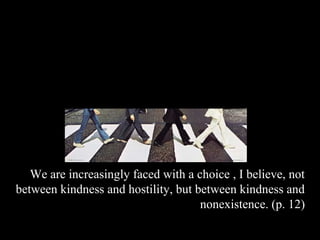
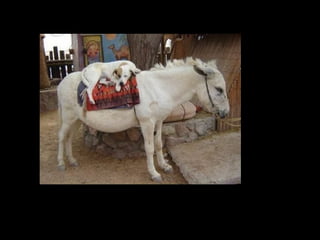
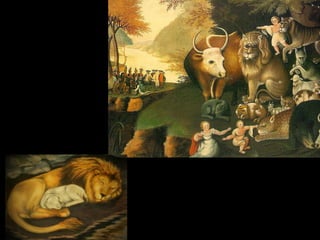
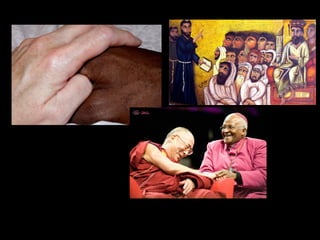
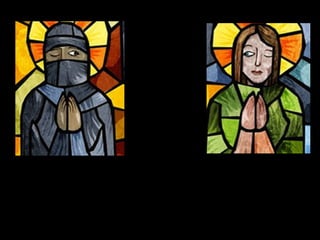
We are increasingly faced with a choice , I believe, not
between kindness and hostility, but between kindness and
                                     nonexistence. (p. 12)
Us.


Them.
Neighbor?      Us.


Them.       Enemy?
Neighbor?                    Us.

   Hostility? Hospitality?
     Different? Same?


Them.              Enemy?
Can there be peace among
passionately faithful people?
Starting Point:
We already know how to do 2
 things quite well:
We already know how to do 2
 things quite well:
1. how to have a strong Christian
  identity that is hostile toward
  people of other religions.
We have the only way.
             STRONG-
You are going to hell.
              HOSTILE
We are God’s chosen.
You worship false gods.
resistance is futile.
you will be assimilated - or
We already know how to do 2
 things quite well:
1. how to have a strong Christian
  identity that is hostile toward
  people of other religions.
2. how to have a weak Christian
  identity that is tolerant (benign)
  toward people of other religions.
it doesn’t matter what you believe.
all religions are the same.
all roads lead to god.
only sincerity matters.
doctrines divide.
     weak-benign
keep religion private.
We haven’t yet learned ...
to have a strong Christian identity
                that is benevolent
           toward other religions.
Because I Follow Jesus, I love you.

I move toward “the other.”

I break down walls of hostility.

i stand with you in solidarity.

you are made in God’s image.
                 strong-
i am your servant.

              benevolent
I practice human-kindness.
A Popular
 Misconception:
Our religious differences
 keep us apart.
Actuality:
It is not our religious
  differences that keep us apart,
  but rather one thing we all
  hold in common:
Actuality:
We build strong religious
 identities through hostility
 toward the other.
Give people a common enemy, and you will

give them a common identity. Deprive them

of an enemy and you will deprive them of

the crutch by which they know who they are.

                             - James Alison
"Historically, the amity, or goodwill, within the
group has often depended on enmity, or hatred,
between groups. But when you get to the global
level, that won't work... That cannot be the
dynamic that holds the planet together... But
what would be unprecedented is to have this
kind of solidarity and moral cohesion at a global
level that did not depend on the hatred of other
groups of people."

   (Robert Wright, Nonzero: The Logic Of Human
  Destiny, quoted in Evolutionaries: Unlocking The
       Spiritual And Cultural Potential In Science's
                  Greatest Idea, by Carter Phipps)
Can Christians today build a new
 kind of identity ... based on
 hospitality and solidarity, not
 hostility, to the other?


          strong-
       benevolent
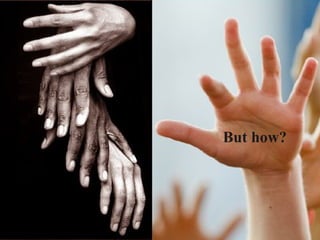
But how?
Four Challenges
    1. Historical


    3. Liturgical
     4. Missional
Four Challenges
    1. Historical
     2. Doctrinal
    3. Liturgical
     4. Missional
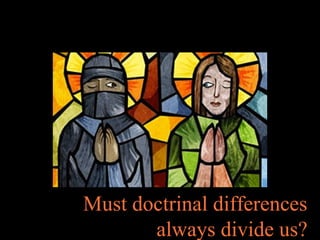
Must doctrinal differences
       always divide us?
Doctrine can mean
               “loyalty test”
 - our tribal paint, tattoos,
feathers, and accent that
distinguish “safe us” from
        “dangerous them.”
But doctrine can have another meaning ...
                        another purpose:

               Doctrine can mean

              “a healing teaching.”
What might happen if we took a
       second look at our core
      doctrines - not as hostile
       identity markers, but as
            healing teachings?
healing teachings
intended to bind together what
    has been torn and broken
                    (re-ligion)?
The Healing Teaching of
       Creation
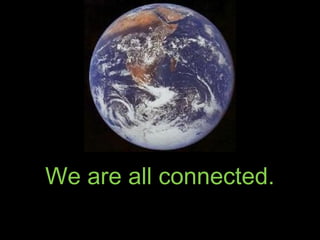
We are all connected.
The Healing Teaching of
      Original Sin
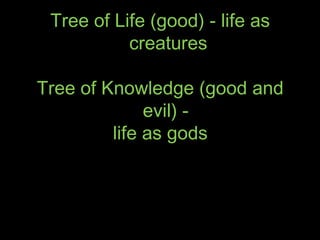
Tree of Life (good) - life as
           creatures

Tree of Knowledge (good and
              evil) -
         life as gods
The Healing Teaching of
       Election
      (or chosen-ness)
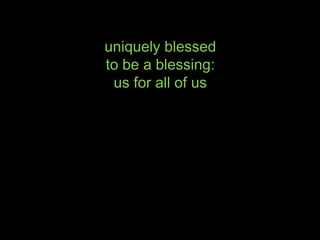
uniquely blessed
to be a blessing:
 us for all of us
The Healing Teaching of
      Incarnation
God joined with human
         flesh ...
all humanity taken up into
          God in
        solidarity
The Healing Teaching of
   the Deity of Christ
Not
“Jesus is like God”
        but
“God is like Jesus”
The Healing Teaching of
     the Holy Spirit
Pentecost Sermon (Paul Nuechterlein)
For me, another clear sign of hope comes through the
irony of God raising up a faithful disciple of Jesus
Christ who was a Hindu and remained a Hindu. I'm
talking about Mahatma Gandhi, who said this, among
many other things, about Jesus:
Jesus expressed, as no other could, the spirit and will
of God. It is in this sense that I see him and recognize
him as the Son of God. And because the life of Jesus
has the significance and the transcendency to which I
have alluded, I believe that he belongs not solely to
Christianity, but to the entire world, to all races and
people...
We might ask, So why didn't Gandhi simply convert to Christianity?
But I think the better Pentecost question would be, Why should he
have to convert? Why should he have to change religions? Why
should he have to play into religion into the negative ways that
bring division? Did Jesus come to offer us a new religion to add to
our ways of dividing into differing cultures and languages -- the
Tower of Babel reality? Or did he come to help each of us within
our own religions and cultures to find the one true God of unity? I
think that Pentecost shows us the latter. We can welcome, as many
Christians are coming to do, the diversity of religious practices that
help lead to the experience of our oneness in God. Christians are
learning from Hindus and Buddhists and Muslims and indigenous
religions the effective religious practices of how to become closer to
the God of Jesus Christ. That's the Pentecost pouring out of the
Holy Spirit on all peoples, so that their experience of oneness
transcends their many languages and cultures.
Finally, the greatest sign of hope to me is how Gandhi helped
deepen our understanding of the Spirit of Truth, the Advocate. He
had his own name for it in Sanskrit: Satyagraha, he called it, which
translates as Truth Force. Satyagraha moved him and many millions
of people over the last century to learn Jesus' way to peace through
loving, nonviolent resistance to evil. Like Jesus on the cross, in this
way to peace we risk taking that old way of sin, righteousness, and
judgment on ourselves in order to reveal its futility, its wrongness,
and offering instead God's way of grace and forgiveness. Pentecost
is Satyagraha poured out on us so that we may bring peace to our
lives as family members, co-workers, neighbors, citizens, and, yes,
as both Jesus and Gandhi compelled us to do, as children of God --
all of humanity, children of God. Amen


Rev. Paul J. Nuechterlein
Delivered at Prince of Peace Lutheran, Portage, MI, May 27, 2012
The Healing Teaching of
       the Trinity
diversity without domination

plurality without subordination

Fatherness that honors son-ness in equality (& ends patriarchy)
Son-ness that honors fatherness without rivalry (& ends patricide)
Fatherness and son-ness that uphold Spiritness without
   homogeneity (ending absolutism)


A God who generates the next generation of God!
The Healing Teaching of
 Inspiration of Scripture
“Manifold witness”
    The plurality of truth

Unity around key questions -
arguments over best answers
Expanding the Dialogue

Differences within and among
      Incommensurability
       Complementarity
      Point-Counterpoint
      Scholars & Mystics
Four Challenges
    1. Historical
     2. Doctrinal
    3. Liturgical
     4. Missional
65
Omaha 2 doctrinal

Omaha 2 doctrinal

  • 2.
    We are increasinglyfaced with a choice , I believe, not between kindness and hostility, but between kindness and nonexistence. (p. 12)
  • 4.
  • 5.
    Neighbor? Us. Them. Enemy?
  • 6.
    Neighbor? Us. Hostility? Hospitality? Different? Same? Them. Enemy?
  • 20.
    Can there bepeace among passionately faithful people?
  • 22.
  • 23.
    We already knowhow to do 2 things quite well:
  • 24.
    We already knowhow to do 2 things quite well: 1. how to have a strong Christian identity that is hostile toward people of other religions.
  • 25.
    We have theonly way. STRONG- You are going to hell. HOSTILE We are God’s chosen. You worship false gods. resistance is futile. you will be assimilated - or
  • 26.
    We already knowhow to do 2 things quite well: 1. how to have a strong Christian identity that is hostile toward people of other religions. 2. how to have a weak Christian identity that is tolerant (benign) toward people of other religions.
  • 27.
    it doesn’t matterwhat you believe. all religions are the same. all roads lead to god. only sincerity matters. doctrines divide. weak-benign keep religion private.
  • 28.
    We haven’t yetlearned ... to have a strong Christian identity that is benevolent toward other religions.
  • 29.
    Because I FollowJesus, I love you. I move toward “the other.” I break down walls of hostility. i stand with you in solidarity. you are made in God’s image. strong- i am your servant. benevolent I practice human-kindness.
  • 30.
    A Popular Misconception: Ourreligious differences keep us apart.
  • 31.
    Actuality: It is notour religious differences that keep us apart, but rather one thing we all hold in common:
  • 32.
    Actuality: We build strongreligious identities through hostility toward the other.
  • 33.
    Give people acommon enemy, and you will give them a common identity. Deprive them of an enemy and you will deprive them of the crutch by which they know who they are. - James Alison
  • 34.
    "Historically, the amity,or goodwill, within the group has often depended on enmity, or hatred, between groups. But when you get to the global level, that won't work... That cannot be the dynamic that holds the planet together... But what would be unprecedented is to have this kind of solidarity and moral cohesion at a global level that did not depend on the hatred of other groups of people." (Robert Wright, Nonzero: The Logic Of Human Destiny, quoted in Evolutionaries: Unlocking The Spiritual And Cultural Potential In Science's Greatest Idea, by Carter Phipps)
  • 35.
    Can Christians todaybuild a new kind of identity ... based on hospitality and solidarity, not hostility, to the other? strong- benevolent
  • 36.
  • 37.
    Four Challenges 1. Historical 3. Liturgical 4. Missional
  • 38.
    Four Challenges 1. Historical 2. Doctrinal 3. Liturgical 4. Missional
  • 39.
    Must doctrinal differences always divide us?
  • 40.
    Doctrine can mean “loyalty test” - our tribal paint, tattoos, feathers, and accent that distinguish “safe us” from “dangerous them.”
  • 41.
    But doctrine canhave another meaning ... another purpose: Doctrine can mean “a healing teaching.”
  • 42.
    What might happenif we took a second look at our core doctrines - not as hostile identity markers, but as healing teachings?
  • 43.
    healing teachings intended tobind together what has been torn and broken (re-ligion)?
  • 45.
  • 46.
    We are allconnected.
  • 47.
    The Healing Teachingof Original Sin
  • 48.
    Tree of Life(good) - life as creatures Tree of Knowledge (good and evil) - life as gods
  • 49.
    The Healing Teachingof Election (or chosen-ness)
  • 50.
    uniquely blessed to bea blessing: us for all of us
  • 51.
    The Healing Teachingof Incarnation
  • 52.
    God joined withhuman flesh ... all humanity taken up into God in solidarity
  • 53.
    The Healing Teachingof the Deity of Christ
  • 54.
    Not “Jesus is likeGod” but “God is like Jesus”
  • 55.
    The Healing Teachingof the Holy Spirit
  • 56.
    Pentecost Sermon (PaulNuechterlein) For me, another clear sign of hope comes through the irony of God raising up a faithful disciple of Jesus Christ who was a Hindu and remained a Hindu. I'm talking about Mahatma Gandhi, who said this, among many other things, about Jesus: Jesus expressed, as no other could, the spirit and will of God. It is in this sense that I see him and recognize him as the Son of God. And because the life of Jesus has the significance and the transcendency to which I have alluded, I believe that he belongs not solely to Christianity, but to the entire world, to all races and people...
  • 57.
    We might ask,So why didn't Gandhi simply convert to Christianity? But I think the better Pentecost question would be, Why should he have to convert? Why should he have to change religions? Why should he have to play into religion into the negative ways that bring division? Did Jesus come to offer us a new religion to add to our ways of dividing into differing cultures and languages -- the Tower of Babel reality? Or did he come to help each of us within our own religions and cultures to find the one true God of unity? I think that Pentecost shows us the latter. We can welcome, as many Christians are coming to do, the diversity of religious practices that help lead to the experience of our oneness in God. Christians are learning from Hindus and Buddhists and Muslims and indigenous religions the effective religious practices of how to become closer to the God of Jesus Christ. That's the Pentecost pouring out of the Holy Spirit on all peoples, so that their experience of oneness transcends their many languages and cultures.
  • 58.
    Finally, the greatestsign of hope to me is how Gandhi helped deepen our understanding of the Spirit of Truth, the Advocate. He had his own name for it in Sanskrit: Satyagraha, he called it, which translates as Truth Force. Satyagraha moved him and many millions of people over the last century to learn Jesus' way to peace through loving, nonviolent resistance to evil. Like Jesus on the cross, in this way to peace we risk taking that old way of sin, righteousness, and judgment on ourselves in order to reveal its futility, its wrongness, and offering instead God's way of grace and forgiveness. Pentecost is Satyagraha poured out on us so that we may bring peace to our lives as family members, co-workers, neighbors, citizens, and, yes, as both Jesus and Gandhi compelled us to do, as children of God -- all of humanity, children of God. Amen Rev. Paul J. Nuechterlein Delivered at Prince of Peace Lutheran, Portage, MI, May 27, 2012
  • 59.
    The Healing Teachingof the Trinity
  • 60.
    diversity without domination pluralitywithout subordination Fatherness that honors son-ness in equality (& ends patriarchy) Son-ness that honors fatherness without rivalry (& ends patricide) Fatherness and son-ness that uphold Spiritness without homogeneity (ending absolutism) A God who generates the next generation of God!
  • 61.
    The Healing Teachingof Inspiration of Scripture
  • 62.
    “Manifold witness” The plurality of truth Unity around key questions - arguments over best answers
  • 63.
    Expanding the Dialogue Differenceswithin and among Incommensurability Complementarity Point-Counterpoint Scholars & Mystics
  • 64.
    Four Challenges 1. Historical 2. Doctrinal 3. Liturgical 4. Missional
  • 65.