
SUBCHAPTER V: A VIEW FROM
KEY PARTICIPANTS
A Presentation of the Utah Bankruptcy Law Forum
March 2, 2021
Presenters:
Judge William T. Thurman, United States Bankruptcy Judge
Andres Diaz, Partner, Diaz & Larsen
Brian M. Rothschild, Shareholder, Parsons Behle & Latimer, Subchapter V Trustee
Moderated by David W. Newman, Assistant United States Trustee
Part I:
An Overview of the SBRA
One Year After Its Effective Date
U B
L F
3
The Small Business Reorganization Act (SBRA) was signed into law on August
26, 2019. SBRA added Subchapter V comprising sections 1181-1195 to
Chapter 11 of the Bankruptcy Code to provide a streamlined procedure for
reorganization of businesses that could not reorganize under the ordinary
provisions of Chapter 11.
Congress revised SBRA in The Coronavirus Aid, Relief, and Economic Security
Act (the “CARES Act”) enacted and effective March 27, 2020, by increasing the
debt limit for eligibility to $7.5 million.
The Small Business Reorganization Act of 2019
UBLF – March 2, 2021
4
 The Subchapter V Trustee. Unlike other Chapter 11 cases, a trustee is always appointed and yet, the debtor
remains in possession. The trustee’s duties are limited and set forth primarily in section 1183.
 No U.S. Trustee Fees. The debtor does not pay U.S. Trustee quarterly fees.
 Default of No Committee. Unless the court orders otherwise, there is no unsecured creditors’ committee.
 Plan Deadlines and Exclusivity. The debtor must file a plan within 90 days of the petition date unless extended,
but there is no confirmation deadline. Only the debtor may propose a plan, ever.
 Modification/Abrogation of Absolute Priority Rule. Subject to section 1191, a debtor may receive a discharge
upon completion of a plan and equity may retain its interest notwithstanding that all creditors may not be paid in full.
 No Disclosure Statement Required. The plan may be solicited without a disclosure statement.
 Eligibility Requirements. Only a small business debtor within the meaning of section 101(51D) may elect to
proceed under Subchapter V. See next slide.
Key Differences Between Subchapter V and
Traditional Chapter 11
UBLF – March 2, 2021
5
Under section 101(51D), a debtor may elect to proceed under Subchapter V if it
is a “small business debtor,” which is defined as a debtor with not more than
$2,725,625 in aggregate noncontingent liquidated secured and unsecured
business debts as of the date of the petition date.
The “Small Business Debtor” Defined
UBLF – March 2, 2021
6
Almost immediately after SBRA became effective, Congress in the CARES Act increased the
debt limit to $7.5 million temporarily for one year beginning on March 27, 2020.
Although there were hopes that Congress would act again to extend or make the increased debt
limit permanent (or even increase it to $10 million), Congress has not acted. Therefore, absent
another act of Congress, the debt limit will revert to $2,725,625 (periodically adjusted for
inflation) on March 26, 2021.
However, on February 25, 2021, Senators Dick Durbin (D-IL) and Chuck Grassley (R-IA)
introduced the COVID-19 Bankruptcy Relief Extension Act, which would temporarily extend
COVID-19 bankruptcy relief provisions enacted as part of the March 2020 CARES Act and
December 2020 omnibus appropriations bill. If it is passed as currently drafted, the $7.5 million
debt limit would remain through March 27, 2022.
Debt Limit Adjustments – Still Up in the Air
UBLF – March 2, 2021
Part II:
The Key Participants in a Subchapter V Case
U B
L F
8
The key participants in a Subchapter V case include (in no particular
order), the following:
 The Bankruptcy Judge
 The United States Trustee
 The Subchapter V Trustee
 The Debtor
Today, we have one representative of each who will discuss their
role, expectations, and interesting legal issues under Subchapter V.
Key Participants
UBLF – March 2, 2021
9
General Expectations
 The debtor, the Subchapter V Trustee, and the creditors must work together cooperatively.
 The Debtor must double check and meet all deadlines, including the following:
– hold an initial status conference under section 1188(a) (within 60 days of the petition date).
– file a detailed report under section 1188(c) (no later than 14 days before the status conference) .
– file a plan under section 1189(b) (no later than 90 days after the petition date unless extended).
 Recognize that some of the provisions of Chapter 11 apply, while others do not. See section 1181. Also, see, e.g.,
section 1187(b) (incorporating debtor disclosure requirements of sections 308 and 1116(2)-(7)).
 Be prepared for much of the complexity of a Chapter 11: Subchapter V is not an easy way to get around Chapter
11.
 Competence – counsel should understand disclosure, confirmation, and eligibility requirements in the Code.
 Counsel should be familiar with the Court’s technology for hearings.
 If confirmation is contested, counsel should be prepared at the confirmation hearing with evidence of the issues
raised, eligibility, and fair and equitable treatment on secured creditors’ collateral. The Federal Rules of Evidence
apply in contested matters and adversary proceedings, and parties’ counsel should understand them.
The Bankruptcy Judge
What does the bankruptcy judge expect from the participants in a
Subchapter V case?
UBLF – March 2, 2021
10
Expectations for the Debtor and Debtor’s Counsel
 Understand the dynamics of Subchapter V.
 Double check the Debtor’s qualification for Sub V relief including the “in business,” requirement, the “operating”
requirement, and the debt cap. A petition is filed under Rule 11.
 Know your client and the business attributes of the case.
 Identify the main issues as early as possible and put them in the filings. Do not hide the ball. The section 1188(c)
status report is a good place to frame those issues for the Court.
 Timely file all reports and other disclosures, including schedules, SOFA, monthly operating reports, etc.
 File counsel and other professionals’ retention applications immediately upon the petition date. Remember, a
professional providing services without a pending employment application is a volunteer. In re Interwest Bus. Equip,
Inc., 23 F. 3d 311, 318 (10th Cir. 1994).
 In a contested confirmation, the debtor must be prepared with the law and evidence, including, if applicable, expert
testimony, on the issue of “fair and equitable” in Subchapter V under section 1191.
 Exhibit good faith. There are consequences for evasive and misleading behavior. In re Wetter, 620 B.R. 243, 254
(Bankr. W.D. Va. 2020).
 Understand that, like in ordinary Chapter 11, conditions for the use of cash collateral apply in Subchapter V. This is
every bit as much of a case killer in Subchapter V if not complied with.
The Bankruptcy Judge (cont.)
UBLF – March 2, 2021
11
Expectations for the Creditors and Creditors’ Counsel
 Understand the dynamics of Subchapter V.
 Read and understand sections 1181-1195 and other pertinent provisions.
 Know the points of attack and consider discovery on the issues, including—
– The debt cap
– “Business debt”
– “Operating” requirement – Compare In re Thurmon, 2020 WL 7249555 (Bankr. W.D. Mo. 2020) with In re Wright, 2020 WL
2193240 (Bankr. D. S.C. 2020)
– Other eligibility requirements
– Confirmation requirements
– Valuation of collateral
Expectations for the Subchapter V Trustee
 At confirmation, offer the Trustee’s view of whether the debtor has complied with the provisions of Chapter 11 and whether the plan is
confirmable.
 Use good judgment as to how much involvement is required in light of the state of the debtor’s affairs, sophistication of debtor’s
counsel, the administrative costs the case can bear, and other relevant factors.
 Monitor the case and the debtor’s disclosures – be the Court’s eyes and ears.
The Bankruptcy Judge (cont.)
UBLF – March 2, 2021
12
General Role - 28 U.S.C. § 586(a)(3)
 The U.S. Trustee’s watchdog role is the same in Subchapter V as it is in Chapter 11 notwithstanding that there are
no U.S. Trustee’s fees. This means that the U.S. Trustee is a party in interest with standing to take positions,
object, and be heard on all matters, including debtor eligibility, professional compensation, and plan confirmation.
 The U.S. Trustee appoints the Subchapter V Trustee, conducts the initial debtor interview and the first meeting of
creditors under section 341(a).
 In the absence of an unsecured creditors’ committee, the U.S. Trustee may take a proactive approach to ensure the
debtor’s compliance with the Code and, if the debtor is failing, it can seek removal of the debtor in possession,
dismissal, or conversion.
Expectations for the Debtor and Debtor’s Counsel
 Careful compliance with all disclosure and reporting requirements, e.g., sections 1187, 1188 and the sections
incorporated thereunder.
 Full compliance with the initial reporting requirements and attendance at the initial debtor interview and 341(a) first
meeting of creditors.
 Careful compliance with all filing deadlines, e.g., plan, controlled entity report, monthly operating reports, and status
conference report under section 1188(c).
The United States Trustee
UBLF – March 2, 2021
13
The Role of the Subchapter V Trustee
Section 1183 defines the Subchapter V trustee’s role. The primary duty is to “facilitate the development of
a consensual plan of reorganization.” § 1183(b)(7). Other duties include—
• Appear and be heard at any hearing concerning (1) the value of property subject to a lien; (2) confirmation of the
plan; (3) modification of the plan after confirmation; and (4) the sale of property of the estate. § 1183(b)(3).
• If ordered by the court, (1) investigate the acts, conduct, assets, liabilities, and financial condition of the debtor, the
operation of the debtor’s business, the desirability of its continuance, and any other matter relevant to the case or
formulation of a plan; (2) file a statement of the investigation, including any fact ascertained pertaining to fraud,
dishonesty, incompetence, misconduct, mismanagement, or irregularity in the management of the affairs of the
debtor or to a cause of action available to the estate, and to transmit a copy or summary of it to entities that the court
directs; and (3) file post-confirmation reports as the court directs. § 1183(b)(2).
• The role of the trustee is not yet well fleshed out. The trustee may do very little (non-possessory, no payment
routing, just observing) or a lot (ordered to investigate, take possession, operate the business, disburse property, file
reports, object to claims, etc.).
The Subchapter V Trustee
UBLF – March 2, 2021
14
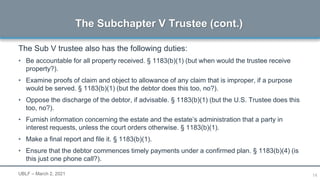
The Sub V trustee also has the following duties:
• Be accountable for all property received. § 1183(b)(1) (but when would the trustee receive
property?).
• Examine proofs of claim and object to allowance of any claim that is improper, if a purpose
would be served. § 1183(b)(1) (but the debtor does this too, no?).
• Oppose the discharge of the debtor, if advisable. § 1183(b)(1) (but the U.S. Trustee does this
too, no?).
• Furnish information concerning the estate and the estate’s administration that a party in
interest requests, unless the court orders otherwise. § 1183(b)(1).
• Make a final report and file it. § 1183(b)(1).
• Ensure that the debtor commences timely payments under a confirmed plan. § 1183(b)(4) (is
this just one phone call?).
The Subchapter V Trustee (cont.)
UBLF – March 2, 2021
15
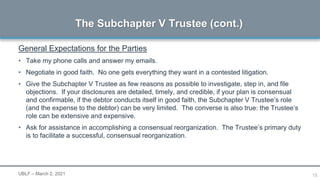
General Expectations for the Parties
• Take my phone calls and answer my emails.
• Negotiate in good faith. No one gets everything they want in a contested litigation.
• Give the Subchapter V Trustee as few reasons as possible to investigate, step in, and file
objections. If your disclosures are detailed, timely, and credible, if your plan is consensual
and confirmable, if the debtor conducts itself in good faith, the Subchapter V Trustee’s role
(and the expense to the debtor) can be very limited. The converse is also true: the Trustee’s
role can be extensive and expensive.
• Ask for assistance in accomplishing a consensual reorganization. The Trustee’s primary duty
is to facilitate a successful, consensual reorganization.
The Subchapter V Trustee (cont.)
UBLF – March 2, 2021
16
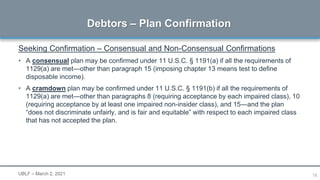
Seeking Confirmation – Consensual and Non-Consensual Confirmations
• A consensual plan may be confirmed under 11 U.S.C. § 1191(a) if all the requirements of
1129(a) are met―other than paragraph 15 (imposing chapter 13 means test to define
disposable income).
• A cramdown plan may be confirmed under 11 U.S.C. § 1191(b) if all the requirements of
1129(a) are met―other than paragraphs 8 (requiring acceptance by each impaired class), 10
(requiring acceptance by at least one impaired non-insider class), and 15―and the plan
“does not discriminate unfairly, and is fair and equitable” with respect to each impaired class
that has not accepted the plan.
Debtors – Plan Confirmation
UBLF – March 2, 2021
17
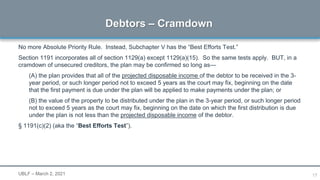
No more Absolute Priority Rule. Instead, Subchapter V has the “Best Efforts Test.”
Section 1191 incorporates all of section 1129(a) except 1129(a)(15). So the same tests apply. BUT, in a
cramdown of unsecured creditors, the plan may be confirmed so long as—
(A) the plan provides that all of the projected disposable income of the debtor to be received in the 3-
year period, or such longer period not to exceed 5 years as the court may fix, beginning on the date
that the first payment is due under the plan will be applied to make payments under the plan; or
(B) the value of the property to be distributed under the plan in the 3-year period, or such longer period
not to exceed 5 years as the court may fix, beginning on the date on which the first distribution is due
under the plan is not less than the projected disposable income of the debtor.
§ 1191(c)(2) (aka the “Best Efforts Test”).
Debtors – Cramdown
UBLF – March 2, 2021
Part III:
Open and Developing Issues in Subchapter V
U B
L F
19
3 versus 5 years. There is no standard in Subchapter V (unlike Chapter 13)
for when the debtor must pay for 5 versus 3 years. Compare section
1325(b)(4)’s test for “applicable commitment period” with . . . well, nothing
because section 1191 of Subchapter V contains no equivalent provision.
Disposable Income. The “Best Efforts Test” requires commitment of all of the
debtor’s projected disposable income for the 3 to 5 year period. But the
definition of disposable income in section 1191(d) is vague and ill-defined.
Business debtors (unless they are individuals) do not have standardized
expenses that can be set by the IRS and income is not ascertainable by simply
referencing a W-2.
Open and Developing Issues
UBLF – March 2, 2021
20
Resolution of Guarantor Liability. A recurring problem will likely be how to resolve guarantor
liability. It is unclear whether bare guarantors that are not themselves in business are eligible
debtors because they may not be “operating” a business. They may need to file their own
concurrent case under a different chapter. See recent decision In re Johnson, 19-42063 (Bankr.
N.D. Tex. March 1, 2021).
Changing Role of the Subchapter V Trustee. While section 1183 contains some guidance,
the Subchapter V Trustee’s involvement can range from minimal to very active. A particularly
thorny issue arises when the Trustee is called upon to “mediate” between parties. The Trustee
is supposed to be a neutral (to fulfil its role to facilitate consensual resolution) but there are a
number of situations in which the Trustee can turn partisan (e.g., objecting to claims, objecting
to discharge, or investigating the debtor’s affairs).
Open and Developing Issues (cont.)
UBLF – March 2, 2021
21
Trustee Discretion – Active Versus Passive. The Subchapter V Trustee may
do a lot or very little. The default is that the Trustee does not spend estate
resources investigating the financial affairs of the debtor, operating the
business, or creating reports of its investigations. It is only “if the court so
orders.” § 1183(b)(2). At whose behest does the Trustee act? Only upon
motion of the U.S. Trustee? Only when the Court raises the issue? On the
Trustee’s own volition? The list of people who can raise the issue is
“everyone.” § 1183(b)(2) (on request of a party in interest, the trustee, or the
United States Trustee”). Anyone can move for the Trustee to act, but who is
required to do it?
Open and Developing Issues (cont.)
UBLF – March 2, 2021

Subchapter V: A View from Key Participants

  • 1.
    SUBCHAPTER V: AVIEW FROM KEY PARTICIPANTS A Presentation of the Utah Bankruptcy Law Forum March 2, 2021 Presenters: Judge William T. Thurman, United States Bankruptcy Judge Andres Diaz, Partner, Diaz & Larsen Brian M. Rothschild, Shareholder, Parsons Behle & Latimer, Subchapter V Trustee Moderated by David W. Newman, Assistant United States Trustee
  • 2.
    Part I: An Overviewof the SBRA One Year After Its Effective Date U B L F
  • 3.
    3 The Small BusinessReorganization Act (SBRA) was signed into law on August 26, 2019. SBRA added Subchapter V comprising sections 1181-1195 to Chapter 11 of the Bankruptcy Code to provide a streamlined procedure for reorganization of businesses that could not reorganize under the ordinary provisions of Chapter 11. Congress revised SBRA in The Coronavirus Aid, Relief, and Economic Security Act (the “CARES Act”) enacted and effective March 27, 2020, by increasing the debt limit for eligibility to $7.5 million. The Small Business Reorganization Act of 2019 UBLF – March 2, 2021
  • 4.
    4  The SubchapterV Trustee. Unlike other Chapter 11 cases, a trustee is always appointed and yet, the debtor remains in possession. The trustee’s duties are limited and set forth primarily in section 1183.  No U.S. Trustee Fees. The debtor does not pay U.S. Trustee quarterly fees.  Default of No Committee. Unless the court orders otherwise, there is no unsecured creditors’ committee.  Plan Deadlines and Exclusivity. The debtor must file a plan within 90 days of the petition date unless extended, but there is no confirmation deadline. Only the debtor may propose a plan, ever.  Modification/Abrogation of Absolute Priority Rule. Subject to section 1191, a debtor may receive a discharge upon completion of a plan and equity may retain its interest notwithstanding that all creditors may not be paid in full.  No Disclosure Statement Required. The plan may be solicited without a disclosure statement.  Eligibility Requirements. Only a small business debtor within the meaning of section 101(51D) may elect to proceed under Subchapter V. See next slide. Key Differences Between Subchapter V and Traditional Chapter 11 UBLF – March 2, 2021
  • 5.
    5 Under section 101(51D),a debtor may elect to proceed under Subchapter V if it is a “small business debtor,” which is defined as a debtor with not more than $2,725,625 in aggregate noncontingent liquidated secured and unsecured business debts as of the date of the petition date. The “Small Business Debtor” Defined UBLF – March 2, 2021
  • 6.
    6 Almost immediately afterSBRA became effective, Congress in the CARES Act increased the debt limit to $7.5 million temporarily for one year beginning on March 27, 2020. Although there were hopes that Congress would act again to extend or make the increased debt limit permanent (or even increase it to $10 million), Congress has not acted. Therefore, absent another act of Congress, the debt limit will revert to $2,725,625 (periodically adjusted for inflation) on March 26, 2021. However, on February 25, 2021, Senators Dick Durbin (D-IL) and Chuck Grassley (R-IA) introduced the COVID-19 Bankruptcy Relief Extension Act, which would temporarily extend COVID-19 bankruptcy relief provisions enacted as part of the March 2020 CARES Act and December 2020 omnibus appropriations bill. If it is passed as currently drafted, the $7.5 million debt limit would remain through March 27, 2022. Debt Limit Adjustments – Still Up in the Air UBLF – March 2, 2021
  • 7.
    Part II: The KeyParticipants in a Subchapter V Case U B L F
  • 8.
    8 The key participantsin a Subchapter V case include (in no particular order), the following:  The Bankruptcy Judge  The United States Trustee  The Subchapter V Trustee  The Debtor Today, we have one representative of each who will discuss their role, expectations, and interesting legal issues under Subchapter V. Key Participants UBLF – March 2, 2021
  • 9.
    9 General Expectations  Thedebtor, the Subchapter V Trustee, and the creditors must work together cooperatively.  The Debtor must double check and meet all deadlines, including the following: – hold an initial status conference under section 1188(a) (within 60 days of the petition date). – file a detailed report under section 1188(c) (no later than 14 days before the status conference) . – file a plan under section 1189(b) (no later than 90 days after the petition date unless extended).  Recognize that some of the provisions of Chapter 11 apply, while others do not. See section 1181. Also, see, e.g., section 1187(b) (incorporating debtor disclosure requirements of sections 308 and 1116(2)-(7)).  Be prepared for much of the complexity of a Chapter 11: Subchapter V is not an easy way to get around Chapter 11.  Competence – counsel should understand disclosure, confirmation, and eligibility requirements in the Code.  Counsel should be familiar with the Court’s technology for hearings.  If confirmation is contested, counsel should be prepared at the confirmation hearing with evidence of the issues raised, eligibility, and fair and equitable treatment on secured creditors’ collateral. The Federal Rules of Evidence apply in contested matters and adversary proceedings, and parties’ counsel should understand them. The Bankruptcy Judge What does the bankruptcy judge expect from the participants in a Subchapter V case? UBLF – March 2, 2021
  • 10.
    10 Expectations for theDebtor and Debtor’s Counsel  Understand the dynamics of Subchapter V.  Double check the Debtor’s qualification for Sub V relief including the “in business,” requirement, the “operating” requirement, and the debt cap. A petition is filed under Rule 11.  Know your client and the business attributes of the case.  Identify the main issues as early as possible and put them in the filings. Do not hide the ball. The section 1188(c) status report is a good place to frame those issues for the Court.  Timely file all reports and other disclosures, including schedules, SOFA, monthly operating reports, etc.  File counsel and other professionals’ retention applications immediately upon the petition date. Remember, a professional providing services without a pending employment application is a volunteer. In re Interwest Bus. Equip, Inc., 23 F. 3d 311, 318 (10th Cir. 1994).  In a contested confirmation, the debtor must be prepared with the law and evidence, including, if applicable, expert testimony, on the issue of “fair and equitable” in Subchapter V under section 1191.  Exhibit good faith. There are consequences for evasive and misleading behavior. In re Wetter, 620 B.R. 243, 254 (Bankr. W.D. Va. 2020).  Understand that, like in ordinary Chapter 11, conditions for the use of cash collateral apply in Subchapter V. This is every bit as much of a case killer in Subchapter V if not complied with. The Bankruptcy Judge (cont.) UBLF – March 2, 2021
  • 11.
    11 Expectations for theCreditors and Creditors’ Counsel  Understand the dynamics of Subchapter V.  Read and understand sections 1181-1195 and other pertinent provisions.  Know the points of attack and consider discovery on the issues, including— – The debt cap – “Business debt” – “Operating” requirement – Compare In re Thurmon, 2020 WL 7249555 (Bankr. W.D. Mo. 2020) with In re Wright, 2020 WL 2193240 (Bankr. D. S.C. 2020) – Other eligibility requirements – Confirmation requirements – Valuation of collateral Expectations for the Subchapter V Trustee  At confirmation, offer the Trustee’s view of whether the debtor has complied with the provisions of Chapter 11 and whether the plan is confirmable.  Use good judgment as to how much involvement is required in light of the state of the debtor’s affairs, sophistication of debtor’s counsel, the administrative costs the case can bear, and other relevant factors.  Monitor the case and the debtor’s disclosures – be the Court’s eyes and ears. The Bankruptcy Judge (cont.) UBLF – March 2, 2021
  • 12.
    12 General Role -28 U.S.C. § 586(a)(3)  The U.S. Trustee’s watchdog role is the same in Subchapter V as it is in Chapter 11 notwithstanding that there are no U.S. Trustee’s fees. This means that the U.S. Trustee is a party in interest with standing to take positions, object, and be heard on all matters, including debtor eligibility, professional compensation, and plan confirmation.  The U.S. Trustee appoints the Subchapter V Trustee, conducts the initial debtor interview and the first meeting of creditors under section 341(a).  In the absence of an unsecured creditors’ committee, the U.S. Trustee may take a proactive approach to ensure the debtor’s compliance with the Code and, if the debtor is failing, it can seek removal of the debtor in possession, dismissal, or conversion. Expectations for the Debtor and Debtor’s Counsel  Careful compliance with all disclosure and reporting requirements, e.g., sections 1187, 1188 and the sections incorporated thereunder.  Full compliance with the initial reporting requirements and attendance at the initial debtor interview and 341(a) first meeting of creditors.  Careful compliance with all filing deadlines, e.g., plan, controlled entity report, monthly operating reports, and status conference report under section 1188(c). The United States Trustee UBLF – March 2, 2021
  • 13.
    13 The Role ofthe Subchapter V Trustee Section 1183 defines the Subchapter V trustee’s role. The primary duty is to “facilitate the development of a consensual plan of reorganization.” § 1183(b)(7). Other duties include— • Appear and be heard at any hearing concerning (1) the value of property subject to a lien; (2) confirmation of the plan; (3) modification of the plan after confirmation; and (4) the sale of property of the estate. § 1183(b)(3). • If ordered by the court, (1) investigate the acts, conduct, assets, liabilities, and financial condition of the debtor, the operation of the debtor’s business, the desirability of its continuance, and any other matter relevant to the case or formulation of a plan; (2) file a statement of the investigation, including any fact ascertained pertaining to fraud, dishonesty, incompetence, misconduct, mismanagement, or irregularity in the management of the affairs of the debtor or to a cause of action available to the estate, and to transmit a copy or summary of it to entities that the court directs; and (3) file post-confirmation reports as the court directs. § 1183(b)(2). • The role of the trustee is not yet well fleshed out. The trustee may do very little (non-possessory, no payment routing, just observing) or a lot (ordered to investigate, take possession, operate the business, disburse property, file reports, object to claims, etc.). The Subchapter V Trustee UBLF – March 2, 2021
  • 14.
    14 The Sub Vtrustee also has the following duties: • Be accountable for all property received. § 1183(b)(1) (but when would the trustee receive property?). • Examine proofs of claim and object to allowance of any claim that is improper, if a purpose would be served. § 1183(b)(1) (but the debtor does this too, no?). • Oppose the discharge of the debtor, if advisable. § 1183(b)(1) (but the U.S. Trustee does this too, no?). • Furnish information concerning the estate and the estate’s administration that a party in interest requests, unless the court orders otherwise. § 1183(b)(1). • Make a final report and file it. § 1183(b)(1). • Ensure that the debtor commences timely payments under a confirmed plan. § 1183(b)(4) (is this just one phone call?). The Subchapter V Trustee (cont.) UBLF – March 2, 2021
  • 15.
    15 General Expectations forthe Parties • Take my phone calls and answer my emails. • Negotiate in good faith. No one gets everything they want in a contested litigation. • Give the Subchapter V Trustee as few reasons as possible to investigate, step in, and file objections. If your disclosures are detailed, timely, and credible, if your plan is consensual and confirmable, if the debtor conducts itself in good faith, the Subchapter V Trustee’s role (and the expense to the debtor) can be very limited. The converse is also true: the Trustee’s role can be extensive and expensive. • Ask for assistance in accomplishing a consensual reorganization. The Trustee’s primary duty is to facilitate a successful, consensual reorganization. The Subchapter V Trustee (cont.) UBLF – March 2, 2021
  • 16.
    16 Seeking Confirmation –Consensual and Non-Consensual Confirmations • A consensual plan may be confirmed under 11 U.S.C. § 1191(a) if all the requirements of 1129(a) are met―other than paragraph 15 (imposing chapter 13 means test to define disposable income). • A cramdown plan may be confirmed under 11 U.S.C. § 1191(b) if all the requirements of 1129(a) are met―other than paragraphs 8 (requiring acceptance by each impaired class), 10 (requiring acceptance by at least one impaired non-insider class), and 15―and the plan “does not discriminate unfairly, and is fair and equitable” with respect to each impaired class that has not accepted the plan. Debtors – Plan Confirmation UBLF – March 2, 2021
  • 17.
    17 No more AbsolutePriority Rule. Instead, Subchapter V has the “Best Efforts Test.” Section 1191 incorporates all of section 1129(a) except 1129(a)(15). So the same tests apply. BUT, in a cramdown of unsecured creditors, the plan may be confirmed so long as— (A) the plan provides that all of the projected disposable income of the debtor to be received in the 3- year period, or such longer period not to exceed 5 years as the court may fix, beginning on the date that the first payment is due under the plan will be applied to make payments under the plan; or (B) the value of the property to be distributed under the plan in the 3-year period, or such longer period not to exceed 5 years as the court may fix, beginning on the date on which the first distribution is due under the plan is not less than the projected disposable income of the debtor. § 1191(c)(2) (aka the “Best Efforts Test”). Debtors – Cramdown UBLF – March 2, 2021
  • 18.
    Part III: Open andDeveloping Issues in Subchapter V U B L F
  • 19.
    19 3 versus 5years. There is no standard in Subchapter V (unlike Chapter 13) for when the debtor must pay for 5 versus 3 years. Compare section 1325(b)(4)’s test for “applicable commitment period” with . . . well, nothing because section 1191 of Subchapter V contains no equivalent provision. Disposable Income. The “Best Efforts Test” requires commitment of all of the debtor’s projected disposable income for the 3 to 5 year period. But the definition of disposable income in section 1191(d) is vague and ill-defined. Business debtors (unless they are individuals) do not have standardized expenses that can be set by the IRS and income is not ascertainable by simply referencing a W-2. Open and Developing Issues UBLF – March 2, 2021
  • 20.
    20 Resolution of GuarantorLiability. A recurring problem will likely be how to resolve guarantor liability. It is unclear whether bare guarantors that are not themselves in business are eligible debtors because they may not be “operating” a business. They may need to file their own concurrent case under a different chapter. See recent decision In re Johnson, 19-42063 (Bankr. N.D. Tex. March 1, 2021). Changing Role of the Subchapter V Trustee. While section 1183 contains some guidance, the Subchapter V Trustee’s involvement can range from minimal to very active. A particularly thorny issue arises when the Trustee is called upon to “mediate” between parties. The Trustee is supposed to be a neutral (to fulfil its role to facilitate consensual resolution) but there are a number of situations in which the Trustee can turn partisan (e.g., objecting to claims, objecting to discharge, or investigating the debtor’s affairs). Open and Developing Issues (cont.) UBLF – March 2, 2021
  • 21.
    21 Trustee Discretion –Active Versus Passive. The Subchapter V Trustee may do a lot or very little. The default is that the Trustee does not spend estate resources investigating the financial affairs of the debtor, operating the business, or creating reports of its investigations. It is only “if the court so orders.” § 1183(b)(2). At whose behest does the Trustee act? Only upon motion of the U.S. Trustee? Only when the Court raises the issue? On the Trustee’s own volition? The list of people who can raise the issue is “everyone.” § 1183(b)(2) (on request of a party in interest, the trustee, or the United States Trustee”). Anyone can move for the Trustee to act, but who is required to do it? Open and Developing Issues (cont.) UBLF – March 2, 2021