INDIAN ETHOS IN MANAGEMENT
TYBMS - B
GROUP NO. 7
DISCLAIMER
All the information given during the presentation
is in good faith and for general information
purpose only.
Also does not mean to hurt anyone’s sentiments.
Religion is commonly defined in terms of an
organized set of beliefs and practices - directed
toward spiritual concerns - that are shared by a
community”.
A particular system of faith and worship
RELIGION
COMPARISION OF VARIOUS RELIGION
Hinduism Islam Christianity Buddhism
Origin India Arabian
peninsula
Palestine India
Deity Polytheistic Allah God (Trinity) None / pantheon of
deities
FOUNDERS Does not have a
founder or date
of origin. Rather,
the tradition
understands
itself to be
timeless, having
always existed.
The founder of
Islam is the
prophet
Muhammad,
who was born
in Mecca in
approximately
570 C.E.
Is founded in
the life and
teachings of
Jesus, and was
established in
Jerusalem
The founder was a
wealthy prince,
born in India in the
6th or 5th century
B.C.E., who
renounced wealth
and power to seek
enlightenment.
Hinduism Islam Christianity Buddhism
Scriptures Hinduism does
not rely
exclusively on
any single
scripture, but
rather on a vast
collection of
sacred writings
of which the
Vedas are the
foundation.
The Quran is
the sacred
scripture of
Islam and is
believed to be
the unaltered
word of God.
Christian
scriptures are
gathered in the
Christian Bible,
which contains
the Jewish
scriptures
They include
record of the
Buddha's
teachings and
structures for
Buddhist social
organization. It
evolved through
the centuries,
&devotional
stories were then
added to the
canon.
Hinduism Islam Christianity Buddhism
Principles of
Moral Thought
and Action
Dharma and
karma are the
underlying
principles of
nearly all
conceptions of
morality and
ethics in
Hinduism.
Muslims' ethical
and moral
commitments
regulating their
daily lives derive
from their
understanding of
the demands of
revelation and are
referred to as the
Shariah.
Christians follow
the principles of
morality
expressed by
Jesus' command
to love God and
neighbor, and rely
on the Ten
Commandments
Buddhist
principles of
moral thought
and action
include karma,
merit, and the
Eightfold Path.
The Eightfold Path
provides
guidelines for
behavior that will
lead to spiritual
growth.
Hinduism Islam Christianity Buddhism
Human Nature
and the
Purpose of
Existence
Hinduism is in
many ways a
profoundly
structured
religion that
presents what
sometimes
appears to be a
highly rigid
understanding
of human
existence.
Islam teaches
that the
purpose of
existence is to
love and serve
God through
loving and
serving others.
Christianity
teaches that
human beings
were created
good by a loving
God. While
being prone to
sin and in need
of grace, they
are partners in
accomplishing
God's plan for
existence.
Human nature
is illustrated by
the Buddhist
teaching of
dependent
origination, or
arising, which
shows how
poisonous
mental states
give rise to
suffering.
ACTIVITY 1
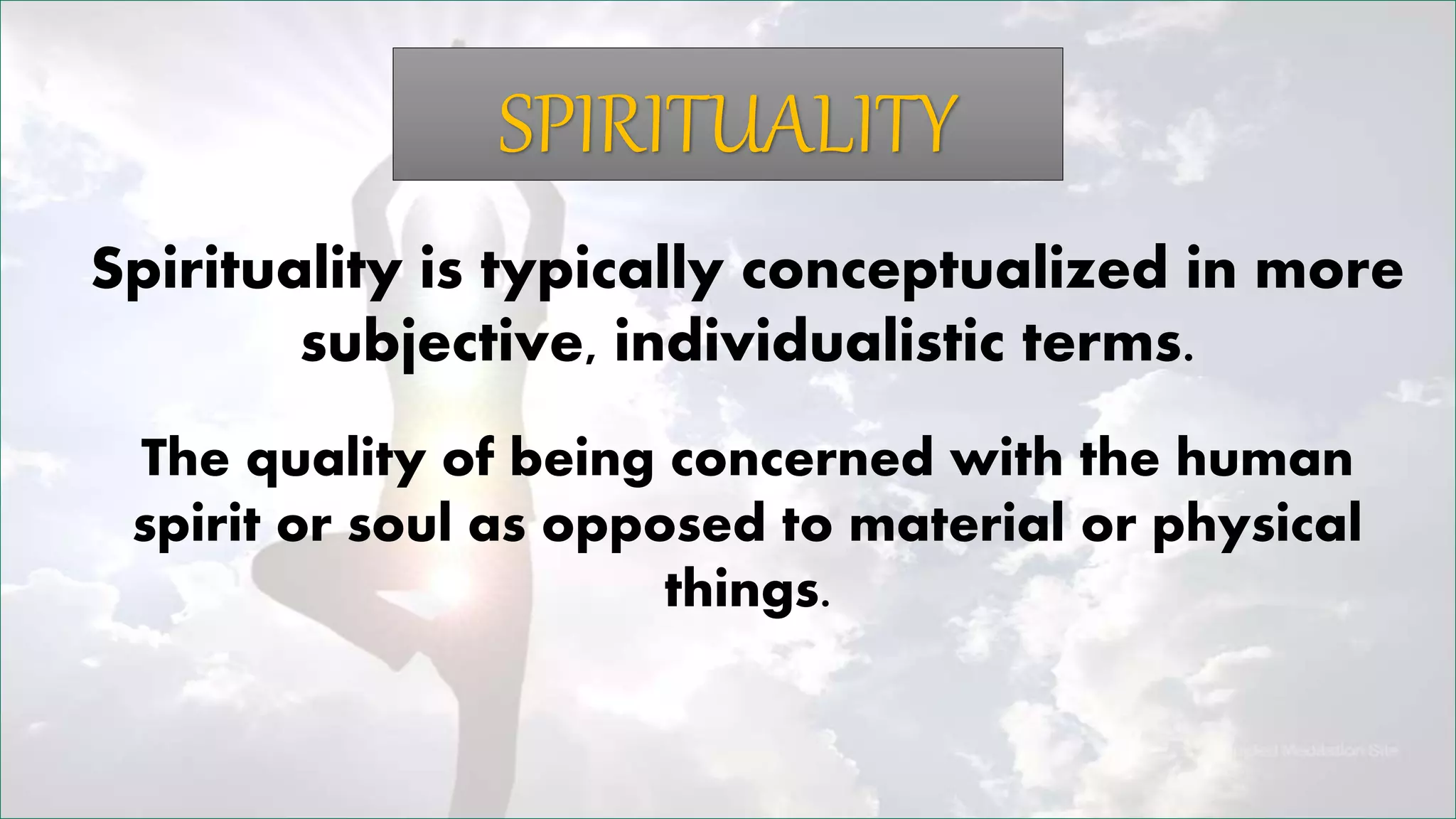
Spirituality is typically conceptualized in more
subjective, individualistic terms.
The quality of being concerned with the human
spirit or soul as opposed to material or physical
things.
SPIRITUALITY
ACTIVITY 2
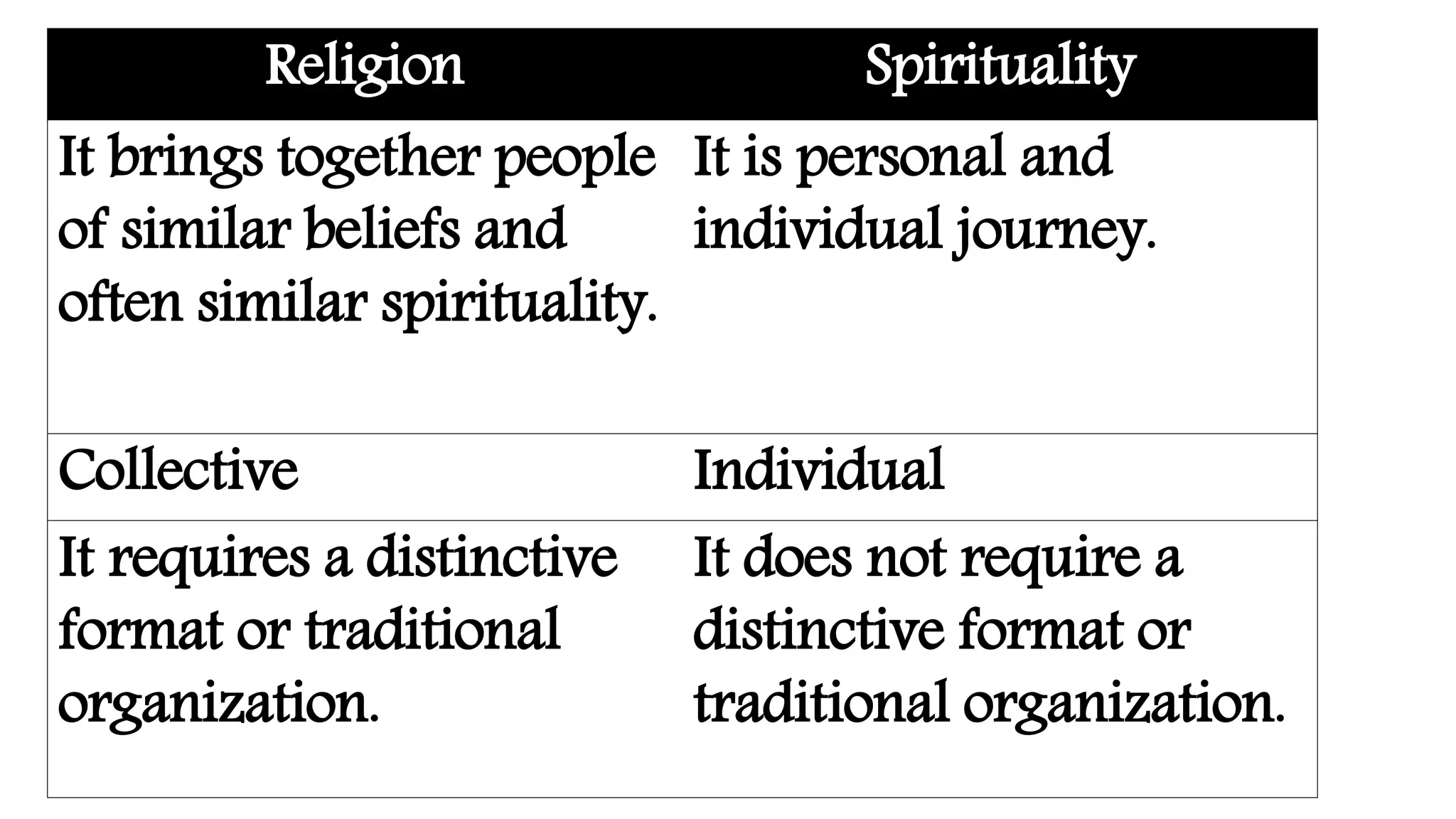
Religion Spirituality
It brings together people
of similar beliefs and
often similar spirituality.
It is personal and
individual journey.
Collective Individual
It requires a distinctive
format or traditional
organization.
It does not require a
distinctive format or
traditional organization.
Religion Spirituality
The emphasis is on the institution. The emphasis is on the
individual.
It is typically experienced within
a social institution with
commonly shared traditions,
sacred texts, beliefs, and worship
practices. Religious institutions
usually have a governing
structure with designated leaders.
It is part of each person that
searches for finding the
answers to life’s essential
questions about purpose,
meaning, worth, and wonder,
often in quest of an ultimate
value or the holy.
Religion Spirituality
Religious commitment Equanimity
Religion usually entails adhering to a
certain belief system.
Religion talks of God as being high in
the heavens. At times God can seem
far from the reach of aspiring
humanity.
Spirituality is concerned with
growing into and experiencing
the Divine consciousness.
Spirituality shows us that God is
omnipresent and can be felt as a
living presence in our own heart.
Religion Without Spirituality
It causes
• Terrorism
• Prejudice
• Extremism
• Bigotry
• Racism.
Spirituality Without a Religion
 It is like if you decide to travel to another city
without taking any known road.
Application of religion in personal life
Puts a smile on your face
Raises self esteem
Soothes anxiety
Protects against depressive symptoms
Religion in management
– Diverse religion brings Unity amongst
the workplace (festivals)
– No Discrimination
– Respect for all
Application of spirituality in personal life
• Meditation
• Spiritual reading
• Practice gratitude
• Spend time in nature
• Being open to the signs from
universe
• Mindful breathing
SPIRITUALITY IN MANAGEMENT
 The influence of religion and spirituality
 Compassion
 Right livelihood
 Selfless service
 Work as meditation
 Problems with pluralism
SPIRITUALITY IN RELIGION
CHRISTIANITY
• Catholic spirituality is the spiritual practice of living out a personal act of
faith following the acceptance of faith.
• Progressive Christianity is a contemporary movement which seeks to
remove the supernatural claims of the faith and replace them with a post-
critical understanding of biblical spirituality based on historical and
scientific research.
• It focuses on the lived experience of spirituality over historical dogmatic
claims, and accepts that the faith is both true and a human construction,
and that spiritual experiences are psychologically and neurally real and
useful.
ISLAM
■ The best known form of Islamic mystic spirituality is
the Sufi tradition.
■ In this tradition, a spiritual master or pir transmits spiritual
discipline to students.
■ These orders meet for spiritual sessions (majalis) in meeting
places known as zawiyas, khanqahs, or tekke.
■ Sufis strive for ihsan (perfection of worship) : "Ihsan is to
worship Allah as if you see Him; if you can't see Him, surely
He sees you.
BUDDHISM
• Buddhist spiritual practices are known as Bhavana, which
literally means "development" or "cultivating“ or
"producing" in the sense of "calling into existence.
• Buddhist terms :
I. Bhavana– Spiritual cultivation
II. citta-bhavana - Development or cultivation of the
heart/mind.
III. metta-bhavana - the development/cultivation of
lovingkindness.
HINDUISM
• SPIRITUALITY IN HINDU PHILOSOPHY IS AN INDIVIDUAL
EXPERIENCE, AND REFERRED TO AS KSAITRAJÑA
•IT DEFINES SPIRITUAL PRACTICE AS ONE'S JOURNEY
TOWARDS MOKSHA, AWARENESS OF SELF, THE DISCOVERY OF
HIGHER TRUTHS, TRUE NATURE OF REALITY, AND A CONSCIOUSNESS
THAT IS LIBERATED AND CONTENT.
•TRADITIONALLY, HINDUISM IDENTIFIES THREE WAYS OF SPIRITUAL PRACTICE NAMELY
•JNANA, THE WAY OF KNOWLEDGE;
•BHAKTI, THE WAY OF DEVOTION: AND
•KARMA YOGA, THE WAY OF SELFLESS ACTION.
•IN THE 19TH CENTURY VIVEKANANDA, ADDED RAJA YOGA, THE WAY OF CONTEMPLATION
AND MEDITATION, AS A FOURTH WAY, CALLING ALL OF THEM “YOGA”.
Spirituality vs religion

Spirituality vs religion

  • 1.
    INDIAN ETHOS INMANAGEMENT TYBMS - B GROUP NO. 7
  • 8.
    DISCLAIMER All the informationgiven during the presentation is in good faith and for general information purpose only. Also does not mean to hurt anyone’s sentiments.
  • 9.
    Religion is commonlydefined in terms of an organized set of beliefs and practices - directed toward spiritual concerns - that are shared by a community”. A particular system of faith and worship RELIGION
  • 10.
  • 11.
    Hinduism Islam ChristianityBuddhism Origin India Arabian peninsula Palestine India Deity Polytheistic Allah God (Trinity) None / pantheon of deities FOUNDERS Does not have a founder or date of origin. Rather, the tradition understands itself to be timeless, having always existed. The founder of Islam is the prophet Muhammad, who was born in Mecca in approximately 570 C.E. Is founded in the life and teachings of Jesus, and was established in Jerusalem The founder was a wealthy prince, born in India in the 6th or 5th century B.C.E., who renounced wealth and power to seek enlightenment.
  • 12.
    Hinduism Islam ChristianityBuddhism Scriptures Hinduism does not rely exclusively on any single scripture, but rather on a vast collection of sacred writings of which the Vedas are the foundation. The Quran is the sacred scripture of Islam and is believed to be the unaltered word of God. Christian scriptures are gathered in the Christian Bible, which contains the Jewish scriptures They include record of the Buddha's teachings and structures for Buddhist social organization. It evolved through the centuries, &devotional stories were then added to the canon.
  • 13.
    Hinduism Islam ChristianityBuddhism Principles of Moral Thought and Action Dharma and karma are the underlying principles of nearly all conceptions of morality and ethics in Hinduism. Muslims' ethical and moral commitments regulating their daily lives derive from their understanding of the demands of revelation and are referred to as the Shariah. Christians follow the principles of morality expressed by Jesus' command to love God and neighbor, and rely on the Ten Commandments Buddhist principles of moral thought and action include karma, merit, and the Eightfold Path. The Eightfold Path provides guidelines for behavior that will lead to spiritual growth.
  • 14.
    Hinduism Islam ChristianityBuddhism Human Nature and the Purpose of Existence Hinduism is in many ways a profoundly structured religion that presents what sometimes appears to be a highly rigid understanding of human existence. Islam teaches that the purpose of existence is to love and serve God through loving and serving others. Christianity teaches that human beings were created good by a loving God. While being prone to sin and in need of grace, they are partners in accomplishing God's plan for existence. Human nature is illustrated by the Buddhist teaching of dependent origination, or arising, which shows how poisonous mental states give rise to suffering.
  • 15.
  • 16.
    Spirituality is typicallyconceptualized in more subjective, individualistic terms. The quality of being concerned with the human spirit or soul as opposed to material or physical things. SPIRITUALITY
  • 17.
  • 19.
    Religion Spirituality It bringstogether people of similar beliefs and often similar spirituality. It is personal and individual journey. Collective Individual It requires a distinctive format or traditional organization. It does not require a distinctive format or traditional organization.
  • 20.
    Religion Spirituality The emphasisis on the institution. The emphasis is on the individual. It is typically experienced within a social institution with commonly shared traditions, sacred texts, beliefs, and worship practices. Religious institutions usually have a governing structure with designated leaders. It is part of each person that searches for finding the answers to life’s essential questions about purpose, meaning, worth, and wonder, often in quest of an ultimate value or the holy.
  • 21.
    Religion Spirituality Religious commitmentEquanimity Religion usually entails adhering to a certain belief system. Religion talks of God as being high in the heavens. At times God can seem far from the reach of aspiring humanity. Spirituality is concerned with growing into and experiencing the Divine consciousness. Spirituality shows us that God is omnipresent and can be felt as a living presence in our own heart.
  • 22.
    Religion Without Spirituality Itcauses • Terrorism • Prejudice • Extremism • Bigotry • Racism.
  • 23.
    Spirituality Without aReligion  It is like if you decide to travel to another city without taking any known road.
  • 24.
    Application of religionin personal life Puts a smile on your face Raises self esteem Soothes anxiety Protects against depressive symptoms
  • 25.
    Religion in management –Diverse religion brings Unity amongst the workplace (festivals) – No Discrimination – Respect for all
  • 26.
    Application of spiritualityin personal life • Meditation • Spiritual reading • Practice gratitude • Spend time in nature • Being open to the signs from universe • Mindful breathing
  • 27.
    SPIRITUALITY IN MANAGEMENT The influence of religion and spirituality  Compassion  Right livelihood  Selfless service  Work as meditation  Problems with pluralism
  • 28.
    SPIRITUALITY IN RELIGION CHRISTIANITY •Catholic spirituality is the spiritual practice of living out a personal act of faith following the acceptance of faith. • Progressive Christianity is a contemporary movement which seeks to remove the supernatural claims of the faith and replace them with a post- critical understanding of biblical spirituality based on historical and scientific research. • It focuses on the lived experience of spirituality over historical dogmatic claims, and accepts that the faith is both true and a human construction, and that spiritual experiences are psychologically and neurally real and useful.
  • 29.
    ISLAM ■ The bestknown form of Islamic mystic spirituality is the Sufi tradition. ■ In this tradition, a spiritual master or pir transmits spiritual discipline to students. ■ These orders meet for spiritual sessions (majalis) in meeting places known as zawiyas, khanqahs, or tekke. ■ Sufis strive for ihsan (perfection of worship) : "Ihsan is to worship Allah as if you see Him; if you can't see Him, surely He sees you.
  • 30.
    BUDDHISM • Buddhist spiritualpractices are known as Bhavana, which literally means "development" or "cultivating“ or "producing" in the sense of "calling into existence. • Buddhist terms : I. Bhavana– Spiritual cultivation II. citta-bhavana - Development or cultivation of the heart/mind. III. metta-bhavana - the development/cultivation of lovingkindness.
  • 31.
    HINDUISM • SPIRITUALITY INHINDU PHILOSOPHY IS AN INDIVIDUAL EXPERIENCE, AND REFERRED TO AS KSAITRAJÑA •IT DEFINES SPIRITUAL PRACTICE AS ONE'S JOURNEY TOWARDS MOKSHA, AWARENESS OF SELF, THE DISCOVERY OF HIGHER TRUTHS, TRUE NATURE OF REALITY, AND A CONSCIOUSNESS THAT IS LIBERATED AND CONTENT.
  • 32.
    •TRADITIONALLY, HINDUISM IDENTIFIESTHREE WAYS OF SPIRITUAL PRACTICE NAMELY •JNANA, THE WAY OF KNOWLEDGE; •BHAKTI, THE WAY OF DEVOTION: AND •KARMA YOGA, THE WAY OF SELFLESS ACTION. •IN THE 19TH CENTURY VIVEKANANDA, ADDED RAJA YOGA, THE WAY OF CONTEMPLATION AND MEDITATION, AS A FOURTH WAY, CALLING ALL OF THEM “YOGA”.