ASIAN RELGIONS
     AND
 PHILOSOPHIES
Why are there many
religions and
philosophies in Asia?
Why does religion
matter to people?
What is the value of
 religion to you?
Nowadays, people tend to interchangeably use
religion and philosophy. By etymology, religion
comes from the latin word religionem which
means "respect for what is sacred, reverence for
the gods," "obligation, the bond between man
and the gods” while philosophy comes from
two words “philo” which means love and
“Sophia” which means wisdom.
Are they the same? NO. People tend to treat
them similarly because of their very striking
similarities. How are they similar?
Both religion and philosophy wrestle
with problems like: What is good? What
does it mean to live a good life? What is
the nature of reality? Why are we here
and what should we be doing? How
should we treat each other? What is
really most important in life?
Religion : is a belief in a supreme
power and worship of it as the
creator and controller of the universe
without reasoning whereas
philosophy is a pursuit of wisdom by
intellectual search and logical
reasoning.
Religion insists on the performance
of rituals, commandments and
hierarchies of leadership whereas
philosophy does not emphasize the
ritualistic aspect of life because it is a
way of thinking/of rationalization of
truth.
Another difference is the fact that
philosophy tends to emphasize just
the use of reason and critical
thinking whereas religions may make
use of reason, but at the very least
they also rely on faith, or even use
faith to the exclusion of reason.
Finally, most religions tend to include some sort of
  belief in what can only be described as the
  “miraculous” — events which either defy normal
  explanation or which are, in principal, outside the
  boundaries of what should occur in our universe.
  Miracles may not play a very large role in every
  religion, but they are a common feature which
  you don’t find in philosophy. Nietzsche wasn’t
  born of a virgin, no angels appeared to announce
  the conception of Sartre, and Hume didn’t make
  the lame walk again.
 In short, they key differentiating factors
    between religion and philosophy are:
   Supreme power
   Reasoning vs. faith
   Rituals
   miracles
Can you name two or more religions? philosophies?
  RELGIONS:

Zoroastrianism
Judaism
Jainism
Buddhism
Hinduism
Islam
Shintoism
Sikhism
Christianity
Can you name two or more religions? philosophies?
  PHILOSOPHIES:

Confucianism
Taoism
Legalism
Is it possible that a philosophy
can also become one’s religion?
Why?
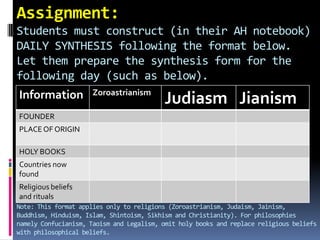
Assignment:
Students must construct (in their AH notebook)
DAILY SYNTHESIS following the format below.
Let them prepare the synthesis form for the
following day (such as below).
Information           Zoroastrianism
                                          Judiasm Jianism
FOUNDER
PLACE OF ORIGIN

HOLY BOOKS
Countries now
found
Religious beliefs
and rituals
Note: This format applies only to religions (Zoroastrianism, Judaism, Jainism,
Buddhism, Hinduism, Islam, Shintoism, Sikhism and Christianity). For philosophies
namely Confucianism, Taoism and Legalism, omit holy books and replace religious beliefs
with philosophical beliefs.

Religion and philosophy

  • 1.
    ASIAN RELGIONS AND PHILOSOPHIES
  • 2.
    Why are theremany religions and philosophies in Asia?
  • 3.
  • 4.
    What is thevalue of religion to you?
  • 5.
    Nowadays, people tendto interchangeably use religion and philosophy. By etymology, religion comes from the latin word religionem which means "respect for what is sacred, reverence for the gods," "obligation, the bond between man and the gods” while philosophy comes from two words “philo” which means love and “Sophia” which means wisdom. Are they the same? NO. People tend to treat them similarly because of their very striking similarities. How are they similar?
  • 6.
    Both religion andphilosophy wrestle with problems like: What is good? What does it mean to live a good life? What is the nature of reality? Why are we here and what should we be doing? How should we treat each other? What is really most important in life?
  • 7.
    Religion : isa belief in a supreme power and worship of it as the creator and controller of the universe without reasoning whereas philosophy is a pursuit of wisdom by intellectual search and logical reasoning.
  • 8.
    Religion insists onthe performance of rituals, commandments and hierarchies of leadership whereas philosophy does not emphasize the ritualistic aspect of life because it is a way of thinking/of rationalization of truth.
  • 9.
    Another difference isthe fact that philosophy tends to emphasize just the use of reason and critical thinking whereas religions may make use of reason, but at the very least they also rely on faith, or even use faith to the exclusion of reason.
  • 10.
    Finally, most religionstend to include some sort of belief in what can only be described as the “miraculous” — events which either defy normal explanation or which are, in principal, outside the boundaries of what should occur in our universe. Miracles may not play a very large role in every religion, but they are a common feature which you don’t find in philosophy. Nietzsche wasn’t born of a virgin, no angels appeared to announce the conception of Sartre, and Hume didn’t make the lame walk again.
  • 11.
     In short,they key differentiating factors between religion and philosophy are:  Supreme power  Reasoning vs. faith  Rituals  miracles
  • 12.
    Can you nametwo or more religions? philosophies? RELGIONS: Zoroastrianism Judaism Jainism Buddhism Hinduism Islam Shintoism Sikhism Christianity
  • 13.
    Can you nametwo or more religions? philosophies? PHILOSOPHIES: Confucianism Taoism Legalism
  • 14.
    Is it possiblethat a philosophy can also become one’s religion? Why?
  • 15.
    Assignment: Students must construct(in their AH notebook) DAILY SYNTHESIS following the format below. Let them prepare the synthesis form for the following day (such as below). Information Zoroastrianism Judiasm Jianism FOUNDER PLACE OF ORIGIN HOLY BOOKS Countries now found Religious beliefs and rituals Note: This format applies only to religions (Zoroastrianism, Judaism, Jainism, Buddhism, Hinduism, Islam, Shintoism, Sikhism and Christianity). For philosophies namely Confucianism, Taoism and Legalism, omit holy books and replace religious beliefs with philosophical beliefs.

Editor's Notes

  • #3 It reached Asia when: Malaysia: Umayyad ruler Muawiyah was in power at Damascus (SYRIA).