vision


The decline of vision with age is a universal complaint. But Prof Dan Reinstein explains how
treatment techniques are turning back the clock on ageing eyes with presbyopia


Ever decreasing circles
Presbyopia will affect all of us at some
point in our lives, occurring in 100% of
the population. The condition occurs as
the eyes age, losing ability to change
the focus of the eye to zoom from
distance to near objects. It’s an entirely
natural process resulting in gradual
visual impairment, but one which
ensures treatment is always in demand.
    The process starts from birth as the
crystalline lens grows in size and is an
unavoidable part of ageing. While the
progressive        decline      continues
throughout a lifetime, the lessened
capacity of the lens only presents itself
as a complaint around the mid-40s
when it has a discernable impact on
vision. At this stage, the eye has lost a
noticeable ability to change from distant
focusing to viewing an up-close object.
The result is that the residual focusing
power of the crystalline lens cannot
provide sufficient near vision, and
treatment       becomes        necessary,
traditionally in the form of reading
glasses or multifocal glasses.                      Traditional non-surgical methods of      high astigmatism and so a number of
                                               refractive correction for presbyopia          patients are unable to adapt to this
The Far Future                                 include the use of dedicated reading          mode of correction.
    So what options are available for the      glasses, bifocal, or varifocal glasses,
growing number of sufferers, as the            monovision contact lenses or multi-focal      Monovision contact lenses
ageing population increases? Of course         contact lenses. But these treatments              The most widely used non-spectacle
the ideal solution would be to repair the      come with their own problems.                 method of presbyopia correction is the
ability of the crystalline lens to             Research studies have indicated that          use of contact lenses through the
accommodate, but as yet no procedure           multi-focal    glasses     impair    depth    creation of monovision. In this
has been able to reverse presbyopia            perception and edge-contrast sensitivity      technique, the eyes are dissociated by
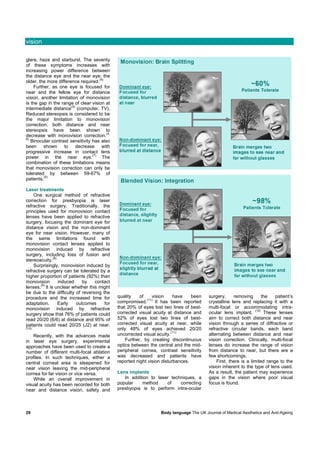
and restore the natural focusing               at critical distances for detecting           focusing one eye for distance vision and
                                                                               (2)
mechanism of the eye. There is ongoing         obstacles in the environment.                 one eye for near vision (see illustration).
research on techniques to achieve this,             While in varifocal lenses, there is a    However, the large image disparity
but clinical applications won’t be             corridor of continuously changing lens        between the two eyes causes several
                                      (1)
available for at least 10 to 20 years.         power and optimal vision is only              limitations to the quality of overall vision.
    Current     treatments     focus      on   obtained when looking though this             Although binocular distance visual
compensating       for    the    lack     of   corridor and directly facing the object of    acuity remains optimal with monovision
accommodation by providing a different         focus. Outside this corridor, the vision is   contact lenses, subjective quality of
refractive power at distance and near.         distorted and peripheral vision is            vision is decreased. There is no change
The challenge of such treatment options        reduced. For these reasons, older             in distance visual acuity because the
is to provide both distance and near           people are more likely to fall when           dominant eye is able to suppress the
                                                                            (3)
vision while simultaneously maintaining        wearing multi-focal glasses.                  blurred image from the near vision eye
optical quality, with particular regard to          Vision through bifocal lenses is the     to provide good binocular vision.
                                                 rd
contrast sensitivity and night vision          3 greatest risk factor for falls in the           However, the loss of fusion between
preservation.                                  elderly. This effect is more pronounced       the two eyes affects subjective quality of
                                               in high prescriptions, particularly for       vision and patients complain of halos,


28                                                                   Body language The UK Journal of Medical Aesthetics and Anti-Ageing
vision

glare, haze and starburst. The severity
of these symptoms increases with
increasing power difference between
the distance eye and the near eye; the
                                      (4)
older, the more difference required.
    Further, as one eye is focused for
near and the fellow eye for distance
vision, another limitation of monovision
is the gap in the range of clear vision at
                       (5)
intermediate distance (computer, TV).
Reduced stereopsis is considered to be
the major limitation to monovision
correction; both distance and near
stereopsis have been shown to
                                          (4,
decrease with monovision correction.
6)
   Binocular contrast sensitivity has also
been     shown     to decrease with
progressive increase in contact lens
                                  (7)
power in the near eye.                  The
combination of these limitations means
that monovision correction can only be
tolerated by between 59-67% of
          (5)
patients.

Laser treatments
    One surgical method of refractive
correction for presbyopia is laser
refractive surgery. Traditionally, the
principles used for monovision contact
lenses have been applied to refractive
surgery, focusing the dominant eye for
distance vision and the non-dominant
eye for near vision. However, many of
the same limitations found with
monovision contact lenses applied to
monovision induced by refractive
surgery, including loss of fusion and
              (8)
stereoacuity.
    Surprisingly, monovision induced by
refractive surgery can be tolerated by a
higher proportion of patients (92%) than
monovision        induced    by   contact
        (9)
lenses. It is unclear whether this might
be due to the difficulty of reversing the
procedure and the increased time for            quality    of    vision     have    been   surgery,     removing         the   patient’s
                                                              (11)
adaptation.       Early   outcomes     for      compromised.       It has been reported    crystalline lens and replacing it with a
monovision induced by refractive                that 20% of eyes lost two lines of best-   multi-focal or accommodating intra-
                                                                                                                    (12)
surgery show that 76% of patients could         corrected visual acuity at distance and    ocular lens implant.           These lenses
read 20/20 (6/6) at distance and 95% of         52% of eyes lost two lines of best-        aim to correct both distance and near
patients could read 20/25 (J2) at near.         corrected visual acuity at near, while     vision through a series of diffractive or
(10)                                            only 48% of eyes achieved 20/20            refractive circular bands, each band
                                                                           (11)
    Recently, with the advances made            uncorrected visual acuity.                 alternating between distance and near
in laser eye surgery, experimental                  Further, by creating discontinuous     vision correction. Clinically, multi-focal
approaches have been used to create a           optics between the central and the mid-    lenses do increase the range of vision
number of different multi-focal ablation        peripheral cornea, contrast sensitivity    from distance to near, but there are a
profiles. In such techniques, either a          was decreased and patients have            few shortcomings.
central corneal area is steepened for           reported night vision disturbances.            First, there is a limited range to the
near vision leaving the mid-peripheral                                                     vision inherent to the type of lens used.
cornea for far vision or vice versa.            Lens implants                              As a result, the patient may experience
    While an overall improvement in                In addition to laser techniques, a      gaps in the vision where poor visual
visual acuity has been recorded for both        popular    method     of    correcting     focus is found.
near and distance vision, safety and            presbyopia is to perform intra-ocular


29                                                                  Body language The UK Journal of Medical Aesthetics and Anti-Ageing
vision

    Second, multi-focal lenses have              any existing refractive error to be more              In myopes, 98% of patients without
discontinuous optics and create more             effective.                                        correction could read 20/20 at distance
than one image to enable both distance                Ideally, the depth of focus would be         and 92% could read J2 at near
vision and near vision correction. This          increased so that one eye can see                 (equivalent to a computer font size of
has been shown to reduce contrast                clearly continuously from near distances          six and used for applications such as
           (13)
sensitivity     and increase night vision        to far distances. As this is not possible,        medicine bottle labels). In hyperopes,
disturbances, with approximately, 4-8%           the new concept increases the depth of            93% of patients without correction could
of patients experiencing serious night           focus of each eye separately, with one            read 20/20 at distance and 82% could
                         (14,15)
vision     disturbances.         This     is     eye focused more for distance vision              read J2 at near.
particularly evident in patients with large      and one eye focused more for near                     Laser Blended Vision can be applied
pupils or where the inserted lens is             vision. But unlike the traditional                to patients who have already had
misaligned or tilted.                            monovision approach the increase in               cataract surgery and are implanted with
    In addition, these methods ignore            depth of focus is such that the range of          monofocal IOL lenses.
the fact that presbyopes under 65 years          clear vision achieved by the distance
in age may have some remaining                   eye and the near eye overlap at                   Future developments
accommodation which is sacrificed                intermediate distances (see illustration).             Advances in the treatment of
when the crystalline leans is replaced                The major advantage of this method           presbyopia have brought a multitude of
by an intra-ocular implant.                      is in creating a zone of fusion, where            refractive corrective options to the
                                                 the brain can merge the images of the             patient, and techniques are constantly
New approaches                                   two eyes. Therefore, much less                    improving. While most procedures are
    New developments suggest the                 suppression is required and there is no           efficient in enhancing the ability of
possibility of a laser surgical technique        dissociation between the eyes. This has           achieving distance and near correction,
with significantly less disadvantages            been proved by measuring better                   many also come with significant side
than both intra-ocular implants and              distance visual acuity binocularly than           effects and drawbacks.
existing laser refractive surgeries.             monocularly, which demonstrates the                    Currently it seems that the best
Recent      laser    refractive   surgery        neural binocular summation of the                 outcomes, lowest complications rates
                                                                                  (17)
approaches focus on modifying the                images from the two eyes.             The         and least side effects are afforded by
                           (16)
asphericity of the cornea to increase            technique not only facilitates the                non-linear aspheric refractive corneal
the depth of focus of the eye, which has         tolerance of this mode of correction, it          surgery by Laser Blended Vision. This
the advantage of maintaining more                also maintains or improves contrast               technique offers clear advantages of
natural continuous optics.                       sensitivity and prevents night vision             better refractive accuracy, no night
    Research in this area was adopted            disturbances.                                     vision disturbances, better centration,
by Professor Reinstein in 2003 in                     Termed ‘Laser Blended Vision’                no reduction in contrast sensitivity, and
collaboration with Carl Zeiss Meditec            rather than monovision (because there             fewer surgical risks. For the opening
(Jena, Germany), and aims to improve             is fusion between the two eyes at mid-            chapter of the millennium, blended
on the concept of asphericity to develop         distances) the mode of correction has             vision looks set to offer the best chance
non-linear aspheric profiles. The                shown a 98% tolerance rate since its              to help restore the youthful functionality
approach adopts a less extreme method            first deployment in 2003. In addition,            which presbyopia deteriorates.
of monovision which also allows the              when distance and near vision were
combined correction of presbyopia and            measured post-operatively no eye lost
                                                 two lines of best-corrected visual acuity.


References                                       5. Evans BJ. Monovision: a review.                10. Wright KW, Guemes A, Kapadia MS,
1. Blum M, Kunert K, Nolte S, Riehemann S,       Ophthalmic Physiol Opt. 2007;27:417-439.          Wilson SE. Binocular function and patient
Palme M, Peschel T, Dick M, Dick HB.             6. Kirschen DG, Hung CC, Nakano TR.               satisfaction after monovision induced by
[Presbyopia treatment using a femtosecond        Comparison of suppression, stereoacuity,          myopic photorefractive keratectomy. J
laser]. Ophthalmologe. 2006;103:1014-1019.       and interocular differences in visual acuity in   Cataract Refract Surg. 1999;25:177-182.
2. Lord SR, Dayhew J, Howland A. Multifocal      monovision and acuvue bifocal contact             11. Alio JL, Chaubard JJ, Caliz A, Sala E,
glasses impair edge-contrast sensitivity and     lenses. Optom Vis Sci. 1999;76:832-837.           Patel S. Correction of presbyopia by
depth perception and increase the risk of        7. Jain S, Arora I, Azar DT. Success of           technovision central       multifocal LASIK
falls in older people. J Am Geriatr Soc.         monovision in presbyopes: review of the           (presbyLASIK). J Refract Surg. 2006;22:453-
2002;50:1760-1766.                               literature and potential applications to          460.
3. Johnson L, Buckley JG, Scally AJ, Elliott     refractive    surgery.    Surv    Ophthalmol.     12. Alfonso JF, Fernandez-Vega L, Senaris
DB. Multifocal spectacles increase variability   1996;40:491-499.                                  A, Montes-Mico R. Quality of vision with the
in toe clearance and risk of tripping in the     8. Fawcett SL, Herman WK, Alfieri CD,             Acri.Twin asymmetric diffractive bifocal
elderly.   Invest   Ophthalmol    Vis    Sci.    Castleberry KA, Parks MM, Birch EE.               intraocular lens system. J Cataract Refract
2007;48:1466-1471.                               Stereoacuity and foveal fusion in adults with     Surg. 2007;33:197-202.
4. Durrie DS. The effect of different            long-standing surgical monovision. J Aapos.       13. Schmidinger G, Simader C, Dejaco-
monovision contact lens powers on the visual     2001;5:342-347.                                   Ruhswurm I, Skorpik C, Pieh S. Contrast
function of emmetropic presbyopic patients       9. Miranda D, Krueger RR. Monovision laser        sensitivity function in eyes with diffractive
(an American Ophthalmological Society            in situ keratomileusis for pre-presbyopic and     bifocal intraocular lenses. J Cataract Refract
thesis). Trans Am Ophthalmol Soc.                presbyopic patients. J Refract Surg.              Surg. 2005;31:2076-2083.
2006;104:366-401.                                2004;20:325-328.                                  14. Kohnen T, Allen D, Boureau C,
                                                                                                   Dublineau P, Hartmann C, Mehdorn E, Rozot


30                                                                       Body language The UK Journal of Medical Aesthetics and Anti-Ageing
vision

P, Tassinari G. European multicenter study
of the AcrySof ReSTOR apodized diffractive
intraocular       lens.       Ophthalmology.
2006;113:584 e581.
15. Vingolo EM, Grenga P, Iacobelli L,
Grenga R. Visual acuity and contrast
sensitivity: AcrySof ReSTOR apodized
diffractive   versus    AcrySof      SA60AT
monofocal intraocular lenses. J Cataract
Refract Surg. 2007;33:1244-1247.
16. Dai GM. Optical surface optimization for
the correction of presbyopia. Appl Opt.
2006;45:4184-4195.
17. Reinstein DZ, Couch DG, Archer TJ.
Laser in Situ Keratomileusis for the
correction of hyperopic astigmatism with
presbyopia. J Refract Surg. [In Press].


31                                             Body language The UK Journal of Medical Aesthetics and Anti-Ageing

Body Language Presbyopia Article

  • 1.
    vision The decline ofvision with age is a universal complaint. But Prof Dan Reinstein explains how treatment techniques are turning back the clock on ageing eyes with presbyopia Ever decreasing circles Presbyopia will affect all of us at some point in our lives, occurring in 100% of the population. The condition occurs as the eyes age, losing ability to change the focus of the eye to zoom from distance to near objects. It’s an entirely natural process resulting in gradual visual impairment, but one which ensures treatment is always in demand. The process starts from birth as the crystalline lens grows in size and is an unavoidable part of ageing. While the progressive decline continues throughout a lifetime, the lessened capacity of the lens only presents itself as a complaint around the mid-40s when it has a discernable impact on vision. At this stage, the eye has lost a noticeable ability to change from distant focusing to viewing an up-close object. The result is that the residual focusing power of the crystalline lens cannot provide sufficient near vision, and treatment becomes necessary, traditionally in the form of reading glasses or multifocal glasses. Traditional non-surgical methods of high astigmatism and so a number of refractive correction for presbyopia patients are unable to adapt to this The Far Future include the use of dedicated reading mode of correction. So what options are available for the glasses, bifocal, or varifocal glasses, growing number of sufferers, as the monovision contact lenses or multi-focal Monovision contact lenses ageing population increases? Of course contact lenses. But these treatments The most widely used non-spectacle the ideal solution would be to repair the come with their own problems. method of presbyopia correction is the ability of the crystalline lens to Research studies have indicated that use of contact lenses through the accommodate, but as yet no procedure multi-focal glasses impair depth creation of monovision. In this has been able to reverse presbyopia perception and edge-contrast sensitivity technique, the eyes are dissociated by and restore the natural focusing at critical distances for detecting focusing one eye for distance vision and (2) mechanism of the eye. There is ongoing obstacles in the environment. one eye for near vision (see illustration). research on techniques to achieve this, While in varifocal lenses, there is a However, the large image disparity but clinical applications won’t be corridor of continuously changing lens between the two eyes causes several (1) available for at least 10 to 20 years. power and optimal vision is only limitations to the quality of overall vision. Current treatments focus on obtained when looking though this Although binocular distance visual compensating for the lack of corridor and directly facing the object of acuity remains optimal with monovision accommodation by providing a different focus. Outside this corridor, the vision is contact lenses, subjective quality of refractive power at distance and near. distorted and peripheral vision is vision is decreased. There is no change The challenge of such treatment options reduced. For these reasons, older in distance visual acuity because the is to provide both distance and near people are more likely to fall when dominant eye is able to suppress the (3) vision while simultaneously maintaining wearing multi-focal glasses. blurred image from the near vision eye optical quality, with particular regard to Vision through bifocal lenses is the to provide good binocular vision. rd contrast sensitivity and night vision 3 greatest risk factor for falls in the However, the loss of fusion between preservation. elderly. This effect is more pronounced the two eyes affects subjective quality of in high prescriptions, particularly for vision and patients complain of halos, 28 Body language The UK Journal of Medical Aesthetics and Anti-Ageing
  • 2.
    vision glare, haze andstarburst. The severity of these symptoms increases with increasing power difference between the distance eye and the near eye; the (4) older, the more difference required. Further, as one eye is focused for near and the fellow eye for distance vision, another limitation of monovision is the gap in the range of clear vision at (5) intermediate distance (computer, TV). Reduced stereopsis is considered to be the major limitation to monovision correction; both distance and near stereopsis have been shown to (4, decrease with monovision correction. 6) Binocular contrast sensitivity has also been shown to decrease with progressive increase in contact lens (7) power in the near eye. The combination of these limitations means that monovision correction can only be tolerated by between 59-67% of (5) patients. Laser treatments One surgical method of refractive correction for presbyopia is laser refractive surgery. Traditionally, the principles used for monovision contact lenses have been applied to refractive surgery, focusing the dominant eye for distance vision and the non-dominant eye for near vision. However, many of the same limitations found with monovision contact lenses applied to monovision induced by refractive surgery, including loss of fusion and (8) stereoacuity. Surprisingly, monovision induced by refractive surgery can be tolerated by a higher proportion of patients (92%) than monovision induced by contact (9) lenses. It is unclear whether this might be due to the difficulty of reversing the procedure and the increased time for quality of vision have been surgery, removing the patient’s (11) adaptation. Early outcomes for compromised. It has been reported crystalline lens and replacing it with a monovision induced by refractive that 20% of eyes lost two lines of best- multi-focal or accommodating intra- (12) surgery show that 76% of patients could corrected visual acuity at distance and ocular lens implant. These lenses read 20/20 (6/6) at distance and 95% of 52% of eyes lost two lines of best- aim to correct both distance and near patients could read 20/25 (J2) at near. corrected visual acuity at near, while vision through a series of diffractive or (10) only 48% of eyes achieved 20/20 refractive circular bands, each band (11) Recently, with the advances made uncorrected visual acuity. alternating between distance and near in laser eye surgery, experimental Further, by creating discontinuous vision correction. Clinically, multi-focal approaches have been used to create a optics between the central and the mid- lenses do increase the range of vision number of different multi-focal ablation peripheral cornea, contrast sensitivity from distance to near, but there are a profiles. In such techniques, either a was decreased and patients have few shortcomings. central corneal area is steepened for reported night vision disturbances. First, there is a limited range to the near vision leaving the mid-peripheral vision inherent to the type of lens used. cornea for far vision or vice versa. Lens implants As a result, the patient may experience While an overall improvement in In addition to laser techniques, a gaps in the vision where poor visual visual acuity has been recorded for both popular method of correcting focus is found. near and distance vision, safety and presbyopia is to perform intra-ocular 29 Body language The UK Journal of Medical Aesthetics and Anti-Ageing
  • 3.
    vision Second, multi-focal lenses have any existing refractive error to be more In myopes, 98% of patients without discontinuous optics and create more effective. correction could read 20/20 at distance than one image to enable both distance Ideally, the depth of focus would be and 92% could read J2 at near vision and near vision correction. This increased so that one eye can see (equivalent to a computer font size of has been shown to reduce contrast clearly continuously from near distances six and used for applications such as (13) sensitivity and increase night vision to far distances. As this is not possible, medicine bottle labels). In hyperopes, disturbances, with approximately, 4-8% the new concept increases the depth of 93% of patients without correction could of patients experiencing serious night focus of each eye separately, with one read 20/20 at distance and 82% could (14,15) vision disturbances. This is eye focused more for distance vision read J2 at near. particularly evident in patients with large and one eye focused more for near Laser Blended Vision can be applied pupils or where the inserted lens is vision. But unlike the traditional to patients who have already had misaligned or tilted. monovision approach the increase in cataract surgery and are implanted with In addition, these methods ignore depth of focus is such that the range of monofocal IOL lenses. the fact that presbyopes under 65 years clear vision achieved by the distance in age may have some remaining eye and the near eye overlap at Future developments accommodation which is sacrificed intermediate distances (see illustration). Advances in the treatment of when the crystalline leans is replaced The major advantage of this method presbyopia have brought a multitude of by an intra-ocular implant. is in creating a zone of fusion, where refractive corrective options to the the brain can merge the images of the patient, and techniques are constantly New approaches two eyes. Therefore, much less improving. While most procedures are New developments suggest the suppression is required and there is no efficient in enhancing the ability of possibility of a laser surgical technique dissociation between the eyes. This has achieving distance and near correction, with significantly less disadvantages been proved by measuring better many also come with significant side than both intra-ocular implants and distance visual acuity binocularly than effects and drawbacks. existing laser refractive surgeries. monocularly, which demonstrates the Currently it seems that the best Recent laser refractive surgery neural binocular summation of the outcomes, lowest complications rates (17) approaches focus on modifying the images from the two eyes. The and least side effects are afforded by (16) asphericity of the cornea to increase technique not only facilitates the non-linear aspheric refractive corneal the depth of focus of the eye, which has tolerance of this mode of correction, it surgery by Laser Blended Vision. This the advantage of maintaining more also maintains or improves contrast technique offers clear advantages of natural continuous optics. sensitivity and prevents night vision better refractive accuracy, no night Research in this area was adopted disturbances. vision disturbances, better centration, by Professor Reinstein in 2003 in Termed ‘Laser Blended Vision’ no reduction in contrast sensitivity, and collaboration with Carl Zeiss Meditec rather than monovision (because there fewer surgical risks. For the opening (Jena, Germany), and aims to improve is fusion between the two eyes at mid- chapter of the millennium, blended on the concept of asphericity to develop distances) the mode of correction has vision looks set to offer the best chance non-linear aspheric profiles. The shown a 98% tolerance rate since its to help restore the youthful functionality approach adopts a less extreme method first deployment in 2003. In addition, which presbyopia deteriorates. of monovision which also allows the when distance and near vision were combined correction of presbyopia and measured post-operatively no eye lost two lines of best-corrected visual acuity. References 5. Evans BJ. Monovision: a review. 10. Wright KW, Guemes A, Kapadia MS, 1. Blum M, Kunert K, Nolte S, Riehemann S, Ophthalmic Physiol Opt. 2007;27:417-439. Wilson SE. Binocular function and patient Palme M, Peschel T, Dick M, Dick HB. 6. Kirschen DG, Hung CC, Nakano TR. satisfaction after monovision induced by [Presbyopia treatment using a femtosecond Comparison of suppression, stereoacuity, myopic photorefractive keratectomy. J laser]. Ophthalmologe. 2006;103:1014-1019. and interocular differences in visual acuity in Cataract Refract Surg. 1999;25:177-182. 2. Lord SR, Dayhew J, Howland A. Multifocal monovision and acuvue bifocal contact 11. Alio JL, Chaubard JJ, Caliz A, Sala E, glasses impair edge-contrast sensitivity and lenses. Optom Vis Sci. 1999;76:832-837. Patel S. Correction of presbyopia by depth perception and increase the risk of 7. Jain S, Arora I, Azar DT. Success of technovision central multifocal LASIK falls in older people. J Am Geriatr Soc. monovision in presbyopes: review of the (presbyLASIK). J Refract Surg. 2006;22:453- 2002;50:1760-1766. literature and potential applications to 460. 3. Johnson L, Buckley JG, Scally AJ, Elliott refractive surgery. Surv Ophthalmol. 12. Alfonso JF, Fernandez-Vega L, Senaris DB. Multifocal spectacles increase variability 1996;40:491-499. A, Montes-Mico R. Quality of vision with the in toe clearance and risk of tripping in the 8. Fawcett SL, Herman WK, Alfieri CD, Acri.Twin asymmetric diffractive bifocal elderly. Invest Ophthalmol Vis Sci. Castleberry KA, Parks MM, Birch EE. intraocular lens system. J Cataract Refract 2007;48:1466-1471. Stereoacuity and foveal fusion in adults with Surg. 2007;33:197-202. 4. Durrie DS. The effect of different long-standing surgical monovision. J Aapos. 13. Schmidinger G, Simader C, Dejaco- monovision contact lens powers on the visual 2001;5:342-347. Ruhswurm I, Skorpik C, Pieh S. Contrast function of emmetropic presbyopic patients 9. Miranda D, Krueger RR. Monovision laser sensitivity function in eyes with diffractive (an American Ophthalmological Society in situ keratomileusis for pre-presbyopic and bifocal intraocular lenses. J Cataract Refract thesis). Trans Am Ophthalmol Soc. presbyopic patients. J Refract Surg. Surg. 2005;31:2076-2083. 2006;104:366-401. 2004;20:325-328. 14. Kohnen T, Allen D, Boureau C, Dublineau P, Hartmann C, Mehdorn E, Rozot 30 Body language The UK Journal of Medical Aesthetics and Anti-Ageing
  • 4.
    vision P, Tassinari G.European multicenter study of the AcrySof ReSTOR apodized diffractive intraocular lens. Ophthalmology. 2006;113:584 e581. 15. Vingolo EM, Grenga P, Iacobelli L, Grenga R. Visual acuity and contrast sensitivity: AcrySof ReSTOR apodized diffractive versus AcrySof SA60AT monofocal intraocular lenses. J Cataract Refract Surg. 2007;33:1244-1247. 16. Dai GM. Optical surface optimization for the correction of presbyopia. Appl Opt. 2006;45:4184-4195. 17. Reinstein DZ, Couch DG, Archer TJ. Laser in Situ Keratomileusis for the correction of hyperopic astigmatism with presbyopia. J Refract Surg. [In Press]. 31 Body language The UK Journal of Medical Aesthetics and Anti-Ageing