International Research Journal of Engineering and Technology (IRJET) e-ISSN: 2395-0056
Volume: 06 Issue: 05 | May 2019 www.irjet.net p-ISSN: 2395-0072
© 2019, IRJET | Impact Factor value: 7.211 | ISO 9001:2008 Certified Journal | Page 4348
EFFECT OF GFRP WRAPPING ON FLEXURAL BEHAVIOUR OF REINFORED
CONCRETE BEAMS
Jincy Josy1, Minu Anna Johny2
1P.G. Student, Department of Civil Engineering, IIET Engineering College, Nellikuzhy, Kerala,
India
2Assistant Professor, Department of Civil Engineering, IIET Engineering College, Nellikuzhy, Kerala, India
---------------------------------------------------------------------***---------------------------------------------------------------------
Abstract - Strengthening of RC beams is necessary to
obtain the expected life span of structures. Strengthening of
RC beams using steel plates and FRP composites are most
common globally. In order to minimize the disadvantages of
steel , many researchers have tried various FRP composites
such as Aramid, Glass and Carbon. Advantages given by this
material is such as resistance against corrosion, high
tensile strength, superior ductility, light weight, and
absence of heavy additional equipment in application.
Strengthening the structural members of old buildings
using advanced materials is a contemporary research in the
field of repairs and rehabilitation. The strengthening of the
beams is done with different amount and configuration of
GFRP sheets. This investigation deals with experimental
study of retrofitted reinforced concrete beams using Glass
Fiber Reinforced Polymer (GFRP). The effect of number of
GFRP layers and its orientation on ultimate load carrying
capacity and failure mode of the beams are investigated.
Rectangular corrugated GFRP laminates are used for
strengthening RC beams to achieve higher flexural strength
and load carrying capacity.
Key Words: Glass Fibre Reinforced Polymer, Epoxy Resin,
Control Beam, Wrapping, Strengthening, Deflection
1.INTRODUCTION
All over the world there are structures intended for living
and transportation. The structures are of varying quality
and function. A structure is designed for a specific period
and depending on the nature of the structure, its design life
varies. Some of these structures are in such a bad condition
that they need to be replaced. There is also a need for
upgrading existing structures. As complete replacement or
reconstruction of the structure will be cost effective,
strengthening or retrofitting is an effective way to
strengthen the same. The most popular techniques for
strengthening of RC beams have involved the use of
external epoxy-bonded steel plates, but it suffers from a
serious problem of deterioration of bond at the steel and
concrete interphase due to corrosion of steel. To eliminate
these problems, steel plate was replaced by corrosion
resistant and light-weight FRP Composite plates. FRPCs
help to increase strength and ductility without excessive
increase in stiffness. Beams are the critical structural
members subjected to bending, torsion and shear in all
type of structures. Similarly, columns are also used as
various important elements subjected to axial load
combined with/without bending and are used in all type
of structures. concrete members can now be easily and
effectively strengthened using externally bonded FRP
composites. By wrapping FRP sheets, retrofitting of
concrete structures provide a more economical and
technically superior alternative to the traditional
techniques in many situations because it offers high
strength, low weight, corrosion resistance, high fatigue
resistance, easy and rapid installation and minimal change
in structural geometry. Fiber Reinforced Polymer(FRP)
systems can also be used in areas with limited access
where traditional techniques would be impractical.
2. METHODOLOGY
 Collection of the materials required for conducting
the experiment.
 Testing of the materials to determine their
properties.
 Concrete mix design.
 Curing of the beam specimen for 28 days.
 Testing of control beam under two-point loading
with simply supported end conditions.
 Bonding of the GFRP strips to the sides of the
beams varying the number of layers, type and
wrapping styles of the strips.
 Testing of the GFRP bonded beams under two-
point loading with simply supported end
conditions.
 Analysis of the test results.
3.MATERIALS AND PROPERTIES
3.1 Cement
Ordinary Portland Cement (OPC) – 53 grade (Malabar
Cement) was used for the investigation.
International Research Journal of Engineering and Technology (IRJET) e-ISSN: 2395-0056
Volume: 06 Issue: 05 | May 2019 www.irjet.net p-ISSN: 2395-0072
© 2019, IRJET | Impact Factor value: 7.211 | ISO 9001:2008 Certified Journal | Page 4349
Table -1:
CEMENT PROPERTIES
Grade OPC 53 Grade
Manufacturer Malabar Cements
Specific gravity 3.15
Fineness 8 %
Initial setting time 120 minutes
Final setting time 247 minutes
Standard consistency 27 %
Compressive strength
7 days 35 N/mm²
28 days 53 N/mm²
3.2 Fine Aggregate
M- Sand was used through out the experiment. As per IS
2386-1963, the fine aggregate passing through 4.75 mm
sieve and had a specific gravity of 2.6 was used. The
grading zone of fine aggregate was zone II as per Indian
Standard specifications.
3.3 Coarse Aggregate
Coarse aggregate are the crushed stone is used for
making concrete. The maximum size of coarse aggregate
was 20 mm and specific gravity of 2.65 subjected to as per
IS 2386 -1963.
3.4 GFRP Sheet and Epoxy Resin System
The beam strengthening was conducted by using
Chopped Strand Mat (300gsm). It’s a type of glass fiber
reinforced polymer(GFRP) and Isothalic resin was used as
the bonding agent, because of its high mechanical property
and chemical resistance.
3.5 Water
Potable water was considered for this experiment.
4.EXPERIMENTAL INVESTIGATION
4.1 Specimen Details
A total of Seven specimens of size (1800 x120x200)mm
is used in this experiment. Out of seven beam specimen,
one beam specimen served as control beam and the rest of
six beam were strengthened in flexure by bonding with
GFRP Sheet. The control beam was used to find the
ultimate load carried and hence to compare the flexural
capacity of GFRP bonded beams. Among the six beams the
experimental variables considered were the number of
layers of wrapping and type of wrapping.
Table -2:
GFRP WRAPPING CONDITIONS
Sl.No Condition Abbreviation
1 U warpping
Single Layer U1
Double Layer U2
Tripple Layer U3
2 Bottom wrapping
Single Layer B1
Double Layer B2
Tripple Layer B3
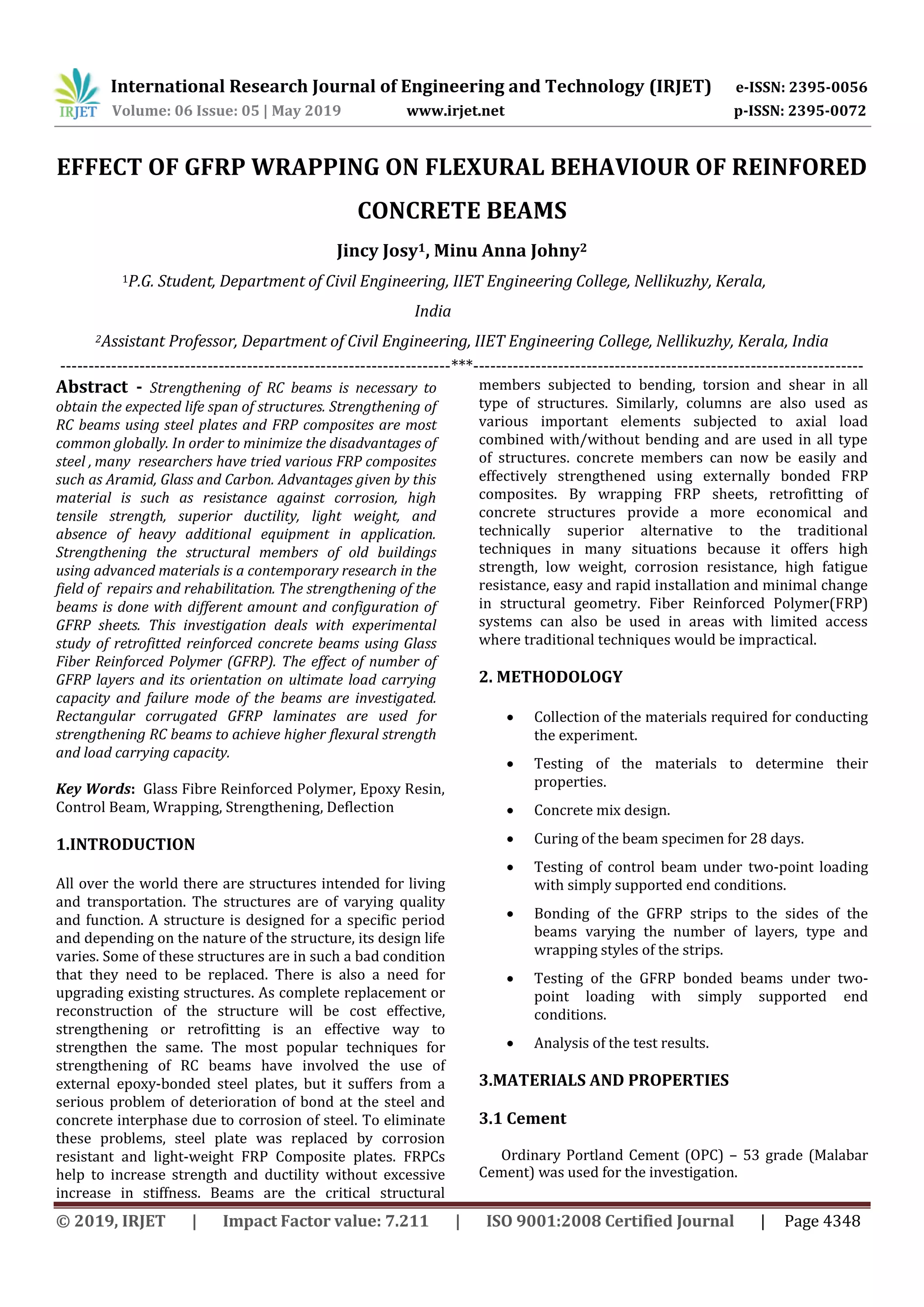
Fig -1: Reinforced concrete beam specimen
International Research Journal of Engineering and Technology (IRJET) e-ISSN: 2395-0056
Volume: 06 Issue: 05 | May 2019 www.irjet.net p-ISSN: 2395-0072
© 2019, IRJET | Impact Factor value: 7.211 | ISO 9001:2008 Certified Journal | Page 4350
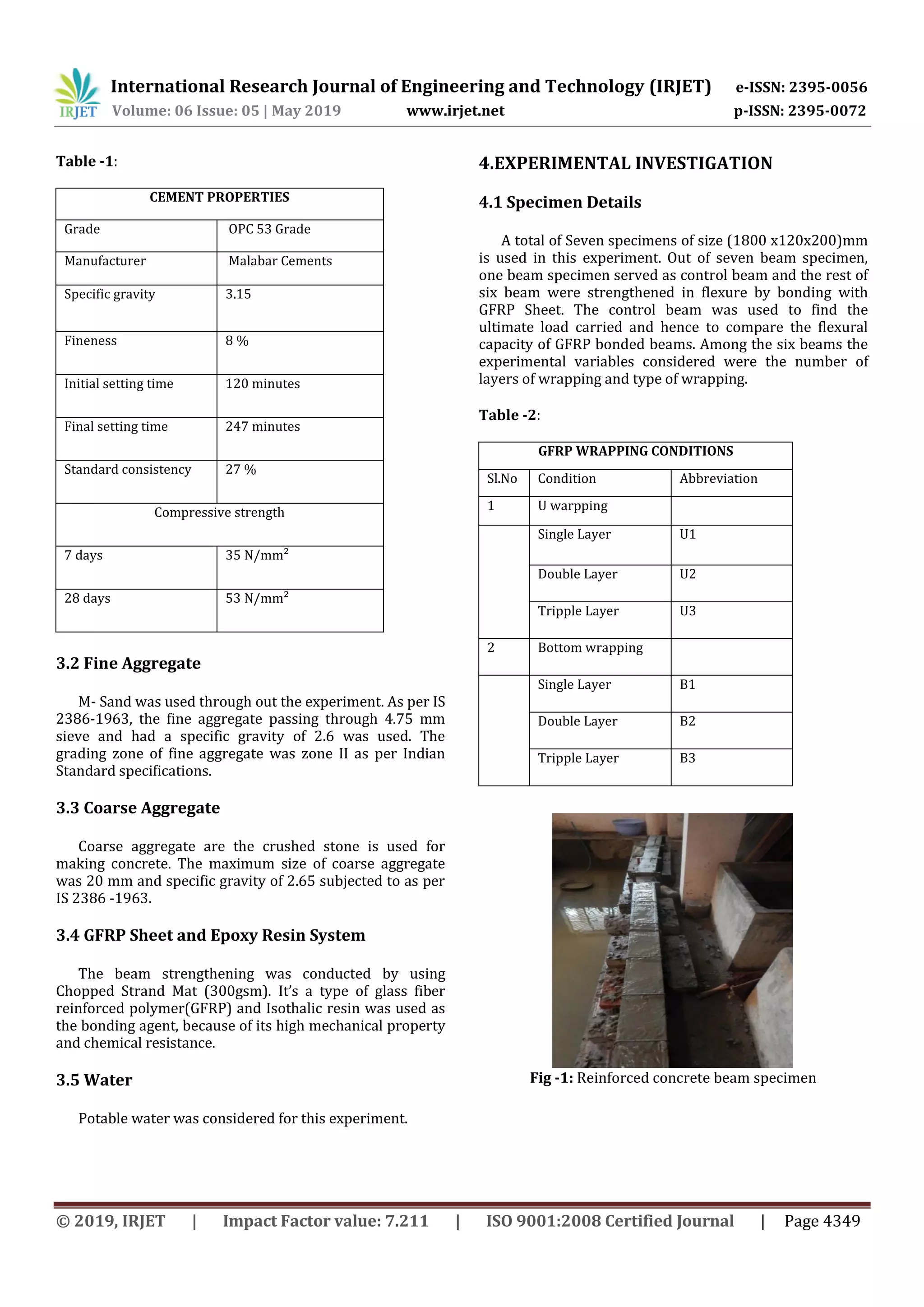
Fig -2: Application of Epoxy Resin layer on specimen
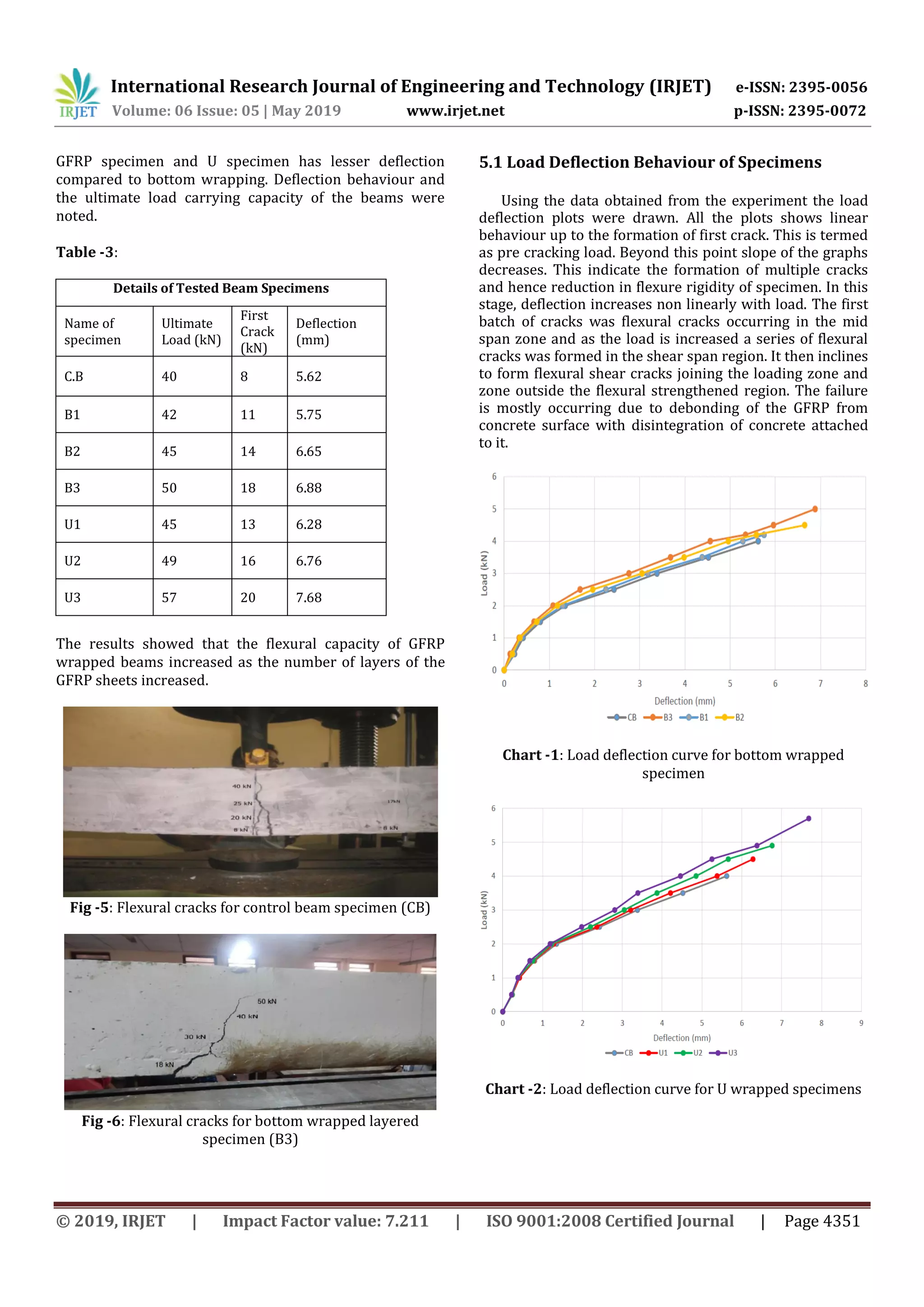
4.2 Reinforcement Details
Seven set of beams were casted for this experimental
test program. In all set of beams, 10 mm φ bars are
provided as the main longitudinal reinforcement and 8 mm
φ bars are provided at top longitudinal reinforcement and
8 mm φ bars as stirrups at a spacing of 135 mm center to
center.
Fig -4: Reinforcement details of the beam
4.3 Test Procedure
Before testing the member cured will be dried in the
sun and will be white washed and kept for 24 hours prior
to testing. The member will then be checked dimensionally,
and a detailed visual inspection made with all information
will be carefully recorded. After setting and reading all
gauges, the load will be increased incrementally up to the
calculated working load, with the loads and deflections
recorded at each stage. Loads will then normally increased
again in similar increments up to the failure, with
deflection gauges replaced by a suitably mounted scale as
that the failure approaches. This is necessary to avoid
damage to gauges and although accuracy is reduced, the
deflections at this stage will usually be large and easily
measured from the distance. Similarly, cracking and
manual strain observations must be suspended as failure
approaches unless special safety precautions are taken. If it
is essential then that precise deflection readings are taken
up to collapse. Cracking and failure mode was checked
visually, and a load v/s deflection plot was prepared.
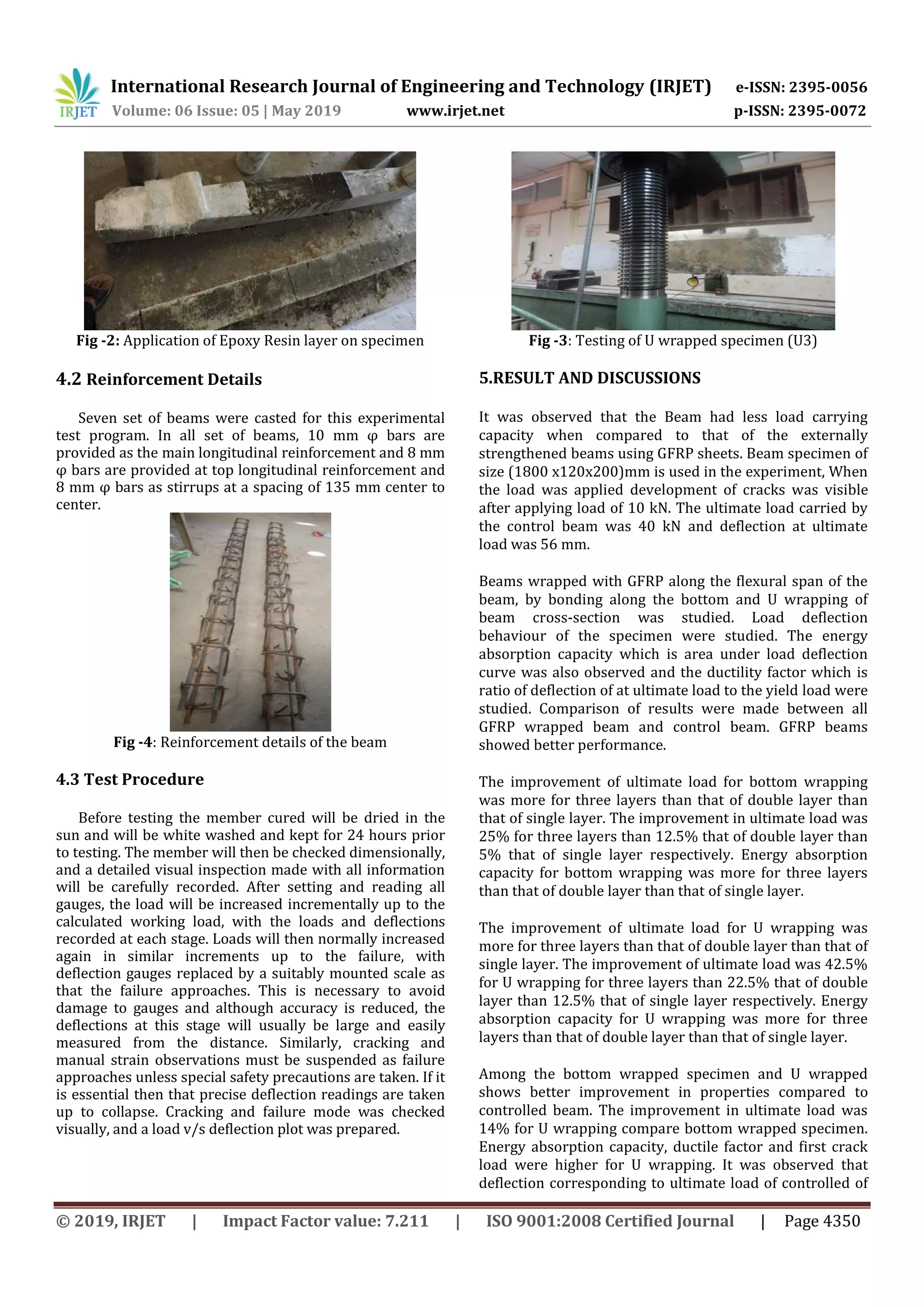
Fig -3: Testing of U wrapped specimen (U3)
5.RESULT AND DISCUSSIONS
It was observed that the Beam had less load carrying
capacity when compared to that of the externally
strengthened beams using GFRP sheets. Beam specimen of
size (1800 x120x200)mm is used in the experiment, When
the load was applied development of cracks was visible
after applying load of 10 kN. The ultimate load carried by
the control beam was 40 kN and deflection at ultimate
load was 56 mm.
Beams wrapped with GFRP along the flexural span of the
beam, by bonding along the bottom and U wrapping of
beam cross-section was studied. Load deflection
behaviour of the specimen were studied. The energy
absorption capacity which is area under load deflection
curve was also observed and the ductility factor which is
ratio of deflection of at ultimate load to the yield load were
studied. Comparison of results were made between all
GFRP wrapped beam and control beam. GFRP beams
showed better performance.
The improvement of ultimate load for bottom wrapping
was more for three layers than that of double layer than
that of single layer. The improvement in ultimate load was
25% for three layers than 12.5% that of double layer than
5% that of single layer respectively. Energy absorption
capacity for bottom wrapping was more for three layers
than that of double layer than that of single layer.
The improvement of ultimate load for U wrapping was
more for three layers than that of double layer than that of
single layer. The improvement of ultimate load was 42.5%
for U wrapping for three layers than 22.5% that of double
layer than 12.5% that of single layer respectively. Energy
absorption capacity for U wrapping was more for three
layers than that of double layer than that of single layer.
Among the bottom wrapped specimen and U wrapped
shows better improvement in properties compared to
controlled beam. The improvement in ultimate load was
14% for U wrapping compare bottom wrapped specimen.
Energy absorption capacity, ductile factor and first crack
load were higher for U wrapping. It was observed that
deflection corresponding to ultimate load of controlled of
International Research Journal of Engineering and Technology (IRJET) e-ISSN: 2395-0056
Volume: 06 Issue: 05 | May 2019 www.irjet.net p-ISSN: 2395-0072
© 2019, IRJET | Impact Factor value: 7.211 | ISO 9001:2008 Certified Journal | Page 4351
GFRP specimen and U specimen has lesser deflection
compared to bottom wrapping. Deflection behaviour and
the ultimate load carrying capacity of the beams were
noted.
Table -3:
Details of Tested Beam Specimens
Name of
specimen
Ultimate
Load (kN)
First
Crack
(kN)
Deflection
(mm)
C.B 40 8 5.62
B1 42 11 5.75
B2 45 14 6.65
B3 50 18 6.88
U1 45 13 6.28
U2 49 16 6.76
U3 57 20 7.68
The results showed that the flexural capacity of GFRP
wrapped beams increased as the number of layers of the
GFRP sheets increased.
Fig -5: Flexural cracks for control beam specimen (CB)
Fig -6: Flexural cracks for bottom wrapped layered
specimen (B3)
5.1 Load Deflection Behaviour of Specimens
Using the data obtained from the experiment the load
deflection plots were drawn. All the plots shows linear
behaviour up to the formation of first crack. This is termed
as pre cracking load. Beyond this point slope of the graphs
decreases. This indicate the formation of multiple cracks
and hence reduction in flexure rigidity of specimen. In this
stage, deflection increases non linearly with load. The first
batch of cracks was flexural cracks occurring in the mid
span zone and as the load is increased a series of flexural
cracks was formed in the shear span region. It then inclines
to form flexural shear cracks joining the loading zone and
zone outside the flexural strengthened region. The failure
is mostly occurring due to debonding of the GFRP from
concrete surface with disintegration of concrete attached
to it.
Chart -1: Load deflection curve for bottom wrapped
specimen
Chart -2: Load deflection curve for U wrapped specimens
International Research Journal of Engineering and Technology (IRJET) e-ISSN: 2395-0056
Volume: 06 Issue: 05 | May 2019 www.irjet.net p-ISSN: 2395-0072
© 2019, IRJET | Impact Factor value: 7.211 | ISO 9001:2008 Certified Journal | Page 4352
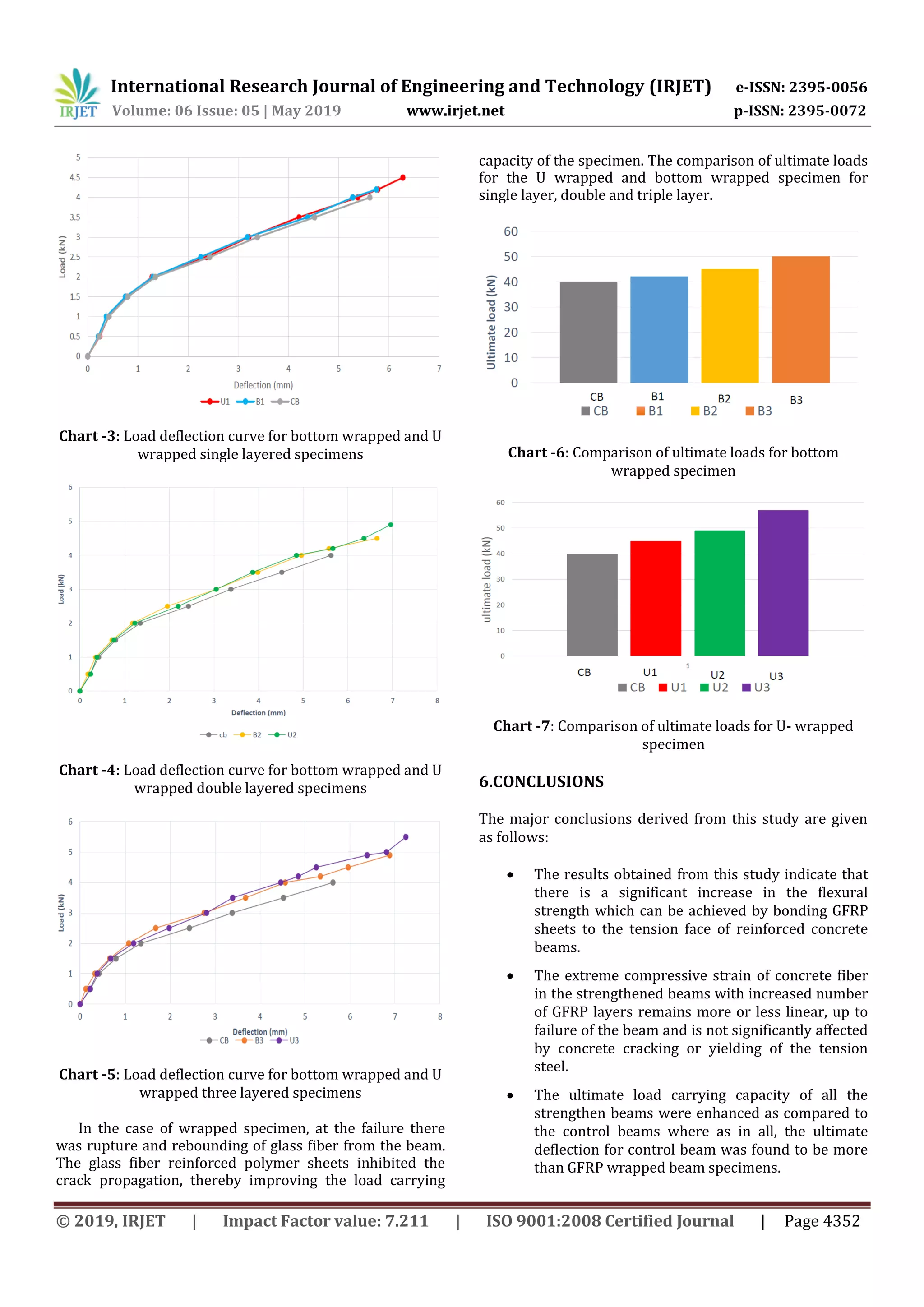
Chart -3: Load deflection curve for bottom wrapped and U
wrapped single layered specimens
Chart -4: Load deflection curve for bottom wrapped and U
wrapped double layered specimens
Chart -5: Load deflection curve for bottom wrapped and U
wrapped three layered specimens
In the case of wrapped specimen, at the failure there
was rupture and rebounding of glass fiber from the beam.
The glass fiber reinforced polymer sheets inhibited the
crack propagation, thereby improving the load carrying
capacity of the specimen. The comparison of ultimate loads
for the U wrapped and bottom wrapped specimen for
single layer, double and triple layer.
Chart -6: Comparison of ultimate loads for bottom
wrapped specimen
Chart -7: Comparison of ultimate loads for U- wrapped
specimen
6.CONCLUSIONS
The major conclusions derived from this study are given
as follows:
 The results obtained from this study indicate that
there is a significant increase in the flexural
strength which can be achieved by bonding GFRP
sheets to the tension face of reinforced concrete
beams.
 The extreme compressive strain of concrete fiber
in the strengthened beams with increased number
of GFRP layers remains more or less linear, up to
failure of the beam and is not significantly affected
by concrete cracking or yielding of the tension
steel.
 The ultimate load carrying capacity of all the
strengthen beams were enhanced as compared to
the control beams where as in all, the ultimate
deflection for control beam was found to be more
than GFRP wrapped beam specimens.
International Research Journal of Engineering and Technology (IRJET) e-ISSN: 2395-0056
Volume: 06 Issue: 05 | May 2019 www.irjet.net p-ISSN: 2395-0072
© 2019, IRJET | Impact Factor value: 7.211 | ISO 9001:2008 Certified Journal | Page 4353
 None of the beams except control beams showed
flexure failure i.e. the beams showed increased
strength in flexure. The failure pattern for
strengthened beams was noticed in shear failure of
the section along with delamination of GFRP below
the crack towards support.
REFERENCES
[1] Nikita Jain, Varun Kumar Sikka, “Strengthening Of RC
Beams with Externally Bonded GFRPs”, IOSR Journal of
Mechanical and Civil Engineering (IOSR-JMCE), Volume 12,
Issue 2, 2015, PP 139-142
[2] Mohite.S.S, Dr. Awati M.M, Patils R.A, “Flexural
Behaviour of R.C. Beams with Side Bonded G.F.R.P.
Laminates”, International Journal of Emerging Technology
and Advanced Engineering, Volume 4, Issue 8, 2014, ISSN
2250-2459
[3] Namasivayam Aravind, “Retrofitting of Reinforced
Concrete Beams using Fibre Reinforced Polymer(FRP)
Composites”, Journal of Urban and Environmental
Engineering, 2013, pp.164-175
[4] Attari A .N, Amziane .S, Chemrouk.M, “Flexural
Strengthening of Concrete Beams Using CFRP, GFRP and
Hybrid FRP Sheets”, Construction and Building Materials,
Vol.37, Dec. 2012, pp. 746-757
[5] IS:456-2000, “Indian Standard Plain and Reinforced
Concrete – Code of Practice (fourth revision)”, Bureau of
Indian Standards
[6] IS:10262-2009, “Indian Standard recommended
guidelines for concrete mix design”, Bureau of Indian
Standards, New Delhi
[7] IS:12269-1987, “Specification for 53 grade ordinary
portland cement”, Bureau of Indian standard, New Delhi

IRJET-Effect of GFRP Wrapping on Flexural Behaviour of Reinfored Concrete Beams

  • 1.
    International Research Journalof Engineering and Technology (IRJET) e-ISSN: 2395-0056 Volume: 06 Issue: 05 | May 2019 www.irjet.net p-ISSN: 2395-0072 © 2019, IRJET | Impact Factor value: 7.211 | ISO 9001:2008 Certified Journal | Page 4348 EFFECT OF GFRP WRAPPING ON FLEXURAL BEHAVIOUR OF REINFORED CONCRETE BEAMS Jincy Josy1, Minu Anna Johny2 1P.G. Student, Department of Civil Engineering, IIET Engineering College, Nellikuzhy, Kerala, India 2Assistant Professor, Department of Civil Engineering, IIET Engineering College, Nellikuzhy, Kerala, India ---------------------------------------------------------------------***--------------------------------------------------------------------- Abstract - Strengthening of RC beams is necessary to obtain the expected life span of structures. Strengthening of RC beams using steel plates and FRP composites are most common globally. In order to minimize the disadvantages of steel , many researchers have tried various FRP composites such as Aramid, Glass and Carbon. Advantages given by this material is such as resistance against corrosion, high tensile strength, superior ductility, light weight, and absence of heavy additional equipment in application. Strengthening the structural members of old buildings using advanced materials is a contemporary research in the field of repairs and rehabilitation. The strengthening of the beams is done with different amount and configuration of GFRP sheets. This investigation deals with experimental study of retrofitted reinforced concrete beams using Glass Fiber Reinforced Polymer (GFRP). The effect of number of GFRP layers and its orientation on ultimate load carrying capacity and failure mode of the beams are investigated. Rectangular corrugated GFRP laminates are used for strengthening RC beams to achieve higher flexural strength and load carrying capacity. Key Words: Glass Fibre Reinforced Polymer, Epoxy Resin, Control Beam, Wrapping, Strengthening, Deflection 1.INTRODUCTION All over the world there are structures intended for living and transportation. The structures are of varying quality and function. A structure is designed for a specific period and depending on the nature of the structure, its design life varies. Some of these structures are in such a bad condition that they need to be replaced. There is also a need for upgrading existing structures. As complete replacement or reconstruction of the structure will be cost effective, strengthening or retrofitting is an effective way to strengthen the same. The most popular techniques for strengthening of RC beams have involved the use of external epoxy-bonded steel plates, but it suffers from a serious problem of deterioration of bond at the steel and concrete interphase due to corrosion of steel. To eliminate these problems, steel plate was replaced by corrosion resistant and light-weight FRP Composite plates. FRPCs help to increase strength and ductility without excessive increase in stiffness. Beams are the critical structural members subjected to bending, torsion and shear in all type of structures. Similarly, columns are also used as various important elements subjected to axial load combined with/without bending and are used in all type of structures. concrete members can now be easily and effectively strengthened using externally bonded FRP composites. By wrapping FRP sheets, retrofitting of concrete structures provide a more economical and technically superior alternative to the traditional techniques in many situations because it offers high strength, low weight, corrosion resistance, high fatigue resistance, easy and rapid installation and minimal change in structural geometry. Fiber Reinforced Polymer(FRP) systems can also be used in areas with limited access where traditional techniques would be impractical. 2. METHODOLOGY  Collection of the materials required for conducting the experiment.  Testing of the materials to determine their properties.  Concrete mix design.  Curing of the beam specimen for 28 days.  Testing of control beam under two-point loading with simply supported end conditions.  Bonding of the GFRP strips to the sides of the beams varying the number of layers, type and wrapping styles of the strips.  Testing of the GFRP bonded beams under two- point loading with simply supported end conditions.  Analysis of the test results. 3.MATERIALS AND PROPERTIES 3.1 Cement Ordinary Portland Cement (OPC) – 53 grade (Malabar Cement) was used for the investigation.
  • 2.
    International Research Journalof Engineering and Technology (IRJET) e-ISSN: 2395-0056 Volume: 06 Issue: 05 | May 2019 www.irjet.net p-ISSN: 2395-0072 © 2019, IRJET | Impact Factor value: 7.211 | ISO 9001:2008 Certified Journal | Page 4349 Table -1: CEMENT PROPERTIES Grade OPC 53 Grade Manufacturer Malabar Cements Specific gravity 3.15 Fineness 8 % Initial setting time 120 minutes Final setting time 247 minutes Standard consistency 27 % Compressive strength 7 days 35 N/mm² 28 days 53 N/mm² 3.2 Fine Aggregate M- Sand was used through out the experiment. As per IS 2386-1963, the fine aggregate passing through 4.75 mm sieve and had a specific gravity of 2.6 was used. The grading zone of fine aggregate was zone II as per Indian Standard specifications. 3.3 Coarse Aggregate Coarse aggregate are the crushed stone is used for making concrete. The maximum size of coarse aggregate was 20 mm and specific gravity of 2.65 subjected to as per IS 2386 -1963. 3.4 GFRP Sheet and Epoxy Resin System The beam strengthening was conducted by using Chopped Strand Mat (300gsm). It’s a type of glass fiber reinforced polymer(GFRP) and Isothalic resin was used as the bonding agent, because of its high mechanical property and chemical resistance. 3.5 Water Potable water was considered for this experiment. 4.EXPERIMENTAL INVESTIGATION 4.1 Specimen Details A total of Seven specimens of size (1800 x120x200)mm is used in this experiment. Out of seven beam specimen, one beam specimen served as control beam and the rest of six beam were strengthened in flexure by bonding with GFRP Sheet. The control beam was used to find the ultimate load carried and hence to compare the flexural capacity of GFRP bonded beams. Among the six beams the experimental variables considered were the number of layers of wrapping and type of wrapping. Table -2: GFRP WRAPPING CONDITIONS Sl.No Condition Abbreviation 1 U warpping Single Layer U1 Double Layer U2 Tripple Layer U3 2 Bottom wrapping Single Layer B1 Double Layer B2 Tripple Layer B3 Fig -1: Reinforced concrete beam specimen
  • 3.
    International Research Journalof Engineering and Technology (IRJET) e-ISSN: 2395-0056 Volume: 06 Issue: 05 | May 2019 www.irjet.net p-ISSN: 2395-0072 © 2019, IRJET | Impact Factor value: 7.211 | ISO 9001:2008 Certified Journal | Page 4350 Fig -2: Application of Epoxy Resin layer on specimen 4.2 Reinforcement Details Seven set of beams were casted for this experimental test program. In all set of beams, 10 mm φ bars are provided as the main longitudinal reinforcement and 8 mm φ bars are provided at top longitudinal reinforcement and 8 mm φ bars as stirrups at a spacing of 135 mm center to center. Fig -4: Reinforcement details of the beam 4.3 Test Procedure Before testing the member cured will be dried in the sun and will be white washed and kept for 24 hours prior to testing. The member will then be checked dimensionally, and a detailed visual inspection made with all information will be carefully recorded. After setting and reading all gauges, the load will be increased incrementally up to the calculated working load, with the loads and deflections recorded at each stage. Loads will then normally increased again in similar increments up to the failure, with deflection gauges replaced by a suitably mounted scale as that the failure approaches. This is necessary to avoid damage to gauges and although accuracy is reduced, the deflections at this stage will usually be large and easily measured from the distance. Similarly, cracking and manual strain observations must be suspended as failure approaches unless special safety precautions are taken. If it is essential then that precise deflection readings are taken up to collapse. Cracking and failure mode was checked visually, and a load v/s deflection plot was prepared. Fig -3: Testing of U wrapped specimen (U3) 5.RESULT AND DISCUSSIONS It was observed that the Beam had less load carrying capacity when compared to that of the externally strengthened beams using GFRP sheets. Beam specimen of size (1800 x120x200)mm is used in the experiment, When the load was applied development of cracks was visible after applying load of 10 kN. The ultimate load carried by the control beam was 40 kN and deflection at ultimate load was 56 mm. Beams wrapped with GFRP along the flexural span of the beam, by bonding along the bottom and U wrapping of beam cross-section was studied. Load deflection behaviour of the specimen were studied. The energy absorption capacity which is area under load deflection curve was also observed and the ductility factor which is ratio of deflection of at ultimate load to the yield load were studied. Comparison of results were made between all GFRP wrapped beam and control beam. GFRP beams showed better performance. The improvement of ultimate load for bottom wrapping was more for three layers than that of double layer than that of single layer. The improvement in ultimate load was 25% for three layers than 12.5% that of double layer than 5% that of single layer respectively. Energy absorption capacity for bottom wrapping was more for three layers than that of double layer than that of single layer. The improvement of ultimate load for U wrapping was more for three layers than that of double layer than that of single layer. The improvement of ultimate load was 42.5% for U wrapping for three layers than 22.5% that of double layer than 12.5% that of single layer respectively. Energy absorption capacity for U wrapping was more for three layers than that of double layer than that of single layer. Among the bottom wrapped specimen and U wrapped shows better improvement in properties compared to controlled beam. The improvement in ultimate load was 14% for U wrapping compare bottom wrapped specimen. Energy absorption capacity, ductile factor and first crack load were higher for U wrapping. It was observed that deflection corresponding to ultimate load of controlled of
  • 4.
    International Research Journalof Engineering and Technology (IRJET) e-ISSN: 2395-0056 Volume: 06 Issue: 05 | May 2019 www.irjet.net p-ISSN: 2395-0072 © 2019, IRJET | Impact Factor value: 7.211 | ISO 9001:2008 Certified Journal | Page 4351 GFRP specimen and U specimen has lesser deflection compared to bottom wrapping. Deflection behaviour and the ultimate load carrying capacity of the beams were noted. Table -3: Details of Tested Beam Specimens Name of specimen Ultimate Load (kN) First Crack (kN) Deflection (mm) C.B 40 8 5.62 B1 42 11 5.75 B2 45 14 6.65 B3 50 18 6.88 U1 45 13 6.28 U2 49 16 6.76 U3 57 20 7.68 The results showed that the flexural capacity of GFRP wrapped beams increased as the number of layers of the GFRP sheets increased. Fig -5: Flexural cracks for control beam specimen (CB) Fig -6: Flexural cracks for bottom wrapped layered specimen (B3) 5.1 Load Deflection Behaviour of Specimens Using the data obtained from the experiment the load deflection plots were drawn. All the plots shows linear behaviour up to the formation of first crack. This is termed as pre cracking load. Beyond this point slope of the graphs decreases. This indicate the formation of multiple cracks and hence reduction in flexure rigidity of specimen. In this stage, deflection increases non linearly with load. The first batch of cracks was flexural cracks occurring in the mid span zone and as the load is increased a series of flexural cracks was formed in the shear span region. It then inclines to form flexural shear cracks joining the loading zone and zone outside the flexural strengthened region. The failure is mostly occurring due to debonding of the GFRP from concrete surface with disintegration of concrete attached to it. Chart -1: Load deflection curve for bottom wrapped specimen Chart -2: Load deflection curve for U wrapped specimens
  • 5.
    International Research Journalof Engineering and Technology (IRJET) e-ISSN: 2395-0056 Volume: 06 Issue: 05 | May 2019 www.irjet.net p-ISSN: 2395-0072 © 2019, IRJET | Impact Factor value: 7.211 | ISO 9001:2008 Certified Journal | Page 4352 Chart -3: Load deflection curve for bottom wrapped and U wrapped single layered specimens Chart -4: Load deflection curve for bottom wrapped and U wrapped double layered specimens Chart -5: Load deflection curve for bottom wrapped and U wrapped three layered specimens In the case of wrapped specimen, at the failure there was rupture and rebounding of glass fiber from the beam. The glass fiber reinforced polymer sheets inhibited the crack propagation, thereby improving the load carrying capacity of the specimen. The comparison of ultimate loads for the U wrapped and bottom wrapped specimen for single layer, double and triple layer. Chart -6: Comparison of ultimate loads for bottom wrapped specimen Chart -7: Comparison of ultimate loads for U- wrapped specimen 6.CONCLUSIONS The major conclusions derived from this study are given as follows:  The results obtained from this study indicate that there is a significant increase in the flexural strength which can be achieved by bonding GFRP sheets to the tension face of reinforced concrete beams.  The extreme compressive strain of concrete fiber in the strengthened beams with increased number of GFRP layers remains more or less linear, up to failure of the beam and is not significantly affected by concrete cracking or yielding of the tension steel.  The ultimate load carrying capacity of all the strengthen beams were enhanced as compared to the control beams where as in all, the ultimate deflection for control beam was found to be more than GFRP wrapped beam specimens.
  • 6.
    International Research Journalof Engineering and Technology (IRJET) e-ISSN: 2395-0056 Volume: 06 Issue: 05 | May 2019 www.irjet.net p-ISSN: 2395-0072 © 2019, IRJET | Impact Factor value: 7.211 | ISO 9001:2008 Certified Journal | Page 4353  None of the beams except control beams showed flexure failure i.e. the beams showed increased strength in flexure. The failure pattern for strengthened beams was noticed in shear failure of the section along with delamination of GFRP below the crack towards support. REFERENCES [1] Nikita Jain, Varun Kumar Sikka, “Strengthening Of RC Beams with Externally Bonded GFRPs”, IOSR Journal of Mechanical and Civil Engineering (IOSR-JMCE), Volume 12, Issue 2, 2015, PP 139-142 [2] Mohite.S.S, Dr. Awati M.M, Patils R.A, “Flexural Behaviour of R.C. Beams with Side Bonded G.F.R.P. Laminates”, International Journal of Emerging Technology and Advanced Engineering, Volume 4, Issue 8, 2014, ISSN 2250-2459 [3] Namasivayam Aravind, “Retrofitting of Reinforced Concrete Beams using Fibre Reinforced Polymer(FRP) Composites”, Journal of Urban and Environmental Engineering, 2013, pp.164-175 [4] Attari A .N, Amziane .S, Chemrouk.M, “Flexural Strengthening of Concrete Beams Using CFRP, GFRP and Hybrid FRP Sheets”, Construction and Building Materials, Vol.37, Dec. 2012, pp. 746-757 [5] IS:456-2000, “Indian Standard Plain and Reinforced Concrete – Code of Practice (fourth revision)”, Bureau of Indian Standards [6] IS:10262-2009, “Indian Standard recommended guidelines for concrete mix design”, Bureau of Indian Standards, New Delhi [7] IS:12269-1987, “Specification for 53 grade ordinary portland cement”, Bureau of Indian standard, New Delhi