Regioselective approaches for
1H-1,2,4 Triazole alkylation


Presented by: Parth Shah, Shalaka Nagarkar
Reg No.     : PH0057


                                             1
Chemistry of Triazole
          Two types : 1,2,3 triazoles and 1,2,4 triazoles

                                               4
                                       NH

                      2        N
                                   N
                           1
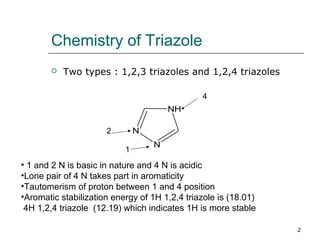
• 1 and 2 N is basic in nature and 4 N is acidic
•Lone pair of 4 N takes part in aromaticity
•Tautomerism of proton between 1 and 4 position
•Aromatic stabilization energy of 1H 1,2,4 triazole is (18.01)
 4H 1,2,4 triazole (12.19) which indicates 1H is more stable

                                                                 2
Synthesis of 1,2,4 triazoles
    Two name reactions:
    Einhorn Brunner reaction: Imide with alky hydrazine to
     form mixture of regioselective
    1H 1,2,4 triazole
                                                                R                       R
         R

                                       O                O   O                               O   O
O    O                        O
                                                 AcOH                       +
         NH   NH2   +   H3C       NH       CH3
                                                                N       N       N       N


                                                                    N               N


   Pellizzari synthesis: It’s a reaction between amide and
    hydrazide but the product is not regioselective
    compared to Einhorn Brunner reaction


                                                                                                    3
Reaction mechanism
   Substitution nucleophilic reaction of SN2
    type
   One transition state with pentavalent
    intermediate
   Primary and secondary halides undergo
    SN2
   Thermodynamically favored reaction
   Aprotic polar solvent: Inhibit tautomerism


                                             4
Drawback of Pellizzari reaction
   Reactants: 1: 2 : 4-Triazole (10.0 g.)
   Reagent: Sodium and methanol
   Alkylating agent: Methyl Iodide
   Reaction condition:120 o for 1 h
   Yield: 78%l-methyl-1 : 2 : 4-triazole
   Work up:precipitate unchanged 1 : 2 : 4-
    triazole, m. p. 121o
   Residue distilled out


                                               5
1H vs 4H alkylation on 1,2,4 triazole
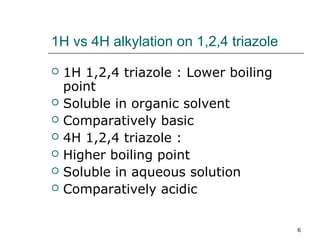
   1H 1,2,4 triazole : Lower boiling
    point
   Soluble in organic solvent
   Comparatively basic
   4H 1,2,4 triazole :
   Higher boiling point
   Soluble in aqueous solution
   Comparatively acidic

                                        6
Problems with regioselectivity
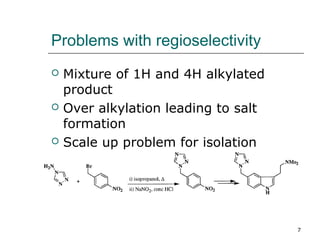
   Mixture of 1H and 4H alkylated
    product
   Over alkylation leading to salt
    formation
   Scale up problem for isolation
   Solutions: Amination of 4 Nitogen


                                        7
   2 step process:
   Alkylation of 4-aminotriazole with 4-
    nitrobenzyl bromide
   sodium nitrite deamination with
    evolution of nitrous oxide
   Advantage: An overall yield of >90%
    from 4-aminotriazole
   Depends upon both reactants
   Replacement of 4 amino triazole by
    triazole in above given reaction gives
    single isomer but with poor yield of 52%
                                               8
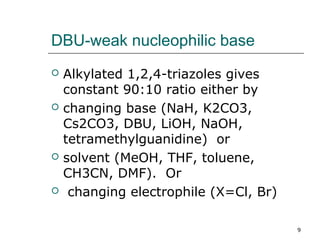
DBU-weak nucleophilic base
   Alkylated 1,2,4-triazoles gives
    constant 90:10 ratio either by
   changing base (NaH, K2CO3,
    Cs2CO3, DBU, LiOH, NaOH,
    tetramethylguanidine) or
   solvent (MeOH, THF, toluene,
    CH3CN, DMF). Or
    changing electrophile (X=Cl, Br)

                                        9
•Regioselectivity of reaction is increased by using weak nucleophilic base
 1,8 diazabicyclo[5.4.0]undec-7-ene (DBU).

•DBU (1.2 equiv.), 4-nitrobenzyl chloride (1.0 equiv.), triazole (1.1 equiv.) and
THF whereby a 93% yield of adducts in a 90:10 ratio was obtained

•successive aqueous washes increased the isomer ratio to 98:2.

•DBU is recycled and can be recovered
•DBU is water soluble
•It forms complex with HX as DBU.HX which can be seprated simply by filtration
•Purification of the isomeric mixtures of triazoles was achieved by distillation,
 or silica gel chromatography or by recrystalization

•For scalling up the reaction on large scale distillation method is preferable as pure
 1-alkyl-1,2,4-triazoles were obtained (>99:1) without any attempt at fractionation.

                                                                                    10
11
   Katritzky et al. have disclosed an improved
    method for the alkylation of 1,2,4-triazole and
    they give five examples of isomer ratios of 100:0
    using a DMF/NaOH system


                                                    12
Role of living group

    +


       Tosylium used here in replacement of halide group is a
        good living group in presence of K2CO3 as base and
        Bu4N+ •Br- as catalyst using DMF as solvent with 95%
        yield [6]. To further increase the yield use of DBU as
        catalyst can be done


                                                             13
Conclusion
   Regioselective alklation of 1H,1,2,4 triazole undergoes SN2
    mechanism for alkylation.

   Regioselectivity for 1H position faces two main problem
    isomerism and over alkylation which is affected by living
    group present on alkyl substituent and catalyst used during
    the process.
    Use of weakly nucleophilic base like DBU with tosylium as
    living group can assure more than 95% yield of 1H product
    with both tosylium and DBU both are reusable so that it can
    make cost efficient process.

    DBU and tosylium salt are water soluble it can be easily
    recovered by aqueous washing and filtration. Desired
    compound can be seprated by distillation on scale up due to
    difference in physical property of 1H and 4H triazene


                                                                  14
Refrences
   [1] POTTS . K. T.; THE CHEMISTRY OF 1,2,4-
    TRIAZOLES;Tetrahedron,1960
   [2] ATKINSON. M. R.; POLYA. J. B.; J.Org.
    Chem., 1952, 3418.
   [3] Katritzky et. al.; Hetrocyclic aromatic
    chemistry
   [4] Balaban.A.T.; Oniciu.C.D.; Esperion
    Therapeutics;2003;2777
   [5] Paul G. B., Ian F. C., Cameron J. C.;
    Tetrahedron Letters 41 (2000) 1297–1301
   [6] Aouine, Younas; Faraj, Hassane;Molecules,16;
    2011; 3380-3390
   [7] Chen, Wei; Chen, Chen;
    Journal;33;7;2011;603-606


                                                  15
Thank
You

         16

Regioselective 1H-1,2,4 Triazole alkylation

  • 1.
    Regioselective approaches for 1H-1,2,4Triazole alkylation Presented by: Parth Shah, Shalaka Nagarkar Reg No. : PH0057 1
  • 2.
    Chemistry of Triazole  Two types : 1,2,3 triazoles and 1,2,4 triazoles 4 NH 2 N N 1 • 1 and 2 N is basic in nature and 4 N is acidic •Lone pair of 4 N takes part in aromaticity •Tautomerism of proton between 1 and 4 position •Aromatic stabilization energy of 1H 1,2,4 triazole is (18.01) 4H 1,2,4 triazole (12.19) which indicates 1H is more stable 2
  • 3.
    Synthesis of 1,2,4triazoles  Two name reactions:  Einhorn Brunner reaction: Imide with alky hydrazine to form mixture of regioselective 1H 1,2,4 triazole R R R O O O O O O O O AcOH + NH NH2 + H3C NH CH3 N N N N N N  Pellizzari synthesis: It’s a reaction between amide and hydrazide but the product is not regioselective compared to Einhorn Brunner reaction 3
  • 4.
    Reaction mechanism  Substitution nucleophilic reaction of SN2 type  One transition state with pentavalent intermediate  Primary and secondary halides undergo SN2  Thermodynamically favored reaction  Aprotic polar solvent: Inhibit tautomerism 4
  • 5.
    Drawback of Pellizzarireaction  Reactants: 1: 2 : 4-Triazole (10.0 g.)  Reagent: Sodium and methanol  Alkylating agent: Methyl Iodide  Reaction condition:120 o for 1 h  Yield: 78%l-methyl-1 : 2 : 4-triazole  Work up:precipitate unchanged 1 : 2 : 4- triazole, m. p. 121o  Residue distilled out 5
  • 6.
    1H vs 4Halkylation on 1,2,4 triazole  1H 1,2,4 triazole : Lower boiling point  Soluble in organic solvent  Comparatively basic  4H 1,2,4 triazole :  Higher boiling point  Soluble in aqueous solution  Comparatively acidic 6
  • 7.
    Problems with regioselectivity  Mixture of 1H and 4H alkylated product  Over alkylation leading to salt formation  Scale up problem for isolation  Solutions: Amination of 4 Nitogen 7
  • 8.
    2 step process:  Alkylation of 4-aminotriazole with 4- nitrobenzyl bromide  sodium nitrite deamination with evolution of nitrous oxide  Advantage: An overall yield of >90% from 4-aminotriazole  Depends upon both reactants  Replacement of 4 amino triazole by triazole in above given reaction gives single isomer but with poor yield of 52% 8
  • 9.
    DBU-weak nucleophilic base  Alkylated 1,2,4-triazoles gives constant 90:10 ratio either by  changing base (NaH, K2CO3, Cs2CO3, DBU, LiOH, NaOH, tetramethylguanidine) or  solvent (MeOH, THF, toluene, CH3CN, DMF). Or  changing electrophile (X=Cl, Br) 9
  • 10.
    •Regioselectivity of reactionis increased by using weak nucleophilic base 1,8 diazabicyclo[5.4.0]undec-7-ene (DBU). •DBU (1.2 equiv.), 4-nitrobenzyl chloride (1.0 equiv.), triazole (1.1 equiv.) and THF whereby a 93% yield of adducts in a 90:10 ratio was obtained •successive aqueous washes increased the isomer ratio to 98:2. •DBU is recycled and can be recovered •DBU is water soluble •It forms complex with HX as DBU.HX which can be seprated simply by filtration •Purification of the isomeric mixtures of triazoles was achieved by distillation, or silica gel chromatography or by recrystalization •For scalling up the reaction on large scale distillation method is preferable as pure 1-alkyl-1,2,4-triazoles were obtained (>99:1) without any attempt at fractionation. 10
  • 11.
  • 12.
    Katritzky et al. have disclosed an improved method for the alkylation of 1,2,4-triazole and they give five examples of isomer ratios of 100:0 using a DMF/NaOH system 12
  • 13.
    Role of livinggroup +  Tosylium used here in replacement of halide group is a good living group in presence of K2CO3 as base and Bu4N+ •Br- as catalyst using DMF as solvent with 95% yield [6]. To further increase the yield use of DBU as catalyst can be done 13
  • 14.
    Conclusion  Regioselective alklation of 1H,1,2,4 triazole undergoes SN2 mechanism for alkylation.  Regioselectivity for 1H position faces two main problem isomerism and over alkylation which is affected by living group present on alkyl substituent and catalyst used during the process.  Use of weakly nucleophilic base like DBU with tosylium as living group can assure more than 95% yield of 1H product with both tosylium and DBU both are reusable so that it can make cost efficient process.  DBU and tosylium salt are water soluble it can be easily recovered by aqueous washing and filtration. Desired compound can be seprated by distillation on scale up due to difference in physical property of 1H and 4H triazene 14
  • 15.
    Refrences  [1] POTTS . K. T.; THE CHEMISTRY OF 1,2,4- TRIAZOLES;Tetrahedron,1960  [2] ATKINSON. M. R.; POLYA. J. B.; J.Org. Chem., 1952, 3418.  [3] Katritzky et. al.; Hetrocyclic aromatic chemistry  [4] Balaban.A.T.; Oniciu.C.D.; Esperion Therapeutics;2003;2777  [5] Paul G. B., Ian F. C., Cameron J. C.; Tetrahedron Letters 41 (2000) 1297–1301  [6] Aouine, Younas; Faraj, Hassane;Molecules,16; 2011; 3380-3390  [7] Chen, Wei; Chen, Chen; Journal;33;7;2011;603-606 15
  • 16.