1
2
3
4
5
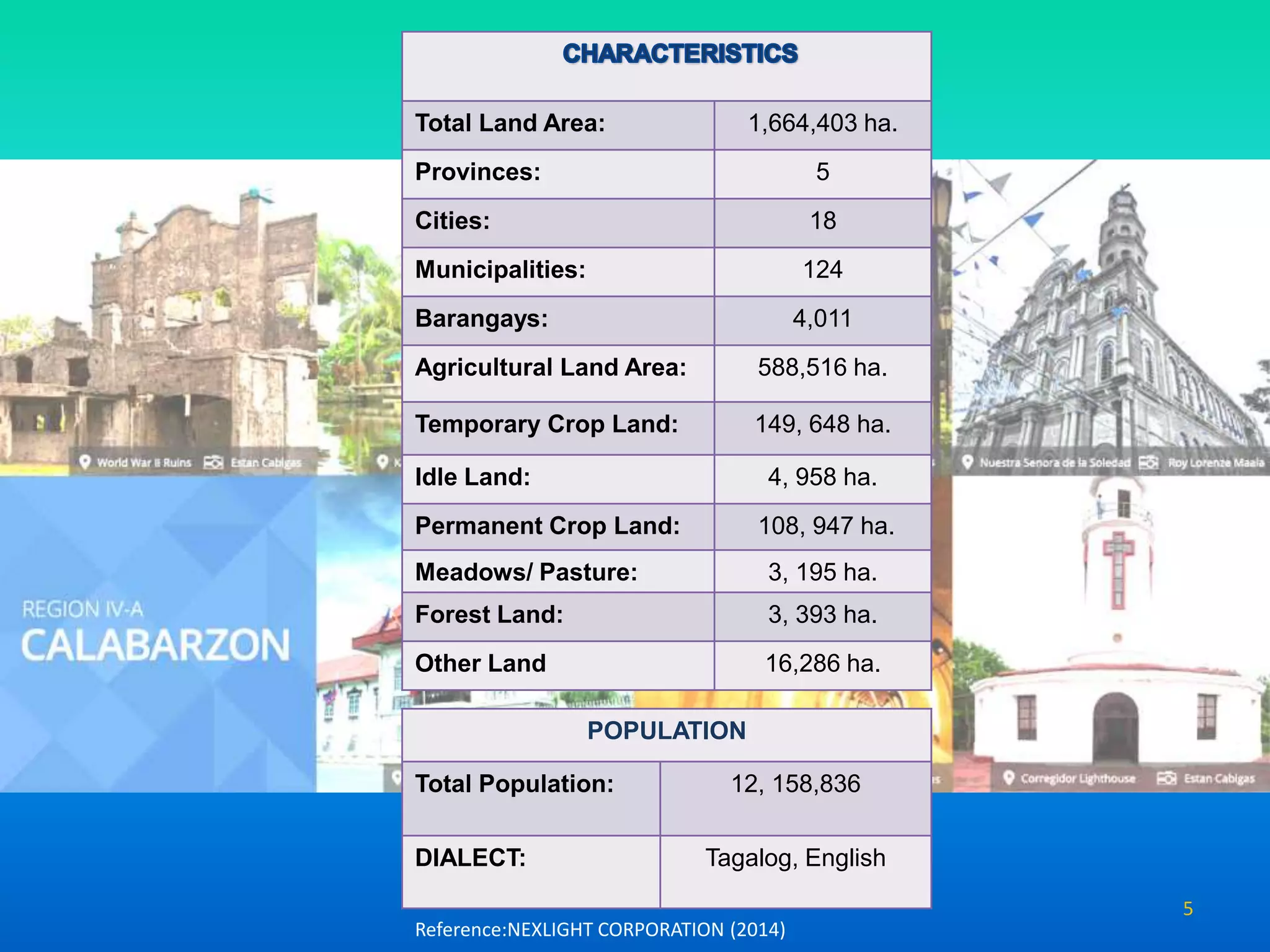
Total Land Area: 1,664,403 ha.
Provinces: 5
Cities: 18
Municipalities: 124
Barangays: 4,011
Agricultural Land Area: 588,516 ha.
Temporary Crop Land: 149, 648 ha.
Idle Land: 4, 958 ha.
Permanent Crop Land: 108, 947 ha.
Meadows/ Pasture: 3, 195 ha.
Forest Land: 3, 393 ha.
Other Land 16,286 ha.
POPULATION
Total Population: 12, 158,836
DIALECT: Tagalog, English
Reference:NEXLIGHT CORPORATION (2014)
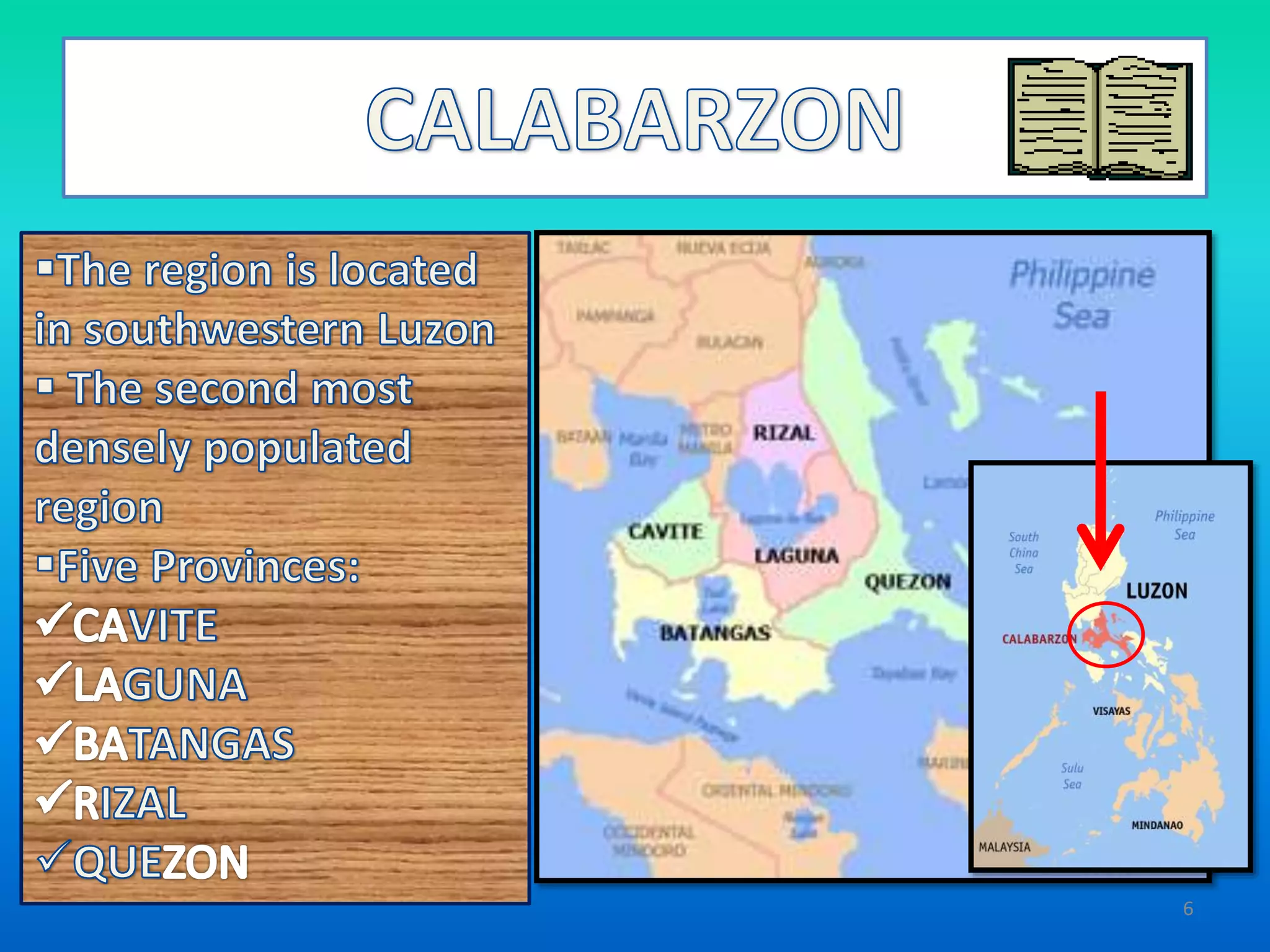
6
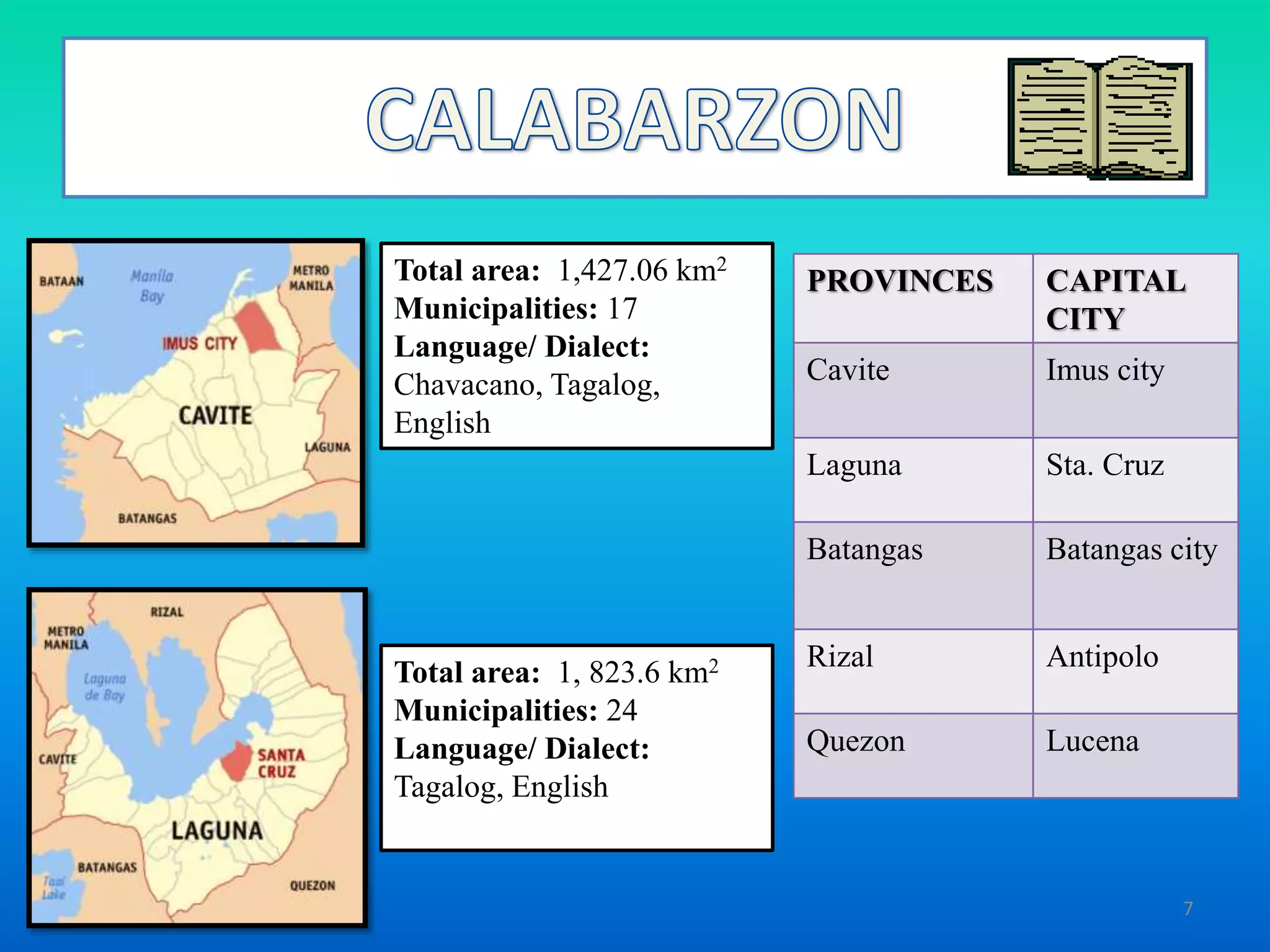
7
PROVINCES CAPITAL
CITY
Cavite Imus city
Laguna Sta. Cruz
Batangas Batangas city
Rizal Antipolo
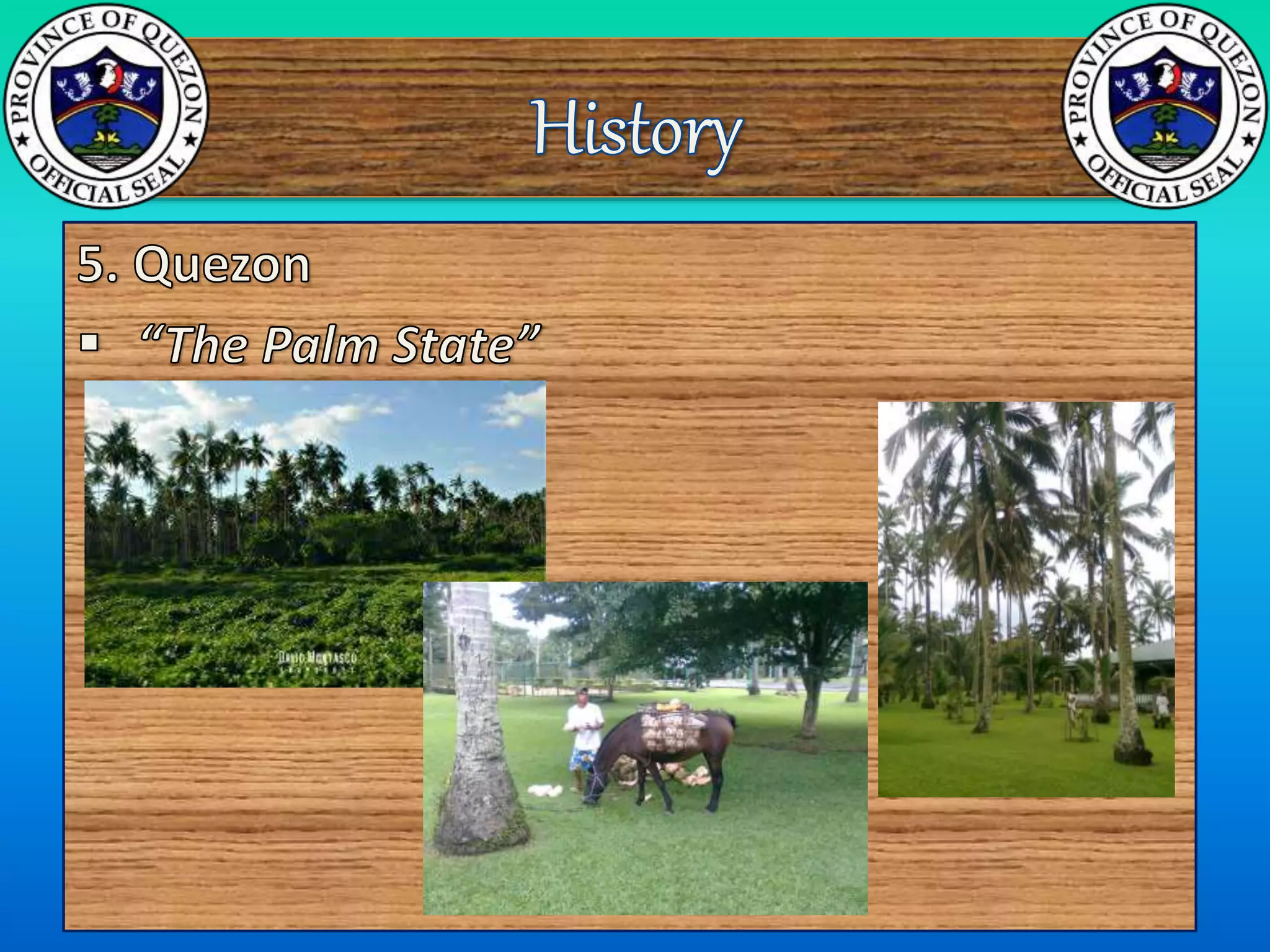
Quezon Lucena
Total area: 1,427.06 km2
Municipalities: 17
Language/ Dialect:
Chavacano, Tagalog,
English
Total area: 1, 823.6 km2
Municipalities: 24
Language/ Dialect:
Tagalog, English
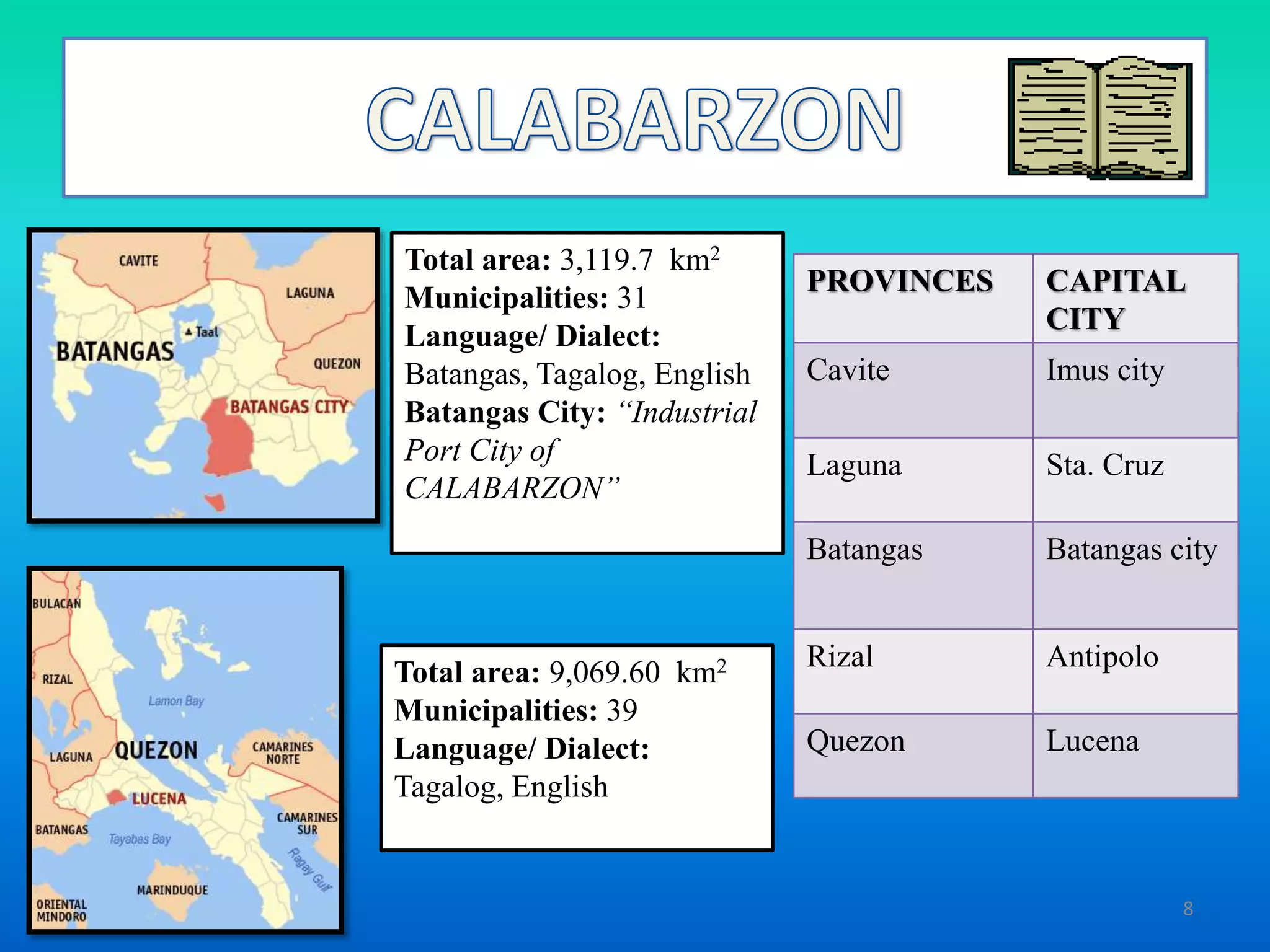
8
PROVINCES CAPITAL
CITY
Cavite Imus city
Laguna Sta. Cruz
Batangas Batangas city
Rizal Antipolo
Quezon Lucena
Total area: 3,119.7 km2
Municipalities: 31
Language/ Dialect:
Batangas, Tagalog, English
Batangas City: “Industrial
Port City of
CALABARZON”
Total area: 9,069.60 km2
Municipalities: 39
Language/ Dialect:
Tagalog, English
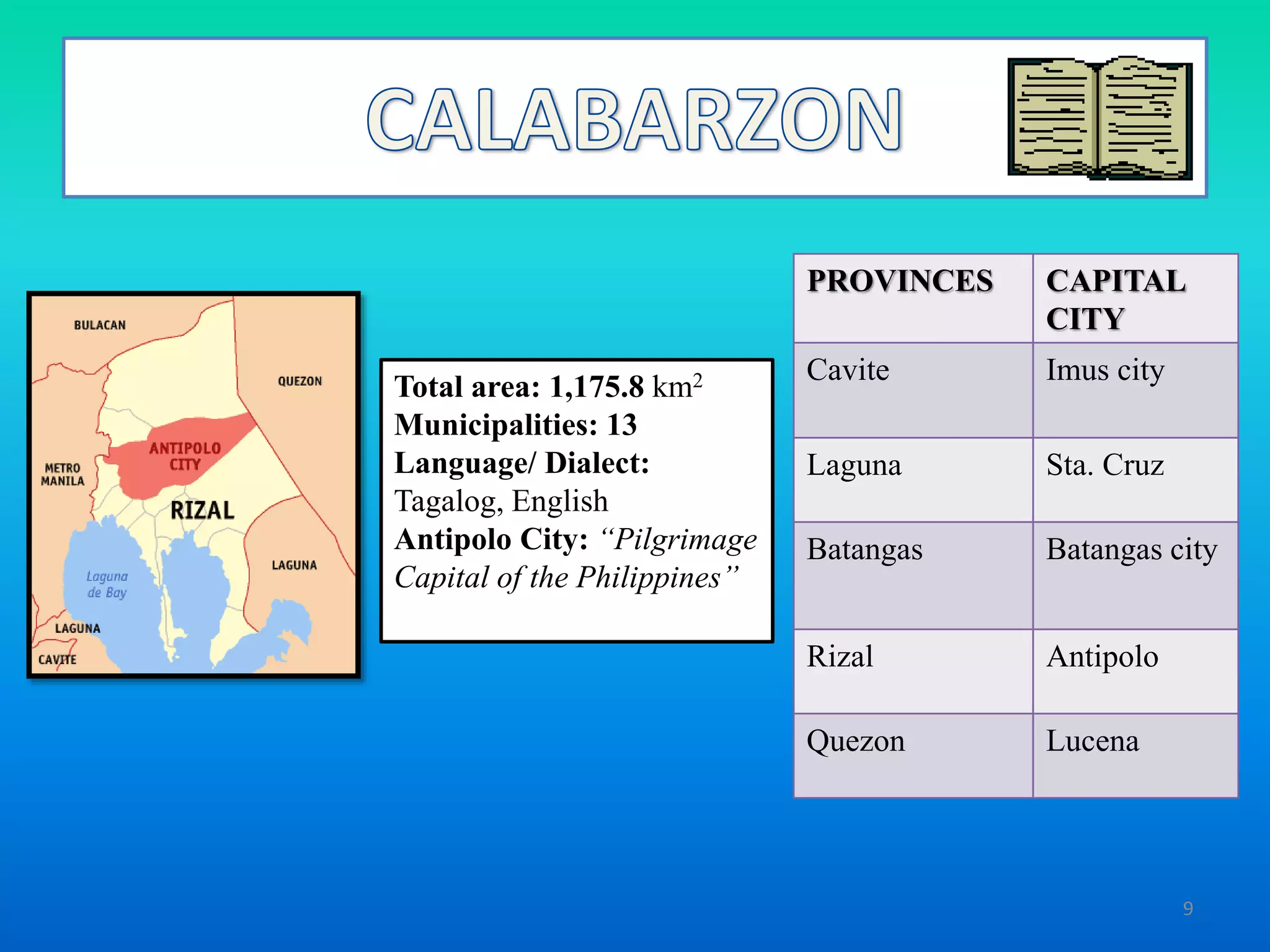
9
PROVINCES CAPITAL
CITY
Cavite Imus city
Laguna Sta. Cruz
Batangas Batangas city
Rizal Antipolo
Quezon Lucena
Total area: 1,175.8 km2
Municipalities: 13
Language/ Dialect:
Tagalog, English
Antipolo City: “Pilgrimage
Capital of the Philippines”
10
11
12
13
14
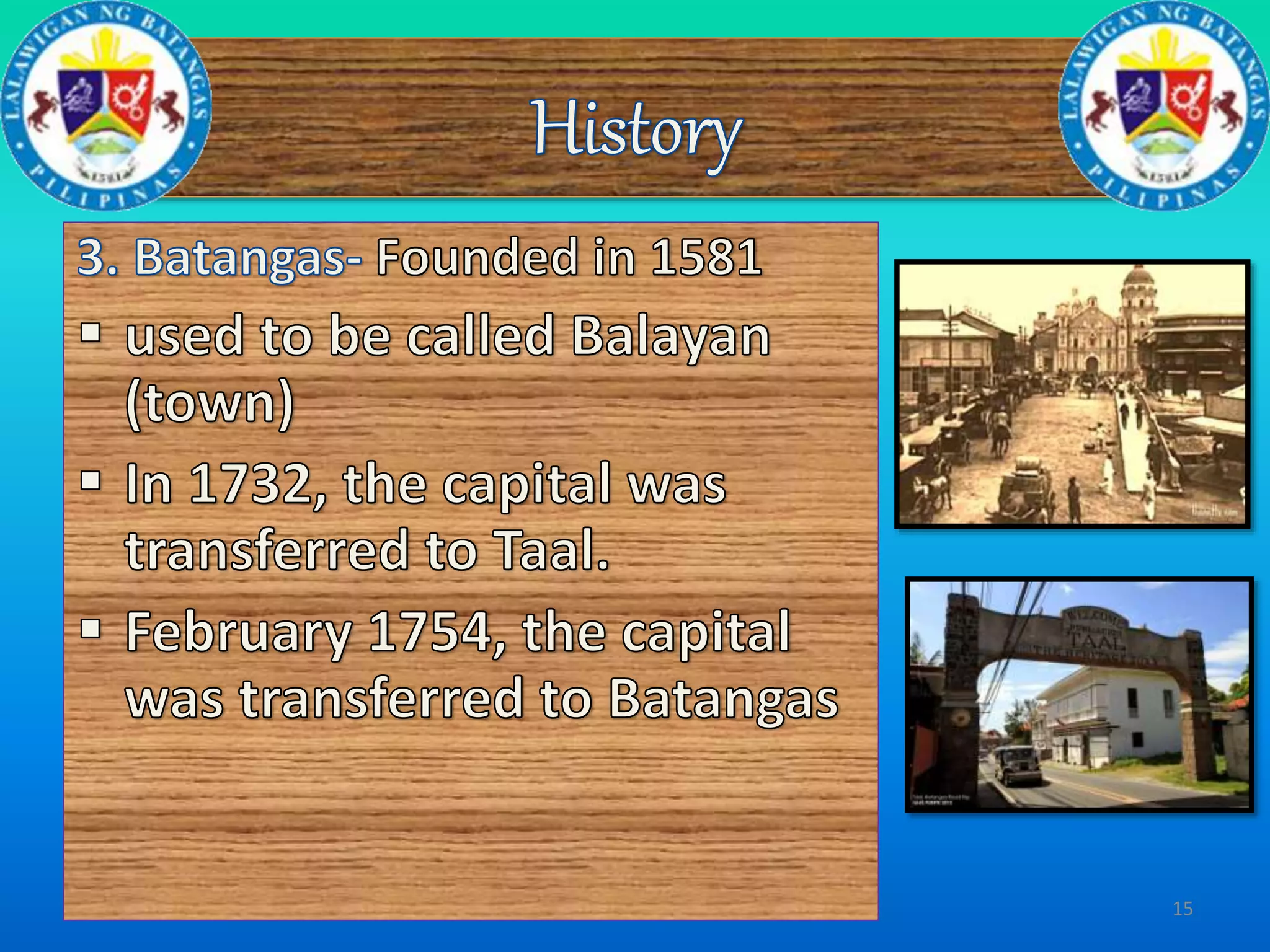
15
16
17
18
19
20
21
22
23
24
25
26
27
28
29
30
31
32
33
34
35
36
37
38
39
40
41
42
43
44
45
46
47
48
49
50
BANGKERO FESTIVAL KANYUGAN FESTIVAL
51
TSINELAS FESTIVAL ITIK FESTIVAL
52
MAYFLOWER FESTIVAL FESTIVAL OF LIGHTS
53
54
ALA- EH FESTIVAL PARADA NG LECHON
55
SIGPAWAN FESTIVAL
56
HIGANTES FESTIVAL
57
FEAST OF SAN ISIDRO
LABRADOR
KALUSKOS BAMBOO ARCH
FESTIVAL
58
SIKARAN FESTIVAL
PAHIYAS FESTIVAL
59
60
BULIHAN FESTIVAL ALIMANGO FESTIVAL
61
62
63
64
65
66
67
Cabag Caves Pico de Loro
68
Balite Falls (Amadeo)
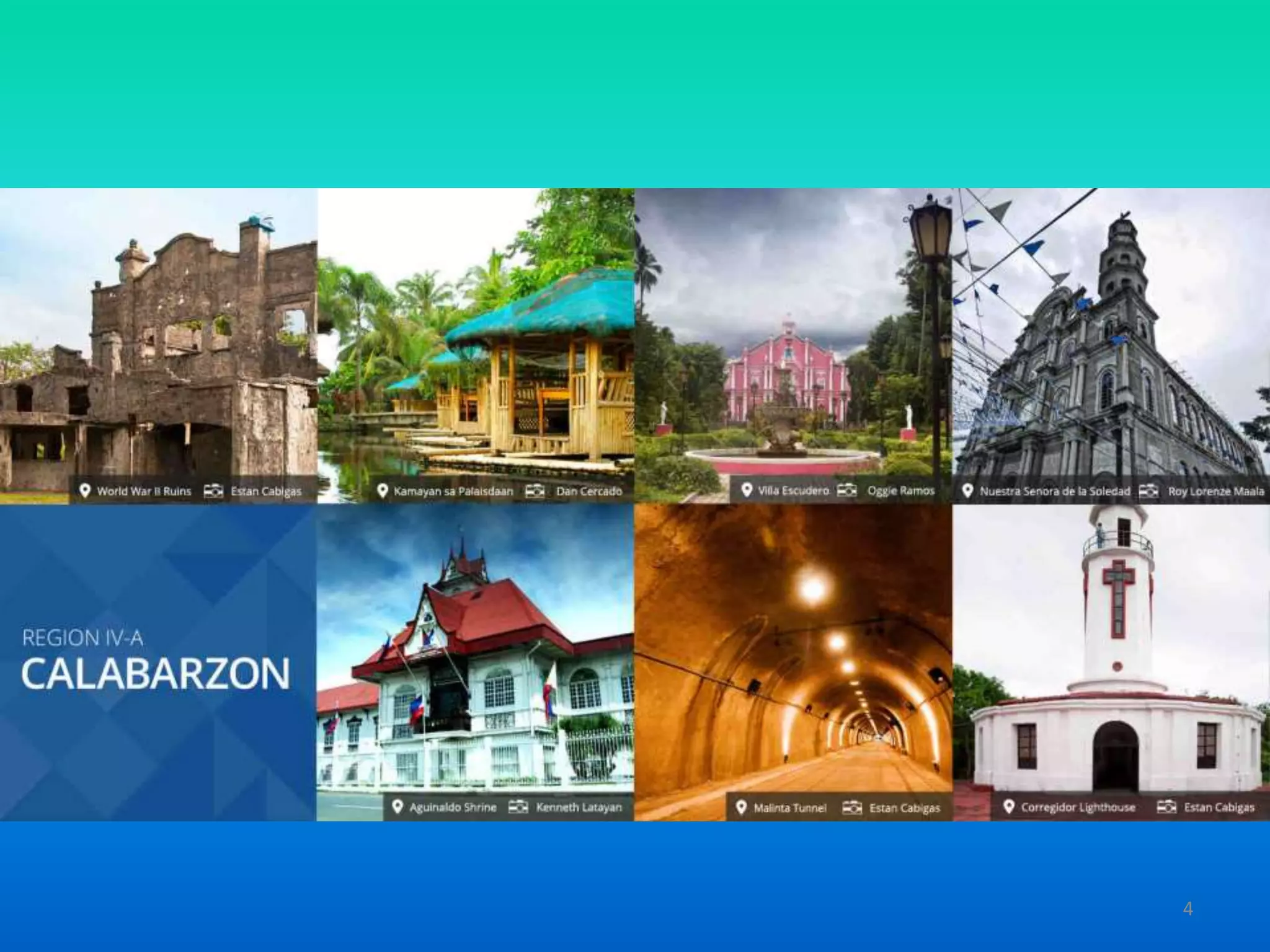
EMILIO AGUINALDO SHRINE
69
70
Taytay Falls
Mount Makiling
71
Pagsanjan Falls Pandin Lake
72
Laguna de Bay
 Largest
freshwater lake in
the Philippines.
90,000 hectares
CALAMBA’S LAND MARK
73
74
Enchanted Kingdom
75
Rizal Shrine
76
Nagcarlan Underground Cemetery
77
Mt. Maculot
Fortune Island
78
The Basilica of St. Martin and Taal Park
79
80
TAAL LAKE
and
VOLACANO
“Heart of the Batangas
province”
the third largest in the
Phil.(240 sq km)
 it cradles a 23 sq km
island with a 1.2 sq km
crater lake within
81
Hinulugang Taktak National Park
82
Daranak Falls Batlag Falls
83
Wawa Dam
84
Morong Church
85
Bird Island
86
Balesin island
87
Lucban Church
88
• Born in 1894 in Lucena City, Quezon.
• Authored the first Filipino modern English
language.
• Tayabas High School
• University of the Philippines.
• Bachelor of Arts degree in 1912.
• Editor of the Philippine Journal of Education at
UP.
89
• Gerardo Luna- wanted
to live in forest
• Ambo-the man who
invited Gerardo to go in
the forest
• Sotera- eldest sister of
Gerardo
• Peregrina- fat woman,
inlove with Gerardo
• Young man- high school
graduate
90
91

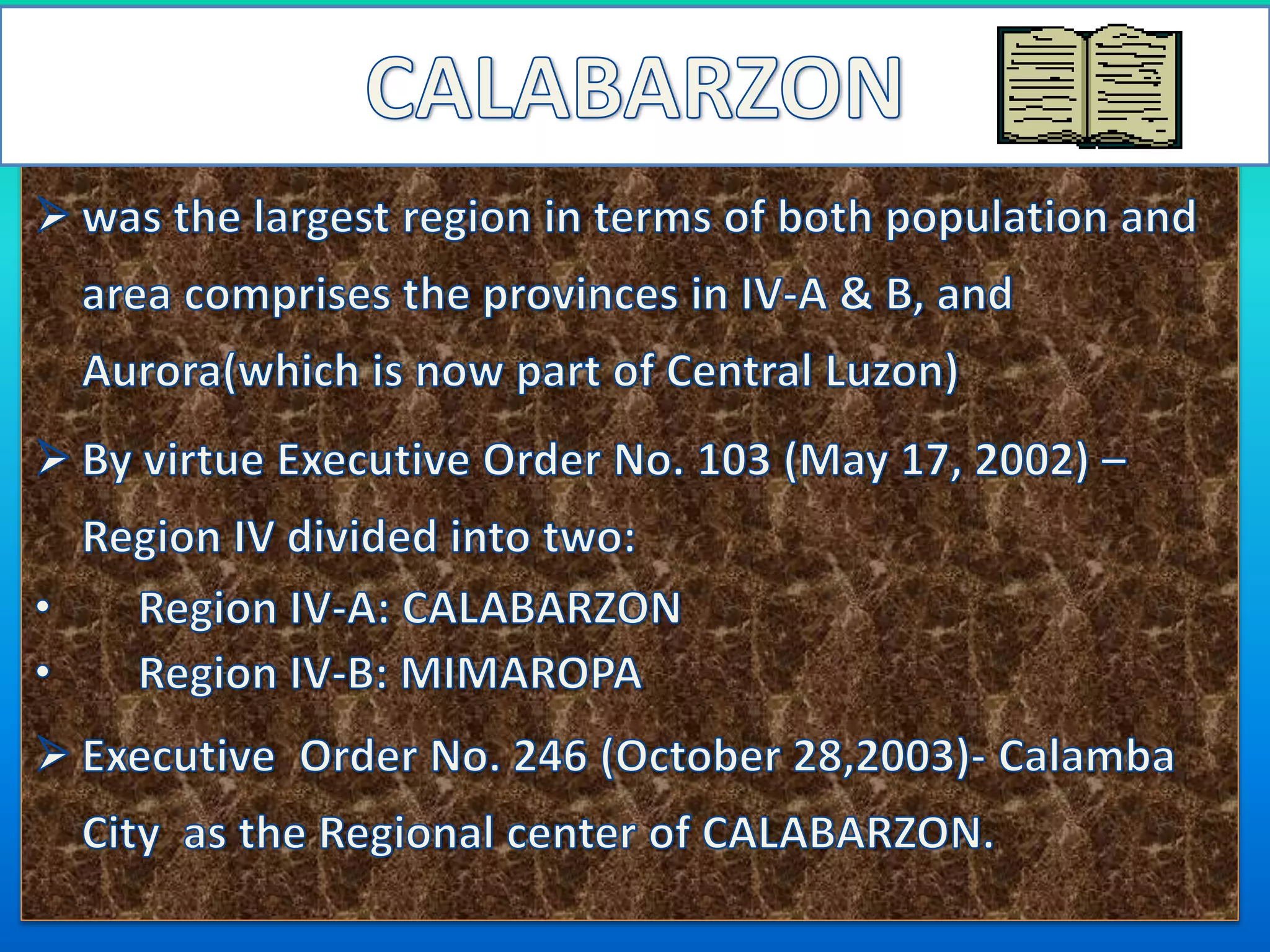
CALABARZON region IV A, Philippines

Editor's Notes

  • #4 Region IV, formally known as Southern Tagalog was the Largest region in terms of both population and area comprises the provinces of Aurora( which is now part of Central Luzon), Batangas, Cavite, Laguna, Marinduque, Oriental Mindoro, Occidental Mindoro, Quezon, Rizal, Romblon Palawan.
  • #7 The region is located in southwestern Luzon, just north and east of Palawan. 
  • #8  The eight primary rays of the sun found in the Philippine Flag represent the first eight provinces (Batangas, Bulacan, Cavite, Laguna, Manila, Nueva Ecija, Pampanga, and Tarlac) that sought independence from Spain and were placed under martial law by the Spaniards at the start of the Philippine Revolution in 1896. The province of Batangas is bounded on the north by the provinces of Cavite and Laguna, on the south by the Verde Island passage, on the east by the provinces of Quezon and Laguna, and on the west by the South China Sea. It has a total land area of 316,580 hectares, 50% of which has a grade of less than 15 degrees. The terrain is generally rolling while the rest are mountainous and hilly.
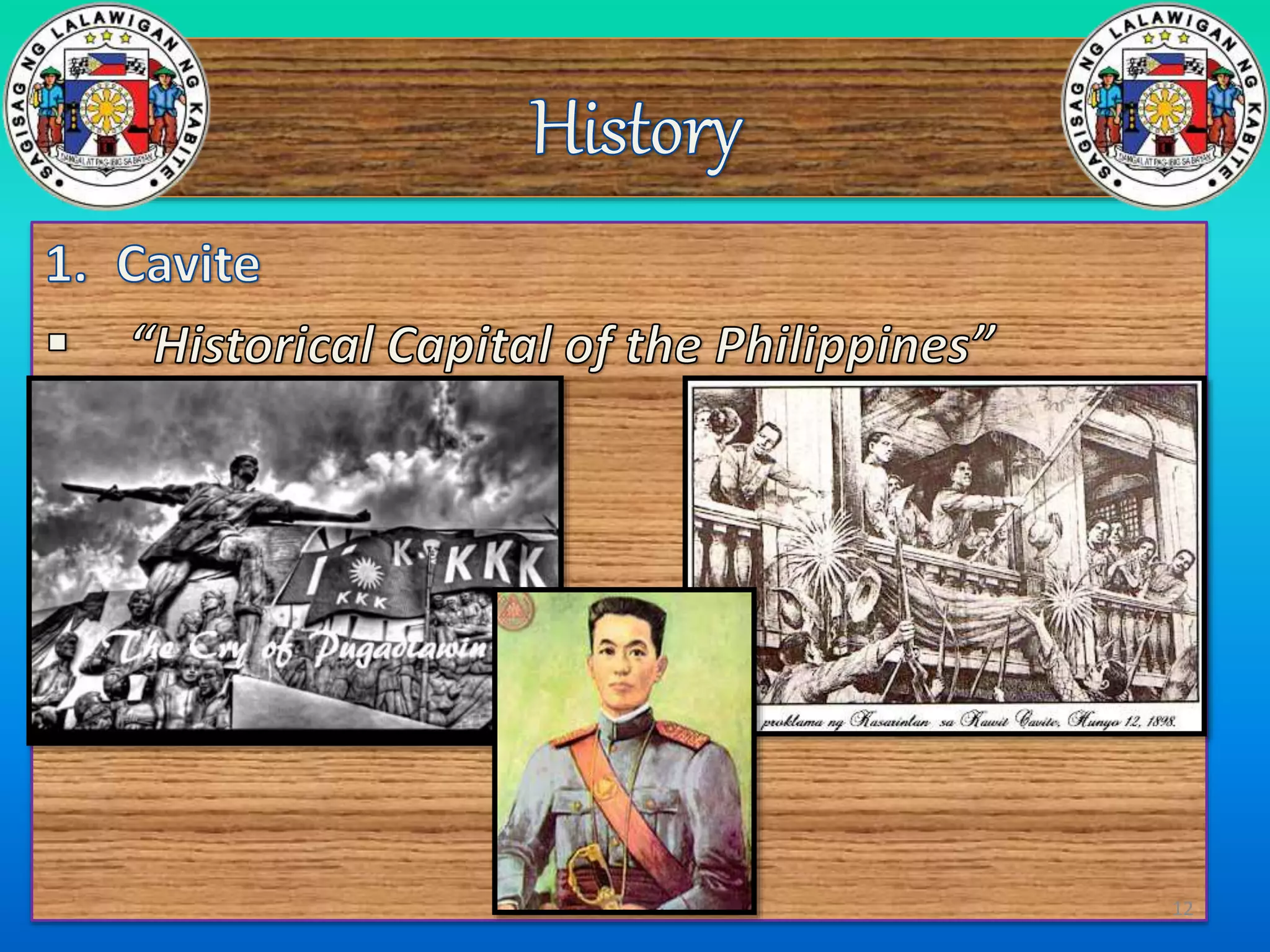
  • #12 The land was known as "Tangway" where Spanish authorities evolved a fort from which the city of Cavite grew. Cavite, the name of the province, is derived from "Kawit", a Tagalog word for "hook". This refers to the hook shaped land on Old Spanish maps.
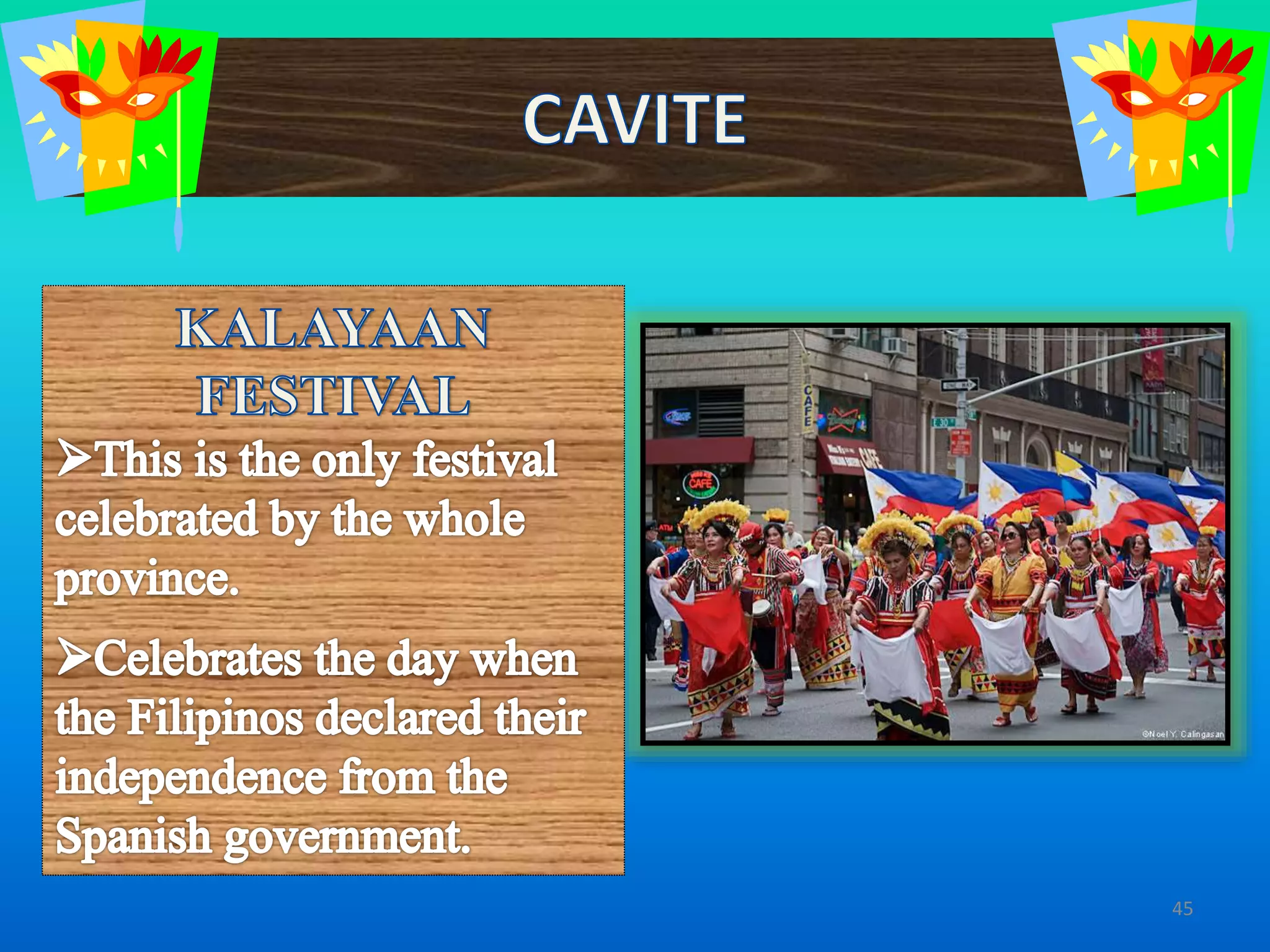
  • #13 In 1872, Filipinos revolted against Spain. Three Filipino priests - Jose Burgos, Mariano Gomez and Jacinto Zamora - were implicated in the Cavite revolt in which 200 Filipinos rose in arms against the Spanish forces in the garrisons. On August 28, 1896, when the Philippine Revolution against Spain broke out, Cavite became a bloody theatre of war. Led by Emilio Aguinaldo, Caviteños made surprise attracts on the Spanish headquarters and soon liberated the whole province. Aguinaldo directed the Revolution to its end: the proclamation of the first Republic in Asia, the Republic of the Philippines, on June 12, 1898 in Kawit.
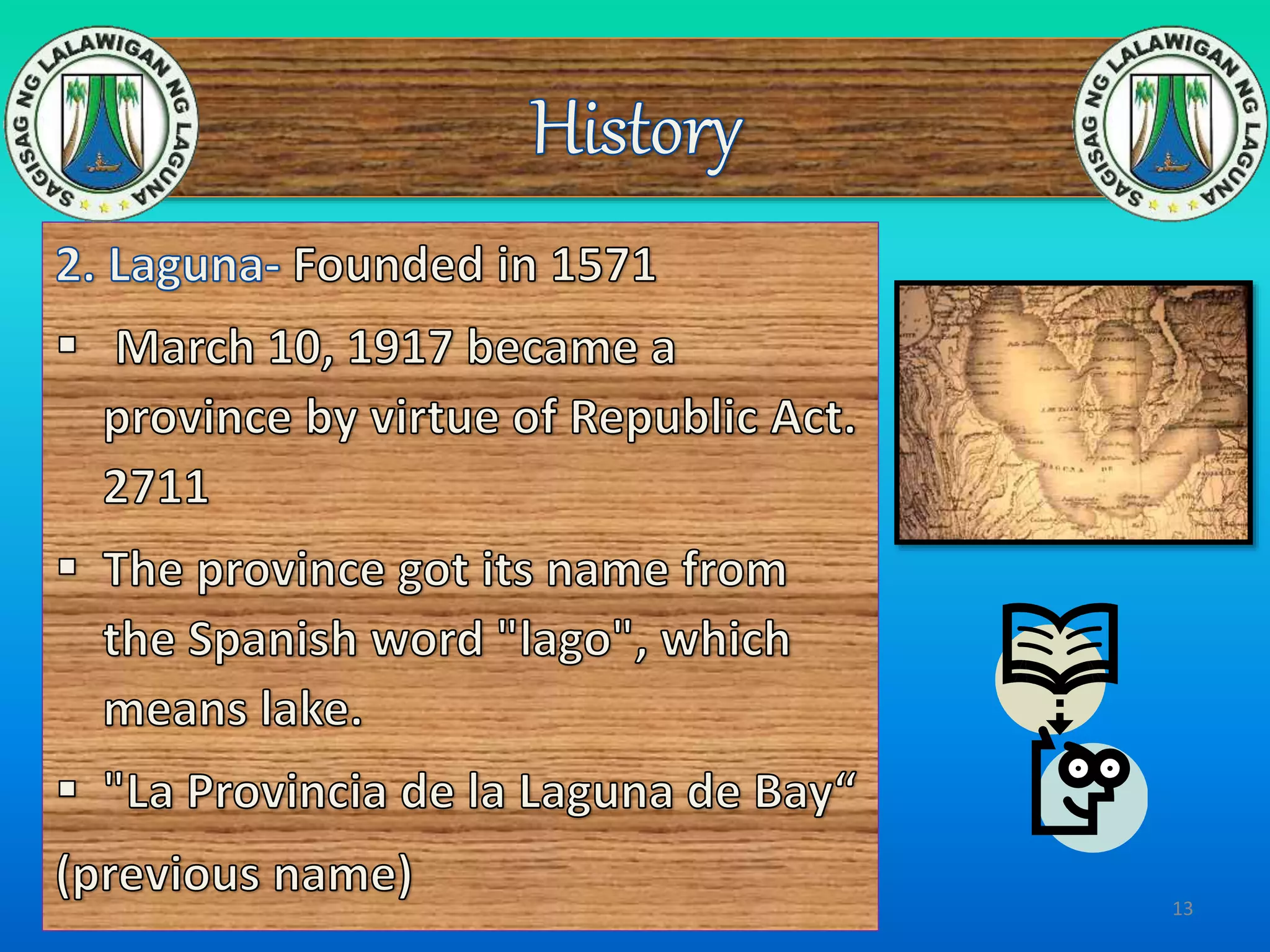
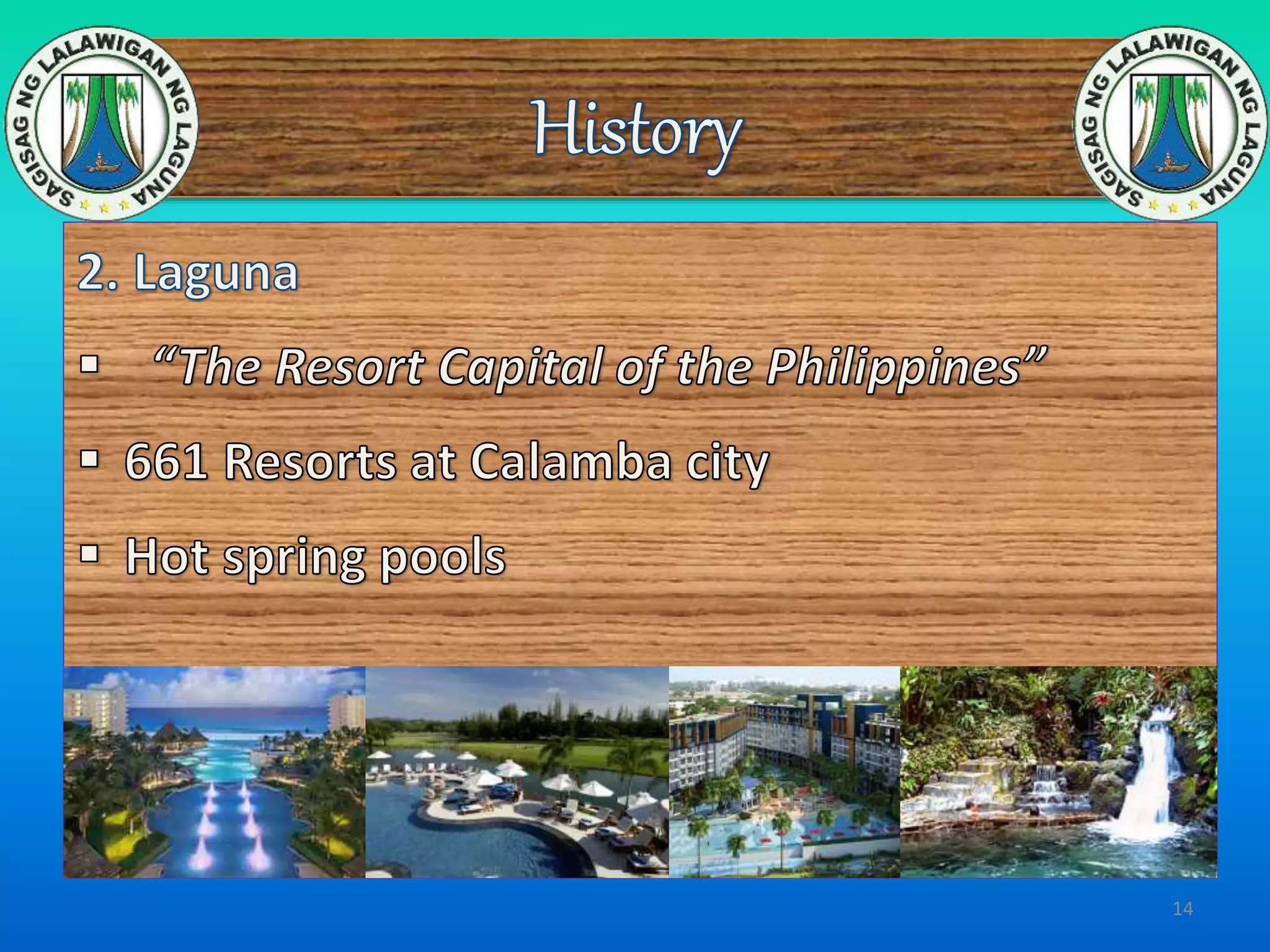
  • #14 Laguna was named after the Spanish word "laguna" which literally means lagoon or lake. The province's previous name given by the Spaniards was "La Provincia de la Laguna de Bay.“ Laguna is widely known as the resort capital of Luzon due to its hot spring pools, with Mount Makiling as the source. The legendary Mount Makiling is also a tourist attraction in the province, preserved and protected by the University of the Philippines Los Baños.
  • #15 Because of Calamba City nickname as the Resort Capital of the Philippines Laguna became famous total count of resorts is 661.
  • #16 The city is also known as the “Cradle of Noble Heroes” because of its two most celebrated sons that have contributed in the history of the Philippines. They are Apolinario Mabini, known as the b rain of Katipunan, the Philippine revolutionary movement against Spain, and Jose P. Laurel who was the Philippine president during World War II.
  • #17 Apolinario Mabini, known as the brain of Katipunan, the Philippine revolutionary movement against Spain, and Jose P. Laurel who was the Philippine president during World War II.
  • #19 Known for its artists’ communities and folk festivals Ang Rizal ang tinatawag na "Duyan ng Pambansang Sining". Ang mga Pambansang Alagad ng Sining na sina Carlos "Botong" Francisco He was rewarded as the National Artist for Painting, considered as the greatest muralist of the country and 1964 Republic of the Philippines Cultural Heritage awardee ,Vicente Manansala Vicente Silva Manansala was a Filipino cubist painter and illustrator., Maestro Lucio San Pedro ay pawang mga taga-Rizal. as a National Artist for Music
  • #21 Ang mga Pambansang Alagad ng Sining na sina Carlos "Botong" Francisco He was rewarded as the National Artist for Painting, considered as the greatest muralist of the country and 1964 Republic of the Philippines Cultural Heritage awardee ,Vicente Manansala Vicente Silva Manansala was a Filipino cubist painter and illustrator., Maestro Lucio San Pedro ay pawang mga taga-Rizal. as a National Artist for Music
  • #22 1591 - The Spaniards established the province of Caliraya, which is the original name of Quezon. Middle of 18th century - The town of Tayabas became the capital of the province, from which the province got its new name. March 12, 1902 - the Americans established civil government and Lucena was designated to be the capital of the province. September 7, 1946 - Tayabas was renamed Quezon province, in honor of the Commonwealth President Manuel L. Quezon.
  • #24 The eight primary rays of the sun found in the Philippine Flag represent the first eight provinces Batangas, Bulacan, Cavite, Laguna, Manila, Nueva Ecija, Pampanga, and Tarlac) that sought independence from Spain and were placed under martial law by the Spaniards at the start of the Philippine Revolution in 1896
  • #38 MgaAwitingBayan  Baka Maputikan  Sa aming pagdating ( Harana)  Kasagutan sa Pusong Umiibig.  Kasagutan sa Pagsinta  Lahat ng bagay sa Mundo.  Kundiman  Kahilingan  Ligaya ng isang magulang  Sagot sa kahilingan  Ako’y bulaklak