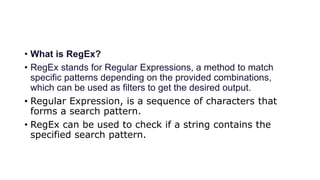
• What is RegEx?
• RegEx stands for Regular Expressions, a method to match
specific patterns depending on the provided combinations,
which can be used as filters to get the desired output.
• Regular Expression, is a sequence of characters that
forms a search pattern.
• RegEx can be used to check if a string contains the
specified search pattern.
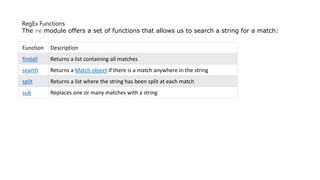
Function Description
findall Returns a list containing all matches
search Returns a Match object if there is a match anywhere in the string
split Returns a list where the string has been split at each match
sub Replaces one or many matches with a string
RegEx Functions
The re module offers a set of functions that allows us to search a string for a match:
Metacharacters are characters with a
special meaning:
Character Description Example
[] A set of characters "[a-m]"
 Signals a special sequence (can also be used to escape special
characters)
"d"
. Any character (except newline character) "he..o"
^ Starts with "^hello"
$ Ends with "planet$"
* Zero or more occurrences "he.*o"
+ One or more occurrences "he.+o"
? Zero or one occurrences "he.?o"
{} Exactly the specified number of occurrences "he.{2}o"
| Either or "falls|stays"
() Capture and group
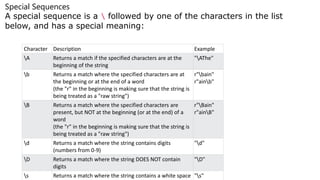
Character Description Example
A Returns a match if the specified characters are at the
beginning of the string
"AThe"
b Returns a match where the specified characters are at
the beginning or at the end of a word
(the "r" in the beginning is making sure that the string is
being treated as a "raw string")
r"bain"
r"ainb"
B Returns a match where the specified characters are
present, but NOT at the beginning (or at the end) of a
word
(the "r" in the beginning is making sure that the string is
being treated as a "raw string")
r"Bain"
r"ainB"
d Returns a match where the string contains digits
(numbers from 0-9)
"d"
D Returns a match where the string DOES NOT contain
digits
"D"
s Returns a match where the string contains a white space "s"
Special Sequences
A special sequence is a  followed by one of the characters in the list
below, and has a special meaning:
Set Description
[arn] Returns a match where one of the specified characters
(a, r, or n) is present
[a-n] Returns a match for any lower case character,
alphabetically between a and n
[^arn] Returns a match for any character EXCEPT a, r, and n
[0123] Returns a match where any of the specified digits
(0, 1, 2, or 3) are present
[0-9] Returns a match for any digit between 0 and 9
[0-5][0-
9]
Returns a match for any two-digit numbers
from 00 and 59
[a-zA-Z] Returns a match for any character alphabetically
between a and z, lower case OR upper case
[+] In sets, +, *, ., |, (), $,{} has no special meaning,
so [+] means: return a match for any + character in the
Sets
A set is a set of characters inside a pair of square brackets [] with a special meaning:
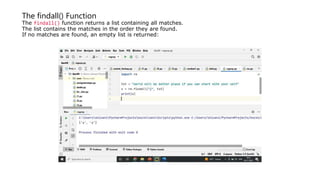
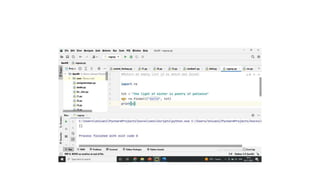
The findall() Function
The findall() function returns a list containing all matches.
The list contains the matches in the order they are found.
If no matches are found, an empty list is returned:
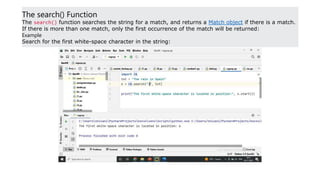
The search() Function
The search() function searches the string for a match, and returns a Match object if there is a match.
If there is more than one match, only the first occurrence of the match will be returned:
Example
Search for the first white-space character in the string:
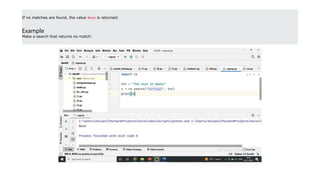
If no matches are found, the value None is returned:
Example
Make a search that returns no match:
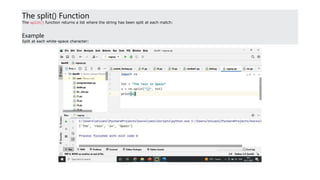
The split() Function
The split() function returns a list where the string has been split at each match:
Example
Split at each white-space character:
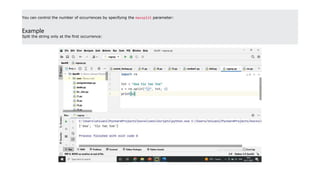
You can control the number of occurrences by specifying the maxsplit parameter:
Example
Split the string only at the first occurrence:
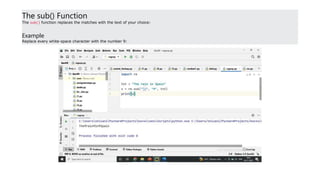
The sub() Function
The sub() function replaces the matches with the text of your choice:
Example
Replace every white-space character with the number 9:
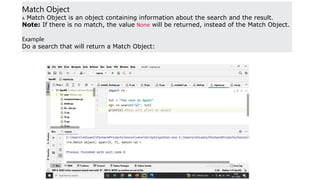
Match Object
A Match Object is an object containing information about the search and the result.
Note: If there is no match, the value None will be returned, instead of the Match Object.
Example
Do a search that will return a Match Object:
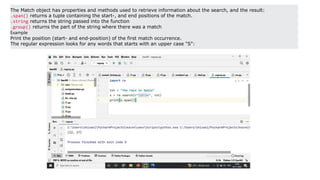
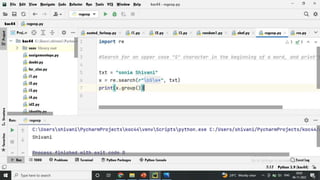
The Match object has properties and methods used to retrieve information about the search, and the result:
.span() returns a tuple containing the start-, and end positions of the match.
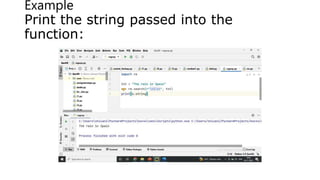
.string returns the string passed into the function
.group() returns the part of the string where there was a match
Example
Print the position (start- and end-position) of the first match occurrence.
The regular expression looks for any words that starts with an upper case "S":
Example
Print the string passed into the
function:
regex.pptx
regex.pptx

regex.pptx

  • 2.
    • What isRegEx? • RegEx stands for Regular Expressions, a method to match specific patterns depending on the provided combinations, which can be used as filters to get the desired output. • Regular Expression, is a sequence of characters that forms a search pattern. • RegEx can be used to check if a string contains the specified search pattern.
  • 4.
    Function Description findall Returnsa list containing all matches search Returns a Match object if there is a match anywhere in the string split Returns a list where the string has been split at each match sub Replaces one or many matches with a string RegEx Functions The re module offers a set of functions that allows us to search a string for a match:
  • 5.
    Metacharacters are characterswith a special meaning: Character Description Example [] A set of characters "[a-m]" Signals a special sequence (can also be used to escape special characters) "d" . Any character (except newline character) "he..o" ^ Starts with "^hello" $ Ends with "planet$" * Zero or more occurrences "he.*o" + One or more occurrences "he.+o" ? Zero or one occurrences "he.?o" {} Exactly the specified number of occurrences "he.{2}o" | Either or "falls|stays" () Capture and group
  • 6.
    Character Description Example AReturns a match if the specified characters are at the beginning of the string "AThe" b Returns a match where the specified characters are at the beginning or at the end of a word (the "r" in the beginning is making sure that the string is being treated as a "raw string") r"bain" r"ainb" B Returns a match where the specified characters are present, but NOT at the beginning (or at the end) of a word (the "r" in the beginning is making sure that the string is being treated as a "raw string") r"Bain" r"ainB" d Returns a match where the string contains digits (numbers from 0-9) "d" D Returns a match where the string DOES NOT contain digits "D" s Returns a match where the string contains a white space "s" Special Sequences A special sequence is a followed by one of the characters in the list below, and has a special meaning:
  • 7.
    Set Description [arn] Returnsa match where one of the specified characters (a, r, or n) is present [a-n] Returns a match for any lower case character, alphabetically between a and n [^arn] Returns a match for any character EXCEPT a, r, and n [0123] Returns a match where any of the specified digits (0, 1, 2, or 3) are present [0-9] Returns a match for any digit between 0 and 9 [0-5][0- 9] Returns a match for any two-digit numbers from 00 and 59 [a-zA-Z] Returns a match for any character alphabetically between a and z, lower case OR upper case [+] In sets, +, *, ., |, (), $,{} has no special meaning, so [+] means: return a match for any + character in the Sets A set is a set of characters inside a pair of square brackets [] with a special meaning:
  • 8.
    The findall() Function Thefindall() function returns a list containing all matches. The list contains the matches in the order they are found. If no matches are found, an empty list is returned:
  • 10.
    The search() Function Thesearch() function searches the string for a match, and returns a Match object if there is a match. If there is more than one match, only the first occurrence of the match will be returned: Example Search for the first white-space character in the string:
  • 11.
    If no matchesare found, the value None is returned: Example Make a search that returns no match:
  • 12.
    The split() Function Thesplit() function returns a list where the string has been split at each match: Example Split at each white-space character:
  • 13.
    You can controlthe number of occurrences by specifying the maxsplit parameter: Example Split the string only at the first occurrence:
  • 14.
    The sub() Function Thesub() function replaces the matches with the text of your choice: Example Replace every white-space character with the number 9:
  • 15.
    Match Object A MatchObject is an object containing information about the search and the result. Note: If there is no match, the value None will be returned, instead of the Match Object. Example Do a search that will return a Match Object:
  • 16.
    The Match objecthas properties and methods used to retrieve information about the search, and the result: .span() returns a tuple containing the start-, and end positions of the match. .string returns the string passed into the function .group() returns the part of the string where there was a match Example Print the position (start- and end-position) of the first match occurrence. The regular expression looks for any words that starts with an upper case "S":
  • 17.
    Example Print the stringpassed into the function: