REGENERATIVE BRAKING SYSTEM
A
Proposed Project Power Point Presentation (1st Defending)
Submitted in partial fulfilment of the requirements for the degree
of
BACHELOR OF TECHNOLOGY
in
MECHANICAL ENGINEERING
by
(Name: Mohd. Taukeer, Mohit Rawat, Mukul Tyagi, Deepak Kumar, & Vishal)
Under the Supervision of
Dr. Thomas Mathew
(Assistant Professor)
Mechanical Engineering
College of Engineering Roorkee, Roorkee
to
MECHANICAL ENGINEERING DEPARTMENT
COLLEGE OF ENGINEERING ROORKEE, ROORKEE
UTTARAKHAND TECHNICAL UNIVERSITY
DEHRADUN
SEPTEMBER, 2020
COLLEGE OF ENGINEERING ROORKEE
PROJECT TITLE
A
Proposed Project Power Point Presentation (1st Defending)
Submitted in partial fulfilment of the requirements for the degree
of
BACHELOR OF TECHNOLOGY
in
MECHANICAL ENGINEERING
to
MECHANICAL ENGINEERING DEPARTMENT
COLLEGE OF ENGINEERING ROORKEE, ROORKEE
UTTARAKHAND TECHNICAL UNIVERSITY
DEHRADUN
SEPTEMBER, 2020
COLLEGE OF ENGINEERING ROORKEE
SUBMITTED BY:
GROUP NO : 6
NAMES:
Mohmaad Taukeer
Mohit Rawat
Mukul Tyagi
Deepak Kumar
Vishal
GUIDE:
Dr. Thomas Mathew
(Assistant Professor)
Mechanical Engineering
INTRODUCTION
• A Regenerative Brake, is an energy recovery mechanism
which slows a vehicle or object down by converting
its kinetic energy into another form, which can be either
used immediately or stored until needed.
• A Traditional Braking System, brake pads produce
friction with the brake rotors to slow or stop the vehicle.
Additional friction is produced between the slowed wheels
and the surface of the road. This friction is what turns the
car's kinetic energy into heat.
PRINCIPLES OF REGENERATIVE BRAKING
 Law of Conservation of Energy states that the
total energy of an isolated system cannot change it is said to
be conserved over time. Energy can be neither created nor
destroyed, but can change form, for instance chemical
energy can be converted to kinetic energy in the explosion
of a stick of dynamite.
 The most common form of regenerative brake involves
using an electric motor as an electric generator. The
generated electricity is fed back into the supply system,
whereas in battery electric and hybrid electric vehicles, the
energy is stored chemically in a battery.
NEED OF REGENERATIVE BRAKING
 Regenerative braking have the potential to improve the fuel
economy of vehicles.
 It reduces the emission of the vehicles.
 It improved the fuel consumption by 33%.
WORKING OF REGENERATIVE BRAKING SYSTEM
REGENERATIVE BRAKING SYSTEM IN HYBRID VEHICLES
 A vehicle which contains two such sources of propulsion is known as hybrid
system.
 A hybrid vehicle consist a series and a parallel circuit of motor and the ICE.
WORKING OF REGENERATIVE BRAKING SYSTEM IN HYBRID & EV’S
 Regenerative braking is used in vehicles that make use of electric motors,
primarily fully electric vehicles and hybrid electric vehicles.
 It's run in one direction, it converts electrical energy into mechanical energy.
 When the motor is run in the opposite direction, a properly designed motor
becomes an electric generator, converting mechanical energy into electrical
energy.
 This electrical energy can then be fed into a charging system for the car's
batteries.
DIFFERENT TYPES OF REGENERATIVE BRAKING SYSTEM
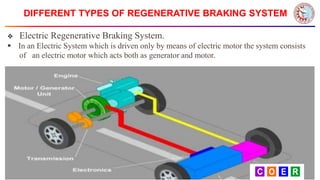
 Electric Regenerative Braking System.
 In an Electric System which is driven only by means of electric motor the system consists
of an electric motor which acts both as generator and motor.
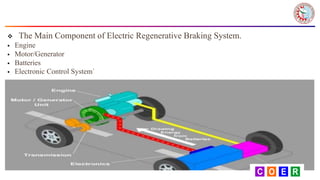
 The Main Component of Electric Regenerative Braking System.
 Engine
 Motor/Generator
 Batteries
 Electronic Control System`
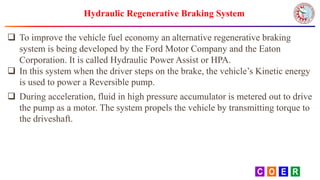
Hydraulic Regenerative Braking System
 To improve the vehicle fuel economy an alternative regenerative braking
system is being developed by the Ford Motor Company and the Eaton
Corporation. It is called Hydraulic Power Assist or HPA.
 In this system when the driver steps on the brake, the vehicle’s Kinetic energy
is used to power a Reversible pump.
 During acceleration, fluid in high pressure accumulator is metered out to drive
the pump as a motor. The system propels the vehicle by transmitting torque to
the driveshaft.
Hydraulic type regenerative braking system
APPLICATION OF REGENERATIVE BRAKING SYSTEM
 Super capacitor accept and release charge much more quickly.
 It can be discharged and recharged many more times and with far
deterioration than a battery.
 The Mazda Unit can accept a full charge in just 8-10 seconds
 The capacitor may take up to about 113s when the load is at
minimum about 18A.
REGENERATIVE BRAKING SYSTEM IN LOCOMOTIVES
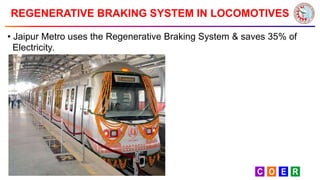
• Jaipur Metro uses the Regenerative Braking System & saves 35% of
Electricity.
ADVANTAGES OF REGENERATIVE BRAKING SYSTEM
 Increase of overall energy efficiency of a vehicle.
 Improved Performance.
 Emission Reduction.
 Reduction in Engine Wear.
 Cuts down on pollution related to electricity generation.
 Increases the lifespan of friction braking systems.
 Smaller Accessories.
 Less use of traditional mechanical brakes leads to less wear over time
DISADVANTAGES OF REGENERATIVE BRAKING SYSTEM
 Added Weight-Extra components can increase weight.
 Complexity-depends on control necessary for operation of regenerative
braking system.
 Cost of components, engineering, manufacturing and installation is high.
 Friction brakes are still necessary.
CONCLUSION
 Regenerative braking is an effective method of
improving vehicle efficiency and longevity
 Is already in use in many EVs
 The technology to do it exists and is often well
worthy
 Mostly dependent on the wider adoption of EVs or
further development of hydraulic regeneration
systems
THANK YOU!

REGENERATIVE BRAKING SYSTEM.pptx

  • 1.
    REGENERATIVE BRAKING SYSTEM A ProposedProject Power Point Presentation (1st Defending) Submitted in partial fulfilment of the requirements for the degree of BACHELOR OF TECHNOLOGY in MECHANICAL ENGINEERING by (Name: Mohd. Taukeer, Mohit Rawat, Mukul Tyagi, Deepak Kumar, & Vishal) Under the Supervision of Dr. Thomas Mathew (Assistant Professor) Mechanical Engineering College of Engineering Roorkee, Roorkee to MECHANICAL ENGINEERING DEPARTMENT COLLEGE OF ENGINEERING ROORKEE, ROORKEE UTTARAKHAND TECHNICAL UNIVERSITY DEHRADUN SEPTEMBER, 2020 COLLEGE OF ENGINEERING ROORKEE
  • 2.
    PROJECT TITLE A Proposed ProjectPower Point Presentation (1st Defending) Submitted in partial fulfilment of the requirements for the degree of BACHELOR OF TECHNOLOGY in MECHANICAL ENGINEERING to MECHANICAL ENGINEERING DEPARTMENT COLLEGE OF ENGINEERING ROORKEE, ROORKEE UTTARAKHAND TECHNICAL UNIVERSITY DEHRADUN SEPTEMBER, 2020 COLLEGE OF ENGINEERING ROORKEE SUBMITTED BY: GROUP NO : 6 NAMES: Mohmaad Taukeer Mohit Rawat Mukul Tyagi Deepak Kumar Vishal GUIDE: Dr. Thomas Mathew (Assistant Professor) Mechanical Engineering
  • 3.
    INTRODUCTION • A RegenerativeBrake, is an energy recovery mechanism which slows a vehicle or object down by converting its kinetic energy into another form, which can be either used immediately or stored until needed. • A Traditional Braking System, brake pads produce friction with the brake rotors to slow or stop the vehicle. Additional friction is produced between the slowed wheels and the surface of the road. This friction is what turns the car's kinetic energy into heat.
  • 4.
    PRINCIPLES OF REGENERATIVEBRAKING  Law of Conservation of Energy states that the total energy of an isolated system cannot change it is said to be conserved over time. Energy can be neither created nor destroyed, but can change form, for instance chemical energy can be converted to kinetic energy in the explosion of a stick of dynamite.  The most common form of regenerative brake involves using an electric motor as an electric generator. The generated electricity is fed back into the supply system, whereas in battery electric and hybrid electric vehicles, the energy is stored chemically in a battery.
  • 5.
    NEED OF REGENERATIVEBRAKING  Regenerative braking have the potential to improve the fuel economy of vehicles.  It reduces the emission of the vehicles.  It improved the fuel consumption by 33%.
  • 6.
  • 7.
    REGENERATIVE BRAKING SYSTEMIN HYBRID VEHICLES  A vehicle which contains two such sources of propulsion is known as hybrid system.  A hybrid vehicle consist a series and a parallel circuit of motor and the ICE.
  • 8.
    WORKING OF REGENERATIVEBRAKING SYSTEM IN HYBRID & EV’S  Regenerative braking is used in vehicles that make use of electric motors, primarily fully electric vehicles and hybrid electric vehicles.  It's run in one direction, it converts electrical energy into mechanical energy.  When the motor is run in the opposite direction, a properly designed motor becomes an electric generator, converting mechanical energy into electrical energy.  This electrical energy can then be fed into a charging system for the car's batteries.
  • 9.
    DIFFERENT TYPES OFREGENERATIVE BRAKING SYSTEM  Electric Regenerative Braking System.  In an Electric System which is driven only by means of electric motor the system consists of an electric motor which acts both as generator and motor.
  • 10.
     The MainComponent of Electric Regenerative Braking System.  Engine  Motor/Generator  Batteries  Electronic Control System`
  • 11.
    Hydraulic Regenerative BrakingSystem  To improve the vehicle fuel economy an alternative regenerative braking system is being developed by the Ford Motor Company and the Eaton Corporation. It is called Hydraulic Power Assist or HPA.  In this system when the driver steps on the brake, the vehicle’s Kinetic energy is used to power a Reversible pump.  During acceleration, fluid in high pressure accumulator is metered out to drive the pump as a motor. The system propels the vehicle by transmitting torque to the driveshaft.
  • 12.
  • 13.
    APPLICATION OF REGENERATIVEBRAKING SYSTEM  Super capacitor accept and release charge much more quickly.  It can be discharged and recharged many more times and with far deterioration than a battery.  The Mazda Unit can accept a full charge in just 8-10 seconds  The capacitor may take up to about 113s when the load is at minimum about 18A.
  • 14.
    REGENERATIVE BRAKING SYSTEMIN LOCOMOTIVES • Jaipur Metro uses the Regenerative Braking System & saves 35% of Electricity.
  • 15.
    ADVANTAGES OF REGENERATIVEBRAKING SYSTEM  Increase of overall energy efficiency of a vehicle.  Improved Performance.  Emission Reduction.  Reduction in Engine Wear.  Cuts down on pollution related to electricity generation.  Increases the lifespan of friction braking systems.  Smaller Accessories.  Less use of traditional mechanical brakes leads to less wear over time
  • 16.
    DISADVANTAGES OF REGENERATIVEBRAKING SYSTEM  Added Weight-Extra components can increase weight.  Complexity-depends on control necessary for operation of regenerative braking system.  Cost of components, engineering, manufacturing and installation is high.  Friction brakes are still necessary.
  • 17.
    CONCLUSION  Regenerative brakingis an effective method of improving vehicle efficiency and longevity  Is already in use in many EVs  The technology to do it exists and is often well worthy  Mostly dependent on the wider adoption of EVs or further development of hydraulic regeneration systems
  • 18.