GEN-ED PHYSICAL
SCIENCE
RUTHER FRANCIS TABLATE, LPT
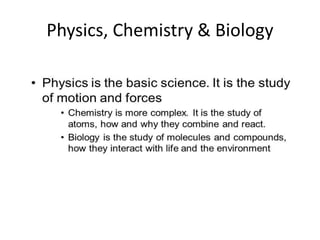
Physics, Chemistry & Biology
SCIENTISTS
• PTOLEMY (Earth Centered Model - geocentric)
• GALILEO (Telescope)
• COPERNICUS (Sun Centered Model – heliocentric)
• JOHANNES KEPLER (Laws of Planetary Motion)
• TYCHO BRAHE (Detailed observation of heavenly
bodies without aid of telescope)
KEPLER’S LAWS
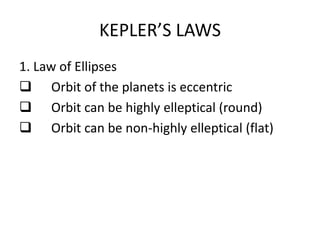
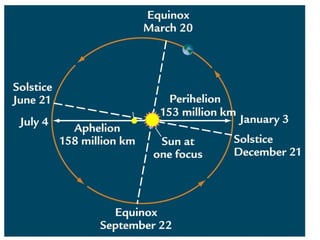
1. Law of Ellipses
 Orbit of the planets is eccentric
 Orbit can be highly elleptical (round)
 Orbit can be non-highly elleptical (flat)
KEPLER’S LAWS
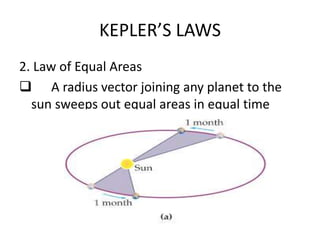
2. Law of Equal Areas
 A radius vector joining any planet to the
sun sweeps out equal areas in equal time
KEPLER’S LAWS
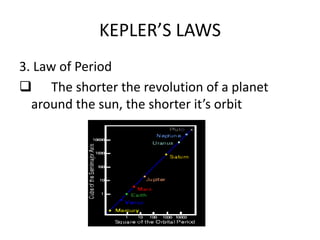
3. Law of Period
 The shorter the revolution of a planet
around the sun, the shorter it’s orbit
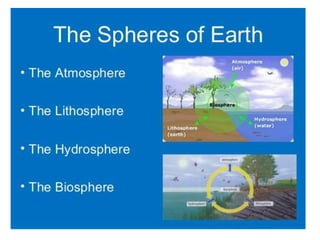
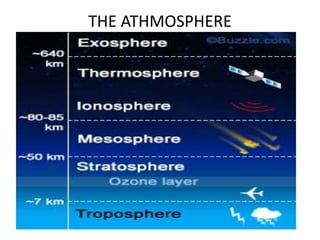
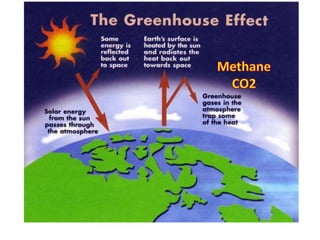
THE ATHMOSPHERE
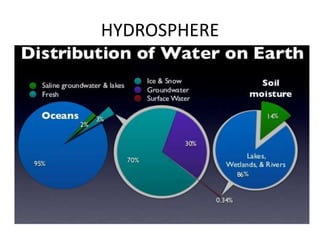
HYDROSPHERE
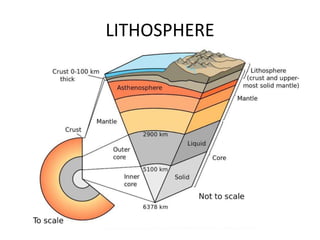
LITHOSPHERE
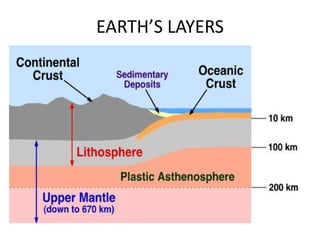
EARTH’S LAYERS
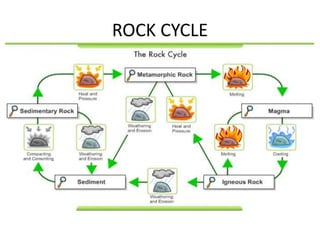
ROCK CYCLE
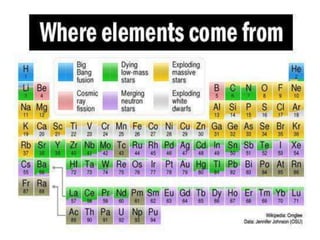
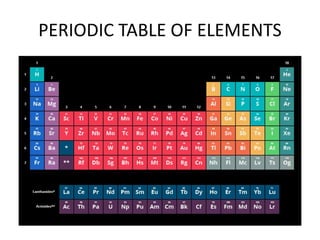
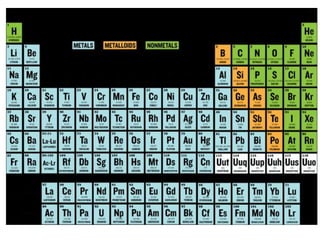
PERIODIC TABLE OF ELEMENTS
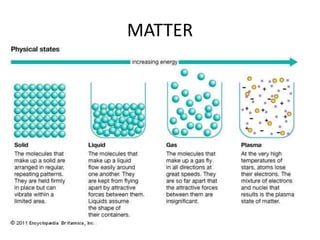
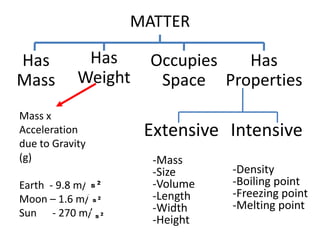
MATTER
MATTER
Occupies
Space
Has
Mass
Has
Weight
Has
Properties
Extensive
Mass x
Acceleration
due to Gravity
(g)
Earth - 9.8 m/
Moon – 1.6 m/
Sun - 270 m/
Intensive
-Mass
-Size
-Volume
-Length
-Width
-Height
-Density
-Boiling point
-Freezing point
-Melting point
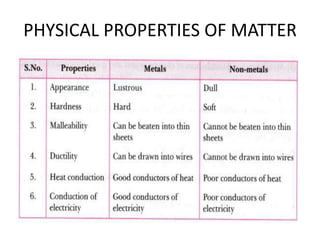
PHYSICAL PROPERTIES OF MATTER
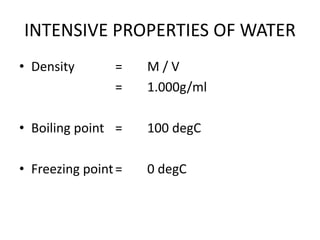
INTENSIVE PROPERTIES OF WATER
• Density = M / V
= 1.000g/ml
• Boiling point = 100 degC
• Freezing point= 0 degC
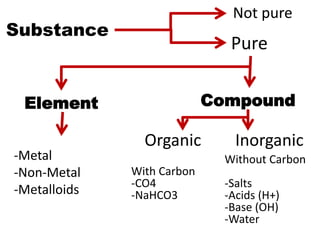
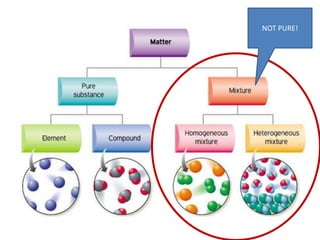
Substance
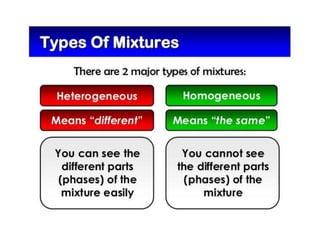
Not pure
Pure
Element Compound
-Metal
-Non-Metal
-Metalloids
Organic Inorganic
With Carbon
-CO4
-NaHCO3
Without Carbon
-Salts
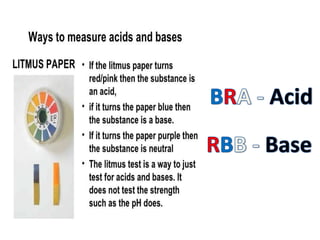
-Acids (H+)
-Base (OH)
-Water
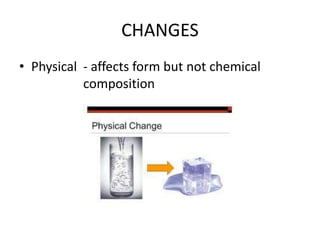
CHANGES
• Physical - affects form but not chemical
composition
CHANGES
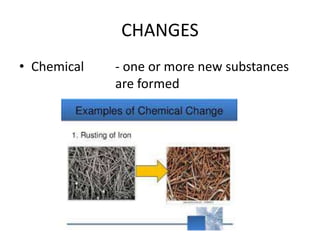
• Chemical - one or more new substances
are formed
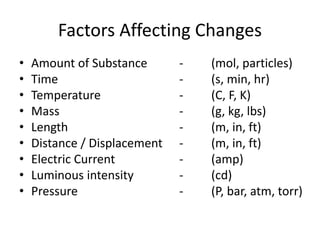
Factors Affecting Changes
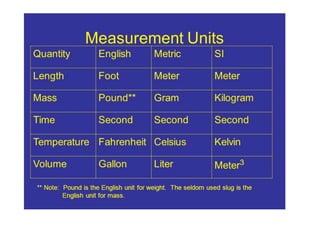
• Amount of Substance - (mol, particles)
• Time - (s, min, hr)
• Temperature - (C, F, K)
• Mass - (g, kg, lbs)
• Length - (m, in, ft)
• Distance / Displacement - (m, in, ft)
• Electric Current - (amp)
• Luminous intensity - (cd)
• Pressure - (P, bar, atm, torr)
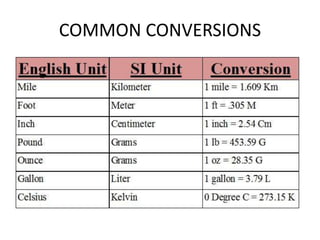
COMMON CONVERSIONS
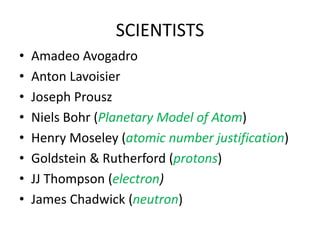
SCIENTISTS
• Amadeo Avogadro
• Anton Lavoisier
• Joseph Prousz
• Niels Bohr (Planetary Model of Atom)
• Henry Moseley (atomic number justification)
• Goldstein & Rutherford (protons)
• JJ Thompson (electron)
• James Chadwick (neutron)
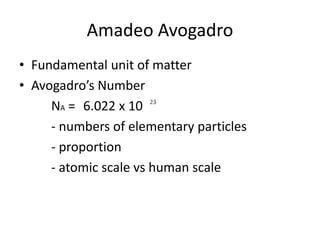
Amadeo Avogadro
• Fundamental unit of matter
• Avogadro’s Number
NA = 6.022 x 10
- numbers of elementary particles
- proportion
- atomic scale vs human scale
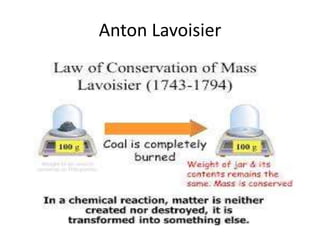
Anton Lavoisier
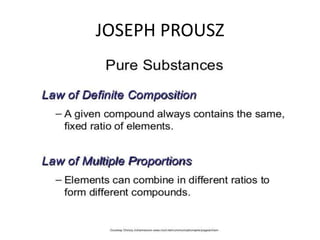
JOSEPH PROUSZ
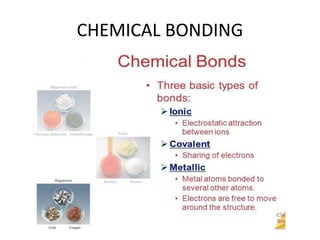
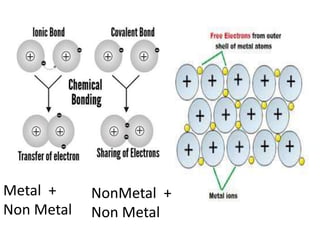
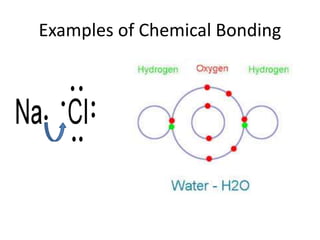
CHEMICAL BONDING
Metal +
Non Metal
NonMetal +
Non Metal
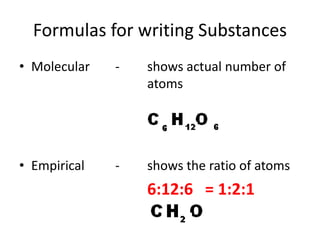
Formulas for writing Substances
• Molecular - shows actual number of
atoms
• Empirical - shows the ratio of atoms
6:12:6 = 1:2:1
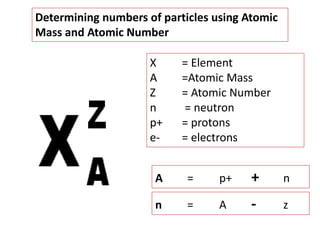
X = Element
A =Atomic Mass
Z = Atomic Number
n = neutron
p+ = protons
e- = electrons
A = p+ + n
n = A - z
Determining numbers of particles using Atomic
Mass and Atomic Number
ELECTRONIC CONFIGURATION
• In atomic physics and quantum chemistry,
the electron configuration is the distribution
of electrons of an atom or molecule (or other
physical structure) in atomic or molecular
orbitals. For example, the electron
configuration of the neon atom is 1s2 2s2 2p6.
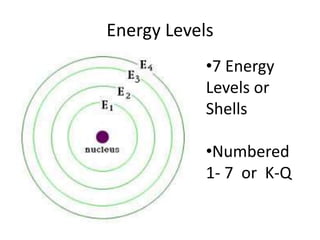
Energy Levels
•7 Energy
Levels or
Shells
•Numbered
1- 7 or K-Q
In showing Electronic Configuration
• Elements
• Atomic Number of element
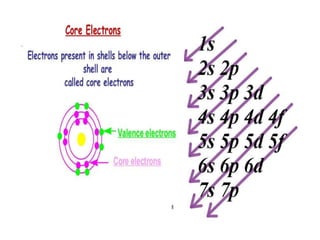
• Electrons (core, outer / valence)
• Energy levels
• Orbitals
• Pauli’s exclusion principle
• Hund’s Rule of electron pairing
• Afbau Building Principle
• Octet rule
Examples of Chemical Bonding
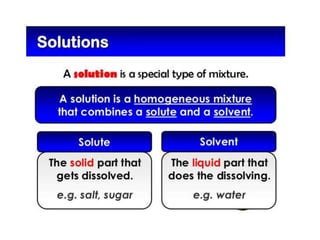
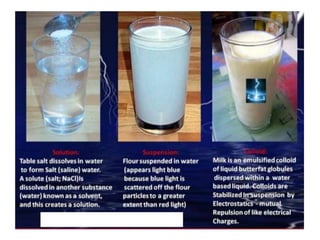
NOT PURE!
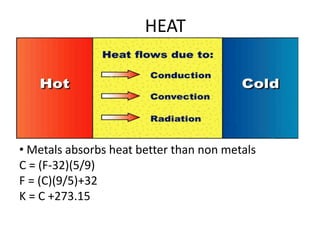
• Metals absorbs heat better than non metals
C = (F-32)(5/9)
F = (C)(9/5)+32
K = C +273.15
HEAT
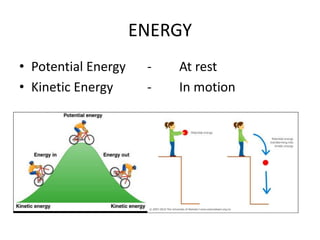
ENERGY
• Potential Energy - At rest
• Kinetic Energy - In motion
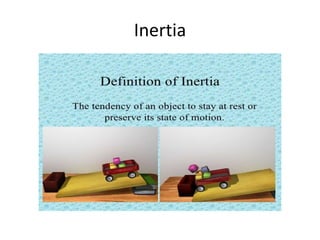
Inertia
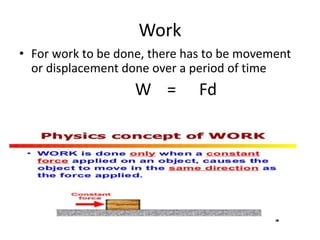
Work
• For work to be done, there has to be movement
or displacement done over a period of time
W = Fd
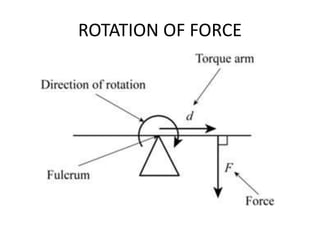
ROTATION OF FORCE
PHYSICAL-SCIENCE-2019.pptx

PHYSICAL-SCIENCE-2019.pptx