Pragmatics
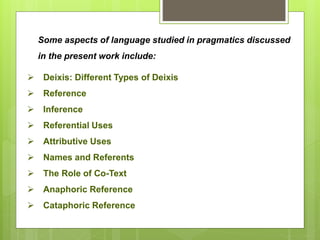
 Deixis: Different Types of Deixis
 Reference
 Inference
 Referential Uses
 Attributive Uses
 Names and Referents
 The Role of Co-Text
 Anaphoric Reference
 Cataphoric Reference
Some aspects of language studied in pragmatics discussed
in the present work include:
Chapter One
December 2001
I became what I am today at the age of twelve, on a frigid overcast
day in the winter of 1975. I remember the precise moment, crouching
behind a crumbling mud wall, peeking into the alley near the frozen
creek. That was a long time ago, but it’s wrong what they say about
the past, I’ve learned, about how you can bury it. Because the past
claws its way out. Looking back now, I realize I have been peeking
into that deserted alley for the last twenty-six years.
Text
Novel: The Kite Runner
Cont’d
One day last summer, my friend Rahim Khan called from Pakistan. He asked
me to come see him. Standing in the kitchen with the receiver to my ear, I knew
it wasn’t just Rahim Khan on the line. It was my past of unatoned sins. After I
hung up, I went for a walk along Spreckels Lake on the northern edge of
Golden Gate Park. The early-afternoon sun sparkled on the water where
dozens of miniature boats sailed, propelled by a crisp breeze. Then I glanced
up and saw a pair of kites, red with long blue tails, soaring in the sky. They
danced high above the trees on the west end of the park, over the windmills,
floating side by side like a pair of eyes looking down on San Francisco, the city
I now call home. And suddenly Hassan’s voice whispered in my head: For you,
a thousand times over. Hassan the harelipped kite runner.
I sat on a park bench near a willow tree. I thought about something Rahim
Khan said just before he hung up, almost as an afterthought. There is a way to
be good again. I looked up at those twin kites. I thought about Hassan. Thought
about Baba. Ali. Kabul. I thought of the life I had lived until the winter of 1975
came along and changed everything. And made me what I am today.
Deixis
Deixis is reference by means of an expression whose interpretation is
relative to the (usually) extralinguistic context of the utterance, such as
• who is speaking
• the time or place of speaking
• the gestures of the speaker, or
• the current location in the discourse.
In linguistics deixis means ‘pointing via language’
The expression used as deixis (to indicate something) is called deictic
expression or indexicals. e.g.
 I, You, Now, There, That, The following
Deixis helps us to identify things in time and space
Types of Deixis
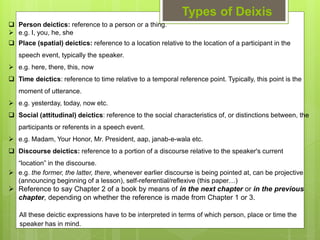
 Person deictics: reference to a person or a thing.
 e.g. I, you, he, she
 Place (spatial) deictics: reference to a location relative to the location of a participant in the
speech event, typically the speaker.
 e.g. here, there, this, now
 Time deictics: reference to time relative to a temporal reference point. Typically, this point is the
moment of utterance.
 e.g. yesterday, today, now etc.
 Social (attitudinal) deictics: reference to the social characteristics of, or distinctions between, the
participants or referents in a speech event.
 e.g. Madam, Your Honor, Mr. President, aap, janab-e-wala etc.
 Discourse deictics: reference to a portion of a discourse relative to the speaker's current
“location” in the discourse.
 e.g. the former, the latter, there, whenever earlier discourse is being pointed at, can be projective
(announcing beginning of a lesson), self-referential/reflexive (this paper…)
 Reference to say Chapter 2 of a book by means of in the next chapter or in the previous
chapter, depending on whether the reference is made from Chapter 1 or 3.
All these deictic expressions have to be interpreted in terms of which person, place or time the
speaker has in mind.
Interpretation of deictic terms
We interpret deictic terms by looking at aspects of context such as
- who is speaking
- the time of speaking
- the location of the speaker
- the topic of the discourse
-To whom the discourse refers to/or is about/ or is addressed to
(social deixis)
From the text
 Person deictics:
 I looked up at those twin kites.
 For you, a thousand times over.
 He asked me to come see him.
 Place (spatial) deictics:
 I sat on a park bench near a willow tree.
 reference to a location relative to the location of the speaker.
 Time deictics:
 the city I now call home.
 I became what I am today at the age of twelve.
 reference to time
Cont’d
 Social (attitudinal) deictics:
 reference to the social characteristics of, or distinctions between,
the participants or referents in a speech event.
 Discourse deictics:
 I became what I am today at the age of twelve,…
 One day last summer,….
 Reference to the speaker's current “location” in the discourse.
Reference and Inference
Reference: act in which a speaker/writer uses linguistic forms (referring
expressions) to enable a listener/reader to identify something
Referring expressions can be
- proper nouns ('Shakespeare', ‘Pakistan')
- definite noun phrases ('the painter', 'the city')
- indefinite noun phrases ('a man', 'a woman', 'a beautiful place')
- pronouns ('he', 'she', 'them')
The choice of expression depends largely on what the speaker assumes the
listener already knows
Inference: because there is no direct relationship between entities and words,
the listener’s task is to infer correctly which entity the speaker intends to
identify
- use of vague expressions
 'the red thing', 'that smelly stuff‘ etc.
- use of expressions focusing on a certain feature
 ‘Mister Aftershave is late today‘,
 ‘Miss nerd and her specs’
From the text
Referring expressions
- Proper nouns
 Pakistan; San Francisco; Rahim Khan
- Definite noun phrases
 the winter of 1975,
 I thought of the life I had)
- Indefinite noun phrases
 I sat on a park bench near a willow tree;
 Then I glanced up and saw a pair of kites
- Pronouns
 He asked me to come see him.
 to enable a listener/reader to identify something
Inference: to infer correctly which entity the speaker intends to identify
 There is a way to be good again.
Referential and Attributive uses
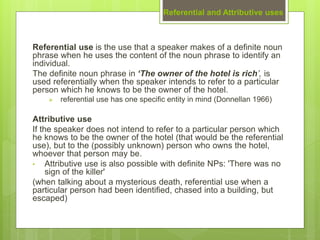
Referential use is the use that a speaker makes of a definite noun
phrase when he uses the content of the noun phrase to identify an
individual.
The definite noun phrase in ‘The owner of the hotel is rich’, is
used referentially when the speaker intends to refer to a particular
person which he knows to be the owner of the hotel.
 referential use has one specific entity in mind (Donnellan 1966)
Attributive use
If the speaker does not intend to refer to a particular person which
he knows to be the owner of the hotel (that would be the referential
use), but to the (possibly unknown) person who owns the hotel,
whoever that person may be.
• Attributive use is also possible with definite NPs: 'There was no
sign of the killer'
(when talking about a mysterious death, referential use when a
particular person had been identified, chased into a building, but
escaped)
From the text
Referential use is the use that a speaker makes of
a definite noun phrase when he uses the content of the noun
phrase to identify an individual.
 The early-afternoon sun sparkled on the water.
 I thought of the life I had lived until the winter of 1975 came
along
 They danced high above the trees on the west end of the
park.
Names and referents
Pragmatic connection between proper names and objects
conventionally associated within a socio-culturally defined
community.
Mutual understanding/agreement between members of a cultural
or language community about the meanings of certain names
For example,
 Can I borrow your Shakespeare?
 Yeah it's over there on the table
 We're going to see Shakespeare in London
 Is Mr. Coffee late today?
 He's ill.
From the text
No such instance found in the selected text
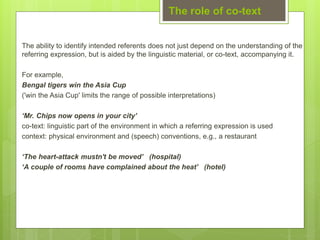
The role of co-text
The ability to identify intended referents does not just depend on the understanding of the
referring expression, but is aided by the linguistic material, or co-text, accompanying it.
For example,
Bengal tigers win the Asia Cup
('win the Asia Cup' limits the range of possible interpretations)
‘Mr. Chips now opens in your city’
co-text: linguistic part of the environment in which a referring expression is used
context: physical environment and (speech) conventions, e.g., a restaurant
‘The heart-attack mustn't be moved’ (hospital)
‘A couple of rooms have complained about the heat’ (hotel)
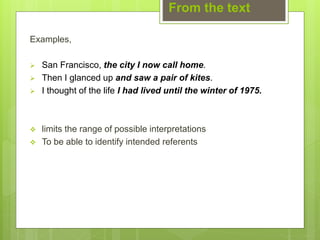
From the text
Examples,
 San Francisco, the city I now call home.
 Then I glanced up and saw a pair of kites.
 I thought of the life I had lived until the winter of 1975.
 limits the range of possible interpretations
 To be able to identify intended referents
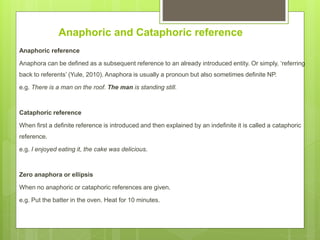
Anaphoric and Cataphoric reference
Anaphoric reference
Anaphora can be defined as a subsequent reference to an already introduced entity. Or simply, ‘referring
back to referents’ (Yule, 2010). Anaphora is usually a pronoun but also sometimes definite NP.
e.g. There is a man on the roof. The man is standing still.
Cataphoric reference
When first a definite reference is introduced and then explained by an indefinite it is called a cataphoric
reference.
e.g. I enjoyed eating it, the cake was delicious.
Zero anaphora or ellipsis
When no anaphoric or cataphoric references are given.
e.g. Put the batter in the oven. Heat for 10 minutes.
From the text
Anaphoric reference
 One day last summer, my friend Rahim Khan called from Pakistan. He asked me to come
see him.
 but it’s wrong what they say about the past, I’ve learned, about how you can bury it.
 Then I glanced up and saw a pair of kites, red with long blue tails, soaring in the sky. They
danced high above the trees on the west end of the park
 I thought about something Rahim Khan said just before he hung up.
 To refer back to referents; to maintain reference.
 To avoid repetition.
Cataphoric reference
 No instance within the text
Thank you

Pragmatics assignment with example from text.pptx

  • 1.
  • 2.
     Deixis: DifferentTypes of Deixis  Reference  Inference  Referential Uses  Attributive Uses  Names and Referents  The Role of Co-Text  Anaphoric Reference  Cataphoric Reference Some aspects of language studied in pragmatics discussed in the present work include:
  • 3.
    Chapter One December 2001 Ibecame what I am today at the age of twelve, on a frigid overcast day in the winter of 1975. I remember the precise moment, crouching behind a crumbling mud wall, peeking into the alley near the frozen creek. That was a long time ago, but it’s wrong what they say about the past, I’ve learned, about how you can bury it. Because the past claws its way out. Looking back now, I realize I have been peeking into that deserted alley for the last twenty-six years. Text Novel: The Kite Runner
  • 4.
    Cont’d One day lastsummer, my friend Rahim Khan called from Pakistan. He asked me to come see him. Standing in the kitchen with the receiver to my ear, I knew it wasn’t just Rahim Khan on the line. It was my past of unatoned sins. After I hung up, I went for a walk along Spreckels Lake on the northern edge of Golden Gate Park. The early-afternoon sun sparkled on the water where dozens of miniature boats sailed, propelled by a crisp breeze. Then I glanced up and saw a pair of kites, red with long blue tails, soaring in the sky. They danced high above the trees on the west end of the park, over the windmills, floating side by side like a pair of eyes looking down on San Francisco, the city I now call home. And suddenly Hassan’s voice whispered in my head: For you, a thousand times over. Hassan the harelipped kite runner. I sat on a park bench near a willow tree. I thought about something Rahim Khan said just before he hung up, almost as an afterthought. There is a way to be good again. I looked up at those twin kites. I thought about Hassan. Thought about Baba. Ali. Kabul. I thought of the life I had lived until the winter of 1975 came along and changed everything. And made me what I am today.
  • 5.
    Deixis Deixis is referenceby means of an expression whose interpretation is relative to the (usually) extralinguistic context of the utterance, such as • who is speaking • the time or place of speaking • the gestures of the speaker, or • the current location in the discourse. In linguistics deixis means ‘pointing via language’ The expression used as deixis (to indicate something) is called deictic expression or indexicals. e.g.  I, You, Now, There, That, The following Deixis helps us to identify things in time and space
  • 6.
    Types of Deixis Person deictics: reference to a person or a thing.  e.g. I, you, he, she  Place (spatial) deictics: reference to a location relative to the location of a participant in the speech event, typically the speaker.  e.g. here, there, this, now  Time deictics: reference to time relative to a temporal reference point. Typically, this point is the moment of utterance.  e.g. yesterday, today, now etc.  Social (attitudinal) deictics: reference to the social characteristics of, or distinctions between, the participants or referents in a speech event.  e.g. Madam, Your Honor, Mr. President, aap, janab-e-wala etc.  Discourse deictics: reference to a portion of a discourse relative to the speaker's current “location” in the discourse.  e.g. the former, the latter, there, whenever earlier discourse is being pointed at, can be projective (announcing beginning of a lesson), self-referential/reflexive (this paper…)  Reference to say Chapter 2 of a book by means of in the next chapter or in the previous chapter, depending on whether the reference is made from Chapter 1 or 3. All these deictic expressions have to be interpreted in terms of which person, place or time the speaker has in mind.
  • 7.
    Interpretation of deicticterms We interpret deictic terms by looking at aspects of context such as - who is speaking - the time of speaking - the location of the speaker - the topic of the discourse -To whom the discourse refers to/or is about/ or is addressed to (social deixis)
  • 8.
    From the text Person deictics:  I looked up at those twin kites.  For you, a thousand times over.  He asked me to come see him.  Place (spatial) deictics:  I sat on a park bench near a willow tree.  reference to a location relative to the location of the speaker.  Time deictics:  the city I now call home.  I became what I am today at the age of twelve.  reference to time
  • 9.
    Cont’d  Social (attitudinal)deictics:  reference to the social characteristics of, or distinctions between, the participants or referents in a speech event.  Discourse deictics:  I became what I am today at the age of twelve,…  One day last summer,….  Reference to the speaker's current “location” in the discourse.
  • 10.
    Reference and Inference Reference:act in which a speaker/writer uses linguistic forms (referring expressions) to enable a listener/reader to identify something Referring expressions can be - proper nouns ('Shakespeare', ‘Pakistan') - definite noun phrases ('the painter', 'the city') - indefinite noun phrases ('a man', 'a woman', 'a beautiful place') - pronouns ('he', 'she', 'them') The choice of expression depends largely on what the speaker assumes the listener already knows Inference: because there is no direct relationship between entities and words, the listener’s task is to infer correctly which entity the speaker intends to identify - use of vague expressions  'the red thing', 'that smelly stuff‘ etc. - use of expressions focusing on a certain feature  ‘Mister Aftershave is late today‘,  ‘Miss nerd and her specs’
  • 11.
    From the text Referringexpressions - Proper nouns  Pakistan; San Francisco; Rahim Khan - Definite noun phrases  the winter of 1975,  I thought of the life I had) - Indefinite noun phrases  I sat on a park bench near a willow tree;  Then I glanced up and saw a pair of kites - Pronouns  He asked me to come see him.  to enable a listener/reader to identify something Inference: to infer correctly which entity the speaker intends to identify  There is a way to be good again.
  • 12.
    Referential and Attributiveuses Referential use is the use that a speaker makes of a definite noun phrase when he uses the content of the noun phrase to identify an individual. The definite noun phrase in ‘The owner of the hotel is rich’, is used referentially when the speaker intends to refer to a particular person which he knows to be the owner of the hotel.  referential use has one specific entity in mind (Donnellan 1966) Attributive use If the speaker does not intend to refer to a particular person which he knows to be the owner of the hotel (that would be the referential use), but to the (possibly unknown) person who owns the hotel, whoever that person may be. • Attributive use is also possible with definite NPs: 'There was no sign of the killer' (when talking about a mysterious death, referential use when a particular person had been identified, chased into a building, but escaped)
  • 13.
    From the text Referentialuse is the use that a speaker makes of a definite noun phrase when he uses the content of the noun phrase to identify an individual.  The early-afternoon sun sparkled on the water.  I thought of the life I had lived until the winter of 1975 came along  They danced high above the trees on the west end of the park.
  • 14.
    Names and referents Pragmaticconnection between proper names and objects conventionally associated within a socio-culturally defined community. Mutual understanding/agreement between members of a cultural or language community about the meanings of certain names For example,  Can I borrow your Shakespeare?  Yeah it's over there on the table  We're going to see Shakespeare in London  Is Mr. Coffee late today?  He's ill.
  • 15.
    From the text Nosuch instance found in the selected text
  • 16.
    The role ofco-text The ability to identify intended referents does not just depend on the understanding of the referring expression, but is aided by the linguistic material, or co-text, accompanying it. For example, Bengal tigers win the Asia Cup ('win the Asia Cup' limits the range of possible interpretations) ‘Mr. Chips now opens in your city’ co-text: linguistic part of the environment in which a referring expression is used context: physical environment and (speech) conventions, e.g., a restaurant ‘The heart-attack mustn't be moved’ (hospital) ‘A couple of rooms have complained about the heat’ (hotel)
  • 17.
    From the text Examples, San Francisco, the city I now call home.  Then I glanced up and saw a pair of kites.  I thought of the life I had lived until the winter of 1975.  limits the range of possible interpretations  To be able to identify intended referents
  • 18.
    Anaphoric and Cataphoricreference Anaphoric reference Anaphora can be defined as a subsequent reference to an already introduced entity. Or simply, ‘referring back to referents’ (Yule, 2010). Anaphora is usually a pronoun but also sometimes definite NP. e.g. There is a man on the roof. The man is standing still. Cataphoric reference When first a definite reference is introduced and then explained by an indefinite it is called a cataphoric reference. e.g. I enjoyed eating it, the cake was delicious. Zero anaphora or ellipsis When no anaphoric or cataphoric references are given. e.g. Put the batter in the oven. Heat for 10 minutes.
  • 19.
    From the text Anaphoricreference  One day last summer, my friend Rahim Khan called from Pakistan. He asked me to come see him.  but it’s wrong what they say about the past, I’ve learned, about how you can bury it.  Then I glanced up and saw a pair of kites, red with long blue tails, soaring in the sky. They danced high above the trees on the west end of the park  I thought about something Rahim Khan said just before he hung up.  To refer back to referents; to maintain reference.  To avoid repetition. Cataphoric reference  No instance within the text
  • 20.