Girish Suryanarayana, Ganesh Samarthyam, Tushar Sharma
2
Outline
Introduction – Design Quality,
Technical Debt, and Design Smells
Design Smells Catalog – Examples
and corresponding Refactoring
The Smell Ecosystem and Repaying
Technical Debt in Practice
3
Outline
Introduction – Design Quality,
Technical Debt, and Design Smells
Design Smells Catalog – Examples
and corresponding Refactoring
The Smell Ecosystem and Repaying
Technical Debt in Practice
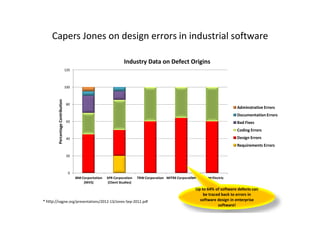
Capers Jones on design errors in industrial software
* http://sqgne.org/presentations/2012-13/Jones-Sep-2012.pdf
0
20
40
60
80
100
120
IBM Corportation
(MVS)
SPR Corporation
(Client Studies)
TRW Corporation MITRE Corporation Nippon Electric
Corp
PercentageContribution
Industry Data on Defect Origins
Adminstrative Errors
Documentation Errors
Bad Fixes
Coding Errors
Design Errors
Requirements Errors
Up to 64% of software defects can
be traced back to errors in
software design in enterprise
software!
Why care about design quality?
Poor software quality
costs more than $150
billion per year in U.S. and
greater than $500 billion
per year worldwide
The debt that accrues when
you knowingly or
unknowingly make wrong or
non-optimal design decisions
Software
Quality
Technical
Debt
Design
Quality
Design Quality means
changeability, extensibility,
understandability,
reusability, ...
6
Why care about technical debt?
Global 'IT Debt‘ is $500 billion for the
year 2010,with potential to grow to $1
trillion by 2015
7
What constitutes technical debt?
…
Code debt
Static analysis
tool violations
Inconsistent
coding style
Design debt
Design smells
Violations of
design rules
Test debt
Lack of tests
Inadequate test
coverage
Documentation
debt
No
documentation
for important
concerns
Outdated
documentation
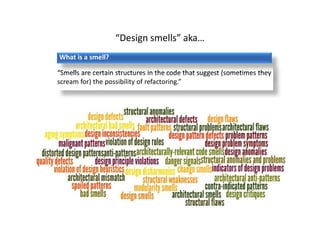
“Design smells” aka…
“Smells are certain structures in the code that suggest (sometimes they
scream for) the possibility of refactoring.”
What is a smell?
9
Why care about smells?
Impacted Quality
§ Reusability
§ Changeability
§ Understandability
§ Extensibility
§ …
Product
Quality
Design
Quality
Design
Smells
Impacted Quality
§ Maintainability: Affected
by changeability &
extensibility
§ Reliability: Impacted by
poor understandability
§ …
Indicators
§ Rigidity & Fragility
§ Immobility & Opacity
§ Needless complexity
§ Needless repetition
§ …
10
What causes design smells?
11
Why we focus on smells?
A good designer is
one who knows the
design solutions
A GREAT designer is
one who understands
the impact of design
smells and knows
how to address them
12
Design Smells as violations of fundamental principles
What do smells indicate?
Violations of fundamental design principles
We use Booch’s fundamental principles for classification and naming of
smells
This helps identify cause of the smell and potential refactoring as well
13
Principles used to classify design smells
14
Quality attributes impacted by smells
15
A principle-based approach to design smells classification
Related Publications
S G Ganesh, Tushar Sharma, Girish Suryanarayana. Towards a Principle-based
Classification of Structural Design Smells. In Journal of Object Technology, vol. 12,
no. 2, 2013, pages 1:1–29.doi:10.5381/jot.2013.12.2.a1
URL: http://www.jot.fm/issues/issue_2013_06/article1.pdf (open access)
16
Summary till now
Design Quality
Technical Debt
Design Smells
Why care about smells
17
Outline
Introduction – Design Quality,
Technical Debt, and Design Smells
Design Smells Catalog – Examples
and corresponding Refactoring
The Smell Ecosystem and Repaying
Technical Debt in Practice
18
19
A note on examples in this presentation
We cover only a few examples of each smell category in this presentation
Lack of time
Most examples are from OpenJDK 7.0 (open source)
All illustrations are mostly as UML diagrams so no need to know Java
(though you’ll appreciate more if you know Java)
Almost all examples are UML-like diagrams – so agnostic of OO language
Some code examples are in Java, but they are very few
20
21
The principle of abstraction
22
Enabling techniques for abstraction
23
24
Incomplete abstraction
This smell arises when a type does not support a responsibility
completely
Specifically, the public interface of the type is incomplete in that it
does not support all behavior needed by objects of its type
25
Incomplete abstraction – Example
In this case, the MutableTreeNode
supports only setUserObject but no
corresponding getUserObject (which
is provided in its derived class!)
Hence, MutableTreeNode has
Incomplete Abstraction smell
How to fix it? Provide all the
necessary and relevant methods
required for satisfying a
responsibility completely in the class
itself
In case of public APIs (as in this
case), it is often “too late” to fix
it!
26
Another example
27
28
How to refactor & in future avoid this smell?
For each abstraction (especially in public interface) look out for symmetrical
methods or methods that go together
For example, methods for comparing equality of objects and getting
hash code (in Java/C#)
Look out for missing matching methods in symmetrical methods (see
table)
min/max open/close create/destroy get/set
read/write print/scan first/last begin/end
start/stop lock/unlock show/hide up/down
source/target insert/delete first/last push/pull
enable/disable acquire/release left/right on/off
29
30
Duplicate abstraction
This smell arises when two or more abstractions have identical
names or identical implementation or both.
31
32
Kinds of clones
• exactly identical except for variations in whitespace, layout, and
comments
Type 1
• syntactically identical except for variation in symbol names,
whitespace, layout, and comments
Type 2
• identical except some statements changed, added, or removed
Type 3
• when the fragments are semantically identical but implemented
by syntactic variants
Type 4
33
public class FormattableFlags {
// Explicit instantiation of this class is prohibited.
private FormattableFlags() {}
/** Left-justifies the output. */
public static final int LEFT_JUSTIFY = 1<<0; // '-'
/** Converts the output to upper case */
public static final int UPPERCASE = 1<<1; // 'S'
/**Requires the output to use an alternate form. */
public static final int ALTERNATE = 1<<2; // '#'
}
34
public class Dollar {
public static final String symbol = “$”;
}
35
Unnecessary abstraction
The smell occurs when an abstraction gets introduced in a software
design which is actually not needed and thus could have been avoided.
36
37
The principle of encapsulation
38
Enabling techniques for encapsulation
39
40
41
Leaky encapsulation
This smell arises when an abstraction “exposes” or “leaks”
implementation details through its public interface.
42
Refactoring leaky encapsulation smell
43
44
45
Missing encapsulation
This smell occurs when the encapsulation of implementation
variations in a type or hierarchy is missing.
46
Refactoring missing encapsulation smell
47
Refactoring missing encapsulation smell
48
49
The principle of modularization
50
Enabling techniques for modularization
51
52
53
Insufficient modularization
This smell arises when an existing abstraction could be further
decomposed thereby reducing its interface size, implementation
complexity or both. Two variants:
a) When an abstraction has a large number of members in its interface, its
implementation, or both
b) When an abstraction has one or more methods with excessive complexity
54
Insufficient modularization – Example
The abstract class java.awt.Component is
an example of insufficient modularization
It is a massive class with 332 methods
(of which 259 are public!)
11 nested/inner classes
107 fields (including constants)
source file spans 10,102 lines of
code!
The Component serves as a base class
and the hierarchy is deep
Derived classes inherit the members
=> life is quite difficult!
55
56
57
58
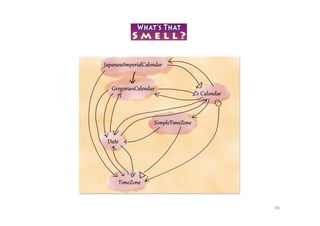
Cyclically-dependent modularization
This smell arises when two or more class-level abstractions depend
on each other directly or indirectly (creating a tight coupling among
the abstractions).
(This smell is commonly known as “cyclic dependencies”)
59
Refactoring cyclically-dependent modularization
60
Refactoring cyclically-dependent modularization
61
Refactoring cyclically-dependent modularization
62
Refactoring cyclically-dependent modularization
63
Refactoring cyclically-dependent modularization
64
Refactoring cyclically-dependent modularization
65
66
The principle of hierarchy
67
Enabling techniques for hierarchy
68
69
70
Unfactored hierarchy
This smell arises when the types in a hierarchy share unnecessary
duplication in the hierarchy. Two forms of this smell:
• Duplication in sibling types
• Duplication in super and subtypes
71
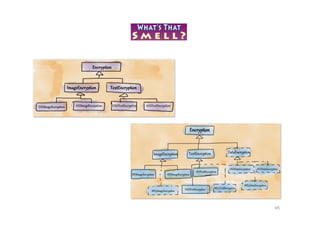
A refactoring for missing intermediate types
72
Refactoring for unfactored hierarchy
73
Refactoring for unfactored hierarchy
74
75
76
77
Broken hierarchy
This smell arises when the base abstraction and its derived
abstraction(s) conceptually do not share “IS-A” relationship
(resulting in broken substitutability).
This design smell arises when inheritance is used wrongly instead of
using composition.
78
LSP
It should be possible to replace
objects of supertype with
objects of subtypes without
altering the desired behavior of
the program
79
Refactoring broken hierarchy
80
Refactoring broken hierarchy
81
82
83
Unnecessary hierarchy
This smell arises when an inheritance hierarchy has one or more unnecessary
abstractions. Includes the following cases:
• all the subtypes are unnecessary (i.e., inappropriate use of inheritance)
• supertype has only one subtype (i.e., speculative generalization)
• intermediate types are unnecessary
84
Refactoring unnecessary hierarchy
85
Refactoring unnecessary hierarchy
86
Refactoring unnecessary hierarchy
87
Summary till now
Abstraction Smells
Incomplete Abstraction
Duplicate Abstraction
Unnecessary Abstraction
Encapsulation Smells
Leaky Encapsulation
Missing Encapsulation
Modularization Smells
Insufficient Modularization
Cyclically-dependent Modularization
Hierarchy Smells
Unfactored Hierarchy
Broken Hierarchy
Unnecessary Hierarchy
88
Outline
Introduction – Design Quality,
Technical Debt, and Design Smells
Design Smells Catalog – Examples
and corresponding Refactoring
The Smell Ecosystem and Repaying
Technical Debt in Practice
89
Smell Ecosystem
DD
DD
DD
DD
DD
Smell
Smell
Smell
DD
DD: Design Decision
Design
90
Role of context in smells and refactoring
Could it be Duplicate
Abstraction, Unfactored
Hierarchy, or Unnecessary
Abstraction smell?
91
Interplay of Smells: Co-occurring smells
92
Interplay of Smells: Amplification
Insufficient Modularization
smell due to Component
class amplify the impact of
deep hierarchy negatively.
93
Interplay of Smells: Deeper problems
94
How to improve design quality in practice?
95
Refactoring process model
96
What were your key takeaways?
97
Our upcoming book on this topic!
98
99
References
100
Ganesh Samarthyam
sgganesh@gmail.com
Twitter@GSamarthyam
Girish Suryanarayana
girish.suryanarayana@gmail.com
Twitter@girish_sur
Tushar Sharma
tusharsharma@ieee.org
Twitter@Sharma__Tushar

Refactoring for Design Smells - ICSE 2014 Tutorial