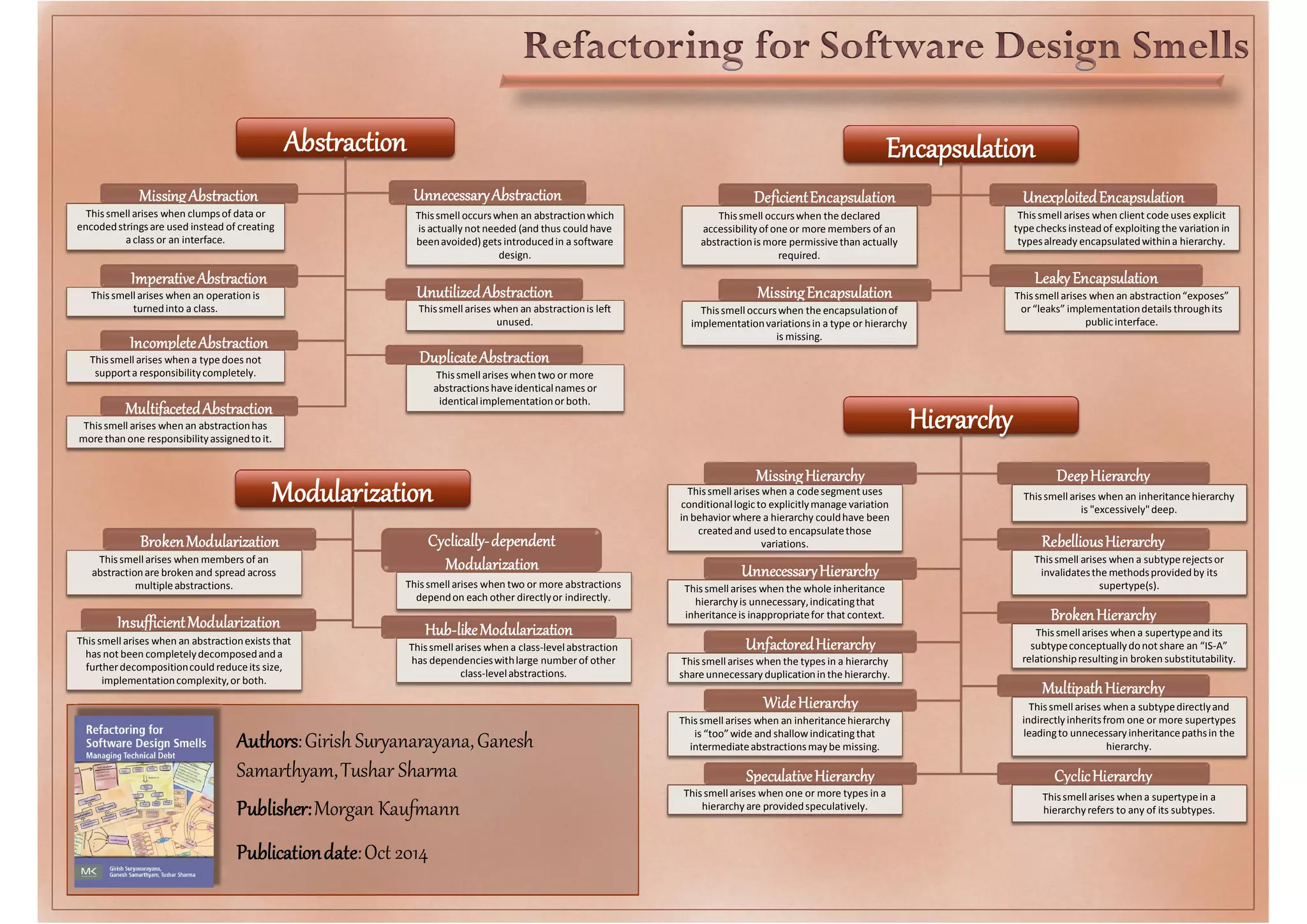
Abstraction
MissingAbstraction
This smell arises when clumps of data or
encoded strings are used instead of creating
a class or an interface.
ImperativeAbstraction
This smell arises when an operation is
turned into a class.
IncompleteAbstraction
This smell arises when an abstraction does
not support complementary or interrelated
methods completely.
MultifacetedAbstraction
This smell arises when an abstraction has
more than one responsibility assigned to it.
UnnecessaryAbstraction
This smell occurs when an abstraction which
is actually not needed (and thus could have
been avoided) gets introduced in a software
design.
UnutilizedAbstraction
This smell arises when an abstraction is left
unused (either not directly used or not
reachable).
DuplicateAbstraction
This smell arises when two or more
abstractions have the identical name or
identical implementation or both.
Encapsulation
DeficientEncapsulation
This smell occurs when the declared
accessibility of one or more members of an
abstraction is more permissive than actually
required.
LeakyEncapsulation
This smell arises when an abstraction “exposes”
or “leaks” implementation details through its
public interface.
MissingEncapsulation
This smell occurs when the encapsulation of
implementation variations in a type or hierarchy
is missing.
UnexploitedEncapsulation
This smell arises when client code uses explicit
type checks(using chained if-else or switch
statements) instead of exploiting the variation
in types already encapsulated within a
hierarchy.
Modularization
Hierarchy
MissingHierarchy DeepHierarchy
Modularization
BrokenModularization
This smell arises when data and/or methods
that ideally should have been localized into a
single abstraction are separated and spread
acrossmultiple abstractions.
InsufficientModularization
This smell arises when an abstraction exists that
has not been completely decomposed and a
further decomposition could reduce its size,
implementation complexity, or both.
Cyclically-dependent
Modularization
This smell arises when two or more abstractions
depend on each other directly or indirectly
(creating a tight coupling between the
abstractions).
Hub-likeModularization
This smell arises when an abstraction has
dependencies (both incoming and outgoing)
with large number of other abstractions.
MissingHierarchy
This smell arises when a code segment uses
conditional logic (typically in conjunction with
“tagged types”) to explicitly manage variation in
behavior where a hierarchy could have been
created and used to encapsulate those
variations.
UnnecessaryHierarchy
This smell arises when the whole inheritance
hierarchy is unnecessary, indicating that
inheritancehas been applied needlessly for the
particulardesign context.
UnfactoredHierarchy
This smell arises when there is unnecessary
duplication among types in the hierarchy.
WideHierarchy
This smell arises when an inheritance hierarchy
is “too” wide indicating that intermediate
abstractions may be missing.
SpeculativeHierarchy
This smell arises when one or more types in a
hierarchy are provided speculatively (i.e. based
on imagined needs rather than real
requirements).
DeepHierarchy
This smell arises when an inheritance hierarchy
is "excessively" deep.
RebelliousHierarchy
This smell arises when a subtype rejects the
methods provided by its supertype(s).
BrokenHierarchy
This smell arises when a supertype and its
subtype conceptually do not share an “IS-A”
relationship resulting in broken substitutability.
MultipathHierarchy
This smell arises when a subtype inherits both
directly as well as indirectly from a supertype
leading to unnecessary inheritance paths in the
hierarchy.
CyclicHierarchy
This smell arises when a supertype in a
hierarchy depends on any of its subtypes.
Authors:Girish Suryanarayana, Ganesh
Samarthyam,Tushar Sharma
Publisher:Morgan Kaufmann
Publicationdate:Nov 2014

Refactoring for Software Design Smells: Managing Technical Debt

  • 1.
    Abstraction MissingAbstraction This smell ariseswhen clumps of data or encoded strings are used instead of creating a class or an interface. ImperativeAbstraction This smell arises when an operation is turned into a class. IncompleteAbstraction This smell arises when an abstraction does not support complementary or interrelated methods completely. MultifacetedAbstraction This smell arises when an abstraction has more than one responsibility assigned to it. UnnecessaryAbstraction This smell occurs when an abstraction which is actually not needed (and thus could have been avoided) gets introduced in a software design. UnutilizedAbstraction This smell arises when an abstraction is left unused (either not directly used or not reachable). DuplicateAbstraction This smell arises when two or more abstractions have the identical name or identical implementation or both. Encapsulation DeficientEncapsulation This smell occurs when the declared accessibility of one or more members of an abstraction is more permissive than actually required. LeakyEncapsulation This smell arises when an abstraction “exposes” or “leaks” implementation details through its public interface. MissingEncapsulation This smell occurs when the encapsulation of implementation variations in a type or hierarchy is missing. UnexploitedEncapsulation This smell arises when client code uses explicit type checks(using chained if-else or switch statements) instead of exploiting the variation in types already encapsulated within a hierarchy. Modularization Hierarchy MissingHierarchy DeepHierarchy Modularization BrokenModularization This smell arises when data and/or methods that ideally should have been localized into a single abstraction are separated and spread acrossmultiple abstractions. InsufficientModularization This smell arises when an abstraction exists that has not been completely decomposed and a further decomposition could reduce its size, implementation complexity, or both. Cyclically-dependent Modularization This smell arises when two or more abstractions depend on each other directly or indirectly (creating a tight coupling between the abstractions). Hub-likeModularization This smell arises when an abstraction has dependencies (both incoming and outgoing) with large number of other abstractions. MissingHierarchy This smell arises when a code segment uses conditional logic (typically in conjunction with “tagged types”) to explicitly manage variation in behavior where a hierarchy could have been created and used to encapsulate those variations. UnnecessaryHierarchy This smell arises when the whole inheritance hierarchy is unnecessary, indicating that inheritancehas been applied needlessly for the particulardesign context. UnfactoredHierarchy This smell arises when there is unnecessary duplication among types in the hierarchy. WideHierarchy This smell arises when an inheritance hierarchy is “too” wide indicating that intermediate abstractions may be missing. SpeculativeHierarchy This smell arises when one or more types in a hierarchy are provided speculatively (i.e. based on imagined needs rather than real requirements). DeepHierarchy This smell arises when an inheritance hierarchy is "excessively" deep. RebelliousHierarchy This smell arises when a subtype rejects the methods provided by its supertype(s). BrokenHierarchy This smell arises when a supertype and its subtype conceptually do not share an “IS-A” relationship resulting in broken substitutability. MultipathHierarchy This smell arises when a subtype inherits both directly as well as indirectly from a supertype leading to unnecessary inheritance paths in the hierarchy. CyclicHierarchy This smell arises when a supertype in a hierarchy depends on any of its subtypes. Authors:Girish Suryanarayana, Ganesh Samarthyam,Tushar Sharma Publisher:Morgan Kaufmann Publicationdate:Nov 2014