Clare Newborn IOM/ ARC Development Manager
Mark Johnson ARC Operational Manager
Pete Grayson Lincolnshire Police Lead
Reducing Reoffending through Multi-Agency Partnerships
Police Foundation Annual Conference 29th November 2017
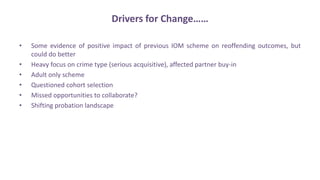
Drivers for Change……
• Some evidence of positive impact of previous IOM scheme on reoffending outcomes, but
could do better
• Heavy focus on crime type (serious acquisitive), affected partner buy-in
• Adult only scheme
• Questioned cohort selection
• Missed opportunities to collaborate?
• Shifting probation landscape
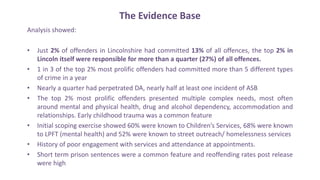
The Evidence Base
Analysis showed:
• Just 2% of offenders in Lincolnshire had committed 13% of all offences, the top 2% in
Lincoln itself were responsible for more than a quarter (27%) of all offences.
• 1 in 3 of the top 2% most prolific offenders had committed more than 5 different types
of crime in a year
• Nearly a quarter had perpetrated DA, nearly half at least one incident of ASB
• The top 2% most prolific offenders presented multiple complex needs, most often
around mental and physical health, drug and alcohol dependency, accommodation and
relationships. Early childhood trauma was a common feature
• Initial scoping exercise showed 60% were known to Children’s Services, 68% were known
to LPFT (mental health) and 52% were known to street outreach/ homelessness services
• History of poor engagement with services and attendance at appointments.
• Short term prison sentences were a common feature and reoffending rates post release
were high
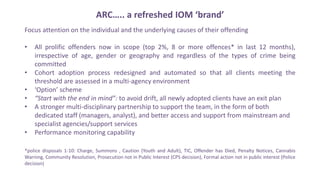
Focus attention on the individual and the underlying causes of their offending
• All prolific offenders now in scope (top 2%, 8 or more offences* in last 12 months),
irrespective of age, gender or geography and regardless of the types of crime being
committed
• Cohort adoption process redesigned and automated so that all clients meeting the
threshold are assessed in a multi-agency environment
• ‘Option’ scheme
• “Start with the end in mind”: to avoid drift, all newly adopted clients have an exit plan
• A stronger multi-disciplinary partnership to support the team, in the form of both
dedicated staff (managers, analyst), and better access and support from mainstream and
specialist agencies/support services
• Performance monitoring capability
*police disposals 1-10: Charge, Summons , Caution (Youth and Adult), TIC, Offender has Died, Penalty Notices, Cannabis
Warning, Community Resolution, Prosecution not in Public Interest (CPS decision), Formal action not in public interest (Police
decision)
ARC….. a refreshed IOM ‘brand’
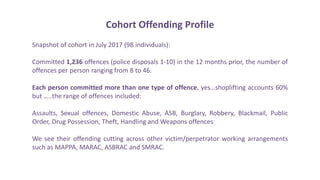
Cohort Offending Profile
Snapshot of cohort in July 2017 (98 individuals):
Committed 1,236 offences (police disposals 1-10) in the 12 months prior, the number of
offences per person ranging from 8 to 46.
Each person committed more than one type of offence, yes…shoplifting accounts 60%
but …..the range of offences included:
Assaults, Sexual offences, Domestic Abuse, ASB, Burglary, Robbery, Blackmail, Public
Order, Drug Possession, Theft, Handling and Weapons offences
We see their offending cutting across other victim/perpetrator working arrangements
such as MAPPA, MARAC, ASBRAC and SMRAC.
Profile of Under 18’s
• Common features: parental neglect, bereavement, exposure to domestic abuse, family
conflict and breakdown, limited education, risk-taking behaviours, frequent missing episodes
• Risks are complex and wide ranging. ARC seek to tackle spectrum of risks in young persons
life
• All current under 18 year olds are known to Children’s Services; either Social Care, Education,
Early Help or LAC teams
• Intergenerational issues
• Majority are 16 years of age and over; ARC presents a unique opportunity to effectively
manage transition to adult services
Synergies not silo’s
A refreshed approach that aims to better understand and integrate the interdependencies across
partnerships.
ARC scheme aligns itself with existing programmes and working arrangements, to reduce
duplication, achieve efficiencies and ensure synchronized service delivery:
• Bluelight (treatment resistant drinkers)
• ACTion Lincs (entrenched rough sleepers)
• Police Transformation Fund ‘Change that Lasts’ Pilot Project (domestic abuse perpetrators)
• MAPPA, MARAC, SMRAC, ASBRAC
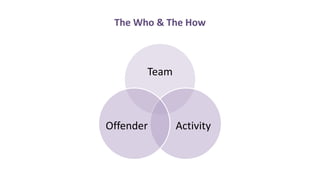
The Who & The How
Team
ActivityOffender
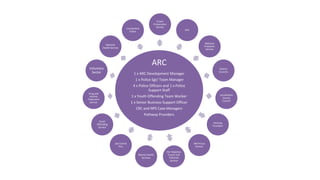
ARC
1 x ARC Development Manager
1 x Police Sgt/ Team Manager
4 x Police Officers and 1 x Police
Support Staff
1 x Youth Offending Team Worker
1 x Senior Business Support Officer
CRC and NPS Case Managers
Pathway Providers
Crown
Prosecution
Service
CRC
National
Probation
Service
District
Councils
Lincolnshire
County
Council
Housing
Providers
HM Prison
Service
Her Majestys
Courts and
Tribunals
Service
Mental Health
Services
Job Centre
Plus
Youth
Offending
Service
Drug and
Alcohol
Treatment
Service
Voluntary
Sector
National
Health Service
Lincolnshire
Police
The Police Officer Affect?.....
We’d suggest being a Police Officer doesn’t need to be a barrier
• Its about the relationship, not the job
• Builds trust and confidence within communities, and across family generations
• Clear rules of engagement
• Its working…
Let’s tell you about “Young Person A”
• 18 year old male adopted by ARC in October 2016
• 16 offences committed in 12mths prior to adoption, for offences of Robbery, Assault and
Possession of Offensive Weapons
• Previous custodial sentences
• Assessed as presenting significant risk of serious harm/ managed at MAPPA Level 2
• Known to Children’s Social Care from the age of 4yrs old due to neglect
• Experienced trauma in early life including exposure to domestic abuse. Now perpetrator of
abuse towards mother and siblings
• Looked After Child, unsettled living arrangements following placement break downs
• Permanently excluded from school
• Problematic alcohol use
Let’s tell you about “Young Person B”
• 16 year old male adopted by ARC in July 2017
• 0 offences committed in 12mths prior to adoption however under investigation for offences
of Robbery, Theft, Possession of Offensive Weapons and Theft
• No previous Court Orders or custodial sentences
• Assessed as being highly vulnerable, as associating with Young Person A and elder brother
managed at MAPPA Level 2
• Known to Children’s Social Care
• Experienced trauma in serious RTC in 2014, continues to have health implications
• Problematic substance use
• In supported housing
Early signs of success
ARC aspires to:
• Slow down rate and seriousness of offending
• Achieve long term behavioural change
• Improve outcomes for individuals, their families and the communities
in which they live
Performance measured six months after adoption onto scheme:
• 73.5% reduction in rate of offending
• 74.7% reduction in crime severity score
ARC Contact Details
Myle Cross Centre, Macaulay Drive, Lincoln, LN2 4EL
ARC@lincs.pnn.police.uk
Twitter: @ARCLincs
Pause and Reflect....
“We believe our model is working, but like everyone we are equally keen to learn from
others experiences”
Given the early signs of success, we are exploring the expansion of the principles of
ARC in the area of early intervention, with a focus on the 16-24yrs cohort so…..
• What experiences do you have of the identification and use of predictors to re-
offending?
• We are open to challenge and would be keen to hear what works for you?
Any Questions

Reducing reoffending through multi-agency partnerships

  • 1.
    Clare Newborn IOM/ARC Development Manager Mark Johnson ARC Operational Manager Pete Grayson Lincolnshire Police Lead Reducing Reoffending through Multi-Agency Partnerships Police Foundation Annual Conference 29th November 2017
  • 2.
    Drivers for Change…… •Some evidence of positive impact of previous IOM scheme on reoffending outcomes, but could do better • Heavy focus on crime type (serious acquisitive), affected partner buy-in • Adult only scheme • Questioned cohort selection • Missed opportunities to collaborate? • Shifting probation landscape
  • 3.
    The Evidence Base Analysisshowed: • Just 2% of offenders in Lincolnshire had committed 13% of all offences, the top 2% in Lincoln itself were responsible for more than a quarter (27%) of all offences. • 1 in 3 of the top 2% most prolific offenders had committed more than 5 different types of crime in a year • Nearly a quarter had perpetrated DA, nearly half at least one incident of ASB • The top 2% most prolific offenders presented multiple complex needs, most often around mental and physical health, drug and alcohol dependency, accommodation and relationships. Early childhood trauma was a common feature • Initial scoping exercise showed 60% were known to Children’s Services, 68% were known to LPFT (mental health) and 52% were known to street outreach/ homelessness services • History of poor engagement with services and attendance at appointments. • Short term prison sentences were a common feature and reoffending rates post release were high
  • 4.
    Focus attention onthe individual and the underlying causes of their offending • All prolific offenders now in scope (top 2%, 8 or more offences* in last 12 months), irrespective of age, gender or geography and regardless of the types of crime being committed • Cohort adoption process redesigned and automated so that all clients meeting the threshold are assessed in a multi-agency environment • ‘Option’ scheme • “Start with the end in mind”: to avoid drift, all newly adopted clients have an exit plan • A stronger multi-disciplinary partnership to support the team, in the form of both dedicated staff (managers, analyst), and better access and support from mainstream and specialist agencies/support services • Performance monitoring capability *police disposals 1-10: Charge, Summons , Caution (Youth and Adult), TIC, Offender has Died, Penalty Notices, Cannabis Warning, Community Resolution, Prosecution not in Public Interest (CPS decision), Formal action not in public interest (Police decision) ARC….. a refreshed IOM ‘brand’
  • 5.
    Cohort Offending Profile Snapshotof cohort in July 2017 (98 individuals): Committed 1,236 offences (police disposals 1-10) in the 12 months prior, the number of offences per person ranging from 8 to 46. Each person committed more than one type of offence, yes…shoplifting accounts 60% but …..the range of offences included: Assaults, Sexual offences, Domestic Abuse, ASB, Burglary, Robbery, Blackmail, Public Order, Drug Possession, Theft, Handling and Weapons offences We see their offending cutting across other victim/perpetrator working arrangements such as MAPPA, MARAC, ASBRAC and SMRAC.
  • 6.
    Profile of Under18’s • Common features: parental neglect, bereavement, exposure to domestic abuse, family conflict and breakdown, limited education, risk-taking behaviours, frequent missing episodes • Risks are complex and wide ranging. ARC seek to tackle spectrum of risks in young persons life • All current under 18 year olds are known to Children’s Services; either Social Care, Education, Early Help or LAC teams • Intergenerational issues • Majority are 16 years of age and over; ARC presents a unique opportunity to effectively manage transition to adult services
  • 7.
    Synergies not silo’s Arefreshed approach that aims to better understand and integrate the interdependencies across partnerships. ARC scheme aligns itself with existing programmes and working arrangements, to reduce duplication, achieve efficiencies and ensure synchronized service delivery: • Bluelight (treatment resistant drinkers) • ACTion Lincs (entrenched rough sleepers) • Police Transformation Fund ‘Change that Lasts’ Pilot Project (domestic abuse perpetrators) • MAPPA, MARAC, SMRAC, ASBRAC
  • 8.
    The Who &The How Team ActivityOffender
  • 9.
    ARC 1 x ARCDevelopment Manager 1 x Police Sgt/ Team Manager 4 x Police Officers and 1 x Police Support Staff 1 x Youth Offending Team Worker 1 x Senior Business Support Officer CRC and NPS Case Managers Pathway Providers Crown Prosecution Service CRC National Probation Service District Councils Lincolnshire County Council Housing Providers HM Prison Service Her Majestys Courts and Tribunals Service Mental Health Services Job Centre Plus Youth Offending Service Drug and Alcohol Treatment Service Voluntary Sector National Health Service Lincolnshire Police
  • 10.
    The Police OfficerAffect?..... We’d suggest being a Police Officer doesn’t need to be a barrier • Its about the relationship, not the job • Builds trust and confidence within communities, and across family generations • Clear rules of engagement • Its working…
  • 11.
    Let’s tell youabout “Young Person A” • 18 year old male adopted by ARC in October 2016 • 16 offences committed in 12mths prior to adoption, for offences of Robbery, Assault and Possession of Offensive Weapons • Previous custodial sentences • Assessed as presenting significant risk of serious harm/ managed at MAPPA Level 2 • Known to Children’s Social Care from the age of 4yrs old due to neglect • Experienced trauma in early life including exposure to domestic abuse. Now perpetrator of abuse towards mother and siblings • Looked After Child, unsettled living arrangements following placement break downs • Permanently excluded from school • Problematic alcohol use
  • 12.
    Let’s tell youabout “Young Person B” • 16 year old male adopted by ARC in July 2017 • 0 offences committed in 12mths prior to adoption however under investigation for offences of Robbery, Theft, Possession of Offensive Weapons and Theft • No previous Court Orders or custodial sentences • Assessed as being highly vulnerable, as associating with Young Person A and elder brother managed at MAPPA Level 2 • Known to Children’s Social Care • Experienced trauma in serious RTC in 2014, continues to have health implications • Problematic substance use • In supported housing
  • 13.
    Early signs ofsuccess ARC aspires to: • Slow down rate and seriousness of offending • Achieve long term behavioural change • Improve outcomes for individuals, their families and the communities in which they live Performance measured six months after adoption onto scheme: • 73.5% reduction in rate of offending • 74.7% reduction in crime severity score
  • 14.
    ARC Contact Details MyleCross Centre, Macaulay Drive, Lincoln, LN2 4EL ARC@lincs.pnn.police.uk Twitter: @ARCLincs
  • 15.
    Pause and Reflect.... “Webelieve our model is working, but like everyone we are equally keen to learn from others experiences” Given the early signs of success, we are exploring the expansion of the principles of ARC in the area of early intervention, with a focus on the 16-24yrs cohort so….. • What experiences do you have of the identification and use of predictors to re- offending? • We are open to challenge and would be keen to hear what works for you?
  • 16.