
ICITAP PHILIPPINES
COMMUNITY POLICING
• To familiarize police supervisors with the philosophy,
goals, objectives and techniques of community
based policing and the SARA problem solving
process.
Module 3 Lesson 3.2
Rev: August 2017
2
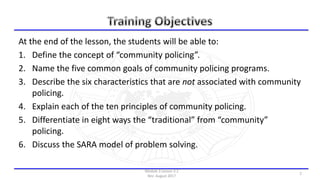
At the end of the lesson, the students will be able to:
1. Define the concept of “community policing”.
2. Name the five common goals of community policing programs.
3. Describe the six characteristics that are not associated with community
policing.
4. Explain each of the ten principles of community policing.
5. Differentiate in eight ways the “traditional” from “community”
policing.
6. Discuss the SARA model of problem solving.
Module 3 Lesson 3.2
Rev: August 2017
3
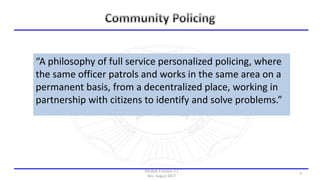
“A philosophy of full service personalized policing, where
the same officer patrols and works in the same area on a
permanent basis, from a decentralized place, working in
partnership with citizens to identify and solve problems.”
Module 3 Lesson 3.2
Rev: August 2017
4
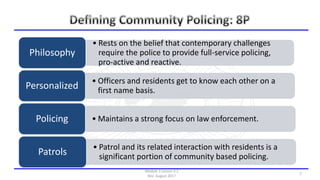
• Rests on the belief that contemporary challenges
require the police to provide full-service policing,
pro-active and reactive.
Philosophy
• Officers and residents get to know each other on a
first name basis.Personalized
• Maintains a strong focus on law enforcement.Policing
• Patrol and its related interaction with residents is a
significant portion of community based policing.Patrols
Module 3 Lesson 3.2
Rev: August 2017
5
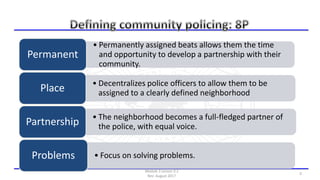
• Permanently assigned beats allows them the time
and opportunity to develop a partnership with their
community.
Permanent
• Decentralizes police officers to allow them to be
assigned to a clearly defined neighborhoodPlace
• The neighborhood becomes a full-fledged partner of
the police, with equal voice.Partnership
• Focus on solving problems.Problems
Module 3 Lesson 3.2
Rev: August 2017
6
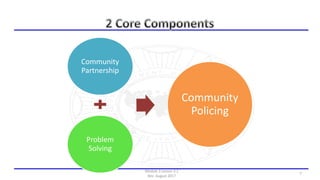
Community
Partnership
Problem
Solving
Community
Policing
Module 3 Lesson 3.2
Rev: August 2017
7
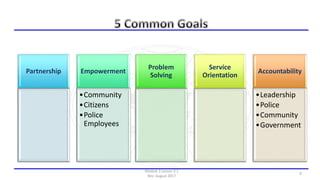
Partnership Empowerment
•Community
•Citizens
•Police
Employees
Problem
Solving
Service
Orientation
Accountability
•Leadership
•Police
•Community
•Government
Module 3 Lesson 3.2
Rev: August 2017
8
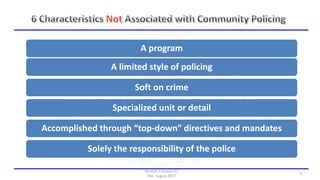
A program
A limited style of policing
Soft on crime
Specialized unit or detail
Accomplished through “top-down” directives and mandates
Solely the responsibility of the police
Module 3 Lesson 3.2
Rev: August 2017
9
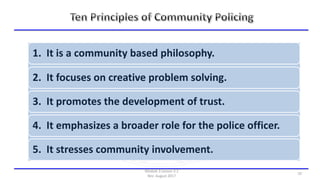
1. It is a community based philosophy.
2. It focuses on creative problem solving.
3. It promotes the development of trust.
4. It emphasizes a broader role for the police officer.
5. It stresses community involvement.
Module 3 Lesson 3.2
Rev: August 2017
10
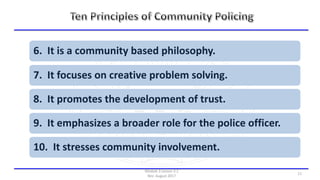
6. It is a community based philosophy.
7. It focuses on creative problem solving.
8. It promotes the development of trust.
9. It emphasizes a broader role for the police officer.
10. It stresses community involvement.
Module 3 Lesson 3.2
Rev: August 2017
11
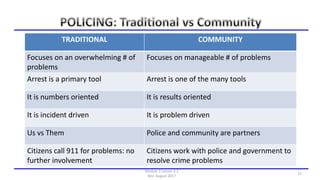
TRADITIONAL COMMUNITY
Focuses on an overwhelming # of
problems
Focuses on manageable # of problems
Arrest is a primary tool Arrest is one of the many tools
It is numbers oriented It is results oriented
It is incident driven It is problem driven
Us vs Them Police and community are partners
Citizens call 911 for problems: no
further involvement
Citizens work with police and government to
resolve crime problems
Module 3 Lesson 3.2
Rev: August 2017
12
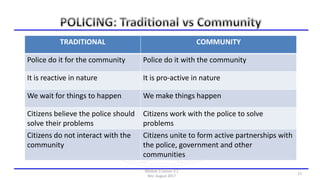
TRADITIONAL COMMUNITY
Police do it for the community Police do it with the community
It is reactive in nature It is pro-active in nature
We wait for things to happen We make things happen
Citizens believe the police should
solve their problems
Citizens work with the police to solve
problems
Citizens do not interact with the
community
Citizens unite to form active partnerships with
the police, government and other
communities
Module 3 Lesson 3.2
Rev: August 2017
13
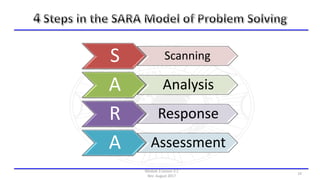
S Scanning
A Analysis
R Response
A Assessment
Module 3 Lesson 3.2
Rev: August 2017
14
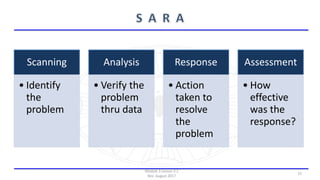
Scanning
• Identify
the
problem
Analysis
• Verify the
problem
thru data
Response
• Action
taken to
resolve
the
problem
Assessment
• How
effective
was the
response?
Module 3 Lesson 3.2
Rev: August 2017
15
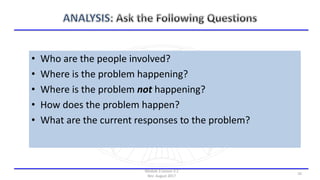
• Who are the people involved?
• Where is the problem happening?
• Where is the problem not happening?
• How does the problem happen?
• What are the current responses to the problem?
Module 3 Lesson 3.2
Rev: August 2017
16
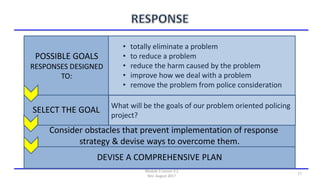
POSSIBLE GOALS
RESPONSES DESIGNED
TO:
• totally eliminate a problem
• to reduce a problem
• reduce the harm caused by the problem
• improve how we deal with a problem
• remove the problem from police consideration
SELECT THE GOAL What will be the goals of our problem oriented policing
project?
Consider obstacles that prevent implementation of response
strategy & devise ways to overcome them.
DEVISE A COMPREHENSIVE PLAN
Module 3 Lesson 3.2
Rev: August 2017
17
1. Define the concept of “community policing”.
2. Name the five common goals of community policing
programs.
3. Describe the six characteristics that are not associated with
community policing.
4. Explain each of the ten principles of community policing.
5. Differentiate in eight ways the “traditional” from
“community” policing.
6. Discuss the SARA model of problem solving.
Module 3 Lesson 3.2
Rev: August 2017
18
Module 3 Lesson 3.2
Rev: August 2017
19

Lesson plan 3.2 community policing

  • 1.
  • 2.
    • To familiarizepolice supervisors with the philosophy, goals, objectives and techniques of community based policing and the SARA problem solving process. Module 3 Lesson 3.2 Rev: August 2017 2
  • 3.
    At the endof the lesson, the students will be able to: 1. Define the concept of “community policing”. 2. Name the five common goals of community policing programs. 3. Describe the six characteristics that are not associated with community policing. 4. Explain each of the ten principles of community policing. 5. Differentiate in eight ways the “traditional” from “community” policing. 6. Discuss the SARA model of problem solving. Module 3 Lesson 3.2 Rev: August 2017 3
  • 4.
    “A philosophy offull service personalized policing, where the same officer patrols and works in the same area on a permanent basis, from a decentralized place, working in partnership with citizens to identify and solve problems.” Module 3 Lesson 3.2 Rev: August 2017 4
  • 5.
    • Rests onthe belief that contemporary challenges require the police to provide full-service policing, pro-active and reactive. Philosophy • Officers and residents get to know each other on a first name basis.Personalized • Maintains a strong focus on law enforcement.Policing • Patrol and its related interaction with residents is a significant portion of community based policing.Patrols Module 3 Lesson 3.2 Rev: August 2017 5
  • 6.
    • Permanently assignedbeats allows them the time and opportunity to develop a partnership with their community. Permanent • Decentralizes police officers to allow them to be assigned to a clearly defined neighborhoodPlace • The neighborhood becomes a full-fledged partner of the police, with equal voice.Partnership • Focus on solving problems.Problems Module 3 Lesson 3.2 Rev: August 2017 6
  • 7.
  • 8.
  • 9.
    A program A limitedstyle of policing Soft on crime Specialized unit or detail Accomplished through “top-down” directives and mandates Solely the responsibility of the police Module 3 Lesson 3.2 Rev: August 2017 9
  • 10.
    1. It isa community based philosophy. 2. It focuses on creative problem solving. 3. It promotes the development of trust. 4. It emphasizes a broader role for the police officer. 5. It stresses community involvement. Module 3 Lesson 3.2 Rev: August 2017 10
  • 11.
    6. It isa community based philosophy. 7. It focuses on creative problem solving. 8. It promotes the development of trust. 9. It emphasizes a broader role for the police officer. 10. It stresses community involvement. Module 3 Lesson 3.2 Rev: August 2017 11
  • 12.
    TRADITIONAL COMMUNITY Focuses onan overwhelming # of problems Focuses on manageable # of problems Arrest is a primary tool Arrest is one of the many tools It is numbers oriented It is results oriented It is incident driven It is problem driven Us vs Them Police and community are partners Citizens call 911 for problems: no further involvement Citizens work with police and government to resolve crime problems Module 3 Lesson 3.2 Rev: August 2017 12
  • 13.
    TRADITIONAL COMMUNITY Police doit for the community Police do it with the community It is reactive in nature It is pro-active in nature We wait for things to happen We make things happen Citizens believe the police should solve their problems Citizens work with the police to solve problems Citizens do not interact with the community Citizens unite to form active partnerships with the police, government and other communities Module 3 Lesson 3.2 Rev: August 2017 13
  • 14.
    S Scanning A Analysis RResponse A Assessment Module 3 Lesson 3.2 Rev: August 2017 14
  • 15.
    Scanning • Identify the problem Analysis • Verifythe problem thru data Response • Action taken to resolve the problem Assessment • How effective was the response? Module 3 Lesson 3.2 Rev: August 2017 15
  • 16.
    • Who arethe people involved? • Where is the problem happening? • Where is the problem not happening? • How does the problem happen? • What are the current responses to the problem? Module 3 Lesson 3.2 Rev: August 2017 16
  • 17.
    POSSIBLE GOALS RESPONSES DESIGNED TO: •totally eliminate a problem • to reduce a problem • reduce the harm caused by the problem • improve how we deal with a problem • remove the problem from police consideration SELECT THE GOAL What will be the goals of our problem oriented policing project? Consider obstacles that prevent implementation of response strategy & devise ways to overcome them. DEVISE A COMPREHENSIVE PLAN Module 3 Lesson 3.2 Rev: August 2017 17
  • 18.
    1. Define theconcept of “community policing”. 2. Name the five common goals of community policing programs. 3. Describe the six characteristics that are not associated with community policing. 4. Explain each of the ten principles of community policing. 5. Differentiate in eight ways the “traditional” from “community” policing. 6. Discuss the SARA model of problem solving. Module 3 Lesson 3.2 Rev: August 2017 18
  • 19.
    Module 3 Lesson3.2 Rev: August 2017 19