1
February 25th, 2020
Red Hat Advanced Cluster
Management for Kubernetes
Dieter De Moitié
Senior Solution Architect
The
Kubernetes
platform
for
big
ideas
Ludovic Aelbrecht
Business Development Manager
2
Disclaimer
The content set forth herein is Red Hat confidential
information and does not constitute in any way a
binding or legal agreement or impose any legal
obligation or duty on Red Hat.  
This information is provided for discussion purposes
only and is subject to change for any or no reason.
Disclaimer
3
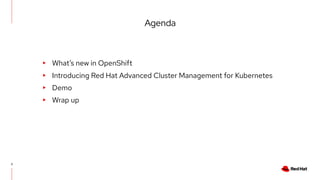
Agenda
▸ What’s new in OpenShift
▸ Introducing Red Hat Advanced Cluster Management for Kubernetes
▸ Demo
▸ Wrap up
ACM
What’s new in OpenShift
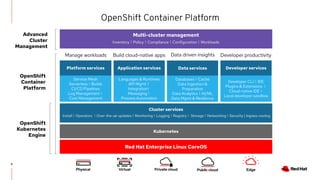
OpenShift Container Platform
Developer productivity
Cluster services
Install ⠇Operators ⠇Over-the-air updates ⠇Monitoring ⠇Logging ⠇Registry ⠇ Storage ⠇Networking ⠇Security | Ingress routing
5
Kubernetes
Developer CLI ⠇IDE
Plugins & Extensions ⠇
Cloud-native IDE ⠇
Local developer sandbox
Service Mesh
Serverless ⠇Builds
CI/CD Pipelines
Log Management ⠇
Cost Management
Languages & Runtimes
API Mgmt ⠇
Integration⠇
Messaging ⠇
Process Automation
Platform services Application services Developer services
Build cloud-native apps
Manage workloads
Multi-cluster management
Inventory ⠇Policy ⠇Compliance ⠇Configuration ⠇Workloads
Data driven insights
Databases ⠇Cache
Data Ingestion &
Preparation
Data Analytics ⠇AI/ML
Data Mgmt & Resilience
Data services
Physical Virtual Private cloud Public cloud Edge
OpenShift
Kubernetes
Engine
Advanced
Cluster
Management
OpenShift
Container
Platform
Red Hat Enterprise Linux CoreOS
5
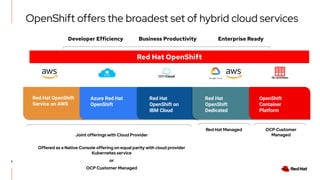
OpenShift offers the broadest set of hybrid cloud services
6
Red Hat OpenShift
Service on AWS
Azure Red Hat
OpenShift
Red Hat
OpenShift on
IBM Cloud
On-premises
Red Hat OpenShift
Red Hat Managed OCP Customer
Managed
Developer Efficiency Business Productivity Enterprise Ready
Red Hat
OpenShift
Dedicated
Joint offerings with Cloud Provider
Offered as a Native Console offering on equal parity with cloud provider
Kubernetes service
or
OCP Customer Managed
OpenShift
Container
Platform
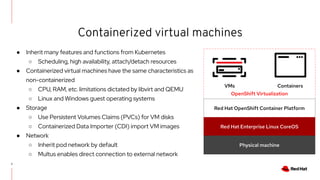
Containerized virtual machines
7
● Inherit many features and functions from Kubernetes
○ Scheduling, high availability, attach/detach resources
● Containerized virtual machines have the same characteristics as
non-containerized
○ CPU, RAM, etc. limitations dictated by libvirt and QEMU
○ Linux and Windows guest operating systems
● Storage
○ Use Persistent Volumes Claims (PVCs) for VM disks
○ Containerized Data Importer (CDI) import VM images
● Network
○ Inherit pod network by default
○ Multus enables direct connection to external network
VMs Containers
Red Hat OpenShift Container Platform
Red Hat Enterprise Linux CoreOS
Physical machine
OpenShift Virtualization
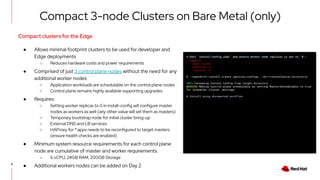
Compact 3-node Clusters on Bare Metal (only)
Compact clusters for the Edge
● Allows minimal footprint clusters to be used for developer and
Edge deployments
○ Reduces hardware costs and power requirements
● Comprised of just 3 control plane nodes without the need for any
additional worker nodes
○ Application workloads are schedulable on the control plane nodes
○ Control plane remains highly available supporting upgrades
● Requires:
○ Setting worker replicas to 0 in install-config will configure master
nodes as workers as well (any other value will set them as masters)
○ Temporary bootstrap node for initial cluster bring-up
○ External DNS and LB services
○ HAProxy for *.apps needs to be reconfigured to target masters
(ensure health checks are enabled)
● Minimum system resource requirements for each control plane
node are cumulative of master and worker requirements:
○ 6 vCPU, 24GB RAM, 200GB Storage
● Additional workers nodes can be added on Day 2
# Edit ‘install-config.yaml’ and ensure worker node replicas is set to ‘0’:
- compute:
name: worker
platform: {}
replicas: 0
$ ./openshift-install create ignition-configs --dir=<installation_directory>
INFO Consuming Install Config from target directory
WARNING Making control-plane schedulable by setting MastersSchedulable to true
for Scheduler cluster settings
# Install using documented workflow
8
9
Control plane
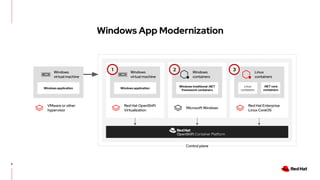
Windows application
Windows
virtual machine
Red Hat OpenShift
Virtualization
Linux
containers
.NET core
containers
Linux
containers
Red Hat Enterprise
Linux CoreOS
Windows traditional .NET
framework containers
Windows
containers
Microsoft Windows
Windows App Modernization
Windows application
Windows
virtual machine
VMware or other
hypervisor
1 2 3
10
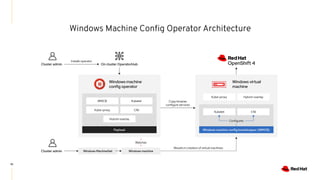
Windows Machine Config Operator Architecture
WMCB
CNI
Kubelet
Kube-proxy
Hybrid-overlay
Payload
Windows machine
config operator
Watches
Windows MachineSet Windows machine
Kube-proxy
CNI
Hybrid-overlay
Kubelet
Windows virtual
machine
Windows machine config bootstrapper (WMCB)
Configures
Installs operator
Results in creation of virtual machines
Cluster admin On cluster OperatorHub
Cluster admin
Copy binaries
configure services
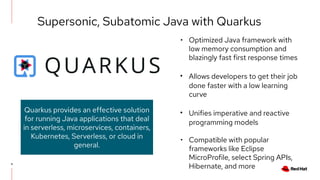
Supersonic, Subatomic Java with Quarkus
• Optimized Java framework with
low memory consumption and
blazingly fast first response times
• Allows developers to get their job
done faster with a low learning
curve
• Unifies imperative and reactive
programming models
• Compatible with popular
frameworks like Eclipse
MicroProfile, select Spring APIs,
Hibernate, and more
Quarkus provides an effective solution
for running Java applications that deal
in serverless, microservices, containers,
Kubernetes, Serverless, or cloud in
general.
11
12
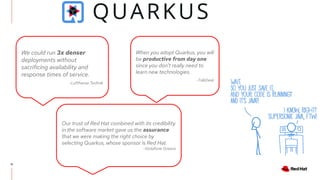
When you adopt Quarkus, you will
be productive from day one
since you don’t really need to
learn new technologies.
-TalkDesk
We could run 3x denser
deployments without
sacrificing availability and
response times of service.
-Lufthansa Technik
Our trust of Red Hat combined with its credibility
in the software market gave us the assurance
that we were making the right choice by
selecting Quarkus, whose sponsor is Red Hat.
-Vodafone Greece
13
14
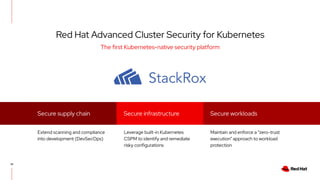
Red Hat Advanced Cluster Security for Kubernetes
The first Kubernetes-native security platform
Secure supply chain
Extend scanning and compliance
into development (DevSecOps)
Secure infrastructure
Leverage built-in Kubernetes
CSPM to identify and remediate
risky configurations
Secure workloads
Maintain and enforce a “zero-trust
execution” approach to workload
protection
ACM
Introducing Red Hat
Advanced Cluster
Management For
Kubernetes
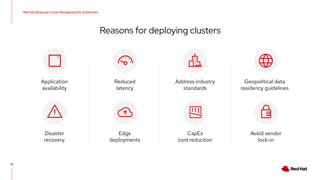
Reasons for deploying clusters
Red Hat Advanced Cluster Management for Kubernetes
Application
availability
Reduced
latency
Address industry
standards
Geopolitical data
residency guidelines
Disaster
recovery
Edge
deployments
CapEx
cost reduction
Avoid vendor
lock-in
16
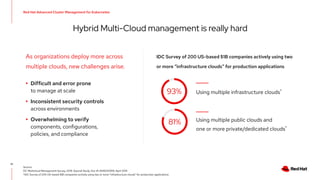
IDC Survey of 200 US-based $1B companies actively using two
or more “infrastructure clouds” for production applications
81%
Hybrid Multi-Cloud management is really hard
17
Source:
DC Multicloud Management Survey, 2019: Special Study, Doc # US45020919, April 2019
*IDC Survey of 200 US-based $1B companies actively using two or more “infrastructure clouds” for production applications
As organizations deploy more across
multiple clouds, new challenges arise.
▸ Difficult and error prone
to manage at scale
▸ Inconsistent security controls
across environments
▸ Overwhelming to verify
components, configurations,
policies, and compliance
Using multiple infrastructure clouds*
93%
Using multiple public clouds and
one or more private/dedicated clouds*
Red Hat Advanced Cluster Management for Kubernetes
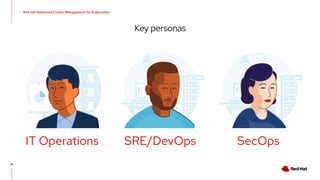
Key personas
18
Red Hat Advanced Cluster Management for Kubernetes
SRE/DevOps
IT Operations SecOps
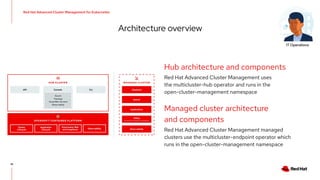
Architecture overview
19
Hub architecture and components
Red Hat Advanced Cluster Management uses
the multicluster-hub operator and runs in the
open-cluster-management namespace
Managed cluster architecture
and components
Red Hat Advanced Cluster Management managed
clusters use the multicluster-endpoint operator which
runs in the open-cluster-management namespace
Cluster
Lifecycle
Red Hat Advanced Cluster Management for Kubernetes
IT Operations
20
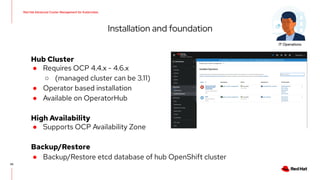
Hub Cluster
● Requires OCP 4.4.x - 4.6.x
○ (managed cluster can be 3.11)
● Operator based installation
● Available on OperatorHub
High Availability
● Supports OCP Availability Zone
Backup/Restore
● Backup/Restore etcd database of hub OpenShift cluster
Installation and foundation
Red Hat Advanced Cluster Management for Kubernetes
IT Operations
21
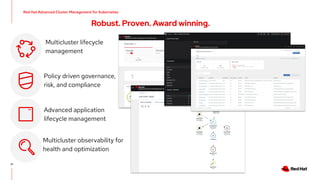
Robust. Proven. Award winning.
Multicluster lifecycle
management
Policy driven governance,
risk, and compliance
Advanced application
lifecycle management
Red Hat Advanced Cluster Management for Kubernetes
Multicluster observability for
health and optimization
22
22
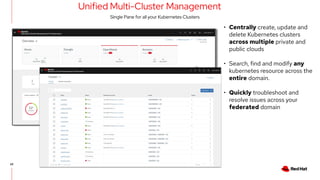
• Centrally create, update and
delete Kubernetes clusters
across multiple private and
public clouds
• Search, find and modify any
kubernetes resource across the
entire domain.
• Quickly troubleshoot and
resolve issues across your
federated domain
Unified Multi-Cluster Management
Single Pane for all your Kubernetes Clusters
23
23
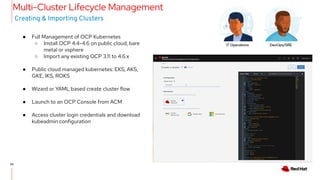
● Full Management of OCP Kubernetes
○ Install OCP 4.4-4.6 on public cloud, bare
metal or vsphere
○ Import any existing OCP 3.11 to 4.6.x
● Public cloud managed kubernetes: EKS, AKS,
GKE, IKS, ROKS
● Wizard or YAML based create cluster flow
● Launch to an OCP Console from ACM
● Access cluster login credentials and download
kubeadmin configuration
Creating & Importing Clusters
Multi-Cluster Lifecycle Management
IT Operations DevOps/SRE
24
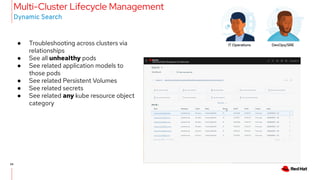
● Troubleshooting across clusters via
relationships
● See all unhealthy pods
● See related application models to
those pods
● See related Persistent Volumes
● See related secrets
● See related any kube resource object
category
Multi-Cluster Lifecycle Management
Dynamic Search
IT Operations DevOps/SRE
25
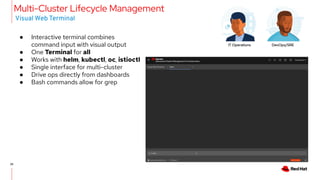
● Interactive terminal combines
command input with visual output
● One Terminal for all
● Works with helm, kubectl, oc, istioctl
● Single interface for multi-cluster
● Drive ops directly from dashboards
● Bash commands allow for grep
Multi-Cluster Lifecycle Management
Visual Web Terminal
IT Operations DevOps/SRE
26
26
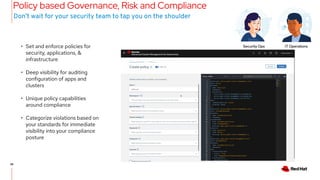
Policy based Governance, Risk and Compliance
• Set and enforce policies for
security, applications, &
infrastructure
• Deep visibility for auditing
configuration of apps and
clusters
• Unique policy capabilities
around compliance
• Categorize violations based on
your standards for immediate
visibility into your compliance
posture
Don’t wait for your security team to tap you on the shoulder
Security Ops IT Operations
27
27
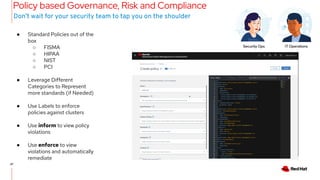
Policy based Governance, Risk and Compliance
● Standard Policies out of the
box
○ FISMA
○ HIPAA
○ NIST
○ PCI
● Leverage Different
Categories to Represent
more standards (if Needed)
● Use Labels to enforce
policies against clusters
● Use inform to view policy
violations
● Use enforce to view
violations and automatically
remediate
Don’t wait for your security team to tap you on the shoulder
Security Ops IT Operations
28
28
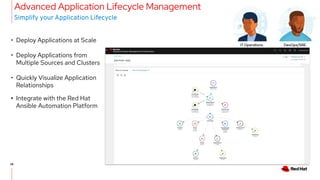
Advanced Application Lifecycle Management
• Deploy Applications at Scale
• Deploy Applications from
Multiple Sources and Clusters
• Quickly Visualize Application
Relationships
• Integrate with the Red Hat
Ansible Automation Platform
Simplify your Application Lifecycle
IT Operations DevOps/SRE
29
29
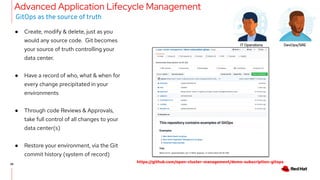
Advanced Application Lifecycle Management
● Create, modify & delete, just as you
would any source code. Git becomes
your source of truth controlling your
data center.
● Have a record of who, what & when for
every change precipitated in your
environments
● Through code Reviews & Approvals,
take full control of all changes to your
data center(s)
● Restore your environment, via the Git
commit history (system of record)
GitOps as the source of truth
https://github.com/open-cluster-management/demo-subscription-gitops
IT Operations DevOps/SRE
30
30
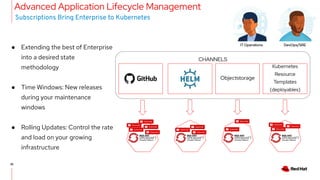
Advanced Application Lifecycle Management
● Extending the best of Enterprise
into a desired state
methodology
● Time Windows: New releases
during your maintenance
windows
● Rolling Updates: Control the rate
and load on your growing
infrastructure
Subscriptions Bring Enterprise to Kubernetes
CHANNELS
Objectstorage
Kubernetes
Resource
Templates
(deployables)
IT Operations DevOps/SRE
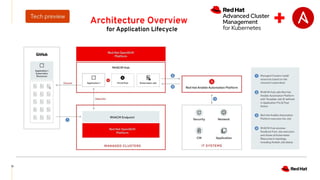
Architecture Overview
31
for Application Lifecycle
32
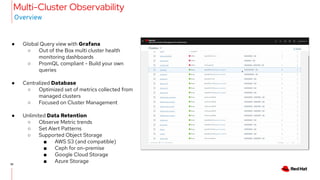
● Global Query view with Grafana
○ Out of the Box multi cluster health
monitoring dashboards
○ PromQL compliant - Build your own
queries
● Centralized Database
○ Optimized set of metrics collected from
managed clusters
○ Focused on Cluster Management
● Unlimited Data Retention
○ Observe Metric trends
○ Set Alert Patterns
○ Supported Object Storage
■ AWS S3 (and compatible)
■ Ceph for on-premise
■ Google Cloud Storage
■ Azure Storage
Multi-Cluster Observability
Overview
ACM
Demo
ACM
Wrap up
Policies can be written by the security team
and enforced at each cluster, allowing
environments to conform to your policy.
Ease compliance
Red Hat OpenShift and Red Hat Advanced Cluster Management for Kubernetes
Benefits
35
Placement rules can allow quick deployment
of clusters across distributed locations for
availability, capacity, and security reasons.
Increase application availability
Self-service provisioning allows app dev
teams to request clusters directly from a
catalog removing central IT as a bottleneck.
Accelerate development to production
Centralized management of clusters reduces
operational cost, makes the environment
consistent, and removes the need to manually
manage individual clusters.
Reduce costs
Red Hat Advanced Cluster Management for Kubernetes
linkedin.com/company/red-hat
youtube.com/user/RedHatVideos
facebook.com/redhatinc
twitter.com/RedHat
Red Hat is the world’s leading provider of
enterprise open source software solutions.
Award-winning support, training, and consulting
services make
Red Hat a trusted adviser to the Fortune 500.
Thank you
36

Red Hat multi-cluster management & what's new in OpenShift

  • 1.
    1 February 25th, 2020 RedHat Advanced Cluster Management for Kubernetes Dieter De Moitié Senior Solution Architect The Kubernetes platform for big ideas Ludovic Aelbrecht Business Development Manager
  • 2.
    2 Disclaimer The content setforth herein is Red Hat confidential information and does not constitute in any way a binding or legal agreement or impose any legal obligation or duty on Red Hat.   This information is provided for discussion purposes only and is subject to change for any or no reason. Disclaimer
  • 3.
    3 Agenda ▸ What’s newin OpenShift ▸ Introducing Red Hat Advanced Cluster Management for Kubernetes ▸ Demo ▸ Wrap up
  • 4.
  • 5.
    OpenShift Container Platform Developerproductivity Cluster services Install ⠇Operators ⠇Over-the-air updates ⠇Monitoring ⠇Logging ⠇Registry ⠇ Storage ⠇Networking ⠇Security | Ingress routing 5 Kubernetes Developer CLI ⠇IDE Plugins & Extensions ⠇ Cloud-native IDE ⠇ Local developer sandbox Service Mesh Serverless ⠇Builds CI/CD Pipelines Log Management ⠇ Cost Management Languages & Runtimes API Mgmt ⠇ Integration⠇ Messaging ⠇ Process Automation Platform services Application services Developer services Build cloud-native apps Manage workloads Multi-cluster management Inventory ⠇Policy ⠇Compliance ⠇Configuration ⠇Workloads Data driven insights Databases ⠇Cache Data Ingestion & Preparation Data Analytics ⠇AI/ML Data Mgmt & Resilience Data services Physical Virtual Private cloud Public cloud Edge OpenShift Kubernetes Engine Advanced Cluster Management OpenShift Container Platform Red Hat Enterprise Linux CoreOS 5
  • 6.
    OpenShift offers thebroadest set of hybrid cloud services 6 Red Hat OpenShift Service on AWS Azure Red Hat OpenShift Red Hat OpenShift on IBM Cloud On-premises Red Hat OpenShift Red Hat Managed OCP Customer Managed Developer Efficiency Business Productivity Enterprise Ready Red Hat OpenShift Dedicated Joint offerings with Cloud Provider Offered as a Native Console offering on equal parity with cloud provider Kubernetes service or OCP Customer Managed OpenShift Container Platform
  • 7.
    Containerized virtual machines 7 ●Inherit many features and functions from Kubernetes ○ Scheduling, high availability, attach/detach resources ● Containerized virtual machines have the same characteristics as non-containerized ○ CPU, RAM, etc. limitations dictated by libvirt and QEMU ○ Linux and Windows guest operating systems ● Storage ○ Use Persistent Volumes Claims (PVCs) for VM disks ○ Containerized Data Importer (CDI) import VM images ● Network ○ Inherit pod network by default ○ Multus enables direct connection to external network VMs Containers Red Hat OpenShift Container Platform Red Hat Enterprise Linux CoreOS Physical machine OpenShift Virtualization
  • 8.
    Compact 3-node Clusterson Bare Metal (only) Compact clusters for the Edge ● Allows minimal footprint clusters to be used for developer and Edge deployments ○ Reduces hardware costs and power requirements ● Comprised of just 3 control plane nodes without the need for any additional worker nodes ○ Application workloads are schedulable on the control plane nodes ○ Control plane remains highly available supporting upgrades ● Requires: ○ Setting worker replicas to 0 in install-config will configure master nodes as workers as well (any other value will set them as masters) ○ Temporary bootstrap node for initial cluster bring-up ○ External DNS and LB services ○ HAProxy for *.apps needs to be reconfigured to target masters (ensure health checks are enabled) ● Minimum system resource requirements for each control plane node are cumulative of master and worker requirements: ○ 6 vCPU, 24GB RAM, 200GB Storage ● Additional workers nodes can be added on Day 2 # Edit ‘install-config.yaml’ and ensure worker node replicas is set to ‘0’: - compute: name: worker platform: {} replicas: 0 $ ./openshift-install create ignition-configs --dir=<installation_directory> INFO Consuming Install Config from target directory WARNING Making control-plane schedulable by setting MastersSchedulable to true for Scheduler cluster settings # Install using documented workflow 8
  • 9.
    9 Control plane Windows application Windows virtualmachine Red Hat OpenShift Virtualization Linux containers .NET core containers Linux containers Red Hat Enterprise Linux CoreOS Windows traditional .NET framework containers Windows containers Microsoft Windows Windows App Modernization Windows application Windows virtual machine VMware or other hypervisor 1 2 3
  • 10.
    10 Windows Machine ConfigOperator Architecture WMCB CNI Kubelet Kube-proxy Hybrid-overlay Payload Windows machine config operator Watches Windows MachineSet Windows machine Kube-proxy CNI Hybrid-overlay Kubelet Windows virtual machine Windows machine config bootstrapper (WMCB) Configures Installs operator Results in creation of virtual machines Cluster admin On cluster OperatorHub Cluster admin Copy binaries configure services
  • 11.
    Supersonic, Subatomic Javawith Quarkus • Optimized Java framework with low memory consumption and blazingly fast first response times • Allows developers to get their job done faster with a low learning curve • Unifies imperative and reactive programming models • Compatible with popular frameworks like Eclipse MicroProfile, select Spring APIs, Hibernate, and more Quarkus provides an effective solution for running Java applications that deal in serverless, microservices, containers, Kubernetes, Serverless, or cloud in general. 11
  • 12.
    12 When you adoptQuarkus, you will be productive from day one since you don’t really need to learn new technologies. -TalkDesk We could run 3x denser deployments without sacrificing availability and response times of service. -Lufthansa Technik Our trust of Red Hat combined with its credibility in the software market gave us the assurance that we were making the right choice by selecting Quarkus, whose sponsor is Red Hat. -Vodafone Greece
  • 13.
  • 14.
    14 Red Hat AdvancedCluster Security for Kubernetes The first Kubernetes-native security platform Secure supply chain Extend scanning and compliance into development (DevSecOps) Secure infrastructure Leverage built-in Kubernetes CSPM to identify and remediate risky configurations Secure workloads Maintain and enforce a “zero-trust execution” approach to workload protection
  • 15.
    ACM Introducing Red Hat AdvancedCluster Management For Kubernetes
  • 16.
    Reasons for deployingclusters Red Hat Advanced Cluster Management for Kubernetes Application availability Reduced latency Address industry standards Geopolitical data residency guidelines Disaster recovery Edge deployments CapEx cost reduction Avoid vendor lock-in 16
  • 17.
    IDC Survey of200 US-based $1B companies actively using two or more “infrastructure clouds” for production applications 81% Hybrid Multi-Cloud management is really hard 17 Source: DC Multicloud Management Survey, 2019: Special Study, Doc # US45020919, April 2019 *IDC Survey of 200 US-based $1B companies actively using two or more “infrastructure clouds” for production applications As organizations deploy more across multiple clouds, new challenges arise. ▸ Difficult and error prone to manage at scale ▸ Inconsistent security controls across environments ▸ Overwhelming to verify components, configurations, policies, and compliance Using multiple infrastructure clouds* 93% Using multiple public clouds and one or more private/dedicated clouds* Red Hat Advanced Cluster Management for Kubernetes
  • 18.
    Key personas 18 Red HatAdvanced Cluster Management for Kubernetes SRE/DevOps IT Operations SecOps
  • 19.
    Architecture overview 19 Hub architectureand components Red Hat Advanced Cluster Management uses the multicluster-hub operator and runs in the open-cluster-management namespace Managed cluster architecture and components Red Hat Advanced Cluster Management managed clusters use the multicluster-endpoint operator which runs in the open-cluster-management namespace Cluster Lifecycle Red Hat Advanced Cluster Management for Kubernetes IT Operations
  • 20.
    20 Hub Cluster ● RequiresOCP 4.4.x - 4.6.x ○ (managed cluster can be 3.11) ● Operator based installation ● Available on OperatorHub High Availability ● Supports OCP Availability Zone Backup/Restore ● Backup/Restore etcd database of hub OpenShift cluster Installation and foundation Red Hat Advanced Cluster Management for Kubernetes IT Operations
  • 21.
    21 Robust. Proven. Awardwinning. Multicluster lifecycle management Policy driven governance, risk, and compliance Advanced application lifecycle management Red Hat Advanced Cluster Management for Kubernetes Multicluster observability for health and optimization
  • 22.
    22 22 • Centrally create,update and delete Kubernetes clusters across multiple private and public clouds • Search, find and modify any kubernetes resource across the entire domain. • Quickly troubleshoot and resolve issues across your federated domain Unified Multi-Cluster Management Single Pane for all your Kubernetes Clusters
  • 23.
    23 23 ● Full Managementof OCP Kubernetes ○ Install OCP 4.4-4.6 on public cloud, bare metal or vsphere ○ Import any existing OCP 3.11 to 4.6.x ● Public cloud managed kubernetes: EKS, AKS, GKE, IKS, ROKS ● Wizard or YAML based create cluster flow ● Launch to an OCP Console from ACM ● Access cluster login credentials and download kubeadmin configuration Creating & Importing Clusters Multi-Cluster Lifecycle Management IT Operations DevOps/SRE
  • 24.
    24 ● Troubleshooting acrossclusters via relationships ● See all unhealthy pods ● See related application models to those pods ● See related Persistent Volumes ● See related secrets ● See related any kube resource object category Multi-Cluster Lifecycle Management Dynamic Search IT Operations DevOps/SRE
  • 25.
    25 ● Interactive terminalcombines command input with visual output ● One Terminal for all ● Works with helm, kubectl, oc, istioctl ● Single interface for multi-cluster ● Drive ops directly from dashboards ● Bash commands allow for grep Multi-Cluster Lifecycle Management Visual Web Terminal IT Operations DevOps/SRE
  • 26.
    26 26 Policy based Governance,Risk and Compliance • Set and enforce policies for security, applications, & infrastructure • Deep visibility for auditing configuration of apps and clusters • Unique policy capabilities around compliance • Categorize violations based on your standards for immediate visibility into your compliance posture Don’t wait for your security team to tap you on the shoulder Security Ops IT Operations
  • 27.
    27 27 Policy based Governance,Risk and Compliance ● Standard Policies out of the box ○ FISMA ○ HIPAA ○ NIST ○ PCI ● Leverage Different Categories to Represent more standards (if Needed) ● Use Labels to enforce policies against clusters ● Use inform to view policy violations ● Use enforce to view violations and automatically remediate Don’t wait for your security team to tap you on the shoulder Security Ops IT Operations
  • 28.
    28 28 Advanced Application LifecycleManagement • Deploy Applications at Scale • Deploy Applications from Multiple Sources and Clusters • Quickly Visualize Application Relationships • Integrate with the Red Hat Ansible Automation Platform Simplify your Application Lifecycle IT Operations DevOps/SRE
  • 29.
    29 29 Advanced Application LifecycleManagement ● Create, modify & delete, just as you would any source code. Git becomes your source of truth controlling your data center. ● Have a record of who, what & when for every change precipitated in your environments ● Through code Reviews & Approvals, take full control of all changes to your data center(s) ● Restore your environment, via the Git commit history (system of record) GitOps as the source of truth https://github.com/open-cluster-management/demo-subscription-gitops IT Operations DevOps/SRE
  • 30.
    30 30 Advanced Application LifecycleManagement ● Extending the best of Enterprise into a desired state methodology ● Time Windows: New releases during your maintenance windows ● Rolling Updates: Control the rate and load on your growing infrastructure Subscriptions Bring Enterprise to Kubernetes CHANNELS Objectstorage Kubernetes Resource Templates (deployables) IT Operations DevOps/SRE
  • 31.
  • 32.
    32 ● Global Queryview with Grafana ○ Out of the Box multi cluster health monitoring dashboards ○ PromQL compliant - Build your own queries ● Centralized Database ○ Optimized set of metrics collected from managed clusters ○ Focused on Cluster Management ● Unlimited Data Retention ○ Observe Metric trends ○ Set Alert Patterns ○ Supported Object Storage ■ AWS S3 (and compatible) ■ Ceph for on-premise ■ Google Cloud Storage ■ Azure Storage Multi-Cluster Observability Overview
  • 33.
  • 34.
  • 35.
    Policies can bewritten by the security team and enforced at each cluster, allowing environments to conform to your policy. Ease compliance Red Hat OpenShift and Red Hat Advanced Cluster Management for Kubernetes Benefits 35 Placement rules can allow quick deployment of clusters across distributed locations for availability, capacity, and security reasons. Increase application availability Self-service provisioning allows app dev teams to request clusters directly from a catalog removing central IT as a bottleneck. Accelerate development to production Centralized management of clusters reduces operational cost, makes the environment consistent, and removes the need to manually manage individual clusters. Reduce costs Red Hat Advanced Cluster Management for Kubernetes
  • 36.
    linkedin.com/company/red-hat youtube.com/user/RedHatVideos facebook.com/redhatinc twitter.com/RedHat Red Hat isthe world’s leading provider of enterprise open source software solutions. Award-winning support, training, and consulting services make Red Hat a trusted adviser to the Fortune 500. Thank you 36