Packaging Recycling:
Current and future trends
Grant Musgrove ACOR
E-mail: grantm@acor.org.au
About ACOR
• Formed in 1983
• A national peak representative body for the recycling and resource
recovery industry –any organisation can join, only one LGA which is odd
• Our core business
o Lobbying governments for policies and regulations that support
organisations in the recycling and resource recovery industry
o Advising our members on what’s going to happen next!
• >80% of all recycling activity
• >30 million tonnes p.a.
• 40,000+ jobs and growing
grantm@acor.org.au
Key barriers to increasing recovery
and recycling of packaging
1. Packaging design
2. Manufacturer’s resistance
3. Lack of supply chain alignment
4. Lack of investment/ infrastructure
5. Landfill costs
6. Uncertainties of regulatory standards
7. Regulatory failures
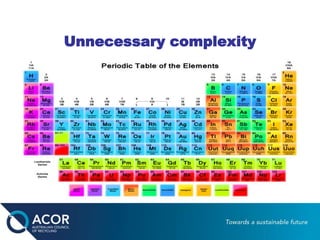
8. Increasing complexity of packaging
9. Increasingly packaging is not recyclable/recoverable
10. Lack of end-of-life markets/ price
grantm@acor.org.au
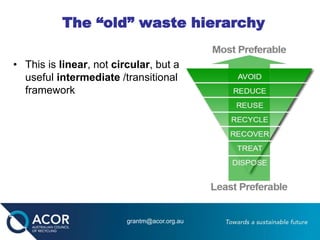
The “old” waste hierarchy
• This is linear, not circular, but a
useful intermediate /transitional
framework
grantm@acor.org.au
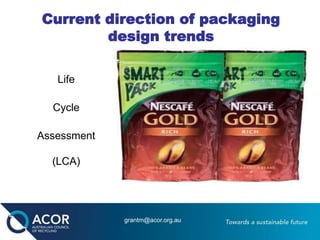
Current direction of packaging
design trends
Life
Cycle
Assessment
(LCA)
grantm@acor.org.au
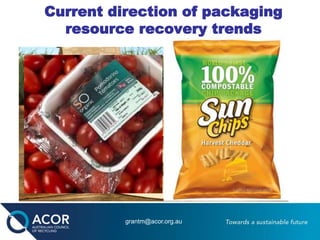
Current direction of packaging
resource recovery trends
grantm@acor.org.au
Unnecessary complexity
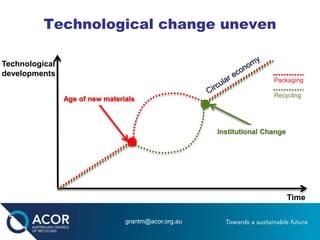
Age of new materials
Institutional Change
Technological change uneven
Packaging
Recycling
Technological
developments
Time
grantm@acor.org.au
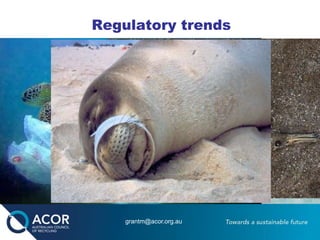
Regulatory trends
Externalities being internalised
grantm@acor.org.au
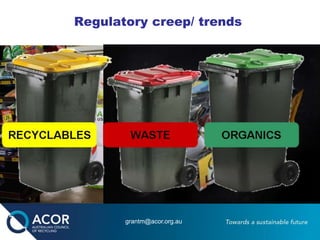
Regulatory creep/ trends
grantm@acor.org.au
Design for recovery
• Material information
• Progressive reduction of contaminants
• More effective sorting
• Easy dismantling
– not using multiple polymers or mixing different
types of materials that cannot be separated
grantm@acor.org.au
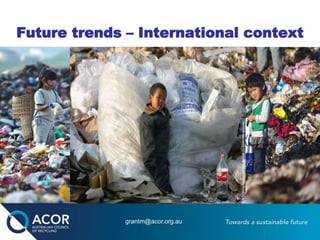
Future trends – International context
grantm@acor.org.au
Future packaging resource recovery
trends – International context
• In 2009 China passed new law to form a Circular
Economy
• Major strategic importance – if successful will set a new
level for global competitiveness
• Part of the law is a Packaging Master Plan comprising of
legislation that will restrict, recover, recycle and reuse all
packaging materials.
• “Green Wall/Fence/hedgerow- in Chinglish
• Contaminated plastic imports being stopped by customs
grantm@acor.org.au
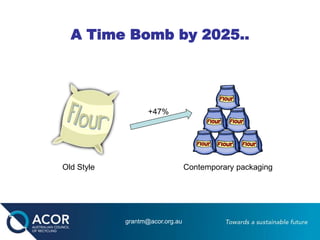
A Time Bomb by 2025..
+47%
Old Style Contemporary packaging
grantm@acor.org.au
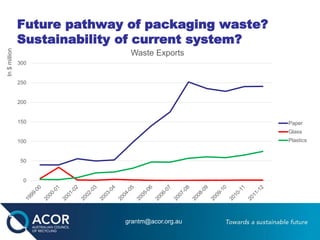
Future pathway of packaging waste?
Sustainability of current system?
grantm@acor.org.au
0
50
100
150
200
250
300
In$million
Waste Exports
Paper
Glass
Plastics
Big Changes
• Price volatility+ divergence + scarcity
• Just the beginning, as developing countries
deal with their own packaging time bombs
• Need for local reprocessing infrastructure
support from government
• Made to be made again, design for recovery/
M&A of supply chain
• Deployment of information technology
• Policy/ regulatory agenda change for a circular
materials economy
grantm@acor.org.au
ACOR
ACOR will continue to advise our members
and governments and our members on
these transformations
grantm@acor.org.au

Packaging Recycling: Current and future trends

  • 1.
    Packaging Recycling: Current andfuture trends Grant Musgrove ACOR E-mail: grantm@acor.org.au
  • 2.
    About ACOR • Formedin 1983 • A national peak representative body for the recycling and resource recovery industry –any organisation can join, only one LGA which is odd • Our core business o Lobbying governments for policies and regulations that support organisations in the recycling and resource recovery industry o Advising our members on what’s going to happen next! • >80% of all recycling activity • >30 million tonnes p.a. • 40,000+ jobs and growing grantm@acor.org.au
  • 3.
    Key barriers toincreasing recovery and recycling of packaging 1. Packaging design 2. Manufacturer’s resistance 3. Lack of supply chain alignment 4. Lack of investment/ infrastructure 5. Landfill costs 6. Uncertainties of regulatory standards 7. Regulatory failures 8. Increasing complexity of packaging 9. Increasingly packaging is not recyclable/recoverable 10. Lack of end-of-life markets/ price grantm@acor.org.au
  • 4.
    The “old” wastehierarchy • This is linear, not circular, but a useful intermediate /transitional framework grantm@acor.org.au
  • 5.
    Current direction ofpackaging design trends Life Cycle Assessment (LCA) grantm@acor.org.au
  • 6.
    Current direction ofpackaging resource recovery trends grantm@acor.org.au
  • 7.
  • 8.
    Age of newmaterials Institutional Change Technological change uneven Packaging Recycling Technological developments Time grantm@acor.org.au
  • 9.
    Regulatory trends Externalities beinginternalised grantm@acor.org.au
  • 10.
  • 11.
    Design for recovery •Material information • Progressive reduction of contaminants • More effective sorting • Easy dismantling – not using multiple polymers or mixing different types of materials that cannot be separated grantm@acor.org.au
  • 12.
    Future trends –International context grantm@acor.org.au
  • 13.
    Future packaging resourcerecovery trends – International context • In 2009 China passed new law to form a Circular Economy • Major strategic importance – if successful will set a new level for global competitiveness • Part of the law is a Packaging Master Plan comprising of legislation that will restrict, recover, recycle and reuse all packaging materials. • “Green Wall/Fence/hedgerow- in Chinglish • Contaminated plastic imports being stopped by customs grantm@acor.org.au
  • 14.
    A Time Bombby 2025.. +47% Old Style Contemporary packaging grantm@acor.org.au
  • 15.
    Future pathway ofpackaging waste? Sustainability of current system? grantm@acor.org.au 0 50 100 150 200 250 300 In$million Waste Exports Paper Glass Plastics
  • 16.
    Big Changes • Pricevolatility+ divergence + scarcity • Just the beginning, as developing countries deal with their own packaging time bombs • Need for local reprocessing infrastructure support from government • Made to be made again, design for recovery/ M&A of supply chain • Deployment of information technology • Policy/ regulatory agenda change for a circular materials economy grantm@acor.org.au
  • 17.
    ACOR ACOR will continueto advise our members and governments and our members on these transformations grantm@acor.org.au

Editor's Notes

  • #3 1 LGA
  • #4 Packaging design unnecessary complexity of packaging undermines supply chain alignment and resource recovery Manufacturer’s resistance to improving design for end-of-life recovery due to: encourage increased consumption manufacturers don’t always benefit economically from changing the design to be more recyclable LCA’s can be used to justify cost minimisation (pouches). Not the business model of the future Lack of investment/infrastructure collection systems/ source separation Landfill costs may be cheaper in some areas than recycling Uncertainties in recycling standards and regulations Regulatory failure different jurisdictions have different regulations and policy frameworks. Increasing complexity of packaging multiple materials used in one product composites and fixtures contaminating the resource stream constraining government recycling targets. Increasingly packaging is not recyclable/recoverable Lack of end-of-life markets establishment of value recovery chains for recycled materials Lack of supply chain alignment manufacturing and recovery facilities SYSTEMS thinking
  • #5 Used by Government and industry All resources are inherently limited Avoidance=cost minimisation should not be at the expense of viable recovery options Its not going to work
  • #6 Waste Hierarchy=LCA Data assumptions, Results are geographically/ time dependent, Garbage mentality, LCA Cradle to Grave, rather than recovery or recycling Many new packaging types not recoverable and will still need to be disposed Waste created at design phase - upstream Can be used to make cost reduction look like sustainability Design for recycling/recovery is more sustainable less energy, water, land and materials Boundary issues – LCA practitioners hope to model complex systems by simplifying them with artificial limits to the models Making astrology look respectable, being taught in unis
  • #7 Biodegradable or bioorganic Organic-increasing fast Often not recoverable or contaminates recycling systems and technologies Can also produce carbon/methane gas or is not really biodegradable (e.g. petrochemical dust/long life litter) Recovered fuels use is constrained by regulatory needs and commercial viability its production often involves moral hazard as it displaces the use of productive land best used for food production.
  • #8 9 layers, diversity of chemistry
  • #9 Amortize plant and equipment, not financially viable Needs to be made to be made again The rapid pace of change in packaging technology requires changes in resource recovery and recycling technologies, many of which require amortisation over 10-25 years which is not commercially realistic.
  • #10 Negative externalities, prices not telling the truth! Regulatory trends wrestling with how to internalise and recover resource Packaging Product Stewardship the shared responsibility across the packaging supply chain ADF’s and EPR negative externalities being internalised APC’s Strategic Plan : packaging industry regulatory creep if not fulfilled. Advance disposal fees for non recyclable/recoverable packaging Corporate social license to operate Driven by environmental concerns, not resource recovery
  • #11 Regulatory trends 1-4 system bins Waste levies $35-$125 tonne ex Qld Plastic bag bans coming in CDL, cash for containers S.A and N.T, Vic? CDL allows jurisdictions to accept or reject new containers based on packaging material or design. Ban of land filling of packaging materials. Recovery/ recycling targets set
  • #12 Made to be made again is the biggest problem/ challenge/ business opportunity Coca Cola Company statement in Circular Economy 2 p. 66 “We [as a consumer good community] need to make sure that more of the materials we put on to the market have value to encourage the circular economy approach; too many today are difficult to recycle or contaminate existing recycling streams.
  • #13 China: Amendment to the 2003 Cleaner Production Law to include a ban on the production and use of excessive packaging This law took effect from July 2012 The amendment makes companies responsible for avoiding excessive packaging, with packaging required to contain no more than 3 layers. China will be the first country to attempt to regulate the volume and materials used in packaging. 70% of waste imported but 1 /5th of the worlds population Packaging pollution seen a threat to social stability First steps to Design for recovery by law, eg Germany private CDL schemes
  • #14 No recycling in residential areas Contaminated shipments being refused Must be a licensed recycler Recyclers being banned State media being used
  • #15 Why is China doing this? USD $10,000 per annum middle class= packaging exponential growth Social stability Pollution Litter BRIC’s Estimate based on the comparison of low-income countries or population segment (e.g., India) and middle/high income countries and segments (e.g., US) SOURCE: World Bank. Ellen MacArthur Foundation circular economy team
  • #16 Paper, Plastics exports up and up: but going to china!!!!!!!!!!! They only want the good stuff Sick of being a toxic dump for the world Note glass, LCA, cost reduction, light weighting issue, lost resource at design phase http://www.abs.gov.au/ausstats/abs@.nsf/Products/4602.0.55.005~2013~Main+Features~Australia%27s+International+Trade+in+Waste?OpenDocument
  • #17 Ultimately resource scarcity and price increases will force packaging design to be made to be made again, because resources will be too expensive for one time use. This will require local and global systems thinking by governments and industry and the deployment of information technology such as mobile phone applications by packaging companies to maximise resource recovery. Industry consolidation globally and much closer integration of recovery, recycling and packaging companies and systems will be needed Changes to Australia supply chain, policy, infrastructure, cleaner streams, industry adjustment, contaminated streams need local processing, focussed thinking Need for transparency, end destinations charter, LGA’s? ACOR will continue to advise our members and advise governments and our members on these transformations.