Recursive Algorithm
What is Recursion?
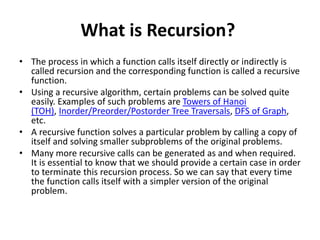
• The process in which a function calls itself directly or indirectly is
called recursion and the corresponding function is called a recursive
function.
• Using a recursive algorithm, certain problems can be solved quite
easily. Examples of such problems are Towers of Hanoi
(TOH), Inorder/Preorder/Postorder Tree Traversals, DFS of Graph,
etc.
• A recursive function solves a particular problem by calling a copy of
itself and solving smaller subproblems of the original problems.
• Many more recursive calls can be generated as and when required.
It is essential to know that we should provide a certain case in order
to terminate this recursion process. So we can say that every time
the function calls itself with a simpler version of the original
problem.
Need of Recursion
• Recursion is an amazing technique with the
help of which we can reduce the length of our
code and make it easier to read and write.
• A task that can be defined with its similar
subtask, recursion is one of the best solutions
for it. For example; The Factorial of a number.
Properties of Recursion:
• Performing the same operations multiple
times with different inputs.
• In every step, we try smaller inputs to make
the problem smaller.
• Base condition is needed to stop the recursion
otherwise infinite loop will occur.
Algorithm: Steps
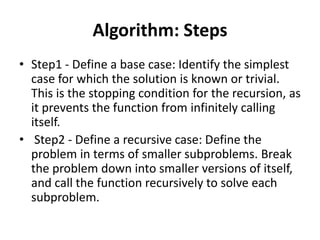
• Step1 - Define a base case: Identify the simplest
case for which the solution is known or trivial.
This is the stopping condition for the recursion, as
it prevents the function from infinitely calling
itself.
• Step2 - Define a recursive case: Define the
problem in terms of smaller subproblems. Break
the problem down into smaller versions of itself,
and call the function recursively to solve each
subproblem.
Algorithm: Steps
• Step3 - Ensure the recursion terminates: Make
sure that the recursive function eventually
reaches the base case, and does not enter an
infinite loop.
• Step4 - Combine the solutions: Combine the
solutions of the subproblems to solve the
original problem.
A Mathematical Interpretation
• approach(1) –
Simply adding one by one
f(n) = 1 + 2 + 3 +……..+ n
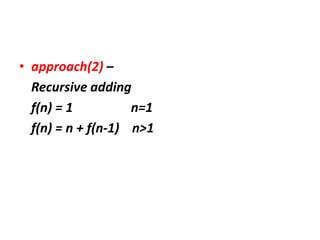
• approach(2) –
Recursive adding
f(n) = 1 n=1
f(n) = n + f(n-1) n>1
MORE…
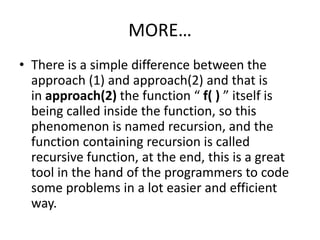
• There is a simple difference between the
approach (1) and approach(2) and that is
in approach(2) the function “ f( ) ” itself is
being called inside the function, so this
phenomenon is named recursion, and the
function containing recursion is called
recursive function, at the end, this is a great
tool in the hand of the programmers to code
some problems in a lot easier and efficient
way.

Recursive Algorithm Detailed Explanation

  • 1.
  • 2.
    What is Recursion? •The process in which a function calls itself directly or indirectly is called recursion and the corresponding function is called a recursive function. • Using a recursive algorithm, certain problems can be solved quite easily. Examples of such problems are Towers of Hanoi (TOH), Inorder/Preorder/Postorder Tree Traversals, DFS of Graph, etc. • A recursive function solves a particular problem by calling a copy of itself and solving smaller subproblems of the original problems. • Many more recursive calls can be generated as and when required. It is essential to know that we should provide a certain case in order to terminate this recursion process. So we can say that every time the function calls itself with a simpler version of the original problem.
  • 3.
    Need of Recursion •Recursion is an amazing technique with the help of which we can reduce the length of our code and make it easier to read and write. • A task that can be defined with its similar subtask, recursion is one of the best solutions for it. For example; The Factorial of a number.
  • 4.
    Properties of Recursion: •Performing the same operations multiple times with different inputs. • In every step, we try smaller inputs to make the problem smaller. • Base condition is needed to stop the recursion otherwise infinite loop will occur.
  • 5.
    Algorithm: Steps • Step1- Define a base case: Identify the simplest case for which the solution is known or trivial. This is the stopping condition for the recursion, as it prevents the function from infinitely calling itself. • Step2 - Define a recursive case: Define the problem in terms of smaller subproblems. Break the problem down into smaller versions of itself, and call the function recursively to solve each subproblem.
  • 6.
    Algorithm: Steps • Step3- Ensure the recursion terminates: Make sure that the recursive function eventually reaches the base case, and does not enter an infinite loop. • Step4 - Combine the solutions: Combine the solutions of the subproblems to solve the original problem.
  • 7.
    A Mathematical Interpretation •approach(1) – Simply adding one by one f(n) = 1 + 2 + 3 +……..+ n
  • 8.
    • approach(2) – Recursiveadding f(n) = 1 n=1 f(n) = n + f(n-1) n>1
  • 9.
    MORE… • There isa simple difference between the approach (1) and approach(2) and that is in approach(2) the function “ f( ) ” itself is being called inside the function, so this phenomenon is named recursion, and the function containing recursion is called recursive function, at the end, this is a great tool in the hand of the programmers to code some problems in a lot easier and efficient way.