
NINJA PARTNERS INC.
HIRING PROCESS
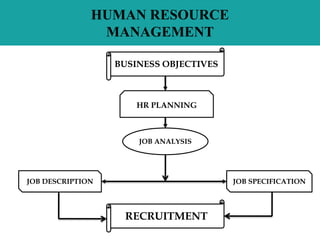
HUMAN RESOURCE
MANAGEMENT
BUSINESS OBJECTIVES
RECRUITMENT
HR PLANNING
JOB DESCRIPTION JOB SPECIFICATION
JOB ANALYSIS
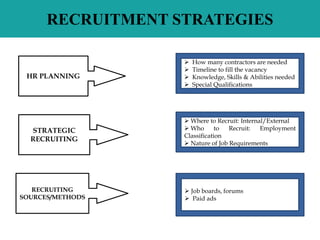
RECRUITMENT STRATEGIES
HR PLANNING
STRATEGIC
RECRUITING
RECRUITING
SOURCES/METHODS
 How many contractors are needed
 Timeline to fill the vacancy
 Knowledge, Skills & Abilities needed
 Special Qualifications
 Where to Recruit: Internal/External
 Who to Recruit: Employment
Classification
 Nature of Job Requirements
 Job boards, forums
 Paid ads
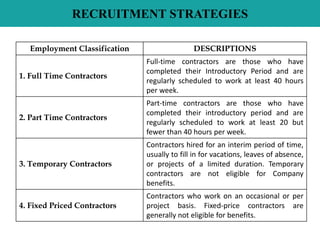
RECRUITMENT STRATEGIES
Employment Classification DESCRIPTIONS
1. Full Time Contractors
Full-time contractors are those who have
completed their Introductory Period and are
regularly scheduled to work at least 40 hours
per week.
2. Part Time Contractors
Part-time contractors are those who have
completed their introductory period and are
regularly scheduled to work at least 20 but
fewer than 40 hours per week.
3. Temporary Contractors
Contractors hired for an interim period of time,
usually to fill in for vacations, leaves of absence,
or projects of a limited duration. Temporary
contractors are not eligible for Company
benefits.
4. Fixed Priced Contractors
Contractors who work on an occasional or per
project basis. Fixed-price contractors are
generally not eligible for benefits.
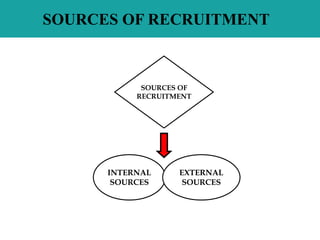
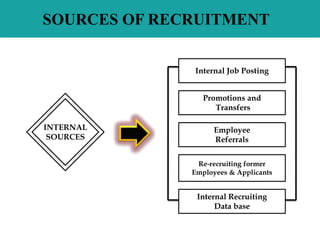
SOURCES OF RECRUITMENT
INTERNAL
SOURCES
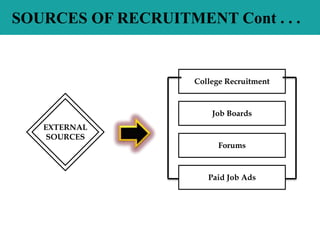
EXTERNAL
SOURCES
SOURCES OF
RECRUITMENT
Internal Recruiting
Data base
Promotions and
Transfers
Internal Job Posting
Employee
Referrals
Re-recruiting former
Employees & Applicants
INTERNAL
SOURCES
SOURCES OF RECRUITMENT
SOURCES OF RECRUITMENT Cont . . .
College Recruitment
Job Boards
Forums
Paid Job Ads
EXTERNAL
SOURCES
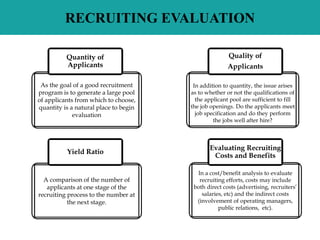
RECRUITING EVALUATION
As the goal of a good recruitment
program is to generate a large pool
of applicants from which to choose,
quantity is a natural place to begin
evaluation
In a cost/benefit analysis to evaluate
recruiting efforts, costs may include
both direct costs (advertising, recruiters’
salaries, etc) and the indirect costs
(involvement of operating managers,
public relations, etc).
Quantity of
Applicants
A comparison of the number of
applicants at one stage of the
recruiting process to the number at
the next stage.
In addition to quantity, the issue arises
as to whether or not the qualifications of
the applicant pool are sufficient to fill
the job openings. Do the applicants meet
job specification and do they perform
the jobs well after hire?
Quality of
Applicants
Yield Ratio
Evaluating Recruiting
Costs and Benefits
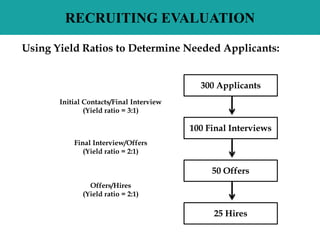
RECRUITING EVALUATION
300 Applicants
100 Final Interviews
50 Offers
25 Hires
Initial Contacts/Final Interview
(Yield ratio = 3:1)
Final Interview/Offers
(Yield ratio = 2:1)
Offers/Hires
(Yield ratio = 2:1)
Using Yield Ratios to Determine Needed Applicants:
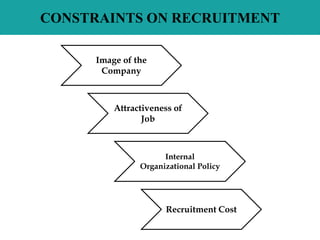
CONSTRAINTS ON RECRUITMENT
Image of the
Company
Attractiveness of
Job
Internal
Organizational Policy
Recruitment Cost
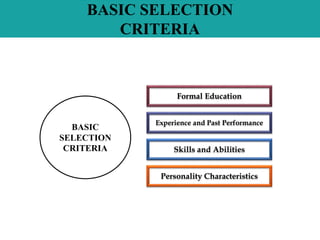
BASIC SELECTION
CRITERIA
BASIC
SELECTION
CRITERIA
Formal Education
Experience and Past Performance
Skills and Abilities
Personality Characteristics
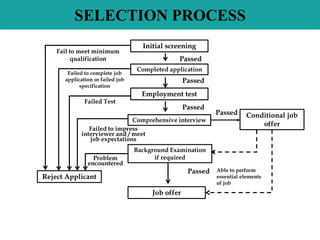
SELECTION PROCESS
Initial screening
Completed application
Comprehensive interview
Employment test
Job offer
Reject Applicant
Background Examination
if required
Conditional job
offer
Passed
Passed
Passed
Passed
Passed
Able to perform
essential elements
of job
Fail to meet minimum
qualification
Failed to complete job
application or failed job
specification
Failed Test
Failed to impress
interviewer and / meet
job expectations
Problem
encountered
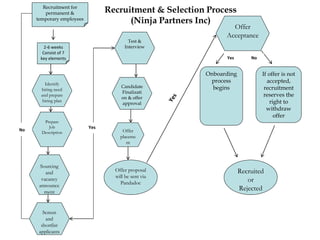
Recruitment & Selection Process
(Ninja Partners Inc)
Recruitment for
permanent &
temporary employees
2-6 weeks
Consist of 7
key elements
Identify
hiring need
and prepare
hiring plan
Prepare
Job
Description
Sourcing
and
vacancy
announce
ment
Screen
and
shortlist
applicants
Test &
Interview
Candidate
Finalizati
on & offer
approval
Offer
placeme
nt
Offer
Acceptance
Offer proposal
will be sent via
Pandadoc
Onboarding
process
begins
If offer is not
accepted,
recruitment
reserves the
right to
withdraw
offer
Recruited
or
Rejected
Yes
Yes No
No
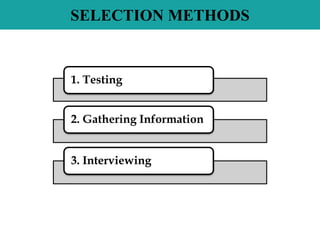
SELECTION METHODS
1. Testing
2. Gathering Information
3. Interviewing
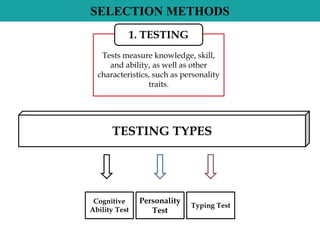
SELECTION METHODS
Tests measure knowledge, skill,
and ability, as well as other
characteristics, such as personality
traits.
1. TESTING
TESTING TYPES
Cognitive
Ability Test
Personality
Test
Typing Test
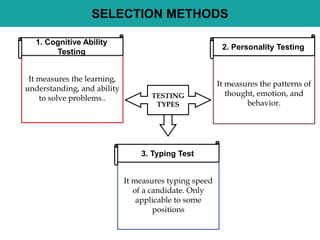
It measures the learning,
understanding, and ability
to solve problems..
1. Cognitive Ability
Testing
It measures typing speed
of a candidate. Only
applicable to some
positions
3. Typing Test
It measures the patterns of
thought, emotion, and
behavior.
2. Personality Testing
SELECTION METHODS
TESTING
TYPES
SELECTION METHODS
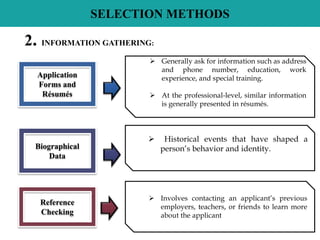
 Generally ask for information such as address
and phone number, education, work
experience, and special training.
 At the professional-level, similar information
is generally presented in résumés.
Application
Forms and
Résumés
 Historical events that have shaped a
person’s behavior and identity.Biographical
Data
 Involves contacting an applicant’s previous
employers, teachers, or friends to learn more
about the applicant
Reference
Checking
2. INFORMATION GATHERING:
SELECTION METHODS
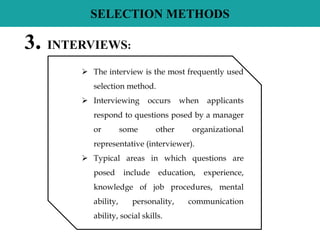
3. INTERVIEWS:
 The interview is the most frequently used
selection method.
 Interviewing occurs when applicants
respond to questions posed by a manager
or some other organizational
representative (interviewer).
 Typical areas in which questions are
posed include education, experience,
knowledge of job procedures, mental
ability, personality, communication
ability, social skills.
SELECTION METHODS
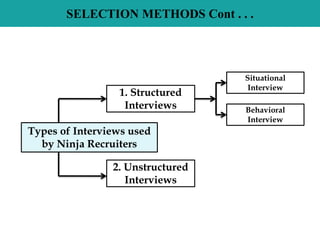
Types of Interviews used
by Ninja Recruiters
2. Unstructured
Interviews
1. Structured
Interviews
Situational
Interview
Behavioral
Interview
SELECTION METHODS
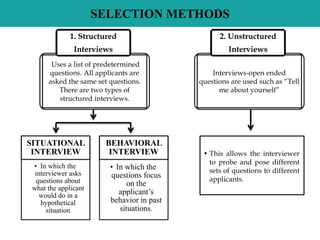
SITUATIONAL
INTERVIEW
• In which the
interviewer asks
questions about
what the applicant
would do in a
hypothetical
situation
BEHAVIORAL
INTERVIEW
• In which the
questions focus
on the
applicant’s
behavior in past
situations.
Uses a list of predetermined
questions. All applicants are
asked the same set questions.
There are two types of
structured interviews.
1. Structured
Interviews
Interviews-open ended
questions are used such as “Tell
me about yourself”
2. Unstructured
Interviews
• This allows the interviewer
to probe and pose different
sets of questions to different
applicants.
SELECTION METHODS
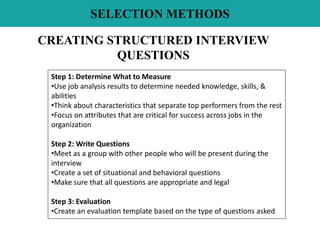
CREATING STRUCTURED INTERVIEW
QUESTIONS
Step 1: Determine What to Measure
•Use job analysis results to determine needed knowledge, skills, &
abilities
•Think about characteristics that separate top performers from the rest
•Focus on attributes that are critical for success across jobs in the
organization
Step 2: Write Questions
•Meet as a group with other people who will be present during the
interview
•Create a set of situational and behavioral questions
•Make sure that all questions are appropriate and legal
Step 3: Evaluation
•Create an evaluation template based on the type of questions asked
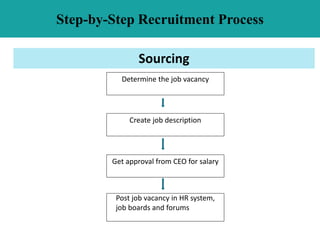
Step-by-Step Recruitment Process
Sourcing
Determine the job vacancy
Create job description
Get approval from CEO for salary
Post job vacancy in HR system,
job boards and forums
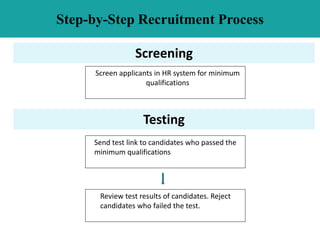
Step-by-Step Recruitment Process
Screening
Screen applicants in HR system for minimum
qualifications
Send test link to candidates who passed the
minimum qualifications
Review test results of candidates. Reject
candidates who failed the test.
Testing
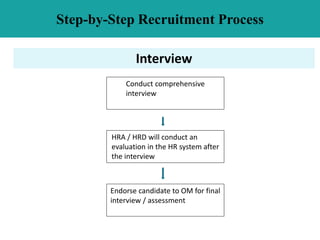
Step-by-Step Recruitment Process
Interview
Conduct comprehensive
interview
HRA / HRD will conduct an
evaluation in the HR system after
the interview
Endorse candidate to OM for final
interview / assessment
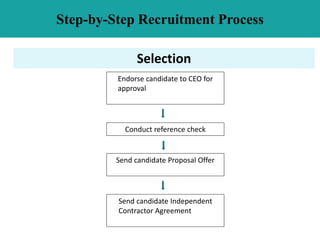
Step-by-Step Recruitment Process
Selection
Endorse candidate to CEO for
approval
Conduct reference check
Send candidate Independent
Contractor Agreement
Send candidate Proposal Offer
Step-by-Step Recruitment Process
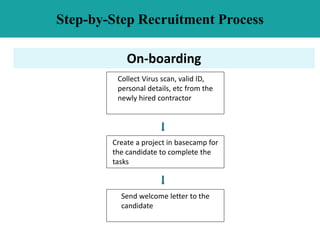
On-boarding
Collect Virus scan, valid ID,
personal details, etc from the
newly hired contractor
Create a project in basecamp for
the candidate to complete the
tasks
Send welcome letter to the
candidate

Ninja Partners Hiring Process

  • 1.
  • 2.
    HUMAN RESOURCE MANAGEMENT BUSINESS OBJECTIVES RECRUITMENT HRPLANNING JOB DESCRIPTION JOB SPECIFICATION JOB ANALYSIS
  • 3.
    RECRUITMENT STRATEGIES HR PLANNING STRATEGIC RECRUITING RECRUITING SOURCES/METHODS How many contractors are needed  Timeline to fill the vacancy  Knowledge, Skills & Abilities needed  Special Qualifications  Where to Recruit: Internal/External  Who to Recruit: Employment Classification  Nature of Job Requirements  Job boards, forums  Paid ads
  • 4.
    RECRUITMENT STRATEGIES Employment ClassificationDESCRIPTIONS 1. Full Time Contractors Full-time contractors are those who have completed their Introductory Period and are regularly scheduled to work at least 40 hours per week. 2. Part Time Contractors Part-time contractors are those who have completed their introductory period and are regularly scheduled to work at least 20 but fewer than 40 hours per week. 3. Temporary Contractors Contractors hired for an interim period of time, usually to fill in for vacations, leaves of absence, or projects of a limited duration. Temporary contractors are not eligible for Company benefits. 4. Fixed Priced Contractors Contractors who work on an occasional or per project basis. Fixed-price contractors are generally not eligible for benefits.
  • 5.
  • 6.
    Internal Recruiting Data base Promotionsand Transfers Internal Job Posting Employee Referrals Re-recruiting former Employees & Applicants INTERNAL SOURCES SOURCES OF RECRUITMENT
  • 7.
    SOURCES OF RECRUITMENTCont . . . College Recruitment Job Boards Forums Paid Job Ads EXTERNAL SOURCES
  • 8.
    RECRUITING EVALUATION As thegoal of a good recruitment program is to generate a large pool of applicants from which to choose, quantity is a natural place to begin evaluation In a cost/benefit analysis to evaluate recruiting efforts, costs may include both direct costs (advertising, recruiters’ salaries, etc) and the indirect costs (involvement of operating managers, public relations, etc). Quantity of Applicants A comparison of the number of applicants at one stage of the recruiting process to the number at the next stage. In addition to quantity, the issue arises as to whether or not the qualifications of the applicant pool are sufficient to fill the job openings. Do the applicants meet job specification and do they perform the jobs well after hire? Quality of Applicants Yield Ratio Evaluating Recruiting Costs and Benefits
  • 9.
    RECRUITING EVALUATION 300 Applicants 100Final Interviews 50 Offers 25 Hires Initial Contacts/Final Interview (Yield ratio = 3:1) Final Interview/Offers (Yield ratio = 2:1) Offers/Hires (Yield ratio = 2:1) Using Yield Ratios to Determine Needed Applicants:
  • 10.
    CONSTRAINTS ON RECRUITMENT Imageof the Company Attractiveness of Job Internal Organizational Policy Recruitment Cost
  • 11.
    BASIC SELECTION CRITERIA BASIC SELECTION CRITERIA Formal Education Experienceand Past Performance Skills and Abilities Personality Characteristics
  • 12.
    SELECTION PROCESS Initial screening Completedapplication Comprehensive interview Employment test Job offer Reject Applicant Background Examination if required Conditional job offer Passed Passed Passed Passed Passed Able to perform essential elements of job Fail to meet minimum qualification Failed to complete job application or failed job specification Failed Test Failed to impress interviewer and / meet job expectations Problem encountered
  • 13.
    Recruitment & SelectionProcess (Ninja Partners Inc) Recruitment for permanent & temporary employees 2-6 weeks Consist of 7 key elements Identify hiring need and prepare hiring plan Prepare Job Description Sourcing and vacancy announce ment Screen and shortlist applicants Test & Interview Candidate Finalizati on & offer approval Offer placeme nt Offer Acceptance Offer proposal will be sent via Pandadoc Onboarding process begins If offer is not accepted, recruitment reserves the right to withdraw offer Recruited or Rejected Yes Yes No No
  • 14.
    SELECTION METHODS 1. Testing 2.Gathering Information 3. Interviewing
  • 15.
    SELECTION METHODS Tests measureknowledge, skill, and ability, as well as other characteristics, such as personality traits. 1. TESTING TESTING TYPES Cognitive Ability Test Personality Test Typing Test
  • 16.
    It measures thelearning, understanding, and ability to solve problems.. 1. Cognitive Ability Testing It measures typing speed of a candidate. Only applicable to some positions 3. Typing Test It measures the patterns of thought, emotion, and behavior. 2. Personality Testing SELECTION METHODS TESTING TYPES
  • 17.
    SELECTION METHODS  Generallyask for information such as address and phone number, education, work experience, and special training.  At the professional-level, similar information is generally presented in résumés. Application Forms and Résumés  Historical events that have shaped a person’s behavior and identity.Biographical Data  Involves contacting an applicant’s previous employers, teachers, or friends to learn more about the applicant Reference Checking 2. INFORMATION GATHERING:
  • 18.
    SELECTION METHODS 3. INTERVIEWS: The interview is the most frequently used selection method.  Interviewing occurs when applicants respond to questions posed by a manager or some other organizational representative (interviewer).  Typical areas in which questions are posed include education, experience, knowledge of job procedures, mental ability, personality, communication ability, social skills.
  • 19.
    SELECTION METHODS Types ofInterviews used by Ninja Recruiters 2. Unstructured Interviews 1. Structured Interviews Situational Interview Behavioral Interview
  • 20.
    SELECTION METHODS SITUATIONAL INTERVIEW • Inwhich the interviewer asks questions about what the applicant would do in a hypothetical situation BEHAVIORAL INTERVIEW • In which the questions focus on the applicant’s behavior in past situations. Uses a list of predetermined questions. All applicants are asked the same set questions. There are two types of structured interviews. 1. Structured Interviews Interviews-open ended questions are used such as “Tell me about yourself” 2. Unstructured Interviews • This allows the interviewer to probe and pose different sets of questions to different applicants.
  • 21.
    SELECTION METHODS CREATING STRUCTUREDINTERVIEW QUESTIONS Step 1: Determine What to Measure •Use job analysis results to determine needed knowledge, skills, & abilities •Think about characteristics that separate top performers from the rest •Focus on attributes that are critical for success across jobs in the organization Step 2: Write Questions •Meet as a group with other people who will be present during the interview •Create a set of situational and behavioral questions •Make sure that all questions are appropriate and legal Step 3: Evaluation •Create an evaluation template based on the type of questions asked
  • 22.
    Step-by-Step Recruitment Process Sourcing Determinethe job vacancy Create job description Get approval from CEO for salary Post job vacancy in HR system, job boards and forums
  • 23.
    Step-by-Step Recruitment Process Screening Screenapplicants in HR system for minimum qualifications Send test link to candidates who passed the minimum qualifications Review test results of candidates. Reject candidates who failed the test. Testing
  • 24.
    Step-by-Step Recruitment Process Interview Conductcomprehensive interview HRA / HRD will conduct an evaluation in the HR system after the interview Endorse candidate to OM for final interview / assessment
  • 25.
    Step-by-Step Recruitment Process Selection Endorsecandidate to CEO for approval Conduct reference check Send candidate Independent Contractor Agreement Send candidate Proposal Offer
  • 26.
    Step-by-Step Recruitment Process On-boarding CollectVirus scan, valid ID, personal details, etc from the newly hired contractor Create a project in basecamp for the candidate to complete the tasks Send welcome letter to the candidate