Annealing-present.pptx for metallurgy and material engineering students
1.
ARBA MINCH UNIVERSITY
INSTITUTEOF TECHNOLOGY
FACULTY OF MECHANICAL ENGINEERING
Presentation on: Annealing Processes
By: Melese .A
January, 2024
Arbaminch,Ethiopia
2.
Outline
Unit Two
Stageof annealing processes
Driving force in annealing processes
Factors of annealing processes
Property change in annealing processes
N-G aspect in annealing processes
Annealing twin
Texture in Cold worked and annealed alloy
3.
Annealing
Annealing isa heat treatment process designed to
eliminate the effects of cold working.
And the properties of a metal may revert back to the
pre-cold worked states by Annealing.
Processes
It is heating cold worked metal to a temperature above
recrystallization temperature, holding there for some
time and then slow cooling.
6.
Recovery the1st
stage of annealing when a metal is
heated to a temperature below its melting point to
remove :
Internal stresses
Dislocations
And restore its ductility, conductivity...
a) Recovery
Atom migration:The heat provides energy to the atoms in
the crystal lattice, allowing them to migrate.
Dislocation removal: The migrating atoms remove
dislocations, or irregularities, in the metal's structure.
Stress relief: The dislocations are moved into stress-free
10.
Polygonization is aprocess that occurs during annealing when
excess dislocations arrange themselves into lower energy
configurations.
This happens when the number of dislocations of two signs are
unequal during deformation.
The result is regular arrays or low angle grain boundaries.
Polygonization
12.
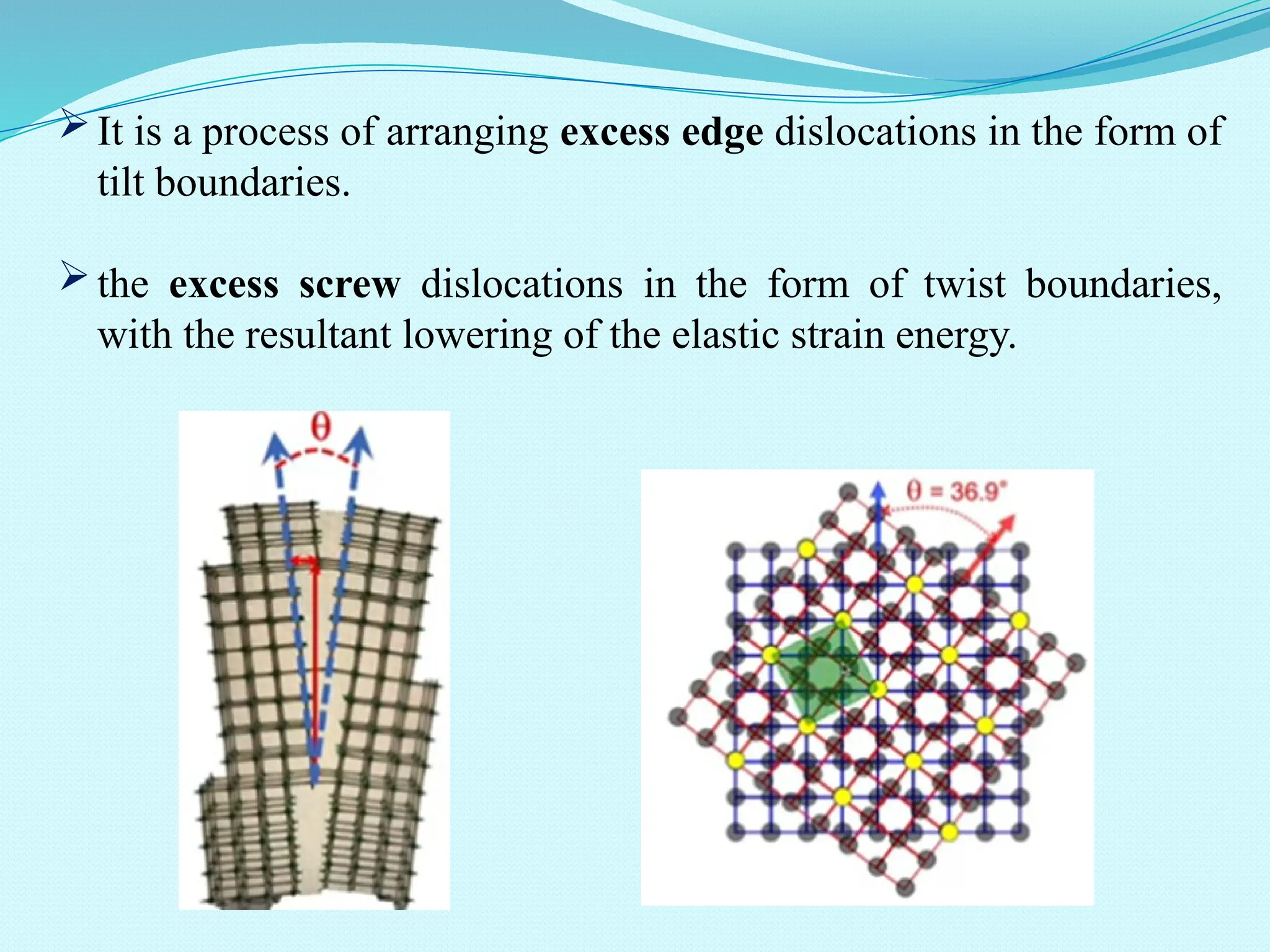
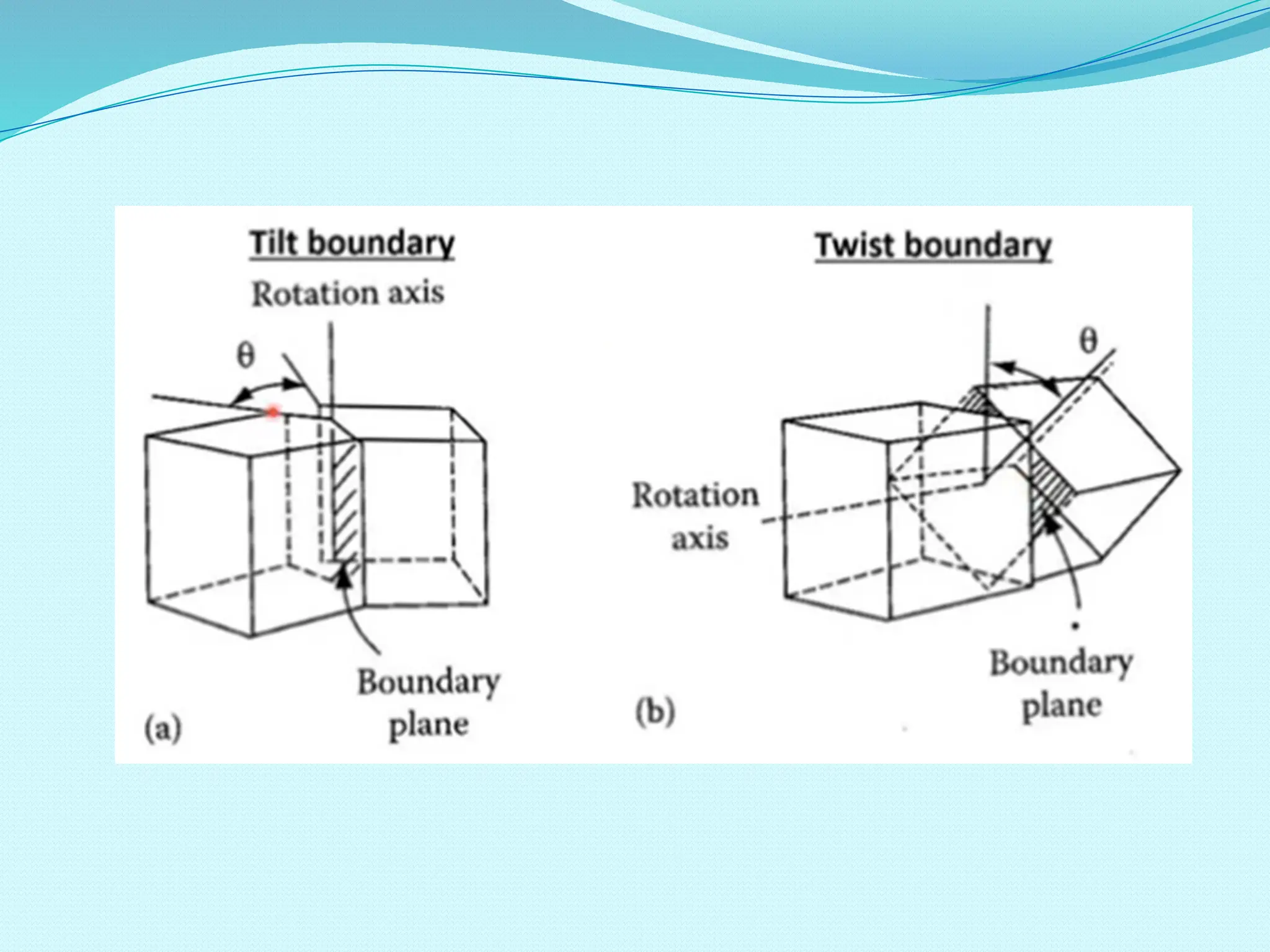
It is aprocess of arranging excess edge dislocations in the form of
tilt boundaries.
the excess screw dislocations in the form of twist boundaries,
with the resultant lowering of the elastic strain energy.
14.
It isnucleation and growth of new equiaxed and strain-free
crystals.
Nucleation Small grains, or nuclei, form in areas of high
dislocation density.
Growth The nuclei grow across regions of high dislocation
density, replacing the distorted structure.
Completion The original grain structure is completely
replaced by new grains that are free from stress and
dislocation.
b) Recrystallization
16.
It isprocess of uniform increase in the average grain size and
decrease the number of grains in a material by eliminating grain
boundaries.
c) Grain Growth
17.
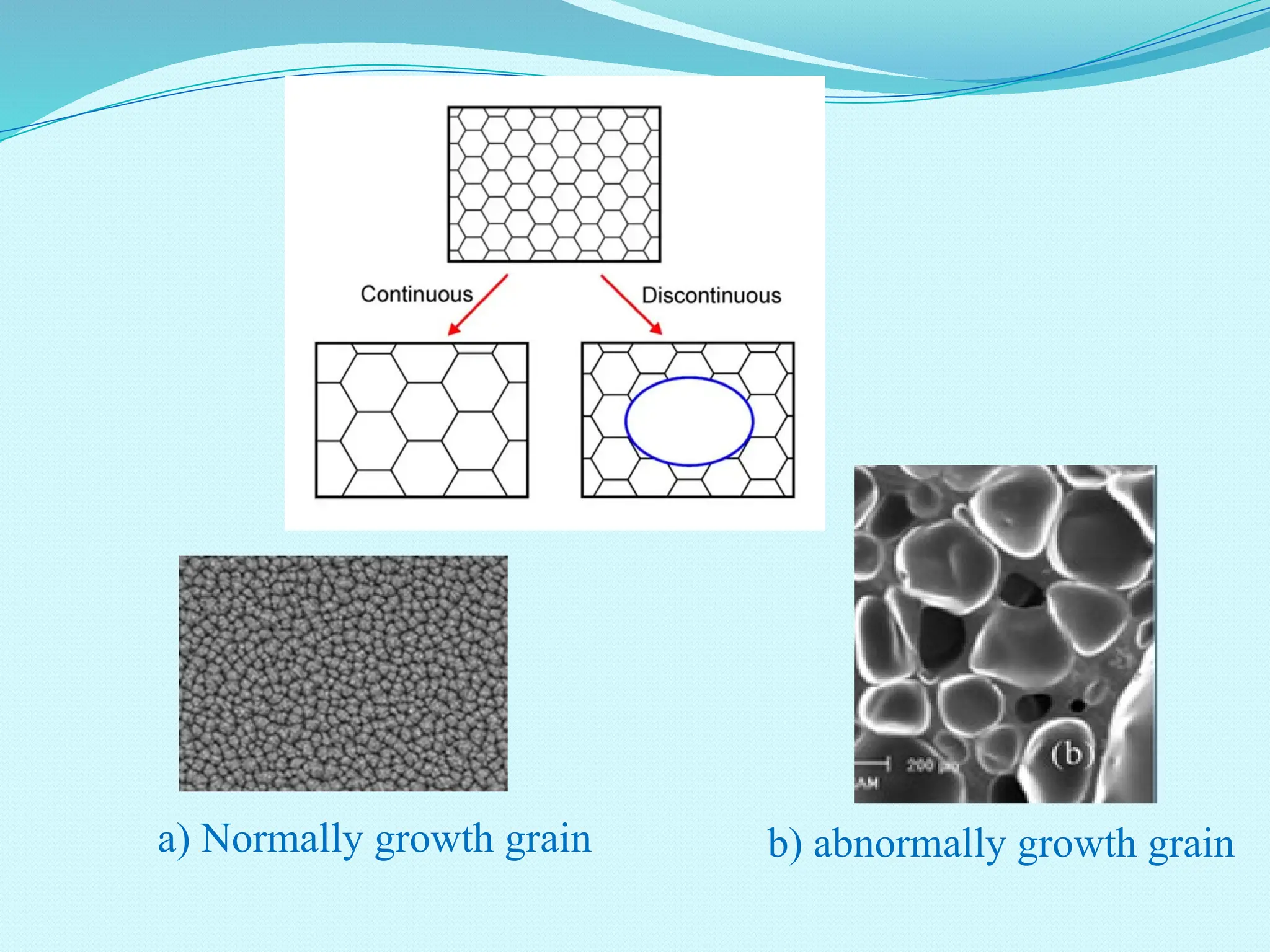
Normal grain growth,the size of individual grains are
relatively uniform.
Abnormal grain growth, the differences in individual sizes of
the grains and randomly-oriented fine grains.
some very large grains present along with the fine grains.
E.g. Abnormal grain growth in in an Al–Mg–Sc–Zr alloy
Driving force instage of annealing process
Recovery The reduction of stored energy due to cold
deformation.
Recrystallization The reduction of stored internal energy, mainly
from the reduction of dislocation density.
Grain growth The minimization of energy associated with grain
boundaries.
20.
Factors influence annealingprocess
(1) Amount of deformation
(2) Temperature
(3) Time
(4) Initial grain size
(5) Composition
(6) Amount of recovery or polygonisation
(7) Method of deformation.
21.
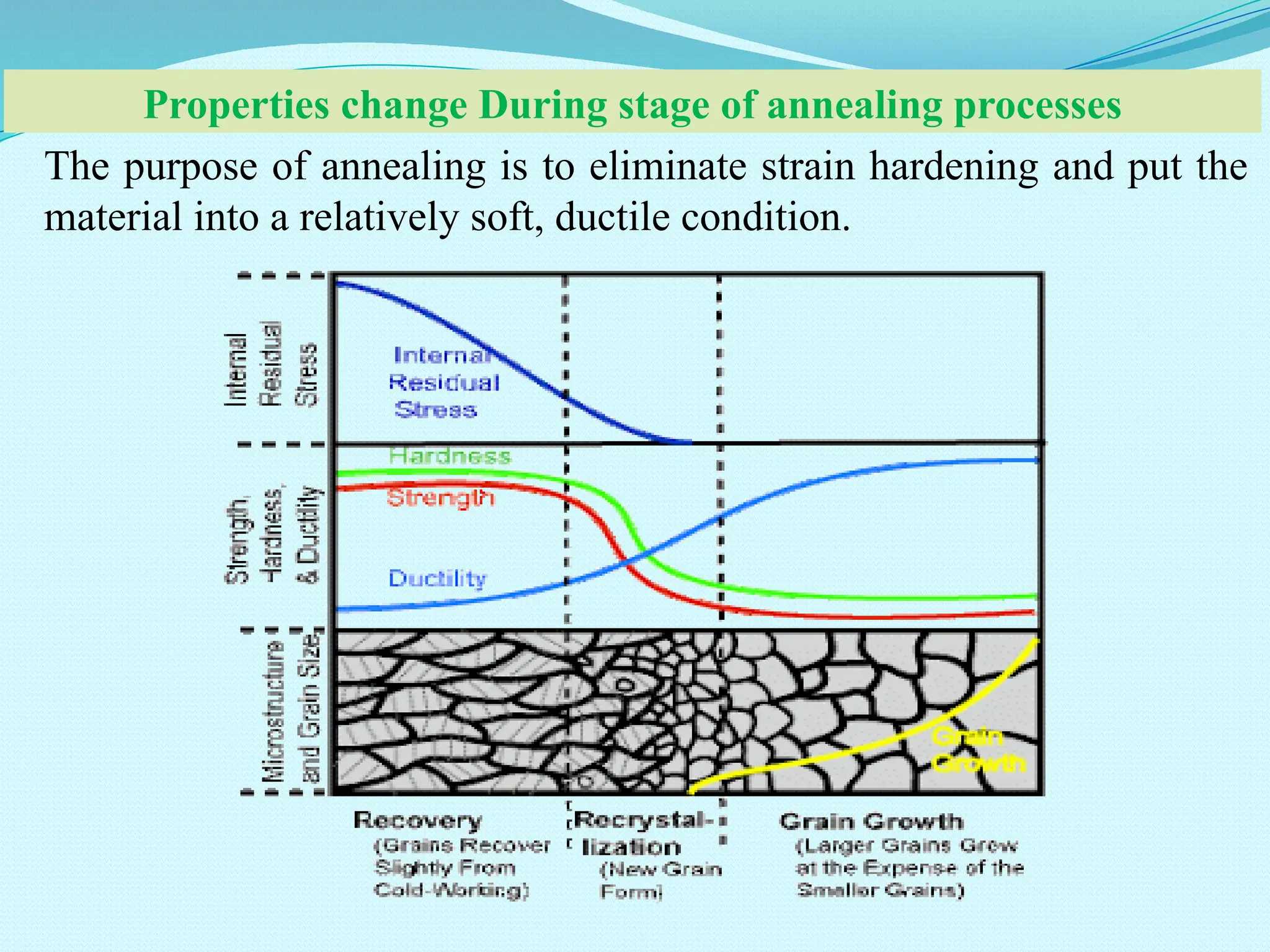
Properties change Duringstage of annealing processes
The purpose of annealing is to eliminate strain hardening and put the
material into a relatively soft, ductile condition.
22.
Annealing Twins
Annealingtwin is formed in recrystallization stage of annealing
due to Growth accidents.
Annealing twins form when a grain boundary migrates, rather
than from slip activity within grains.
Annealing twins, most prevalent in Face Centered Cubic (FCC)
metals
e.g. aluminum, copper, brass & iron with austenite etc.
24.
Texture in Cold-Workedand annealed Alloys
Texture refers to the crystallographic orientation of grains in a
material.
During cold work and annealing, the changes in the microstructure
of the alloy, including the size and orientation of the grain, grain
boundary characteristics, and texture components, will
significantly affect the mechanical properties of the material
25.
Texture in Cold-WorkedAlloys Texture in Annealed Alloys
Elongated and distorted grains.
Deformation texture due to slip
systems.
High strength and hardness.
Reduced ductility.
Equiaxed, strain and
dislocation -free grains.
Restored ductility.
Reduced strength and
hardness.