Discover Recovery College
Kirklees
Learn.
Share.
DISCOVER:
What do we mean by “Recovery”
In ordinary speech, recovery is often equated with cure, a
return to how things were before the illness or injury
occurred, a process of getting back to normal, but by this
definition few, if any, who experience severe mental illness
recover (Whitwell, 2005)
Personal journey that is self defined and determined about a life worth
living.
Recovering aspects of life lost or limited by both mental health
difficulties and the way society and services respond. Opportunities to
have a social role, friends, relationships, education, volunteering,
work, social life, hobbies, interests etc..
What do we mean by College?
Like any other college it relies on the
student to choose, take opportunities and
control the direction of their own lives
Service users become students and learners
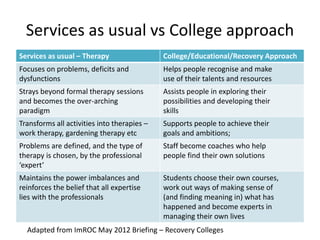
Services as usual vs College approach
Services as usual – Therapy College/Educational/Recovery Approach
Focuses on problems, deficits and
dysfunctions
Helps people recognise and make
use of their talents and resources
Strays beyond formal therapy sessions
and becomes the over-arching
paradigm
Assists people in exploring their
possibilities and developing their
skills
Transforms all activities into therapies –
work therapy, gardening therapy etc
Supports people to achieve their
goals and ambitions;
Problems are defined, and the type of
therapy is chosen, by the professional
‘expert’
Staff become coaches who help
people find their own solutions
Maintains the power imbalances and
reinforces the belief that all expertise
lies with the professionals
Students choose their own courses,
work out ways of making sense of
(and finding meaning in) what has
happened and become experts in
managing their own lives
Adapted from ImROC May 2012 Briefing – Recovery Colleges
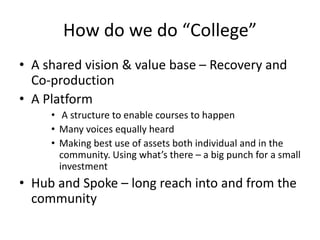
How do we do “College”
• A shared vision & value base – Recovery and
Co-production
• A Platform
• A structure to enable courses to happen
• Many voices equally heard
• Making best use of assets both individual and in the
community. Using what’s there – a big punch for a small
investment
• Hub and Spoke – long reach into and from the
community
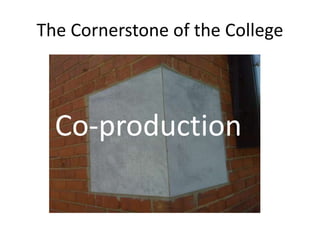
The Cornerstone of the College
Co-production
Co-production in the UK
The term ‘co–production’ has been used here
since the 1980s… to describe the reciprocal
relationship
between those delivering a service and those
receiving a service
What do we mean by co-production?
Co-production is a model in which experts by experience
and profession work collaboratively to create and facilitate
learning opportunities.
Each co-producer should have equally valued input into
the decision making process, content development and
delivery.
All comments and opinions should be explored and
respected.
(Adapted from Nottingham Recovery College)
How does co-production work at the
Recovery College?
• Governance Structure
• Steering/Board
• Operational Group
• Editorial Group
• Equal say and influence!
• Holding each other to account
• “Dis-census” sitting with it! – evolving &
changing
The Prospectus
Introduction Workshops
• Recovery College; Co-production; WRAP; Tasters to course;
Investigate your interests
• Hobbies; Outdoors; Leisure; Creative
• Linking to community opportunities
• Recognising the assets volunteers have
Exploring well-being (WRAP)
Moving forward
• Volunteering – from learner to provider
• Moving forward – back to work, education etc..
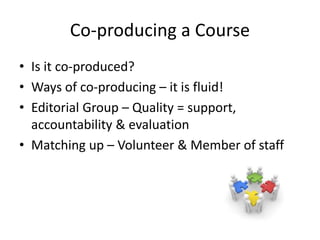
Co-producing a Course
• Is it co-produced?
• Ways of co-producing – it is fluid!
• Editorial Group – Quality = support,
accountability & evaluation
• Matching up – Volunteer & Member of staff
Learner/Student Experience
• Learner/Student choice
• Personal responsibility – not being told
• Self management – I can do it
• Enablement – Giving the tools not doing too
• Peer working – Sharing learning & community
• Using abilities – Up-skilling not de-skilling
Sue’s personal experience
Experience of health services:
• Only look at your illnesses
• Talk at you
• Told to “accept” the way you are
• Compartmentalize problems
• Lack of communication between professionals
• They decide when I am OK not me!
• Not being listened to
• Feel worse after appointments
Recovery College:
• Welcoming – no barrier between professionals
and me
• You have an equal voice – influence decisions
• Opportunity to use your skills
• Being valued
• Its what you can do that counts
• Opportunity to learn
Sue’s personal experience
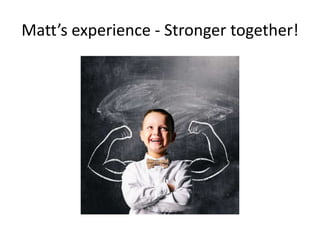
Matt’s experience - Stronger together!
Matts Experience
• Surprised by what people can do when given
the opportunity and responsibility
• Rewarding – people grow and shine
• Blurring of professional boundaries – its us
together - collaborative not me in charge
• 25 volunteers – over half still use statutory
services – are we then under valuing what
people can do!!
• Asset based approach = productivity
Modest investment = Big punch!
55+ courses delivered since Sept
150 + learners enrolled
25 volunteers 60% use statutory services
4 day a week Co-ordinator
Recovery College Lead – add on responsibility
Admin support 1.5 days a week
Staff co-delivering courses from NHS MH Services
120 hours (17 hours per month)
14 Organisations working in partnership
Over 30 partners identified as showing a positive
interested in working closely with the Recovery
College.
Volunteers – some going back to work. All report
positive outcomes and benefits
Outcomes and the success
Early indications of evaluation and return on
investment by SWYPFT:
Barnsley Recovery College – The Exchange:
85% of students that use statutory Mental Health services
use service over 60+% less
15% of students within statutory MH services use them
more – suggests that the College signposts appropriately into
services
Nationally these figures have been supported by evaluations
conducted or supported by ImROC
Thank you
For more information
Please contact
matt.ellis@swyt.nhs.uk

Recovery Colleges

  • 1.
  • 2.
    What do wemean by “Recovery”
  • 3.
    What do wemean by “Recovery” In ordinary speech, recovery is often equated with cure, a return to how things were before the illness or injury occurred, a process of getting back to normal, but by this definition few, if any, who experience severe mental illness recover (Whitwell, 2005) Personal journey that is self defined and determined about a life worth living. Recovering aspects of life lost or limited by both mental health difficulties and the way society and services respond. Opportunities to have a social role, friends, relationships, education, volunteering, work, social life, hobbies, interests etc..
  • 4.
    What do wemean by College?
  • 5.
    What do wemean by College? Like any other college it relies on the student to choose, take opportunities and control the direction of their own lives Service users become students and learners
  • 6.
    Services as usualvs College approach Services as usual – Therapy College/Educational/Recovery Approach Focuses on problems, deficits and dysfunctions Helps people recognise and make use of their talents and resources Strays beyond formal therapy sessions and becomes the over-arching paradigm Assists people in exploring their possibilities and developing their skills Transforms all activities into therapies – work therapy, gardening therapy etc Supports people to achieve their goals and ambitions; Problems are defined, and the type of therapy is chosen, by the professional ‘expert’ Staff become coaches who help people find their own solutions Maintains the power imbalances and reinforces the belief that all expertise lies with the professionals Students choose their own courses, work out ways of making sense of (and finding meaning in) what has happened and become experts in managing their own lives Adapted from ImROC May 2012 Briefing – Recovery Colleges
  • 7.
    How do wedo “College” • A shared vision & value base – Recovery and Co-production • A Platform • A structure to enable courses to happen • Many voices equally heard • Making best use of assets both individual and in the community. Using what’s there – a big punch for a small investment • Hub and Spoke – long reach into and from the community
  • 8.
    The Cornerstone ofthe College Co-production
  • 9.
    Co-production in theUK The term ‘co–production’ has been used here since the 1980s… to describe the reciprocal relationship between those delivering a service and those receiving a service
  • 10.
    What do wemean by co-production? Co-production is a model in which experts by experience and profession work collaboratively to create and facilitate learning opportunities. Each co-producer should have equally valued input into the decision making process, content development and delivery. All comments and opinions should be explored and respected. (Adapted from Nottingham Recovery College)
  • 11.
    How does co-productionwork at the Recovery College? • Governance Structure • Steering/Board • Operational Group • Editorial Group • Equal say and influence! • Holding each other to account • “Dis-census” sitting with it! – evolving & changing
  • 12.
    The Prospectus Introduction Workshops •Recovery College; Co-production; WRAP; Tasters to course; Investigate your interests • Hobbies; Outdoors; Leisure; Creative • Linking to community opportunities • Recognising the assets volunteers have Exploring well-being (WRAP) Moving forward • Volunteering – from learner to provider • Moving forward – back to work, education etc..
  • 13.
    Co-producing a Course •Is it co-produced? • Ways of co-producing – it is fluid! • Editorial Group – Quality = support, accountability & evaluation • Matching up – Volunteer & Member of staff
  • 14.
    Learner/Student Experience • Learner/Studentchoice • Personal responsibility – not being told • Self management – I can do it • Enablement – Giving the tools not doing too • Peer working – Sharing learning & community • Using abilities – Up-skilling not de-skilling
  • 15.
    Sue’s personal experience Experienceof health services: • Only look at your illnesses • Talk at you • Told to “accept” the way you are • Compartmentalize problems • Lack of communication between professionals • They decide when I am OK not me! • Not being listened to • Feel worse after appointments
  • 16.
    Recovery College: • Welcoming– no barrier between professionals and me • You have an equal voice – influence decisions • Opportunity to use your skills • Being valued • Its what you can do that counts • Opportunity to learn Sue’s personal experience
  • 17.
    Matt’s experience -Stronger together!
  • 18.
    Matts Experience • Surprisedby what people can do when given the opportunity and responsibility • Rewarding – people grow and shine • Blurring of professional boundaries – its us together - collaborative not me in charge • 25 volunteers – over half still use statutory services – are we then under valuing what people can do!! • Asset based approach = productivity
  • 19.
    Modest investment =Big punch! 55+ courses delivered since Sept 150 + learners enrolled 25 volunteers 60% use statutory services 4 day a week Co-ordinator Recovery College Lead – add on responsibility Admin support 1.5 days a week Staff co-delivering courses from NHS MH Services 120 hours (17 hours per month) 14 Organisations working in partnership Over 30 partners identified as showing a positive interested in working closely with the Recovery College. Volunteers – some going back to work. All report positive outcomes and benefits
  • 20.
    Outcomes and thesuccess Early indications of evaluation and return on investment by SWYPFT: Barnsley Recovery College – The Exchange: 85% of students that use statutory Mental Health services use service over 60+% less 15% of students within statutory MH services use them more – suggests that the College signposts appropriately into services Nationally these figures have been supported by evaluations conducted or supported by ImROC
  • 21.
    Thank you For moreinformation Please contact matt.ellis@swyt.nhs.uk

Editor's Notes

  • #10 (Anna Coote and others at the Institute for Public Policy Research and the King’s Fund - independent charitable organisations) Reciprocal… both sides benefit and can contribute