1
CHAPTER ONE: INTRODUCTION
1.1 BACKGROUND OF THE STUDY
Cattle have long been a very important component of many farming systems which
provides a means of livelihood they are used for the production of milk, dairy products like cheese,
butter, ghee, cream, meat etc. which is very important source of good health as well as good income
for a number of families. World agriculture is facing a tremendous challenge due to rapid growth
of human population. UN’s study (as cited in Ibrahim, Ayoola, & Abu, 2017) Global population
is estimated to grow annually by 76 million and to exceed 9 billion by the year 2050. In developing
countries food consumption, in particular animal-product consumption has rapidly increased over
the past decades as a result of population and economic growth, higher disposable income and
urbanization (Ibrahim, Ayoola, & Abu, 2017). As the population is growing very fast, this
business is also growing at a very rapid rate. Cattle are domesticated ungulates mammal animals.
Cattle are Bovine subfamily and originated from Bos genus. In many places, cattle is been raised
well by the farmers for the beef and dairy products, which is profitable. Besides that, cattle which
is known as livestock, also act as draft animals, it pulls carts and plows.
Cattle as well kept for other products such as leather and dung for manure or fuel. This
reveals the important of cattle business in today's life. It is observed that one of the most important
commodities of livestock subsector is beef cattle, it produce quality meat that has high economic
value, and has more important role in public life, important social function in community, therefore
it is important to developed the sector and to ensure availability of the product (Sunarso et. al.,
2012). In most of the countries large number of people lives in rural areas mostly rural population
involves in farming and agriculture, their mainly income depend on cattle farming (Ali, 2017).
Consequently, farming systems and management practices have to be continuously adapted by
2
farmers to this changing world. Kristjanson (2010) highlight that Livestock production is
considered to be an important pathway out of poverty for the rural poor in developing countries.
And worldwide 1 billion poor people depend on livestock for their livelihoods (McDermott, 2010).
Livestock are living assets contributing to nutrition, food security and building wealth.
The increasing consumption of meat in some developing countries, related to rising
household income and rapid urbanization, has been well documented. Also Aswini et.al, (2017)
have argue that Agriculture is the major source of income in the country sides. Cattle industry is
an integral of world economy. Animals like cow, buffalo, sheep, goat etc. play in an important role
in life of rural (Kristjanson, 2010). Among the many sources of animal protein in some developed
countries, recent studies have shown that cattle and cattle products are the predominant and the
most commonly consumed animal protein sources. Thus, cattle are a highly valued livestock in
some developed countries (Tibi & Aphunu, 2010). Consequently, the outcome of enhanced
production and farming of cattle and its products carry the potentials to better the income and
nutritional status of households and positively impinge their living standard. Efficient cattle
farming plays an important requirement in the attempt to achieve wider accessibility and
affordability of product to consumers (Mafimisebi et.al., 2012).
The industrialization of agriculture has expanded a lots in the previous decades. Cattle
Farming are developing towards high-tech factories that are characterized by large scale
production and intensive use of technology cattle farm should not only be very efficient but also
have to meet high quality and environmental standard and should adapt flexibility to changing
farming condition (Verdouw, Robbemond, & Wolfert, 2015). In today’s dynamic world
everything is changing very radically; and as the 21st century dawns, revolutionary changes are
also beginning to challenge the business and marketing world. To cope with the increasing
3
competition and uncertainty, industries need to take advantage of information technology (IT)
(Payman & Hojat, 2010). Sustainable agriculture, which encompasses elements such as
maintaining the integrity of entire ecosystems, the continuing supply of natural resources, and the
coherence and well-being of communities in rural areas, needs to be supported by adequate
information Technology. Human cannot imagine their life without technology in this modern era.
Various kinds of technologies help people to live their life with luxury.
The cattle industry is an integral part of the world economy. Technological change has
been the major driving force for increasing agricultural productivity and promoting agriculture
development in all developed countries. In the past, the choice of technologies and their adoption
was to increase production, productivity and farm incomes. Over many decades, policies for
agriculture, trade, research and development, education, training and advice have been strong
influences on the choice of technology, the level of agricultural production and farm practices.
Computers and its applications play the important role in the field of agriculture and cattle farm
management system where the every activity is done by the computer advanced system in the
various methods. The main act of cattle farm management system is to manage with the system
the record information of cattle. Some of the new technologies are used in agriculture and farm
maintenance which may reduce the human work load and also main purpose of taking this advance
technology is to minimize the labour involved in the agriculture converting into fully automation
& computerized process (Rajanbabu, 2014).
The modernization of cattle farming worldwide requires high management skills and
increased financial awareness: beef prices, for example, do not depend on local rainfall anymore,
but are dictated by international price fluctuations. But animal production still depends mainly on
rainfall and temperature patterns. Consequently there is a hard economic need to consider farming
4
as a business enterprise only. This applies to all types of farmers. Because of the currently available
information technology the time and circumstances are now right to implement more efficient
farming techniques aiming at an economically healthy and viable farming community which can
withstand temporary setbacks. Accurate and easy to use information technology are of
fundamental importance for a successful operational of farm management. Unfortunately, most
farmers do not use Information Technology when it comes to operate their business, despite the
increasing professionalism in the agricultural sector and its increasing usage.
Cattle farm management system (CFMS) is a system for the cattle farmers that can ease
the cattle management. CFMS acts as record keeper for the farmer to supervise the cattle farm.
CFMS also helps the farmer to observe the health level of the cattle. Besides that CFMS can be
refer as a guidelines for new cattle farmer to be acquainted with the cattle development and the
management. The cattle farm management system (CFMS), is a sophisticated planning system for
practical on-farm use, to assist cattle farmers with animal production, marketing and pasture
management to solve the following problems like what is the right age to market animals, what is
the best weight for marketing, when must animals be marketed and how and what must animals
be fed for optimal growth and fattening in order to get maximum profit. The cattle industry
provides a means of livelihood we have a great impact on overall sustainability in disfavored
and/or sensitive areas (socially, economically and environmentally), which is even higher in
traditional (extensive and mixed) production systems.
1.2 STATEMENT OF THE PROBLEM
Nowadays, many new farmers are not aware about the real way of running and caring a
cattle farm. Those people of olden days are educated by the antecedent about the cattle rising and
development. This is also due to the tradition, where the cattle caring are done by a family and
5
being thought to the young in order to keep it as the family business. Appropriate to the technology
development many those people who did the cattle rising as their family business was not
practicing it anymore. At this instant, the cattle farming are being very profitable sector in the
growth of our nation. Furthermore cattle production and its management is a very long economic
activities in the history of human being in every developed nation today the population is growing
very fast that is not in commensuration with the growing of cattle population in the nation.
However there is a need to ensure adequate supply of meat, milk, hides and skin for the human
need that will guarantee protein supply much and support the growing population.
It is a known fact poor cattle management results in animal disease and high losses that
affect profit of the farmer this is a major problem that bringing a new way of cattle management
system which will help greatly in solving the problem and the why the project seek to design the
perceptive system which is desirable to support such situation. Thus, many are taking up this cattle
farming as their business for this ages. However there are some who are inexperience in this field
and they need lot of guidelines before getting involve in cattle farming. Besides that, difficulty
does occur if happens a situation where the farm caring has to be turned to other hand due to certain
unpleased reason. Therefore a regimented system with aptitude to keep data about daily
management of cattle farm should be used by farmer. If the farm being handed over to a new
farmer, this system will be a fine source for the new farmer to learn and know about the current
flow of the management. Besides that, this system also could play a role as an education for the
new and rawness farmer to be exposed about the cattle management. The health and the caring of
rising cattle also have to be considering in the system. A firm system for cattle farming will ease
the management of cattle farms and it also enables the productivity of cattle farming to increase.
6
1.3 AIM AND OBJECTIVES
The aim of this study will be to develop a web-based cattle farm management system.
The objectives of the study are:
i. Develop a web-based cattle farm management system.
ii. Develop a database management for cattle farm.
iii. Create a platform for cattle farmers that can ease the cattle management.
1.4 SIGNIFICANCE OF THE STUDY
In view of the rapid development of computer technology in almost all the fields of
operation and its use in relation to data management it has become important to look into the
development of cattle farm management system for cattle farmers to meet up with demands of the
customers. Therefore, the study would be tremendous importance to cattle farmers which will help
them to observe the right time and animal right weight for marketing. It may also be useful to the
cattle farmers that are willing to have accurate and reliable record keeping of their cattle farms.
1.5 SCOPE AND LIMITATION OF STUDY
The scope of the study will be limited to using the PHP and MySQL to develop an
automated cattle farm management system for farmers who take cares of cattle for its beef and
dairy; and for those who are interested to know about the running of cattle production. The
proposed system of cattle farm management system will be a web-based application which is
developed to provide the channel for running intensive cattle farm.
1.6 DEFINITION OF TERMS
Database: - is an organized collection of structured information, or data, generally stored and
accessed electronically from a computer system.
7
Web-Based Application: - is a software that run on a server (computer connected to the internet),
while users connect to it from their various devices such as computers, tablets, smartphones,
iPhones etc. using an internet browser.
Administrator: - is someone who manage the overall functionality of system such as adding,
editing and deleting of data.
Cattle:- Are domesticated ungulates mammal animals with horns and cloven hoofs, originated
from Bos genus that are commonly raised as livestock by farmers for meat (beef), milk (dairy) and
for hides which are used to make leather.
Breed: - is a specific group of domestic animal having homogeneous appearance (phenotype),
homogeneous behavior, and other characteristics that distinguish it from other organism of the
same species.
Quarantine: - is an isolation of cattle that has been infected or suspected to be infected for a period
of time. It can also be done on arrival at a farm.
Farm: - is an area of land and its building where livestock (animal) are raised. The people who
own and work on the farm are called farmers.
8
CHAPTER TWO: LITERATURE REVIEW
2.1 INTRODUCTION
Agriculture is the most important sector in the economies of most low-income
African countries and about 75% of them depend solely on incomes generated from
agriculture and agribusinesses. Livestock production is the most important agricultural land
use in the world with grasslands covering 25% of land surface and contributing to the
livelihoods of more than 800 million people. Over the past 30 years, meat and milk
consumption in developing countries have grown three times as fast as in developed
countries with a market value of US $155 billion. Smallholder mixed crop-livestock
systems reportedly provide over 50% of the world’s meat and over 90% of its milk and
these are the most important livestock systems in developing countries (Claire, et al.,
2017). Livestock activities are facing a critical period at the global level: on the one hand they are
particularly criticized for their environmental impacts, e.g., water pollution (concerning especially
the monogastric farming systems), greenhouse gas emission, land degradation, competition for
land with human food production (concerning especially the cattle farming systems).
On the other hand, livestock farming systems contribute to the production of meat, milk
and eggs for human diet: animal proteins represent 33% of the human diet and they are known to
be particularly adapted to children’s needs (Manolia, Ickowicz, & Dedieuc, 2010). Moreover, the
proportion of proteins in human diets usually increases with the Gross Domestic Product (GDP)
of developing countries. Therefore, in developing countries, demand for animal products is
expected to increase significantly: the word ‘livestock revolution’ has been used to describe this
expected growth. Other functions are attributed to livestock; the production of fiber and organic
fertilizers, a source of employment and income for farmers and the overall market chain, a “living
9
bank” and a direct source of food for the most vulnerable populations, a landscape and biodiversity
builder, a user of industrial or agricultural wastes, and in the end symbolic uses. Increasing demand
in developing countries for animal sources of food including red meat is predicted to double by
2050 (Ali & Satya, 2018).
Livestock sector provide food and nutritional security to rural households while at the
same time acting as a tool for poverty alleviation. Despite the contribution, the livestock sector in
most West African countries is still characterized by the traditional production practices. Thus the
livestock sector is fundamental for food security not only at the household level, for small
producers who depend directly on livestock to obtain food, income and services, but also at the
national level, by providing consumers access to food of high nutritional quality (Rodríguez,
Anríquez, & Riveros, 2016). Thus Agricultural sectors play an important role in the overall
development of the country’s economy. That means the sectors plan have a major role in the
national economy and it is the source of income, food and employment for the rural and urban
populations (Gebreselassie, 2010).
2.2 CATTLE FARMING AND PRODUCTION
Cattle farming is a key industry within the West African context according to several
authors. The geospatial coverage and economic investment, as well as envisioned returns from
investment underscore the importance of cattle farming as a major production system within the
West African region. The cattle production industry contributes both directly and indirectly to the
viability, success, and continuity of other production systems within the region. (Santoze &
Gicheha, 2019). Commodities such as beef, milk, and hide derived from cattle are traded for
foreign exchange that is later channeled towards economic development of the countries. Cattle
are also used in various rituals or worship ceremonies as gifts or sacrificial items. In general, cattle
10
farming offers a holistic range of benefits that help spur sociocultural growth in West Africa and
other domains around the world. Cattle farming has being identified as a predominant activity
among developed nation’s peasant or small-scale farmers. Those farmers rely on the cattle as a
source of income, hence a buffer to poverty. Similarly, cattle production plays a role in improving
food security standards for those farmers by ensuring continued availability of both money and
food to mitigate negatives such as crop failure (Kubkomawa, 2017).
According to Thornton (2010) keeping livestock is an important risk reduction strategy for
vulnerable communities, and livestock are important providers of nutrients and traction for
growing crops in smallholder systems. Livestock products contribute 17 per cent to kilocalorie
consumption and 33 per cent to protein consumption globally, but there are large differences
between rich and poor countries Global livestock production has increased substantially since the
1960s. Beef production has more than doubled, while over the same time chicken meat production
has increased by a factor of nearly 10, made up of increases in both number of animals and
productivity Livestock system evolution in the coming decades is inevitably going to involve
trade-offs between food security, poverty, equity, environmental sustainability and economic
development. The livestock sector globally is highly dynamic. In developing countries, it is
evolving in response to rapidly increasing demand for livestock products, while many production
systems are increasing their efficiency and environmental sustainability.
Historical changes in the demand for livestock products have been largely driven by human
population growth, income growth and urbanization and the production response in different
livestock systems has been associated with science and technology as well as increases in animal
numbers (Garnett, et al., 2013). Livestock farming is under increasing pressure to become more
efficient and more sustainably intensive to meet the twin demands of climate change mitigation
11
and feeding the 9 (or even 11) billion people who are projected to be alive in 2050 (Godfray, et
al., 2010). Livestock production is also an instrument to socio-economic change to improved
income and quality of life. Cattle in specific is a major protein supplier to developed nation
populace and the world as a whole; hence, cattle farming activities are very essential which will
yield the distribution of the cattle to the final consumers and for the wellbeing of the farmers and
the marketers (Dire, Girei, & Bello, 2014).
The cattle fattening enterprise being a major component of the livestock sector play a vital
role in the economic development of the nation. Cattle fattening which is the preparation of the
animal for marketing through increased weight gain play a vital role in the economic development
of the nation. Many people earn their living from the fattening enterprise as veterinary doctors,
feed millers, transporters, marketers and drug manufacturers (Omolehin, et al., 2009). Thus, it is
believed that increase in the scale of operation of the fattening enterprise could accelerate the phase
of economic development of the nation. However, one of the basic constraints militating against
the fattening enterprise is finance. It is reported that small-scale cattle fattening enterprise in some
nation lack finance and capital to expand and modernize their operation. Cattle fattening has been
recommended as one of the fastest means of improving animal protein supply in the nation. Cattle
fattening is a management strategy employed to control and regulate the feed intake of the animals
in order to obtain a faster weight gain. (Umar, Zakari, & Oseni, 2015).
The shortage of animal protein in the nation was attributed to high cost of feed which
constitutes about 80% of the total cost of production. This increases the price of the beef to a level
beyond the reach of the average Nation. The shortage of animal protein necessitated research into
various alternative means of meeting the ever-increasing demand of the product (Amadasun,
2012). The socioeconomic values of cattle production are evident in the livelihoods supported by
12
the suggested industry, especially for entities that undertake farming at subsistence level Nomadic
communities provide a second scenario to the economic values of cattle keeping (Kubkomawa,
2017). Cattle also assist in the economic utilization of non-marketable crop resources and land,
creating value through limiting wastage or offering convenient alternatives for utility. For instance,
cattle are able to survive on fallow lands or domains that are not suitable for arable crop farming.
Such activities aid in maximizing the use of the available land resource (Kosgey, Arendok, &
Baker, 2013). Cattle production systems all over the world can be simply divided into extensive
(low input) and intensive (high input). There is no real line between the systems and you can find
a lot of combinations. Choosing the right system depends on local conditions, climate, available
feeding components, herd size, etc.
Patil et al., (2010) have concluded that the land and animals are traditionally basic income
sources and assets of farmers. It is major source of protein to majority of nation’s population
probably, poor families of small landholders. Deshmukh (2012) observed that the livestock
generates massive employment opportunities to rural population, particularly rural self-
employment at lowest possible investment compared to others. Iqubal (2010) concluded that the
growing population, increasing urbanization and the changing food habits of people is enhancing
the demand of livestock products worldwide. Therefore, livestock sector is growing at higher rate
in developing countries it can be an important activity to get out the rural population from poverty.
Cattle production is considered to be a key pathway to improved productivity, efficiency, and
sustainability. Cattle production contributes to nutrient balance of the whole farming system,
which is very relevant for organic agriculture where the system approach is emphasized
(Nalubwama, et al., 2016).
13
Descheemaeker et al., (2010) have also reported that livestock can play critical roles to
support the communities involved in the mixed crop-livestock production systems through a range
of products and services. The major products obtained from livestock include draught power, meat,
milk, eggs and manure. It was further elaborated by Ali et al., (2011) that these livestock derived
products and services serve as a financial reserve thus offering an alternative source of income in
the face of uncertain crop production. Hence the rising demand for cattle presents poor livestock
producers with significant opportunities to increase the benefits gained from their livestock and
raise income through increasing livestock sales. However, to date there have been few documented
examples of smallholder farmers whose livelihood was based on small, diversified crop–livestock
farms, which they were able to take advantage of these opportunities to change from being
traditional ‘cattle keepers’ to becoming cattle farmer-oriented ‘cattle producers’ within a relatively
short time span (Werner, Khanhc, & Duncand, 2013).
2.3 CATTLE FARM MANAGEMENT
Since the world has become a global village, everything becomes smart and feasible from
scale to large scale. But unfortunately some under developed countries where rural conditions are
not well or satisfied, cattle farming and agriculture activities are very hard and tough for them,
they do their activities in day time as most rural areas don’t have electricity, life is not that very
simple for them And not even government are helping them, they need technology and new system
for their village and work that lead to the need towards modernization and introduction for new
system which will make villagers life easier and increase their quality and quantity of production
(Ali, 2017). In recent decades farming in developed nation has shifted towards intensification,
industrialization, and specialization. These changes have been driven by technological innovation,
increasing demand for affordably priced food, and the availability of farm subsidies. Small family
14
farms remain, although the trend is for larger, more intensive systems, particularly in poultry and
cattle production, and more recently, in dairy farming.
These changes in food production and other variables (for example, increased urbanization,
changing rural/urban dynamics, developments in animal science and awareness of the linkages
between human and animal health) have transformed how we view farming and our relationship
with farm animals (Broom, 2011). Intensification of cattle production is widely promoted as a
strategy to meet the increasing demand for animal source of foods and to improve the livelihoods
of smallholder livestock farmers it is also seen as an important way of reducing the environmental
impact of livestock, in particular in smallholder production systems Various global studies suggest
that intensification of livestock production will reduce emissions of greenhouse gasses (GHG) per
unit of production Intensification is also expected to reduce the pressure on land, resulting in less
cultivation of natural areas and destruction of woodlands (Widi, et al., 2015). The skillful and
conceived management of farms is one of the most important success factors for their proper
functioning and their sustainable development and survival in today’s fast changing environment.
Accurate and easy to use farm management system are of fundamental importance for a successful
operational of farm Unfortunately, most farmers do not use it when it comes to operate their
business, despite the increasing professionalism in the agricultural sector and its increasing usage
of IT technologies (Husemann, Novkovic, & Vukelic, 2012) .
Farming systems are faced with complex, dynamic and interrelated changes in the
production context related (among other things) to climate change, increasing food demand,
scarcity of natural resources, volatile input and output prices, rising energy costs and
administrative regulation. The pace, scale and even the direction of such changes are hardly
predictable. Consequently, farming systems and management practices have to be continuously
15
adapted by farmers to this changing world (Thompson & Scoones, 2009). Cattle management was
very labour intensive as grazing needed to be supervised in cropping areas and hand cutting of
short, native grasses was very time consuming. This situation has resulted in thin animals with
poor reproductive performance and a low meat yield at slaughter. Animals, therefore, were sold at
local markets for local consumption only. For traders to access urban markets, cattle needed to be
in a much better condition and this could only be achieved if farmers changed the way they raised,
produced and marketed cattle.
2.4 CATTLE WELFARE AND HEALTH
Cattle were raised to preserve cash: farmers bought cattle whenever cash was available and
sold animals when funds for major expenses were needed. Thus, cattle were a cash reserve rather
than a way of generating regular income for the family. Farmers grazed cattle on grass, herbs and
shrubs growing along road sides, fields and waterways, and in nearby forests. In intensively
cropped lowland area, farmers supplemented grazing with freshly cut native grasses and crop
residues such as rice straw (Mafimisebi, 2012). Cattle need to be well fed, maintained in a
comfortable environment. Cattle are the most common type of large domesticated animal which
are raised as livestock for meat, as dairy animals for milk and other dairy products. Kelly et al.,
(2011) define farm animal welfare incident is as ‘any situation where a person in charge of cattle
or sheep causes avoidable pain or suffering to those cattle or sheep, or fails to take steps to prevent
avoidable pain or suffering to cattle or sheep under his or her care, or fails to respond expeditiously
to cattle or sheep that are experiencing avoidable pain or suffering under his or her care.
Recent years cattle farming faced many health issues and to keep track of cattle’s health
few parameters can be monitor which includes its body temperature, weight and milk
measurement. These are parameters that indicate if the cattle is ill or not (Anuj & Gerhard, 2015).
16
Cattle keeping without proper animal waste management may also cause serious environmental
hazards (e.g., creating breeding grounds for insects that transmit malaria, yellow fever, and rift
valley and nile fevers). These environmental problems from cattle farming threaten both human
life and natural ecosystems. Consequently, it is important to examine and assess the systems of
cattle keeping and waste disposal methods in urban area (Cheruiyot, et. al., 2014). Similarly
Radder et al., (2010) have recorded the multiple objectives and dimensions that livestock keeping
in some nations. Crop residues like straw, husk and grass from grazing are the main source of
nutrition to majority of the animals in some nations and profitability is sole determining factor of
cattle farming.
Singh et al., (2012) resulted that climate change has negative impact on productive and
reproductive performance of livestock, increased incidence of livestock diseases and parasitic
infestation decreasing trend of feed and fodder resources. Most of the farmers preserved fodder
crop in farm of hay for adverse climatic condition, followed mixed livestock farming, diversifying
farming practices and changed planting date, provided bedding and warmth to their animals to
protect them from extreme cold, similarly during hot days farmers provided cold water and shed
to protect their animals as adaptation strategies for sustain livestock production. However, studies
indicate that organic farmers in some nation continue to rear livestock without adherence to organic
principals and standards. This has been attributed to various livestock production challenges faced
in smallholder farming systems such as endemic animal diseases and pests which are still
controlled using conventional methods; insufficient supply of certified organic feeds; and limited
land and scanty knowledge on improved farm management practices (Nalubwama, et al., 2014).
17
2.5 RELATIONAL DATABASE MANAGEMENT SYSTEM (RDBMS)
A relational database management system is a system that manages data using the relational
model. Most current RDBMS for example MySQL, Oracle, Microsoft SQL Server, and
PostgreSQL are more accurately called SQL database management products. A database based on
the relational model is developed by E F Codd. A relational database allows the definition of data
structures, storage and retrieval operations and integrity constraints (Suri & Sharma, 2011).
According to Bassil (2012) MySQL is an open-source RDBMS which ranked second in the world
and the most popular RDBMS system among all open-source RDBMS systems. Platform
independency makes it great to be implementing in any application. The basic program runs as a
server providing multi-user access to a number of databases. MySQL includes a broad subset of
ANSI SQL 99, as well as extensions, cross-platform support, stored procedures, triggers, cursors,
updatable views, and X/Open XA distributed transaction processing support. Moreover, it supports
two phase commit engine, independent storage engines, SSL support, query caching, replication
with one master per slave, many slaves per master, embedded database library, and ACID
compliance using the InnoDB cluster engines.
Another RDBMS discussed by Bassil (2012) is the Oracle Database (commonly referred
to as Oracle RDBMS or simply as Oracle), is a relational database management system (RDBMS)
released by Oracle Corporation, and it comprises at least one instance of the application, along
with data storage. An instance comprises a set of operating system processes and memory
structures that interact with the storage. In addition to storage, the database consists of online redo
logs which hold the transactional history. Processes can in turn archive the online redo logs into
archive logs, which provide the basis for data recovery and for some forms of data replication. The
Oracle RDBMS stores data logically in the form of table-spaces and physically in the form of data
18
files. At the physical level, data files comprise one or more data blocks, where the block size can
vary between data files. Oracle features data dictionary, indexes, and clusters.
2.5.1 COMPARATIVE ANALYSIS OF RDBMS
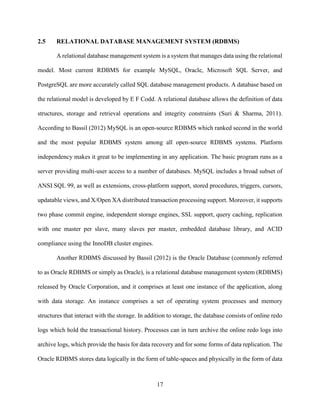
Table 2.1 shows the comparative analysis of different relational database management system
Table 2.1 Comparative Analysis of RDBMS
Features MySQL Oracle MS SQL Server
Interface SQL GUI, SQL GUI, SQL, Various
Language
Support
Many, including PHP,
C#, C++, Java, Ruby
and Objective C
Many, including C,
C#, C++, Java, Ruby
and Objective C
Java, Ruby, Python,
VB, .Net, and PHP
Operating
System
Windows, Linux,
OSX, FreeBSD and
Solaris
Windows, Linux
Solaris, HP-UX,
OSX, Z/OS and AIX
Windows
Licensing Open Source Proprietary Proprietary
2.6 SOFTWARE DEVELOPMENT LIFE CYCLE (SDLC)
A software development process, also known as a software development life cycle (SDLC),
is a structure imposed on the development of a software product. It is often considered as a subset
of system development life cycle. There are several models for such processes, each describing
approaches to a variety of activities that take place during the process. Activities involved Software
Development life cycle model includes; Understanding the problem, deciding a plan for a solution,
coding the planned solution and testing the actual program (Taya & Gupta, 2011). Proper Software
life cycle model can serve as a basic for planning, organizing, staffing, coordinating and directing
various other software development activities and at the same time help an organization in building
a software product (Prateek & Dhananjaya, 2015). There are different types of software
19
development life cycle models which are waterfall, iterative, V-shaped, prototype and spiral
model. Each of these model may have advantages and disadvantages in different situations. The
challenge is to determine which model should be selected under certain circumstances (Dwivedi,
2016).
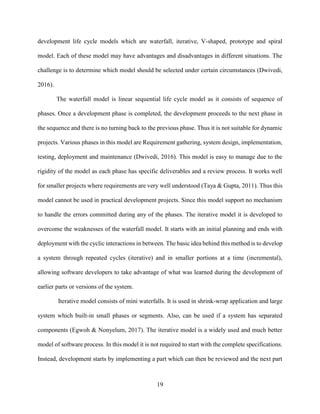
The waterfall model is linear sequential life cycle model as it consists of sequence of
phases. Once a development phase is completed, the development proceeds to the next phase in
the sequence and there is no turning back to the previous phase. Thus it is not suitable for dynamic
projects. Various phases in this model are Requirement gathering, system design, implementation,
testing, deployment and maintenance (Dwivedi, 2016). This model is easy to manage due to the
rigidity of the model as each phase has specific deliverables and a review process. It works well
for smaller projects where requirements are very well understood (Taya & Gupta, 2011). Thus this
model cannot be used in practical development projects. Since this model support no mechanism
to handle the errors committed during any of the phases. The iterative model it is developed to
overcome the weaknesses of the waterfall model. It starts with an initial planning and ends with
deployment with the cyclic interactions in between. The basic idea behind this method is to develop
a system through repeated cycles (iterative) and in smaller portions at a time (incremental),
allowing software developers to take advantage of what was learned during the development of
earlier parts or versions of the system.
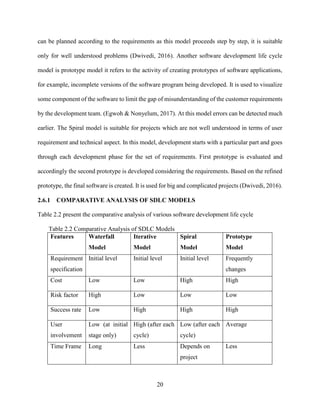
Iterative model consists of mini waterfalls. It is used in shrink-wrap application and large
system which built-in small phases or segments. Also, can be used if a system has separated
components (Egwoh & Nonyelum, 2017). The iterative model is a widely used and much better
model of software process. In this model it is not required to start with the complete specifications.
Instead, development starts by implementing a part which can then be reviewed and the next part
20
can be planned according to the requirements as this model proceeds step by step, it is suitable
only for well understood problems (Dwivedi, 2016). Another software development life cycle
model is prototype model it refers to the activity of creating prototypes of software applications,
for example, incomplete versions of the software program being developed. It is used to visualize
some component of the software to limit the gap of misunderstanding of the customer requirements
by the development team. (Egwoh & Nonyelum, 2017). At this model errors can be detected much
earlier. The Spiral model is suitable for projects which are not well understood in terms of user
requirement and technical aspect. In this model, development starts with a particular part and goes
through each development phase for the set of requirements. First prototype is evaluated and
accordingly the second prototype is developed considering the requirements. Based on the refined
prototype, the final software is created. It is used for big and complicated projects (Dwivedi, 2016).
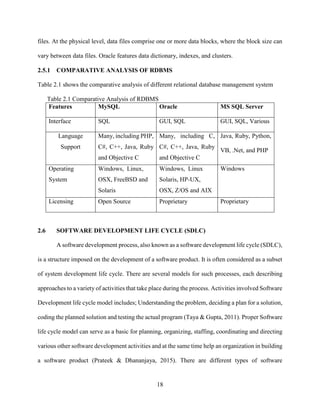
2.6.1 COMPARATIVE ANALYSIS OF SDLC MODELS
Table 2.2 present the comparative analysis of various software development life cycle
Table 2.2 Comparative Analysis of SDLC Models
Features Waterfall
Model
Iterative
Model
Spiral
Model
Prototype
Model
Requirement
specification
Initial level Initial level Initial level Frequently
changes
Cost Low Low High High
Risk factor High Low Low Low
Success rate Low High High High
User
involvement
Low (at initial
stage only)
High (after each
cycle)
Low (after each
cycle)
Average
Time Frame Long Less Depends on
project
Less
21
CHAPTER THREE: SYSTEM ANALYSIS AND DESIGN
3.1 INTRODUCTION
System Analysis is a structured and systematic process of studying how a system works
and then designing and realizing such functions. System analysis is mainly concerned with the
proper study of current system with the aim of discovering problem areas affecting it efficiency.
Consequently this stage will give recommendations (with alternatives) for re-designing the system
for improved performance. It is also called physical design, whereas system analysis emphasized
the business problem, system design focuses on technical or implementation concerns of the
system. A complementary problem-solving technique (to system analysis) that resembles a
system’s component pieces back into a complete system, hopefully an improved system. This may
involve adding, deleting and changing pieces related to the original system.
3.2 METHOD OF DATA COLLECTION
Various data were needed for the successful completion of this research and several
methods were employed to collect relevant data. The data used in the study were collected from
two sources, the primary and secondary source.
i. Primary Source: These involve oral interviews conducted with various cattle farmers of
different background in reviewing and sharing their experience about the difficulties they
undergo in using the current system carrying out their farm activities.
ii. Secondary Source: These include the use of journals and internet sources to collect data
in order to understand what cattle farm management is all about.
22
3.3 THE EXISTING SYSTEM
This section is to discuss about the existing system that related to cattle farm management
system. A brief explanation about manual cattle farm management is stated in this section.
3.3.1 MANUAL CATTLE FARM MANAGEMENT
Those days, cattle are managed manually by farmers. The special physical appearances of
each cattle is used by most of the farmers as the cattle identification. The cattle behavior and
grazing is used as the data of knowing the cattle health and preceding condition. At that timing,
cattle are being well observed and studied by the farmer in order to know and remember the
information that needed to run the management appropriately. Moreover many were skilled about
the cattle farming and raising by their family and forebear at that era.
3.3.2 DISADVANTAGES OF EXISTING SYSTEM
i. Hand kept records which is slow and subject to errors.
ii. Retrieving information may be time consuming if extensive records are kept.
iii. Stress in maintenance process.
iv. Several activities are done in an unordered manner.
3.4 PROPOSED SYSTEM
Based on the user requirement and detailed analysis of an existing system, the new system
will be designed. The design phase of any system is very important and crucial because the success
of any system depends largely on its design specification. The proposed system will be developed
using web technology to be executed as distributed system that stores information about cattle
farm management. The cattle farm management system is a web-based application which runs the
cattle farm management on a web server providing an attractive and friendly interface. The whole
data of the cattle farm is kept in the MySQL database, which is one of the best repositories. This
23
can ease the cattle management and it would act as a record keeper for farmers which can store
basic information about cattle such as cattle unique id, weight, gender, breed etc. at the same time
it would be very easy to edit and delete the detail. The “web-based cattle farm management
system” application consists of unique feature. The structure of the system will provides access to
much richer content to a more structure manner so the burden of cattle farmers will be reduce.
Also it will provides better and efficient service to cattle farmers together with simplifying cattle
farm management. Hence using this system cattle farmers will feel very easy to work on it.
3.4.1 ADVANTAGES OF THE PROPOSED SYSTEM
i. User friendly interface.
ii. Fast access to database.
iii. Less error.
iv. More Storage Capacity.
v. Search facility.
vi. The database design of the project is very simple. So the admin and staff can easily
understand the flow of the project.
3.5 SYSTEM PROTOTYPING AND DESIGN
This phase deals with detailed flow graph, requirement analysis, and the design process of
the backend of the cattle farm management system. Basically, the system design involves two
stages:
i. Conceptual and logical design
ii. Detailed design
24
3.5.1 CONCEPTUAL AND LOGICAL DESIGN
The proposed system is made up of two interface each of which performs different
functions and grants access rights to the operation the user can perform. The two interface includes:
i. The Admin Interface: This interface will be used by the admin of the cattle farm
management system to login to the system, to perform the operations of creating, editing
and deleting user’s record, editing profile, creating, editing and deleting cattle record,
creating, editing and deleting breed record, adding and deleting cattle in quarantine list.
ii. The Staff Interface: This interface will be used by the staff of the cattle farm management
system to login to the system, to perform the operations of editing profile, creating, editing
and deleting cattle record, adding and deleting cattle in quarantine list.
3.6 SOFTWARE DEVELOPMENT TOOLS
The following tools were used to achieve this project:
i. Apache Server (XAMPP): The Apache HTTP Server, commonly referred to as Apache
is a web server application notable for playing a key role in the initial growth of the world
wide web and creates a localhost server. Apache is open-source software developed and
maintained by an open community of developers under the auspices of the Apache
Software Foundation. Most commonly used on Microsoft Windows, OS/2, TPF etc.
ii. Database Server: MySQL is a relational database management system that runs as a server
providing multi-user access to a number of databases. The reason of using this Database
Server is that MySQL is an open source relational database management system (RDBMS)
that uses Structured Query Language (SQL), the most popular language for adding,
accessing, and processing data in a database. MySQL is noted mainly for its speed,
reliability, and flexibility.
25
iii. Web Browser: is a special program that helps the computer to display information from
the localhost server or internet. Example of web browser include opera google chrome etc.
iv. Hypertext Markup Language (HTML): HTML is a markup language that are used to
create electronic documents, especially pages on the world wide web that contain
connections called hyperlinks to other pages. Every web page you see on the Internet
contains HTML code that helps format and show text and images in an easy to read format.
v. PHP: The PHP Hypertext Preprocessor (PHP) is a programming language that allows web
developers to create dynamic content that interacts with databases. PHP is basically used
for developing web based software applications. Also it is a server side scripting language
that is embedded in HTML. It is integrated with a number of popular databases, including
MySQL, Oracle, Microsoft SQL Server etc.
vi. Editor (Sublime Text): is a proprietary cross-platform source code editor with a Python
application programming interface (API). It natively supports many programming
languages and markup languages, and functions can be added by users with plugins,
typically community-built and maintained under free-software licenses.
3.7 HARDWARE REQUIREMENT
The section of hardware configuration is an important task related to the software
development, insufficient Random Access Memory (RAM) may have an adverse effect on the
speed and efficiency of the entire system. The hard disk should have sufficient capacity to store
the file and application, any processor with minimum of (1.6GHz or faster) processor power at
least 512MB RAM, Keyboard and a Microsoft Mouse or some other compatible pointing device,
monitor with super VGA (800 x 600) or higher resolution and at least 250GB Hard disk drive.
26
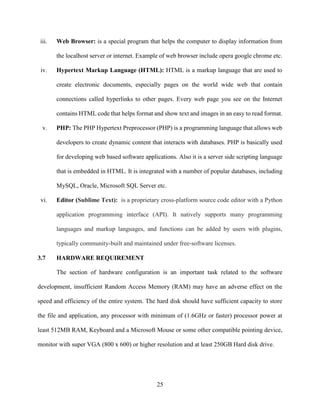
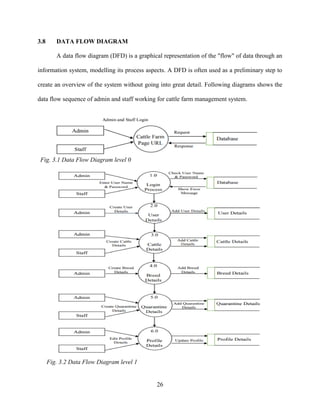
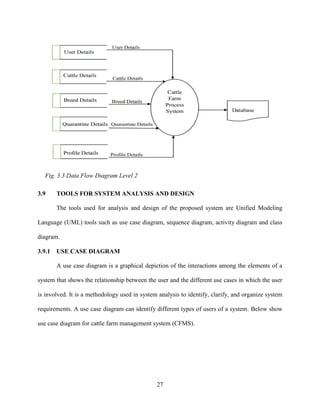
3.8 DATA FLOW DIAGRAM
A data flow diagram (DFD) is a graphical representation of the "flow" of data through an
information system, modelling its process aspects. A DFD is often used as a preliminary step to
create an overview of the system without going into great detail. Following diagrams shows the
data flow sequence of admin and staff working for cattle farm management system.
Fig. 3.1 Data Flow Diagram level 0
Fig. 3.2 Data Flow Diagram level 1
27
3.9 TOOLS FOR SYSTEM ANALYSIS AND DESIGN
The tools used for analysis and design of the proposed system are Unified Modeling
Language (UML) tools such as use case diagram, sequence diagram, activity diagram and class
diagram.
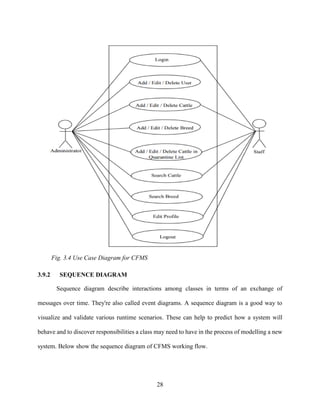
3.9.1 USE CASE DIAGRAM
A use case diagram is a graphical depiction of the interactions among the elements of a
system that shows the relationship between the user and the different use cases in which the user
is involved. It is a methodology used in system analysis to identify, clarify, and organize system
requirements. A use case diagram can identify different types of users of a system. Below show
use case diagram for cattle farm management system (CFMS).
Fig. 3.3 Data Flow Diagram Level 2
28
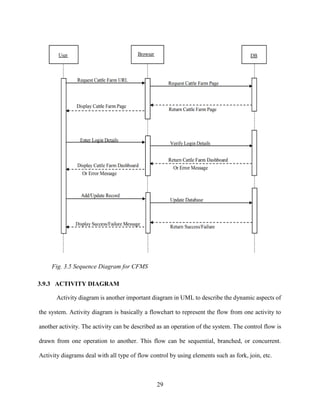
3.9.2 SEQUENCE DIAGRAM
Sequence diagram describe interactions among classes in terms of an exchange of
messages over time. They're also called event diagrams. A sequence diagram is a good way to
visualize and validate various runtime scenarios. These can help to predict how a system will
behave and to discover responsibilities a class may need to have in the process of modelling a new
system. Below show the sequence diagram of CFMS working flow.
Fig. 3.4 Use Case Diagram for CFMS
29
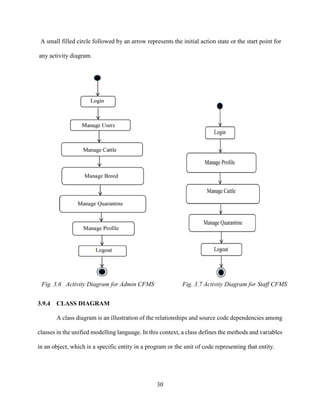
3.9.3 ACTIVITY DIAGRAM
Activity diagram is another important diagram in UML to describe the dynamic aspects of
the system. Activity diagram is basically a flowchart to represent the flow from one activity to
another activity. The activity can be described as an operation of the system. The control flow is
drawn from one operation to another. This flow can be sequential, branched, or concurrent.
Activity diagrams deal with all type of flow control by using elements such as fork, join, etc.
Fig. 3.5 Sequence Diagram for CFMS
30
A small filled circle followed by an arrow represents the initial action state or the start point for
any activity diagram.
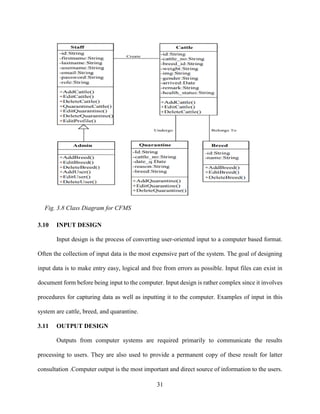
3.9.4 CLASS DIAGRAM
A class diagram is an illustration of the relationships and source code dependencies among
classes in the unified modelling language. In this context, a class defines the methods and variables
in an object, which is a specific entity in a program or the unit of code representing that entity.
Fig. 3.6 Activity Diagram for Admin CFMS Fig. 3.7 Activity Diagram for Staff CFMS
AdmCFMS
31
3.10 INPUT DESIGN
Input design is the process of converting user-oriented input to a computer based format.
Often the collection of input data is the most expensive part of the system. The goal of designing
input data is to make entry easy, logical and free from errors as possible. Input files can exist in
document form before being input to the computer. Input design is rather complex since it involves
procedures for capturing data as well as inputting it to the computer. Examples of input in this
system are cattle, breed, and quarantine.
3.11 OUTPUT DESIGN
Outputs from computer systems are required primarily to communicate the results
processing to users. They are also used to provide a permanent copy of these result for latter
consultation .Computer output is the most important and direct source of information to the users.
Fig. 3.8 Class Diagram for CFMS
32
Designing computer output should proceed in an organized well manner. The right output must be
available for the people who find the system easy to use. The output normally depends on the input
of the data, the report generated as output is the detailed information about a cattle, breed record
and quarantine record.
3.12 DATABASE DESIGN
The general theme behind a database is to handle information as an integrated whole. A
database is a collection of interrelated data stored with minimum redundancy to serve many users
quickly and effectively. After designing input and output, the analyst must concentrate on database
design or how data should be organized around user requirements. The general objective is to make
information access, easy quick, inexpensive and flexible for other users. During database design
the following objectives are concerned:-
i. Controlled Redundancy.
ii. Data independence.
iii. Accurate and integrating.
iv. More information at low cost.
v. Performance.
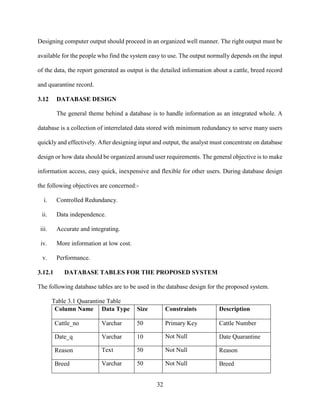
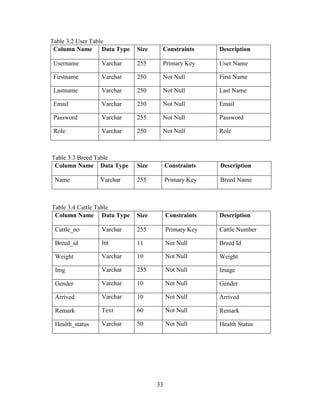
3.12.1 DATABASE TABLES FOR THE PROPOSED SYSTEM
The following database tables are to be used in the database design for the proposed system.
Table 3.1 Quarantine Table
Column Name Data Type Size Constraints Description
Cattle_no Varchar 50 Primary Key Cattle Number
Date_q Varchar 10 Not Null Date Quarantine
Reason Text 50 Not Null Reason
Breed Varchar 50 Not Null Breed
33
Table 3.2 User Table
Column Name Data Type Size Constraints Description
Username Varchar 255 Primary Key User Name
Firstname Varchar 250 Not Null First Name
Lastname Varchar 250 Not Null Last Name
Email Varchar 250 Not Null Email
Password Varchar 255 Not Null Password
Role Varchar 250 Not Null Role
Table 3.3 Breed Table
Column Name Data Type Size Constraints Description
Name Varchar 255 Primary Key Breed Name
Table 3.4 Cattle Table
Column Name Data Type Size Constraints Description
Cattle_no Varchar 255 Primary Key Cattle Number
Breed_id Int 11 Not Null Breed Id
Weight Varchar 10 Not Null Weight
Img Varchar 255 Not Null Image
Gender Varchar 10 Not Null Gender
Arrived Varchar 10 Not Null Arrived
Remark Text 60 Not Null Remark
Health_status Varchar 50 Not Null Health Status
34
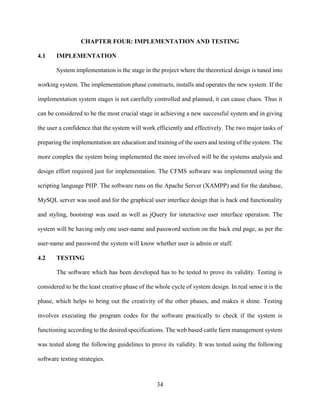
CHAPTER FOUR: IMPLEMENTATION AND TESTING
4.1 IMPLEMENTATION
System implementation is the stage in the project where the theoretical design is tuned into
working system. The implementation phase constructs, installs and operates the new system. If the
implementation system stages is not carefully controlled and planned, it can cause chaos. Thus it
can be considered to be the most crucial stage in achieving a new successful system and in giving
the user a confidence that the system will work efficiently and effectively. The two major tasks of
preparing the implementation are education and training of the users and testing of the system. The
more complex the system being implemented the more involved will be the systems analysis and
design effort required just for implementation. The CFMS software was implemented using the
scripting language PHP. The software runs on the Apache Server (XAMPP) and for the database,
MySQL server was used and for the graphical user interface design that is back end functionality
and styling, bootstrap was used as well as jQuery for interactive user interface operation. The
system will be having only one user-name and password section on the back end page, as per the
user-name and password the system will know whether user is admin or staff.
4.2 TESTING
The software which has been developed has to be tested to prove its validity. Testing is
considered to be the least creative phase of the whole cycle of system design. In real sense it is the
phase, which helps to bring out the creativity of the other phases, and makes it shine. Testing
involves executing the program codes for the software practically to check if the system is
functioning according to the desired specifications. The web based cattle farm management system
was tested along the following guidelines to prove its validity. It was tested using the following
software testing strategies.
35
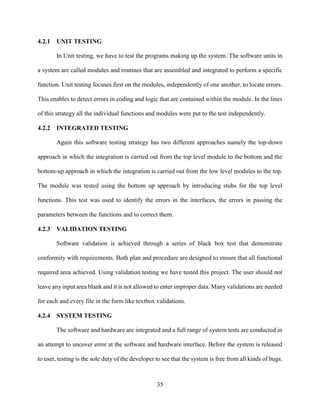
4.2.1 UNIT TESTING
In Unit testing, we have to test the programs making up the system. The software units in
a system are called modules and routines that are assembled and integrated to perform a specific
function. Unit testing focuses first on the modules, independently of one another, to locate errors.
This enables to detect errors in coding and logic that are contained within the module. In the lines
of this strategy all the individual functions and modules were put to the test independently.
4.2.2 INTEGRATED TESTING
Again this software testing strategy has two different approaches namely the top-down
approach in which the integration is carried out from the top level module to the bottom and the
bottom-up approach in which the integration is carried out from the low level modules to the top.
The module was tested using the bottom up approach by introducing stubs for the top level
functions. This test was used to identify the errors in the interfaces, the errors in passing the
parameters between the functions and to correct them.
4.2.3 VALIDATION TESTING
Software validation is achieved through a series of black box test that demonstrate
conformity with requirements. Both plan and procedure are designed to ensure that all functional
required area achieved. Using validation testing we have tested this project. The user should not
leave any input area blank and it is not allowed to enter improper data. Many validations are needed
for each and every file in the form like textbox validations.
4.2.4 SYSTEM TESTING
The software and hardware are integrated and a full range of system tests are conducted in
an attempt to uncover error at the software and hardware interface. Before the system is released
to user, testing is the sole duty of the developer to see that the system is free from all kinds of bugs.
36
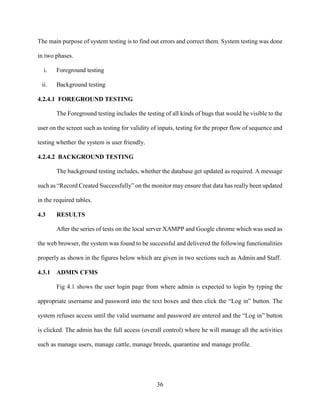
The main purpose of system testing is to find out errors and correct them. System testing was done
in two phases.
i. Foreground testing
ii. Background testing
4.2.4.1 FOREGROUND TESTING
The Foreground testing includes the testing of all kinds of bugs that would be visible to the
user on the screen such as testing for validity of inputs, testing for the proper flow of sequence and
testing whether the system is user friendly.
4.2.4.2 BACKGROUND TESTING
The background testing includes, whether the database get updated as required. A message
such as “Record Created Successfully” on the monitor may ensure that data has really been updated
in the required tables.
4.3 RESULTS
After the series of tests on the local server XAMPP and Google chrome which was used as
the web browser, the system was found to be successful and delivered the following functionalities
properly as shown in the figures below which are given in two sections such as Admin and Staff.
4.3.1 ADMIN CFMS
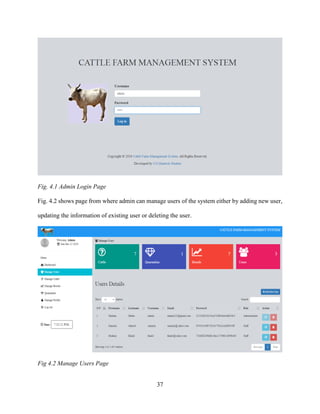
Fig 4.1 shows the user login page from where admin is expected to login by typing the
appropriate username and password into the text boxes and then click the “Log in” button. The
system refuses access until the valid username and password are entered and the “Log in” button
is clicked. The admin has the full access (overall control) where he will manage all the activities
such as manage users, manage cattle, manage breeds, quarantine and manage profile.
37
Fig. 4.1 Admin Login Page
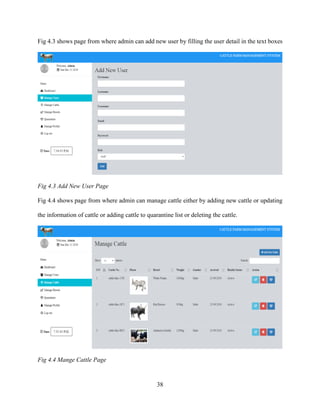
Fig. 4.2 shows page from where admin can manage users of the system either by adding new user,
updating the information of existing user or deleting the user.
Fig 4.2 Manage Users Page
38
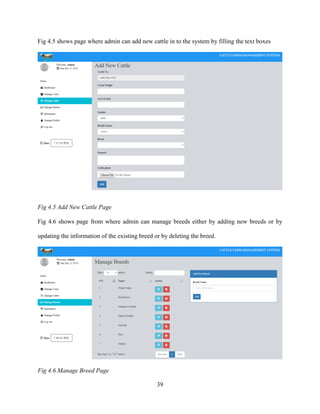
Fig 4.3 shows page from where admin can add new user by filling the user detail in the text boxes
Fig 4.3 Add New User Page
Fig 4.4 shows page from where admin can manage cattle either by adding new cattle or updating
the information of cattle or adding cattle to quarantine list or deleting the cattle.
Fig 4.4 Mange Cattle Page
39
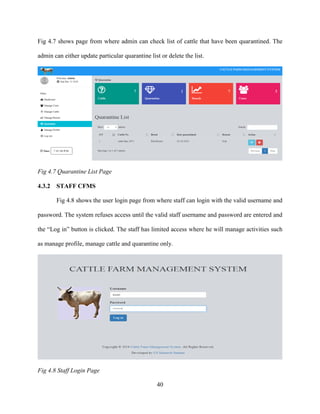
Fig 4.5 shows page where admin can add new cattle in to the system by filling the text boxes
Fig 4.5 Add New Cattle Page
Fig 4.6 shows page from where admin can manage breeds either by adding new breeds or by
updating the information of the existing breed or by deleting the breed.
Fig 4.6 Manage Breed Page
40
Fig 4.7 shows page from where admin can check list of cattle that have been quarantined. The
admin can either update particular quarantine list or delete the list.
Fig 4.7 Quarantine List Page
4.3.2 STAFF CFMS
Fig 4.8 shows the user login page from where staff can login with the valid username and
password. The system refuses access until the valid staff username and password are entered and
the “Log in” button is clicked. The staff has limited access where he will manage activities such
as manage profile, manage cattle and quarantine only.
Fig 4.8 Staff Login Page
41
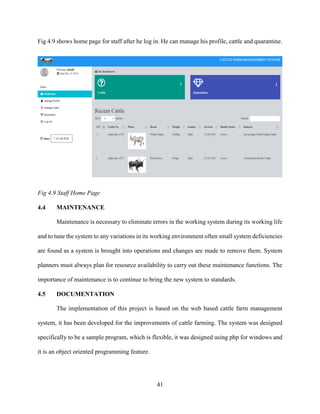
Fig 4.9 shows home page for staff after he log in. He can manage his profile, cattle and quarantine.
Fig 4.9 Staff Home Page
4.4 MAINTENANCE
Maintenance is necessary to eliminate errors in the working system during its working life
and to tune the system to any variations in its working environment often small system deficiencies
are found as a system is brought into operations and changes are made to remove them. System
planners must always plan for resource availability to carry out these maintenance functions. The
importance of maintenance is to continue to bring the new system to standards.
4.5 DOCUMENTATION
The implementation of this project is based on the web based cattle farm management
system, it has been developed for the improvements of cattle farming. The system was designed
specifically to be a sample program, which is flexible, it was designed using php for windows and
it is an object oriented programming feature.
42
CHAPTER FIVE: SUMMARY, RECOMMENDATION AND CONCLUSION
5.1 SUMMARY
The cattle farm management system (CFMS) is a web-based application geared toward
solving problems of cattle farming, it does this by easing the tedious activities that goes with the
traditional (manual) system which was faced with a high workload such as keeping the records of
cattle identifications, cattle health, cattle breed, cattle weight, cattle gender and other dealings of
cattle farm management like the increasing numbers of animals and growing farm structures. The
software is designed to enhance productivity and efficiency in the management of cattle farm. The
structure of the system provides access to much richer content to a more structure manner so the
burden of cattle farmers will be reduce. The system has passed both unit test, integration test,
validation test and system test. Thus the system is ready for deployment to intensive cattle farm.
5.2 RECOMMENDATION
Considering the proliferation of the cattle farming today, the CFMS will be a perfect tool
for the smooth pilot of affairs in various intensive cattle farms. In light of that we strongly
recommend CFMS for the management of affairs in the intensive cattle farms. We also recommend
that further research should be done on the topic in order to advance on the system we created
either on the platform we used or on any other platform.
5.3 CONCLUSION
We have successfully designed and implemented a web-based cattle farm management
system which has a great improvement over the manual system. The computerization of the system
has speed up the process. These save time by keeping an eye on all cattle, everywhere and at all
times. Changes in behavior and health are detected early on, allowing measures for the benefit of
the animals to be taken immediately. In comparison to the current system (manual system), the
43
system is more secure, flexible, reduce the workload and stress which is done by a farmer and that
is time consuming and lengthy process, prevent erroneous data entry and provides more
functionality. The present project has been developed to meet the aspirations indicated in the
modern age. Through the developed project, anyone can visualize the effectiveness and efficiency
in the real life. With this application cattle information are stored very efficiently in a secured
database. Trend of information improvement in the generation has improved the quality and
services of human operation. The result of the study showed that the system can help the cattle
farmers to increase their profits and to perform their work easily and in good situation.
44
REFERENCES
Ali, A., & Satya, M. T. (2018). Current Situation and Future Prospects for Beef Cattle
Production in Indonesia. Asian Australasian Journal of Animal Sciences, 31(7), 976-983.
Ali, H., Descheemaeker, K., Steenhuis, T., & Pandey, &. S. (2011). Comparison of Land use &
Land Cover Changes, Drivers and Impacts for a Moisture-Sufficient and Drought-Prone
Region in the Ethiopian Highlands. Journal of Experimental Agriculture, 47, 71-83.
Ali, M. (2017). Bovini (Cattle) And Dairy Farm Management. International Research Journal of
Engineering and Technology (IRJET), 04(02), 714-718.
Amadasun, C. C. (2012). Analsis of Beef Marketing in Benin City, Nigeria. Nigerian Journal of
Agriculture, Food and Environment, 8(3), 26-31.
Anuj, K., & Gerhard, P. H. (2015). A Zigbee Based Animal Health Monitoring System. IEEE
Sensors Journal, 15(1), 221-250.
Aswini, D., Santhya, S., Nandheni, T. S., & Sukirthini, N. (2017). Cattle Health and
Environment Monitoring System. International Research Journal of Engineering and
Technology (IRJET), 04(03), 1899-1903.
Bassil, Y. (2012). A Comparative Study on the Performance of the Top DBMS Systems. Journal
of Computer Science & Research, 1(1), 20-31.
Broom, D. (2011). A History of Animal Welfare Science. Journal of Acta Biotheoretica, 59,
121-137.
Cheruiyot, M. K., Kurgat, B. K., Muturi, W., & Kosgey, &. I. (2014). Assessment of Urban
Cattle Keeping Patterns and Waste Disposal Mechanisms in Nakuru Municipality,
Kenya. Journal of Natural Sciences Research, 4(16), 138-144.
Claire, H., Cyprian, E., Jules, M., Mupenzi, M., Felix, N., & Amponsah, &. W. (2017).
Livestock Farming and Management: The Case of Meat Production and Processing in
Rwanda. Asian Journal of Animal Sciences, 11, 96-107.
Descheemaeker, K., Tilahun, A., & Amare, &. H. (2010). Improving Water Productivity in
Mixed Crop-Livestock Farming Systems of Sub-Saharan Africa. Journal of Agricultural
Water Management, 97, 579-586.
Deshmukh, R. D. (2012). Dairy Farming in Indaia. Indian Streams Research Journal., 2(3), 1-4.
Dire, B., Girei, A., & Bello, &. B. (2014). Economics of cattle marketing on the socio-economic
characteristics of cattle marketers in central zone of Adamawa State, Nigeria.
International Journal Of Advanced Agricultural Research, 2(5), 1-7.
Dwivedi, S. ( 2016). Software Development Life Cycle Models - A Comparative analysis.
International Journal of Advanced Research in Computer and Communication
Engineering, 5(2), 232-233.
45
Egwoh, A. Y., & Nonyelum, &. O. (2017). A Software System Development Life Cycle Model
For Improved Students’ Communication And Collaboration. International Journal of
Computer Science & Engineering Survey, 8(4), 1-10.
Garnett, T., Appleby, M., Balmford, A., Bateman, I., Benton, T., Bloomers, P., . . . Godfray, &.
H. (2013). Sustainable Intensification in Agriculture: Premises and Policies. Journal of
Science, 341, 33–34.
Gebreselassie, N. (2010). Review on Beef Cattle Production and Marketing System in Ethiopia.
Journal of Fisheries & Livestock Production, 6(3), 1-3.
Godfray, H., Beddington, J., Crute, I., Haddad, L., Lawrence, D., Muir, J., . . . Tiulmin, &. C.
(2010). Food security: the challenge of feeding 9 billion people. Journal of Science, 327,
812–818.
Husemann, C., Novkovic, N., & Vukelic, &. N. (2012). The Model of Farm Management
Information System: A Case-Study of Diversified German Farm. The Central European
Journal of Regional Development And Tourism, 4(1), 76-90.
Ibrahim, M. G., Ayoola, J. B., & Abu, G. A. (2017). Socio- Economic Factors Influencing the
Probability of Market Participation among the Cattle Farmers in Adamawa State, Nigeria.
International Journal of Environmental & Agriculture Research (IJOEAR), 3(11), 1-8.
Iqubal, A. (2010). Role of livestock husbandry rural transformation in north India: a case study.
Revija Za geografijo. Journal of Geography, 5(2), 83-94.
Kelly, P. C., More, S., Blake, M., & Hanlon, &. A. (2011). Identification of Key Performance
Indicators For on-Farm Animal Welfare Incidents: Possible Tools For Early Warning
And Prevention. Irish Veterinary Journal, 64, 13-22.
Kosgey, I., Arendok, V., & Baker, R. (2013). Economic Values For Traits of Meat Sheep in
Areas of the Tropics with Medium to High Production Potential. Journal of Small Rum.
Res, 50, 187-202.
Kristjanson, P. (2010). Understanding poverty dynamics in Kenya. Journal of international
development, 22(1), 978-996.
Kubkomawa, H. (2017). Indigenous Breeds of Cattle, their Productivity, Economic and Cultural
Values in Sub-Saharan Africa: A Review. International Journal Research Studies
Agricultural Science, 3(1), 2454– 6224.
Mafimisebi, T. E. (2012). Spatial Equilibrium, Market Integration and Price Exogeneity in Dry
Fish Marketing in Nigeria: A Vector Auto-regressive (VAR) Approach. Journal of
Economics, Finance and Administrative Sciences, 17(33), 31-37.
Mafimisebi, T. E., Oguntade, A. E., Fajeminsin, N. A., & Ayelari, P. O. (2012). Local
Knowledge and Socio Economic Determinants of Traditional Medicines’ Utilization in
Livestock Health Managements in South West Nigeria. Journal of Ethnobiology and
Ethno medicine, 29(3), 210-220.
46
Manolia, C., Ickowicz, A., & Dedieuc, B. (2010). Livestock farming systems and local
development: A review of the multiple dimensions of “Territory” in livestock science.
Education In Landscape And Territory Agronomy, 50(10), 2167-2175.
McDermott, J. (2010). Sustaining Intensification of Smallholder Livestock Systems in The
Tropics. Livestock science, 130(1), 95–109.
Nalubwama, S., Kabi, F., Vaarst, &. M., Smolders, G., & Kiggundu, &. M. (2016). Cattle
management practices and milk production on mixed smallholder organic pineapple
farms in Central Uganda. Journal of tropical Animal & Health Production, 1(2), 1-8.
Nalubwama, S., Vaarst, M., Kabi, F., Kiggundu, M., Bagamba, F., Odhong, C., . . . Halberg, &.
N. (2014). Challenges and prospects of integrating livestock into smallholder organic
pineapple production in Uganda. Journal of Livestock Research for Rural Development,
26, 749-760.
Omolehin, B. A., Adeniji, O. K., Abba, S. S., & Ahmed, B. (2009). Profitability Analysis of
Small scale Beef Cattle fattening Enterprise in Bama Local Government Area of Borno
State Nigeria. Nigerian Veterinary Journal, 30(3), 250-285.
Patil, S. S., Bhavani, K., & Hiremath, &. G. (2010). Pattern of Milk Production, Consumption
And Sale In Different Dairy Units of North Karnataka. Karnataka Journal pf Agric.
Science, 23(2), 374-375.
Payman, S., & Hojat, A. (2010). Review of Farm Management Information Systems (FMIS).
New York Science Journal, 3(5), 87-95.
Prateek, S., & Dhananjaya, &. S. (2015). Comparative Study of Various SDLC Models on
Different Parameters . International Journal of Engineering Research, 4(4), 189-191.
Radder, K. S., Bhanj, S. K., & Kaul, &. P. (2010). Cattle Rearing Patterns of Farmers in
Northern Karnataka. International Journal of Rural Studies, 17(1), 1-5.
Rajanbabu, G. (2014). Computerized Agriculture & Farm Management. International Journal of
Agriculture & Environmental Science (SSRG-IJAES), 1(1), 16-20.
Rodríguez, D. I., Anríquez, G., & Riveros, &. J. (2016). Animal production literature review
Food security and livestock: The case of Latin America and the Caribbean. Journal of
animal production, 43(1), 1-17.
Santoze, A., & Gicheha, M. (2019). The Status of Cattle Genetic Resources in West Africa: A
Review. Journal of Advances in Animal and Veterinary Sciences, 7(2), 112-121.
Singh, S. K., Meen, H. R., Kolekar, D. V., & Singh, &. Y. (2012). Climate Change Impacts on
Livestock and Adaptation Strategies to sustain Livestock Production. Journal of
Veterinary Advances, 2(7), 407-412.
47
Sunarso, P. E., Rianto, S. P., Ekowati, E., Yuwana, T., & B, M. (2012). The Influence of 5-C
Factors on Rate of Credit Return in Beef Cattle Farming in Central Java. Journal Of The
Indonesian Tropical Animal Agriculture, 37(3), 213-219.
Suri, P., & Sharma, &. M. (2011). A Comparative Study Between The Performance Of
Relational & Object Oriented Database In Data Warehousing. International Journal of
Database Management Systems, 3(2), 116-127.
Taya, S., & Gupta, &. S. (2011). Comparative Analysis of Software Development Life Cycle
Models. International Journal of Computer Science And Technology, 2(4), 536-539.
Thompson, J., & Scoones, &. I. (2009). Addressing The Dynamics of Agri-Food Systems: An
Emerging Agenda For Social Science Research. Journal Environmental Science Policy,
12, 386–397.
Thornton, P. K. (2010). Livestock production: recent trends, future prospects. journal of
philosophical transactions of the royal society, 365, 2853–2867.
Tibi, K., & Aphunu, A. (2010). Analysis of Cattle Market in Delta State. The Supply
Determinants. African Journal of General Agriculture, 6(4), 199-203.
Umar, A. S., Zakari, A., & Oseni, &. Y. (2015). Allocative Efficiency and its Sources among
Cattle Fattening Farms of Borno State, Nigeria: Stochastic Frontier Approach. Journal of
Agricultural Economics, Environment and Social Sciences, 1(1), 129-124.
Verdouw, C. N., Robbemond, R. M., & Wolfert, J. (2015). Erp in Agriculture: Lesson Learned
From Dutch Horticulture. Journal of Computer and Electronics in Agriculture, 114, 125-
133.
Werner, S., Khanhc, T. T., & Duncand, &. A. (2013). Transformation of smallholder beef cattle
production in Vietnam. International Journal of Agricultural Sustainability, 11(4), 363 –
381.
Widi, T. S., Udo, H. M., Oldenbroek, K., Budisatria, I. G., Baliarti, E., & Zijpp, &. A. (2015). Is
Crossbreeding Beneficial For Mixed Farming Systems In Central Java? Journal of Anim.
Genet. Resour., 56, 127–144.
48
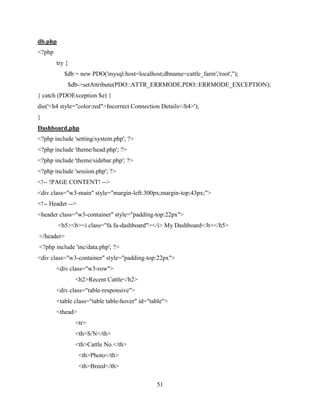
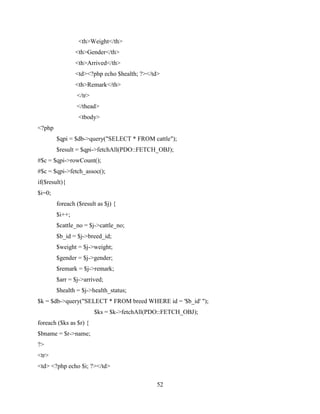
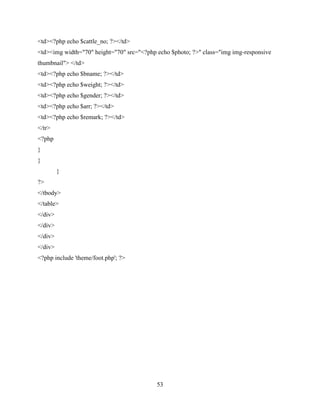
APPENDIX
Head.php
<!DOCTYPE html>
<html>
<head>
<title><?php echo NAME_; ?></title>
<meta name="viewport" content="width=device-width, initial-scale=1">
<meta charset="UTF-8">
<!-- FILE BASED -->
<link rel="stylesheet" href="./plugin/w3.css">
<link rel="stylesheet" href="./plugin/bootstrap.min.css">
<link href="./jquery-ui/jquery-ui.css" rel="stylesheet">
<!--link rel = "stylesheet" href ="./plugin/datatables.min.css" /-->
<script src="./jquery-ui/jquery.js"></script>
<script src="./jquery-ui/jquery-ui.js"></script>
<script src="./plugin/bootstrap.min.js"></script>
<!--script src="./plugin/datatables.min.js"></script-->
<link rel="stylesheet" href="./plugin/font-awesome.min.css">
<script src="./jquery-ui/jquery.dataTables.min.js"></script>
<link rel="stylesheet" type="text/css" href="./jquery-ui/dataTables.bootstrap.min.css"-->
<script src="./jquery-ui/dataTables.bootstrap.min.js"></script>
<style>
body {
font-family: 'Baumans';
background-color: #d4d8dd;
}
</style>
<script>
$(document).ready(function(){
$('#table').DataTable();
49
});
</script>
</head>
<body>
Index.php
<?php include 'setting/system.php'; ?>
<?php include 'theme/head.php'; ?>
<div class="container">
<div class="row" style="margin-top: 10%">
<h1 class="text-center"><?php echo NAME_X; ?></h1><br><br><br>
<div class="col-md-2 col-md-offset-2">
<img src="img/2.png" class="img img-responsive">
</div>
<div class="col-md-4">
<form method="post" autocomplete="off">
<div class="form-group">
<label class="control-label">Username</label>
<input type="text" name="username" class="form-control input-sm" required>
</div>
<div class="form-group">
<label class="control-label">Password</label>
<input type="password" name="password" class="form-control input-sm" required>
</div>
<button name="submit" type="submit" class="btn btn-md btn-primary">Log in</button>
</form>
<?php
if (isset($_POST['submit'])) {
$username = trim($_POST['username']);
$password = md5($_POST['password']);
50
$q = $db->query("SELECT * FROM user WHERE username = '$username' AND
password = '$password' LIMIT 1 ");
$count = $q->rowCount();
$rows = $q->fetchAll(PDO::FETCH_OBJ);
if($count > 0){
foreach($rows as $row){
$user_id = $row->id;
$user = $row->username;
$_SESSION['id'] = $user_id;
$_SESSION['user'] = $user;
header('location: dashboard.php');
}
}else{
$error = 'incorrect login details';
}
}
if(isset($error)){ ?>
<br><br>
<div class="alert alert-danger alert-dismissable">
<a href="#" class="close" data-dismiss="alert" aria-label="close">&times;</a>
<strong><?php echo $error; ?>.</strong>
</div>
<?php }
?>
</div>
</div>
</div>
<?php include 'theme/foot.php'; ?>
51
db.php
<?php
try {
$db = new PDO('mysql:host=localhost;dbname=cattle_farm','root','');
$db->setAttribute(PDO::ATTR_ERRMODE,PDO::ERRMODE_EXCEPTION);
} catch (PDOException $e) {
die('<h4 style="color:red">Incorrect Connection Details</h4>');
}
Dashboard.php
<?php include 'setting/system.php'; ?>
<?php include 'theme/head.php'; ?>
<?php include 'theme/sidebar.php'; ?>
<?php include 'session.php'; ?>
<!-- !PAGE CONTENT! -->
<div class="w3-main" style="margin-left:300px;margin-top:43px;">
<!-- Header -->
<header class="w3-container" style="padding-top:22px">
<h5><b><i class="fa fa-dashboard"></i> My Dashboard</b></h5>
</header>
<?php include 'inc/data.php'; ?>
<div class="w3-container" style="padding-top:22px">
<div class="w3-row">
<h2>Recent Cattle</h2>
<div class="table-responsive">
<table class="table table-hover" id="table">
<thead>
<tr>
<th>S/N</th>
<th>Cattle No.</th>
<th>Photo</th>
<th>Breed</th>
52
<th>Weight</th>
<th>Gender</th>
<th>Arrived</th>
<td><?php echo $health; ?></td>
<th>Remark</th>
</tr>
</thead>
<tbody>
<?php
$qpi = $db->query("SELECT * FROM cattle");
$result = $qpi->fetchAll(PDO::FETCH_OBJ);
#$c = $qpi->rowCount();
#$c = $qpi->fetch_assoc();
if($result){
$i=0;
foreach ($result as $j) {
$i++;
$cattle_no = $j->cattle_no;
$b_id = $j->breed_id;
$weight = $j->weight;
$gender = $j->gender;
$remark = $j->remark;
$arr = $j->arrived;
$health = $j->health_status;
$k = $db->query("SELECT * FROM breed WHERE id = '$b_id' ");
$ks = $k->fetchAll(PDO::FETCH_OBJ);
foreach ($ks as $r) {
$bname = $r->name;
?>
<tr>
<td> <?php echo $i; ?></td>
53
<td><?php echo $cattle_no; ?></td>
<td><img width="70" height="70" src="<?php echo $photo; ?>" class="img img-responsive
thumbnail"> </td>
<td><?php echo $bname; ?></td>
<td><?php echo $weight; ?></td>
<td><?php echo $gender; ?></td>
<td><?php echo $arr; ?></td>
<td><?php echo $remark; ?></td>
</tr>
<?php
}
}
}
?>
</tbody>
</table>
</div>
</div>
</div>
</div>
<?php include 'theme/foot.php'; ?>

Web Based Cattle Farm Management System Report

  • 1.
    1 CHAPTER ONE: INTRODUCTION 1.1BACKGROUND OF THE STUDY Cattle have long been a very important component of many farming systems which provides a means of livelihood they are used for the production of milk, dairy products like cheese, butter, ghee, cream, meat etc. which is very important source of good health as well as good income for a number of families. World agriculture is facing a tremendous challenge due to rapid growth of human population. UN’s study (as cited in Ibrahim, Ayoola, & Abu, 2017) Global population is estimated to grow annually by 76 million and to exceed 9 billion by the year 2050. In developing countries food consumption, in particular animal-product consumption has rapidly increased over the past decades as a result of population and economic growth, higher disposable income and urbanization (Ibrahim, Ayoola, & Abu, 2017). As the population is growing very fast, this business is also growing at a very rapid rate. Cattle are domesticated ungulates mammal animals. Cattle are Bovine subfamily and originated from Bos genus. In many places, cattle is been raised well by the farmers for the beef and dairy products, which is profitable. Besides that, cattle which is known as livestock, also act as draft animals, it pulls carts and plows. Cattle as well kept for other products such as leather and dung for manure or fuel. This reveals the important of cattle business in today's life. It is observed that one of the most important commodities of livestock subsector is beef cattle, it produce quality meat that has high economic value, and has more important role in public life, important social function in community, therefore it is important to developed the sector and to ensure availability of the product (Sunarso et. al., 2012). In most of the countries large number of people lives in rural areas mostly rural population involves in farming and agriculture, their mainly income depend on cattle farming (Ali, 2017). Consequently, farming systems and management practices have to be continuously adapted by
  • 2.
    2 farmers to thischanging world. Kristjanson (2010) highlight that Livestock production is considered to be an important pathway out of poverty for the rural poor in developing countries. And worldwide 1 billion poor people depend on livestock for their livelihoods (McDermott, 2010). Livestock are living assets contributing to nutrition, food security and building wealth. The increasing consumption of meat in some developing countries, related to rising household income and rapid urbanization, has been well documented. Also Aswini et.al, (2017) have argue that Agriculture is the major source of income in the country sides. Cattle industry is an integral of world economy. Animals like cow, buffalo, sheep, goat etc. play in an important role in life of rural (Kristjanson, 2010). Among the many sources of animal protein in some developed countries, recent studies have shown that cattle and cattle products are the predominant and the most commonly consumed animal protein sources. Thus, cattle are a highly valued livestock in some developed countries (Tibi & Aphunu, 2010). Consequently, the outcome of enhanced production and farming of cattle and its products carry the potentials to better the income and nutritional status of households and positively impinge their living standard. Efficient cattle farming plays an important requirement in the attempt to achieve wider accessibility and affordability of product to consumers (Mafimisebi et.al., 2012). The industrialization of agriculture has expanded a lots in the previous decades. Cattle Farming are developing towards high-tech factories that are characterized by large scale production and intensive use of technology cattle farm should not only be very efficient but also have to meet high quality and environmental standard and should adapt flexibility to changing farming condition (Verdouw, Robbemond, & Wolfert, 2015). In today’s dynamic world everything is changing very radically; and as the 21st century dawns, revolutionary changes are also beginning to challenge the business and marketing world. To cope with the increasing
  • 3.
    3 competition and uncertainty,industries need to take advantage of information technology (IT) (Payman & Hojat, 2010). Sustainable agriculture, which encompasses elements such as maintaining the integrity of entire ecosystems, the continuing supply of natural resources, and the coherence and well-being of communities in rural areas, needs to be supported by adequate information Technology. Human cannot imagine their life without technology in this modern era. Various kinds of technologies help people to live their life with luxury. The cattle industry is an integral part of the world economy. Technological change has been the major driving force for increasing agricultural productivity and promoting agriculture development in all developed countries. In the past, the choice of technologies and their adoption was to increase production, productivity and farm incomes. Over many decades, policies for agriculture, trade, research and development, education, training and advice have been strong influences on the choice of technology, the level of agricultural production and farm practices. Computers and its applications play the important role in the field of agriculture and cattle farm management system where the every activity is done by the computer advanced system in the various methods. The main act of cattle farm management system is to manage with the system the record information of cattle. Some of the new technologies are used in agriculture and farm maintenance which may reduce the human work load and also main purpose of taking this advance technology is to minimize the labour involved in the agriculture converting into fully automation & computerized process (Rajanbabu, 2014). The modernization of cattle farming worldwide requires high management skills and increased financial awareness: beef prices, for example, do not depend on local rainfall anymore, but are dictated by international price fluctuations. But animal production still depends mainly on rainfall and temperature patterns. Consequently there is a hard economic need to consider farming
  • 4.
    4 as a businessenterprise only. This applies to all types of farmers. Because of the currently available information technology the time and circumstances are now right to implement more efficient farming techniques aiming at an economically healthy and viable farming community which can withstand temporary setbacks. Accurate and easy to use information technology are of fundamental importance for a successful operational of farm management. Unfortunately, most farmers do not use Information Technology when it comes to operate their business, despite the increasing professionalism in the agricultural sector and its increasing usage. Cattle farm management system (CFMS) is a system for the cattle farmers that can ease the cattle management. CFMS acts as record keeper for the farmer to supervise the cattle farm. CFMS also helps the farmer to observe the health level of the cattle. Besides that CFMS can be refer as a guidelines for new cattle farmer to be acquainted with the cattle development and the management. The cattle farm management system (CFMS), is a sophisticated planning system for practical on-farm use, to assist cattle farmers with animal production, marketing and pasture management to solve the following problems like what is the right age to market animals, what is the best weight for marketing, when must animals be marketed and how and what must animals be fed for optimal growth and fattening in order to get maximum profit. The cattle industry provides a means of livelihood we have a great impact on overall sustainability in disfavored and/or sensitive areas (socially, economically and environmentally), which is even higher in traditional (extensive and mixed) production systems. 1.2 STATEMENT OF THE PROBLEM Nowadays, many new farmers are not aware about the real way of running and caring a cattle farm. Those people of olden days are educated by the antecedent about the cattle rising and development. This is also due to the tradition, where the cattle caring are done by a family and
  • 5.
    5 being thought tothe young in order to keep it as the family business. Appropriate to the technology development many those people who did the cattle rising as their family business was not practicing it anymore. At this instant, the cattle farming are being very profitable sector in the growth of our nation. Furthermore cattle production and its management is a very long economic activities in the history of human being in every developed nation today the population is growing very fast that is not in commensuration with the growing of cattle population in the nation. However there is a need to ensure adequate supply of meat, milk, hides and skin for the human need that will guarantee protein supply much and support the growing population. It is a known fact poor cattle management results in animal disease and high losses that affect profit of the farmer this is a major problem that bringing a new way of cattle management system which will help greatly in solving the problem and the why the project seek to design the perceptive system which is desirable to support such situation. Thus, many are taking up this cattle farming as their business for this ages. However there are some who are inexperience in this field and they need lot of guidelines before getting involve in cattle farming. Besides that, difficulty does occur if happens a situation where the farm caring has to be turned to other hand due to certain unpleased reason. Therefore a regimented system with aptitude to keep data about daily management of cattle farm should be used by farmer. If the farm being handed over to a new farmer, this system will be a fine source for the new farmer to learn and know about the current flow of the management. Besides that, this system also could play a role as an education for the new and rawness farmer to be exposed about the cattle management. The health and the caring of rising cattle also have to be considering in the system. A firm system for cattle farming will ease the management of cattle farms and it also enables the productivity of cattle farming to increase.
  • 6.
    6 1.3 AIM ANDOBJECTIVES The aim of this study will be to develop a web-based cattle farm management system. The objectives of the study are: i. Develop a web-based cattle farm management system. ii. Develop a database management for cattle farm. iii. Create a platform for cattle farmers that can ease the cattle management. 1.4 SIGNIFICANCE OF THE STUDY In view of the rapid development of computer technology in almost all the fields of operation and its use in relation to data management it has become important to look into the development of cattle farm management system for cattle farmers to meet up with demands of the customers. Therefore, the study would be tremendous importance to cattle farmers which will help them to observe the right time and animal right weight for marketing. It may also be useful to the cattle farmers that are willing to have accurate and reliable record keeping of their cattle farms. 1.5 SCOPE AND LIMITATION OF STUDY The scope of the study will be limited to using the PHP and MySQL to develop an automated cattle farm management system for farmers who take cares of cattle for its beef and dairy; and for those who are interested to know about the running of cattle production. The proposed system of cattle farm management system will be a web-based application which is developed to provide the channel for running intensive cattle farm. 1.6 DEFINITION OF TERMS Database: - is an organized collection of structured information, or data, generally stored and accessed electronically from a computer system.
  • 7.
    7 Web-Based Application: -is a software that run on a server (computer connected to the internet), while users connect to it from their various devices such as computers, tablets, smartphones, iPhones etc. using an internet browser. Administrator: - is someone who manage the overall functionality of system such as adding, editing and deleting of data. Cattle:- Are domesticated ungulates mammal animals with horns and cloven hoofs, originated from Bos genus that are commonly raised as livestock by farmers for meat (beef), milk (dairy) and for hides which are used to make leather. Breed: - is a specific group of domestic animal having homogeneous appearance (phenotype), homogeneous behavior, and other characteristics that distinguish it from other organism of the same species. Quarantine: - is an isolation of cattle that has been infected or suspected to be infected for a period of time. It can also be done on arrival at a farm. Farm: - is an area of land and its building where livestock (animal) are raised. The people who own and work on the farm are called farmers.
  • 8.
    8 CHAPTER TWO: LITERATUREREVIEW 2.1 INTRODUCTION Agriculture is the most important sector in the economies of most low-income African countries and about 75% of them depend solely on incomes generated from agriculture and agribusinesses. Livestock production is the most important agricultural land use in the world with grasslands covering 25% of land surface and contributing to the livelihoods of more than 800 million people. Over the past 30 years, meat and milk consumption in developing countries have grown three times as fast as in developed countries with a market value of US $155 billion. Smallholder mixed crop-livestock systems reportedly provide over 50% of the world’s meat and over 90% of its milk and these are the most important livestock systems in developing countries (Claire, et al., 2017). Livestock activities are facing a critical period at the global level: on the one hand they are particularly criticized for their environmental impacts, e.g., water pollution (concerning especially the monogastric farming systems), greenhouse gas emission, land degradation, competition for land with human food production (concerning especially the cattle farming systems). On the other hand, livestock farming systems contribute to the production of meat, milk and eggs for human diet: animal proteins represent 33% of the human diet and they are known to be particularly adapted to children’s needs (Manolia, Ickowicz, & Dedieuc, 2010). Moreover, the proportion of proteins in human diets usually increases with the Gross Domestic Product (GDP) of developing countries. Therefore, in developing countries, demand for animal products is expected to increase significantly: the word ‘livestock revolution’ has been used to describe this expected growth. Other functions are attributed to livestock; the production of fiber and organic fertilizers, a source of employment and income for farmers and the overall market chain, a “living
  • 9.
    9 bank” and adirect source of food for the most vulnerable populations, a landscape and biodiversity builder, a user of industrial or agricultural wastes, and in the end symbolic uses. Increasing demand in developing countries for animal sources of food including red meat is predicted to double by 2050 (Ali & Satya, 2018). Livestock sector provide food and nutritional security to rural households while at the same time acting as a tool for poverty alleviation. Despite the contribution, the livestock sector in most West African countries is still characterized by the traditional production practices. Thus the livestock sector is fundamental for food security not only at the household level, for small producers who depend directly on livestock to obtain food, income and services, but also at the national level, by providing consumers access to food of high nutritional quality (Rodríguez, Anríquez, & Riveros, 2016). Thus Agricultural sectors play an important role in the overall development of the country’s economy. That means the sectors plan have a major role in the national economy and it is the source of income, food and employment for the rural and urban populations (Gebreselassie, 2010). 2.2 CATTLE FARMING AND PRODUCTION Cattle farming is a key industry within the West African context according to several authors. The geospatial coverage and economic investment, as well as envisioned returns from investment underscore the importance of cattle farming as a major production system within the West African region. The cattle production industry contributes both directly and indirectly to the viability, success, and continuity of other production systems within the region. (Santoze & Gicheha, 2019). Commodities such as beef, milk, and hide derived from cattle are traded for foreign exchange that is later channeled towards economic development of the countries. Cattle are also used in various rituals or worship ceremonies as gifts or sacrificial items. In general, cattle
  • 10.
    10 farming offers aholistic range of benefits that help spur sociocultural growth in West Africa and other domains around the world. Cattle farming has being identified as a predominant activity among developed nation’s peasant or small-scale farmers. Those farmers rely on the cattle as a source of income, hence a buffer to poverty. Similarly, cattle production plays a role in improving food security standards for those farmers by ensuring continued availability of both money and food to mitigate negatives such as crop failure (Kubkomawa, 2017). According to Thornton (2010) keeping livestock is an important risk reduction strategy for vulnerable communities, and livestock are important providers of nutrients and traction for growing crops in smallholder systems. Livestock products contribute 17 per cent to kilocalorie consumption and 33 per cent to protein consumption globally, but there are large differences between rich and poor countries Global livestock production has increased substantially since the 1960s. Beef production has more than doubled, while over the same time chicken meat production has increased by a factor of nearly 10, made up of increases in both number of animals and productivity Livestock system evolution in the coming decades is inevitably going to involve trade-offs between food security, poverty, equity, environmental sustainability and economic development. The livestock sector globally is highly dynamic. In developing countries, it is evolving in response to rapidly increasing demand for livestock products, while many production systems are increasing their efficiency and environmental sustainability. Historical changes in the demand for livestock products have been largely driven by human population growth, income growth and urbanization and the production response in different livestock systems has been associated with science and technology as well as increases in animal numbers (Garnett, et al., 2013). Livestock farming is under increasing pressure to become more efficient and more sustainably intensive to meet the twin demands of climate change mitigation
  • 11.
    11 and feeding the9 (or even 11) billion people who are projected to be alive in 2050 (Godfray, et al., 2010). Livestock production is also an instrument to socio-economic change to improved income and quality of life. Cattle in specific is a major protein supplier to developed nation populace and the world as a whole; hence, cattle farming activities are very essential which will yield the distribution of the cattle to the final consumers and for the wellbeing of the farmers and the marketers (Dire, Girei, & Bello, 2014). The cattle fattening enterprise being a major component of the livestock sector play a vital role in the economic development of the nation. Cattle fattening which is the preparation of the animal for marketing through increased weight gain play a vital role in the economic development of the nation. Many people earn their living from the fattening enterprise as veterinary doctors, feed millers, transporters, marketers and drug manufacturers (Omolehin, et al., 2009). Thus, it is believed that increase in the scale of operation of the fattening enterprise could accelerate the phase of economic development of the nation. However, one of the basic constraints militating against the fattening enterprise is finance. It is reported that small-scale cattle fattening enterprise in some nation lack finance and capital to expand and modernize their operation. Cattle fattening has been recommended as one of the fastest means of improving animal protein supply in the nation. Cattle fattening is a management strategy employed to control and regulate the feed intake of the animals in order to obtain a faster weight gain. (Umar, Zakari, & Oseni, 2015). The shortage of animal protein in the nation was attributed to high cost of feed which constitutes about 80% of the total cost of production. This increases the price of the beef to a level beyond the reach of the average Nation. The shortage of animal protein necessitated research into various alternative means of meeting the ever-increasing demand of the product (Amadasun, 2012). The socioeconomic values of cattle production are evident in the livelihoods supported by
  • 12.
    12 the suggested industry,especially for entities that undertake farming at subsistence level Nomadic communities provide a second scenario to the economic values of cattle keeping (Kubkomawa, 2017). Cattle also assist in the economic utilization of non-marketable crop resources and land, creating value through limiting wastage or offering convenient alternatives for utility. For instance, cattle are able to survive on fallow lands or domains that are not suitable for arable crop farming. Such activities aid in maximizing the use of the available land resource (Kosgey, Arendok, & Baker, 2013). Cattle production systems all over the world can be simply divided into extensive (low input) and intensive (high input). There is no real line between the systems and you can find a lot of combinations. Choosing the right system depends on local conditions, climate, available feeding components, herd size, etc. Patil et al., (2010) have concluded that the land and animals are traditionally basic income sources and assets of farmers. It is major source of protein to majority of nation’s population probably, poor families of small landholders. Deshmukh (2012) observed that the livestock generates massive employment opportunities to rural population, particularly rural self- employment at lowest possible investment compared to others. Iqubal (2010) concluded that the growing population, increasing urbanization and the changing food habits of people is enhancing the demand of livestock products worldwide. Therefore, livestock sector is growing at higher rate in developing countries it can be an important activity to get out the rural population from poverty. Cattle production is considered to be a key pathway to improved productivity, efficiency, and sustainability. Cattle production contributes to nutrient balance of the whole farming system, which is very relevant for organic agriculture where the system approach is emphasized (Nalubwama, et al., 2016).
  • 13.
    13 Descheemaeker et al.,(2010) have also reported that livestock can play critical roles to support the communities involved in the mixed crop-livestock production systems through a range of products and services. The major products obtained from livestock include draught power, meat, milk, eggs and manure. It was further elaborated by Ali et al., (2011) that these livestock derived products and services serve as a financial reserve thus offering an alternative source of income in the face of uncertain crop production. Hence the rising demand for cattle presents poor livestock producers with significant opportunities to increase the benefits gained from their livestock and raise income through increasing livestock sales. However, to date there have been few documented examples of smallholder farmers whose livelihood was based on small, diversified crop–livestock farms, which they were able to take advantage of these opportunities to change from being traditional ‘cattle keepers’ to becoming cattle farmer-oriented ‘cattle producers’ within a relatively short time span (Werner, Khanhc, & Duncand, 2013). 2.3 CATTLE FARM MANAGEMENT Since the world has become a global village, everything becomes smart and feasible from scale to large scale. But unfortunately some under developed countries where rural conditions are not well or satisfied, cattle farming and agriculture activities are very hard and tough for them, they do their activities in day time as most rural areas don’t have electricity, life is not that very simple for them And not even government are helping them, they need technology and new system for their village and work that lead to the need towards modernization and introduction for new system which will make villagers life easier and increase their quality and quantity of production (Ali, 2017). In recent decades farming in developed nation has shifted towards intensification, industrialization, and specialization. These changes have been driven by technological innovation, increasing demand for affordably priced food, and the availability of farm subsidies. Small family
  • 14.
    14 farms remain, althoughthe trend is for larger, more intensive systems, particularly in poultry and cattle production, and more recently, in dairy farming. These changes in food production and other variables (for example, increased urbanization, changing rural/urban dynamics, developments in animal science and awareness of the linkages between human and animal health) have transformed how we view farming and our relationship with farm animals (Broom, 2011). Intensification of cattle production is widely promoted as a strategy to meet the increasing demand for animal source of foods and to improve the livelihoods of smallholder livestock farmers it is also seen as an important way of reducing the environmental impact of livestock, in particular in smallholder production systems Various global studies suggest that intensification of livestock production will reduce emissions of greenhouse gasses (GHG) per unit of production Intensification is also expected to reduce the pressure on land, resulting in less cultivation of natural areas and destruction of woodlands (Widi, et al., 2015). The skillful and conceived management of farms is one of the most important success factors for their proper functioning and their sustainable development and survival in today’s fast changing environment. Accurate and easy to use farm management system are of fundamental importance for a successful operational of farm Unfortunately, most farmers do not use it when it comes to operate their business, despite the increasing professionalism in the agricultural sector and its increasing usage of IT technologies (Husemann, Novkovic, & Vukelic, 2012) . Farming systems are faced with complex, dynamic and interrelated changes in the production context related (among other things) to climate change, increasing food demand, scarcity of natural resources, volatile input and output prices, rising energy costs and administrative regulation. The pace, scale and even the direction of such changes are hardly predictable. Consequently, farming systems and management practices have to be continuously
  • 15.
    15 adapted by farmersto this changing world (Thompson & Scoones, 2009). Cattle management was very labour intensive as grazing needed to be supervised in cropping areas and hand cutting of short, native grasses was very time consuming. This situation has resulted in thin animals with poor reproductive performance and a low meat yield at slaughter. Animals, therefore, were sold at local markets for local consumption only. For traders to access urban markets, cattle needed to be in a much better condition and this could only be achieved if farmers changed the way they raised, produced and marketed cattle. 2.4 CATTLE WELFARE AND HEALTH Cattle were raised to preserve cash: farmers bought cattle whenever cash was available and sold animals when funds for major expenses were needed. Thus, cattle were a cash reserve rather than a way of generating regular income for the family. Farmers grazed cattle on grass, herbs and shrubs growing along road sides, fields and waterways, and in nearby forests. In intensively cropped lowland area, farmers supplemented grazing with freshly cut native grasses and crop residues such as rice straw (Mafimisebi, 2012). Cattle need to be well fed, maintained in a comfortable environment. Cattle are the most common type of large domesticated animal which are raised as livestock for meat, as dairy animals for milk and other dairy products. Kelly et al., (2011) define farm animal welfare incident is as ‘any situation where a person in charge of cattle or sheep causes avoidable pain or suffering to those cattle or sheep, or fails to take steps to prevent avoidable pain or suffering to cattle or sheep under his or her care, or fails to respond expeditiously to cattle or sheep that are experiencing avoidable pain or suffering under his or her care. Recent years cattle farming faced many health issues and to keep track of cattle’s health few parameters can be monitor which includes its body temperature, weight and milk measurement. These are parameters that indicate if the cattle is ill or not (Anuj & Gerhard, 2015).
  • 16.
    16 Cattle keeping withoutproper animal waste management may also cause serious environmental hazards (e.g., creating breeding grounds for insects that transmit malaria, yellow fever, and rift valley and nile fevers). These environmental problems from cattle farming threaten both human life and natural ecosystems. Consequently, it is important to examine and assess the systems of cattle keeping and waste disposal methods in urban area (Cheruiyot, et. al., 2014). Similarly Radder et al., (2010) have recorded the multiple objectives and dimensions that livestock keeping in some nations. Crop residues like straw, husk and grass from grazing are the main source of nutrition to majority of the animals in some nations and profitability is sole determining factor of cattle farming. Singh et al., (2012) resulted that climate change has negative impact on productive and reproductive performance of livestock, increased incidence of livestock diseases and parasitic infestation decreasing trend of feed and fodder resources. Most of the farmers preserved fodder crop in farm of hay for adverse climatic condition, followed mixed livestock farming, diversifying farming practices and changed planting date, provided bedding and warmth to their animals to protect them from extreme cold, similarly during hot days farmers provided cold water and shed to protect their animals as adaptation strategies for sustain livestock production. However, studies indicate that organic farmers in some nation continue to rear livestock without adherence to organic principals and standards. This has been attributed to various livestock production challenges faced in smallholder farming systems such as endemic animal diseases and pests which are still controlled using conventional methods; insufficient supply of certified organic feeds; and limited land and scanty knowledge on improved farm management practices (Nalubwama, et al., 2014).
  • 17.
    17 2.5 RELATIONAL DATABASEMANAGEMENT SYSTEM (RDBMS) A relational database management system is a system that manages data using the relational model. Most current RDBMS for example MySQL, Oracle, Microsoft SQL Server, and PostgreSQL are more accurately called SQL database management products. A database based on the relational model is developed by E F Codd. A relational database allows the definition of data structures, storage and retrieval operations and integrity constraints (Suri & Sharma, 2011). According to Bassil (2012) MySQL is an open-source RDBMS which ranked second in the world and the most popular RDBMS system among all open-source RDBMS systems. Platform independency makes it great to be implementing in any application. The basic program runs as a server providing multi-user access to a number of databases. MySQL includes a broad subset of ANSI SQL 99, as well as extensions, cross-platform support, stored procedures, triggers, cursors, updatable views, and X/Open XA distributed transaction processing support. Moreover, it supports two phase commit engine, independent storage engines, SSL support, query caching, replication with one master per slave, many slaves per master, embedded database library, and ACID compliance using the InnoDB cluster engines. Another RDBMS discussed by Bassil (2012) is the Oracle Database (commonly referred to as Oracle RDBMS or simply as Oracle), is a relational database management system (RDBMS) released by Oracle Corporation, and it comprises at least one instance of the application, along with data storage. An instance comprises a set of operating system processes and memory structures that interact with the storage. In addition to storage, the database consists of online redo logs which hold the transactional history. Processes can in turn archive the online redo logs into archive logs, which provide the basis for data recovery and for some forms of data replication. The Oracle RDBMS stores data logically in the form of table-spaces and physically in the form of data
  • 18.
    18 files. At thephysical level, data files comprise one or more data blocks, where the block size can vary between data files. Oracle features data dictionary, indexes, and clusters. 2.5.1 COMPARATIVE ANALYSIS OF RDBMS Table 2.1 shows the comparative analysis of different relational database management system Table 2.1 Comparative Analysis of RDBMS Features MySQL Oracle MS SQL Server Interface SQL GUI, SQL GUI, SQL, Various Language Support Many, including PHP, C#, C++, Java, Ruby and Objective C Many, including C, C#, C++, Java, Ruby and Objective C Java, Ruby, Python, VB, .Net, and PHP Operating System Windows, Linux, OSX, FreeBSD and Solaris Windows, Linux Solaris, HP-UX, OSX, Z/OS and AIX Windows Licensing Open Source Proprietary Proprietary 2.6 SOFTWARE DEVELOPMENT LIFE CYCLE (SDLC) A software development process, also known as a software development life cycle (SDLC), is a structure imposed on the development of a software product. It is often considered as a subset of system development life cycle. There are several models for such processes, each describing approaches to a variety of activities that take place during the process. Activities involved Software Development life cycle model includes; Understanding the problem, deciding a plan for a solution, coding the planned solution and testing the actual program (Taya & Gupta, 2011). Proper Software life cycle model can serve as a basic for planning, organizing, staffing, coordinating and directing various other software development activities and at the same time help an organization in building a software product (Prateek & Dhananjaya, 2015). There are different types of software
  • 19.
    19 development life cyclemodels which are waterfall, iterative, V-shaped, prototype and spiral model. Each of these model may have advantages and disadvantages in different situations. The challenge is to determine which model should be selected under certain circumstances (Dwivedi, 2016). The waterfall model is linear sequential life cycle model as it consists of sequence of phases. Once a development phase is completed, the development proceeds to the next phase in the sequence and there is no turning back to the previous phase. Thus it is not suitable for dynamic projects. Various phases in this model are Requirement gathering, system design, implementation, testing, deployment and maintenance (Dwivedi, 2016). This model is easy to manage due to the rigidity of the model as each phase has specific deliverables and a review process. It works well for smaller projects where requirements are very well understood (Taya & Gupta, 2011). Thus this model cannot be used in practical development projects. Since this model support no mechanism to handle the errors committed during any of the phases. The iterative model it is developed to overcome the weaknesses of the waterfall model. It starts with an initial planning and ends with deployment with the cyclic interactions in between. The basic idea behind this method is to develop a system through repeated cycles (iterative) and in smaller portions at a time (incremental), allowing software developers to take advantage of what was learned during the development of earlier parts or versions of the system. Iterative model consists of mini waterfalls. It is used in shrink-wrap application and large system which built-in small phases or segments. Also, can be used if a system has separated components (Egwoh & Nonyelum, 2017). The iterative model is a widely used and much better model of software process. In this model it is not required to start with the complete specifications. Instead, development starts by implementing a part which can then be reviewed and the next part
  • 20.
    20 can be plannedaccording to the requirements as this model proceeds step by step, it is suitable only for well understood problems (Dwivedi, 2016). Another software development life cycle model is prototype model it refers to the activity of creating prototypes of software applications, for example, incomplete versions of the software program being developed. It is used to visualize some component of the software to limit the gap of misunderstanding of the customer requirements by the development team. (Egwoh & Nonyelum, 2017). At this model errors can be detected much earlier. The Spiral model is suitable for projects which are not well understood in terms of user requirement and technical aspect. In this model, development starts with a particular part and goes through each development phase for the set of requirements. First prototype is evaluated and accordingly the second prototype is developed considering the requirements. Based on the refined prototype, the final software is created. It is used for big and complicated projects (Dwivedi, 2016). 2.6.1 COMPARATIVE ANALYSIS OF SDLC MODELS Table 2.2 present the comparative analysis of various software development life cycle Table 2.2 Comparative Analysis of SDLC Models Features Waterfall Model Iterative Model Spiral Model Prototype Model Requirement specification Initial level Initial level Initial level Frequently changes Cost Low Low High High Risk factor High Low Low Low Success rate Low High High High User involvement Low (at initial stage only) High (after each cycle) Low (after each cycle) Average Time Frame Long Less Depends on project Less
  • 21.
    21 CHAPTER THREE: SYSTEMANALYSIS AND DESIGN 3.1 INTRODUCTION System Analysis is a structured and systematic process of studying how a system works and then designing and realizing such functions. System analysis is mainly concerned with the proper study of current system with the aim of discovering problem areas affecting it efficiency. Consequently this stage will give recommendations (with alternatives) for re-designing the system for improved performance. It is also called physical design, whereas system analysis emphasized the business problem, system design focuses on technical or implementation concerns of the system. A complementary problem-solving technique (to system analysis) that resembles a system’s component pieces back into a complete system, hopefully an improved system. This may involve adding, deleting and changing pieces related to the original system. 3.2 METHOD OF DATA COLLECTION Various data were needed for the successful completion of this research and several methods were employed to collect relevant data. The data used in the study were collected from two sources, the primary and secondary source. i. Primary Source: These involve oral interviews conducted with various cattle farmers of different background in reviewing and sharing their experience about the difficulties they undergo in using the current system carrying out their farm activities. ii. Secondary Source: These include the use of journals and internet sources to collect data in order to understand what cattle farm management is all about.
  • 22.
    22 3.3 THE EXISTINGSYSTEM This section is to discuss about the existing system that related to cattle farm management system. A brief explanation about manual cattle farm management is stated in this section. 3.3.1 MANUAL CATTLE FARM MANAGEMENT Those days, cattle are managed manually by farmers. The special physical appearances of each cattle is used by most of the farmers as the cattle identification. The cattle behavior and grazing is used as the data of knowing the cattle health and preceding condition. At that timing, cattle are being well observed and studied by the farmer in order to know and remember the information that needed to run the management appropriately. Moreover many were skilled about the cattle farming and raising by their family and forebear at that era. 3.3.2 DISADVANTAGES OF EXISTING SYSTEM i. Hand kept records which is slow and subject to errors. ii. Retrieving information may be time consuming if extensive records are kept. iii. Stress in maintenance process. iv. Several activities are done in an unordered manner. 3.4 PROPOSED SYSTEM Based on the user requirement and detailed analysis of an existing system, the new system will be designed. The design phase of any system is very important and crucial because the success of any system depends largely on its design specification. The proposed system will be developed using web technology to be executed as distributed system that stores information about cattle farm management. The cattle farm management system is a web-based application which runs the cattle farm management on a web server providing an attractive and friendly interface. The whole data of the cattle farm is kept in the MySQL database, which is one of the best repositories. This
  • 23.
    23 can ease thecattle management and it would act as a record keeper for farmers which can store basic information about cattle such as cattle unique id, weight, gender, breed etc. at the same time it would be very easy to edit and delete the detail. The “web-based cattle farm management system” application consists of unique feature. The structure of the system will provides access to much richer content to a more structure manner so the burden of cattle farmers will be reduce. Also it will provides better and efficient service to cattle farmers together with simplifying cattle farm management. Hence using this system cattle farmers will feel very easy to work on it. 3.4.1 ADVANTAGES OF THE PROPOSED SYSTEM i. User friendly interface. ii. Fast access to database. iii. Less error. iv. More Storage Capacity. v. Search facility. vi. The database design of the project is very simple. So the admin and staff can easily understand the flow of the project. 3.5 SYSTEM PROTOTYPING AND DESIGN This phase deals with detailed flow graph, requirement analysis, and the design process of the backend of the cattle farm management system. Basically, the system design involves two stages: i. Conceptual and logical design ii. Detailed design
  • 24.
    24 3.5.1 CONCEPTUAL ANDLOGICAL DESIGN The proposed system is made up of two interface each of which performs different functions and grants access rights to the operation the user can perform. The two interface includes: i. The Admin Interface: This interface will be used by the admin of the cattle farm management system to login to the system, to perform the operations of creating, editing and deleting user’s record, editing profile, creating, editing and deleting cattle record, creating, editing and deleting breed record, adding and deleting cattle in quarantine list. ii. The Staff Interface: This interface will be used by the staff of the cattle farm management system to login to the system, to perform the operations of editing profile, creating, editing and deleting cattle record, adding and deleting cattle in quarantine list. 3.6 SOFTWARE DEVELOPMENT TOOLS The following tools were used to achieve this project: i. Apache Server (XAMPP): The Apache HTTP Server, commonly referred to as Apache is a web server application notable for playing a key role in the initial growth of the world wide web and creates a localhost server. Apache is open-source software developed and maintained by an open community of developers under the auspices of the Apache Software Foundation. Most commonly used on Microsoft Windows, OS/2, TPF etc. ii. Database Server: MySQL is a relational database management system that runs as a server providing multi-user access to a number of databases. The reason of using this Database Server is that MySQL is an open source relational database management system (RDBMS) that uses Structured Query Language (SQL), the most popular language for adding, accessing, and processing data in a database. MySQL is noted mainly for its speed, reliability, and flexibility.
  • 25.
    25 iii. Web Browser:is a special program that helps the computer to display information from the localhost server or internet. Example of web browser include opera google chrome etc. iv. Hypertext Markup Language (HTML): HTML is a markup language that are used to create electronic documents, especially pages on the world wide web that contain connections called hyperlinks to other pages. Every web page you see on the Internet contains HTML code that helps format and show text and images in an easy to read format. v. PHP: The PHP Hypertext Preprocessor (PHP) is a programming language that allows web developers to create dynamic content that interacts with databases. PHP is basically used for developing web based software applications. Also it is a server side scripting language that is embedded in HTML. It is integrated with a number of popular databases, including MySQL, Oracle, Microsoft SQL Server etc. vi. Editor (Sublime Text): is a proprietary cross-platform source code editor with a Python application programming interface (API). It natively supports many programming languages and markup languages, and functions can be added by users with plugins, typically community-built and maintained under free-software licenses. 3.7 HARDWARE REQUIREMENT The section of hardware configuration is an important task related to the software development, insufficient Random Access Memory (RAM) may have an adverse effect on the speed and efficiency of the entire system. The hard disk should have sufficient capacity to store the file and application, any processor with minimum of (1.6GHz or faster) processor power at least 512MB RAM, Keyboard and a Microsoft Mouse or some other compatible pointing device, monitor with super VGA (800 x 600) or higher resolution and at least 250GB Hard disk drive.
  • 26.
    26 3.8 DATA FLOWDIAGRAM A data flow diagram (DFD) is a graphical representation of the "flow" of data through an information system, modelling its process aspects. A DFD is often used as a preliminary step to create an overview of the system without going into great detail. Following diagrams shows the data flow sequence of admin and staff working for cattle farm management system. Fig. 3.1 Data Flow Diagram level 0 Fig. 3.2 Data Flow Diagram level 1
  • 27.
    27 3.9 TOOLS FORSYSTEM ANALYSIS AND DESIGN The tools used for analysis and design of the proposed system are Unified Modeling Language (UML) tools such as use case diagram, sequence diagram, activity diagram and class diagram. 3.9.1 USE CASE DIAGRAM A use case diagram is a graphical depiction of the interactions among the elements of a system that shows the relationship between the user and the different use cases in which the user is involved. It is a methodology used in system analysis to identify, clarify, and organize system requirements. A use case diagram can identify different types of users of a system. Below show use case diagram for cattle farm management system (CFMS). Fig. 3.3 Data Flow Diagram Level 2
  • 28.
    28 3.9.2 SEQUENCE DIAGRAM Sequencediagram describe interactions among classes in terms of an exchange of messages over time. They're also called event diagrams. A sequence diagram is a good way to visualize and validate various runtime scenarios. These can help to predict how a system will behave and to discover responsibilities a class may need to have in the process of modelling a new system. Below show the sequence diagram of CFMS working flow. Fig. 3.4 Use Case Diagram for CFMS
  • 29.
    29 3.9.3 ACTIVITY DIAGRAM Activitydiagram is another important diagram in UML to describe the dynamic aspects of the system. Activity diagram is basically a flowchart to represent the flow from one activity to another activity. The activity can be described as an operation of the system. The control flow is drawn from one operation to another. This flow can be sequential, branched, or concurrent. Activity diagrams deal with all type of flow control by using elements such as fork, join, etc. Fig. 3.5 Sequence Diagram for CFMS
  • 30.
    30 A small filledcircle followed by an arrow represents the initial action state or the start point for any activity diagram. 3.9.4 CLASS DIAGRAM A class diagram is an illustration of the relationships and source code dependencies among classes in the unified modelling language. In this context, a class defines the methods and variables in an object, which is a specific entity in a program or the unit of code representing that entity. Fig. 3.6 Activity Diagram for Admin CFMS Fig. 3.7 Activity Diagram for Staff CFMS AdmCFMS
  • 31.
    31 3.10 INPUT DESIGN Inputdesign is the process of converting user-oriented input to a computer based format. Often the collection of input data is the most expensive part of the system. The goal of designing input data is to make entry easy, logical and free from errors as possible. Input files can exist in document form before being input to the computer. Input design is rather complex since it involves procedures for capturing data as well as inputting it to the computer. Examples of input in this system are cattle, breed, and quarantine. 3.11 OUTPUT DESIGN Outputs from computer systems are required primarily to communicate the results processing to users. They are also used to provide a permanent copy of these result for latter consultation .Computer output is the most important and direct source of information to the users. Fig. 3.8 Class Diagram for CFMS
  • 32.
    32 Designing computer outputshould proceed in an organized well manner. The right output must be available for the people who find the system easy to use. The output normally depends on the input of the data, the report generated as output is the detailed information about a cattle, breed record and quarantine record. 3.12 DATABASE DESIGN The general theme behind a database is to handle information as an integrated whole. A database is a collection of interrelated data stored with minimum redundancy to serve many users quickly and effectively. After designing input and output, the analyst must concentrate on database design or how data should be organized around user requirements. The general objective is to make information access, easy quick, inexpensive and flexible for other users. During database design the following objectives are concerned:- i. Controlled Redundancy. ii. Data independence. iii. Accurate and integrating. iv. More information at low cost. v. Performance. 3.12.1 DATABASE TABLES FOR THE PROPOSED SYSTEM The following database tables are to be used in the database design for the proposed system. Table 3.1 Quarantine Table Column Name Data Type Size Constraints Description Cattle_no Varchar 50 Primary Key Cattle Number Date_q Varchar 10 Not Null Date Quarantine Reason Text 50 Not Null Reason Breed Varchar 50 Not Null Breed
  • 33.
    33 Table 3.2 UserTable Column Name Data Type Size Constraints Description Username Varchar 255 Primary Key User Name Firstname Varchar 250 Not Null First Name Lastname Varchar 250 Not Null Last Name Email Varchar 250 Not Null Email Password Varchar 255 Not Null Password Role Varchar 250 Not Null Role Table 3.3 Breed Table Column Name Data Type Size Constraints Description Name Varchar 255 Primary Key Breed Name Table 3.4 Cattle Table Column Name Data Type Size Constraints Description Cattle_no Varchar 255 Primary Key Cattle Number Breed_id Int 11 Not Null Breed Id Weight Varchar 10 Not Null Weight Img Varchar 255 Not Null Image Gender Varchar 10 Not Null Gender Arrived Varchar 10 Not Null Arrived Remark Text 60 Not Null Remark Health_status Varchar 50 Not Null Health Status
  • 34.
    34 CHAPTER FOUR: IMPLEMENTATIONAND TESTING 4.1 IMPLEMENTATION System implementation is the stage in the project where the theoretical design is tuned into working system. The implementation phase constructs, installs and operates the new system. If the implementation system stages is not carefully controlled and planned, it can cause chaos. Thus it can be considered to be the most crucial stage in achieving a new successful system and in giving the user a confidence that the system will work efficiently and effectively. The two major tasks of preparing the implementation are education and training of the users and testing of the system. The more complex the system being implemented the more involved will be the systems analysis and design effort required just for implementation. The CFMS software was implemented using the scripting language PHP. The software runs on the Apache Server (XAMPP) and for the database, MySQL server was used and for the graphical user interface design that is back end functionality and styling, bootstrap was used as well as jQuery for interactive user interface operation. The system will be having only one user-name and password section on the back end page, as per the user-name and password the system will know whether user is admin or staff. 4.2 TESTING The software which has been developed has to be tested to prove its validity. Testing is considered to be the least creative phase of the whole cycle of system design. In real sense it is the phase, which helps to bring out the creativity of the other phases, and makes it shine. Testing involves executing the program codes for the software practically to check if the system is functioning according to the desired specifications. The web based cattle farm management system was tested along the following guidelines to prove its validity. It was tested using the following software testing strategies.
  • 35.
    35 4.2.1 UNIT TESTING InUnit testing, we have to test the programs making up the system. The software units in a system are called modules and routines that are assembled and integrated to perform a specific function. Unit testing focuses first on the modules, independently of one another, to locate errors. This enables to detect errors in coding and logic that are contained within the module. In the lines of this strategy all the individual functions and modules were put to the test independently. 4.2.2 INTEGRATED TESTING Again this software testing strategy has two different approaches namely the top-down approach in which the integration is carried out from the top level module to the bottom and the bottom-up approach in which the integration is carried out from the low level modules to the top. The module was tested using the bottom up approach by introducing stubs for the top level functions. This test was used to identify the errors in the interfaces, the errors in passing the parameters between the functions and to correct them. 4.2.3 VALIDATION TESTING Software validation is achieved through a series of black box test that demonstrate conformity with requirements. Both plan and procedure are designed to ensure that all functional required area achieved. Using validation testing we have tested this project. The user should not leave any input area blank and it is not allowed to enter improper data. Many validations are needed for each and every file in the form like textbox validations. 4.2.4 SYSTEM TESTING The software and hardware are integrated and a full range of system tests are conducted in an attempt to uncover error at the software and hardware interface. Before the system is released to user, testing is the sole duty of the developer to see that the system is free from all kinds of bugs.
  • 36.
    36 The main purposeof system testing is to find out errors and correct them. System testing was done in two phases. i. Foreground testing ii. Background testing 4.2.4.1 FOREGROUND TESTING The Foreground testing includes the testing of all kinds of bugs that would be visible to the user on the screen such as testing for validity of inputs, testing for the proper flow of sequence and testing whether the system is user friendly. 4.2.4.2 BACKGROUND TESTING The background testing includes, whether the database get updated as required. A message such as “Record Created Successfully” on the monitor may ensure that data has really been updated in the required tables. 4.3 RESULTS After the series of tests on the local server XAMPP and Google chrome which was used as the web browser, the system was found to be successful and delivered the following functionalities properly as shown in the figures below which are given in two sections such as Admin and Staff. 4.3.1 ADMIN CFMS Fig 4.1 shows the user login page from where admin is expected to login by typing the appropriate username and password into the text boxes and then click the “Log in” button. The system refuses access until the valid username and password are entered and the “Log in” button is clicked. The admin has the full access (overall control) where he will manage all the activities such as manage users, manage cattle, manage breeds, quarantine and manage profile.
  • 37.
    37 Fig. 4.1 AdminLogin Page Fig. 4.2 shows page from where admin can manage users of the system either by adding new user, updating the information of existing user or deleting the user. Fig 4.2 Manage Users Page
  • 38.
    38 Fig 4.3 showspage from where admin can add new user by filling the user detail in the text boxes Fig 4.3 Add New User Page Fig 4.4 shows page from where admin can manage cattle either by adding new cattle or updating the information of cattle or adding cattle to quarantine list or deleting the cattle. Fig 4.4 Mange Cattle Page
  • 39.
    39 Fig 4.5 showspage where admin can add new cattle in to the system by filling the text boxes Fig 4.5 Add New Cattle Page Fig 4.6 shows page from where admin can manage breeds either by adding new breeds or by updating the information of the existing breed or by deleting the breed. Fig 4.6 Manage Breed Page
  • 40.
    40 Fig 4.7 showspage from where admin can check list of cattle that have been quarantined. The admin can either update particular quarantine list or delete the list. Fig 4.7 Quarantine List Page 4.3.2 STAFF CFMS Fig 4.8 shows the user login page from where staff can login with the valid username and password. The system refuses access until the valid staff username and password are entered and the “Log in” button is clicked. The staff has limited access where he will manage activities such as manage profile, manage cattle and quarantine only. Fig 4.8 Staff Login Page
  • 41.
    41 Fig 4.9 showshome page for staff after he log in. He can manage his profile, cattle and quarantine. Fig 4.9 Staff Home Page 4.4 MAINTENANCE Maintenance is necessary to eliminate errors in the working system during its working life and to tune the system to any variations in its working environment often small system deficiencies are found as a system is brought into operations and changes are made to remove them. System planners must always plan for resource availability to carry out these maintenance functions. The importance of maintenance is to continue to bring the new system to standards. 4.5 DOCUMENTATION The implementation of this project is based on the web based cattle farm management system, it has been developed for the improvements of cattle farming. The system was designed specifically to be a sample program, which is flexible, it was designed using php for windows and it is an object oriented programming feature.
  • 42.
    42 CHAPTER FIVE: SUMMARY,RECOMMENDATION AND CONCLUSION 5.1 SUMMARY The cattle farm management system (CFMS) is a web-based application geared toward solving problems of cattle farming, it does this by easing the tedious activities that goes with the traditional (manual) system which was faced with a high workload such as keeping the records of cattle identifications, cattle health, cattle breed, cattle weight, cattle gender and other dealings of cattle farm management like the increasing numbers of animals and growing farm structures. The software is designed to enhance productivity and efficiency in the management of cattle farm. The structure of the system provides access to much richer content to a more structure manner so the burden of cattle farmers will be reduce. The system has passed both unit test, integration test, validation test and system test. Thus the system is ready for deployment to intensive cattle farm. 5.2 RECOMMENDATION Considering the proliferation of the cattle farming today, the CFMS will be a perfect tool for the smooth pilot of affairs in various intensive cattle farms. In light of that we strongly recommend CFMS for the management of affairs in the intensive cattle farms. We also recommend that further research should be done on the topic in order to advance on the system we created either on the platform we used or on any other platform. 5.3 CONCLUSION We have successfully designed and implemented a web-based cattle farm management system which has a great improvement over the manual system. The computerization of the system has speed up the process. These save time by keeping an eye on all cattle, everywhere and at all times. Changes in behavior and health are detected early on, allowing measures for the benefit of the animals to be taken immediately. In comparison to the current system (manual system), the
  • 43.
    43 system is moresecure, flexible, reduce the workload and stress which is done by a farmer and that is time consuming and lengthy process, prevent erroneous data entry and provides more functionality. The present project has been developed to meet the aspirations indicated in the modern age. Through the developed project, anyone can visualize the effectiveness and efficiency in the real life. With this application cattle information are stored very efficiently in a secured database. Trend of information improvement in the generation has improved the quality and services of human operation. The result of the study showed that the system can help the cattle farmers to increase their profits and to perform their work easily and in good situation.
  • 44.
    44 REFERENCES Ali, A., &Satya, M. T. (2018). Current Situation and Future Prospects for Beef Cattle Production in Indonesia. Asian Australasian Journal of Animal Sciences, 31(7), 976-983. Ali, H., Descheemaeker, K., Steenhuis, T., & Pandey, &. S. (2011). Comparison of Land use & Land Cover Changes, Drivers and Impacts for a Moisture-Sufficient and Drought-Prone Region in the Ethiopian Highlands. Journal of Experimental Agriculture, 47, 71-83. Ali, M. (2017). Bovini (Cattle) And Dairy Farm Management. International Research Journal of Engineering and Technology (IRJET), 04(02), 714-718. Amadasun, C. C. (2012). Analsis of Beef Marketing in Benin City, Nigeria. Nigerian Journal of Agriculture, Food and Environment, 8(3), 26-31. Anuj, K., & Gerhard, P. H. (2015). A Zigbee Based Animal Health Monitoring System. IEEE Sensors Journal, 15(1), 221-250. Aswini, D., Santhya, S., Nandheni, T. S., & Sukirthini, N. (2017). Cattle Health and Environment Monitoring System. International Research Journal of Engineering and Technology (IRJET), 04(03), 1899-1903. Bassil, Y. (2012). A Comparative Study on the Performance of the Top DBMS Systems. Journal of Computer Science & Research, 1(1), 20-31. Broom, D. (2011). A History of Animal Welfare Science. Journal of Acta Biotheoretica, 59, 121-137. Cheruiyot, M. K., Kurgat, B. K., Muturi, W., & Kosgey, &. I. (2014). Assessment of Urban Cattle Keeping Patterns and Waste Disposal Mechanisms in Nakuru Municipality, Kenya. Journal of Natural Sciences Research, 4(16), 138-144. Claire, H., Cyprian, E., Jules, M., Mupenzi, M., Felix, N., & Amponsah, &. W. (2017). Livestock Farming and Management: The Case of Meat Production and Processing in Rwanda. Asian Journal of Animal Sciences, 11, 96-107. Descheemaeker, K., Tilahun, A., & Amare, &. H. (2010). Improving Water Productivity in Mixed Crop-Livestock Farming Systems of Sub-Saharan Africa. Journal of Agricultural Water Management, 97, 579-586. Deshmukh, R. D. (2012). Dairy Farming in Indaia. Indian Streams Research Journal., 2(3), 1-4. Dire, B., Girei, A., & Bello, &. B. (2014). Economics of cattle marketing on the socio-economic characteristics of cattle marketers in central zone of Adamawa State, Nigeria. International Journal Of Advanced Agricultural Research, 2(5), 1-7. Dwivedi, S. ( 2016). Software Development Life Cycle Models - A Comparative analysis. International Journal of Advanced Research in Computer and Communication Engineering, 5(2), 232-233.
  • 45.
    45 Egwoh, A. Y.,& Nonyelum, &. O. (2017). A Software System Development Life Cycle Model For Improved Students’ Communication And Collaboration. International Journal of Computer Science & Engineering Survey, 8(4), 1-10. Garnett, T., Appleby, M., Balmford, A., Bateman, I., Benton, T., Bloomers, P., . . . Godfray, &. H. (2013). Sustainable Intensification in Agriculture: Premises and Policies. Journal of Science, 341, 33–34. Gebreselassie, N. (2010). Review on Beef Cattle Production and Marketing System in Ethiopia. Journal of Fisheries & Livestock Production, 6(3), 1-3. Godfray, H., Beddington, J., Crute, I., Haddad, L., Lawrence, D., Muir, J., . . . Tiulmin, &. C. (2010). Food security: the challenge of feeding 9 billion people. Journal of Science, 327, 812–818. Husemann, C., Novkovic, N., & Vukelic, &. N. (2012). The Model of Farm Management Information System: A Case-Study of Diversified German Farm. The Central European Journal of Regional Development And Tourism, 4(1), 76-90. Ibrahim, M. G., Ayoola, J. B., & Abu, G. A. (2017). Socio- Economic Factors Influencing the Probability of Market Participation among the Cattle Farmers in Adamawa State, Nigeria. International Journal of Environmental & Agriculture Research (IJOEAR), 3(11), 1-8. Iqubal, A. (2010). Role of livestock husbandry rural transformation in north India: a case study. Revija Za geografijo. Journal of Geography, 5(2), 83-94. Kelly, P. C., More, S., Blake, M., & Hanlon, &. A. (2011). Identification of Key Performance Indicators For on-Farm Animal Welfare Incidents: Possible Tools For Early Warning And Prevention. Irish Veterinary Journal, 64, 13-22. Kosgey, I., Arendok, V., & Baker, R. (2013). Economic Values For Traits of Meat Sheep in Areas of the Tropics with Medium to High Production Potential. Journal of Small Rum. Res, 50, 187-202. Kristjanson, P. (2010). Understanding poverty dynamics in Kenya. Journal of international development, 22(1), 978-996. Kubkomawa, H. (2017). Indigenous Breeds of Cattle, their Productivity, Economic and Cultural Values in Sub-Saharan Africa: A Review. International Journal Research Studies Agricultural Science, 3(1), 2454– 6224. Mafimisebi, T. E. (2012). Spatial Equilibrium, Market Integration and Price Exogeneity in Dry Fish Marketing in Nigeria: A Vector Auto-regressive (VAR) Approach. Journal of Economics, Finance and Administrative Sciences, 17(33), 31-37. Mafimisebi, T. E., Oguntade, A. E., Fajeminsin, N. A., & Ayelari, P. O. (2012). Local Knowledge and Socio Economic Determinants of Traditional Medicines’ Utilization in Livestock Health Managements in South West Nigeria. Journal of Ethnobiology and Ethno medicine, 29(3), 210-220.
  • 46.
    46 Manolia, C., Ickowicz,A., & Dedieuc, B. (2010). Livestock farming systems and local development: A review of the multiple dimensions of “Territory” in livestock science. Education In Landscape And Territory Agronomy, 50(10), 2167-2175. McDermott, J. (2010). Sustaining Intensification of Smallholder Livestock Systems in The Tropics. Livestock science, 130(1), 95–109. Nalubwama, S., Kabi, F., Vaarst, &. M., Smolders, G., & Kiggundu, &. M. (2016). Cattle management practices and milk production on mixed smallholder organic pineapple farms in Central Uganda. Journal of tropical Animal & Health Production, 1(2), 1-8. Nalubwama, S., Vaarst, M., Kabi, F., Kiggundu, M., Bagamba, F., Odhong, C., . . . Halberg, &. N. (2014). Challenges and prospects of integrating livestock into smallholder organic pineapple production in Uganda. Journal of Livestock Research for Rural Development, 26, 749-760. Omolehin, B. A., Adeniji, O. K., Abba, S. S., & Ahmed, B. (2009). Profitability Analysis of Small scale Beef Cattle fattening Enterprise in Bama Local Government Area of Borno State Nigeria. Nigerian Veterinary Journal, 30(3), 250-285. Patil, S. S., Bhavani, K., & Hiremath, &. G. (2010). Pattern of Milk Production, Consumption And Sale In Different Dairy Units of North Karnataka. Karnataka Journal pf Agric. Science, 23(2), 374-375. Payman, S., & Hojat, A. (2010). Review of Farm Management Information Systems (FMIS). New York Science Journal, 3(5), 87-95. Prateek, S., & Dhananjaya, &. S. (2015). Comparative Study of Various SDLC Models on Different Parameters . International Journal of Engineering Research, 4(4), 189-191. Radder, K. S., Bhanj, S. K., & Kaul, &. P. (2010). Cattle Rearing Patterns of Farmers in Northern Karnataka. International Journal of Rural Studies, 17(1), 1-5. Rajanbabu, G. (2014). Computerized Agriculture & Farm Management. International Journal of Agriculture & Environmental Science (SSRG-IJAES), 1(1), 16-20. Rodríguez, D. I., Anríquez, G., & Riveros, &. J. (2016). Animal production literature review Food security and livestock: The case of Latin America and the Caribbean. Journal of animal production, 43(1), 1-17. Santoze, A., & Gicheha, M. (2019). The Status of Cattle Genetic Resources in West Africa: A Review. Journal of Advances in Animal and Veterinary Sciences, 7(2), 112-121. Singh, S. K., Meen, H. R., Kolekar, D. V., & Singh, &. Y. (2012). Climate Change Impacts on Livestock and Adaptation Strategies to sustain Livestock Production. Journal of Veterinary Advances, 2(7), 407-412.
  • 47.
    47 Sunarso, P. E.,Rianto, S. P., Ekowati, E., Yuwana, T., & B, M. (2012). The Influence of 5-C Factors on Rate of Credit Return in Beef Cattle Farming in Central Java. Journal Of The Indonesian Tropical Animal Agriculture, 37(3), 213-219. Suri, P., & Sharma, &. M. (2011). A Comparative Study Between The Performance Of Relational & Object Oriented Database In Data Warehousing. International Journal of Database Management Systems, 3(2), 116-127. Taya, S., & Gupta, &. S. (2011). Comparative Analysis of Software Development Life Cycle Models. International Journal of Computer Science And Technology, 2(4), 536-539. Thompson, J., & Scoones, &. I. (2009). Addressing The Dynamics of Agri-Food Systems: An Emerging Agenda For Social Science Research. Journal Environmental Science Policy, 12, 386–397. Thornton, P. K. (2010). Livestock production: recent trends, future prospects. journal of philosophical transactions of the royal society, 365, 2853–2867. Tibi, K., & Aphunu, A. (2010). Analysis of Cattle Market in Delta State. The Supply Determinants. African Journal of General Agriculture, 6(4), 199-203. Umar, A. S., Zakari, A., & Oseni, &. Y. (2015). Allocative Efficiency and its Sources among Cattle Fattening Farms of Borno State, Nigeria: Stochastic Frontier Approach. Journal of Agricultural Economics, Environment and Social Sciences, 1(1), 129-124. Verdouw, C. N., Robbemond, R. M., & Wolfert, J. (2015). Erp in Agriculture: Lesson Learned From Dutch Horticulture. Journal of Computer and Electronics in Agriculture, 114, 125- 133. Werner, S., Khanhc, T. T., & Duncand, &. A. (2013). Transformation of smallholder beef cattle production in Vietnam. International Journal of Agricultural Sustainability, 11(4), 363 – 381. Widi, T. S., Udo, H. M., Oldenbroek, K., Budisatria, I. G., Baliarti, E., & Zijpp, &. A. (2015). Is Crossbreeding Beneficial For Mixed Farming Systems In Central Java? Journal of Anim. Genet. Resour., 56, 127–144.
  • 48.
    48 APPENDIX Head.php <!DOCTYPE html> <html> <head> <title><?php echoNAME_; ?></title> <meta name="viewport" content="width=device-width, initial-scale=1"> <meta charset="UTF-8"> <!-- FILE BASED --> <link rel="stylesheet" href="./plugin/w3.css"> <link rel="stylesheet" href="./plugin/bootstrap.min.css"> <link href="./jquery-ui/jquery-ui.css" rel="stylesheet"> <!--link rel = "stylesheet" href ="./plugin/datatables.min.css" /--> <script src="./jquery-ui/jquery.js"></script> <script src="./jquery-ui/jquery-ui.js"></script> <script src="./plugin/bootstrap.min.js"></script> <!--script src="./plugin/datatables.min.js"></script--> <link rel="stylesheet" href="./plugin/font-awesome.min.css"> <script src="./jquery-ui/jquery.dataTables.min.js"></script> <link rel="stylesheet" type="text/css" href="./jquery-ui/dataTables.bootstrap.min.css"--> <script src="./jquery-ui/dataTables.bootstrap.min.js"></script> <style> body { font-family: 'Baumans'; background-color: #d4d8dd; } </style> <script> $(document).ready(function(){ $('#table').DataTable();
  • 49.
    49 }); </script> </head> <body> Index.php <?php include 'setting/system.php';?> <?php include 'theme/head.php'; ?> <div class="container"> <div class="row" style="margin-top: 10%"> <h1 class="text-center"><?php echo NAME_X; ?></h1><br><br><br> <div class="col-md-2 col-md-offset-2"> <img src="img/2.png" class="img img-responsive"> </div> <div class="col-md-4"> <form method="post" autocomplete="off"> <div class="form-group"> <label class="control-label">Username</label> <input type="text" name="username" class="form-control input-sm" required> </div> <div class="form-group"> <label class="control-label">Password</label> <input type="password" name="password" class="form-control input-sm" required> </div> <button name="submit" type="submit" class="btn btn-md btn-primary">Log in</button> </form> <?php if (isset($_POST['submit'])) { $username = trim($_POST['username']); $password = md5($_POST['password']);
  • 50.
    50 $q = $db->query("SELECT* FROM user WHERE username = '$username' AND password = '$password' LIMIT 1 "); $count = $q->rowCount(); $rows = $q->fetchAll(PDO::FETCH_OBJ); if($count > 0){ foreach($rows as $row){ $user_id = $row->id; $user = $row->username; $_SESSION['id'] = $user_id; $_SESSION['user'] = $user; header('location: dashboard.php'); } }else{ $error = 'incorrect login details'; } } if(isset($error)){ ?> <br><br> <div class="alert alert-danger alert-dismissable"> <a href="#" class="close" data-dismiss="alert" aria-label="close">&times;</a> <strong><?php echo $error; ?>.</strong> </div> <?php } ?> </div> </div> </div> <?php include 'theme/foot.php'; ?>
  • 51.
    51 db.php <?php try { $db =new PDO('mysql:host=localhost;dbname=cattle_farm','root',''); $db->setAttribute(PDO::ATTR_ERRMODE,PDO::ERRMODE_EXCEPTION); } catch (PDOException $e) { die('<h4 style="color:red">Incorrect Connection Details</h4>'); } Dashboard.php <?php include 'setting/system.php'; ?> <?php include 'theme/head.php'; ?> <?php include 'theme/sidebar.php'; ?> <?php include 'session.php'; ?> <!-- !PAGE CONTENT! --> <div class="w3-main" style="margin-left:300px;margin-top:43px;"> <!-- Header --> <header class="w3-container" style="padding-top:22px"> <h5><b><i class="fa fa-dashboard"></i> My Dashboard</b></h5> </header> <?php include 'inc/data.php'; ?> <div class="w3-container" style="padding-top:22px"> <div class="w3-row"> <h2>Recent Cattle</h2> <div class="table-responsive"> <table class="table table-hover" id="table"> <thead> <tr> <th>S/N</th> <th>Cattle No.</th> <th>Photo</th> <th>Breed</th>
  • 52.
    52 <th>Weight</th> <th>Gender</th> <th>Arrived</th> <td><?php echo $health;?></td> <th>Remark</th> </tr> </thead> <tbody> <?php $qpi = $db->query("SELECT * FROM cattle"); $result = $qpi->fetchAll(PDO::FETCH_OBJ); #$c = $qpi->rowCount(); #$c = $qpi->fetch_assoc(); if($result){ $i=0; foreach ($result as $j) { $i++; $cattle_no = $j->cattle_no; $b_id = $j->breed_id; $weight = $j->weight; $gender = $j->gender; $remark = $j->remark; $arr = $j->arrived; $health = $j->health_status; $k = $db->query("SELECT * FROM breed WHERE id = '$b_id' "); $ks = $k->fetchAll(PDO::FETCH_OBJ); foreach ($ks as $r) { $bname = $r->name; ?> <tr> <td> <?php echo $i; ?></td>
  • 53.
    53 <td><?php echo $cattle_no;?></td> <td><img width="70" height="70" src="<?php echo $photo; ?>" class="img img-responsive thumbnail"> </td> <td><?php echo $bname; ?></td> <td><?php echo $weight; ?></td> <td><?php echo $gender; ?></td> <td><?php echo $arr; ?></td> <td><?php echo $remark; ?></td> </tr> <?php } } } ?> </tbody> </table> </div> </div> </div> </div> <?php include 'theme/foot.php'; ?>