Recommender Engines
Recommender Engines
Recommender Engines
Recommender Engines
Recommender Engines
Recommender Engines
Recommender Engines
Recommender Engines
Recommender Engines
Recommender Engines
Recommender Engines
Recommender Engines
Recommender Engines
Recommender Engines
Recommender Engines
Recommender Engines
Recommender Engines
Recommender Engines
Recommender Engines
Recommender Engines
Recommender Engines
Recommender Engines
Recommender Engines
Recommender Engines
Recommender Engines
Recommender Engines
Recommender Engines
Recommender Engines
Recommender Engines
Recommender Engines
Recommender Engines
Recommender Engines
Recommender Engines
Recommender Engines
Recommender Engines
Recommender Engines
Recommender Engines
Recommender Engines
Recommender Engines
Recommender Engines
Recommender Engines

Editor's Notes

  • #2 * My topic are recommender engines * We all know them from websites like ...
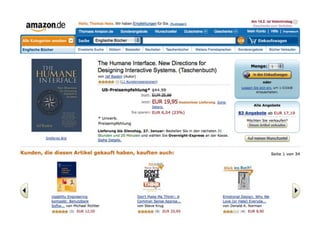
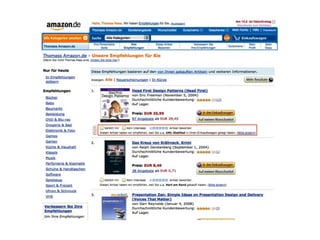
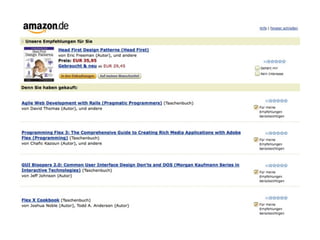
  • #3 ... Amazon (the \"Customers who bought this also bought\" feature) ...
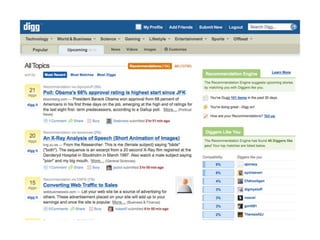
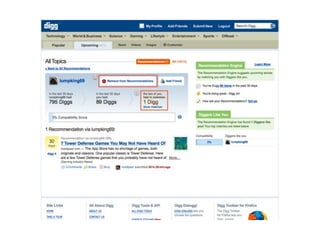
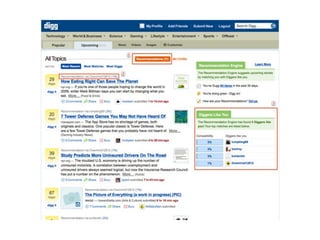
  • #4 ... Digg.com (“Diggers Like You” recommend upcoming stories) ...
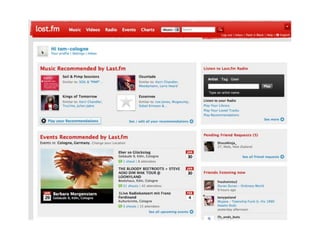
  • #5 ... or last.fm (Music, Events, and Videos matching your music taste)
  • #6 * First I’m talking about what recommender engines are in general and e-commerce * Second I will talk about the different techniques used by recommender engines * And finally I’m going to show some examples of recommender engines in e-commerce
  • #7 * Recommender engines are Personalized Information Agents, which means, they provide personalized information to individual users * Particularly they recommend items to users by predicting which items out of a large pool a user may be interested in * Recommender engines use a variety of techniques that use different knowledge sources for their predictions * These knowledge sources can be information about the users, about the items and information about users’ preferences for items. These are called ratings.
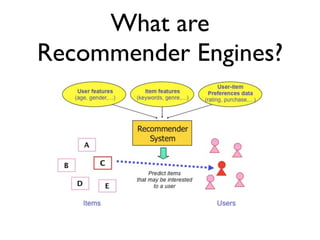
  • #8 * Here we have the concept again in an illustration * We have a pool of items and a group of users * The recommender engine uses knowledge about the users, the items, and the user-item preferences * Based on this knowledge it recommends a specific item to a specific user * The user-item preferences are often called user-item ratings and can be derived from many different sources like the purchase history, explicit item ratings or preference questionnaires.
  • #9 * So what role do recommender engines play in e-commerce? * Recommender engines are used by more and more e-commerce businesses * They are a tool for to personalize websites for customers * Personalization is something only e-businesses can do in contrast to real stores * E-Businesses have no storage space constrains, in contrast to real world stores * Therefore they can have very large catalogs of items * But these are unable to be looked through manually, which makes personalization a necessity
  • #10 * What benefits do e-businesses have from using recommender engines? * Recommender Engines present customers with items that are interesting for them, but that they didn’t plan to buy * This makes them to buy more items, which increases the sales of the e-business * These unplanned purchases are common in real world stores but don’t happen that often in e-businesses * Engines make it easier and faster to find new items, which makes the customers come back more often. Customer loyalty is increased. * And the often customers come back and the more they purchase, the more the recommendation system knows about them and their preferences. * The accuracy of the recommendations increases which increases the value of the website for the user. * Last but not least E-businesses can promote specific items through the recommendation system.
  • #11 * Now I’m going to talk about the recommendation techniques with their strengths and weaknesses
  • #12 * First we have non-personalized recommendations
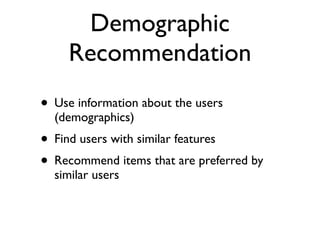
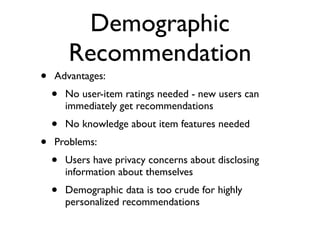
  • #13 * First we have demographic recommendations * As said before the techniques are classification based on which knowledge sources they use * Demographic recommendation uses the knowledge about the users * This are features like age, gender, profession, income, or location * To make recommendation the system first looks for users with similar features to the one it wants to find recommendations for * And then recommends items that are preferred by these similar users
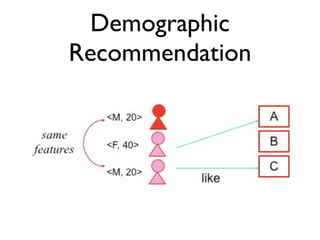
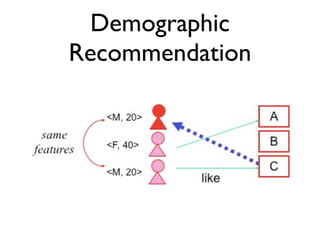
  • #14 * Here is the process again in an illustration * We have three users and three items * User 2 likes Item A and User 3 likes Item C * User 1 and User 3 have similar demographic features * So the system recommends Item C to User 1
  • #15 * The advantages of demographic recommendation are: * The technique does not need rating data for the user it recommends items to * So a new user without any ratings can immediately get recommendations as long as he has given information about himself * The techniques also doesn’t need to know anything about the items the system deals with * The drawbacks are: * Users generally don’t like to give away information about themselves, but this is the only knowledge source the system has * Demographic data is too crude to make good recommendations. The system will make generalisations that are problematic especially when the system deals with cultural items like books, music, or movies. * Not all 30 year old females like the same movies. * Users with unusual taste will get no good recommendations
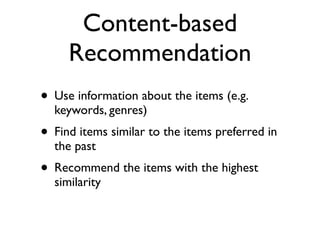
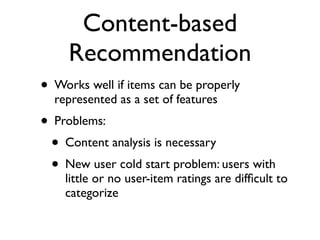
  • #16 * The next technique are content-based recommendations * This technique uses information about the items * This are keywords or genres. For movies for example this could be year, title, director, actors and so on. * The system first looks at the items a user has preferred in the past * And then searches the item database for similar items that have the same features * From these search results the engine then recommends the items that have the highest similarity
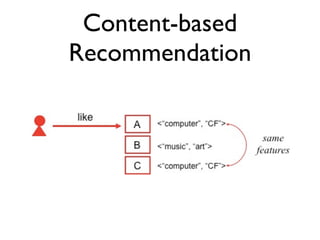
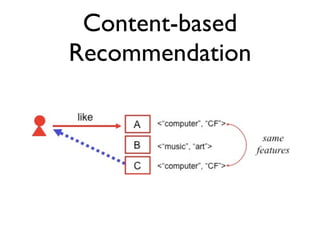
  • #17 * Here is how it works in an illustration * We have a user and three items * Items A and C have the same features * So the engine recommends Item C to the user
  • #18 * This technique works well if the items can be properly represented as a set of features. * If the items or the item descriptions can be analysed with automatic content analysis the features can be extracted automatically. * But if this is not possible it has to be done manually, which takes a lot of resources. * The technique has problems if new users have rated none or only a few items. Because then the system doesn’t know what items to search for.
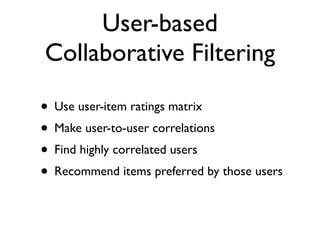
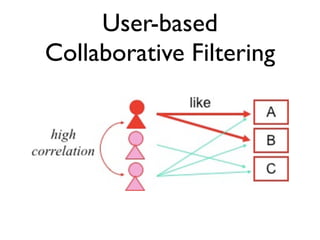
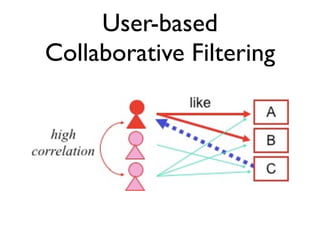
  • #19 * The next techniques are collaborative filtering techniques. * These techniques use the user-item rating data matrix as knowledge source. * First we look at user-based collaborative filtering. * This technique makes correlations between users based on their item preferences. * The system first finds highly correlated users based on their rating profiles, that means users that have the shared item preferences * Then it recommends items that the highly correlated users also preferred
  • #20 * In the illustration it looks like this * We have three users, and three items * User 1 likes items A and B * User 2 likes item C * and User 3 likes all three items * So User 1 and 3 share their preference for items A and B and have therefore a high correlation * So the recommender system recommends item C to User 1 as there is a high probability User 1 will like it
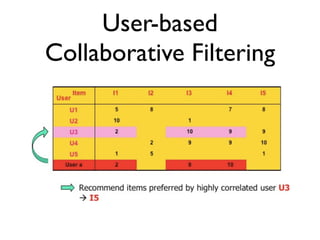
  • #21 * In the user-item rating matrix this looks like this * We have 6 users, 5 items and ratings from 1-10 * User U3 has very similar ratings to User A, so there is a high correlation * As user U3 also gives item I5 a high rating, we can recommend this item to User a
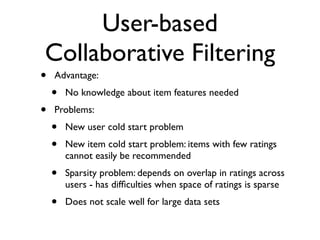
  • #22 * The advantage of all collaborative filtering techniques is, that they don’t need to know anything about the items the system deals with, just like demographic recommendation * The problems are: * We have the new user cold start problem that we also had with the content-based recommendation * We also have a cold start problem for new items, which means that new items that have none or only a few ratings cannot be recommended easily * Sparse data in the rating matrix is a problem, as collaborative filtering techniques depend on an overlap in ratings across users. If few users have rated the same items the quality of the recommendations gets bad. * User-based collaborative filtering also does not scale well for large data sets. The user-dimension of the matrix usually becomes much larger than the item-dimension, which makes drawing of user-to-user correlations very expensive.
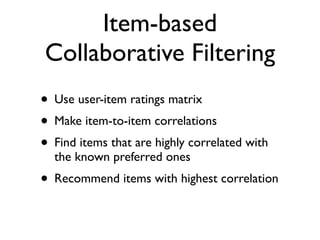
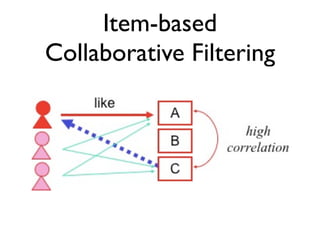
  • #23 * The next technique is item-based collaborative filtering * Here we don’t draw correlations between users but between items * The algorithm looks at an item and then finds other items that are preferred by the same users * So it builds item-to-item correlations based on the shared appreciation of users * The highly correlated items are then recommended
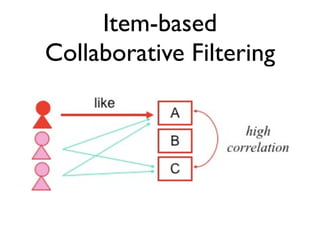
  • #24 * In the diagram it looks like this * We again have three users and three items * User 1 likes Item A * User 2 and User 3 like items A and C * So the Items A and C are correlated as they are preferred by the same users * So the engine recommends item C to User 1
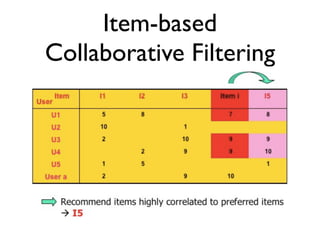
  • #25 * In the matrix it looks like this * Items I and I5 have high ratings from the same users, so I5 is recommended
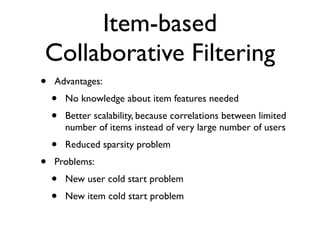
  • #26 * The advantages of this technique are: * No knowledge about the items is needed as in all collaborative filtering approaches * The approach scales better than the user-based approach, as the number of items is usually smaller than the number of users, and items are easier to categorize. * Because of this the sparsity problem is also reduced. * But the approach also has the cold start problems for new users and new items
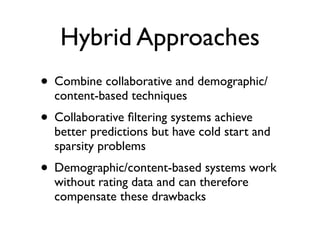
  • #30 * The last approach I’m going to present are hybrid recommender systems * This is not a new technique but rather a combination of techniques * As we have seen all of the techniques have benefits and drawbacks * Hybrid approaches try to combine complementary techniques so that the drawbacks will be neutralized * This works especially for the combination of collaborative filtering techniques with demographic or content-based techniques * Collaborative filtering techniques achieve a high prediction accuracy but have problems when the available rating data is limited * Here demographic and content-based can help out because they don’t rely on rating data
  • #36 * Concluding I’m going to show two examples of websites that use recommender engines * What techniques do they use and how are the recommendations used on the websites
  • #37 * Recommender engines are developed and run on the one hand by independent technology vendors * Also many e-businesses have their own engines developed * ChoiceStream is one of the leading independent vendors
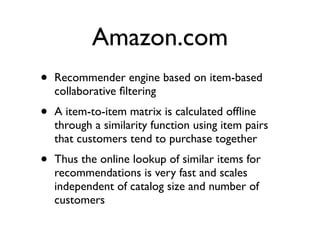
  • #39 * The first one is amazon.com * Amazon is maybe the most famous example for an e-business utilizing a recommender engine * They use the recommendation very extensively to personalize their website * The recommender engine is based on item-based collaborative filtering * Their system consists out of an online and an offline component * The offline component calculates a item-to-item matrix with the correlation coefficients * It does this by using a similarity function that gets applied to pairs of items that customers tend to purchase together * The online component then only has to lookup similar items in this matrix when recommendations are needed * Through this separation Amazon is able to deal with their huge data set of several million catalog items and tens of millions of users. * The expensive calculations are performed offline and the online component scales independent on catalog size and number of users. It only depends on the number of items a user has purchased and rated. * Now let’s see how the recommendation engine is used on the website.
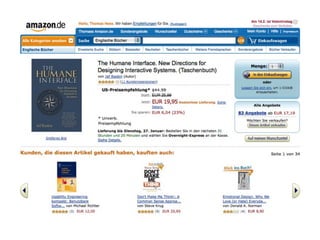
  • #40 * Of course there is the famous “Customers who bought this also bought” feature shown on every item detail page ...
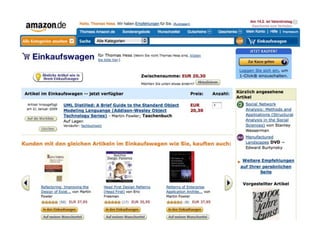
  • #41 .. and also on the shopping cart page.
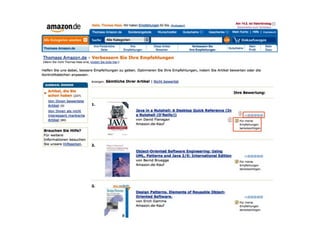
  • #42 * Then there is the “Your Recommendations” page, that shows all the recommendations for you. * You can mark recommendations as already owned or not interested in and also rate them in order to influence your recommendations. * It is also shown why an item is recommended, that is which purchase is correlated to the recommended item.