LAU CASE STUDY


                   By
                   Cendrella Habre
                   Systems Librarian
                   Lebanese American University

                   chabre@lau.edu.lb


January 24, 2006                                  1
Outline
    Terminology
    Definitions
    Major developers and available
     systems
    Brief overview of LAU’s ZPortal
    Looking @ other ZPortal examples
    Advantages & disadvantages
January 24, 2006                        2
Terminology
Note: This technology started in 1999/2000

    Library Portals
    Federated Search Engines
    Library Portlets
    Protocols/Standards/Set of rules:
         Z39.50
         OpenURLs (Z2Web)
    Link Resolvers (OL2)

January 24, 2006                             3
Definition (1)
    Portal is a web-based search tool

    Portal concept is often ambiguous and confusing

    Portal is a “buzzword” – inappropriately used

    Other terms used in the information community:
          Metasearch
          Metadata search
          Parallel search
          Broadcast search
          Cross-database search
          Search portal


January 24, 2006                                       4
Definition (2)

     “A library portal or a federated search
     engine is a discovery tool (a software
     actually) that enables a user to search using
     a single-search interface across certain
     websites, library catalogs, and databases of
     information resources to retrieve and
     integrate the results in a single presentation”

January 24, 2006                                   5
Library Portals vs. Federated
              Search Engines
    Library Portals
      It is certain that all Library Portals can search
        Z39.50 databases
      Yet not all Library Portals can search currently
        available licensed databases. (Authentication
        problem for remote users)

    Federated Search Engines can search all Z39.50 and
     currently available licensed databases for both walk-in
     and remote users.


January 24, 2006                                           6
Library Portlet
    The Library Portlet is a small search window
     found on any web page of a university,
     organization, institution, company, etc., which
     allows direct access to the online catalog and
     other resources available.

    This is a powerful and convenient library
     resources tool.


January 24, 2006                                       7
Z39.50
    A protocol that allows a computer to search collections of
     information on a remote system, create sets of results for further
     manipulation, and retrieve information; mainly used for
     bibliographic information.
     www.cs.cornell.edu/wya/DigLib/MS1999/glossary.html

    A set of rules governing the formats and procedures used by two
     computers to interact with one another.
     www.esls.lib.wi.us/glossary.html

    A standard that defines how computers search in library
     catalogues. The Library of Congress is the Maintenance Agency
     and Registration Authority for this standard, see
     http://www.loc.gov/z3950/agency/
     www.lib.monash.edu.au/vl/glossind.htm


January 24, 2006                                                      8
OpenURL
    A standard developed by NISO (National
     Information Standards Organization)
    It provides a uniform way for users to link
     directly from bibliographic citations (in non
     Z39.50 compliant databases) to fulltext
     articles available in online resources,
     websites, and other services for which a
     URL can be constructed
    It facilitates links

January 24, 2006                                     9
Link Resolver
    A link resolver uses the OpenURL standard to
     create links to content, such as E-journals, library
     catalogs, Internet search engines, some ILL
     systems, bookshops, etc.

    In other words, when a patron finds a citation or
     reference to a specific article, this link resolver
     supplies the best available path to the content,
     anywhere in the library collection.

January 24, 2006                                           10
Developers?

    Small Vendors
    Library Systems Vendors
    Database Aggregators


January 24, 2006               11
Federated Search Engines:
    AGent (Auto-Graphics)
    MetaStar (Blue Angel Technologies)
    MuseGlobal (MuseGlobal, Inc.)
    WebFeat (WebFeat)
    ZPortal (FDI)

                         For more information
             http://www.loc.gov/catdir/lcpaig/portalproducts.html


January 24, 2006                                                    12
Automated Library Systems:
    EnCompass (Endeavor)
    iPAC (Epixtech – Dynix/Horizon)
    ILINK (Sirsi)
    MetaLib (Ex-Libris)
    Polaris (Gaylord)
    MAP or Millennium Access Plus (Innovative Interfaces,
     Inc.)
    iPortal (VTLS)
    YouSeeMore (TLC)

                      For more information
         http://www.loc.gov/catdir/lcpaig/portalproducts.html

January 24, 2006                                                13
Database Aggregators:
  MultiSearch (CSA)
  OVID Technologies and MuseGlobal (Dec. 1, 2004 announced
   delivery of a metasearch engine)
  More to come
______________________________________________________
   _

     Few aggregators have integrating metasearching into their
     resources, e.g.:
        ScienceDirect
        JSTOR
        GALE
        EBSCOhost
        WilsonWeb
        Etc.
January 24, 2006                                                 14
Hosting
                   Note

     All the above mentioned companies
     provide hosting services at their
     own sites to potential clients.


January 24, 2006                     15
@ LAU
     LAU is the first academic institution in Lebanon to
      implement the ZPortal system.
     Why ZPortal was selected?
3.    Professional/Academic
4.    Rigid
5.    Flexible
6.    Familiar with interface (OLIB)
7.    Widely used
8.    Pricing/Services
January 24, 2006                                       16
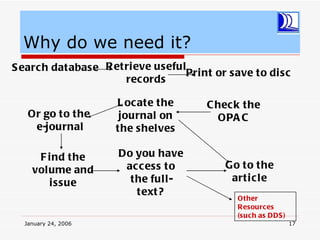
Why do we need it?
S earc h database R etrieve usefulPrint or save to disc
                      records

                     L ocate the      C hec k the
   Or go to the       journal on        OPA C
    e-journal        the shelves

     F ind the       Do you have
    volume and        access to           Go to the
       issue           the full-           article
                        text?
                                            Other
                                            Resources
                                            (such as DDS )
  January 24, 2006                                           17
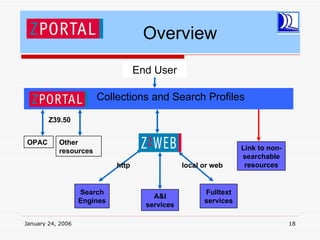
Overview
                                    End User

                       Collections and Search Profiles

        Z39.50


OPAC       Other
           resources                                              Link to non-
                                                                  searchable
                             http                local or web      resources


                   Search                              Fulltext
                                        A&I
                   Engines                             services
                                      services

January 24, 2006                                                                 18
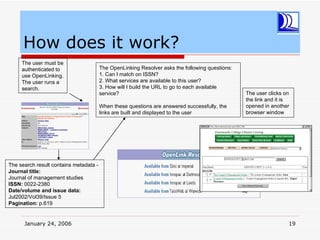
How does it work?
     The user must be
     authenticated to                   The OpenLinking Resolver asks the following questions:
     use OpenLinking.                   1. Can I match on ISSN?
     The user runs a                    2. What services are available to this user?
     search.                            3. How will I build the URL to go to each available
                                        service?                                                 The user clicks on
                                                                                                 the link and it is
                                        When these questions are answered successfully, the      opened in another
                                        links are built and displayed to the user                browser window


The search result contains metadata -
Journal title:
Journal of management studies
ISSN: 0022-2380
Date/volume and issue data:
Jul2002/Vol39/Issue 5
Pagination: p.619


      January 24, 2006                                                                                            19
@ LAU

     LAU site:
      http://libwserv.lau.edu.lb:43002/zportal/

     Other sites:
      http://www.k4h.northbristol.nhs.uk
      http://www.library.nhs.uk/

January 24, 2006                                  20
Advantages:
    Less time in searching: Several resources are
     searched at once
    Single one-stop web page
    Single interface (results)
    Tremendous increase in the usage of online
     resources, thus cost-effective
    Excellent tool for ILL/DDS
    Portal vs. Google
    Searching techniques are applied, e.g., Boolean
     operators

January 24, 2006                                       21
Disadvantages:

    No Arabic support
    Security: It involves the opening of some ports
     outside the university firewalls
    End-user overwhelmed with # of hits
    Continuous maintenance and update
    Unable to cover all licensed databases


January 24, 2006                                       22
Conclusion


 Library Portals or Federated Search
   Engines enable you to search a
          world of information

January 24, 2006                   23

LLA ZPortal

  • 1.
    LAU CASE STUDY By Cendrella Habre Systems Librarian Lebanese American University chabre@lau.edu.lb January 24, 2006 1
  • 2.
    Outline  Terminology  Definitions  Major developers and available systems  Brief overview of LAU’s ZPortal  Looking @ other ZPortal examples  Advantages & disadvantages January 24, 2006 2
  • 3.
    Terminology Note: This technologystarted in 1999/2000  Library Portals  Federated Search Engines  Library Portlets  Protocols/Standards/Set of rules:  Z39.50  OpenURLs (Z2Web)  Link Resolvers (OL2) January 24, 2006 3
  • 4.
    Definition (1)  Portal is a web-based search tool  Portal concept is often ambiguous and confusing  Portal is a “buzzword” – inappropriately used  Other terms used in the information community:  Metasearch  Metadata search  Parallel search  Broadcast search  Cross-database search  Search portal January 24, 2006 4
  • 5.
    Definition (2) “A library portal or a federated search engine is a discovery tool (a software actually) that enables a user to search using a single-search interface across certain websites, library catalogs, and databases of information resources to retrieve and integrate the results in a single presentation” January 24, 2006 5
  • 6.
    Library Portals vs.Federated Search Engines  Library Portals  It is certain that all Library Portals can search Z39.50 databases  Yet not all Library Portals can search currently available licensed databases. (Authentication problem for remote users)  Federated Search Engines can search all Z39.50 and currently available licensed databases for both walk-in and remote users. January 24, 2006 6
  • 7.
    Library Portlet  The Library Portlet is a small search window found on any web page of a university, organization, institution, company, etc., which allows direct access to the online catalog and other resources available.  This is a powerful and convenient library resources tool. January 24, 2006 7
  • 8.
    Z39.50  A protocol that allows a computer to search collections of information on a remote system, create sets of results for further manipulation, and retrieve information; mainly used for bibliographic information. www.cs.cornell.edu/wya/DigLib/MS1999/glossary.html  A set of rules governing the formats and procedures used by two computers to interact with one another. www.esls.lib.wi.us/glossary.html  A standard that defines how computers search in library catalogues. The Library of Congress is the Maintenance Agency and Registration Authority for this standard, see http://www.loc.gov/z3950/agency/ www.lib.monash.edu.au/vl/glossind.htm January 24, 2006 8
  • 9.
    OpenURL  A standard developed by NISO (National Information Standards Organization)  It provides a uniform way for users to link directly from bibliographic citations (in non Z39.50 compliant databases) to fulltext articles available in online resources, websites, and other services for which a URL can be constructed  It facilitates links January 24, 2006 9
  • 10.
    Link Resolver  A link resolver uses the OpenURL standard to create links to content, such as E-journals, library catalogs, Internet search engines, some ILL systems, bookshops, etc.  In other words, when a patron finds a citation or reference to a specific article, this link resolver supplies the best available path to the content, anywhere in the library collection. January 24, 2006 10
  • 11.
    Developers?  Small Vendors  Library Systems Vendors  Database Aggregators January 24, 2006 11
  • 12.
    Federated Search Engines:  AGent (Auto-Graphics)  MetaStar (Blue Angel Technologies)  MuseGlobal (MuseGlobal, Inc.)  WebFeat (WebFeat)  ZPortal (FDI) For more information http://www.loc.gov/catdir/lcpaig/portalproducts.html January 24, 2006 12
  • 13.
    Automated Library Systems:  EnCompass (Endeavor)  iPAC (Epixtech – Dynix/Horizon)  ILINK (Sirsi)  MetaLib (Ex-Libris)  Polaris (Gaylord)  MAP or Millennium Access Plus (Innovative Interfaces, Inc.)  iPortal (VTLS)  YouSeeMore (TLC) For more information http://www.loc.gov/catdir/lcpaig/portalproducts.html January 24, 2006 13
  • 14.
    Database Aggregators:  MultiSearch (CSA)  OVID Technologies and MuseGlobal (Dec. 1, 2004 announced delivery of a metasearch engine)  More to come ______________________________________________________ _ Few aggregators have integrating metasearching into their resources, e.g.:  ScienceDirect  JSTOR  GALE  EBSCOhost  WilsonWeb  Etc. January 24, 2006 14
  • 15.
    Hosting Note All the above mentioned companies provide hosting services at their own sites to potential clients. January 24, 2006 15
  • 16.
    @ LAU  LAU is the first academic institution in Lebanon to implement the ZPortal system.  Why ZPortal was selected? 3. Professional/Academic 4. Rigid 5. Flexible 6. Familiar with interface (OLIB) 7. Widely used 8. Pricing/Services January 24, 2006 16
  • 17.
    Why do weneed it? S earc h database R etrieve usefulPrint or save to disc records L ocate the C hec k the Or go to the journal on OPA C e-journal the shelves F ind the Do you have volume and access to Go to the issue the full- article text? Other Resources (such as DDS ) January 24, 2006 17
  • 18.
    Overview End User Collections and Search Profiles Z39.50 OPAC Other resources Link to non- searchable http local or web resources Search Fulltext A&I Engines services services January 24, 2006 18
  • 19.
    How does itwork? The user must be authenticated to The OpenLinking Resolver asks the following questions: use OpenLinking. 1. Can I match on ISSN? The user runs a 2. What services are available to this user? search. 3. How will I build the URL to go to each available service? The user clicks on the link and it is When these questions are answered successfully, the opened in another links are built and displayed to the user browser window The search result contains metadata - Journal title: Journal of management studies ISSN: 0022-2380 Date/volume and issue data: Jul2002/Vol39/Issue 5 Pagination: p.619 January 24, 2006 19
  • 20.
    @ LAU  LAU site: http://libwserv.lau.edu.lb:43002/zportal/  Other sites: http://www.k4h.northbristol.nhs.uk http://www.library.nhs.uk/ January 24, 2006 20
  • 21.
    Advantages:  Less time in searching: Several resources are searched at once  Single one-stop web page  Single interface (results)  Tremendous increase in the usage of online resources, thus cost-effective  Excellent tool for ILL/DDS  Portal vs. Google  Searching techniques are applied, e.g., Boolean operators January 24, 2006 21
  • 22.
    Disadvantages:  No Arabic support  Security: It involves the opening of some ports outside the university firewalls  End-user overwhelmed with # of hits  Continuous maintenance and update  Unable to cover all licensed databases January 24, 2006 22
  • 23.
    Conclusion Library Portalsor Federated Search Engines enable you to search a world of information January 24, 2006 23

Editor's Notes

  • #10 Note that each bullet needs a click to appear on screen!! OpenLinking is FD’s OpenURL resolver. The OpenURL resolver takes metadata and matches it with locally held rules about where your electronic content is available from. It means that FDI have implemented the OpenURL standard in its draft form, to enable your users to link from a search result in ZPORTAL to digital conent. Not all content providers and e-journal sites you use will be OpenURL enabled. However, this does not mean that you cannot link to those sites. FD have developed a range of templates which specify the metadata required for a website. Content can mean a range of media - including journals, electronic full-text, the library catalog, Internet search engines and so on.
  • #18 Note that individual mouse clicks are needed on this slide. Life before ZPORTAL and OpenLinking - the research process currently goes something like this - your users search a database or databases to find articles that may be useful for their term paper they find some useful records and then print them out or save them to a floppy they then go check the OPAC and find the item on the library shelves or go to the e-journal (if they can find it on your website or through the OPAC perhaps) they would then locate the volume and then the issue (in both e-journals and on the shelves) in the case of e-journals, they may then find that the library doesn’t have a subscription, or they aren’t allowed access but if they are lucky , then they may finally reach their destination - the article
  • #20 This slide is on page “x” of your training manual as well as in the ppt slides. So what’s going on in the background? The user must be authenticated to use openlinking - this enables authorization to take place - does the user have appropriate access rights? From a search result, metadata is taken and passed to the OpenURL resolver - configurable rules are questions - can I find the ISSN? What services are available to this user? And how do I build the URL to that service, given the metadata I have from the search result? Following this provess, the user is offered a number of links and by following the links, they can access full-text or library catalogues.
  • #24 OpenLinking is the final piece in the ZPORTAL jigsaw. Using openlinking you will be resolving “the most appropriate copy” issue. OpenLinking is FD’s solution for linking from a citation to the full-text or other appropriate website or service.