iPad/Tablet UsageSecondary Research & InsightsApril, 2011
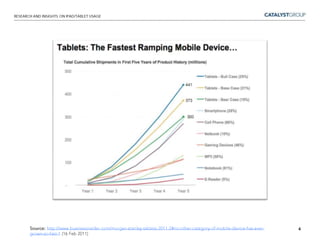
A recent Morgan Stanley report predicts that tablets will have a faster market adoption than has been seen by any other mobile device.  With over 28 million iPad devices sold in 2010, the release of a swarm of tablets from Apple competitors, and the recent debut of the iPad 2 there is now no longer any doubt that the tablet represents a new era in portable computing devices.
There is an engaging and intuitive magic to these touch screen devices. But the big question we are tackling is: “How can we help our clients to leverage tablet user expectations and behaviors to unlock new value for their brand and deliver a memorable experience for their customers?” And many, rightfully, want to know the most efficient and effective way to ensure there is a measurable return on the investment required to do this right.
So, as we are wired to do, we are starting with facts.  We created this document to help give some context to the data that is informing our decisions and that of our clients. We think you will find some of the answers surprising and, as often is the case, quite different from what some of the “experts” predicted.
We hope you find this helpful in the discussions you are having as you continue to craft and execute your strategies. 2Introduction
3Tablet Market Overview
4Source: http://www.businessinsider.com/morgan-stanley-tablets-2011-2#no-other-category-of-mobile-device-has-ever-grown-so-fast-1 (16 Feb 2011)
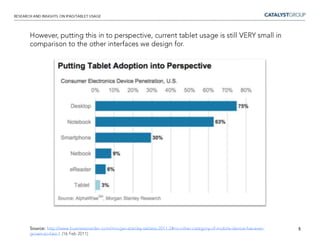
However, putting this in to perspective, current tablet usage is still VERY small in comparison to the other interfaces we design for.5Source: http://www.businessinsider.com/morgan-stanley-tablets-2011-2#no-other-category-of-mobile-device-has-ever-grown-so-fast-1 (16 Feb 2011)
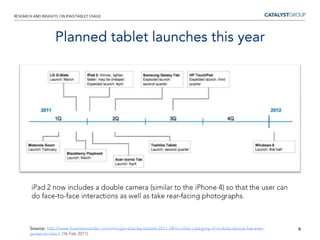
iPad 2 now includes a double camera (similar to the iPhone 4) so that the user can do face-to-face interactions as well as take rear-facing photographs.6Planned tablet launches this yearSource: http://www.businessinsider.com/morgan-stanley-tablets-2011-2#no-other-category-of-mobile-device-has-ever-grown-so-fast-1 (16 Feb 2011)
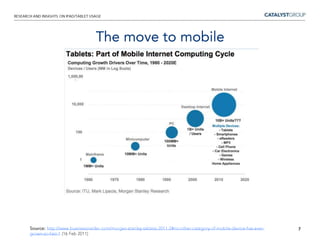
7The move to mobileSource: http://www.businessinsider.com/morgan-stanley-tablets-2011-2#no-other-category-of-mobile-device-has-ever-grown-so-fast-1 (16 Feb 2011)
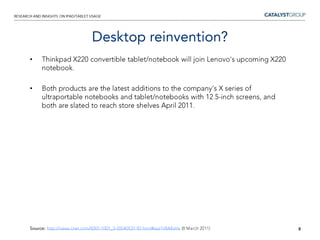
Thinkpad X220 convertible tablet/notebook will join Lenovo's upcoming X220 notebook.
Both products are the latest additions to the company's X series of ultraportable notebooks and tablet/notebooks with 12.5-inch screens, and both are slated to reach store shelves April 2011.8Desktop reinvention?Source: http://news.cnet.com/8301-1001_3-20040537-92.html#ixzz1Il8AKzHs (8 March 2011)
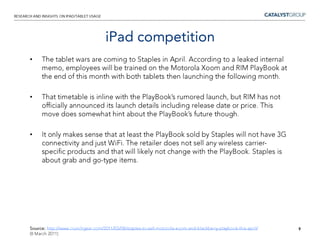
The tablet wars are coming to Staples in April. According to a leaked internal memo, employees will be trained on the Motorola Xoom and RIM PlayBook at the end of this month with both tablets then launching the following month.
That timetable is inline with the PlayBook’s rumored launch, but RIM has not officially announced its launch details including release date or price. This move does somewhat hint about the PlayBook’s future though.
It only makes sense that at least the PlayBook sold by Staples will not have 3G connectivity and just WiFi. The retailer does not sell any wireless carrier-specific products and that will likely not change with the PlayBook. Staples is about grab and go-type items. 9iPad competitionSource: http://www.crunchgear.com/2011/03/08/staples-to-sell-motorola-xoom-and-blackberry-playbook-this-april/(8 March 2011)
RBC analyst Mike Abramsky believes that Google’s Android OS is going dominate the tablet market by 2014.
“While Apple’s iPad may continue to set the bar high for experience, we expect Android to dominate (40% share Tablets by 2014), given its broader support from OEMs and carriers and expected budget-priced Android Tablets from Asia.”
The deciding factors, according to the analyst (who also covers Apple), will be innovation from Apple’s competitors and the appearance of cheap Android tablets from Asia.
Bryan Chaffin from Mac Observer questions this, given that so far few Android tablets have shipped and those that have are markedly more expensive than Apple’s iPad line. Apple seems also to have 60% of the world’s capacitive touch displays locked up in contract, therefore chances of competitors getting their hands on cheap supply is unlikely.10Continued iPad dominance?Source: http://www.macobserver.com/tmo/article/rbc_expects_erroneously_android_to_dominate_tablets_by_2014/(4 March 2011)
Interestingly, however, Amazon launched it’s Android app store in March 2011 and they have a music and movie store to rival Apple.
There are rumors that Amazon could launch a fully functional tablet, and have shown they are capable of building good hardware (note the success of the Kindle).
They could according to Business Insider, be perhaps one of the most serious threats to Apple’s dominance.11Continued iPad dominance?Source: http://www.businessinsider.com/amazon-tablet-2011-3 (22 March 2011)
12iPad Audience
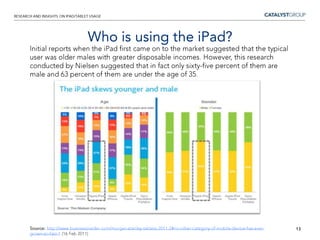
Initial reports when the iPad first came on to the market suggested that the typical user was older males with greater disposable incomes. However, this research conducted by Nielsen suggested that in fact only sixty-five percent of them are male and 63 percent of them are under the age of 35.13Who is using the iPad?Source: http://www.businessinsider.com/morgan-stanley-tablets-2011-2#no-other-category-of-mobile-device-has-ever-grown-so-fast-1 (16 Feb 2011)
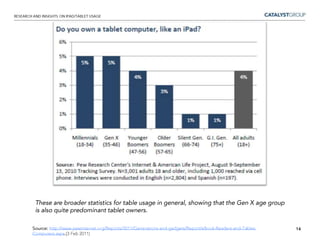
These are broader statistics for table usage in general, showing that the Gen X age group is also quite predominant tablet owners.14Source: http://www.pewinternet.org/Reports/2011/Generations-and-gadgets/Report/eBook-Readers-and-Tablet-Computers.aspx(3 Feb 2011)
iPad versus other tabletsNielsen found that Kindle owners tend to be wealthier than iPad owners.  Forty-four percent of them make more than $80,000/year compared to 39 percent of iPad owners and 37 percent of iPhone owners. 
They also tend to have more education: 27 percent of Kindle owners have Master’s degrees or doctorates.
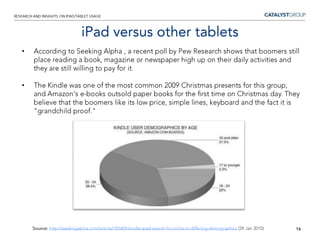
The kindle is used by a distinctly older age group than the iPad.15Source: http://blog.nielsen.com/nielsenwire/consumer/the-connected-devices-age-ipads-kindles-smartphones-and-the-connected-consumer/ (28 Sep 2010)
iPad versus other tablets According to Seeking Alpha , a recent poll by Pew Research shows that boomers still place reading a book, magazine or newspaper high up on their daily activities and they are still willing to pay for it.
The Kindle was one of the most common 2009 Christmas presents for this group, and Amazon's e-books outsold paper books for the first time on Christmas day. They believe that the boomers like its low price, simple lines, keyboard and the fact it is "grandchild proof."16Source: http://seekingalpha.com/article/185409-kindle-ipad-search-for-niche-in-differing-demographics (29 Jan 2010)
Who bought the iPad 2?According to research conducted by Piper Jaffrey and validated by Deutsche Bank:400,000 to 500,000 iPad 2s sold in the first weekend, compared with 300,000 iPad 1s in its first weekend last year.
70% of iPad 2 buyers were new to the iPad, compared with 23% of iPhone 4 buyers who were new to the iPhone at launch.
Buyers were split almost evenly between Mac and PC users (51%/49%). By contrast, the split for the original iPad was 74%/26%.
47% of buyers were purchasing a 3G model, which carries a $130 premium.
41% purchased the 32GB iPad 2, up from 32% who bought the 32GB version of the original iPad. The 64GB models also gained a slight share.
65% of buyers owned an iPhone, 24% owned a Kindle (up from 13% of original iPad buyers), but only 6% plan to read with their iPad (down from 19% in Piper Jaffray's first iPad survey).
17% expect to use apps and play games, up from 9%, which suggests that the App Store ecosystem is growing.17Source: http://tech.fortune.cnn.com/2011/03/13/piper-jaffray-ipad-2-totally-sold-out-70-to-new-buyers/(13 Mar 2011)
18iPad Usage
How are iPads used?On average, around 74.8 percent of iPad users spend between one and five hours a day on their tablet device; 15.3 percent spend less than an hour; and 9.8 percent spend five or more hours per day.
Web browsing occupies 37.7 percent of the time spent on the iPad, followed by 23.6 percent of time spent on email, Facebook, and other communication apps. The lowest category, at only 10.2 percent, was spent playing games.
Nearly 80 percent of respondents (77.6) said they use their iPads more often now than they did when they first got them – so it wasn’t a novelty purchase people did, in fact, find a use, or even more uses as time went on.
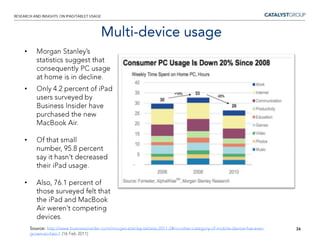
71 percent of participants use their iPads between one and five hours per day. Additionally, 28.9 percent said that their iPad has become their primary computer. The iPad was found to be used most often by those surveyed: 31.8 percent of the time. Laptop usage, at 31 percent, fell just under, with the desktop further back still at 22.1 percent, and smartphone usage coming in last at 15.2 percent.19Source: http://www.businessinsider.com/ipad-survey-results-2010-11#two-thirds-of-ipad-owners-use-their-ipads-1-5-hours-a-day-1 (15 Nov 2010)
Most participants reported spending the bulk of their iPad time browsing the Web (37.7 percent) while 39.4 percent claim to have downloaded between 20 and 50 apps (most people paid for about 10 apps).
74.5 percent of those surveyed read books on their iPad. But, though the iPad is a popular book device, 50 percent of users who read on their iPads chose the Kindle app as their preferred reading app. Only 42.4 percent chose iBooks first. Amazon is clearly winning the e-book war by being platform-agnostic.
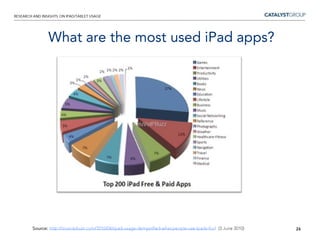
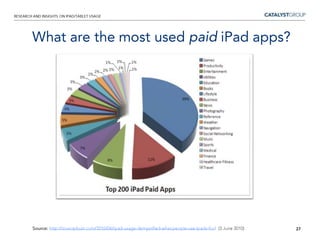
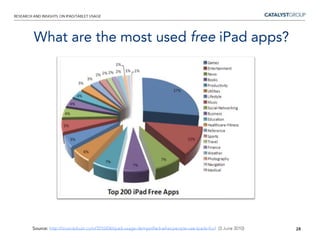
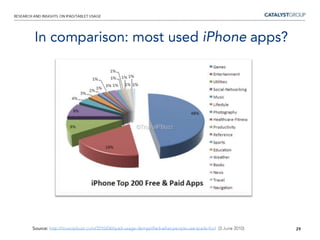
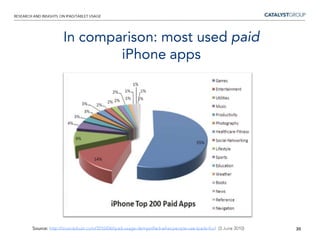
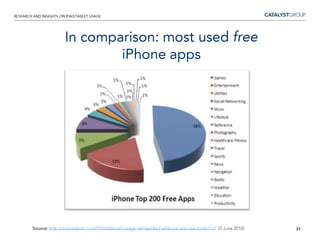
AlokSaboo in June 2010 analyzed the popular downloads in the Apple app store for the iPad and iPhone and found that reading constitutes an important element on the iPad. For example, Books, News, and Education apps are far more important in the case of iPads, accounting for around 20% usage, whereas they only account for about 3% on the iPhone.
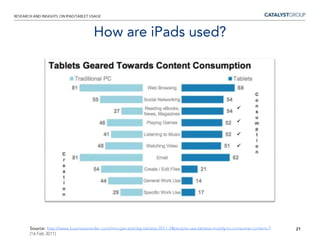
Similarly Morgan Stanley argues that iPads are currently about consumption as opposed to creation.But this could be entirely due to the apps available. Over time, as more ‘creation’ focused tools become available, this usage could increase.20How are iPads used?Source: http://truvoipbuzz.com/2010/06/ipad-usage-demystified-what-people-use-ipads-for/ (3 June 2010)
21How areiPads used?Source: http://www.businessinsider.com/morgan-stanley-tablets-2011-2#people-use-tablets-mostly-to-consume-content-7 (16 Feb 2011)
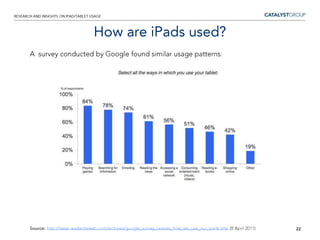
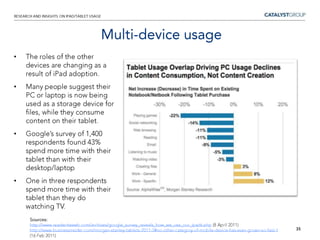
22How areiPads used?A  survey conducted by Google found similar usage patterns:Source: http://www.readwriteweb.com/archives/google_survey_reveals_how_we_use_our_ipads.php (8 April 2011)
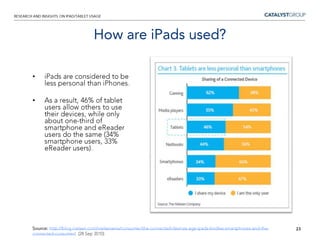
23How areiPads used?iPads are considered to be less personal than iPhones.
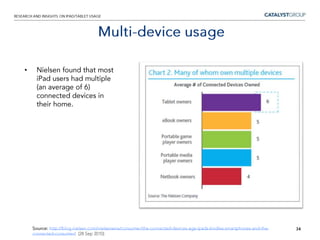
As a result, 46% of tablet users allow others to use their devices, while only about one-third of smartphone and eReader users do the same (34% smartphone users, 33% eReader users).Source: http://blog.nielsen.com/nielsenwire/consumer/the-connected-devices-age-ipads-kindles-smartphones-and-the-connected-consumer/  (28 Sep 2010)
What are the most used iPad apps?A Business Insider survey found that 56.1 percent of respondents have downloaded 20 or more apps. Most have downloaded around 10 paid apps (52.3 percent having downloaded 6-20 paid apps). So while free apps account for a majority of downloads, paid apps are by no means being ignored.
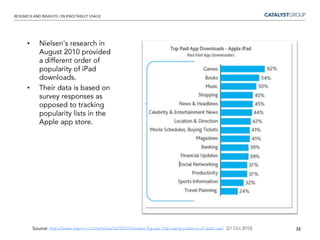
Nielsen’s survey of 5000 iPad users in August 2010 found that 32 percent, may not be downloading any apps from the App Store, a Nielsen study suggests.
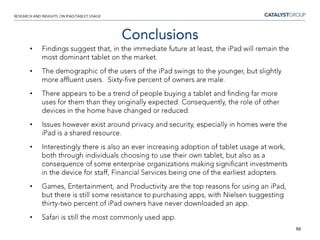
Whether it be paid or free, most people use 10 apps or fewer on a regular basis, leaving half or more of their apps ignored shortly after download. In fact, the most commonly used app is one you don’t even download: Safari. The built-in browser remains the iPad’s killer app.

Recent i pad usage stats

  • 1.
  • 2.
    A recent MorganStanley report predicts that tablets will have a faster market adoption than has been seen by any other mobile device. With over 28 million iPad devices sold in 2010, the release of a swarm of tablets from Apple competitors, and the recent debut of the iPad 2 there is now no longer any doubt that the tablet represents a new era in portable computing devices.
  • 3.
    There is anengaging and intuitive magic to these touch screen devices. But the big question we are tackling is: “How can we help our clients to leverage tablet user expectations and behaviors to unlock new value for their brand and deliver a memorable experience for their customers?” And many, rightfully, want to know the most efficient and effective way to ensure there is a measurable return on the investment required to do this right.
  • 4.
    So, as weare wired to do, we are starting with facts. We created this document to help give some context to the data that is informing our decisions and that of our clients. We think you will find some of the answers surprising and, as often is the case, quite different from what some of the “experts” predicted.
  • 5.
    We hope youfind this helpful in the discussions you are having as you continue to craft and execute your strategies. 2Introduction
  • 6.
  • 7.
  • 8.
    However, putting thisin to perspective, current tablet usage is still VERY small in comparison to the other interfaces we design for.5Source: http://www.businessinsider.com/morgan-stanley-tablets-2011-2#no-other-category-of-mobile-device-has-ever-grown-so-fast-1 (16 Feb 2011)
  • 9.
    iPad 2 nowincludes a double camera (similar to the iPhone 4) so that the user can do face-to-face interactions as well as take rear-facing photographs.6Planned tablet launches this yearSource: http://www.businessinsider.com/morgan-stanley-tablets-2011-2#no-other-category-of-mobile-device-has-ever-grown-so-fast-1 (16 Feb 2011)
  • 10.
    7The move tomobileSource: http://www.businessinsider.com/morgan-stanley-tablets-2011-2#no-other-category-of-mobile-device-has-ever-grown-so-fast-1 (16 Feb 2011)
  • 11.
    Thinkpad X220 convertibletablet/notebook will join Lenovo's upcoming X220 notebook.
  • 12.
    Both products arethe latest additions to the company's X series of ultraportable notebooks and tablet/notebooks with 12.5-inch screens, and both are slated to reach store shelves April 2011.8Desktop reinvention?Source: http://news.cnet.com/8301-1001_3-20040537-92.html#ixzz1Il8AKzHs (8 March 2011)
  • 13.
    The tablet warsare coming to Staples in April. According to a leaked internal memo, employees will be trained on the Motorola Xoom and RIM PlayBook at the end of this month with both tablets then launching the following month.
  • 14.
    That timetable isinline with the PlayBook’s rumored launch, but RIM has not officially announced its launch details including release date or price. This move does somewhat hint about the PlayBook’s future though.
  • 15.
    It only makessense that at least the PlayBook sold by Staples will not have 3G connectivity and just WiFi. The retailer does not sell any wireless carrier-specific products and that will likely not change with the PlayBook. Staples is about grab and go-type items. 9iPad competitionSource: http://www.crunchgear.com/2011/03/08/staples-to-sell-motorola-xoom-and-blackberry-playbook-this-april/(8 March 2011)
  • 16.
    RBC analyst MikeAbramsky believes that Google’s Android OS is going dominate the tablet market by 2014.
  • 17.
    “While Apple’s iPadmay continue to set the bar high for experience, we expect Android to dominate (40% share Tablets by 2014), given its broader support from OEMs and carriers and expected budget-priced Android Tablets from Asia.”
  • 18.
    The deciding factors,according to the analyst (who also covers Apple), will be innovation from Apple’s competitors and the appearance of cheap Android tablets from Asia.
  • 19.
    Bryan Chaffin fromMac Observer questions this, given that so far few Android tablets have shipped and those that have are markedly more expensive than Apple’s iPad line. Apple seems also to have 60% of the world’s capacitive touch displays locked up in contract, therefore chances of competitors getting their hands on cheap supply is unlikely.10Continued iPad dominance?Source: http://www.macobserver.com/tmo/article/rbc_expects_erroneously_android_to_dominate_tablets_by_2014/(4 March 2011)
  • 20.
    Interestingly, however, Amazonlaunched it’s Android app store in March 2011 and they have a music and movie store to rival Apple.
  • 21.
    There are rumorsthat Amazon could launch a fully functional tablet, and have shown they are capable of building good hardware (note the success of the Kindle).
  • 22.
    They could accordingto Business Insider, be perhaps one of the most serious threats to Apple’s dominance.11Continued iPad dominance?Source: http://www.businessinsider.com/amazon-tablet-2011-3 (22 March 2011)
  • 23.
  • 24.
    Initial reports whenthe iPad first came on to the market suggested that the typical user was older males with greater disposable incomes. However, this research conducted by Nielsen suggested that in fact only sixty-five percent of them are male and 63 percent of them are under the age of 35.13Who is using the iPad?Source: http://www.businessinsider.com/morgan-stanley-tablets-2011-2#no-other-category-of-mobile-device-has-ever-grown-so-fast-1 (16 Feb 2011)
  • 25.
    These are broaderstatistics for table usage in general, showing that the Gen X age group is also quite predominant tablet owners.14Source: http://www.pewinternet.org/Reports/2011/Generations-and-gadgets/Report/eBook-Readers-and-Tablet-Computers.aspx(3 Feb 2011)
  • 26.
    iPad versus othertabletsNielsen found that Kindle owners tend to be wealthier than iPad owners.  Forty-four percent of them make more than $80,000/year compared to 39 percent of iPad owners and 37 percent of iPhone owners. 
  • 27.
    They also tendto have more education: 27 percent of Kindle owners have Master’s degrees or doctorates.
  • 28.
    The kindle isused by a distinctly older age group than the iPad.15Source: http://blog.nielsen.com/nielsenwire/consumer/the-connected-devices-age-ipads-kindles-smartphones-and-the-connected-consumer/ (28 Sep 2010)
  • 29.
    iPad versus othertablets According to Seeking Alpha , a recent poll by Pew Research shows that boomers still place reading a book, magazine or newspaper high up on their daily activities and they are still willing to pay for it.
  • 30.
    The Kindle wasone of the most common 2009 Christmas presents for this group, and Amazon's e-books outsold paper books for the first time on Christmas day. They believe that the boomers like its low price, simple lines, keyboard and the fact it is "grandchild proof."16Source: http://seekingalpha.com/article/185409-kindle-ipad-search-for-niche-in-differing-demographics (29 Jan 2010)
  • 31.
    Who bought theiPad 2?According to research conducted by Piper Jaffrey and validated by Deutsche Bank:400,000 to 500,000 iPad 2s sold in the first weekend, compared with 300,000 iPad 1s in its first weekend last year.
  • 32.
    70% of iPad2 buyers were new to the iPad, compared with 23% of iPhone 4 buyers who were new to the iPhone at launch.
  • 33.
    Buyers were splitalmost evenly between Mac and PC users (51%/49%). By contrast, the split for the original iPad was 74%/26%.
  • 34.
    47% of buyerswere purchasing a 3G model, which carries a $130 premium.
  • 35.
    41% purchased the32GB iPad 2, up from 32% who bought the 32GB version of the original iPad. The 64GB models also gained a slight share.
  • 36.
    65% of buyersowned an iPhone, 24% owned a Kindle (up from 13% of original iPad buyers), but only 6% plan to read with their iPad (down from 19% in Piper Jaffray's first iPad survey).
  • 37.
    17% expect touse apps and play games, up from 9%, which suggests that the App Store ecosystem is growing.17Source: http://tech.fortune.cnn.com/2011/03/13/piper-jaffray-ipad-2-totally-sold-out-70-to-new-buyers/(13 Mar 2011)
  • 38.
  • 39.
    How are iPadsused?On average, around 74.8 percent of iPad users spend between one and five hours a day on their tablet device; 15.3 percent spend less than an hour; and 9.8 percent spend five or more hours per day.
  • 40.
    Web browsing occupies37.7 percent of the time spent on the iPad, followed by 23.6 percent of time spent on email, Facebook, and other communication apps. The lowest category, at only 10.2 percent, was spent playing games.
  • 41.
    Nearly 80 percentof respondents (77.6) said they use their iPads more often now than they did when they first got them – so it wasn’t a novelty purchase people did, in fact, find a use, or even more uses as time went on.
  • 42.
    71 percent ofparticipants use their iPads between one and five hours per day. Additionally, 28.9 percent said that their iPad has become their primary computer. The iPad was found to be used most often by those surveyed: 31.8 percent of the time. Laptop usage, at 31 percent, fell just under, with the desktop further back still at 22.1 percent, and smartphone usage coming in last at 15.2 percent.19Source: http://www.businessinsider.com/ipad-survey-results-2010-11#two-thirds-of-ipad-owners-use-their-ipads-1-5-hours-a-day-1 (15 Nov 2010)
  • 43.
    Most participants reportedspending the bulk of their iPad time browsing the Web (37.7 percent) while 39.4 percent claim to have downloaded between 20 and 50 apps (most people paid for about 10 apps).
  • 44.
    74.5 percent ofthose surveyed read books on their iPad. But, though the iPad is a popular book device, 50 percent of users who read on their iPads chose the Kindle app as their preferred reading app. Only 42.4 percent chose iBooks first. Amazon is clearly winning the e-book war by being platform-agnostic.
  • 45.
    AlokSaboo in June2010 analyzed the popular downloads in the Apple app store for the iPad and iPhone and found that reading constitutes an important element on the iPad. For example, Books, News, and Education apps are far more important in the case of iPads, accounting for around 20% usage, whereas they only account for about 3% on the iPhone.
  • 46.
    Similarly Morgan Stanleyargues that iPads are currently about consumption as opposed to creation.But this could be entirely due to the apps available. Over time, as more ‘creation’ focused tools become available, this usage could increase.20How are iPads used?Source: http://truvoipbuzz.com/2010/06/ipad-usage-demystified-what-people-use-ipads-for/ (3 June 2010)
  • 47.
    21How areiPads used?Source:http://www.businessinsider.com/morgan-stanley-tablets-2011-2#people-use-tablets-mostly-to-consume-content-7 (16 Feb 2011)
  • 48.
    22How areiPads used?A survey conducted by Google found similar usage patterns:Source: http://www.readwriteweb.com/archives/google_survey_reveals_how_we_use_our_ipads.php (8 April 2011)
  • 49.
    23How areiPads used?iPadsare considered to be less personal than iPhones.
  • 50.
    As a result,46% of tablet users allow others to use their devices, while only about one-third of smartphone and eReader users do the same (34% smartphone users, 33% eReader users).Source: http://blog.nielsen.com/nielsenwire/consumer/the-connected-devices-age-ipads-kindles-smartphones-and-the-connected-consumer/ (28 Sep 2010)
  • 51.
    What are themost used iPad apps?A Business Insider survey found that 56.1 percent of respondents have downloaded 20 or more apps. Most have downloaded around 10 paid apps (52.3 percent having downloaded 6-20 paid apps). So while free apps account for a majority of downloads, paid apps are by no means being ignored.
  • 52.
    Nielsen’s survey of5000 iPad users in August 2010 found that 32 percent, may not be downloading any apps from the App Store, a Nielsen study suggests.
  • 53.
    Whether it bepaid or free, most people use 10 apps or fewer on a regular basis, leaving half or more of their apps ignored shortly after download. In fact, the most commonly used app is one you don’t even download: Safari. The built-in browser remains the iPad’s killer app.