RECENT DEVELOPMENTS IN  HALAL FOOD ANALYSIS YAAKOB B. CHE MAN, Ph.D INSTITUTE OF HALAL FOOD Universiti Putra Malaysia  In conjuction with the Annual General Meeting of MIFT, 20 May 2006, Subang Jaya, Selangor
Introduction  Increasing awareness of Muslim consumers on their religious obligations creates  greater demand for halal food and other consumer goods ~ 2 billion Muslims out of > 6.5 billion world population Majority are in OIC member countries
Organization of Islamic Countries (OIC)
Cont…  Trade in halal food is enormous  - estimated annual halal food value ~ USD 347 (RM 1,317) billion globally Lucrative market and huge opportunities for halal food business - domestic and international trade Many companies are looking at halal concept as a new tool for marketing
Cont…  Halal is a Qur’anic term meaning ‘permitted, allowed or lawful’. Halal when used in relation to food and other consumer goods,  means “permissible for consumption and used by Muslims’ Haram is the opposite of halal. Shubhah or Mashbooh, means doubtful or suspected Halal and haram are serious matters in Islam
Shariah Law means Islamic Law based on the Quran, Hadith, Ijma’ and Qiyas  A particular food or other consumer product becomes halal or haram if it is considered so through any  one of the above mentioned sources  or Fatwa (religious rulings) issued by competent Islamic Authorities.  The lives of every Muslims, including their dietary requirements, are guided by Shariah Law Cont…
Al Quran Surah Al-Baqarah:   “ O ye people! Eat of what is on earth,  Halal and good ; and do not follow the footsteps of the Evil One, for he is to you an avowed enemy.” (Verse 168)
Al-Quran Surah Al-Maidah “ O ye who believe! Forbid not the good thing which Allah hath made Halal for you, and transgress not. Lo Allah loveth not transgressors. Eat of that which Allah hath bestowed on you as food  Halal  and Good , and keep your duty to Allah in Whom ye are believers.”  (verse 87 –88)
Hadith Bukhari and Muslim “ Halal  is clear and  Haram   is clear; in between these two are certain things that are  shubhah  (suspected ).  Many people may not know whether those items are Halal   or Haram .  Whosoever leaves them, he is innocent towards his religion and his conscience. He is, therefore, safe. Anyone who gets involved in any of these suspected items, he may fall into the unlawful and the prohibition.  This case is similar to the one who wishes to raise his animals next to a restricted area, he may step into it. Indeed for every landlord there is a restricted area. Indeed the restrictions of Allah are the unlawful (Haram).”
Cont… Ensuring food and other consumer products authentically halal is obligatory for every Muslims Hence, certification and verification of every item for halal compliance by competent  Islamic Authorities, such as JAKIM, is extremely important
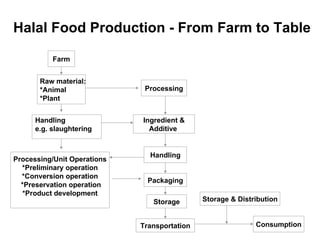
Halal Food Production - From Farm to Table Farm Raw material: *Animal *Plant Processing Handling e.g. slaughtering Processing/Unit Operations *Preliminary operation *Conversion operation *Preservation operation *Product development Ingredient & Additive  Handling Packaging Storage Transportation Storage & Distribution Consumption
I Issues in Halal Food Production Issues in Halal Food Production Raw materials – animal or plant origin/imported Slaughtering – according to Shariah/stunning Processing operations/equipment – x-contamination Packaging/Storage/Transportation (containers and vessels) Food ingredients and additives Pig and its by-products (e.g. pork, lard, gelatin) Enzymes (e.g rennet) Emulsifiers (e.g. E471 or mono- & diglycerides) Alcohol (ethanol) Biotechnology and GMOs (genetically modified organisms)  Safety and quality aspects (aspect of ‘Thoyyiba’)
Cont… Halal is not just end-product certification but involves approval of all ingredients and all food processing at every stage of the production – from farm to table concept
Cont… Due to breathtaking technological development today and the diversification of sources acquired globally for  food processing and production - various kinds of processed foods are available in the market  It is very challenging and increasingly difficult for Muslims to ensure halal status of food in the market This trend has raised concerns among Muslim consumers regarding new processed food
Cont… Food is only halal if the entire food chain, from farm to plate, is processed, handled and stored  in accordance to Shariah or Islamic Guidelines, e.g MS1500:2004, JAKIM’s Guidelines, Codex Alimentarious  etc .
Adulteration of Food Adulteration is an issue of major concern in the food industry globally Adulteration of value-added food products - involving the replacement of high cost ingredients with lower grade and cheaper substitutes Adulteration of food products can be very attractive and lucrative for food manufacturers or raw material suppliers
Adulteration with Porcine-based Products   In some countries, food manufacturers choose to blend vegetable fats with lard to reduce production cost Lard could be effectively blended with other vegetable oils to produce shortening, margarines and other specialty food oils In other instances, adulteration with porcine products could be unintentional
Al-Quran Surah 2: Verse 173 “ He has only forbidden you dead meat, and blood, and the  flesh of swine  and that on which any other name hath been invoked besides that of Allah. But if one is forced by necessity, without willful disobedience, nor transgressing due limits, - then is he guiltless. For Allah is oft-forgiving, most merciful.”
Cont… Many fraudulent and deception cases reported worldwide involving adulteration of haram ingredients  in halal food (especially porcine-based products), misuse of halal label, etc E.g. In the U.K., Food Standards Agency conducted test for adulteration and authenticity of chicken using ELISA and DNA-PCR methods.  Test including samples with halal label revealed that chicken were adulterated with pig derivatives
Recent Issues of Processed Halal Food Fraud in Malaysia Non-halal (pork) moon cakes with halal logo Pigs and chicken stored together  Issue on bread using lard  Brushes using pig’s bristle (fur) in cake and bread preparation Minced pork with halal label Sausages with non-halal casing, expired halal certificate and old halal logo etc
Cont… In the past, many Muslims may have consumed processed food claimed to be halal but adulterated with non-halal ingredients and additives Food producers/manufacturers/food service providers should be more sensitive and responsible to label their products.
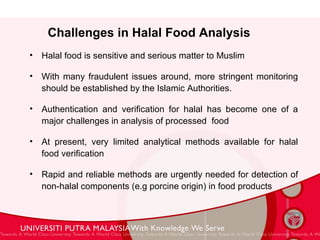
Challenges in Halal Food Analysis  Halal food is sensitive and serious matter to Muslim With many fraudulent issues around, more stringent monitoring should be established by the Islamic Authorities.  Authentication and verification for halal has become one of a major challenges in analysis of processed  food At present, very limited analytical methods available for halal food verification Rapid and reliable methods are urgently needed for detection of non-halal components (e.g porcine origin) in food products
Cont… Currently, Chemistry Department (MOSTI) is the official laboratory doing all halal food analysis Received request for halal verification from various quarters : JAKIM  KPDNHEP Ministry of Health  Jabatan Agama Islam Negeri Private companies  etc
Cont… Current Methods of Analysis used for Halal Food Authentication DNA-Polymerase Chain Reaction  DNA-sequencing Gas Chromatography – FAC/FAME and TAG Analysis Microscopic determinations  Chemical Testing
 
New Initiatives on Halal Food Analysis JAKIM’s Halal Laboratories UPM’s Halal Food Institute National Reference Laboratory for Halal Products
 
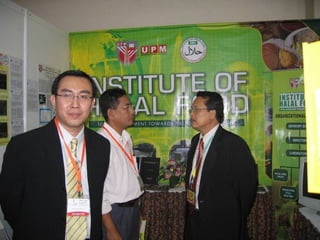
Institute of Halal Food, UPM   Approved by Ministry of Higher Education and officially set up in 1 June 2005 in UPM


Objectives: to carry out R & D on halal food production  to develop new methods for halal food analysis  to provide professional services on halal food related matters to actively contribute together with other agencies towards achieving Malaysia’s vision to be a Global Halal Food Hub Cont…


IMH developed several new analytical approaches for  detection of halal food adulteration  Since porcine-based products are widely used in food and is the biggest issue in halal food, we are developing techniques for detecting pork and lard in some food items claimed to be  halal Cont…
Development of Potential Methods for Detection and Monitoring of Halal Food Fourier Transform Infrared (FTIR) spectroscopy Electronic Nose (E-nose) technology Differential Scanning Calorimetry (DSC) Molecular Biology techniques
FTIR Spectroscopy Food samples (chocolate, cake, biscuits) were analyzed to identify the differences in FTIR spectra profiles FTIR technique combined with chemometric analysis was able to detect and quantify the level of lard adulterated in food samples (3% detection limit) Offers rapid (results in 2 min), simple, accurate, reliable, and environmental friendly tool
Expended view of region  990-950 cm -1 1018.0 1010 1000 990 980 970 960 950 940 929.0 0.030 0.05 0.10 0.15 0.20 0.25 0.30 0.35 0.40 0.45 0.500 Wavenumber (cm-1) Absorbance (A)  0% lard 20% lard 40% lard 60% lard 80% lard 100% lard b
                                                                                                                                                                        FTIR Calibration Model                                                         y = 3.3191x + 0.2462 R 2 = 0.979 0 10 20 30 40 50 60 70 4 6 10 12 14 18 22 28 34 36 40 42 44 46 50 52 54 60 Actual weight of lard content in shortening (g) FTIR value of lard content in shortening (g)
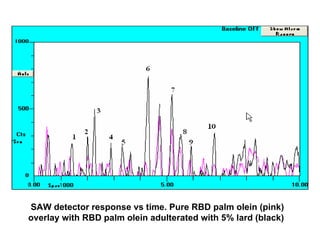
Electronic Nose (E-nose) Technology An instrument, which comprises an array of electronic chemical sensors and appropriate pattern recognition system, capable of recognizing simple or complex odor or smell This technique was applied to monitor the presence of lard in food sample such as cooking oil  Qualitative identification of adulterated oil is possible by the characteristic 2-dimensional olfactory images called VaporPrint  TM
SAW detector response vs time. Pure  RBD palm olein (pink) overlay with RBD palm olein adulterated with 5% lard (black)
VaporPrint TM 1% lard   3% lard 5% lard 7% lard    10% lard   100% lard
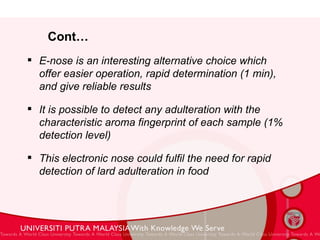
Cont… E-nose is an interesting alternative choice which offer easier operation, rapid determination (1 min), and give reliable results It is possible to detect any adulteration with the characteristic aroma fingerprint of each sample (1% detection level) This electronic nose could fulfil the need for rapid detection of lard adulteration in food
Differential Scanning Calorimetry Thermoanalytical technique for monitoring changes in physical or chemical properties of material by detecting the heat changes Thermogram profile show the presence of lard in food sample Relatively simple, accurate and minimum amount of sample needed
DSC Thermogram
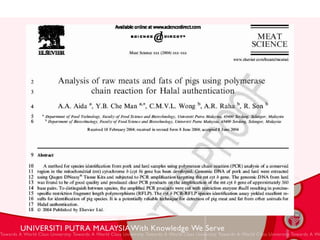
DNA-based technique DNA technique is a favorite approach for species identification because DNA is relatively stable even after processing  We developed method for species identification from pork and lard samples using PCR analysis of a conserved region in the  mt cyt b  gene The analysis yielded excellent results for identification of pig species in samples
DNA EXTRACTION  PCR AMPLIFICATION PCR-RFLP SPECIES IDENTIFICATION FOOD SAMPLES
M1  1  2  3  4  5  6  7  10  11  12  13  14  M2 M1 : 100bp Ladder Marker 1 : Mutton’s meat 2 : Cow’s meat (beef) 3 : Chicken’s meat 4, 5, 6, 7 : Pig’s meat (pork) 10: Chicken’s fat  11, 12, 13, 14 : Pig’s fat M2: 1kb Plus Marker ≈ 360bp 228bp 131bp Restriction Enzyme Analysis of  PCR Amplified Cytochrome b Gene  (raw meat and fat samples)
M  A1  A2  A3  D1  D2  D3  K1  K2  P1  P2  228 bp 131 bp 500 bp ≈ 360 bp Restriction Enzyme Analysis  of PCR Amplified Cytochrome b Gene  (sausages) M-1Kb DNA ladder A1, A2 and A3- sosej ayam berlainan jenama D1, D2 and D3- sosej daging lembu berlainan jenama K1 and K2- sosej babi berlainan jenama P1 and P2- sosej yang tidak dikenalpasti
Protein-based technique ELISA is used to determine the level of antibodies in a sample and useful because they are specific and are relatively simple to perform. We developed method for detection of pig derivatives qualitatively in the food samples using ELISA technique  The analysis yielded excellent results for detection of pig derivatives in samples
1  2  3  4  5 A B C D E F G H ELISA Results A1- positive control;  B1 and C1- negative controls;  D1- mutton,  E1- beef;  F1- chicken meat,  G1, H1, A2 and B2-pork;  C2- mutton fat;  D2- beef fat;  E2- chicken fat;  F2, G2, H2, A3- lard;  B3, C3 and D3- chicken sausages with different brands;  E3, F3 and G3- beef sausages with different brands;  H3 and A4- pork sausages with different brands;  B4 and C4- unknown sausages;  D4, E4 and F4- unknown casings;  G4, H4, A5 and B5- bread with different brands;  C5 and D5- biscuits with different brands; E5- homemade biscuit with 1% lard;  F5- homemade biscuit with 50% lard;  G5- homemade biscuits with 100% lard.
Conclusion Halal and haram are sensitive and serious matters to every Muslim  Properly  processed and certified halal food is pertinent to capture the lucrative halal food market Adulteration and contamination of non-halal components are major concern in food processing and production
Cont…  Development on methods of detection adulteration  are urgently needed for halal food verification and certification New analytical methods of analysis developed by our research group is simple, rapid and reliable for  detection of pork and lard in  food  and other consumer products These analytical methods have potential to be utilised  by halal food authorities responsible for  authentication of halal food such as JAKIM
Cont… We hope these advances would contribute to the credibility of Malaysian Halal Certification Programme


THANK YOU & WASSALAM

Recent Development In Halal Food Analysis

  • 1.
    RECENT DEVELOPMENTS IN HALAL FOOD ANALYSIS YAAKOB B. CHE MAN, Ph.D INSTITUTE OF HALAL FOOD Universiti Putra Malaysia In conjuction with the Annual General Meeting of MIFT, 20 May 2006, Subang Jaya, Selangor
  • 2.
    Introduction Increasingawareness of Muslim consumers on their religious obligations creates greater demand for halal food and other consumer goods ~ 2 billion Muslims out of > 6.5 billion world population Majority are in OIC member countries
  • 3.
    Organization of IslamicCountries (OIC)
  • 4.
    Cont… Tradein halal food is enormous - estimated annual halal food value ~ USD 347 (RM 1,317) billion globally Lucrative market and huge opportunities for halal food business - domestic and international trade Many companies are looking at halal concept as a new tool for marketing
  • 5.
    Cont… Halalis a Qur’anic term meaning ‘permitted, allowed or lawful’. Halal when used in relation to food and other consumer goods, means “permissible for consumption and used by Muslims’ Haram is the opposite of halal. Shubhah or Mashbooh, means doubtful or suspected Halal and haram are serious matters in Islam
  • 6.
    Shariah Law meansIslamic Law based on the Quran, Hadith, Ijma’ and Qiyas A particular food or other consumer product becomes halal or haram if it is considered so through any one of the above mentioned sources or Fatwa (religious rulings) issued by competent Islamic Authorities. The lives of every Muslims, including their dietary requirements, are guided by Shariah Law Cont…
  • 7.
    Al Quran SurahAl-Baqarah: “ O ye people! Eat of what is on earth, Halal and good ; and do not follow the footsteps of the Evil One, for he is to you an avowed enemy.” (Verse 168)
  • 8.
    Al-Quran Surah Al-Maidah“ O ye who believe! Forbid not the good thing which Allah hath made Halal for you, and transgress not. Lo Allah loveth not transgressors. Eat of that which Allah hath bestowed on you as food Halal and Good , and keep your duty to Allah in Whom ye are believers.” (verse 87 –88)
  • 9.
    Hadith Bukhari andMuslim “ Halal is clear and Haram is clear; in between these two are certain things that are shubhah (suspected ). Many people may not know whether those items are Halal or Haram . Whosoever leaves them, he is innocent towards his religion and his conscience. He is, therefore, safe. Anyone who gets involved in any of these suspected items, he may fall into the unlawful and the prohibition. This case is similar to the one who wishes to raise his animals next to a restricted area, he may step into it. Indeed for every landlord there is a restricted area. Indeed the restrictions of Allah are the unlawful (Haram).”
  • 10.
    Cont… Ensuring foodand other consumer products authentically halal is obligatory for every Muslims Hence, certification and verification of every item for halal compliance by competent Islamic Authorities, such as JAKIM, is extremely important
  • 11.
    Halal Food Production- From Farm to Table Farm Raw material: *Animal *Plant Processing Handling e.g. slaughtering Processing/Unit Operations *Preliminary operation *Conversion operation *Preservation operation *Product development Ingredient & Additive Handling Packaging Storage Transportation Storage & Distribution Consumption
  • 12.
    I Issues inHalal Food Production Issues in Halal Food Production Raw materials – animal or plant origin/imported Slaughtering – according to Shariah/stunning Processing operations/equipment – x-contamination Packaging/Storage/Transportation (containers and vessels) Food ingredients and additives Pig and its by-products (e.g. pork, lard, gelatin) Enzymes (e.g rennet) Emulsifiers (e.g. E471 or mono- & diglycerides) Alcohol (ethanol) Biotechnology and GMOs (genetically modified organisms) Safety and quality aspects (aspect of ‘Thoyyiba’)
  • 13.
    Cont… Halal isnot just end-product certification but involves approval of all ingredients and all food processing at every stage of the production – from farm to table concept
  • 14.
    Cont… Due tobreathtaking technological development today and the diversification of sources acquired globally for food processing and production - various kinds of processed foods are available in the market It is very challenging and increasingly difficult for Muslims to ensure halal status of food in the market This trend has raised concerns among Muslim consumers regarding new processed food
  • 15.
    Cont… Food isonly halal if the entire food chain, from farm to plate, is processed, handled and stored in accordance to Shariah or Islamic Guidelines, e.g MS1500:2004, JAKIM’s Guidelines, Codex Alimentarious etc .
  • 16.
    Adulteration of FoodAdulteration is an issue of major concern in the food industry globally Adulteration of value-added food products - involving the replacement of high cost ingredients with lower grade and cheaper substitutes Adulteration of food products can be very attractive and lucrative for food manufacturers or raw material suppliers
  • 17.
    Adulteration with Porcine-basedProducts In some countries, food manufacturers choose to blend vegetable fats with lard to reduce production cost Lard could be effectively blended with other vegetable oils to produce shortening, margarines and other specialty food oils In other instances, adulteration with porcine products could be unintentional
  • 18.
    Al-Quran Surah 2:Verse 173 “ He has only forbidden you dead meat, and blood, and the flesh of swine and that on which any other name hath been invoked besides that of Allah. But if one is forced by necessity, without willful disobedience, nor transgressing due limits, - then is he guiltless. For Allah is oft-forgiving, most merciful.”
  • 19.
    Cont… Many fraudulentand deception cases reported worldwide involving adulteration of haram ingredients in halal food (especially porcine-based products), misuse of halal label, etc E.g. In the U.K., Food Standards Agency conducted test for adulteration and authenticity of chicken using ELISA and DNA-PCR methods. Test including samples with halal label revealed that chicken were adulterated with pig derivatives
  • 20.
    Recent Issues ofProcessed Halal Food Fraud in Malaysia Non-halal (pork) moon cakes with halal logo Pigs and chicken stored together Issue on bread using lard Brushes using pig’s bristle (fur) in cake and bread preparation Minced pork with halal label Sausages with non-halal casing, expired halal certificate and old halal logo etc
  • 21.
    Cont… In thepast, many Muslims may have consumed processed food claimed to be halal but adulterated with non-halal ingredients and additives Food producers/manufacturers/food service providers should be more sensitive and responsible to label their products.
  • 22.
    Challenges in HalalFood Analysis Halal food is sensitive and serious matter to Muslim With many fraudulent issues around, more stringent monitoring should be established by the Islamic Authorities. Authentication and verification for halal has become one of a major challenges in analysis of processed food At present, very limited analytical methods available for halal food verification Rapid and reliable methods are urgently needed for detection of non-halal components (e.g porcine origin) in food products
  • 23.
    Cont… Currently, ChemistryDepartment (MOSTI) is the official laboratory doing all halal food analysis Received request for halal verification from various quarters : JAKIM KPDNHEP Ministry of Health Jabatan Agama Islam Negeri Private companies etc
  • 24.
    Cont… Current Methodsof Analysis used for Halal Food Authentication DNA-Polymerase Chain Reaction DNA-sequencing Gas Chromatography – FAC/FAME and TAG Analysis Microscopic determinations Chemical Testing
  • 25.
  • 26.
    New Initiatives onHalal Food Analysis JAKIM’s Halal Laboratories UPM’s Halal Food Institute National Reference Laboratory for Halal Products
  • 27.
  • 28.
    Institute of HalalFood, UPM Approved by Ministry of Higher Education and officially set up in 1 June 2005 in UPM
  • 29.
  • 30.
  • 31.
  • 32.
    Objectives: to carryout R & D on halal food production to develop new methods for halal food analysis to provide professional services on halal food related matters to actively contribute together with other agencies towards achieving Malaysia’s vision to be a Global Halal Food Hub Cont…
  • 33.
  • 34.
  • 35.
  • 36.
    IMH developed severalnew analytical approaches for detection of halal food adulteration Since porcine-based products are widely used in food and is the biggest issue in halal food, we are developing techniques for detecting pork and lard in some food items claimed to be halal Cont…
  • 37.
    Development of PotentialMethods for Detection and Monitoring of Halal Food Fourier Transform Infrared (FTIR) spectroscopy Electronic Nose (E-nose) technology Differential Scanning Calorimetry (DSC) Molecular Biology techniques
  • 38.
    FTIR Spectroscopy Foodsamples (chocolate, cake, biscuits) were analyzed to identify the differences in FTIR spectra profiles FTIR technique combined with chemometric analysis was able to detect and quantify the level of lard adulterated in food samples (3% detection limit) Offers rapid (results in 2 min), simple, accurate, reliable, and environmental friendly tool
  • 39.
    Expended view ofregion 990-950 cm -1 1018.0 1010 1000 990 980 970 960 950 940 929.0 0.030 0.05 0.10 0.15 0.20 0.25 0.30 0.35 0.40 0.45 0.500 Wavenumber (cm-1) Absorbance (A) 0% lard 20% lard 40% lard 60% lard 80% lard 100% lard b
  • 40.
                                                                                                                                                                           FTIR Calibration Model                                                         y = 3.3191x + 0.2462 R 2 = 0.979 0 10 20 30 40 50 60 70 4 6 10 12 14 18 22 28 34 36 40 42 44 46 50 52 54 60 Actual weight of lard content in shortening (g) FTIR value of lard content in shortening (g)
  • 41.
    Electronic Nose (E-nose)Technology An instrument, which comprises an array of electronic chemical sensors and appropriate pattern recognition system, capable of recognizing simple or complex odor or smell This technique was applied to monitor the presence of lard in food sample such as cooking oil Qualitative identification of adulterated oil is possible by the characteristic 2-dimensional olfactory images called VaporPrint TM
  • 42.
    SAW detector responsevs time. Pure RBD palm olein (pink) overlay with RBD palm olein adulterated with 5% lard (black)
  • 43.
    VaporPrint TM 1%lard 3% lard 5% lard 7% lard 10% lard 100% lard
  • 44.
    Cont… E-nose isan interesting alternative choice which offer easier operation, rapid determination (1 min), and give reliable results It is possible to detect any adulteration with the characteristic aroma fingerprint of each sample (1% detection level) This electronic nose could fulfil the need for rapid detection of lard adulteration in food
  • 45.
    Differential Scanning CalorimetryThermoanalytical technique for monitoring changes in physical or chemical properties of material by detecting the heat changes Thermogram profile show the presence of lard in food sample Relatively simple, accurate and minimum amount of sample needed
  • 46.
  • 47.
    DNA-based technique DNAtechnique is a favorite approach for species identification because DNA is relatively stable even after processing We developed method for species identification from pork and lard samples using PCR analysis of a conserved region in the mt cyt b gene The analysis yielded excellent results for identification of pig species in samples
  • 48.
    DNA EXTRACTION PCR AMPLIFICATION PCR-RFLP SPECIES IDENTIFICATION FOOD SAMPLES
  • 49.
    M1 1 2 3 4 5 6 7 10 11 12 13 14 M2 M1 : 100bp Ladder Marker 1 : Mutton’s meat 2 : Cow’s meat (beef) 3 : Chicken’s meat 4, 5, 6, 7 : Pig’s meat (pork) 10: Chicken’s fat 11, 12, 13, 14 : Pig’s fat M2: 1kb Plus Marker ≈ 360bp 228bp 131bp Restriction Enzyme Analysis of PCR Amplified Cytochrome b Gene (raw meat and fat samples)
  • 50.
    M A1 A2 A3 D1 D2 D3 K1 K2 P1 P2 228 bp 131 bp 500 bp ≈ 360 bp Restriction Enzyme Analysis of PCR Amplified Cytochrome b Gene (sausages) M-1Kb DNA ladder A1, A2 and A3- sosej ayam berlainan jenama D1, D2 and D3- sosej daging lembu berlainan jenama K1 and K2- sosej babi berlainan jenama P1 and P2- sosej yang tidak dikenalpasti
  • 51.
    Protein-based technique ELISAis used to determine the level of antibodies in a sample and useful because they are specific and are relatively simple to perform. We developed method for detection of pig derivatives qualitatively in the food samples using ELISA technique The analysis yielded excellent results for detection of pig derivatives in samples
  • 52.
    1 2 3 4 5 A B C D E F G H ELISA Results A1- positive control; B1 and C1- negative controls; D1- mutton, E1- beef; F1- chicken meat, G1, H1, A2 and B2-pork; C2- mutton fat; D2- beef fat; E2- chicken fat; F2, G2, H2, A3- lard; B3, C3 and D3- chicken sausages with different brands; E3, F3 and G3- beef sausages with different brands; H3 and A4- pork sausages with different brands; B4 and C4- unknown sausages; D4, E4 and F4- unknown casings; G4, H4, A5 and B5- bread with different brands; C5 and D5- biscuits with different brands; E5- homemade biscuit with 1% lard; F5- homemade biscuit with 50% lard; G5- homemade biscuits with 100% lard.
  • 53.
    Conclusion Halal andharam are sensitive and serious matters to every Muslim Properly processed and certified halal food is pertinent to capture the lucrative halal food market Adulteration and contamination of non-halal components are major concern in food processing and production
  • 54.
    Cont… Developmenton methods of detection adulteration are urgently needed for halal food verification and certification New analytical methods of analysis developed by our research group is simple, rapid and reliable for detection of pork and lard in food and other consumer products These analytical methods have potential to be utilised by halal food authorities responsible for authentication of halal food such as JAKIM
  • 55.
    Cont… We hopethese advances would contribute to the credibility of Malaysian Halal Certification Programme
  • 56.
  • 57.
  • 58.
  • 59.
  • 60.
  • 61.
  • 62.
  • 63.
  • 64.
    THANK YOU &WASSALAM