
DOST XII PPRROOGGRRAAMM OONN HHAALLAALL 
TThhee PPhhiilliippppiinnee SScciieennccee aanndd TTeecchhnnoollooggyy PPrrooggrraamm 
ffoorr tthhee DDeevveellooppmmeenntt ooff tthhee HHaallaall IInndduussttrryy 
DR. ZENAIDA P. HADJI RAOF LAIDAN 
Regional Director, DOST XII 
Chairperson, National Halal Forum 
Program Leader, Philippine Science & Technology Program for 
the Development of the Halal Industry
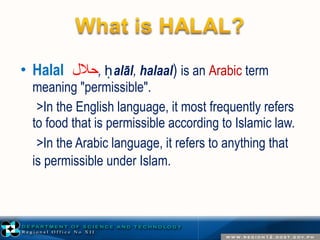
• Halal ( حلل, , ḥalāl, halaal) is an Arabic term 
meaning "permissible". 
>In the English language, it most frequently refers 
to food that is permissible according to Islamic law. 
>In the Arabic language, it refers to anything that 
is permissible under Islam.
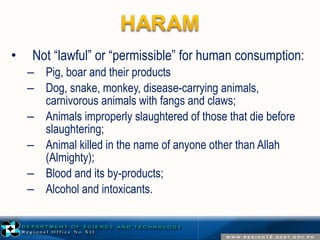
• Not “lawful” or “permissible” for human consumption: 
– Pig, boar and their products 
– Dog, snake, monkey, disease-carrying animals, 
carnivorous animals with fangs and claws; 
– Animals improperly slaughtered of those that die before 
slaughtering; 
– Animal killed in the name of anyone other than Allah 
(Almighty); 
– Blood and its by-products; 
– Alcohol and intoxicants.
• means suspect, in doubt or questionable. If 
the origin of a certain food item is in doubt, 
or there is uncertainty about whether it is 
prohibited means under Islamic laws, then 
the product is considered Mashbooh.
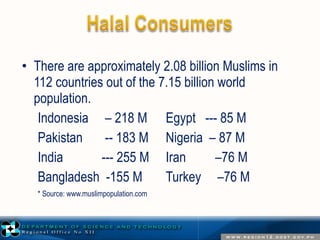
• There are approximately 2.08 billion Muslims in 
112 countries out of the 7.15 billion world 
population. 
Indonesia – 218 M Egypt --- 85 M 
Pakistan -- 183 M Nigeria – 87 M 
India --- 255 M Iran –76 M 
Bangladesh -155 M Turkey –76 M 
* Source: www.muslimpopulation.com
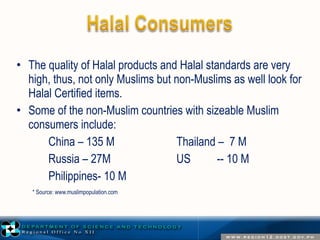
• The quality of Halal products and Halal standards are very 
high, thus, not only Muslims but non-Muslims as well look for 
Halal Certified items. 
• Some of the non-Muslim countries with sizeable Muslim 
consumers include: 
China – 135 M Thailand – 7 M 
Russia – 27M US -- 10 M 
Philippines- 10 M 
* Source: www.muslimpopulation.com
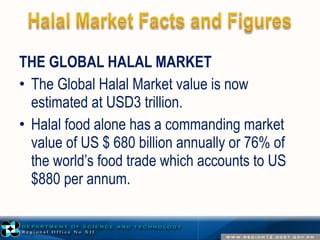
THE GLOBAL HALAL MARKET 
• The Global Halal Market value is now 
estimated at USD3 trillion. 
• Halal food alone has a commanding market 
value of US $ 680 billion annually or 76% of 
the world’s food trade which accounts to US 
$880 per annum.
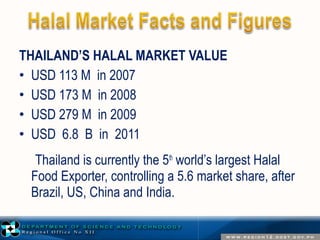
THAILAND’S HALAL MARKET VALUE 
• USD 113 M in 2007 
• USD 173 M in 2008 
• USD 279 M in 2009 
• USD 6.8 B in 2011 
Thailand is currently the 5th world’s largest Halal 
Food Exporter, controlling a 5.6 market share, after 
Brazil, US, China and India.
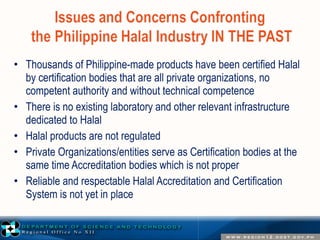
• Thousands of Philippine-made products have been certified Halal 
by certification bodies that are all private organizations, no 
competent authority and without technical competence 
• There is no existing laboratory and other relevant infrastructure 
dedicated to Halal 
• Halal products are not regulated 
• Private Organizations/entities serve as Certification bodies at the 
same time Accreditation bodies which is not proper 
• Reliable and respectable Halal Accreditation and Certification 
System is not yet in place
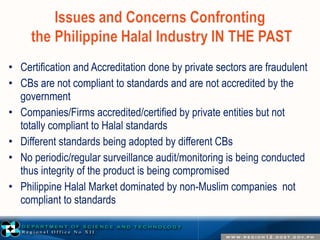
• Certification and Accreditation done by private sectors are fraudulent 
• CBs are not compliant to standards and are not accredited by the 
government 
• Companies/Firms accredited/certified by private entities but not 
totally compliant to Halal standards 
• Different standards being adopted by different CBs 
• No periodic/regular surveillance audit/monitoring is being conducted 
thus integrity of the product is being compromised 
• Philippine Halal Market dominated by non-Muslim companies not 
compliant to standards
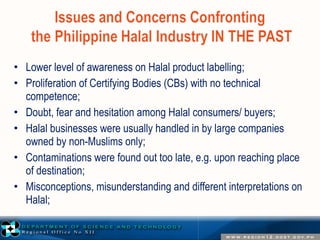
• Lower level of awareness on Halal product labelling; 
• Proliferation of Certifying Bodies (CBs) with no technical 
competence; 
• Doubt, fear and hesitation among Halal consumers/ buyers; 
• Halal businesses were usually handled in by large companies 
owned by non-Muslims only; 
• Contaminations were found out too late, e.g. upon reaching place 
of destination; 
• Misconceptions, misunderstanding and different interpretations on 
Halal;
"Oh Mankind! Eat from the earth that which is 
Halal and Thayyib (lawful and wholesome).“ 
Holy Quran 2:168 
Consumption and utilization of Halal food and 
non-food products as well as preservation and 
promotion of Halal practices are “Fardhu 
Kifaya” or obligatory to every Muslim.
Halal was identified as 
one of the High Impact 
Programs (HIPs) of the 
DOST .
Provide central direction, leadership and 
coordination of all scientific and 
technological efforts in the country. 
Formulate S&T policies, plans, programs, 
and projects in support of national 
development priorities.
PPhilippine 
SScience and TTechnology 
PProgram for the 
DDevelopment of the 
HHalal IIndustry
aims to support the National Development Agenda 
•Generation of more jobs and employment; 
•Reduction of poverty; and 
•Solution to peace and order problem/ Mindanao conflict 
in consonance with the 5-Point Program of DOST 
•Developing solutions to pressing national problems; 
•Developing appropriate technologies to create growth in the 
countryside; 
•Harnessing technology to improve industry competitiveness; 
•Using S&T to enhance delivery of government and social services; 
•Harnessing emerging technologies to boost national competitiveness.
• Establish performance-based reward system in providing technical and 
financial assistance to support the growth and competitiveness of Halal 
micro, small and medium scale enterprises (MSMEs) through the 
adoption of appropriate technologies, innovation and best practices; 
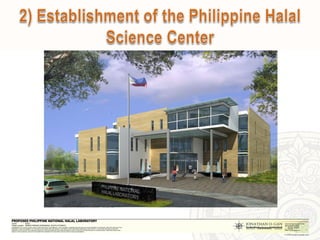
• Establish Philippine Halal Science Center, Forensic Laboratory and 
Technology Business Incubation (TBI) Center to prove the Halalness 
of the products; 
• Ensure Halal integrity thru effective farm-to-fork monitoring and 
improved technologies essential in detecting Haram for food and non-food 
products;
• Establish mechanisms for complementarities and resource-sharing 
of government and private resources to ensure sustainability; 
• Adopt the clustering approach (by municipality, province or region) in 
administering projects in coordination with LGUs, SUCs, farmers’ 
organizations, industry associations to ensure sustainability, high-impact. 
• Develop Human Resource Complement for the Halal Industry thru 
Capacity – building (degree and non-degree).
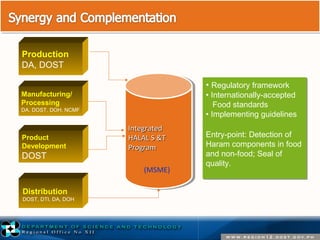
Production 
DA, DOST 
Manufacturing/ 
Processing 
DA, DOST, DOH, NCMF 
Product 
Development 
DOST 
DA, DTI 
IInntteeggrraatteedd 
HHAALLAALL SS &&TT 
PPrrooggrraamm 
IInntteeggrraatteedd 
HHAALLAALL SS &&TT 
PPrrooggrraamm 
• Regulatory framework 
• Internationally-accepted 
Food standards 
• Implementing guidelines 
Entry-point: Detection of 
Haram components in food 
and non-food; Seal of 
quality. 
Distribution 
DOST, DTI, DA, DOH 
(MSME)
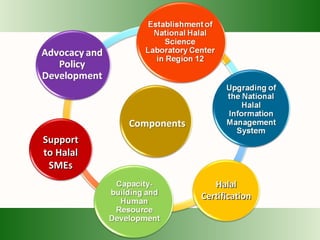
HHaallaall 
CCeerrttiiffiiccaattiioonn 
SSuuppppoorrtt 
ttoo HHaallaall 
SSMMEEss
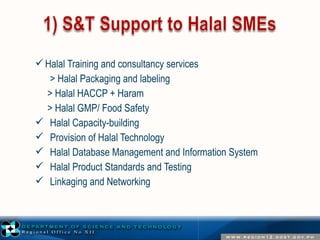
Halal Training and consultancy services 
> Halal Packaging and labeling 
> Halal HACCP + Haram 
> Halal GMP/ Food Safety 
 Halal Capacity-building 
 Provision of Halal Technology 
 Halal Database Management and Information System 
 Halal Product Standards and Testing 
 Linkaging and Networking
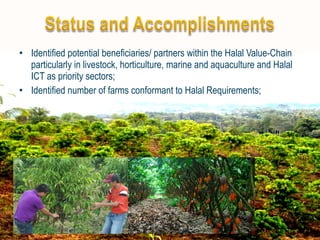
• Identified potential beneficiaries/ partners within the Halal Value-Chain 
particularly in livestock, horticulture, marine and aquaculture and Halal 
ICT as priority sectors; 
• Identified number of farms conformant to Halal Requirements;
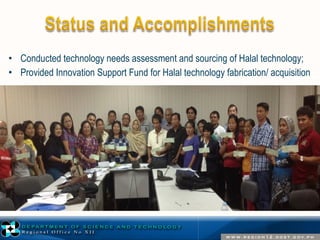
• Conducted technology needs assessment and sourcing of Halal technology; 
• Provided Innovation Support Fund for Halal technology fabrication/ acquisition
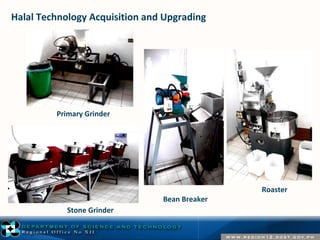
Primary Grinder 
Stone Grinder 
Bean Breaker 
Roaster 
Halal Technology Acquisition and Upgrading
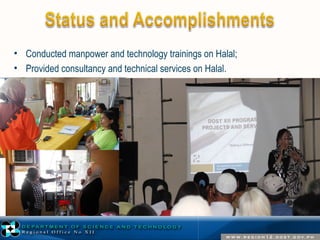
• Conducted manpower and technology trainings on Halal; 
• Provided consultancy and technical services on Halal.
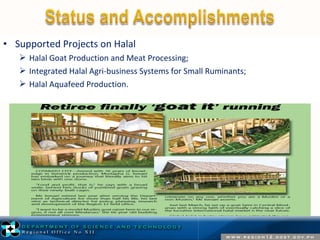
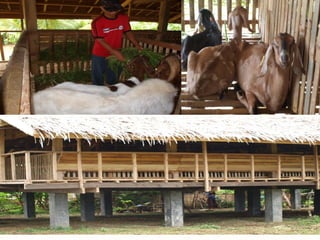
• Supported Projects on Halal 
 Halal Goat Production and Meat Processing; 
 Integrated Halal Agri-business Systems for Small Ruminants; 
 Halal Aquafeed Production.
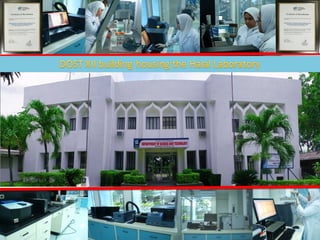
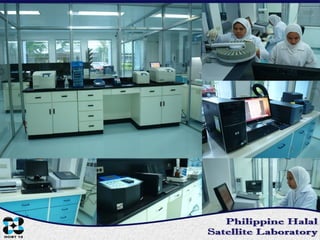
Halal Laboratory in Cotabato City 
• Analytical Services 
>Fatty acids of animals and plants (profiles) 
>DNA analysis of foods and other processed products 
>Gelatin content of milk and other dairy products 
>Genetically Modified Organisms (GMO) testing 
>Alcohol content of beverages and other related products 
>Qualitative detection of haram in meat products 
>Detection of lard in bakery products and edible oils
We provide laboratory testing services to customers that 
encompasses the entire food supply chain: 
 Food and beverage Manufacturers/ Producers 
 Food distributors and Suppliers 
 Food Service Outlets/ Caterers/ Producers 
 Importers and exporters 
 Pharmaceuticals Manufacturers 
 Medical Devices and Manufacturers
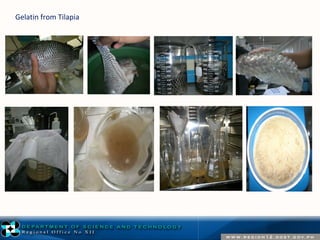
Gelatin from Tilapia
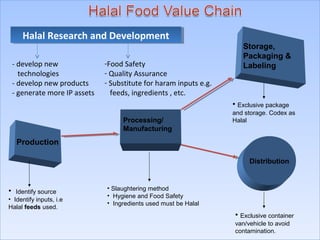
Production 
Distribution 
• Identify source 
• Identify inputs, i.e 
Halal feeds used. 
-Food Safety 
- Quality Assurance 
- Substitute for haram inputs e.g. 
feeds, ingredients , etc. 
• Slaughtering method 
• Hygiene and Food Safety 
• Ingredients used must be Halal 
• Exclusive package 
and storage. Codex as 
Halal 
• Exclusive container 
van/vehicle to avoid 
contamination. 
Halal Halal R Reesseeaarrcchh a anndd D Deevveellooppmmeenntt 
Storage, 
Packaging & 
- develop new Labeling 
technologies 
- develop new products 
- generate more IP assets 
Processing/ 
Manufacturing
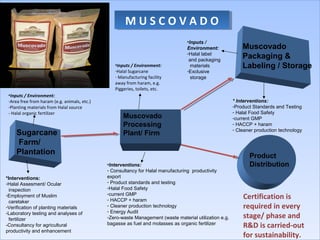
Sugarcane 
Farm/ 
Plantation Product 
Distribution 
*Interventions: 
-Halal Assesment/ Ocular 
inspection 
-Employment of Muslim 
caretaker 
-Verification of planting materials 
-Laboratory testing and analyses of 
fertilizer 
-Consultancy for agricultural 
productivity and enhancement 
•Interventions: 
- Consultancy for Halal manufacturing productivity 
export 
- Product standards and testing 
-Halal Food Safety 
-current GMP 
- HACCP + haram 
- Cleaner production technology 
- Energy Audit 
-Zero-waste Management (waste material utilization e.g. 
bagasse as fuel and molasses as organic fertilizer 
* Interventions: 
-Product Standards and Testing 
- Halal Food Safety 
-current GMP 
- HACCP + haram 
- Cleaner production technology 
MM UU SS CC OO VV AA DD OO 
Muscovado 
Packaging & 
Labeling / Storage 
Muscovado 
Processing 
Plant/ Firm 
•Inputs / Environment: 
-Area free from haram (e.g. animals, etc.) 
-Planting materials from Halal source 
- Halal organic fertilizer 
•Inputs / Environment: 
-Halal Sugarcane 
- Manufacturing facility 
away from haram, e.g. 
Piggeries, toilets, etc. 
•Inputs / 
Environment: 
-Halal label 
and packaging 
materials 
-Exclusive 
storage 
Certification is 
required in every 
stage/ phase and 
R&D is carried-out 
for sustainability.
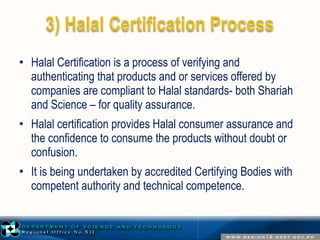
• Halal Certification is a process of verifying and 
authenticating that products and or services offered by 
companies are compliant to Halal standards- both Shariah 
and Science – for quality assurance. 
• Halal certification provides Halal consumer assurance and 
the confidence to consume the products without doubt or 
confusion. 
• It is being undertaken by accredited Certifying Bodies with 
competent authority and technical competence.
• Accreditation of a Halal Certifying Body is a formal 
declaration that a particular organization or institution is 
highly qualified/ capable, competent, credible, and reliable 
to certify Halal products or services to be recognized by 
International Standards Organization and/ or Accreditation 
body
• A system by which an organization aims to reduce and 
eventually eliminate non-conformities to specifications, 
standards, requirements and customer expectations in the 
most cost effective and efficient manner.
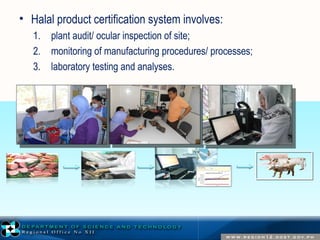
• Halal product certification system involves: 
1. plant audit/ ocular inspection of site; 
2. monitoring of manufacturing procedures/ processes; 
3. laboratory testing and analyses.
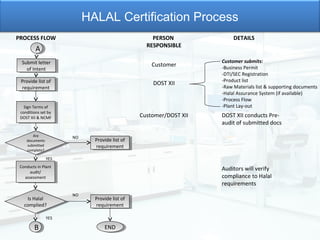
HALAL Certification Process 
PROCESS FLOW PERSON 
AA 
Submit letter 
of Intent 
Provide list of 
requirement 
Sign Terms of 
conditions set by 
DOST XII & NCMF 
YES 
Conducts in Plant 
audit/ 
assessment 
Is Halal 
complied? 
YES 
NO 
NO 
Are 
documents 
submitted 
complete? 
Provide list of 
requirement 
Provide list of 
requirement 
BB EENNDD 
RESPONSIBLE 
DETAILS 
Customer 
DOST XII 
Customer/DOST XII 
Customer submits: 
-Business Permit 
-DTI/SEC Registration 
-Product list 
-Raw Materials list & supporting documents 
-Halal Assurance System (if available) 
-Process Flow 
-Plant Lay-out 
DOST XII conducts Pre-audit 
of submitted docs 
Auditors will verify 
compliance to Halal 
requirements 
Submit letter 
of Intent 
Provide list of 
requirement 
Sign Terms of 
conditions set by 
DOST XII & NCMF 
Are 
documents 
submitted 
complete? 
Conducts in Plant 
audit/ 
assessment 
Is Halal 
complied? 
Provide list of 
requirement 
Provide list of 
requirement
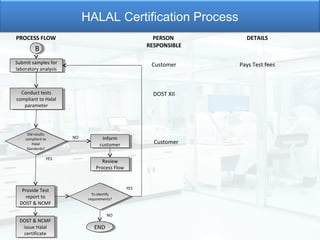
PROCESS FLOW PERSON 
BB 
Submit samples for Pays Test fees 
laboratory analysis 
Inform 
customer 
Review 
Process Flow 
To identify 
requirements? 
EENNDD 
Conduct tests 
compliant to Halal 
parameter 
Did results 
compliant to 
YES 
YES 
NO 
NO 
RESPONSIBLE 
DETAILS 
Customer 
DOST XII 
Customer 
Submit samples for 
laboratory analysis 
Conduct tests 
compliant to Halal 
parameter 
Did results 
compliant to 
Halal 
Halal 
Standards? 
Standards? 
Provide Test 
report to 
DOST & NCMF 
Provide Test 
report to 
DOST & NCMF 
Inform 
customer 
Review 
Process Flow 
To identify 
requirements? 
DOST & NCMF 
issue Halal 
certificate 
DOST & NCMF 
issue Halal 
certificate 
HALAL Certification Process
Submit 
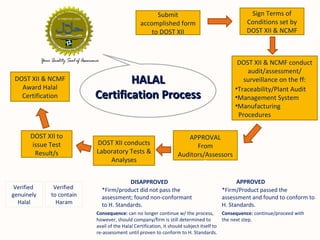
accomplished form 
to DOST XII 
HHAALLAALL 
CCeerrttiiffiiccaattiioonn PPrroocceessss 
Sign Terms of 
Conditions set by 
DOST XII & NCMF 
DOST XII & NCMF conduct 
audit/assessment/ 
surveillance on the ff: 
•Traceability/Plant Audit 
•Management System 
•Manufacturing 
Procedures 
APPROVAL 
From 
Auditors/Assessors 
DOST XII conducts 
Laboratory Tests & 
Analyses 
DOST XII & NCMF 
Award Halal 
Certification 
DOST XII to 
issue Test 
Result/s 
Verified 
genuinely 
Halal 
Verified 
to contain 
Haram 
DISAPPROVED APPROVED 
*Firm/product did not pass the 
assessment; found non-conformant 
to H. Standards. 
Consequence: can no longer continue w/ the process, 
however, should company/firm is still determined to 
avail of the Halal Certification, it should subject itself to 
re-assessment until proven to conform to H. Standards. 
*Firm/Product passed the 
assessment and found to conform to 
H. Standards. 
Consequence: continue/proceed with 
the next step.
DDOOSSTT 
XXIIII 
Philippine 
National 
Halal Science 
Center
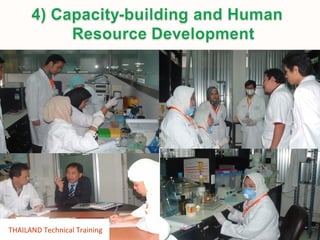
THAILAND Technical Training
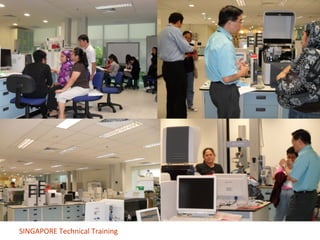
SINGAPORE Technical Training
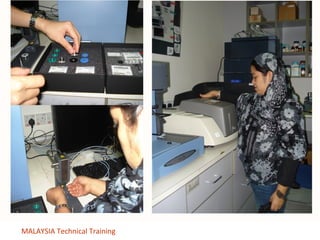
MALAYSIA Technical Training
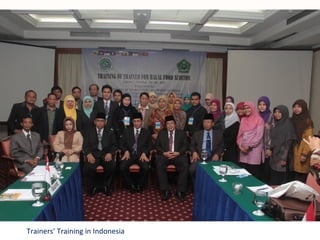
Trainers’ Training in Indonesia
• Created Food Safety Teams for Halal; 
• Gained approval from the Board of Regents of 
SUCs in Region XII on the proposed integration of 
Halal Science in the curriculum as well as the 
offering of Halal Science Program.
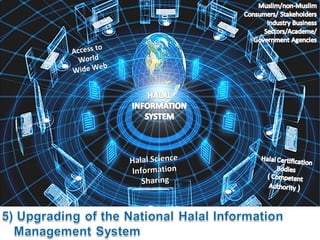
Access to 
World 
Wide Web 
Halal Science 
Information 
Sharing
• Upgrading of the Halal Information Management 
System is on-going that includes Traceability and 
Surveillance System for Halal. 
• Acquisition of IT equipment for the Halal Information 
Management System is on-going. 
• Gained ICT support for Halal from Malaysia, Taiwan 
and other countries.
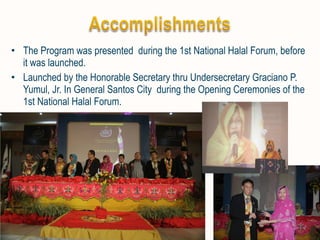
• The Program was presented during the 1st National Halal Forum, before 
it was launched. 
• Launched by the Honorable Secretary thru Undersecretary Graciano P. 
Yumul, Jr. In General Santos City during the Opening Ceremonies of the 
1st National Halal Forum.
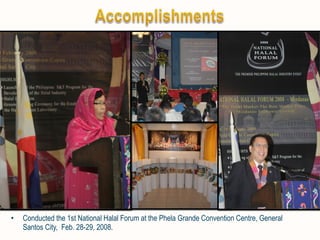
• Conducted the 1st National Halal Forum at the Phela Grande Convention Centre, General 
Santos City, Feb. 28-29, 2008.
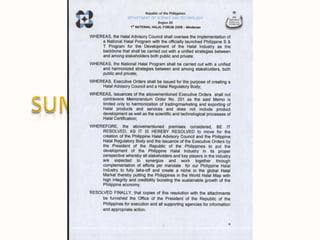
• Regional Development Council XII (RDC XII) Resolution No. 05, 
Series of 2008 entitled: “A Resolution Supporting and Adopting the 
Philippine Science and Technology Program for the Development of 
the Halal Industry” 
– Excerpts from the Minutes of the 22nd Regular Meeting of the 
Regional Development Council (RDC) XII on 28 March 2008 at 
the Provincial Capitol, Kidapawan City; 
– RDC XII endorsed the this Resolution after finding it supportive of 
the region’s vision, development thrusts and priorities as 
enunciated in Region XII’s Medium-Term Regional Development 
Plan (MTRDP) 2004-2010.
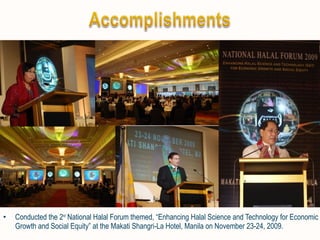
• Conducted the 2nd National Halal Forum themed, “Enhancing Halal Science and Technology for Economic 
Growth and Social Equity” at the Makati Shangri-La Hotel, Manila on November 23-24, 2009.
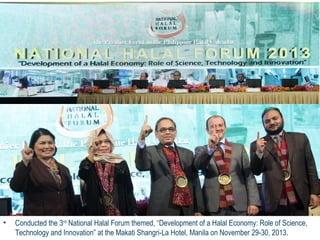
• Conducted the 3rd National Halal Forum themed, “Development of a Halal Economy: Role of Science, 
Technology and Innovation” at the Makati Shangri-La Hotel, Manila on November 29-30, 2013.
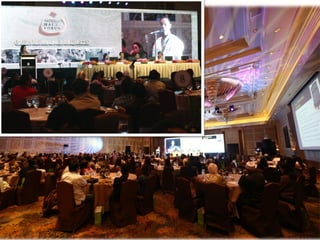
• In 2013, the 3rd National Halal Forum (NHF) was 
held at the Makati Shangri-La, Manila.
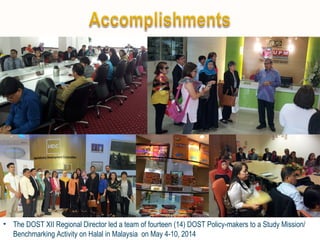
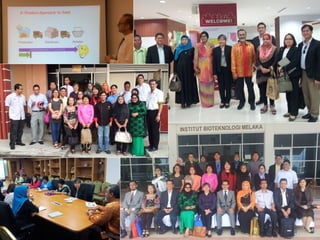
• The DOST XII Regional Director led a team of fourteen (14) DOST Policy-makers to a Study Mission/ 
Benchmarking Activity on Halal in Malaysia on May 4-10, 2014
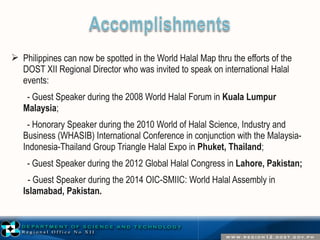
 Philippines can now be spotted in the World Halal Map thru the efforts of the 
DOST XII Regional Director who was invited to speak on international Halal 
events: 
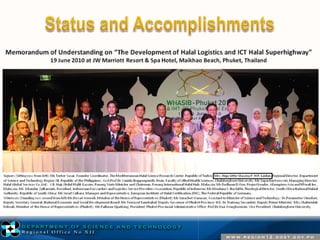
- Guest Speaker during the 2008 World Halal Forum in Kuala Lumpur 
Malaysia; 
- Honorary Speaker during the 2010 World of Halal Science, Industry and 
Business (WHASIB) International Conference in conjunction with the Malaysia- 
Indonesia-Thailand Group Triangle Halal Expo in Phuket, Thailand; 
- Guest Speaker during the 2012 Global Halal Congress in Lahore, Pakistan; 
- Guest Speaker during the 2014 OIC-SMIIC: World Halal Assembly in 
Islamabad, Pakistan.
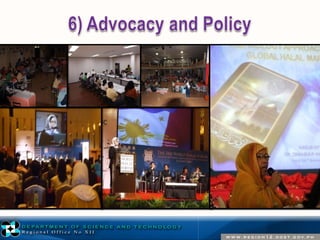
• In the process of developing IEC materials for Halal Awareness and Promotion; 
• Developed Training Modules for the Development of the Halal Industry; 
• Halal concerns were included in the Agenda of some of the Regional Meetings; 
• Press Releases (a number of which were published in international, national and 
local papers) 
• Dr. Laidan was invited to a number of international and local press conferences 
as well as to several interviews on TV and radio; 
• National Halal Forum, a country-wide undertaking with global trend is known as 
the “Premier Event in the Philippine Halal Calendar”.
AAccccoommpplliisshhmmeennttss 
• Draft Executive Order for the Institutionalization of the 
Philippine National Halal Laboratory and Halal Science 
Center had been submitted to the Regional 
Development Council (RDC XII) and DOST-Central Office 
for endorsement to Malacañang.
• Develop knowledge-based facility supported 
by scientific validation; 
• Set-up Research and Development 
infrastructure to resolve new issues; and 
• Provide innovative solutions that can be 
commercialized.
The Philippine Halal Industry 
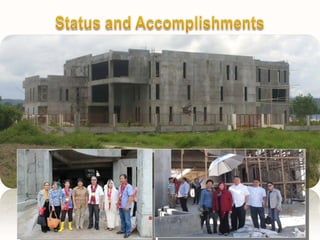
• Philippine National Halal Infrastructure including the Philippine 
National Halal Science Center has been established and in 
operation 
• Increasing demand for genuine Halal products; 
• Many CBs had given up operations, acknowledging their 
inadequacies; 
• Consumers are now looking for seal of quality for guaranteed 
Halalness of product; 
• Not only big companies but SMEs as well are now engage in Halal 
business;
The Philippine Halal Industry 
• Halal producers and manufacturers can avail technical 
assistance to boost integrity of their products 
• Thru education, technology-trainings and consultancies, 
manpower capabilities of SMEs on Halal have been developed; 
• Issues and concerns on Halal have been identified, brought out 
and rationally discussed, clarified and addressed; 
• Harmonization of Philippine Halal standards to be aligned to 
International Standards of OIC-SMIIC has started 
• Competent authority as accrediting body for religious 
requirements has been created, the NCMF per RA 9997
The Philippine Halal Industry 
• Legislation by the Senate of the Philippines and the House of 
Representatives is underway for the institutionalization of the 
Philippine Halal Science Center with DOST XII as the regulatory 
body/ clearing house of Halal products coming in and out of the 
country 
• DOST XII Philippine Halal Science Center as competent authority to 
accredit CBs in terms of technical competence and accredit 
laboratories dedicated to Halal that shall be established in the future 
• Development of reliable Philippine Halal accreditation and 
certification system and respectable Halal Premium brand with proof 
of reliability is being pursued
The Philippine Halal Industry 
• Created the Halal Food Safety Team 
• Established Halal R&D Consortium 
• Increased level of Halal awareness among Filipinos 
• Relevant national agencies have unite with collective efforts to 
pursue for one standard, one logo, one test 
• Regulatory body shall be created to ensure the integrity of the 
product from farm to fork 
• More stringent standards is being pursued to protect, maintain, 
and sustain the integrity of Philippine-made Halal certified product
The Philippine Halal Industry 
• Integration of the Halal Science in the curriculum as a 
program, a major or elective subject, for human resource 
development has started to produce the needed Muslim 
scientists, engineers, researchers to man the Halal Industry 
and propel the Halal economy for growth and development 
• Universities encouraged to undertake Halal R&D and to 
include Fundamentals of Halal in the learning modules for 
pre-schoolers
The Philippine Halal Industry 
• Gained trust and confidence of consumers and attracted more 
investors 
• Philippines particularly Mindanao is positioned as the 
country’s Halal Industry Center and Region XII as the Halal 
Hub and Halal Gateway 
• Development of the Halal Information System is being 
pursued 
• Innovation system has been strengthened 
• And other developments in the Halal sector.
• Private Certification Bodies that have no competent authority 
and without technical competence continue to certify companies 
and their products who are not compliant to Halal Standards 
• Most of the products certified halal did not pass through the 
Halal laboratory for verification, authentication, and 
standardization 
• Private Organizations/entities serve as Certification bodies at the 
same time Accreditation bodies which is NOT PROPER/ NOT 
ALLOWED
• Products have fraudulent logos by different Certification Bodies 
who are not accredited by the government and not given 
recognition certificate 
• There is no Harmonized Standards for Halal Certification 
established yet 
• Appreciation of only few companies on the significance of Halal 
Certification
• Mutual recognition between the NCMF and DOST XII 
• Avoid duplication of agency mandates/ functions 
• Fast-track the institutionalization of the Philippine Halal Science 
Center with DOST XII as the regulatory body/ clearing house of Halal 
products coming in and out of the country 
• Align Philippine Halal standards to the soon-to-be approved unified 
Halal standards of OIC-SMIIC and come up with a Halal Seal of 
Quality as the basis for issuance of recognition certificate and the use 
of the common logo;
• Strict implementation of Halal Accreditation and Certification 
System. 
• Strengthen promotion and advocacy in the country for awareness 
and appreciation of the public especially the non-Muslim 
consumers and for policy development and direction 
• Push for a common logo for proof of reliability and seal of quality 
recognized internationally 
• Government to impose penalties to non-accredited Certification 
Bodies/ private entities/ companies which are still performing 
Halal Certification
Dost xii

Dost xii

  • 1.
    DOST XII PPRROOGGRRAAMMOONN HHAALLAALL TThhee PPhhiilliippppiinnee SScciieennccee aanndd TTeecchhnnoollooggyy PPrrooggrraamm ffoorr tthhee DDeevveellooppmmeenntt ooff tthhee HHaallaall IInndduussttrryy DR. ZENAIDA P. HADJI RAOF LAIDAN Regional Director, DOST XII Chairperson, National Halal Forum Program Leader, Philippine Science & Technology Program for the Development of the Halal Industry
  • 2.
    • Halal (حلل, , ḥalāl, halaal) is an Arabic term meaning "permissible". >In the English language, it most frequently refers to food that is permissible according to Islamic law. >In the Arabic language, it refers to anything that is permissible under Islam.
  • 3.
    • Not “lawful”or “permissible” for human consumption: – Pig, boar and their products – Dog, snake, monkey, disease-carrying animals, carnivorous animals with fangs and claws; – Animals improperly slaughtered of those that die before slaughtering; – Animal killed in the name of anyone other than Allah (Almighty); – Blood and its by-products; – Alcohol and intoxicants.
  • 4.
    • means suspect,in doubt or questionable. If the origin of a certain food item is in doubt, or there is uncertainty about whether it is prohibited means under Islamic laws, then the product is considered Mashbooh.
  • 5.
    • There areapproximately 2.08 billion Muslims in 112 countries out of the 7.15 billion world population. Indonesia – 218 M Egypt --- 85 M Pakistan -- 183 M Nigeria – 87 M India --- 255 M Iran –76 M Bangladesh -155 M Turkey –76 M * Source: www.muslimpopulation.com
  • 6.
    • The qualityof Halal products and Halal standards are very high, thus, not only Muslims but non-Muslims as well look for Halal Certified items. • Some of the non-Muslim countries with sizeable Muslim consumers include: China – 135 M Thailand – 7 M Russia – 27M US -- 10 M Philippines- 10 M * Source: www.muslimpopulation.com
  • 7.
    THE GLOBAL HALALMARKET • The Global Halal Market value is now estimated at USD3 trillion. • Halal food alone has a commanding market value of US $ 680 billion annually or 76% of the world’s food trade which accounts to US $880 per annum.
  • 8.
    THAILAND’S HALAL MARKETVALUE • USD 113 M in 2007 • USD 173 M in 2008 • USD 279 M in 2009 • USD 6.8 B in 2011 Thailand is currently the 5th world’s largest Halal Food Exporter, controlling a 5.6 market share, after Brazil, US, China and India.
  • 9.
    • Thousands ofPhilippine-made products have been certified Halal by certification bodies that are all private organizations, no competent authority and without technical competence • There is no existing laboratory and other relevant infrastructure dedicated to Halal • Halal products are not regulated • Private Organizations/entities serve as Certification bodies at the same time Accreditation bodies which is not proper • Reliable and respectable Halal Accreditation and Certification System is not yet in place
  • 10.
    • Certification andAccreditation done by private sectors are fraudulent • CBs are not compliant to standards and are not accredited by the government • Companies/Firms accredited/certified by private entities but not totally compliant to Halal standards • Different standards being adopted by different CBs • No periodic/regular surveillance audit/monitoring is being conducted thus integrity of the product is being compromised • Philippine Halal Market dominated by non-Muslim companies not compliant to standards
  • 11.
    • Lower levelof awareness on Halal product labelling; • Proliferation of Certifying Bodies (CBs) with no technical competence; • Doubt, fear and hesitation among Halal consumers/ buyers; • Halal businesses were usually handled in by large companies owned by non-Muslims only; • Contaminations were found out too late, e.g. upon reaching place of destination; • Misconceptions, misunderstanding and different interpretations on Halal;
  • 12.
    "Oh Mankind! Eatfrom the earth that which is Halal and Thayyib (lawful and wholesome).“ Holy Quran 2:168 Consumption and utilization of Halal food and non-food products as well as preservation and promotion of Halal practices are “Fardhu Kifaya” or obligatory to every Muslim.
  • 13.
    Halal was identifiedas one of the High Impact Programs (HIPs) of the DOST .
  • 14.
    Provide central direction,leadership and coordination of all scientific and technological efforts in the country. Formulate S&T policies, plans, programs, and projects in support of national development priorities.
  • 16.
    PPhilippine SScience andTTechnology PProgram for the DDevelopment of the HHalal IIndustry
  • 17.
    aims to supportthe National Development Agenda •Generation of more jobs and employment; •Reduction of poverty; and •Solution to peace and order problem/ Mindanao conflict in consonance with the 5-Point Program of DOST •Developing solutions to pressing national problems; •Developing appropriate technologies to create growth in the countryside; •Harnessing technology to improve industry competitiveness; •Using S&T to enhance delivery of government and social services; •Harnessing emerging technologies to boost national competitiveness.
  • 18.
    • Establish performance-basedreward system in providing technical and financial assistance to support the growth and competitiveness of Halal micro, small and medium scale enterprises (MSMEs) through the adoption of appropriate technologies, innovation and best practices; • Establish Philippine Halal Science Center, Forensic Laboratory and Technology Business Incubation (TBI) Center to prove the Halalness of the products; • Ensure Halal integrity thru effective farm-to-fork monitoring and improved technologies essential in detecting Haram for food and non-food products;
  • 19.
    • Establish mechanismsfor complementarities and resource-sharing of government and private resources to ensure sustainability; • Adopt the clustering approach (by municipality, province or region) in administering projects in coordination with LGUs, SUCs, farmers’ organizations, industry associations to ensure sustainability, high-impact. • Develop Human Resource Complement for the Halal Industry thru Capacity – building (degree and non-degree).
  • 20.
    Production DA, DOST Manufacturing/ Processing DA, DOST, DOH, NCMF Product Development DOST DA, DTI IInntteeggrraatteedd HHAALLAALL SS &&TT PPrrooggrraamm IInntteeggrraatteedd HHAALLAALL SS &&TT PPrrooggrraamm • Regulatory framework • Internationally-accepted Food standards • Implementing guidelines Entry-point: Detection of Haram components in food and non-food; Seal of quality. Distribution DOST, DTI, DA, DOH (MSME)
  • 21.
  • 22.
    Halal Training andconsultancy services > Halal Packaging and labeling > Halal HACCP + Haram > Halal GMP/ Food Safety  Halal Capacity-building  Provision of Halal Technology  Halal Database Management and Information System  Halal Product Standards and Testing  Linkaging and Networking
  • 23.
    • Identified potentialbeneficiaries/ partners within the Halal Value-Chain particularly in livestock, horticulture, marine and aquaculture and Halal ICT as priority sectors; • Identified number of farms conformant to Halal Requirements;
  • 24.
    • Conducted technologyneeds assessment and sourcing of Halal technology; • Provided Innovation Support Fund for Halal technology fabrication/ acquisition
  • 26.
    Primary Grinder StoneGrinder Bean Breaker Roaster Halal Technology Acquisition and Upgrading
  • 27.
    • Conducted manpowerand technology trainings on Halal; • Provided consultancy and technical services on Halal.
  • 29.
    • Supported Projectson Halal  Halal Goat Production and Meat Processing;  Integrated Halal Agri-business Systems for Small Ruminants;  Halal Aquafeed Production.
  • 37.
    Halal Laboratory inCotabato City • Analytical Services >Fatty acids of animals and plants (profiles) >DNA analysis of foods and other processed products >Gelatin content of milk and other dairy products >Genetically Modified Organisms (GMO) testing >Alcohol content of beverages and other related products >Qualitative detection of haram in meat products >Detection of lard in bakery products and edible oils
  • 38.
    We provide laboratorytesting services to customers that encompasses the entire food supply chain:  Food and beverage Manufacturers/ Producers  Food distributors and Suppliers  Food Service Outlets/ Caterers/ Producers  Importers and exporters  Pharmaceuticals Manufacturers  Medical Devices and Manufacturers
  • 39.
  • 40.
    Production Distribution •Identify source • Identify inputs, i.e Halal feeds used. -Food Safety - Quality Assurance - Substitute for haram inputs e.g. feeds, ingredients , etc. • Slaughtering method • Hygiene and Food Safety • Ingredients used must be Halal • Exclusive package and storage. Codex as Halal • Exclusive container van/vehicle to avoid contamination. Halal Halal R Reesseeaarrcchh a anndd D Deevveellooppmmeenntt Storage, Packaging & - develop new Labeling technologies - develop new products - generate more IP assets Processing/ Manufacturing
  • 41.
    Sugarcane Farm/ PlantationProduct Distribution *Interventions: -Halal Assesment/ Ocular inspection -Employment of Muslim caretaker -Verification of planting materials -Laboratory testing and analyses of fertilizer -Consultancy for agricultural productivity and enhancement •Interventions: - Consultancy for Halal manufacturing productivity export - Product standards and testing -Halal Food Safety -current GMP - HACCP + haram - Cleaner production technology - Energy Audit -Zero-waste Management (waste material utilization e.g. bagasse as fuel and molasses as organic fertilizer * Interventions: -Product Standards and Testing - Halal Food Safety -current GMP - HACCP + haram - Cleaner production technology MM UU SS CC OO VV AA DD OO Muscovado Packaging & Labeling / Storage Muscovado Processing Plant/ Firm •Inputs / Environment: -Area free from haram (e.g. animals, etc.) -Planting materials from Halal source - Halal organic fertilizer •Inputs / Environment: -Halal Sugarcane - Manufacturing facility away from haram, e.g. Piggeries, toilets, etc. •Inputs / Environment: -Halal label and packaging materials -Exclusive storage Certification is required in every stage/ phase and R&D is carried-out for sustainability.
  • 42.
    • Halal Certificationis a process of verifying and authenticating that products and or services offered by companies are compliant to Halal standards- both Shariah and Science – for quality assurance. • Halal certification provides Halal consumer assurance and the confidence to consume the products without doubt or confusion. • It is being undertaken by accredited Certifying Bodies with competent authority and technical competence.
  • 43.
    • Accreditation ofa Halal Certifying Body is a formal declaration that a particular organization or institution is highly qualified/ capable, competent, credible, and reliable to certify Halal products or services to be recognized by International Standards Organization and/ or Accreditation body
  • 44.
    • A systemby which an organization aims to reduce and eventually eliminate non-conformities to specifications, standards, requirements and customer expectations in the most cost effective and efficient manner.
  • 45.
    • Halal productcertification system involves: 1. plant audit/ ocular inspection of site; 2. monitoring of manufacturing procedures/ processes; 3. laboratory testing and analyses.
  • 46.
    HALAL Certification Process PROCESS FLOW PERSON AA Submit letter of Intent Provide list of requirement Sign Terms of conditions set by DOST XII & NCMF YES Conducts in Plant audit/ assessment Is Halal complied? YES NO NO Are documents submitted complete? Provide list of requirement Provide list of requirement BB EENNDD RESPONSIBLE DETAILS Customer DOST XII Customer/DOST XII Customer submits: -Business Permit -DTI/SEC Registration -Product list -Raw Materials list & supporting documents -Halal Assurance System (if available) -Process Flow -Plant Lay-out DOST XII conducts Pre-audit of submitted docs Auditors will verify compliance to Halal requirements Submit letter of Intent Provide list of requirement Sign Terms of conditions set by DOST XII & NCMF Are documents submitted complete? Conducts in Plant audit/ assessment Is Halal complied? Provide list of requirement Provide list of requirement
  • 47.
    PROCESS FLOW PERSON BB Submit samples for Pays Test fees laboratory analysis Inform customer Review Process Flow To identify requirements? EENNDD Conduct tests compliant to Halal parameter Did results compliant to YES YES NO NO RESPONSIBLE DETAILS Customer DOST XII Customer Submit samples for laboratory analysis Conduct tests compliant to Halal parameter Did results compliant to Halal Halal Standards? Standards? Provide Test report to DOST & NCMF Provide Test report to DOST & NCMF Inform customer Review Process Flow To identify requirements? DOST & NCMF issue Halal certificate DOST & NCMF issue Halal certificate HALAL Certification Process
  • 48.
    Submit accomplished form to DOST XII HHAALLAALL CCeerrttiiffiiccaattiioonn PPrroocceessss Sign Terms of Conditions set by DOST XII & NCMF DOST XII & NCMF conduct audit/assessment/ surveillance on the ff: •Traceability/Plant Audit •Management System •Manufacturing Procedures APPROVAL From Auditors/Assessors DOST XII conducts Laboratory Tests & Analyses DOST XII & NCMF Award Halal Certification DOST XII to issue Test Result/s Verified genuinely Halal Verified to contain Haram DISAPPROVED APPROVED *Firm/product did not pass the assessment; found non-conformant to H. Standards. Consequence: can no longer continue w/ the process, however, should company/firm is still determined to avail of the Halal Certification, it should subject itself to re-assessment until proven to conform to H. Standards. *Firm/Product passed the assessment and found to conform to H. Standards. Consequence: continue/proceed with the next step.
  • 49.
    DDOOSSTT XXIIII Philippine National Halal Science Center
  • 50.
  • 51.
  • 52.
  • 53.
  • 54.
    • Created FoodSafety Teams for Halal; • Gained approval from the Board of Regents of SUCs in Region XII on the proposed integration of Halal Science in the curriculum as well as the offering of Halal Science Program.
  • 55.
    Access to World Wide Web Halal Science Information Sharing
  • 56.
    • Upgrading ofthe Halal Information Management System is on-going that includes Traceability and Surveillance System for Halal. • Acquisition of IT equipment for the Halal Information Management System is on-going. • Gained ICT support for Halal from Malaysia, Taiwan and other countries.
  • 59.
    • The Programwas presented during the 1st National Halal Forum, before it was launched. • Launched by the Honorable Secretary thru Undersecretary Graciano P. Yumul, Jr. In General Santos City during the Opening Ceremonies of the 1st National Halal Forum.
  • 60.
    • Conducted the1st National Halal Forum at the Phela Grande Convention Centre, General Santos City, Feb. 28-29, 2008.
  • 61.
    • Regional DevelopmentCouncil XII (RDC XII) Resolution No. 05, Series of 2008 entitled: “A Resolution Supporting and Adopting the Philippine Science and Technology Program for the Development of the Halal Industry” – Excerpts from the Minutes of the 22nd Regular Meeting of the Regional Development Council (RDC) XII on 28 March 2008 at the Provincial Capitol, Kidapawan City; – RDC XII endorsed the this Resolution after finding it supportive of the region’s vision, development thrusts and priorities as enunciated in Region XII’s Medium-Term Regional Development Plan (MTRDP) 2004-2010.
  • 63.
    • Conducted the2nd National Halal Forum themed, “Enhancing Halal Science and Technology for Economic Growth and Social Equity” at the Makati Shangri-La Hotel, Manila on November 23-24, 2009.
  • 65.
    • Conducted the3rd National Halal Forum themed, “Development of a Halal Economy: Role of Science, Technology and Innovation” at the Makati Shangri-La Hotel, Manila on November 29-30, 2013.
  • 67.
    • In 2013,the 3rd National Halal Forum (NHF) was held at the Makati Shangri-La, Manila.
  • 68.
    • The DOSTXII Regional Director led a team of fourteen (14) DOST Policy-makers to a Study Mission/ Benchmarking Activity on Halal in Malaysia on May 4-10, 2014
  • 70.
     Philippines cannow be spotted in the World Halal Map thru the efforts of the DOST XII Regional Director who was invited to speak on international Halal events: - Guest Speaker during the 2008 World Halal Forum in Kuala Lumpur Malaysia; - Honorary Speaker during the 2010 World of Halal Science, Industry and Business (WHASIB) International Conference in conjunction with the Malaysia- Indonesia-Thailand Group Triangle Halal Expo in Phuket, Thailand; - Guest Speaker during the 2012 Global Halal Congress in Lahore, Pakistan; - Guest Speaker during the 2014 OIC-SMIIC: World Halal Assembly in Islamabad, Pakistan.
  • 71.
    • In theprocess of developing IEC materials for Halal Awareness and Promotion; • Developed Training Modules for the Development of the Halal Industry; • Halal concerns were included in the Agenda of some of the Regional Meetings; • Press Releases (a number of which were published in international, national and local papers) • Dr. Laidan was invited to a number of international and local press conferences as well as to several interviews on TV and radio; • National Halal Forum, a country-wide undertaking with global trend is known as the “Premier Event in the Philippine Halal Calendar”.
  • 72.
    AAccccoommpplliisshhmmeennttss • DraftExecutive Order for the Institutionalization of the Philippine National Halal Laboratory and Halal Science Center had been submitted to the Regional Development Council (RDC XII) and DOST-Central Office for endorsement to Malacañang.
  • 73.
    • Develop knowledge-basedfacility supported by scientific validation; • Set-up Research and Development infrastructure to resolve new issues; and • Provide innovative solutions that can be commercialized.
  • 74.
    The Philippine HalalIndustry • Philippine National Halal Infrastructure including the Philippine National Halal Science Center has been established and in operation • Increasing demand for genuine Halal products; • Many CBs had given up operations, acknowledging their inadequacies; • Consumers are now looking for seal of quality for guaranteed Halalness of product; • Not only big companies but SMEs as well are now engage in Halal business;
  • 75.
    The Philippine HalalIndustry • Halal producers and manufacturers can avail technical assistance to boost integrity of their products • Thru education, technology-trainings and consultancies, manpower capabilities of SMEs on Halal have been developed; • Issues and concerns on Halal have been identified, brought out and rationally discussed, clarified and addressed; • Harmonization of Philippine Halal standards to be aligned to International Standards of OIC-SMIIC has started • Competent authority as accrediting body for religious requirements has been created, the NCMF per RA 9997
  • 76.
    The Philippine HalalIndustry • Legislation by the Senate of the Philippines and the House of Representatives is underway for the institutionalization of the Philippine Halal Science Center with DOST XII as the regulatory body/ clearing house of Halal products coming in and out of the country • DOST XII Philippine Halal Science Center as competent authority to accredit CBs in terms of technical competence and accredit laboratories dedicated to Halal that shall be established in the future • Development of reliable Philippine Halal accreditation and certification system and respectable Halal Premium brand with proof of reliability is being pursued
  • 77.
    The Philippine HalalIndustry • Created the Halal Food Safety Team • Established Halal R&D Consortium • Increased level of Halal awareness among Filipinos • Relevant national agencies have unite with collective efforts to pursue for one standard, one logo, one test • Regulatory body shall be created to ensure the integrity of the product from farm to fork • More stringent standards is being pursued to protect, maintain, and sustain the integrity of Philippine-made Halal certified product
  • 78.
    The Philippine HalalIndustry • Integration of the Halal Science in the curriculum as a program, a major or elective subject, for human resource development has started to produce the needed Muslim scientists, engineers, researchers to man the Halal Industry and propel the Halal economy for growth and development • Universities encouraged to undertake Halal R&D and to include Fundamentals of Halal in the learning modules for pre-schoolers
  • 79.
    The Philippine HalalIndustry • Gained trust and confidence of consumers and attracted more investors • Philippines particularly Mindanao is positioned as the country’s Halal Industry Center and Region XII as the Halal Hub and Halal Gateway • Development of the Halal Information System is being pursued • Innovation system has been strengthened • And other developments in the Halal sector.
  • 80.
    • Private CertificationBodies that have no competent authority and without technical competence continue to certify companies and their products who are not compliant to Halal Standards • Most of the products certified halal did not pass through the Halal laboratory for verification, authentication, and standardization • Private Organizations/entities serve as Certification bodies at the same time Accreditation bodies which is NOT PROPER/ NOT ALLOWED
  • 81.
    • Products havefraudulent logos by different Certification Bodies who are not accredited by the government and not given recognition certificate • There is no Harmonized Standards for Halal Certification established yet • Appreciation of only few companies on the significance of Halal Certification
  • 82.
    • Mutual recognitionbetween the NCMF and DOST XII • Avoid duplication of agency mandates/ functions • Fast-track the institutionalization of the Philippine Halal Science Center with DOST XII as the regulatory body/ clearing house of Halal products coming in and out of the country • Align Philippine Halal standards to the soon-to-be approved unified Halal standards of OIC-SMIIC and come up with a Halal Seal of Quality as the basis for issuance of recognition certificate and the use of the common logo;
  • 83.
    • Strict implementationof Halal Accreditation and Certification System. • Strengthen promotion and advocacy in the country for awareness and appreciation of the public especially the non-Muslim consumers and for policy development and direction • Push for a common logo for proof of reliability and seal of quality recognized internationally • Government to impose penalties to non-accredited Certification Bodies/ private entities/ companies which are still performing Halal Certification

Editor's Notes

  • #12 Before, Muslims in our country were contented of what were being provided and shown in the claimed Halal product label which is not good for the entire Muslim Ummah. CBs with no technical capabilities proliferated. Doubt, fear and hesitation had always been the companion of Halal consumers/ buyers whether a particular Halal labelled product is purely or 100% Halal due to many surrounding factors. Before, Halal businesses were usually handled in by major and big companies only which relatively have the capacity to avail expensive certification services. Food manufacturers/ producers were not confident in the fate of their products in fear that contamination usually had been found out in the place of destination- too late FOR THEM TO ADDRESS. Before, non-Muslim manufacturing firms have not employed Muslims to police the daily operations aside from regular audits that shall be conducted, manufacturing firms and companies and find it hard to employ capable manpower. Moreover, there were so many misconceptions, misunderstanding and different interpretations of Halal-related matters.
  • #17 To develop Philippine Premium Halal Brand with proof of reliability helping the SMEs to tap the lucrative halal market and to clean up the mess confronting the Philippine Halal Industry in the past, the DOST thru DOST XII crafted and implemented a comprehensive and encompassing program which is known as the “Philippine Science and Technology Program for the Development of the Halal Industry”.
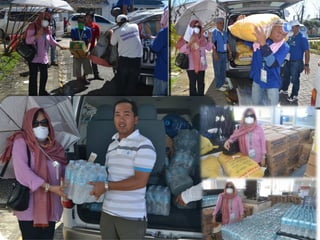
  • #29 The same assistance scheme will be especially provided for free to those affected by disasters (e.g. typhoon haiyan/ yolanda) yet are interested to start Halal enterprise. With this approach, the government will not simply spoon-feed the victims but rather provide them livelihood which is a far more sustainable option of assistance with long-term benefits.
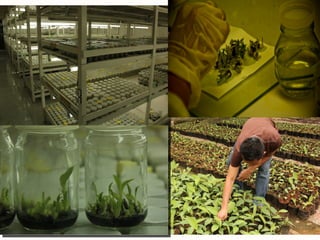
  • #41 DOST XII Halal Research and Development (R&D) is focused on developing new technologies and new products and on generating more Intellectual Property (IP) assets for techno-transfer and commercialization for the Halal industry meeting market requirements and for public good improving quality of life thru public-private sectors partnerships.
  • #42 This shows the crucial role of our Halal S&T interventions in the industry.
  • #45 Certification Bodies must have documented Halal Quality Management System that is internationally recognized. QMS is....
  • #50 The DOST XII being managed by yours truly, the only Muslim Official in the middle management of DOST, supported by Muslim technical and laboratory personnel and having ISO/ IEC 17025 Accredited Laboratories complemented with Certified ISO 9001:2008 Quality Management System possesses the competence and capabilities to spearhead the development of the Halal industry in the country thru Science, Technology and Innovation. All Research and Development Institutes as well as regional offices of DOST have its own respective laboratories BUT ONLY DOST XII has Laboratory ESPECIALLY DEDICATED TO HALAL.
  • #56 Upgrading of the Halal Information Management System is on-going that includes Traceability and Surveillance System for Halal. Acquisition of IT equipment for the Halal Information Management System is on-going. Gained ICT support for Halal from Malaysia, Thailand and other countries.
  • #61 As an offshoot of the forum, the Regional Development Council XII (RDC XII) Resolution No. 05, Series of 2008 entitled: “A Resolution Supporting and Adopting the Philippine Science and Technology Program for the Development of the Halal Industry” was formulated and adopted.
  • #62 As an offshoot of the forum, the Regional Development Council XII (RDC XII) Resolution No. 05, Series of 2008 entitled: “A Resolution Supporting and Adopting the Philippine Science and Technology Program for the Development of the Halal Industry” was formulated and adopted.
  • #68 It was during the NHF 2013 where primary Halal stakeholders from the government, academe, private sector/ industry/ Certification entities of the country unite with common endeavor and inked Memorandum of Agreements as well as declared commitments publicly delivered by no less than Ministers/ Deputy Ministers from the government; President from a State University; and CEO from the Chamber of Commerce and Export Association representing the private sector/ industry.
  • #75 With our S&T interventions, many have been aware of the complexity in the food supply and value chains, thereby Muslims and even non-Muslim consumers are now looking for seal of quality for guaranteed Halalness of product. With increasing awareness on Halal S&T, many CBs with no technical competence stopped their operations, acknowledging that Halal laboratory services could provide better and far more assurance in addition to plant surveillance/ audit and other related ocular inspections. Consumers are now confident enough that Halal certified products which pass thru laboratory tests and analyses are completely processed Halal. With S&T interventions from the government, not only companies but SMEs as well are now availing similar opportunities in Halal business, and Halal producers especially in the food sector can now avail free technical assistance to boost their credibility and integrity of their products. With S&T interventions, particularly thru education, technology-trainings and consultancies, manpower capabilities of SMEs have been developed and companies can now hire competent manpower. In fact, yours truly is a Regent of Governing Boards of State Universities in the region in which I was able to convince a number of universities to include in their curricula, Halal and Halal Science as either regular or elective subjects. Moreover, relevant issues and concerns on Halal have been identified, brought out and rationally dicussed, clarified and addressed with the conduct of series of National Halal Fora and other S&T related activities,.
  • #76 With our S&T interventions, many have been aware of the complexity in the food supply and value chains, thereby Muslims and even non-Muslim consumers are now looking for seal of quality for guaranteed Halalness of product. With increasing awareness on Halal S&T, many CBs with no technical competence stopped their operations, acknowledging that Halal laboratory services could provide better and far more assurance in addition to plant surveillance/ audit and other related ocular inspections. Consumers are now confident enough that Halal certified products which pass thru laboratory tests and analyses are completely processed Halal. With S&T interventions from the government, not only companies but SMEs as well are now availing similar opportunities in Halal business, and Halal producers especially in the food sector can now avail free technical assistance to boost their credibility and integrity of their products. With S&T interventions, particularly thru education, technology-trainings and consultancies, manpower capabilities of SMEs have been developed and companies can now hire competent manpower. In fact, yours truly is a Regent of Governing Boards of State Universities in the region in which I was able to convince a number of universities to include in their curricula, Halal and Halal Science as either regular or elective subjects. Moreover, relevant issues and concerns on Halal have been identified, brought out and rationally dicussed, clarified and addressed with the conduct of series of National Halal Fora and other S&T related activities,.
  • #84 We appreciate that the Japanese government has been taking initiatives on Halal resulting to the increasing number of Muslim tourists in the country.