Drug
Review
Presenter-
Dr Nikita Ingale
JR3 Pharmacology
Guide-
Dr Vijay Motghare
Professor and Head
Pharmacology
REVEFENACIN
[YUPELRI]
Introduction
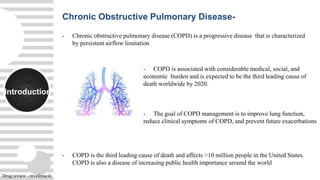
- Chronic obstructive pulmonary disease (COPD) is a progressive disease that is characterized
by persistent airflow limitation
- COPD is the third leading cause of death and affects >10 million people in the United States.
COPD is also a disease of increasing public health importance around the world
Chronic Obstructive Pulmonary Disease-
- COPD is associated with considerable medical, social, and
economic burden and is expected to be the third leading cause of
death worldwide by 2020.
- The goal of COPD management is to improve lung function,
reduce clinical symptoms of COPD, and prevent future exacerbations
Drug review - revefenacin
Introduction
- The mainstay maintenance treatment for COPD patients includes inhaled long-acting
muscarinic antagonist [LAMAs] and/or long-acting β2-agonists (LABAs) with or without
Inhaled corticosteroid
- Long-acting bronchodilators (e.g. LABAs or LAMAs) are often delivered via hand-held
devices, such as a dry powder inhaler (DPI) or a metered dose inhaler (MDI).
- However, some COPD patients [e.g. the elderly, cognitively impaired] find it difficult to use
such devices, resulting in inaccurate dosing, poor adherence, and potentially poor clinical
outcomes
- For these patients, nebulized drug delivery, which is easier to use and provides similar
efficacy to hand-held inhalers can be an alternative treatment option.
- Nebulized bronchodilator therapy options for the maintenance treatment of COPD are
currently limited
Current treatment of COPD-
Drug review - revefenacin
Revefenacin
- Revefenacin (YUPELRI) inhalation solution is a once daily nebulized LAMA that has been
developed by Theravance Biopharma and Mylan for the maintenance treatment of patients with
COPD
- Revefenacin is a potent, lung-selective LAMA that prevents
bronchoconstriction by inhibiting muscarinic M3 receptors in
airway smooth muscle.
- Revefenacin received its first global approval on 9 November 2018 in the USA for maintenance
treatment of patients with COPD.
Drug review - revefenacin
Revefenacin
Dose-
- The approved dosage of revefenacin inhalation solution is 175 μg once daily, delivered via a
standard jet nebulizer
- Revefenacin should not be used to relieve acute symptoms
of and should not be initiated in patients experiencing acutely
deteriorating or potentially life-threatening episodes of COPD
- Revefenacin should be discontinued immediately if patients develop paradoxical bronchospasm
or immediate hypersensitivity reactions
Drug review - revefenacin
Pharmaco
dynamics
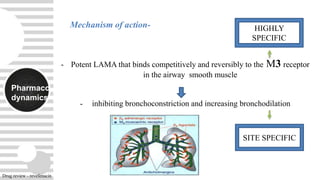
- Potent LAMA that binds competitively and reversibly to the M3 receptor
in the airway smooth muscle
- inhibiting bronchoconstriction and increasing bronchodilation
SITE SPECIFIC
HIGHLY
SPECIFIC
Mechanism of action-
Drug review - revefenacin
Pharmaco
kinetics
Metabolism of the drug-
- After inhaled administration in COPD patients, revefenacin is rapidly metabolized in the liver to
its major active metabolite (THRX-195518)
- In healthy volunteers and in COPD patients, peak plasma concentrations (Cmax) of revefenacin
and its active metabolite occurred 14–40 min after start of nebulization
- The absolute bioavailability of revefenacin following oral administration is very low (< 3%)
- Following intravenous administration of revefenacin in healthy volunteers, volume of distribution
was 218 L
- plasma protein binding for revefenacin averaged 71%
Drug review - revefenacin
Pharmaco
kinetics
-
- Following administration of a single radiolabeled oral dose of revefenacin, 88% of total
radioactivity was recovered in the feces and < 5% was present in urine, suggesting low oral
absorption. There was minimal renal excretion after inhaled revefenacin [<5%]
Dosage adjustments-
- systemic exposure are not significantly affected by age, gender,
smoking status or weight
- Revefenacin is not recommended in patients with any degree of hepatic impairment as the safety
of revefenacin has not been studied in COPD patients with mild to severe hepatic impairment
- Dosage adjustments are not required in patients with renal impairment
Excretion of the drug-
Drug review - revefenacin
Pharmaco
kinetics
Drug Interactions-
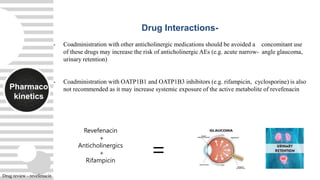
- Coadministration with other anticholinergic medications should be avoided a concomitant use
of these drugs may increase the risk of anticholinergic AEs (e.g. acute narrow- angle glaucoma,
urinary retention)
- Coadministration with OATP1B1 and OATP1B3 inhibitors (e.g. rifampicin, cyclosporine) is also
not recommended as it may increase systemic exposure of the active metabolite of revefenacin
Drug review - revefenacin
Revefenacin
+
Anticholinergics
+
Rifampicin
=
Adverse
events
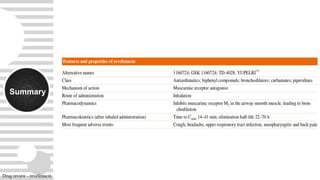
- Revefenacin inhalation solution was generally well tolerated in patients with moderate to very
severe COPD in clinical trials [ caution in narrow angle glaucoma patients]
- The most common AEs occurring in ≥ 2% of patients with a higher incidence in revefenacin
88 or 175 μg in recipients were-
- cough 4.0%
- headache 2.6%
- upper respiratory tract infection 2.1%
- nasopharyngitis 2.1%
- back pain 1%
- The incidence of antimuscarinic adverse events were low
Drug review - revefenacin
Current
status
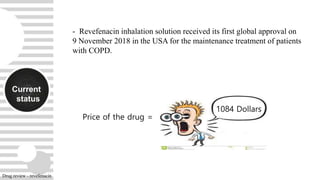
- Revefenacin inhalation solution received its first global approval on
9 November 2018 in the USA for the maintenance treatment of patients
with COPD.
Drug review - revefenacin
Price of the drug =
1084 Dollars
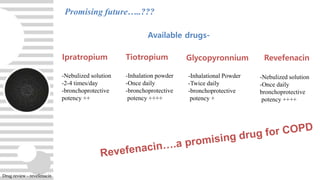
-Nebulized solution
-Once daily
bronchoprotective
potency ++++
Promising future…..???
Available drugs-
Ipratropium Tiotropium Glycopyronnium Revefenacin
-Inhalation powder
-Once daily
-bronchoprotective
potency ++++
-Inhalational Powder
-Twice daily
-bronchoprotective
potency +
-Nebulized solution
-2-4 times/day
-bronchoprotective
potency ++
Drug review - revefenacin
Summary
Drug review - revefenacin
References
- Young‐A Heo, Revefenacin: First Global Approval, DrugS(2019) 79:85–91
- https://doi.org/10.1007/s40265-018-1036-x
Drug review - revefenacin
Next PG activity
21/06/19
Journal reporting
Dr Rucha

Revefenacin

  • 1.
    Drug Review Presenter- Dr Nikita Ingale JR3Pharmacology Guide- Dr Vijay Motghare Professor and Head Pharmacology
  • 2.
  • 3.
    Introduction - Chronic obstructivepulmonary disease (COPD) is a progressive disease that is characterized by persistent airflow limitation - COPD is the third leading cause of death and affects >10 million people in the United States. COPD is also a disease of increasing public health importance around the world Chronic Obstructive Pulmonary Disease- - COPD is associated with considerable medical, social, and economic burden and is expected to be the third leading cause of death worldwide by 2020. - The goal of COPD management is to improve lung function, reduce clinical symptoms of COPD, and prevent future exacerbations Drug review - revefenacin
  • 4.
    Introduction - The mainstaymaintenance treatment for COPD patients includes inhaled long-acting muscarinic antagonist [LAMAs] and/or long-acting β2-agonists (LABAs) with or without Inhaled corticosteroid - Long-acting bronchodilators (e.g. LABAs or LAMAs) are often delivered via hand-held devices, such as a dry powder inhaler (DPI) or a metered dose inhaler (MDI). - However, some COPD patients [e.g. the elderly, cognitively impaired] find it difficult to use such devices, resulting in inaccurate dosing, poor adherence, and potentially poor clinical outcomes - For these patients, nebulized drug delivery, which is easier to use and provides similar efficacy to hand-held inhalers can be an alternative treatment option. - Nebulized bronchodilator therapy options for the maintenance treatment of COPD are currently limited Current treatment of COPD- Drug review - revefenacin
  • 5.
    Revefenacin - Revefenacin (YUPELRI)inhalation solution is a once daily nebulized LAMA that has been developed by Theravance Biopharma and Mylan for the maintenance treatment of patients with COPD - Revefenacin is a potent, lung-selective LAMA that prevents bronchoconstriction by inhibiting muscarinic M3 receptors in airway smooth muscle. - Revefenacin received its first global approval on 9 November 2018 in the USA for maintenance treatment of patients with COPD. Drug review - revefenacin
  • 6.
    Revefenacin Dose- - The approveddosage of revefenacin inhalation solution is 175 μg once daily, delivered via a standard jet nebulizer - Revefenacin should not be used to relieve acute symptoms of and should not be initiated in patients experiencing acutely deteriorating or potentially life-threatening episodes of COPD - Revefenacin should be discontinued immediately if patients develop paradoxical bronchospasm or immediate hypersensitivity reactions Drug review - revefenacin
  • 7.
    Pharmaco dynamics - Potent LAMAthat binds competitively and reversibly to the M3 receptor in the airway smooth muscle - inhibiting bronchoconstriction and increasing bronchodilation SITE SPECIFIC HIGHLY SPECIFIC Mechanism of action- Drug review - revefenacin
  • 8.
    Pharmaco kinetics Metabolism of thedrug- - After inhaled administration in COPD patients, revefenacin is rapidly metabolized in the liver to its major active metabolite (THRX-195518) - In healthy volunteers and in COPD patients, peak plasma concentrations (Cmax) of revefenacin and its active metabolite occurred 14–40 min after start of nebulization - The absolute bioavailability of revefenacin following oral administration is very low (< 3%) - Following intravenous administration of revefenacin in healthy volunteers, volume of distribution was 218 L - plasma protein binding for revefenacin averaged 71% Drug review - revefenacin
  • 9.
    Pharmaco kinetics - - Following administrationof a single radiolabeled oral dose of revefenacin, 88% of total radioactivity was recovered in the feces and < 5% was present in urine, suggesting low oral absorption. There was minimal renal excretion after inhaled revefenacin [<5%] Dosage adjustments- - systemic exposure are not significantly affected by age, gender, smoking status or weight - Revefenacin is not recommended in patients with any degree of hepatic impairment as the safety of revefenacin has not been studied in COPD patients with mild to severe hepatic impairment - Dosage adjustments are not required in patients with renal impairment Excretion of the drug- Drug review - revefenacin
  • 10.
    Pharmaco kinetics Drug Interactions- - Coadministrationwith other anticholinergic medications should be avoided a concomitant use of these drugs may increase the risk of anticholinergic AEs (e.g. acute narrow- angle glaucoma, urinary retention) - Coadministration with OATP1B1 and OATP1B3 inhibitors (e.g. rifampicin, cyclosporine) is also not recommended as it may increase systemic exposure of the active metabolite of revefenacin Drug review - revefenacin Revefenacin + Anticholinergics + Rifampicin =
  • 11.
    Adverse events - Revefenacin inhalationsolution was generally well tolerated in patients with moderate to very severe COPD in clinical trials [ caution in narrow angle glaucoma patients] - The most common AEs occurring in ≥ 2% of patients with a higher incidence in revefenacin 88 or 175 μg in recipients were- - cough 4.0% - headache 2.6% - upper respiratory tract infection 2.1% - nasopharyngitis 2.1% - back pain 1% - The incidence of antimuscarinic adverse events were low Drug review - revefenacin
  • 12.
    Current status - Revefenacin inhalationsolution received its first global approval on 9 November 2018 in the USA for the maintenance treatment of patients with COPD. Drug review - revefenacin Price of the drug = 1084 Dollars
  • 13.
    -Nebulized solution -Once daily bronchoprotective potency++++ Promising future…..??? Available drugs- Ipratropium Tiotropium Glycopyronnium Revefenacin -Inhalation powder -Once daily -bronchoprotective potency ++++ -Inhalational Powder -Twice daily -bronchoprotective potency + -Nebulized solution -2-4 times/day -bronchoprotective potency ++ Drug review - revefenacin
  • 14.
  • 15.
    References - Young‐A Heo,Revefenacin: First Global Approval, DrugS(2019) 79:85–91 - https://doi.org/10.1007/s40265-018-1036-x Drug review - revefenacin
  • 16.