School Effectiveness as a 
Function of Organizational 
Structure, Organizational Culture 
and School Programs: An Initial 
Approximation for Quality 
Assurance 
Helen Sumagaysay Losbañes 
Researcher
Members: 
Doris J. Santos 
Ritchie C. Lozano 
Analyn A. Carag 
Emmie Rita Fontanilla 
Carleen Aquino 
Zyth Mark Apusaga 
Cathy M. Calalung 
Joana Kristel I. Mata
I. Statement of the Problem 
The main purpose of this study 
was to determine school 
effectiveness as a function of 
organizational structure, 
organizational culture and school 
programs which is an initial 
approximation for quality assurance. 
Specifically, it sought to answer the 
following questions:
1. What is the profile of the principals 
in terms of the following: 
1.1 Language spoken at Home; 
1.2 Regional Origin; 
1.3 Sex; 
1.4 Age; 
1.5 Civil Status; 
1.6 Health; 
1.7 Socio-Economic Status; 
1.8 Special Talents; 
1.9 Hobbies;
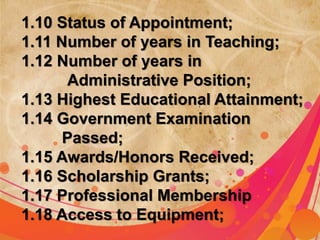
1.10 Status of Appointment; 
1.11 Number of years in Teaching; 
1.12 Number of years in 
Administrative Position; 
1.13 Highest Educational Attainment; 
1.14 Government Examination 
Passed; 
1.15 Awards/Honors Received; 
1.16 Scholarship Grants; 
1.17 Professional Membership 
1.18 Access to Equipment;
1.19 Reading Materials Available at 
Home; 
1.20 Attendance to 
Conferences/Seminars/Conventions; 
1.21 Nature of Participation in 
Conferences/Conventions; and 
1.22 Scholarly Works/Publications
2. What is the level of effectiveness of 
the organizational structure of the 
private elementary schools in terms 
of: 
2.1 Leadership; 
2.2 Motivation; 
2.3 Communication; 
2.4 Decision Making; 
2.5 Goal Setting; 
2.6 Creativity; and 
2.7 Control?
3. What is the level of effectiveness of 
the organizational culture of the 
private elementary schools in terms 
of: 
3.1 Team Orientation; 
3.2 Innovation; 
3.3 Attention to Detail; 
3.4 Outcome Orientation 
3.5 People Orientation; 
3.6 Aggresiveness; and 
3.7 Stabilty?
4. What is the level of effectiveness of 
the school programs of the 
selected private elementary 
schools in terms ; 
of: 
4.1 Mission, Goals and Objectives 
4.2 The Teacher; 
4.3 Curriculum/Instruction; 
4.4 The Administration; 
4.5 The School Environment; and 
4.6 The Learner?
5. Are there significant differences in 
the perception of administrators 
and teachers in terms of the 
following: 
5.1 Level of effectiveness of 
Organizational Structure; 
5.2 Level of effectiveness of 
Organizational Culture; and 
5.3 Level of Effectiveness in the 
School Programs?
6. What is the trend of achievement 
within the last five (5) years in 
terms of National Elementary 
Achievement Test (NEAT) Results 
of Grade VI in the selected private 
schools? 
7. Based on the findings, what are the 
proposed monitoring guidelines 
that can be developed to assist 
private schools in sustaining 
quality assurance?
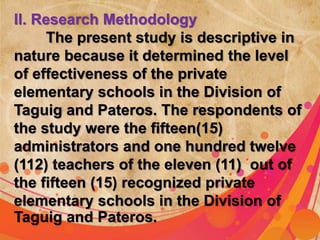
II. Research Methodology 
The present study is descriptive in 
nature because it determined the level 
of effectiveness of the private 
elementary schools in the Division of 
Taguig and Pateros. The respondents of 
the study were the fifteen(15) 
administrators and one hundred twelve 
(112) teachers of the eleven (11) out of 
the fifteen (15) recognized private 
elementary schools in the Division of 
Taguig and Pateros.
A one hundred eighty one (181) 
item questionnaire which was divided 
into 3 parts were used namely: the Level 
of Organizational Effectiveness in terms 
of Organizational Structure 63 items; the 
Level of Organizational Effectiveness in 
terms of Organizational Culture 65 items 
and the Level of Organizational 
Effectiveness of the School Programs 
53 items which were used to gather data 
needed for the study.
The judgmental validity of the 
instrument was established by four (4) 
experts in educational administration 
and accreditation. The construct validity 
and internal consistency of the 
instrument were established through 
item component and Inter component 
correlation Matrix. An observation guide 
and an interview were also used to 
verify the veracity of the information 
and the gathered data.
The data were submitted to the 
University of the Philippine Computer 
Center for the following statistical 
procedures: frequency and percentage 
distribution to describe the socio-demographic 
profile of the respondents; 
mean to determine the level of 
effectiveness of the organizational 
structure, organizational culture and the 
school programs; standard deviation to 
measure the variations as to the quality 
of the data
based on the perception of the 
respondents; Pearson rxy Product 
Moment Correlation to establish the 
validity and internal consistency 
(reliability) of the ; Pearson 
instrument and t-test 
of Independent Samples to find out the 
difference in the perception of teachers 
and principals in terms of the 
effectiveness of the organizational 
structure, organizational culture and 
and the school program.
III. Summary of the Findings 
1. Socio-Demographic Profile 
Majority of the respondents 
(73.30%) use English as one the 
languages spoken at home, (33.33%) are 
Tagalog/s Ilongos and most of the 
principals are females, (53.30%) ages 
between 30-51 years old and majority 
(73.30%) are married while 40% have 
very satisfactory health condition. 
Of the fifteen principals, 60% 
have a family monthly gross income b
Between PhP 10,000-PhP 30,000 and 
almost all principals own a house and lot 
86.70% and 66.70% have 0-2 number of 
children. 
Most of them 40% have special talents 
in playing ballgames, while almost 93.30% 
are fond of reading and the same 
percentage enjoy their permanent work 
status. Though, 20% taught for less than a 
year most of the principles have teaching 
experiences ranging between 5 to 36 years 
old and been in the administrative position 
for 5 years and above.
Only few principals met the mandated 
qualifications (26.70%) to be a holder of 
Master of Arts degree but 100% are 
eligible. While majority of the principals 
(66.70%) are not recipients of any award 
nor enjoyed scholarship grants (86.70%) 
and more than half 53.30% have no 
Professional affiliation. Moreover, 100% 
have daily newspaper at home while 
86.70% have access to TV/VCD/DVD and 
the same number have attendance to local 
or division level doing an active role
53.30% as facilitator or speaker in 
seminars or conventions and the same 
number revealed of their scholarly 
contributions in the academe as an 
author/contributor in different publications 
or with unpublished thesis or dissertation. 
2. Level of Effectiveness of 
Organizational Structure 
The principals rated their level of 
effectiveness “very satisfactory” as 
revealed by overall weighted mean of 
4.25.While the teachers rated the
the level of effectiveness of the principals 
“very satisfactory” with the overall 
weighted mean of 4.09. 
3. The Level of Effectiveness of 
Organizational Culture 
In terms of Organizational Culture, the 
principal rated their effectiveness “ very 
satisfactory” as evidenced by an overall 
weighted mean of 4.23. Similarly, the 
teachers rated the level of effectiveness of 
the principal’s “very satisfactory” with an 
average weighted mean of 4.40.
4. The Level of Effectiveness of the School 
Programs 
The principal rated their level of 
effectiveness of the School Programs 
“very satisfactory” as revealed by an 
overall weighted mean of 4.23. Likewise, 
the teachers rayed the level of 
effectiveness of the school programs “very 
satisfactory” with an average weighted 
mean of 4.11
The rating “Very Satisfactory” means 
that both the teachers and principals 
observe their schools with very competent 
or acceptable characteristics based on the 
given statement. 
5. Differences in the Perception of the 
Principals and Teachers 
There is a significant difference 
between the perceptions of the principals 
and teachers in terms of organizational 
structure and organizational culture while 
both have the same perception as to the 
effectiveness of the school programs.
6. The trend of Achievement 
Most schools had ascending trend of 
Achievement based on the National 
Elementary Achievement Tests (NEAT) 
administered by DepED. 
7. Proposed Monitoring guidelines for 
Quality Assurance 
A monitoring guidelines has been 
developed to assist private elementary 
schools in order to sustain quality 
assurance.
IV. Conclusions 
Based on the findings of this study, 
the following conclusions are drawn: 
1. That all private elementary school 
principals are eligible, have sense of 
enjoyment in their work as manifestedin 
their long years of teaching experiences 
and administrative works. In addition, their 
active role and participation in seminars 
and conventions can be linked with their 
exposure to educational reading materials 
and accessibility to audiovisual 
equipments.
2. That the present level of effectiveness of 
the organizational structure and 
organizational culture as perceived by both 
the principals and the teachers are very 
satisfactory. While they have different 
perceptions in the level of effectiveness of 
the school programs. 
3. That there is a significant difference in 
the perception of the administrators on the 
level of effectiveness of organizational 
structure and organizational culture. 
However, there is no significant difference in 
their perception as to the level of 
effectiveness of the school programs.
4. That most schools had ascending trend 
of achievements based on the National 
Elementary Achievement Tests (NEAT) 
administered by the Department of 
Education. 
5. That the Proposed Monitoring 
Guideline to sustain quality assurance is 
needed to assist schools.
Recommendations: 
Based on the findings and conclusions of 
this study, the following implications were 
drawn, and could serve as basis for 
recommendations: 
1. The private elementary school principals 
should enroll in post graduate course not only to 
meet the requirement mandated by DepEd but 
also to enhance their administrative and 
leadership skills in order to enrich their level of 
effectiveness in terms of the school programs.
2. The private school principals should not 
only focus on their cognitive and affective 
skills but rather they should also develop 
their special talents and skills which 
greatly influence and affect the level of 
effectiveness of the school culture
Reasearch mapping
Reasearch mapping

Reasearch mapping

  • 1.
    School Effectiveness asa Function of Organizational Structure, Organizational Culture and School Programs: An Initial Approximation for Quality Assurance Helen Sumagaysay Losbañes Researcher
  • 2.
    Members: Doris J.Santos Ritchie C. Lozano Analyn A. Carag Emmie Rita Fontanilla Carleen Aquino Zyth Mark Apusaga Cathy M. Calalung Joana Kristel I. Mata
  • 3.
    I. Statement ofthe Problem The main purpose of this study was to determine school effectiveness as a function of organizational structure, organizational culture and school programs which is an initial approximation for quality assurance. Specifically, it sought to answer the following questions:
  • 4.
    1. What isthe profile of the principals in terms of the following: 1.1 Language spoken at Home; 1.2 Regional Origin; 1.3 Sex; 1.4 Age; 1.5 Civil Status; 1.6 Health; 1.7 Socio-Economic Status; 1.8 Special Talents; 1.9 Hobbies;
  • 5.
    1.10 Status ofAppointment; 1.11 Number of years in Teaching; 1.12 Number of years in Administrative Position; 1.13 Highest Educational Attainment; 1.14 Government Examination Passed; 1.15 Awards/Honors Received; 1.16 Scholarship Grants; 1.17 Professional Membership 1.18 Access to Equipment;
  • 6.
    1.19 Reading MaterialsAvailable at Home; 1.20 Attendance to Conferences/Seminars/Conventions; 1.21 Nature of Participation in Conferences/Conventions; and 1.22 Scholarly Works/Publications
  • 7.
    2. What isthe level of effectiveness of the organizational structure of the private elementary schools in terms of: 2.1 Leadership; 2.2 Motivation; 2.3 Communication; 2.4 Decision Making; 2.5 Goal Setting; 2.6 Creativity; and 2.7 Control?
  • 8.
    3. What isthe level of effectiveness of the organizational culture of the private elementary schools in terms of: 3.1 Team Orientation; 3.2 Innovation; 3.3 Attention to Detail; 3.4 Outcome Orientation 3.5 People Orientation; 3.6 Aggresiveness; and 3.7 Stabilty?
  • 9.
    4. What isthe level of effectiveness of the school programs of the selected private elementary schools in terms ; of: 4.1 Mission, Goals and Objectives 4.2 The Teacher; 4.3 Curriculum/Instruction; 4.4 The Administration; 4.5 The School Environment; and 4.6 The Learner?
  • 10.
    5. Are theresignificant differences in the perception of administrators and teachers in terms of the following: 5.1 Level of effectiveness of Organizational Structure; 5.2 Level of effectiveness of Organizational Culture; and 5.3 Level of Effectiveness in the School Programs?
  • 11.
    6. What isthe trend of achievement within the last five (5) years in terms of National Elementary Achievement Test (NEAT) Results of Grade VI in the selected private schools? 7. Based on the findings, what are the proposed monitoring guidelines that can be developed to assist private schools in sustaining quality assurance?
  • 12.
    II. Research Methodology The present study is descriptive in nature because it determined the level of effectiveness of the private elementary schools in the Division of Taguig and Pateros. The respondents of the study were the fifteen(15) administrators and one hundred twelve (112) teachers of the eleven (11) out of the fifteen (15) recognized private elementary schools in the Division of Taguig and Pateros.
  • 13.
    A one hundredeighty one (181) item questionnaire which was divided into 3 parts were used namely: the Level of Organizational Effectiveness in terms of Organizational Structure 63 items; the Level of Organizational Effectiveness in terms of Organizational Culture 65 items and the Level of Organizational Effectiveness of the School Programs 53 items which were used to gather data needed for the study.
  • 14.
    The judgmental validityof the instrument was established by four (4) experts in educational administration and accreditation. The construct validity and internal consistency of the instrument were established through item component and Inter component correlation Matrix. An observation guide and an interview were also used to verify the veracity of the information and the gathered data.
  • 15.
    The data weresubmitted to the University of the Philippine Computer Center for the following statistical procedures: frequency and percentage distribution to describe the socio-demographic profile of the respondents; mean to determine the level of effectiveness of the organizational structure, organizational culture and the school programs; standard deviation to measure the variations as to the quality of the data
  • 16.
    based on theperception of the respondents; Pearson rxy Product Moment Correlation to establish the validity and internal consistency (reliability) of the ; Pearson instrument and t-test of Independent Samples to find out the difference in the perception of teachers and principals in terms of the effectiveness of the organizational structure, organizational culture and and the school program.
  • 17.
    III. Summary ofthe Findings 1. Socio-Demographic Profile Majority of the respondents (73.30%) use English as one the languages spoken at home, (33.33%) are Tagalog/s Ilongos and most of the principals are females, (53.30%) ages between 30-51 years old and majority (73.30%) are married while 40% have very satisfactory health condition. Of the fifteen principals, 60% have a family monthly gross income b
  • 18.
    Between PhP 10,000-PhP30,000 and almost all principals own a house and lot 86.70% and 66.70% have 0-2 number of children. Most of them 40% have special talents in playing ballgames, while almost 93.30% are fond of reading and the same percentage enjoy their permanent work status. Though, 20% taught for less than a year most of the principles have teaching experiences ranging between 5 to 36 years old and been in the administrative position for 5 years and above.
  • 19.
    Only few principalsmet the mandated qualifications (26.70%) to be a holder of Master of Arts degree but 100% are eligible. While majority of the principals (66.70%) are not recipients of any award nor enjoyed scholarship grants (86.70%) and more than half 53.30% have no Professional affiliation. Moreover, 100% have daily newspaper at home while 86.70% have access to TV/VCD/DVD and the same number have attendance to local or division level doing an active role
  • 20.
    53.30% as facilitatoror speaker in seminars or conventions and the same number revealed of their scholarly contributions in the academe as an author/contributor in different publications or with unpublished thesis or dissertation. 2. Level of Effectiveness of Organizational Structure The principals rated their level of effectiveness “very satisfactory” as revealed by overall weighted mean of 4.25.While the teachers rated the
  • 21.
    the level ofeffectiveness of the principals “very satisfactory” with the overall weighted mean of 4.09. 3. The Level of Effectiveness of Organizational Culture In terms of Organizational Culture, the principal rated their effectiveness “ very satisfactory” as evidenced by an overall weighted mean of 4.23. Similarly, the teachers rated the level of effectiveness of the principal’s “very satisfactory” with an average weighted mean of 4.40.
  • 22.
    4. The Levelof Effectiveness of the School Programs The principal rated their level of effectiveness of the School Programs “very satisfactory” as revealed by an overall weighted mean of 4.23. Likewise, the teachers rayed the level of effectiveness of the school programs “very satisfactory” with an average weighted mean of 4.11
  • 23.
    The rating “VerySatisfactory” means that both the teachers and principals observe their schools with very competent or acceptable characteristics based on the given statement. 5. Differences in the Perception of the Principals and Teachers There is a significant difference between the perceptions of the principals and teachers in terms of organizational structure and organizational culture while both have the same perception as to the effectiveness of the school programs.
  • 24.
    6. The trendof Achievement Most schools had ascending trend of Achievement based on the National Elementary Achievement Tests (NEAT) administered by DepED. 7. Proposed Monitoring guidelines for Quality Assurance A monitoring guidelines has been developed to assist private elementary schools in order to sustain quality assurance.
  • 25.
    IV. Conclusions Basedon the findings of this study, the following conclusions are drawn: 1. That all private elementary school principals are eligible, have sense of enjoyment in their work as manifestedin their long years of teaching experiences and administrative works. In addition, their active role and participation in seminars and conventions can be linked with their exposure to educational reading materials and accessibility to audiovisual equipments.
  • 26.
    2. That thepresent level of effectiveness of the organizational structure and organizational culture as perceived by both the principals and the teachers are very satisfactory. While they have different perceptions in the level of effectiveness of the school programs. 3. That there is a significant difference in the perception of the administrators on the level of effectiveness of organizational structure and organizational culture. However, there is no significant difference in their perception as to the level of effectiveness of the school programs.
  • 27.
    4. That mostschools had ascending trend of achievements based on the National Elementary Achievement Tests (NEAT) administered by the Department of Education. 5. That the Proposed Monitoring Guideline to sustain quality assurance is needed to assist schools.
  • 28.
    Recommendations: Based onthe findings and conclusions of this study, the following implications were drawn, and could serve as basis for recommendations: 1. The private elementary school principals should enroll in post graduate course not only to meet the requirement mandated by DepEd but also to enhance their administrative and leadership skills in order to enrich their level of effectiveness in terms of the school programs.
  • 29.
    2. The privateschool principals should not only focus on their cognitive and affective skills but rather they should also develop their special talents and skills which greatly influence and affect the level of effectiveness of the school culture