20 Outstanding Schools
Excelling Against the Odds
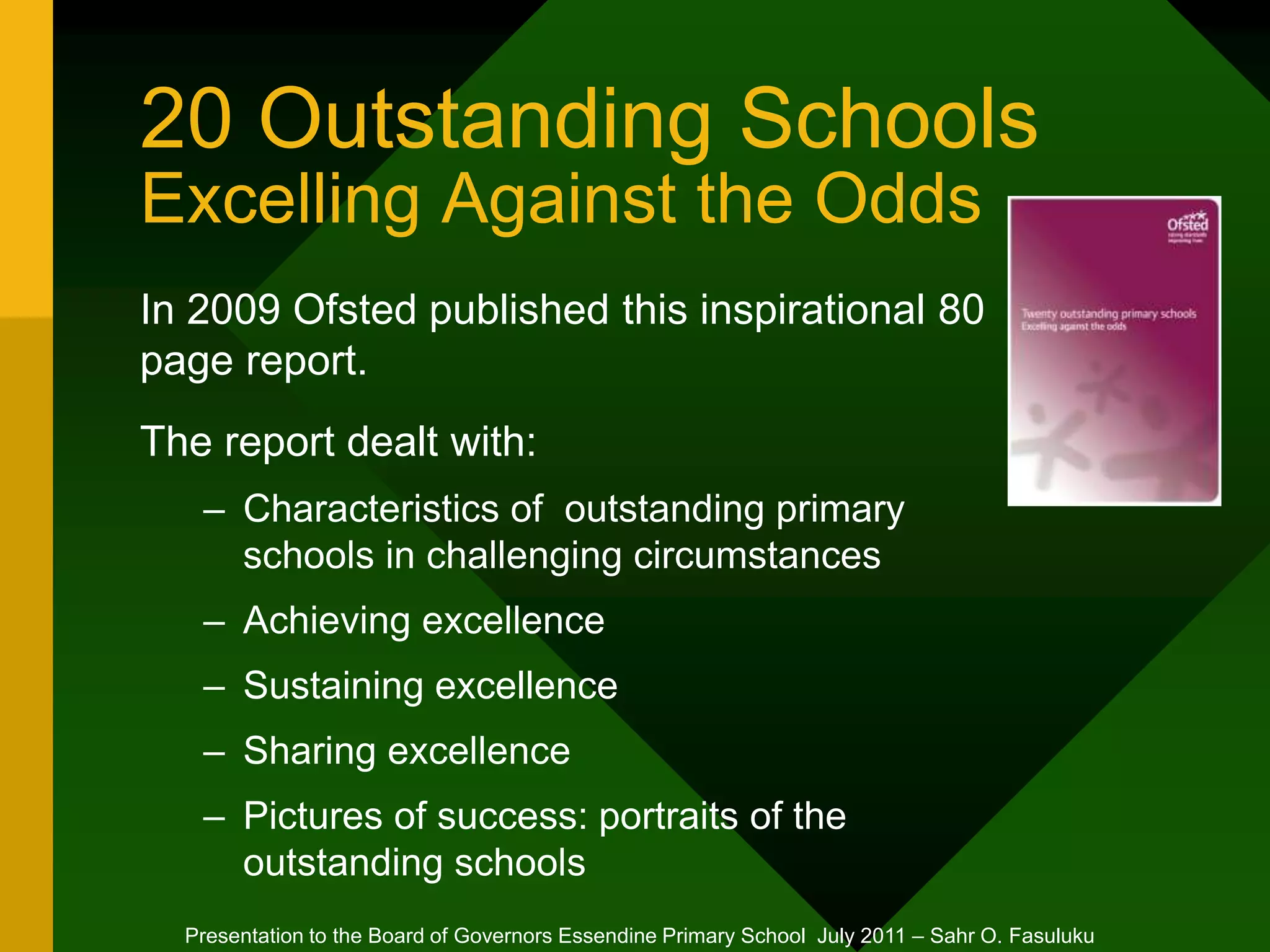
In 2009 Ofsted published this inspirational 80
page report.
The report dealt with:
– Characteristics of outstanding primary
schools in challenging circumstances
– Achieving excellence
– Sustaining excellence
– Sharing excellence
– Pictures of success: portraits of the
outstanding schools
Presentation to the Board of Governors Essendine Primary School July 2011 – Sahr O. Fasuluku
Why is this important for
Essendine stakeholders..? (1/2)
Because:
• At least 20 primary schools in very challenging
circumstances have succeeded in turning
themselves around and achieving CONSISTENT
ratings of OUTSTANDING over the last few years.
• This report shows it HAS been done by schools in
worse circumstances than ours, which means it
CAN be done by Essendine.
Why is this important for
Essendine stakeholders..? (2/2)
Because:
• The report gives 20 examples of HOW it was
done
• We need to be HIGHLY AWARE of WHAT
OUTSTANDING LOOKS LIKE in the real world
• Most importantly; the report lists WHAT
COMMON INGREDIENTS FOR SUCCESS the
schools ALL shared - for us to emulate.
• We don’t need to re-invent the wheel !!!!
Action
• I strongly recommend you;
1. read the full report or the 10 page summary
2. take note of the common ingredients for
success that the 20 schools share
3. incorporate these common characteristics into
Essendine’s improvement strategies
4. monitor and ensure Essendine’s delivery of
these characteristics
The benefits are self explanatory
Common Characteristics of the
20 Successful Schools (1/3)
•They excel against the odds and teach children to do the same.
•Outstanding in; leadership and management, teaching and
learning, and overall effectiveness
•Standards well above floor targets
•Contextual Value Added (CVA) score exceeding 100
•The passion of all who work in them for improving the chances
and well-being of individual children.
•They provide affection, stability and a purposeful and structured
experience.
•They build – and often rebuild – children’s self belief
Common Characteristics of the
20 Successful Schools (2/3)
•The schools teach children the things they really need to know
and show them how to learn for themselves and with others
•They give them opportunities, responsibility and trust in an
environment which is both stimulating and humanising.
•They listen to their pupils, value their views and reflect and act
on what they say.
•They build bridges with parents, families and communities,
working in partnership with other professionals. All the primary
schools were close to their communities; the best were PART of
them. Many had parent associations or ‘friends’ of the school,
parent helpers and a source of willing volunteers.
Common Characteristics of the
20 Successful Schools (3/3)
•They ensure their pupils progress as fast as possible and
achieve as much as possible (outperforming both similar
schools and many with fewer challenges).
•In short they put the child at the centre of everything they
do, and high aspirations, expectations and achievement
underpin the schools’ work.
•Primary schools in challenging circumstances invest heavily in
recognising symptoms of social deprivation, support children
through bad experiences, try to act to improve matters and
reduce threats to wellbeing and barriers to learning. This takes
commitment, belief, skills and resources. They do not wash their
hands of families, nor do they blame the child or home
circumstances.
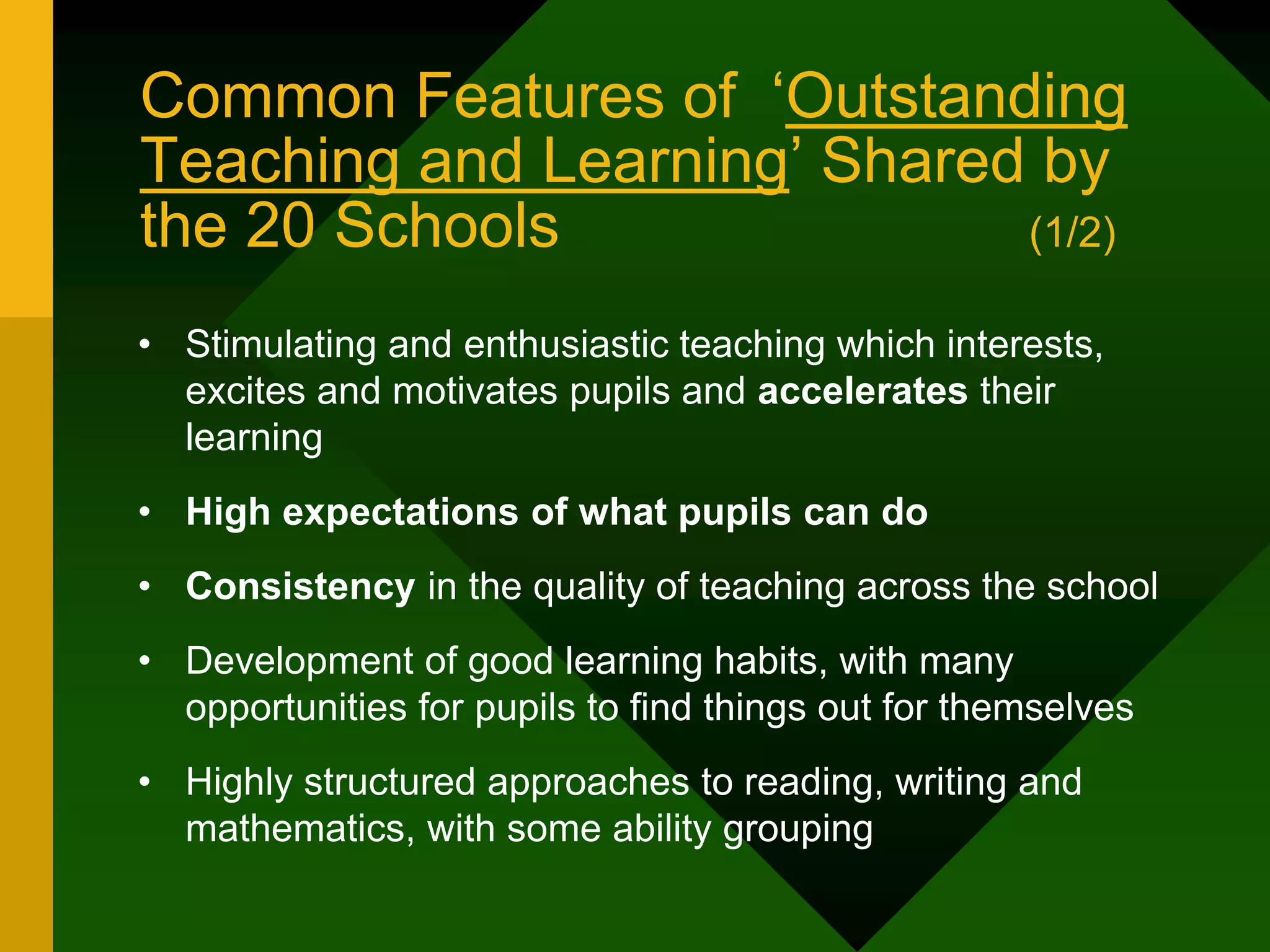
Common Features of ‘Outstanding
Teaching and Learning’ Shared by
the 20 Schools (1/2)
• Stimulating and enthusiastic teaching which interests,
excites and motivates pupils and accelerates their
learning
• High expectations of what pupils can do
• Consistency in the quality of teaching across the school
• Development of good learning habits, with many
opportunities for pupils to find things out for themselves
• Highly structured approaches to reading, writing and
mathematics, with some ability grouping
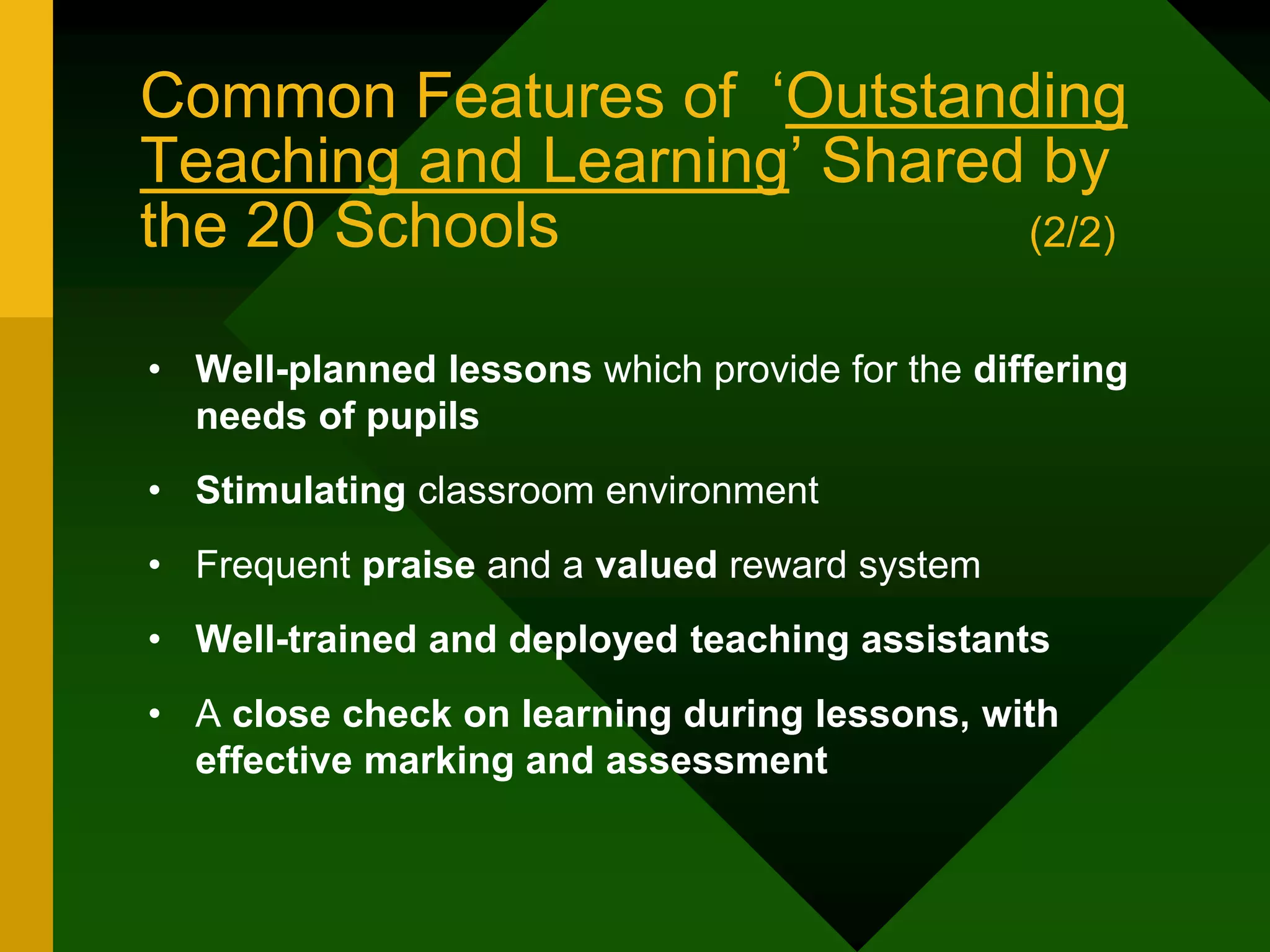
Common Features of ‘Outstanding
Teaching and Learning’ Shared by
the 20 Schools (2/2)
• Well-planned lessons which provide for the differing
needs of pupils
• Stimulating classroom environment
• Frequent praise and a valued reward system
• Well-trained and deployed teaching assistants
• A close check on learning during lessons, with
effective marking and assessment
‘Outstanding Curriculum Provision’
Common to all 20 Schools (1/2)
• Placing a strong emphasis on, and making exemplary
provision for, the basic skills
• Strengthening English, mathematics and science through
applications in other subjects and areas
• Writing for purpose in a variety of transactional styles
• Developing language by encouraging pupils to
communicate their understanding and evaluate their
learning
• Activities carefully tailored to widen pupils learning and
enrich their lives
‘Outstanding Curriculum Provision’
Common to all 20 Schools (2/2)
• A vibrant and exciting range of visits and stimulating
inputs
• Planning which tailors activities to individuals pupils
including the gifted and talented
• Well-managed homework carefully communicated to
pupils and parents
• Assessment and tracking of progress - common
factors include; rigour of assessment, continual
observation and assessment in foundation stage, careful
analysis of data and appropriate interventions.
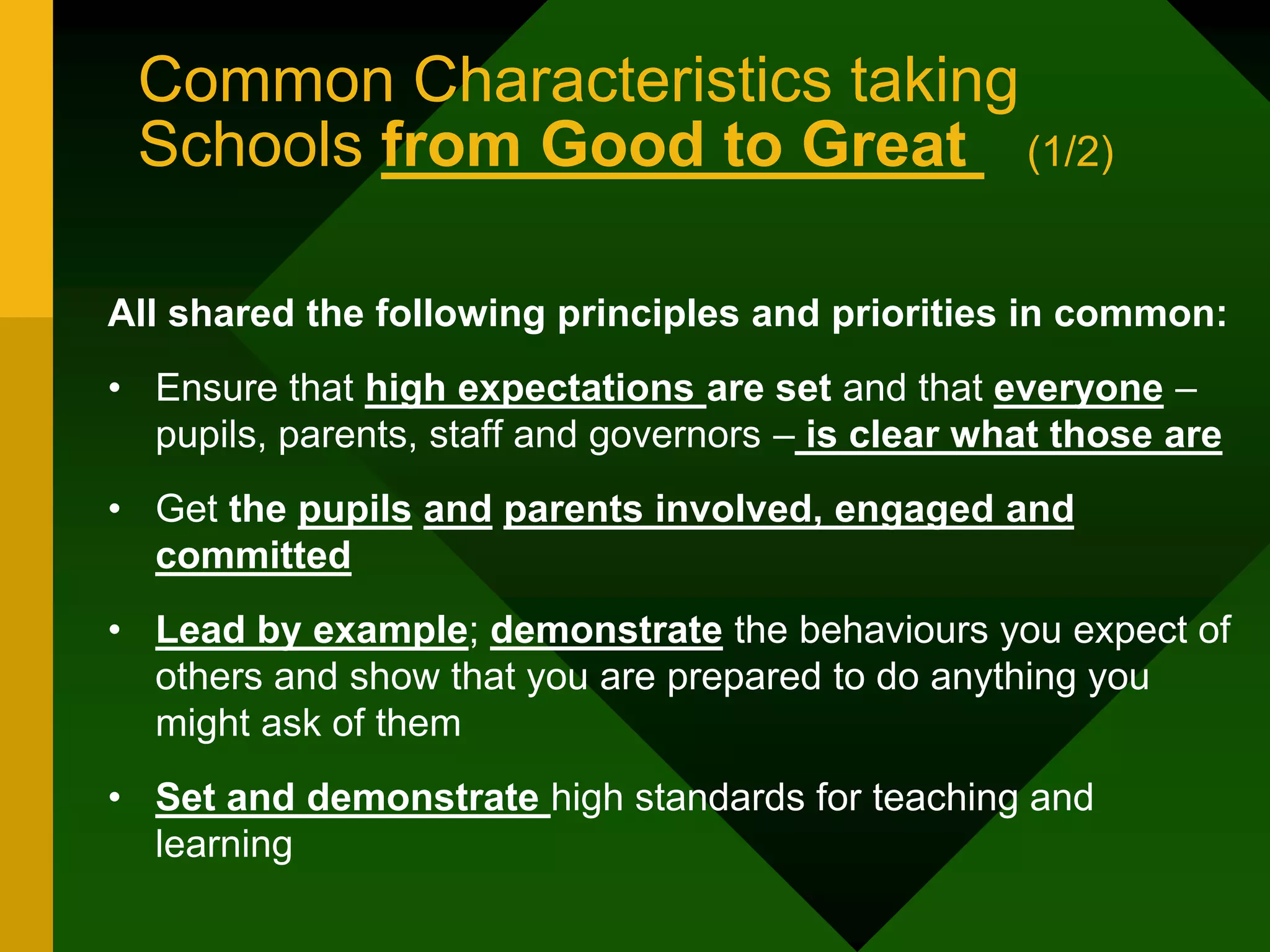
Common Characteristics taking
Schools from Good to Great (1/2)
All shared the following principles and priorities in common:
• Ensure that high expectations are set and that everyone –
pupils, parents, staff and governors – is clear what those are
• Get the pupils and parents involved, engaged and
committed
• Lead by example; demonstrate the behaviours you expect of
others and show that you are prepared to do anything you
might ask of them
• Set and demonstrate high standards for teaching and
learning
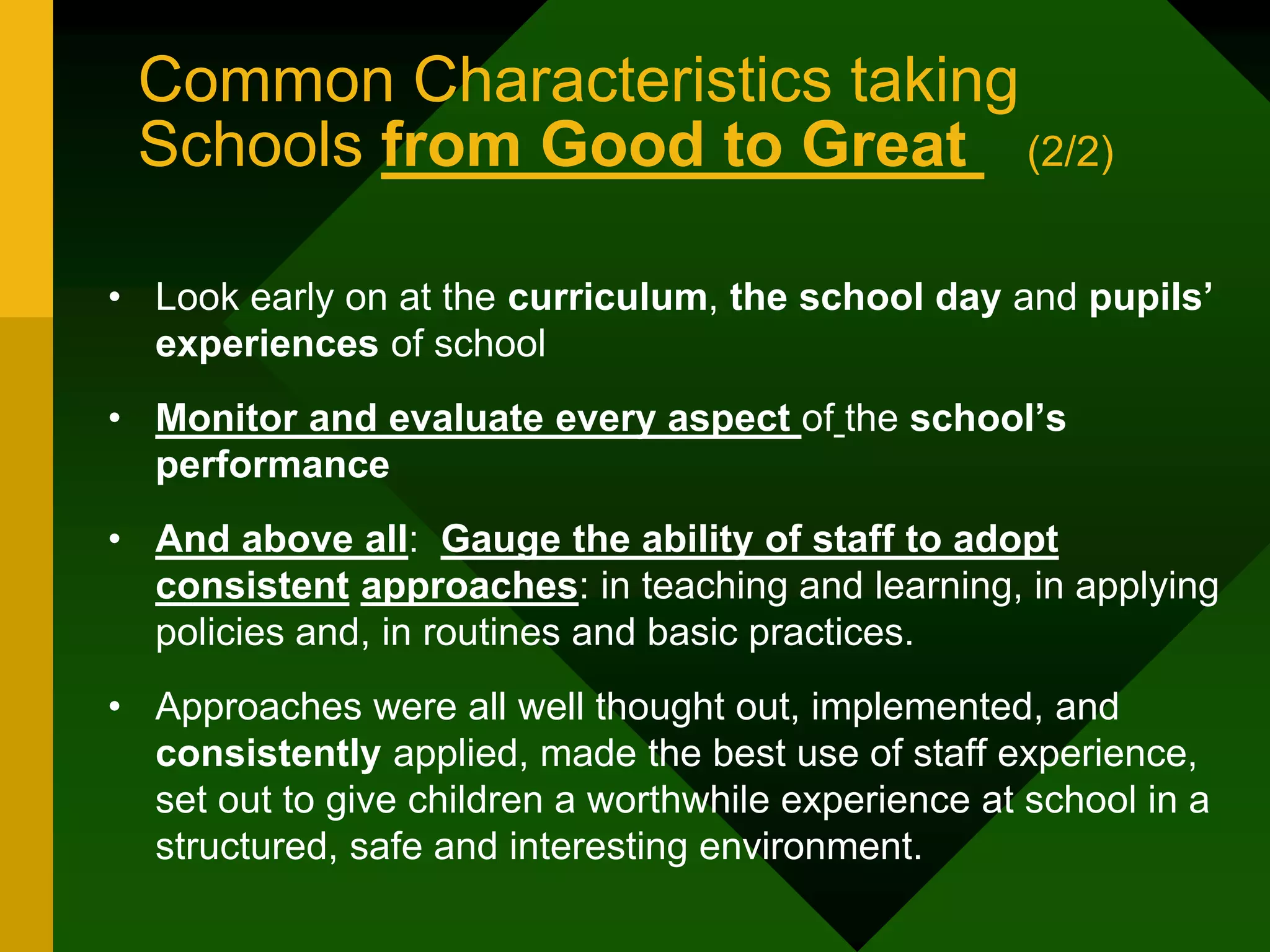
Common Characteristics taking
Schools from Good to Great (2/2)
• Look early on at the curriculum, the school day and pupils’
experiences of school
• Monitor and evaluate every aspect of the school’s
performance
• And above all: Gauge the ability of staff to adopt
consistent approaches: in teaching and learning, in applying
policies and, in routines and basic practices.
• Approaches were all well thought out, implemented, and
consistently applied, made the best use of staff experience,
set out to give children a worthwhile experience at school in a
structured, safe and interesting environment.
Sustaining Excellence
• This section of the report emphasises the centrality of
the child in everything the schools do, and their
approaches to inclusion.
• Important strategies include:
– gaining the trust of parents and the support of the
community
– not resting on laurels
– constant development of staff
– honing of teaching
– enrichment of the curriculum
– relentless monitoring and evaluation
Sharing Excellence
• Outstanding schools have much to offer other schools. By
virtue of overcoming their contextual challenges so
magnificently, these schools are resources for school
improvement.
• This section considers some of the mechanisms through
which the expertise and good practice of these schools are
disseminated. They include; system leadership, national
support schools, sharing best practise, mentors,
consultant leaders, training on behalf of local authority,
leading and brokering extended services, schools
partnerships and federation.
• Sharing excellence through outreach interactions and
partnerships with other educators and their schools are
indicators of a great school.
Recommendations
1. Read the 10 page summary or the full report
2. Take note of the common ingredients for
success that the 20 schools share, and other
strategies recommended by the report that
would benefit Essendine
3. Incorporate these into Essendine’s
improvement strategies
4. Monitor and ensure Essendine’s delivery of
them
Parting quote
• “ While contextual factors affect educational
outcomes, the culture and rhetoric of education have
shifted perceptibly in recent years. IT IS NO
LONGER ACCEPTABLE TO USE A CHILD’S
BACKGROUND AS AN EXCUSE FOR
UNDERACHIEVEMENT.
• Success arises out of the steady accumulation of
advantages. The job of the school is to provide
advantages where lacking, mentor and support
parenting where needed, and provide high ideals and
aspirations.” (20 Outstanding Schools Excelling Against the Odds - Ofsted
2009)
Presentation to the Board of Governors Essendine Primary School July 2011 – Sahr O. Fasuluku

20 outstanding schools did it in challenging circumstances !

  • 1.
    20 Outstanding Schools ExcellingAgainst the Odds In 2009 Ofsted published this inspirational 80 page report. The report dealt with: – Characteristics of outstanding primary schools in challenging circumstances – Achieving excellence – Sustaining excellence – Sharing excellence – Pictures of success: portraits of the outstanding schools Presentation to the Board of Governors Essendine Primary School July 2011 – Sahr O. Fasuluku
  • 2.
    Why is thisimportant for Essendine stakeholders..? (1/2) Because: • At least 20 primary schools in very challenging circumstances have succeeded in turning themselves around and achieving CONSISTENT ratings of OUTSTANDING over the last few years. • This report shows it HAS been done by schools in worse circumstances than ours, which means it CAN be done by Essendine.
  • 3.
    Why is thisimportant for Essendine stakeholders..? (2/2) Because: • The report gives 20 examples of HOW it was done • We need to be HIGHLY AWARE of WHAT OUTSTANDING LOOKS LIKE in the real world • Most importantly; the report lists WHAT COMMON INGREDIENTS FOR SUCCESS the schools ALL shared - for us to emulate. • We don’t need to re-invent the wheel !!!!
  • 4.
    Action • I stronglyrecommend you; 1. read the full report or the 10 page summary 2. take note of the common ingredients for success that the 20 schools share 3. incorporate these common characteristics into Essendine’s improvement strategies 4. monitor and ensure Essendine’s delivery of these characteristics The benefits are self explanatory
  • 5.
    Common Characteristics ofthe 20 Successful Schools (1/3) •They excel against the odds and teach children to do the same. •Outstanding in; leadership and management, teaching and learning, and overall effectiveness •Standards well above floor targets •Contextual Value Added (CVA) score exceeding 100 •The passion of all who work in them for improving the chances and well-being of individual children. •They provide affection, stability and a purposeful and structured experience. •They build – and often rebuild – children’s self belief
  • 6.
    Common Characteristics ofthe 20 Successful Schools (2/3) •The schools teach children the things they really need to know and show them how to learn for themselves and with others •They give them opportunities, responsibility and trust in an environment which is both stimulating and humanising. •They listen to their pupils, value their views and reflect and act on what they say. •They build bridges with parents, families and communities, working in partnership with other professionals. All the primary schools were close to their communities; the best were PART of them. Many had parent associations or ‘friends’ of the school, parent helpers and a source of willing volunteers.
  • 7.
    Common Characteristics ofthe 20 Successful Schools (3/3) •They ensure their pupils progress as fast as possible and achieve as much as possible (outperforming both similar schools and many with fewer challenges). •In short they put the child at the centre of everything they do, and high aspirations, expectations and achievement underpin the schools’ work. •Primary schools in challenging circumstances invest heavily in recognising symptoms of social deprivation, support children through bad experiences, try to act to improve matters and reduce threats to wellbeing and barriers to learning. This takes commitment, belief, skills and resources. They do not wash their hands of families, nor do they blame the child or home circumstances.
  • 8.
    Common Features of‘Outstanding Teaching and Learning’ Shared by the 20 Schools (1/2) • Stimulating and enthusiastic teaching which interests, excites and motivates pupils and accelerates their learning • High expectations of what pupils can do • Consistency in the quality of teaching across the school • Development of good learning habits, with many opportunities for pupils to find things out for themselves • Highly structured approaches to reading, writing and mathematics, with some ability grouping
  • 9.
    Common Features of‘Outstanding Teaching and Learning’ Shared by the 20 Schools (2/2) • Well-planned lessons which provide for the differing needs of pupils • Stimulating classroom environment • Frequent praise and a valued reward system • Well-trained and deployed teaching assistants • A close check on learning during lessons, with effective marking and assessment
  • 10.
    ‘Outstanding Curriculum Provision’ Commonto all 20 Schools (1/2) • Placing a strong emphasis on, and making exemplary provision for, the basic skills • Strengthening English, mathematics and science through applications in other subjects and areas • Writing for purpose in a variety of transactional styles • Developing language by encouraging pupils to communicate their understanding and evaluate their learning • Activities carefully tailored to widen pupils learning and enrich their lives
  • 11.
    ‘Outstanding Curriculum Provision’ Commonto all 20 Schools (2/2) • A vibrant and exciting range of visits and stimulating inputs • Planning which tailors activities to individuals pupils including the gifted and talented • Well-managed homework carefully communicated to pupils and parents • Assessment and tracking of progress - common factors include; rigour of assessment, continual observation and assessment in foundation stage, careful analysis of data and appropriate interventions.
  • 12.
    Common Characteristics taking Schoolsfrom Good to Great (1/2) All shared the following principles and priorities in common: • Ensure that high expectations are set and that everyone – pupils, parents, staff and governors – is clear what those are • Get the pupils and parents involved, engaged and committed • Lead by example; demonstrate the behaviours you expect of others and show that you are prepared to do anything you might ask of them • Set and demonstrate high standards for teaching and learning
  • 13.
    Common Characteristics taking Schoolsfrom Good to Great (2/2) • Look early on at the curriculum, the school day and pupils’ experiences of school • Monitor and evaluate every aspect of the school’s performance • And above all: Gauge the ability of staff to adopt consistent approaches: in teaching and learning, in applying policies and, in routines and basic practices. • Approaches were all well thought out, implemented, and consistently applied, made the best use of staff experience, set out to give children a worthwhile experience at school in a structured, safe and interesting environment.
  • 14.
    Sustaining Excellence • Thissection of the report emphasises the centrality of the child in everything the schools do, and their approaches to inclusion. • Important strategies include: – gaining the trust of parents and the support of the community – not resting on laurels – constant development of staff – honing of teaching – enrichment of the curriculum – relentless monitoring and evaluation
  • 15.
    Sharing Excellence • Outstandingschools have much to offer other schools. By virtue of overcoming their contextual challenges so magnificently, these schools are resources for school improvement. • This section considers some of the mechanisms through which the expertise and good practice of these schools are disseminated. They include; system leadership, national support schools, sharing best practise, mentors, consultant leaders, training on behalf of local authority, leading and brokering extended services, schools partnerships and federation. • Sharing excellence through outreach interactions and partnerships with other educators and their schools are indicators of a great school.
  • 16.
    Recommendations 1. Read the10 page summary or the full report 2. Take note of the common ingredients for success that the 20 schools share, and other strategies recommended by the report that would benefit Essendine 3. Incorporate these into Essendine’s improvement strategies 4. Monitor and ensure Essendine’s delivery of them
  • 17.
    Parting quote • “While contextual factors affect educational outcomes, the culture and rhetoric of education have shifted perceptibly in recent years. IT IS NO LONGER ACCEPTABLE TO USE A CHILD’S BACKGROUND AS AN EXCUSE FOR UNDERACHIEVEMENT. • Success arises out of the steady accumulation of advantages. The job of the school is to provide advantages where lacking, mentor and support parenting where needed, and provide high ideals and aspirations.” (20 Outstanding Schools Excelling Against the Odds - Ofsted 2009) Presentation to the Board of Governors Essendine Primary School July 2011 – Sahr O. Fasuluku