PRESENTED BY,
VISHALI NS
AGRICULTURAL PRICE POLICY
AGRICULTURE
PRICE
POLICY…
INTRODUCTION
• Agricultural Price Policy is one of the important instruments in
achieving food security by improving production,
employment and incomes of the farmers.
• There is a need to provide remunerative prices for farmers in
order to maintain food security and increase the incomes of
farmers
EVOLUTION OF AGRICULTURAL PRICE POLICY
• In the pre Independence era , the procurement and distribution of
major food grains were started and statutory maximum prices were
fixed, but were not strictly enforced.
• In the post Independence era, the objective of the Government’s
price policy for agri-produce is to set remunerative prices with a
view to encourage higher investment and production.
INSTITUTIONS
• The Government of India has set up some institutions are
the Agricultural Price Commission was set up in 1965 which
announced the minimum support prices and procurement
prices for the agricultural products.
• The Food Corporation of India was also set up in 1965 for
making necessary procurement, storage and distribution of
food grains.
• The Commission was renamed in 1985 as the Commission for
Agricultural Costs and Prices.
4 INSTRUMENTS OF APP
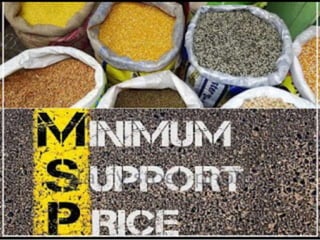
• Minimum support price (MSP)
• Procurement price
• Public distribution system (PDS)
• Buffer stock
MSP (PRICE POLICY OF KHARIF CROPS)
▪ The first and foremost mandate of CACP was to
recommend Minimum Support Prices (MSP).
▪ These prices are generally announced well in
advance of the sowing season.
▪ It is fixed based on the average cost of production.
OBJECTIVES
• The major objectives are to support the farmers from distress
sales and to procure food grains for public distribution.
• In case the market price for the commodity falls below
,government agencies purchase the entire quantity offered by
the farmers at the announced minimum price.
CROPS
UNDER MSP
● Cereals (7)-paddy, wheat, barley,
jowar, bajra, maize and ragi
● Pulses (5) - gram, arhar/tur,
moong, urad and lentil
● Oilseeds (8) - groundnut,
rapeseed/mustard, toria,
soyabean, sunflower seed,
sesamum, safflower seed and
nigerseed
● Raw cotton
● Raw jute
● Copra
● De-husked coconut
● Sugarcane (Fair and
remunerative price)
● Virginia flu cured (VFC) tobacco
Government announces
minimum support prices
(MSPs) for 22 mandated
crops. The mandated crops
are 14 crops of the kharif
season, 6 rabi crops and
two other commercial
crops
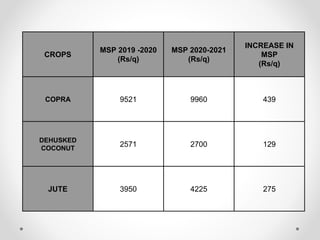
CROPS
MSP 2019 -2020
(Rs/q)
MSP 2020-2021
(Rs/q)
INCREASE IN
MSP
(Rs/q)
COPRA 9521 9960 439
DEHUSKED
COCONUT
2571 2700 129
JUTE 3950 4225 275
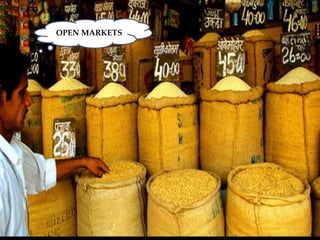
OPEN MARKETS
PROCUREMENT PRICES
• In a situation of shortage, sailable supplies of food grains in the free
market would generally be available at very high prices.
• Therefore, in view to achieve the objective of stabilizing prices on
the part of the consumers, the Govt., may adopt the system of public
distribution.
• It can be in the form of rationing, fair price shops.
• The best way to attain the stocks would be through the open market.
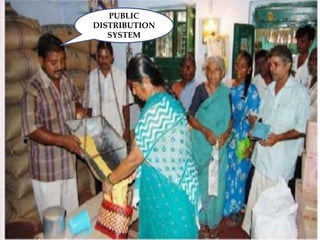
PUBLIC
DISTRIBUTION
SYSTEM
PDS
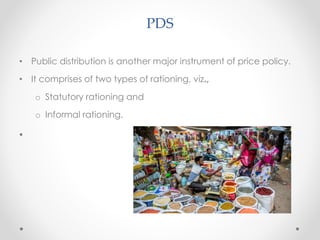
• Public distribution is another major instrument of price policy.
• It comprises of two types of rationing, viz.,
o Statutory rationing and
o Informal rationing.
•
TYPES OF RATIONING
STATUTORY RATIONING
• In the statutorily rationed areas, the open market is legally barred from
functioning, the Government undertakes the responsibility of supplying
specific rationed quantities to consumers.
INFORMAL RATIONING
• In the areas of informal rationing, the open market is allowed to function
so that the consumers can supplement the ration obtained from fair price
shops by purchase in the open market.
OBJECTIVES OF PDS
• The fundamental objectives of the system are enlisted below:
(i) To improve distribution of basic goods
(ii) To control prices of essential commodities
(iii) To meet consumption needs of masses
(iv) To maintain good quality at low cost
(v) To bring stability in prices
• In accordance to this criteria, cereals, sugar, edible oils, tea, coffee etc.
could be treated as precarious items for public distribution
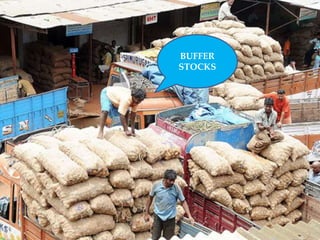
BUFFER
STOCKS
BUFFER STOCK
• Buffer stocks refer to the buying and selling out stock with sole
purpose of moderating the price fluctuations.
• Under this policy Govt., builds stocks of food either through
direct purchase from the domestic market or through imports
from outside and release these stocks for sale when prices are
going up.
CLASSIFICATION OF BUFFER STOCK
• The govt., has to keep operational stock need for meeting
the requirements of fair price shops.
• Therefore, size of stock is determined by two considerations
viz.;
1. To meet the current needs -seasonal fluctuations.
2. To maintain supply in the years of crop failure-annual
fluctuations
OBJECTIVES OF BUFFER STOCKS
• Stability in Income
• Stability in Food Prices
• Public Distribution System
• To Ensure Remunerative Price to Farmers
• Food Security
OBJECTIVES OF APP
• To Ensure Relation between Prices of Food-grains and
Agricultural Goods
• To Watch Interests of Producers and Consumers:
• Relation Between Prices of Crops
• To Control Seasonal Fluctuations
• Integrate the Price
• Stabilise the General Price
• Increase in Production
MAIN OBJECTIVES OF APP
• Facilities for All-Round Development
• Infrastructural Development
• Revising and Strengthening Co-Operatives
• Involvement of NGOs
• Encouragement to the farmers.
FEATURES OF POLICY
• Raising Capital Formation
• Enhancing Public Investment
• Raising the Flow of Credit
• Improving Agricultural Marketing
• Ensuring Remunerative Prices
• Raising Agro-Exports
• Land Reforms
• Treating Agriculture at Par with Industry
• Crop Insurance Scheme
TYPES OF PRICE POLICY
• The prices favourable to the producers of agricultural products
may work against the interest of the non-agricultural sector
vice-versa.
• The two types of price policy have been
o ‘Negative’ price policy
o ‘Positive’ price policies respectively.
Negative Price Policy:
• The main objectives of such a policy was to keep the prices of food and
raw materials relatively low (when compared with the prices of industrial
products) so as to facilitate the growth of the industrial and tertiary sectors
and to provide surpluses in the form of savings for these sectors.
Positive Price Policy
• The “positive” price policy which consists of light taxes on the agricultural
sector and also assure the farmer of a fair price for his produce.
EFFECTS OF APP
• Incentive to Increase Production
• Increase in the level of income of Farmers
• Price Stability
• Change in Cropping Pattern
• Benefit to Consumers
• Benefit to Industrials
DRAWBACKS OF APP
• Inadequate Coverage
• Remunerative Price
• Ineffective Public Distribution System
• Difference in Prices
• Unaccompanied by Effective Policy
CONCLUSION
The Government’s Price Policy for agricultural produce seeks
to ensure remunerative prices to growers for their produce with
a view to encourage higher investment and production as
well as safeguarding the interests of consumers by making
available supplies at reasonable prices.
REFERENCE
• Subba reddy ,S et al, (2018).Agricultural Economics. New Delhi.Oxford and IBH publishing
Co.Pvt.Ltd. 588
• Acharya, S S and N I Agarwal .(2006).Agricultural Marketing in India.New Delhi:
Delhi.Oxford and IBH publishing Co.Pvt.Ltd. 320
• Acharya ,S S.(1997). Agricultural price policy and Development Some facts and Emerging
Issues: Indian journal of Agricultural Economics 52 (1):1-47
• Dev Mahendra and C Nuthalapati.(2010). Agricultural price policy, Farm profitability and
food security: Economic & political weekly 45 (26):174-
182https://www.researchgate.net/publication/286701161_Agricultural_price_policy_farm_
profitability_and_food_security
• Patil,Anna . 2011.Agricultural Prices and Policies . Agri Eco :
10(1).https://www.researchgate.net/publication/220028105_AGRICULTURAL_PRICES_AND_
QUERIES TO CLEAR??...