1
CHAPTER 1: INTRODUCTION
PART A
OVERVIEW
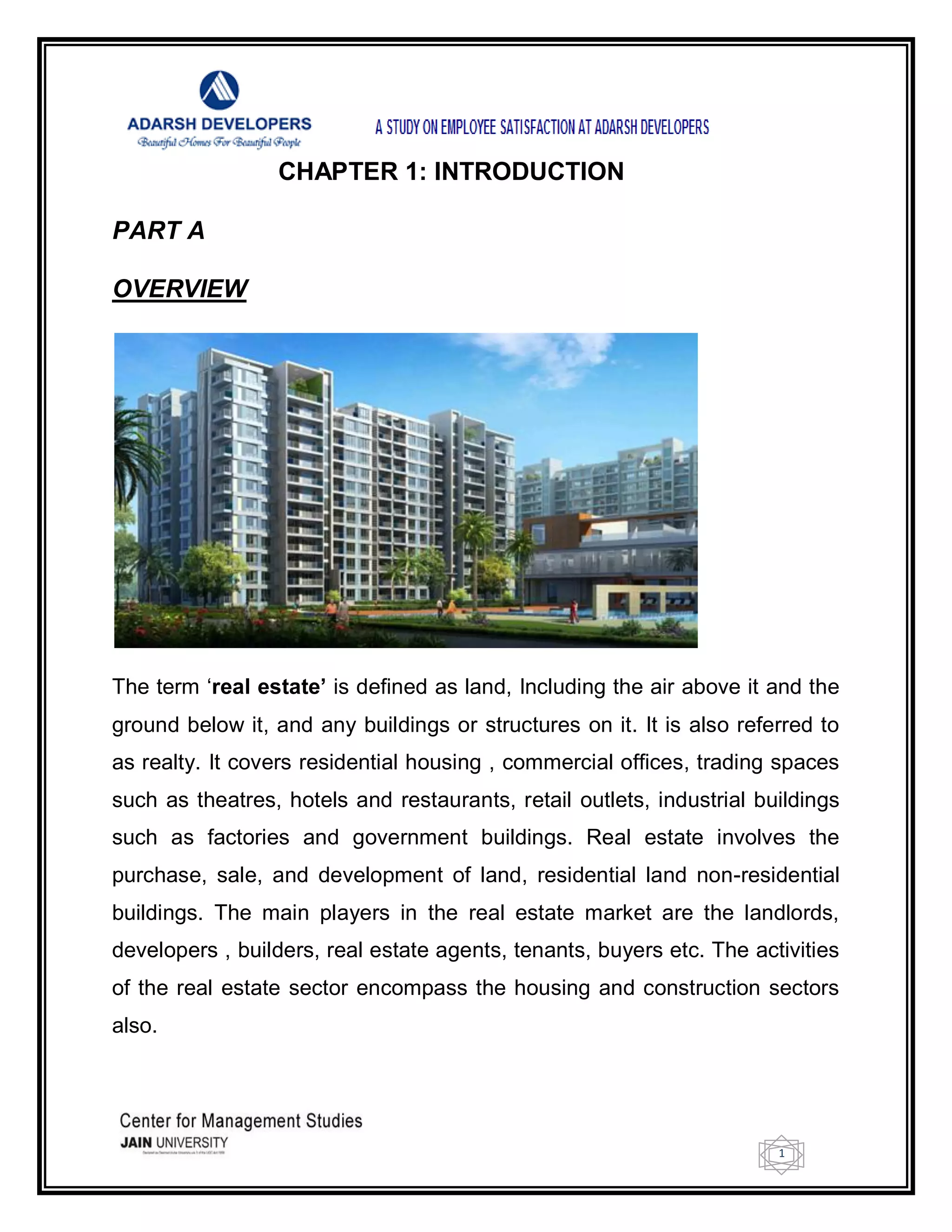
The term ‗real estate’ is defined as land, Including the air above it and the
ground below it, and any buildings or structures on it. It is also referred to
as realty. It covers residential housing , commercial offices, trading spaces
such as theatres, hotels and restaurants, retail outlets, industrial buildings
such as factories and government buildings. Real estate involves the
purchase, sale, and development of land, residential land non-residential
buildings. The main players in the real estate market are the landlords,
developers , builders, real estate agents, tenants, buyers etc. The activities
of the real estate sector encompass the housing and construction sectors
also.
2
The real estate sector in India has come a long way by becoming one of
the fastest growing markets in the world. It is not only successfully
attracting domestic real estate developers, but foreign investors as well.
The growth of the industry is attributed mainly to a large population base,
rising income level, and rapid urbanization. The sector comprises of four
sub-sectors- housing, retail, hospitality, and commercial.
While housing contributes to five-six percent of the country‘s gross
domestic product (GDP), the remaining three sub-sectors are also growing
at a rapid pace, meeting the increasing infrastructural needs. The real
estate sector has transformed from being unorganized to a dynamic and
organized sector over the past decade. Government policies have been
instrumental in providing support after recognizing the need for
infrastructure development in order to ensure better standard of living for its
citizens. In addition to this, adequate infrastructure forms a prerequisite for
sustaining the long-term growth momentum of the economy.
The Indian real estate sector is one of the most globally recognized
sectors. In the country, it is the second largest employer after agriculture
and is slated to grow at 30 per cent over the next decade. It comprises four
sub sectors - housing, retail, hospitality, and commercial. The growth of this
sector is well complemented by the growth of the corporate environment
and the demand for office space as well as urban and semi-urban
accommodations.
The real estate sector of India presently contributes about 5% to the
national GDP, is the second largest employer after the agricultural sector,
3
and is growing rapidly with a compound annual growth rate [CAGR] of over
11%. Currently, the real estate sector of India is the fourth biggest in
respect of FDI inflows [the Government of India has allowed FDI of up to
100% in the development projects for township and settlements], and is
constantly growing to reach the level of US$650 billion by the year 2020,
and thus become the third largest real estate market of the whole world by
then. Here, it may also be noted that growth in the real estate industry is
linked to developments in the corporate and commercial sectors, hospitality
sector [hotels, restaurants, resorts, etc.], retail sector [shopping complexes
and malls], information technology (IT) and ITES sector, (urban)
infrastructure, modern housing, education and teaching sector, service
sector [hospitals, etc.], tourism and entertainment sector, and many other
fields. Though this real estate sector of India has regularly been in the
limelight of the domestic and international investors, it still lacks easy and
adequate sources for finances, accountability and reliability, and
transparency, which prevail in the well-developed countries. This Indian
real estate sector has traditionally been dominated by a number of small
regional players, and has been drawing funds from high net-worth
individuals and other informal sources of financing, and consequently
lacked high levels of transparency.
4
REAL ESTATE INDUSTRY ESTIMATION IN 2015 AT A GLANCE
The real estate industry has been under scrutiny in recent years with the
mortgage crisis and other current events, but it is still a large field which
generates billions or dollars in revenue. There were 165,000 companies
operating in the residential brokerage and management field last year,
which generated $170 billion in revenue, and there were 25,000 companies
operating in the commercial brokerage and management field, generating
an annual revenue of $30 billion.
THE SCENE TODAY
The real estate sector is a critical sector of our economy. It has a huge
multiplier effect on the economy and therefore, is a big driver of economic
growth. It is the second largest employment generating sector after
agriculture. Growing at a rate of about 20% per annum and this sector has
been contributing about 5-6% to India‘s GDP. Not only does it generate a
high level of direct employment, but it also stimulates the demand in over
250 ancillary industries such as cement, steel, paint, brick, building
materials, consumer durables and so on. The Indian real estate industry
has been on a roller coaster ride since 2005. Consequent to the
government‘s policy to allow Foreign Direct Investment (FDI) in this sector,
there was a boom in investment and developmental activities. The sector
not only witnessed the entry of many new domestic realty players but also
the arrival of many foreign real estate investment companies including
private equity funds, pension funds and development companies entered
5
the sector lured by the high returns on investments. The real estate sector
has been riding through many
highs and lows since then. The industry achieved new heights during 2007
and early 2008, characterized by a growth in demand, substantial
development and increased foreign investments. However, by mid 2008,
the effects of the global economic slowdown were evident here too, and the
industry took a ‗U‘ turn. FDI inflow into real estate dropped significantly and
what had emerged as one of the most promising markets for foreign
investments experienced a downturn.
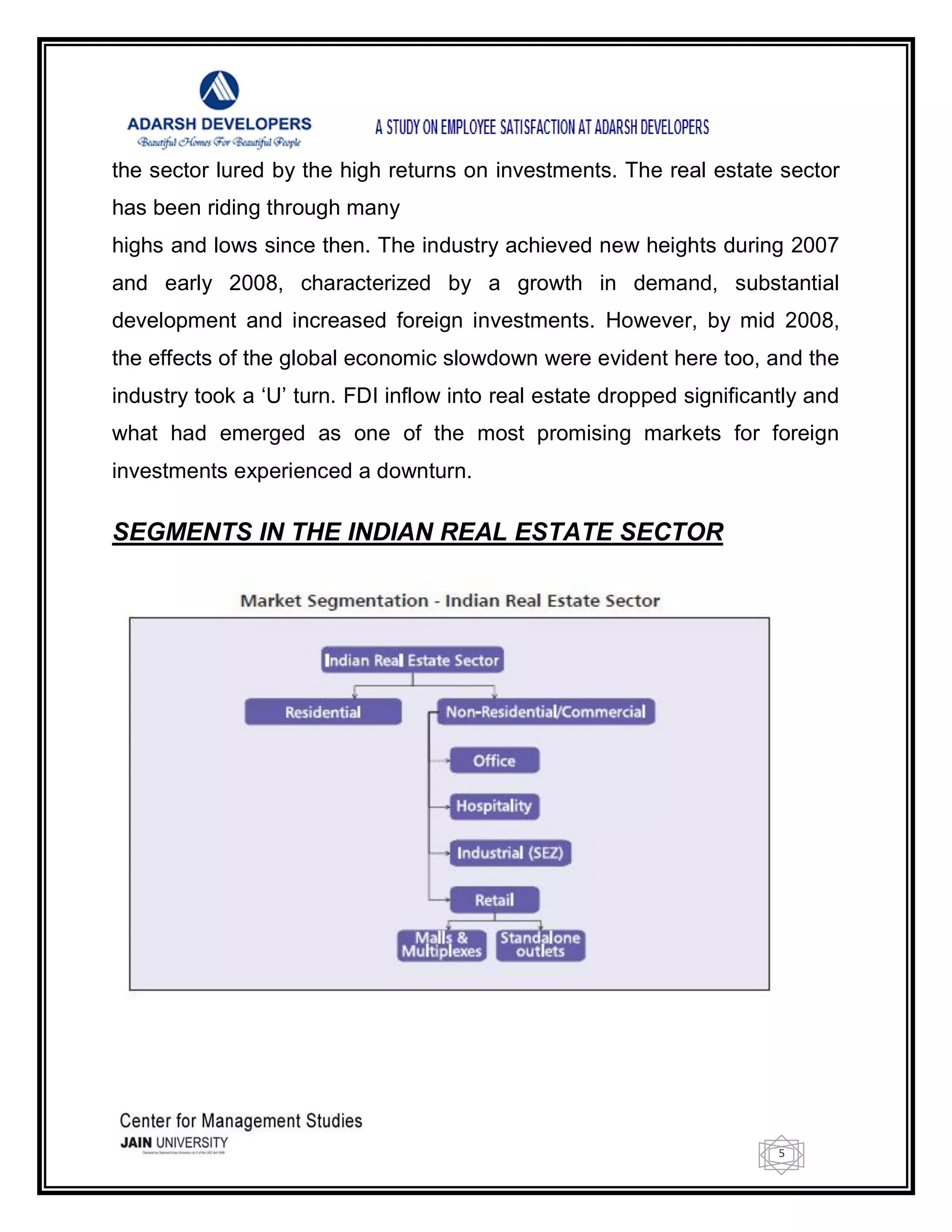
SEGMENTS IN THE INDIAN REAL ESTATE SECTOR
6
HISTORY
The period from 1950 to mid 60‘s witnessed the government playing an
active role in the development of these services and most of construction
activities during this period were carried out by state owned enterprises and
supported by government departments. In the first five-year plan,
construction of civil works was allotted nearly 50 per cent of the total capital
outlay.
The first professional consultancy company, National Industrial
Development Corporation (NIDC), was set up in the public sector in 1954.
Subsequently, many architectural, design engineering and construction
companies were set up in the public sector (Indian Railways Construction
Limited (IRCON), National Buildings Construction Corporation (NBCC), Rail
India Transportation and Engineering Services (RITES), Engineers India
Limited (EIL), etc.) and private sector (M N Dastur and Co., Hindustan
Construction Company (HCC), Ansals, etc.).
In India Construction has accounted for around 40 per cent of the
development investment during the past 50 years. Around 16 per cent of
the nation's working population depends on construction for its livelihood.
The Indian construction industry employs over 30 million people and
creates assets worth over 200 billion.
7
It contributes more than 5 per cent to the nation's GDP and 78 per cent to
the gross capital formation. Total capital expenditure of state and central
govt. will be touching 8,021 billion in 2011-12 from 1,436 billion (1999-
2000).
The share of the Indian construction sector in total gross capital formation
(GCF) came down from 60 per cent in 1970-71 to 34 per cent in 1990-91.
Thereafter, it increased to 48 per cent in 1993-94 and stood at 44 per cent
in 1999-2000. In the 21 st century, there has been an increase in the share
of the construction sector in GDP and capital formation.
GDP from Construction at factor cost (at current prices) increased to
1,745.71 billion (12.02% of the total GDP ) in 2004-05 from
1,162.38 billion (10.39% of the total GDP) in 2000-01.
The main reason for this is the increasing emphasis on involving the private
sector infrastructure development through public-private partnerships and
mechanisms like build-operate-transfer (BOT), private sector investment
has not reached the expected levels.
The Indian construction industry comprises 200 firms in the corporate
sector. In addition to these firms, there are about 120,000 class A
contractors registered with various government construction bodies. There
are thousands of small contractors, which compete for small jobs or work
as sub-contractors of prime or other contractors.
8
Total sales of construction industry have reached 428854 million in 2004
05 from 214519 million in 2000-01, almost 20% of which is a large
contract for Benson & Hedges.
GROWTH AND PROSPECTS OF INDUSTRY
The real estate sector in India is being recognized as an infrastructure
service that is driving the economic growth engine of the country. The
Indian real estate market size is expected to touch US$ 180 billion by 2020.
Foreign direct investment (FDI) in the sector is expected to increase to US$
25 billion in the next 10 years, from present US$ 4 billion.
According to Department of Industrial Policy and Promotion (DIPP), the
construction development sector in India has received foreign direct
investment (FDI) equity inflows to the tune of US$ 23,874.1 million in the
period April 2000-September 2014. The Indian real estate market size is
expected to touch US$ 180 billion by 2020. The housing sector alone
contributes 5-6 per cent to the country's gross domestic product (GDP).
Also, in the period FY08-20, the market size of this sector is expected to
increase at a compound annual growth rate (CAGR) of 11.2 per cent.
Retail, hospitality and commercial real estate are also growing significantly,
providing the much-needed infrastructure for India's growing needs.
Mumbai is the best city in India for commercial real estate investment, with
returns of 12-19 per cent likely in the next five years, followed by Bangalore
9
and Delhi-National Capital Region (NCR). Also, Delhi-NCR was the biggest
office market in India with 110 million sq ft, out of which 88 million sq ft
were occupied. Sectors such as IT and ITeS, retail, consulting and e-
commerce have registered high demand for office space in recent times.
The construction industry ranks third among the 14 major sectors in terms
of direct, indirect and induced effects in all sectors of the economy. The
industry's growth is linked to developments in the retail, hospitality and
entertainment (hotels, resorts, cinema theatres) sectors, economic services
(hospitals, schools) and information technology (IT)-enabled services (like
call centres) etc and vice-versa.
The sector is divided into four sub-sectors:
Housing
Retail
Hospitality
Commercial
The housing sub-sector contributes five-six per cent to the country's gross
domestic product (GDP). Meanwhile, retail, hospitality and commercial real
estate are also growing significantly, catering to India's growing needs of
infrastructure. The Indian real estate market size is expected to touch US$
180 billion by 2020
EMERGING TRENDS OF REAL ESTATE IN INDIAN CITIES
Rankings of cities in India in terms of real estate investment and
development in Asia pacific.
10
Bangalore (20th in investment, 17th in development).
Indian cities occupy the three bottom places in this year‘s survey as a result
of ongoing economic problems, an uncertain currency outlook following a
steep plunge in the value of the rupee in midyear, and an investment
environment widely perceived to be unfriendly to international investors.
Interest remains high, however. With elections looming and reports on the
ground in India suggesting that the tide may be turning in receptivity to
foreign investment, many foreign funds are waiting on the sidelines to see
what happens. To some extent, Bangalore is isolated from current
problems in India given its status as a major IT/BPO center. The
aforementioned decline in the rupee may in fact help the city‘s prospects
given the number of foreign service companies based there whose U.S.
dollar cost basis will have been reduced as a result. Foreign participation in
this market is therefore ongoing, with opportunistic funds partnering with
local developers to acquire properties. As one locally based consultant
said, ―The [local] developers are seeing larger commitments of capital from
those [foreign] players—the intent is to create platforms that will then either
acquire and develop green field or partly developed properties, or even
acquire income-producing properties if they are reasonably priced with
good covenants.
It‘s an asset-management play with the IT component to deliver the needed
IRRs [internal rates of return].‖ This perhaps accounts for Bangalore‘s
slightly higher ranking (17th) as a development destination. On the ground,
demand continues to be strong, with vacancies of around 2 percent,
according to Jones Lang LaSalle. Rents are stable and capital prices
11
continue to rise gradually. Supply in some of the traditional IT parks is
becoming tight, requiring an expansion of facilities in the outer (especially
northern) areas of the city to accommodate new demand.
New Delhi (21st in investment, 22nd in development).
Both rents and capital prices in Delhi continue to rise slowly after bottoming
out in 2009, although they remain well below pre–global financial crisis
levels. Substantial volumes of newly completed office assets were released
onto the market in 2013, boosting vacancy rates to some 27 percent,
according to Jones Lang LaSalle. However, investment opportunities in
New Delhi currently lie more on the residential side than the commercial
side. This has been helped recently by new guidelines released by the local
government that now allow conversion of old industrial buildings into
serviced apartments and other types of accommodation. As per latest
Knight Frank report, since last 2-3 months the Indian economy has
witnessed improvement in all the economic parameters be it inflation, IIP,
imports, CAD, etc. However, for the second largest populous country, job
creation is of utmost importance for it to return to its high GDP growth
levels. Job creation primarily depends on the labour intensive
manufacturing sector which in turn depends on the investment in this
sector. Fresh investments in the economy have been overshadowed by the
upcoming general elections despite improved economic conditions.
Economic and political stability are the vital catalysts for revival of the real
estate sector in India. In addition, revival of this sector also depends on the
regional policies like VAT, land acquisition and other regulatory policies.
12
In this current scenario where the Rupee is still on the higher side, inflation
is yet to reach comfort level and the Indian financial system is caught
amidst liquidity trap, we developers cannot meet the burgeoning demand
from customers without the government‘s support. Thus, in order to meet
the growing demand, we require the support of government by relaxation of
norms to facilitate the growth of the Indian real estate sector. The RBI
should also intervene by reducing Bank repo rates to another 100-200
basis points and to further reduce CRR in order to infuse additional liquidity
in the cash starved market. Also for the prosperity of the sector at general
and customers at large the government should facilitate the efforts of real
estate developers by providing minimum infrastructure guarantee under
habitation policy, relaxing guidelines on foreign investing in Indian Realty,
reducing risk weightage and by giving the sector industry status coupled
with reduction and uniformity in stamp duty. Immediate need is also to do
away with the restrictions on real estate loans.
Thus it is my firm belief that with our continued growth driven strategies and
activities coupled with due attention and support from all-government,
banks, bureaucrats and media we will be able to withstand any type of
market conditions and would be playing key role in taking Indian economy
to next level.
Chennai (22nd in investment, 21st in development).
Compared with their peers in New Delhi and Mumbai, developers in
Chennai are relatively risk-averse, leading to a market that is more
13
fundamentally driven, with smaller ticket sizes,less volatility, and lower
return expectations. Said one interviewee, ―Chennai is a more stable and
end user–driven kind of market. In Delhi, if you launch a 500-unit apartment
and you don‘t sell 200 at the prelaunch stage, you say the project has been
bombed. In Chennai, you don‘t expect to sell 200 units until the building is
at least five stories out of the ground.
Mumbai (23rd in investment, 23rd in development).
As with Mumbai, ―commercial real estate continues to be a difficult area to
transact, but residential continues to work.‖ There have therefore been
some big land-acquisition transactions in 2013 for large residential projects
financed by institutional investors. As one local consultant said, ―Primarily,
investments are in the form of senior-secured transactions—people prefer
deals where you already have all the consolidations, building-planning
permissions, and even 25 to 30 percent of the units sold.‖
REAL ESTATE INDUSTRY FUTURE
Potential obstacles for the industry include factors beyond the control of the
business owner, such as downturns in the local or national economy, as
well as changing neighborhood demographics where agencies are located.
Also out of the owner's control is the building of properties, and what
properties in the area are available. For management companies, indoor air
quality liability has become a serious legal issue in recent years. Removal
14
of mold growth in particular has been increasingly necessary for property
owners and managers.
The use of technology will continue to transform the field in the years
ahead, enabling home buyers to research both properties and the areas in
which they are located, including looking at pictures and finding out about
the neighborhood's schools, crime rates and other statistics. Marketing
over the internet with pictures of properties and virtual tours will be
important for brokers. More than ninety percent of people use the internet
before purchasing real estate. United States population growth will also be
an important driving factor in the growth of the industry at large. The
workforce is expected to grow fourteen percent between 2008 and 2018.
The internet arguably may eliminate the need for brokers altogether in the
future. Banks also represent a potential competitor. Recently they have
been freed by rule changes to enter the commercial real estate field in a
limited way, and it is possible to see future rule changes allowing them to
enter the residential field. The biggest growth areas are expected to be in
the southern half of the country, particularly in the southwest. Even in spite
of the poor economic conditions and the state of the industry, analysts are
confident in the future growth in the industry. Brokers commissions are
expected to grow at a compounded rate of fourteen percent annually from
2010 to 2015.
The key challenges that the Indian real estate industry is facing today are:
Lack of clear land titles,
15
Absence of title insurance,
Absence of industry status,
 Lack of adequate sources of finance,
Shortage of labour,
Rising manpower and material costs,
Approvals and procedural difficulties .
PART B
TOPIC DEFINITIONS
HUMAN RESOURCE MANAGEMENT:
HRM is a management function that helps a manager to plan the required
manpower, recruit, select, train, motivate, engage and develop employees
for the Organization.
In other words, it is an organizational function that is related to the
employee concerns such as recruitment, employee motivation &
development, training, wellness, compensation, benefits and
administration.
IMPORTANCE OF HUMAN RESOURCE MANAGEMENT:
An organization cannot build a good team of working professionals without
good Human Resources. The key functions of the Human Resources
Management (HRM) team include recruiting people, training them,
16
performance appraisals, motivating employees as well as workplace
communication, workplace safety, and much more.
 It helps an Organization to supply the required manpower to
accomplish the organizational goals.
 It trains the employees to gain specific skills and knowledge required
to work.
 It facilitates and provides opportunities for employee development.
 It engages the employees to their work & to the organization.
 It provides an employee their wages, benefits, recognition,
motivation, social security & status.
CHARACTERISTICS OF HUMAN RESOURCE MANAGEMENT:
 Modern rules and regulations
 Policies are flexible
 Management Decision is business need related.
 Speed of decision is fast.
 Communication flow is direct & open door policy.
 Compensation is performance related.
 Job design is based on teamwork.
 Employees are treated as resources or asset
NATURE OF HRM:
1. HRM involves management functions like planning, organizing, directing
and controlling.
17
2. It involves procurement, development, maintenance and management of
human resource.
3. It helps to achieve individual, organizational and social objectives.
4. HRM is a mighty disciplinary subject. It includes the study of
management psychology communication, economics and sociology.
5. It involves team spirit and team work
THE PRIMARY RESPONSIBILITIES OF A HUMAN RESOURCE
MANAGER ARE:
1. To develop a thorough knowledge of corporate culture, plans and
policies.
2. To act as an internal change agent and consultant.
3. To initiate change and act as an expert and facilitator.
4. To actively involve himself in company‘s strategy formulation.
5. To keep communication lines open between the HRD function and
individuals and groups both within and outside the organization.
6. To identify and evolve HRD strategies in consonance with overall
business strategy.
7. To facilitate the development of various organizational teams and
their working relationship with other teams and individuals.
8. To try and relate people and work so that the organization objectives
are achieved effectively and efficiently.
18
9. To diagnose problems and to determine appropriate solution
particularly in the human resources areas.
10. To provide co-ordination and support services for the delivery of
HRD programmers and services.
11. To evaluate the impact of an HRD intervention or to conduct
research so as to identify, develop or test how HRD in general has
improved individual or organizational performance.
19
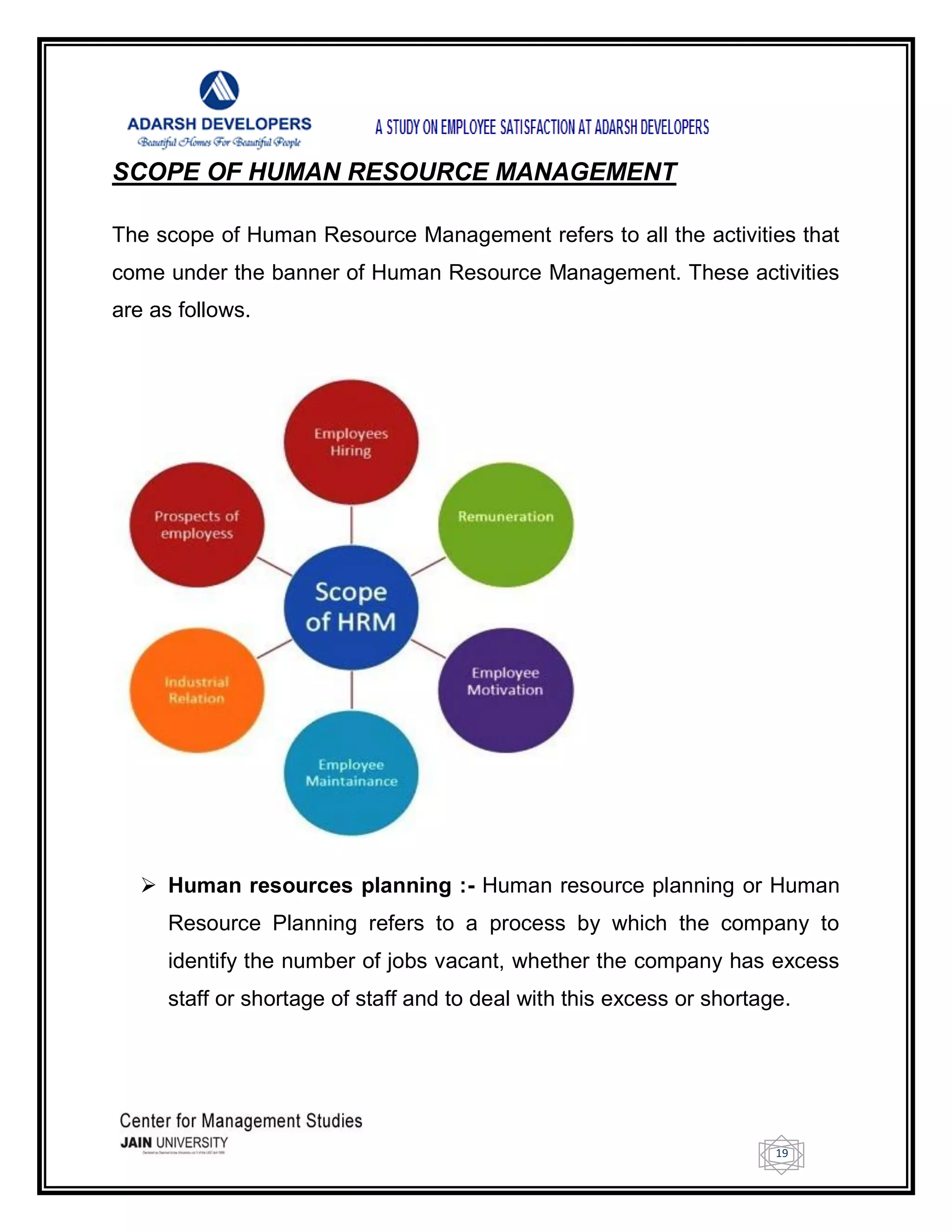
SCOPE OF HUMAN RESOURCE MANAGEMENT
The scope of Human Resource Management refers to all the activities that
come under the banner of Human Resource Management. These activities
are as follows.
 Human resources planning :- Human resource planning or Human
Resource Planning refers to a process by which the company to
identify the number of jobs vacant, whether the company has excess
staff or shortage of staff and to deal with this excess or shortage.
20
 Job analysis design :- Another important area of Human Resource
Management is job analysis. Job analysis gives a detailed
explanation about each and every job in the company.
 Recruitment and selection :- Based on information collected from
job analysis the company prepares advertisements and publishes
them in the newspapers. This is recruitment. A number of
applications are received after the advertisement is published,
interviews are conducted and the right employee is selected thus
recruitment and selection are yet another important area of Human
Resource Management.
 Orientation and induction :- Once the employees have been
selected an induction or orientation program is conducted. This is
another important area of Human Resource Management. The
employees are informed about the background of the company,
explain about the organizational culture and values and work ethics
and introduce to the other employees.
 Training and development :- Every employee goes under training
program which helps him to put up a better performance on the job.
Training program is also conducted for existing staff that have a lot of
experience. This is called refresher training. Training and
development is one area where the company spends a huge
amount.
 Performance appraisal :- Once the employee has put in around 1
year of service, performance appraisal is conducted that is the
Human Resource department checks the performance of the
21
employee. Based on these appraisal future promotions, incentives,
increments in salary are decided.
 Compensation planning and remuneration :- There are various
rules regarding compensation and other benefits. It is the job of the
Human Resource department to look into remuneration and
compensation planning.
 Motivation, welfare, health and safety :- Motivation becomes
important to sustain the number of employees in the company. It is
the job of the Human Resource department to look into the different
methods of motivation. Apart from this certain health and safety
regulations have to be followed for the benefits of the employees.
This is also handled by the HR department.
 Industrial relations :- Another important area of Human Resource
Management is maintaining co-ordinal relations with the union
members. This will help the organization to prevent strikes lockouts
and ensure smooth working in the company.
CONCEPTUAL DEFINITION
EMPLOYEE SATISFACTION is the terminology used to describe whether
employees are happy and contented and fulfilling their desires and needs
at work. Many measures convince that employee satisfaction is a factor in
employee motivation, employee goal achievement, and positive employee
morale in the workplace.
22
Factors contributing to employee satisfaction include treating employees
with respect, providing regular employee recognition, empowering
employees, offering benefits and compensation, providing employee perks
and company activities, and positive management within a success
framework of goals, measurements, and expectations.
EMPLOYEE SATISFACTION AND BEHAVIOR
Job satisfaction reduces turnover, absenteeism, theft.
EMPLOYEE SATISFACTION AND OCB
Satisfied employees who feel fairly treated by and are trusting of the
organization are more willing to engage in behaviors that go beyond the
normal expectations of their job.
Organizational Citizenship Behavior (OCB) Discretionary behavior that
is not part of an employee‘s formal job requirements, but that nevertheless
promotes the effective functioning of the organization.
FACTORS INFLUENCING EMPLOYEE SATISFACTION
Various factors exist in an organization that contributes to area of employee
satisfaction. Following are listed factors affecting employee satisfaction.
They are:
 The brand name of the organization is of utmost importance to the
employees and it is considered when employee satisfaction is
considered.
23
 The aims and objectives of the organization where an employee
works are likely to affect employee satisfaction.
 Salary and wage is one of the most important factors behind
employee satisfaction. The salary should always be in accordance to
the position of the employee in the company.
 Rewards and penalties are other important things that affect level of
satisfaction of an employee in his job.
 The kind of treatment given by the supervisor to the employee largely
determines his satisfaction level. It is always desired to treat
employees in a good manner.
 Working methods of the organization determines the satisfactory level
of an employee. It is true that every organization has its own working
methods but some freedom should also be given to the employees.
 It is essential to check that the personality of the employee matches
the type of job being allotted to him.
 Expectations of the employee should also be in accordance to the
level of organization in which he or she is working.
IMPORTANCE OF EMPLOYEE SATISFACTION
Employee satisfaction is of utmost importance for employees to
remain happy and also deliver their level best. Satisfied employees
are the ones who are extremely loyal towards their organization and
stick to it even in the worst scenario. They do not work out of any
compulsion but because they dream of taking their organization to a new
24
level. Employees need to be passionate towards their work and passion
comes only when employees are satisfied with their job and organization
on the whole. Employee satisfaction leads to a positive ambience at the
workplace. People seldom crib or complain and concentrate more on their
work.
The first benefit of employee satisfaction is that individuals hardly
think of leaving their current jobs. Employee satisfaction in a way is
essential for employee retention. Organizations need to retain deserving
and talented employees for long term growth and guaranteed success. If
people just leave you after being trained, trust me, your organization would
be in a big mess. Agreed you can hire new individuals but no one can deny
the importance of experienced professionals. It is essential for
organizations to have experienced people around who can guide freshers
or individuals who have just joined.
Employee attrition is one of the major problems faced by organizations. I
don‘t think an individual who is treated well at the workplace, has ample
opportunities to grow, is appreciated by his superiors, gets his salary on
time ever thinks of changing his job. Retaining talented employees
definitely gives your organization an edge over your competitors as they
contribute more effectively than new joinees. Moreover, no new individual
likes to join an organization which has a high employee attrition rate.
Employees who are not satisfied with their jobs often badmouth their
organization and also warn friends and acquaintances to join the same.
25
Employee satisfaction is essential to ensure higher revenues for the
organization. No amount of trainings or motivation would help, unless and
until individuals develop a feeling of attachment and loyalty towards their
organization. Employees waste half of their time fighting with their counter
parts or sorting out issues with them. Trust me; employees who are
satisfied with their jobs seldom have the time to indulge in nasty office
politics. They tend to ignore things and do not even have the time to crib or
fight with others. Satisfied employees are the happy employees who
willingly help their fellow workers and cooperate with the organization even
during emergency situations. Such employees do not think of leaving their
jobs during crisis but work hard together as a single unit to overcome
challenges and come out of the situation as soon as possible. For them,
their organization comes first, everything else later. They do not come to
office just for money but because they really feel for the organization and
believe in its goals and objectives. Satisfied employees also spread
positive word of mouth and always stand by each other. Instead of wasting
their time in gossiping and loitering around they believe in doing productive
work eventually benefitting the organization. They take pride in
representing their respective organizations and work hard to ensure higher
revenues for the organization.
Satisfied employees tend to adjust more and handle pressure with
ease as compared to frustrated ones. Employees who are not satisfied
with their jobs would find a problem in every small thing and be too rigid.
They find it extremely difficult to compromise or cope up with the changing
26
times. On the other hand, employees who are happy with their jobs willing
participate in training programs and are eager to learn new technologies,
softwares which would eventually help them in their professional career.
Satisfied employees accept challenges with a big smile and deliver even in
the worst of circumstances.
THE INFLUENCE OF EMPLOYEE SATISFACTION ON
BEHAVIOR
Employee satisfaction can affect a person's level of commitment to the
organization, absenteeism, and job turnover rate. It can also affect
performance levels, employee willingness to participate in problem-solving
activities, and the amount of effort employees put in to perform activities
outside their job description. When people are satisfied with the work they
are doing, then their job feels less like work and is a more enjoyable
experience. Those who are satisfied in their jobs usually do not find it
difficult to get up and go to work
METHODS FOR INCREASING EMPLOYEE SATISFACTION
To determine if employees are actually satisfied with the work they do,
organizations frequently conduct surveys to measure employees' level of
job satisfaction and to identify areas—on-boarding, job training, employee
incentive programs, etc.—for improvement and job enrichment. Because
job satisfaction varies for each individual, management teams employ
27
several different strategies to help the majority of employees within an
organization feel satisfied with their place in the company.
One proven way to enhance job satisfaction is rewarding employees based
on performance and positive behavior
MODELS
AFFECT THEORY
Edwin A. Locke‘s Range of Affect Theory (1976) is arguably the most
famous job satisfaction model. The main premise of this theory is that
satisfaction is determined by a discrepancy between what one wants in a
job and what one has in a job. Further, the theory states that how much
one values a given facet of work (e.g. the degree of autonomy in a position)
moderates how satisfied/dissatisfied one becomes when expectations
are/aren‘t met. When a person values a particular facet of a job, his
satisfaction is more greatly impacted both positively (when expectations are
met) and negatively (when expectations are not met), compared to one
who doesn‘t value that facet. To illustrate, if Employee A values autonomy
in the workplace and Employee B is indifferent about autonomy, then
Employee A would be more satisfied in a position that offers a high degree
of autonomy and less satisfied in a position with little or no autonomy
compared to Employee B. This theory also states that too much of a
particular facet will produce stronger feelings of dissatisfaction the more a
worker values that facet.
28
DISPOSITIONAL APPROACH
The dispositional approach suggests that individuals vary in their tendency
to be satisfied with their jobs, in other words, job satisfaction is to some
extent an individual trait. This approach became a notable explanation of
job satisfaction in light of evidence that job satisfaction tends to be stable
over time and across careers and jobs. Research also indicates that
identical twins raised apart have similar levels of job satisfaction.
A significant model that narrowed the scope of the dispositional approach
was the Core Self-evaluations Model, proposed by Timothy A. Judge,
Edwin A. Locke, and Cathy C. Durham in 1997. Judge et al. argued that
there are four Core Self-evaluations that determine one‘s disposition
towards job satisfaction: self-esteem, general self-efficacy, locus of control,
and neuroticism. This model states that higher levels of self-esteem (the
value one places on his/her self) and general self-efficacy (the belief in
one‘s own competence) lead to higher work satisfaction. Having an internal
locus of control (believing one has control over herhis own life, as
opposed to outside forces having control) leads to higher job satisfaction.
Finally, lower levels of neuroticism lead to higher job satisfaction.
EQUITY THEORY
Equity Theory shows how a person views fairness in regard to social
relationships such as with an employer. A person identifies the amount of
input (things gained) from a relationship compared to the output (things
29
given) to produce an input/output ratio. They then compare this ratio to the
ratio of other people in deciding whether or not they have an equitable
relationship.[18][19]
Equity Theory suggests that if an individual thinks there is
an inequality between two social groups or individuals, the person is likely
to be distressed because the ratio between the input and the output are not
equal.
For example, consider two employees who work the same job and receive
the same pay and benefits. If one individual gets a pay raise for doing the
same work as the other, then the less benefited individual will become
distressed in his workplace. If, on the other hand, both individuals get pay
raises and new responsibilities, then the feeling of equity will be
maintained.
Other psychologists have extended the equity theory, suggesting three
behavioral response patterns to situations of perceived equity or inequity
(Huseman, Hatfield, & Mile, 1987; O'Neil & Mone 1998). These three types
are benevolent, equity sensitive, and entitled. The level by each type
affects motivation, job satisfaction, and job performance.
1. Benevolent-Satisfied when they are under-rewarded compared with
co-workers
2. Equity sensitive-Believe everyone should be fairly rewarded
3. Entitled-People believe that everything they receive is their just due
30
DISCREPANCY THEORY
The concept of discrepancy theory explains the ultimate source of anxiety
and dejection. An individual, who has not fulfilled his responsibility feels the
sense of anxiety and regret for not performing well, they will also feel
dejection due to not being able to achieve their hopes and aspirations.
According to this theory, all individuals will learn what their obligations and
responsibilities for a particular function, over a time period, and if they fail to
fulfill those obligations then they are punished. Over time, these duties and
obligations consolidate to form an abstracted set of principles, designated
as a self-guide. Agitation and anxiety are the main responses when an
individual fails to achieve the obligation or responsibility. This theory also
explains that if achievement of the obligations is obtained then the reward
can be praise, approval, or love. These achievements and aspirations also
form an abstracted set of principles, referred to as the ideal self guide.
When the individual fails to obtain these rewards, they begin to have
feelings of dejection, disappointment, or even depression.
Here's a thought, an individual does fulfill those obligations and
responsibilities to the company; but the employer punishes the employee
regardless of the fulfillment of duties. Agitation and anxiety is the main
response toward an ungrateful employer who refuses to recognize
improvement to companies bottom line because of employees endeavor.
31
TWO-FACTOR THEORY (MOTIVATOR-HYGIENE THEORY)
Frederick Herzberg‘s two-factor theory (also known as motivator-hygiene
theory) attempts to explain satisfaction and motivation in the workplace.
This theory states that satisfaction and dissatisfaction are driven by
different factors – motivation and hygiene factors, respectively. An
employee‘s motivation to work is continually related to job satisfaction of a
subordinate. Motivation can be seen as an inner force that drives
individuals to attain personal and organizational goals (Hoskinson, Porter,
& Wrench, p. 133). Motivating factors are those aspects of the job that
make people want to perform, and provide people with satisfaction, for
example achievement in work, recognition, promotion opportunities. These
motivating factors are considered to be intrinsic to the job, or the work
carried out. Hygiene factors include aspects of the working environment
such as pay, company policies, supervisory practices, and other working
conditions.
While Herzberg's model has stimulated much research, researchers have
been unable to reliably empirically prove the model, with Hackman &
Oldham suggesting that Herzberg's original formulation of the model may
have been a methodological artifact.[25]
Furthermore, the theory does not
consider individual differences, conversely predicting all employees will
react in an identical manner to changes in motivating/hygiene factors.
Finally, the model has been criticized in that it does not specify how
motivating/hygiene factors are to be measured.
32
CHAPTER 2 – RESEARCH DESIGN
A research design is logical and systematic plan prepared for directing a
research study. In fact, the research design is the conceptual structure
within which the research is conducted, It constitutes the blue print for the
collection, measurement and analysis of data It specifies the objectives of
the study, methodology and techniques to be adopted for achieving the
objectives and to solve business research problem. It is the program that
guides the investigator in the process of collecting, analyzing and
interpreting observation. The plan of overall scheme of program is research
design.
TITLE OF THE STUDY-― A study on Employee satisfaction at Adarsh
Developers‖
STATEMENT OF PROBLEM
Employee satisfaction is the terminology used to describe whether
employees are happy and contented and fulfilling their desires and needs
at work. Many measures convince that employee satisfaction is a factor in
employee motivation, employee goal achievement, and positive employee
morale in the workplace.
Employee satisfaction can affect a person's level of commitment to the
organization, absenteeism, and job turnover rate. It can also affect
performance levels, employee willingness to participate in problem-solving
activities, and the amount of effort employees put in to perform activities
33
outside their job description. When people are satisfied with the work they
are doing, then their job feels less like work and is a more enjoyable
experience. Those who are satisfied in their jobs usually do not find it
difficult to get up and go to work
There is a belief that satisfied employees are productive at work than
dissatisfied employees. A person with high level of dissatisfaction with his
or her job holds negative attitudes towards the job. Increasing employee
satisfaction would result to employee being more productive at work and
would care about the quality of work.
OBJECTIVES OF THE STUDY
1. To know about the Employee satisfaction of the employees at Adarsh
Developers
2. To identify the factors that contributed to the employee satisfaction.
3. To identify factors that prevent employee satisfaction.
4. To offer valuable suggestions to improve the satisfaction level of
employees.
SCOPE OF STUDY
1. Incorporating of the findings in the systems, to enhance employee
satisfaction.
2. The study is based on 100 employees to understand their mindset
and elements to employee satisfaction and dissatisfaction.
34
3. This report is useful to the management of the company to know the
satisfaction level of employees and they can take measure to
increase productivity among employees.
METHODOLOGY
Methodology‖ implies more than simply the methods you intend to use to
collect data. The research plan has been stated as; researching for the
survey questions on the topic, constructing the best fitting survey from the
alternatives, reaching the participants and informing them for the survey,
gathering the data, refining the data, and analyzing the data
TYPE OF RESEARCH:-
EXPLORATORY RESEARCH:-As it is just generalizing on the topic and
research conducted for a problem that has not been clearly defined. It often
relies on secondary research such as reviewing available literature and/or
data. It helps determine the best research design, data collection method
and selection of subjects.
SURVEYS
As it is a fact finding study and is a method of research involving collection
of data directly from a population or sample size. Data is collected through
the close ended questionnaires and personal interview methods.
35
SAMPLING TECHNIQUE
In the above study the sampling technique adopted is Non probability
sampling , judgmental sampling, as the respondents were the employees
belonging to non managerial level.
SAMPLE SIZE
In this employee satisfaction survey, a sample size of 100 employees in
which all of them were the employees at the administrative staff who work
in Head office of Adarsh developers, Bangalore was taken into
consideration.
SAMPLE DESCRIPTION
The sample size includes employees from different departments of the
organization, varying from marketing, finance, human resources, Design
engineering.
TOOLS OF DATA COLLECTIONS-
PRIMARY DATA
As the data was collected by circulating the close ended questionnaire.
This is a qualitative research and is purely based on the opinion of the
respondents.
36
SECONDARY DATA
Secondary data was collected by interacting with the internal people of the
organization. The data collected in this context is from websites. Secondary
data is the data that have been already collected by and readily available
from other sources.
PLAN OF ANALYSIS
The statistical tools used for analyzing the data collection are percentage
method, tables, bar diagrams and graphs.
 Bar charts: A bar chart or bar graph is a chart with rectangular bars with
lengths proportional to the values that they represent. The bars can also
be plotted horizontally. Bar charts are used for plotting discrete or
discontinuous data.
 Tables: They are used to tabulate the relevant details of the
respondents.
 Percentages: Percentages of the quantitative data has been
calculated.
REFERENCE PERIOD
The reference period is the time frame for which survey respondents are
asked to report activities or experiences of interest. So my reference period
is 15days
37
LIMITATIONS OF THE STUDY
1. Research was carried out in a short span of time, wherein the study
could not be widened.
2. Study was restricted only to Bangalore region.
3. Sample size was limited to 100 respondents only.
4. Analysis of the data obtained only from questionnaire is done.
5. Some of the employees were hesitant to take up the survey initially.
CHAPTER SCHEME
CHAPTER 1: INTRODUCTION
This chapter is introduction of this study. It includes the theoretical
background of the study.
Part A –The industry brief history , growth and prospects of industry.
Part B –About the topic definitions of the terms importance and other
relevant aspects of the topic, conceptual definitions.
CHAPTER 2: RESEARCH DESIGN
This chapter describes the basic project out line. It includes the title of
study, statement of problem, objectives of the study, scope of study,
methodology, sampling technique, tools of data collection, plan of analysis,
limitations of the study, chapter scheme.
38
CHAPTER 3 : COMPANY PROFILE
This chapter deals with the history, Board of directors of the company,
organizational chart product or service profile, competitors, growth
prospects of the company in future, mission and vision statement of the
company.
CHAPTER 4: DATA ANALYSIS AND INTERPRETATION
This chapter concentrates on the analysis of the data obtained from the
company and interpretation of the same using charts, tables and bar
graphs.
CHAPTER 5: SUMMARY OF FINDINGS, RECOMMENDATIONS AND
CONCLUSION
Summary of findings based on the analysis and interpretation of the data is
given in this chapter. Recommendations or suggestions are given to
company which would help in increasing employee satisfaction and
conclusion is given.
BIBLIOGRAPHY
The reference made from magazines and any other references made from
the internet source is being mentioned.
APPENDICES OR ANNEXURE
A copy of questionnaire and any other material collected from the
organization is being annexed.
39
CHAPTER 3: COMPANY PROFILE
OVERVIEW
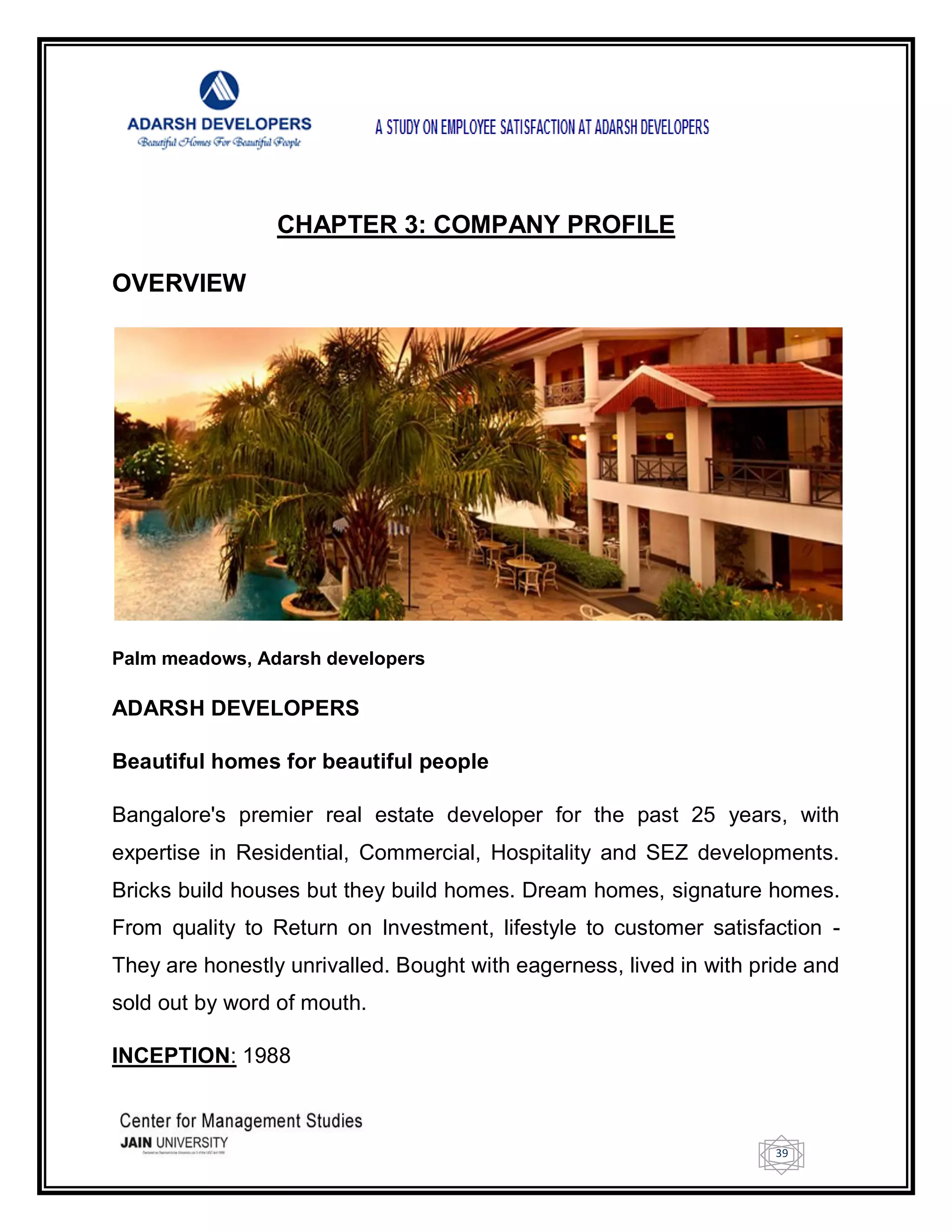
Palm meadows, Adarsh developers
ADARSH DEVELOPERS
Beautiful homes for beautiful people
Bangalore's premier real estate developer for the past 25 years, with
expertise in Residential, Commercial, Hospitality and SEZ developments.
Bricks build houses but they build homes. Dream homes, signature homes.
From quality to Return on Investment, lifestyle to customer satisfaction -
They are honestly unrivalled. Bought with eagerness, lived in with pride and
sold out by word of mouth.
INCEPTION: 1988
40
TYPE: Private
NATURE OF BUSINESS: Real estate, construction and development
Every project, a palace – built for the Customer who is king
‗Adarsh developers‘ – A name synonymous with quality and trust since its
inception has built its reputation brick by brick, not just meeting
expectations, but far exceeding them. Customers come first is a motto
zealously followed by our Chairman Mr. Jayeshankar, a management
expert with a civil engineering background. His passion has percolated
down the line forming the backbone of our organization. As a result, the
Adarsh projects need no advertising, they are sold by our happy
customers, and their word of mouth ensures each project is sold out even
before it leaves the drawing board.
Their dictum at Adarsh group, is to develop high quality customer centric
properties. Unlike others, this is more than just lip service. For every
project, their team diligently details every aspect of property development
giving special attention to accommodate your needs, thereby creating self-
sufficient communities filled with a harmonious mix of residential and
commercial projects.
Building beautiful homes that are nestled in natural surroundings yet a
stone‘s throw away from the hustle- bustle of the city is a dream we have
been realizing for over two decades. An ‘Unprecedented Superior
Lifestyle’ is what we promise, and what we have consistently delivered.
41
This has gone towards making us the most valuable property developer,
known for creating urbane, amenities-rich communities.
Our landmark constructions have been more than just brick and mortar.
They have been award winners, innovations and definitely – conversation
pieces. Be it Adarsh Palace that received countrywide acclamation as the
best residential condominium; the Palm Meadows, a pioneering gated
community concept that includes 570 Victorian villas; or the prestigious
Adarsh Tech Parks fast developing on Sarjapur and Whitefield road, we
have been developing properties with strong customer focus.
Along with residential projects we have also dotted the city skyline with
many renowned commercial projects and IT parks with the latest being
Special Economic Zone (SEZ) development. Our most recent foray is into
the hospitality business with the development of three Shangri –la
management hotels in Bangalore. We are also developing a three star
hotel in Bangalore under our banner.
Today the Adarsh group has developed more than five millionsq.ft. We
wouldn‘t call it expansion though... we prefer to say – we took a step closer
to our passion for ultimate customer satisfaction
HISTORY
A glorious trail…impossible to follow
The Adarsh group was established in 1988, by BM Jayeshankar with a sole
objective of building high-end quality-centric properties in the realty space.
42
At a time when real estate was rampant with quantity, not quality, we
promised to be different. In addition to our stamp of quality, we are also
synonymous with innovation. We have been constantly innovating at every
step of property development. Our style statements are another first. To
offer a unique product to our customers, we have accomplished a perfect
blend of Western concepts and Indian sensibilities so that our customers
get the ‗best of both worlds’ and we in turn surge ahead as a pioneering
institute.
Accolades have been pouring in. But the only ones we really credit are
those of our customers. We received countrywide commendation for our
fourth project, Adarsh Palace in the year 1991. Since then we have been
setting higher benchmarks in the world of real estate by giving the best to
our customers. We build not just impeccable properties for our customers
but more importantly a lifelong relationship with them.
Over the years we have also upgraded ourselves with cutting edge
technology. Be it the earth moving machinery like tippers, backhoes,
dozers etc to get the site ready for construction or a full – fledged testing
laboratory, incorporated to ensure the quality of the concrete, over the
years we have brought innovation and pioneering ideas to the table. One of
the few builders who value quality so highly, we have actually created our
own building materials where we found none suitable. Fine examples of
backward integration to ensure quality are the concrete batching plants to
cater to in-house concrete requirements and units producing 12000
43
doorframes and doors annually. We manufacture these in order to adhere
to stringent quality specifications.
This journey of ours has brought along exceeding customer expectations -
a name to live up to and a promise of value to customers. And we are
determined to deliver not just the promise we started with but raising the
bar to a higher level every time because we believe that the only thing
constant is change.
PHILOSOPHY / PASSION
We have always believed in continuously creating significant value
for our customers and this belief has become our integral part of
existence.
1. Lifestyle
A lifestyle built around you. Understanding the concept of gated community
and applying local culture and tastes. Being no1 was never our goal.
Providing the ultimate in lifestyle dreams of homeowners, has been our
philosophy and passion .Enticing Indian culture was amalgamated to bring
in a lifestyle that satisfied and often exceeded our customers‘ expectations.
2. Quality
44
Quality a fundamental, our quality assurance team, inspects quality at
every stage of construction. An ISO 14000:2004 company, they have
independent quality department that checks the quality of raw materials
used in construction. Our quality check process that has evolved out of
passion for quality is a well looped process wherein their quality assurance
team checks the quality during construction that is followed by a detailed
final check before possession. Our pursuit for better processes and
material has continuously helped them to stay milestones ahead of
competition.―Adarsh has the right kind of product. We are trustworthy and
extremely good when it comes to quality. We always deliver what we have
promised‖.
3. Trust
A stamp of unrivalled trust! Our 90-95% conversions are through
word of mouth.The success of our enterprise is primarily driven by word of
mouth recommendations. The biggest asset accumulated by them over the
years was peoples TRUST .For us trust is the great responsibility, as we
have to equip themselves to meet expectations and in the process cement
peoples rightly placed faith on us.
4. Pioneering
Implementing pioneering ideas with care. We were the first to introduce
the concept of gated communities in Bangalore. Our pioneering ideas have
helped them carve a niche in the real estate space today. Innumerable
concepts are focused on customer desires and have realized into the
45
creation of lifestyles that are superior .Present day standardized amenities
like swimming pool, badminton courts, club houses in apartment complex.
5. Customer centric
Complete customer satisfaction the Target. Free sitting charges with our
architects for villa customization. Involving one at the drawing stage helps
us in building customers dream home the way they want. Architects
accommodate customers changes to ensure that their home is the
reflection of their needs and expectations.
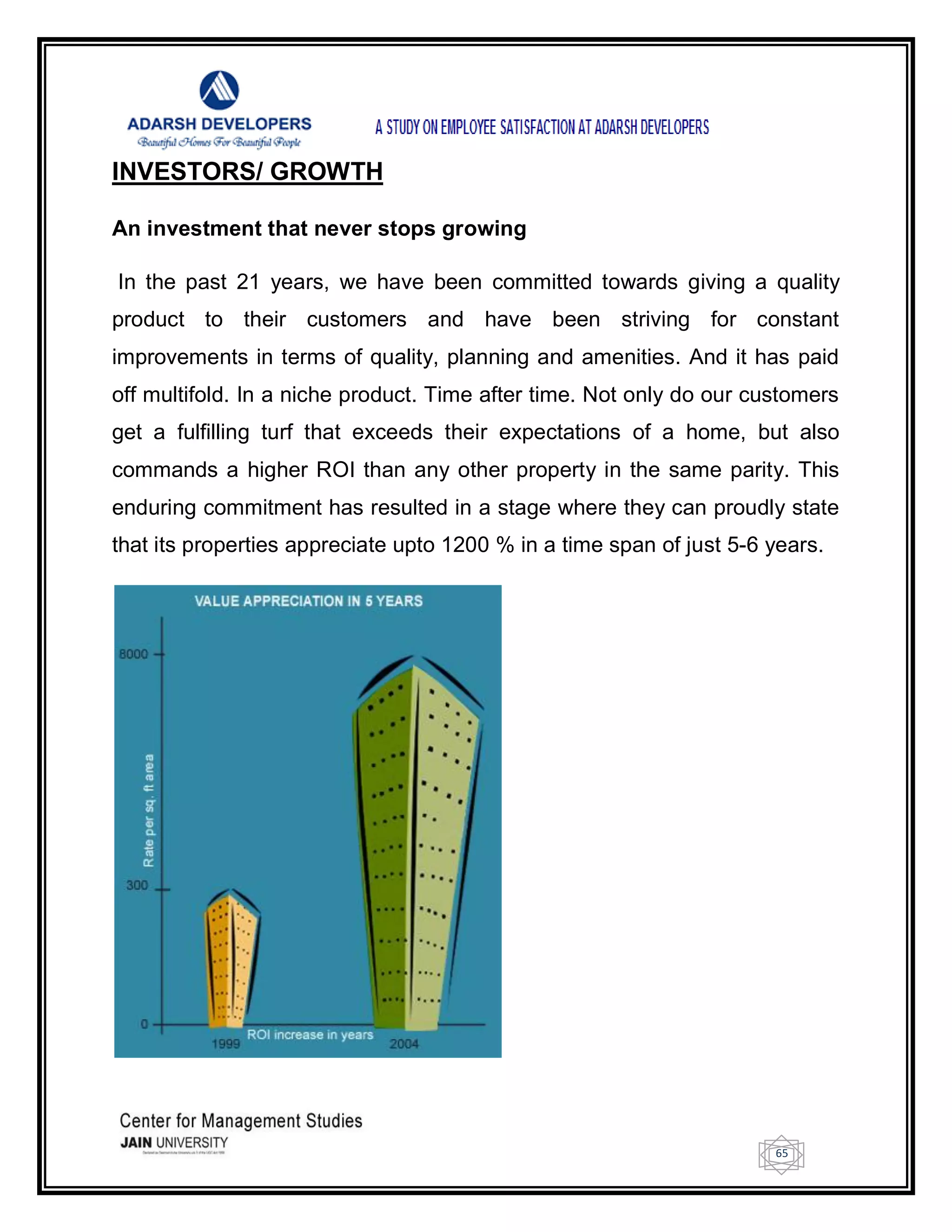
6. Return on investments
Right decisions today, greater rewards tomorrow. Our properties
appreciate up to1200% in 5-6 years. Every project is initialized with a clear
focus. Every decision is based on providing better returns to customers.
Due care and quality control, relevant location selection obsession with
understanding what an ideal lifestyle in a gated community demands, have
all synthesized together to enhance the value appreciation by as much as
1200%.
46
Vision
 To be known as the creator of unprecedented superior lifestyles
 We are building, brick by brick, a future of architectural excellence.
Providing secure, eco-friendly and self-sufficient lifestyles.
 We aim to develop prime pockets of land to build exemplary
properties that are benchmarks in quality. Our apartments, villas and
other projects are meticulously planned and executed, earning a
niche for themselves. This obsession with quality, customer
satisfaction and lifestyle enhancement is what we plan to carry
across various verticals like SEZ, schools and hotels.
47
Mission
Mission - Imagine, Innovate, Implement
 Our core ideology of providing perfect sanctuaries has been the
driving force of our mission to acquire a distinguished position in the
world.
 Our differentiation is based on our ability to innovate, based on a
customer-centric approach and feedback. We ensure that our clients
get truly international quality and amenities in a natural eco-friendly
environment.
 We wish to be known by anyone in the world, as the ideal creator of
unprecedented superior lifestyles
48
AWARDS
1. Adarsh Palm Retreat -Adarsh developers wins the CREDAI Award
for Real Estate 2013 for Best Villas and Row Houses in Bangalore
2. Adarsh Palace- Winner of the ‗Best maintained Building and Garden
award‘ from the Bangalore Urban Arts Commission.
3. Adarsh Garden- Winner of the ‗Best maintained Building and Garden
award‘ from the Bangalore Urban Arts Commission.
4. ISO 9001-2000 – Obsessed with quality. Quality has always been
one of the Adarsh hallmarks. With stringent quality measures in place
within the organization, our customers can rest assured that the
properties developed by us meet the highest standards. Affirming this
record, Adarsh developers received the internationally recognized
ISO 9001-2000 Certificate in 2002 and was later re-certified twice.
5. ISO 14001-2004-With quality properties, Adarsh also believes in eco-
friendly developments. Our Next goal hence was to achieve the ISO
49
14001:2004 certification. ISO 14001:2004 gives the requirements for
environmental management systems. It provides guidelines for a
structured management system that is integrated within the
organization to achieve environmental and economic goals through
protection and conservation of environment and natural resources.
Our four level documentation system that exhibits more transparency
in implementation was the key factor in achieving ISO 14001:2004.
This feat reaffirms our effort of blending highest standards of quality
and environment friendly project.
50
CHRONICLE OF FIRSTS
 Providing common amenities in apartments was a dream that they
realized 18 years ago. We were the first to introduce common
amenities in Bangalore apartments.
 Adarsh envisaged the concept of gated communities and realized this
concept in Bangalore. No other developer had entered this arena
while the gated community concept existed overseas.
 After selling 70% of the Palm Retreat villas, we decided to upgrade
the entire roofing tiles. Bearing the extra costs internally the work was
undertaken as the tiles laid were to be a better version, with an
51
improved technology of laying tiles. It is projected to almost nullify any
future leakages.
 Built to suite for commercial projects, a concept not followed by many
developers, was incorporated to provide our commercial customers a
flexible work area concept.
 For effective implementation of quality standards it has a quality
department, headed by a German expat. The quality department
checks the quality of the raw materials along with regular checks on
completion of every stage in construction. A final check is carried out
before handing over the possession of the property. Any flaws
detected, are immediately reported for a speedy solution.
 Solid blocks required in construction are not available in Bangalore,
and the blocks available are not uptoAdarsh quality standards hence
it has established a solid block-manufacturing unit.
 Water supplied at Palm Meadows is treated to ensure pure water for
all the villa owners.
 This is the first time in the country that the water supplied is pure
enough to drink directly from tap.
 It has been time tested that for the past 20 years there have been
bare minimum leakages. Some of its projects boast zero leakage.
 All its projects have teak wood windows while maximum builders opt
for steel or aluminum widows.
 For the first time in the country in its SEZ they are providing a bus
station inthe basement.
52
 We introduced the Georgian shutter windows, 17 years back in our
projects. It is Victorian style teakwood window with checkered
designs. It consumes lot of labour and time; hence builders avoid
using it in construction.
 Picket fences around the villas are made of RCC to avoid termites.
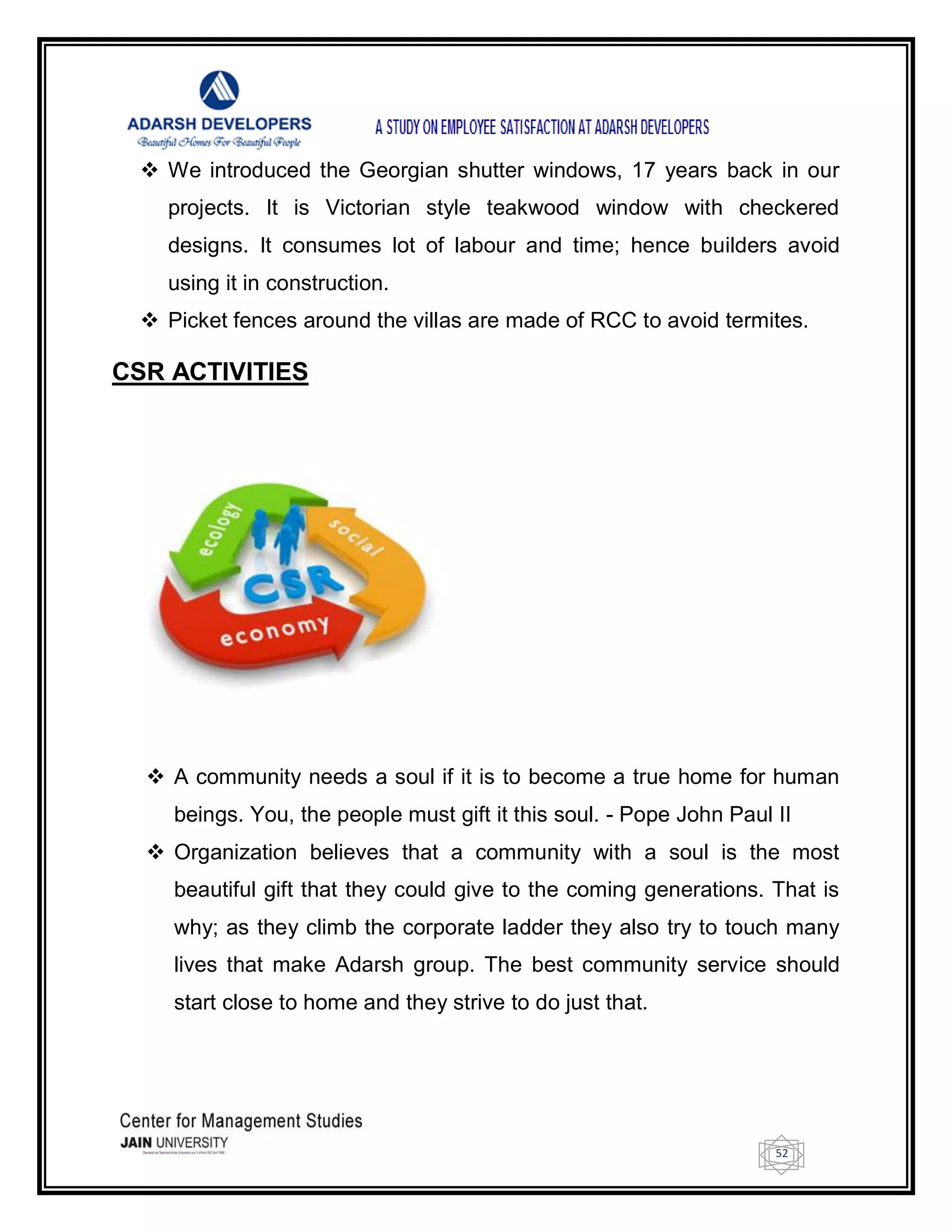
CSR ACTIVITIES
 A community needs a soul if it is to become a true home for human
beings. You, the people must gift it this soul. - Pope John Paul II
 Organization believes that a community with a soul is the most
beautiful gift that they could give to the coming generations. That is
why; as they climb the corporate ladder they also try to touch many
lives that make Adarsh group. The best community service should
start close to home and they strive to do just that.
53
Responsibility towards society
 Outreach Onsite – Adarsh has been setting up schools and imparting
education to the workers‘ children at every worksite for the past 21
years. Its project called Outreach Onsite encourages workers to send
their children to school.While helping them carve a better future for
themselves, Organization also ensure that they are well looked after
and provide mid-day meals to the children. Today, they have nearly
500 children studying at their ongoing project at Palm Retreat.
 They have developed a sewage treatment plant for Devarbisnahalli
village. With the intention of improving the sanitation facilities, They
have extended their in-project plant to the entire village. Around 1000
people will benefit from this plant.
 They sponsor several sports events in various leading colleges while
also providing substantial financial support for the same.
 They undertake various voluntary and philanthropic activities and
donate generously to NGOs, spiritual and other bodies.
 They have donated furniture to a local school in Ramagundanahalli.
 They are committed to delivering environmental-friendly quality
buildings with state-of-the-art technology
 Wherever possible, recycling of material is done, such as recycled
waste and recycled water, which is used for landscaping.
54
 Adarsh, along with nine other builders, developed a road from
Brookfield‘s junction till Saibaba ashram that passes over Palm
Meadows and Whitefield on a 50-50 basis with the government.
BOARD OF DIRECTORS
BM Jayeshankar
Coming from a modest background, Mr. BM Jayeshankar always
had an urge to be different. After completing his Civil Engineering
from Sri. Jaychamarajendra College of Engineering, Mysore he
decided to take a plunge in the real estate sector. With a clear focus
on good quality and construction, Mr Jayeshankar formed Adarsh
Group in 1988.
Combining his innovative ideas with devote attitude towards
accommodating customer needs along with an uncompromising
outlook towards quality, Adarsh has been able to achieve greater
heights in the past 21 years. Today with around 5 million sq.ft of
constructed space, Adarsh commands the repute of being an
exclusive builder delivering unprecedented superior lifestyles under
his command.
BM Karunesh
With complete faith in his brother‘s knowledge and conviction, Mr.
Karunesh supported him and joined him in forming the Adarsh Group
in 1988. With his exceptional knowledge in the areas of Revenue,
Land acquisitions, Legal & Liasioning he has been a continuing
55
contributor in these areas while being involved in the Company
operations.
Smt. Sudha Shanker
As a versatile human being, she has been the driving force behind
Adarsh since its inception. Unified in achieving the vision of our
organization, Smt. Sudha Shanker has been the incarnate inspiration
behind the success of Adarsh group. She is involved in various
aspects of property development and has also been spearheading
numerous social initiatives undertaken by Adarsh Group.
BV Ravikumar
Mr. BV Ravikumar, was appointed as a director of Adarsh group in
2004. With an enriching experience in the field of Infrastructure
development, he brought on board his impeccable knowledge in
Infrastructure & Management. He has executed projects worth more
than Rs. 100 crores from 1985-2004. He has also participated in the
Management Programme for ASEAN and South Asia (ASPM).
56
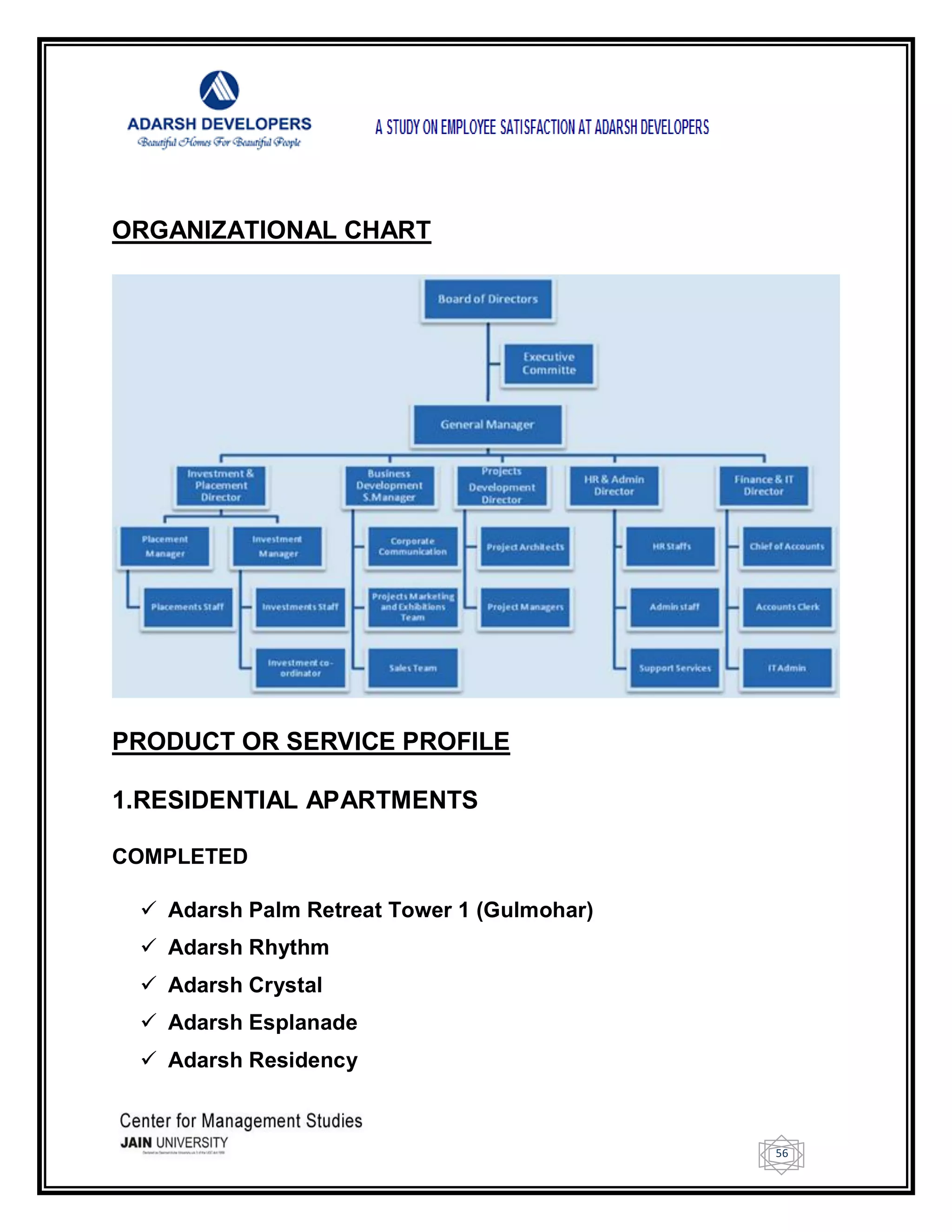
ORGANIZATIONAL CHART
PRODUCT OR SERVICE PROFILE
1.RESIDENTIAL APARTMENTS
COMPLETED
 Adarsh Palm Retreat Tower 1 (Gulmohar)
 Adarsh Rhythm
 Adarsh Crystal
 Adarsh Esplanade
 Adarsh Residency
57
 Adarsh Gardens
 Adarsh Palace
 Adarsh Nest
 Adarsh Nivas
 Adarsh Hills
 Adarsh Court
 AdarshVihar
 Adarsh Manor
 Garadi Apartments
 AdarshSeelin Villa
 Adarsh Rose
CURRENT
 Adarsh Palm Retreat
Proposed Year of Completion – 2015
 Adarsh premia
Proposed Year of Completion – 2016
 Adarsh Palm Retreat Lake Front
Proposed Year of Completion – 2016
2. SIGNATURE VILLAS
COMPLETED
 Palm Meadows
58
 Adarsh vista
CURRENT
 Adarsh Palm Retreat
Proposed Year of Completion - 2016 (Phase 3)
 Adarsh Serenity
Proposed Year of Completion – 2015
 Adarsh Palm Meadows Annex
3. COMMERCIAL OR TECH PARKS
COMPLETED
 Manhattan Associates India Development Center
Project highlights – Built to Suit
Structure – Basement + Ground level + Mezzanine + 3 Upper Level
Current Occupants – Manhattan Associates.
 Adarsh Eco Place
Project highlights – Designed by world renowned architects RSP
Architects, Planners & Engineers (I) Pvt. Ltd., located amidst many IT
giants like SAP and Manhattan Associates this standalone building is
in close proximities to KTPO (Exhibition and Convention Center) and
Ginger Hotel, an entity of Taj Group of Hotels.S tructure – Basement
+ Ground Level + 6 Upper Level. Current Occupants – CEM
Solutions, Align Biz, Qualcomm, Hindustan Petroleum, Aarbee
Structures and Smartplay.
59
 Adarsh Opus
Project highlights – Adarsh Opus is a Grade A facility. Situated in
the heart of the city, Adarsh Opus, today is a shopper‘s destination as
it hosts the fashion Bigwig Lifestyle. Structure – Basement + Ground
Level + 3 Upper Levels. Current Occupants – Lifestyle
 Adarsh Regent
Project highlights – Strategically located in a commercially viable
area, this smoked glass façade complex is modern and highly
efficient in design and space. Efficient office layouts, optimum usage
of space, communication systems, power back-up, basement car
park and ample visitor parking slots along with an array of high-end
support systems. Structure – Basement + Ground Level + 5 Upper
Levels.Current Occupants – Mistral Software, Solectron
 SJM Towers
Project highlights – Built to highest specifications, this tower is
home to one of the leading software companies in India. Strategically
located, complete with corporate requirements and amenities, this
project well describes the Adarsh hallmark of class and elegance
Structure – Ground Level + 3 Upper Levels.
Current Occupants – Tata Consultancy Services
CURRENT
 Adarsh Yelavarthy Centre
Project highlights – Designed by world-renowned architects RSP,
this business center is the latest landmark offering by Adarsh.
60
Centrally located, while being close to MG Road and Indiranagar, this
architectural icon boasts of quite environs of Cambridge layout along
with good connectivity. This is a property best suited for IT and ITES
companies.
Structure – Ground Level + Mezzanine +3 Upper Levels
FORTHCOMING
 Stand-alone Commercial building @ Adarsh Palm
Retreat (ORR)
Set in a serene surrounding, adjoining the lake and as part of a
mixed use development comprising of Luxury condominiums,a
85000 sft commercial development is on the anvil. This can also be a
Built-to-suit option for a dedicated client.
 ADARSH TECH PARK, Whitefield
Spread across 17 acres, in the midst of the IT hub in Bangalore is
AdarshTechPark, Whitefield. An ideally located campus specific for
the IT/ITES domain, it promises to be an elaborate structure designed
to meet the most advanced of needs with cutting edge sophistication.
The Tech Park has been conceived on the theme of ‗Campus Feel
environment‘ and has been designed by the renowned architects and
planners, RSP Singapore. Workplaces being areas where hard-
working employees spend most of their time, Adarsh understands the
importance of creating mini-paradises within the commercial sector
as well. To this end, Adarsh, has retained international consultants for
61
designing landscapes that will relax soaring minds and tired spirits. A
4 star category Shangri-la Traders Hotel is also a part of the
development.
4. HOSPITALITY
Palm Meadows Club
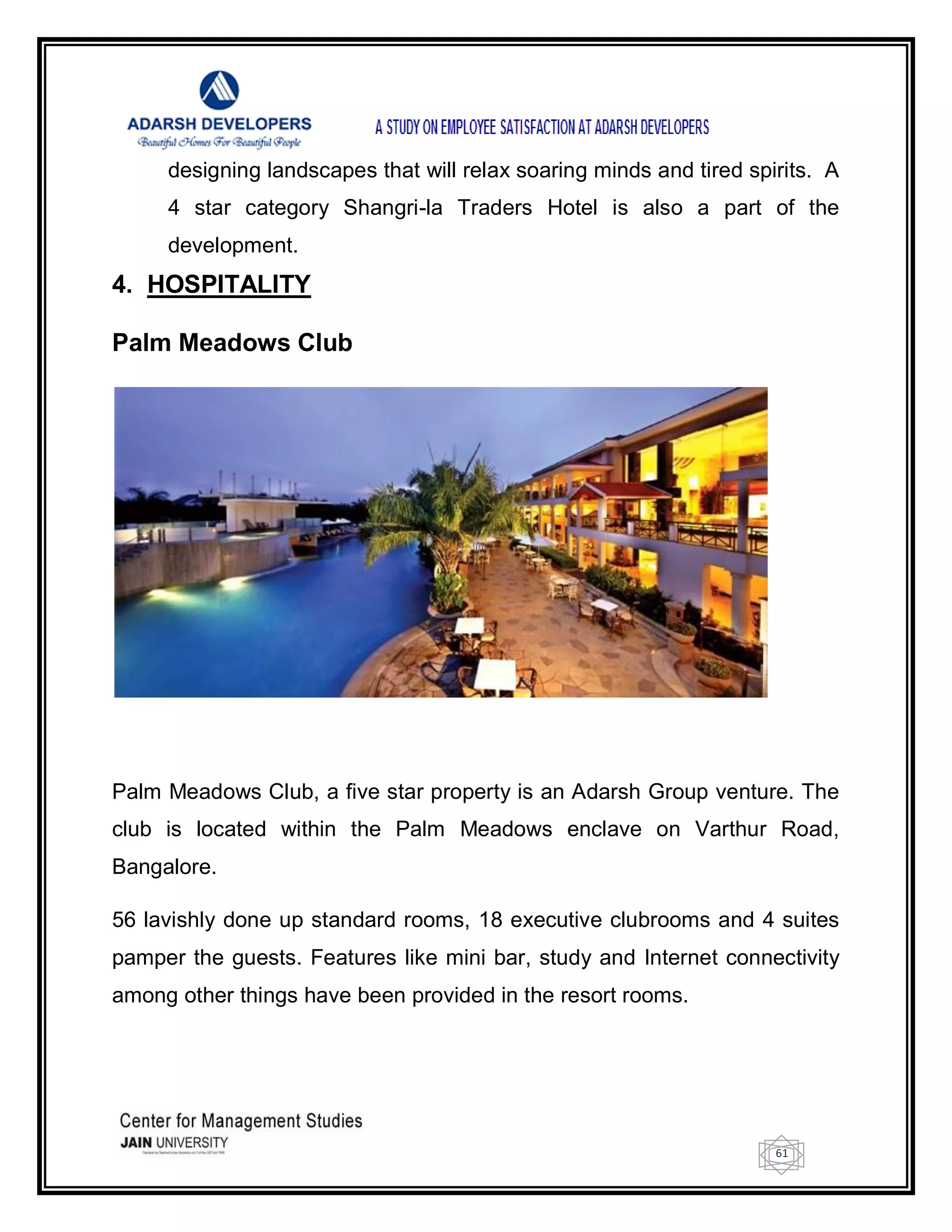
Palm Meadows Club, a five star property is an Adarsh Group venture. The
club is located within the Palm Meadows enclave on Varthur Road,
Bangalore.
56 lavishly done up standard rooms, 18 executive clubrooms and 4 suites
pamper the guests. Features like mini bar, study and Internet connectivity
among other things have been provided in the resort rooms.
62
Besides rooms, Palm Meadows Club also has two state-of-the-art
conferencing facilities for business purposes, restaurants, indoor and
outdoor swimming pools, spa and fitness center and other sports facilities.
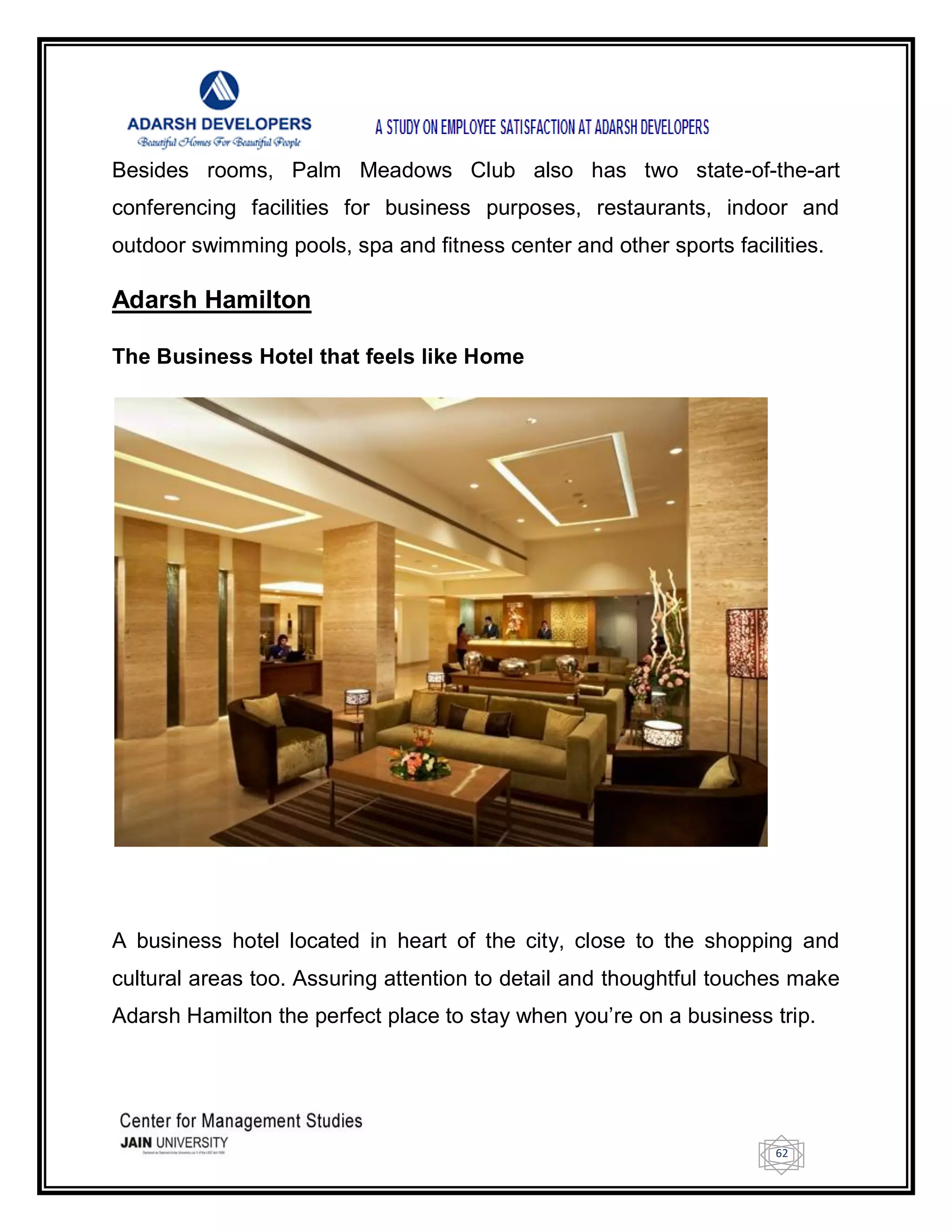
Adarsh Hamilton
The Business Hotel that feels like Home
A business hotel located in heart of the city, close to the shopping and
cultural areas too. Assuring attention to detail and thoughtful touches make
Adarsh Hamilton the perfect place to stay when you‘re on a business trip.
63
Indian hospitality at international standards
When Shangri-la, Asia‘s fastest growing luxury hotel group set its eyes on
Bangalore as the next destination, it searched for a partner who reflected
its own philosophy – a customer-centric approach and the offer of exquisite
luxury amenities to its customers. Adarsh saw the potential of taking its
commitment to quality into a whole new hospitality arena. Our convergent
thinking resulted in a partnership with Shangri-la for developing luxury and
business hotels in Bangalore. The pioneer hotels are two 5 star deluxe
hotels opening by 2013 in the Indian Silicon Valley.
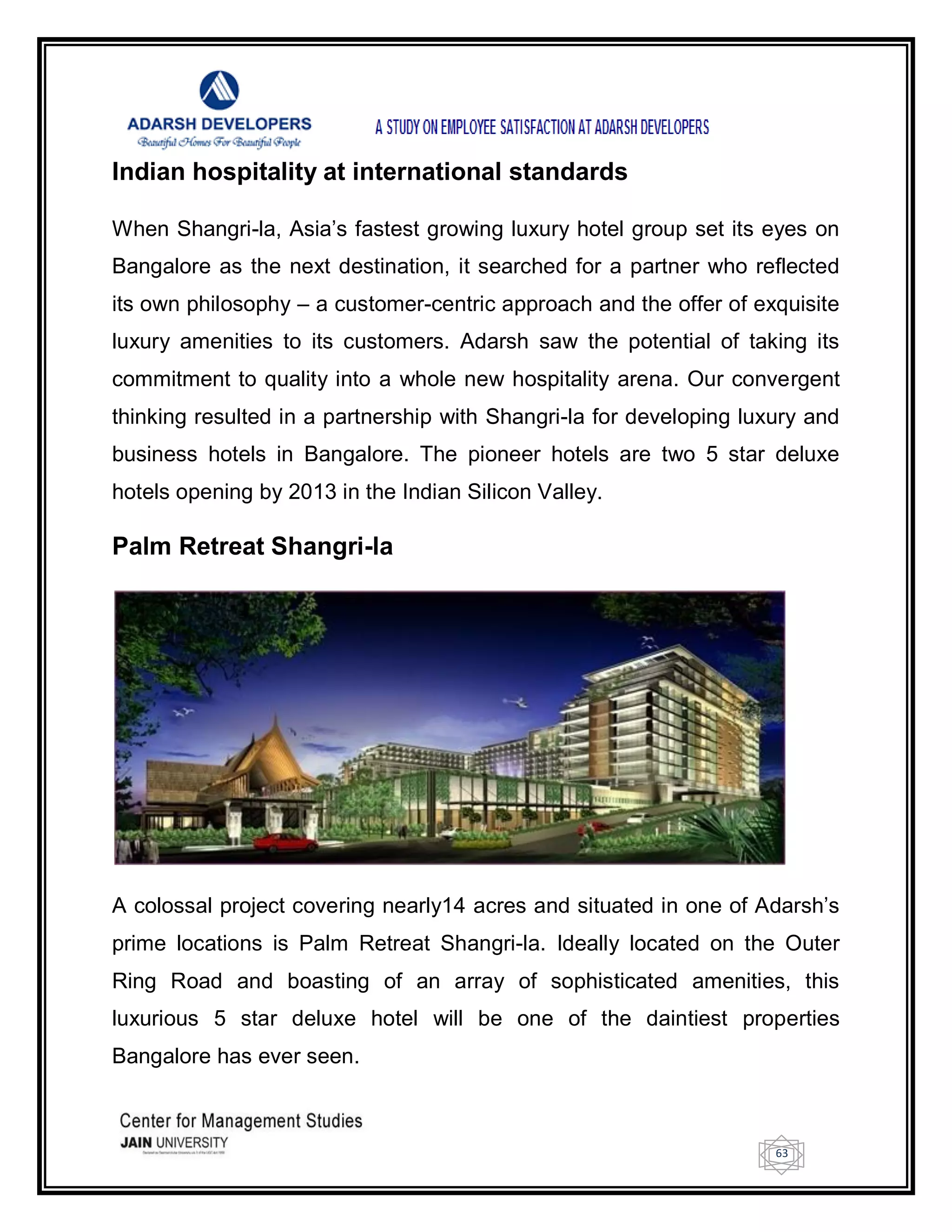
Palm Retreat Shangri-la
A colossal project covering nearly14 acres and situated in one of Adarsh‘s
prime locations is Palm Retreat Shangri-la. Ideally located on the Outer
Ring Road and boasting of an array of sophisticated amenities, this
luxurious 5 star deluxe hotel will be one of the daintiest properties
Bangalore has ever seen.
64
Keeping in view the privacy of our customers and Shangri-la visitors we
have created separate entrance and exits for the Palm Retreat residential
project and Palm Retreat Shangri-la. Enjoy a serene getaway, right in the
kernel.
5 star deluxe
Destined to be an important landmark in Bangalore, this 5 star deluxe hotel
promises to give the most sophisticated experience to all its guests.
Located in the heart of the city and overlooking the Golf course and City
Palace, we have crafted this property with an aesthetical appeal like no
other.To bolster our expertise, we have roped in architects and consultants
of international caliber to create a niche property that would be one of the
most sought after choices.
COMPETITORS
1. Mantri developers
2. Shobha developers
3. Gopalan developers
4. Brigade Enterprises ltd
5. Sterling developers
6. Concorde group
7. Prestige group
65
INVESTORS/ GROWTH
An investment that never stops growing
In the past 21 years, we have been committed towards giving a quality
product to their customers and have been striving for constant
improvements in terms of quality, planning and amenities. And it has paid
off multifold. In a niche product. Time after time. Not only do our customers
get a fulfilling turf that exceeds their expectations of a home, but also
commands a higher ROI than any other property in the same parity. This
enduring commitment has resulted in a stage where they can proudly state
that its properties appreciate upto 1200 % in a time span of just 5-6 years.
66
Most important to its equity standing is the location of its properties. It
selects prime locations with future potential. Next comes their stress on
quality and finish. A fine example of their expertise is Palm Meadows. A
project that has given astronomical returns to our customers and continues
to be the most sought after development. Understanding this growing
demand, at Adarsh Group are planning on an extension of the Palm
Meadows. A few of our select clients will be a part of this extension.
They will be extending the same facilities that the present Palm Meadows
customers are enjoying to the new customers as well.
In the coming years, Adarsh will spread its wings in various verticals and in
many more states to give our brand an edge over the competition, in turn
giving better rewards to our customers. Already on a progressive path, we
will also come up with investor-backed projects in the near future.
67
CHAPTER 4:- DATA ANALYSIS AND INTERPRETATION
The purpose of the data analysis and interpretation phase is to transform
the data collected into credible evidence about the development of the
intervention and its performance. The purpose of data collection is to obtain
information to keep on record, to make decisions about important issues, to
pass information on to others.
In the Employee Satisfaction Survey, employees rate their organization‘s
human resource practices in a number of areas within the following
categories:
1. Satisfaction about company.
2. Satisfaction about job.
3. Satisfaction on Performance Management.
4. Satisfaction on Employee Benefits and Compensation.
5. Satisfaction on Employee Relations, Welfare, and Fulfillment.
68
4.1. SATISFACTION ABOUT COMPANY
4.1.1 TABLE SHOWING WHETHER THE EMPLOYEES ARE
PROUD ABOUT TO TELL PEOPLE THAT THEY WORK FOR
THIS COMPANY
SL.NO RESPONSES NO OF
RESPONDENTS
PERCENTAGE
1. Strongly disagree 4 4%
2. Disagree 2 2%
3. Neutral 18 18%
4. Agree 58 58%
5. Strongly agree 18 18%
TOTAL 100 100%
ANALYSIS
4% of the respondents strongly disagree on the statement that they are
proud to tell people that they work for this company.2% of the respondents
disagree on the statement that they are proud to tell people that they work
for this company.18% of the respondents neither agree nor disagree or
neutral on the statement that they are proud to tell people that they work for
this company.58% of the respondents agree on the statement that they are
proud to tell people that they work for this company.18% of the
respondents strongly agree on the statement that they are proud to tell
people that they work for this company.
69
4.1.1 GRAPH WHETHER THE EMPLOYEES ARE PROUD
ABOUT TO TELL PEOPLE THAT THEY WORK FOR THIS
COMPANY
INTERPRETATION
From the graph we can interpret more than half the respondents agree that
they are proud to tell people that they work for this company.
0
5
10
15
20
25
30
35
40
45
Strongly
disagree
Disagree Neutral Agree strongly
agree
No of respondents
percentage
70
4.1.2 TABLE SHOWING WHETHER EMPLOYEES ARE
SATISFIED WORKING FOR COMPANY AT THE PRESENT
TIME.
SL.NO RESPONSES NO OF
RESPONDENTS
PERCENTAGE
1. Strongly disagree 4 4%
2. Disagree 4 4%
3. Neutral 16 16%
4. Agree 52 52%
5. Strongly agree 24 24%
TOTAL 100 100%
ANALYSIS
4% of the respondents strongly disagree on the statement that they are
satisfied working for company at the present.4% of the respondents
disagree on the statement.16% of the respondents neither agree nor
disagree or neutral on the statement.52% of the respondents agree on the
statement.24% of the respondents strongly agree on the statement.
71
4.1.2 GRAPH SHOWING WHETHER EMPLOYEES ARE
SATISFIED WORKING FOR COMPANY AT THE PRESENT
TIME.
INTERPRETATION
From the graph we can interpret more than half the respondents agree that
they are satisfied working for the company at the present.
0
5
10
15
20
25
30
35
40
45
Strongly
disagree
Disagree Neutral Agree strongly
agree
No of respondents
percentage
72
4.1.3 TABLE SHOWING WHETHER EMPLOYEES WOULD
LIKE TO RECOMMEND OTHERS TO WORK IN THEIR
COMPANY.
SL.NO RESPONSES NO OF
RESPONDENTS
PERCENTAGE
1. Strongly disagree 2 2%
2. Disagree 12 12%
3. Neutral 20 20%
4. Agree 48 48%
5. Strongly agree 18 18%
TOTAL 100 100%
ANALYSIS
2% of the respondents strongly disagree on the statement that they would
like to recommend others to work in their company.12% of the respondents
disagree on the statement.20% of the respondents neither agree nor
disagree or neutral on the statement.48% of the respondents agree on the
statement.18% of the respondents strongly agree on the statement.
73
4.1.3 GRAPH SHOWING WHETHER EMPLOYEES WOULD
LIKE TO RECOMMEND OTHERS TO WORK IN THEIR
COMPANY.
INTERPRETATION
From the graph we can interpret many of the respondents agree that they
would recommend others to work in their company.
0
5
10
15
20
25
30
35
40
45
Strongly
disagree
Disagree Neutral Agree strongly
agree
No of respondents
percentage
74
4.2 SATISFACTION ABOUT JOB.
4.2.1 TABLE SHOWING WHETHER EMPLOYEES ARE
SATISFIED WITH THE JOB AND THE KIND OF WORK THEY
DO.
SL.NO RESPONSES NO OF
RESPONDENTS
PERCENTAGE
1. Strongly disagree 4 4%
2. Disagree 6 6%
3. Neutral 18 18%
4. Agree 40 40%
5. Strongly agree 32 32%
TOTAL 100 100%
ANALYSIS
4% of the respondents strongly disagree on the statement that they are
satisfied with the job and the kind of work that they do.6% of the
respondents disagree on the statement.18% of the respondents neither
agree nor disagree or neutral on the statement.40% of the respondents
agree on the statement.32% of the respondents strongly agree on the
statement.
75
4.2.1 GRAPH SHOWING WHETHER EMPLOYEES ARE
SATISFIED WITH THE JOB AND THE KIND OF WORK THEY
DO.
INTERPRETATION
From the graph we can interpret many of the respondents agree that they
are satisfied with the job and the kind of work they do.
0
5
10
15
20
25
30
35
40
45
Strongly
disagree
Disagree Neutral Agree strongly
agree
No of respondents
percentage
76
4.2.2 TABLE SHOWING WHETHER EMPLOYEES ARE
GETTING ENOUGH RELEVANT TRAINING FOR THE
PRESENT JOB.
SL.NO RESPONSES NO OF
RESPONDENTS
PERCENTAGE
1. Strongly disagree 4 4%
2. Disagree 6 6%
3. Neutral 24 24%
4. Agree 52 52%
5. Strongly agree 14 14%
TOTAL 100 100%
ANALYSIS
4% of the respondents strongly disagree on the statement that they are
getting enough relevant training for the present job.6% of the respondents
disagree on the statement.24% of the respondents neither agree nor
disagree or neutral on the statement.52% of the respondents agree on the
statement.14% of the respondents strongly agree on the statement.
77
4.2.2 GRAPH SHOWING WHETHER EMPLOYEES ARE
GETTING ENOUGH RELEVANT TRAINING FOR THE
PRESENT JOB.
INTERPRETATION
From the graph we can interpret that more than half of the respondents
agree that they are getting enough relevant training for the present job.
78
4.2.3 TABLE SHOWING WHETHER EMPLOYEES ARE
SATISFIED WITH THEIR WORKING CONDITIONS.
SL.NO RESPONSES NO OF
RESPONDENTS
PERCENTAGE
1. Strongly disagree 2 2%
2. Disagree 4 4%
3. Neutral 24 24%
4. Agree 40 40%
5. Strongly agree 30 30%
TOTAL 100 100%
ANALYSIS
2% of the respondents strongly disagree on the statement that they are
satisfied with their working conditions.4% of the respondents disagree on
the statement.24% of the respondents neither agree nor disagree or neutral
on the statement.40% of the respondents agree on the statement.30% of
the respondents strongly agree on the statement.
79
4.2.3 GRAPH SHOWING WHETHER EMPLOYEES ARE
SATISFIED WITH THEIR WORKING CONDITIONS.
INTERPRETATION
From the graph we can interpret that more than half of the respondents
agree that they are satisfied with their working conditions.
80
4.2.4 TABLE SHOWING WHETHER EMPLOYEES FEEL THAT
THEIR JOB IS CHALLENGING AND INTERESTING
SL.NO RESPONSES NO OF
RESPONDENTS
PERCENTAGE
1. Strongly disagree 2 2%
2. Disagree 2 2%
3. Neutral 18 18%
4. Agree 48 48%
5. Strongly agree 30 30%
TOTAL 100 100%
ANALYSIS
2% of the respondents strongly disagree on the statement that they feel
that their job is challenging and interesting.2% of the respondents disagree
on the statement.18% of the respondents neither agree nor disagree or
neutral on the statement.48% of the respondents agree on the
statement.30% of the respondents strongly agree on the statement.
81
4.2.4 GRAPH SHOWING WHETHER EMPLOYEES FEEL THAT
THEIR JOB IS CHALLENGING AND INTERESTING.
INTERPRETATION
From the graph we can interpret that many of the respondents agree that
their job is challenging and interesting.
82
4.3 SATISFACTION ON PERFORMANCE MANAGEMENT.
4.3.1 TABLE SHOWING WHETHER PROMOTION GOES TO
THOSE WHO MOST DESERVE IT.
SL.NO RESPONSES NO OF
RESPONDENTS
PERCENTAGE
1. Strongly disagree 4 4%
2. Disagree 12 12%
3. Neutral 48 48%
4. Agree 24 24%
5. Strongly agree 12 12%
TOTAL 100 100%
ANALYSIS
4% of the respondents strongly disagree on the statement that promotion
goes to those who most deserve it.12% of the respondents disagree on the
statement.48% of the respondents neither agree nor disagree or neutral on
the statement.24% of the respondents agree on the statement.12% of the
respondents strongly agree on the statement.
83
4.3.1 GRAPH SHOWING WHETHER PROMOTION GOES TO
THOSE WHO MOST DESERVE IT.
INTERPRETATION
From the graph we can interpret that many of the respondents neither
agree nor disagree on the statement that promotion goes to those who
most deserve it.
0
5
10
15
20
25
30
35
40
45
Strongly
disagree
Disagree Neutral Agree strongly
agree
No of respondents
percentage
84
4.3.2 TABLE SHOWING WHETHER EMPLOYEES WERE
GIVEN ENOUGH FEEDBACK ON THEIR PERFORMANCE.
SL.NO RESPONSES NO OF
RESPONDENTS
PERCENTAGE
1. Strongly disagree 0 0%
2. Disagree 4 4%
3. Neutral 30 30%
4. Agree 36 36%
5. Strongly agree 30 30%
TOTAL 100 100%
ANALYSIS
0% of the respondents strongly disagree on the statement that they were
given enough feedback on their performance.4% of the respondents
disagree on the statement.30% of the respondents neither agree nor
disagree or neutral on the statement.36% of the respondents agree on the
statement.30% of the respondents strongly agree on the statement.
85
4.3.2 GRAPH SHOWING WHETHER EMPLOYEES WERE
GIVEN ENOUGH FEEDBACK ON THEIR PERFORMANCE.
INTERPRETATION
From the graph we can interpret that many of the respondents agree on the
statement that they were given enough feedback on their performance.
86
4.3.3 TABLE SHOWING WHETHER THEIR
MANAGER/SUPERVISOR PROVIDES THEM WITH CLEAR
DIRECTION.
SL.NO RESPONSES NO OF
RESPONDENTS
PERCENTAGE
1. Strongly disagree 6 6%
2. Disagree 6 6%
3. Neutral 8 8%
4. Agree 52 52%
5. Strongly agree 28 28%
TOTAL 100 100%
ANALYSIS
6% of the respondents strongly disagree on the statement that their
manager/supervisor provides them with clear direction.6% of the
respondents disagree on the above statement.8% of the respondents
neither agree nor disagree or neutral on the statement.52% of the
respondents agree on the above statement.28% of the respondents
strongly agree on the above statement.
87
4.3.3 GRAPH SHOWING WHETHER THEIR
MANAGER/SUPERVISOR PROVIDES THEM WITH CLEAR
DIRECTION .
INTERPRETATION
From the graph we can interpret that more than half of the respondents
agree on the statement that their manager/supervisor provides them with
clear directions.
88
4.3.4 TABLE SHOWING WHETHER THEIR MANAGER
RECOGNIZES AND ACKNOWLEDGES THEIR GOOD
PERFORMANCE.
SL.NO RESPONSES NO OF
RESPONDENTS
PERCENTAGE
1. Strongly disagree 2 2%
2. Disagree 6 6%
3. Neutral 24 24%
4. Agree 46 46%
5. Strongly agree 22 22%
TOTAL 100 100%
ANALYSIS
2% of the respondents strongly disagree on the statement that their
manager recognizes and acknowledges their good performance. 6% of the
respondents disagree on the above statement. 24% of the respondents
neither agree nor disagree or neutral on the statement.46% of the
respondents agree on the above statement. 22% of the respondents
strongly agree on the above statement.
89
4.3.4 GRAPH SHOWING WHETHER THEIR MANAGER
RECOGNIZES AND ACKNOWLEDGES THEIR GOOD
PERFORMANCE.
INTERPRETATION
From the graph we can interpret that many of the respondents agree on the
statement that their manager recognizes and acknowledges their good
performance.
90
4.4 SATISFACTION ON EMPLOYEE BENEFITS AND
COMPENSATION
4.4.1 TABLE SHOWING WHETHER EMPLOYEES ARE
SATISFIED WITH THE COMPANYS EMPLOYEE WELFARE
PROGRAMS SUCH AS REWARDS,INCENTIVES,FOOD
COUPONS,INSURANCE AND HEALTH CARE,ETC
SL.NO RESPONSES NO OF
RESPONDENTS
PERCENTAGE
1. Strongly disagree 0 0%
2. Disagree 12 12%
3. Neutral 46 46%
4. Agree 34 34%
5. Strongly agree 8 8%
TOTAL 100 100%
ANALYSIS
0% of the respondents strongly disagree on the statement that they are
satisfied with the company‘s employee welfare programs such as rewards,
incentives, food coupons, insurance and health care. 12% of the
respondents disagree on the above statement. 46% of the respondents
neither agree nor disagree or neutral on the statement.34% of the
respondents agree on the above statement. 8% of the respondents strongly
agree on the above statement.
91
4.4.1 GRAPH SHOWING WHETHER EMPLOYEES ARE
SATISFIED WITH THE COMPANYS EMPLOYEE WELFARE
PROGRAMS SUCH AS REWARDS,INCENTIVES,FOOD
COUPONS,INSURANCE AND HEALTH CARE,ETC
INTERPRETATION
From the graph we can interpret that many of the respondents neither
agree nor disagree on the statement that they are satisfied with the
company‘s welfare programs such as rewards, incentives, food coupons,
insurance and health care etc.
92
4.4.2 TABLE SHOWING WHETHER EMPLOYEES ARE
SATISFIED WITH THE COMPANYS RECREATIONAL
ACTIVITIES PROVIDED BY THE COMPANY, Eg, PICNICS AND
ANNUAL DINNER.
SL.NO RESPONSES NO OF
RESPONDENTS
PERCENTAGE
1. Strongly disagree 2 2%
2. Disagree 24 24%
3. Neutral 38 38%
4. Agree 24 24%
5. Strongly agree 12 12%
TOTAL 100 100%
ANALYSIS
1% of the respondents strongly disagree on the statement that they are
satisfied with the recreational activities provided by the company, eg.
picnics and annual dinner.24% of the respondents disagree on the above
statement. 38% of the respondents neither agree nor disagree or neutral on
the statement.24% of the respondents agree on the above statement. 12%
of the respondents strongly agree on the above statement.
93
4.4.2. GRAPH SHOWING WHETHER EMPLOYEES ARE
SATISFIED WITH THE COMPANYS RECREATIONAL
ACTIVITIES PROVIDED BY THE COMPANY, Eg, PICNICS AND
ANNUAL DINNER.
INTERPRETATION
From the graph we can interpret that many of the respondents neither
agree nor disagree on the statement that they are satisfied with the
recreational activities provided by the company.
94
4.4.3 TABLE SHOWING WHETHER EMPLOYEES ARE
SATISFIED WITH THE COMPANYS PEOPLE PROGRAMS,
SUCH AS BIRTHDAY ANNOUNCEMENTS, VALUABLE
EMPLOYEE OF THE MONTH, BULLETINS AND
NEWSLETTER, ETC
SL.NO RESPONSES NO OF
RESPONDENTS
PERCENTAGE
1. Strongly disagree 4 4%
2. Disagree 16 16%
3. Neutral 32 32%
4. Agree 26 26%
5. Strongly agree 22 22%
TOTAL 100 100%
ANALYSIS
4% of the respondents strongly disagree on the statement that they are
satisfied with the company‘s people programs, such as birthday
announcements, valuable employee of the month, bulletins and newsletter,
etc.16% of the respondents disagree on the above statement. 32% of the
respondents neither agree nor disagree or neutral on the statement.26% of
the respondents agree on the above statement. 22% of the respondents
strongly agree on the above statement.
95
4.4.3. GRAPH SHOWING WHETHER EMPLOYEES ARE
SATISFIED WITH THE COMPANYS PEOPLE PROGRAMS,
SUCH AS BIRTHDAY ANNOUNCEMENTS, VALUABLE
EMPLOYEE OF THE MONTH, BULLETINS AND
NEWSLETTER, ETC
INTERPRETATION
From the graph we can interpret that many of the respondents neither
agree nor disagree on the statement that they are satisfied with the
company‘s people programs, such as birthday announcements, valuable
employee of the month, bulletins and newsletter etc.
0
5
10
15
20
25
30
35
40
45
Strongly
disagree
Disagree Neutral Agree strongly
agree
No of respondents
percentage
96
4.4.4 TABLE SHOWING WHETHER EMPLOYEES BELIEVE
THAT SALARIES ARE FAIR AND NOT BASED ON
FAVORITISM.
SL.NO RESPONSES NO OF
RESPONDENTS
PERCENTAGE
1. Strongly disagree 6 6%
2. Disagree 10 10%
3. Neutral 28 28%
4. Agree 32 32%
5. Strongly agree 24 24%
TOTAL 100 100%
ANALYSIS
6% of the respondents strongly disagree on the statement that they believe
that salaries are fair and not based on favoritism.10% of the respondents
disagree on the above statement. 28% of the respondents neither agree
nor disagree or neutral on the statement.32% of the respondents agree on
the above statement. 24% of the respondents strongly agree on the above
statement.
97
4.4.4 GRAPH SHOWING WHETHER EMPLOYEES BELIEVE
THAT SALARIES ARE FAIR AND NOT BASED ON
FAVORITISM.
INTERPRETATION
From the graph we can interpret that many of the respondents agree on the
statement that they believe that salaries are fair and not based on
favoritism.
0
5
10
15
20
25
30
35
40
45
Strongly
disagree
Disagree Neutral Agree strongly
agree
No of respondents
percentage
98
4.4.5 TABLE SHOWING WHETHER SALARIES ARE
COMPETITIVE COMPARED TO OTHER SIMILAR
ORGANIZATIONS.
SL.NO RESPONSES NO OF
RESPONDENTS
PERCENTAGE
1. Strongly disagree 6 6%
2. Disagree 22 22%
3. Neutral 36 36%
4. Agree 18 18%
5. Strongly agree 18 18%
TOTAL 100 100%
ANALYSIS
6% of the respondents strongly disagree on the statement that salaries are
competitive compared to other similar organizations.22% of the
respondents disagree on the above statement. 36% of the respondents
neither agree nor disagree or neutral on the statement.18% of the
respondents agree on the above statement. 18% of the respondents
strongly agree on the above statement.
99
4.4.5 GRAPH SHOWING WHETHER SALARIES ARE
COMPETITIVE COMPARED TO OTHER SIMILAR
ORGANIZATIONS.
INTERPRETATION
From the graph we can interpret that many of the respondents neither
agree nor disagree on the statement that salaries are competitive
compared to other similar organizations.
100
4.5 SATISFACTION ON EMPLOYEE RELATIONS, WELFARE
AND FULFILLMENT.
4.5.1 TABLE SHOWING WHETHER EMPLOYEES FEEL THAT
MANAGEMENT CARES ABOUT EMPLOYEES AND TAKES
INTEREST IN THEM.
SL.NO RESPONSES NO OF
RESPONDENTS
PERCENTAGE
1. Strongly disagree 4 4%
2. Disagree 6 6%
3. Neutral 20 20%
4. Agree 46 46%
5. Strongly agree 24 24%
TOTAL 100 100%
ANALYSIS
4% of the respondents strongly disagree on the statement that
management cares about employees and takes interest in them.6% of the
respondents disagree on the above statement. 20% of the respondents
neither agree nor disagree or neutral on the statement.46% of the
respondents agree on the above statement. 24% of the respondents
strongly agree on the above statement.
101
4.5.1 GRAPH SHOWING WHETHER EMPLOYEES FEEL THAT
MANAGEMENT CARES ABOUT EMPLOYEES AND TAKES
INTEREST IN THEM.
INTERPRETATION
From the graph we can interpret that many of the respondents agree on the
statement that management cares about employees and takes interest in
them.
102
4.5.2 TABLE SHOWING WHETHER EMPLOYEES FEEL THAT
WORK IS FAIRLY DISTRIBUTED IN THEIR WORK GROUP.
SL.NO RESPONSES NO OF
RESPONDENTS
PERCENTAGE
1. Strongly disagree 4 4%
2. Disagree 6 6%
3. Neutral 18 18%
4. Agree 48 48%
5. Strongly agree 24 24%
TOTAL 100 100%
ANALYSIS
4% of the respondents strongly disagree on the statement that work is fairly
distributed in their work group.6% of the respondents disagree on the
above statement. 18% of the respondents neither agree nor disagree or
neutral on the statement.48% of the respondents agree on the above
statement. 24% of the respondents strongly agree on the above statement.
103
4.5.2 GRAPH SHOWING WHETHER EMPLOYEES FEEL THAT
WORK IS FAIRLY DISTRIBUTED IN THEIR WORK GROUP.
INTERPRETATION
From the graph we can interpret that many of the respondents agree on the
statement that work is fairly distributed in their work group.
104
4.5.3 TABLE SHOWING WHETHER EMPLOYEES ARE
SATISFIED WITH HOW MEMBERS OF THEIR GROUP SOLVE
PROBLEMS.
SL.NO RESPONSES NO OF
RESPONDENTS
PERCENTAGE
1. Strongly disagree 0 0%
2. Disagree 8 8%
3. Neutral 14 14%
4. Agree 44 44%
5. Strongly agree 34 34%
TOTAL 100 100%
ANALYSIS
0% of the respondents strongly disagree on the statement that they are
satisfied with how members of their work group solve problems.8% of the
respondents disagree on the above statement. 14% of the respondents
neither agree nor disagree or neutral on the statement.44% of the
respondents agree on the above statement. 34% of the respondents
strongly agree on the above statement.
105
4.5.3 GRAPH SHOWING WHETHER EMPLOYEES ARE
SATISFIED WITH HOW MEMBERS OF THEIR GROUP SOLVE
PROBLEMS.
INTERPRETATION
From the graph we can interpret that many of the respondents agree on the
statement that they are satisfied with how members of their group solve
problems.
106
4.5.4 TABLE SHOWING WHETHER THEIR WORK GROUP
WORKS WELL TOGETHER.
SL.NO RESPONSES NO OF
RESPONDENTS
PERCENTAGE
1. Strongly disagree 0 0%
2. Disagree 8 8%
3. Neutral 12 12%
4. Agree 50 50%
5. Strongly agree 30 30%
TOTAL 100 100%
ANALYSIS
0% of the respondents strongly disagree on the statement that their work
group works well together.8% of the respondents disagree on the above
statement. 12% of the respondents neither agree nor disagree or neutral on
the statement.50% of the respondents agree on the above statement. 30%
of the respondents strongly agree on the above statement.
107
4.5.4 GRAPH SHOWING WHETHER THEIR WORK GROUP
WORKS WELL TOGETHER.
INTERPRETATION
From the graph we can interpret that many of the respondents agree on the
statement that their work group works well together.
108
4.5.5 TABLE SHOWING WHETHER EMPLOYEES FEEL FREE
TO TALK OPENLY AND HONESTLY WITH THE MEMBERS OF
THEIR WORK GROUP.
SL.NO RESPONSES NO OF
RESPONDENTS
PERCENTAGE
1. Strongly disagree 4 4%
2. Disagree 10 10%
3. Neutral 12 12%
4. Agree 36 36%
5. Strongly agree 38 38%
TOTAL 100 100%
ANALYSIS
4% of the respondents strongly disagree on the statement that they feel
free to talk openly and honestly with the members of their work group .10%
of the respondents disagree on the above statement. 12% of the
respondents neither agree nor disagree or neutral on the statement.36% of
the respondents agree on the above statement. 38% of the respondents
strongly agree on the above statement.
109
4.5.5 GRAPH SHOWING WHETHER EMPLOYEES FEEL FREE
TO TALK OPENLY AND HONESTLY WITH THE MEMBERS OF
THEIR WORK GROUP.
INTERPRETATION
From the graph we can interpret that many of the respondents strongly
agree on the statement that they feel free to talk openly and honestly with
members of their work group.
110
4.5.6 TABLE SHOWING WHETHER EMPLOYEES OBSERVE
THAT THERE ARE GOOD WORKING RELATIONS AND
TEAMWORK AT MOST LEVEL IN MOST DEPARMENTS.
SL.NO RESPONSES NO OF
RESPONDENTS
PERCENTAGE
1. Strongly disagree 6 6%
2. Disagree 10 10%
3. Neutral 18 18%
4. Agree 42 42%
5. Strongly agree 24 24%
TOTAL 100 100%
ANALYSIS
6% of the respondents strongly disagree on the statement that they
observe that there are good working relations and teamwork at most levels
in most departments.10% of the respondents disagree on the above
statement. 18% of the respondents neither agree nor disagree or neutral on
the statement.42% of the respondents agree on the above statement. 24%
of the respondents strongly agree on the above statement.
111
4.5.6 GRAPH SHOWING WHETHER EMPLOYEES OBSERVE
THAT THERE ARE GOOD WORKING RELATIONS AND
TEAMWORK AT MOST LEVEL IN MOST DEPARMENTS.
INTERPRETATION
From the graph we can interpret that many of the respondents agree on the
statement that they observe that there are good working relations and
teamwork at most levels in most departments.
112
CHAPTER 5 –SUMMARY OF FINDINGS,RECOMMENDATIONS
AND CONCLUSION
SUMMARY OF FINDINGS
A study titled Employee satisfaction at Adarsh developers has adopted
exploratory method of research. After tabulating and analyzing the data
collected, the findings are summarized under
 We can interpret that more than half the respondents are proud to
tell people that they work for this company.
 Employees are satisfied working for company at the present time.
 Employees would like to recommend others to work in their company.
 Employees are satisfied with the job and the kind of work they do.
 Employees are getting enough relevant training for the present job.
 Employees are satisfied with their working conditions. Company has
taken utmost importance in providing a healthy and hygienic work
environment to all employees.
 Employees feel that their job is challenging and interesting.
 Employees responded neutral neither agree nor disagree i.e not that
satisfied when it comes to promotion goes to those who deserve it.
 Employees were given enough feedback on their performance.
 More than half of the respondents agree on the statement that their
manager/supervisor provides them with clear directions.
 Many of the respondents agree on the statement that their manager
recognizes and acknowledges their good performance.
113
 Many of the respondents neither agree nor disagree on the statement
that they are satisfied with the company‘s welfare programs such as
rewards, incentives, food coupons, insurance and health care etc.
 We can interpret that many of the respondents neither agree nor
disagree on the statement that they are satisfied with the recreational
activities provided by the company.
 Many of the respondents neither agree nor disagree to the statement
whether they were satisfied with the companys people programs,
such as birthday announcements, valuable employee of the month,
bulletins and newsletter, etc
 Most of the employees believe that salaries are fair and not based on
favoritism.
 Most of the employees neither agree nor disagree to the statement
salaries are competitive compared to other similar organizations.
 Many of the respondents agree on the statement that management
cares about employees and takes interest in them.
 Many of the respondents agree on the statement that work is fairly
distributed in their work group.
 Many of the respondents agree on the statement that they are
satisfied with how members of their group solve problems.
 Many of the respondents agree on the statement that their work
group works well together.
 Many of the respondents strongly agree on the statement that they
feel free to talk openly and honestly with members of their work
group.
114
 Many of the respondents agree on the statement that they observe
that there are good working relations and teamwork at most levels in
most departments.
RECOMMENDATIONS
 Promotion opportunities-The careers of the employees should be
modified so as to include a fast pace in their carrer slope and include
more rewarding jobs. Promotion should be given to those who
deserve it the most.
 Welfare programs- There should be more incentive programs for
employees such as fringe benefits, rewards, food coupons, valuable
employee of the month and insurance.
 Recreational activities- Conducting annual day function, create an
atmosphere of fun at work, have a schedule for employee
engagement activities.
 Conduct company’s people programs, such as birthday
announcements.
 Bench mark the pay for employees based on their hierarchy levels
for same industry and provide them the salaries by comparing it with
the other similar organization so as to sustain many hardworking,
active and best employees.
 Give your staff regular, consistent feedback. Employees want to
know how managers believe they are performing. Even some
negative or need-to-improve messages are preferred to no feedback
115
at all. A lack of feedback can also render your semi-annual or annual
written performance reviews ineffective.
CONCLUSIONS
Findings and suggestions are based on the survey conducted and
these points are to be looked into and steps are to be taken in this
regard for higher growth.
 From the analysis I conclude that the job provides the opportunity are
proud to tell people that they work for this company.
 Employees are satisfied working for company at the present time.
 Employees would like to recommend others to work in their company.
 Employees are satisfied with the job and the kind of work they do.
 Employees are getting enough relevant training for the present job.
 Employees are satisfied with their working conditions. Company has
taken utmost importance in providing a healthy and hygienic work
environment to all employees.
 Employees feel that their job is challenging and interesting.
From analysis it was also observed that there is the scope for improvement
for welfare program, Recreational activities, Company‘s people program.
Finally I would like to conclude that Adarsh developers has most of the
satisfied employees at its work place.
116
BIBLIOGRAPHY
WEBSITES
http://www.adarshdevelopers.com/AdarshHome.aspx
http://smallenterpriseindia.com
http://spiritofhr.in
http://www.humanresourceexcellence.com
http://www.moneycontrol.com
http://www.mondaq.com
http://www.ibef.org
www.planningcommission.nic
www.businessdictionary.co
https://wikispaces.psu.edu
http://talentedapps.wordpress.com/2008/04/11/job-satisfaction-model-for-
retention/.
JOURNALS
Baker, W. K. (2004). Antecedents and consequences of job satisfaction: Testing a
comprehensive model using integrated methodology .Pg 31-44.
BOOKS
Aamodt, M. (2009). Industrial/Organizational Psychology. Belmont, CA. Cengage
Learning. Pg 357
Craig C. Pinder (2008)Work Motivation in Organizational Behavior, Second Edition,
psychology press, Newyork
117
Questionnaire on Employee satisfaction at Adarsh developers
Dear sir/madam,
I am a student pursuing BBM at CMS Jain University, undertaking a
project entitled ―A study on Employee satisfaction at Adarsh developers‖.
Kindly furnish the following information, which would help me in completion
of the project. I assure you that information collected will remain
confidential and will be used strictly for academic purpose only.
Thanking you for your kind co-operation and valuable help.
Yours faithfully,
Date-
Place- Bangalore
Demographic information
Name- Designation – Gender-M/F
(optional) (optional)
Age- 21-30, 31-40, 41- 50,51-60
In the Employee Satisfaction Survey, employees rate their organization‘s
human resource practices in a number of areas within the following
categories:
1. Satisfaction about your company
2. Satisfaction about your job
3. Satisfaction on Performance Management
4. Satisfaction on Employee Benefits and Compensation
5. Satisfaction on Employee Relations, Welfare, and Fulfillment
118
Tick the one which you feel appropriate
This provides you with an overview of some of the questions asked for
employees in the each of the 6 areas. Each response is based on a 5-point
scale:
5 = Strongly disagree
4 = Disagree
3 = Neutral
2 = Strongly agree
1 = Agree
Satisfaction about your company
1 2 3 4 5
1 I am proud to tell people I work for this
company
2 I am satisfied working for my company at the
present time.
3 I Would like to recommend others to work
here
Satisfaction about your job
1 2 3 4 5
1 I am satisfied with my job and the kind of
work I do.
2 I am getting enough relevant training for my
present job.
3 I am satisfied with my working conditions.
4 My job is challenging and interesting.
119
Satisfaction on Performance management
1 2 3 4 5
1 Promotion goes to those who most deserve it.
2 I was given enough feedback on my
performance.
3 My manager/supervisor provides me with
clear direction.
4 My manager recognizes and acknowledges
my good performance.
Satisfaction on Employee benefits and compensation
1 2 3 4 5
1 I am satisfied with the company‘s employee
welfare
programs such as rewards, incentives, food
coupons, insurance and health care, etc.
2 I am satisfied with the recreational activities
provided by the company, e.g. picnics and
annual dinner.
3 I am satisfied with the company‘s people
programs, such as birthday announcements,
valuable employee of the month, bulletins and
newsletter, etc.
4 I believe that salaries are fair and not based
on favoritism.
5 Salaries are competitive compared to other
similar organizations
120
Satisfaction on Employee relations, welfare and fulfillment
1 2 3 4 5
1 I feel that management cares about
employees and take an interest in them.
2 Work is fairly distributed in my work group.
3 I am satisfied with how members of my work
group solve problems.
4 My work group works well together.
5 I feel free to talk openly and honestly with
members of
my work group.
6 I observe that there are good working
relations and teamwork at most levels in most
departments.

Major project on employee satisfaction at adarsh developers

  • 1.
    1 CHAPTER 1: INTRODUCTION PARTA OVERVIEW The term ‗real estate’ is defined as land, Including the air above it and the ground below it, and any buildings or structures on it. It is also referred to as realty. It covers residential housing , commercial offices, trading spaces such as theatres, hotels and restaurants, retail outlets, industrial buildings such as factories and government buildings. Real estate involves the purchase, sale, and development of land, residential land non-residential buildings. The main players in the real estate market are the landlords, developers , builders, real estate agents, tenants, buyers etc. The activities of the real estate sector encompass the housing and construction sectors also.
  • 2.
    2 The real estatesector in India has come a long way by becoming one of the fastest growing markets in the world. It is not only successfully attracting domestic real estate developers, but foreign investors as well. The growth of the industry is attributed mainly to a large population base, rising income level, and rapid urbanization. The sector comprises of four sub-sectors- housing, retail, hospitality, and commercial. While housing contributes to five-six percent of the country‘s gross domestic product (GDP), the remaining three sub-sectors are also growing at a rapid pace, meeting the increasing infrastructural needs. The real estate sector has transformed from being unorganized to a dynamic and organized sector over the past decade. Government policies have been instrumental in providing support after recognizing the need for infrastructure development in order to ensure better standard of living for its citizens. In addition to this, adequate infrastructure forms a prerequisite for sustaining the long-term growth momentum of the economy. The Indian real estate sector is one of the most globally recognized sectors. In the country, it is the second largest employer after agriculture and is slated to grow at 30 per cent over the next decade. It comprises four sub sectors - housing, retail, hospitality, and commercial. The growth of this sector is well complemented by the growth of the corporate environment and the demand for office space as well as urban and semi-urban accommodations. The real estate sector of India presently contributes about 5% to the national GDP, is the second largest employer after the agricultural sector,
  • 3.
    3 and is growingrapidly with a compound annual growth rate [CAGR] of over 11%. Currently, the real estate sector of India is the fourth biggest in respect of FDI inflows [the Government of India has allowed FDI of up to 100% in the development projects for township and settlements], and is constantly growing to reach the level of US$650 billion by the year 2020, and thus become the third largest real estate market of the whole world by then. Here, it may also be noted that growth in the real estate industry is linked to developments in the corporate and commercial sectors, hospitality sector [hotels, restaurants, resorts, etc.], retail sector [shopping complexes and malls], information technology (IT) and ITES sector, (urban) infrastructure, modern housing, education and teaching sector, service sector [hospitals, etc.], tourism and entertainment sector, and many other fields. Though this real estate sector of India has regularly been in the limelight of the domestic and international investors, it still lacks easy and adequate sources for finances, accountability and reliability, and transparency, which prevail in the well-developed countries. This Indian real estate sector has traditionally been dominated by a number of small regional players, and has been drawing funds from high net-worth individuals and other informal sources of financing, and consequently lacked high levels of transparency.
  • 4.
    4 REAL ESTATE INDUSTRYESTIMATION IN 2015 AT A GLANCE The real estate industry has been under scrutiny in recent years with the mortgage crisis and other current events, but it is still a large field which generates billions or dollars in revenue. There were 165,000 companies operating in the residential brokerage and management field last year, which generated $170 billion in revenue, and there were 25,000 companies operating in the commercial brokerage and management field, generating an annual revenue of $30 billion. THE SCENE TODAY The real estate sector is a critical sector of our economy. It has a huge multiplier effect on the economy and therefore, is a big driver of economic growth. It is the second largest employment generating sector after agriculture. Growing at a rate of about 20% per annum and this sector has been contributing about 5-6% to India‘s GDP. Not only does it generate a high level of direct employment, but it also stimulates the demand in over 250 ancillary industries such as cement, steel, paint, brick, building materials, consumer durables and so on. The Indian real estate industry has been on a roller coaster ride since 2005. Consequent to the government‘s policy to allow Foreign Direct Investment (FDI) in this sector, there was a boom in investment and developmental activities. The sector not only witnessed the entry of many new domestic realty players but also the arrival of many foreign real estate investment companies including private equity funds, pension funds and development companies entered
  • 5.
    5 the sector luredby the high returns on investments. The real estate sector has been riding through many highs and lows since then. The industry achieved new heights during 2007 and early 2008, characterized by a growth in demand, substantial development and increased foreign investments. However, by mid 2008, the effects of the global economic slowdown were evident here too, and the industry took a ‗U‘ turn. FDI inflow into real estate dropped significantly and what had emerged as one of the most promising markets for foreign investments experienced a downturn. SEGMENTS IN THE INDIAN REAL ESTATE SECTOR
  • 6.
    6 HISTORY The period from1950 to mid 60‘s witnessed the government playing an active role in the development of these services and most of construction activities during this period were carried out by state owned enterprises and supported by government departments. In the first five-year plan, construction of civil works was allotted nearly 50 per cent of the total capital outlay. The first professional consultancy company, National Industrial Development Corporation (NIDC), was set up in the public sector in 1954. Subsequently, many architectural, design engineering and construction companies were set up in the public sector (Indian Railways Construction Limited (IRCON), National Buildings Construction Corporation (NBCC), Rail India Transportation and Engineering Services (RITES), Engineers India Limited (EIL), etc.) and private sector (M N Dastur and Co., Hindustan Construction Company (HCC), Ansals, etc.). In India Construction has accounted for around 40 per cent of the development investment during the past 50 years. Around 16 per cent of the nation's working population depends on construction for its livelihood. The Indian construction industry employs over 30 million people and creates assets worth over 200 billion.
  • 7.
    7 It contributes morethan 5 per cent to the nation's GDP and 78 per cent to the gross capital formation. Total capital expenditure of state and central govt. will be touching 8,021 billion in 2011-12 from 1,436 billion (1999- 2000). The share of the Indian construction sector in total gross capital formation (GCF) came down from 60 per cent in 1970-71 to 34 per cent in 1990-91. Thereafter, it increased to 48 per cent in 1993-94 and stood at 44 per cent in 1999-2000. In the 21 st century, there has been an increase in the share of the construction sector in GDP and capital formation. GDP from Construction at factor cost (at current prices) increased to 1,745.71 billion (12.02% of the total GDP ) in 2004-05 from 1,162.38 billion (10.39% of the total GDP) in 2000-01. The main reason for this is the increasing emphasis on involving the private sector infrastructure development through public-private partnerships and mechanisms like build-operate-transfer (BOT), private sector investment has not reached the expected levels. The Indian construction industry comprises 200 firms in the corporate sector. In addition to these firms, there are about 120,000 class A contractors registered with various government construction bodies. There are thousands of small contractors, which compete for small jobs or work as sub-contractors of prime or other contractors.
  • 8.
    8 Total sales ofconstruction industry have reached 428854 million in 2004 05 from 214519 million in 2000-01, almost 20% of which is a large contract for Benson & Hedges. GROWTH AND PROSPECTS OF INDUSTRY The real estate sector in India is being recognized as an infrastructure service that is driving the economic growth engine of the country. The Indian real estate market size is expected to touch US$ 180 billion by 2020. Foreign direct investment (FDI) in the sector is expected to increase to US$ 25 billion in the next 10 years, from present US$ 4 billion. According to Department of Industrial Policy and Promotion (DIPP), the construction development sector in India has received foreign direct investment (FDI) equity inflows to the tune of US$ 23,874.1 million in the period April 2000-September 2014. The Indian real estate market size is expected to touch US$ 180 billion by 2020. The housing sector alone contributes 5-6 per cent to the country's gross domestic product (GDP). Also, in the period FY08-20, the market size of this sector is expected to increase at a compound annual growth rate (CAGR) of 11.2 per cent. Retail, hospitality and commercial real estate are also growing significantly, providing the much-needed infrastructure for India's growing needs. Mumbai is the best city in India for commercial real estate investment, with returns of 12-19 per cent likely in the next five years, followed by Bangalore
  • 9.
    9 and Delhi-National CapitalRegion (NCR). Also, Delhi-NCR was the biggest office market in India with 110 million sq ft, out of which 88 million sq ft were occupied. Sectors such as IT and ITeS, retail, consulting and e- commerce have registered high demand for office space in recent times. The construction industry ranks third among the 14 major sectors in terms of direct, indirect and induced effects in all sectors of the economy. The industry's growth is linked to developments in the retail, hospitality and entertainment (hotels, resorts, cinema theatres) sectors, economic services (hospitals, schools) and information technology (IT)-enabled services (like call centres) etc and vice-versa. The sector is divided into four sub-sectors: Housing Retail Hospitality Commercial The housing sub-sector contributes five-six per cent to the country's gross domestic product (GDP). Meanwhile, retail, hospitality and commercial real estate are also growing significantly, catering to India's growing needs of infrastructure. The Indian real estate market size is expected to touch US$ 180 billion by 2020 EMERGING TRENDS OF REAL ESTATE IN INDIAN CITIES Rankings of cities in India in terms of real estate investment and development in Asia pacific.
  • 10.
    10 Bangalore (20th ininvestment, 17th in development). Indian cities occupy the three bottom places in this year‘s survey as a result of ongoing economic problems, an uncertain currency outlook following a steep plunge in the value of the rupee in midyear, and an investment environment widely perceived to be unfriendly to international investors. Interest remains high, however. With elections looming and reports on the ground in India suggesting that the tide may be turning in receptivity to foreign investment, many foreign funds are waiting on the sidelines to see what happens. To some extent, Bangalore is isolated from current problems in India given its status as a major IT/BPO center. The aforementioned decline in the rupee may in fact help the city‘s prospects given the number of foreign service companies based there whose U.S. dollar cost basis will have been reduced as a result. Foreign participation in this market is therefore ongoing, with opportunistic funds partnering with local developers to acquire properties. As one locally based consultant said, ―The [local] developers are seeing larger commitments of capital from those [foreign] players—the intent is to create platforms that will then either acquire and develop green field or partly developed properties, or even acquire income-producing properties if they are reasonably priced with good covenants. It‘s an asset-management play with the IT component to deliver the needed IRRs [internal rates of return].‖ This perhaps accounts for Bangalore‘s slightly higher ranking (17th) as a development destination. On the ground, demand continues to be strong, with vacancies of around 2 percent, according to Jones Lang LaSalle. Rents are stable and capital prices
  • 11.
    11 continue to risegradually. Supply in some of the traditional IT parks is becoming tight, requiring an expansion of facilities in the outer (especially northern) areas of the city to accommodate new demand. New Delhi (21st in investment, 22nd in development). Both rents and capital prices in Delhi continue to rise slowly after bottoming out in 2009, although they remain well below pre–global financial crisis levels. Substantial volumes of newly completed office assets were released onto the market in 2013, boosting vacancy rates to some 27 percent, according to Jones Lang LaSalle. However, investment opportunities in New Delhi currently lie more on the residential side than the commercial side. This has been helped recently by new guidelines released by the local government that now allow conversion of old industrial buildings into serviced apartments and other types of accommodation. As per latest Knight Frank report, since last 2-3 months the Indian economy has witnessed improvement in all the economic parameters be it inflation, IIP, imports, CAD, etc. However, for the second largest populous country, job creation is of utmost importance for it to return to its high GDP growth levels. Job creation primarily depends on the labour intensive manufacturing sector which in turn depends on the investment in this sector. Fresh investments in the economy have been overshadowed by the upcoming general elections despite improved economic conditions. Economic and political stability are the vital catalysts for revival of the real estate sector in India. In addition, revival of this sector also depends on the regional policies like VAT, land acquisition and other regulatory policies.
  • 12.
    12 In this currentscenario where the Rupee is still on the higher side, inflation is yet to reach comfort level and the Indian financial system is caught amidst liquidity trap, we developers cannot meet the burgeoning demand from customers without the government‘s support. Thus, in order to meet the growing demand, we require the support of government by relaxation of norms to facilitate the growth of the Indian real estate sector. The RBI should also intervene by reducing Bank repo rates to another 100-200 basis points and to further reduce CRR in order to infuse additional liquidity in the cash starved market. Also for the prosperity of the sector at general and customers at large the government should facilitate the efforts of real estate developers by providing minimum infrastructure guarantee under habitation policy, relaxing guidelines on foreign investing in Indian Realty, reducing risk weightage and by giving the sector industry status coupled with reduction and uniformity in stamp duty. Immediate need is also to do away with the restrictions on real estate loans. Thus it is my firm belief that with our continued growth driven strategies and activities coupled with due attention and support from all-government, banks, bureaucrats and media we will be able to withstand any type of market conditions and would be playing key role in taking Indian economy to next level. Chennai (22nd in investment, 21st in development). Compared with their peers in New Delhi and Mumbai, developers in Chennai are relatively risk-averse, leading to a market that is more
  • 13.
    13 fundamentally driven, withsmaller ticket sizes,less volatility, and lower return expectations. Said one interviewee, ―Chennai is a more stable and end user–driven kind of market. In Delhi, if you launch a 500-unit apartment and you don‘t sell 200 at the prelaunch stage, you say the project has been bombed. In Chennai, you don‘t expect to sell 200 units until the building is at least five stories out of the ground. Mumbai (23rd in investment, 23rd in development). As with Mumbai, ―commercial real estate continues to be a difficult area to transact, but residential continues to work.‖ There have therefore been some big land-acquisition transactions in 2013 for large residential projects financed by institutional investors. As one local consultant said, ―Primarily, investments are in the form of senior-secured transactions—people prefer deals where you already have all the consolidations, building-planning permissions, and even 25 to 30 percent of the units sold.‖ REAL ESTATE INDUSTRY FUTURE Potential obstacles for the industry include factors beyond the control of the business owner, such as downturns in the local or national economy, as well as changing neighborhood demographics where agencies are located. Also out of the owner's control is the building of properties, and what properties in the area are available. For management companies, indoor air quality liability has become a serious legal issue in recent years. Removal
  • 14.
    14 of mold growthin particular has been increasingly necessary for property owners and managers. The use of technology will continue to transform the field in the years ahead, enabling home buyers to research both properties and the areas in which they are located, including looking at pictures and finding out about the neighborhood's schools, crime rates and other statistics. Marketing over the internet with pictures of properties and virtual tours will be important for brokers. More than ninety percent of people use the internet before purchasing real estate. United States population growth will also be an important driving factor in the growth of the industry at large. The workforce is expected to grow fourteen percent between 2008 and 2018. The internet arguably may eliminate the need for brokers altogether in the future. Banks also represent a potential competitor. Recently they have been freed by rule changes to enter the commercial real estate field in a limited way, and it is possible to see future rule changes allowing them to enter the residential field. The biggest growth areas are expected to be in the southern half of the country, particularly in the southwest. Even in spite of the poor economic conditions and the state of the industry, analysts are confident in the future growth in the industry. Brokers commissions are expected to grow at a compounded rate of fourteen percent annually from 2010 to 2015. The key challenges that the Indian real estate industry is facing today are: Lack of clear land titles,
  • 15.
    15 Absence of titleinsurance, Absence of industry status,  Lack of adequate sources of finance, Shortage of labour, Rising manpower and material costs, Approvals and procedural difficulties . PART B TOPIC DEFINITIONS HUMAN RESOURCE MANAGEMENT: HRM is a management function that helps a manager to plan the required manpower, recruit, select, train, motivate, engage and develop employees for the Organization. In other words, it is an organizational function that is related to the employee concerns such as recruitment, employee motivation & development, training, wellness, compensation, benefits and administration. IMPORTANCE OF HUMAN RESOURCE MANAGEMENT: An organization cannot build a good team of working professionals without good Human Resources. The key functions of the Human Resources Management (HRM) team include recruiting people, training them,
  • 16.
    16 performance appraisals, motivatingemployees as well as workplace communication, workplace safety, and much more.  It helps an Organization to supply the required manpower to accomplish the organizational goals.  It trains the employees to gain specific skills and knowledge required to work.  It facilitates and provides opportunities for employee development.  It engages the employees to their work & to the organization.  It provides an employee their wages, benefits, recognition, motivation, social security & status. CHARACTERISTICS OF HUMAN RESOURCE MANAGEMENT:  Modern rules and regulations  Policies are flexible  Management Decision is business need related.  Speed of decision is fast.  Communication flow is direct & open door policy.  Compensation is performance related.  Job design is based on teamwork.  Employees are treated as resources or asset NATURE OF HRM: 1. HRM involves management functions like planning, organizing, directing and controlling.
  • 17.
    17 2. It involvesprocurement, development, maintenance and management of human resource. 3. It helps to achieve individual, organizational and social objectives. 4. HRM is a mighty disciplinary subject. It includes the study of management psychology communication, economics and sociology. 5. It involves team spirit and team work THE PRIMARY RESPONSIBILITIES OF A HUMAN RESOURCE MANAGER ARE: 1. To develop a thorough knowledge of corporate culture, plans and policies. 2. To act as an internal change agent and consultant. 3. To initiate change and act as an expert and facilitator. 4. To actively involve himself in company‘s strategy formulation. 5. To keep communication lines open between the HRD function and individuals and groups both within and outside the organization. 6. To identify and evolve HRD strategies in consonance with overall business strategy. 7. To facilitate the development of various organizational teams and their working relationship with other teams and individuals. 8. To try and relate people and work so that the organization objectives are achieved effectively and efficiently.
  • 18.
    18 9. To diagnoseproblems and to determine appropriate solution particularly in the human resources areas. 10. To provide co-ordination and support services for the delivery of HRD programmers and services. 11. To evaluate the impact of an HRD intervention or to conduct research so as to identify, develop or test how HRD in general has improved individual or organizational performance.
  • 19.
    19 SCOPE OF HUMANRESOURCE MANAGEMENT The scope of Human Resource Management refers to all the activities that come under the banner of Human Resource Management. These activities are as follows.  Human resources planning :- Human resource planning or Human Resource Planning refers to a process by which the company to identify the number of jobs vacant, whether the company has excess staff or shortage of staff and to deal with this excess or shortage.
  • 20.
    20  Job analysisdesign :- Another important area of Human Resource Management is job analysis. Job analysis gives a detailed explanation about each and every job in the company.  Recruitment and selection :- Based on information collected from job analysis the company prepares advertisements and publishes them in the newspapers. This is recruitment. A number of applications are received after the advertisement is published, interviews are conducted and the right employee is selected thus recruitment and selection are yet another important area of Human Resource Management.  Orientation and induction :- Once the employees have been selected an induction or orientation program is conducted. This is another important area of Human Resource Management. The employees are informed about the background of the company, explain about the organizational culture and values and work ethics and introduce to the other employees.  Training and development :- Every employee goes under training program which helps him to put up a better performance on the job. Training program is also conducted for existing staff that have a lot of experience. This is called refresher training. Training and development is one area where the company spends a huge amount.  Performance appraisal :- Once the employee has put in around 1 year of service, performance appraisal is conducted that is the Human Resource department checks the performance of the
  • 21.
    21 employee. Based onthese appraisal future promotions, incentives, increments in salary are decided.  Compensation planning and remuneration :- There are various rules regarding compensation and other benefits. It is the job of the Human Resource department to look into remuneration and compensation planning.  Motivation, welfare, health and safety :- Motivation becomes important to sustain the number of employees in the company. It is the job of the Human Resource department to look into the different methods of motivation. Apart from this certain health and safety regulations have to be followed for the benefits of the employees. This is also handled by the HR department.  Industrial relations :- Another important area of Human Resource Management is maintaining co-ordinal relations with the union members. This will help the organization to prevent strikes lockouts and ensure smooth working in the company. CONCEPTUAL DEFINITION EMPLOYEE SATISFACTION is the terminology used to describe whether employees are happy and contented and fulfilling their desires and needs at work. Many measures convince that employee satisfaction is a factor in employee motivation, employee goal achievement, and positive employee morale in the workplace.
  • 22.
    22 Factors contributing toemployee satisfaction include treating employees with respect, providing regular employee recognition, empowering employees, offering benefits and compensation, providing employee perks and company activities, and positive management within a success framework of goals, measurements, and expectations. EMPLOYEE SATISFACTION AND BEHAVIOR Job satisfaction reduces turnover, absenteeism, theft. EMPLOYEE SATISFACTION AND OCB Satisfied employees who feel fairly treated by and are trusting of the organization are more willing to engage in behaviors that go beyond the normal expectations of their job. Organizational Citizenship Behavior (OCB) Discretionary behavior that is not part of an employee‘s formal job requirements, but that nevertheless promotes the effective functioning of the organization. FACTORS INFLUENCING EMPLOYEE SATISFACTION Various factors exist in an organization that contributes to area of employee satisfaction. Following are listed factors affecting employee satisfaction. They are:  The brand name of the organization is of utmost importance to the employees and it is considered when employee satisfaction is considered.
  • 23.
    23  The aimsand objectives of the organization where an employee works are likely to affect employee satisfaction.  Salary and wage is one of the most important factors behind employee satisfaction. The salary should always be in accordance to the position of the employee in the company.  Rewards and penalties are other important things that affect level of satisfaction of an employee in his job.  The kind of treatment given by the supervisor to the employee largely determines his satisfaction level. It is always desired to treat employees in a good manner.  Working methods of the organization determines the satisfactory level of an employee. It is true that every organization has its own working methods but some freedom should also be given to the employees.  It is essential to check that the personality of the employee matches the type of job being allotted to him.  Expectations of the employee should also be in accordance to the level of organization in which he or she is working. IMPORTANCE OF EMPLOYEE SATISFACTION Employee satisfaction is of utmost importance for employees to remain happy and also deliver their level best. Satisfied employees are the ones who are extremely loyal towards their organization and stick to it even in the worst scenario. They do not work out of any compulsion but because they dream of taking their organization to a new
  • 24.
    24 level. Employees needto be passionate towards their work and passion comes only when employees are satisfied with their job and organization on the whole. Employee satisfaction leads to a positive ambience at the workplace. People seldom crib or complain and concentrate more on their work. The first benefit of employee satisfaction is that individuals hardly think of leaving their current jobs. Employee satisfaction in a way is essential for employee retention. Organizations need to retain deserving and talented employees for long term growth and guaranteed success. If people just leave you after being trained, trust me, your organization would be in a big mess. Agreed you can hire new individuals but no one can deny the importance of experienced professionals. It is essential for organizations to have experienced people around who can guide freshers or individuals who have just joined. Employee attrition is one of the major problems faced by organizations. I don‘t think an individual who is treated well at the workplace, has ample opportunities to grow, is appreciated by his superiors, gets his salary on time ever thinks of changing his job. Retaining talented employees definitely gives your organization an edge over your competitors as they contribute more effectively than new joinees. Moreover, no new individual likes to join an organization which has a high employee attrition rate. Employees who are not satisfied with their jobs often badmouth their organization and also warn friends and acquaintances to join the same.
  • 25.
    25 Employee satisfaction isessential to ensure higher revenues for the organization. No amount of trainings or motivation would help, unless and until individuals develop a feeling of attachment and loyalty towards their organization. Employees waste half of their time fighting with their counter parts or sorting out issues with them. Trust me; employees who are satisfied with their jobs seldom have the time to indulge in nasty office politics. They tend to ignore things and do not even have the time to crib or fight with others. Satisfied employees are the happy employees who willingly help their fellow workers and cooperate with the organization even during emergency situations. Such employees do not think of leaving their jobs during crisis but work hard together as a single unit to overcome challenges and come out of the situation as soon as possible. For them, their organization comes first, everything else later. They do not come to office just for money but because they really feel for the organization and believe in its goals and objectives. Satisfied employees also spread positive word of mouth and always stand by each other. Instead of wasting their time in gossiping and loitering around they believe in doing productive work eventually benefitting the organization. They take pride in representing their respective organizations and work hard to ensure higher revenues for the organization. Satisfied employees tend to adjust more and handle pressure with ease as compared to frustrated ones. Employees who are not satisfied with their jobs would find a problem in every small thing and be too rigid. They find it extremely difficult to compromise or cope up with the changing
  • 26.
    26 times. On theother hand, employees who are happy with their jobs willing participate in training programs and are eager to learn new technologies, softwares which would eventually help them in their professional career. Satisfied employees accept challenges with a big smile and deliver even in the worst of circumstances. THE INFLUENCE OF EMPLOYEE SATISFACTION ON BEHAVIOR Employee satisfaction can affect a person's level of commitment to the organization, absenteeism, and job turnover rate. It can also affect performance levels, employee willingness to participate in problem-solving activities, and the amount of effort employees put in to perform activities outside their job description. When people are satisfied with the work they are doing, then their job feels less like work and is a more enjoyable experience. Those who are satisfied in their jobs usually do not find it difficult to get up and go to work METHODS FOR INCREASING EMPLOYEE SATISFACTION To determine if employees are actually satisfied with the work they do, organizations frequently conduct surveys to measure employees' level of job satisfaction and to identify areas—on-boarding, job training, employee incentive programs, etc.—for improvement and job enrichment. Because job satisfaction varies for each individual, management teams employ
  • 27.
    27 several different strategiesto help the majority of employees within an organization feel satisfied with their place in the company. One proven way to enhance job satisfaction is rewarding employees based on performance and positive behavior MODELS AFFECT THEORY Edwin A. Locke‘s Range of Affect Theory (1976) is arguably the most famous job satisfaction model. The main premise of this theory is that satisfaction is determined by a discrepancy between what one wants in a job and what one has in a job. Further, the theory states that how much one values a given facet of work (e.g. the degree of autonomy in a position) moderates how satisfied/dissatisfied one becomes when expectations are/aren‘t met. When a person values a particular facet of a job, his satisfaction is more greatly impacted both positively (when expectations are met) and negatively (when expectations are not met), compared to one who doesn‘t value that facet. To illustrate, if Employee A values autonomy in the workplace and Employee B is indifferent about autonomy, then Employee A would be more satisfied in a position that offers a high degree of autonomy and less satisfied in a position with little or no autonomy compared to Employee B. This theory also states that too much of a particular facet will produce stronger feelings of dissatisfaction the more a worker values that facet.
  • 28.
    28 DISPOSITIONAL APPROACH The dispositionalapproach suggests that individuals vary in their tendency to be satisfied with their jobs, in other words, job satisfaction is to some extent an individual trait. This approach became a notable explanation of job satisfaction in light of evidence that job satisfaction tends to be stable over time and across careers and jobs. Research also indicates that identical twins raised apart have similar levels of job satisfaction. A significant model that narrowed the scope of the dispositional approach was the Core Self-evaluations Model, proposed by Timothy A. Judge, Edwin A. Locke, and Cathy C. Durham in 1997. Judge et al. argued that there are four Core Self-evaluations that determine one‘s disposition towards job satisfaction: self-esteem, general self-efficacy, locus of control, and neuroticism. This model states that higher levels of self-esteem (the value one places on his/her self) and general self-efficacy (the belief in one‘s own competence) lead to higher work satisfaction. Having an internal locus of control (believing one has control over herhis own life, as opposed to outside forces having control) leads to higher job satisfaction. Finally, lower levels of neuroticism lead to higher job satisfaction. EQUITY THEORY Equity Theory shows how a person views fairness in regard to social relationships such as with an employer. A person identifies the amount of input (things gained) from a relationship compared to the output (things
  • 29.
    29 given) to producean input/output ratio. They then compare this ratio to the ratio of other people in deciding whether or not they have an equitable relationship.[18][19] Equity Theory suggests that if an individual thinks there is an inequality between two social groups or individuals, the person is likely to be distressed because the ratio between the input and the output are not equal. For example, consider two employees who work the same job and receive the same pay and benefits. If one individual gets a pay raise for doing the same work as the other, then the less benefited individual will become distressed in his workplace. If, on the other hand, both individuals get pay raises and new responsibilities, then the feeling of equity will be maintained. Other psychologists have extended the equity theory, suggesting three behavioral response patterns to situations of perceived equity or inequity (Huseman, Hatfield, & Mile, 1987; O'Neil & Mone 1998). These three types are benevolent, equity sensitive, and entitled. The level by each type affects motivation, job satisfaction, and job performance. 1. Benevolent-Satisfied when they are under-rewarded compared with co-workers 2. Equity sensitive-Believe everyone should be fairly rewarded 3. Entitled-People believe that everything they receive is their just due
  • 30.
    30 DISCREPANCY THEORY The conceptof discrepancy theory explains the ultimate source of anxiety and dejection. An individual, who has not fulfilled his responsibility feels the sense of anxiety and regret for not performing well, they will also feel dejection due to not being able to achieve their hopes and aspirations. According to this theory, all individuals will learn what their obligations and responsibilities for a particular function, over a time period, and if they fail to fulfill those obligations then they are punished. Over time, these duties and obligations consolidate to form an abstracted set of principles, designated as a self-guide. Agitation and anxiety are the main responses when an individual fails to achieve the obligation or responsibility. This theory also explains that if achievement of the obligations is obtained then the reward can be praise, approval, or love. These achievements and aspirations also form an abstracted set of principles, referred to as the ideal self guide. When the individual fails to obtain these rewards, they begin to have feelings of dejection, disappointment, or even depression. Here's a thought, an individual does fulfill those obligations and responsibilities to the company; but the employer punishes the employee regardless of the fulfillment of duties. Agitation and anxiety is the main response toward an ungrateful employer who refuses to recognize improvement to companies bottom line because of employees endeavor.
  • 31.
    31 TWO-FACTOR THEORY (MOTIVATOR-HYGIENETHEORY) Frederick Herzberg‘s two-factor theory (also known as motivator-hygiene theory) attempts to explain satisfaction and motivation in the workplace. This theory states that satisfaction and dissatisfaction are driven by different factors – motivation and hygiene factors, respectively. An employee‘s motivation to work is continually related to job satisfaction of a subordinate. Motivation can be seen as an inner force that drives individuals to attain personal and organizational goals (Hoskinson, Porter, & Wrench, p. 133). Motivating factors are those aspects of the job that make people want to perform, and provide people with satisfaction, for example achievement in work, recognition, promotion opportunities. These motivating factors are considered to be intrinsic to the job, or the work carried out. Hygiene factors include aspects of the working environment such as pay, company policies, supervisory practices, and other working conditions. While Herzberg's model has stimulated much research, researchers have been unable to reliably empirically prove the model, with Hackman & Oldham suggesting that Herzberg's original formulation of the model may have been a methodological artifact.[25] Furthermore, the theory does not consider individual differences, conversely predicting all employees will react in an identical manner to changes in motivating/hygiene factors. Finally, the model has been criticized in that it does not specify how motivating/hygiene factors are to be measured.
  • 32.
    32 CHAPTER 2 –RESEARCH DESIGN A research design is logical and systematic plan prepared for directing a research study. In fact, the research design is the conceptual structure within which the research is conducted, It constitutes the blue print for the collection, measurement and analysis of data It specifies the objectives of the study, methodology and techniques to be adopted for achieving the objectives and to solve business research problem. It is the program that guides the investigator in the process of collecting, analyzing and interpreting observation. The plan of overall scheme of program is research design. TITLE OF THE STUDY-― A study on Employee satisfaction at Adarsh Developers‖ STATEMENT OF PROBLEM Employee satisfaction is the terminology used to describe whether employees are happy and contented and fulfilling their desires and needs at work. Many measures convince that employee satisfaction is a factor in employee motivation, employee goal achievement, and positive employee morale in the workplace. Employee satisfaction can affect a person's level of commitment to the organization, absenteeism, and job turnover rate. It can also affect performance levels, employee willingness to participate in problem-solving activities, and the amount of effort employees put in to perform activities
  • 33.
    33 outside their jobdescription. When people are satisfied with the work they are doing, then their job feels less like work and is a more enjoyable experience. Those who are satisfied in their jobs usually do not find it difficult to get up and go to work There is a belief that satisfied employees are productive at work than dissatisfied employees. A person with high level of dissatisfaction with his or her job holds negative attitudes towards the job. Increasing employee satisfaction would result to employee being more productive at work and would care about the quality of work. OBJECTIVES OF THE STUDY 1. To know about the Employee satisfaction of the employees at Adarsh Developers 2. To identify the factors that contributed to the employee satisfaction. 3. To identify factors that prevent employee satisfaction. 4. To offer valuable suggestions to improve the satisfaction level of employees. SCOPE OF STUDY 1. Incorporating of the findings in the systems, to enhance employee satisfaction. 2. The study is based on 100 employees to understand their mindset and elements to employee satisfaction and dissatisfaction.
  • 34.
    34 3. This reportis useful to the management of the company to know the satisfaction level of employees and they can take measure to increase productivity among employees. METHODOLOGY Methodology‖ implies more than simply the methods you intend to use to collect data. The research plan has been stated as; researching for the survey questions on the topic, constructing the best fitting survey from the alternatives, reaching the participants and informing them for the survey, gathering the data, refining the data, and analyzing the data TYPE OF RESEARCH:- EXPLORATORY RESEARCH:-As it is just generalizing on the topic and research conducted for a problem that has not been clearly defined. It often relies on secondary research such as reviewing available literature and/or data. It helps determine the best research design, data collection method and selection of subjects. SURVEYS As it is a fact finding study and is a method of research involving collection of data directly from a population or sample size. Data is collected through the close ended questionnaires and personal interview methods.
  • 35.
    35 SAMPLING TECHNIQUE In theabove study the sampling technique adopted is Non probability sampling , judgmental sampling, as the respondents were the employees belonging to non managerial level. SAMPLE SIZE In this employee satisfaction survey, a sample size of 100 employees in which all of them were the employees at the administrative staff who work in Head office of Adarsh developers, Bangalore was taken into consideration. SAMPLE DESCRIPTION The sample size includes employees from different departments of the organization, varying from marketing, finance, human resources, Design engineering. TOOLS OF DATA COLLECTIONS- PRIMARY DATA As the data was collected by circulating the close ended questionnaire. This is a qualitative research and is purely based on the opinion of the respondents.
  • 36.
    36 SECONDARY DATA Secondary datawas collected by interacting with the internal people of the organization. The data collected in this context is from websites. Secondary data is the data that have been already collected by and readily available from other sources. PLAN OF ANALYSIS The statistical tools used for analyzing the data collection are percentage method, tables, bar diagrams and graphs.  Bar charts: A bar chart or bar graph is a chart with rectangular bars with lengths proportional to the values that they represent. The bars can also be plotted horizontally. Bar charts are used for plotting discrete or discontinuous data.  Tables: They are used to tabulate the relevant details of the respondents.  Percentages: Percentages of the quantitative data has been calculated. REFERENCE PERIOD The reference period is the time frame for which survey respondents are asked to report activities or experiences of interest. So my reference period is 15days
  • 37.
    37 LIMITATIONS OF THESTUDY 1. Research was carried out in a short span of time, wherein the study could not be widened. 2. Study was restricted only to Bangalore region. 3. Sample size was limited to 100 respondents only. 4. Analysis of the data obtained only from questionnaire is done. 5. Some of the employees were hesitant to take up the survey initially. CHAPTER SCHEME CHAPTER 1: INTRODUCTION This chapter is introduction of this study. It includes the theoretical background of the study. Part A –The industry brief history , growth and prospects of industry. Part B –About the topic definitions of the terms importance and other relevant aspects of the topic, conceptual definitions. CHAPTER 2: RESEARCH DESIGN This chapter describes the basic project out line. It includes the title of study, statement of problem, objectives of the study, scope of study, methodology, sampling technique, tools of data collection, plan of analysis, limitations of the study, chapter scheme.
  • 38.
    38 CHAPTER 3 :COMPANY PROFILE This chapter deals with the history, Board of directors of the company, organizational chart product or service profile, competitors, growth prospects of the company in future, mission and vision statement of the company. CHAPTER 4: DATA ANALYSIS AND INTERPRETATION This chapter concentrates on the analysis of the data obtained from the company and interpretation of the same using charts, tables and bar graphs. CHAPTER 5: SUMMARY OF FINDINGS, RECOMMENDATIONS AND CONCLUSION Summary of findings based on the analysis and interpretation of the data is given in this chapter. Recommendations or suggestions are given to company which would help in increasing employee satisfaction and conclusion is given. BIBLIOGRAPHY The reference made from magazines and any other references made from the internet source is being mentioned. APPENDICES OR ANNEXURE A copy of questionnaire and any other material collected from the organization is being annexed.
  • 39.
    39 CHAPTER 3: COMPANYPROFILE OVERVIEW Palm meadows, Adarsh developers ADARSH DEVELOPERS Beautiful homes for beautiful people Bangalore's premier real estate developer for the past 25 years, with expertise in Residential, Commercial, Hospitality and SEZ developments. Bricks build houses but they build homes. Dream homes, signature homes. From quality to Return on Investment, lifestyle to customer satisfaction - They are honestly unrivalled. Bought with eagerness, lived in with pride and sold out by word of mouth. INCEPTION: 1988
  • 40.
    40 TYPE: Private NATURE OFBUSINESS: Real estate, construction and development Every project, a palace – built for the Customer who is king ‗Adarsh developers‘ – A name synonymous with quality and trust since its inception has built its reputation brick by brick, not just meeting expectations, but far exceeding them. Customers come first is a motto zealously followed by our Chairman Mr. Jayeshankar, a management expert with a civil engineering background. His passion has percolated down the line forming the backbone of our organization. As a result, the Adarsh projects need no advertising, they are sold by our happy customers, and their word of mouth ensures each project is sold out even before it leaves the drawing board. Their dictum at Adarsh group, is to develop high quality customer centric properties. Unlike others, this is more than just lip service. For every project, their team diligently details every aspect of property development giving special attention to accommodate your needs, thereby creating self- sufficient communities filled with a harmonious mix of residential and commercial projects. Building beautiful homes that are nestled in natural surroundings yet a stone‘s throw away from the hustle- bustle of the city is a dream we have been realizing for over two decades. An ‘Unprecedented Superior Lifestyle’ is what we promise, and what we have consistently delivered.
  • 41.
    41 This has gonetowards making us the most valuable property developer, known for creating urbane, amenities-rich communities. Our landmark constructions have been more than just brick and mortar. They have been award winners, innovations and definitely – conversation pieces. Be it Adarsh Palace that received countrywide acclamation as the best residential condominium; the Palm Meadows, a pioneering gated community concept that includes 570 Victorian villas; or the prestigious Adarsh Tech Parks fast developing on Sarjapur and Whitefield road, we have been developing properties with strong customer focus. Along with residential projects we have also dotted the city skyline with many renowned commercial projects and IT parks with the latest being Special Economic Zone (SEZ) development. Our most recent foray is into the hospitality business with the development of three Shangri –la management hotels in Bangalore. We are also developing a three star hotel in Bangalore under our banner. Today the Adarsh group has developed more than five millionsq.ft. We wouldn‘t call it expansion though... we prefer to say – we took a step closer to our passion for ultimate customer satisfaction HISTORY A glorious trail…impossible to follow The Adarsh group was established in 1988, by BM Jayeshankar with a sole objective of building high-end quality-centric properties in the realty space.
  • 42.
    42 At a timewhen real estate was rampant with quantity, not quality, we promised to be different. In addition to our stamp of quality, we are also synonymous with innovation. We have been constantly innovating at every step of property development. Our style statements are another first. To offer a unique product to our customers, we have accomplished a perfect blend of Western concepts and Indian sensibilities so that our customers get the ‗best of both worlds’ and we in turn surge ahead as a pioneering institute. Accolades have been pouring in. But the only ones we really credit are those of our customers. We received countrywide commendation for our fourth project, Adarsh Palace in the year 1991. Since then we have been setting higher benchmarks in the world of real estate by giving the best to our customers. We build not just impeccable properties for our customers but more importantly a lifelong relationship with them. Over the years we have also upgraded ourselves with cutting edge technology. Be it the earth moving machinery like tippers, backhoes, dozers etc to get the site ready for construction or a full – fledged testing laboratory, incorporated to ensure the quality of the concrete, over the years we have brought innovation and pioneering ideas to the table. One of the few builders who value quality so highly, we have actually created our own building materials where we found none suitable. Fine examples of backward integration to ensure quality are the concrete batching plants to cater to in-house concrete requirements and units producing 12000
  • 43.
    43 doorframes and doorsannually. We manufacture these in order to adhere to stringent quality specifications. This journey of ours has brought along exceeding customer expectations - a name to live up to and a promise of value to customers. And we are determined to deliver not just the promise we started with but raising the bar to a higher level every time because we believe that the only thing constant is change. PHILOSOPHY / PASSION We have always believed in continuously creating significant value for our customers and this belief has become our integral part of existence. 1. Lifestyle A lifestyle built around you. Understanding the concept of gated community and applying local culture and tastes. Being no1 was never our goal. Providing the ultimate in lifestyle dreams of homeowners, has been our philosophy and passion .Enticing Indian culture was amalgamated to bring in a lifestyle that satisfied and often exceeded our customers‘ expectations. 2. Quality
  • 44.
    44 Quality a fundamental,our quality assurance team, inspects quality at every stage of construction. An ISO 14000:2004 company, they have independent quality department that checks the quality of raw materials used in construction. Our quality check process that has evolved out of passion for quality is a well looped process wherein their quality assurance team checks the quality during construction that is followed by a detailed final check before possession. Our pursuit for better processes and material has continuously helped them to stay milestones ahead of competition.―Adarsh has the right kind of product. We are trustworthy and extremely good when it comes to quality. We always deliver what we have promised‖. 3. Trust A stamp of unrivalled trust! Our 90-95% conversions are through word of mouth.The success of our enterprise is primarily driven by word of mouth recommendations. The biggest asset accumulated by them over the years was peoples TRUST .For us trust is the great responsibility, as we have to equip themselves to meet expectations and in the process cement peoples rightly placed faith on us. 4. Pioneering Implementing pioneering ideas with care. We were the first to introduce the concept of gated communities in Bangalore. Our pioneering ideas have helped them carve a niche in the real estate space today. Innumerable concepts are focused on customer desires and have realized into the
  • 45.
    45 creation of lifestylesthat are superior .Present day standardized amenities like swimming pool, badminton courts, club houses in apartment complex. 5. Customer centric Complete customer satisfaction the Target. Free sitting charges with our architects for villa customization. Involving one at the drawing stage helps us in building customers dream home the way they want. Architects accommodate customers changes to ensure that their home is the reflection of their needs and expectations. 6. Return on investments Right decisions today, greater rewards tomorrow. Our properties appreciate up to1200% in 5-6 years. Every project is initialized with a clear focus. Every decision is based on providing better returns to customers. Due care and quality control, relevant location selection obsession with understanding what an ideal lifestyle in a gated community demands, have all synthesized together to enhance the value appreciation by as much as 1200%.
  • 46.
    46 Vision  To beknown as the creator of unprecedented superior lifestyles  We are building, brick by brick, a future of architectural excellence. Providing secure, eco-friendly and self-sufficient lifestyles.  We aim to develop prime pockets of land to build exemplary properties that are benchmarks in quality. Our apartments, villas and other projects are meticulously planned and executed, earning a niche for themselves. This obsession with quality, customer satisfaction and lifestyle enhancement is what we plan to carry across various verticals like SEZ, schools and hotels.
  • 47.
    47 Mission Mission - Imagine,Innovate, Implement  Our core ideology of providing perfect sanctuaries has been the driving force of our mission to acquire a distinguished position in the world.  Our differentiation is based on our ability to innovate, based on a customer-centric approach and feedback. We ensure that our clients get truly international quality and amenities in a natural eco-friendly environment.  We wish to be known by anyone in the world, as the ideal creator of unprecedented superior lifestyles
  • 48.
    48 AWARDS 1. Adarsh PalmRetreat -Adarsh developers wins the CREDAI Award for Real Estate 2013 for Best Villas and Row Houses in Bangalore 2. Adarsh Palace- Winner of the ‗Best maintained Building and Garden award‘ from the Bangalore Urban Arts Commission. 3. Adarsh Garden- Winner of the ‗Best maintained Building and Garden award‘ from the Bangalore Urban Arts Commission. 4. ISO 9001-2000 – Obsessed with quality. Quality has always been one of the Adarsh hallmarks. With stringent quality measures in place within the organization, our customers can rest assured that the properties developed by us meet the highest standards. Affirming this record, Adarsh developers received the internationally recognized ISO 9001-2000 Certificate in 2002 and was later re-certified twice. 5. ISO 14001-2004-With quality properties, Adarsh also believes in eco- friendly developments. Our Next goal hence was to achieve the ISO
  • 49.
    49 14001:2004 certification. ISO14001:2004 gives the requirements for environmental management systems. It provides guidelines for a structured management system that is integrated within the organization to achieve environmental and economic goals through protection and conservation of environment and natural resources. Our four level documentation system that exhibits more transparency in implementation was the key factor in achieving ISO 14001:2004. This feat reaffirms our effort of blending highest standards of quality and environment friendly project.
  • 50.
    50 CHRONICLE OF FIRSTS Providing common amenities in apartments was a dream that they realized 18 years ago. We were the first to introduce common amenities in Bangalore apartments.  Adarsh envisaged the concept of gated communities and realized this concept in Bangalore. No other developer had entered this arena while the gated community concept existed overseas.  After selling 70% of the Palm Retreat villas, we decided to upgrade the entire roofing tiles. Bearing the extra costs internally the work was undertaken as the tiles laid were to be a better version, with an
  • 51.
    51 improved technology oflaying tiles. It is projected to almost nullify any future leakages.  Built to suite for commercial projects, a concept not followed by many developers, was incorporated to provide our commercial customers a flexible work area concept.  For effective implementation of quality standards it has a quality department, headed by a German expat. The quality department checks the quality of the raw materials along with regular checks on completion of every stage in construction. A final check is carried out before handing over the possession of the property. Any flaws detected, are immediately reported for a speedy solution.  Solid blocks required in construction are not available in Bangalore, and the blocks available are not uptoAdarsh quality standards hence it has established a solid block-manufacturing unit.  Water supplied at Palm Meadows is treated to ensure pure water for all the villa owners.  This is the first time in the country that the water supplied is pure enough to drink directly from tap.  It has been time tested that for the past 20 years there have been bare minimum leakages. Some of its projects boast zero leakage.  All its projects have teak wood windows while maximum builders opt for steel or aluminum widows.  For the first time in the country in its SEZ they are providing a bus station inthe basement.
  • 52.
    52  We introducedthe Georgian shutter windows, 17 years back in our projects. It is Victorian style teakwood window with checkered designs. It consumes lot of labour and time; hence builders avoid using it in construction.  Picket fences around the villas are made of RCC to avoid termites. CSR ACTIVITIES  A community needs a soul if it is to become a true home for human beings. You, the people must gift it this soul. - Pope John Paul II  Organization believes that a community with a soul is the most beautiful gift that they could give to the coming generations. That is why; as they climb the corporate ladder they also try to touch many lives that make Adarsh group. The best community service should start close to home and they strive to do just that.
  • 53.
    53 Responsibility towards society Outreach Onsite – Adarsh has been setting up schools and imparting education to the workers‘ children at every worksite for the past 21 years. Its project called Outreach Onsite encourages workers to send their children to school.While helping them carve a better future for themselves, Organization also ensure that they are well looked after and provide mid-day meals to the children. Today, they have nearly 500 children studying at their ongoing project at Palm Retreat.  They have developed a sewage treatment plant for Devarbisnahalli village. With the intention of improving the sanitation facilities, They have extended their in-project plant to the entire village. Around 1000 people will benefit from this plant.  They sponsor several sports events in various leading colleges while also providing substantial financial support for the same.  They undertake various voluntary and philanthropic activities and donate generously to NGOs, spiritual and other bodies.  They have donated furniture to a local school in Ramagundanahalli.  They are committed to delivering environmental-friendly quality buildings with state-of-the-art technology  Wherever possible, recycling of material is done, such as recycled waste and recycled water, which is used for landscaping.
  • 54.
    54  Adarsh, alongwith nine other builders, developed a road from Brookfield‘s junction till Saibaba ashram that passes over Palm Meadows and Whitefield on a 50-50 basis with the government. BOARD OF DIRECTORS BM Jayeshankar Coming from a modest background, Mr. BM Jayeshankar always had an urge to be different. After completing his Civil Engineering from Sri. Jaychamarajendra College of Engineering, Mysore he decided to take a plunge in the real estate sector. With a clear focus on good quality and construction, Mr Jayeshankar formed Adarsh Group in 1988. Combining his innovative ideas with devote attitude towards accommodating customer needs along with an uncompromising outlook towards quality, Adarsh has been able to achieve greater heights in the past 21 years. Today with around 5 million sq.ft of constructed space, Adarsh commands the repute of being an exclusive builder delivering unprecedented superior lifestyles under his command. BM Karunesh With complete faith in his brother‘s knowledge and conviction, Mr. Karunesh supported him and joined him in forming the Adarsh Group in 1988. With his exceptional knowledge in the areas of Revenue, Land acquisitions, Legal & Liasioning he has been a continuing
  • 55.
    55 contributor in theseareas while being involved in the Company operations. Smt. Sudha Shanker As a versatile human being, she has been the driving force behind Adarsh since its inception. Unified in achieving the vision of our organization, Smt. Sudha Shanker has been the incarnate inspiration behind the success of Adarsh group. She is involved in various aspects of property development and has also been spearheading numerous social initiatives undertaken by Adarsh Group. BV Ravikumar Mr. BV Ravikumar, was appointed as a director of Adarsh group in 2004. With an enriching experience in the field of Infrastructure development, he brought on board his impeccable knowledge in Infrastructure & Management. He has executed projects worth more than Rs. 100 crores from 1985-2004. He has also participated in the Management Programme for ASEAN and South Asia (ASPM).
  • 56.
    56 ORGANIZATIONAL CHART PRODUCT ORSERVICE PROFILE 1.RESIDENTIAL APARTMENTS COMPLETED  Adarsh Palm Retreat Tower 1 (Gulmohar)  Adarsh Rhythm  Adarsh Crystal  Adarsh Esplanade  Adarsh Residency
  • 57.
    57  Adarsh Gardens Adarsh Palace  Adarsh Nest  Adarsh Nivas  Adarsh Hills  Adarsh Court  AdarshVihar  Adarsh Manor  Garadi Apartments  AdarshSeelin Villa  Adarsh Rose CURRENT  Adarsh Palm Retreat Proposed Year of Completion – 2015  Adarsh premia Proposed Year of Completion – 2016  Adarsh Palm Retreat Lake Front Proposed Year of Completion – 2016 2. SIGNATURE VILLAS COMPLETED  Palm Meadows
  • 58.
    58  Adarsh vista CURRENT Adarsh Palm Retreat Proposed Year of Completion - 2016 (Phase 3)  Adarsh Serenity Proposed Year of Completion – 2015  Adarsh Palm Meadows Annex 3. COMMERCIAL OR TECH PARKS COMPLETED  Manhattan Associates India Development Center Project highlights – Built to Suit Structure – Basement + Ground level + Mezzanine + 3 Upper Level Current Occupants – Manhattan Associates.  Adarsh Eco Place Project highlights – Designed by world renowned architects RSP Architects, Planners & Engineers (I) Pvt. Ltd., located amidst many IT giants like SAP and Manhattan Associates this standalone building is in close proximities to KTPO (Exhibition and Convention Center) and Ginger Hotel, an entity of Taj Group of Hotels.S tructure – Basement + Ground Level + 6 Upper Level. Current Occupants – CEM Solutions, Align Biz, Qualcomm, Hindustan Petroleum, Aarbee Structures and Smartplay.
  • 59.
    59  Adarsh Opus Projecthighlights – Adarsh Opus is a Grade A facility. Situated in the heart of the city, Adarsh Opus, today is a shopper‘s destination as it hosts the fashion Bigwig Lifestyle. Structure – Basement + Ground Level + 3 Upper Levels. Current Occupants – Lifestyle  Adarsh Regent Project highlights – Strategically located in a commercially viable area, this smoked glass façade complex is modern and highly efficient in design and space. Efficient office layouts, optimum usage of space, communication systems, power back-up, basement car park and ample visitor parking slots along with an array of high-end support systems. Structure – Basement + Ground Level + 5 Upper Levels.Current Occupants – Mistral Software, Solectron  SJM Towers Project highlights – Built to highest specifications, this tower is home to one of the leading software companies in India. Strategically located, complete with corporate requirements and amenities, this project well describes the Adarsh hallmark of class and elegance Structure – Ground Level + 3 Upper Levels. Current Occupants – Tata Consultancy Services CURRENT  Adarsh Yelavarthy Centre Project highlights – Designed by world-renowned architects RSP, this business center is the latest landmark offering by Adarsh.
  • 60.
    60 Centrally located, whilebeing close to MG Road and Indiranagar, this architectural icon boasts of quite environs of Cambridge layout along with good connectivity. This is a property best suited for IT and ITES companies. Structure – Ground Level + Mezzanine +3 Upper Levels FORTHCOMING  Stand-alone Commercial building @ Adarsh Palm Retreat (ORR) Set in a serene surrounding, adjoining the lake and as part of a mixed use development comprising of Luxury condominiums,a 85000 sft commercial development is on the anvil. This can also be a Built-to-suit option for a dedicated client.  ADARSH TECH PARK, Whitefield Spread across 17 acres, in the midst of the IT hub in Bangalore is AdarshTechPark, Whitefield. An ideally located campus specific for the IT/ITES domain, it promises to be an elaborate structure designed to meet the most advanced of needs with cutting edge sophistication. The Tech Park has been conceived on the theme of ‗Campus Feel environment‘ and has been designed by the renowned architects and planners, RSP Singapore. Workplaces being areas where hard- working employees spend most of their time, Adarsh understands the importance of creating mini-paradises within the commercial sector as well. To this end, Adarsh, has retained international consultants for
  • 61.
    61 designing landscapes thatwill relax soaring minds and tired spirits. A 4 star category Shangri-la Traders Hotel is also a part of the development. 4. HOSPITALITY Palm Meadows Club Palm Meadows Club, a five star property is an Adarsh Group venture. The club is located within the Palm Meadows enclave on Varthur Road, Bangalore. 56 lavishly done up standard rooms, 18 executive clubrooms and 4 suites pamper the guests. Features like mini bar, study and Internet connectivity among other things have been provided in the resort rooms.
  • 62.
    62 Besides rooms, PalmMeadows Club also has two state-of-the-art conferencing facilities for business purposes, restaurants, indoor and outdoor swimming pools, spa and fitness center and other sports facilities. Adarsh Hamilton The Business Hotel that feels like Home A business hotel located in heart of the city, close to the shopping and cultural areas too. Assuring attention to detail and thoughtful touches make Adarsh Hamilton the perfect place to stay when you‘re on a business trip.
  • 63.
    63 Indian hospitality atinternational standards When Shangri-la, Asia‘s fastest growing luxury hotel group set its eyes on Bangalore as the next destination, it searched for a partner who reflected its own philosophy – a customer-centric approach and the offer of exquisite luxury amenities to its customers. Adarsh saw the potential of taking its commitment to quality into a whole new hospitality arena. Our convergent thinking resulted in a partnership with Shangri-la for developing luxury and business hotels in Bangalore. The pioneer hotels are two 5 star deluxe hotels opening by 2013 in the Indian Silicon Valley. Palm Retreat Shangri-la A colossal project covering nearly14 acres and situated in one of Adarsh‘s prime locations is Palm Retreat Shangri-la. Ideally located on the Outer Ring Road and boasting of an array of sophisticated amenities, this luxurious 5 star deluxe hotel will be one of the daintiest properties Bangalore has ever seen.
  • 64.
    64 Keeping in viewthe privacy of our customers and Shangri-la visitors we have created separate entrance and exits for the Palm Retreat residential project and Palm Retreat Shangri-la. Enjoy a serene getaway, right in the kernel. 5 star deluxe Destined to be an important landmark in Bangalore, this 5 star deluxe hotel promises to give the most sophisticated experience to all its guests. Located in the heart of the city and overlooking the Golf course and City Palace, we have crafted this property with an aesthetical appeal like no other.To bolster our expertise, we have roped in architects and consultants of international caliber to create a niche property that would be one of the most sought after choices. COMPETITORS 1. Mantri developers 2. Shobha developers 3. Gopalan developers 4. Brigade Enterprises ltd 5. Sterling developers 6. Concorde group 7. Prestige group
  • 65.
    65 INVESTORS/ GROWTH An investmentthat never stops growing In the past 21 years, we have been committed towards giving a quality product to their customers and have been striving for constant improvements in terms of quality, planning and amenities. And it has paid off multifold. In a niche product. Time after time. Not only do our customers get a fulfilling turf that exceeds their expectations of a home, but also commands a higher ROI than any other property in the same parity. This enduring commitment has resulted in a stage where they can proudly state that its properties appreciate upto 1200 % in a time span of just 5-6 years.
  • 66.
    66 Most important toits equity standing is the location of its properties. It selects prime locations with future potential. Next comes their stress on quality and finish. A fine example of their expertise is Palm Meadows. A project that has given astronomical returns to our customers and continues to be the most sought after development. Understanding this growing demand, at Adarsh Group are planning on an extension of the Palm Meadows. A few of our select clients will be a part of this extension. They will be extending the same facilities that the present Palm Meadows customers are enjoying to the new customers as well. In the coming years, Adarsh will spread its wings in various verticals and in many more states to give our brand an edge over the competition, in turn giving better rewards to our customers. Already on a progressive path, we will also come up with investor-backed projects in the near future.
  • 67.
    67 CHAPTER 4:- DATAANALYSIS AND INTERPRETATION The purpose of the data analysis and interpretation phase is to transform the data collected into credible evidence about the development of the intervention and its performance. The purpose of data collection is to obtain information to keep on record, to make decisions about important issues, to pass information on to others. In the Employee Satisfaction Survey, employees rate their organization‘s human resource practices in a number of areas within the following categories: 1. Satisfaction about company. 2. Satisfaction about job. 3. Satisfaction on Performance Management. 4. Satisfaction on Employee Benefits and Compensation. 5. Satisfaction on Employee Relations, Welfare, and Fulfillment.
  • 68.
    68 4.1. SATISFACTION ABOUTCOMPANY 4.1.1 TABLE SHOWING WHETHER THE EMPLOYEES ARE PROUD ABOUT TO TELL PEOPLE THAT THEY WORK FOR THIS COMPANY SL.NO RESPONSES NO OF RESPONDENTS PERCENTAGE 1. Strongly disagree 4 4% 2. Disagree 2 2% 3. Neutral 18 18% 4. Agree 58 58% 5. Strongly agree 18 18% TOTAL 100 100% ANALYSIS 4% of the respondents strongly disagree on the statement that they are proud to tell people that they work for this company.2% of the respondents disagree on the statement that they are proud to tell people that they work for this company.18% of the respondents neither agree nor disagree or neutral on the statement that they are proud to tell people that they work for this company.58% of the respondents agree on the statement that they are proud to tell people that they work for this company.18% of the respondents strongly agree on the statement that they are proud to tell people that they work for this company.
  • 69.
    69 4.1.1 GRAPH WHETHERTHE EMPLOYEES ARE PROUD ABOUT TO TELL PEOPLE THAT THEY WORK FOR THIS COMPANY INTERPRETATION From the graph we can interpret more than half the respondents agree that they are proud to tell people that they work for this company. 0 5 10 15 20 25 30 35 40 45 Strongly disagree Disagree Neutral Agree strongly agree No of respondents percentage
  • 70.
    70 4.1.2 TABLE SHOWINGWHETHER EMPLOYEES ARE SATISFIED WORKING FOR COMPANY AT THE PRESENT TIME. SL.NO RESPONSES NO OF RESPONDENTS PERCENTAGE 1. Strongly disagree 4 4% 2. Disagree 4 4% 3. Neutral 16 16% 4. Agree 52 52% 5. Strongly agree 24 24% TOTAL 100 100% ANALYSIS 4% of the respondents strongly disagree on the statement that they are satisfied working for company at the present.4% of the respondents disagree on the statement.16% of the respondents neither agree nor disagree or neutral on the statement.52% of the respondents agree on the statement.24% of the respondents strongly agree on the statement.
  • 71.
    71 4.1.2 GRAPH SHOWINGWHETHER EMPLOYEES ARE SATISFIED WORKING FOR COMPANY AT THE PRESENT TIME. INTERPRETATION From the graph we can interpret more than half the respondents agree that they are satisfied working for the company at the present. 0 5 10 15 20 25 30 35 40 45 Strongly disagree Disagree Neutral Agree strongly agree No of respondents percentage
  • 72.
    72 4.1.3 TABLE SHOWINGWHETHER EMPLOYEES WOULD LIKE TO RECOMMEND OTHERS TO WORK IN THEIR COMPANY. SL.NO RESPONSES NO OF RESPONDENTS PERCENTAGE 1. Strongly disagree 2 2% 2. Disagree 12 12% 3. Neutral 20 20% 4. Agree 48 48% 5. Strongly agree 18 18% TOTAL 100 100% ANALYSIS 2% of the respondents strongly disagree on the statement that they would like to recommend others to work in their company.12% of the respondents disagree on the statement.20% of the respondents neither agree nor disagree or neutral on the statement.48% of the respondents agree on the statement.18% of the respondents strongly agree on the statement.
  • 73.
    73 4.1.3 GRAPH SHOWINGWHETHER EMPLOYEES WOULD LIKE TO RECOMMEND OTHERS TO WORK IN THEIR COMPANY. INTERPRETATION From the graph we can interpret many of the respondents agree that they would recommend others to work in their company. 0 5 10 15 20 25 30 35 40 45 Strongly disagree Disagree Neutral Agree strongly agree No of respondents percentage
  • 74.
    74 4.2 SATISFACTION ABOUTJOB. 4.2.1 TABLE SHOWING WHETHER EMPLOYEES ARE SATISFIED WITH THE JOB AND THE KIND OF WORK THEY DO. SL.NO RESPONSES NO OF RESPONDENTS PERCENTAGE 1. Strongly disagree 4 4% 2. Disagree 6 6% 3. Neutral 18 18% 4. Agree 40 40% 5. Strongly agree 32 32% TOTAL 100 100% ANALYSIS 4% of the respondents strongly disagree on the statement that they are satisfied with the job and the kind of work that they do.6% of the respondents disagree on the statement.18% of the respondents neither agree nor disagree or neutral on the statement.40% of the respondents agree on the statement.32% of the respondents strongly agree on the statement.
  • 75.
    75 4.2.1 GRAPH SHOWINGWHETHER EMPLOYEES ARE SATISFIED WITH THE JOB AND THE KIND OF WORK THEY DO. INTERPRETATION From the graph we can interpret many of the respondents agree that they are satisfied with the job and the kind of work they do. 0 5 10 15 20 25 30 35 40 45 Strongly disagree Disagree Neutral Agree strongly agree No of respondents percentage
  • 76.
    76 4.2.2 TABLE SHOWINGWHETHER EMPLOYEES ARE GETTING ENOUGH RELEVANT TRAINING FOR THE PRESENT JOB. SL.NO RESPONSES NO OF RESPONDENTS PERCENTAGE 1. Strongly disagree 4 4% 2. Disagree 6 6% 3. Neutral 24 24% 4. Agree 52 52% 5. Strongly agree 14 14% TOTAL 100 100% ANALYSIS 4% of the respondents strongly disagree on the statement that they are getting enough relevant training for the present job.6% of the respondents disagree on the statement.24% of the respondents neither agree nor disagree or neutral on the statement.52% of the respondents agree on the statement.14% of the respondents strongly agree on the statement.
  • 77.
    77 4.2.2 GRAPH SHOWINGWHETHER EMPLOYEES ARE GETTING ENOUGH RELEVANT TRAINING FOR THE PRESENT JOB. INTERPRETATION From the graph we can interpret that more than half of the respondents agree that they are getting enough relevant training for the present job.
  • 78.
    78 4.2.3 TABLE SHOWINGWHETHER EMPLOYEES ARE SATISFIED WITH THEIR WORKING CONDITIONS. SL.NO RESPONSES NO OF RESPONDENTS PERCENTAGE 1. Strongly disagree 2 2% 2. Disagree 4 4% 3. Neutral 24 24% 4. Agree 40 40% 5. Strongly agree 30 30% TOTAL 100 100% ANALYSIS 2% of the respondents strongly disagree on the statement that they are satisfied with their working conditions.4% of the respondents disagree on the statement.24% of the respondents neither agree nor disagree or neutral on the statement.40% of the respondents agree on the statement.30% of the respondents strongly agree on the statement.
  • 79.
    79 4.2.3 GRAPH SHOWINGWHETHER EMPLOYEES ARE SATISFIED WITH THEIR WORKING CONDITIONS. INTERPRETATION From the graph we can interpret that more than half of the respondents agree that they are satisfied with their working conditions.
  • 80.
    80 4.2.4 TABLE SHOWINGWHETHER EMPLOYEES FEEL THAT THEIR JOB IS CHALLENGING AND INTERESTING SL.NO RESPONSES NO OF RESPONDENTS PERCENTAGE 1. Strongly disagree 2 2% 2. Disagree 2 2% 3. Neutral 18 18% 4. Agree 48 48% 5. Strongly agree 30 30% TOTAL 100 100% ANALYSIS 2% of the respondents strongly disagree on the statement that they feel that their job is challenging and interesting.2% of the respondents disagree on the statement.18% of the respondents neither agree nor disagree or neutral on the statement.48% of the respondents agree on the statement.30% of the respondents strongly agree on the statement.
  • 81.
    81 4.2.4 GRAPH SHOWINGWHETHER EMPLOYEES FEEL THAT THEIR JOB IS CHALLENGING AND INTERESTING. INTERPRETATION From the graph we can interpret that many of the respondents agree that their job is challenging and interesting.
  • 82.
    82 4.3 SATISFACTION ONPERFORMANCE MANAGEMENT. 4.3.1 TABLE SHOWING WHETHER PROMOTION GOES TO THOSE WHO MOST DESERVE IT. SL.NO RESPONSES NO OF RESPONDENTS PERCENTAGE 1. Strongly disagree 4 4% 2. Disagree 12 12% 3. Neutral 48 48% 4. Agree 24 24% 5. Strongly agree 12 12% TOTAL 100 100% ANALYSIS 4% of the respondents strongly disagree on the statement that promotion goes to those who most deserve it.12% of the respondents disagree on the statement.48% of the respondents neither agree nor disagree or neutral on the statement.24% of the respondents agree on the statement.12% of the respondents strongly agree on the statement.
  • 83.
    83 4.3.1 GRAPH SHOWINGWHETHER PROMOTION GOES TO THOSE WHO MOST DESERVE IT. INTERPRETATION From the graph we can interpret that many of the respondents neither agree nor disagree on the statement that promotion goes to those who most deserve it. 0 5 10 15 20 25 30 35 40 45 Strongly disagree Disagree Neutral Agree strongly agree No of respondents percentage
  • 84.
    84 4.3.2 TABLE SHOWINGWHETHER EMPLOYEES WERE GIVEN ENOUGH FEEDBACK ON THEIR PERFORMANCE. SL.NO RESPONSES NO OF RESPONDENTS PERCENTAGE 1. Strongly disagree 0 0% 2. Disagree 4 4% 3. Neutral 30 30% 4. Agree 36 36% 5. Strongly agree 30 30% TOTAL 100 100% ANALYSIS 0% of the respondents strongly disagree on the statement that they were given enough feedback on their performance.4% of the respondents disagree on the statement.30% of the respondents neither agree nor disagree or neutral on the statement.36% of the respondents agree on the statement.30% of the respondents strongly agree on the statement.
  • 85.
    85 4.3.2 GRAPH SHOWINGWHETHER EMPLOYEES WERE GIVEN ENOUGH FEEDBACK ON THEIR PERFORMANCE. INTERPRETATION From the graph we can interpret that many of the respondents agree on the statement that they were given enough feedback on their performance.
  • 86.
    86 4.3.3 TABLE SHOWINGWHETHER THEIR MANAGER/SUPERVISOR PROVIDES THEM WITH CLEAR DIRECTION. SL.NO RESPONSES NO OF RESPONDENTS PERCENTAGE 1. Strongly disagree 6 6% 2. Disagree 6 6% 3. Neutral 8 8% 4. Agree 52 52% 5. Strongly agree 28 28% TOTAL 100 100% ANALYSIS 6% of the respondents strongly disagree on the statement that their manager/supervisor provides them with clear direction.6% of the respondents disagree on the above statement.8% of the respondents neither agree nor disagree or neutral on the statement.52% of the respondents agree on the above statement.28% of the respondents strongly agree on the above statement.
  • 87.
    87 4.3.3 GRAPH SHOWINGWHETHER THEIR MANAGER/SUPERVISOR PROVIDES THEM WITH CLEAR DIRECTION . INTERPRETATION From the graph we can interpret that more than half of the respondents agree on the statement that their manager/supervisor provides them with clear directions.
  • 88.
    88 4.3.4 TABLE SHOWINGWHETHER THEIR MANAGER RECOGNIZES AND ACKNOWLEDGES THEIR GOOD PERFORMANCE. SL.NO RESPONSES NO OF RESPONDENTS PERCENTAGE 1. Strongly disagree 2 2% 2. Disagree 6 6% 3. Neutral 24 24% 4. Agree 46 46% 5. Strongly agree 22 22% TOTAL 100 100% ANALYSIS 2% of the respondents strongly disagree on the statement that their manager recognizes and acknowledges their good performance. 6% of the respondents disagree on the above statement. 24% of the respondents neither agree nor disagree or neutral on the statement.46% of the respondents agree on the above statement. 22% of the respondents strongly agree on the above statement.
  • 89.
    89 4.3.4 GRAPH SHOWINGWHETHER THEIR MANAGER RECOGNIZES AND ACKNOWLEDGES THEIR GOOD PERFORMANCE. INTERPRETATION From the graph we can interpret that many of the respondents agree on the statement that their manager recognizes and acknowledges their good performance.
  • 90.
    90 4.4 SATISFACTION ONEMPLOYEE BENEFITS AND COMPENSATION 4.4.1 TABLE SHOWING WHETHER EMPLOYEES ARE SATISFIED WITH THE COMPANYS EMPLOYEE WELFARE PROGRAMS SUCH AS REWARDS,INCENTIVES,FOOD COUPONS,INSURANCE AND HEALTH CARE,ETC SL.NO RESPONSES NO OF RESPONDENTS PERCENTAGE 1. Strongly disagree 0 0% 2. Disagree 12 12% 3. Neutral 46 46% 4. Agree 34 34% 5. Strongly agree 8 8% TOTAL 100 100% ANALYSIS 0% of the respondents strongly disagree on the statement that they are satisfied with the company‘s employee welfare programs such as rewards, incentives, food coupons, insurance and health care. 12% of the respondents disagree on the above statement. 46% of the respondents neither agree nor disagree or neutral on the statement.34% of the respondents agree on the above statement. 8% of the respondents strongly agree on the above statement.
  • 91.
    91 4.4.1 GRAPH SHOWINGWHETHER EMPLOYEES ARE SATISFIED WITH THE COMPANYS EMPLOYEE WELFARE PROGRAMS SUCH AS REWARDS,INCENTIVES,FOOD COUPONS,INSURANCE AND HEALTH CARE,ETC INTERPRETATION From the graph we can interpret that many of the respondents neither agree nor disagree on the statement that they are satisfied with the company‘s welfare programs such as rewards, incentives, food coupons, insurance and health care etc.
  • 92.
    92 4.4.2 TABLE SHOWINGWHETHER EMPLOYEES ARE SATISFIED WITH THE COMPANYS RECREATIONAL ACTIVITIES PROVIDED BY THE COMPANY, Eg, PICNICS AND ANNUAL DINNER. SL.NO RESPONSES NO OF RESPONDENTS PERCENTAGE 1. Strongly disagree 2 2% 2. Disagree 24 24% 3. Neutral 38 38% 4. Agree 24 24% 5. Strongly agree 12 12% TOTAL 100 100% ANALYSIS 1% of the respondents strongly disagree on the statement that they are satisfied with the recreational activities provided by the company, eg. picnics and annual dinner.24% of the respondents disagree on the above statement. 38% of the respondents neither agree nor disagree or neutral on the statement.24% of the respondents agree on the above statement. 12% of the respondents strongly agree on the above statement.
  • 93.
    93 4.4.2. GRAPH SHOWINGWHETHER EMPLOYEES ARE SATISFIED WITH THE COMPANYS RECREATIONAL ACTIVITIES PROVIDED BY THE COMPANY, Eg, PICNICS AND ANNUAL DINNER. INTERPRETATION From the graph we can interpret that many of the respondents neither agree nor disagree on the statement that they are satisfied with the recreational activities provided by the company.
  • 94.
    94 4.4.3 TABLE SHOWINGWHETHER EMPLOYEES ARE SATISFIED WITH THE COMPANYS PEOPLE PROGRAMS, SUCH AS BIRTHDAY ANNOUNCEMENTS, VALUABLE EMPLOYEE OF THE MONTH, BULLETINS AND NEWSLETTER, ETC SL.NO RESPONSES NO OF RESPONDENTS PERCENTAGE 1. Strongly disagree 4 4% 2. Disagree 16 16% 3. Neutral 32 32% 4. Agree 26 26% 5. Strongly agree 22 22% TOTAL 100 100% ANALYSIS 4% of the respondents strongly disagree on the statement that they are satisfied with the company‘s people programs, such as birthday announcements, valuable employee of the month, bulletins and newsletter, etc.16% of the respondents disagree on the above statement. 32% of the respondents neither agree nor disagree or neutral on the statement.26% of the respondents agree on the above statement. 22% of the respondents strongly agree on the above statement.
  • 95.
    95 4.4.3. GRAPH SHOWINGWHETHER EMPLOYEES ARE SATISFIED WITH THE COMPANYS PEOPLE PROGRAMS, SUCH AS BIRTHDAY ANNOUNCEMENTS, VALUABLE EMPLOYEE OF THE MONTH, BULLETINS AND NEWSLETTER, ETC INTERPRETATION From the graph we can interpret that many of the respondents neither agree nor disagree on the statement that they are satisfied with the company‘s people programs, such as birthday announcements, valuable employee of the month, bulletins and newsletter etc. 0 5 10 15 20 25 30 35 40 45 Strongly disagree Disagree Neutral Agree strongly agree No of respondents percentage
  • 96.
    96 4.4.4 TABLE SHOWINGWHETHER EMPLOYEES BELIEVE THAT SALARIES ARE FAIR AND NOT BASED ON FAVORITISM. SL.NO RESPONSES NO OF RESPONDENTS PERCENTAGE 1. Strongly disagree 6 6% 2. Disagree 10 10% 3. Neutral 28 28% 4. Agree 32 32% 5. Strongly agree 24 24% TOTAL 100 100% ANALYSIS 6% of the respondents strongly disagree on the statement that they believe that salaries are fair and not based on favoritism.10% of the respondents disagree on the above statement. 28% of the respondents neither agree nor disagree or neutral on the statement.32% of the respondents agree on the above statement. 24% of the respondents strongly agree on the above statement.
  • 97.
    97 4.4.4 GRAPH SHOWINGWHETHER EMPLOYEES BELIEVE THAT SALARIES ARE FAIR AND NOT BASED ON FAVORITISM. INTERPRETATION From the graph we can interpret that many of the respondents agree on the statement that they believe that salaries are fair and not based on favoritism. 0 5 10 15 20 25 30 35 40 45 Strongly disagree Disagree Neutral Agree strongly agree No of respondents percentage
  • 98.
    98 4.4.5 TABLE SHOWINGWHETHER SALARIES ARE COMPETITIVE COMPARED TO OTHER SIMILAR ORGANIZATIONS. SL.NO RESPONSES NO OF RESPONDENTS PERCENTAGE 1. Strongly disagree 6 6% 2. Disagree 22 22% 3. Neutral 36 36% 4. Agree 18 18% 5. Strongly agree 18 18% TOTAL 100 100% ANALYSIS 6% of the respondents strongly disagree on the statement that salaries are competitive compared to other similar organizations.22% of the respondents disagree on the above statement. 36% of the respondents neither agree nor disagree or neutral on the statement.18% of the respondents agree on the above statement. 18% of the respondents strongly agree on the above statement.
  • 99.
    99 4.4.5 GRAPH SHOWINGWHETHER SALARIES ARE COMPETITIVE COMPARED TO OTHER SIMILAR ORGANIZATIONS. INTERPRETATION From the graph we can interpret that many of the respondents neither agree nor disagree on the statement that salaries are competitive compared to other similar organizations.
  • 100.
    100 4.5 SATISFACTION ONEMPLOYEE RELATIONS, WELFARE AND FULFILLMENT. 4.5.1 TABLE SHOWING WHETHER EMPLOYEES FEEL THAT MANAGEMENT CARES ABOUT EMPLOYEES AND TAKES INTEREST IN THEM. SL.NO RESPONSES NO OF RESPONDENTS PERCENTAGE 1. Strongly disagree 4 4% 2. Disagree 6 6% 3. Neutral 20 20% 4. Agree 46 46% 5. Strongly agree 24 24% TOTAL 100 100% ANALYSIS 4% of the respondents strongly disagree on the statement that management cares about employees and takes interest in them.6% of the respondents disagree on the above statement. 20% of the respondents neither agree nor disagree or neutral on the statement.46% of the respondents agree on the above statement. 24% of the respondents strongly agree on the above statement.
  • 101.
    101 4.5.1 GRAPH SHOWINGWHETHER EMPLOYEES FEEL THAT MANAGEMENT CARES ABOUT EMPLOYEES AND TAKES INTEREST IN THEM. INTERPRETATION From the graph we can interpret that many of the respondents agree on the statement that management cares about employees and takes interest in them.
  • 102.
    102 4.5.2 TABLE SHOWINGWHETHER EMPLOYEES FEEL THAT WORK IS FAIRLY DISTRIBUTED IN THEIR WORK GROUP. SL.NO RESPONSES NO OF RESPONDENTS PERCENTAGE 1. Strongly disagree 4 4% 2. Disagree 6 6% 3. Neutral 18 18% 4. Agree 48 48% 5. Strongly agree 24 24% TOTAL 100 100% ANALYSIS 4% of the respondents strongly disagree on the statement that work is fairly distributed in their work group.6% of the respondents disagree on the above statement. 18% of the respondents neither agree nor disagree or neutral on the statement.48% of the respondents agree on the above statement. 24% of the respondents strongly agree on the above statement.
  • 103.
    103 4.5.2 GRAPH SHOWINGWHETHER EMPLOYEES FEEL THAT WORK IS FAIRLY DISTRIBUTED IN THEIR WORK GROUP. INTERPRETATION From the graph we can interpret that many of the respondents agree on the statement that work is fairly distributed in their work group.
  • 104.
    104 4.5.3 TABLE SHOWINGWHETHER EMPLOYEES ARE SATISFIED WITH HOW MEMBERS OF THEIR GROUP SOLVE PROBLEMS. SL.NO RESPONSES NO OF RESPONDENTS PERCENTAGE 1. Strongly disagree 0 0% 2. Disagree 8 8% 3. Neutral 14 14% 4. Agree 44 44% 5. Strongly agree 34 34% TOTAL 100 100% ANALYSIS 0% of the respondents strongly disagree on the statement that they are satisfied with how members of their work group solve problems.8% of the respondents disagree on the above statement. 14% of the respondents neither agree nor disagree or neutral on the statement.44% of the respondents agree on the above statement. 34% of the respondents strongly agree on the above statement.
  • 105.
    105 4.5.3 GRAPH SHOWINGWHETHER EMPLOYEES ARE SATISFIED WITH HOW MEMBERS OF THEIR GROUP SOLVE PROBLEMS. INTERPRETATION From the graph we can interpret that many of the respondents agree on the statement that they are satisfied with how members of their group solve problems.
  • 106.
    106 4.5.4 TABLE SHOWINGWHETHER THEIR WORK GROUP WORKS WELL TOGETHER. SL.NO RESPONSES NO OF RESPONDENTS PERCENTAGE 1. Strongly disagree 0 0% 2. Disagree 8 8% 3. Neutral 12 12% 4. Agree 50 50% 5. Strongly agree 30 30% TOTAL 100 100% ANALYSIS 0% of the respondents strongly disagree on the statement that their work group works well together.8% of the respondents disagree on the above statement. 12% of the respondents neither agree nor disagree or neutral on the statement.50% of the respondents agree on the above statement. 30% of the respondents strongly agree on the above statement.
  • 107.
    107 4.5.4 GRAPH SHOWINGWHETHER THEIR WORK GROUP WORKS WELL TOGETHER. INTERPRETATION From the graph we can interpret that many of the respondents agree on the statement that their work group works well together.
  • 108.
    108 4.5.5 TABLE SHOWINGWHETHER EMPLOYEES FEEL FREE TO TALK OPENLY AND HONESTLY WITH THE MEMBERS OF THEIR WORK GROUP. SL.NO RESPONSES NO OF RESPONDENTS PERCENTAGE 1. Strongly disagree 4 4% 2. Disagree 10 10% 3. Neutral 12 12% 4. Agree 36 36% 5. Strongly agree 38 38% TOTAL 100 100% ANALYSIS 4% of the respondents strongly disagree on the statement that they feel free to talk openly and honestly with the members of their work group .10% of the respondents disagree on the above statement. 12% of the respondents neither agree nor disagree or neutral on the statement.36% of the respondents agree on the above statement. 38% of the respondents strongly agree on the above statement.
  • 109.
    109 4.5.5 GRAPH SHOWINGWHETHER EMPLOYEES FEEL FREE TO TALK OPENLY AND HONESTLY WITH THE MEMBERS OF THEIR WORK GROUP. INTERPRETATION From the graph we can interpret that many of the respondents strongly agree on the statement that they feel free to talk openly and honestly with members of their work group.
  • 110.
    110 4.5.6 TABLE SHOWINGWHETHER EMPLOYEES OBSERVE THAT THERE ARE GOOD WORKING RELATIONS AND TEAMWORK AT MOST LEVEL IN MOST DEPARMENTS. SL.NO RESPONSES NO OF RESPONDENTS PERCENTAGE 1. Strongly disagree 6 6% 2. Disagree 10 10% 3. Neutral 18 18% 4. Agree 42 42% 5. Strongly agree 24 24% TOTAL 100 100% ANALYSIS 6% of the respondents strongly disagree on the statement that they observe that there are good working relations and teamwork at most levels in most departments.10% of the respondents disagree on the above statement. 18% of the respondents neither agree nor disagree or neutral on the statement.42% of the respondents agree on the above statement. 24% of the respondents strongly agree on the above statement.
  • 111.
    111 4.5.6 GRAPH SHOWINGWHETHER EMPLOYEES OBSERVE THAT THERE ARE GOOD WORKING RELATIONS AND TEAMWORK AT MOST LEVEL IN MOST DEPARMENTS. INTERPRETATION From the graph we can interpret that many of the respondents agree on the statement that they observe that there are good working relations and teamwork at most levels in most departments.
  • 112.
    112 CHAPTER 5 –SUMMARYOF FINDINGS,RECOMMENDATIONS AND CONCLUSION SUMMARY OF FINDINGS A study titled Employee satisfaction at Adarsh developers has adopted exploratory method of research. After tabulating and analyzing the data collected, the findings are summarized under  We can interpret that more than half the respondents are proud to tell people that they work for this company.  Employees are satisfied working for company at the present time.  Employees would like to recommend others to work in their company.  Employees are satisfied with the job and the kind of work they do.  Employees are getting enough relevant training for the present job.  Employees are satisfied with their working conditions. Company has taken utmost importance in providing a healthy and hygienic work environment to all employees.  Employees feel that their job is challenging and interesting.  Employees responded neutral neither agree nor disagree i.e not that satisfied when it comes to promotion goes to those who deserve it.  Employees were given enough feedback on their performance.  More than half of the respondents agree on the statement that their manager/supervisor provides them with clear directions.  Many of the respondents agree on the statement that their manager recognizes and acknowledges their good performance.
  • 113.
    113  Many ofthe respondents neither agree nor disagree on the statement that they are satisfied with the company‘s welfare programs such as rewards, incentives, food coupons, insurance and health care etc.  We can interpret that many of the respondents neither agree nor disagree on the statement that they are satisfied with the recreational activities provided by the company.  Many of the respondents neither agree nor disagree to the statement whether they were satisfied with the companys people programs, such as birthday announcements, valuable employee of the month, bulletins and newsletter, etc  Most of the employees believe that salaries are fair and not based on favoritism.  Most of the employees neither agree nor disagree to the statement salaries are competitive compared to other similar organizations.  Many of the respondents agree on the statement that management cares about employees and takes interest in them.  Many of the respondents agree on the statement that work is fairly distributed in their work group.  Many of the respondents agree on the statement that they are satisfied with how members of their group solve problems.  Many of the respondents agree on the statement that their work group works well together.  Many of the respondents strongly agree on the statement that they feel free to talk openly and honestly with members of their work group.
  • 114.
    114  Many ofthe respondents agree on the statement that they observe that there are good working relations and teamwork at most levels in most departments. RECOMMENDATIONS  Promotion opportunities-The careers of the employees should be modified so as to include a fast pace in their carrer slope and include more rewarding jobs. Promotion should be given to those who deserve it the most.  Welfare programs- There should be more incentive programs for employees such as fringe benefits, rewards, food coupons, valuable employee of the month and insurance.  Recreational activities- Conducting annual day function, create an atmosphere of fun at work, have a schedule for employee engagement activities.  Conduct company’s people programs, such as birthday announcements.  Bench mark the pay for employees based on their hierarchy levels for same industry and provide them the salaries by comparing it with the other similar organization so as to sustain many hardworking, active and best employees.  Give your staff regular, consistent feedback. Employees want to know how managers believe they are performing. Even some negative or need-to-improve messages are preferred to no feedback
  • 115.
    115 at all. Alack of feedback can also render your semi-annual or annual written performance reviews ineffective. CONCLUSIONS Findings and suggestions are based on the survey conducted and these points are to be looked into and steps are to be taken in this regard for higher growth.  From the analysis I conclude that the job provides the opportunity are proud to tell people that they work for this company.  Employees are satisfied working for company at the present time.  Employees would like to recommend others to work in their company.  Employees are satisfied with the job and the kind of work they do.  Employees are getting enough relevant training for the present job.  Employees are satisfied with their working conditions. Company has taken utmost importance in providing a healthy and hygienic work environment to all employees.  Employees feel that their job is challenging and interesting. From analysis it was also observed that there is the scope for improvement for welfare program, Recreational activities, Company‘s people program. Finally I would like to conclude that Adarsh developers has most of the satisfied employees at its work place.
  • 116.
    116 BIBLIOGRAPHY WEBSITES http://www.adarshdevelopers.com/AdarshHome.aspx http://smallenterpriseindia.com http://spiritofhr.in http://www.humanresourceexcellence.com http://www.moneycontrol.com http://www.mondaq.com http://www.ibef.org www.planningcommission.nic www.businessdictionary.co https://wikispaces.psu.edu http://talentedapps.wordpress.com/2008/04/11/job-satisfaction-model-for- retention/. JOURNALS Baker, W. K.(2004). Antecedents and consequences of job satisfaction: Testing a comprehensive model using integrated methodology .Pg 31-44. BOOKS Aamodt, M. (2009). Industrial/Organizational Psychology. Belmont, CA. Cengage Learning. Pg 357 Craig C. Pinder (2008)Work Motivation in Organizational Behavior, Second Edition, psychology press, Newyork
  • 117.
    117 Questionnaire on Employeesatisfaction at Adarsh developers Dear sir/madam, I am a student pursuing BBM at CMS Jain University, undertaking a project entitled ―A study on Employee satisfaction at Adarsh developers‖. Kindly furnish the following information, which would help me in completion of the project. I assure you that information collected will remain confidential and will be used strictly for academic purpose only. Thanking you for your kind co-operation and valuable help. Yours faithfully, Date- Place- Bangalore Demographic information Name- Designation – Gender-M/F (optional) (optional) Age- 21-30, 31-40, 41- 50,51-60 In the Employee Satisfaction Survey, employees rate their organization‘s human resource practices in a number of areas within the following categories: 1. Satisfaction about your company 2. Satisfaction about your job 3. Satisfaction on Performance Management 4. Satisfaction on Employee Benefits and Compensation 5. Satisfaction on Employee Relations, Welfare, and Fulfillment
  • 118.
    118 Tick the onewhich you feel appropriate This provides you with an overview of some of the questions asked for employees in the each of the 6 areas. Each response is based on a 5-point scale: 5 = Strongly disagree 4 = Disagree 3 = Neutral 2 = Strongly agree 1 = Agree Satisfaction about your company 1 2 3 4 5 1 I am proud to tell people I work for this company 2 I am satisfied working for my company at the present time. 3 I Would like to recommend others to work here Satisfaction about your job 1 2 3 4 5 1 I am satisfied with my job and the kind of work I do. 2 I am getting enough relevant training for my present job. 3 I am satisfied with my working conditions. 4 My job is challenging and interesting.
  • 119.
    119 Satisfaction on Performancemanagement 1 2 3 4 5 1 Promotion goes to those who most deserve it. 2 I was given enough feedback on my performance. 3 My manager/supervisor provides me with clear direction. 4 My manager recognizes and acknowledges my good performance. Satisfaction on Employee benefits and compensation 1 2 3 4 5 1 I am satisfied with the company‘s employee welfare programs such as rewards, incentives, food coupons, insurance and health care, etc. 2 I am satisfied with the recreational activities provided by the company, e.g. picnics and annual dinner. 3 I am satisfied with the company‘s people programs, such as birthday announcements, valuable employee of the month, bulletins and newsletter, etc. 4 I believe that salaries are fair and not based on favoritism. 5 Salaries are competitive compared to other similar organizations
  • 120.
    120 Satisfaction on Employeerelations, welfare and fulfillment 1 2 3 4 5 1 I feel that management cares about employees and take an interest in them. 2 Work is fairly distributed in my work group. 3 I am satisfied with how members of my work group solve problems. 4 My work group works well together. 5 I feel free to talk openly and honestly with members of my work group. 6 I observe that there are good working relations and teamwork at most levels in most departments.