READING SKILLS
AZENETH
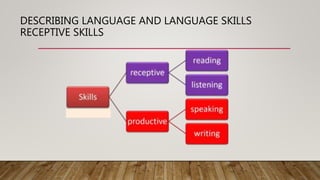
DESCRIBING LANGUAGE AND LANGUAGE SKILLS
RECEPTIVE SKILLS
• The best way to improve your knowledge of a foreign language is to go and live
among its speakers. The next best way is to read extensively in it.
• Nuttall (1996:128)
• Frequent readers have better vocabulary
• Frequent readers use grammar more accurately
• Frequent readers have positive feeling about the language
• Frequent readers show higher motivation
• Frequent readers have better listening, speaking and writing skills
• It can, of course, be argued that the causation may work both ways. Frequent readers
may read frequently because they have better vocabularies and find it easier, are
more motivated in any case and so on.
READING: THE MECHANICS
• For many of us, reading seems such a commonplace skill that we overlook how complex and difficult it is
to learn. A much-cited figure is that it takes around 600 hours of instruction to learn to read with any
fluency and some people never truly master the art even in their first language. We should not,
therefore, treat the area lightly or assume that our learners will simply transfer the skill from first to
subsequent languages.
• Being able quickly to read a text and grasp the meaning and organisation requires a reading speed of
around 200 words per minute and a native speaker of English will usually achieve something around 300
words per minute (Nuttall, 1982: 36). Speeds below 200 words per minute will usually result in non-
comprehension because each word is being processed too slowly for the overall meaning to be
gathered.
• For speakers of languages which do not have an alphabetic writing system or use a different alphabet,
attaining those sorts of speeds is a challenge.
• This is especially true for people whose first languages use logographic or syllabic writing systems and
even those which have an alphabetic (i.e., more or less phonemic) system may use a range of alphabets
as well as writing right to left or top to bottom.
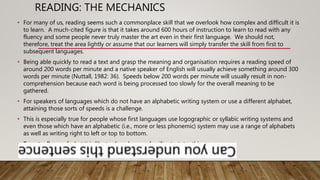
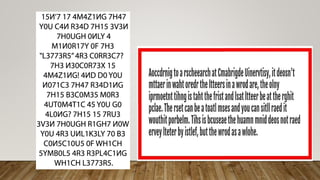
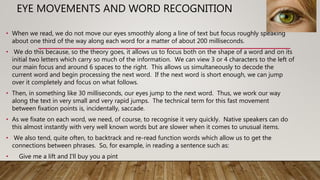
• To get a flavor of what it is like to decode an unfamiliar text, try this:
• .
EYE MOVEMENTS AND WORD RECOGNITION
• When we read, we do not move our eyes smoothly along a line of text but focus roughly speaking
about one third of the way along each word for a matter of about 200 milliseconds.
• We do this because, so the theory goes, it allows us to focus both on the shape of a word and on its
initial two letters which carry so much of the information. We can view 3 or 4 characters to the left of
our main focus and around 6 spaces to the right. This allows us simultaneously to decode the
current word and begin processing the next word. If the next word is short enough, we can jump
over it completely and focus on what follows.
• Then, in something like 30 milliseconds, our eyes jump to the next word. Thus, we work our way
along the text in very small and very rapid jumps. The technical term for this fast movement
between fixation points is, incidentally, saccade.
• As we fixate on each word, we need, of course, to recognise it very quickly. Native speakers can do
this almost instantly with very well known words but are slower when it comes to unusual items.
• We also tend, quite often, to backtrack and re-read function words which allow us to get the
connections between phrases. So, for example, in reading a sentence such as:
• Give me a lift and I'll buy you a pint
• we may return to re-read the coordinator and to figure out that it is, in fact,
acting as a conditional subordinator in this sentence, not as an additive
coordinator which is its usual role. (The sentence could be rephrased as If you
give me a lift, I'll buy you a pint.)
• It has been suggested that having an active schema (or set of conceptual
associations) allows native speakers to skip large sections of text because we
can predict what comes next. However, research (reported in Schmitt, 200: 47)
shows that, in fact, most of the text is focused on and processed in the way
described here.
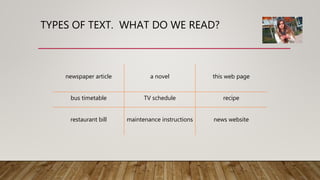
TYPES OF TEXT. WHAT DO WE READ?
newspaper article a novel this web page
bus timetable TV schedule recipe
restaurant bill maintenance instructions news website
• When we are dealing with some texts, for example, a recipe or a set of
maintenance instructions, it's important that we understand nearly
everything.
• If the book says twist anti-clockwise or do not allow it to boil, it's
important that we get it right.
• With other texts, we can be a bit more careless. Typically, on a news
website, people will run their eyes across the links looking for a story that
interests them and then access the text for a more detailed look at the
information.
• Even when we are quite interested in a story, we still often won't read
every word, preferring to skip to the important (for us) bits of the story.
• Other texts, such a bus timetable require different approaches. We can't usually just read from top
to bottom, left to right because we don't want the information from most of the text.
• We only want to know when the next bus goes to where we want to be, usually. If you are looking
for a name in a telephone directory, don't start at page one and read till you find it.
• Depending on how much we are engaged, reading a novel requires a different approach, too.
• We will usually read with some care and even back-track to re-read sections but we can ignore
parts of the text and simply follow the story.
• If we are getting a bit bored, we may even start to glance through the text to find out what
happened in the story.
• If we are trying to learn something or prepare for an examination, we will often read and re-read
with some care, making sure we understand the text.
• Is that how you are reading this?
• It's clear, then, that we deploy different skills depending on:
• The sorts of text we are accessing .
• Our reasons for reading.
TYPES OF READING. HOW DO WE READ?
• Scanning
• This is the bus timetable kind of reading. We scan the text looking for key data such
as Destination, Time, Bus number etc. It's also how we might find a telephone
number or scan an encyclopaedia entry to locate a specific bit of information such as
numbers or lists of events.
• Skimming
• This is how we might approach a TV schedule if we don't know what we want to
watch. We run our eyes quickly across the text to get a general idea of what each
program is about. Once we find something that interests us, we read it for detail and
find out when it's on and where. We are interested in the gist, not the detail at this
stage.
• Intensive reading
• We deploy this skill when we are concerned to understand as much as we can.
Maintenance instructions, recipes, study texts and so on are the typical things
we read like this. Often we will read things more than once and we will usually
try to understand every word of the text. We almost always use this approach
with short texts containing key information.
• Extensive reading
• We read extensively when we are reading for pleasure and also when we are
hoping to get some general information. In this mode, we usually don't read
extremely carefully and we can ignore words we don't know. We may backtrack
sometimes if we get lost but usually we simply read through the text, following
the writer's organization. Novels, magazines, newspaper articles etc. are all
accessed like this.
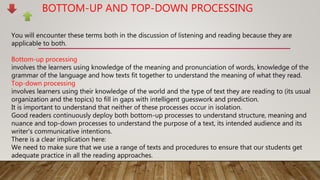
BOTTOM-UP AND TOP-DOWN PROCESSING
You will encounter these terms both in the discussion of listening and reading because they are
applicable to both.
Bottom-up processing
involves the learners using knowledge of the meaning and pronunciation of words, knowledge of the
grammar of the language and how texts fit together to understand the meaning of what they read.
Top-down processing
involves learners using their knowledge of the world and the type of text they are reading to (its usual
organization and the topics) to fill in gaps with intelligent guesswork and prediction.
It is important to understand that neither of these processes occur in isolation.
Good readers continuously deploy both bottom-up processes to understand structure, meaning and
nuance and top-down processes to understand the purpose of a text, its intended audience and its
writer's communicative intentions.
There is a clear implication here:
We need to make sure that we use a range of texts and procedures to ensure that our students get
adequate practice in all the reading approaches.
THE KNOWLEDGE
• From here on the discussion of reading skills becomes slightly more technical.
• Before going on to thinking about how to teach reading skills, it is worth pausing to
consider what knowledge learners need to bring to the process of understanding what
they read.
• In other words, we need to look for some kind of syllabus for reading skills which goes
a little beyond simple descriptions of top-down and bottom-up processing, important
though they probably are.
• Reading is not a passive process.
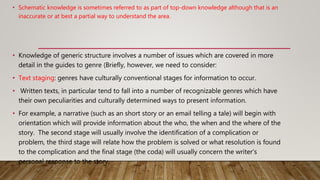
• Schematic knowledge is sometimes referred to as part of top-down knowledge although that is an
inaccurate or at best a partial way to understand the area.
• Knowledge of generic structure involves a number of issues which are covered in more
detail in the guides to genre (Briefly, however, we need to consider:
• Text staging: genres have culturally conventional stages for information to occur.
• Written texts, in particular tend to fall into a number of recognizable genres which have
their own peculiarities and culturally determined ways to present information.
• For example, a narrative (such as an short story or an email telling a tale) will begin with
orientation which will provide information about the who, the when and the where of the
story. The second stage will usually involve the identification of a complication or
problem, the third stage will relate how the problem is solved or what resolution is found
to the complication and the final stage (the coda) will usually concern the writer's
personal response to the story.
• Recounts, such as news reports follow a slightly different format but orientation will usually
come first setting out what happened, where and when followed by a record (usually in
chronological order) of events. Towards the end of the text there will often be some
reorientation and (especially in newspapers) some direct evaluation of the events from
witnesses and others affected by whatever has occurred.
• A procedural text, for example, will have a very different structure because it is designed for a
different cultural purpose (to explain how something is done) and this will usually start with
the goal of the process (why you are doing it) and then go on to tell you about the materials
and resources you will need before setting out, step-by-step, how the process is managed. A
recipe is a good example and so are texts explaining software or hardware connections and so
on.
• Knowing how these sorts of texts, whether written or spoken, are structured in terms of where
the information comes is very helpful to readers because they will be alert to spot each stage
separately rather than being faced with a mass of data.
• Elements of the language: all genres will use language elements of different sorts to help them fulfil
their cultural purposes.
• Taking the example of a news report recount, such a text will conventionally contain circumstances of
time and location (in the center of the city, off the coast of Dover, in the early hours of the morning,
during the rush hour etc.). Conventionally, too, the orientation phase of the text will concern itself with
events having present relevance to the reader and this will, in the course of things, often involve the
use of relative tense forms such as Two men have been arrested, the police have sealed off the area,
ambulances have now left the scene and so on. The rest of the text, recounting events will usually be
pinned to past time markers, yesterday, at four o'clock etc., and use simpler tense forms. There is a
guide, linked below, to tense and genre.
• The text will normally revolve around what are called behavioral or material process verbs such as do,
go, become, collapse, sink, swim and so on.
• Finally, in the evaluation section of the text, we may well find projecting verbs such as neighbors
reported, a police spokesman asked for, the Prime Minister accused etc.
• If the reader is primed to focus on decoding circumstances and verbs of this sort, comprehending a
text becomes a good deal easier.
• Knowledge of the world goes beyond the text. We rarely come to a text knowing nothing of its content or topic
in advance. We know, for example, that the little booklet that comes with a new router is unlikely to contain a
recount or narrative or a text discussing safe use of the internet. In fact, of course, we will expect it to contain a
procedural text telling us the goal and the materials and the steps to take to achieve the goal (connection). One
reason a lot of us struggle with such texts is that they are often translated from languages with different cultural
conventions for text staging.
• Equally, of course, we know what newspapers are for and what forms of text they usually include (and these vary
from straight news reports of events (recounts), through expositions in the opinion and letter pages, discussions
in the financial and political sections and procedural advice in other life-style pages). Newspapers are a rich
source of reading material and it is certainly motivating for learners to be faced with something locally relevant
and interesting but we need to take a bit of care to focus on one text type at a time.
• Visual clues are also very helpful and one reason why newspapers tend to head reports and other text types with
eye-catching graphics or images.
• If the learners' knowledge of the world concerning the topic of the text is activated early on in the process, it
becomes a good deal easier for people to understand what they read.
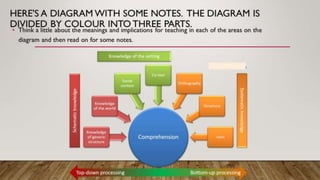
KNOWLEDGE OF THE SETTING ALSO COMES IN TWO
DISTINCT PARTS, ONE REQUIRING TOP-DOWN
PROCESSING AND ONE REQUIRING MORE FORMAL
BOTTOM-UP KNOWLEDGE.
• The social context is critical, of course because our knowledge of it allows us to predict the purposes for which
someone is writing. The assumption we all start from is that people write to communicate something and
knowing the writers' intentions helps very considerably with understanding what they write.
What we are discussing here is the tenor of a text which is revealed through the types of language that the
writer uses.
• A text designed to convince us of the truth of an argument, for example, will often contain extensive use of
modality referring to duties and obligations whereas one which is designed to persuade the reader that it is a
logically argued discussion will be much less dependent on strong modality and rely more on hedging and
expressions of modest conclusions.
• Recount texts will contain almost no modality at all because they are concerned with facts and events, not
feelings about truth and advisability. Procedural texts will contain a good deal of sequencing data (often using
numbered points and so on) and stories will concern themselves with the mental processes of the characters.
The social context includes, too, an understanding of what the writer feels about the audience.
• If we know, for example, that someone is writing to colleagues in the same profession, we will expect certain
amounts of shared knowledge to be assumed but a writer recounting events in a foreign country will be at
some pains to set the scene and explain the local context. Local newspaper reports will be less concerned with
such matters, of course.
The social setting will very often give us that information before a word is spoken.
• In addition to contextual clues, more sophisticated readers also rely on co-text
data. For example, knowing that, in a discussion text, Con the other hand
prefaces a counter argument and nevertheless precedes a reinforcing point is
helpful information.
• Knowing, too, about other discourse features and being alerted to their
importance is also helpful. Here, the functions of conjunctions, pronoun
referencing and so on will play a part. For example, relative clause structures are
a feature of many written text types and being able to unpack what follows
pronouns such as who, which, that as well as adverbs such as where, why and so
on in their post-modifying roles is critical to understanding the content of what
one is reading.
FINALLY, WE COME TO THE PURELY BOTTOM-UP
PROCESSING SKILLS ON THE RIGHT OF THE DIAGRAM
AND THESE ALL FOCUS ON UNDERSTANDING THE
FORMAL NATURE OF THE LANGUAGE.
• Orthographic knowledge is the place to start, naturally, because reading in an unfamiliar script or in a language which uses very different
punctuation conventions is often troublesome and may block understanding altogether.
• English is often and sometimes unfairly criticized for having a loose relationship between spelling and pronunciation so it is sometimes
the case that a learner will simply not recognize a word, such as thorough or disputed, in its written form which has previously only been
encountered in speech.
• Structural knowledge is important because, for example, it allows us to set events in time by focusing on tense and aspect, to see how
writers' intentions vary through the modality they use and to understand that tense forms are intended to set a state, action or event in
absolute time or to connect it relatively to other times. The difference between
• The victims were taken to hospital
• and
• The victims have been taken to hospital
• is not random.
• This structural knowledge is often underestimated by those who feel that top-down processing is the new normal.
• Lexis or semantic knowledge is, naturally, vital for reading comprehension. Some unknown words my be safely ignored (especially if, for
example, a word is identifiable by its co-text as an adjective or adverb) but too many unknown items will effectively block comprehension.
Hence the need to train readers in the art of ignoring some words and inferring the meanings of others from co-text.
USING READING TEXTS: TALO VS. TAVI
• TALO and TAVI are terms coined by Johns and Davies (1983) and mean:
• TALO: Text as a Linguistic Object
• In this approach a reading text is used purely for language input. It may contain, for example, grammatical items which form the target of this
part of the teaching programme or lexis in a particular field of interest to the learners.
• The approach involves mining the text for these language items (with most of the hard digging done by the teacher, usually) and then focusing on
them for further clarification and practice. Examples of tasks using texts for this purpose will include activities such as:
• Find and underline all the words in the text to do with crime and divide them into three lists: person who does the crime, the crime and the verb
• Find all the ways in the text where the writer is recommending what should happen next. Make a list from strongest to weakest suggestions.
• This is not using the text to develop reading skills, of course, except incidentally.
• TAVI: Text as a Vehicle for Information
• In this approach, the text is being used to develop the strategies that learners need to deploy to unlock the writer's meanings and attitudes. The
theory is that this approach will lead to the development of cognitive strategies which learners can then use independently to access the meaning
of any text they encounter.
• It is a TAVI approach that is considered here because we are concerned with language skills rather than language systems development.
THE AIMS OF A READING PROGRAMME
• Before we go on, can you make a note of what you believe should be the targets of a reading program in terms of
enabling our learners?
• The aims of a reading program are to enable our learners to read:
• authentic texts
• without help
• at appropriate speed
• silently
• and with adequate understanding
• That's the eventual aim. Here are some ideas for getting there.
• All of the following can be done with paper-based materials and internet sites. In fact, scanning is a key skill when
accessing internet sites because it is here that people are most often looking for explicit information.
• Wikipedia articles are very useful for these exercises if chosen with care and sensitivity to the interests and levels of
your learners.
SKIMMING
• The aim of these skimming exercises is to train students to follow simple skimming steps. These
are:
• Read the title. It's often a short summary of what's in the text.
• Read the first paragraph. It often sets out what questions are to be answered in the text.
• Read the first line of each following paragraph only.
• Read the last paragraph completely. It often summarizes the whole text.
• You can't just tell people to do this; we have to train students and give them the skills they need
to succeed.
• All these exercises and tasks should be done with a clear time limit set for their completion. If
you don't do this, learners will often fall back on trying to read and understand every word. The
intent is to force them to skim the text for essential information.
• Matching exercises:
• On the board / projector put 4 headlines or titles, three of which would be suitable for a set of three texts.
• Set a short time limit to match the headlines / titles to the texts.
• Hand out texts to everyone in the class.
• Multiple choice exercises:
• Use a longer reading text of at least 5 paragraphs.
• Prepare 4 alternative summary sentences for each paragraph containing the paragraph's main idea.
• Set a time limit to match the correct summary sentences to the paragraphs.
• Topic sentences:
• Prepare a text by removing the first sentence of each paragraph except the first and last paragraph.
• Hand out the text and the topic sentences separately and get students to match topic sentence to paragraph.
• Raising awareness of text structure and where to look for information:
• Find a text (or write one) which has a clear structure with signposts such as Firstly, Secondly, In summary etc. and
also has a clear first line which addresses the content of the text.
• Chop the text up into paragraphs and get the students to work together (with the usual time limit) to put the
paragraphs in the right order.
SCANNING
• The aim of these exercises is to give the learners the skills they need to follow these
scanning steps:
• Having a question or questions to answer firmly in mind before starting to read.
• Think about what the information is that you need. Is it a name, a number, a place?
etc.
• Skim the text to get an idea of its structure. If there are subheadings in the text,
read them carefully.
• Run your eyes along the text looking ONLY for the kind of data you need.
• When you find a candidate sentence, read it intensively to extract the information.
DESCRIPTIVE TEXTS:
• Find a text which describes a person or a location and contains data such as names,
numbers, places and dates.
Hand out the text face down to the students.
On the board / projector put up questions one at a time such as
Where was he born?
When did he die?
What was his wife's name?
etc. and get the learners in a race to turn over the text after each question to find
the answers. You can also read out the questions, of course, but it's useful to have
them written down because it focuses the learners.
NARRATIVE TEXTS:
•
Short stories or diary entries are useful for this exercise.
Proceed as above but this time the questions refer to the sequence of events in
the story such as
What happened after he left the army?
Where did she go when she left her husband?
etc.
INFORMATION TEXTS:
• Hand out something like a TV guide magazine, a local information newspaper, a
holiday brochure etc.
• Set questions as above but this time focusing on the sorts of information your
students might realistically need: times of TV shows, prices, venues etc., such as:
• What time is the news on?
• Which film is showing at the Multiplex?
• How far is the hotel from the airport?
INTENSIVE READING
• Synonym matching:
• Select some key vocabulary from a reading text and invent synonyms. Be careful to keep the word class consistent and make
the synonyms easier than the items in the text. For example, if the words in the text are incandescent with rage make sure
that your synonym is a) an adjective and b) easier to understand.
• Choose, therefore, something like extremely angry rather than burning with ire.
• Learners need to scan the text to find items which match the word class they are looking for and then read intensively to
locate the precise meaning they are looking for.
• Multiple-choice exercises:
• These are frequently used in examination of reading skills.
• Select questions which force the learners to focus on key parts of the text to read intensively. Don't try to test everything.
• Make sure only one answer is correct but ensure that the 'wrong' answers are not daft. If the learners can dismiss any of the
alternatives because they make no logical sense, you aren't developing intensive reading skills.
• Spot the error:
• Focus on particular word classes for this task.
• Remove, say, 10 adjectives from a text and replace them with adjectives that make no sense. So, e.g., if the original text had
• He was absolutely delighted with the beautifully cooked meal
• replace it with something like He was absolutely horrified by the beautifully cooked meal.
EXTENSIVE READING
• Reading extensively for pleasure is a great learning aid so the more we can
encourage it, the better.
• Th
• the issue here is often one of level. Many learners (and their teachers,
regrettably) assume that lower level learners are unable to read extensively in
English but there are actually a number of resources that they can access, not
least the large number of commercially published graded readers. Here's a list
of some frequently used resources:
Black Cat Readers
Cambridge Readers
Easy Readers
Macmillan Guided Readers
Oxford Bookworms
Penguin Readers
Scholastic Readers
https://www.blackcat-cideb.com/en/
https://www.cambridge.org/gb/cambridgeenglish/catalog/readers?site_locale=
en_GB
http://www.easyreaders.eu/Home.aspx
http://www.macmillanreaders.com/
https://shop.scholastic.co.uk/elt
• Many learners may be reluctant to read extensively so a little encouragement is needed.
Reasons for reluctance might include:
• Past experience of encountering demotivating difficult texts so make sure you select texts at
the right level
• Difficulties accessing Latin-script texts
• so ensure that the texts you present do not use quirky or unusual fonts and are in large
enough type
• Lack of experience in the first language of reading more than the label on a tin or a text
message
• so select texts (or get the learners to select texts) which appeal to their particular interests
• No discernible purpose or outcome
• so make sure that you start something like a reading circle so the learners do something
(discuss, summarize, recommend, review etc.) with the texts they have read
• Not knowing where to start and what to read
• so set up a small class library with a range of readers at the right level and get the learners to
read one a week or so.

Reading skills

  • 1.
  • 2.
    DESCRIBING LANGUAGE ANDLANGUAGE SKILLS RECEPTIVE SKILLS
  • 3.
    • The bestway to improve your knowledge of a foreign language is to go and live among its speakers. The next best way is to read extensively in it. • Nuttall (1996:128) • Frequent readers have better vocabulary • Frequent readers use grammar more accurately • Frequent readers have positive feeling about the language • Frequent readers show higher motivation • Frequent readers have better listening, speaking and writing skills • It can, of course, be argued that the causation may work both ways. Frequent readers may read frequently because they have better vocabularies and find it easier, are more motivated in any case and so on.
  • 4.
    READING: THE MECHANICS •For many of us, reading seems such a commonplace skill that we overlook how complex and difficult it is to learn. A much-cited figure is that it takes around 600 hours of instruction to learn to read with any fluency and some people never truly master the art even in their first language. We should not, therefore, treat the area lightly or assume that our learners will simply transfer the skill from first to subsequent languages. • Being able quickly to read a text and grasp the meaning and organisation requires a reading speed of around 200 words per minute and a native speaker of English will usually achieve something around 300 words per minute (Nuttall, 1982: 36). Speeds below 200 words per minute will usually result in non- comprehension because each word is being processed too slowly for the overall meaning to be gathered. • For speakers of languages which do not have an alphabetic writing system or use a different alphabet, attaining those sorts of speeds is a challenge. • This is especially true for people whose first languages use logographic or syllabic writing systems and even those which have an alphabetic (i.e., more or less phonemic) system may use a range of alphabets as well as writing right to left or top to bottom. • To get a flavor of what it is like to decode an unfamiliar text, try this: • .
  • 6.
    EYE MOVEMENTS ANDWORD RECOGNITION • When we read, we do not move our eyes smoothly along a line of text but focus roughly speaking about one third of the way along each word for a matter of about 200 milliseconds. • We do this because, so the theory goes, it allows us to focus both on the shape of a word and on its initial two letters which carry so much of the information. We can view 3 or 4 characters to the left of our main focus and around 6 spaces to the right. This allows us simultaneously to decode the current word and begin processing the next word. If the next word is short enough, we can jump over it completely and focus on what follows. • Then, in something like 30 milliseconds, our eyes jump to the next word. Thus, we work our way along the text in very small and very rapid jumps. The technical term for this fast movement between fixation points is, incidentally, saccade. • As we fixate on each word, we need, of course, to recognise it very quickly. Native speakers can do this almost instantly with very well known words but are slower when it comes to unusual items. • We also tend, quite often, to backtrack and re-read function words which allow us to get the connections between phrases. So, for example, in reading a sentence such as: • Give me a lift and I'll buy you a pint
  • 7.
    • we mayreturn to re-read the coordinator and to figure out that it is, in fact, acting as a conditional subordinator in this sentence, not as an additive coordinator which is its usual role. (The sentence could be rephrased as If you give me a lift, I'll buy you a pint.) • It has been suggested that having an active schema (or set of conceptual associations) allows native speakers to skip large sections of text because we can predict what comes next. However, research (reported in Schmitt, 200: 47) shows that, in fact, most of the text is focused on and processed in the way described here.
  • 8.
    TYPES OF TEXT.WHAT DO WE READ? newspaper article a novel this web page bus timetable TV schedule recipe restaurant bill maintenance instructions news website
  • 9.
    • When weare dealing with some texts, for example, a recipe or a set of maintenance instructions, it's important that we understand nearly everything. • If the book says twist anti-clockwise or do not allow it to boil, it's important that we get it right. • With other texts, we can be a bit more careless. Typically, on a news website, people will run their eyes across the links looking for a story that interests them and then access the text for a more detailed look at the information. • Even when we are quite interested in a story, we still often won't read every word, preferring to skip to the important (for us) bits of the story.
  • 10.
    • Other texts,such a bus timetable require different approaches. We can't usually just read from top to bottom, left to right because we don't want the information from most of the text. • We only want to know when the next bus goes to where we want to be, usually. If you are looking for a name in a telephone directory, don't start at page one and read till you find it. • Depending on how much we are engaged, reading a novel requires a different approach, too. • We will usually read with some care and even back-track to re-read sections but we can ignore parts of the text and simply follow the story. • If we are getting a bit bored, we may even start to glance through the text to find out what happened in the story. • If we are trying to learn something or prepare for an examination, we will often read and re-read with some care, making sure we understand the text. • Is that how you are reading this? • It's clear, then, that we deploy different skills depending on: • The sorts of text we are accessing . • Our reasons for reading.
  • 11.
    TYPES OF READING.HOW DO WE READ? • Scanning • This is the bus timetable kind of reading. We scan the text looking for key data such as Destination, Time, Bus number etc. It's also how we might find a telephone number or scan an encyclopaedia entry to locate a specific bit of information such as numbers or lists of events. • Skimming • This is how we might approach a TV schedule if we don't know what we want to watch. We run our eyes quickly across the text to get a general idea of what each program is about. Once we find something that interests us, we read it for detail and find out when it's on and where. We are interested in the gist, not the detail at this stage.
  • 12.
    • Intensive reading •We deploy this skill when we are concerned to understand as much as we can. Maintenance instructions, recipes, study texts and so on are the typical things we read like this. Often we will read things more than once and we will usually try to understand every word of the text. We almost always use this approach with short texts containing key information. • Extensive reading • We read extensively when we are reading for pleasure and also when we are hoping to get some general information. In this mode, we usually don't read extremely carefully and we can ignore words we don't know. We may backtrack sometimes if we get lost but usually we simply read through the text, following the writer's organization. Novels, magazines, newspaper articles etc. are all accessed like this.
  • 13.
    BOTTOM-UP AND TOP-DOWNPROCESSING You will encounter these terms both in the discussion of listening and reading because they are applicable to both. Bottom-up processing involves the learners using knowledge of the meaning and pronunciation of words, knowledge of the grammar of the language and how texts fit together to understand the meaning of what they read. Top-down processing involves learners using their knowledge of the world and the type of text they are reading to (its usual organization and the topics) to fill in gaps with intelligent guesswork and prediction. It is important to understand that neither of these processes occur in isolation. Good readers continuously deploy both bottom-up processes to understand structure, meaning and nuance and top-down processes to understand the purpose of a text, its intended audience and its writer's communicative intentions. There is a clear implication here: We need to make sure that we use a range of texts and procedures to ensure that our students get adequate practice in all the reading approaches.
  • 14.
    THE KNOWLEDGE • Fromhere on the discussion of reading skills becomes slightly more technical. • Before going on to thinking about how to teach reading skills, it is worth pausing to consider what knowledge learners need to bring to the process of understanding what they read. • In other words, we need to look for some kind of syllabus for reading skills which goes a little beyond simple descriptions of top-down and bottom-up processing, important though they probably are. • Reading is not a passive process.
  • 16.
    • Schematic knowledgeis sometimes referred to as part of top-down knowledge although that is an inaccurate or at best a partial way to understand the area. • Knowledge of generic structure involves a number of issues which are covered in more detail in the guides to genre (Briefly, however, we need to consider: • Text staging: genres have culturally conventional stages for information to occur. • Written texts, in particular tend to fall into a number of recognizable genres which have their own peculiarities and culturally determined ways to present information. • For example, a narrative (such as an short story or an email telling a tale) will begin with orientation which will provide information about the who, the when and the where of the story. The second stage will usually involve the identification of a complication or problem, the third stage will relate how the problem is solved or what resolution is found to the complication and the final stage (the coda) will usually concern the writer's personal response to the story.
  • 17.
    • Recounts, suchas news reports follow a slightly different format but orientation will usually come first setting out what happened, where and when followed by a record (usually in chronological order) of events. Towards the end of the text there will often be some reorientation and (especially in newspapers) some direct evaluation of the events from witnesses and others affected by whatever has occurred. • A procedural text, for example, will have a very different structure because it is designed for a different cultural purpose (to explain how something is done) and this will usually start with the goal of the process (why you are doing it) and then go on to tell you about the materials and resources you will need before setting out, step-by-step, how the process is managed. A recipe is a good example and so are texts explaining software or hardware connections and so on. • Knowing how these sorts of texts, whether written or spoken, are structured in terms of where the information comes is very helpful to readers because they will be alert to spot each stage separately rather than being faced with a mass of data.
  • 18.
    • Elements ofthe language: all genres will use language elements of different sorts to help them fulfil their cultural purposes. • Taking the example of a news report recount, such a text will conventionally contain circumstances of time and location (in the center of the city, off the coast of Dover, in the early hours of the morning, during the rush hour etc.). Conventionally, too, the orientation phase of the text will concern itself with events having present relevance to the reader and this will, in the course of things, often involve the use of relative tense forms such as Two men have been arrested, the police have sealed off the area, ambulances have now left the scene and so on. The rest of the text, recounting events will usually be pinned to past time markers, yesterday, at four o'clock etc., and use simpler tense forms. There is a guide, linked below, to tense and genre. • The text will normally revolve around what are called behavioral or material process verbs such as do, go, become, collapse, sink, swim and so on. • Finally, in the evaluation section of the text, we may well find projecting verbs such as neighbors reported, a police spokesman asked for, the Prime Minister accused etc. • If the reader is primed to focus on decoding circumstances and verbs of this sort, comprehending a text becomes a good deal easier.
  • 19.
    • Knowledge ofthe world goes beyond the text. We rarely come to a text knowing nothing of its content or topic in advance. We know, for example, that the little booklet that comes with a new router is unlikely to contain a recount or narrative or a text discussing safe use of the internet. In fact, of course, we will expect it to contain a procedural text telling us the goal and the materials and the steps to take to achieve the goal (connection). One reason a lot of us struggle with such texts is that they are often translated from languages with different cultural conventions for text staging. • Equally, of course, we know what newspapers are for and what forms of text they usually include (and these vary from straight news reports of events (recounts), through expositions in the opinion and letter pages, discussions in the financial and political sections and procedural advice in other life-style pages). Newspapers are a rich source of reading material and it is certainly motivating for learners to be faced with something locally relevant and interesting but we need to take a bit of care to focus on one text type at a time. • Visual clues are also very helpful and one reason why newspapers tend to head reports and other text types with eye-catching graphics or images. • If the learners' knowledge of the world concerning the topic of the text is activated early on in the process, it becomes a good deal easier for people to understand what they read.
  • 20.
    KNOWLEDGE OF THESETTING ALSO COMES IN TWO DISTINCT PARTS, ONE REQUIRING TOP-DOWN PROCESSING AND ONE REQUIRING MORE FORMAL BOTTOM-UP KNOWLEDGE. • The social context is critical, of course because our knowledge of it allows us to predict the purposes for which someone is writing. The assumption we all start from is that people write to communicate something and knowing the writers' intentions helps very considerably with understanding what they write. What we are discussing here is the tenor of a text which is revealed through the types of language that the writer uses. • A text designed to convince us of the truth of an argument, for example, will often contain extensive use of modality referring to duties and obligations whereas one which is designed to persuade the reader that it is a logically argued discussion will be much less dependent on strong modality and rely more on hedging and expressions of modest conclusions. • Recount texts will contain almost no modality at all because they are concerned with facts and events, not feelings about truth and advisability. Procedural texts will contain a good deal of sequencing data (often using numbered points and so on) and stories will concern themselves with the mental processes of the characters. The social context includes, too, an understanding of what the writer feels about the audience. • If we know, for example, that someone is writing to colleagues in the same profession, we will expect certain amounts of shared knowledge to be assumed but a writer recounting events in a foreign country will be at some pains to set the scene and explain the local context. Local newspaper reports will be less concerned with such matters, of course. The social setting will very often give us that information before a word is spoken.
  • 21.
    • In additionto contextual clues, more sophisticated readers also rely on co-text data. For example, knowing that, in a discussion text, Con the other hand prefaces a counter argument and nevertheless precedes a reinforcing point is helpful information. • Knowing, too, about other discourse features and being alerted to their importance is also helpful. Here, the functions of conjunctions, pronoun referencing and so on will play a part. For example, relative clause structures are a feature of many written text types and being able to unpack what follows pronouns such as who, which, that as well as adverbs such as where, why and so on in their post-modifying roles is critical to understanding the content of what one is reading.
  • 22.
    FINALLY, WE COMETO THE PURELY BOTTOM-UP PROCESSING SKILLS ON THE RIGHT OF THE DIAGRAM AND THESE ALL FOCUS ON UNDERSTANDING THE FORMAL NATURE OF THE LANGUAGE. • Orthographic knowledge is the place to start, naturally, because reading in an unfamiliar script or in a language which uses very different punctuation conventions is often troublesome and may block understanding altogether. • English is often and sometimes unfairly criticized for having a loose relationship between spelling and pronunciation so it is sometimes the case that a learner will simply not recognize a word, such as thorough or disputed, in its written form which has previously only been encountered in speech. • Structural knowledge is important because, for example, it allows us to set events in time by focusing on tense and aspect, to see how writers' intentions vary through the modality they use and to understand that tense forms are intended to set a state, action or event in absolute time or to connect it relatively to other times. The difference between • The victims were taken to hospital • and • The victims have been taken to hospital • is not random. • This structural knowledge is often underestimated by those who feel that top-down processing is the new normal. • Lexis or semantic knowledge is, naturally, vital for reading comprehension. Some unknown words my be safely ignored (especially if, for example, a word is identifiable by its co-text as an adjective or adverb) but too many unknown items will effectively block comprehension. Hence the need to train readers in the art of ignoring some words and inferring the meanings of others from co-text.
  • 23.
    USING READING TEXTS:TALO VS. TAVI • TALO and TAVI are terms coined by Johns and Davies (1983) and mean: • TALO: Text as a Linguistic Object • In this approach a reading text is used purely for language input. It may contain, for example, grammatical items which form the target of this part of the teaching programme or lexis in a particular field of interest to the learners. • The approach involves mining the text for these language items (with most of the hard digging done by the teacher, usually) and then focusing on them for further clarification and practice. Examples of tasks using texts for this purpose will include activities such as: • Find and underline all the words in the text to do with crime and divide them into three lists: person who does the crime, the crime and the verb • Find all the ways in the text where the writer is recommending what should happen next. Make a list from strongest to weakest suggestions. • This is not using the text to develop reading skills, of course, except incidentally. • TAVI: Text as a Vehicle for Information • In this approach, the text is being used to develop the strategies that learners need to deploy to unlock the writer's meanings and attitudes. The theory is that this approach will lead to the development of cognitive strategies which learners can then use independently to access the meaning of any text they encounter. • It is a TAVI approach that is considered here because we are concerned with language skills rather than language systems development.
  • 24.
    THE AIMS OFA READING PROGRAMME • Before we go on, can you make a note of what you believe should be the targets of a reading program in terms of enabling our learners? • The aims of a reading program are to enable our learners to read: • authentic texts • without help • at appropriate speed • silently • and with adequate understanding • That's the eventual aim. Here are some ideas for getting there. • All of the following can be done with paper-based materials and internet sites. In fact, scanning is a key skill when accessing internet sites because it is here that people are most often looking for explicit information. • Wikipedia articles are very useful for these exercises if chosen with care and sensitivity to the interests and levels of your learners.
  • 25.
    SKIMMING • The aimof these skimming exercises is to train students to follow simple skimming steps. These are: • Read the title. It's often a short summary of what's in the text. • Read the first paragraph. It often sets out what questions are to be answered in the text. • Read the first line of each following paragraph only. • Read the last paragraph completely. It often summarizes the whole text. • You can't just tell people to do this; we have to train students and give them the skills they need to succeed. • All these exercises and tasks should be done with a clear time limit set for their completion. If you don't do this, learners will often fall back on trying to read and understand every word. The intent is to force them to skim the text for essential information.
  • 26.
    • Matching exercises: •On the board / projector put 4 headlines or titles, three of which would be suitable for a set of three texts. • Set a short time limit to match the headlines / titles to the texts. • Hand out texts to everyone in the class. • Multiple choice exercises: • Use a longer reading text of at least 5 paragraphs. • Prepare 4 alternative summary sentences for each paragraph containing the paragraph's main idea. • Set a time limit to match the correct summary sentences to the paragraphs. • Topic sentences: • Prepare a text by removing the first sentence of each paragraph except the first and last paragraph. • Hand out the text and the topic sentences separately and get students to match topic sentence to paragraph. • Raising awareness of text structure and where to look for information: • Find a text (or write one) which has a clear structure with signposts such as Firstly, Secondly, In summary etc. and also has a clear first line which addresses the content of the text. • Chop the text up into paragraphs and get the students to work together (with the usual time limit) to put the paragraphs in the right order.
  • 27.
    SCANNING • The aimof these exercises is to give the learners the skills they need to follow these scanning steps: • Having a question or questions to answer firmly in mind before starting to read. • Think about what the information is that you need. Is it a name, a number, a place? etc. • Skim the text to get an idea of its structure. If there are subheadings in the text, read them carefully. • Run your eyes along the text looking ONLY for the kind of data you need. • When you find a candidate sentence, read it intensively to extract the information.
  • 28.
    DESCRIPTIVE TEXTS: • Finda text which describes a person or a location and contains data such as names, numbers, places and dates. Hand out the text face down to the students. On the board / projector put up questions one at a time such as Where was he born? When did he die? What was his wife's name? etc. and get the learners in a race to turn over the text after each question to find the answers. You can also read out the questions, of course, but it's useful to have them written down because it focuses the learners.
  • 29.
    NARRATIVE TEXTS: • Short storiesor diary entries are useful for this exercise. Proceed as above but this time the questions refer to the sequence of events in the story such as What happened after he left the army? Where did she go when she left her husband? etc.
  • 30.
    INFORMATION TEXTS: • Handout something like a TV guide magazine, a local information newspaper, a holiday brochure etc. • Set questions as above but this time focusing on the sorts of information your students might realistically need: times of TV shows, prices, venues etc., such as: • What time is the news on? • Which film is showing at the Multiplex? • How far is the hotel from the airport?
  • 31.
    INTENSIVE READING • Synonymmatching: • Select some key vocabulary from a reading text and invent synonyms. Be careful to keep the word class consistent and make the synonyms easier than the items in the text. For example, if the words in the text are incandescent with rage make sure that your synonym is a) an adjective and b) easier to understand. • Choose, therefore, something like extremely angry rather than burning with ire. • Learners need to scan the text to find items which match the word class they are looking for and then read intensively to locate the precise meaning they are looking for. • Multiple-choice exercises: • These are frequently used in examination of reading skills. • Select questions which force the learners to focus on key parts of the text to read intensively. Don't try to test everything. • Make sure only one answer is correct but ensure that the 'wrong' answers are not daft. If the learners can dismiss any of the alternatives because they make no logical sense, you aren't developing intensive reading skills. • Spot the error: • Focus on particular word classes for this task. • Remove, say, 10 adjectives from a text and replace them with adjectives that make no sense. So, e.g., if the original text had • He was absolutely delighted with the beautifully cooked meal • replace it with something like He was absolutely horrified by the beautifully cooked meal.
  • 32.
    EXTENSIVE READING • Readingextensively for pleasure is a great learning aid so the more we can encourage it, the better. • Th • the issue here is often one of level. Many learners (and their teachers, regrettably) assume that lower level learners are unable to read extensively in English but there are actually a number of resources that they can access, not least the large number of commercially published graded readers. Here's a list of some frequently used resources: Black Cat Readers Cambridge Readers Easy Readers Macmillan Guided Readers Oxford Bookworms Penguin Readers Scholastic Readers https://www.blackcat-cideb.com/en/ https://www.cambridge.org/gb/cambridgeenglish/catalog/readers?site_locale= en_GB http://www.easyreaders.eu/Home.aspx http://www.macmillanreaders.com/ https://shop.scholastic.co.uk/elt
  • 33.
    • Many learnersmay be reluctant to read extensively so a little encouragement is needed. Reasons for reluctance might include: • Past experience of encountering demotivating difficult texts so make sure you select texts at the right level • Difficulties accessing Latin-script texts • so ensure that the texts you present do not use quirky or unusual fonts and are in large enough type • Lack of experience in the first language of reading more than the label on a tin or a text message • so select texts (or get the learners to select texts) which appeal to their particular interests • No discernible purpose or outcome • so make sure that you start something like a reading circle so the learners do something (discuss, summarize, recommend, review etc.) with the texts they have read • Not knowing where to start and what to read • so set up a small class library with a range of readers at the right level and get the learners to read one a week or so.