Reading Enrichment Unit- Charlie & the Chocolate
               Factory by Roald Dahl
  Title of Unit       Reading &          Grade Level           3rd
                       Writing:
                     Chocolate!
 Subject/Topic     Reading. Writing     Time Frame            5 days
     Area
  Key Words        Reading, writing,    Designed by      Autumn Schaffer
                        graphic
                      organizers
 School District   Griffin Spalding        School          Anne Street
                                                           Elementary

Brief Summary of Unit:

This unit is designed to prompt students into writing creatively about
topics and beginning to use a basic five-paragraph essay template. The
students will either read in small groups or as a whole class Charlie and
the Chocolate Factory by Roald Dahl. Afterwards they will analyze the
characters, events, settings, and various perspectives in the story using
various modes of writing. Specific types of writing in the assignments
included within this unit are poetry (limericks), letter writing,
advertisements (jingles), and essays.

The students will also use web 2.0 features to enhance their ability to
analyze features of the book. The students will use a site based upon
“sticky notes” to discuss and answer questions about different themes
within the book as they read. They will also use an online graphic
organizer program to work together to build relationships among various
features of the books.

                     Stage 1: Identify Desired Results

Content Standards:

Fluency:
ELA3R1 The student demonstrates the ability to read orally with speed,
accuracy,
and expression. The student
a. Applies letter-sound knowledge to decode unknown words quickly and
accurately.
d. Uses self-correction when subsequent reading indicates an earlier
misreading
within grade-level texts.
Comprehension:
ELA3R3 The student uses a variety of strategies to gain meaning from
grade-level
text. The student
g. Summarizes text content.
i. Makes connections between texts and/or personal experiences.
n. Identifies the basic elements of a variety of genres (fiction, non-fiction,
drama, and poetry).
q. Formulates and defends an opinion about a text.

Writing:
ELA3W1 The student demonstrates competency in the writing process.
The
student
a. Captures a reader’s interest by setting a purpose and developing a
point of view.
b. Begins to select a focus and an organizational pattern based on
purpose, genre,
expectations, audience, and length.
d. Uses organizational patterns for conveying information (e.g.,
chronological
order, cause and effect, similarity and difference, questions and
answers).
f. Begins to use specific sensory details (e.g., strong verbs, adjectives) to
enhance
descriptive effect.
i. Begins to include relevant examples, facts, anecdotes, and details
appropriate
to the audience.
j. Uses a variety of resources to research and share information on a
topic.
k. Writes a response to literature that demonstrates understanding of the
text,
formulates an opinion, and supports a judgment.
l. Writes a persuasive piece that states a clear position.

ALA Standards for 21st Century Learner

2. Draw conclusions, make informed decisions, apply knowledge to new
situations, and create new knowledge
2.1.2 Organize knowledge so that it is useful.
2.1.3 Use strategies to draw conclusions from information and apply
knowledge to curricular areas, real- world situations, and further
investigations.
 2.1.4 Use technology and other information tools to analyze and
organize information.
2.1.5 Collaborate with others to exchange ideas, develop new
understandings, make decisions, and solve problems.
2.1.6 Use the writing process, media and visual literacy, and technology
skills to create products that express new understandings.

Understandings:
Students will understand that:

*Understanding 1: Characters in a story are not all good or bad- they
have traits that may make them seem one way or another. If you analyze
enough, however, you can find traits that show they have both sides.

*Understanding 2: One can analyze parts of a story using various modes
of writing- not just essay form.

*Understanding 3: In order to develop a clear and cohesive essay one
must have a topic, thesis sentence, body paragraphs, and a conclusion.

*Understanding 4: Once can organize thoughts, facts, and concepts in
the form of a graphic organizer before creating a final form of writing
(essay, poem, etc.)

Related Misconceptions:

*Misconception 1: Characters in a story are either all good or all bad.
They are flat and one sided. They do not change throughout the course of
the story.

*Misconception 2: You cannot analyze a story or discuss the story in
modes other than an essay where you break the themes down into
paragraphs.

*Misconception 3: Essays are just paragraphs put together with your
thoughts about a story.

*Misconception 4: Writing an essay or final product should be done first-
brainstorming wastes time.

Essential Questions:
Overarching Questions                 Topical Questions
*How do I respond to what I am          *While reading, what can I do to
reading?                                remind myself of what I want to
                                        write about later?
*What are ways I can write to           *How can I use poems, essays, and
explain my thoughts?                    advertisements to get across my
                                        idea/ analyze what I’ve read?
*How can I get my thoughts
together before writing?                *What types of graphic organizers
                                        can I use to get my thought
                                        together before I write?

Knowledge and Skills
Knowledge                               Skills
Knowledge 1: Key terms- Graphic         Skill 1: Students will understand
Organizers, Essays, Poems,              key terms and be able to explain
Advertisements                          the difference between them.

Knowledge 2: You can write to           Skill 2: Students will be able to
respond to what you are reading.        write to entertain, persuade,
You can write to entertain,             describe, or inform.
persuade, describe or inform.

Knowledge 3: You can use graphic        Skill 3: Students will use different
organizers to put your thoughts         graphic organizers to brainstorm
together before you begin your          before writing.
writing. There are different types of
graphic organizers to help you
brainstorm.

Knowledge 4: You can write in           Skill 4: Students will write in
different modes including poetry,       different modes including poetry,
advertisements, and essays.             advertisements, and essays.

                             Stage 2: Evidence

Performance Tasks:

1. Performance Task 1: Creating a Graphic Organizer of How Chocolate is
Made

*Goal- You goal is to put together the steps of making chocolate. You will
read about it online- then you need to put together an essay describing
step by step how it is made.
*Role-You are a teacher who is putting together a lesson of how chocolate
is made.

*Audience- Your students need you to describe the steps of making
chocolate in a way that they understand.

*Situation-You have to write paragraphs describing how chocolate is
made and where it comes from. You need to read about it online and use
a graphic organizer to organize the different steps.

*Produce Performance and Purpose-You will write the steps in order in
the graphic organizer and use the graphic organizer to write the steps in
paragraph form.

*Standard and Criteria for Success-
Your finished product should include a graphic organizer with the steps
in order and paragraphs broken into each step. Each paragraph should
describe the steps in detail.

d. Uses organizational patterns for conveying information (e.g.,
chronological
order, cause and effect, similarity and difference, questions and
answers).

II. Performance Task 2: Writing a Poem for a Golden Ticket

*Goal- You are to write a poem to be place on the Golden Ticket.

*Role- You are the writer for the Willa Wonka Chocolate Factory- in
charge of all of his clever poems

*Audience- Your audience will be everyone who wins a Golden Ticket!

*Situation- You have to write a clever poem to but put in the Golden
Ticket. It has to inform them of the time and place the person is to meet
Mr. Wonka and the rest of the winners.

*Produce Performance and Purpose- You will develop a poem to let the
winners know where to go to enter the factory. Your poem must have 6
lines. The first two must rhyme, the second two must rhyme, and the
third two must rhyme.

*Standard and Criteria for Success-
The poem must tell when and where to meet the rest of the winners.
Your poem must have 6 lines. The first two must rhyme, the second two
must rhyme, and the third two must rhyme.

b. Begins to select a focus and an organizational pattern based on
purpose, genre,
expectations, audience, and length.
III. Performance Task 3: Write a letter to Charlie

*Goal- You are to write a letter to Charlie wishing him a happy birthday
and trying to cheer him up for not getting the Golden Ticket.

*Role- You are Charlie’s friend and you have heard that he didn’t get a
Golden Ticket like he wanted.

*Audience- Your audience will be Charlie, who is feeling really bad that
he didn’t get a Golden Ticket.

*Situation- You are Charlie’s friend and you want to cheer him up
because he didn’t get a Golden Ticket. You want to help him look on the
bright side.

*Produce Performance and Product- You will write a letter to Charlie to
cheer him up for not winning a Golden Ticket. You want to make him feel
better and see that things are not all that bad.

*Standard & Criteria for Success-
You letter must be in letter form- with an address at the top. It must
contain body paragraphs and a proper ending.
You must use your understanding of persuasion to persuade Charlie into
believing that he shouldn’t feel so bad that he didn’t get a ticket. You
should try to convince him there are other things to be happy about.

l. Writes a persuasive piece that states a clear position.


IV. Performance Task 4: The Drama of the Golden Ticket

*Goal- You are to create a short scene depicting the moment when
Charlie opens his chocolate and discovers he has a Golden Ticket.

*Role- You are a screenwriter for a play about this book and you are
putting together scripts and scenes.
*Audience- Your audience will be all of New York City who will come to
see this play within the next few weeks.

*Situation- You are writing the scripts for a play about this book. You are
currently working on writing a scene where Charlie finds out he has the
Golden Ticket.

*Produce Performance and Product- You will write a short scene in which
Charlie finds the Golden Ticket. This should be written in the form of a
script

*Standard and Criteria for Success- You must write in script form with
the character’s name before what he/she is to say. You must also
include a list of the characters in the scene. You must depict what
happens in the scene where Charlie wins the Golden Ticket.

f. Begins to use specific sensory details (e.g., strong verbs, adjectives) to
enhance
descriptive effect.

V. Performance Task 5: Character Study

*Goal- You will use the Primary Notes application online to determine a
character to study. You will then use the information provided by the
students online as well as what you can find in the book to verify the
conclusions you draw about the character. These conclusions will be put
into a 5 paragraph essay.

*Role- You are a character analyzer trying to tell the rest of the class the
best and worse about each character.

*Audience- The audience will be the students in your class.

*Situation- Use Primary Notes application online and information you
find in the book to complete the graphic organizer about a character you
choose. Based upon this evidence you will choose 3 characteristics that
describe the characters as either being “good” or “bad”. You will use the 5
paragraph essay template to persuade the other students towards your
view.

*Produce and Performance Product- Use will contribute to the Primary
Note Application to help describe the characters. You will use the graphic
organizer and the book to complete your character analyzes. You will use
the 5 paragraph essay template to write your character analyzes. You will
use the bubbleus application online to post two of the characteristics you
concluded about your character into the online graphic organizer.

*Standard and Criteria for Success-
Must include evidence of:
-Contributing to Primary Notes Application
-Using graphic organizer to complete character analysis
-Use 5 paragraph essay template to write character analysis
-Contribute to Bubbleus Graphic Organizer
k. Writes a response to literature that demonstrates understanding of the
text,
formulates an opinion, and supports a judgment.
l. Writes a persuasive piece that states a clear position.
d. Uses organizational patterns for conveying information (e.g.,
chronological
order, cause and effect, similarity and difference, questions and
answers).

IV. Performance Task 6: Chocolate Prediction

*Goal- You will predict what type of chocolate will be in the next room in
the factory based upon the information leading up to it.

*Role- You are a character in the book and you are trying to guess what
type of chocolate is in the next room

*Audience- The other members of the tour are listening to you and what
you to help them decide what chocolate is in the next room

*Situation- You are trying to guess what type of chocolate is in the next
room. You have to read the chapter leading up to entering the room and
use the clues to complete the prediction graphic organizer and the five
paragraph essay explaining what you think the chocolate is and why.

*Produce and Product Performance- You will predict what type of
chocolate is in the next room by using the book and the graphic
organizer. Then you will use your graphic organizer to complete a 5
paragraph essay about the chocolate.

*Standard & Criteria for Success-
You must have completed the graphic organizer using the book to predict
what chocolate is in the next room. Your 5 paragraph essay template
must also be complete based upon your graphic organizer work.
f. Begins to use specific sensory details (e.g., strong verbs, adjectives) to
enhance
descriptive effect.
k. Writes a response to literature that demonstrates understanding of the
text,
formulates an opinion, and supports a judgment.


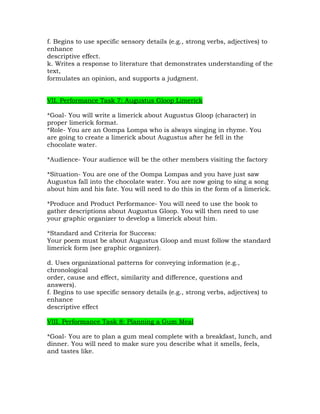
VII. Performance Task 7: Augustus Gloop Limerick

*Goal- You will write a limerick about Augustus Gloop (character) in
proper limerick format.
*Role- You are an Oompa Lompa who is always singing in rhyme. You
are going to create a limerick about Augustus after he fell in the
chocolate water.

*Audience- Your audience will be the other members visiting the factory

*Situation- You are one of the Oompa Lompas and you have just saw
Augustus fall into the chocolate water. You are now going to sing a song
about him and his fate. You will need to do this in the form of a limerick.

*Produce and Product Performance- You will need to use the book to
gather descriptions about Augustus Gloop. You will then need to use
your graphic organizer to develop a limerick about him.

*Standard and Criteria for Success:
Your poem must be about Augustus Gloop and must follow the standard
limerick form (see graphic organizer).

d. Uses organizational patterns for conveying information (e.g.,
chronological
order, cause and effect, similarity and difference, questions and
answers).
f. Begins to use specific sensory details (e.g., strong verbs, adjectives) to
enhance
descriptive effect

VIII. Performance Task 8: Planning a Gum Meal

*Goal- You are to plan a gum meal complete with a breakfast, lunch, and
dinner. You will need to make sure you describe what it smells, feels,
and tastes like.
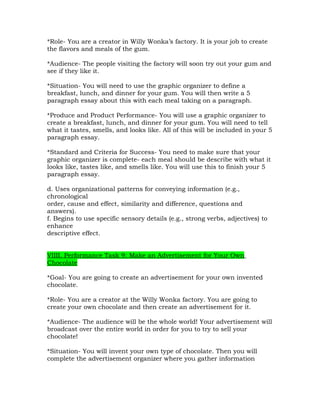
*Role- You are a creator in Willy Wonka’s factory. It is your job to create
the flavors and meals of the gum.

*Audience- The people visiting the factory will soon try out your gum and
see if they like it.

*Situation- You will need to use the graphic organizer to define a
breakfast, lunch, and dinner for your gum. You will then write a 5
paragraph essay about this with each meal taking on a paragraph.

*Produce and Product Performance- You will use a graphic organizer to
create a breakfast, lunch, and dinner for your gum. You will need to tell
what it tastes, smells, and looks like. All of this will be included in your 5
paragraph essay.

*Standard and Criteria for Success- You need to make sure that your
graphic organizer is complete- each meal should be describe with what it
looks like, tastes like, and smells like. You will use this to finish your 5
paragraph essay.

d. Uses organizational patterns for conveying information (e.g.,
chronological
order, cause and effect, similarity and difference, questions and
answers).
f. Begins to use specific sensory details (e.g., strong verbs, adjectives) to
enhance
descriptive effect.


VIIII. Performance Task 9: Make an Advertisement for Your Own
Chocolate

*Goal- You are going to create an advertisement for your own invented
chocolate.

*Role- You are a creator at the Willy Wonka factory. You are going to
create your own chocolate and then create an advertisement for it.

*Audience- The audience will be the whole world! Your advertisement will
broadcast over the entire world in order for you to try to sell your
chocolate!

*Situation- You will invent your own type of chocolate. Then you will
complete the advertisement organizer where you gather information
about your chocolate as well as what type of advertisement you want to
create. You will then create a script for it.

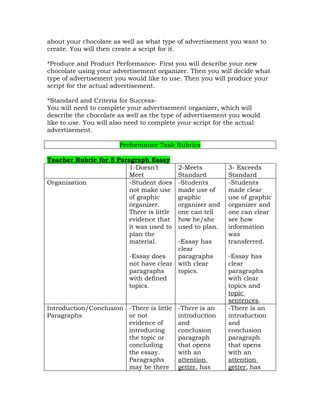
*Produce and Product Performance- First you will describe your new
chocolate using your advertisement organizer. Then you will decide what
type of advertisement you would like to use. Then you will produce your
script for the actual advertisement.

*Standard and Criteria for Success-
You will need to complete your advertisement organizer, which will
describe the chocolate as well as the type of advertisement you would
like to use. You will also need to complete your script for the actual
advertisement.

                       Performance Task Rubrics

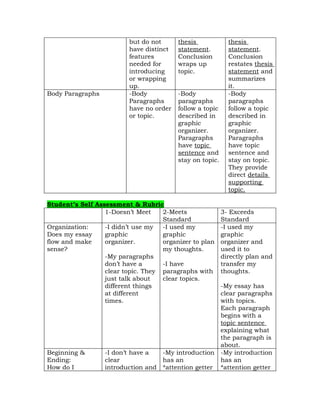
Teacher Rubric for 5 Paragraph Essay
                         1-Doesn’t         2-Meets         3- Exceeds
                         Meet              Standard        Standard
Organization             -Student does     -Students       -Students
                         not make use      made use of     made clear
                         of graphic        graphic         use of graphic
                         organizer.        organizer and   organizer and
                         There is little   one can tell    one can clear
                         evidence that     how he/she      see how
                         it was used to    used to plan.   information
                         plan the                          was
                         material.       -Essay has        transferred.
                                         clear
                          -Essay does    paragraphs        -Essay has
                          not have clear with clear        clear
                          paragraphs     topics.           paragraphs
                          with defined                     with clear
                          topics.                          topics and
                                                           topic
                                                           sentences.
Introduction/Conclusion -There is little   -There is an    -There is an
Paragraphs              or not             introduction    introduction
                        evidence of        and             and
                        introducing        conclusion      conclusion
                        the topic or       paragraph       paragraph
                        concluding         that opens      that opens
                        the essay.         with an         with an
                        Paragraphs         attention       attention
                        may be there       getter, has     getter, has
but do not      thesis             thesis
                         have distinct   statement.         statement.
                         features        Conclusion         Conclusion
                         needed for      wraps up           restates thesis
                         introducing     topic.             statement and
                         or wrapping                        summarizes
                         up.                                it.
Body Paragraphs          -Body           -Body              -Body
                         Paragraphs      paragraphs         paragraphs
                         have no order   follow a topic     follow a topic
                         or topic.       described in       described in
                                         graphic            graphic
                                         organizer.         organizer.
                                         Paragraphs         Paragraphs
                                         have topic         have topic
                                         sentence and       sentence and
                                         stay on topic.     stay on topic.
                                                            They provide
                                                            direct details
                                                            supporting
                                                            topic.

Student’s Self Assessment & Rubric
                  1-Doesn’t Meet    2-Meets               3- Exceeds
                                    Standard              Standard
Organization:     -I didn’t use my  -I used my            -I used my
Does my essay     graphic           graphic               graphic
flow and make     organizer.        organizer to plan     organizer and
sense?                              my thoughts.          used it to
                  -My paragraphs                          directly plan and
                  don’t have a      -I have               transfer my
                  clear topic. They paragraphs with       thoughts.
                  just talk about   clear topics.
                  different things                   -My essay has
                  at different                       clear paragraphs
                  times.                             with topics.
                                                     Each paragraph
                                                     begins with a
                                                     topic sentence
                                                     explaining what
                                                     the paragraph is
                                                     about.
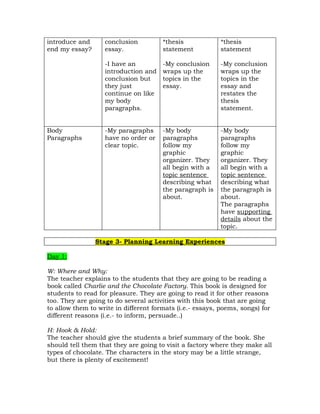
Beginning &       -I don’t have a  -My introduction -My introduction
Ending:           clear            has an            has an
How do I          introduction and *attention getter *attention getter
introduce and      conclusion          *thesis             *thesis
end my essay?      essay.              statement           statement

                   -I have an          -My conclusion      -My conclusion
                   introduction and    wraps up the        wraps up the
                   conclusion but      topics in the       topics in the
                   they just           essay.              essay and
                   continue on like                        restates the
                   my body                                 thesis
                   paragraphs.                             statement.


Body               -My paragraphs      -My body            -My body
Paragraphs         have no order or    paragraphs          paragraphs
                   clear topic.        follow my           follow my
                                       graphic             graphic
                                       organizer. They     organizer. They
                                       all begin with a    all begin with a
                                       topic sentence      topic sentence
                                       describing what     describing what
                                       the paragraph is    the paragraph is
                                       about.              about.
                                                           The paragraphs
                                                           have supporting
                                                           details about the
                                                           topic.

                Stage 3- Planning Learning Experiences

Day 1:

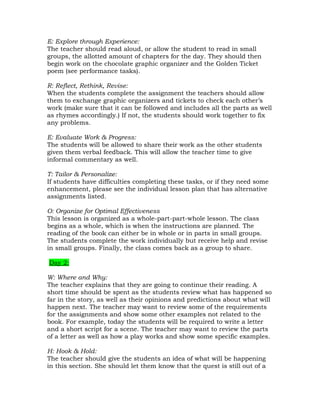
W: Where and Why:
The teacher explains to the students that they are going to be reading a
book called Charlie and the Chocolate Factory. This book is designed for
students to read for pleasure. They are going to read it for other reasons
too. They are going to do several activities with this book that are going
to allow them to write in different formats (i.e.- essays, poems, songs) for
different reasons (i.e.- to inform, persuade..)

H: Hook & Hold:
The teacher should give the students a brief summary of the book. She
should tell them that they are going to visit a factory where they make all
types of chocolate. The characters in the story may be a little strange,
but there is plenty of excitement!
E: Explore through Experience:
The teacher should read aloud, or allow the student to read in small
groups, the allotted amount of chapters for the day. They should then
begin work on the chocolate graphic organizer and the Golden Ticket
poem (see performance tasks).

R: Reflect, Rethink, Revise:
When the students complete the assignment the teachers should allow
them to exchange graphic organizers and tickets to check each other’s
work (make sure that it can be followed and includes all the parts as well
as rhymes accordingly.) If not, the students should work together to fix
any problems.

E: Evaluate Work & Progress:
The students will be allowed to share their work as the other students
given them verbal feedback. This will allow the teacher time to give
informal commentary as well.

T: Tailor & Personalize:
If students have difficulties completing these tasks, or if they need some
enhancement, please see the individual lesson plan that has alternative
assignments listed.

O: Organize for Optimal Effectiveness
This lesson is organized as a whole-part-part-whole lesson. The class
begins as a whole, which is when the instructions are planned. The
reading of the book can either be in whole or in parts in small groups.
The students complete the work individually but receive help and revise
in small groups. Finally, the class comes back as a group to share.

Day 2:

W: Where and Why:
The teacher explains that they are going to continue their reading. A
short time should be spent as the students review what has happened so
far in the story, as well as their opinions and predictions about what will
happen next. The teacher may want to review some of the requirements
for the assignments and show some other examples not related to the
book. For example, today the students will be required to write a letter
and a short script for a scene. The teacher may want to review the parts
of a letter as well as how a play works and show some specific examples.

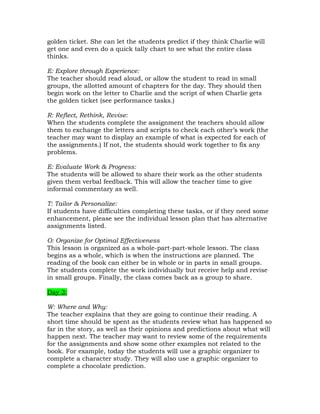
H: Hook & Hold:
The teacher should give the students an idea of what will be happening
in this section. She should let them know that the quest is still out of a
golden ticket. She can let the students predict if they think Charlie will
get one and even do a quick tally chart to see what the entire class
thinks.

E: Explore through Experience:
The teacher should read aloud, or allow the student to read in small
groups, the allotted amount of chapters for the day. They should then
begin work on the letter to Charlie and the script of when Charlie gets
the golden ticket (see performance tasks.)

R: Reflect, Rethink, Revise:
When the students complete the assignment the teachers should allow
them to exchange the letters and scripts to check each other’s work (the
teacher may want to display an example of what is expected for each of
the assignments.) If not, the students should work together to fix any
problems.

E: Evaluate Work & Progress:
The students will be allowed to share their work as the other students
given them verbal feedback. This will allow the teacher time to give
informal commentary as well.

T: Tailor & Personalize:
If students have difficulties completing these tasks, or if they need some
enhancement, please see the individual lesson plan that has alternative
assignments listed.

O: Organize for Optimal Effectiveness
This lesson is organized as a whole-part-part-whole lesson. The class
begins as a whole, which is when the instructions are planned. The
reading of the book can either be in whole or in parts in small groups.
The students complete the work individually but receive help and revise
in small groups. Finally, the class comes back as a group to share.

Day 3:

W: Where and Why:
The teacher explains that they are going to continue their reading. A
short time should be spent as the students review what has happened so
far in the story, as well as their opinions and predictions about what will
happen next. The teacher may want to review some of the requirements
for the assignments and show some other examples not related to the
book. For example, today the students will use a graphic organizer to
complete a character study. They will also use a graphic organizer to
complete a chocolate prediction.
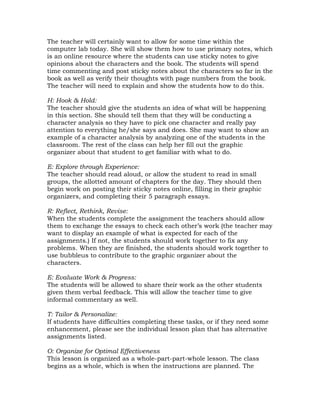
The teacher will certainly want to allow for some time within the
computer lab today. She will show them how to use primary notes, which
is an online resource where the students can use sticky notes to give
opinions about the characters and the book. The students will spend
time commenting and post sticky notes about the characters so far in the
book as well as verify their thoughts with page numbers from the book.
The teacher will need to explain and show the students how to do this.

H: Hook & Hold:
The teacher should give the students an idea of what will be happening
in this section. She should tell them that they will be conducting a
character analysis so they have to pick one character and really pay
attention to everything he/she says and does. She may want to show an
example of a character analysis by analyzing one of the students in the
classroom. The rest of the class can help her fill out the graphic
organizer about that student to get familiar with what to do.

E: Explore through Experience:
The teacher should read aloud, or allow the student to read in small
groups, the allotted amount of chapters for the day. They should then
begin work on posting their sticky notes online, filling in their graphic
organizers, and completing their 5 paragraph essays.

R: Reflect, Rethink, Revise:
When the students complete the assignment the teachers should allow
them to exchange the essays to check each other’s work (the teacher may
want to display an example of what is expected for each of the
assignments.) If not, the students should work together to fix any
problems. When they are finished, the students should work together to
use bubbleus to contribute to the graphic organizer about the
characters.

E: Evaluate Work & Progress:
The students will be allowed to share their work as the other students
given them verbal feedback. This will allow the teacher time to give
informal commentary as well.

T: Tailor & Personalize:
If students have difficulties completing these tasks, or if they need some
enhancement, please see the individual lesson plan that has alternative
assignments listed.

O: Organize for Optimal Effectiveness
This lesson is organized as a whole-part-part-whole lesson. The class
begins as a whole, which is when the instructions are planned. The
reading of the book can either be in whole or in parts in small groups.
The students complete the work individually but receive help and revise
in small groups. Finally, the class comes back as a group to share.

Day 4:

W: Where and Why:
The teacher explains that they are going to continue their reading. A
short time should be spent as the students review what has happened so
far in the story, as well as their opinions and predictions about what will
happen next. The teacher may want to review some of the requirements
for the assignments and show some other examples not related to the
book. For example, today the students will be required to form a limerick
about one of the characters in the story. The teacher should show
examples of limerick as well as go over their sequence of rhyme.

H: Hook & Hold:
The teacher should give the students an idea of what will be happening
in this section. She should point out the songs of the Oompa Lompas up
until this point. She should also tell them to pay close attention to the
gum incident and start to think about types of gum they would like to
create.

E: Explore through Experience:
The teacher should read aloud, or allow the student to read in small
groups, the allotted amount of chapters for the day. They should then
begin work on the limerick and gum graphic organizers.

R: Reflect, Rethink, Revise:
When the students complete the assignment the teachers should allow
them to exchange the graphic organizers to check each other’s work (the
teacher may want to display an example of what is expected for each of
the assignments.) If not, the students should work together to fix any
problems.

E: Evaluate Work & Progress:
The students will be allowed to share their work as the other students
given them verbal feedback. This will allow the teacher time to give
informal commentary as well.

T: Tailor & Personalize:
If students have difficulties completing these tasks, or if they need some
enhancement, please see the individual lesson plan that has alternative
assignments listed.
O: Organize for Optimal Effectiveness
This lesson is organized as a whole-part-part-whole lesson. The class
begins as a whole, which is when the instructions are planned. The
reading of the book can either be in whole or in parts in small groups.
The students complete the work individually but receive help and revise
in small groups. Finally, the class comes back as a group to share.

Day 5:

W: Where and Why:
The teacher explains that they are going to complete their reading today.
A short time should be spent as the students review what has happened
so far in the story, as well as their opinions and predictions about what
will happen next. The teacher may want to review some of the
requirements for the assignments and show some other examples not
related to the book. For example, today the students are going to create
their own type of chocolate and then they are going to write an
advertisement to sell their chocolate. The teacher may want to review
different popular types of chocolate as well as allow students to watch
real advertisements of items to allow them to get an idea.

H: Hook & Hold:
The teacher should give the students an idea of what will be happening
in this section. She should let them know that the story will end today,
and it might not end as expected. She should also tell them that today
there are going to put their creativity to the test as they design their own
advertisement.

E: Explore through Experience:
The teacher should read aloud, or allow the student to read in small
groups, the allotted amount of chapters for the day. They should then
begin work on inventing their chocolate and their advertisement.

R: Reflect, Rethink, Revise:
When the students complete the assignment the teachers should allow
them to exchange the advertisement to check each other’s work (the
teacher may want to display an example of what is expected for each of
the assignments.) If not, the students should work together to fix any
problems. They may also want to pair up and begin practicing the
advertisement.

E: Evaluate Work & Progress:
The students will be allowed to share their work as the other students
given them verbal feedback. This will allow the teacher time to give
informal commentary as well. The students will perform their
advertisement for the rest of the class.

T: Tailor & Personalize:
If students have difficulties completing these tasks, or if they need some
enhancement, please see the individual lesson plan that has alternative
assignments listed.

O: Organize for Optimal Effectiveness
This lesson is organized as a whole-part-part-whole lesson. The class
begins as a whole, which is when the instructions are planned. The
reading of the book can either be in whole or in parts in small groups.
The students complete the work individually but receive help and revise
in small groups. Finally, the class comes back as a group to share.

                                Appendix

**See the individual lesson plans and resources for all the assessments
and performance activities materials.

Reading enrichment unit

  • 1.
    Reading Enrichment Unit-Charlie & the Chocolate Factory by Roald Dahl Title of Unit Reading & Grade Level 3rd Writing: Chocolate! Subject/Topic Reading. Writing Time Frame 5 days Area Key Words Reading, writing, Designed by Autumn Schaffer graphic organizers School District Griffin Spalding School Anne Street Elementary Brief Summary of Unit: This unit is designed to prompt students into writing creatively about topics and beginning to use a basic five-paragraph essay template. The students will either read in small groups or as a whole class Charlie and the Chocolate Factory by Roald Dahl. Afterwards they will analyze the characters, events, settings, and various perspectives in the story using various modes of writing. Specific types of writing in the assignments included within this unit are poetry (limericks), letter writing, advertisements (jingles), and essays. The students will also use web 2.0 features to enhance their ability to analyze features of the book. The students will use a site based upon “sticky notes” to discuss and answer questions about different themes within the book as they read. They will also use an online graphic organizer program to work together to build relationships among various features of the books. Stage 1: Identify Desired Results Content Standards: Fluency: ELA3R1 The student demonstrates the ability to read orally with speed, accuracy, and expression. The student a. Applies letter-sound knowledge to decode unknown words quickly and accurately.
  • 2.
    d. Uses self-correctionwhen subsequent reading indicates an earlier misreading within grade-level texts. Comprehension: ELA3R3 The student uses a variety of strategies to gain meaning from grade-level text. The student g. Summarizes text content. i. Makes connections between texts and/or personal experiences. n. Identifies the basic elements of a variety of genres (fiction, non-fiction, drama, and poetry). q. Formulates and defends an opinion about a text. Writing: ELA3W1 The student demonstrates competency in the writing process. The student a. Captures a reader’s interest by setting a purpose and developing a point of view. b. Begins to select a focus and an organizational pattern based on purpose, genre, expectations, audience, and length. d. Uses organizational patterns for conveying information (e.g., chronological order, cause and effect, similarity and difference, questions and answers). f. Begins to use specific sensory details (e.g., strong verbs, adjectives) to enhance descriptive effect. i. Begins to include relevant examples, facts, anecdotes, and details appropriate to the audience. j. Uses a variety of resources to research and share information on a topic. k. Writes a response to literature that demonstrates understanding of the text, formulates an opinion, and supports a judgment. l. Writes a persuasive piece that states a clear position. ALA Standards for 21st Century Learner 2. Draw conclusions, make informed decisions, apply knowledge to new situations, and create new knowledge 2.1.2 Organize knowledge so that it is useful.
  • 3.
    2.1.3 Use strategiesto draw conclusions from information and apply knowledge to curricular areas, real- world situations, and further investigations. 2.1.4 Use technology and other information tools to analyze and organize information. 2.1.5 Collaborate with others to exchange ideas, develop new understandings, make decisions, and solve problems. 2.1.6 Use the writing process, media and visual literacy, and technology skills to create products that express new understandings. Understandings: Students will understand that: *Understanding 1: Characters in a story are not all good or bad- they have traits that may make them seem one way or another. If you analyze enough, however, you can find traits that show they have both sides. *Understanding 2: One can analyze parts of a story using various modes of writing- not just essay form. *Understanding 3: In order to develop a clear and cohesive essay one must have a topic, thesis sentence, body paragraphs, and a conclusion. *Understanding 4: Once can organize thoughts, facts, and concepts in the form of a graphic organizer before creating a final form of writing (essay, poem, etc.) Related Misconceptions: *Misconception 1: Characters in a story are either all good or all bad. They are flat and one sided. They do not change throughout the course of the story. *Misconception 2: You cannot analyze a story or discuss the story in modes other than an essay where you break the themes down into paragraphs. *Misconception 3: Essays are just paragraphs put together with your thoughts about a story. *Misconception 4: Writing an essay or final product should be done first- brainstorming wastes time. Essential Questions: Overarching Questions Topical Questions
  • 4.
    *How do Irespond to what I am *While reading, what can I do to reading? remind myself of what I want to write about later? *What are ways I can write to *How can I use poems, essays, and explain my thoughts? advertisements to get across my idea/ analyze what I’ve read? *How can I get my thoughts together before writing? *What types of graphic organizers can I use to get my thought together before I write? Knowledge and Skills Knowledge Skills Knowledge 1: Key terms- Graphic Skill 1: Students will understand Organizers, Essays, Poems, key terms and be able to explain Advertisements the difference between them. Knowledge 2: You can write to Skill 2: Students will be able to respond to what you are reading. write to entertain, persuade, You can write to entertain, describe, or inform. persuade, describe or inform. Knowledge 3: You can use graphic Skill 3: Students will use different organizers to put your thoughts graphic organizers to brainstorm together before you begin your before writing. writing. There are different types of graphic organizers to help you brainstorm. Knowledge 4: You can write in Skill 4: Students will write in different modes including poetry, different modes including poetry, advertisements, and essays. advertisements, and essays. Stage 2: Evidence Performance Tasks: 1. Performance Task 1: Creating a Graphic Organizer of How Chocolate is Made *Goal- You goal is to put together the steps of making chocolate. You will read about it online- then you need to put together an essay describing step by step how it is made.
  • 5.
    *Role-You are ateacher who is putting together a lesson of how chocolate is made. *Audience- Your students need you to describe the steps of making chocolate in a way that they understand. *Situation-You have to write paragraphs describing how chocolate is made and where it comes from. You need to read about it online and use a graphic organizer to organize the different steps. *Produce Performance and Purpose-You will write the steps in order in the graphic organizer and use the graphic organizer to write the steps in paragraph form. *Standard and Criteria for Success- Your finished product should include a graphic organizer with the steps in order and paragraphs broken into each step. Each paragraph should describe the steps in detail. d. Uses organizational patterns for conveying information (e.g., chronological order, cause and effect, similarity and difference, questions and answers). II. Performance Task 2: Writing a Poem for a Golden Ticket *Goal- You are to write a poem to be place on the Golden Ticket. *Role- You are the writer for the Willa Wonka Chocolate Factory- in charge of all of his clever poems *Audience- Your audience will be everyone who wins a Golden Ticket! *Situation- You have to write a clever poem to but put in the Golden Ticket. It has to inform them of the time and place the person is to meet Mr. Wonka and the rest of the winners. *Produce Performance and Purpose- You will develop a poem to let the winners know where to go to enter the factory. Your poem must have 6 lines. The first two must rhyme, the second two must rhyme, and the third two must rhyme. *Standard and Criteria for Success-
  • 6.
    The poem musttell when and where to meet the rest of the winners. Your poem must have 6 lines. The first two must rhyme, the second two must rhyme, and the third two must rhyme. b. Begins to select a focus and an organizational pattern based on purpose, genre, expectations, audience, and length. III. Performance Task 3: Write a letter to Charlie *Goal- You are to write a letter to Charlie wishing him a happy birthday and trying to cheer him up for not getting the Golden Ticket. *Role- You are Charlie’s friend and you have heard that he didn’t get a Golden Ticket like he wanted. *Audience- Your audience will be Charlie, who is feeling really bad that he didn’t get a Golden Ticket. *Situation- You are Charlie’s friend and you want to cheer him up because he didn’t get a Golden Ticket. You want to help him look on the bright side. *Produce Performance and Product- You will write a letter to Charlie to cheer him up for not winning a Golden Ticket. You want to make him feel better and see that things are not all that bad. *Standard & Criteria for Success- You letter must be in letter form- with an address at the top. It must contain body paragraphs and a proper ending. You must use your understanding of persuasion to persuade Charlie into believing that he shouldn’t feel so bad that he didn’t get a ticket. You should try to convince him there are other things to be happy about. l. Writes a persuasive piece that states a clear position. IV. Performance Task 4: The Drama of the Golden Ticket *Goal- You are to create a short scene depicting the moment when Charlie opens his chocolate and discovers he has a Golden Ticket. *Role- You are a screenwriter for a play about this book and you are putting together scripts and scenes.
  • 7.
    *Audience- Your audiencewill be all of New York City who will come to see this play within the next few weeks. *Situation- You are writing the scripts for a play about this book. You are currently working on writing a scene where Charlie finds out he has the Golden Ticket. *Produce Performance and Product- You will write a short scene in which Charlie finds the Golden Ticket. This should be written in the form of a script *Standard and Criteria for Success- You must write in script form with the character’s name before what he/she is to say. You must also include a list of the characters in the scene. You must depict what happens in the scene where Charlie wins the Golden Ticket. f. Begins to use specific sensory details (e.g., strong verbs, adjectives) to enhance descriptive effect. V. Performance Task 5: Character Study *Goal- You will use the Primary Notes application online to determine a character to study. You will then use the information provided by the students online as well as what you can find in the book to verify the conclusions you draw about the character. These conclusions will be put into a 5 paragraph essay. *Role- You are a character analyzer trying to tell the rest of the class the best and worse about each character. *Audience- The audience will be the students in your class. *Situation- Use Primary Notes application online and information you find in the book to complete the graphic organizer about a character you choose. Based upon this evidence you will choose 3 characteristics that describe the characters as either being “good” or “bad”. You will use the 5 paragraph essay template to persuade the other students towards your view. *Produce and Performance Product- Use will contribute to the Primary Note Application to help describe the characters. You will use the graphic organizer and the book to complete your character analyzes. You will use the 5 paragraph essay template to write your character analyzes. You will
  • 8.
    use the bubbleusapplication online to post two of the characteristics you concluded about your character into the online graphic organizer. *Standard and Criteria for Success- Must include evidence of: -Contributing to Primary Notes Application -Using graphic organizer to complete character analysis -Use 5 paragraph essay template to write character analysis -Contribute to Bubbleus Graphic Organizer k. Writes a response to literature that demonstrates understanding of the text, formulates an opinion, and supports a judgment. l. Writes a persuasive piece that states a clear position. d. Uses organizational patterns for conveying information (e.g., chronological order, cause and effect, similarity and difference, questions and answers). IV. Performance Task 6: Chocolate Prediction *Goal- You will predict what type of chocolate will be in the next room in the factory based upon the information leading up to it. *Role- You are a character in the book and you are trying to guess what type of chocolate is in the next room *Audience- The other members of the tour are listening to you and what you to help them decide what chocolate is in the next room *Situation- You are trying to guess what type of chocolate is in the next room. You have to read the chapter leading up to entering the room and use the clues to complete the prediction graphic organizer and the five paragraph essay explaining what you think the chocolate is and why. *Produce and Product Performance- You will predict what type of chocolate is in the next room by using the book and the graphic organizer. Then you will use your graphic organizer to complete a 5 paragraph essay about the chocolate. *Standard & Criteria for Success- You must have completed the graphic organizer using the book to predict what chocolate is in the next room. Your 5 paragraph essay template must also be complete based upon your graphic organizer work.
  • 9.
    f. Begins touse specific sensory details (e.g., strong verbs, adjectives) to enhance descriptive effect. k. Writes a response to literature that demonstrates understanding of the text, formulates an opinion, and supports a judgment. VII. Performance Task 7: Augustus Gloop Limerick *Goal- You will write a limerick about Augustus Gloop (character) in proper limerick format. *Role- You are an Oompa Lompa who is always singing in rhyme. You are going to create a limerick about Augustus after he fell in the chocolate water. *Audience- Your audience will be the other members visiting the factory *Situation- You are one of the Oompa Lompas and you have just saw Augustus fall into the chocolate water. You are now going to sing a song about him and his fate. You will need to do this in the form of a limerick. *Produce and Product Performance- You will need to use the book to gather descriptions about Augustus Gloop. You will then need to use your graphic organizer to develop a limerick about him. *Standard and Criteria for Success: Your poem must be about Augustus Gloop and must follow the standard limerick form (see graphic organizer). d. Uses organizational patterns for conveying information (e.g., chronological order, cause and effect, similarity and difference, questions and answers). f. Begins to use specific sensory details (e.g., strong verbs, adjectives) to enhance descriptive effect VIII. Performance Task 8: Planning a Gum Meal *Goal- You are to plan a gum meal complete with a breakfast, lunch, and dinner. You will need to make sure you describe what it smells, feels, and tastes like.
  • 10.
    *Role- You area creator in Willy Wonka’s factory. It is your job to create the flavors and meals of the gum. *Audience- The people visiting the factory will soon try out your gum and see if they like it. *Situation- You will need to use the graphic organizer to define a breakfast, lunch, and dinner for your gum. You will then write a 5 paragraph essay about this with each meal taking on a paragraph. *Produce and Product Performance- You will use a graphic organizer to create a breakfast, lunch, and dinner for your gum. You will need to tell what it tastes, smells, and looks like. All of this will be included in your 5 paragraph essay. *Standard and Criteria for Success- You need to make sure that your graphic organizer is complete- each meal should be describe with what it looks like, tastes like, and smells like. You will use this to finish your 5 paragraph essay. d. Uses organizational patterns for conveying information (e.g., chronological order, cause and effect, similarity and difference, questions and answers). f. Begins to use specific sensory details (e.g., strong verbs, adjectives) to enhance descriptive effect. VIIII. Performance Task 9: Make an Advertisement for Your Own Chocolate *Goal- You are going to create an advertisement for your own invented chocolate. *Role- You are a creator at the Willy Wonka factory. You are going to create your own chocolate and then create an advertisement for it. *Audience- The audience will be the whole world! Your advertisement will broadcast over the entire world in order for you to try to sell your chocolate! *Situation- You will invent your own type of chocolate. Then you will complete the advertisement organizer where you gather information
  • 11.
    about your chocolateas well as what type of advertisement you want to create. You will then create a script for it. *Produce and Product Performance- First you will describe your new chocolate using your advertisement organizer. Then you will decide what type of advertisement you would like to use. Then you will produce your script for the actual advertisement. *Standard and Criteria for Success- You will need to complete your advertisement organizer, which will describe the chocolate as well as the type of advertisement you would like to use. You will also need to complete your script for the actual advertisement. Performance Task Rubrics Teacher Rubric for 5 Paragraph Essay 1-Doesn’t 2-Meets 3- Exceeds Meet Standard Standard Organization -Student does -Students -Students not make use made use of made clear of graphic graphic use of graphic organizer. organizer and organizer and There is little one can tell one can clear evidence that how he/she see how it was used to used to plan. information plan the was material. -Essay has transferred. clear -Essay does paragraphs -Essay has not have clear with clear clear paragraphs topics. paragraphs with defined with clear topics. topics and topic sentences. Introduction/Conclusion -There is little -There is an -There is an Paragraphs or not introduction introduction evidence of and and introducing conclusion conclusion the topic or paragraph paragraph concluding that opens that opens the essay. with an with an Paragraphs attention attention may be there getter, has getter, has
  • 12.
    but do not thesis thesis have distinct statement. statement. features Conclusion Conclusion needed for wraps up restates thesis introducing topic. statement and or wrapping summarizes up. it. Body Paragraphs -Body -Body -Body Paragraphs paragraphs paragraphs have no order follow a topic follow a topic or topic. described in described in graphic graphic organizer. organizer. Paragraphs Paragraphs have topic have topic sentence and sentence and stay on topic. stay on topic. They provide direct details supporting topic. Student’s Self Assessment & Rubric 1-Doesn’t Meet 2-Meets 3- Exceeds Standard Standard Organization: -I didn’t use my -I used my -I used my Does my essay graphic graphic graphic flow and make organizer. organizer to plan organizer and sense? my thoughts. used it to -My paragraphs directly plan and don’t have a -I have transfer my clear topic. They paragraphs with thoughts. just talk about clear topics. different things -My essay has at different clear paragraphs times. with topics. Each paragraph begins with a topic sentence explaining what the paragraph is about. Beginning & -I don’t have a -My introduction -My introduction Ending: clear has an has an How do I introduction and *attention getter *attention getter
  • 13.
    introduce and conclusion *thesis *thesis end my essay? essay. statement statement -I have an -My conclusion -My conclusion introduction and wraps up the wraps up the conclusion but topics in the topics in the they just essay. essay and continue on like restates the my body thesis paragraphs. statement. Body -My paragraphs -My body -My body Paragraphs have no order or paragraphs paragraphs clear topic. follow my follow my graphic graphic organizer. They organizer. They all begin with a all begin with a topic sentence topic sentence describing what describing what the paragraph is the paragraph is about. about. The paragraphs have supporting details about the topic. Stage 3- Planning Learning Experiences Day 1: W: Where and Why: The teacher explains to the students that they are going to be reading a book called Charlie and the Chocolate Factory. This book is designed for students to read for pleasure. They are going to read it for other reasons too. They are going to do several activities with this book that are going to allow them to write in different formats (i.e.- essays, poems, songs) for different reasons (i.e.- to inform, persuade..) H: Hook & Hold: The teacher should give the students a brief summary of the book. She should tell them that they are going to visit a factory where they make all types of chocolate. The characters in the story may be a little strange, but there is plenty of excitement!
  • 14.
    E: Explore throughExperience: The teacher should read aloud, or allow the student to read in small groups, the allotted amount of chapters for the day. They should then begin work on the chocolate graphic organizer and the Golden Ticket poem (see performance tasks). R: Reflect, Rethink, Revise: When the students complete the assignment the teachers should allow them to exchange graphic organizers and tickets to check each other’s work (make sure that it can be followed and includes all the parts as well as rhymes accordingly.) If not, the students should work together to fix any problems. E: Evaluate Work & Progress: The students will be allowed to share their work as the other students given them verbal feedback. This will allow the teacher time to give informal commentary as well. T: Tailor & Personalize: If students have difficulties completing these tasks, or if they need some enhancement, please see the individual lesson plan that has alternative assignments listed. O: Organize for Optimal Effectiveness This lesson is organized as a whole-part-part-whole lesson. The class begins as a whole, which is when the instructions are planned. The reading of the book can either be in whole or in parts in small groups. The students complete the work individually but receive help and revise in small groups. Finally, the class comes back as a group to share. Day 2: W: Where and Why: The teacher explains that they are going to continue their reading. A short time should be spent as the students review what has happened so far in the story, as well as their opinions and predictions about what will happen next. The teacher may want to review some of the requirements for the assignments and show some other examples not related to the book. For example, today the students will be required to write a letter and a short script for a scene. The teacher may want to review the parts of a letter as well as how a play works and show some specific examples. H: Hook & Hold: The teacher should give the students an idea of what will be happening in this section. She should let them know that the quest is still out of a
  • 15.
    golden ticket. Shecan let the students predict if they think Charlie will get one and even do a quick tally chart to see what the entire class thinks. E: Explore through Experience: The teacher should read aloud, or allow the student to read in small groups, the allotted amount of chapters for the day. They should then begin work on the letter to Charlie and the script of when Charlie gets the golden ticket (see performance tasks.) R: Reflect, Rethink, Revise: When the students complete the assignment the teachers should allow them to exchange the letters and scripts to check each other’s work (the teacher may want to display an example of what is expected for each of the assignments.) If not, the students should work together to fix any problems. E: Evaluate Work & Progress: The students will be allowed to share their work as the other students given them verbal feedback. This will allow the teacher time to give informal commentary as well. T: Tailor & Personalize: If students have difficulties completing these tasks, or if they need some enhancement, please see the individual lesson plan that has alternative assignments listed. O: Organize for Optimal Effectiveness This lesson is organized as a whole-part-part-whole lesson. The class begins as a whole, which is when the instructions are planned. The reading of the book can either be in whole or in parts in small groups. The students complete the work individually but receive help and revise in small groups. Finally, the class comes back as a group to share. Day 3: W: Where and Why: The teacher explains that they are going to continue their reading. A short time should be spent as the students review what has happened so far in the story, as well as their opinions and predictions about what will happen next. The teacher may want to review some of the requirements for the assignments and show some other examples not related to the book. For example, today the students will use a graphic organizer to complete a character study. They will also use a graphic organizer to complete a chocolate prediction.
  • 16.
    The teacher willcertainly want to allow for some time within the computer lab today. She will show them how to use primary notes, which is an online resource where the students can use sticky notes to give opinions about the characters and the book. The students will spend time commenting and post sticky notes about the characters so far in the book as well as verify their thoughts with page numbers from the book. The teacher will need to explain and show the students how to do this. H: Hook & Hold: The teacher should give the students an idea of what will be happening in this section. She should tell them that they will be conducting a character analysis so they have to pick one character and really pay attention to everything he/she says and does. She may want to show an example of a character analysis by analyzing one of the students in the classroom. The rest of the class can help her fill out the graphic organizer about that student to get familiar with what to do. E: Explore through Experience: The teacher should read aloud, or allow the student to read in small groups, the allotted amount of chapters for the day. They should then begin work on posting their sticky notes online, filling in their graphic organizers, and completing their 5 paragraph essays. R: Reflect, Rethink, Revise: When the students complete the assignment the teachers should allow them to exchange the essays to check each other’s work (the teacher may want to display an example of what is expected for each of the assignments.) If not, the students should work together to fix any problems. When they are finished, the students should work together to use bubbleus to contribute to the graphic organizer about the characters. E: Evaluate Work & Progress: The students will be allowed to share their work as the other students given them verbal feedback. This will allow the teacher time to give informal commentary as well. T: Tailor & Personalize: If students have difficulties completing these tasks, or if they need some enhancement, please see the individual lesson plan that has alternative assignments listed. O: Organize for Optimal Effectiveness This lesson is organized as a whole-part-part-whole lesson. The class begins as a whole, which is when the instructions are planned. The
  • 17.
    reading of thebook can either be in whole or in parts in small groups. The students complete the work individually but receive help and revise in small groups. Finally, the class comes back as a group to share. Day 4: W: Where and Why: The teacher explains that they are going to continue their reading. A short time should be spent as the students review what has happened so far in the story, as well as their opinions and predictions about what will happen next. The teacher may want to review some of the requirements for the assignments and show some other examples not related to the book. For example, today the students will be required to form a limerick about one of the characters in the story. The teacher should show examples of limerick as well as go over their sequence of rhyme. H: Hook & Hold: The teacher should give the students an idea of what will be happening in this section. She should point out the songs of the Oompa Lompas up until this point. She should also tell them to pay close attention to the gum incident and start to think about types of gum they would like to create. E: Explore through Experience: The teacher should read aloud, or allow the student to read in small groups, the allotted amount of chapters for the day. They should then begin work on the limerick and gum graphic organizers. R: Reflect, Rethink, Revise: When the students complete the assignment the teachers should allow them to exchange the graphic organizers to check each other’s work (the teacher may want to display an example of what is expected for each of the assignments.) If not, the students should work together to fix any problems. E: Evaluate Work & Progress: The students will be allowed to share their work as the other students given them verbal feedback. This will allow the teacher time to give informal commentary as well. T: Tailor & Personalize: If students have difficulties completing these tasks, or if they need some enhancement, please see the individual lesson plan that has alternative assignments listed.
  • 18.
    O: Organize forOptimal Effectiveness This lesson is organized as a whole-part-part-whole lesson. The class begins as a whole, which is when the instructions are planned. The reading of the book can either be in whole or in parts in small groups. The students complete the work individually but receive help and revise in small groups. Finally, the class comes back as a group to share. Day 5: W: Where and Why: The teacher explains that they are going to complete their reading today. A short time should be spent as the students review what has happened so far in the story, as well as their opinions and predictions about what will happen next. The teacher may want to review some of the requirements for the assignments and show some other examples not related to the book. For example, today the students are going to create their own type of chocolate and then they are going to write an advertisement to sell their chocolate. The teacher may want to review different popular types of chocolate as well as allow students to watch real advertisements of items to allow them to get an idea. H: Hook & Hold: The teacher should give the students an idea of what will be happening in this section. She should let them know that the story will end today, and it might not end as expected. She should also tell them that today there are going to put their creativity to the test as they design their own advertisement. E: Explore through Experience: The teacher should read aloud, or allow the student to read in small groups, the allotted amount of chapters for the day. They should then begin work on inventing their chocolate and their advertisement. R: Reflect, Rethink, Revise: When the students complete the assignment the teachers should allow them to exchange the advertisement to check each other’s work (the teacher may want to display an example of what is expected for each of the assignments.) If not, the students should work together to fix any problems. They may also want to pair up and begin practicing the advertisement. E: Evaluate Work & Progress: The students will be allowed to share their work as the other students given them verbal feedback. This will allow the teacher time to give
  • 19.
    informal commentary aswell. The students will perform their advertisement for the rest of the class. T: Tailor & Personalize: If students have difficulties completing these tasks, or if they need some enhancement, please see the individual lesson plan that has alternative assignments listed. O: Organize for Optimal Effectiveness This lesson is organized as a whole-part-part-whole lesson. The class begins as a whole, which is when the instructions are planned. The reading of the book can either be in whole or in parts in small groups. The students complete the work individually but receive help and revise in small groups. Finally, the class comes back as a group to share. Appendix **See the individual lesson plans and resources for all the assessments and performance activities materials.