Section B

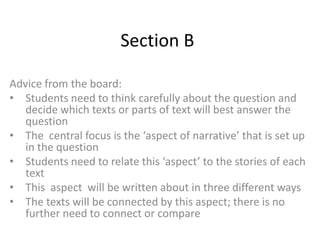
Advice from the board:
• Students need to think carefully about the question and
   decide which texts or parts of text will best answer the
   question
• The central focus is the ‘aspect of narrative’ that is set up
   in the question
• Students need to relate this ‘aspect’ to the stories of each
   text
• This aspect will be written about in three different ways
• The texts will be connected by this aspect; there is no
   further need to connect or compare
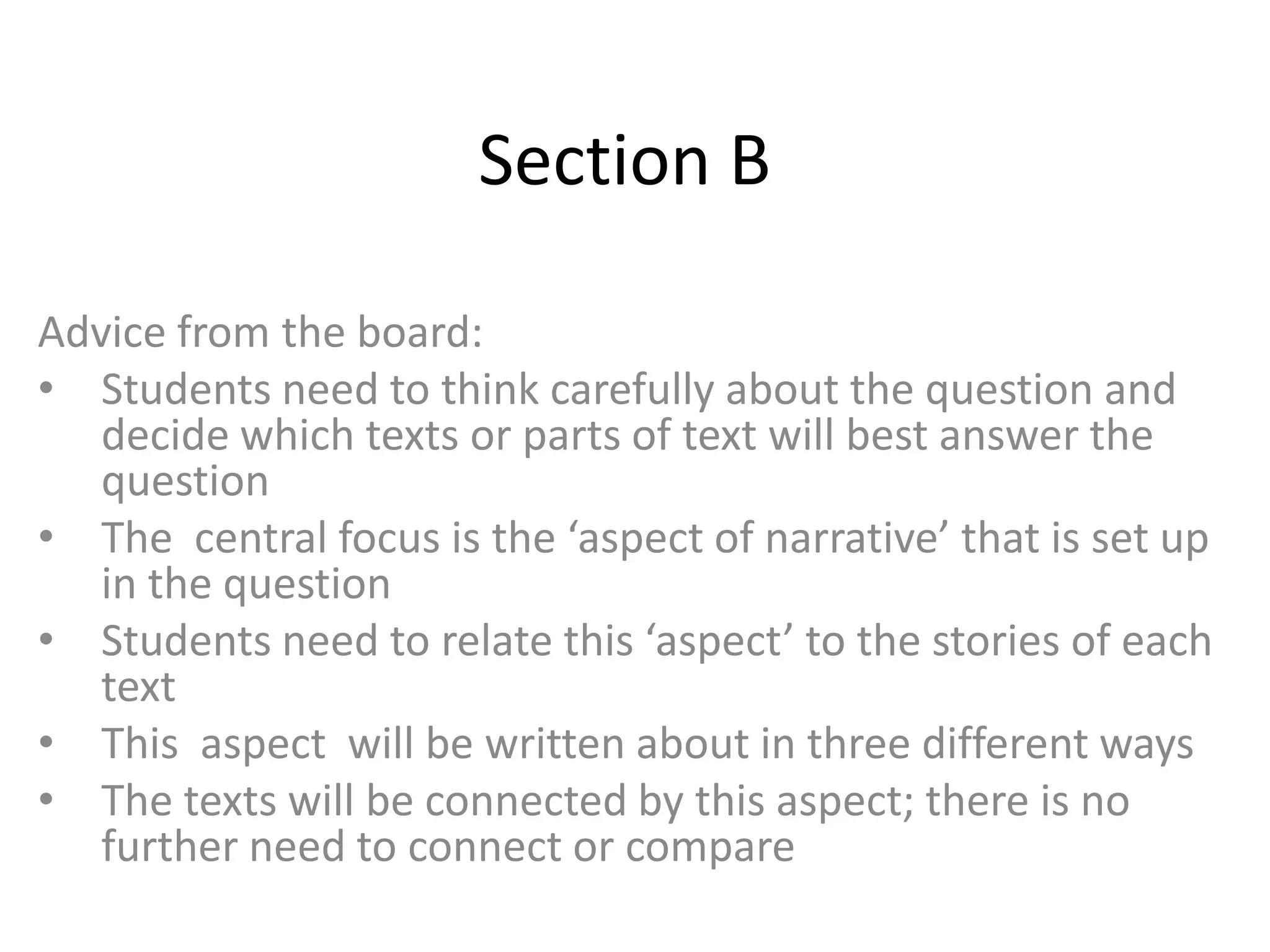
You are going to select a section B
     question from the lucky dip.

• What aspect of narrative is the question
  directing you to focus on?

• Which texts would you use?

• For novels, or longer poems, which section of
  the text would you use?
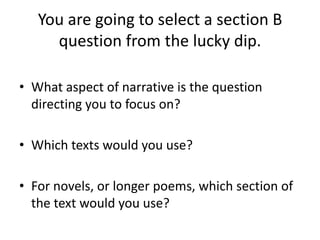
Brainstorm key points
(relating to the aspect of
narrative in the question)
                                Form:
about language, form and
structure for the three
                              resulting
texts you will answer on
                             overall style

                         Structure: how the
                          text has been put
                               together

                  Language: words; images
                    sentence structures;
                punctuation; stage directions
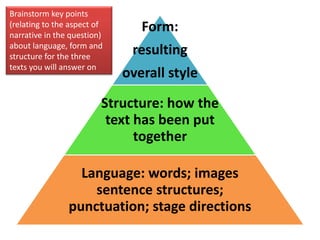
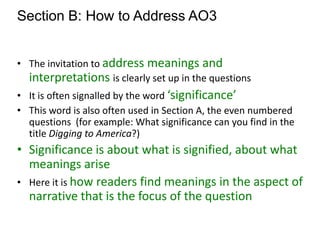
Section B: How to Address AO3


• The invitation to address meanings and
  interpretations is clearly set up in the questions
• It is often signalled by the word ‘significance’
• This word is also often used in Section A, the even numbered
  questions (for example: What significance can you find in the
  title Digging to America?)
• Significance is about what is signified, about what
  meanings arise
• Here it is how readers find meanings in the aspect of
  narrative that is the focus of the question
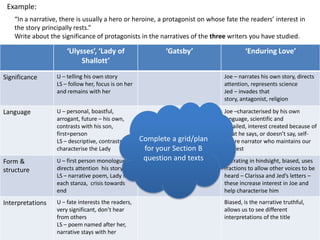
Example:
   “In a narrative, there is usually a hero or heroine, a protagonist on whose fate the readers’ interest in
   the story principally rests.”
   Write about the significance of protagonists in the narratives of the three writers you have studied.

                      ‘Ulysses’, ‘Lady of                   ‘Gatsby’                  ‘Enduring Love’
                           Shallott’

Significance      U – telling his own story                                   Joe – narrates his own story, directs
                  LS – follow her, focus is on her                            attention, represents science
                  and remains with her                                        Jed – invades that
                                                                              story, antagonist, religion

Language          U – personal, boastful,                                     Joe –characterised by his own
                  arrogant, future – his own,                                 language, scientific and
                  contrasts with his son,                                     detailed, interest created because of
                  first=person                                                what he says, or doesn’t say, self-
                  LS – descriptive, contrasts to     Complete a grid/plan     aware narrator who maintains our
                  characterise the Lady               for your Section B      interest

Form &            U – first person monologue,         question and texts      Narrating in hindsight, biased, uses
structure         directs attention his story                                 fractions to allow other voices to be
                  LS – narrative poem, Lady in                                heard – Clarissa and Jed’s letters –
                  each stanza, crisis towards                                 these increase interest in Joe and
                  end                                                         help characterise him
Interpretations   U – fate interests the readers,                             Biased, is the narrative truthful,
                  very significant, don’t hear                                allows us to see different
                  from others                                                 interpretations of the title
                  LS – poem named after her,
                  narrative stays with her
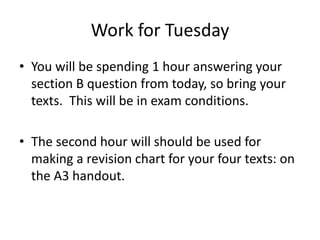
Work for Tuesday
• You will be spending 1 hour answering your
  section B question from today, so bring your
  texts. This will be in exam conditions.

• The second hour will should be used for
  making a revision chart for your four texts: on
  the A3 handout.
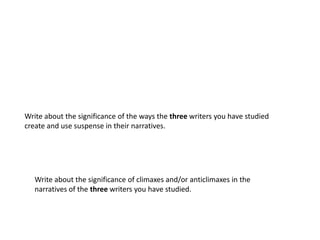
Write about the significance of the ways the three writers you have studied
create and use suspense in their narratives.


   Write about the significance of climaxes and/or anticlimaxes in the
   narratives of the three writers you have studied.
Write about the significance of the ways speech is used in the work of the three writers
you have studied.


Writers draw upon the conventions of different genres when constructing their
narratives: for example, ballads, monologues, elegies, fictive
biographies, thrillers, romances.

Write about the significance of generic conventions in the narratives of the three
writers you have studied.


A key choice writers make is how they name or refer to characters in their stories.

Write about the significance of the choices writers have made in naming or
referring to their characters in the three texts you have studied.
“In narratives, what we are not told is just as important as what we
are told.”

Write about the significance of the gaps or of the untold stories in
the narratives of the three writers you have studied.


     Write about the significance of descriptive language as it is used by each of
     the three writers you have studied.


 Write about the significance of the ways the three writers you have studied
 have structured their narratives.
Write about the significance of the ways the three writers you have studied have
  used places in their narratives.


Write about the significance of the ways writers end their narratives in the work of
the three writers you have studied.


Write about the significance of narrators in the work of the three writers you have
studied.
Many narratives have one or more significant moments of crisis.

 Write about the significance of crises in the work of the three writers you
 have studied.


   How do writers use repetition to create meanings in their texts?

   Write about the significance of repetition in the work of the three writers you
   have studied.


Write about the significance of some of the ways characters are created
in the three texts you have studied.
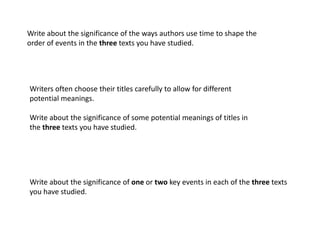
Write about the significance of the ways authors use time to shape the
order of events in the three texts you have studied.


Writers often choose their titles carefully to allow for different
potential meanings.

Write about the significance of some potential meanings of titles in
the three texts you have studied.


Write about the significance of one or two key events in each of the three texts
you have studied.

Section b lucky dip

  • 1.
    Section B Advice fromthe board: • Students need to think carefully about the question and decide which texts or parts of text will best answer the question • The central focus is the ‘aspect of narrative’ that is set up in the question • Students need to relate this ‘aspect’ to the stories of each text • This aspect will be written about in three different ways • The texts will be connected by this aspect; there is no further need to connect or compare
  • 2.
    You are goingto select a section B question from the lucky dip. • What aspect of narrative is the question directing you to focus on? • Which texts would you use? • For novels, or longer poems, which section of the text would you use?
  • 3.
    Brainstorm key points (relatingto the aspect of narrative in the question) Form: about language, form and structure for the three resulting texts you will answer on overall style Structure: how the text has been put together Language: words; images sentence structures; punctuation; stage directions
  • 4.
    Section B: Howto Address AO3 • The invitation to address meanings and interpretations is clearly set up in the questions • It is often signalled by the word ‘significance’ • This word is also often used in Section A, the even numbered questions (for example: What significance can you find in the title Digging to America?) • Significance is about what is signified, about what meanings arise • Here it is how readers find meanings in the aspect of narrative that is the focus of the question
  • 5.
    Example: “In a narrative, there is usually a hero or heroine, a protagonist on whose fate the readers’ interest in the story principally rests.” Write about the significance of protagonists in the narratives of the three writers you have studied. ‘Ulysses’, ‘Lady of ‘Gatsby’ ‘Enduring Love’ Shallott’ Significance U – telling his own story Joe – narrates his own story, directs LS – follow her, focus is on her attention, represents science and remains with her Jed – invades that story, antagonist, religion Language U – personal, boastful, Joe –characterised by his own arrogant, future – his own, language, scientific and contrasts with his son, detailed, interest created because of first=person what he says, or doesn’t say, self- LS – descriptive, contrasts to Complete a grid/plan aware narrator who maintains our characterise the Lady for your Section B interest Form & U – first person monologue, question and texts Narrating in hindsight, biased, uses structure directs attention his story fractions to allow other voices to be LS – narrative poem, Lady in heard – Clarissa and Jed’s letters – each stanza, crisis towards these increase interest in Joe and end help characterise him Interpretations U – fate interests the readers, Biased, is the narrative truthful, very significant, don’t hear allows us to see different from others interpretations of the title LS – poem named after her, narrative stays with her
  • 6.
    Work for Tuesday •You will be spending 1 hour answering your section B question from today, so bring your texts. This will be in exam conditions. • The second hour will should be used for making a revision chart for your four texts: on the A3 handout.
  • 7.
    Write about thesignificance of the ways the three writers you have studied create and use suspense in their narratives. Write about the significance of climaxes and/or anticlimaxes in the narratives of the three writers you have studied.
  • 8.
    Write about thesignificance of the ways speech is used in the work of the three writers you have studied. Writers draw upon the conventions of different genres when constructing their narratives: for example, ballads, monologues, elegies, fictive biographies, thrillers, romances. Write about the significance of generic conventions in the narratives of the three writers you have studied. A key choice writers make is how they name or refer to characters in their stories. Write about the significance of the choices writers have made in naming or referring to their characters in the three texts you have studied.
  • 9.
    “In narratives, whatwe are not told is just as important as what we are told.” Write about the significance of the gaps or of the untold stories in the narratives of the three writers you have studied. Write about the significance of descriptive language as it is used by each of the three writers you have studied. Write about the significance of the ways the three writers you have studied have structured their narratives.
  • 10.
    Write about thesignificance of the ways the three writers you have studied have used places in their narratives. Write about the significance of the ways writers end their narratives in the work of the three writers you have studied. Write about the significance of narrators in the work of the three writers you have studied.
  • 11.
    Many narratives haveone or more significant moments of crisis. Write about the significance of crises in the work of the three writers you have studied. How do writers use repetition to create meanings in their texts? Write about the significance of repetition in the work of the three writers you have studied. Write about the significance of some of the ways characters are created in the three texts you have studied.
  • 12.
    Write about thesignificance of the ways authors use time to shape the order of events in the three texts you have studied. Writers often choose their titles carefully to allow for different potential meanings. Write about the significance of some potential meanings of titles in the three texts you have studied. Write about the significance of one or two key events in each of the three texts you have studied.