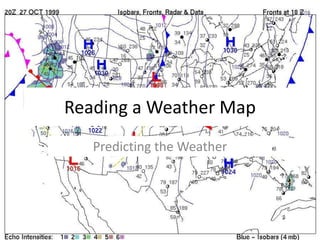
Reading a Weather Map
   Predicting the Weather
Air Pressure
• Generally acceptable
  pressure range is 94.00
  kPa to 106.00 kPa
• Add a 9 or 10 in front
  of the number and
  move the decimal two
  places to the left
   – ie. 9013 = 90.13 or
     10013 = 100.13
• Which air pressure is
  acceptable?
Air Pressure
• Even if you forget how
  to do this, you know
  that
   – “High means Dry” or
   – Low pressure is
     associated with really
     stormy weather
• The circle tells you the
  fraction of cloud cover
• You be the judge
Air Pressure
• Converting kPa to millibars
  – Multiply by 10
  – 100.13 kPa = 1001.3 mb
Air Pressure Change
• If 013 translates to
  100.13 kPa with 2
  decimal places…
   – +08 becomes “an
     increase of 0.08 kPa”
   (notice, 2 decimal places)
Wind Direction and Speed
• The point towards the
  circle in the same
  direction as the wind
  travels.
  – ie. Southwesterly
• Wind speed shown by
  total barbs
  – Each barb = 10 knots
  – ½ barb = 5 knots
  – ie. 15 knots
Temperature
• Measured in degrees
  Celsius
  – ie. 25°C
Dew Point
• The temperature at
  which condensation will
  occur.
  – In other words, when
    clouds will form
• Measured in degrees
  Celsius
  – ie. 19°C

Reading a weather map slideshare

  • 1.
    Reading a WeatherMap Predicting the Weather
  • 2.
    Air Pressure • Generallyacceptable pressure range is 94.00 kPa to 106.00 kPa • Add a 9 or 10 in front of the number and move the decimal two places to the left – ie. 9013 = 90.13 or 10013 = 100.13 • Which air pressure is acceptable?
  • 3.
    Air Pressure • Evenif you forget how to do this, you know that – “High means Dry” or – Low pressure is associated with really stormy weather • The circle tells you the fraction of cloud cover • You be the judge
  • 4.
    Air Pressure • ConvertingkPa to millibars – Multiply by 10 – 100.13 kPa = 1001.3 mb
  • 5.
    Air Pressure Change •If 013 translates to 100.13 kPa with 2 decimal places… – +08 becomes “an increase of 0.08 kPa” (notice, 2 decimal places)
  • 6.
    Wind Direction andSpeed • The point towards the circle in the same direction as the wind travels. – ie. Southwesterly • Wind speed shown by total barbs – Each barb = 10 knots – ½ barb = 5 knots – ie. 15 knots
  • 7.
    Temperature • Measured indegrees Celsius – ie. 25°C
  • 8.
    Dew Point • Thetemperature at which condensation will occur. – In other words, when clouds will form • Measured in degrees Celsius – ie. 19°C