HFH Ch. 7, PHAK Ch. 10, POH Sec. 5
Factors Affecting Performance
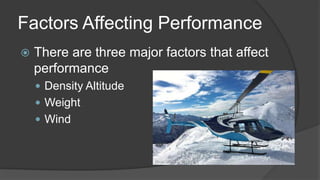
 There are three major factors that affect
performance
 Density Altitude
 Weight
 Wind
Density Altitude (DA)
 The altitude in the standard atmosphere
corresponding to a particular value of air
density
 High DA=low air density
 DA is the pressure altitude (PA) corrected
for non-standard temperature
 In order for us to understand DA we have
to understand PA
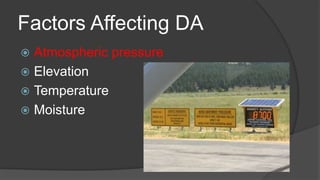
Factors Affecting DA
 Atmospheric pressure
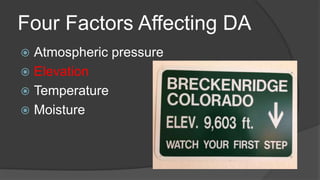
 Elevation
 Temperature
 Moisture
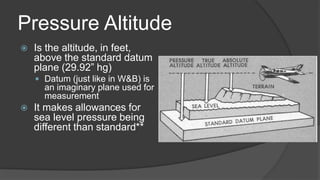
Pressure Altitude
 Is the altitude, in feet,
above the standard datum
plane (29.92” hg)
 Datum (just like in W&B) is
an imaginary plane used for
measurement
 It makes allowances for
sea level pressure being
different than standard**
Atmospheric Pressure
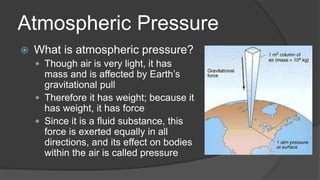
 What is atmospheric pressure?
 Though air is very light, it has
mass and is affected by Earth’s
gravitational pull
 Therefore it has weight; because it
has weight, it has force
 Since it is a fluid substance, this
force is exerted equally in all
directions, and its effect on bodies
within the air is called pressure
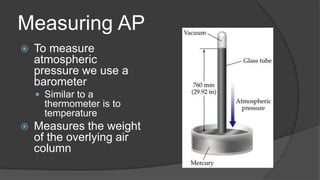
Measuring AP
 To measure
atmospheric
pressure we use a
barometer
 Similar to a
thermometer is to
temperature
 Measures the weight
of the overlying air
column
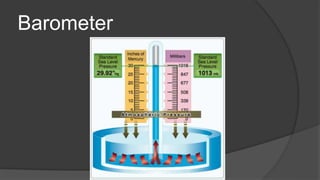
Barometer
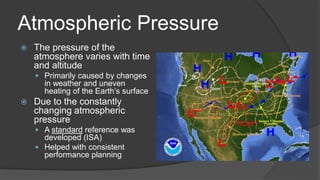
Atmospheric Pressure
 The pressure of the
atmosphere varies with time
and altitude
 Primarily caused by changes
in weather and uneven
heating of the Earth’s surface
 Due to the constantly
changing atmospheric
pressure
 A standard reference was
developed (ISA)
 Helped with consistent
performance planning
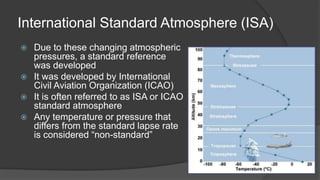
International Standard Atmosphere (ISA)
 Due to these changing atmospheric
pressures, a standard reference
was developed
 It was developed by International
Civil Aviation Organization (ICAO)
 It is often referred to as ISA or ICAO
standard atmosphere
 Any temperature or pressure that
differs from the standard lapse rate
is considered “non-standard”
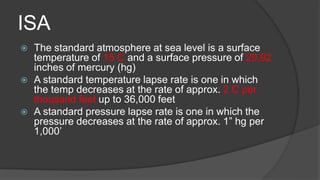
ISA
 The standard atmosphere at sea level is a surface
temperature of 15 C and a surface pressure of 29.92
inches of mercury (hg)
 A standard temperature lapse rate is one in which
the temp decreases at the rate of approx. 2 C per
thousand feet up to 36,000 feet
 A standard pressure lapse rate is one in which the
pressure decreases at the rate of approx. 1” hg per
1,000’
Pressure Altitude Overview
 Is the altitude, in feet, above the
standard datum plane of 29.92” hg
 ISA
 It makes allowances for sea level
pressure being different than standard
 Let’s look at an example of this…
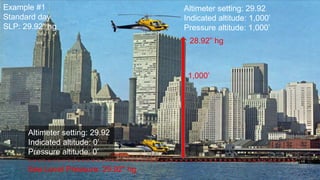
1,000’
- - - - - - - - - - - - - - - - - - - - - - - - - - - - - - - - - - - - - - - - - - - - - - - - - - - - - - -
Sea Level Pressure: 29.92” hg
28.92” hg
Example #1
Standard day
SLP: 29.92” hg
Altimeter setting: 29.92
Indicated altitude: 0’
Pressure altitude: 0’
Altimeter setting: 29.92
Indicated altitude: 1,000’
Pressure altitude: 1,000’
1,000’
- - - - - - - - - - - - - - - - - - - - - - - - - - - - - - - - - - - - - - - - - - - - - - - - - - - - - - -
Sea Level Pressure: 30.12” hg
- - - - - - - - - - - - - - - - - - - - - - - - - - - - - - - - - - - - - - - - - - - - - - - - - - - - - - -
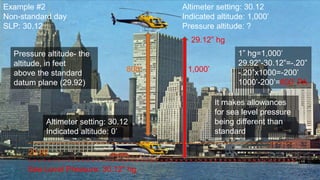
29.92
Example #2
Non-standard day
SLP: 30.12
Altimeter setting: 30.12
Indicated altitude: 0’
Altimeter setting: 30.12
Indicated altitude: 1,000’
Pressure altitude: ?
Pressure altitude- the
altitude, in feet
above the standard
datum plane (29.92)
29.12” hg
1” hg=1,000’
29.92”-30.12”=-.20”
-.20”x1000=-200’
1000’-200’=800’ PA
800’
It makes allowances
for sea level pressure
being different than
standard
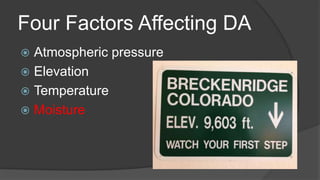
Four Factors Affecting DA
 Atmospheric pressure
 Elevation
 Temperature
 Moisture
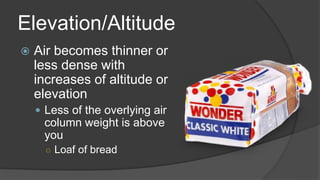
Elevation/Altitude
 Air becomes thinner or
less dense with
increases of altitude or
elevation
 Less of the overlying air
column weight is above
you
○ Loaf of bread
Four Factors Affecting DA
 Atmospheric pressure
 Elevation
 Temperature
 Moisture
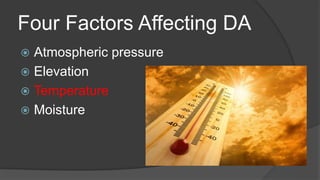
Temperature
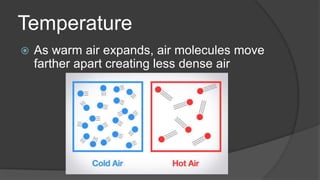
 As warm air expands, air molecules move
farther apart creating less dense air
Four Factors Affecting DA
 Atmospheric pressure
 Elevation
 Temperature
 Moisture
Moisture Content
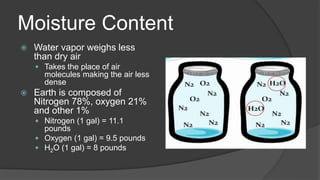
 Water vapor weighs less
than dry air
 Takes the place of air
molecules making the air less
dense
 Earth is composed of
Nitrogen 78%, oxygen 21%
and other 1%
 Nitrogen (1 gal) = 11.1
pounds
 Oxygen (1 gal) = 9.5 pounds
 H2O (1 gal) = 8 pounds
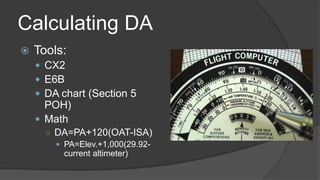
Calculating DA
 Tools:
 CX2
 E6B
 DA chart (Section 5
POH)
 Math
○ DA=PA+120(OAT-ISA)
 PA=Elev.+1,000(29.92-
current altimeter)
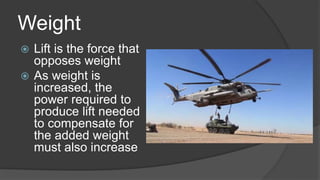
Weight
 Lift is the force that
opposes weight
 As weight is
increased, the
power required to
produce lift needed
to compensate for
the added weight
must also increase
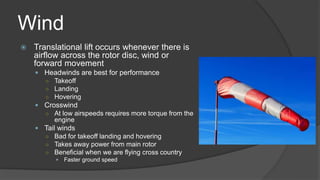
Wind
 Translational lift occurs whenever there is
airflow across the rotor disc, wind or
forward movement
 Headwinds are best for performance
○ Takeoff
○ Landing
○ Hovering
 Crosswind
○ At low airspeeds requires more torque from the
engine
 Tail winds
○ Bad for takeoff landing and hovering
○ Takes away power from main rotor
○ Beneficial when we are flying cross country
 Faster ground speed
Factors Affecting Helicopter Performance

Factors Affecting Helicopter Performance

  • 1.
    HFH Ch. 7,PHAK Ch. 10, POH Sec. 5
  • 2.
    Factors Affecting Performance There are three major factors that affect performance  Density Altitude  Weight  Wind
  • 3.
    Density Altitude (DA) The altitude in the standard atmosphere corresponding to a particular value of air density  High DA=low air density  DA is the pressure altitude (PA) corrected for non-standard temperature  In order for us to understand DA we have to understand PA
  • 4.
    Factors Affecting DA Atmospheric pressure  Elevation  Temperature  Moisture
  • 5.
    Pressure Altitude  Isthe altitude, in feet, above the standard datum plane (29.92” hg)  Datum (just like in W&B) is an imaginary plane used for measurement  It makes allowances for sea level pressure being different than standard**
  • 6.
    Atmospheric Pressure  Whatis atmospheric pressure?  Though air is very light, it has mass and is affected by Earth’s gravitational pull  Therefore it has weight; because it has weight, it has force  Since it is a fluid substance, this force is exerted equally in all directions, and its effect on bodies within the air is called pressure
  • 7.
    Measuring AP  Tomeasure atmospheric pressure we use a barometer  Similar to a thermometer is to temperature  Measures the weight of the overlying air column
  • 8.
  • 9.
    Atmospheric Pressure  Thepressure of the atmosphere varies with time and altitude  Primarily caused by changes in weather and uneven heating of the Earth’s surface  Due to the constantly changing atmospheric pressure  A standard reference was developed (ISA)  Helped with consistent performance planning
  • 10.
    International Standard Atmosphere(ISA)  Due to these changing atmospheric pressures, a standard reference was developed  It was developed by International Civil Aviation Organization (ICAO)  It is often referred to as ISA or ICAO standard atmosphere  Any temperature or pressure that differs from the standard lapse rate is considered “non-standard”
  • 11.
    ISA  The standardatmosphere at sea level is a surface temperature of 15 C and a surface pressure of 29.92 inches of mercury (hg)  A standard temperature lapse rate is one in which the temp decreases at the rate of approx. 2 C per thousand feet up to 36,000 feet  A standard pressure lapse rate is one in which the pressure decreases at the rate of approx. 1” hg per 1,000’
  • 12.
    Pressure Altitude Overview Is the altitude, in feet, above the standard datum plane of 29.92” hg  ISA  It makes allowances for sea level pressure being different than standard  Let’s look at an example of this…
  • 13.
    1,000’ - - -- - - - - - - - - - - - - - - - - - - - - - - - - - - - - - - - - - - - - - - - - - - - - - - - - - - - Sea Level Pressure: 29.92” hg 28.92” hg Example #1 Standard day SLP: 29.92” hg Altimeter setting: 29.92 Indicated altitude: 0’ Pressure altitude: 0’ Altimeter setting: 29.92 Indicated altitude: 1,000’ Pressure altitude: 1,000’
  • 14.
    1,000’ - - -- - - - - - - - - - - - - - - - - - - - - - - - - - - - - - - - - - - - - - - - - - - - - - - - - - - - Sea Level Pressure: 30.12” hg - - - - - - - - - - - - - - - - - - - - - - - - - - - - - - - - - - - - - - - - - - - - - - - - - - - - - - - 29.92 Example #2 Non-standard day SLP: 30.12 Altimeter setting: 30.12 Indicated altitude: 0’ Altimeter setting: 30.12 Indicated altitude: 1,000’ Pressure altitude: ? Pressure altitude- the altitude, in feet above the standard datum plane (29.92) 29.12” hg 1” hg=1,000’ 29.92”-30.12”=-.20” -.20”x1000=-200’ 1000’-200’=800’ PA 800’ It makes allowances for sea level pressure being different than standard
  • 15.
    Four Factors AffectingDA  Atmospheric pressure  Elevation  Temperature  Moisture
  • 16.
    Elevation/Altitude  Air becomesthinner or less dense with increases of altitude or elevation  Less of the overlying air column weight is above you ○ Loaf of bread
  • 17.
    Four Factors AffectingDA  Atmospheric pressure  Elevation  Temperature  Moisture
  • 18.
    Temperature  As warmair expands, air molecules move farther apart creating less dense air
  • 19.
    Four Factors AffectingDA  Atmospheric pressure  Elevation  Temperature  Moisture
  • 20.
    Moisture Content  Watervapor weighs less than dry air  Takes the place of air molecules making the air less dense  Earth is composed of Nitrogen 78%, oxygen 21% and other 1%  Nitrogen (1 gal) = 11.1 pounds  Oxygen (1 gal) = 9.5 pounds  H2O (1 gal) = 8 pounds
  • 21.
    Calculating DA  Tools: CX2  E6B  DA chart (Section 5 POH)  Math ○ DA=PA+120(OAT-ISA)  PA=Elev.+1,000(29.92- current altimeter)
  • 22.
    Weight  Lift isthe force that opposes weight  As weight is increased, the power required to produce lift needed to compensate for the added weight must also increase
  • 23.
    Wind  Translational liftoccurs whenever there is airflow across the rotor disc, wind or forward movement  Headwinds are best for performance ○ Takeoff ○ Landing ○ Hovering  Crosswind ○ At low airspeeds requires more torque from the engine  Tail winds ○ Bad for takeoff landing and hovering ○ Takes away power from main rotor ○ Beneficial when we are flying cross country  Faster ground speed

Editor's Notes

  • #2 Recording 36 File A
  • #8 Mercury doesn’t freeze and remains consistent at different pressures/temperatures
  • #9 Turn a cup of water upside down in the bathtub and then lift it up, the force of the atmosphere and the vacuum push water up into the cup and keep it there
  • #10 Lets say I have an Olympic sized swimming pool, and an Olympic swimmer (phelps) and I time him on the 50 m dash. Then I replace the water with syrup, he will probably be slower. Do you think that will affect his performance? If I want to predict his performance, I have to have a standard (water) Helicopter is moving through air, which is a fluid. We need a STD to predict performance and that is the ISA
  • #12 A study and average taken over 2 year period in all seasons over the entire Earth
  • #14 The altimeter setting is the pressure that would exist at sea level for a given location. Digging a big hole under the tower to where sea level was and put a barometer reading there. We want the altimeter to give us MSL.
  • #15 Pressure is a little higher for this example…more weight from the overlying air column. The weight of the atmosphere in which a barometer would read 29.92 is now above sea level Pressure altitude would be negative in lower helicopter Did either of the aircraft move? No but because the atmospheric pressure changes the altitude the helicopter feels changes and that is how we use the difference to ISA to calculate the performance we will get out of our aircraft Tape measurer example
  • #17 Loaf of bread stood up on its side. Bottom pieces become squished and top pieces are normal.
  • #19 Opening an oven vs. opening a freezer. The oven blasts you with air and you have to put your head in the freezer to cool off
  • #21 Water molecule is less dense than nitrogen or oxygen
  • #22 120 is the difference for every degree in C from PA to DA