Content as Conversation:  Writing for the Web Janice (Ginny) Redish, Ph.D. Redish & Associates, Inc. Bethesda, Maryland 301 − 229 − 3039 [email_address] www.redish.net @GinnyRedish
Topics for this morning Setting the context Planning the conversation Getting people to what they need Writing the conversation Assuring successful conversations
Setting the context © iStockphoto
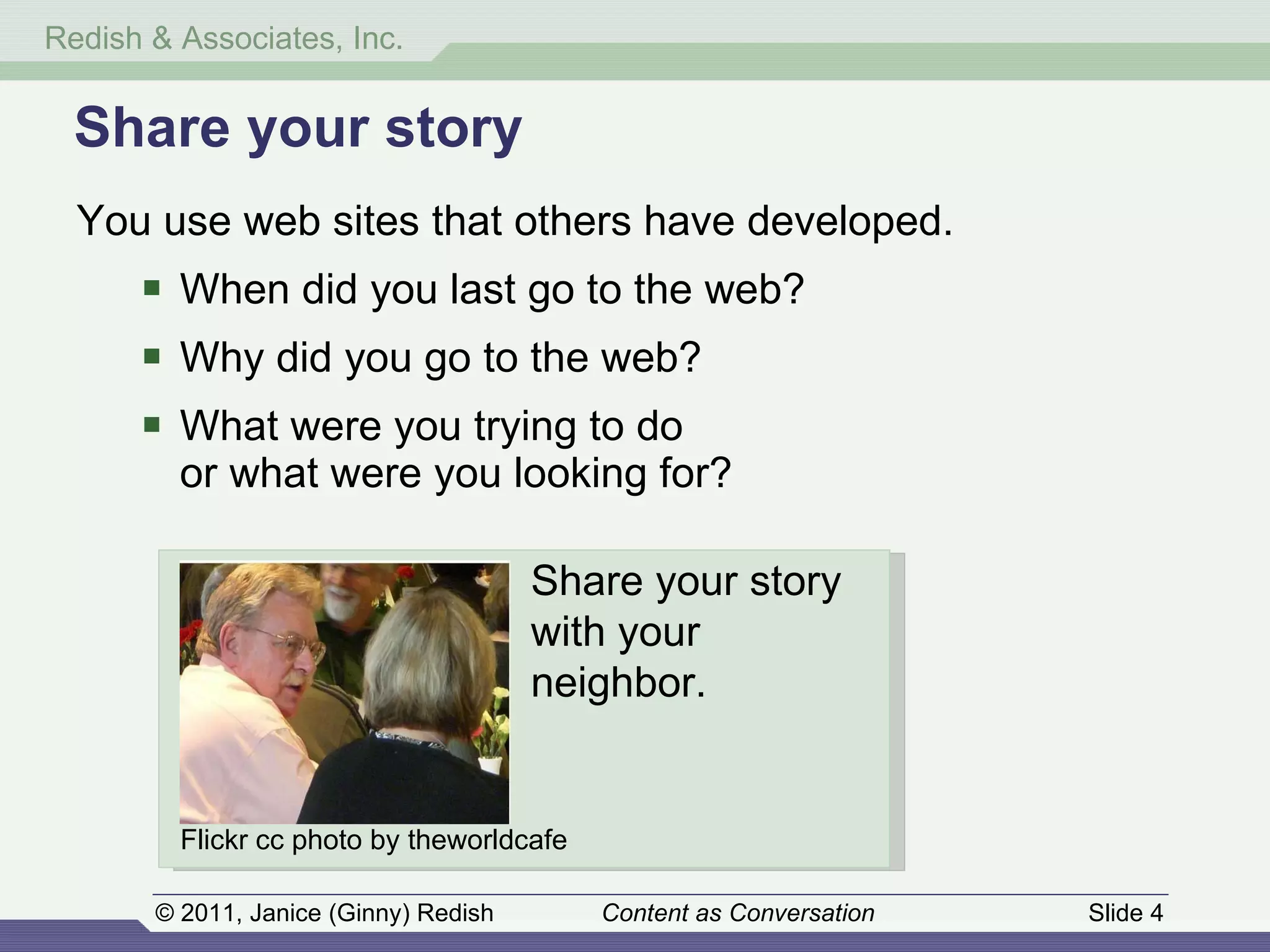
You use web sites that others have developed. When did you last go to the web?  Why did you go to the web? What were you trying to do  or what were you looking for?  Share your story Flickr cc photo by theworldcafe  Share your story  with your neighbor.
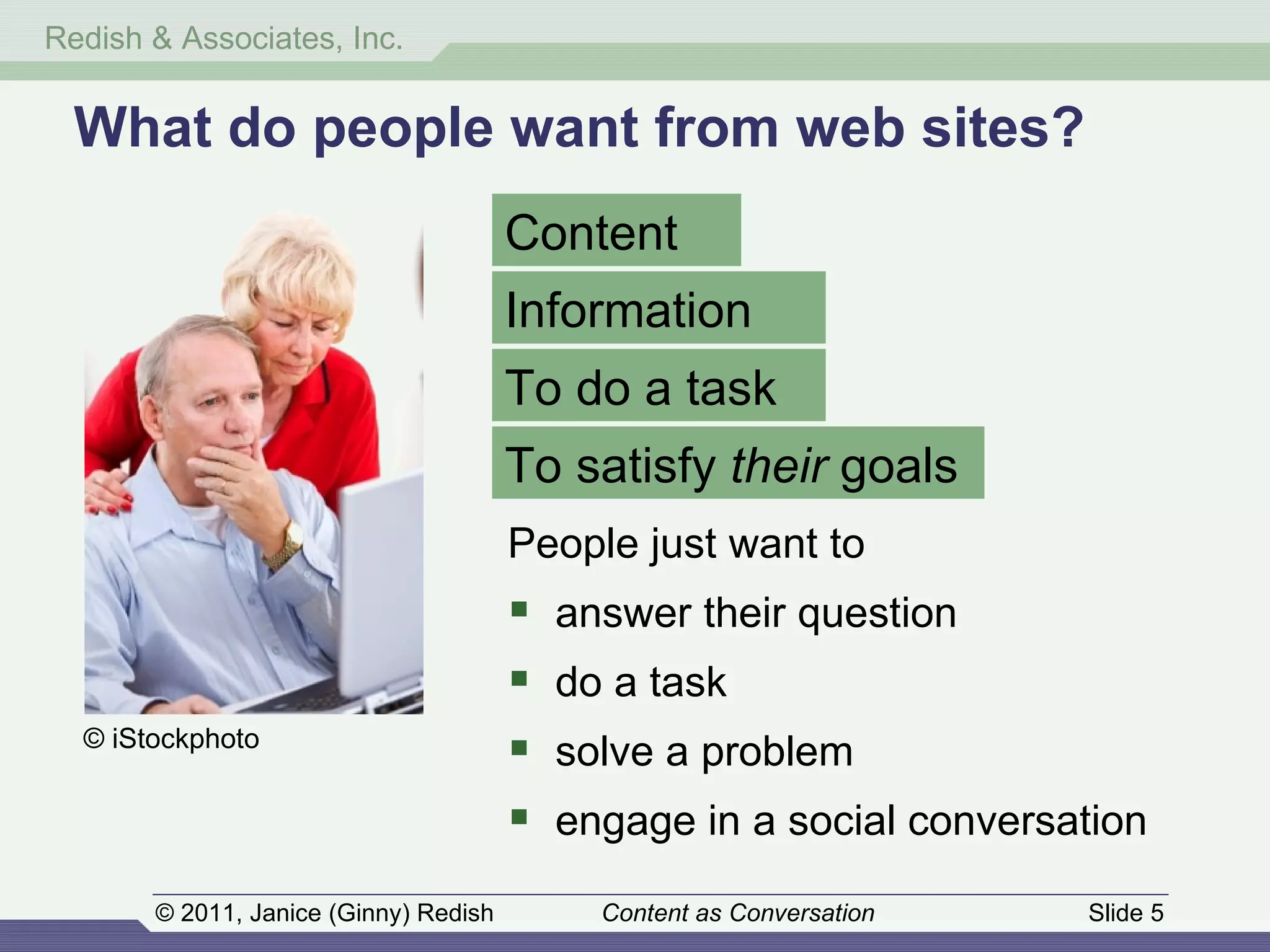
What do people want from web sites? To satisfy  their  goals Content Information To do a task People just want to answer their question do a task solve a problem engage in a social conversation © iStockphoto
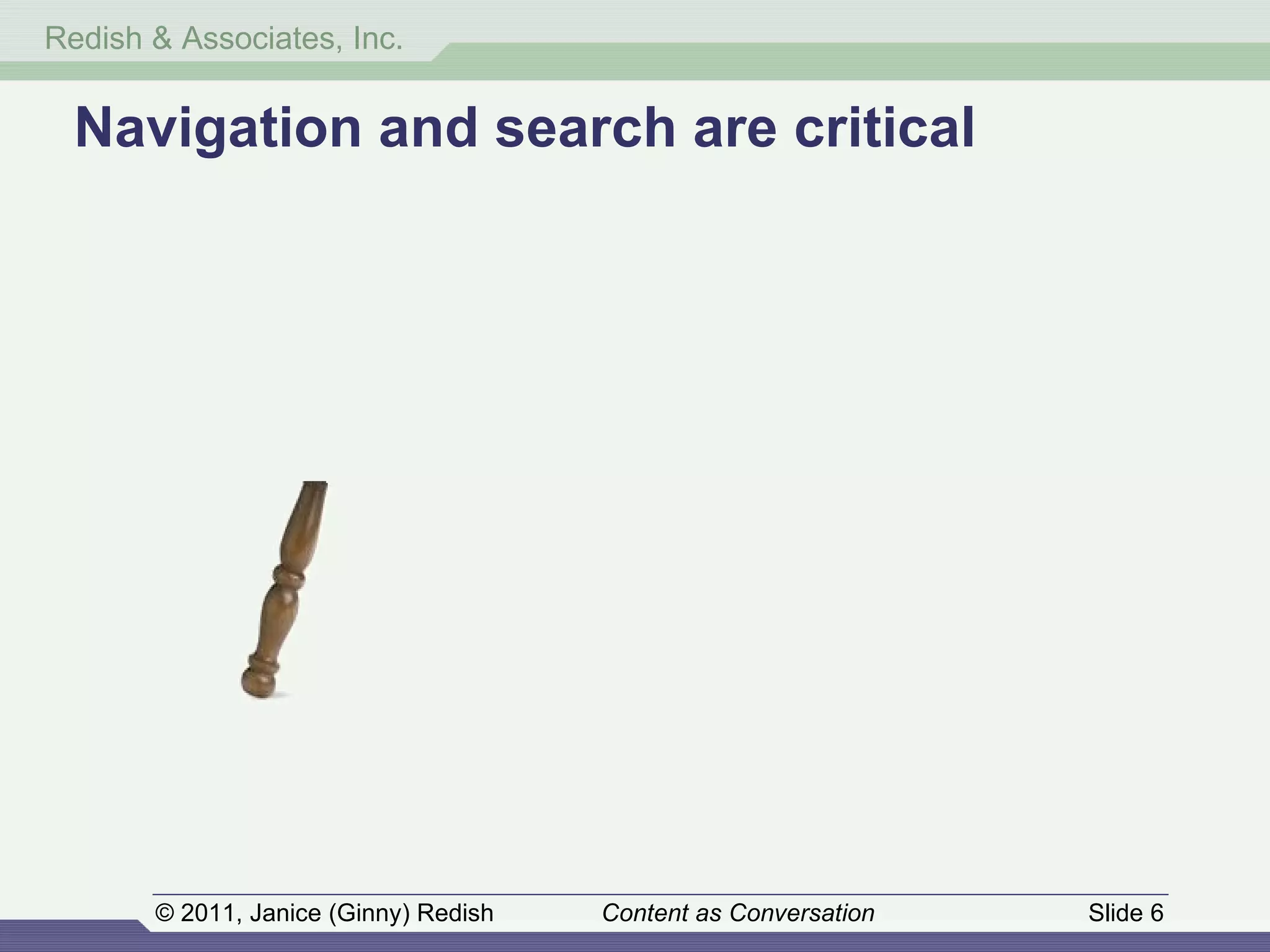
Navigation and search are critical
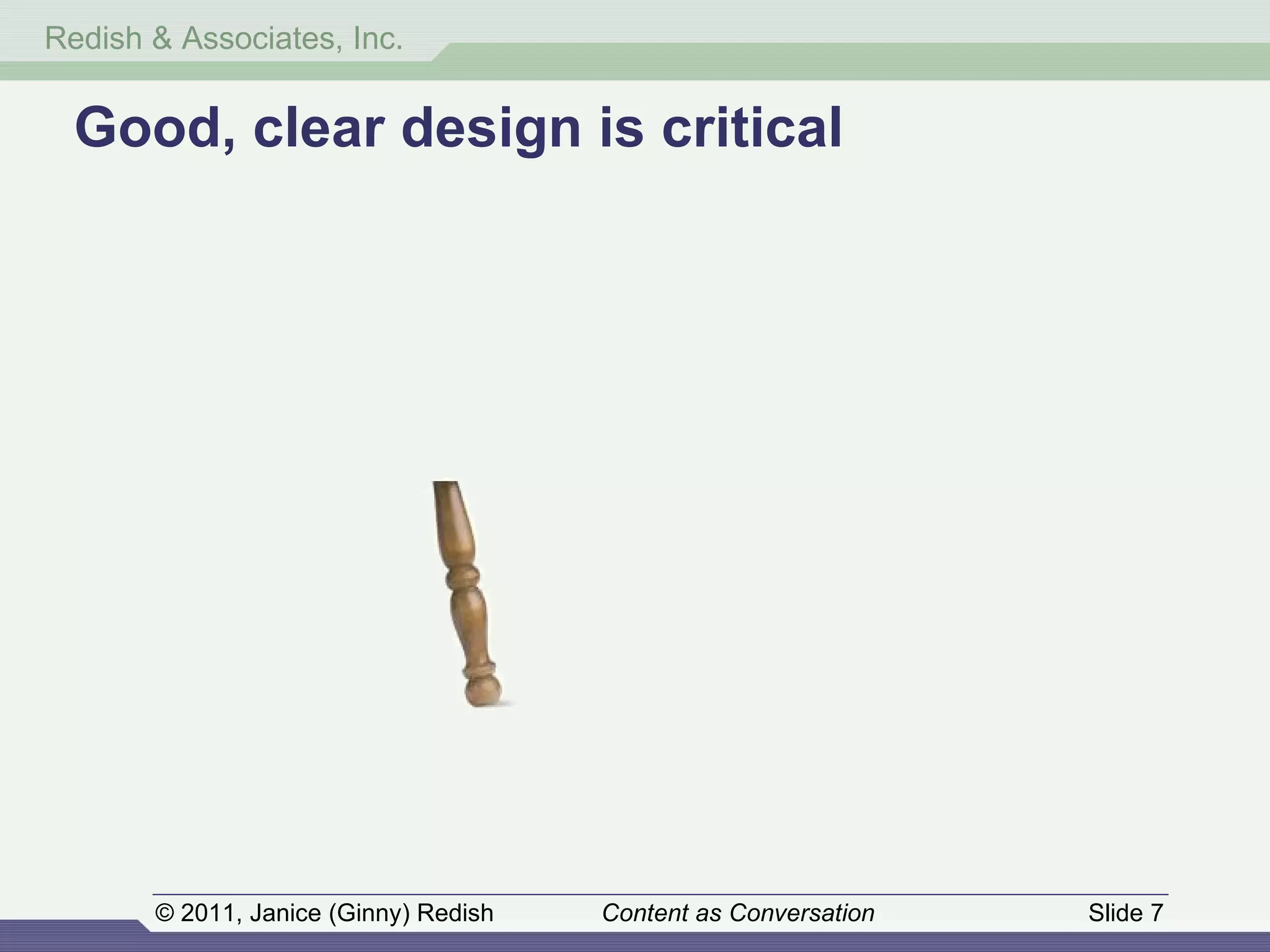
Good, clear design is critical
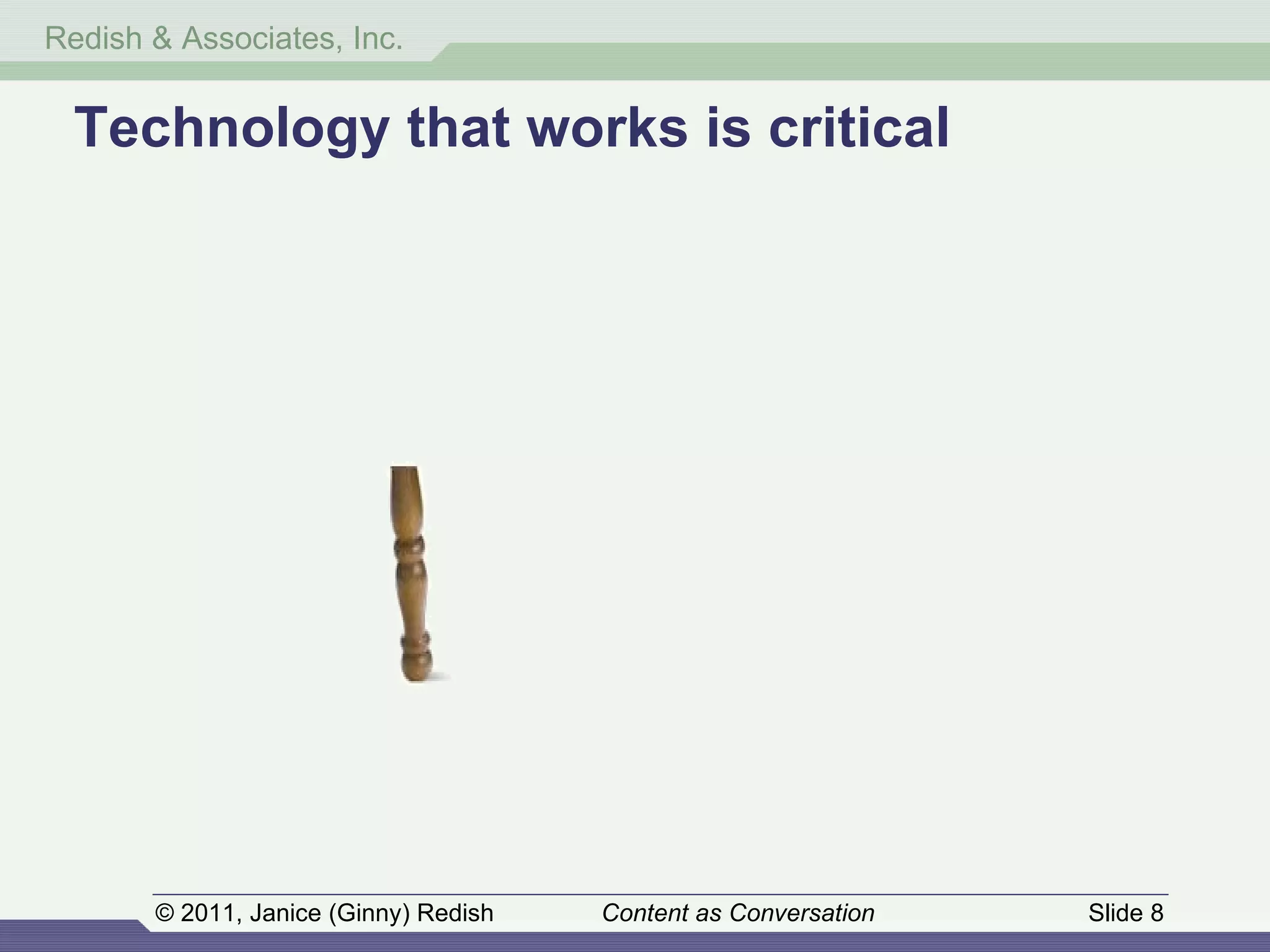
Technology that works is critical
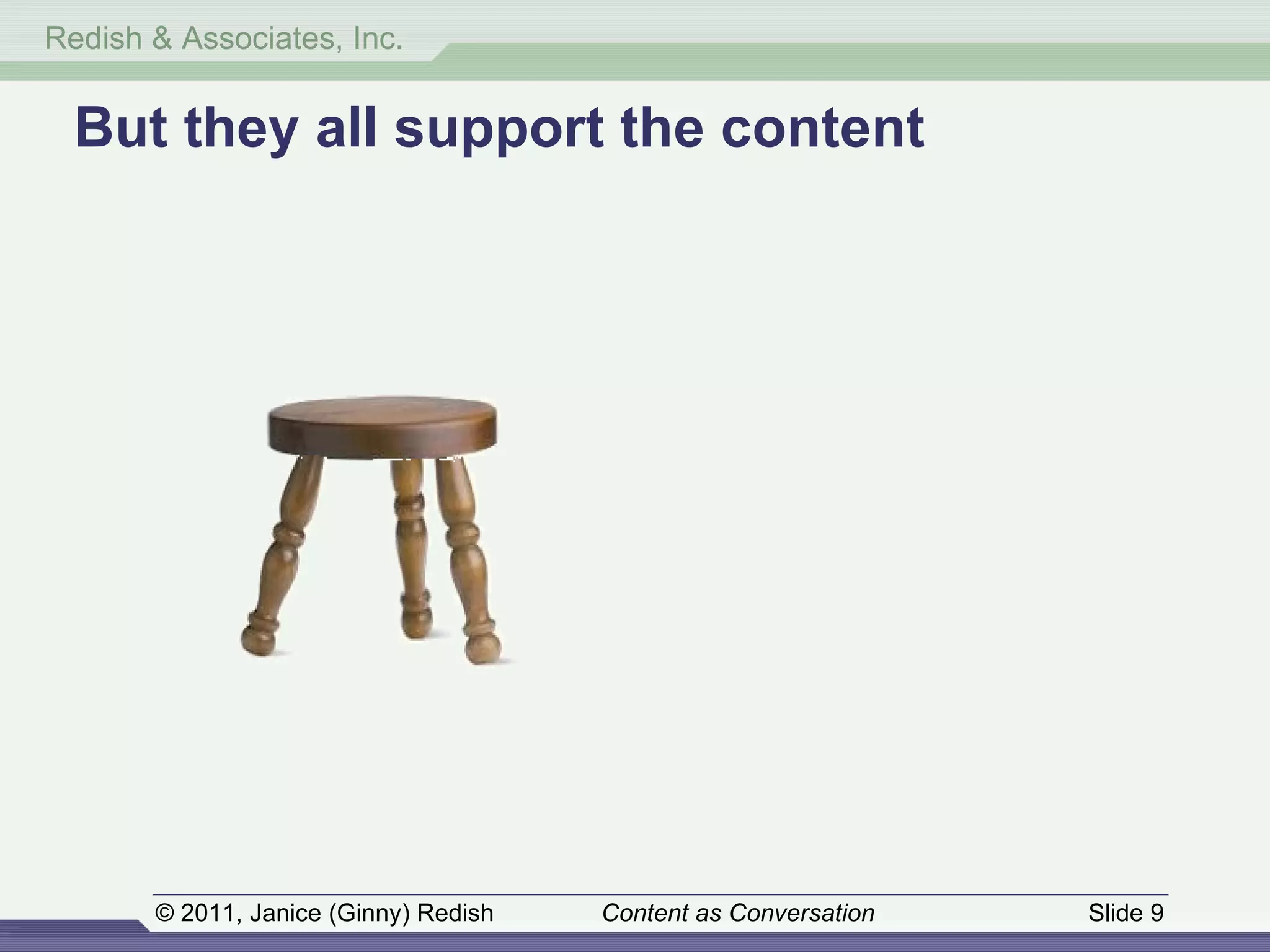
But they all support the content
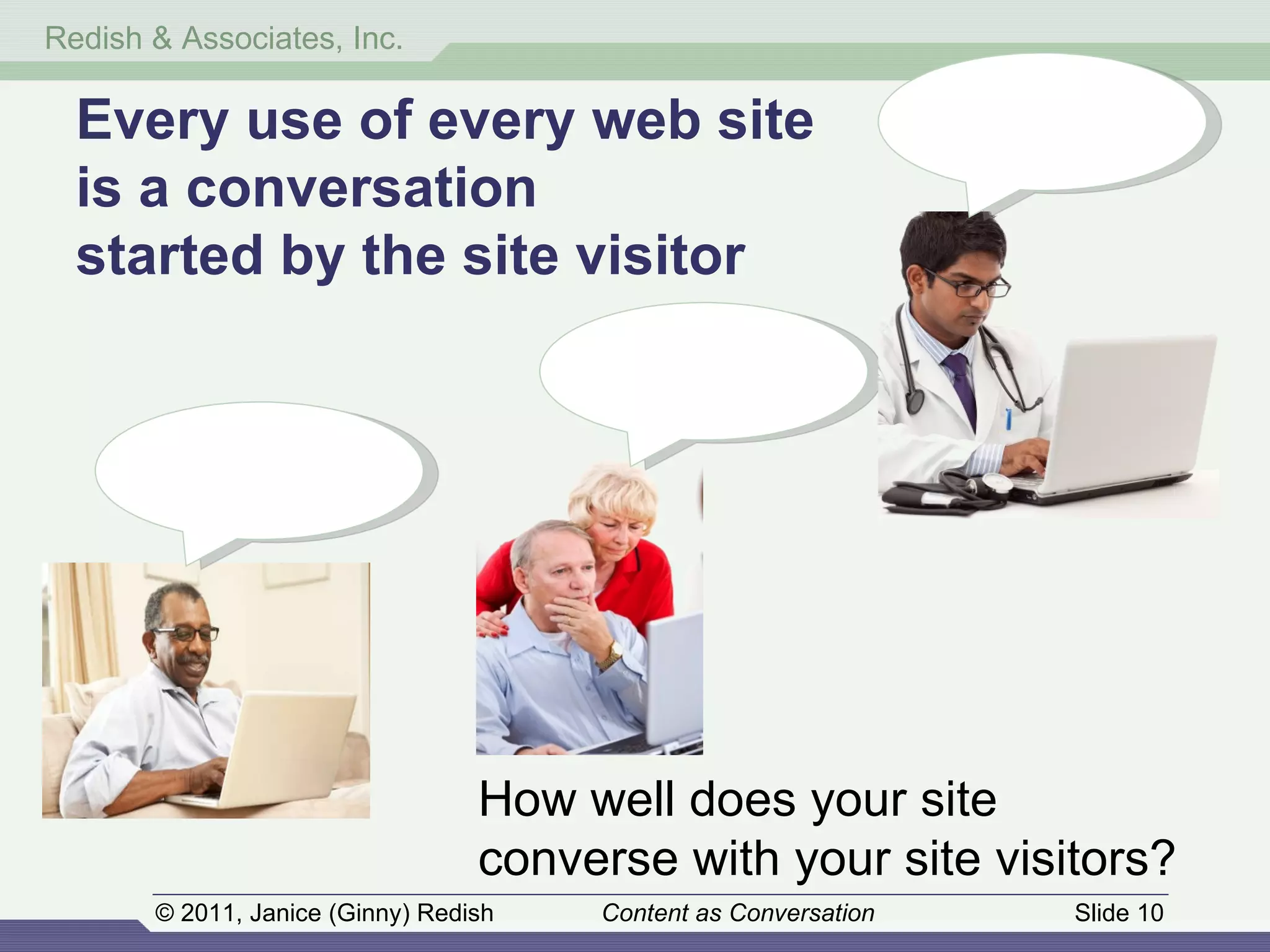
Every use of every web site  is a conversation  started by the site visitor How well does your site  converse with your site visitors?
Planning the conversation © iStockphoto
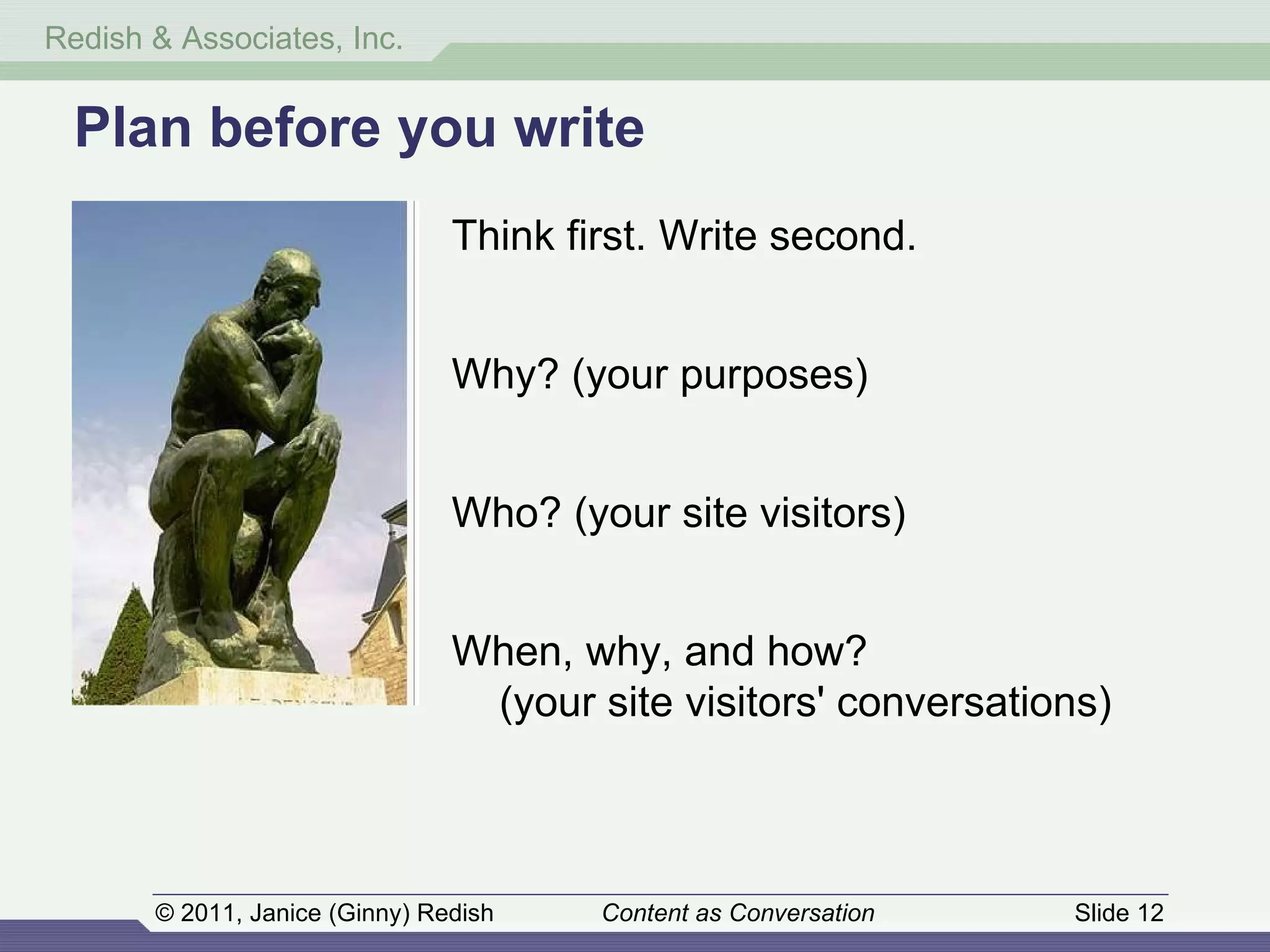
Plan before you write Think first. Write second. Why? (your purposes) Who? (your site visitors) When, why, and how? (your site visitors' conversations)
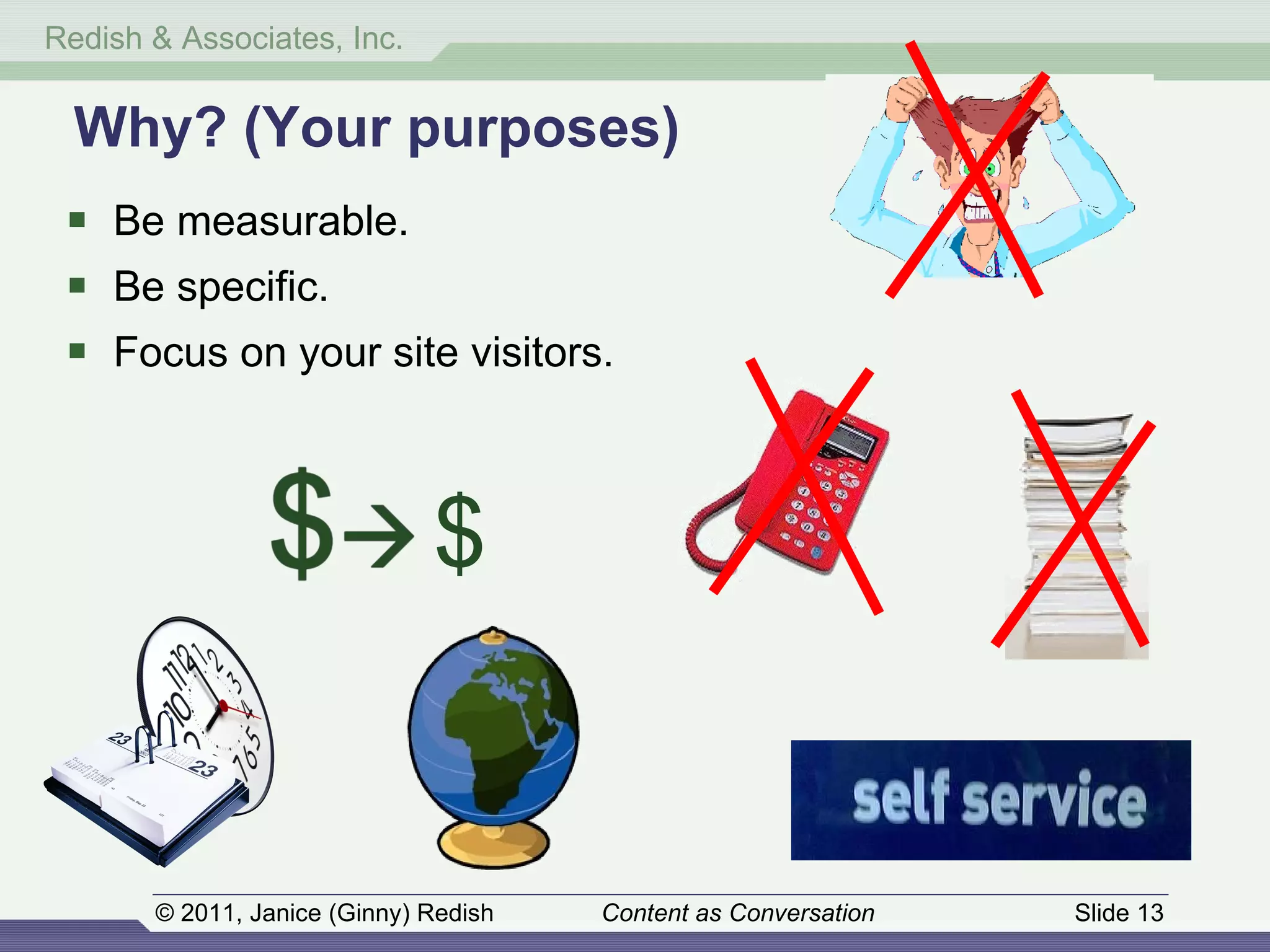
Why? (Your purposes) Be measurable. Be specific. Focus on your site visitors. $
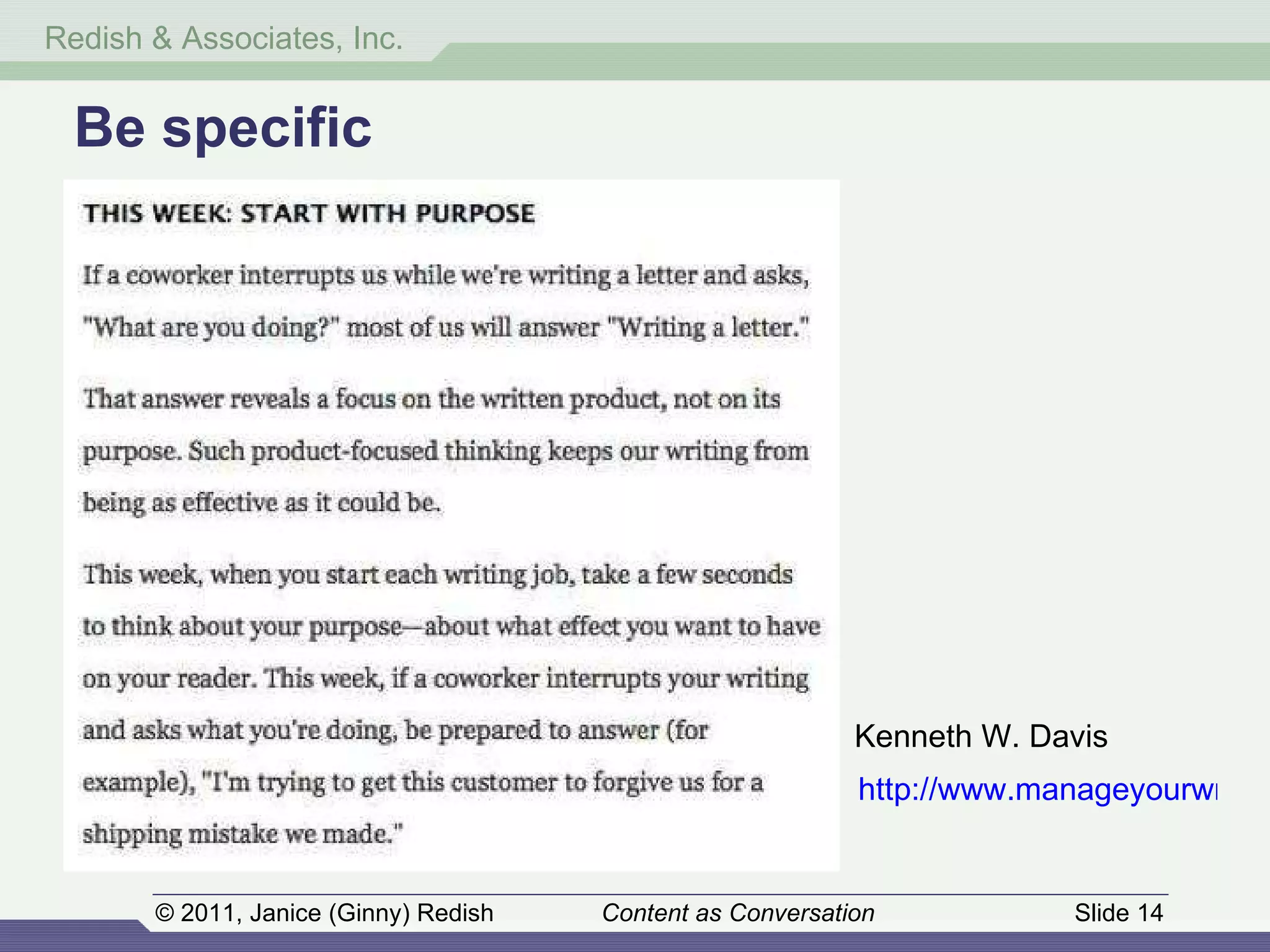
Be specific http://www.manageyourwriting.com/   Kenneth W. Davis
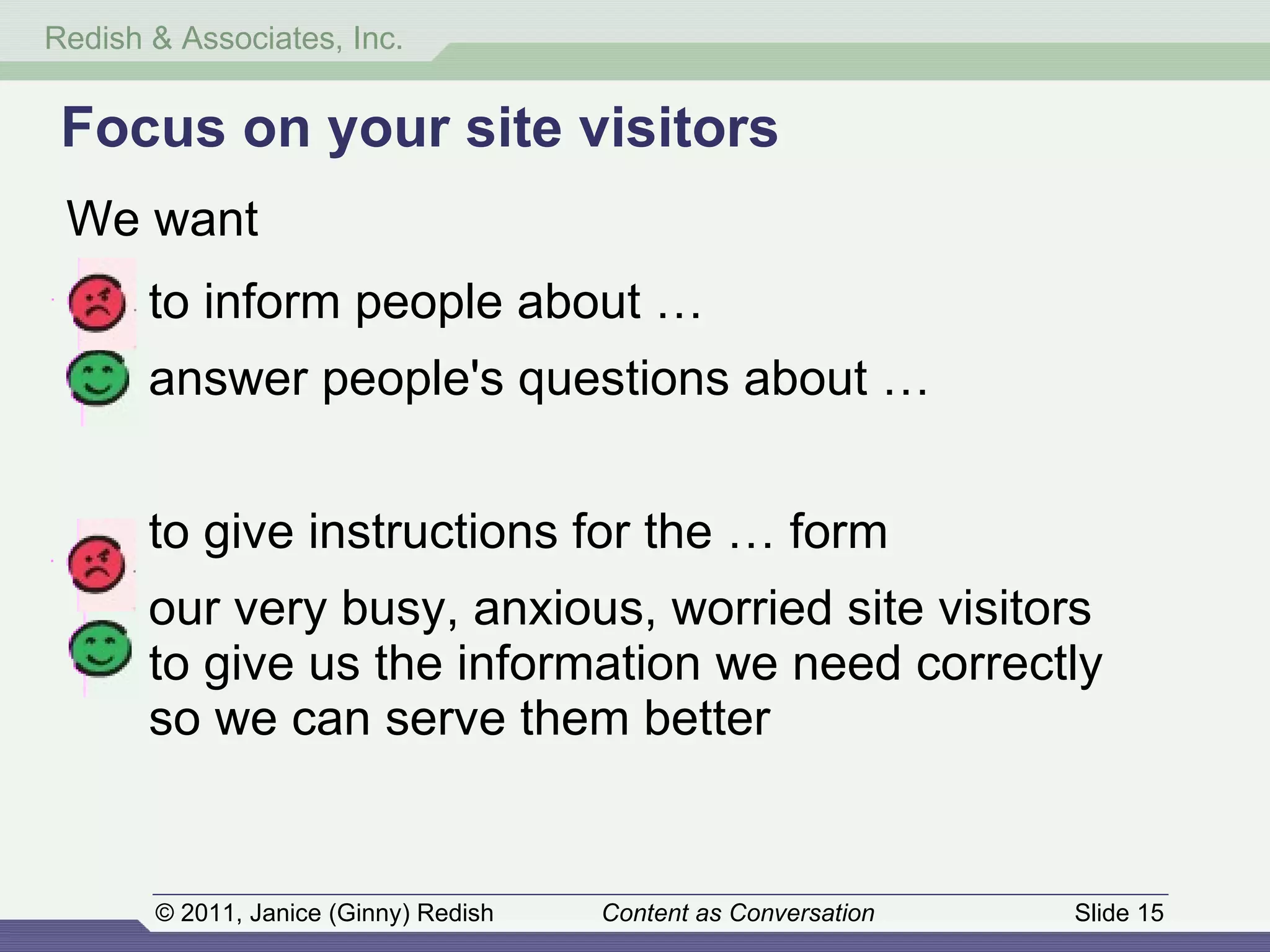
Focus on your site visitors to inform people about … answer people's questions about … to give instructions for the … form our very busy, anxious, worried site visitors to give us the information we need correctly so we can serve them better We want
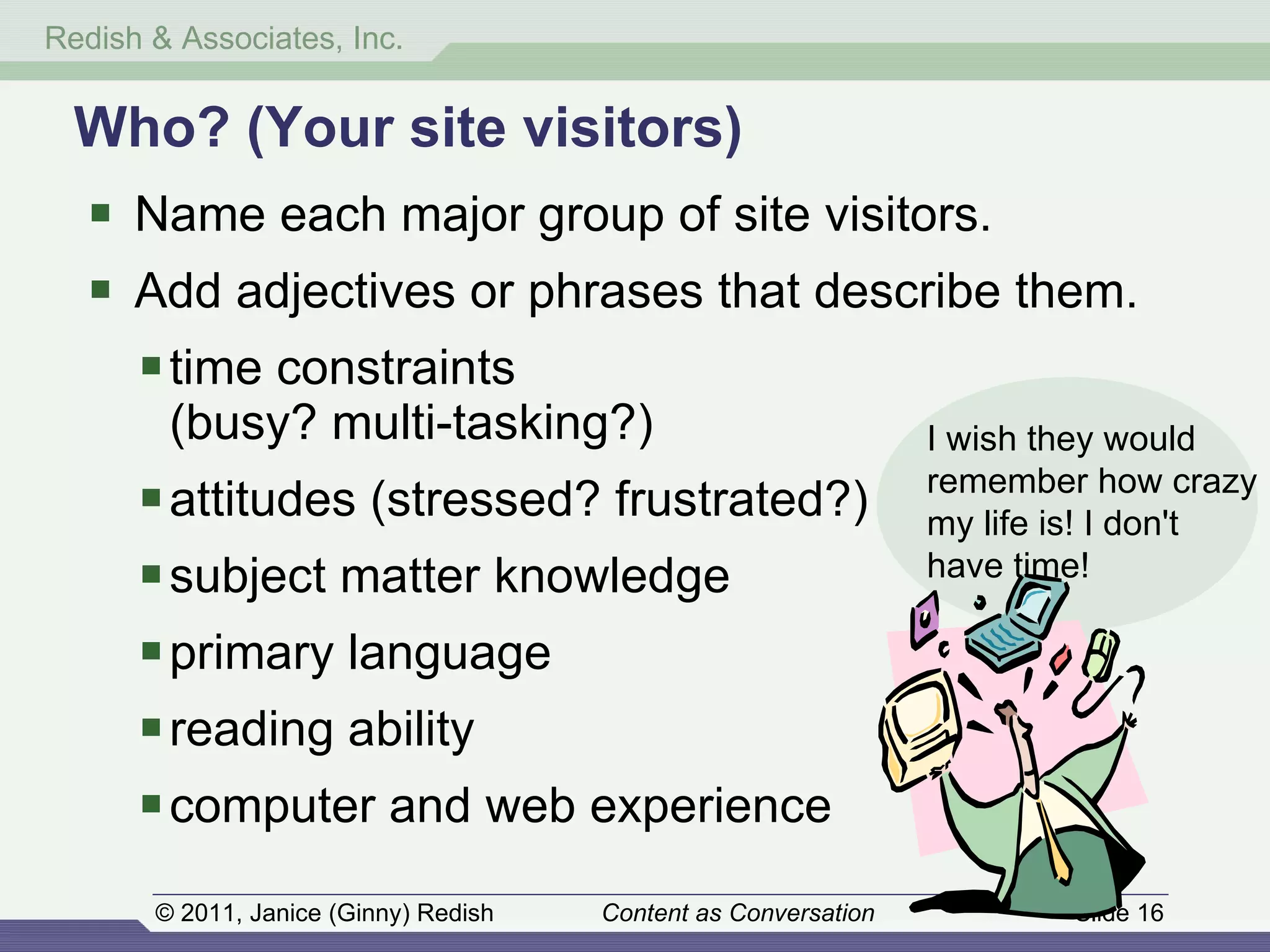
Name each major group of site visitors. Add adjectives or phrases that describe them. time constraints (busy? multi-tasking?) attitudes (stressed? frustrated?) subject matter knowledge primary language reading ability computer and web experience Who? (Your site visitors) I wish they would remember how crazy my life is! I don't have time!
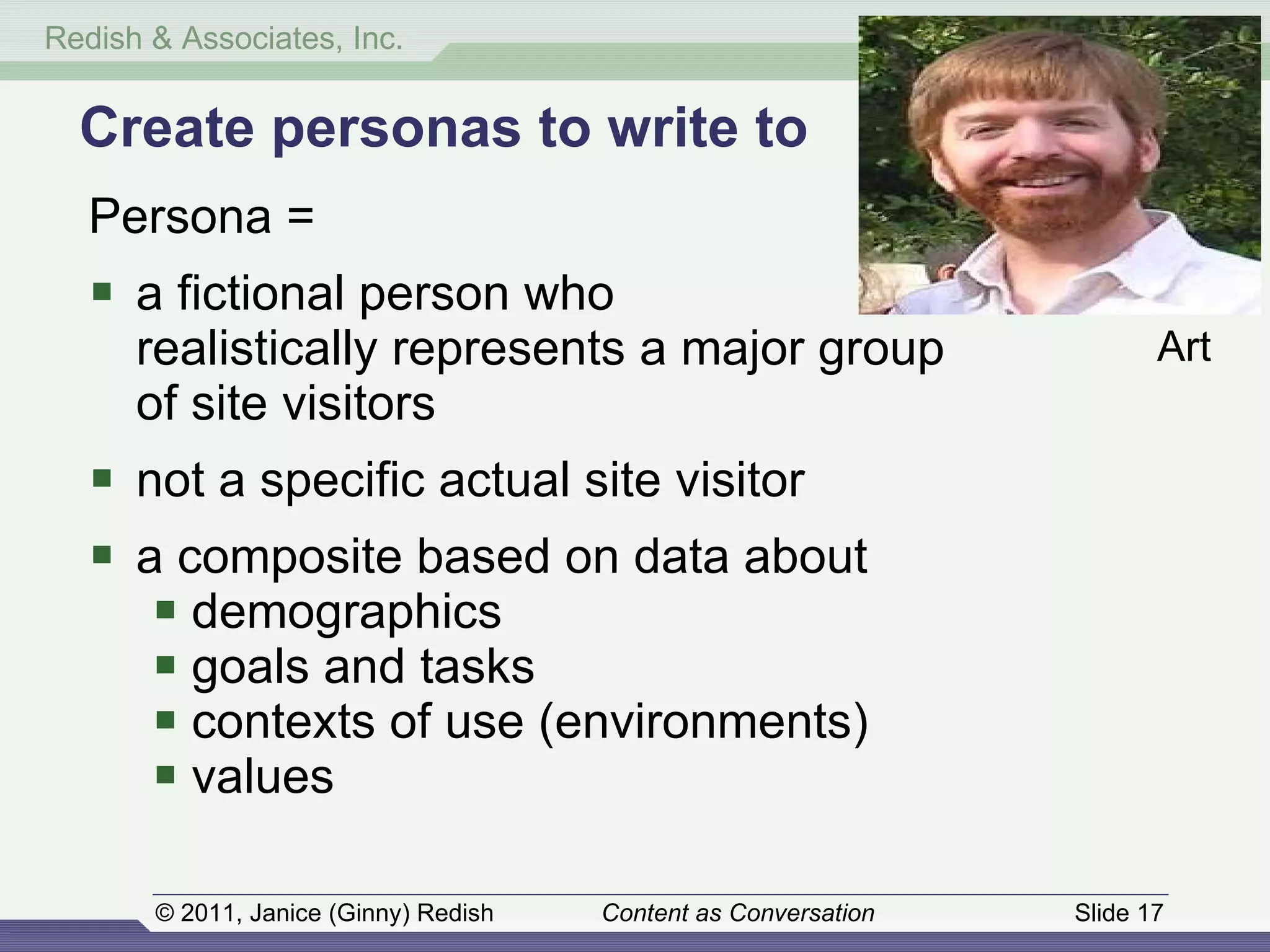
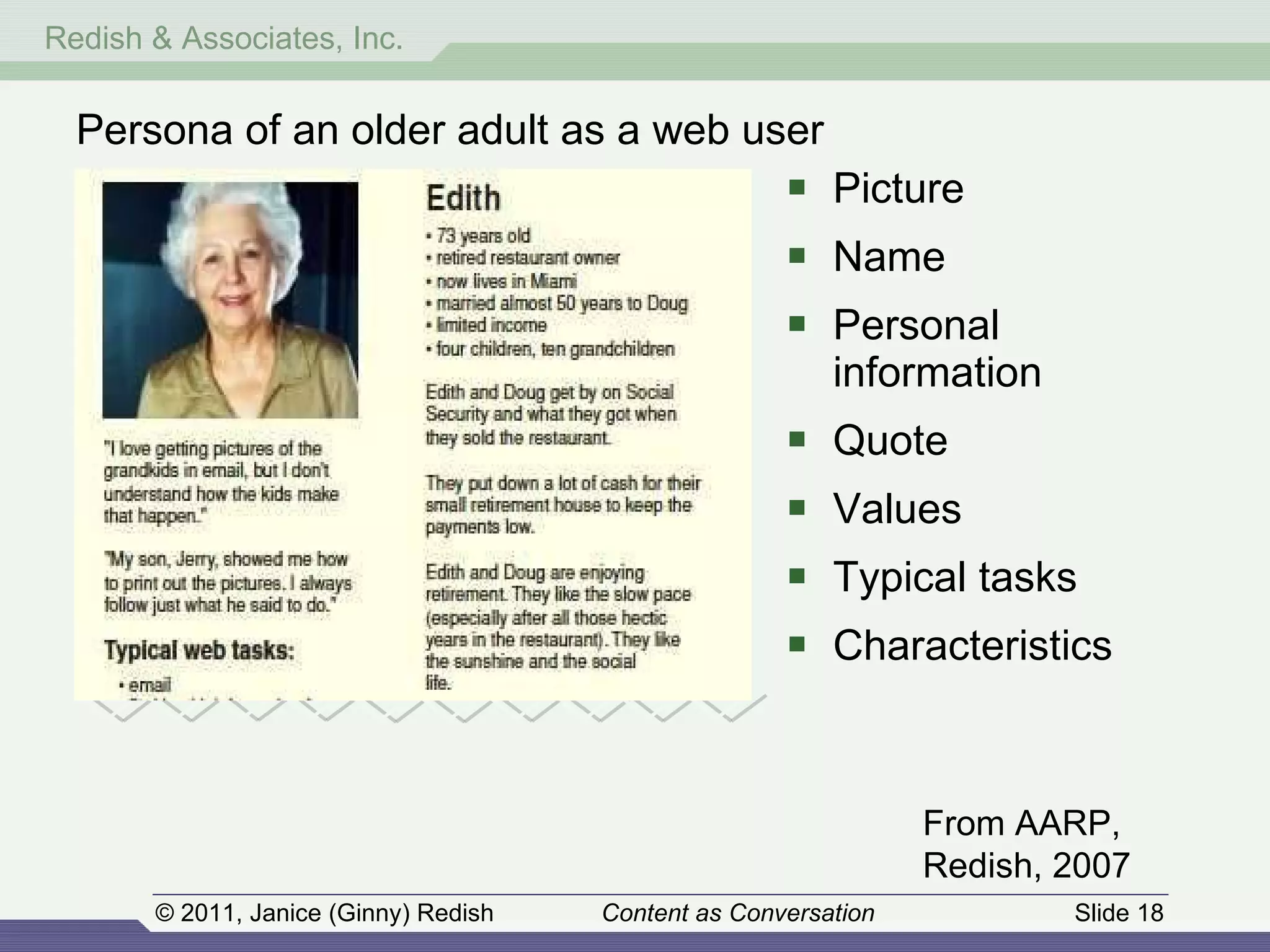
Create personas to write to Persona = a fictional person who  realistically represents a major group of site visitors not a specific actual site visitor a composite based on data about demographics goals and tasks contexts of use (environments) values Art
Picture Name Personal information Quote Values Typical tasks Characteristics Persona of an older adult as a web user  From AARP, Redish, 2007
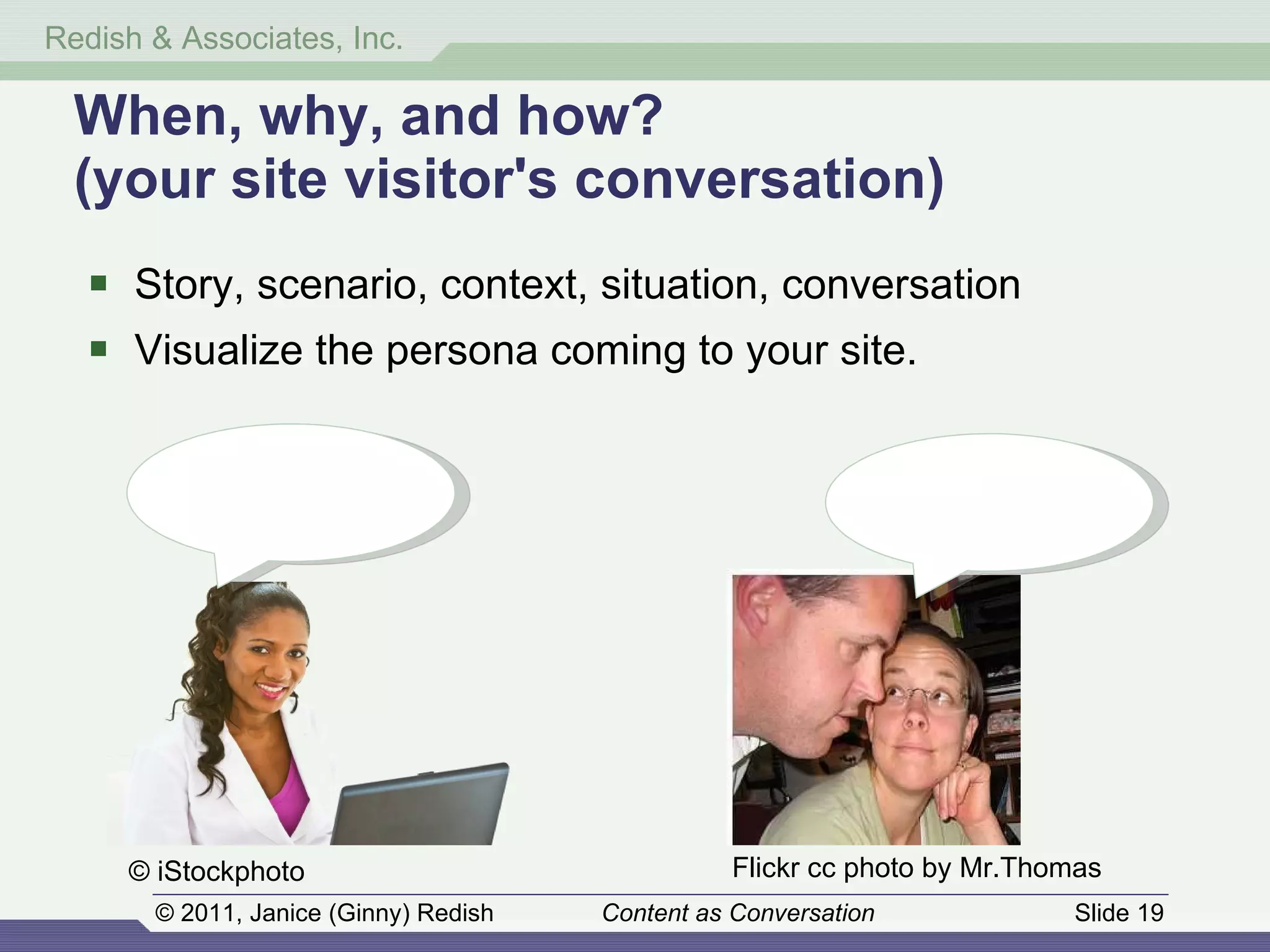
When, why, and how? (your site visitor's conversation) Story, scenario, context, situation, conversation Visualize the persona coming to your site. Flickr cc photo by Mr.Thomas © iStockphoto
Getting people to what they need  © iStockphoto
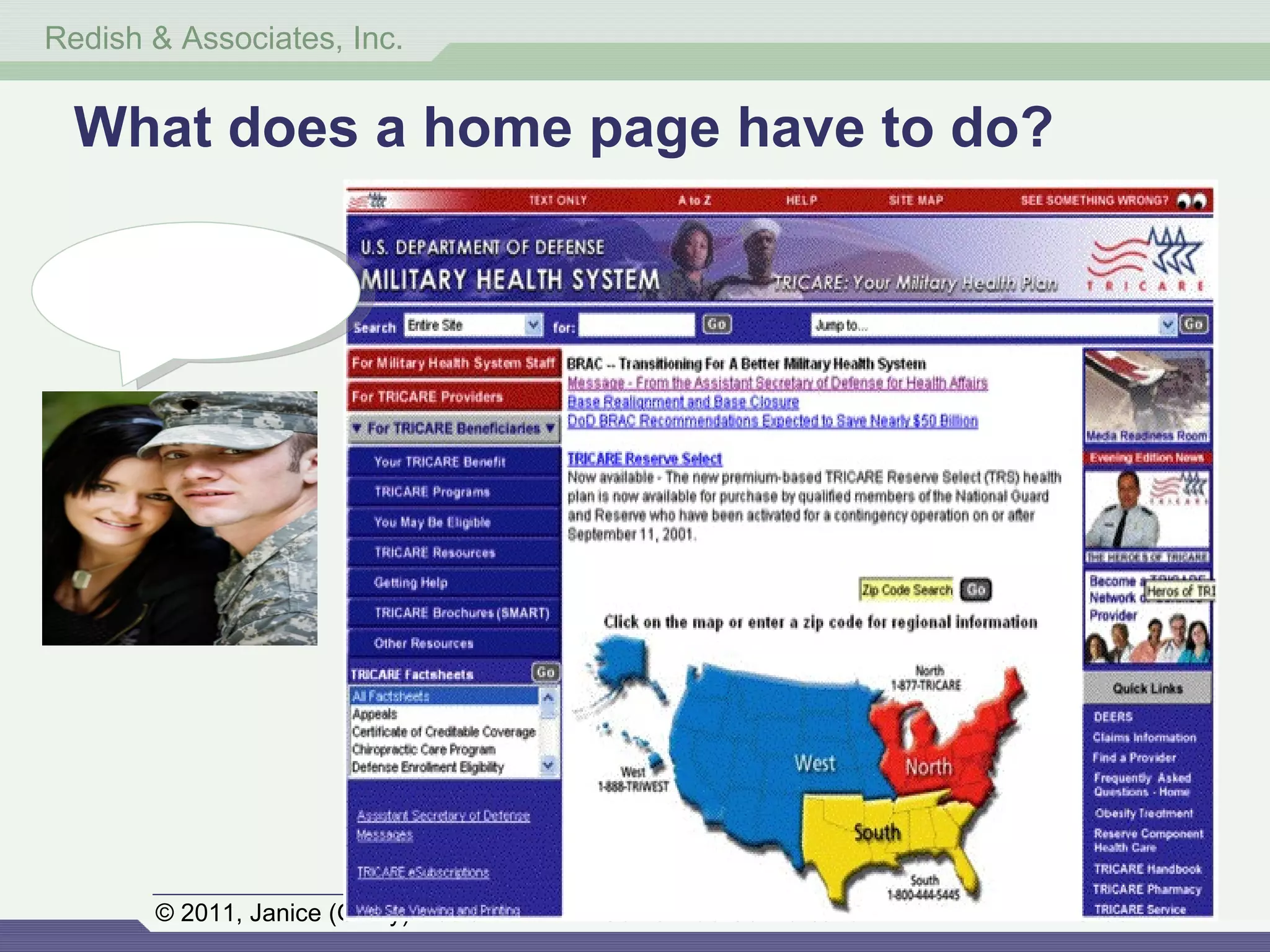
What does a home page have to do?
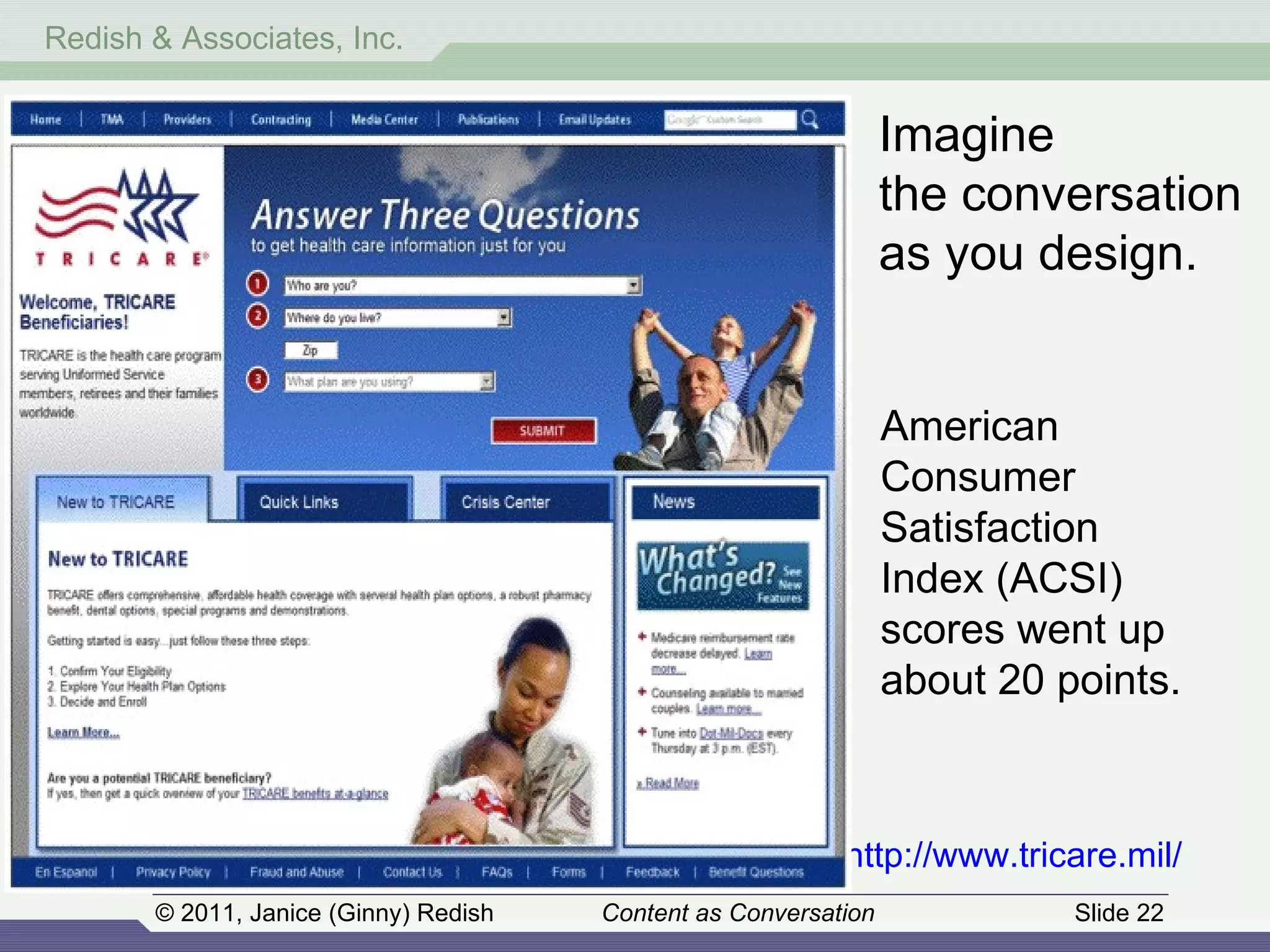
http://www.tricare.mil/   Imagine  the conversation as you design. American Consumer Satisfaction Index (ACSI) scores went up about 20 points.
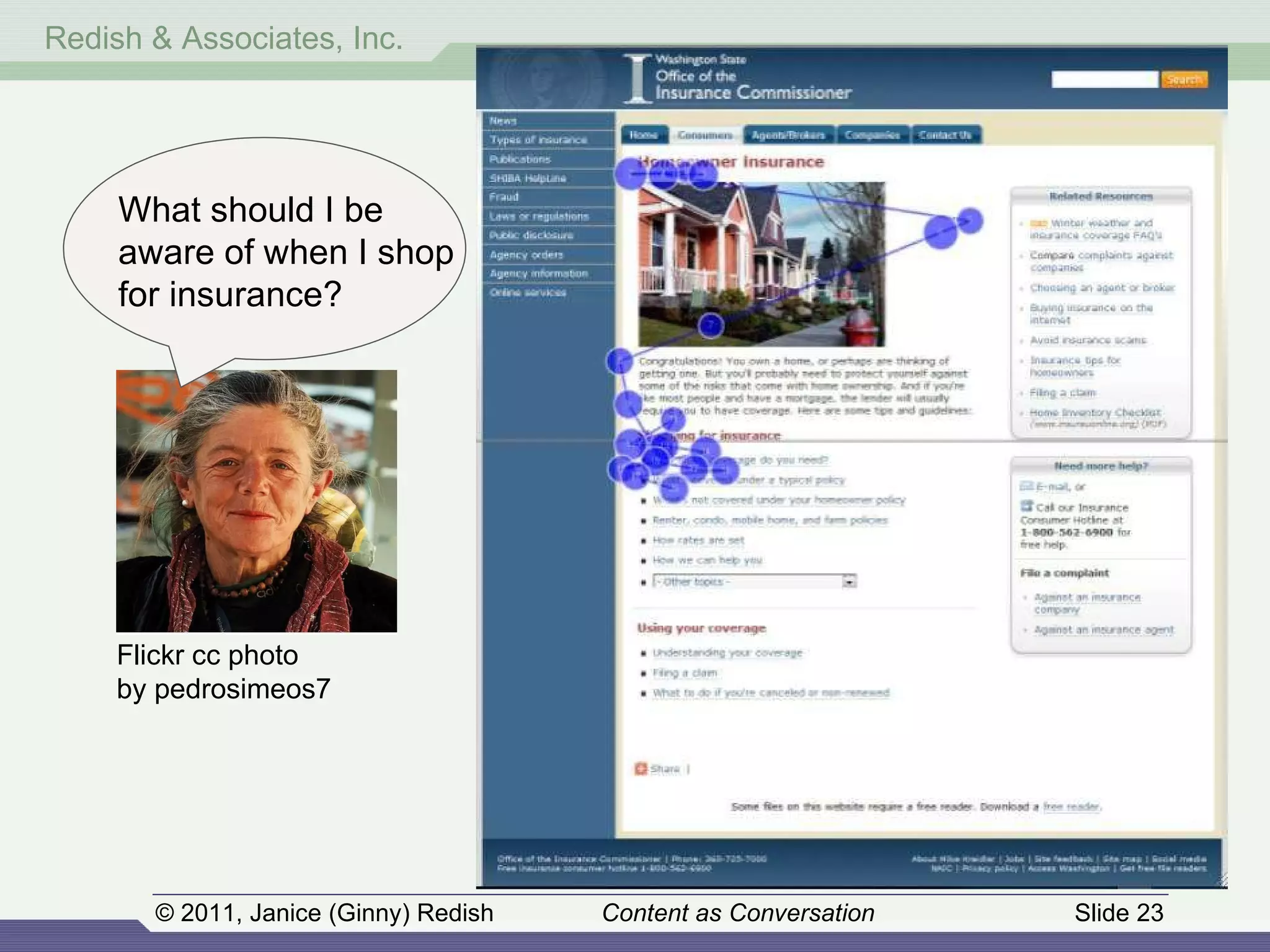
Flickr cc photo  by pedrosimeos7 What should I be aware of when I shop for insurance?
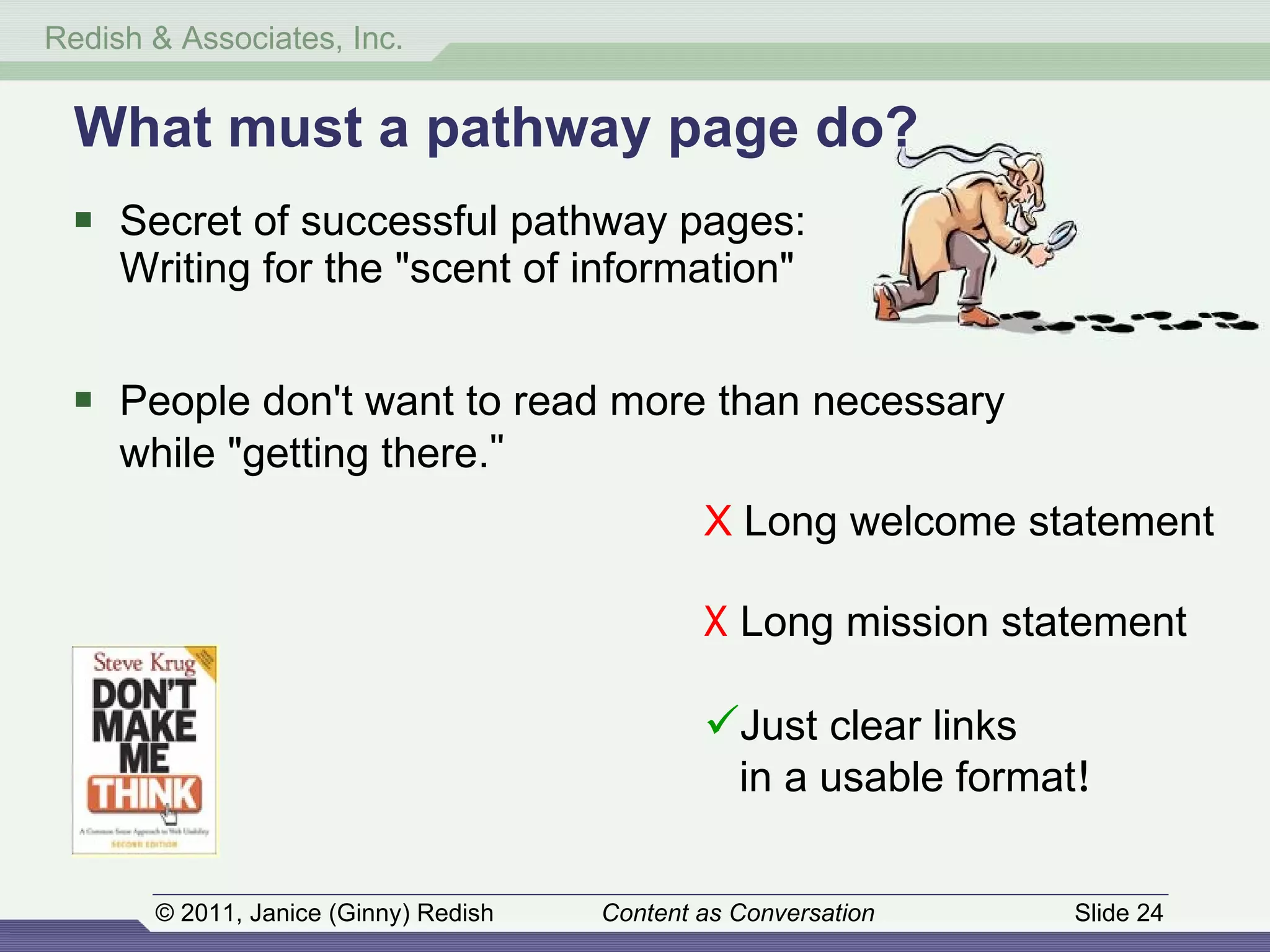
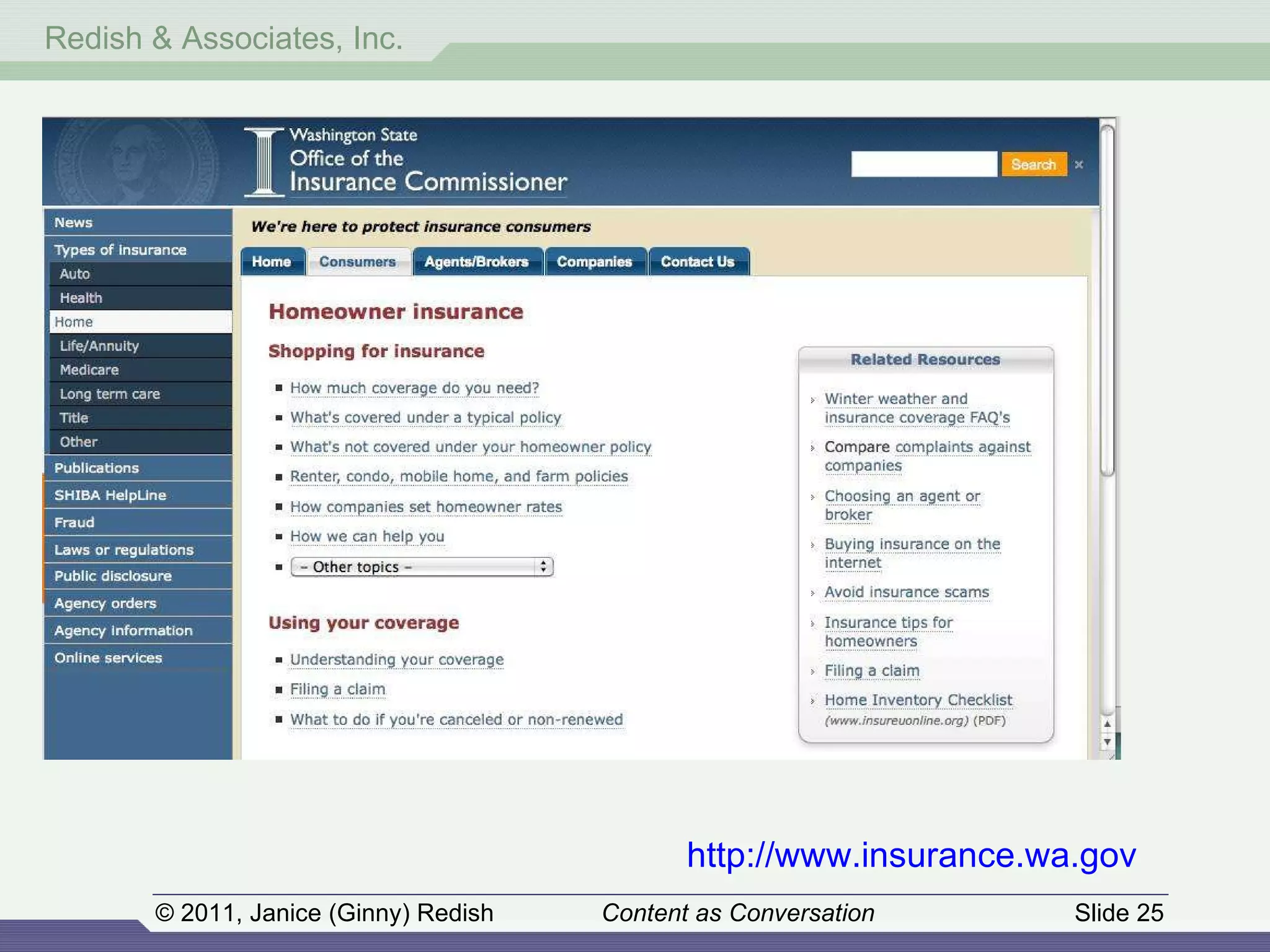
Secret of successful pathway pages: Writing for the "scent of information"  People don't want to read more than necessary while "getting there. " What must a pathway page do? X  Long welcome statement  Just clear links    in a usable format ! X   Long mission statement
http://www.insurance.wa.gov
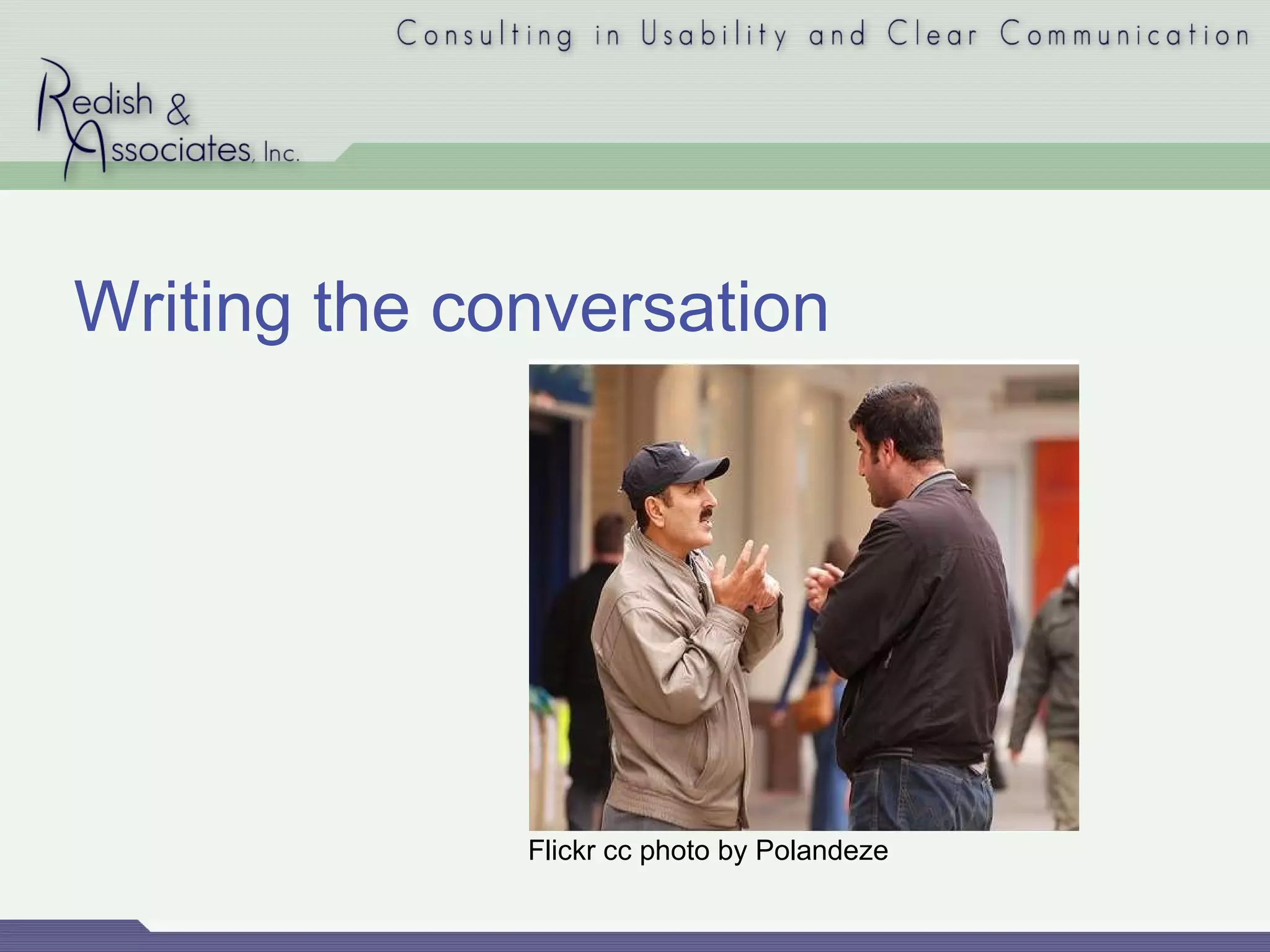
Writing the conversation Flickr cc photo by Polandeze
 
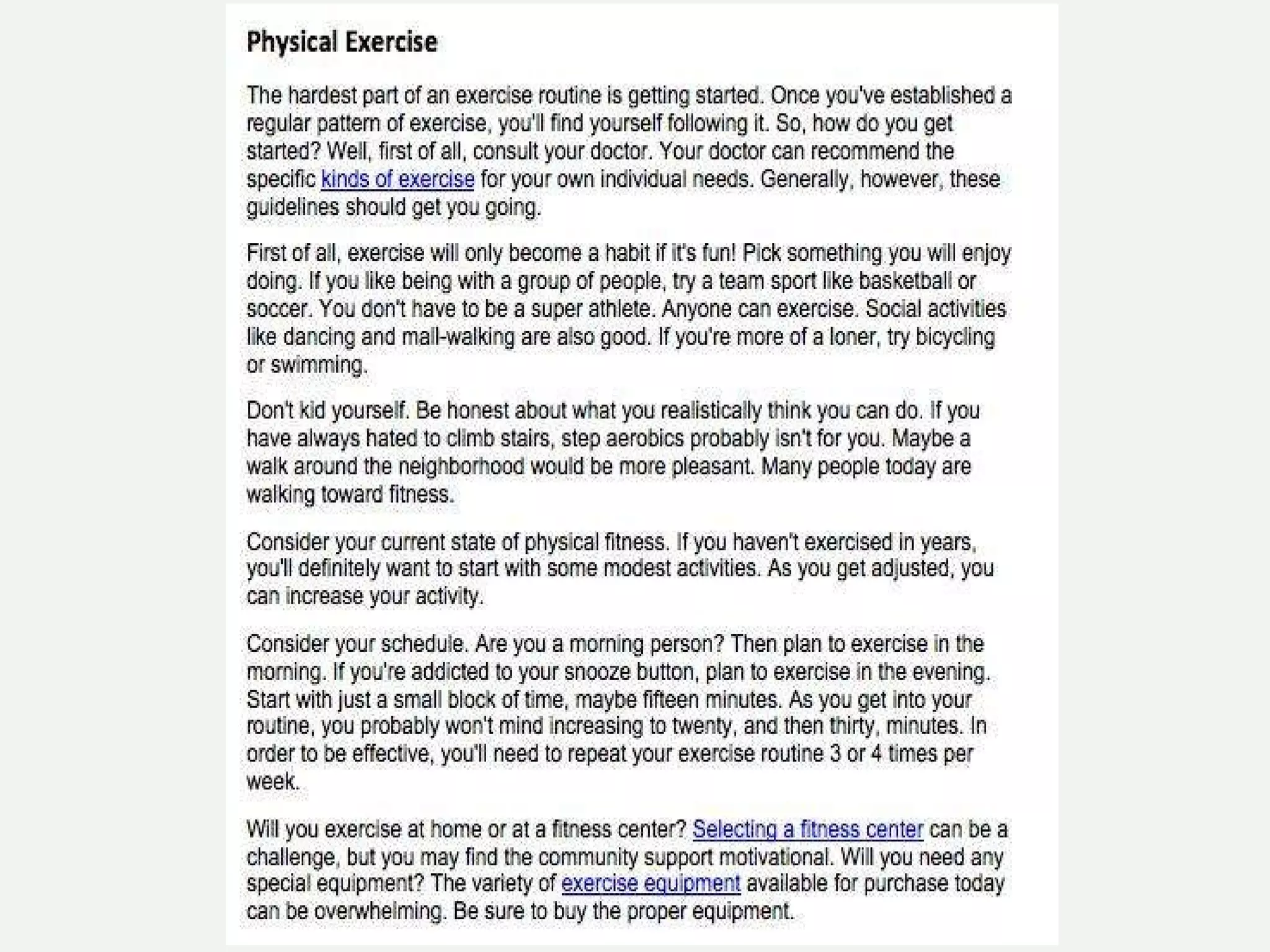
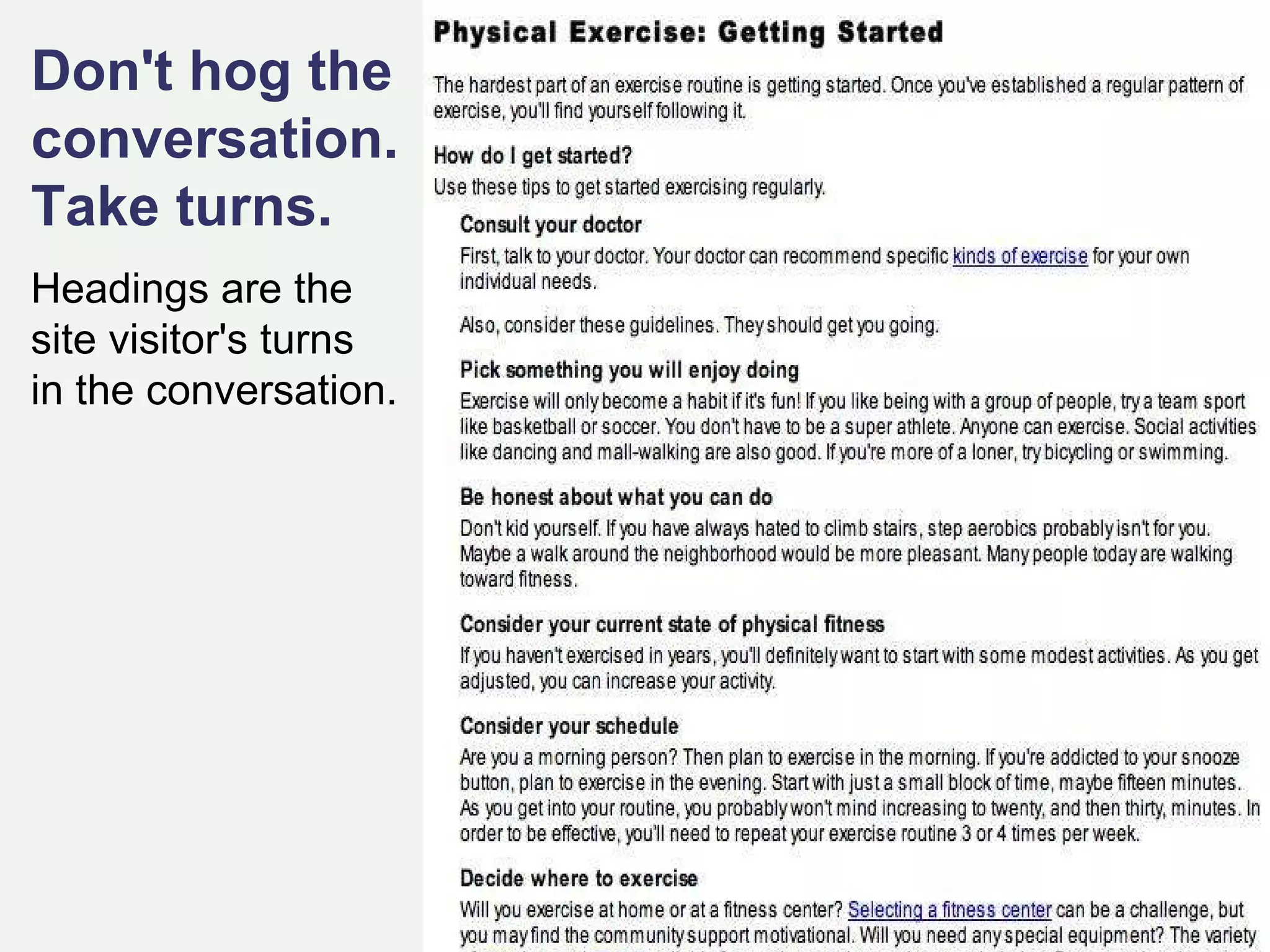
Don't hog the conversation. Take turns. Headings are the site visitor's turns  in the conversation.
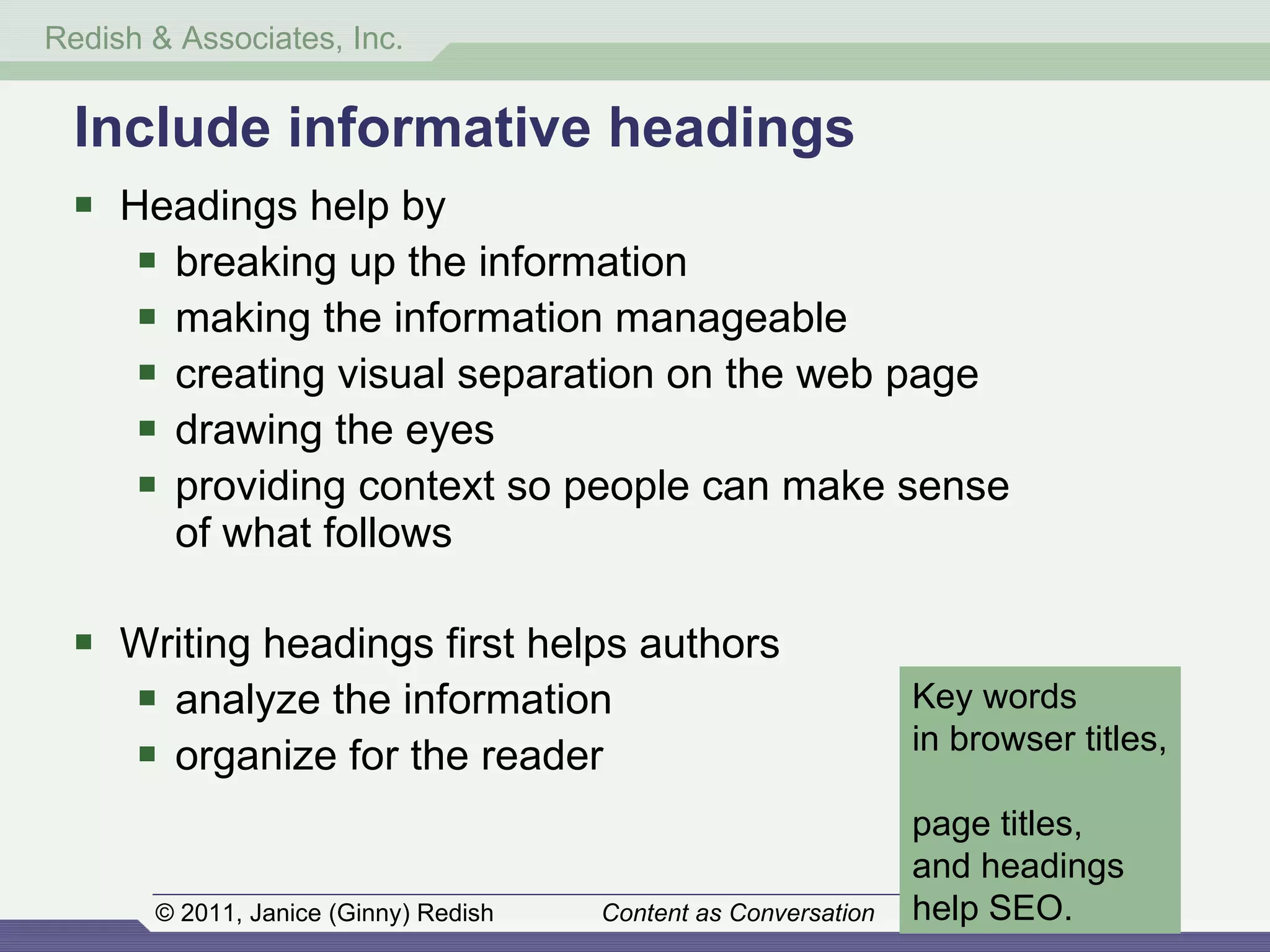
Headings help by  breaking up the information making the information manageable creating visual separation on the web page drawing the eyes  providing context so people can make sense  of what follows Writing headings first helps authors analyze the information organize for the reader Include informative headings Key words  in browser titles,  page titles,  and headings  help SEO.
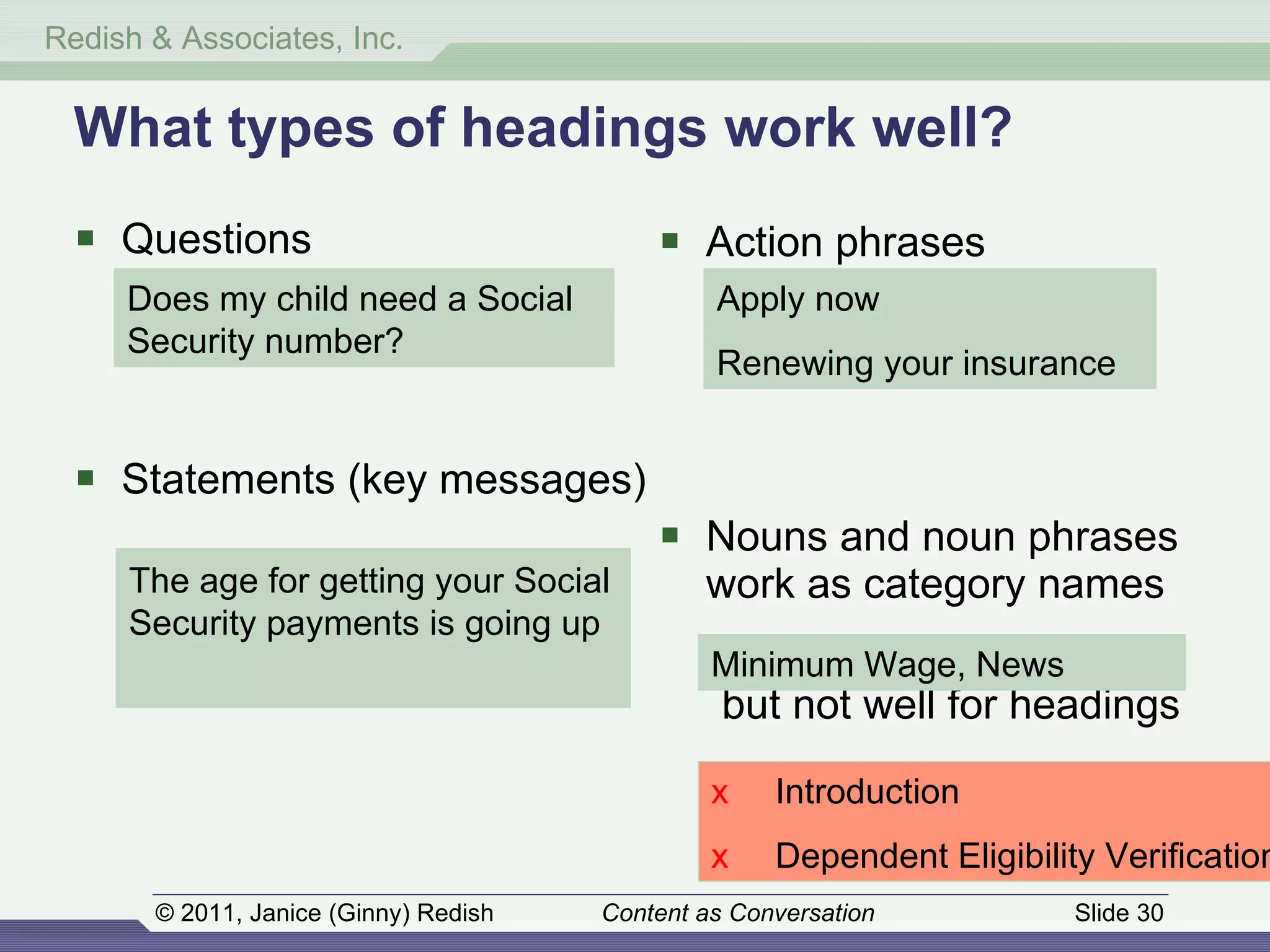
Questions Statements (key messages) Action phrases Nouns and noun phrases  work as category names but not well for headings What types of headings work well? Does my child need a Social Security number? Apply now Renewing your insurance Minimum Wage, News x Introduction x Dependent Eligibility Verification  The age for getting your Social Security payments is going up
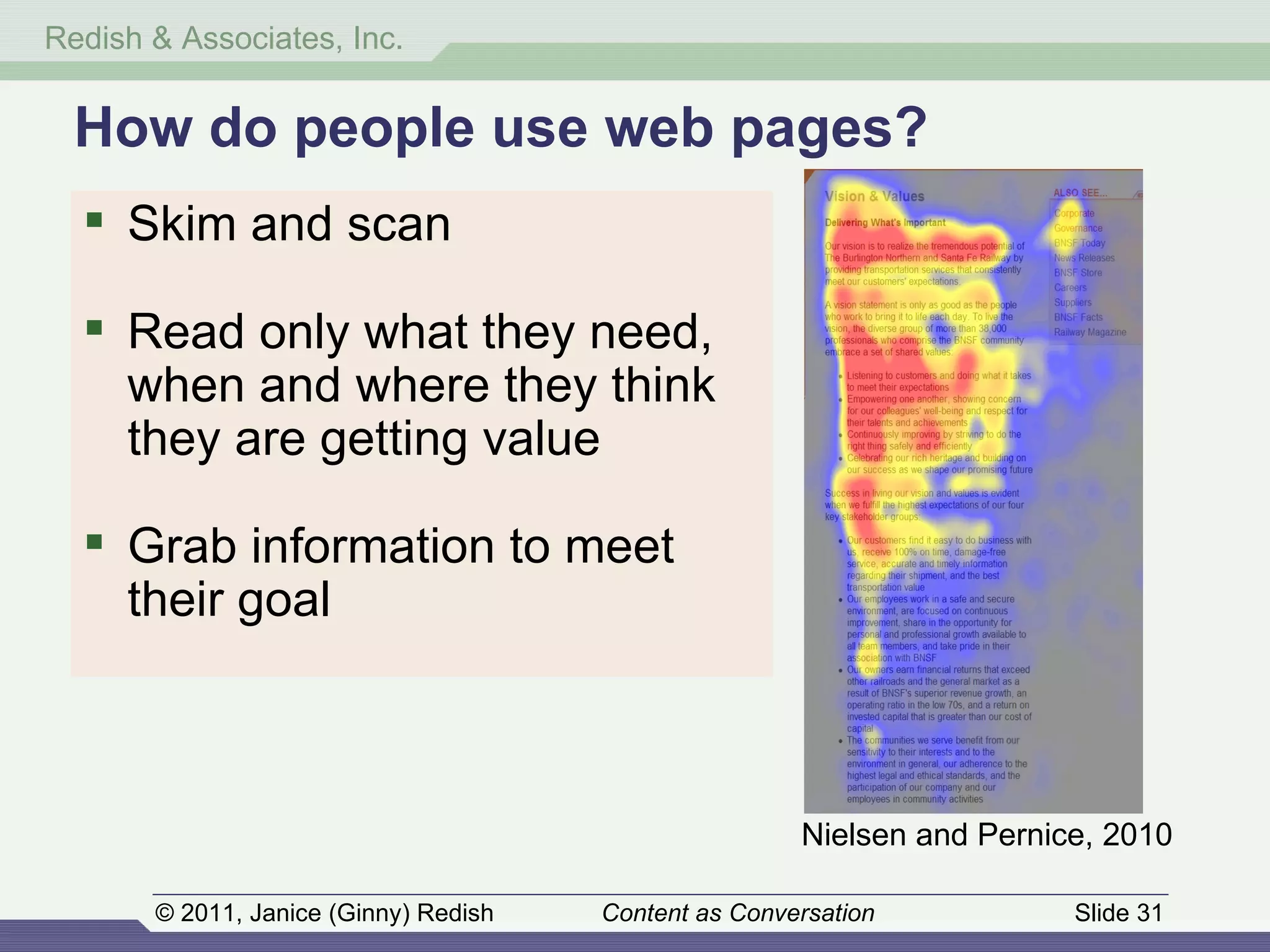
How do people use web pages? Nielsen and Pernice, 2010 Skim and scan Read only what they need,  when and where they think  they are getting value Grab information to meet their goal
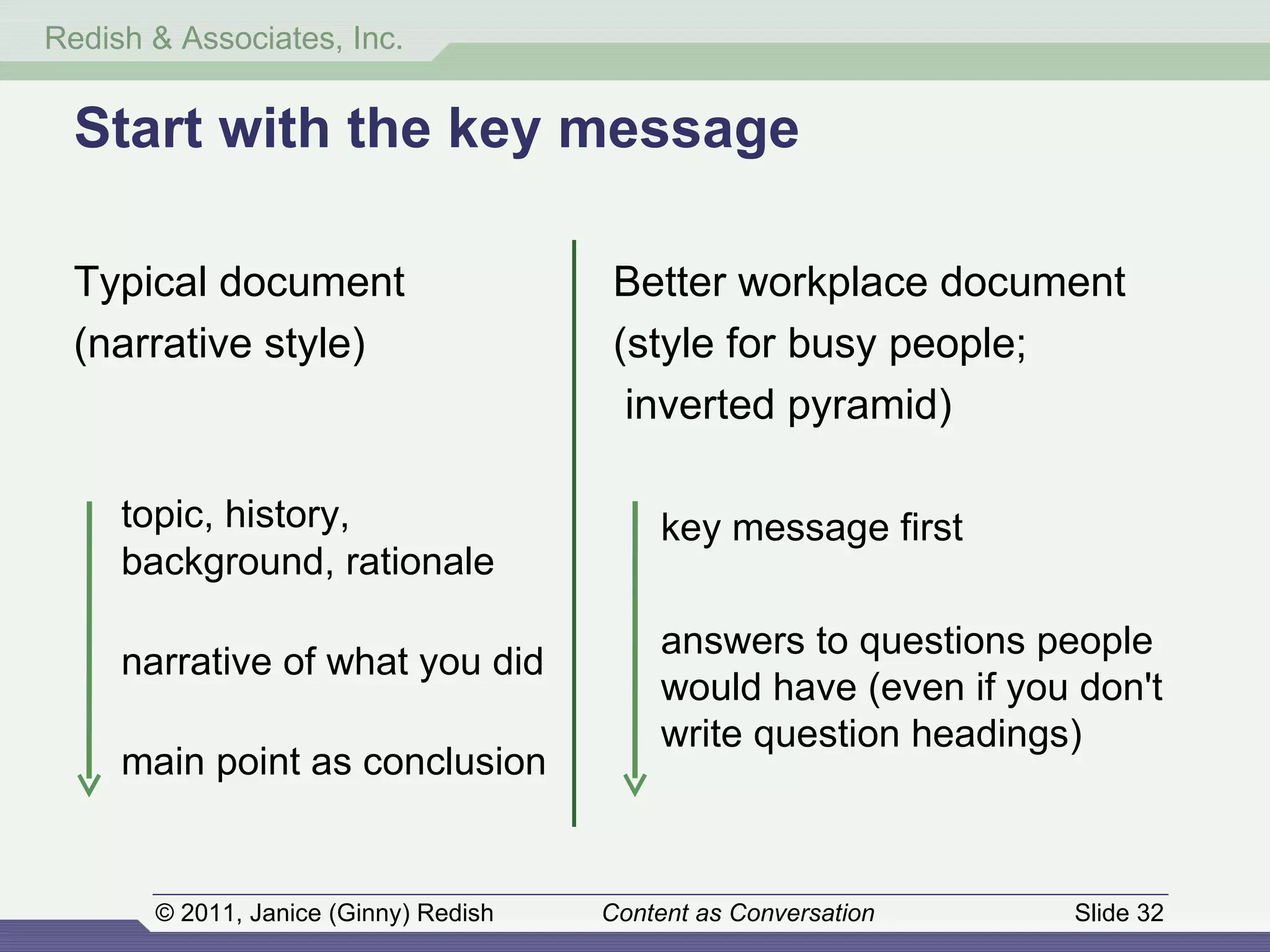
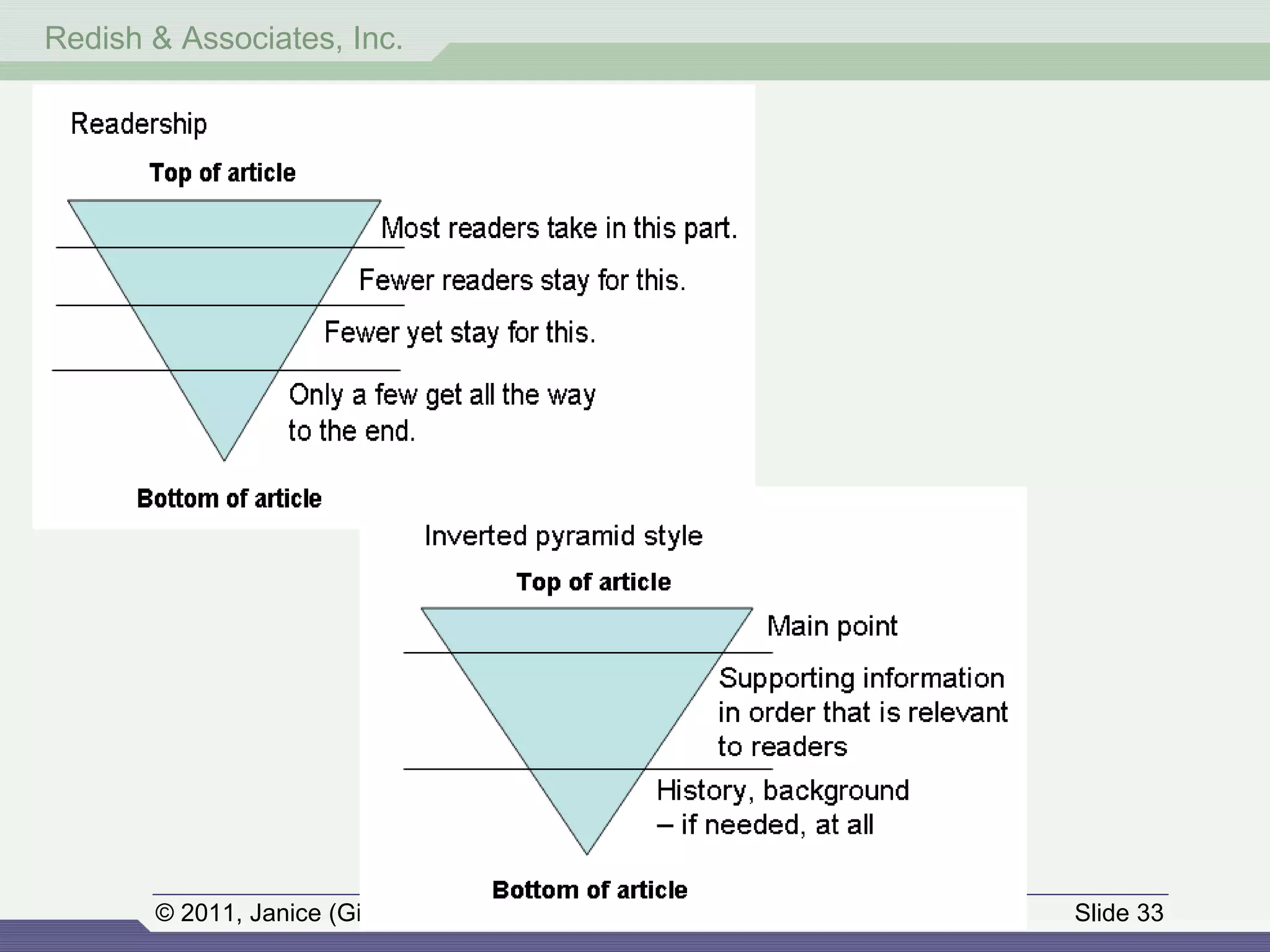
Start with the key message Typical document (narrative style) topic, history, background, rationale narrative of what you did main point as conclusion Better workplace document (style for busy people; inverted pyramid) key message first  answers to questions people would have (even if you don't write question headings)
 
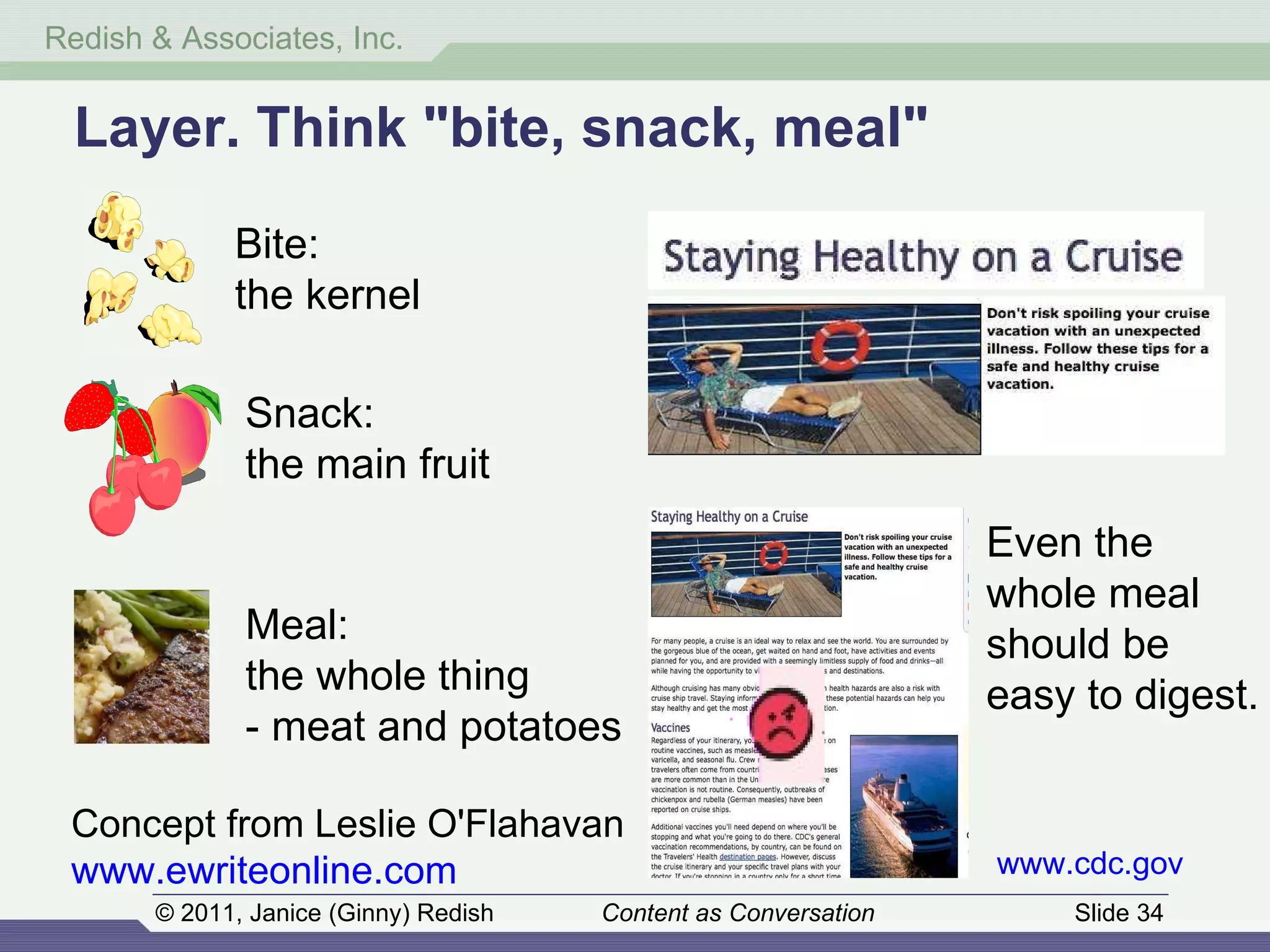
Layer. Think "bite, snack, meal" Concept from Leslie O'Flahavan  www.ewriteonline.com   Even the  whole meal  should be  easy to digest . www.cdc.gov   Snack:  the main fruit Bite:  the kernel Meal:  the whole thing - meat and potatoes
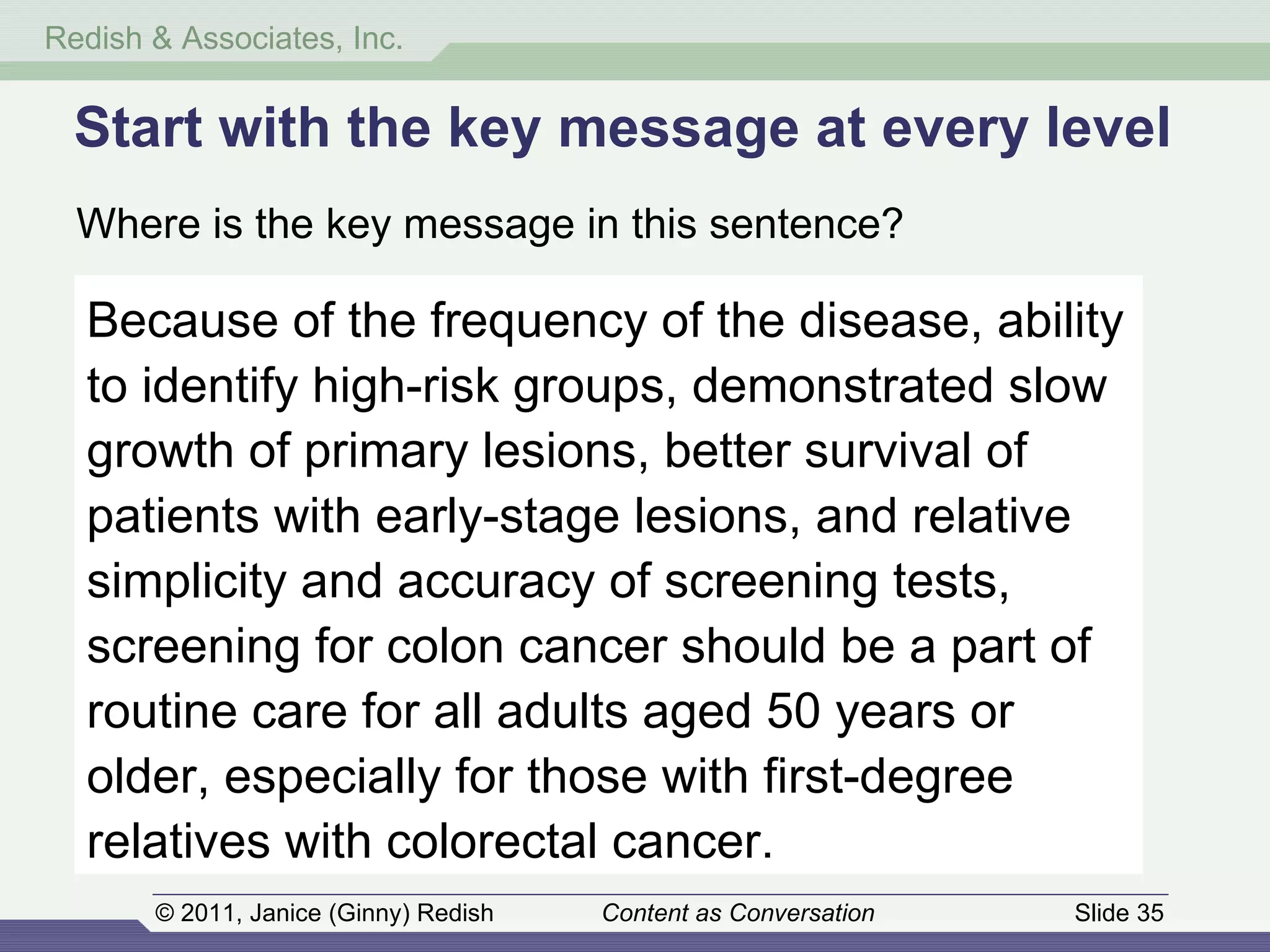
Start with the key message at every level Where is the key message in this sentence? Because of the frequency of the disease, ability to identify high-risk groups, demonstrated slow growth of primary lesions, better survival of patients with early-stage lesions, and relative simplicity and accuracy of screening tests, screening for colon cancer should be a part of routine care for all adults aged 50 years or older, especially for those with first-degree relatives with colorectal cancer.
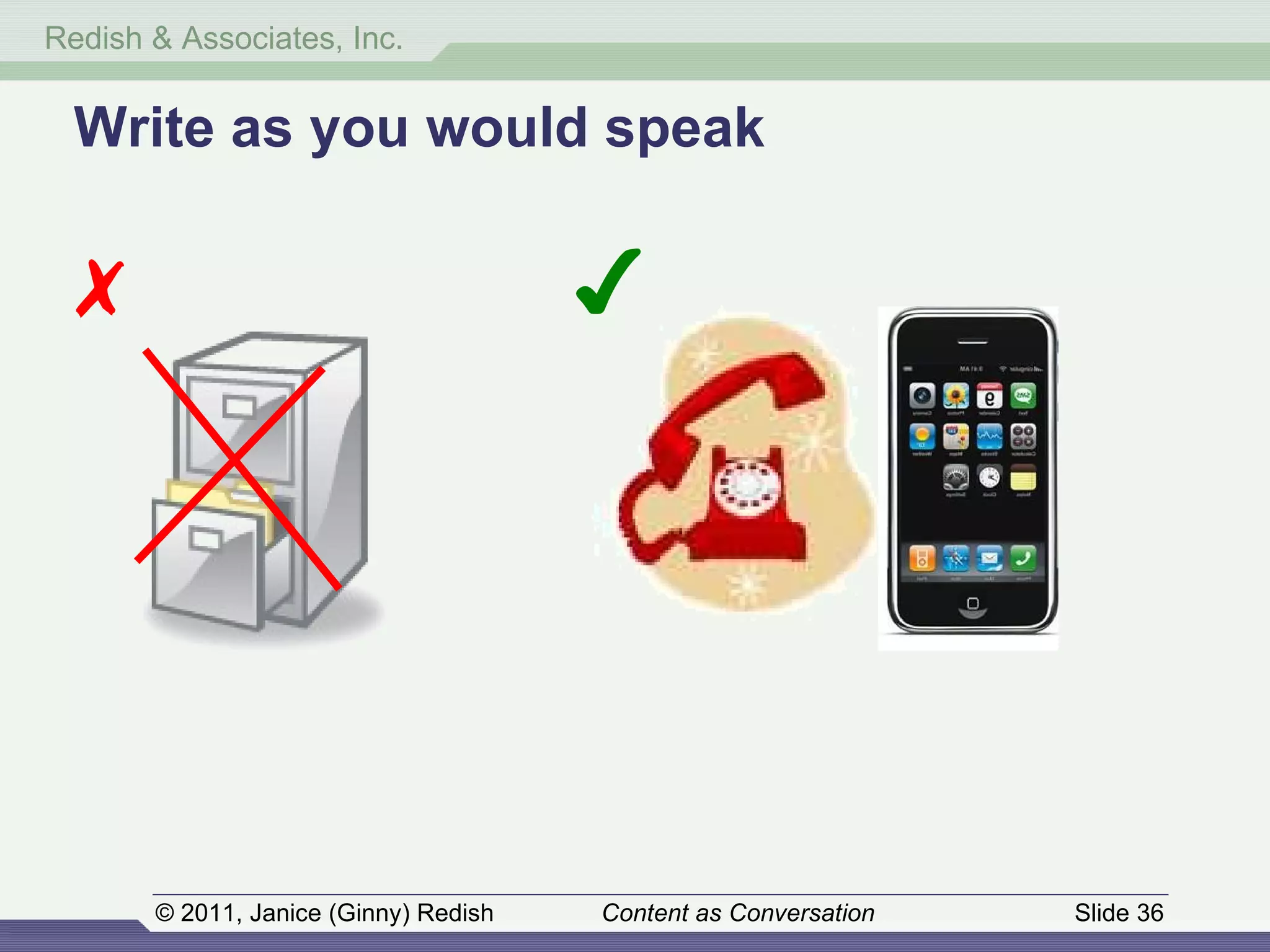
Write as you would speak ✔ ✗
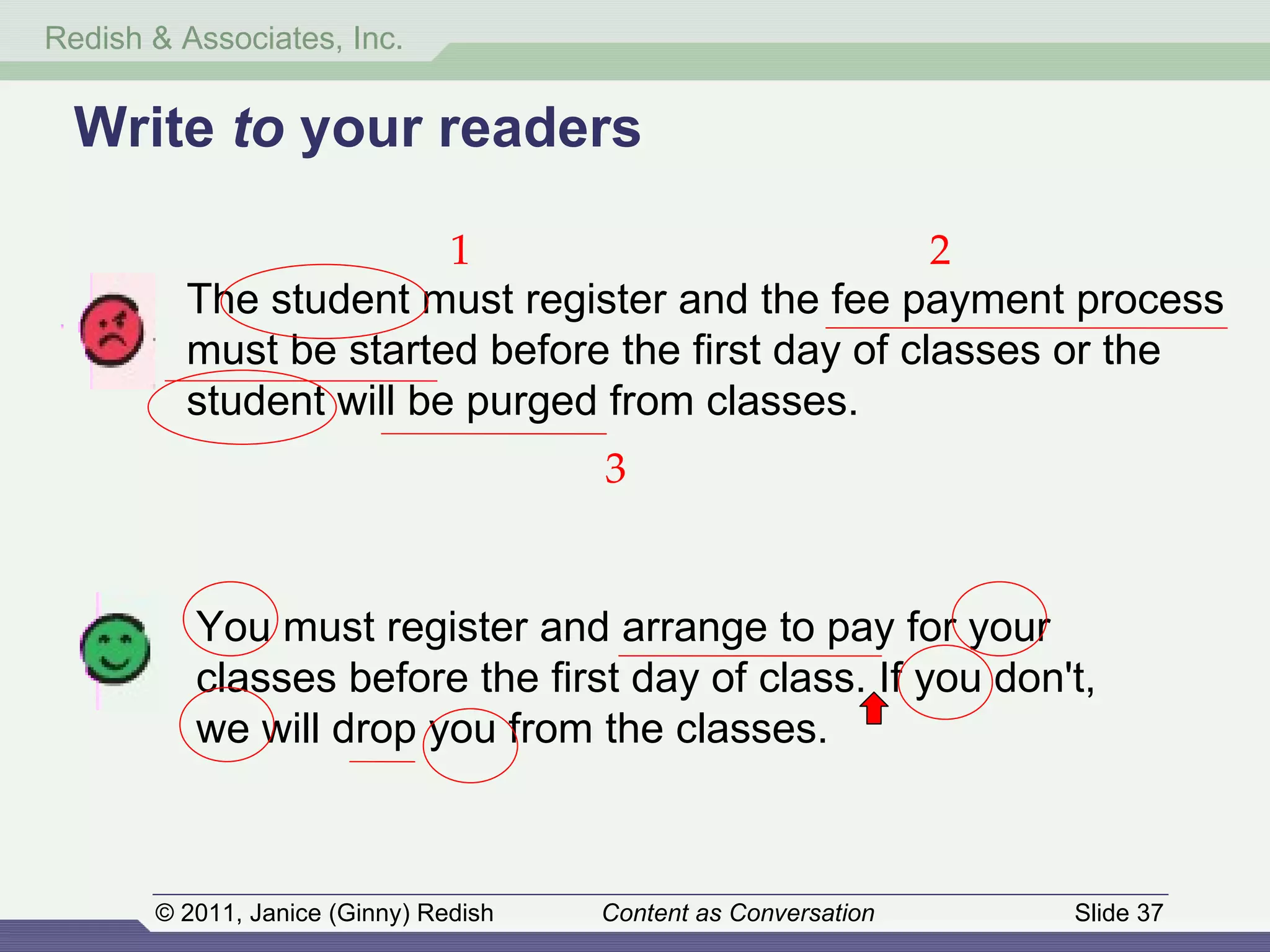
Write  to  your readers The student must register and the fee payment process must be started before the first day of classes or the student will be purged from classes.  You must register and arrange to pay for your classes before the first day of class. If you don't, we will drop you from the classes.  1 2 3
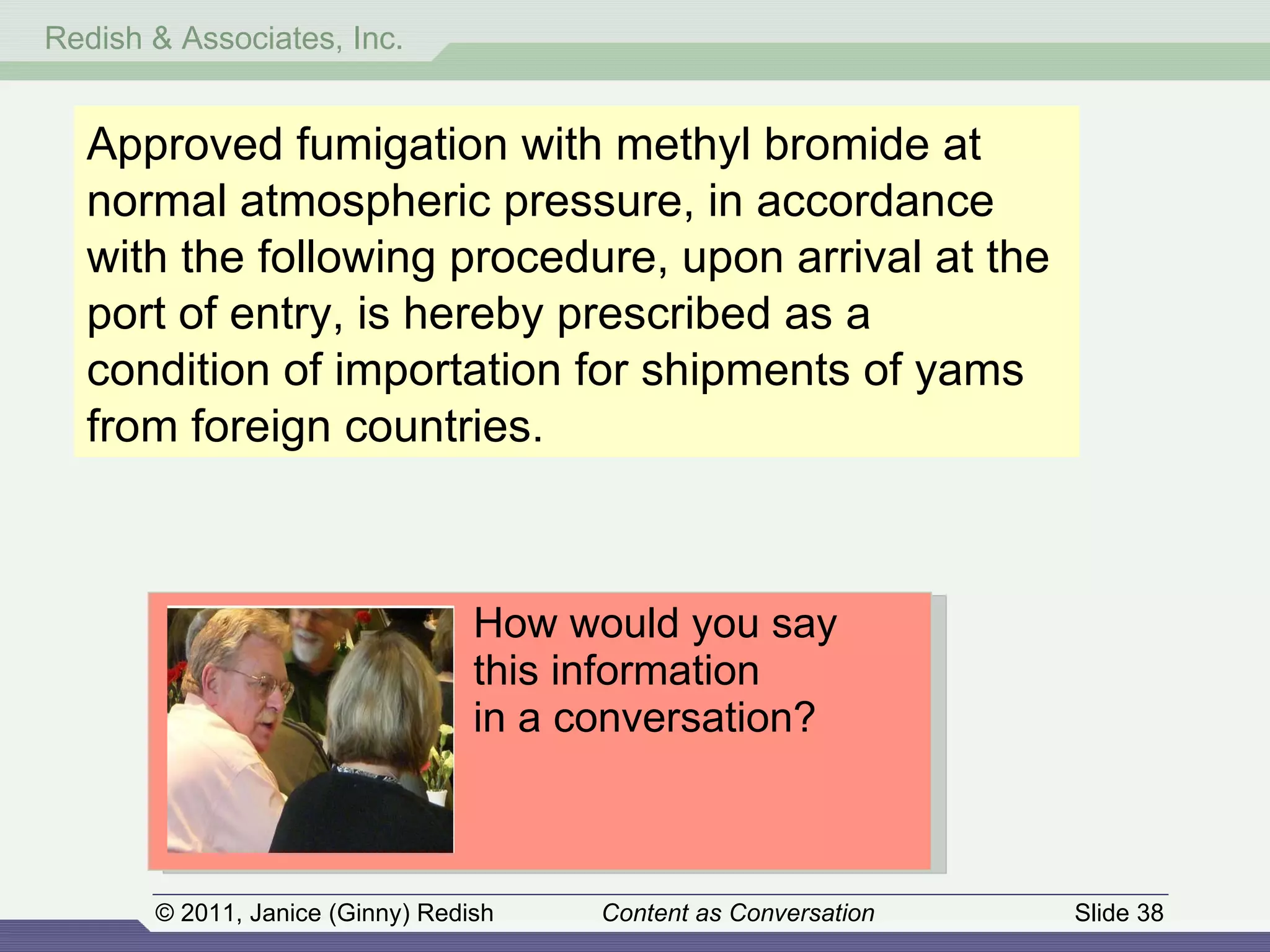
How would you say  this information  in a conversation? Approved fumigation with methyl bromide at normal atmospheric pressure, in accordance with the following procedure, upon arrival at the port of entry, is hereby prescribed as a condition of importation for shipments of yams from foreign countries.
Did you say something like this? If you are importing yams, [someone] must fumigate them when they arrive at the port of entry.  To fumigate yams, [someone] must use this procedure: Hear the conversation as you write context  = given, known then new
What's wrong with this sentence? Interested persons, on or before October 15, 2011, may submit to the Hearing Clerk, 1000 Pennsylvania Avenue, NW, Washington, DC 20000, written comments regarding this proposal .
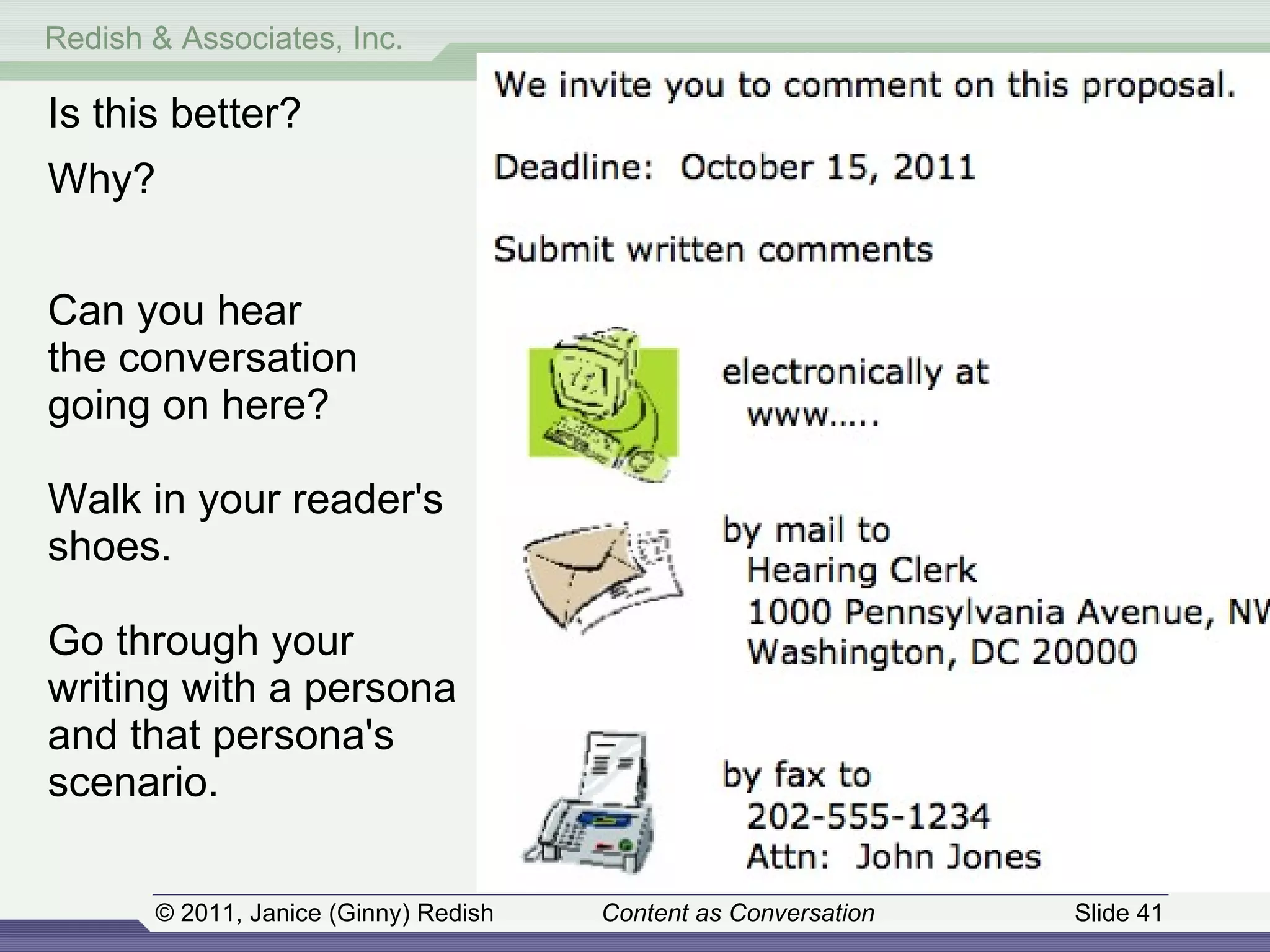
Is this better?  Why? Can you hear  the conversation  going on here? Walk in your reader's shoes.  Go through your writing with a persona and that persona's scenario.
Keep it short Your seventh-grade English teacher  never wrote for the web. People scan. A one-sentence paragraph is fine. Think information, not paragraph. fragments pictures lists links tables
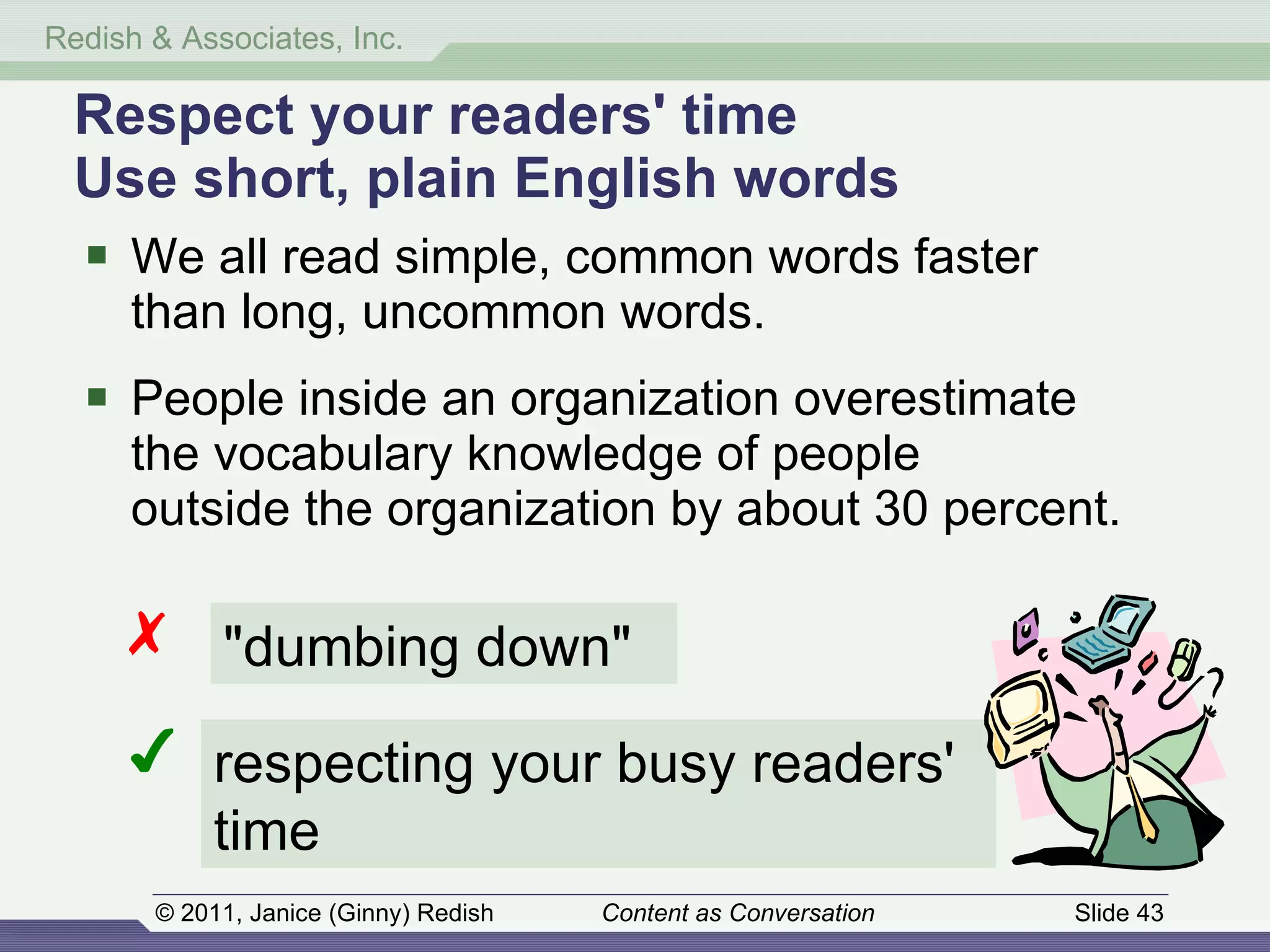
Respect your readers' time Use short, plain English words We all read simple, common words faster  than long, uncommon words. People inside an organization overestimate  the vocabulary knowledge of people  outside the organization by about 30 percent. "dumbing down" ✗ ✔ respecting your busy readers' time
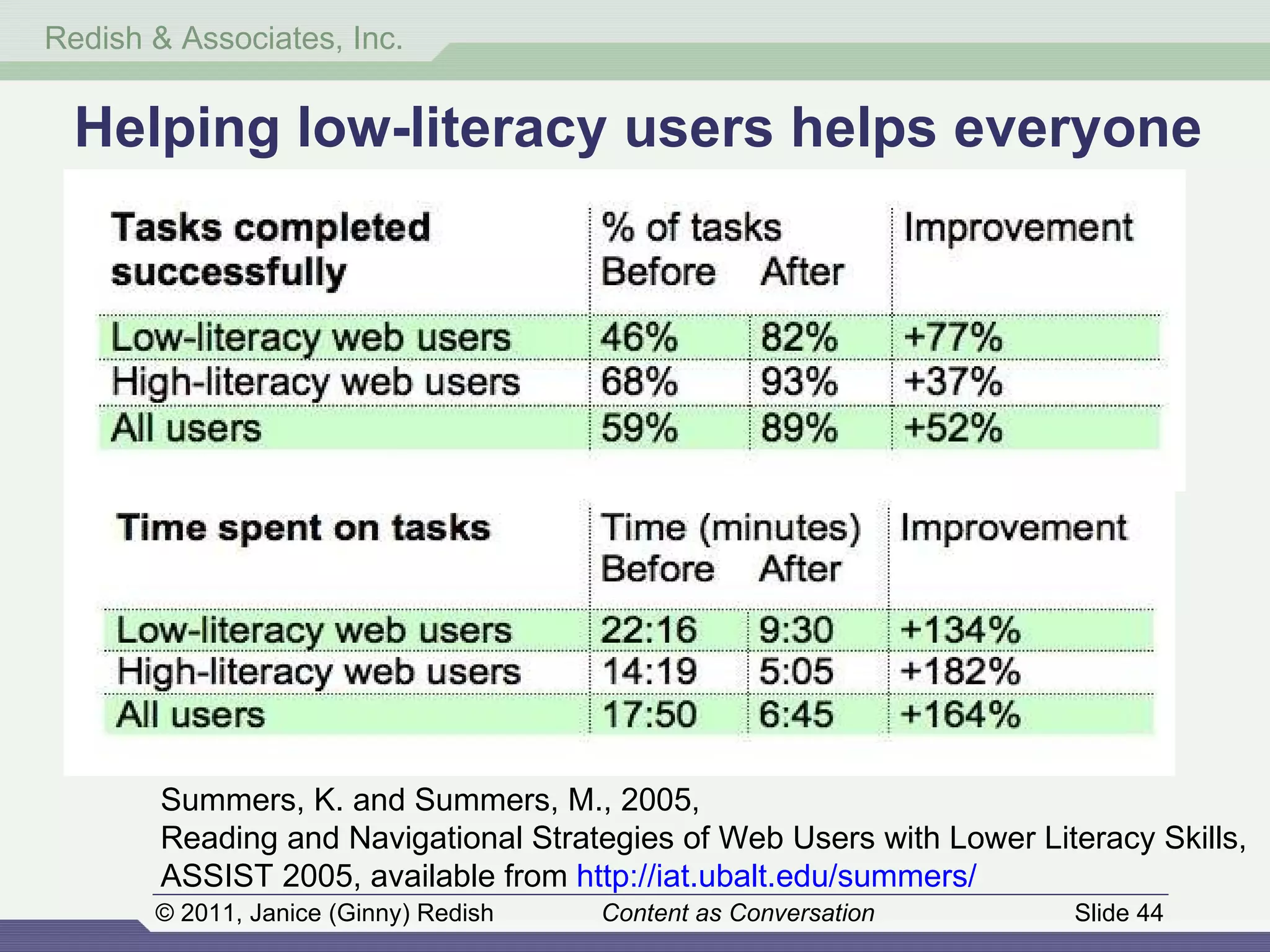
Helping low-literacy users helps everyone Summers, K. and Summers, M., 2005,  Reading and Navigational Strategies of Web Users with Lower Literacy Skills,  ASSIST 2005, available from  http://iat.ubalt.edu/summers/
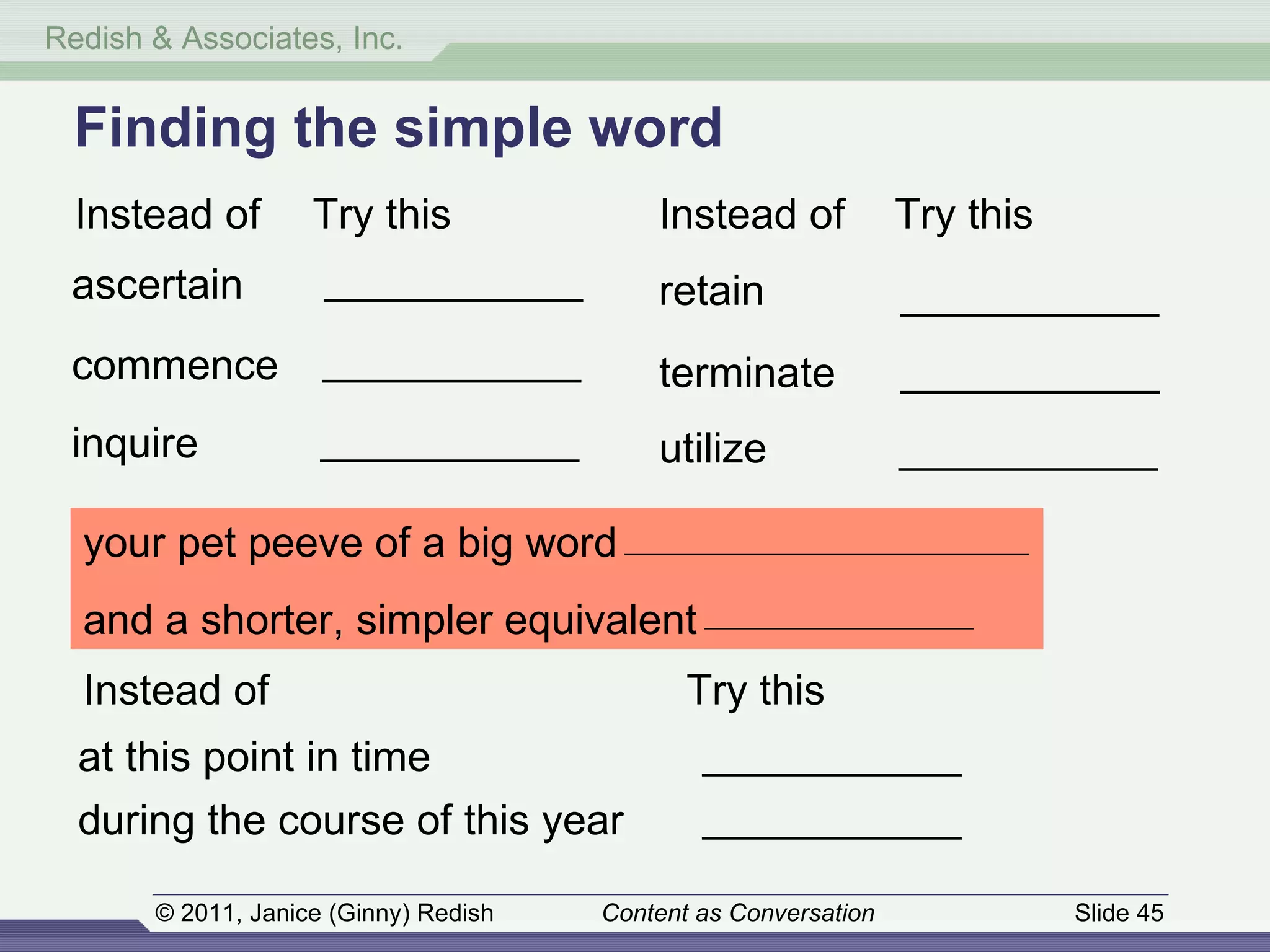
Finding the simple word your pet peeve of a big word and a shorter, simpler equivalent retain ___________ Instead of Try this ascertain ___________ commence ___________ inquire ___________ Instead of Try this terminate ___________ utilize ___________ Instead of Try this at this point in time ___________ during the course of this year ___________
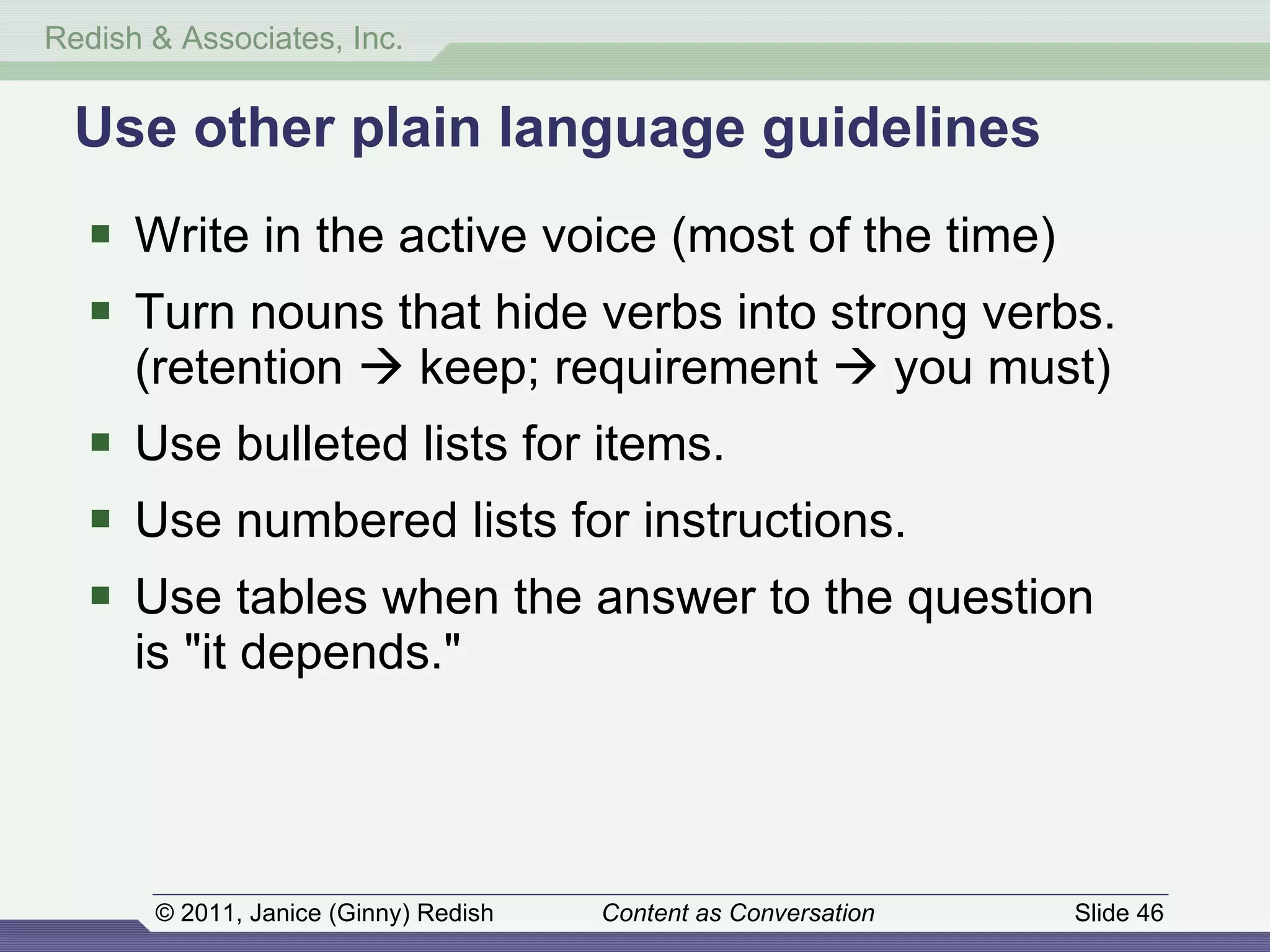
Use other plain language guidelines Write in the active voice (most of the time) Turn nouns that hide verbs into strong verbs. (retention    keep; requirement    you must) Use bulleted lists for items. Use numbered lists for instructions. Use tables when the answer to the question  is "it depends."
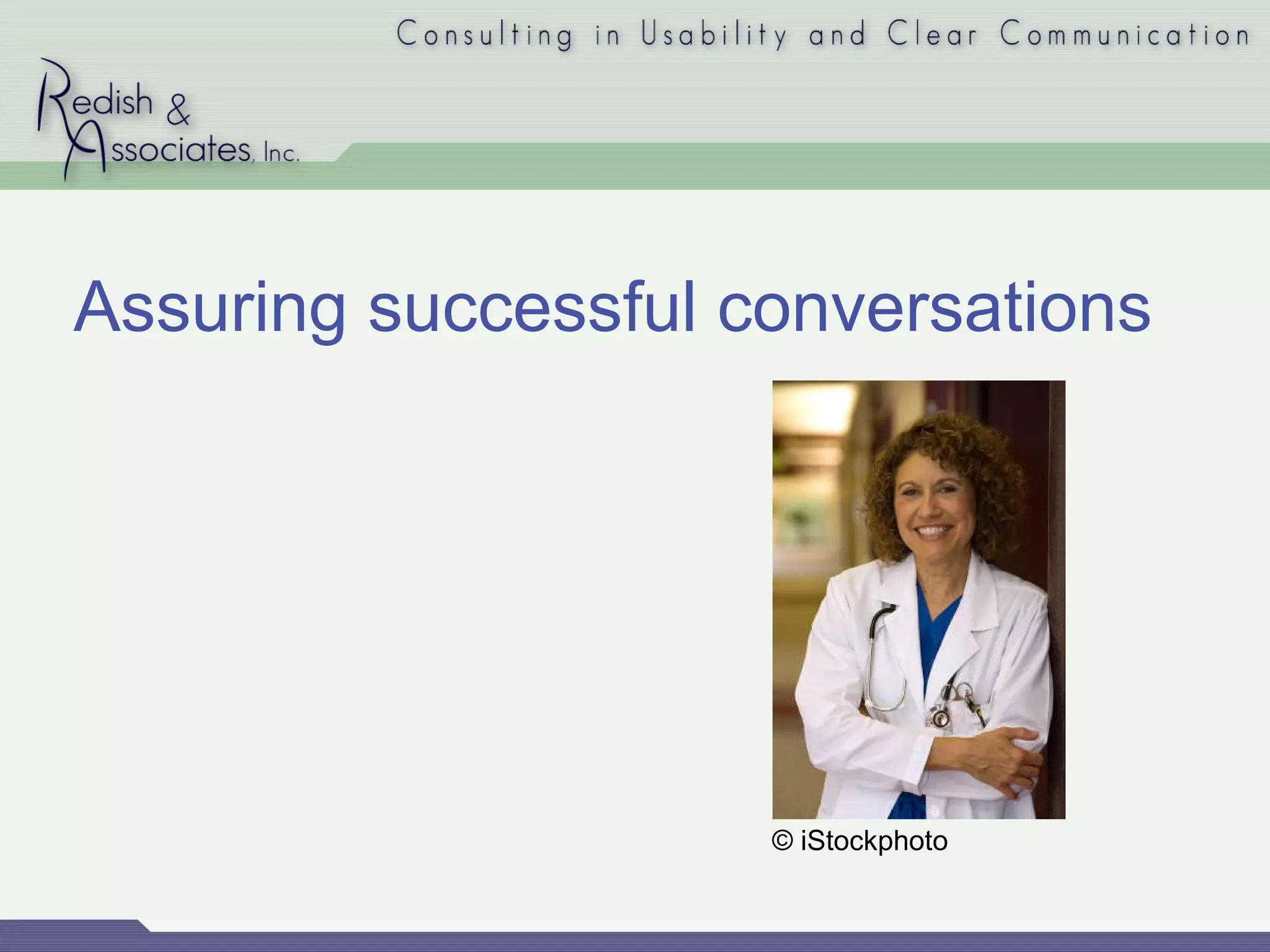
Assuring successful conversations © iStockphoto
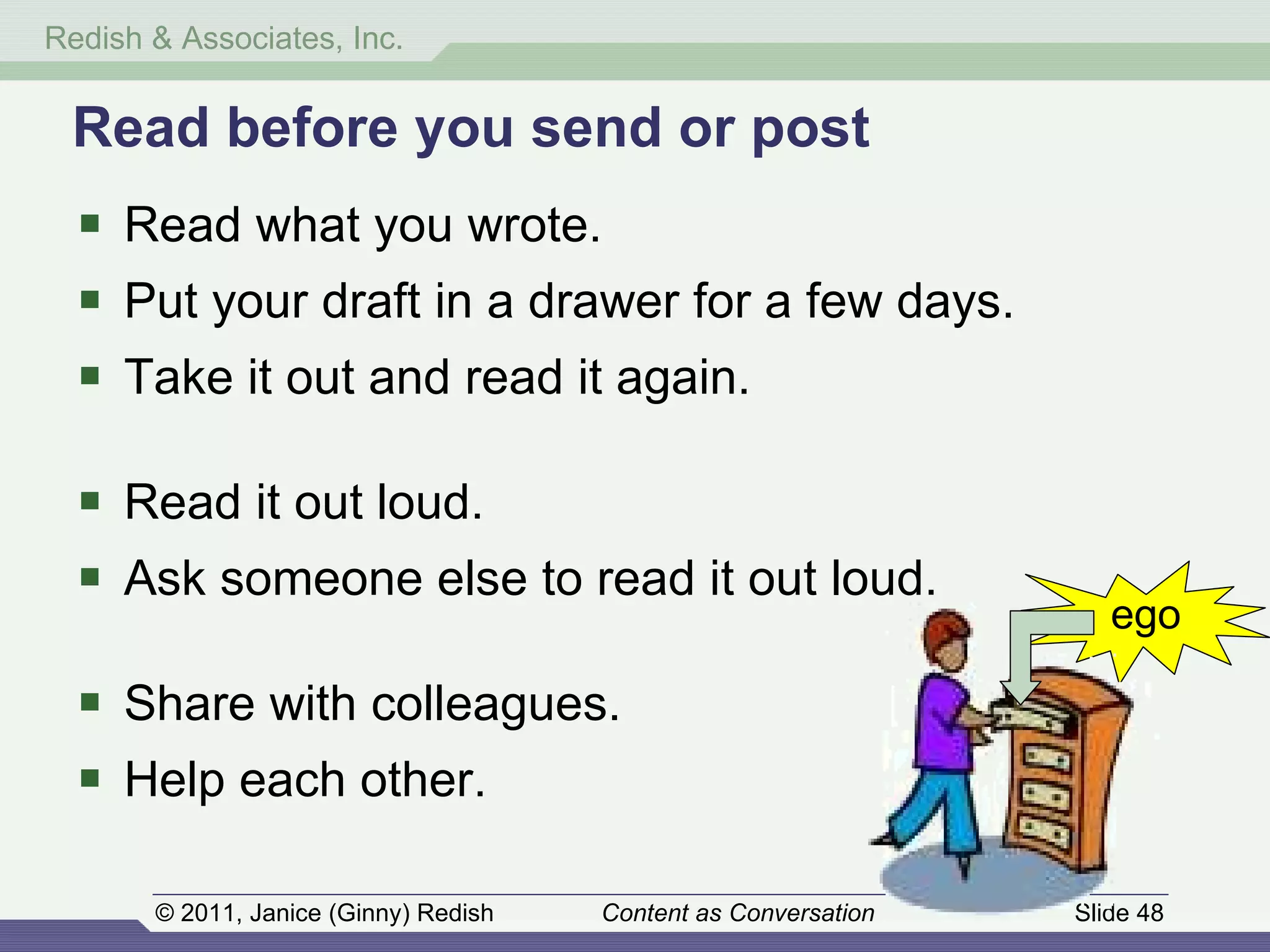
Read before you send or post Read what you wrote.  Put your draft in a drawer for a few days. Take it out and read it again. Read it out loud. Ask someone else to read it out loud. Share with colleagues. Help each other. ego
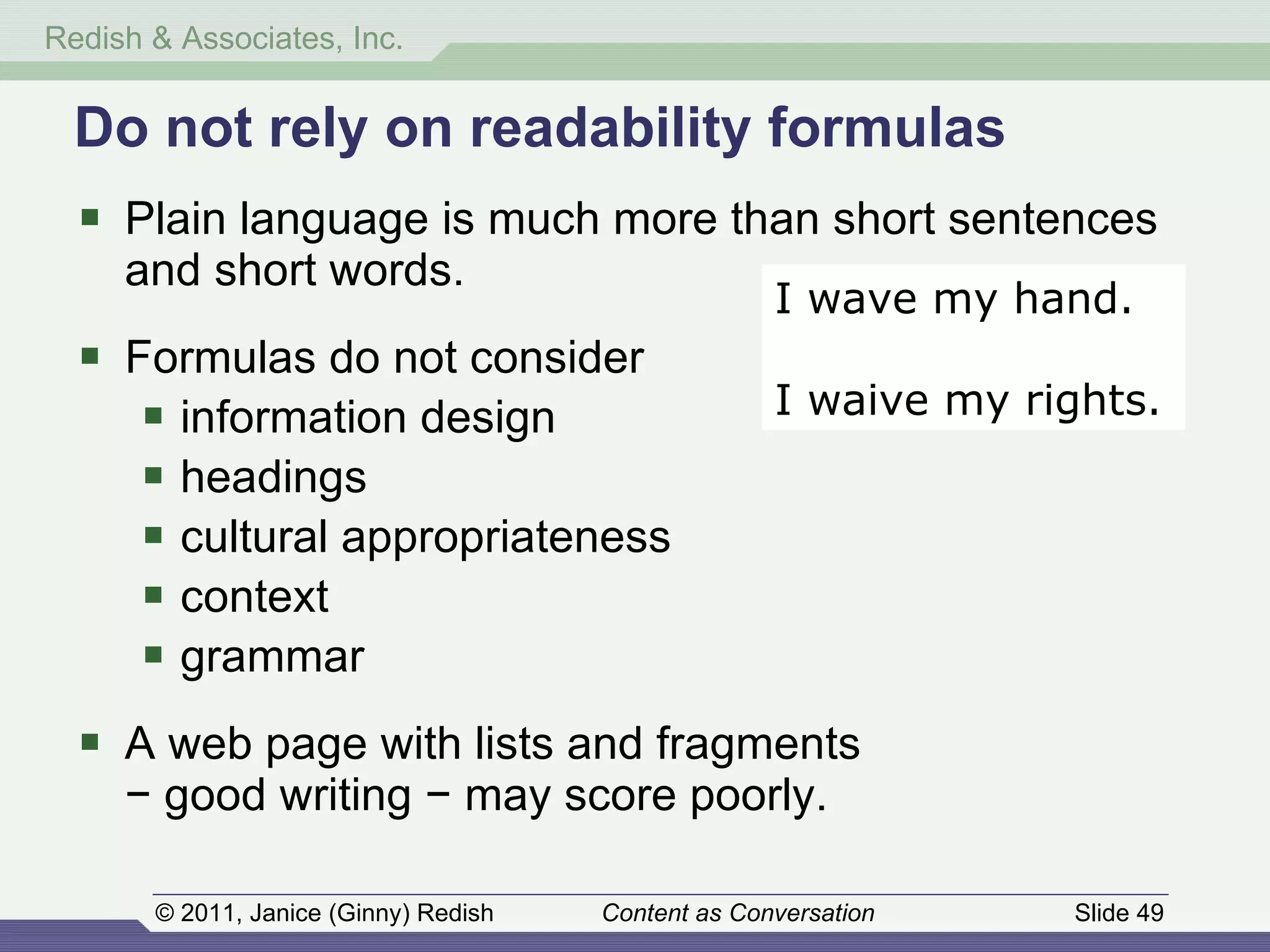
Do not rely on readability formulas Plain language is much more than short sentences and short words. Formulas do not consider information design headings cultural appropriateness context grammar A web page with lists and fragments − good writing − may score poorly. I wave my hand. I waive my rights.
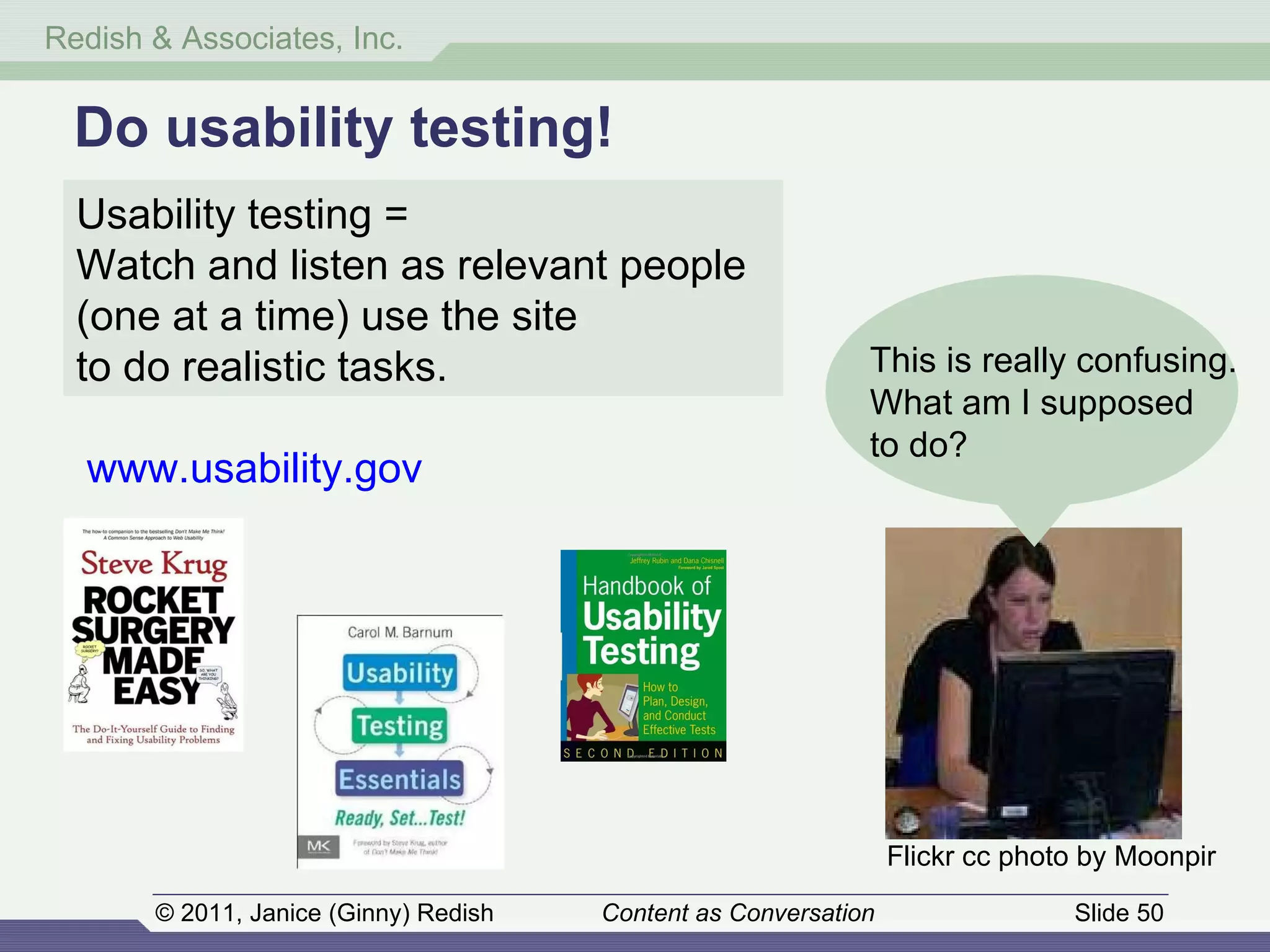
Do usability testing! Usability testing =  Watch and listen as relevant people (one at a time) use the site  to do realistic tasks . www.usability.gov This is really confusing. What am I supposed  to do? Flickr cc photo by Moonpir
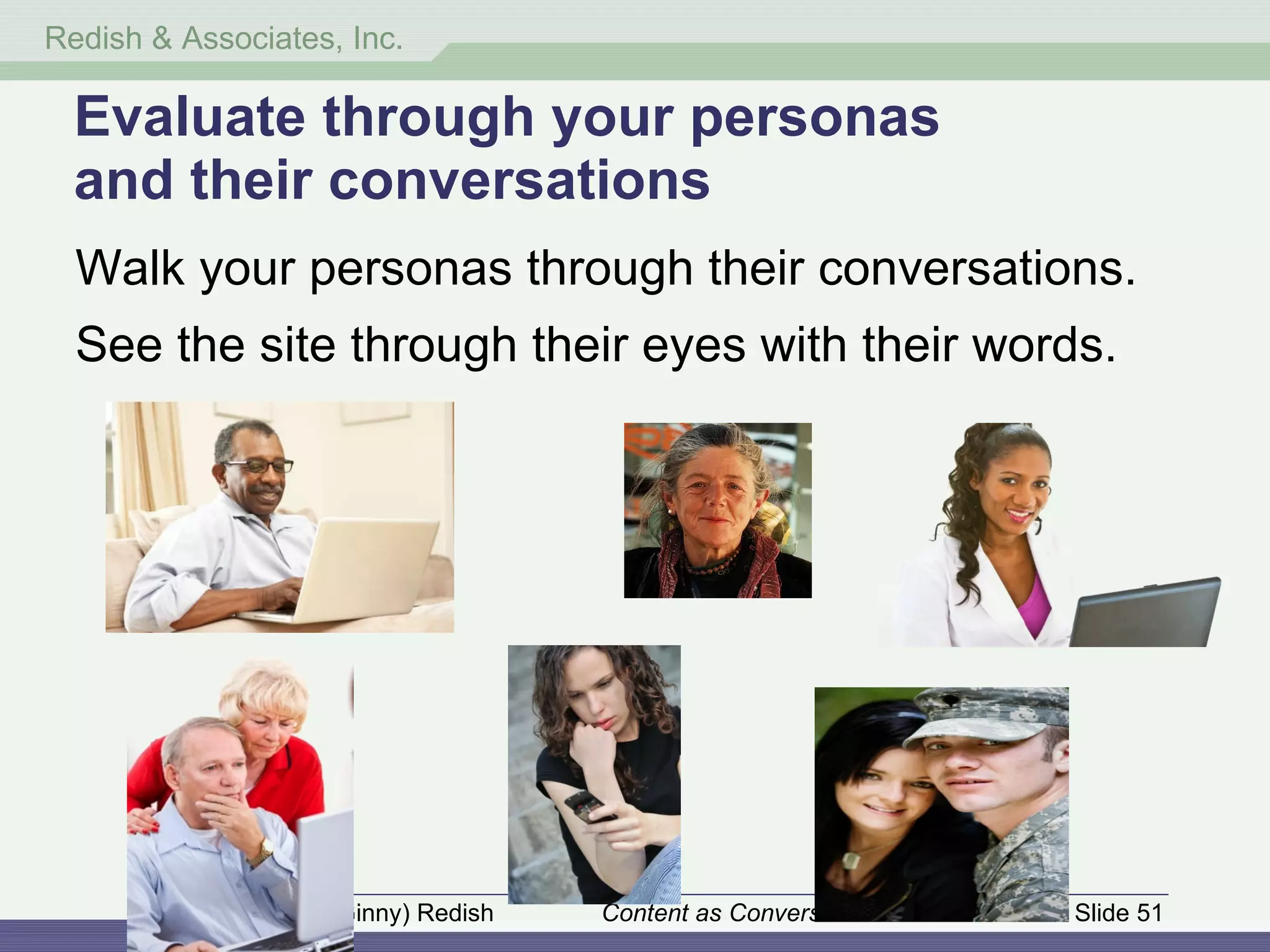
Evaluate through your personas and their conversations Walk your personas through their conversations. See the site through their eyes with their words.
Ginny Redish [email_address] 301 229 3039 Thank you

Janice (Ginny) Redish - Content as Conversation: Writing for the Web

  • 1.
    Content as Conversation: Writing for the Web Janice (Ginny) Redish, Ph.D. Redish & Associates, Inc. Bethesda, Maryland 301 − 229 − 3039 [email_address] www.redish.net @GinnyRedish
  • 2.
    Topics for thismorning Setting the context Planning the conversation Getting people to what they need Writing the conversation Assuring successful conversations
  • 3.
    Setting the context© iStockphoto
  • 4.
    You use websites that others have developed. When did you last go to the web? Why did you go to the web? What were you trying to do or what were you looking for? Share your story Flickr cc photo by theworldcafe Share your story with your neighbor.
  • 5.
    What do peoplewant from web sites? To satisfy their goals Content Information To do a task People just want to answer their question do a task solve a problem engage in a social conversation © iStockphoto
  • 6.
  • 7.
    Good, clear designis critical
  • 8.
  • 9.
    But they allsupport the content
  • 10.
    Every use ofevery web site is a conversation started by the site visitor How well does your site converse with your site visitors?
  • 11.
  • 12.
    Plan before youwrite Think first. Write second. Why? (your purposes) Who? (your site visitors) When, why, and how? (your site visitors' conversations)
  • 13.
    Why? (Your purposes)Be measurable. Be specific. Focus on your site visitors. $
  • 14.
  • 15.
    Focus on yoursite visitors to inform people about … answer people's questions about … to give instructions for the … form our very busy, anxious, worried site visitors to give us the information we need correctly so we can serve them better We want
  • 16.
    Name each majorgroup of site visitors. Add adjectives or phrases that describe them. time constraints (busy? multi-tasking?) attitudes (stressed? frustrated?) subject matter knowledge primary language reading ability computer and web experience Who? (Your site visitors) I wish they would remember how crazy my life is! I don't have time!
  • 17.
    Create personas towrite to Persona = a fictional person who realistically represents a major group of site visitors not a specific actual site visitor a composite based on data about demographics goals and tasks contexts of use (environments) values Art
  • 18.
    Picture Name Personalinformation Quote Values Typical tasks Characteristics Persona of an older adult as a web user From AARP, Redish, 2007
  • 19.
    When, why, andhow? (your site visitor's conversation) Story, scenario, context, situation, conversation Visualize the persona coming to your site. Flickr cc photo by Mr.Thomas © iStockphoto
  • 20.
    Getting people towhat they need © iStockphoto
  • 21.
    What does ahome page have to do?
  • 22.
    http://www.tricare.mil/ Imagine the conversation as you design. American Consumer Satisfaction Index (ACSI) scores went up about 20 points.
  • 23.
    Flickr cc photo by pedrosimeos7 What should I be aware of when I shop for insurance?
  • 24.
    Secret of successfulpathway pages: Writing for the "scent of information" People don't want to read more than necessary while "getting there. " What must a pathway page do? X Long welcome statement  Just clear links in a usable format ! X Long mission statement
  • 25.
  • 26.
    Writing the conversationFlickr cc photo by Polandeze
  • 27.
  • 28.
    Don't hog theconversation. Take turns. Headings are the site visitor's turns in the conversation.
  • 29.
    Headings help by breaking up the information making the information manageable creating visual separation on the web page drawing the eyes providing context so people can make sense of what follows Writing headings first helps authors analyze the information organize for the reader Include informative headings Key words in browser titles, page titles, and headings help SEO.
  • 30.
    Questions Statements (keymessages) Action phrases Nouns and noun phrases work as category names but not well for headings What types of headings work well? Does my child need a Social Security number? Apply now Renewing your insurance Minimum Wage, News x Introduction x Dependent Eligibility Verification The age for getting your Social Security payments is going up
  • 31.
    How do peopleuse web pages? Nielsen and Pernice, 2010 Skim and scan Read only what they need, when and where they think they are getting value Grab information to meet their goal
  • 32.
    Start with thekey message Typical document (narrative style) topic, history, background, rationale narrative of what you did main point as conclusion Better workplace document (style for busy people; inverted pyramid) key message first answers to questions people would have (even if you don't write question headings)
  • 33.
  • 34.
    Layer. Think "bite,snack, meal" Concept from Leslie O'Flahavan www.ewriteonline.com Even the whole meal should be easy to digest . www.cdc.gov Snack: the main fruit Bite: the kernel Meal: the whole thing - meat and potatoes
  • 35.
    Start with thekey message at every level Where is the key message in this sentence? Because of the frequency of the disease, ability to identify high-risk groups, demonstrated slow growth of primary lesions, better survival of patients with early-stage lesions, and relative simplicity and accuracy of screening tests, screening for colon cancer should be a part of routine care for all adults aged 50 years or older, especially for those with first-degree relatives with colorectal cancer.
  • 36.
    Write as youwould speak ✔ ✗
  • 37.
    Write to your readers The student must register and the fee payment process must be started before the first day of classes or the student will be purged from classes. You must register and arrange to pay for your classes before the first day of class. If you don't, we will drop you from the classes. 1 2 3
  • 38.
    How would yousay this information in a conversation? Approved fumigation with methyl bromide at normal atmospheric pressure, in accordance with the following procedure, upon arrival at the port of entry, is hereby prescribed as a condition of importation for shipments of yams from foreign countries.
  • 39.
    Did you saysomething like this? If you are importing yams, [someone] must fumigate them when they arrive at the port of entry. To fumigate yams, [someone] must use this procedure: Hear the conversation as you write context = given, known then new
  • 40.
    What's wrong withthis sentence? Interested persons, on or before October 15, 2011, may submit to the Hearing Clerk, 1000 Pennsylvania Avenue, NW, Washington, DC 20000, written comments regarding this proposal .
  • 41.
    Is this better? Why? Can you hear the conversation going on here? Walk in your reader's shoes. Go through your writing with a persona and that persona's scenario.
  • 42.
    Keep it shortYour seventh-grade English teacher never wrote for the web. People scan. A one-sentence paragraph is fine. Think information, not paragraph. fragments pictures lists links tables
  • 43.
    Respect your readers'time Use short, plain English words We all read simple, common words faster than long, uncommon words. People inside an organization overestimate the vocabulary knowledge of people outside the organization by about 30 percent. "dumbing down" ✗ ✔ respecting your busy readers' time
  • 44.
    Helping low-literacy usershelps everyone Summers, K. and Summers, M., 2005, Reading and Navigational Strategies of Web Users with Lower Literacy Skills, ASSIST 2005, available from http://iat.ubalt.edu/summers/
  • 45.
    Finding the simpleword your pet peeve of a big word and a shorter, simpler equivalent retain ___________ Instead of Try this ascertain ___________ commence ___________ inquire ___________ Instead of Try this terminate ___________ utilize ___________ Instead of Try this at this point in time ___________ during the course of this year ___________
  • 46.
    Use other plainlanguage guidelines Write in the active voice (most of the time) Turn nouns that hide verbs into strong verbs. (retention  keep; requirement  you must) Use bulleted lists for items. Use numbered lists for instructions. Use tables when the answer to the question is "it depends."
  • 47.
  • 48.
    Read before yousend or post Read what you wrote. Put your draft in a drawer for a few days. Take it out and read it again. Read it out loud. Ask someone else to read it out loud. Share with colleagues. Help each other. ego
  • 49.
    Do not relyon readability formulas Plain language is much more than short sentences and short words. Formulas do not consider information design headings cultural appropriateness context grammar A web page with lists and fragments − good writing − may score poorly. I wave my hand. I waive my rights.
  • 50.
    Do usability testing!Usability testing = Watch and listen as relevant people (one at a time) use the site to do realistic tasks . www.usability.gov This is really confusing. What am I supposed to do? Flickr cc photo by Moonpir
  • 51.
    Evaluate through yourpersonas and their conversations Walk your personas through their conversations. See the site through their eyes with their words.
  • 52.
    Ginny Redish [email_address]301 229 3039 Thank you

Editor's Notes

  • #40 Clark, H., and Haviland S., 1975, Comprehension and the given-new contract. In R. Freedle (Ed.), Discourse production and comprehension , Erlbaum, 1-40.