BY GROUP 5
Reader-Response
Approach
What is Reader -Response Approach
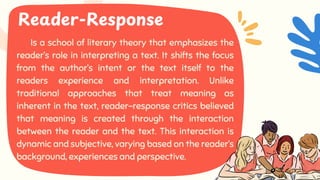
Is a school of literary theory that emphasizes the
reader’s role in interpreting a text. It shifts the focus
from the author’s intent or the text itself to the
readers experience and interpretation. Unlike
traditional approaches that treat meaning as
inherent in the text, reader-response critics believed
that meaning is created through the interaction
between the reader and the text. This interaction is
dynamic and subjective, varying based on the reader’s
background, experiences and perspective.
Is a school of literary theory that emphasizes the
reader’s role in interpreting a text. It shifts the focus
from the author’s intent or the text itself to the
readers experience and interpretation. Unlike
traditional approaches that treat meaning as
inherent in the text, reader-response critics believed
that meaning is created through the interaction
between the reader and the text. This interaction is
dynamic and subjective, varying based on the reader’s
background, experiences and perspective.
Reader-Response
-
R
esponse Approac
h
5
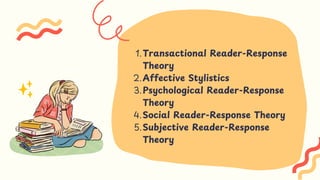
Types of Reader
Transactional Reader-Response
Theory
1.
Affective Stylistics
2.
Psychological Reader-Response
Theory
3.
Social Reader-Response Theory
4.
Subjective Reader-Response
Theory
5.
Led by Louise Rosenblatt and supported
by Wolfgang Iser, Involves a transaction
between the text’s inferred meaning and the
individual interpretation by the reader
influenced by their personal emotions and
knowledge.
Transactional
Reader-Response
Theory
Established by Fish, believe that a text can
only come into existence as it is read;
therefore, a text cannot have meaning
independent of the reader.
Affective
Stylistics
Employed by Norman Hollan, believes that
a reader’s motives heavily affect how they
read, and subsequently use this reading to
analyze the psychological response of the
reader.
Psychological
Reader-Response
Theory
Is Stanley Fish’s extension of his earlier
work, stating that any individual
interpretation of a text is created in an
interpretive community of minds consisting
of participants who share a specific reading
and interpretation strategy.
Social Reader-
Response Theory
Associated with David Bleich, looks entirely
to the reader’s response for literary meaning
as individual written responses to a text are
then compared to other individual
interpretations to find continuity of meaning.
Subjective
Reader-Response
Theory
Literary Piece!!
Let's Read a
Two roads diverged in a yellow wood, And sorry I
could not travel both And be one traveler, long I
stood And looked down one as far as I could To
where it bent in the undergrowth;
Then took the other, as just as fair, And having
perhaps the better claim Because it was grassy
and wanted wear, Though as for that the
passing there Had worn them really about the
same,
The Road Not Taken
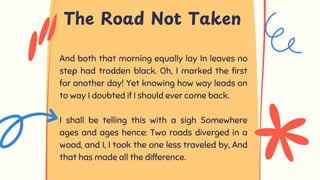
And both that morning equally lay In leaves no
step had trodden black. Oh, I marked the first
for another day! Yet knowing how way leads on
to way I doubted if I should ever come back.
I shall be telling this with a sigh Somewhere
ages and ages hence: Two roads diverged in a
wood, and I, I took the one less traveled by, And
that has made all the difference.
The Road Not Taken
i
n
C
r
i
ticizing a Literary
P
i
e
c
e
U
s
ing
Reader-Respon
s
e
Reader-Response
Approach
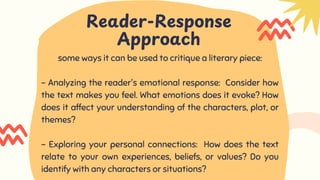
some ways it can be used to critique a literary piece:
- Analyzing the reader's emotional response: Consider how
the text makes you feel. What emotions does it evoke? How
does it affect your understanding of the characters, plot, or
themes?
- Exploring your personal connections: How does the text
relate to your own experiences, beliefs, or values? Do you
identify with any characters or situations?
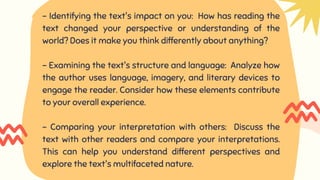
- Identifying the text's impact on you: How has reading the
text changed your perspective or understanding of the
world? Does it make you think differently about anything?
- Examining the text's structure and language: Analyze how
the author uses language, imagery, and literary devices to
engage the reader. Consider how these elements contribute
to your overall experience.
- Comparing your interpretation with others: Discuss the
text with other readers and compare your interpretations.
This can help you understand different perspectives and
explore the text's multifaceted nature.
Q&A
Session
Thank
You

READER-RESPONSE APPROACH SLIDE PRESENTATION

  • 1.
  • 2.
    What is Reader-Response Approach
  • 3.
    Is a schoolof literary theory that emphasizes the reader’s role in interpreting a text. It shifts the focus from the author’s intent or the text itself to the readers experience and interpretation. Unlike traditional approaches that treat meaning as inherent in the text, reader-response critics believed that meaning is created through the interaction between the reader and the text. This interaction is dynamic and subjective, varying based on the reader’s background, experiences and perspective. Is a school of literary theory that emphasizes the reader’s role in interpreting a text. It shifts the focus from the author’s intent or the text itself to the readers experience and interpretation. Unlike traditional approaches that treat meaning as inherent in the text, reader-response critics believed that meaning is created through the interaction between the reader and the text. This interaction is dynamic and subjective, varying based on the reader’s background, experiences and perspective. Reader-Response
  • 4.
  • 5.
    Transactional Reader-Response Theory 1. Affective Stylistics 2. PsychologicalReader-Response Theory 3. Social Reader-Response Theory 4. Subjective Reader-Response Theory 5.
  • 6.
    Led by LouiseRosenblatt and supported by Wolfgang Iser, Involves a transaction between the text’s inferred meaning and the individual interpretation by the reader influenced by their personal emotions and knowledge. Transactional Reader-Response Theory
  • 7.
    Established by Fish,believe that a text can only come into existence as it is read; therefore, a text cannot have meaning independent of the reader. Affective Stylistics
  • 8.
    Employed by NormanHollan, believes that a reader’s motives heavily affect how they read, and subsequently use this reading to analyze the psychological response of the reader. Psychological Reader-Response Theory
  • 9.
    Is Stanley Fish’sextension of his earlier work, stating that any individual interpretation of a text is created in an interpretive community of minds consisting of participants who share a specific reading and interpretation strategy. Social Reader- Response Theory
  • 10.
    Associated with DavidBleich, looks entirely to the reader’s response for literary meaning as individual written responses to a text are then compared to other individual interpretations to find continuity of meaning. Subjective Reader-Response Theory
  • 11.
  • 12.
    Two roads divergedin a yellow wood, And sorry I could not travel both And be one traveler, long I stood And looked down one as far as I could To where it bent in the undergrowth; Then took the other, as just as fair, And having perhaps the better claim Because it was grassy and wanted wear, Though as for that the passing there Had worn them really about the same, The Road Not Taken
  • 13.
    And both thatmorning equally lay In leaves no step had trodden black. Oh, I marked the first for another day! Yet knowing how way leads on to way I doubted if I should ever come back. I shall be telling this with a sigh Somewhere ages and ages hence: Two roads diverged in a wood, and I, I took the one less traveled by, And that has made all the difference. The Road Not Taken
  • 14.
  • 15.
    Reader-Response Approach some ways itcan be used to critique a literary piece: - Analyzing the reader's emotional response: Consider how the text makes you feel. What emotions does it evoke? How does it affect your understanding of the characters, plot, or themes? - Exploring your personal connections: How does the text relate to your own experiences, beliefs, or values? Do you identify with any characters or situations?
  • 16.
    - Identifying thetext's impact on you: How has reading the text changed your perspective or understanding of the world? Does it make you think differently about anything? - Examining the text's structure and language: Analyze how the author uses language, imagery, and literary devices to engage the reader. Consider how these elements contribute to your overall experience. - Comparing your interpretation with others: Discuss the text with other readers and compare your interpretations. This can help you understand different perspectives and explore the text's multifaceted nature.
  • 17.
  • 18.