Download to read offline
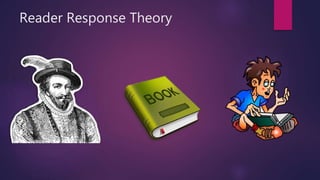
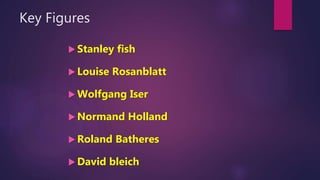
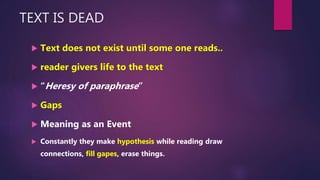

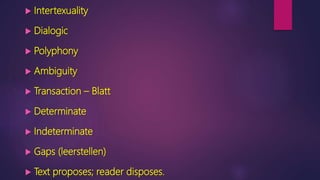
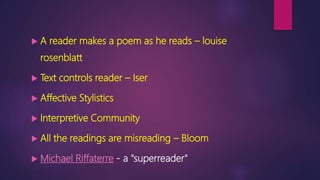
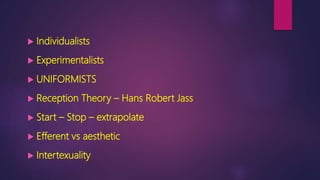
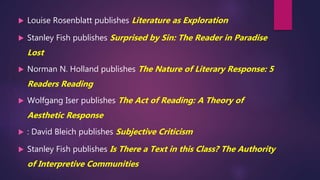

Reader response theory proposes that readers play an active role in constructing meaning from a text. It arose in response to New Criticism's focus on the text alone and emphasizes that readers use their own background and experiences to interpret what is missing or ambiguous in a text. Key figures who developed reader response theory include Stanley Fish, Louise Rosenblatt, and Wolfgang Iser. They explored how readers form hypotheses, make connections, and fill in gaps as they read to create meaning.


