Read my Blog
         Workshop: Blogging for Researchers
    Graeme Earl, Lisa Harris, Nicole Beale, Fiona
Harvey, Peter Wheeler, Alison Simmance, Hembo Pagi
                   January 2013
Workshop Plan
• Intro to the blogging setup and plans for future
  development (Graeme)
• Examples of existing University blogs (Graeme)
• What is blogging and why is it important (Lisa)
• Blogging for researchers (Nicole)
• University blogging rules e.g. posting copyright
  material, complaints etc. (Fiona)
• Technical aspects – requesting a blog, signing up
  and creating a blog post. This will be a quick
  demo and then a hands-on opportunity (Peter)
Blogging setup
•   Funded by Multidisciplinary initiative, sotonDH and the DE USRG, with support
    from iSolutions and Communications and Marketing

•   Wordpress (www.wordpress.com)
•   “Multi-site”
•   Domain blog.soton.ac.uk or custom
•   University theme

•   Standard plugins e.g. social media, ePrints
•   Commenting and trackbacks e.g.
    http://www.portusproject.org/blogs/2012/11/rome-what-lies-beneath/

•   blog.soton.ac.uk
•   Two options:
     – The standard blog is provided with a University theme. You can add, manage or remove
       content and users, select from a list of pre-installed plugins and request new plugins from
       iSolutions but you cannot change the theme
     – The custom blog is a empty blog with which you can create your own theme, change the
       plugins and manage the blog as a custom site. iSolutions is unable to support you in creating
       your own themes. Any theme which is used to represent the University should be approved by
       Marketing and Communications
Example University blogs
•   Events:
     – Web Science 2013: http://www.websci13.org/

•   Projects:
     –   Agincourt: http://www.agincourt.soton.ac.uk/blog/
     –   Slavery and Revolution: http://blog.soton.ac.uk/slaveryandrevolution/
     –   Portus Project: http://www.portusproject.org/
     –   LANG-SNAP: http://langsnap.soton.ac.uk/
     –   Százhalombatta : http://szazhalombattaexcavation.info/

•   Research Groups:
     –   ILC: www.blog.soton.ac.uk/ilc
     –   ACRG: http://acrg.soton.ac.uk/
     –   Digital Humanities: http://digitalhumanities.soton.ac.uk/
     –   Digital Economy: http://digitaleconomy.soton.ac.uk/
     –   Computational Imaging: http://blog.soton.ac.uk/cii/
     –   Work Thought Blog: http://blog.soton.ac.uk/wfrc/
     –   CAHO Seminar series: http://cahoseminars.soton.ac.uk/

•   Teaching:
     – Languages at Southampton: http://www.languagesatsouthampton.soton.ac.uk/
What is a blog?
• ‘conversational scholarship’
or
• ‘writing which makes scholarly work accessible
   and accountable to a readership outside the
   academy’ (Gregg, 2006 p 147-8)
or
• ‘a discussion or informational site published
   online and consisting of discrete entries ("posts")
   typically displayed in reverse chronological order
   (the most recent post appears first)’ (Wikipedia)
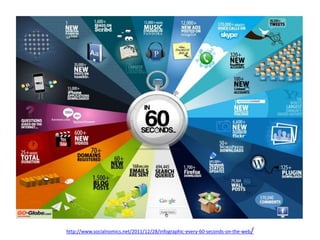
http://www.socialnomics.net/2011/12/28/infographic-every-60-seconds-on-the-web/
Rationale
• Technology Will Kill…(2 min video by Erik
  Qualman)
• Seth Godin and Tom Peters on blogging
• Blogging provides:
  – Visibility
  – Recognition
  – Community and public engagement
  – Social capital
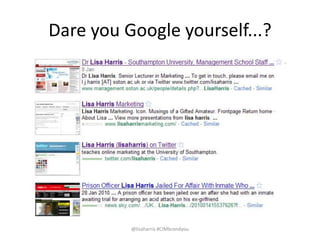
Dare you Google yourself...?


          @lisaharris #CIMbrandyou
Blogs v websites
Blogs
• Instantaneous
• Timely
• Posts are time stamped
• Personal and informal
• You “subscribe” to blogs to be updated with new content
• Two-way communications

Websites
• Tend to be static
• Change infrequently
• Who knows how old?
• Generally impersonal even ‘corporate’
• You “bookmark” websites but this is easily forgotten
• One-way communications
Various blogging forms
• Personal brand building – see Martin Weller’s EdTechie blog
• A project diary which may be collaboratively produced and
  edited – see Guy Poppy’s Assets Malawi Blog
• A reflective diary relating to a specific course – see Maria
  Serres’ MSc blog
• A collection of projects within a research group – see Digital
  Economy USRG
• Crowdsourcing content/feedback on the writing of draft
  book chapters - see Charlene Li’s Open Leadership
• Syndication of relevant content to a range of authors - see
  LSE Impact blog
Pulling it all together
• Use the blog framework as a central point pulling in your other
  social media content:
   –   Tweets
   –   LinkedIn
   –   Flickr
   –   Vimeo/YouTube
   –   Slideshare
   –   Pinterest etc
• You can also embed other social media within individual blog posts
  – video content is increasingly important
• Provide sharing buttons so that your readers can share your content
  on their own networks
• These activities provide a regular supply of googlejuice to the blog
Blogging and search engine
               optimisation
Social media shares of a blogpost are the biggest
influence on its search visibility:
  1.   Facebook shares
  2.   Facebook comments
  3.   Facebook likes
  4.   Tweets
http://www.socialmediastrategist.co.uk/blog/1-
news/175-social-media-seo
Practical tips
• Be transparent and authentic
• Build social capital by providing a regular supply of
  interesting content
• Use a range of media in each post
• Keep posts short – our attentions spans are getting
  ever smal…
• Link and share. Link and share. Did I say link and share?
• Respond to all queries and comments
• Don’t expect instant results…persistence will pay off 
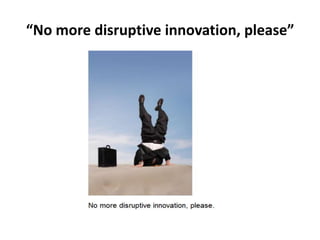
“No more disruptive innovation, please”
Useful links
How to write a good research blogpost
Blogging: the new research dissemination
strategy
Review of Martin Weller’s book Digital Scholar
The value of academic blogging
Read my blog

Read my blog

  • 1.
    Read my Blog Workshop: Blogging for Researchers Graeme Earl, Lisa Harris, Nicole Beale, Fiona Harvey, Peter Wheeler, Alison Simmance, Hembo Pagi January 2013
  • 2.
    Workshop Plan • Introto the blogging setup and plans for future development (Graeme) • Examples of existing University blogs (Graeme) • What is blogging and why is it important (Lisa) • Blogging for researchers (Nicole) • University blogging rules e.g. posting copyright material, complaints etc. (Fiona) • Technical aspects – requesting a blog, signing up and creating a blog post. This will be a quick demo and then a hands-on opportunity (Peter)
  • 4.
    Blogging setup • Funded by Multidisciplinary initiative, sotonDH and the DE USRG, with support from iSolutions and Communications and Marketing • Wordpress (www.wordpress.com) • “Multi-site” • Domain blog.soton.ac.uk or custom • University theme • Standard plugins e.g. social media, ePrints • Commenting and trackbacks e.g. http://www.portusproject.org/blogs/2012/11/rome-what-lies-beneath/ • blog.soton.ac.uk • Two options: – The standard blog is provided with a University theme. You can add, manage or remove content and users, select from a list of pre-installed plugins and request new plugins from iSolutions but you cannot change the theme – The custom blog is a empty blog with which you can create your own theme, change the plugins and manage the blog as a custom site. iSolutions is unable to support you in creating your own themes. Any theme which is used to represent the University should be approved by Marketing and Communications
  • 5.
    Example University blogs • Events: – Web Science 2013: http://www.websci13.org/ • Projects: – Agincourt: http://www.agincourt.soton.ac.uk/blog/ – Slavery and Revolution: http://blog.soton.ac.uk/slaveryandrevolution/ – Portus Project: http://www.portusproject.org/ – LANG-SNAP: http://langsnap.soton.ac.uk/ – Százhalombatta : http://szazhalombattaexcavation.info/ • Research Groups: – ILC: www.blog.soton.ac.uk/ilc – ACRG: http://acrg.soton.ac.uk/ – Digital Humanities: http://digitalhumanities.soton.ac.uk/ – Digital Economy: http://digitaleconomy.soton.ac.uk/ – Computational Imaging: http://blog.soton.ac.uk/cii/ – Work Thought Blog: http://blog.soton.ac.uk/wfrc/ – CAHO Seminar series: http://cahoseminars.soton.ac.uk/ • Teaching: – Languages at Southampton: http://www.languagesatsouthampton.soton.ac.uk/
  • 7.
    What is ablog? • ‘conversational scholarship’ or • ‘writing which makes scholarly work accessible and accountable to a readership outside the academy’ (Gregg, 2006 p 147-8) or • ‘a discussion or informational site published online and consisting of discrete entries ("posts") typically displayed in reverse chronological order (the most recent post appears first)’ (Wikipedia)
  • 8.
  • 9.
    Rationale • Technology WillKill…(2 min video by Erik Qualman) • Seth Godin and Tom Peters on blogging • Blogging provides: – Visibility – Recognition – Community and public engagement – Social capital
  • 10.
    Dare you Googleyourself...? @lisaharris #CIMbrandyou
  • 11.
    Blogs v websites Blogs •Instantaneous • Timely • Posts are time stamped • Personal and informal • You “subscribe” to blogs to be updated with new content • Two-way communications Websites • Tend to be static • Change infrequently • Who knows how old? • Generally impersonal even ‘corporate’ • You “bookmark” websites but this is easily forgotten • One-way communications
  • 12.
    Various blogging forms •Personal brand building – see Martin Weller’s EdTechie blog • A project diary which may be collaboratively produced and edited – see Guy Poppy’s Assets Malawi Blog • A reflective diary relating to a specific course – see Maria Serres’ MSc blog • A collection of projects within a research group – see Digital Economy USRG • Crowdsourcing content/feedback on the writing of draft book chapters - see Charlene Li’s Open Leadership • Syndication of relevant content to a range of authors - see LSE Impact blog
  • 13.
    Pulling it alltogether • Use the blog framework as a central point pulling in your other social media content: – Tweets – LinkedIn – Flickr – Vimeo/YouTube – Slideshare – Pinterest etc • You can also embed other social media within individual blog posts – video content is increasingly important • Provide sharing buttons so that your readers can share your content on their own networks • These activities provide a regular supply of googlejuice to the blog
  • 14.
    Blogging and searchengine optimisation Social media shares of a blogpost are the biggest influence on its search visibility: 1. Facebook shares 2. Facebook comments 3. Facebook likes 4. Tweets http://www.socialmediastrategist.co.uk/blog/1- news/175-social-media-seo
  • 15.
    Practical tips • Betransparent and authentic • Build social capital by providing a regular supply of interesting content • Use a range of media in each post • Keep posts short – our attentions spans are getting ever smal… • Link and share. Link and share. Did I say link and share? • Respond to all queries and comments • Don’t expect instant results…persistence will pay off 
  • 16.
    “No more disruptiveinnovation, please”
  • 17.
    Useful links How towrite a good research blogpost Blogging: the new research dissemination strategy Review of Martin Weller’s book Digital Scholar The value of academic blogging

Editor's Notes

  • #9 http://www.socialnomics.net/2011/12/28/infographic-every-60-seconds-on-the-web/