Kathryn Bretz
 Walden University
Dr. Davenna Williams
     EDUC 6706
 February 19, 2012
Getting to Know Literacy
           Learners
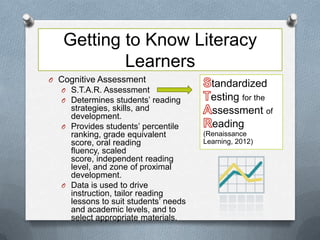
O Cognitive Assessment
                                        tandardized
  O S.T.A.R. Assessment
  O Determines students’ reading        esting for the
    strategies, skills, and             ssessment of
    development.
  O Provides students’ percentile       eading
    ranking, grade equivalent         (Renaissance
    score, oral reading               Learning, 2012)
    fluency, scaled
    score, independent reading
    level, and zone of proximal
    development.
  O Data is used to drive
    instruction, tailor reading
    lessons to suit students’ needs
    and academic levels, and to
    select appropriate materials.
Getting to Know Literacy
           Learners
O Noncognitive Assessment
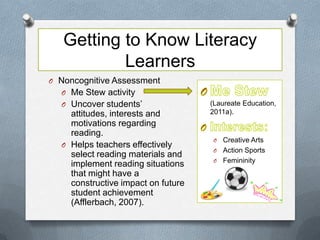
  O Me Stew activity
  O Uncover students’               (Laureate Education,
    attitudes, interests and        2011a).
    motivations regarding
    reading.
                                    O Creative Arts
  O Helps teachers effectively
                                    O Action Sports
    select reading materials and
                                    O Femininity
    implement reading situations
    that might have a
    constructive impact on future
    student achievement
    (Afflerbach, 2007).
Selecting Texts
O Text Selection
   O Making thoughtful and meaningful
     decisions when choosing reading
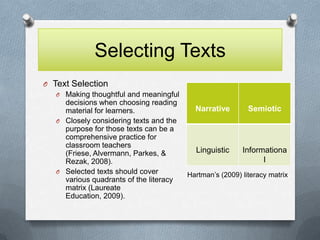
     material for learners.                Narrative        Semiotic
   O Closely considering texts and the
     purpose for those texts can be a
     comprehensive practice for
     classroom teachers
     (Friese, Alvermann, Parkes, &         Linguistic     Informationa
     Rezak, 2008).                                              l
   O Selected texts should cover
                                         Hartman’s (2009) literacy matrix
     various quadrants of the literacy
     matrix (Laureate
     Education, 2009).
Selecting Texts

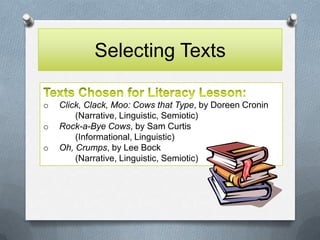
o   Click, Clack, Moo: Cows that Type, by Doreen Cronin
        (Narrative, Linguistic, Semiotic)
o   Rock-a-Bye Cows, by Sam Curtis
        (Informational, Linguistic)
o   Oh, Crumps, by Lee Bock
        (Narrative, Linguistic, Semiotic)
Interactive Perspective
 Teaching students how to read (Laureate
  Education, Inc., 2011b).
 Training students to become metacognitive
  thinkers and strategic processors.
 Reading and the strategies that students use to
  read is a “deliberate, conscious, metacognitive act”
  (Afflerbach, Pearson, and Paris, 2008, p. 368).


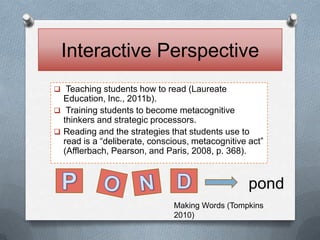
                                                  pond
                              Making Words (Tompkins
                              2010)
Critical and Response
                Perspectives
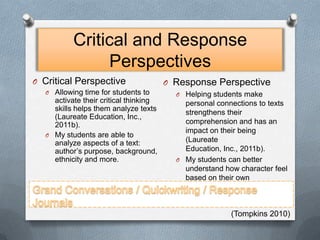
O Critical Perspective                  O Response Perspective
   O Allowing time for students to        O Helping students make
     activate their critical thinking       personal connections to texts
     skills helps them analyze texts
                                            strengthens their
     (Laureate Education, Inc.,
     2011b).                                comprehension and has an
                                            impact on their being
   O My students are able to
     analyze aspects of a text:             (Laureate
     author’s purpose, background,          Education, Inc., 2011b).
     ethnicity and more.                  O My students can better
                                            understand how character feel
                                            based on their own
                                            experiences.


                                                         (Tompkins 2010)
In Conclusion…
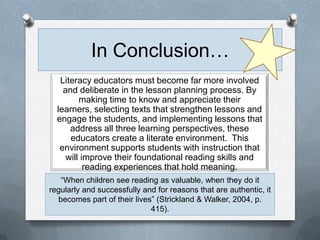
   Literacy educators must become far more involved
    and deliberate in the lesson planning process. By
         making time to know and appreciate their
  learners, selecting texts that strengthen lessons and
  engage the students, and implementing lessons that
      address all three learning perspectives, these
      educators create a literate environment. This
   environment supports students with instruction that
     will improve their foundational reading skills and
           reading experiences that hold meaning.
   “When children see reading as valuable, when they do it
regularly and successfully and for reasons that are authentic, it
  becomes part of their lives” (Strickland & Walker, 2004, p.
                             415).
Feedback from Colleagues
  and Family Members of
                Students literacy
O What insights did you gain about
    instruction from viewing this presentation?
O   How might the information presented change
    in your literacy practices and/or your literacy
    interactions with students?
O   In what ways can I support you in the literacy
    development of your students or children?
O   How might you support me in my work with
    students or your children?
O   What questions do you have?
References

Afflerbach, P. (2007). Understanding and using reading assessment, K–12. Newark, DE: International
Reading Association.

Afflerbach, P., Pearson, P. D., & Paris, S. G. (2008). Clarifying differences between reading skills and
reading strategies. Reading Teacher, 61(5), 364–373.

Friese, E. E., Alvermann, D. E., Parkes, A., & Rezak, A. T. (2008). Selecting texts for English
Language Arts      classrooms: When assessment is not enough. English Teaching: Practice & Critique
, 74-99.

Laureate Education, Inc. (Executive Producer). (2009). Analyzing and selecting text [Webcast].
The beginning reader, PreK–3. Baltimore, MD: Author.

Laureate Education, Inc. (Executive Producer). (2011a). Getting to know your students [Webcast]. In
The    beginning reader, PreK–3. Baltimore, MD: Author.

Laureate Education, Inc. (Executive Producer). (2011b). Perspectives on literacy learning. [Webcast].
The beginning reader PreK-3. Baltimore, MD: Author.

Renaissance Learning. (2012). STAR Enterprise. Retrieved January 12, 2012, from STAR Reading
Enterprise : http://www.renlearn.com/sr/default.aspx

Strickland, K., & Walker, A. (2004). "Re-Valuing" Reading: Assessing Attitude and Providing
Appropriate Reading Support. Reading and Writing Quarterly , 401-418.

Tompkins, G.E. (2010). Literacy for the 21st Century. Laureate Education. Pearson Education Inc.
Published by Allyn & Bacon. Boston MA.

Literate Environment Analysis Presentation

  • 1.
    Kathryn Bretz WaldenUniversity Dr. Davenna Williams EDUC 6706 February 19, 2012
  • 2.
    Getting to KnowLiteracy Learners O Cognitive Assessment tandardized O S.T.A.R. Assessment O Determines students’ reading esting for the strategies, skills, and ssessment of development. O Provides students’ percentile eading ranking, grade equivalent (Renaissance score, oral reading Learning, 2012) fluency, scaled score, independent reading level, and zone of proximal development. O Data is used to drive instruction, tailor reading lessons to suit students’ needs and academic levels, and to select appropriate materials.
  • 3.
    Getting to KnowLiteracy Learners O Noncognitive Assessment O Me Stew activity O Uncover students’ (Laureate Education, attitudes, interests and 2011a). motivations regarding reading. O Creative Arts O Helps teachers effectively O Action Sports select reading materials and O Femininity implement reading situations that might have a constructive impact on future student achievement (Afflerbach, 2007).
  • 4.
    Selecting Texts O TextSelection O Making thoughtful and meaningful decisions when choosing reading material for learners. Narrative Semiotic O Closely considering texts and the purpose for those texts can be a comprehensive practice for classroom teachers (Friese, Alvermann, Parkes, & Linguistic Informationa Rezak, 2008). l O Selected texts should cover Hartman’s (2009) literacy matrix various quadrants of the literacy matrix (Laureate Education, 2009).
  • 5.
    Selecting Texts o Click, Clack, Moo: Cows that Type, by Doreen Cronin (Narrative, Linguistic, Semiotic) o Rock-a-Bye Cows, by Sam Curtis (Informational, Linguistic) o Oh, Crumps, by Lee Bock (Narrative, Linguistic, Semiotic)
  • 6.
    Interactive Perspective  Teachingstudents how to read (Laureate Education, Inc., 2011b).  Training students to become metacognitive thinkers and strategic processors.  Reading and the strategies that students use to read is a “deliberate, conscious, metacognitive act” (Afflerbach, Pearson, and Paris, 2008, p. 368). pond Making Words (Tompkins 2010)
  • 7.
    Critical and Response Perspectives O Critical Perspective O Response Perspective O Allowing time for students to O Helping students make activate their critical thinking personal connections to texts skills helps them analyze texts strengthens their (Laureate Education, Inc., 2011b). comprehension and has an impact on their being O My students are able to analyze aspects of a text: (Laureate author’s purpose, background, Education, Inc., 2011b). ethnicity and more. O My students can better understand how character feel based on their own experiences. (Tompkins 2010)
  • 8.
    In Conclusion… Literacy educators must become far more involved and deliberate in the lesson planning process. By making time to know and appreciate their learners, selecting texts that strengthen lessons and engage the students, and implementing lessons that address all three learning perspectives, these educators create a literate environment. This environment supports students with instruction that will improve their foundational reading skills and reading experiences that hold meaning. “When children see reading as valuable, when they do it regularly and successfully and for reasons that are authentic, it becomes part of their lives” (Strickland & Walker, 2004, p. 415).
  • 9.
    Feedback from Colleagues and Family Members of Students literacy O What insights did you gain about instruction from viewing this presentation? O How might the information presented change in your literacy practices and/or your literacy interactions with students? O In what ways can I support you in the literacy development of your students or children? O How might you support me in my work with students or your children? O What questions do you have?
  • 10.
    References Afflerbach, P. (2007).Understanding and using reading assessment, K–12. Newark, DE: International Reading Association. Afflerbach, P., Pearson, P. D., & Paris, S. G. (2008). Clarifying differences between reading skills and reading strategies. Reading Teacher, 61(5), 364–373. Friese, E. E., Alvermann, D. E., Parkes, A., & Rezak, A. T. (2008). Selecting texts for English Language Arts classrooms: When assessment is not enough. English Teaching: Practice & Critique , 74-99. Laureate Education, Inc. (Executive Producer). (2009). Analyzing and selecting text [Webcast]. The beginning reader, PreK–3. Baltimore, MD: Author. Laureate Education, Inc. (Executive Producer). (2011a). Getting to know your students [Webcast]. In The beginning reader, PreK–3. Baltimore, MD: Author. Laureate Education, Inc. (Executive Producer). (2011b). Perspectives on literacy learning. [Webcast]. The beginning reader PreK-3. Baltimore, MD: Author. Renaissance Learning. (2012). STAR Enterprise. Retrieved January 12, 2012, from STAR Reading Enterprise : http://www.renlearn.com/sr/default.aspx Strickland, K., & Walker, A. (2004). "Re-Valuing" Reading: Assessing Attitude and Providing Appropriate Reading Support. Reading and Writing Quarterly , 401-418. Tompkins, G.E. (2010). Literacy for the 21st Century. Laureate Education. Pearson Education Inc. Published by Allyn & Bacon. Boston MA.