ULTIMATE STRENGTH DESIGN OF REINFORCED CONCRETE
COLUMN BY THE APPLICATION OF THE COMPUTER
By
BRIJ RAJ KISHORE
Bachelor of Architecture
University of Roorkee
Roorkee, India
Submitted to the faculty of the Graduate College
of the Oklahoma State University
in partial fulfillment of the requirements
for the degree of
MASTER OF ARCHITECTURAL ENGINEERING
July, 1967
ULTIMATE STRENGTH DESIGN OF REINFORCED CONCRETE
COLUMN BY THE APPLICATION OF THE COMPlY£ER
Report Approved:
Dean of the Graduate College
ii
ACKNOWLEDGEMENTS
I wish to express my sincere appreciation and great indebtedness
to the following individuals:
My teacher and former adviser, Professor Arlyn A. Orr
of Orr Bass and Associates, Stillwater, Oklahoma, and
my present adviser, Professor Louis O. Bass, for their
untiring assistance and valuable guidance.
Professor F. Cuthbert Salmon, Head of the School of
Architecture, who aided in obtaining a graduate assist-
antship, which made it possible for me to continue my
graduate studies.
Professor R. Bruce Miller, whose assistance made it
possible for me to complete this study.
Also, J wish to thank very sincerely Mr. Nathan Cronheim,
Architect and Engineer, Philadelphia, Pennsylvania, for his assistance
in the procurement of the various information and the material on
Ultimate Strength Design and for giving me a long vacation to work on
this report at the time of heavy pressure of work in the company.
In the last, I must thank and admire Mrs. Patty Tillerson whose
typing skill is evidenced on the pages of this study.
iii
TABLE OF CONTENTS
Chapter
I. INTRODUCTION . . • • • • • • . . .. . . . . . . . .. . .
II. THEORY AND BASIC ASSUMPTIONS . . . . . . . . . . . . . . .
III. THE ANALYSIS AND THE DERIVATIONS . . . .. . . . . . . . . .
IV• EXAMPLES . . . . . . . . . . . . . . . . . . . . . . . . .
V. CO:MPUTER PROGRAMS . . .. . . . . . . . . . . . .. . ..
VI. INTERACTION DIAGRAMS . . . . . . . . . . . .. . . . . . .
A SELECTED BIBLIOGRAPHY • • . . . .. . . . . . . . . . . .. . .
iv
Page
1
3
7
14
23
28
31
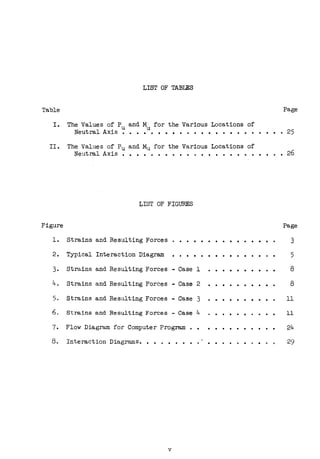
LIST OF TABLES
Table Page
I. The Values of Pu and Mu for the Various Locations of
Neutral Axis • • • • • • • • • • • • • • • • • • • • • • • 25
II. The Values of Pu and Mu for the Various Locations of
Neutral Axis • • • • • • • • • • • • • • • • • • • • • • • 26
LIST OF FIGURES
Figure Page
1. Strains and Resulting Forces . • . • • • . • • • . • • • • 3
2. Typical Interaction Diagram • . • • . . . . • . • . • 5
3, Strains and Resulting Forces - Case 1 . • . . • • • • . • 8
4. Strains and Resulting Forces - Case 2 • . • • • • . • • . 8
5. Strains and Resulting Forces - Case 3 • . • • • • • . • . 11
6. Strains and Resulting Forces - Case 4 . . . • . • . . . • 11
7. Flow Diagram for Computer Program . • • . • . . • • • . • 24
8. Interaction Diagrams. . . . . . . . . . . . . . . . • 29
V
USED IN
EQUATIONS
As
b
CL, CL1, CL2
ec
esc
E
e
est
esy
fl
C
fsc
fst
fy
~
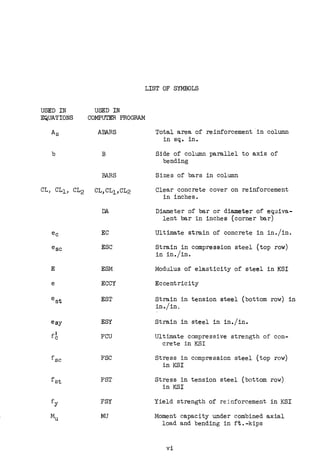
LIST OF SYMBOLS
USED IN
COMPUTER PROGRAM
ABA.RS
B
BA.RS
CL,CL1,CL2
DA
EC
ESC
ESM
ECCY
EST
ESY
FCU
FSC
FST
FSY
MU
Total area of reinforcement ·in column
in sq. in.
S:ide of column parallel to axis of
bending
Sizes of bars in column
Clear concrete cover on reinforcement
in inches.
Diameter of bar or diameter of equiva-
lent bar in inches (corner bar)
Ultimate strain of concrete in in./in.
Strain in compression steel (top row)
in in./in.
Modulus of elasticity of steel in KSI
Eccentricity
Strain in tension steel (bottom row) in
in./in.
Strain in steel in in./in.
Ultimate compressive strength of con-
crete in KSI
Stress in compression steel (top row)
in KSI
Stress in tension steel (bottom row)
in KSI
Yield strength of re:1nforcement in KSI
Moment capacity under combined axial
load and bending in ft.-kips
vi
USED IN USED IN
EQUATIONS COMPUTER PROGRAM
pc PC
p PERC
Po PO
PSSUM
Pst PST
p PU
u
t T
TD
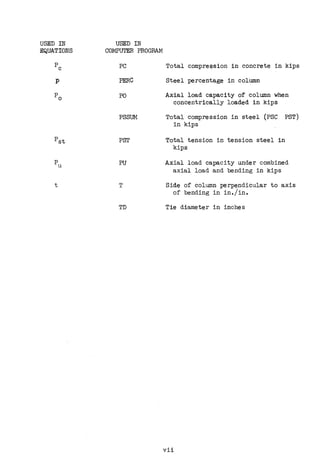
Total compre~sion in concrete in kips
Steel percentage in column
Axial load capacity of column when
concentrically loaded in kips
Total compression in steel (PSC PST)
in kips
Total tension in tension steel in
kips
Axial load capacity under combined
axial load and bending in kips
Side of column perpendicular to axis
of bending in in./in.
Tie diameter in inches
vii
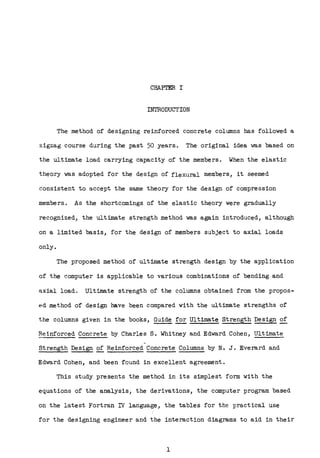
CHAPTER I
INTRODUCTION
The method of designing reinforced concrete columns has followed a
zigzag course during the past 50 years. The original idea was based on
the ultimate load carrying capacity of the members. When the elastic
theory was adopted for the design of flexural members, it seemed
consistent to accept the same theory for the design of compression
members. As the shortcomings of the elastic theory were gradually
recognized, the ultimate strength method was again introduced, although
on a limited basis, for the design of members subject to axial loads
only.
The proposed method of ultimate strength design by the application
of the computer is applicable to various combinations of bending and
axial load. Ultimate strength of the columns obtained from the propos-
ed method of design have been compared with the ultimate strengths of
the columns given in the books, Guide~ Ultimate Strength Design of
Reinforced Concrete by Charles S. Whitney and Edward Cohen, Ultimate
Strength Design of Reinforced Concrete Columns by N. J. Everard and
Edward Cohen, and been found in excellent agreement.
This study presents the method in its simplest form with the
equations of the analysis, the derivations, the computer program based
on the latest Fortran rl language, the tables for the practical use
for the designing engineer and the interaction diagrams to aid in their
1
application. The interaction diagrams themselves demonstrate that
their use can be quite a practical tool for a design engineer.
2
CHAPTER Il
THEORY AND BA.SIC ASSUMPTIONS
The ultimate strength of eccentrically loaded columns is governed
by the crushing resistance of concrete, assuming that reinforcing bars
are ductile enough to deform at constant yield stress until concrete
crushes in compression. ACI-ASCE Committee 327, Ultimate Strength
Design, recommends a maximum strain of 0.003 at which concrete may be
depended on to resist crushing. With a maximum extreme fiber strain
of 0.003 in compression, and the accepted assumption that plane. sec-
tions before bending remain plane after bending, it is possible for any
assumed neutral axis to describe strains at all points of a cross sec-
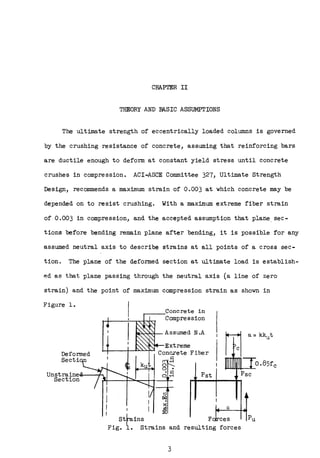
tion. The plane of the deformed section at ultimate load is establish-
P.d as that plane passing through the neutral axis (a line of zero
strain) and the point of maximum compression strain as shown in
Figure 1.
Deformed
Secti n
Unstraine---
Section
I
I
I
I
.--~~Concrete in
Compression
Pst Psc
St~ains
Fig. 1. Strains and
F ces Pu
resulting forces
3
4
With strains at all points established, and with knowledge of
stress-strain characteristics for the reinforcement used, it is possi-
ble to evaluate the resultant force and moment that created the assumed
strain distribution. For example, steel stress fs equals the product
of strain, Es and Young's modulus E until strains exceed the yield
strain of steel. In both tension and compression, for all strains
beyond the yield strain, steel stress was assumed constant at the
minimum yield stress specified for the type of steel considered.
Concrete was assumed to have no tensile strength, and the resultant
compression force on concrete was approximated using Whitney's equiva-
lent rectangular stress distribution. Whitney's rectangular stress
block is probably the most convenient aid in estimating the volume
and locating the centroid for a stress "wedge" of concrete at failure
· conditions.
In the application of Whitney's rectangular stress distribution,
restrictions of Committee 327 were observed in using an average stress
of 85 percent of the cylinder strength of concrete (0.85 f~} and limit-
ing the depth of stress block "a" in the direction of the neutral axis
to 85 percent of the distance from the extreme fibre to the neutral
axis, (a~o.85 kut). Forces resulting from an assumed strain distribu-
tion are shown in Figure 1. Summation of forces and moments about
the center of the column yield the resultant force and moment causing
the assumed strain distribution.
If a series of neutral axes are assumed perpendicular to an axis
of symmetry, a series of ultimate forces and corresponding ultimate
forces and corresponding ultimate moments can be obtained. The result-
ant moments will each act in the plane of the axis of symmetry. A
5
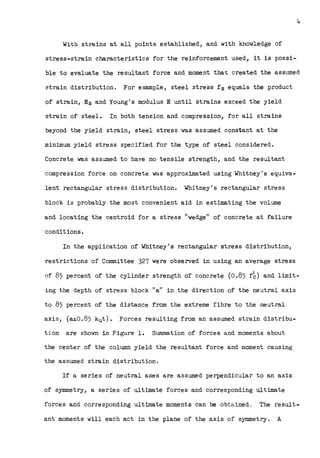
graph of the ultimate axial forces against corresponding ultimate
moments is shown in Figure 2.
I
O
rv/
~
I -
I ......-f
---
-
As fy
Fig, 2. Typical interaction diagram
In Figure 2, the point P0 is simply the axial load at which the
concrete cross section is assumed to crush at all points simultaneously.
As the load Pu is moved slightly away from the center of the cross sec-
tion, the extreme fibers of concrete in the direction of eccentricity
will crush before any other points of the cross section fail. Such
failures are said to be compression failures. Obviously as eccentri-
city e increases, Pu must decrease, and Mu which equals the product of
Pu and e, increases. There is a particular eccentricity for any cross
,.''( (~ ··'!'·-, . ~ .
·section a.net' p~helof b,e:s:ding at which the extreme fibers of concrete
in compression crush at the same instant that the extreme reinforcing
bar reaches its yield strength in tension. The load and moment at such
an eccentricity are called the balanced load and balanced moment at a
balanced eccentricity. As eccentricity is increased beyond the balanc-
ed eccentricity, the yielding of reinforcement precedes crushing of
6
concrete and such failures are considered to be tension failures.
Because ultimate moments may be expressed as an axial load at some
eccentricity from the center of the column, the slope with respect to
the Pu axis of a line from the origin of the interaction diagram to a
point of the diagram is equal to the eccentricity of load at that
point of the diagram. At an infinite eccentricity, Pu is zero and the
pure bending capacity of the cross section is determined. Then, as a
limiting case for resultant Pu in tension, the tension capacity of
reinforcing bars at their yield stress in tension establishes the
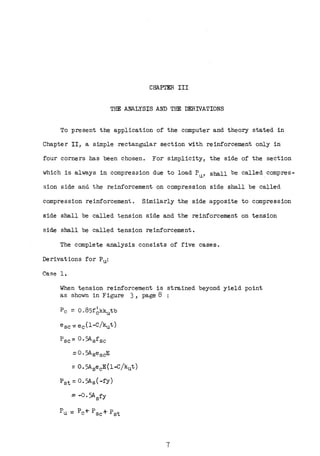
strength of the cross section. The value, Astfy, representing ultimate
capacity of reinforced concrete members in pure tension, is meaningless
for columns, but it may serve as a conveneient point for sketching
interaction diagrams.
CHAPI'ER III
THE ANALYSIS AND THE DERIVATIONS
To present the application of the computer and theory stated in
Chapter II, a simple rectangular section with reinforcement only in
four corners has been chosen. For simplicity, the side of the section
which is always in compression due to load Pu, shall be called compres-
sion side and the reinforcement on compression side shall be called
compression reinforcement. Similarly the side apposite to compression
side shall be called tension side and the reinforcement on tension
side shall be called tension reinforcement.
The complete analysis consists of five cases.
Derivations for Pu:
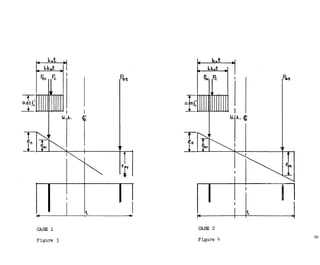
Case 1.
When tension reinforcement is strained beyond yield point
as shown in Figure 3, page 8
Pc= 0,85f6kkutb
esc-= ec(l-C/kut)
=0.5A8 ecE(l-C/kut)
P6 t = O. 5A6 (-fy)
= -0. 5AsfY
7
I
~. A. 4t
~
0,85:rc
~ ...........~..........,,
IJ.)..
I
t I It J
~ I
•' ,~
CASE l CASE 2
Figure 3 Figure 4
0:,
9
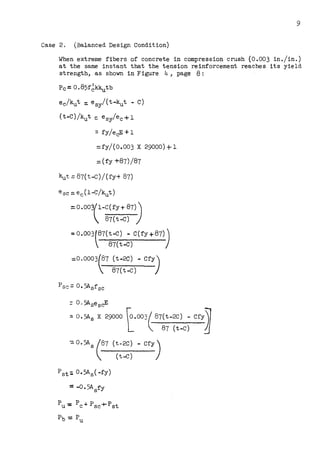
Case 2. (Balanced Design Condition)
When extreme fibers of concrete in compression crush (0.003 in./in.)
at the same instant that the tension reinforcement reaches its yield
strength, as shown in Figure 4, page 8:
Pc= o.85f~k~tb
ec/kut: e 8 y/(t-kut - C)
(t-C)/kut::. esy/ec+l
:: fy/e~ +1
=fy/ (0.003 X 29000) +1
::::: (fy +87) /87
kut =87(t-c)/(fy-t 87)
e 6 c::. ec(l-C/kut)
::0.003(1-C(fy-i- 87))
87(t-C) /
=0.003(87(t-C) - C(fy+87))
 87(t-C)
:0.0003(87 (t-2C) - Cfy)
 87(t-C)
=0. 5AsescE
=O. 5As X 29000 o .003/ 87(t-2C) - Cfyy
L  87 (t-C) J
-::; o.5As (87 (t-2C) - Cfy)·
(t-C)
Pst: 0.5A8 (-fy)
= -0.5A6 fy
pU : p C 4- p SC+ p St
Pb-:= Pu
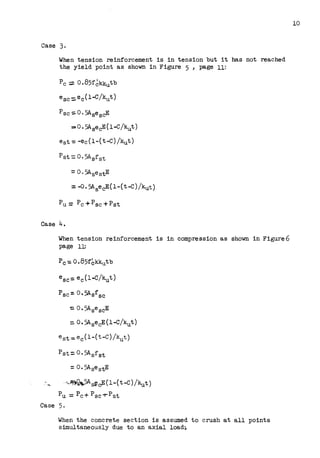
Case 3.
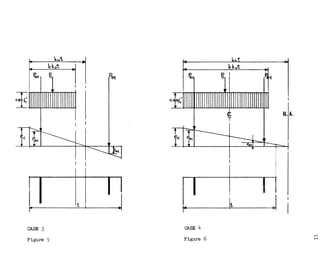
When tension reinforcement is in tension but it bas not reached
the yield point as shown in Figure 5, page 11:
Pc;::. 0.85f~kkutb
e6 c:::.ec (1-C/kut)
Psc::::. 0. 5Ase6 cE
== 0. 5A8ecE(l-C/kut)
e6 t-:: -ec (1-(t-C) /kut)
Case 4.
When tension reinforcement is in compression as shown in Figure6
page 11:
Psc= 0.5Asfsc
:. 0. 5A6 escE
= 0.5A6ecE(l-C/kut)
e 8 t::. ec (1-( t-C) /kllt)
Pst= 0.5A8 f 6 t
=o. 5AsestE
,,,,~g...5As~c;E(l-(t-C) /kut)
Pu= Pc+ Psc-t-Pst
Case 5.
When the concrete section is assumed to crush at all points
simultaneously due to an axial load_
10
pst
~
I:
0
1
_t
I t I J
r
CASE 3
Figure 5
- b,t
-
- kkut
Ps( Pc
' ,
~
....
..
1
-----
es, ~
I eat
.
I
-
CASE 4
Figure 6
~ t
N.
-- ',
--i--
:
;
I
I
I
'
A..
I-'
I-'
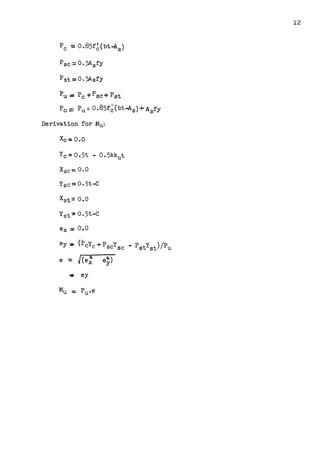
p sc: 0. 5AsfY
Pst:::: O. 5AsfY
pU := pC +p SC T' pst
P0 =Pu=- o.85f~(bt-As)+ AsfY
Derivation for Mu:
Xe-= 0.0
Xsc = 0.0
Ysc== 0.5t-C
Xst = 0.0
Y8 t=0.5t-C
ex= 0.0
ey ~ (PcYc +PscYsc - PstYst)/Pu
e -= J(e; e~)
.,. ey
12
CHAPTER TY
EXAMPLES
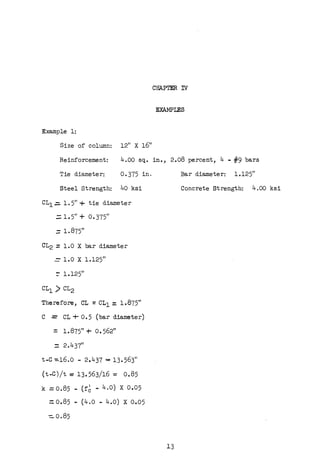
Example 1:
Size of column: 12" X 1611
Reinforcement: 4.00 sq. in., 2.08 percent, 4 - #9 bars
Tie diameter: 0-375 in.
Steel Strength: 40 ksi
CL1.:. 1. 5" + tie diameter
=1.5" + 0.375"
:: 1.875"
CL2::: 1.0 X bar diameter
= 1.0 X l.125"
:- l.125"
CL1 ) CL2
Therefore, CL =CL1 = 1.875"
C =CL+ 0.5 {bar diameter)
= 1.875" + o. 562"
- 2.437"
t-C -=-16.o - 2.437 == 13.563"
{t-C)/t = 13.563/16 = 0.85
k = 0.85 - {f6 - 4.0) X 0.05
::0.85 - (4.o - 4.o) x 0.05
-:::. 0.85
13
Bar diameter: 1.125"
Concrete Strength: 4.00 ksi
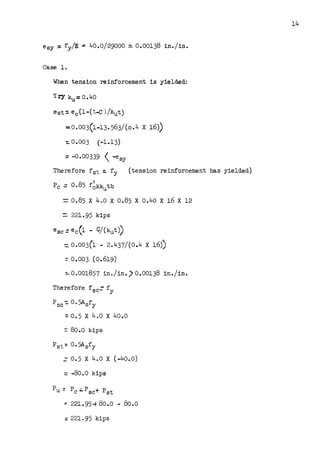
esy = fy/E ~ 40.0/29000 ~ 0.00138 in./in.
Case 1,
When tension reinforcement is yielded:
T.ey ku=0.40
est:. ec(l-(t-C )/kut)
=0.003(1-13.563/(0.4 X 16))
-:..0.003 . (-1.13)
:: -0.00339  -~sy
Therefore fst ~ fy (tension reinforcement has yielded)
I
Pc= 0.85 fckkutb
=0.85 X 4.o X 0.85 X o.40 X 16 X 12
= 221.95 kips
esc: ec(l .. C/(kut))
=.0.003(1 - 2.437/(0.4 X 16))
=0.003 (0.619)
::. 0.001857 in./in.) 0.00138 in./in.
Therefore f sc= fy
Psc-:. O. 5Asfy
: 0. 5 X 4•0 X 40.0
-= 80.0 kips
Pst-= o. 5Asfy
=0.5 X 4.0 X (-40.0)
=-8o.o kips
Pu= Pc-1-Psc+ Pst
r 221.95-+ 80.0 - 8o.o
: 221.95 kips
14
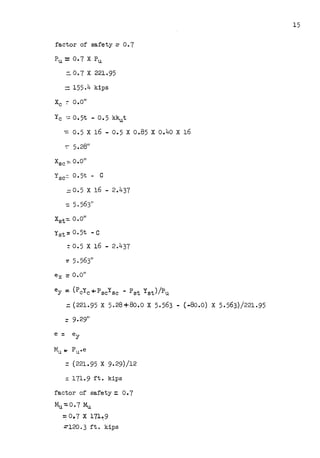
factor of safety= 0.7
::. O. 7 X 221.95
:::. 155.4 kips
y C -..:: 0 • 5t - 0 •5 kkut
-= 0.5 X 16 - 0.5 X 0.85 X 0.40 X 16
-:: 5.2811
Xsc-:::.. O.O"
Ysc= o. 5t -· C
=
0.5 X 16 - 2.437
=5.563"
Xst-::. 0.011
Yst =O. 5t - C
:- 0.5 X 16 - 2.437
:: 5. 563"
ex =o.o"
ey =(PcYc+Pscysc - Pat Yst)/Pu
::: (221.95 X 5.28+80.o X 5.563 - (-8o.o) X 5.563)/221.95
:: 9.29"
=(221.95 X 9.29)/12
: 171.9 ft. kips
factor of safety :: 0.7
Mu-:0.7 Mu
=: 0,7 X 171~9
=-120. 3 ft. kips
15
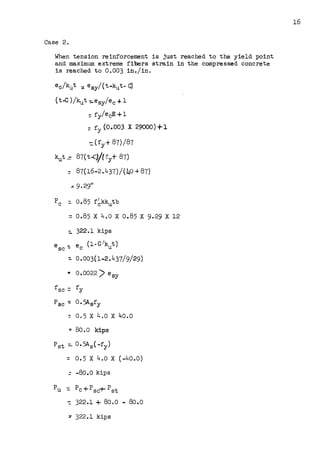
Case 2.
When tension reinforcement is just reached to the yield point
and maximum extreme fibers strain in the compressed concrete
is reached to 0.003 in./in.
e0 /kut :: e6y/(t ..kut- C)
(t-C )/kut -:.esy/ec -4- l
=fy/ecE+l
:: fy (0,.003 X 29000)+1
::(fy+ 87)/87
kut = 87(t-c)/(ry+ 87)
= 87(16-2.437)/(40 +87)
~ 9.29"
pc =. 0.85 f6kkutb
: 0.85 X 4.0 X 0.85 X 9.29 X 12
::. 322.l kips
e _ e (1-C 1kut)
SC - C
~ o.003(1..2.437/9/29)
.. 0.0022) e6y
f SC = fy
p SC -: 0. 5Asfy
: 0.5 X 4.0 X 40.0
.. 80.0 kips
Pst =- 0.5As{-fy)
::: 0. 5 X 4.0 X (-40.0)
=-80.0 kips
Pu =Pc+Psc+Pst
~ 322.1 + 80.0 - 80.0
=322.1 kips
16
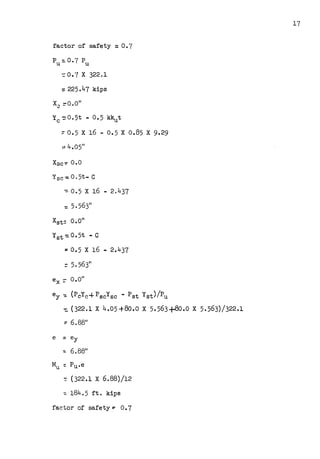
factor of safety= 0.7
P :.0.7 P
u u
:: O. 7 X 322.l
:: 225.47 kips
x... ~o.o"
.....
YC ': 0 •5t - 0•5 k~t
:: 0.5 X 16 - 0.5 X 0.85 X 9,29
~': 4.05"
Xsc-:- 0.0
Y6 c-:.0,5t- C
-=-0.5 X 16 - 2.437
X - O'O"
st- •
Yst :. 0. 5t - C
=0.5 X 16 - 2.437
=5. 563''
ey -::. (PcYc+PscYsc - Pst Yst)/Pu
-:. (322.1 x 4.o5+80.o x 5. 563+so.o x 5•563) / 322.1
:: 6.88"
e = ey
-:. 6.88"
~ ::. Pu.e
~ (322.1 X 6.88)/12
-:::. 184. 5 ft. kips
factor of safety s- 0. 7
17
~ 128.1 ft kips
Case 3,
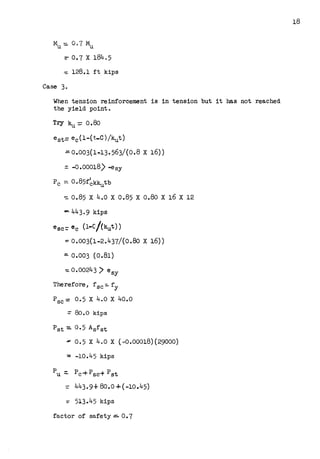
When tension reinforcement is in tension but it has not reached
the yield point.
Try ku =: o.80
est= ec (1-( t-C) /kut)
=- 0.003(1-13. 563/(0.8 X 16))
= -0.00018) -esy
Pc= o.85f~kkutb
-::. 0.85 X 4.o X 0.85 X o.80 X 16 X 12
=- 443.9 kips
e 6 c:: ec (1-c/(kut))
=0.003(1-2.437/(0.80 X 16))
=- 0.003 (0.81)
-::. 0.00243) esy
Therefore, f sc =- fy
Psc : 0. 5 X 4.0 X 40.0
:: 80.0 kips
4 0.5 X 4.0 X (=0.00018)(29000)
= -10.45 kips
-= 443.9+ 80.0 +(-10.45)
= 513.45 kips
factor of safety .::::. 0. 7
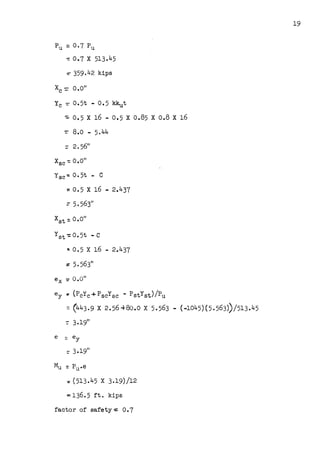
18
Pu = o.7 Pu
-= 0.1 X 513.45
~ 359.42 kips
X - 0 O"
C - •
Yc =0 • 5t • 0 • 5 kkut
~ 0.5 X 16 - 0.5 X 0.85 X 0.8 X 16
-=- 8.o - 5.44
Xsc: O.O"
Ysc -: 0 • 5t • C
=0.5 X 16 - 2.437
: 5.563"
xst:: o.o"
Yst -: 0. 5t - C
... 0.5 X 16 - 2.437
ey r (PcYc+PscYsc - PstYst)/Pu
=(443.9 X 2.56+80.0 X 5.563 - (-1045)(5.~63))/513.45
:: 3.19"
Mu =Pu.e
: (513.45 X 3.19)/12
=-136. 5 ft. kips
factor of safety = 0.1
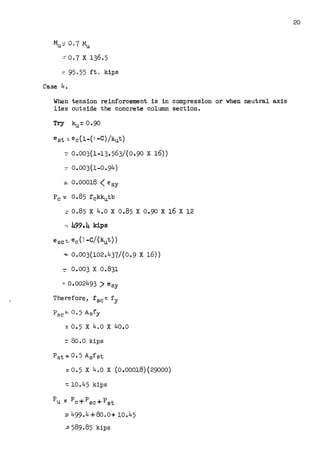
19
Mu::: 0.7 ~
:: O. 7 X 136.5
~ 95,55 ft. kips
Case 4.
When tension reinforcement is in compression or when neutral axis
lies outside the concrete column section.
Try ku:: 0.90
est ::: ec(1-(-1 -C)/kut)
~ 0.003(1-13.563/(0.90 X 16))
:- O•003(1-0•94)
:::. 0.00018 <esy
Pc-= 0.85 fckkutb
: 0.85 X 4.0 X 0.85 X 0.90 X 16 X 12
-~ 499.4 kips
esc-=- ec(J-C/(kut))
~ 0.003(102.437/(0.9 X 16))
::- 0.003 X 0.831
:a 0.002493 ) e 6 y
Therefore, f sc-:: fy
Psc-=- 0.5 A 5 fy
::: 0.5 x 4.o x 4o.o
=80.0 kips
=0.5 X 4.0 X (0.00018)(29000)
-:: 10.45 kips
pU ~ pC +p SC + p st
=499.4+80.o+ 10.45
;. 589.85 kips
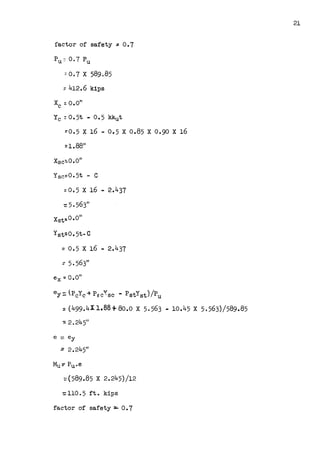
20
factor of safety= 0.7
Pu:: 0.7 Pu
~ O. 7 X 589085
:: 412.6 kips
Yc : 0 • 5t - 0 • 5 kkut
~0.5 X 16 - 0.5 X 0.85 X 0.90 X 16
::1.8811
Xsc:.0.011
Ysc::0.5t - C
:0.5 X 16 - 2.437
=0.5 X 16 - 2.437
: 5. 563"
ex.,. o.o"
ey =. PcYc-+ Pee':sc - PstYst) /Pu
:: (499.411.88+80.o X 5.563 - 10.45 X 5.563)/589.85
e:::: ey
:: 2.245"
~(589.85 X 2.245)/12
=
110. 5 ft. kips
factor of safety=-- 0.7
21
22
~::0.7~
=O. 7 X 110. 5
:::: 77. 3 ft. kips
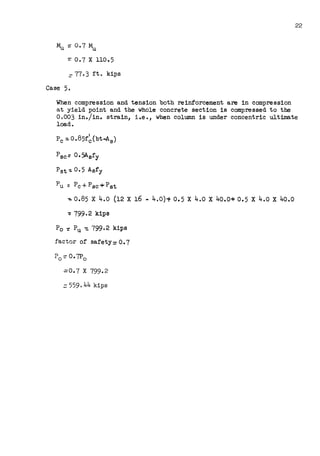
Case 5.
When compression and tension both reinforcement are in compression
at yield point and the whole concrete section is compressed to the
0.003 in./in. strain, i.e., when column is under concentric ultimate
load.
Psc= 0.5Asfy
P5t-.; o. 5 Asfy
Pu= Pc-t-Psc+Pst
~0.85 X 4.o (12 X 16 - 4.o)~ 0.5 X 4.o X 40.0+ 0.5 X 4.o X 40.0
-= 799.2 kips
Po~ Pu~ 799.2 kips
factor of safety: O. 7
.:::0. 7 X 799.2
=559. 44 kips
CHAPTER V
COMPUTER PROGRAMS
The computer is a very useful device in exploring the alternatives
such as finding the strain in the compression and tension reinforcement
of the reinforced concrete section under the set conditions and
alternatives.
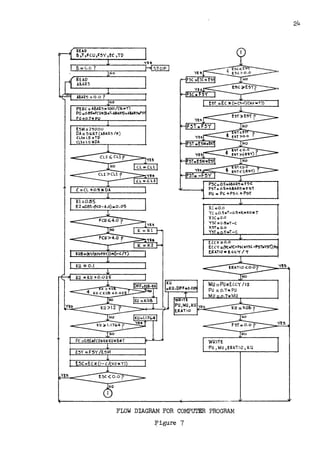
The procedure used in programming for the computer is the same as
the procedure used in the derivation of the formulas in Chapter III.
In programming for the computer all the different cases have been put
together in the form of the equations with the logical and arithmatical
11 IF11 statements in such a way that the computer itself finds the cor-
rect value of the unknowns by exploring into the alternatives set under
some conditions. It finds the value of CL, coefficient k, strain in
compression reinforcement Esc, strain in tension reinforcement Est,
yield strains of reinforcement, the location of neutral axis for the
balanced design condition, and the condition of stresses in the tension
reinforcement with the use of logical and arithmatical 11 IF0
' statements.
The input that is required for the computer is the dimensions of
the column section, ultimate compressive strength of concrete, yield
strength of reinforcement, ultimate strain of concrete, diameter of the
tie, amount of the reinforcement, and the modulus of elasticity of
steel. With this data, and with a set location of neutral axis known,
the computer will calculate all the required values, the value of the
23
llEAD
6,T,FCU,F5Y ,ec ,TD
~=v.O 'I
READ
U,AIZ~
Af.l~'!> =o.o ?
PERC:Al!,l!i!.,.. loo C:&1tT)
PO :0,8S',0FCU!1(&11T-l.&l~)+l&AR~F~
P0:0.7!1
E5M:2~ooo
DA: 5GI.R.T (lSJ..R.'5 /Jt)
CL1:l,5+TD
(l2:l,O~DA
'(£~
P5C:0,Sl'l&l2'5M- f'!>C:
P~T= O,Sttl&lR:,>,1,F!:>T
PU ... PG +Psc. +P-:,T
XC::O.o
Ye :O,S10T-o.St1li:,..IC,U>,l,T
lC5CsO,O
'(5C:O,S,oT-C
X.'5T:o.o
Y~T.: .s..T-c
ECCll, :O.O ,
ECC'I' :(l'C.•VC:+P6C1tV,G-P!>T,..V,T)/P
EIU,TIO • ! c.c.'"( / 'T
WRITE
PU, MU ,EIZA.iO, KU
FLOW DIAGRAM FOR COMPU'.L1ER PROGRAM
~igu.re 7
24
YE~
25
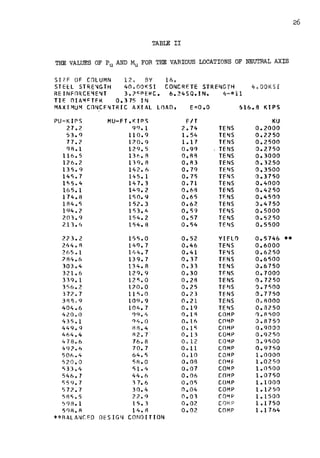
TABLE I
THE VALUES OF Pu AND Mu FOR THE VARIOUS LOCATIONS OF NEUTRAL AXIS
SllE OF C1LU~~ 12. BY 16.
STEEL STRE~~TH 40.00KSI CONC~ETE STRENGTH 4s00KSU
RFI~Fl~CF~~NT 2.0RPERC. 4.00SQ.IN. 4-•g
TIE DIA1f:TER Q.37'5 IN
M~XIMU~ cn~CF~TRIC AXIAL LnAO, E=O.O 559e4 KIPS
PlJ-KIPS
27.7
50.6
70.7
88.6
1or;. 1
116. 5
126.2
135. q
14"5.7
155.4
16"5. l
174.8
184.5
194.2
203.9
2u.n
2?3.3
225.5
255.4
271.5
287.0
302.2
317.0
331.5
l45.6
359.5
373.l
38A.5
399.7
412.7
42'5."i
438.l
450.6
463.0
475.2
487.3
499.3
511.2
"523.0
534.7
546. 3
5,.1. 0
MU-FT.KIPS
71.8
82.4
Ql.3
c.,g.o
LO 5. 7
109.8
112.8
115. 6
118. l
120.3
12?.2
123.9
12 5. 2
126.3
P7.2
127.7
12 8. 0
128.0
121.g
118. 4
114. 9
111.3
107.5
101.7
99.7
95.f>
ql.3
8 ti. 9
82.2
77.4
72.4
67.?
Al.A
56.2
50.4
44.3
3A.O
31.5
24.8
17.8
10.~
10.2
**BALANCED DESIGN CONDITION
E/T
1.95
1.22
0.97
0.84
0.75
0.11
0.67
0.64
0.61
o.sa
0.56
o.53
0.51
0.49
0.47
0.45
0.43
0.43
0. 3f,
0.33
0.30
0.213
0.25
0.2]
0.22
0.20
O.lA
0.11
0.15
0.14
0.13
0.12
0.10
o.oq
o.oa
0.01
0.06
0.05
0 • 0 1
t
o.p2
0.01
0.01
TENS
TENS
TENS
TENS
TENS
TENS
TENS
TENS
TENS
TENS
TENS
TENS
TENS
TENS
TENS
TENS
TENS
YIFLO
TENS
TFNS
TENS
TENS
TENS
TENS
TE"IS
TENS
TENS
COMP
COMP
CC:H-4P
COMP
COMP
COMP
COMP
co~~P
COMP
COMP
COMP
cn~P
CnMP
COll1P
COMP
KU
0.1750
0.2000
0.2250
0.2500
0.2750
0.3000
0.3250
0.3500
0.3750
0.4000
0.4250
0.4500
0.4750
0.5001)
0.5250
0.5500
0.5750
0.5806 ••
0. 6250
0.6500
0.6750
0.1000
0.7250
0.7500
0 .. 7750
0.801)0
J.8250
0.8500
0.8750
o.gooo
0 .9250
o.qsoo
0.9750
1.0000
1. 02 50
1.or;oo
1.0750
1.1000
1.1250
1.1500
l.1750
l.1764
TABLE II
THE VALUES OF Pu AND Mu FOR THE VARIOUS LOCATIONS OF NEUTRAL AXIS
Sl?F OF CnLUMN i2o BY
STEEL STRE~GTH 40o00KS1
REINFnRCE~E~T 3o2~PERC.
H>e
CONCRETE STRE~GTH
6.24SQ.IN. ~-•il
TIE f)I A"1 FT ER O• 3 75 IN
MAXIMUM CONCENTRIC AXIAL LOAD, E=O.O ol6 .. 8 KIPS
PU-KIPS
21.2
53. <J
11.2
. <)8 .1
116. 5
126.2
135.9
14'5. 7
155.4
165.l
174.8
184.'5
194.2
203.9
213.6
223.2
2't4. A
265.l
7 fVt. 6
303.4
32 l. 6
339.l
356.2
372.7
31Jf3.9
404.6
420.0
1t35.l
449.9
464.4
4 78. 6
492.6
506.4
520.0
533.4
546.7
r:;5 9. 7
572.7
5A'i.5
~9B.l
5qa.A
**A Al ANC ED
MU-FT.KIPS
9q.1
ll o. 9
120.9
129.5
13 6. 8
l 39. 8
142.6
14 5. 1
147.3
l4<J.2
1,0. 9
152.3
153.'+
154.2
154.8
155.0
149.7
11,-4. 7
139.7
134.8
129. 9
12 i:;. 0
120.0
115. 0
109.9
104.7
C)Q. "1
q,t. 0
88.4
82. 7
76.8
70. 7
64. '5
5 A. 0
',l.'t
44.6
3 7. 6
30.4
22.9
15,3
14.8
DESIGN CONDITION
f/T
2.74
l. 54
1.17
o.9q
0.88
0.83
0.79
0.75
0.71
0.68
0.65
0,62
0,59
0.57
0.54
0.52
0,46
0.41
0.37
0.33
0.30
0,28
0.25
0,23
0. 211.
0.19
O,lR
0.16
0. l '5
0.13
0.12
0 .11
0.10
0.08
0.01
0.06
0. 0'5
0.04
0.03
0.02
0.02
TENS
TENS
TENS
TENS
TENS
TENS
TENS
TFNS
TENS
TENS
TF.NS
TENS
TENS
TENS
TENS
YIFLO
TENS
TENS
TF.NS
TENS
TENS
TENS
TfNS
TENS
TENS
TENS
COMP
COMP
COMP
COMP
CO~P
COMP
COMP
COMF
COMP
COMP
COMP
COMP
COMP
COMP'
COMP
KU
0.2000
0.2250
0.2500
0.2750
0.3000
0.3250
0,3500
0.3750
0.4000
0.4250
0,4500
0.4750
o.sooo
0. 5 2 50
0 .. 5500
o.5746 **
0.6000
0.6250
0.6500
0.6750
0.1000
0. 72 50
0.7'500
0.7750
0.,8000
0. 8 2 50
().8500
0.8751)
o.qooo
0. q 2 '50
0 .. 91500
0.9750
1.0000
l • 0 2 50
1,0500
1.0750
1.1000
1.1250
1.1500
l.1750
1.1764
26
27
total compression resisted by concrete, strains and stresses in the
reinforcement, total compression and tension resisted by the reinforce-
ment and thus ultima.te load capacity of the section by using the for.mu.~
las given in the program. To find the ultimate moment capacity of the
section for the location of the neutral axis, the computer calculates
the values of the X and Y ordinates of all the forces acting on the
section and then it finds the eccentricity of the ultimate load from
the given formulas and thus the ultimate moment which is the product
of the ultimate load Pu and the eccentricity e.
Fortran DI language has been used in the program for the computer
IBM 7040. The Flow Diagram for the Program is shown on page 24 , and
the symbols used in the program are defined under the List of Symbols.
The tables of the results obtained from the execution of the program
are shown on the page 25, as samples and some of the values of the
ultimate loads and ultimate moments have been compared with the values
of ultimate loads and ultimate moments obtained from the examples done
by hand calculations in Chapter D/.
CHAPrER VI
INTERACTION DIAGRAMS
After the execution of the computer program and the values of
ultimate load and ultimate moment are obtained as shown on page 2~,
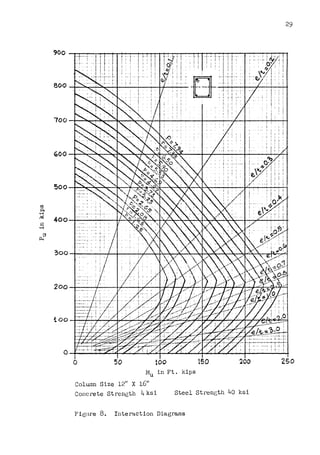
interaction diagrams have been plotted as shown in Figure 8. These
interaction diagrams describe column capacity for bending in one parti-
cular plane •
In evaluating points for an interaction diagram, a cross section
of 12" X 16" has been used. Using a concrete cover of 1.5" plus the
tie diameter, cross sections with bars in four corners have been
studied allowing variations of fc, fy and steel percentage. Cylinder
strengths of 3 ksi and 4 ksi and 5 ksi have been used and yield
s~rengths of 40 ksi and 50 ksi have been used.
Data for interaction diagrams, Pu and Mu values, has been accumu-
lated from the computer for a series of eccentricities as shown in the
table on page 25. To plot the interaction diagram, the computer with
the Plotter is fed with a Fortran program and the data cards with
values of P and M. The interaction diagrams obtained from the
u u
Plotter are .shown in Figure 8. These diagrams are very useful and
a convenient tool for the ultimate strength design of columns. With
the values of Pu and Mu known for a certain colllillll, we can enter
into the interaction diagram and find approximately the required per-
centage of reinforcement for the column. Interaction diagrams indicat-
28
29
.1, Tli .
. : : . : . 1· !I
800 -+-~""""~oe--+-_;_---+--++_..;.....__ g:·-~.....~f:....
j.....1_·-1."'"---'-__;_....__-l-,J
j I J '
. '
900
i
L.
! 1
I
,oo
i ' I
I
Soo
I
•
!I)
P,
•rl
.!icl
400
~
•rl
;:l
fl.. - 1- - -· ~-
300
0 50 100 150 200 2SO
Mu in Ft. kips
Colwnn Size 12" X 1611
Concrete Strength 1+ ksi Steel Strength 40 ksi
F'ie;ure 8. Interaction Diagrams
30
ing "balanced design condition11 , 11 compression zone" and "tension zone"
can be an excellent guide to the design engineer to furnish him all the
information that he needs for the design of the column.
A SEIBCTED BIBLIOGRAPHY
l. Anderson, Decima M. "Computer Programming Fortran IV". New York:
Meredith Publishing Company, 1966.
2. Everard, Noel J., Edward Cohen. Ultimate Strength Design of
Reinforced Concrete Columns. ACI Publication. -
3. Furlong, Richard W. Ultimate Strength £f. S9,uare Columns Under
Biaxially Eccentric Loads. ACI Journal, March, 1961,
pp. 1129-1140.
4, Mattock, A.H., L.B. Kriz, Eivind Hognestad. Rectangular Concrete
Stress Distribution in Ultimate Strength Design. ACI Journal,
February, 1961, pp. 875-928.
5. McCracken, D. Daniel. A Guide to Fortran IV Programming.
6.
New York, John Wiley and Sons, Inc., 1966.
Whitney, Charles s., Edward Cohen.
Design of Reinforced Concrete.
pp. 455:Ii'."90.
Guide for Ultimate Strength
ACI Journal, November, 1956,
7. • "ACI Standard Building Code Requirements for Reinforced
Concrete." ACI Publica~ion, June, 1963•
. 31
vrrA
Brij Raj Kishore
Candid.ate for the Degree of
Master of Architectural Engineering
Report: ULTIMATE STRENGTH DESIGN OF REINFORCED CONCRETE COLUMN BY THE
APPLICATION OF THE COMPUTER
Major Field: Architectural Engineering
Biographical:
Personal Data: Born in Kheri-Lakhimpur, India, July 8, 1938,
the son of Late Mr. Mritunjai Bats.
Education: Graduated from D. A. V. High School in 1953, received
Intermediate Science from Lucknow Christian College in 1955,
completed the Bachelor of Science Part I from Lucknow Univer-
sity in 1956, received the Bachelor of Architecture degree
from University of Roorkee, India, in 1961, completed require-
ments for the Master of Architectural Engineering degree in
July, 1967.
Professional Experience: Four summers made models of buildings
for Roorkee University, India, 1957-1960; worked for four
months on Gujrat Housing Board Design Competition drawings
with Professor G. M. Mand.alia, Head of Architecture School,
Roorkee University, India, 1961; Architectural Assistant,
Department of Architecture and Town Planning, Government of
U. P., India, 1961; Graduate Assistant, School of Architecture,
Oklahoma State University, 1962; Structural Designer, Cronheim
&Weger (since the beginning of this year, Cronheim &Kuo),
Architects and Engineers, Philadelphia, Pennsylvania, 1963-67.

Thesis-1967R-K61u (1).pdf

  • 1.
    ULTIMATE STRENGTH DESIGNOF REINFORCED CONCRETE COLUMN BY THE APPLICATION OF THE COMPUTER By BRIJ RAJ KISHORE Bachelor of Architecture University of Roorkee Roorkee, India Submitted to the faculty of the Graduate College of the Oklahoma State University in partial fulfillment of the requirements for the degree of MASTER OF ARCHITECTURAL ENGINEERING July, 1967
  • 2.
    ULTIMATE STRENGTH DESIGNOF REINFORCED CONCRETE COLUMN BY THE APPLICATION OF THE COMPlY£ER Report Approved: Dean of the Graduate College ii
  • 3.
    ACKNOWLEDGEMENTS I wish toexpress my sincere appreciation and great indebtedness to the following individuals: My teacher and former adviser, Professor Arlyn A. Orr of Orr Bass and Associates, Stillwater, Oklahoma, and my present adviser, Professor Louis O. Bass, for their untiring assistance and valuable guidance. Professor F. Cuthbert Salmon, Head of the School of Architecture, who aided in obtaining a graduate assist- antship, which made it possible for me to continue my graduate studies. Professor R. Bruce Miller, whose assistance made it possible for me to complete this study. Also, J wish to thank very sincerely Mr. Nathan Cronheim, Architect and Engineer, Philadelphia, Pennsylvania, for his assistance in the procurement of the various information and the material on Ultimate Strength Design and for giving me a long vacation to work on this report at the time of heavy pressure of work in the company. In the last, I must thank and admire Mrs. Patty Tillerson whose typing skill is evidenced on the pages of this study. iii
  • 4.
    TABLE OF CONTENTS Chapter I.INTRODUCTION . . • • • • • • . . .. . . . . . . . .. . . II. THEORY AND BASIC ASSUMPTIONS . . . . . . . . . . . . . . . III. THE ANALYSIS AND THE DERIVATIONS . . . .. . . . . . . . . . IV• EXAMPLES . . . . . . . . . . . . . . . . . . . . . . . . . V. CO:MPUTER PROGRAMS . . .. . . . . . . . . . . . .. . .. VI. INTERACTION DIAGRAMS . . . . . . . . . . . .. . . . . . . A SELECTED BIBLIOGRAPHY • • . . . .. . . . . . . . . . . .. . . iv Page 1 3 7 14 23 28 31
  • 5.
    LIST OF TABLES TablePage I. The Values of Pu and Mu for the Various Locations of Neutral Axis • • • • • • • • • • • • • • • • • • • • • • • 25 II. The Values of Pu and Mu for the Various Locations of Neutral Axis • • • • • • • • • • • • • • • • • • • • • • • 26 LIST OF FIGURES Figure Page 1. Strains and Resulting Forces . • . • • • . • • • . • • • • 3 2. Typical Interaction Diagram • . • • . . . . • . • . • 5 3, Strains and Resulting Forces - Case 1 . • . . • • • • . • 8 4. Strains and Resulting Forces - Case 2 • . • • • • . • • . 8 5. Strains and Resulting Forces - Case 3 • . • • • • • . • . 11 6. Strains and Resulting Forces - Case 4 . . . • . • . . . • 11 7. Flow Diagram for Computer Program . • • . • . . • • • . • 24 8. Interaction Diagrams. . . . . . . . . . . . . . . . • 29 V
  • 6.
    USED IN EQUATIONS As b CL, CL1,CL2 ec esc E e est esy fl C fsc fst fy ~ LIST OF SYMBOLS USED IN COMPUTER PROGRAM ABA.RS B BA.RS CL,CL1,CL2 DA EC ESC ESM ECCY EST ESY FCU FSC FST FSY MU Total area of reinforcement ·in column in sq. in. S:ide of column parallel to axis of bending Sizes of bars in column Clear concrete cover on reinforcement in inches. Diameter of bar or diameter of equiva- lent bar in inches (corner bar) Ultimate strain of concrete in in./in. Strain in compression steel (top row) in in./in. Modulus of elasticity of steel in KSI Eccentricity Strain in tension steel (bottom row) in in./in. Strain in steel in in./in. Ultimate compressive strength of con- crete in KSI Stress in compression steel (top row) in KSI Stress in tension steel (bottom row) in KSI Yield strength of re:1nforcement in KSI Moment capacity under combined axial load and bending in ft.-kips vi
  • 7.
    USED IN USEDIN EQUATIONS COMPUTER PROGRAM pc PC p PERC Po PO PSSUM Pst PST p PU u t T TD Total compre~sion in concrete in kips Steel percentage in column Axial load capacity of column when concentrically loaded in kips Total compression in steel (PSC PST) in kips Total tension in tension steel in kips Axial load capacity under combined axial load and bending in kips Side of column perpendicular to axis of bending in in./in. Tie diameter in inches vii
  • 8.
    CHAPTER I INTRODUCTION The methodof designing reinforced concrete columns has followed a zigzag course during the past 50 years. The original idea was based on the ultimate load carrying capacity of the members. When the elastic theory was adopted for the design of flexural members, it seemed consistent to accept the same theory for the design of compression members. As the shortcomings of the elastic theory were gradually recognized, the ultimate strength method was again introduced, although on a limited basis, for the design of members subject to axial loads only. The proposed method of ultimate strength design by the application of the computer is applicable to various combinations of bending and axial load. Ultimate strength of the columns obtained from the propos- ed method of design have been compared with the ultimate strengths of the columns given in the books, Guide~ Ultimate Strength Design of Reinforced Concrete by Charles S. Whitney and Edward Cohen, Ultimate Strength Design of Reinforced Concrete Columns by N. J. Everard and Edward Cohen, and been found in excellent agreement. This study presents the method in its simplest form with the equations of the analysis, the derivations, the computer program based on the latest Fortran rl language, the tables for the practical use for the designing engineer and the interaction diagrams to aid in their 1
  • 9.
    application. The interactiondiagrams themselves demonstrate that their use can be quite a practical tool for a design engineer. 2
  • 10.
    CHAPTER Il THEORY ANDBA.SIC ASSUMPTIONS The ultimate strength of eccentrically loaded columns is governed by the crushing resistance of concrete, assuming that reinforcing bars are ductile enough to deform at constant yield stress until concrete crushes in compression. ACI-ASCE Committee 327, Ultimate Strength Design, recommends a maximum strain of 0.003 at which concrete may be depended on to resist crushing. With a maximum extreme fiber strain of 0.003 in compression, and the accepted assumption that plane. sec- tions before bending remain plane after bending, it is possible for any assumed neutral axis to describe strains at all points of a cross sec- tion. The plane of the deformed section at ultimate load is establish- P.d as that plane passing through the neutral axis (a line of zero strain) and the point of maximum compression strain as shown in Figure 1. Deformed Secti n Unstraine--- Section I I I I .--~~Concrete in Compression Pst Psc St~ains Fig. 1. Strains and F ces Pu resulting forces 3
  • 11.
    4 With strains atall points established, and with knowledge of stress-strain characteristics for the reinforcement used, it is possi- ble to evaluate the resultant force and moment that created the assumed strain distribution. For example, steel stress fs equals the product of strain, Es and Young's modulus E until strains exceed the yield strain of steel. In both tension and compression, for all strains beyond the yield strain, steel stress was assumed constant at the minimum yield stress specified for the type of steel considered. Concrete was assumed to have no tensile strength, and the resultant compression force on concrete was approximated using Whitney's equiva- lent rectangular stress distribution. Whitney's rectangular stress block is probably the most convenient aid in estimating the volume and locating the centroid for a stress "wedge" of concrete at failure · conditions. In the application of Whitney's rectangular stress distribution, restrictions of Committee 327 were observed in using an average stress of 85 percent of the cylinder strength of concrete (0.85 f~} and limit- ing the depth of stress block "a" in the direction of the neutral axis to 85 percent of the distance from the extreme fibre to the neutral axis, (a~o.85 kut). Forces resulting from an assumed strain distribu- tion are shown in Figure 1. Summation of forces and moments about the center of the column yield the resultant force and moment causing the assumed strain distribution. If a series of neutral axes are assumed perpendicular to an axis of symmetry, a series of ultimate forces and corresponding ultimate forces and corresponding ultimate moments can be obtained. The result- ant moments will each act in the plane of the axis of symmetry. A
  • 12.
    5 graph of theultimate axial forces against corresponding ultimate moments is shown in Figure 2. I O rv/ ~ I - I ......-f --- - As fy Fig, 2. Typical interaction diagram In Figure 2, the point P0 is simply the axial load at which the concrete cross section is assumed to crush at all points simultaneously. As the load Pu is moved slightly away from the center of the cross sec- tion, the extreme fibers of concrete in the direction of eccentricity will crush before any other points of the cross section fail. Such failures are said to be compression failures. Obviously as eccentri- city e increases, Pu must decrease, and Mu which equals the product of Pu and e, increases. There is a particular eccentricity for any cross ,.''( (~ ··'!'·-, . ~ . ·section a.net' p~helof b,e:s:ding at which the extreme fibers of concrete in compression crush at the same instant that the extreme reinforcing bar reaches its yield strength in tension. The load and moment at such an eccentricity are called the balanced load and balanced moment at a balanced eccentricity. As eccentricity is increased beyond the balanc- ed eccentricity, the yielding of reinforcement precedes crushing of
  • 13.
    6 concrete and suchfailures are considered to be tension failures. Because ultimate moments may be expressed as an axial load at some eccentricity from the center of the column, the slope with respect to the Pu axis of a line from the origin of the interaction diagram to a point of the diagram is equal to the eccentricity of load at that point of the diagram. At an infinite eccentricity, Pu is zero and the pure bending capacity of the cross section is determined. Then, as a limiting case for resultant Pu in tension, the tension capacity of reinforcing bars at their yield stress in tension establishes the strength of the cross section. The value, Astfy, representing ultimate capacity of reinforced concrete members in pure tension, is meaningless for columns, but it may serve as a conveneient point for sketching interaction diagrams.
  • 14.
    CHAPI'ER III THE ANALYSISAND THE DERIVATIONS To present the application of the computer and theory stated in Chapter II, a simple rectangular section with reinforcement only in four corners has been chosen. For simplicity, the side of the section which is always in compression due to load Pu, shall be called compres- sion side and the reinforcement on compression side shall be called compression reinforcement. Similarly the side apposite to compression side shall be called tension side and the reinforcement on tension side shall be called tension reinforcement. The complete analysis consists of five cases. Derivations for Pu: Case 1. When tension reinforcement is strained beyond yield point as shown in Figure 3, page 8 Pc= 0,85f6kkutb esc-= ec(l-C/kut) =0.5A8 ecE(l-C/kut) P6 t = O. 5A6 (-fy) = -0. 5AsfY 7
  • 15.
    I ~. A. 4t ~ 0,85:rc ~...........~..........,, IJ.).. I t I It J ~ I •' ,~ CASE l CASE 2 Figure 3 Figure 4 0:,
  • 16.
    9 Case 2. (BalancedDesign Condition) When extreme fibers of concrete in compression crush (0.003 in./in.) at the same instant that the tension reinforcement reaches its yield strength, as shown in Figure 4, page 8: Pc= o.85f~k~tb ec/kut: e 8 y/(t-kut - C) (t-C)/kut::. esy/ec+l :: fy/e~ +1 =fy/ (0.003 X 29000) +1 ::::: (fy +87) /87 kut =87(t-c)/(fy-t 87) e 6 c::. ec(l-C/kut) ::0.003(1-C(fy-i- 87)) 87(t-C) / =0.003(87(t-C) - C(fy+87)) 87(t-C) :0.0003(87 (t-2C) - Cfy) 87(t-C) =0. 5AsescE =O. 5As X 29000 o .003/ 87(t-2C) - Cfyy L 87 (t-C) J -::; o.5As (87 (t-2C) - Cfy)· (t-C) Pst: 0.5A8 (-fy) = -0.5A6 fy pU : p C 4- p SC+ p St Pb-:= Pu
  • 17.
    Case 3. When tensionreinforcement is in tension but it bas not reached the yield point as shown in Figure 5, page 11: Pc;::. 0.85f~kkutb e6 c:::.ec (1-C/kut) Psc::::. 0. 5Ase6 cE == 0. 5A8ecE(l-C/kut) e6 t-:: -ec (1-(t-C) /kut) Case 4. When tension reinforcement is in compression as shown in Figure6 page 11: Psc= 0.5Asfsc :. 0. 5A6 escE = 0.5A6ecE(l-C/kut) e 8 t::. ec (1-( t-C) /kllt) Pst= 0.5A8 f 6 t =o. 5AsestE ,,,,~g...5As~c;E(l-(t-C) /kut) Pu= Pc+ Psc-t-Pst Case 5. When the concrete section is assumed to crush at all points simultaneously due to an axial load_ 10
  • 18.
    pst ~ I: 0 1 _t I t IJ r CASE 3 Figure 5 - b,t - - kkut Ps( Pc ' , ~ .... .. 1 ----- es, ~ I eat . I - CASE 4 Figure 6 ~ t N. -- ', --i-- : ; I I I ' A.. I-' I-'
  • 19.
    p sc: 0.5AsfY Pst:::: O. 5AsfY pU := pC +p SC T' pst P0 =Pu=- o.85f~(bt-As)+ AsfY Derivation for Mu: Xe-= 0.0 Xsc = 0.0 Ysc== 0.5t-C Xst = 0.0 Y8 t=0.5t-C ex= 0.0 ey ~ (PcYc +PscYsc - PstYst)/Pu e -= J(e; e~) .,. ey 12
  • 20.
    CHAPTER TY EXAMPLES Example 1: Sizeof column: 12" X 1611 Reinforcement: 4.00 sq. in., 2.08 percent, 4 - #9 bars Tie diameter: 0-375 in. Steel Strength: 40 ksi CL1.:. 1. 5" + tie diameter =1.5" + 0.375" :: 1.875" CL2::: 1.0 X bar diameter = 1.0 X l.125" :- l.125" CL1 ) CL2 Therefore, CL =CL1 = 1.875" C =CL+ 0.5 {bar diameter) = 1.875" + o. 562" - 2.437" t-C -=-16.o - 2.437 == 13.563" {t-C)/t = 13.563/16 = 0.85 k = 0.85 - {f6 - 4.0) X 0.05 ::0.85 - (4.o - 4.o) x 0.05 -:::. 0.85 13 Bar diameter: 1.125" Concrete Strength: 4.00 ksi
  • 21.
    esy = fy/E~ 40.0/29000 ~ 0.00138 in./in. Case 1, When tension reinforcement is yielded: T.ey ku=0.40 est:. ec(l-(t-C )/kut) =0.003(1-13.563/(0.4 X 16)) -:..0.003 . (-1.13) :: -0.00339 -~sy Therefore fst ~ fy (tension reinforcement has yielded) I Pc= 0.85 fckkutb =0.85 X 4.o X 0.85 X o.40 X 16 X 12 = 221.95 kips esc: ec(l .. C/(kut)) =.0.003(1 - 2.437/(0.4 X 16)) =0.003 (0.619) ::. 0.001857 in./in.) 0.00138 in./in. Therefore f sc= fy Psc-:. O. 5Asfy : 0. 5 X 4•0 X 40.0 -= 80.0 kips Pst-= o. 5Asfy =0.5 X 4.0 X (-40.0) =-8o.o kips Pu= Pc-1-Psc+ Pst r 221.95-+ 80.0 - 8o.o : 221.95 kips 14
  • 22.
    factor of safety=0.7 ::. O. 7 X 221.95 :::. 155.4 kips y C -..:: 0 • 5t - 0 •5 kkut -= 0.5 X 16 - 0.5 X 0.85 X 0.40 X 16 -:: 5.2811 Xsc-:::.. O.O" Ysc= o. 5t -· C = 0.5 X 16 - 2.437 =5.563" Xst-::. 0.011 Yst =O. 5t - C :- 0.5 X 16 - 2.437 :: 5. 563" ex =o.o" ey =(PcYc+Pscysc - Pat Yst)/Pu ::: (221.95 X 5.28+80.o X 5.563 - (-8o.o) X 5.563)/221.95 :: 9.29" =(221.95 X 9.29)/12 : 171.9 ft. kips factor of safety :: 0.7 Mu-:0.7 Mu =: 0,7 X 171~9 =-120. 3 ft. kips 15
  • 23.
    Case 2. When tensionreinforcement is just reached to the yield point and maximum extreme fibers strain in the compressed concrete is reached to 0.003 in./in. e0 /kut :: e6y/(t ..kut- C) (t-C )/kut -:.esy/ec -4- l =fy/ecE+l :: fy (0,.003 X 29000)+1 ::(fy+ 87)/87 kut = 87(t-c)/(ry+ 87) = 87(16-2.437)/(40 +87) ~ 9.29" pc =. 0.85 f6kkutb : 0.85 X 4.0 X 0.85 X 9.29 X 12 ::. 322.l kips e _ e (1-C 1kut) SC - C ~ o.003(1..2.437/9/29) .. 0.0022) e6y f SC = fy p SC -: 0. 5Asfy : 0.5 X 4.0 X 40.0 .. 80.0 kips Pst =- 0.5As{-fy) ::: 0. 5 X 4.0 X (-40.0) =-80.0 kips Pu =Pc+Psc+Pst ~ 322.1 + 80.0 - 80.0 =322.1 kips 16
  • 24.
    factor of safety=0.7 P :.0.7 P u u :: O. 7 X 322.l :: 225.47 kips x... ~o.o" ..... YC ': 0 •5t - 0•5 k~t :: 0.5 X 16 - 0.5 X 0.85 X 9,29 ~': 4.05" Xsc-:- 0.0 Y6 c-:.0,5t- C -=-0.5 X 16 - 2.437 X - O'O" st- • Yst :. 0. 5t - C =0.5 X 16 - 2.437 =5. 563'' ey -::. (PcYc+PscYsc - Pst Yst)/Pu -:. (322.1 x 4.o5+80.o x 5. 563+so.o x 5•563) / 322.1 :: 6.88" e = ey -:. 6.88" ~ ::. Pu.e ~ (322.1 X 6.88)/12 -:::. 184. 5 ft. kips factor of safety s- 0. 7 17
  • 25.
    ~ 128.1 ftkips Case 3, When tension reinforcement is in tension but it has not reached the yield point. Try ku =: o.80 est= ec (1-( t-C) /kut) =- 0.003(1-13. 563/(0.8 X 16)) = -0.00018) -esy Pc= o.85f~kkutb -::. 0.85 X 4.o X 0.85 X o.80 X 16 X 12 =- 443.9 kips e 6 c:: ec (1-c/(kut)) =0.003(1-2.437/(0.80 X 16)) =- 0.003 (0.81) -::. 0.00243) esy Therefore, f sc =- fy Psc : 0. 5 X 4.0 X 40.0 :: 80.0 kips 4 0.5 X 4.0 X (=0.00018)(29000) = -10.45 kips -= 443.9+ 80.0 +(-10.45) = 513.45 kips factor of safety .::::. 0. 7 18
  • 26.
    Pu = o.7Pu -= 0.1 X 513.45 ~ 359.42 kips X - 0 O" C - • Yc =0 • 5t • 0 • 5 kkut ~ 0.5 X 16 - 0.5 X 0.85 X 0.8 X 16 -=- 8.o - 5.44 Xsc: O.O" Ysc -: 0 • 5t • C =0.5 X 16 - 2.437 : 5.563" xst:: o.o" Yst -: 0. 5t - C ... 0.5 X 16 - 2.437 ey r (PcYc+PscYsc - PstYst)/Pu =(443.9 X 2.56+80.0 X 5.563 - (-1045)(5.~63))/513.45 :: 3.19" Mu =Pu.e : (513.45 X 3.19)/12 =-136. 5 ft. kips factor of safety = 0.1 19
  • 27.
    Mu::: 0.7 ~ ::O. 7 X 136.5 ~ 95,55 ft. kips Case 4. When tension reinforcement is in compression or when neutral axis lies outside the concrete column section. Try ku:: 0.90 est ::: ec(1-(-1 -C)/kut) ~ 0.003(1-13.563/(0.90 X 16)) :- O•003(1-0•94) :::. 0.00018 <esy Pc-= 0.85 fckkutb : 0.85 X 4.0 X 0.85 X 0.90 X 16 X 12 -~ 499.4 kips esc-=- ec(J-C/(kut)) ~ 0.003(102.437/(0.9 X 16)) ::- 0.003 X 0.831 :a 0.002493 ) e 6 y Therefore, f sc-:: fy Psc-=- 0.5 A 5 fy ::: 0.5 x 4.o x 4o.o =80.0 kips =0.5 X 4.0 X (0.00018)(29000) -:: 10.45 kips pU ~ pC +p SC + p st =499.4+80.o+ 10.45 ;. 589.85 kips 20
  • 28.
    factor of safety=0.7 Pu:: 0.7 Pu ~ O. 7 X 589085 :: 412.6 kips Yc : 0 • 5t - 0 • 5 kkut ~0.5 X 16 - 0.5 X 0.85 X 0.90 X 16 ::1.8811 Xsc:.0.011 Ysc::0.5t - C :0.5 X 16 - 2.437 =0.5 X 16 - 2.437 : 5. 563" ex.,. o.o" ey =. PcYc-+ Pee':sc - PstYst) /Pu :: (499.411.88+80.o X 5.563 - 10.45 X 5.563)/589.85 e:::: ey :: 2.245" ~(589.85 X 2.245)/12 = 110. 5 ft. kips factor of safety=-- 0.7 21
  • 29.
    22 ~::0.7~ =O. 7 X110. 5 :::: 77. 3 ft. kips Case 5. When compression and tension both reinforcement are in compression at yield point and the whole concrete section is compressed to the 0.003 in./in. strain, i.e., when column is under concentric ultimate load. Psc= 0.5Asfy P5t-.; o. 5 Asfy Pu= Pc-t-Psc+Pst ~0.85 X 4.o (12 X 16 - 4.o)~ 0.5 X 4.o X 40.0+ 0.5 X 4.o X 40.0 -= 799.2 kips Po~ Pu~ 799.2 kips factor of safety: O. 7 .:::0. 7 X 799.2 =559. 44 kips
  • 30.
    CHAPTER V COMPUTER PROGRAMS Thecomputer is a very useful device in exploring the alternatives such as finding the strain in the compression and tension reinforcement of the reinforced concrete section under the set conditions and alternatives. The procedure used in programming for the computer is the same as the procedure used in the derivation of the formulas in Chapter III. In programming for the computer all the different cases have been put together in the form of the equations with the logical and arithmatical 11 IF11 statements in such a way that the computer itself finds the cor- rect value of the unknowns by exploring into the alternatives set under some conditions. It finds the value of CL, coefficient k, strain in compression reinforcement Esc, strain in tension reinforcement Est, yield strains of reinforcement, the location of neutral axis for the balanced design condition, and the condition of stresses in the tension reinforcement with the use of logical and arithmatical 11 IF0 ' statements. The input that is required for the computer is the dimensions of the column section, ultimate compressive strength of concrete, yield strength of reinforcement, ultimate strain of concrete, diameter of the tie, amount of the reinforcement, and the modulus of elasticity of steel. With this data, and with a set location of neutral axis known, the computer will calculate all the required values, the value of the 23
  • 31.
    llEAD 6,T,FCU,F5Y ,ec ,TD ~=v.O'I READ U,AIZ~ Af.l~'!> =o.o ? PERC:Al!,l!i!.,.. loo C:&1tT) PO :0,8S',0FCU!1(&11T-l.&l~)+l&AR~F~ P0:0.7!1 E5M:2~ooo DA: 5GI.R.T (lSJ..R.'5 /Jt) CL1:l,5+TD (l2:l,O~DA '(£~ P5C:0,Sl'l&l2'5M- f'!>C: P~T= O,Sttl&lR:,>,1,F!:>T PU ... PG +Psc. +P-:,T XC::O.o Ye :O,S10T-o.St1li:,..IC,U>,l,T lC5CsO,O '(5C:O,S,oT-C X.'5T:o.o Y~T.: .s..T-c ECCll, :O.O , ECC'I' :(l'C.•VC:+P6C1tV,G-P!>T,..V,T)/P EIU,TIO • ! c.c.'"( / 'T WRITE PU, MU ,EIZA.iO, KU FLOW DIAGRAM FOR COMPU'.L1ER PROGRAM ~igu.re 7 24 YE~
  • 32.
    25 TABLE I THE VALUESOF Pu AND Mu FOR THE VARIOUS LOCATIONS OF NEUTRAL AXIS SllE OF C1LU~~ 12. BY 16. STEEL STRE~~TH 40.00KSI CONC~ETE STRENGTH 4s00KSU RFI~Fl~CF~~NT 2.0RPERC. 4.00SQ.IN. 4-•g TIE DIA1f:TER Q.37'5 IN M~XIMU~ cn~CF~TRIC AXIAL LnAO, E=O.O 559e4 KIPS PlJ-KIPS 27.7 50.6 70.7 88.6 1or;. 1 116. 5 126.2 135. q 14"5.7 155.4 16"5. l 174.8 184.5 194.2 203.9 2u.n 2?3.3 225.5 255.4 271.5 287.0 302.2 317.0 331.5 l45.6 359.5 373.l 38A.5 399.7 412.7 42'5."i 438.l 450.6 463.0 475.2 487.3 499.3 511.2 "523.0 534.7 546. 3 5,.1. 0 MU-FT.KIPS 71.8 82.4 Ql.3 c.,g.o LO 5. 7 109.8 112.8 115. 6 118. l 120.3 12?.2 123.9 12 5. 2 126.3 P7.2 127.7 12 8. 0 128.0 121.g 118. 4 114. 9 111.3 107.5 101.7 99.7 95.f> ql.3 8 ti. 9 82.2 77.4 72.4 67.? Al.A 56.2 50.4 44.3 3A.O 31.5 24.8 17.8 10.~ 10.2 **BALANCED DESIGN CONDITION E/T 1.95 1.22 0.97 0.84 0.75 0.11 0.67 0.64 0.61 o.sa 0.56 o.53 0.51 0.49 0.47 0.45 0.43 0.43 0. 3f, 0.33 0.30 0.213 0.25 0.2] 0.22 0.20 O.lA 0.11 0.15 0.14 0.13 0.12 0.10 o.oq o.oa 0.01 0.06 0.05 0 • 0 1 t o.p2 0.01 0.01 TENS TENS TENS TENS TENS TENS TENS TENS TENS TENS TENS TENS TENS TENS TENS TENS TENS YIFLO TENS TFNS TENS TENS TENS TENS TE"IS TENS TENS COMP COMP CC:H-4P COMP COMP COMP COMP co~~P COMP COMP COMP cn~P CnMP COll1P COMP KU 0.1750 0.2000 0.2250 0.2500 0.2750 0.3000 0.3250 0.3500 0.3750 0.4000 0.4250 0.4500 0.4750 0.5001) 0.5250 0.5500 0.5750 0.5806 •• 0. 6250 0.6500 0.6750 0.1000 0.7250 0.7500 0 .. 7750 0.801)0 J.8250 0.8500 0.8750 o.gooo 0 .9250 o.qsoo 0.9750 1.0000 1. 02 50 1.or;oo 1.0750 1.1000 1.1250 1.1500 l.1750 l.1764
  • 33.
    TABLE II THE VALUESOF Pu AND Mu FOR THE VARIOUS LOCATIONS OF NEUTRAL AXIS Sl?F OF CnLUMN i2o BY STEEL STRE~GTH 40o00KS1 REINFnRCE~E~T 3o2~PERC. H>e CONCRETE STRE~GTH 6.24SQ.IN. ~-•il TIE f)I A"1 FT ER O• 3 75 IN MAXIMUM CONCENTRIC AXIAL LOAD, E=O.O ol6 .. 8 KIPS PU-KIPS 21.2 53. <J 11.2 . <)8 .1 116. 5 126.2 135.9 14'5. 7 155.4 165.l 174.8 184.'5 194.2 203.9 213.6 223.2 2't4. A 265.l 7 fVt. 6 303.4 32 l. 6 339.l 356.2 372.7 31Jf3.9 404.6 420.0 1t35.l 449.9 464.4 4 78. 6 492.6 506.4 520.0 533.4 546.7 r:;5 9. 7 572.7 5A'i.5 ~9B.l 5qa.A **A Al ANC ED MU-FT.KIPS 9q.1 ll o. 9 120.9 129.5 13 6. 8 l 39. 8 142.6 14 5. 1 147.3 l4<J.2 1,0. 9 152.3 153.'+ 154.2 154.8 155.0 149.7 11,-4. 7 139.7 134.8 129. 9 12 i:;. 0 120.0 115. 0 109.9 104.7 C)Q. "1 q,t. 0 88.4 82. 7 76.8 70. 7 64. '5 5 A. 0 ',l.'t 44.6 3 7. 6 30.4 22.9 15,3 14.8 DESIGN CONDITION f/T 2.74 l. 54 1.17 o.9q 0.88 0.83 0.79 0.75 0.71 0.68 0.65 0,62 0,59 0.57 0.54 0.52 0,46 0.41 0.37 0.33 0.30 0,28 0.25 0,23 0. 211. 0.19 O,lR 0.16 0. l '5 0.13 0.12 0 .11 0.10 0.08 0.01 0.06 0. 0'5 0.04 0.03 0.02 0.02 TENS TENS TENS TENS TENS TENS TENS TFNS TENS TENS TF.NS TENS TENS TENS TENS YIFLO TENS TENS TF.NS TENS TENS TENS TfNS TENS TENS TENS COMP COMP COMP COMP CO~P COMP COMP COMF COMP COMP COMP COMP COMP COMP' COMP KU 0.2000 0.2250 0.2500 0.2750 0.3000 0.3250 0,3500 0.3750 0.4000 0.4250 0,4500 0.4750 o.sooo 0. 5 2 50 0 .. 5500 o.5746 ** 0.6000 0.6250 0.6500 0.6750 0.1000 0. 72 50 0.7'500 0.7750 0.,8000 0. 8 2 50 ().8500 0.8751) o.qooo 0. q 2 '50 0 .. 91500 0.9750 1.0000 l • 0 2 50 1,0500 1.0750 1.1000 1.1250 1.1500 l.1750 1.1764 26
  • 34.
    27 total compression resistedby concrete, strains and stresses in the reinforcement, total compression and tension resisted by the reinforce- ment and thus ultima.te load capacity of the section by using the for.mu.~ las given in the program. To find the ultimate moment capacity of the section for the location of the neutral axis, the computer calculates the values of the X and Y ordinates of all the forces acting on the section and then it finds the eccentricity of the ultimate load from the given formulas and thus the ultimate moment which is the product of the ultimate load Pu and the eccentricity e. Fortran DI language has been used in the program for the computer IBM 7040. The Flow Diagram for the Program is shown on page 24 , and the symbols used in the program are defined under the List of Symbols. The tables of the results obtained from the execution of the program are shown on the page 25, as samples and some of the values of the ultimate loads and ultimate moments have been compared with the values of ultimate loads and ultimate moments obtained from the examples done by hand calculations in Chapter D/.
  • 35.
    CHAPrER VI INTERACTION DIAGRAMS Afterthe execution of the computer program and the values of ultimate load and ultimate moment are obtained as shown on page 2~, interaction diagrams have been plotted as shown in Figure 8. These interaction diagrams describe column capacity for bending in one parti- cular plane • In evaluating points for an interaction diagram, a cross section of 12" X 16" has been used. Using a concrete cover of 1.5" plus the tie diameter, cross sections with bars in four corners have been studied allowing variations of fc, fy and steel percentage. Cylinder strengths of 3 ksi and 4 ksi and 5 ksi have been used and yield s~rengths of 40 ksi and 50 ksi have been used. Data for interaction diagrams, Pu and Mu values, has been accumu- lated from the computer for a series of eccentricities as shown in the table on page 25. To plot the interaction diagram, the computer with the Plotter is fed with a Fortran program and the data cards with values of P and M. The interaction diagrams obtained from the u u Plotter are .shown in Figure 8. These diagrams are very useful and a convenient tool for the ultimate strength design of columns. With the values of Pu and Mu known for a certain colllillll, we can enter into the interaction diagram and find approximately the required per- centage of reinforcement for the column. Interaction diagrams indicat- 28
  • 36.
    29 .1, Tli . .: : . : . 1· !I 800 -+-~""""~oe--+-_;_---+--++_..;.....__ g:·-~.....~f:.... j.....1_·-1."'"---'-__;_....__-l-,J j I J ' . ' 900 i L. ! 1 I ,oo i ' I I Soo I • !I) P, •rl .!icl 400 ~ •rl ;:l fl.. - 1- - -· ~- 300 0 50 100 150 200 2SO Mu in Ft. kips Colwnn Size 12" X 1611 Concrete Strength 1+ ksi Steel Strength 40 ksi F'ie;ure 8. Interaction Diagrams
  • 37.
    30 ing "balanced designcondition11 , 11 compression zone" and "tension zone" can be an excellent guide to the design engineer to furnish him all the information that he needs for the design of the column.
  • 38.
    A SEIBCTED BIBLIOGRAPHY l.Anderson, Decima M. "Computer Programming Fortran IV". New York: Meredith Publishing Company, 1966. 2. Everard, Noel J., Edward Cohen. Ultimate Strength Design of Reinforced Concrete Columns. ACI Publication. - 3. Furlong, Richard W. Ultimate Strength £f. S9,uare Columns Under Biaxially Eccentric Loads. ACI Journal, March, 1961, pp. 1129-1140. 4, Mattock, A.H., L.B. Kriz, Eivind Hognestad. Rectangular Concrete Stress Distribution in Ultimate Strength Design. ACI Journal, February, 1961, pp. 875-928. 5. McCracken, D. Daniel. A Guide to Fortran IV Programming. 6. New York, John Wiley and Sons, Inc., 1966. Whitney, Charles s., Edward Cohen. Design of Reinforced Concrete. pp. 455:Ii'."90. Guide for Ultimate Strength ACI Journal, November, 1956, 7. • "ACI Standard Building Code Requirements for Reinforced Concrete." ACI Publica~ion, June, 1963• . 31
  • 39.
    vrrA Brij Raj Kishore Candid.atefor the Degree of Master of Architectural Engineering Report: ULTIMATE STRENGTH DESIGN OF REINFORCED CONCRETE COLUMN BY THE APPLICATION OF THE COMPUTER Major Field: Architectural Engineering Biographical: Personal Data: Born in Kheri-Lakhimpur, India, July 8, 1938, the son of Late Mr. Mritunjai Bats. Education: Graduated from D. A. V. High School in 1953, received Intermediate Science from Lucknow Christian College in 1955, completed the Bachelor of Science Part I from Lucknow Univer- sity in 1956, received the Bachelor of Architecture degree from University of Roorkee, India, in 1961, completed require- ments for the Master of Architectural Engineering degree in July, 1967. Professional Experience: Four summers made models of buildings for Roorkee University, India, 1957-1960; worked for four months on Gujrat Housing Board Design Competition drawings with Professor G. M. Mand.alia, Head of Architecture School, Roorkee University, India, 1961; Architectural Assistant, Department of Architecture and Town Planning, Government of U. P., India, 1961; Graduate Assistant, School of Architecture, Oklahoma State University, 1962; Structural Designer, Cronheim &Weger (since the beginning of this year, Cronheim &Kuo), Architects and Engineers, Philadelphia, Pennsylvania, 1963-67.