The VRIO Framework: An Overview
1
 Barney and Hesterly (2006), describe the VRIO framework as a good tool to examine the internal
environment of a firm. They state that VRIO “stands for four questions one must ask about a resource or
capability to determine its competitive potential:

1. The Question of Value: Does a resource enable a firm to exploit an environmental opportunity,
   and/or neutralize an environmental threat?
2. The Question of Rarity: Is a resource currently controlled by only a small number of competing
   firms? [are the resources used to make the products/services or the products/services themselves
   rare?]
3. The Question of Imitability: do firms without a resource face a cost disadvantage in obtaining or
   developing it? [is what a firm is doing difficult to imitate?]
4. The Question of Organization: Are a firm’s other policies and procedures organized to support the
   exploitation of its valuable, rare, and costly-to-imitate resources?”

What types of resources should we evaluate (e.g., what types of resources lead to a competitive
advantage)? 1) tangible resources, 2) intangible resources, 3) organizational capabilities.

                                             Tangible Resources
                                 •Firm’s cash and cash equivalents
         Financial               •Firm’s capacity to raise equity
                                 •Firm’s borrowing capacity
                                 •Modern plant and facilities
         Physical                •Favorable manufacturing locations
                                 •State-of-the-art machinery and equipment
                                 •Trade secrets
      Technological              •Innovative production processes
                                 •Patents, copyrights, trademarks
                                 •Effective strategic planning process
      Organizational
                                 •Excellent evaluation and control systems
                                            Intangible Resources
                             • Experience and capabilities of employees
                             • Trust
          Human
                             • Managerial skills
                             • Firm-specific practices and procedures
                             • Technical and scientific skills
 Innovation and Creativity
                             • Innovation capacities
                             • Brand name
        Reputation           • Reputation with customers for quality and reliability
                             • Reputation with suppliers for fairness, non-zero-sum relationships
                                        Organizational Capabilities
• Firm competences or skills the firm employs to transfer inputs to outputs
• Capacity to combine tangible and intangible resources, using firm processes to attain desired end.
    Examples
    • Outstanding customer service                         • Innovativeness or products and services
    • Excellent product development capabilities           • Ability to hire, motivate, and retain human capital

1
 Note that the material presented in this handout are adapted from J.B. Barney, “Firm resources and sustained
competitive advantage,” Journal of Management 17 (1991), p. 101; R.M. Grand, Comtemporary Strategy Analysis
(Cambridge, England: Blackwell Business, 1991), pp. 100-102; M.A. Hitt, R.D. Ireland, and R.E. Hoskisson,
Strategic Management: Competitiveness and Globalization, 4th ed. (Cincinnati, OH: South-Western College
Publishing, 2001); G.G. Dess, G.T. Lumpkin, M.L. Taylor, A.A. Thompson, and A.J. Strickland III, Strategic
Management (Boston, McGraw Hill, 2004) pp. 141-148.
The VRIO Framework: An Overview

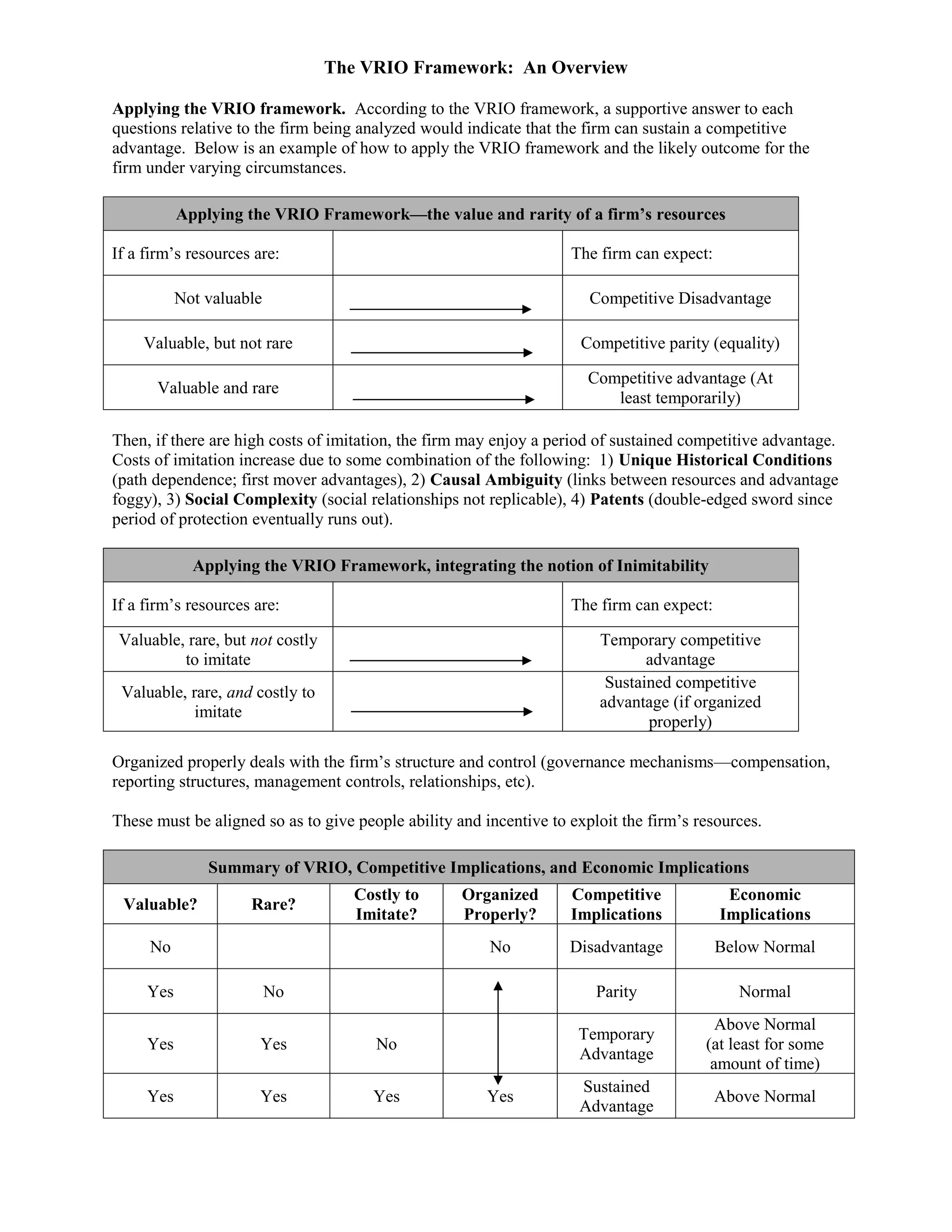
Applying the VRIO framework. According to the VRIO framework, a supportive answer to each
questions relative to the firm being analyzed would indicate that the firm can sustain a competitive
advantage. Below is an example of how to apply the VRIO framework and the likely outcome for the
firm under varying circumstances.

           Applying the VRIO Framework—the value and rarity of a firm’s resources

If a firm’s resources are:                                          The firm can expect:

           Not valuable                                                Competitive Disadvantage

    Valuable, but not rare                                           Competitive parity (equality)

                                                                       Competitive advantage (At
       Valuable and rare
                                                                          least temporarily)

Then, if there are high costs of imitation, the firm may enjoy a period of sustained competitive advantage.
Costs of imitation increase due to some combination of the following: 1) Unique Historical Conditions
(path dependence; first mover advantages), 2) Causal Ambiguity (links between resources and advantage
foggy), 3) Social Complexity (social relationships not replicable), 4) Patents (double-edged sword since
period of protection eventually runs out).

             Applying the VRIO Framework, integrating the notion of Inimitability

If a firm’s resources are:                                          The firm can expect:

 Valuable, rare, but not costly                                         Temporary competitive
          to imitate                                                           advantage
                                                                         Sustained competitive
 Valuable, rare, and costly to
                                                                        advantage (if organized
            imitate
                                                                               properly)

Organized properly deals with the firm’s structure and control (governance mechanisms—compensation,
reporting structures, management controls, relationships, etc).

These must be aligned so as to give people ability and incentive to exploit the firm’s resources.

               Summary of VRIO, Competitive Implications, and Economic Implications
                                     Costly to      Organized       Competitive             Economic
 Valuable?           Rare?
                                     Imitate?       Properly?       Implications           Implications
     No                                                 No          Disadvantage           Below Normal

     Yes                  No                                            Parity               Normal
                                                                                          Above Normal
                                                                     Temporary
     Yes               Yes              No                                              (at least for some
                                                                     Advantage
                                                                                         amount of time)
                                                                     Sustained
     Yes               Yes             Yes             Yes                                 Above Normal
                                                                     Advantage

Applying the vrio framework

  • 1.
    The VRIO Framework:An Overview 1 Barney and Hesterly (2006), describe the VRIO framework as a good tool to examine the internal environment of a firm. They state that VRIO “stands for four questions one must ask about a resource or capability to determine its competitive potential: 1. The Question of Value: Does a resource enable a firm to exploit an environmental opportunity, and/or neutralize an environmental threat? 2. The Question of Rarity: Is a resource currently controlled by only a small number of competing firms? [are the resources used to make the products/services or the products/services themselves rare?] 3. The Question of Imitability: do firms without a resource face a cost disadvantage in obtaining or developing it? [is what a firm is doing difficult to imitate?] 4. The Question of Organization: Are a firm’s other policies and procedures organized to support the exploitation of its valuable, rare, and costly-to-imitate resources?” What types of resources should we evaluate (e.g., what types of resources lead to a competitive advantage)? 1) tangible resources, 2) intangible resources, 3) organizational capabilities. Tangible Resources •Firm’s cash and cash equivalents Financial •Firm’s capacity to raise equity •Firm’s borrowing capacity •Modern plant and facilities Physical •Favorable manufacturing locations •State-of-the-art machinery and equipment •Trade secrets Technological •Innovative production processes •Patents, copyrights, trademarks •Effective strategic planning process Organizational •Excellent evaluation and control systems Intangible Resources • Experience and capabilities of employees • Trust Human • Managerial skills • Firm-specific practices and procedures • Technical and scientific skills Innovation and Creativity • Innovation capacities • Brand name Reputation • Reputation with customers for quality and reliability • Reputation with suppliers for fairness, non-zero-sum relationships Organizational Capabilities • Firm competences or skills the firm employs to transfer inputs to outputs • Capacity to combine tangible and intangible resources, using firm processes to attain desired end. Examples • Outstanding customer service • Innovativeness or products and services • Excellent product development capabilities • Ability to hire, motivate, and retain human capital 1 Note that the material presented in this handout are adapted from J.B. Barney, “Firm resources and sustained competitive advantage,” Journal of Management 17 (1991), p. 101; R.M. Grand, Comtemporary Strategy Analysis (Cambridge, England: Blackwell Business, 1991), pp. 100-102; M.A. Hitt, R.D. Ireland, and R.E. Hoskisson, Strategic Management: Competitiveness and Globalization, 4th ed. (Cincinnati, OH: South-Western College Publishing, 2001); G.G. Dess, G.T. Lumpkin, M.L. Taylor, A.A. Thompson, and A.J. Strickland III, Strategic Management (Boston, McGraw Hill, 2004) pp. 141-148.
  • 2.
  • 3.
    The VRIO Framework:An Overview Applying the VRIO framework. According to the VRIO framework, a supportive answer to each questions relative to the firm being analyzed would indicate that the firm can sustain a competitive advantage. Below is an example of how to apply the VRIO framework and the likely outcome for the firm under varying circumstances. Applying the VRIO Framework—the value and rarity of a firm’s resources If a firm’s resources are: The firm can expect: Not valuable Competitive Disadvantage Valuable, but not rare Competitive parity (equality) Competitive advantage (At Valuable and rare least temporarily) Then, if there are high costs of imitation, the firm may enjoy a period of sustained competitive advantage. Costs of imitation increase due to some combination of the following: 1) Unique Historical Conditions (path dependence; first mover advantages), 2) Causal Ambiguity (links between resources and advantage foggy), 3) Social Complexity (social relationships not replicable), 4) Patents (double-edged sword since period of protection eventually runs out). Applying the VRIO Framework, integrating the notion of Inimitability If a firm’s resources are: The firm can expect: Valuable, rare, but not costly Temporary competitive to imitate advantage Sustained competitive Valuable, rare, and costly to advantage (if organized imitate properly) Organized properly deals with the firm’s structure and control (governance mechanisms—compensation, reporting structures, management controls, relationships, etc). These must be aligned so as to give people ability and incentive to exploit the firm’s resources. Summary of VRIO, Competitive Implications, and Economic Implications Costly to Organized Competitive Economic Valuable? Rare? Imitate? Properly? Implications Implications No No Disadvantage Below Normal Yes No Parity Normal Above Normal Temporary Yes Yes No (at least for some Advantage amount of time) Sustained Yes Yes Yes Yes Above Normal Advantage