Copyright © Wondershare Software
Presented By :
Chetan Jadav
Rasik Jani
CD Deshmukh
The First Indian Governor of
Reserve Bank of India (RBI)
Dr. Raghuram Rajan
Present Governer of
Reserve Bank of India (RBI)
Monetary policy- Meaning
The part of the economic policy
which regulates the level of money
in the economy in order to achieve
certain objectives.
In INDIA,RBI controls the
monetary policy. It is announced
twice a year, through which
RBI,regulate the price stability for
the economy.
1.slack season policy April-September
2.Busy season policy October-March
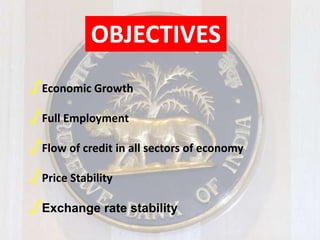
∫Economic Growth
∫Full Employment
∫Flow of credit in all sectors of economy
∫Price Stability
∫Exchange rate stability
OBJECTIVES
Repo
Rate
LOAN TAKER =
BANK
Reverse
Repo Rate
LOAN TAKER =
RBI
Quantitative measures
Bank rate
Open market operations
Cash reserve ratio (CRR)
Statutory liquidity ratio (SLR)
Quantitative measures
Bank rate :
Bank Rate is the rate at which central bank of
the country (in India it is RBI) allows finance to
commercial banks. Bank Rate is a tool, which
central bank uses for short-term purposes.
Open market operations
Quantitative measures
An open market operation (also
known as OMO) is an activity by a
central bank to buy or sell government
bonds on the open market.
Cash reserve ratio (CRR)
Quantitative measures
This serves two
purposes. It ensures
that a portion of bank
deposits is totally risk-
free.
It enables that RBI
control liquidity in the
system, and thereby,
inflation by tying their
hands in lending money
Always stands between
3 % to 15 %
Ω Moral Suasion
Ω Direct Action
Ω Regulation in consumer credit
Qualitative Measures
REGULATION IN CONSUMER CREDIT
Qualitative Measures
most of the consumer durables like T.V.,
Refrigerator, Motorcar, etc. are available on
installment basis.
If there is excess demand for certain consumer
durables leading to their high prices, central bank
can reduce consumer credit by (a) increasing down
payment, and (b) reducing the number of
installments of repayment of such credit.
DIRECT ACTION
Qualitative Measures
This method is adopted when a
commercial bank does not co-operate
the central bank in achieving its desirable
objectives.
MORAL SUASION
Qualitative Measures
To arrest inflationary situation central bank persuades and request the commercial
banks to refrain from giving loans for speculative and non-essential purposes.
On the other hand, to counteract deflation central bank pursuades
the commercial banks to extend credit for different purposes.
IF :
Bank Rate
Bank Rate
CRR/SLR
CRR/SLR
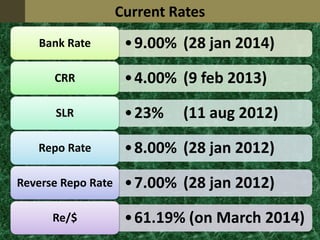
•9.00% (28 jan 2014)Bank Rate
•4.00% (9 feb 2013)CRR
•23% (11 aug 2012)SLR
•8.00% (28 jan 2012)Repo Rate
•7.00% (28 jan 2012)Reverse Repo Rate
•61.19% (on March 2014)Re/$
Current Rates
CASE STUDY
CORRECTIVE STEPS
TAKEN TO STABILIZE
EXCHANGE RATE ( RS ).
Use Indian product.
Avoid meeting in five star hotel.
Avoid foreign tour.
Come out idol money balance in
market .
Monetary policy of RBI

Monetary policy of RBI

  • 1.
    Copyright © WondershareSoftware Presented By : Chetan Jadav Rasik Jani
  • 2.
    CD Deshmukh The FirstIndian Governor of Reserve Bank of India (RBI) Dr. Raghuram Rajan Present Governer of Reserve Bank of India (RBI)
  • 3.
    Monetary policy- Meaning Thepart of the economic policy which regulates the level of money in the economy in order to achieve certain objectives. In INDIA,RBI controls the monetary policy. It is announced twice a year, through which RBI,regulate the price stability for the economy. 1.slack season policy April-September 2.Busy season policy October-March
  • 4.
    ∫Economic Growth ∫Full Employment ∫Flowof credit in all sectors of economy ∫Price Stability ∫Exchange rate stability OBJECTIVES
  • 6.
    Repo Rate LOAN TAKER = BANK Reverse RepoRate LOAN TAKER = RBI Quantitative measures
  • 7.
    Bank rate Open marketoperations Cash reserve ratio (CRR) Statutory liquidity ratio (SLR) Quantitative measures
  • 8.
    Quantitative measures Bank rate: Bank Rate is the rate at which central bank of the country (in India it is RBI) allows finance to commercial banks. Bank Rate is a tool, which central bank uses for short-term purposes.
  • 9.
    Open market operations Quantitativemeasures An open market operation (also known as OMO) is an activity by a central bank to buy or sell government bonds on the open market.
  • 10.
    Cash reserve ratio(CRR) Quantitative measures This serves two purposes. It ensures that a portion of bank deposits is totally risk- free. It enables that RBI control liquidity in the system, and thereby, inflation by tying their hands in lending money Always stands between 3 % to 15 %
  • 11.
    Ω Moral Suasion ΩDirect Action Ω Regulation in consumer credit Qualitative Measures
  • 12.
    REGULATION IN CONSUMERCREDIT Qualitative Measures most of the consumer durables like T.V., Refrigerator, Motorcar, etc. are available on installment basis. If there is excess demand for certain consumer durables leading to their high prices, central bank can reduce consumer credit by (a) increasing down payment, and (b) reducing the number of installments of repayment of such credit.
  • 13.
    DIRECT ACTION Qualitative Measures Thismethod is adopted when a commercial bank does not co-operate the central bank in achieving its desirable objectives.
  • 14.
    MORAL SUASION Qualitative Measures Toarrest inflationary situation central bank persuades and request the commercial banks to refrain from giving loans for speculative and non-essential purposes. On the other hand, to counteract deflation central bank pursuades the commercial banks to extend credit for different purposes.
  • 15.
  • 16.
  • 17.
    •9.00% (28 jan2014)Bank Rate •4.00% (9 feb 2013)CRR •23% (11 aug 2012)SLR •8.00% (28 jan 2012)Repo Rate •7.00% (28 jan 2012)Reverse Repo Rate •61.19% (on March 2014)Re/$ Current Rates
  • 18.
    CASE STUDY CORRECTIVE STEPS TAKENTO STABILIZE EXCHANGE RATE ( RS ).
  • 19.
    Use Indian product. Avoidmeeting in five star hotel. Avoid foreign tour. Come out idol money balance in market .

Editor's Notes

  • #18 Bank Rateminimum rate at which the central bank provides loans to commercial banksAlso called the discount rate. An increase in bank rate results in commercial banks increasing their lending rates. Changes in bank rate alter the cost of creditCurrent Bank rate 6%Cash Reserve Ratio Certain amount of banks deposits in cash with RBI. This % is cash reserve ratioThe current CRR requirement is 5 per cent. Statutory Liquidity RatioBanks to maintain 24 per cent of their demand and time liabilities in government securities and certain approved securities called SLR securitiesBuying/Selling of securities laid to Harshad Mehta scam(1992)Reposecured short-term (usually 15 days) loan by one bank to another against government securities. The borrower sells the securities to the lending bank for cash, with the stipulation that at the end of the borrowing term, it will buy back the securities at a slightly higher price, the difference in price representing the interest.Current Repo Rate is 5%Reverse Reposame repurchase agreement(as Repo) from the buyer's viewpoint seller executing the transaction would describe it as a 'repo', while the buyer would describe it a 'reverse repo‘Current Reverse Repo rate is 3.5%CAR (Capital adequacy Ratio ):ratio of a bank's capital to its riskNational regulators track a bank's CAR to ensure banks can bear reasonable amount of loss and are complying with statutory Capital requirementscapacity of bank meeting the time liabilities and other risk Risk could be credit risk, operational risk, etcBank's capital is the "cushion" for potential losses, which protect the bank's depositors or other lendersBanking regulators in most countries define and monitor CAR to protect depositors, thereby maintaining confidence in the banking systemCAR is similar to leverageOpen Market Operationsimportant instrument of credit controlRBI purchases/sells securities in open market operations. During inflation, RBI sells securities to remove excess money in the market.During Deflation ,RBI purchases securitiesMoney Supply (M3)total volume of money circulating in the economycurrency with the public and demand deposits (current account + savings account) with the public. four concepts of measuring money supply:M1= currency with the public + demand deposits with the public + other deposits with the public. All coins and notes in circulation, and personal current accounts. M2= M1+ personal deposit accounts + government deposits + deposits in currencies other than rupee. M3= fixed deposits + savings deposits with post office + saving banks + M1Most Popular and known as Broad money conceptInflationInflation refers to a persistent rise in pricesToo much money and too few goodsScarcity of goods and many buyers, push the prices up Deflation is Converse of inflation persistent falling of prices. RBI can take two steps to reduce InflationReduce supply of money Increase interest rates