Guided By
Presented By
DR. PREMA RAJAN
RBI ESTABLISHMENT
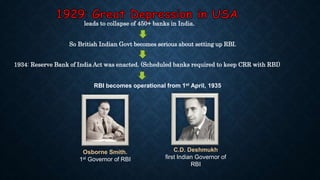
1913 Commercial banks were required to register under the Companies Act, but monitoring
was lax. No CRR, SLR, BASEL Norms.
Royal Commission on Indian Currency
(Hilton Young Commission)
Lord Reading.
(Indian viceroy)
Recommends setting
up a central bank
named 'Reserve
Bank of India’.
1926: Appoints
FRIDAY, OCTOBER, 1929
leads to collapse of 450+ banks in India.
So British Indian Govt becomes serious about setting up RBI.
1934: Reserve Bank of India Act was enacted. (Scheduled banks required to keep CRR with RBI)
RBI becomes operational from 1st April, 1935
C.D. Deshmukh
first Indian Governor of
RBI
Osborne Smith.
1st Governor of RBI
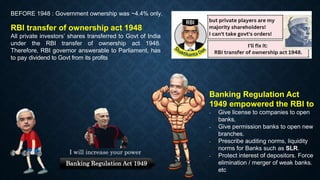
BEFORE 1948 : Government ownership was ~4.4% only.
RBI transfer of ownership act 1948
All private investors’ shares transferred to Govt of India
under the RBI transfer of ownership act 1948.
Therefore, RBI governor answerable to Parliament, has
to pay dividend to Govt from its profits
Banking Regulation Act 1949
I will increase your power
Banking Regulation Act
1949 empowered the RBI to
- Give license to companies to open
banks,
- Give permission banks to open new
branches.
- Prescribe auditing norms, liquidity
norms for Banks such as SLR.
- Protect interest of depositors. Force
elimination / merger of weak banks.
etc
Non-Official Directors Official Directors
 2 Government officials
 10 directors nominated by Government.
 4 directors from RBI’s local boards @West, East, North, South
 RBI Governor
 4 Dy. Governors
Successful candidates’ names sent to Appointments
Committee of the Cabinet headed by the Prime
Minister for final approval.
2016-2018 2018-2021 2021-2024
2013-2016
COMPOSITION OF RBI
They’re selected by Financial sector regulatory
appointment search committee (FSRASC)
headed by the Cabinet Secretary (IAS)
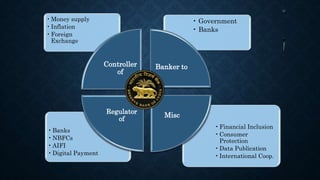
•Financial Inclusion
•Consumer
Protection
•Data Publication
•International Coop.
•Banks
•NBFCs
•AIFI
•Digital Payment
• Government
• Banks
•Money supply
•Inflation
•Foreign
Exchange
Controller
of
Banker to
Misc
Regulator
of
 Monetary Policy is a macroeconomic policy , designed by Central bank of a country, to manage money supply & interest
rates. It helps shaping variables such as
• Inflation
• Consumption
• Savings
• Investment
 So, stable & moderate inflation is good for the economy. So, RBI
tries to keep inflation with 2-6% Consumer Price Index (CPI: All
India) using its bi-monthly monetary policy made by its 6-
member statutory Monetary Policy Committee.
• capital formation
• economic growth
• job creation
• social justice
Milton Friedman: This American economist’s research on monetary policy made this subject more
popular, he also won a Nobel in Economics in this regard (1976).
 Philip Curve: Inflation ↑ = unemployment ↓ (and vice versa).
MONETARY POLICY
GDP
Savings Investmen
t
Unemployment Inflation Inclusive Growth& More
MONETARY POLICY FISCAL POLICY
CRR, SLR, REPO Rate, Bank Rate
MSF, OMO, PSL, ect
Taxation, Subsidy, Public
Expenditure, Disinvestment, PPP
etc..
Helps
in
Fiscal Policy is the set of Govt. decisions regarding taxation, expenditure, subsidies and other financial operations. Using
fiscal policy, Govt influences the savings, investment and consumption in an economy, to accomplish certain national
goals such as income redistribution, socio-economic welfare, economic development and inclusive growth.
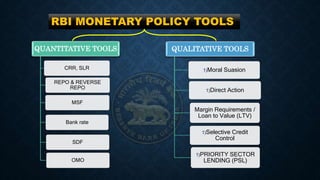
QUANTITATIVE TOOLS
CRR, SLR
REPO & REVERSE
REPO
MSF
Bank rate
SDF
OMO
QUALITATIVE TOOLS
1)Moral Suasion
1)Direct Action
Margin Requirements /
Loan to Value (LTV)
1)Selective Credit
Control
1)PRIORITY SECTOR
LENDING (PSL)
RBI MONETARY POLICY TOOLS
DEFLATION GOVERNMENT SECURITY
INFLATION
Government Reserve Bank
Road Construction Project
1000
Cr
1000 Cr
1000 Cr
8% interest per year
Buy back after 10 years
Repay after 10 years
with 8% interest
DEPOSITS
Mandated under RBI Act, 1934 Banking Regulation Act, 1949
Cash Reserve
Ratio
Statutory Liquid
Ratio
Reverse Repo Rate
Repo Rate
I don’t have much
deposit to give loan to
my client. So Please
give Repo loan .
I need 6.50% Interest
(Repo Rate) & I need
Non SLR quota G-
Sec as collateral
RBI
I have Surplus fund &
people are not taking
loan. So please keep
this money and pay me
interest and give G-Sec
as collateral
I pay 3.35%
interest (Reverse
Repo rate)
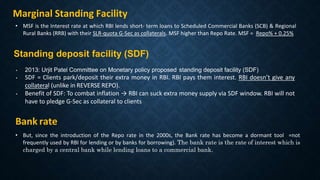
Bank rate
• But, since the introduction of the Repo rate in the 2000s, the Bank rate has become a dormant tool =not
frequently used by RBI for lending or by banks for borrowing). The bank rate is the rate of interest which is
charged by a central bank while lending loans to a commercial bank.
Standing deposit facility (SDF)
• 2013: Urjit Patel Committee on Monetary policy proposed standing deposit facility (SDF)
• SDF = Clients park/deposit their extra money in RBI. RBI pays them interest. RBI doesn’t give any
collateral (unlike in REVERSE REPO).
• Benefit of SDF: To combat inflation → RBI can suck extra money supply via SDF window. RBI will not
have to pledge G-Sec as collateral to clients
• MSF is the Interest rate at which RBI lends short- term loans to Scheduled Commercial Banks (SCB) & Regional
Rural Banks (RRB) with their SLR-quota G-Sec as collaterals. MSF higher than Repo Rate. MSF = Repo% + 0.25%
Marginal Standing Facility
Open Market Operations (OMO):
RBI buys and sells Union & State Govts’ securities to control money supply.
LIQUIDITY
ABSORBED
LIQUIDITY
INJECTED
DURING INFLATION
Buy G-Sec
Money supply ⏫
Money supply ⏬
Sell G-Sec
DURING DEFLATION
5 ₹
50 ₹
150 ₹
Make Loan Expensive
Demand Money with people
Price
Inflation
Controlled
TOOLS
CRR
SLR
REPO
OMO :
Sell G-Sec
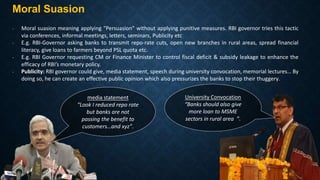
Moral Suasion
- Moral suasion meaning applying “Persuasion” without applying punitive measures. RBI governor tries this tactic
via conferences, informal meetings, letters, seminars, Publicity etc
- E.g. RBI-Governor asking banks to transmit repo-rate cuts, open new branches in rural areas, spread financial
literacy, give loans to farmers beyond PSL quota etc.
- E.g. RBI Governor requesting CM or Finance Minister to control fiscal deficit & subsidy leakage to enhance the
efficacy of RBI’s monetary policy.
- Publicity: RBI governor could give, media statement, speech during university convocation, memorial lectures… By
doing so, he can create an effective public opinion which also pressurizes the banks to stop their thuggery.
media statement
“Look I reduced repo rate
but banks are not
passing the benefit to
customers…and xyz”.
University Convocation
“Banks should also give
more loan to MSME
sectors in rural area ”.
Direct Action
- RBI can punish banks (and even non-banks) for not complying with its directives under RBI Act, Banking Regulation
Act, Payment and Settlement Systems Act, Prevention of Money Laundering Act (PMLA), Foreign Exchange
Management Act (FEMA).
- 2019: RBI ordered the banks to have a “Clawback” provision in their CEO & Top executives’ salaries. E.g. If the CEO
did any scam/fraud, he’ll have to return his previously paid salary / bonus, even if he had retired/left the job
afterwards
Margin Requirements / Loan to Value (LTV)
RBI can mandate Loan to Value (LTV) for a gold-loan, home loan, auto loan or
business loan etc. so a Bank/NBFC can’t lend more than x% of the value of the
collaterals. RBI can change this x% to boost / curb demand
In a negative / restrictive direction In a positive direction
- Credit Rationing System: English (in 18th century) and USSR (till 1990s)–
their central bank will not give more than “X” amount as loan to individual
banks. an individual can’t get more than prescribed amount of loans for
each category (housing, education, business).
- 1960s: Credit Authorization Scheme (CAS) in India: all commercial banks
had to obtain prior approval of the RBI before loaning ₹ 1 crore/> to a
single borrower. 1970s: RBI imposed quantitative ceiling on non-food loans
to boost green revolution, food inflation.
- But such measures failed due to lax monitoring and loopholes
- Consumer credit control e.g. During
deflation / recession, RBI can relax
the down payment / EMI installment
norms for durables like Vehicles, TV,
Fridge etc. to boost consumption and
demand.
- Priority Sector Lending <see below
Selective Credit Control
PRIORITY SECTOR LENDING (PSL)
Banks must give 40% of their loans to various sectors such as agriculture, MSME , exporters, weaker Sections (SC, ST,
Women, PH, Minorities), Student-Education loans (upto Rs.10lakh), Social Infrastructure (schools,drinking water,
sanitation facilities, health care, Renewable Energy Projects etc.
NDTL
(Total Deposits)
CRR
SLR
Loanable
Deposits
PSL
Others
RBI Monetory policy

RBI Monetory policy

  • 1.
  • 3.
    RBI ESTABLISHMENT 1913 Commercialbanks were required to register under the Companies Act, but monitoring was lax. No CRR, SLR, BASEL Norms. Royal Commission on Indian Currency (Hilton Young Commission) Lord Reading. (Indian viceroy) Recommends setting up a central bank named 'Reserve Bank of India’. 1926: Appoints
  • 4.
  • 5.
    leads to collapseof 450+ banks in India. So British Indian Govt becomes serious about setting up RBI. 1934: Reserve Bank of India Act was enacted. (Scheduled banks required to keep CRR with RBI) RBI becomes operational from 1st April, 1935 C.D. Deshmukh first Indian Governor of RBI Osborne Smith. 1st Governor of RBI
  • 6.
    BEFORE 1948 :Government ownership was ~4.4% only. RBI transfer of ownership act 1948 All private investors’ shares transferred to Govt of India under the RBI transfer of ownership act 1948. Therefore, RBI governor answerable to Parliament, has to pay dividend to Govt from its profits Banking Regulation Act 1949 I will increase your power Banking Regulation Act 1949 empowered the RBI to - Give license to companies to open banks, - Give permission banks to open new branches. - Prescribe auditing norms, liquidity norms for Banks such as SLR. - Protect interest of depositors. Force elimination / merger of weak banks. etc
  • 7.
    Non-Official Directors OfficialDirectors  2 Government officials  10 directors nominated by Government.  4 directors from RBI’s local boards @West, East, North, South  RBI Governor  4 Dy. Governors Successful candidates’ names sent to Appointments Committee of the Cabinet headed by the Prime Minister for final approval. 2016-2018 2018-2021 2021-2024 2013-2016 COMPOSITION OF RBI They’re selected by Financial sector regulatory appointment search committee (FSRASC) headed by the Cabinet Secretary (IAS)
  • 8.
    •Financial Inclusion •Consumer Protection •Data Publication •InternationalCoop. •Banks •NBFCs •AIFI •Digital Payment • Government • Banks •Money supply •Inflation •Foreign Exchange Controller of Banker to Misc Regulator of
  • 11.
     Monetary Policyis a macroeconomic policy , designed by Central bank of a country, to manage money supply & interest rates. It helps shaping variables such as • Inflation • Consumption • Savings • Investment  So, stable & moderate inflation is good for the economy. So, RBI tries to keep inflation with 2-6% Consumer Price Index (CPI: All India) using its bi-monthly monetary policy made by its 6- member statutory Monetary Policy Committee. • capital formation • economic growth • job creation • social justice Milton Friedman: This American economist’s research on monetary policy made this subject more popular, he also won a Nobel in Economics in this regard (1976).  Philip Curve: Inflation ↑ = unemployment ↓ (and vice versa). MONETARY POLICY
  • 12.
    GDP Savings Investmen t Unemployment InflationInclusive Growth& More MONETARY POLICY FISCAL POLICY CRR, SLR, REPO Rate, Bank Rate MSF, OMO, PSL, ect Taxation, Subsidy, Public Expenditure, Disinvestment, PPP etc.. Helps in Fiscal Policy is the set of Govt. decisions regarding taxation, expenditure, subsidies and other financial operations. Using fiscal policy, Govt influences the savings, investment and consumption in an economy, to accomplish certain national goals such as income redistribution, socio-economic welfare, economic development and inclusive growth.
  • 13.
    QUANTITATIVE TOOLS CRR, SLR REPO& REVERSE REPO MSF Bank rate SDF OMO QUALITATIVE TOOLS 1)Moral Suasion 1)Direct Action Margin Requirements / Loan to Value (LTV) 1)Selective Credit Control 1)PRIORITY SECTOR LENDING (PSL) RBI MONETARY POLICY TOOLS
  • 14.
  • 15.
    Government Reserve Bank RoadConstruction Project 1000 Cr 1000 Cr 1000 Cr 8% interest per year Buy back after 10 years Repay after 10 years with 8% interest
  • 16.
    DEPOSITS Mandated under RBIAct, 1934 Banking Regulation Act, 1949 Cash Reserve Ratio Statutory Liquid Ratio
  • 17.
    Reverse Repo Rate RepoRate I don’t have much deposit to give loan to my client. So Please give Repo loan . I need 6.50% Interest (Repo Rate) & I need Non SLR quota G- Sec as collateral RBI I have Surplus fund & people are not taking loan. So please keep this money and pay me interest and give G-Sec as collateral I pay 3.35% interest (Reverse Repo rate)
  • 18.
    Bank rate • But,since the introduction of the Repo rate in the 2000s, the Bank rate has become a dormant tool =not frequently used by RBI for lending or by banks for borrowing). The bank rate is the rate of interest which is charged by a central bank while lending loans to a commercial bank. Standing deposit facility (SDF) • 2013: Urjit Patel Committee on Monetary policy proposed standing deposit facility (SDF) • SDF = Clients park/deposit their extra money in RBI. RBI pays them interest. RBI doesn’t give any collateral (unlike in REVERSE REPO). • Benefit of SDF: To combat inflation → RBI can suck extra money supply via SDF window. RBI will not have to pledge G-Sec as collateral to clients • MSF is the Interest rate at which RBI lends short- term loans to Scheduled Commercial Banks (SCB) & Regional Rural Banks (RRB) with their SLR-quota G-Sec as collaterals. MSF higher than Repo Rate. MSF = Repo% + 0.25% Marginal Standing Facility
  • 19.
    Open Market Operations(OMO): RBI buys and sells Union & State Govts’ securities to control money supply. LIQUIDITY ABSORBED LIQUIDITY INJECTED DURING INFLATION Buy G-Sec Money supply ⏫ Money supply ⏬ Sell G-Sec DURING DEFLATION
  • 20.
    5 ₹ 50 ₹ 150₹ Make Loan Expensive Demand Money with people Price Inflation Controlled TOOLS CRR SLR REPO OMO : Sell G-Sec
  • 21.
    Moral Suasion - Moralsuasion meaning applying “Persuasion” without applying punitive measures. RBI governor tries this tactic via conferences, informal meetings, letters, seminars, Publicity etc - E.g. RBI-Governor asking banks to transmit repo-rate cuts, open new branches in rural areas, spread financial literacy, give loans to farmers beyond PSL quota etc. - E.g. RBI Governor requesting CM or Finance Minister to control fiscal deficit & subsidy leakage to enhance the efficacy of RBI’s monetary policy. - Publicity: RBI governor could give, media statement, speech during university convocation, memorial lectures… By doing so, he can create an effective public opinion which also pressurizes the banks to stop their thuggery. media statement “Look I reduced repo rate but banks are not passing the benefit to customers…and xyz”. University Convocation “Banks should also give more loan to MSME sectors in rural area ”.
  • 22.
    Direct Action - RBIcan punish banks (and even non-banks) for not complying with its directives under RBI Act, Banking Regulation Act, Payment and Settlement Systems Act, Prevention of Money Laundering Act (PMLA), Foreign Exchange Management Act (FEMA). - 2019: RBI ordered the banks to have a “Clawback” provision in their CEO & Top executives’ salaries. E.g. If the CEO did any scam/fraud, he’ll have to return his previously paid salary / bonus, even if he had retired/left the job afterwards
  • 23.
    Margin Requirements /Loan to Value (LTV) RBI can mandate Loan to Value (LTV) for a gold-loan, home loan, auto loan or business loan etc. so a Bank/NBFC can’t lend more than x% of the value of the collaterals. RBI can change this x% to boost / curb demand In a negative / restrictive direction In a positive direction - Credit Rationing System: English (in 18th century) and USSR (till 1990s)– their central bank will not give more than “X” amount as loan to individual banks. an individual can’t get more than prescribed amount of loans for each category (housing, education, business). - 1960s: Credit Authorization Scheme (CAS) in India: all commercial banks had to obtain prior approval of the RBI before loaning ₹ 1 crore/> to a single borrower. 1970s: RBI imposed quantitative ceiling on non-food loans to boost green revolution, food inflation. - But such measures failed due to lax monitoring and loopholes - Consumer credit control e.g. During deflation / recession, RBI can relax the down payment / EMI installment norms for durables like Vehicles, TV, Fridge etc. to boost consumption and demand. - Priority Sector Lending <see below Selective Credit Control
  • 24.
    PRIORITY SECTOR LENDING(PSL) Banks must give 40% of their loans to various sectors such as agriculture, MSME , exporters, weaker Sections (SC, ST, Women, PH, Minorities), Student-Education loans (upto Rs.10lakh), Social Infrastructure (schools,drinking water, sanitation facilities, health care, Renewable Energy Projects etc. NDTL (Total Deposits) CRR SLR Loanable Deposits PSL Others